Search Results: "mt"

12 May 2022

Jonathan Dowland: Scalable Computing seminar

title slide
Last week I delivered a seminar for the research group I belong to, Scalable Computing. This was a slightly-expanded version of the presentation I gave at uksystems21. The most substantial change is the addition of a fourth example to describe recent work on optimising for a second non-functional requirement: Bandwidth.

5 May 2022

Reproducible Builds: Reproducible Builds in April 2022

Welcome to the April 2022 report from the Reproducible Builds project! In these reports, we try to summarise the most important things that we have been up to over the past month. If you are interested in contributing to the project, please take a few moments to visit our Contribute page on our website.


News Cory Doctorow published an interesting article this month about the possibility of Undetectable backdoors for machine learning models. Given that machine learning models can provide unpredictably incorrect results, Doctorow recounts that there exists another category of adversarial examples that comprise a gimmicked machine-learning input that, to the human eye, seems totally normal but which causes the ML system to misfire dramatically that permit the possibility of planting undetectable back doors into any machine learning system at training time .
Chris Lamb published two supporter spotlights on our blog: the first about Amateur Radio Digital Communications (ARDC) and the second about the Google Open Source Security Team (GOSST).
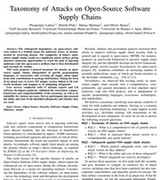
Piergiorgio Ladisa, Henrik Plate, Matias Martinez and Olivier Barais published a new academic paper titled A Taxonomy of Attacks on Open-Source Software Supply Chains (PDF):
This work proposes a general taxonomy for attacks on open-source supply chains, independent of specific programming languages or ecosystems, and covering all supply chain stages from code contributions to package distribution. Taking the form of an attack tree, it covers 107 unique vectors, linked to 94 real-world incidents, and mapped to 33 mitigating safeguards.

Elsewhere in academia, Ly Vu Duc published his PhD thesis. Titled Towards Understanding and Securing the OSS Supply Chain (PDF), Duc s abstract reads as follows:
This dissertation starts from the first link in the software supply chain, developers . Since many developers do not update their vulnerable software libraries, thus exposing the user of their code to security risks. To understand how they choose, manage and update the libraries, packages, and other Open-Source Software (OSS) that become the building blocks of companies completed products consumed by end-users, twenty-five semi-structured interviews were conducted with developers of both large and small-medium enterprises in nine countries. All interviews were transcribed, coded, and analyzed according to applied thematic analysis

Upstream news Filippo Valsorda published an informative blog post recently called How Go Mitigates Supply Chain Attacks outlining the high-level features of the Go ecosystem that helps prevent various supply-chain attacks.
There was new/further activity on a pull request filed against openssl by Sebastian Andrzej Siewior in order to prevent saved CFLAGS (which may contain the -fdebug-prefix-map=<PATH> flag that is used to strip an arbitrary the build path from the debug info if this information remains recorded then the binary is no longer reproducible if the build directory changes.

Events The Linux Foundation s SupplyChainSecurityCon, will take place June 21st 24th 2022, both virtually and in Austin, Texas. Long-time Reproducible Builds and openSUSE contributor Bernhard M. Wiedemann learned that he had his talk accepted, and will speak on Reproducible Builds: Unexpected Benefits and Problems on June 21st.
There will be an in-person Debian Reunion in Hamburg, Germany later this year, taking place from 23 30 May. Although this is a Debian event, there will be some folks from the broader Reproducible Builds community and, of course, everyone is welcome. Please see the event page on the Debian wiki for more information. 41 people have registered so far, and there s approx 10 on-site beds still left.
The minutes and logs from our April 2022 IRC meeting have been published. In case you missed this one, our next IRC meeting will take place on May 31st at 15:00 UTC on #reproducible-builds on the OFTC network.

Debian Roland Clobus wrote another in-depth status update about the status of live Debian images, summarising the current situation that all major desktops build reproducibly with bullseye, bookworm and sid, including the Cinnamon desktop on bookworm and sid, but at a small functionality cost: 14 words will be incorrectly abbreviated . This work incorporated:
  • Reporting an issue about unnecessarily modified timestamps in the daily Debian installer images. [ ]
  • Reporting a bug against the debian-installer: in order to use a suitable kernel version. (#1006800)
  • Reporting a bug in: texlive-binaries regarding the unreproducible content of .fmt files. (#1009196)
  • Adding hacks to make the Cinnamon desktop image reproducible in bookworm and sid. [ ]
  • Added a script to rebuild a live-build ISO image from a given timestamp. [
  • etc.
On our mailing list, Venkata Pyla started a thread on the Debian debconf cache is non-reproducible issue while creating system images and Vagrant Cascadian posted an excellent summary of the reproducibility status of core package sets in Debian and solicited for similar information from other distributions.
Lastly, 122 reviews of Debian packages were added, 44 were updated and 193 were removed this month adding to our extensive knowledge about identified issues. A number of issue types have been updated as well, including timestamps_generated_by_hevea, randomness_in_ocaml_preprocessed_files, build_path_captured_in_emacs_el_file, golang_compiler_captures_build_path_in_binary and build_path_captured_in_assembly_objects,

Other distributions Happy birthday to GNU Guix, which recently turned 10 years old! People have been sharing their stories, in which reproducible builds and bootstrappable builds are a recurring theme as a feature important to its users and developers. The experiences are available on the GNU Guix blog as well as a post on fossandcrafts.org
In openSUSE, Bernhard M. Wiedemann posted his usual monthly reproducible builds status report.

Upstream patches The Reproducible Builds project detects, dissects and attempts to fix as many currently-unreproducible packages as possible. We endeavour to send all of our patches upstream where appropriate. This month, we wrote a large number of such patches, including:

diffoscope diffoscope is our in-depth and content-aware diff utility. Not only can it locate and diagnose reproducibility issues, it can provide human-readable diffs from many kinds of binary formats. This month, Chris Lamb prepared and uploaded versions 210 and 211 to Debian unstable, as well as noticed that some Python .pyc files are reported as data, so we should support .pyc as a fallback filename extension [ ]. In addition, Mattia Rizzolo disabled the Gnumeric tests in Debian as the package is not currently available [ ] and dropped mplayer from Build-Depends too [ ]. In addition, Mattia fixed an issue to ensure that the PATH environment variable is properly modified for all actions, not just when running the comparator. [ ]

Testing framework The Reproducible Builds project runs a significant testing framework at tests.reproducible-builds.org, to check packages and other artifacts for reproducibility. This month, the following changes were made:
  • Daniel Golle:
    • Prefer a different solution to avoid building all OpenWrt packages; skip packages from optional community feeds. [ ]
  • Holger Levsen:
    • Detect Python deprecation warnings in the node health check. [ ]
    • Detect failure to build the Debian Installer. [ ]
  • Mattia Rizzolo:
    • Install disorderfs for building OpenWrt packages. [ ]
  • Paul Spooren (OpenWrt-related changes):
    • Don t build all packages whilst the core packages are not yet reproducible. [ ]
    • Add a missing RUN directive to node_cleanup. [ ]
    • Be less verbose during a toolchain build. [ ]
    • Use disorderfs for rebuilds and update the documentation to match. [ ][ ][ ]
  • Roland Clobus:
    • Publish the last reproducible Debian ISO image. [ ]
    • Use the rebuild.sh script from the live-build package. [ ]
Lastly, node maintenance was also performed by Holger Levsen [ ][ ].
If you are interested in contributing to the Reproducible Builds project, please visit our Contribute page on our website. However, you can get in touch with us via:

3 May 2022

Gunnar Wolf: Using a RPi as a display adapter

Almost ten months ago, I mentioned on this blog I bought an ARM laptop, which is now my main machine while away from home a Lenovo Yoga C630 13Q50. Yes, yes, I am still not as much away from home as I used to before, as this pandemic is still somewhat of a thing, but I do move more. My main activity in the outside world with my laptop is teaching. I teach twice a week, and well, having a display for my slides and for showing examples in the terminal and such is a must. However, as I said back in August, one of the hardware support issues for this machine is:
No HDMI support via the USB-C displayport. While I don t expect
to go to conferences or even classes in the next several months,
I hope this can be fixed before I do. It s a potential important
issue for me.
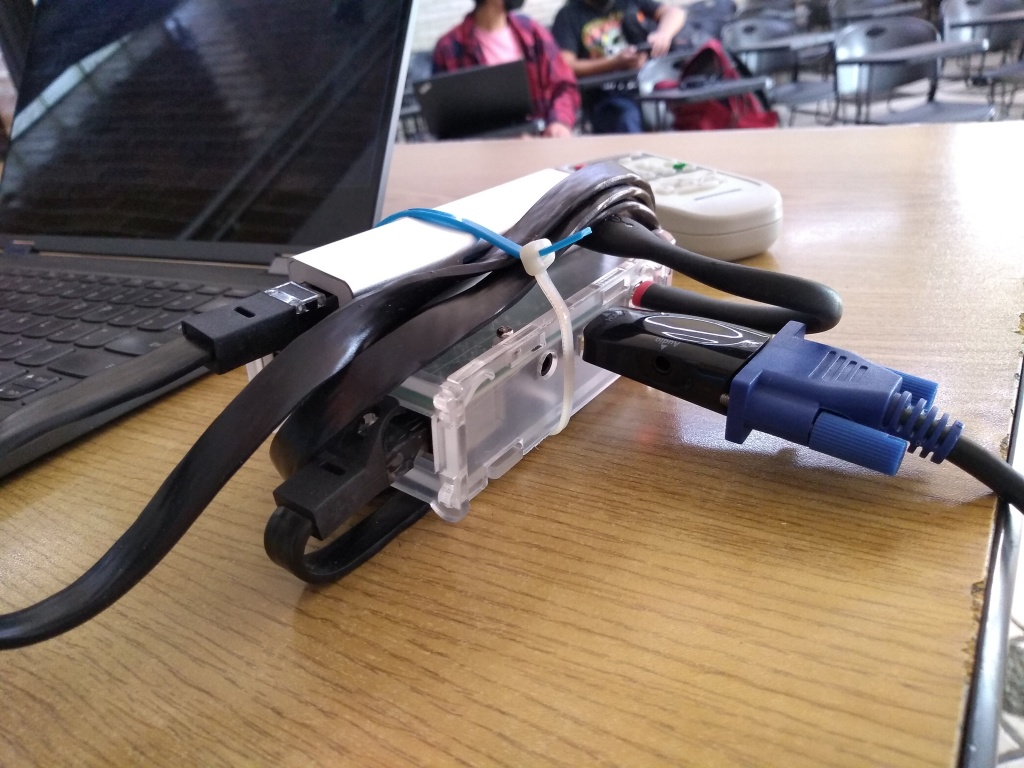
It has sadly not yet been solved While many things have improved since kernel 5.12 (the first I used), the Device Tree does not yet hint at where external video might sit. So, I went to the obvious: Many people carry different kinds of video adaptors I carry a slightly bulky one: A RPi3 For two months already (time flies!), I had an ugly contraption where the RPi3 connected via Ethernet and displayed a VNC client, and my laptop had a VNC server. Oh, but did I mention My laptop works so much better with Wayland than with Xorg that I switched, and am now a happy user of the Sway compositor (a drop-in replacement for the i3 window manager). It is built over WLRoots, which is a great and (relatively) simple project, but will thankfully not carry some of Gnome or KDE s ideas not even those I d rather have. So it took a bit of searching; I was very happy to find WayVNC, a VNC server for wlroot-sbased Wayland compositors. I launched a second Wayland, to be able to have my main session undisturbed and present only a window from it. Only that VNC is slow and laggy, and sometimes awkward. So I kept searching for something better. And something better is, happily, what I was finally able to do! In the laptop, I am using wf-recorder to grab an area of the screen and funnel it into a V4L2 loopback device (which allows it to be used as a camera, solving the main issue with grabbing parts of a Wayland screen):
/usr/bin/wf-recorder -g '0,32 960x540' -t --muxer=v4l2 --codec=rawvideo --pixelformat=yuv420p --file=/dev/video10
(yes, my V4L2Loopback device is set to /dev/video10). You will note I m grabbing a 960 540 rectangle, which is the top of my screen (1920x1080) minus the Waybar. I think I ll increase it to 960 720, as the projector to which I connect the Raspberry has a 4 3 output. After this is sent to /dev/video10, I tell ffmpeg to send it via RTP to the fixed address of the Raspberry:
/usr/bin/ffmpeg -i /dev/video10 -an -f rtp -sdp_file /tmp/video.sdp rtp://10.0.0.100:7000/
Yes, some uglier things happen here. You will note /tmp/video.sdp is created in the laptop itself; this file describes the stream s metadata so it can be used from the client side. I cheated and copied it over to the Raspberry, doing an ugly hardcode along the way:
user@raspi:~ $ cat video.sdp
v=0
o=- 0 0 IN IP4 127.0.0.1
s=No Name
c=IN IP4 10.0.0.100
t=0 0
a=tool:libavformat 58.76.100
m=video 7000 RTP/AVP 96
b=AS:200
a=rtpmap:96 MP4V-ES/90000
a=fmtp:96 profile-level-id=1
People familiar with RTP will scold me: How come I m streaming to the unicast client address? I should do it to an address in the 224.0.0.0 239.0.0.0 range. And it worked, sometimes. I switched over to 10.0.0.100 because it works, basically always Finally, upon bootup, I have configured NoDM to start a session with the user user, and dropped the following in my user s .xsession:
setterm -blank 0 -powersave off -powerdown 0
xset s off
xset -dpms
xset s noblank
mplayer -msglevel all=1 -fs /home/usuario/video.sdp
Anyway, as a result, my students are able to much better follow the pace of my presentation, and I m able to do some tricks better (particularly when it requires quick reaction times, as often happens when dealing with concurrency and such issues). Oh, and of course in case it s of interest to anybody, knowing that SD cards are all but reliable in the long run, I wrote a vmdb2 recipe to build the images. You can grab it here; it requires some local files to be present to be built some are the ones I copied over above, and the other ones are surely of no interest to you (such as my public ssh key or such :-] ) What am I still missing? (read: Can you help me with some ideas? ) Of course, this is a blog post published to brag about my stuff, but also to serve me as persistent memory in case I need to recreate this

29 April 2022

Jonathan Dowland: hyperlinked PDF planner

The Year page The Year page
A day page A day page
I've been having reasonable success with time blocking, a technique I learned from Cal Newport's writings, in particular Deep Work. I'd been doing it on paper for a while, but I wanted to try and move to a digital solution. There's a cottage industry of people making (and selling) various types of diary and planner as PDF files for use on tablets such as the Remarkable. Some of these use PDF hyperlinks to greatly improve navigating around. This one from Clou Media is particularly good, but I found that I wanted something slightly different from what I could find out there, so I decided to build my own. I explored a couple of different approaches for how to do this. One was Latex, and here's one example of a latex-based planner, but I decided against as I spend too much time wrestling with it for my PhD work already. Another approach might have been Pandoc, but as far as I could tell its PDF pipeline went via Latex, so I thought I might as well cut out the middleman. Eventually I stumbled across tools to build PDFs from HTML, via "CSS Paged Media". This appealed, because I've done plenty of HTML generation. print-css.rocks is a fantastic resource to explore the print-specific CSS features. Weasyprint is a fantastic open source tool to convert appropriately-written HTML/CSS into PDF. Finally I wanted to use a templating system to take shortcuts on writing HTML. I settled for embedded Ruby, which is something I haven't touched in over a decade. This was a relatively simple project and I found it surprisingly fun. The results are available on GitHub: https://github.com/jmtd/planner. Right now, you get exactly what I have described. But my next plan is to add support for re-generating a planner, incorporating new information: pulling diary info from iCal, and any annotations made (such as with the Remarkable tablet) on top of the last generation and preserving them on the next.

22 April 2022

Jonathan Dowland: 3D-printed replacement battery cover

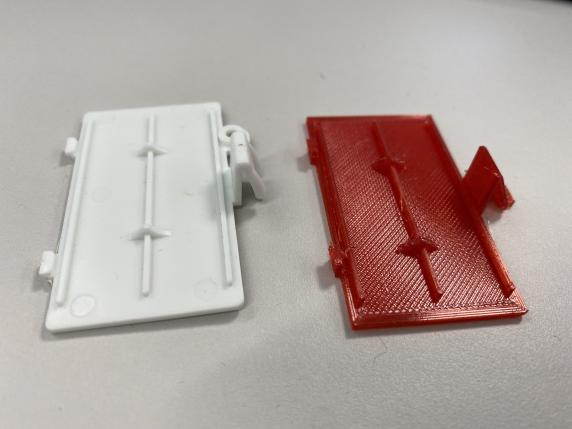
Print next to the original Print next to the original
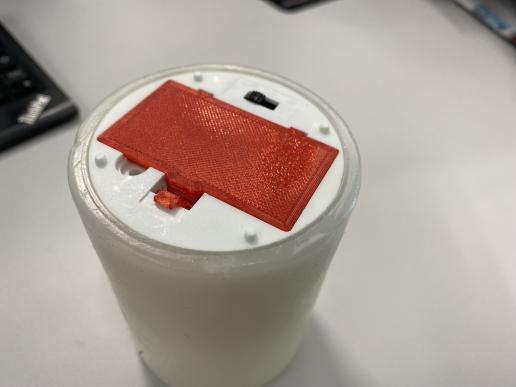
new cover in the light new cover in the light
My first self-designed functional 3D print is a replacement battery cover for a LED fake-candle that my daughter uses as a night-light. I measured the original cover (we have three of the candles) using a newly-purchased micrometer and tried to re-create it in OpenSCAD. I skipped the screw-hole that is for securing the cover as we don't use that. I sliced it using Cura and printed it using PETG on our office 3D printer, a Ender 3. Print time was about an hour. To my amazement, my first take fits snugly! I've uploaded the OpenSCAD source here: batterycover.scad. It's covered under the terms of Creative Commons Attribution-ShareAlike 4.0 International (CC BY-SA 4.0).

16 April 2022

Petter Reinholdtsen: Playing and encoding AV1 in Debian Bullseye

Inspired by the recent news of AV1 hardware encoding support from Intel, I decided to look into the state of AV1 on Linux today. AV1 is a free and open standard as defined by Digistan without any royalty payment requirement, unlike its much used competitor encoding H.264. While looking, I came across an 5 year old question on askubuntu.com which in turn inspired me to check out how things are in Debian Stable regarding AV1. The test file listed in the question (askubuntu_test_aom.mp4) did not exist any more, so I tracked down a different set of test files on av1.webmfiles.org to test them with the various video tools I had installed on my machine. I was happy to discover that AV1 decoding and playback worked with almost every tool I tested:
mediainfo ok
dragonplayer ok
ffmpeg / ffplay ok
gnome-mplayer fail
mplayer ok
mpv ok
parole ok
vlc ok
firefox ok
chromium ok
AV1 encoding is available in Debian Stable from the aom-tools version 1.0.0.errata1-3 package, using the aomenc tool. The encoding using the package in Debian Stable is quite slow, with the frame rate for my 10 second test video at around 0.25 fps. My 10 second video test took 16 minutes and 11 seconds on my test machine. I tested by first running ffmpeg and then aomenc using the recipe provided by the askubuntu recipe above. I had to remove the '--row-mt=1' option, as it was not supported in my 1.0.0 version. The encoding only used a single thread, according to top.
ffmpeg -i some-old-video.ogv -t 10 -pix_fmt yuv420p video.y4m
aomenc --fps=24/1 -u 0 --codec=av1 --target-bitrate=1000 \
  --lag-in-frames=25 --auto-alt-ref=1 -t 24 --cpu-used=8 \
  --tile-columns=2 --tile-rows=2 -o output.webm video.y4m
As version 1.0.0 currently have several unsolved security issues in Debian Stable, and to see if the recent backport provided in Debian is any quicker, I ran apt -t bullseye-backports install aom-tools to fetch the backported version and re-encoded the video using the latest version. This time the '--row-mt=1' option worked, and the encoding was done in 46 seconds with a frame rate of around 5.22 fps. This time it seem to be using all my four cores to encode. Encoding speed is still too low for streaming and real time, which would require frame rates above 25 fps, but might be good enough for offline encoding. I am very happy to see AV1 playback working so well with the default tools in Debian Stable. I hope the encoding situation improve too, allowing even a slow old computer like my 10 year old laptop to be used for encoding. As usual, if you use Bitcoin and want to show your support of my activities, please send Bitcoin donations to my address 15oWEoG9dUPovwmUL9KWAnYRtNJEkP1u1b.

14 April 2022

Jonathan Dowland: hledger

This year I've decided to bite the bullet and properly try out hledger for personal accounting. It seems I need to commit to it properly if I'm to figure out whether it will work for me or not. Up until now I'd been strictly separating my finances into two buckets: family and personal. I'd been using GNUCash for a couple of years for my personal finances, initially to evaluate it for use for the family, but I had not managed to adopt it for that. I set up a new git repository to track the ledger file, as well as a notes.txt "diary" that documents my planning around its structure and how to use it, and a import.txt which documents what account data I have imported and confirmed that the resulting balances match those reported on monthly statements. For this evaluation, I decided to bite the bullet and track both family and personal finances at the same time. I'm still keeping them conceptually very separate. To reflect that I've organised my account names around that: all accounts relating to family are prefixed family:, and likewise personal jon:.1 Some example accounts:
family:assets:shared    - shared bank account
family:dues:jon         - I owe to family
family:expenses:cat     - budget category for the cat
income                  - where money enters this universe
jon:assets:current      - my personal account
jon:dues:peter          - money Peter owes me
jon:expenses:snacks     - budget category for coffees etc
jon:liabilities:amex    - a personal credit card
I decided to make the calendar year a strict cut-over point: my personal opening balances in hledger are determined by what GNUCash reports. It's possible those will change over this year, as adjustments are made to last year's data: but it's easy enough to go in and update the opening balances in hledger to reflect that. Credit cards are a small exception. January's credit card bills are paid in January but cover transactions from mid-December. I import those transactions into hledger to balance the credit card payment. As a consequence, the "spend per month" view of my data is a bit skewed: All the transactions in December should be thought of as in January since that's when they were paid. I need to explore options to fix this. When I had family and personal managed separately, occasionally something would be paid for on the wrong card and end up in the wrong data. The solution I used last year was to keep an account dues:family to which I posted those and periodically I'd settle it with a real-world bank transfer. I've realised that this doesn't work so well when I manage both together: I can't track both dues and expense categorisation with just one posting. The solution I'm using for now is hledger's unbalanced virtual postings: a third posting for the transaction to the budget category, which is not balanced, e.g.:
2022-01-02 ZTL*RELISH
    family:liabilities:creditcard        -3.00
    family:dues:jon                       3.00
    (jon:expenses:snacks)                 3.00
This works, but it completely side-steps double-entry book keeping, which is the whole point of using a double-entry system. There's also no check and balance that the figure I put in the virtual posting ( 3) matches the figure in the rest of the transaction. I'm therefore open to other ideas.

  1. there are a couple of places in hledger where default account names are used, such as the default place that expenses are posted to during CSV imports: expenses:unknown, that obviously don't fit my family/jon: prefix scheme. The solution is to make sure I specify a default posting-to account in all my CSV import rules.

13 April 2022

Jonathan Dowland: Another Green World

Brian Eno's classic 1975 album Another Green World, with the iconic cover crop from Tom Philip's After Raphael. This is a recent pressing. I try to avoid buying new vinyl, and I think I got this as part of a trade-in swap two years ago when I went to get one of my first Covid vaccinations in Newcastle. It was the first time I'd been anywhere near a record shop (which was adjacent to the temporary vaccine centre) in a year or more, and I took the opportunity to bring in some records to sell. I definitely left with fewer records than I went in with, at least
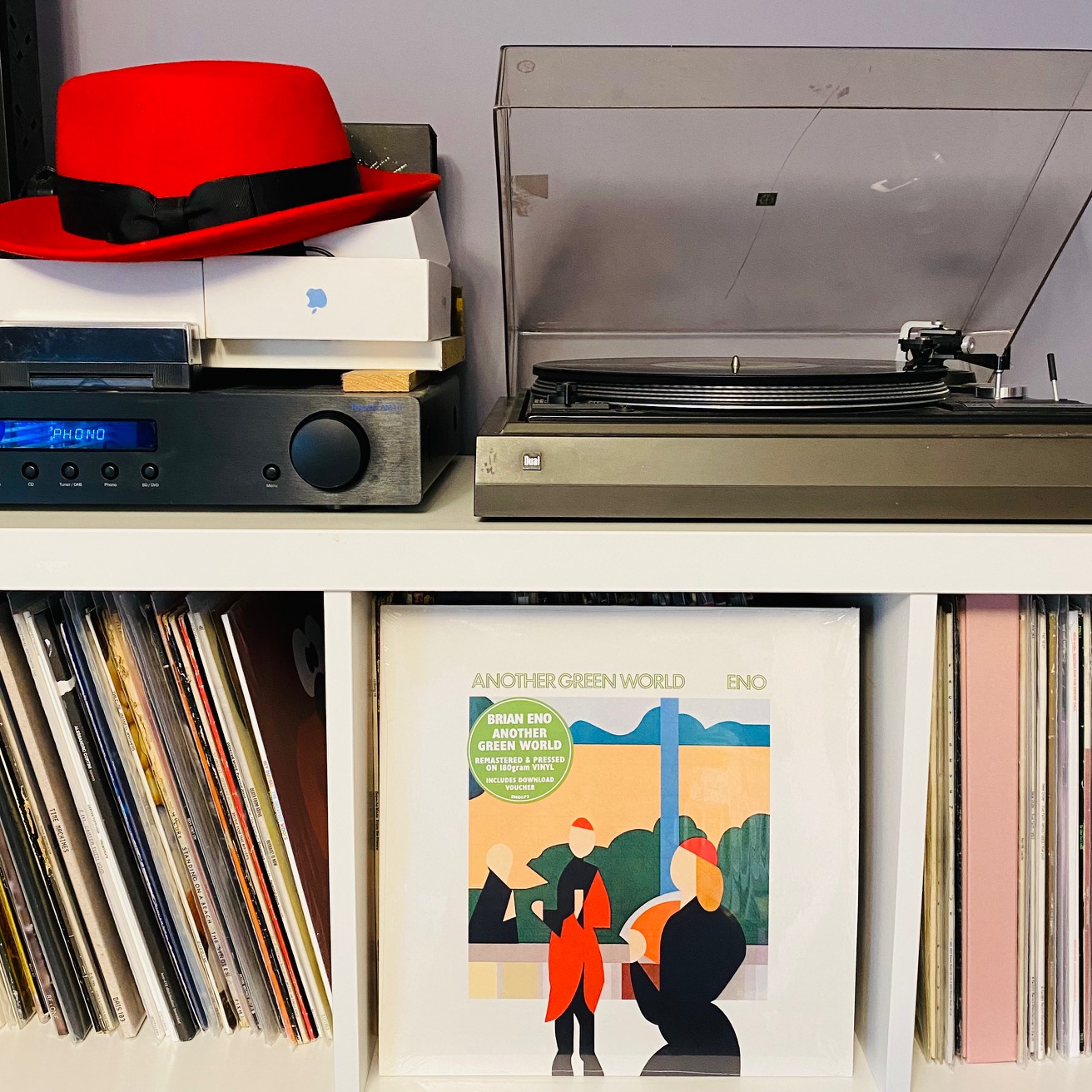
Another Green World on the turntable
What to say about this album? It's a classic, it's weirdly compelling, it dances over the line between engaging your attention and something you can have on in the background. Many of the tracks are quite short relative to the ideas they express: I imagine some remixer could have a lot of fun with it. The Big Ship is perhaps the standout, but I really like the title track, and opener Sky Saw too. It's probably the first album written using using the oblique strategies card system.
Card reading 'You are an Engineer'

11 April 2022

Paul Tagliamonte: k3xec.com/patty: Go bindings to patty

AX.25 is a tough protocol to use on UNIX systems. A lot of the support in Linux, specifically, is pretty hard to use, and tends to be built into the reptilian brain of the kernel. xan built a userland AX.25 stack called patty, for which I have now built some Go bindings on top of. Code needed to create AX.25 Sockets via Go can be found at github.com/k3xec/go-patty, and imported by Go source as k3xec.com/patty.

Overview Clint patty programs (including consumers of this Go library) work by communicating with a userland daemon (pattyd) via a UNIX named socket. That daemon will communicate with a particular radio using a KISS TNC serial device. The Go bindings implement as many standard Go library interfaces as is practical, allowing for the plug and play use of patty (and AX.25) in places where you would expect a network socket (such as TCP) to work, such as Go s http library.

Example
package main
import (
"fmt"
"log"
"net"
"os"
"time"
"k3xec.com/patty"
)
func main()  
callsign := "N0CALL-10"
client, err := patty.Open("patty.sock")
if err != nil  
panic(err)
 
l, err := client.Listen("ax25", callsign)
if err != nil  
panic(err)
 
for  
log.Printf("Listening for requests to %s", l.Addr())
conn, err := l.Accept()
if err != nil  
log.Printf("Error accepting: %s", err)
continue
 
go handle(conn)
 
 
func handle(c net.Conn) error  
defer c.Close()
log.Printf("New connection from %s (local: %s)", c.RemoteAddr(), c.LocalAddr())
fmt.Fprintf(c,  

Hello! This is Paul's experimental %s node. Feel free
to poke around. Let me know if you spot anything funny.

Five pings are to follow!

 , c.LocalAddr())
for i := 0; i < 5; i++  
time.Sleep(time.Second * 5)
fmt.Fprintf(c, "Ping!\n")
 
return nil
 

Jonathan Dowland: With Teeth

Sometimes people ask me which is the best entry point for Nine Inch Nails, and I have trouble answering. I've eventually decided that it's 2005's With Teeth.
Picture of 'With Teeth' playing on my turntable
I've pulled this from my pile of records to sell. Most Nine Inch Nails stuff seems to increase in value over time, and it's got to the stage that some of the ones in my collection are now valuable enough that I'm nervous to play them, which makes them a little pointless. A couple of years ago, a handful of the albums were re-issued (including With Teeth, here, and The Fragile, which hadn't been repressed since 1999). I had a vague plan to sell off my original pressings to someone who would appreciate them more and use the takings to buy the re-issues, but I didn't move fast enough, and now the re-issues are (for the most part) also sought-after.

6 April 2022

Jonathan Dowland: Hope in a Darkened Heart

I first heard Virginia Astley via Lauren Laverne, who played (I think) "With my eyes wide open" from her first album, "From Gardens Where We Feel Secure". Mostly ambient, a conceptual piece about a garden in an English Summer, spanning dawn to dusk. Bucolic ambient, dream pop. It was a little outside my wheel-house, but I loved it, and wanted to find out more. I soon learned that official, physical copies of it were rare and expensive.
'Hope in a Darkened Heart' spinning on my turntable
Some time later I stumbled across her second album "Hope in a Darkened Heart" (which is possibly the most commonly available of her albums) and bought it blind. It's quite different, with a lot more singing, but whatever drew me to Gardens is present. I love this. It was produced by Ryuichi Sakamoto. Only this week I was enormously pleased to discover a chunk of her discography on Bandcamp, including the two aformentioned albums. Highlights from Darkened:

Jonathan Dowland: Stanley Kubrick's A Clockwork Orange (Music From The Soundtrack)

I was reminded of this record over the weekend, as Radio 4's Front Row was discussing the 50th anniversary of Kubrick's movie. To me, the soundtrack has a strange, whimsical, almost cynical element to it (especially with the selection of things like Pomp and Circumstance), but I was familiar with the movie before the soundtrack and it might just be the association that triggers those feelings.
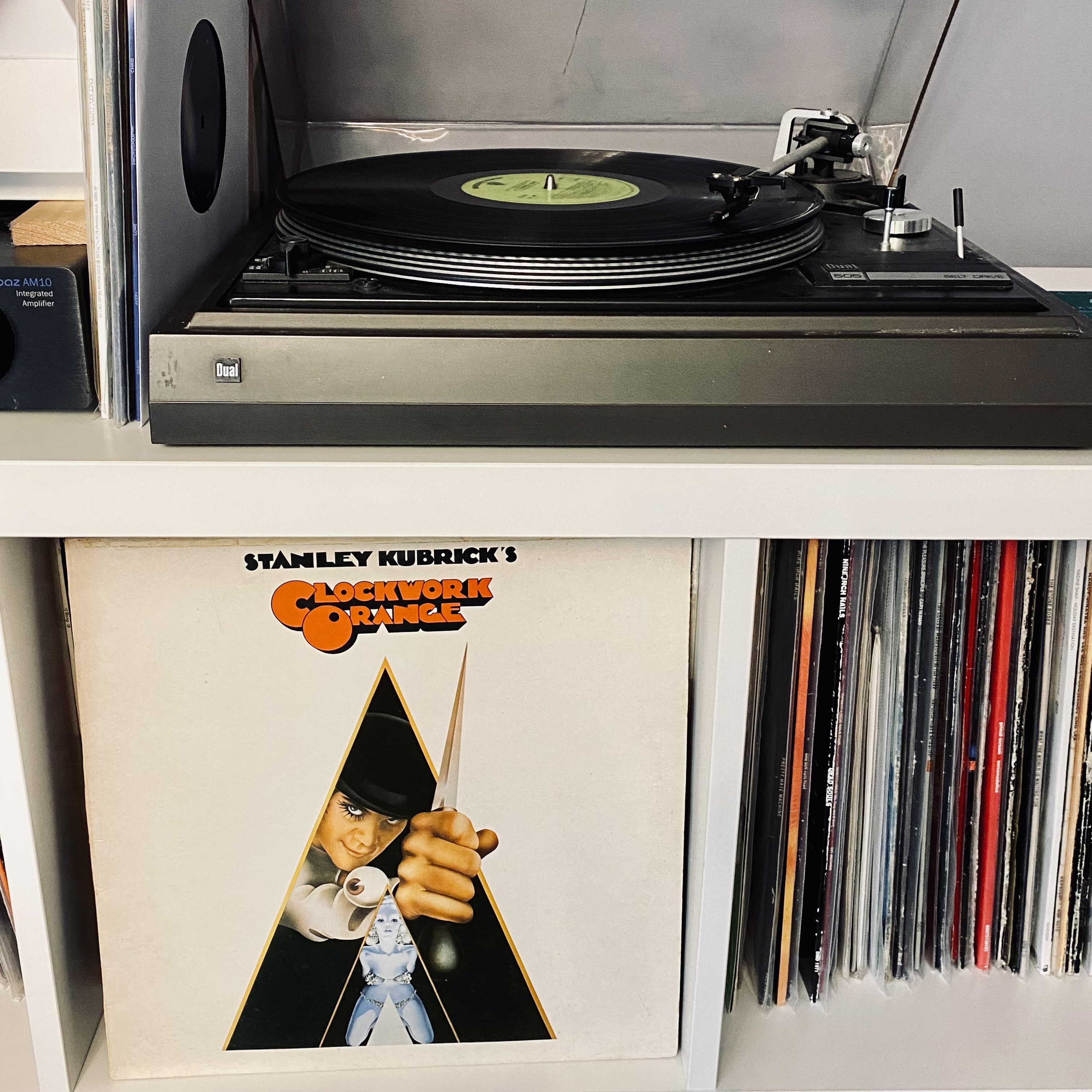
Picture of 'A Clockwork Orange' vinyl record playing on my turntable
I think I picked this up at Tynemouth Market when I lived close by, but I'm not sure. I am sure I didn't pay much for it. Mine is a UK re-pressing from 1971. The abridged (and sped-up) version of William Tell Overture is great for getting the kids to complete a task. Burgess's novel (now 60 years old) has been on my to-read pile for years. in 2018 Electronic Sound magazine featured a cover-mount CD "New Clockwork Music" of music inspired by this soundtrack: It's very good. I must dig that out

Jonathan Dowland: Death from Above

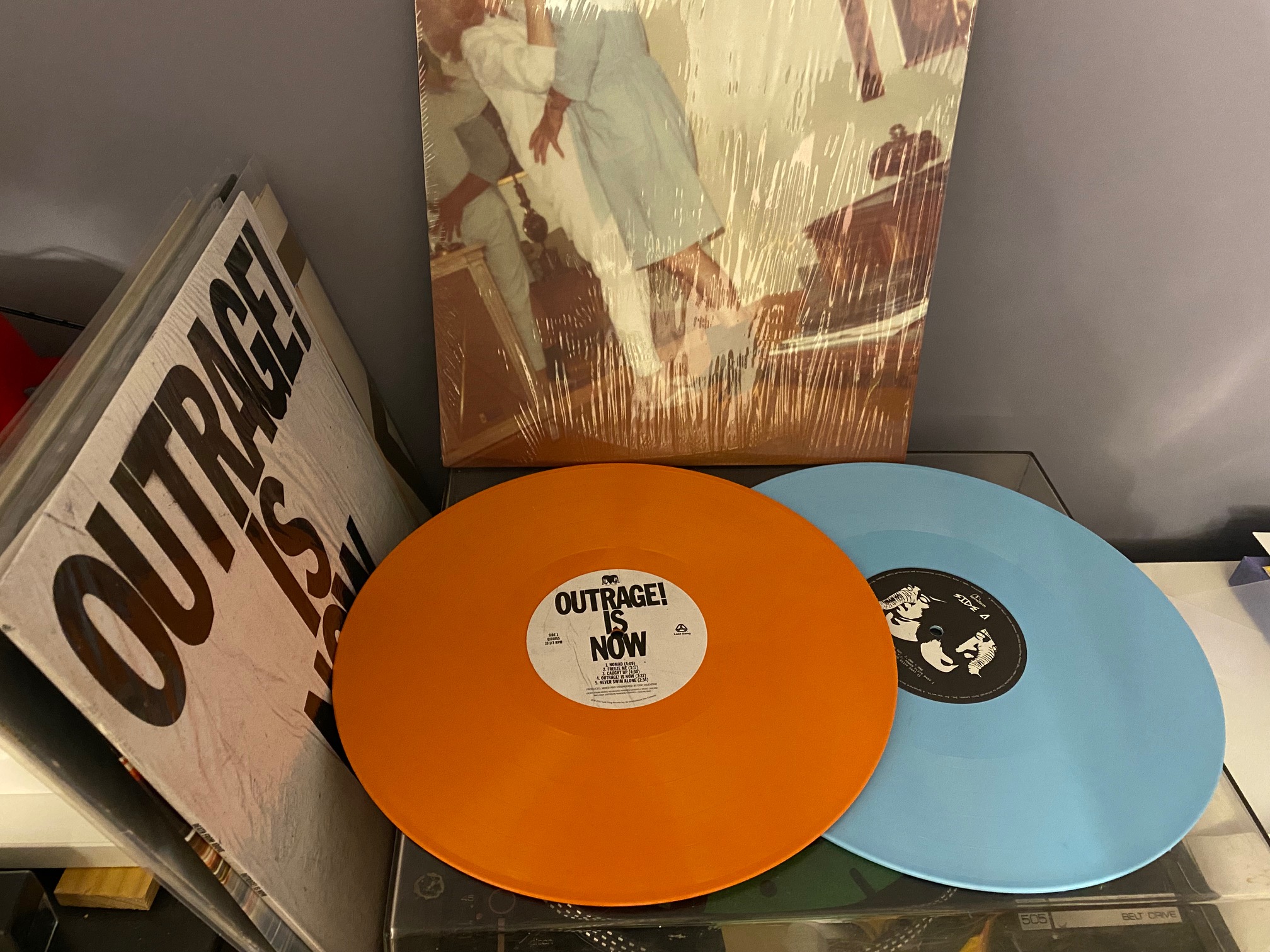
picture of two vinyl records
I received the last two Death From Above albums at Christmas and this weekend managed to give the first (Outrage Is Now) a spin. Pretty colours! They remain one of the best bands to see live. Last time I saw them in a support slot in Newcastle. My friend Rob, a man of few words said I wouldn t want to have to follow them on stage!

Jonathan Dowland: My Life In The Bush Of Ghosts

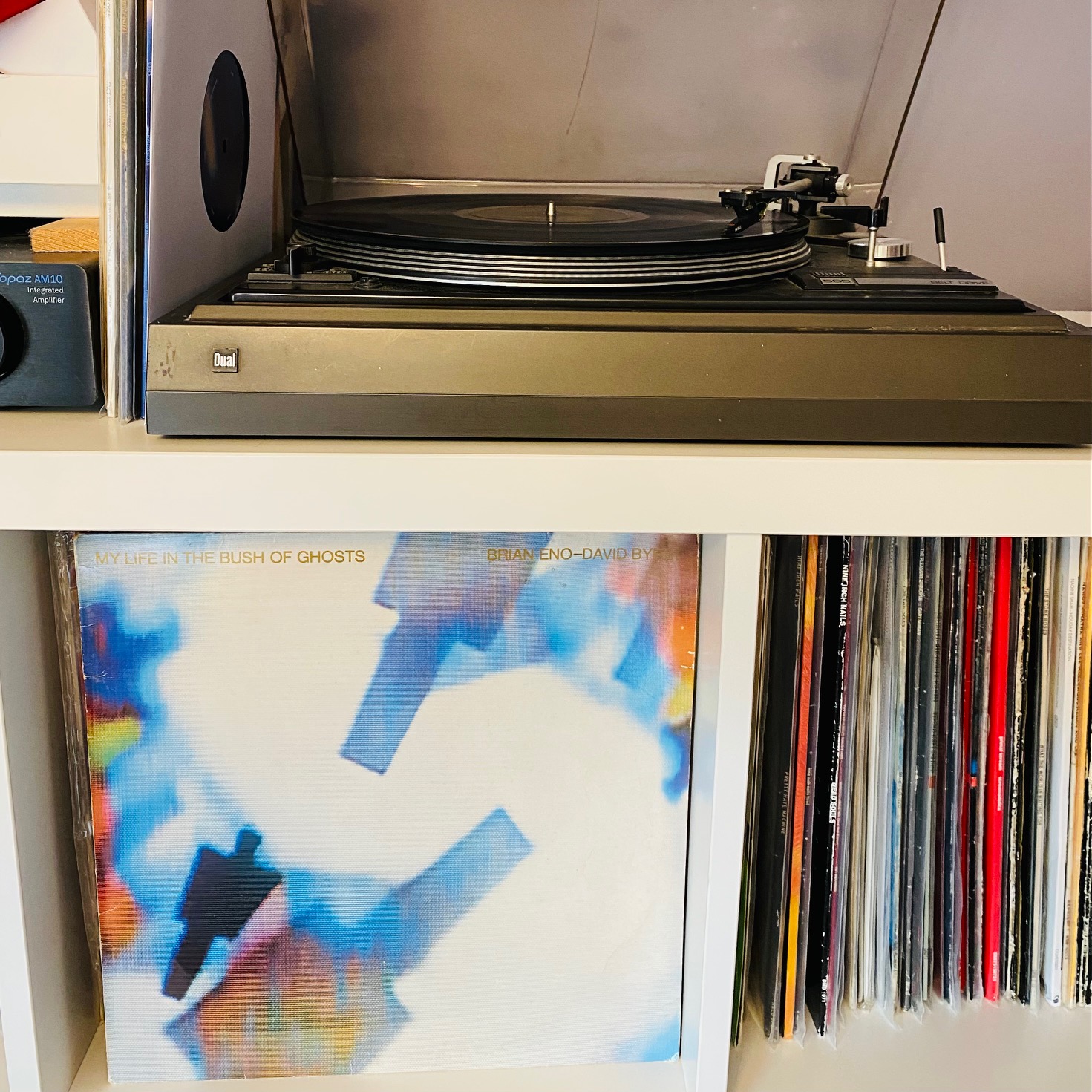
Photo of the record playing next to its cover.
My Life In The Bush Of Ghosts is a weird sound-collage-style album by Brian Eno and David Byrne, released in 1981. It has African-inspired rhythms layered with lots of samples from American radio and TV. It sounds almost like a field recording of the United States was made by wildlife surveyors. My copy is the UK first pressing which includes the track "Qu'ran" which was removed from later editions (and re-instated again later on). I previously wrote about uploading multitracks for two tracks from this album to archive.org.

Jonathan Dowland: One, by Be

picture of a vinyl record
The sublime One, by Be is a pastoral, English summer time instrumental improvisation around field recordings and the theme of the honey bee. A lovely piece to accompany deep thinking. I m reminded of Virginia Astley. Be are associated with Caught by the River, a collective who explore ways of setpping out of daily digital live and embrace, nature, walks, calm, etc.

5 April 2022

Dirk Eddelbuettel: RcppSpdlog 0.0.8 on CRAN: Upstream Update

A new version 0.0.8 of RcppSpdlog is now on CRAN. RcppSpdlog bundles spdlog, a wonderful header-only C++ logging library with all the bells and whistles you would want that was written by Gabi Melman, and also includes fmt by Victor Zverovich. This release brings a new upstream release 1.10.0 of spdlog. The (minimal) NEWS entry for this release follows.

Changes in RcppSpdlog version 0.0.8 (2022-04-04)
  • Upgraded to upstream releases spdlog 1.10.0

Courtesy of my CRANberries, there is also a diffstat report. More detailed information is on the RcppSpdlog page, or the package documention site. If you like this or other open-source work I do, you can sponsor me at GitHub.

This post by Dirk Eddelbuettel originated on his Thinking inside the box blog. Please report excessive re-aggregation in third-party for-profit settings.

Kees Cook: security things in Linux v5.10

Previously: v5.9 Linux v5.10 was released in December, 2020. Here s my summary of various security things that I found interesting: AMD SEV-ES
While guest VM memory encryption with AMD SEV has been supported for a while, Joerg Roedel, Thomas Lendacky, and others added register state encryption (SEV-ES). This means it s even harder for a VM host to reconstruct a guest VM s state. x86 static calls
Josh Poimboeuf and Peter Zijlstra implemented static calls for x86, which operates very similarly to the static branch infrastructure in the kernel. With static branches, an if/else choice can be hard-coded, instead of being run-time evaluated every time. Such branches can be updated too (the kernel just rewrites the code to switch around the branch ). All these principles apply to static calls as well, but they re for replacing indirect function calls (i.e. a call through a function pointer) with a direct call (i.e. a hard-coded call address). This eliminates the need for Spectre mitigations (e.g. RETPOLINE) for these indirect calls, and avoids a memory lookup for the pointer. For hot-path code (like the scheduler), this has a measurable performance impact. It also serves as a kind of Control Flow Integrity implementation: an indirect call got removed, and the potential destinations have been explicitly identified at compile-time. network RNG improvements
In an effort to improve the pseudo-random number generator used by the network subsystem (for things like port numbers and packet sequence numbers), Linux s home-grown pRNG has been replaced by the SipHash round function, and perturbed by (hopefully) hard-to-predict internal kernel states. This should make it very hard to brute force the internal state of the pRNG and make predictions about future random numbers just from examining network traffic. Similarly, ICMP s global rate limiter was adjusted to avoid leaking details of network state, as a start to fixing recent DNS Cache Poisoning attacks. SafeSetID handles GID
Thomas Cedeno improved the SafeSetID LSM to handle group IDs (which required teaching the kernel about which syscalls were actually performing setgid.) Like the earlier setuid policy, this lets the system owner define an explicit list of allowed group ID transitions under CAP_SETGID (instead of to just any group), providing a way to keep the power of granting this capability much more limited. (This isn t complete yet, though, since handling setgroups() is still needed.) improve kernel s internal checking of file contents
The kernel provides LSMs (like the Integrity subsystem) with details about files as they re loaded. (For example, loading modules, new kernel images for kexec, and firmware.) There wasn t very good coverage for cases where the contents were coming from things that weren t files. To deal with this, new hooks were added that allow the LSMs to introspect the contents directly, and to do partial reads. This will give the LSMs much finer grain visibility into these kinds of operations. set_fs removal continues
With the earlier work landed to free the core kernel code from set_fs(), Christoph Hellwig made it possible for set_fs() to be optional for an architecture. Subsequently, he then removed set_fs() entirely for x86, riscv, and powerpc. These architectures will now be free from the entire class of kernel address limit attacks that only needed to corrupt a single value in struct thead_info. sysfs_emit() replaces sprintf() in /sys
Joe Perches tackled one of the most common bug classes with sprintf() and snprintf() in /sys handlers by creating a new helper, sysfs_emit(). This will handle the cases where kernel code was not correctly dealing with the length results from sprintf() calls, which might lead to buffer overflows in the PAGE_SIZE buffer that /sys handlers operate on. With the helper in place, it was possible to start the refactoring of the many sprintf() callers. nosymfollow mount option
Mattias Nissler and Ross Zwisler implemented the nosymfollow mount option. This entirely disables symlink resolution for the given filesystem, similar to other mount options where noexec disallows execve(), nosuid disallows setid bits, and nodev disallows device files. Quoting the patch, it is useful as a defensive measure for systems that need to deal with untrusted file systems in privileged contexts. (i.e. for when /proc/sys/fs/protected_symlinks isn t a big enough hammer.) Chrome OS uses this option for its stateful filesystem, as symlink traversal as been a common attack-persistence vector. ARMv8.5 Memory Tagging Extension support
Vincenzo Frascino added support to arm64 for the coming Memory Tagging Extension, which will be available for ARMv8.5 and later chips. It provides 4 bits of tags (covering multiples of 16 byte spans of the address space). This is enough to deterministically eliminate all linear heap buffer overflow flaws (1 tag for free , and then rotate even values and odd values for neighboring allocations), which is probably one of the most common bugs being currently exploited. It also makes use-after-free and over/under indexing much more difficult for attackers (but still possible if the target s tag bits can be exposed). Maybe some day we can switch to 128 bit virtual memory addresses and have fully versioned allocations. But for now, 16 tag values is better than none, though we do still need to wait for anyone to actually be shipping ARMv8.5 hardware. fixes for flaws found by UBSAN
The work to make UBSAN generally usable under syzkaller continues to bear fruit, with various fixes all over the kernel for stuff like shift-out-of-bounds, divide-by-zero, and integer overflow. Seeing these kinds of patches land reinforces the the rationale of shifting the burden of these kinds of checks to the toolchain: these run-time bugs continue to pop up. flexible array conversions
The work on flexible array conversions continues. Gustavo A. R. Silva and others continued to grind on the conversions, getting the kernel ever closer to being able to enable the -Warray-bounds compiler flag and clear the path for saner bounds checking of array indexes and memcpy() usage. That s it for now! Please let me know if you think anything else needs some attention. Next up is Linux v5.11.

2022, Kees Cook. This work is licensed under a Creative Commons Attribution-ShareAlike 4.0 License.
CC BY-SA 4.0

31 March 2022

Russell Coker: AMT/MEBX on Debian

I ve just been playing with Intel s Active Management Technology (AMT) [1] which is also known as Management Engine Bios Extension (MEBX). Firstly a disclaimer, using this sort of technology gives remote access to your system at a level that allows in some ways overriding the OS. If this gets broken then you have big problems. Also all the code that matters is non-free. Please don t comment on this post saying that AMT is bad, take it as known that it has issues and that people are forced to use it anyway. I tested this out on a HP Z420 workstation. The first thing it to enable AMT via Intel MEBX , the default password is admin . On first use you are compelled to set a new password which must be 8+ characters containing upper and lower case, number, and punctuation characters. The Debian package amtterm (which needs the package libsoap-lite-perl ) has basic utilities for AMT. The amttool program connects to TCP port 16992 and the amtterm program connects to TCP port 16994. Note that these programs seem a little rough, you can get Perl errors (as opposed to deliberate help messages) if you enter bad command-line parameters. They basically work but could do with some improvement. If you use DHCP for the IP address the DHCP hostname will be DESKTOP-$AssetID and you can find the IP address by requesting an alert be sent to the sysadmin. Here are some examples of amttool usage:
# get AMT info
AMT_PASSWORD="$PASS" amttool $IP
# reset the system and redirect BIOS messages to serial over lan
AMT_PASSWORD="$PASS" amttool reset bios
# access serial over lan console
amtterm -p "$PASS" $IP
The following APT configuration enables the Ubuntu package wsmancli which had some features not in any Debian packages last time I checked.
deb http://us.archive.ubuntu.com/ubuntu/ bionic-updates universe
deb http://us.archive.ubuntu.com/ubuntu/ bionic universe
This Cyberciti article has information on accessing KVM over AMT [2], I haven t tried to do that yet.

Russell Coker: Links March 2022

Anarcat wrote a great blog post about switching from OpenNTP to Chrony which gives a good overview of how NTP works and how accurate the different versions are [1]. Bleeping Computer has an amusing article about criminals who copied a lot of data from NVidia servers including specs of their latest products [2], they are threatening to release all the data if NVidia doesn t stop crippling their GPUs to make them unsuitable for crypto currency mining. I don t support these criminals, but I think NVidia should allow people who buy hardware to use their property as they choose. If cryptocurrency miners buy all the NVidia products then NVidia still makes the sales, they could even auction them to make more money. NPR has a disturbing article about the way execution by lethal injection works in the US [3]. It seems that most people die in an extremely unpleasant way. It makes the North Korean execution by anti-aircraft gun seem civilised. The DirtyPipe vulnerability is the latest serious security issue in the Linux kernel [4]. The report of how it was discovered is very interesting and should be read by all sysadmins. SE Linux will not save you from this as the vulnerability allows writing to read-only files like /etc/passwd. Politico has an insightful analysis of Putin, it s not good news he wants to conquer all territory that had ever been part of a Russian empire at any time in history [5]. The Guardian has an informative article about the EU s attempts to debunk Russian propaganda about Covid19 [6]. Fortunately the sanctions are reducing Russia s ability to do such things now. The Guardian has in interesting article about a project to use literary analysis to predict wars [7]. Funded by the German military but funding was cut after it was proven to work. The Fact Act is a proposal by David Brin for political changes in the US to involve scientists and statisticians in an official advisory role in the legislative process [8], it s an idea with a lot of potential. Technology Review has an interesting interview with the leader of the NSA s Research Directorate [9]. In 2008 the EFF posted a long and informative article about the RIAA s war against music fans [10]. I had followed a lot of the news about this when it was happening, but I still learnt some things from this article that I hadn t known at the time. Also considering past legal battles in the context of the current situation is useful. As an aside all the music I want to listen to is now on YouTube and youtube-dl works really well for me. The 1952 edition of Psychiatry: Journal of Interpersonal Relations has an interesting article On Cooling the Mark Out [11] which starts about how criminal gangs engaged in fraud try to make their victims come to terms with the loss in a way that doesn t involve the police. But it goes on to cover ways of dealing with loss of status in general. The layout is hacky with words broken by hyphens in the middle of lines as it appears to have been scanned from paper, converted to MS-Word, and from there to PDF. But it s worth it. The Internet Heist by Cory Doctorow is an insightful series of 3 articles about the MPAA (MAFIAA) attempts to take over all TV distribution in the US [12]. Wired has an interesting exerpt from the book Spies, Lies, and Algorithms: The History and Future of American Intelligence , by Amy B. Zegart [13]. Interesting summary of the open source intelligence systems (which have nothing to do with open source as free software). But it would be interesting to have an open source intelligence organisation along similar lines to open source software. The guy who tracks billionaire s private jets is an example of this.

17 March 2022

Gunnar Wolf: Speaking about the OpenPGP WoT on LibrePlanet this Saturday

So, LibrePlanet, the FSF s conference, is coming! I much enjoyed attending this conference in person in March 2018. This year I submitted a talk again, and it got accepted of course, given the conference is still 100% online, I doubt I will be able to go 100% conference-mode (I hope to catch a couple of other talks, but well, we are all eager to go back to how things were before 2020!)

Anyway, what is my talk about? My talk is titled Current challenges for the OpenPGP keyserver network. Is there a way forward?. The abstract I submitted follows:
Many free projects use OpenPGP encryption or signatures for various important tasks, like defining membership, authenticating participation, asserting identity over a vote, etc. The Web-of-Trust upon which its operation is based is a model many of us hold dear, allowing for a decentralized way to assign trust to the identity of a given person. But both the Web-of-Trust model and the software that serves as a basis for the above mentioned uses are at risk due to attacks on the key distribution protocol (not on the software itself!) With this talk, I will try to bring awareness to this situation, to some possible mitigations, and present some proposals to allow for the decentralized model to continue to thrive towards the future.
I am on the third semester of my PhD, trying to somehow keep a decentralized infrastructure for the OpenPGP Web of Trust viable and usable for the future. While this is still in the early stages of my PhD work (and I still don t have a solution to present), I will talk about what the main problems are and will sketch out the path I intend to develop. What is the relevance? Mainly, I think, that many free software projects use the OpenPGP Web of Trust for their identity definitions Are we anachronistic? Are we using tools unfit for this century? I don t think so. I think we are in time to fix the main sore spots for this great example of a decentralized infrastructure.

When is my talk scheduled? This Saturday, 2022.03.19, at
GMT / UTC time
19:25 20:10
Conference schedule time (EDT/GMT-4)
15:25 16:10
Mexico City time (GMT-6)
13:25 14:10

How to watch it? The streams are open online. I will be talking in the Saturn room, feel free to just appear there and watch! The FSF asks people to [register for the conference](https://my.fsf.org/civicrm/event/info?reset=1&id=99) beforehand, in order to be able to have an active participation (i.e. ask questions and that). Of course, you might be interested in other talks take a look at the schedule! LibrePlanet keeps a video archive of their past conferences, and this talk will be linked from there. Of course, I will link to the recording once it is online. Update: As of 2022.03.30, LibrePlanet has posted the videos for all of their talks, all linked from the program. And of course, for convenience, I copied the talk over here: Current challenges for the OpenPGP keyserver network. Is there a way forward?

Next.

Previous.