Search Results: "mats"

5 April 2011

Dirk Eddelbuettel: Rcpp 0.9.3

A brand new and shiny 0.9.3 release of Rcpp is now on CRAN and Debian. This version contains an actual bug fix for Rcpp modules and a few build improvements, including for both clang/llvm and g++-4.6 (which, being in Debian, is already used for conformance checks on CRAN's incoming directory) and g++-4.5. We also updated the main introductory vignette Rcpp-introduction to the content of what should be a forthcoming paper in the Journal of Statistical Software. The complete NEWS entry is below; more details are in the ChangeLog file in the package and on the Rcpp Changelog page.
0.9.3   2011-04-05
    o   Fixed a bug in which modules code was not behaving when compiled 
        twice as can easily happen with inline'ed version
    o   Exceptions code includes exception_defines.h only when g++ is 4.5 or
        younger as the file no longer exists with g++-4.6
    
    o   The documentation Makefile now uses the $R_HOME environment variable
    o   The documentation Makefile no longer calls clean in the all target
    o   C++ conformance issue found by clang/llvm addressed by re-ordering
        declarations in grow.h as unqualified names must be declared before
        they are used, even when used within templates
    o   The 'long long' typedef now depends on C++0x being enabled as this
        was not a feature in C++98; this suppresses a new g++-4.5 warning
    o   The Rcpp-introduction vignette was updated to the forthcoming JSS paper
Thanks to CRANberries, there is also a diff to the previous release 0.9.2:
Diff between Rcpp versions 0.9.2 dated 2011-02-24 and 0.9.3 dated 2011-04-05
 ChangeLog                                                      60 
 DESCRIPTION                                                     8 
 R/00_classes.R                                                  5 
 R/01_show.R                                                    44 
 R/Module.R                                                      1 
 cleanup                                                         2 
 inst/NEWS                                                      23 
 inst/doc/Makefile                                              74 
 inst/doc/Rcpp-FAQ.pdf                                       binary
 inst/doc/Rcpp-FAQ/Rcpp-FAQ.Rnw                                  2 
 inst/doc/Rcpp-extending.pdf                                 binary
 inst/doc/Rcpp-introduction.Rnw                               1355 +++++++------
 inst/doc/Rcpp-introduction.pdf                              binary
 inst/doc/Rcpp-modules.pdf                                   binary
 inst/doc/Rcpp-package.pdf                                   binary
 inst/doc/Rcpp-quickref.pdf                                  binary
 inst/doc/Rcpp-sugar.pdf                                     binary
 inst/doc/Rcpp-unitTests.pdf                                 binary
 inst/doc/Rcpp.bib                                              99 
 inst/doc/jss.bst                                            only
 inst/doc/unitTests-results/Rcpp-unitTests.html                 18 
 inst/doc/unitTests-results/Rcpp-unitTests.txt                  46 
 inst/include/Rcpp/Module.h                                     40 
 inst/include/Rcpp/Vector.h                                      6 
 inst/include/Rcpp/config.h                                      2 
 inst/include/Rcpp/grow.h                                       91 
 inst/include/Rcpp/module/Module_generated_ctor_signature.h     18 
 inst/include/Rcpp/vector/RangeIndexer.h                         5 
 inst/include/RcppCommon.h                                       6 
 inst/unitTests/runit.Module.R                                  19 
 inst/unitTests/testRcppModule/src/stdVector.cpp                 7 
 src/exceptions.cpp                                              2 
 32 files changed, 1167 insertions(+), 766 deletions(-)
As always, even fuller details are on the Rcpp Changelog page and the Rcpp page which also leads to the downloads, the browseable doxygen docs and zip files of doxygen output for the standard formats. A local directory has source and documentation too. Questions, comments etc should go to the rcpp-devel mailing list off the R-Forge page

5 March 2011

Lars Wirzenius: DPL nomination period for 2011

The nominations for Debian Project Leader elections for 2011 are open. As always, I'm tempted to nominate myself, but after thinking about it, I again conclude that I shouldn't. If I did nominate myself, there's a couple of things I'd like to push for. The DPL position is inherently a political one, which is why nothing in the list above is technical. On the other hand, I want to concentrate my Debian time on doing stuff that is fun, and right now that means writing code. I want to write code for Debian.

2 March 2011

Kai Wasserb ch: Downloading entire YouTube playlists

Downloading videos from YouTube isn't a problem thanks to tools like clive. But fetching all videos of a playlist was always a little bit tricky. There is clivescan, but it requires user intervention and needs Tk. Other tools have focused on feed parsing, so in case you have a playlist feed you can then download all (listed) videos. But none of the tools offered me a simple way to download all videos in a playlist from the command line. That's when I started writing ytplaylistfetcher, a simple shell script aiming to parse a YouTube playlist, extract all unique video ids and pass the list on to clive for downloading. By now ytplaylistfetcher is pretty much complete and there aren't many changes ahead (unless YouTube changes its page layout again, e.g. back to multi-page playlists). At the moment ytplaylistfetcher can handle the three common playlist link formats. If you've encountered another format or found a playlist link that doesn't work, let me know. ytplaylistfetcher has just one limitation in my opionin (but one I can live well with): it is limited to YouTube playlists. But that isn't a severe drawback in my opinion, as I rarely receive playlist links to other video hosting platforms (at least none where a simple wget call doesn't solve the problem. This little script show-cases one reason, why I like Linux so much: there is always an easy way to extend existing functionality.

25 February 2011

Lucas Nussbaum: Debian is changing

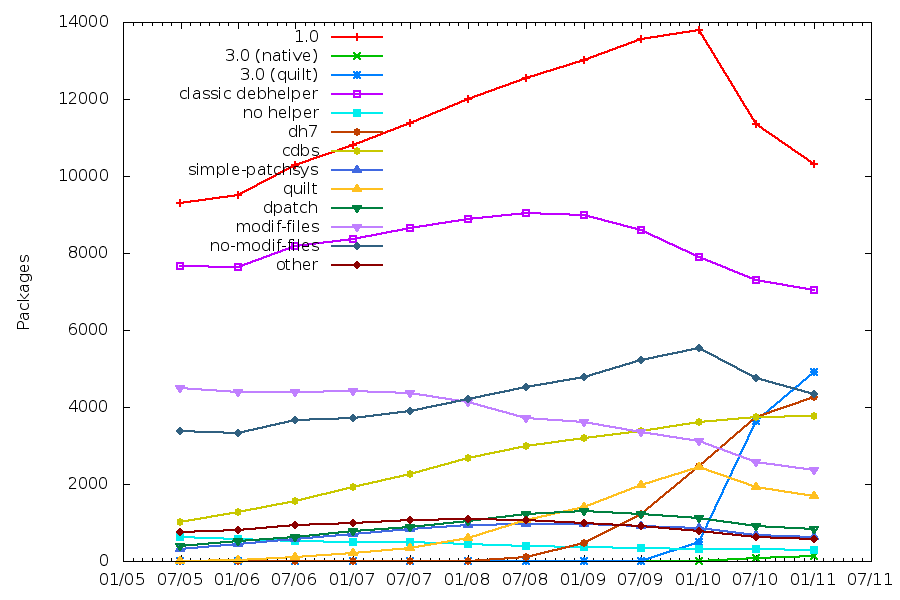
I ve been playing with snapshot.d.o, which is a fantastic resource to look at how Debian has been changing over the years.
Below are some preliminary results about various aspects of source packages: format, packaging helpers, and patch systems.
For clarification: Random comments: If you have other ideas of things to investigate using snapshot.d.o, don t hesitate to ask in comments.

24 February 2011

Dirk Eddelbuettel: Rcpp 0.9.2

The 0.9.2 release of Rcpp is now on CRAN and Debian. This version contains a build fix for the older 10.5.* version of OS X and its g++ 4.2.1 compiler; we now skip one test that upset it. CRAN builds for OS X should resume. We also added simple configuration support for the Intel Compiler; feedback would be welcome on the list. Lastly, documentation in the vignettes was expanded a little. The NEWS entry is below; more detail is in the ChangeLog file in the package and on the Rcpp Changelog page.
0.9.2   2011-02-23
    o   The unitTest runit.Module.client.package.R is now skipped on older OS
        X releases as it triggers a bug with g++ 4.2.1 or older; OS X 10.6 is
        fine but as it no longer support ppc we try to accomodate 10.5 too
        Thanks to Simon Urbanek for pinning this down and Baptiste Auguie
        and Ken Williams for additonal testing 
    o   RcppCommon.h now recognises the Intel Compiler thanks to a short
        patch by Alexey Stukalov; this turns off Cxx0x and TR1 features too
    o   Three more setup questions were added to the Rcpp-FAQ vignette
    o   One question about RcppArmadillo was added to the Rcpp-FAQ vignette
Thanks to CRANberries, there is also a diff to the previous release 0.9.1. As always, even fuller details are on the Rcpp Changelog page and the Rcpp page which also leads to the downloads, the browseable doxygen docs and zip files of doxygen output for the standard formats. A local directory has source and documentation too. Questions, comments etc should go to the rcpp-devel mailing list off the R-Forge page

15 February 2011

Dirk Eddelbuettel: Rcpp 0.9.1

A new release 0.9.1 of Rcpp went to CRAN and Debian yesterday. This version contains mostly bug-fixes and rather few enhancements. The changes are mostly 'internal fixes' and not user-facing; they mostly address some issues in memory management which, while not tripping up the unit tests or common usage, caused trouble for advanced Rcpp modules use and repeated memory allocation / deallocation. This bit Doug Bates repeatedly, and he put his head down and debugged the issue. A number of changes fairly deep-down in Rcpp (as well as in R-devel) later, this looks much better and we owe him a hearfelt Thank You! A big Thanks! also goes to Luke Tierney who out some new memory debugging code into R-devel which the --enable-strict-barrier in R 2.13.0 (due in April) will enable. A related fix is also in R 2.12.2 due on the 25th. The NEWS entry is below; more detail is in the ChangeLog file in the package.
0.9.1   2011-02-14
    o   A number of internal changes to the memory allocation / protection of
        temporary objects were made---with a heartfelt "Thank You!" to both
        Doug Bates for very persistent debugging of Rcpp modules code, and to
        Luke Tierney who added additional memory allocation debugging tools
        to R-devel (which will be in R 2.13.0 and may also be in R 2.12.2)
        
    o   Removed another GNU Make-specific variable from src/Makevars in order
        to make the build more portable; this was noticed on FreeBSD
    o   On *BSD, do not try to compute a stack trace but provide file and
        line number (which is the same behaviour as implemented in Windows)
    o   Fixed an int conversion bug reported by Daniel Sabanes Bove on r-devel,
        added unit test as well
    
    o   Added unit tests for complex-typed vectors (thanks to Christian Gunning)
    
    o   Expanded the Rcpp-quickref vignette (with thanks to Christian Gunning)
    o   Additional examples were added to the Rcpp-FAQ vignette
Thanks to CRANberries, there is also a diff to the previous release 0.9.0. As always, even fuller details are on the Rcpp Changelog page and the Rcpp page which also leads to the downloads, the browseable doxygen docs and zip files of doxygen output for the standard formats. A local directory has source and documentation too. Questions, comments etc should go to the rcpp-devel mailing list off the R-Forge page

14 February 2011

John Goerzen: How do you hire programmers and sysadmins? How should employers evaluate you?

Reading job listings for any sort of IT job is depressing. It s been quite some time since I ve had to do that, but how many times have you seen something like this: I could go on and on. As a job seeker, that sort of thing is fundamentally devaluing to someone who has strengths in being adaptable and quickly learning new tools, languages, or even entire environments. As an employer, it sends a message that you re not interested in more than a surface look at someone s strengths, and probably don t care to hire the best and the brightest. After all, would you turn away a rockstar programmer simply because he or she had been writing filesystem code in C the last 3 years instead of the latest whizbang Java web widget that will probably be obsolete in a year and unsupported in two? I am quite certain that there are plenty of managers that do. Even if you are a company large enough to have an entire team of people that do nothing but work on that whizbang app, don t you still want the best you can find, realizing that some of the best people to work on that app may not have even heard of it yet? (And that when the app goes obsolete in 5 years, you d rather not have to lay off a large team of single-skill people) Some of you may know that I work in IT at a manufacturing company. We have a small IT team here, about seven people, and are a heavy Debian shop. And we have a vacancy open up in our development/Linux admin group. I m the manager of that group, which is why I m thinking about this right now. We re too small for single-subject specialists to make sense, yet we re big enough to appreciate skill, experience, flexibility, and rigor. Consequently, when the occasion arises for me to look for new employees, I don t prepare a laundry list of things we use in-house and would like experience with. The list of almost-required things generally begins with Linux and ends with experienced , and has nothing else in between. In other words, I d like it if I don t have to explain to you what a symlink or a hardlink is, but I d be willing to do so if I think you d internalize it quickly. On the experienced side, it would be nice if you already have a well-developed sense of fear at running rm when you re root, or have designed a storage infrastructure for a network before, or are paranoid about security. But again, if people can pick up those traits on the job, we are usually still interested. If learning how to package up software for Debian, fix bugs in software you ve never seen in a language you ve never heard of, raise good questions about things you may not have lots of experience with, and write documentation for it all on a wiki sounds like fun, then that s probably the kind of person I want, even if you ve never used our particular tools before. If I were to judge based on the stuff I normally see in job postings, I guess you might conclude I m nuts. I don t think I am, but then again I m also the only person I know that formats his own resume in hand-crafted LaTeX. What do you all think? The next question is: how should one evaluate candidates given this sort of philosophy? I m not a fan of canned tests, or even whiteboard tests that tend to be some sort of canned topic that may test the applicant s specific knowledge base more than overall skill and flexibility. Similarly, as an applicant in years past, I ve struggled with how to present the I ve never used $LANGUAGE, but I know I could pick it up quickly and do it very well vibe. To certain people, that might sound like BS. To the more geeky managers, perhaps it sounds like what they want. We ve built a fairly diverse team on the back of this approach, and it s worked out well for us so far. I m interested to hear your thoughts. Oh, and if you d like to work for us, you should probably be sending me an email. No, I m not going to list the address here on this blog post. If you can t figure it out, I don t want to hear from you <grin>

8 February 2011

Cyril Brulebois: Debian XSF News #4

Here comes the forth Debian XSF News issue! I usually try to keep the items sorted chronologically (but grouped by topic when possible), so if you re wondering about the current status of X in unstable, make sure you read the last entry.

5 February 2011

Craig Small: Syntax Highlighting with Mid-Century themes

As a site that discusses a variety of programming languages, I thought it would be good to have syntax highlighting for the code snippets. This blog runs Movable Type so it had to fit in with the setup I have already. So I found the Syntax Highlighter module ok and the initial installation went fine, it was simply:
  1. Download the .zip archive
  2. Unzip the archive into a temporary directory
  3. Copy the plugins/SyntaxHighlighter directory to my plugins directory
  4. Copy the mt-static/plugins/SyntaxHighlighter directory to static/plugins
You then need to edit the HTML Head template and add to the bottom of it the following line:
<$MTSyntaxHighlighterInclude$>
Next, I like to use Markdown as my markup language. But you can only have one type text filter. Another plugin called FormatStack solves this. Create a new stack and put Syntax Highlighter before Markdown. You can then create documents with both sorts of tags and it works quite nicely, well almost. Mid Century Problems This is probably not a Mid-Century specific problem but the modern templates or styles may cause a problem. You ll find you switch styles and suddenly, no more syntax highlighting. The problem is the onLoad functions get overloaded. Some styles have an onload property on their body. You ll see lines similiar to
 <body id="blogbase" class="whatever" onload="mtEntryOnLoad">
This onload event stops other onload events, which means Syntax Highlighter cannot do its thing. The fix is rather simple, you just adjust the templates so they look like the following:
<body id="blogbase" class="mt-entry-archive layout-wtt">
<script type="text/javascript">
 mtAttachEvent("load", mtEntryOnLoad);
</script> 
After doing this and publishing it all worked! You may also see this sort of problem with other plugins that use the mtAttachEvent() Javascript call. Reducing Includes By default, the script includes all syntaxes it knows. If you want to only include some, you do this by specifying what brushes you want. For example if you only will highlight perl and python scripts then you can change the line to:
<$MTSyntaxHighlighterInclude brush="perl,python"$>
Syntax Themes The other attribute the Include line will take is theme. There are several themes but default is alternating white on grey with the rest being variations on light text on a dark background.

Craig Small: A few minor updates

No real terribly exciting updates lately but all important in their own way. ncurses A new version of ncurses got uploaded into sid. It should hopefully fix the backspace versus delete problem some of the FreeBSD people have been having with some of the terminal emulators. Oh, and if you are pining for the good old days when 8 colours and 64kB of memory was good enough for everyone, checkout ncurses-examples which have a bunch of interesting things you can do with curses, including some games. Anyone remeber the tower of Hanoi? dh-make dh-make, the tool to take a raw tar (or zip) archive and make a Debian package has been updated too. One of the interesting side-effects of maintaining dh-make is you find out (usually through bug reports) the little changes that happen to the Debian package build process. Most people, including myself, though the main big thing between versions 1 and 2 and version 3 of the source formats was the inclusion of quilt patches right inside the source files. And probably for the sake of "main things" this is true. What I didn't realise is that dpkg-source has changed in other ways too. Bug 580804 tripped this one up. For most people, you run dh_make, fix some things up and use debuild. If you didn't have the original tar file (perhaps you got the source from git or svn) you just use --creatorig and it copies the current directory into ../whatever-1.2.3.orig Source format 3 doesn't like this. Previously it would find that there was no orig.tar.gz archive but there was a orig directory and make the archive from that. Now you have to do it yourself and dh_make does it like that too. pidgin-musictracker Now this should of been a pretty simple stock-standard upstream upgrade. Download the file, uupdate, debuild and release. The problem is that upstream didn't fix their po files. These are the translation files that convert the raw english texts in a program into whatever language. This means the first time you run the build process, you have no diff file. However when you run it the second time, part of the install target rebuilds the po files (mainly the line references), you have differences and then a big diff file of these po updates. The real fix is to make sure your po files are up to date before you release! The trick is that they don't automatically and I have been caught myself; though it happens in the release testing phase (because my release testing involves usually building the debian archive so I see my own problem). irc came to the rescue again. Someone there suggested getting dpkg-source to ignore the changes. The way you do that is put parameters into debian/source/options. I wanted to ignore the changes to the po and pot files so my file has:
extend-diff-ignore=po/.*\.pot?
I put that in and it works!

22 January 2011

Enrico Zini: Cross-distro Meeting on Application Installer

Cross-distro Meeting on Application Installer I have been to a Cross-distro Meeting on Application Installer which to the best of our knowledge is also the first one of its kind. Credit goes to Vincent Untz for organising it, to OpenSUSE for hosting it and to the various sponsors for getting us there. It went surprisingly well. We got along, got stuff done, did as much work as possible to agree on as many formats, protocols and technologies as we possibly could. The timing of it is very important, as most major distros would like to adopt some of the features that just became popular in the various new app markets and stores, such as screenshots, user comments and ratings. It looks like a lot of new code is about to be written, or a lot of existing code is about to gain quite a bit of popularity. For my part, I presented the work on Debtags and apt-xapian-index. With regards to Debtags, other distros seem to be missing a compehensive classification system, and Debtags is, well, it. With regards to apt-xapian-index, we just noticed that it's the perfect back-end for what everyone would like to do, and the index structure is rather distribution-agnostic, and it's been road-tested with considerable success by at least software-center, so it attracted quite a bit of interest, and will likely attract some more. Just to prove a point I put together a prototype webby markety appy thing in just a few hours of work. The meeting was also the ideal place to create a joint effort to match package names across distributions, which means that a lot of things that were hard to share before, such as screenshots, tags and patches, are suddenly not hard to share anymore.

20 January 2011

John Goerzen: Research on deduplicating disk-based and cloud backups

Yesterday, I wrote about backing up to the cloud. I specifically was looking at cloud backup services. I ve been looking into various options there, but also various options for disk-based backups. I d like to have both onsite and offsite backups, so both types of backup are needed. Also, it is useful to think about how the two types of backups can be combined with minimal overhead. For the onsite backups, I d want to see:
  1. Preservation of ownership, permissions, etc.
  2. Preservation of symlinks and hardlinks
  3. Space-efficient representation of changes ideally binary deltas or block-level deduplication
  4. Ease of restoring
  5. Support for backing up Linux and Windows machines
Deduplicating Filesystems for Local Storage Although I initially thought of block-level deduplicating file systems as something to use for offsite backups, they could also make an excellent choice for onsite disk-based backups. rsync-based dedup backups One way to use them would be to simply rsync data to them each night. Since copies are essentially free, we could do (or use some optimized version of) cp -r current snapshot/2011-01-20 or some such to save off historic backups. Moreover, we d get dedup both across and within machines. And, many of these can use filesystem-level compression. The real upshot of this is that the entire history of the backups can be browsed as a mounted filesystem. It would be fast and easy to find files, especially when users call about that file that they deleted at some point in the past but they don t remember when, exactly what it was called, or exactly where it was stored. We can do a lot more with find and grep to locate these things than we could do with tools in Bacula (or any other backup program) restore console. Since it is a real mounted filesystem, we could also do fun things like make tarballs of it at will, zip parts up, scp them back to the file server, whatever. We could potentially even give users direct access to their files to restore things they need for themselves. The downside of this approach is that rsync can t store all the permissions unless it s running as root on the system. Wrappers such as rdup around rsync could help with that. Another downside is that there isn t a central scheduling/statistics service. We wouldn t want the backup system to be hammered by 20 servers trying to send it data at once. So there d be an element of rolling our own scripts, though not too bad. I d have preferred not to authorize a backup server with root-level access to dozens of machines, but may be inescapable in this instance. Bacula and dedup The other alternative I thought of system such as Bacula with disk-based volumes . A Bacula volume is normally a tape, but Bacula can just write them to disk files. This lets us use the powerful Bacula scheduling engine, logging service, pre-backup and post-backup jobs, etc. Normally this would be an egregious waste of disk space. Bacula, like most tape-heritage programs, will write out an entire new copy of a file if even one byte changes. I had thought that I could let block-level dedupe reduce the storage size of Bacula volumes, but after looking at the Bacula block format spec, this won t be possible as each block will have timestamps and such in it. The good things about this setup revolve around using the central Bacula director. We need only install bacula-fd on each server to be backed up, and it has a fairly limited set of things it can do. Bacula already has built-in support for defining simple or complicated retention policies. Its director will email us if there is a problem with anything. And its logs and catalog are already extensive and enable us to easily find out things such as how long backups take, how much space they consume, etc. And it backs up Windows machines intelligently and comprehensively in addition to POSIX ones. The downsides are, of course, that we don t have all the features we d get from having the entire history on the filesystem all at once, and far less efficient use of space. Not only that, but recovering from a disaster would require a more extensive bootstrapping process. A hybrid option may be possible: automatically unpacking bacula backups after they ve run onto the local filesystem. Dedupe should ensure this doesn t take additional space if the Bacula blocksize aligns with the filesystem blocksize. This is certainly not a given however. It may also make sense to use Bacula for Windows and rsync/rdup for Linux systems. This seems, however, rather wasteful and useless. Evaluation of deduplicating filesystems I set up and tested three deduplicating filesystems available for Linux: S3QL, SDFS, and zfs-fuse. I did not examine lessfs. I ran a similar set of tests for each:
  1. Copy /usr/bin into the fs with tar -cpf - /usr/bin tar -xvpf - -C /mnt/testfs
  2. Run commands to sync/flush the disk cache. Evaluate time and disk used at this point.
  3. Rerun the tar command, putting the contents into a slightly different path in the test filesystem. This should consume very little additional space since the files will have already been there. This will validate that dedupe works as expected, and provide a hint about its efficiency.
  4. Make a tarball of both directories from the dedup filesystem, writing it to /dev/zero (to test read performance)
I did not attempt to flush read caches during this, but I did flush write caches. The test system has 8GB RAM, 5GB of which was free or in use by a cache. The CPU is a Core2 6420 at 2.13GHz. The filesystems which created files atop an existing filesystem had ext4 mounted noatime beneath them. ZFS was mounted on an LVM LV. I also benchmarked native performance on ext4 as a baseline. The data set consists of 3232 files and 516MB. It contains hardlinks and symlinks. Here are my results. Please note the comments below as SDFS could not accurately complete the test.
Test ext4 S3QL SDFS zfs-fuse
First copy 1.59s 6m20s 2m2s 0m25s
Sync/Flush 8.0s 1m1s 0s 0s
Second copy+sync N/A 0m48s 1m48s 0m24s
Disk usage after 1st copy 516MB 156MB 791MB 201MB
Disk usage after 2nd copy N/A 157MB 823MB 208MB
Make tarball 0.2s 1m1s 2m22s 0m54s
Max RAM usage N/A 150MB 350MB 153MB
Compression none lzma none gzip-2
It should be mentioned that these tests pretty much ruled out SDFS. SDFS doesn t appear to support local compression, and it severely bloated the data store, which was much larger than the original data. Moreover, it permitted any user to create and modify files, even if the permissions bits said that the user couldn t. tar gave many errors unpacking symlinks onto the SDFS filesystem, and du -s on the result threw up errors as well. Besides that, I noted that find found 10 fewer files than in my source data. Between the huge memory consumption, the data integrity concerns, and inefficient disk storage, SDFS is out of the running for this project. S3QL is optimized for storage to S3, though it can also store its files locally or on an sftp server a nice touch. I suspect part of its performance problem stems from being designed for network backends, and using slow compression algorithms. S3QL worked fine, however, and produced no problems. Creating a checkpoint using s3qlcp (faster than cp since it doesn t have to read the data from the store) took 16s. zfs-fuse appears to be the most-used ZFS implementation on Linux at the moment. I set up a 2GB ZFS pool for this test, and set dedupe=on and compress=gzip-2. When I evaluated compression in the past, I hadn t looked at lzjb. I found a blog post comparing lzjb to the gzip options supported by zfs and wound up using gzip-2 for this test. ZFS really shone here. Compared to S3QL, it took 25s instead of over 6 minutes to copy the data over and took only 28% more space. I suspect that if I selected gzip -9 compression it would have been closer both in time and space to S3QL. But creating a ZFS snapshot was nearly instantaneous. Although ZFS-fuse probably doesn t have as many users as ZFS on Solaris, still it is available in Debian, and has a good backing behind it. I feel safer using it than I do using S3QL. So I think ZFS wins this comparison. I spent quite some time testing ZFS snapshots, which are instantaneous. (Incidentally, ZFS-fuse can t mount them directly as documented, so you create a clone of the snapshot and mount that.) They worked out as well as could be hoped. Due to dedupe, even deleting and recreating the entire content of the original filesystem resulted in less than 1MB additional storage used. I also tested creating multiple filesystems in the zpool, and confirmed that dedupe even works between filesystems. Incidentally wow, ZFS has a ton of awesome features. I see why you OpenSolaris people kept looking at us Linux folks with a sneer now. Only our project hasn t been killed by a new corporate overlord, so guess that maybe didn t work out so well for you <grin>. The Cloud Tie-In This discussion leaves another discussion: what to do about offsite backups? Assuming for the moment that I want to back them up over the Internet to some sort of cloud storage facility, there are about 3 options:
  1. Get an Amazon EC2 instance with EBS storage and rsync files to it. Perhaps run ZFS on that thing.
  2. Use a filesystem that can efficiently store data in S3 or Cloud Files (S3QL is the only contender here)
  3. Use a third-party backup product (JungleDisk appears to be the leading option)
There is something to be said for using a different tool for offsite backups if there is some tool-level issue, that could be helpful. One of the nice things about JungleDisk is that bandwidth is free, and disk is the same $0.15/GB-mo that RackSpace normally charges. JungleDisk also does block-level dedup, and has a central management interface. This all spells nice for us. The only remaining question would be whether to just use JungleDisk to back up the backup server, or to put it on each individual machine as well. If it just backs up the backup server, then administrative burdens are lower; we can back everything there up by default and just not worry about it. On the other hand, if there is a problem with our main backups, we could be really stuck. So I d say I m leaning towards ZFS plus some sort of rsync solution and JungleDisk for offsite. I had two people suggest CrashPlan Pro on my blog. It looks interesting, but is a very closed product which makes me nervous. I like using standard tools and formats gives me more peace of mind, control, and recovery options. CrashPlan Pro supports multiple destinations and says that they do cloud hosting, but don t list pricing anywhere. So I ll probably not mess with it. I m still very interested in what comments people may have on all this. Let me know!

17 January 2011

Michal &#268;iha&#345;: Gammu documentation

I've made cleanup in Gammu documentation and the only place where to look for it is now The Gammu Manual. Reason for this is simple - single documentation format allows easy cross-referencing and is easier to maintain than mixed sources we used to have before. Thanks to using Sphinx it is possible to generate various outputs, you can see the HTML version on the website, you can download PDF variants and the same source is being used for generating man pages. PS: You can find more details on generating other formats in the documentation.

Filed under: English Gammu 0 comments Flattr this!

Rapha&#235;l Hertzog: Review of my Debian related goals for 2010

Last year I shared my Debian related goals for 2010 . I announced that I would not be able to complete them all and indeed I have not, but I have still done more than what I expected. Let s have a look. Translate my Debian book into English and get it published: NOT DONE Or rather not yet done. It s still an important project of mine and I will do it this year. When I wrote this last year, I expected to find a publisher that would take care of everything but we failed to find a suitable one so we re going to do it ourselves. Cleanup the dpkg perl API and create libdpkg-perl: DONE libdpkg-perl has been introduced with dpkg 1.15.6. Create dpkg-buildflags: DONE dpkg-buildflags has been introduced with dpkg 1.15.7. It s not widely used yet and it won t really be until debhelper 7 supports it (see #544844). It would be nice to see progress on this front this year. Ensure the new source formats continue to gain acceptance: DONE The adoption rate has been steady, it clearly slowed down since the freeze though. I have implemented quite a few features to satisfy the needs of users, like the possibility to unapply the patches after the build, or the possibility to fail in case of unwanted upstream changes. Design a generic vcs-buildpackage infrastructure to be integrated in dpkg-dev: NOT DONE I believe it s something important on the long term but it never made it to my short-term TODO list and it s unlikely to change any time soon. Continue fixing dpkg bugs faster than they are reported: PARTLY DONE We have dealt with many bugs over the year, but we still have 20 more bugs than at the start of last year (370 vs 350). We re not doing bad compared to many other Debian teams but we can still benefit from some help. Start here if you re interested. Enhance our infrastructure to ease interaction between contributors and to have a better view of how each package is maintained: NOT DONE I am convinced that we need something to have a clearer idea of the commitments made by each contributor. I don t put the same amount of care in maintaining smarty-gettext that I do on dpkg. If we had a database of the stuff that we know we don t do well enough, it s easier to point new contributors towards those. Anyway, this project is still unlikely to come to the top of my priorities any time soon. Work on the developers-reference: NOT DONE We have switched the Maintainer field to debian-policy@lists.debian.org to have more review of the changes suggested through the bug tracking system but that has not changed much on the global situation. I still hope to become more active on it sometimes this year. Maybe by trying to make it more fun and creating the text for some of the wishlist bugs as blog articles first. Rewrite in C the last Perl scripts provided by the dpkg binary package: DONE Dpkg 1.15.8 was the first version working without Perl, I announced it in July. Integrate the 3-way merge tool for Debian changelogs in dpkg-dev: DONE dpkg-mergechangelogs is part of dpkg-dev since 1.15.7. I enjoy it regularly. Unfortunately it doesn t work well for cherry-picks. Would be nice to see this fixed, anyone up to the task? :-)
Click here to subscribe to my free newsletter and get my monthly analysis on what s going on in Debian and Ubuntu. Or just follow along via the RSS feed, Identi.ca, Twitter or Facebook.

One comment Liked this article? Click here. My blog is Flattr-enabled.

15 January 2011

Petter Reinholdtsen: The video format most supported in web browsers?

The video format struggle on the web continues, and the three contenders seem to be Ogg Theora, H.264 and WebM. Most video sites seem to use H.264, while others use Ogg Theora. Interestingly enough, the comments I see give me the feeling that a lot of people believe H.264 is the most supported video format in browsers, but according to the Wikipedia article on HTML5 video, this is not true. Check out the nice table of supprted formats in different browsers there. The format supported by most browsers is Ogg Theora, supported by released versions of Mozilla Firefox, Google Chrome, Chromium, Opera, Konqueror, Epiphany, Origyn Web Browser and BOLT browser, while not supported by Internet Explorer nor Safari. The runner up is WebM supported by released versions of Google Chrome Chromium Opera and Origyn Web Browser, and test versions of Mozilla Firefox. H.264 is supported by released versions of Safari, Origyn Web Browser and BOLT browser, and the test version of Internet Explorer. Those wanting Ogg Theora support in Internet Explorer and Safari can install plugins to get it. To me, the simple conclusion from this is that to reach most users without any extra software installed, one uses Ogg Theora with the HTML5 video tag. Of course to reach all those without a browser handling HTML5, one need fallback mechanisms. In NUUG, we provide first fallback to a plugin capable of playing MPEG1 video, and those without such support we have a second fallback to the Cortado java applet playing Ogg Theora. This seem to work quite well, as can be seen in an example from last week. The reason Ogg Theora is the most supported format, and H.264 is the least supported is simple. Implementing and using H.264 require royalty payment to MPEG-LA, and the terms of use from MPEG-LA are incompatible with free software licensing. If you believed H.264 was without royalties and license terms, check out "H.264 Not The Kind Of Free That Matters" by Simon Phipps. A incomplete list of sites providing video in Ogg Theora is available from the Xiph.org wiki, if you want to have a look. I'm not aware of a similar list for WebM nor H.264. Update 2011-01-16 09:40: A question from Tollef on IRC made me realise that I failed to make it clear enough this text is about the <video> tag support in browsers and not the video support provided by external plugins like the Flash plugins.

27 December 2010

Petter Reinholdtsen: The many definitions of a open standard

One of the reasons I like the Digistan definition of "Free and Open Standard" is that this is a new term, and thus the meaning of the term has been decided by Digistan. The term "Open Standard" has become so misunderstood that it is no longer very useful when talking about standards. One end up discussing which definition is the best one and with such frame the only one gaining are the proponents of de-facto standards and proprietary solutions. But to give us an idea about the diversity of definitions of open standards, here are a few that I know about. This list is not complete, but can be a starting point for those that want to do a complete survey. More definitions are available on the wikipedia page. First off is my favourite, the definition from the European Interoperability Framework version 1.0. Really sad to notice that BSA and others has succeeded in getting it removed from version 2.0 of the framework by stacking the committee drafting the new version with their own people. Anyway, the definition is still available and it include the key properties needed to make sure everyone can use a specification on equal terms.
The following are the minimal characteristics that a specification and its attendant documents must have in order to be considered an open standard:
  • The standard is adopted and will be maintained by a not-for-profit organisation, and its ongoing development occurs on the basis of an open decision-making procedure available to all interested parties (consensus or majority decision etc.).
  • The standard has been published and the standard specification document is available either freely or at a nominal charge. It must be permissible to all to copy, distribute and use it for no fee or at a nominal fee.
  • The intellectual property - i.e. patents possibly present - of (parts of) the standard is made irrevocably available on a royalty- free basis.
  • There are no constraints on the re-use of the standard.
Another one originates from my friends over at DKUUG, who coined and gathered support for this definition in 2004. It even made it into the Danish parlament as their definition of a open standard. Another from a different part of the Danish government is available from the wikipedia page.
En ben standard opfylder f lgende krav:
  1. Veldokumenteret med den fuldst ndige specifikation offentligt tilg ngelig.
  2. Frit implementerbar uden konomiske, politiske eller juridiske begr nsninger p implementation og anvendelse.
  3. Standardiseret og vedligeholdt i et bent forum (en s kaldt "standardiseringsorganisation") via en ben proces.
Then there is the definition from Free Software Foundation Europe.
An Open Standard refers to a format or protocol that is
  1. subject to full public assessment and use without constraints in a manner equally available to all parties;
  2. without any components or extensions that have dependencies on formats or protocols that do not meet the definition of an Open Standard themselves;
  3. free from legal or technical clauses that limit its utilisation by any party or in any business model;
  4. managed and further developed independently of any single vendor in a process open to the equal participation of competitors and third parties;
  5. available in multiple complete implementations by competing vendors, or as a complete implementation equally available to all parties.
A long time ago, SUN Microsystems, now bought by Oracle, created its Open Standards Checklist with a fairly detailed description.
Creation and Management of an Open Standard
  • Its development and management process must be collaborative and democratic:
    • Participation must be accessible to all those who wish to participate and can meet fair and reasonable criteria imposed by the organization under which it is developed and managed.
    • The processes must be documented and, through a known method, can be changed through input from all participants.
    • The process must be based on formal and binding commitments for the disclosure and licensing of intellectual property rights.
    • Development and management should strive for consensus, and an appeals process must be clearly outlined.
    • The standard specification must be open to extensive public review at least once in its life-cycle, with comments duly discussed and acted upon, if required.
Use and Licensing of an Open Standard
  • The standard must describe an interface, not an implementation, and the industry must be capable of creating multiple, competing implementations to the interface described in the standard without undue or restrictive constraints. Interfaces include APIs, protocols, schemas, data formats and their encoding.
  • The standard must not contain any proprietary "hooks" that create a technical or economic barriers
  • Faithful implementations of the standard must interoperate. Interoperability means the ability of a computer program to communicate and exchange information with other computer programs and mutually to use the information which has been exchanged. This includes the ability to use, convert, or exchange file formats, protocols, schemas, interface information or conventions, so as to permit the computer program to work with other computer programs and users in all the ways in which they are intended to function.
  • It must be permissible for anyone to copy, distribute and read the standard for a nominal fee, or even no fee. If there is a fee, it must be low enough to not preclude widespread use.
  • It must be possible for anyone to obtain free (no royalties or fees; also known as "royalty free"), worldwide, non-exclusive and perpetual licenses to all essential patent claims to make, use and sell products based on the standard. The only exceptions are terminations per the reciprocity and defensive suspension terms outlined below. Essential patent claims include pending, unpublished patents, published patents, and patent applications. The license is only for the exact scope of the standard in question.
    • May be conditioned only on reciprocal licenses to any of licensees' patent claims essential to practice that standard (also known as a reciprocity clause)
    • May be terminated as to any licensee who sues the licensor or any other licensee for infringement of patent claims essential to practice that standard (also known as a "defensive suspension" clause)
    • The same licensing terms are available to every potential licensor
  • The licensing terms of an open standards must not preclude implementations of that standard under open source licensing terms or restricted licensing terms
It is said that one of the nice things about standards is that there are so many of them. As you can see, the same holds true for open standard definitions. Most of the definitions have a lot in common, and it is not really controversial what properties a open standard should have, but the diversity of definitions have made it possible for those that want to avoid a level marked field and real competition to downplay the significance of open standards. I hope we can turn this tide by focusing on the advantages of Free and Open Standards.

25 December 2010

Petter Reinholdtsen: The reply from Edgar Villanueva to Microsoft in Peru

A few days ago an article in the Norwegian Computerworld magazine about how version 2.0 of European Interoperability Framework has been successfully lobbied by the proprietary software industry to remove the focus on free software. Nothing very surprising there, given earlier reports on how Microsoft and others have stacked the committees in this work. But I find this very sad. The definition of an open standard from version 1 was very good, and something I believe should be used also in the future, alongside the definition from Digistan. Version 2 have removed the open standard definition from its content. Anyway, the news reminded me of the great reply sent by Dr. Edgar Villanueva, congressman in Peru at the time, to Microsoft as a reply to Microsofts attack on his proposal regarding the use of free software in the public sector in Peru. As the text was not available from a few of the URLs where it used to be available, I copy it here from my source to ensure it is available also in the future. Some background information about that story is available in an article from Linux Journal in 2002.
Lima, 8th of April, 2002
To: Se or JUAN ALBERTO GONZ LEZ
General Manager of Microsoft Per Dear Sir: First of all, I thank you for your letter of March 25, 2002 in which you state the official position of Microsoft relative to Bill Number 1609, Free Software in Public Administration, which is indubitably inspired by the desire for Peru to find a suitable place in the global technological context. In the same spirit, and convinced that we will find the best solutions through an exchange of clear and open ideas, I will take this opportunity to reply to the commentaries included in your letter. While acknowledging that opinions such as yours constitute a significant contribution, it would have been even more worthwhile for me if, rather than formulating objections of a general nature (which we will analyze in detail later) you had gathered solid arguments for the advantages that proprietary software could bring to the Peruvian State, and to its citizens in general, since this would have allowed a more enlightening exchange in respect of each of our positions. With the aim of creating an orderly debate, we will assume that what you call "open source software" is what the Bill defines as "free software", since there exists software for which the source code is distributed together with the program, but which does not fall within the definition established by the Bill; and that what you call "commercial software" is what the Bill defines as "proprietary" or "unfree", given that there exists free software which is sold in the market for a price like any other good or service. It is also necessary to make it clear that the aim of the Bill we are discussing is not directly related to the amount of direct savings that can by made by using free software in state institutions. That is in any case a marginal aggregate value, but in no way is it the chief focus of the Bill. The basic principles which inspire the Bill are linked to the basic guarantees of a state of law, such as:
  • Free access to public information by the citizen.
  • Permanence of public data.
  • Security of the State and citizens.
To guarantee the free access of citizens to public information, it is indispensable that the encoding of data is not tied to a single provider. The use of standard and open formats gives a guarantee of this free access, if necessary through the creation of compatible free software. To guarantee the permanence of public data, it is necessary that the usability and maintenance of the software does not depend on the goodwill of the suppliers, or on the monopoly conditions imposed by them. For this reason the State needs systems the development of which can be guaranteed due to the availability of the source code. To guarantee national security or the security of the State, it is indispensable to be able to rely on systems without elements which allow control from a distance or the undesired transmission of information to third parties. Systems with source code freely accessible to the public are required to allow their inspection by the State itself, by the citizens, and by a large number of independent experts throughout the world. Our proposal brings further security, since the knowledge of the source code will eliminate the growing number of programs with *spy code*. In the same way, our proposal strengthens the security of the citizens, both in their role as legitimate owners of information managed by the state, and in their role as consumers. In this second case, by allowing the growth of a widespread availability of free software not containing *spy code* able to put at risk privacy and individual freedoms. In this sense, the Bill is limited to establishing the conditions under which the state bodies will obtain software in the future, that is, in a way compatible with these basic principles. From reading the Bill it will be clear that once passed:
  • the law does not forbid the production of proprietary software
  • the law does not forbid the sale of proprietary software
  • the law does not specify which concrete software to use
  • the law does not dictate the supplier from whom software will be bought
  • the law does not limit the terms under which a software product can be licensed.
  • What the Bill does express clearly, is that, for software to be acceptable for the state it is not enough that it is technically capable of fulfilling a task, but that further the contractual conditions must satisfy a series of requirements regarding the license, without which the State cannot guarantee the citizen adequate processing of his data, watching over its integrity, confidentiality, and accessibility throughout time, as these are very critical aspects for its normal functioning. We agree, Mr. Gonzalez, that information and communication technology have a significant impact on the quality of life of the citizens (whether it be positive or negative). We surely also agree that the basic values I have pointed out above are fundamental in a democratic state like Peru. So we are very interested to know of any other way of guaranteeing these principles, other than through the use of free software in the terms defined by the Bill. As for the observations you have made, we will now go on to analyze them in detail: Firstly, you point out that: "1. The bill makes it compulsory for all public bodies to use only free software, that is to say open source software, which breaches the principles of equality before the law, that of non-discrimination and the right of free private enterprise, freedom of industry and of contract, protected by the constitution." This understanding is in error. The Bill in no way affects the rights you list; it limits itself entirely to establishing conditions for the use of software on the part of state institutions, without in any way meddling in private sector transactions. It is a well established principle that the State does not enjoy the wide spectrum of contractual freedom of the private sector, as it is limited in its actions precisely by the requirement for transparency of public acts; and in this sense, the preservation of the greater common interest must prevail when legislating on the matter. The Bill protects equality under the law, since no natural or legal person is excluded from the right of offering these goods to the State under the conditions defined in the Bill and without more limitations than those established by the Law of State Contracts and Purchasing (T.U.O. by Supreme Decree No. 012-2001-PCM). The Bill does not introduce any discrimination whatever, since it only establishes *how* the goods have to be provided (which is a state power) and not *who* has to provide them (which would effectively be discriminatory, if restrictions based on national origin, race religion, ideology, sexual preference etc. were imposed). On the contrary, the Bill is decidedly antidiscriminatory. This is so because by defining with no room for doubt the conditions for the provision of software, it prevents state bodies from using software which has a license including discriminatory conditions. It should be obvious from the preceding two paragraphs that the Bill does not harm free private enterprise, since the latter can always choose under what conditions it will produce software; some of these will be acceptable to the State, and others will not be since they contradict the guarantee of the basic principles listed above. This free initiative is of course compatible with the freedom of industry and freedom of contract (in the limited form in which the State can exercise the latter). Any private subject can produce software under the conditions which the State requires, or can refrain from doing so. Nobody is forced to adopt a model of production, but if they wish to provide software to the State, they must provide the mechanisms which guarantee the basic principles, and which are those described in the Bill. By way of an example: nothing in the text of the Bill would prevent your company offering the State bodies an office "suite", under the conditions defined in the Bill and setting the price that you consider satisfactory. If you did not, it would not be due to restrictions imposed by the law, but to business decisions relative to the method of commercializing your products, decisions with which the State is not involved. To continue; you note that:" 2. The bill, by making the use of open source software compulsory, would establish discriminatory and non competitive practices in the contracting and purchasing by public bodies..." This statement is just a reiteration of the previous one, and so the response can be found above. However, let us concern ourselves for a moment with your comment regarding "non-competitive ... practices." Of course, in defining any kind of purchase, the buyer sets conditions which relate to the proposed use of the good or service. From the start, this excludes certain manufacturers from the possibility of competing, but does not exclude them "a priori", but rather based on a series of principles determined by the autonomous will of the purchaser, and so the process takes place in conformance with the law. And in the Bill it is established that *no one* is excluded from competing as far as he guarantees the fulfillment of the basic principles. Furthermore, the Bill *stimulates* competition, since it tends to generate a supply of software with better conditions of usability, and to better existing work, in a model of continuous improvement. On the other hand, the central aspect of competivity is the chance to provide better choices to the consumer. Now, it is impossible to ignore the fact that marketing does not play a neutral role when the product is offered on the market (since accepting the opposite would lead one to suppose that firms' expenses in marketing lack any sense), and that therefore a significant expense under this heading can influence the decisions of the purchaser. This influence of marketing is in large measure reduced by the bill that we are backing, since the choice within the framework proposed is based on the *technical merits* of the product and not on the effort put into commercialization by the producer; in this sense, competitiveness is increased, since the smallest software producer can compete on equal terms with the most powerful corporations. It is necessary to stress that there is no position more anti-competitive than that of the big software producers, which frequently abuse their dominant position, since in innumerable cases they propose as a solution to problems raised by users: "update your software to the new version" (at the user's expense, naturally); furthermore, it is common to find arbitrary cessation of technical help for products, which, in the provider's judgment alone, are "old"; and so, to receive any kind of technical assistance, the user finds himself forced to migrate to new versions (with non-trivial costs, especially as changes in hardware platform are often involved). And as the whole infrastructure is based on proprietary data formats, the user stays "trapped" in the need to continue using products from the same supplier, or to make the huge effort to change to another environment (probably also proprietary). You add: "3. So, by compelling the State to favor a business model based entirely on open source, the bill would only discourage the local and international manufacturing companies, which are the ones which really undertake important expenditures, create a significant number of direct and indirect jobs, as well as contributing to the GNP, as opposed to a model of open source software which tends to have an ever weaker economic impact, since it mainly creates jobs in the service sector." I do not agree with your statement. Partly because of what you yourself point out in paragraph 6 of your letter, regarding the relative weight of services in the context of software use. This contradiction alone would invalidate your position. The service model, adopted by a large number of companies in the software industry, is much larger in economic terms, and with a tendency to increase, than the licensing of programs. On the other hand, the private sector of the economy has the widest possible freedom to choose the economic model which best suits its interests, even if this freedom of choice is often obscured subliminally by the disproportionate expenditure on marketing by the producers of proprietary software. In addition, a reading of your opinion would lead to the conclusion that the State market is crucial and essential for the proprietary software industry, to such a point that the choice made by the State in this bill would completely eliminate the market for these firms. If that is true, we can deduce that the State must be subsidizing the proprietary software industry. In the unlikely event that this were true, the State would have the right to apply the subsidies in the area it considered of greatest social value; it is undeniable, in this improbable hypothesis, that if the State decided to subsidize software, it would have to do so choosing the free over the proprietary, considering its social effect and the rational use of taxpayers money. In respect of the jobs generated by proprietary software in countries like ours, these mainly concern technical tasks of little aggregate value; at the local level, the technicians who provide support for proprietary software produced by transnational companies do not have the possibility of fixing bugs, not necessarily for lack of technical capability or of talent, but because they do not have access to the source code to fix it. With free software one creates more technically qualified employment and a framework of free competence where success is only tied to the ability to offer good technical support and quality of service, one stimulates the market, and one increases the shared fund of knowledge, opening up alternatives to generate services of greater total value and a higher quality level, to the benefit of all involved: producers, service organizations, and consumers. It is a common phenomenon in developing countries that local software industries obtain the majority of their takings in the service sector, or in the creation of "ad hoc" software. Therefore, any negative impact that the application of the Bill might have in this sector will be more than compensated by a growth in demand for services (as long as these are carried out to high quality standards). If the transnational software companies decide not to compete under these new rules of the game, it is likely that they will undergo some decrease in takings in terms of payment for licenses; however, considering that these firms continue to allege that much of the software used by the State has been illegally copied, one can see that the impact will not be very serious. Certainly, in any case their fortune will be determined by market laws, changes in which cannot be avoided; many firms traditionally associated with proprietary software have already set out on the road (supported by copious expense) of providing services associated with free software, which shows that the models are not mutually exclusive. With this bill the State is deciding that it needs to preserve certain fundamental values. And it is deciding this based on its sovereign power, without affecting any of the constitutional guarantees. If these values could be guaranteed without having to choose a particular economic model, the effects of the law would be even more beneficial. In any case, it should be clear that the State does not choose an economic model; if it happens that there only exists one economic model capable of providing software which provides the basic guarantee of these principles, this is because of historical circumstances, not because of an arbitrary choice of a given model. Your letter continues: "4. The bill imposes the use of open source software without considering the dangers that this can bring from the point of view of security, guarantee, and possible violation of the intellectual property rights of third parties." Alluding in an abstract way to "the dangers this can bring", without specifically mentioning a single one of these supposed dangers, shows at the least some lack of knowledge of the topic. So, allow me to enlighten you on these points. On security: National security has already been mentioned in general terms in the initial discussion of the basic principles of the bill. In more specific terms, relative to the security of the software itself, it is well known that all software (whether proprietary or free) contains errors or "bugs" (in programmers' slang). But it is also well known that the bugs in free software are fewer, and are fixed much more quickly, than in proprietary software. It is not in vain that numerous public bodies responsible for the IT security of state systems in developed countries require the use of free software for the same conditions of security and efficiency. What is impossible to prove is that proprietary software is more secure than free, without the public and open inspection of the scientific community and users in general. This demonstration is impossible because the model of proprietary software itself prevents this analysis, so that any guarantee of security is based only on promises of good intentions (biased, by any reckoning) made by the producer itself, or its contractors. It should be remembered that in many cases, the licensing conditions include Non-Disclosure clauses which prevent the user from publicly revealing security flaws found in the licensed proprietary product. In respect of the guarantee: As you know perfectly well, or could find out by reading the "End User License Agreement" of the products you license, in the great majority of cases the guarantees are limited to replacement of the storage medium in case of defects, but in no case is compensation given for direct or indirect damages, loss of profits, etc... If as a result of a security bug in one of your products, not fixed in time by yourselves, an attacker managed to compromise crucial State systems, what guarantees, reparations and compensation would your company make in accordance with your licensing conditions? The guarantees of proprietary software, inasmuch as programs are delivered AS IS'', that is, in the state in which they are, with no additional responsibility of the provider in respect of function, in no way differ from those normal with free software. On Intellectual Property: Questions of intellectual property fall outside the scope of this bill, since they are covered by specific other laws. The model of free software in no way implies ignorance of these laws, and in fact the great majority of free software is covered by copyright. In reality, the inclusion of this question in your observations shows your confusion in respect of the legal framework in which free software is developed. The inclusion of the intellectual property of others in works claimed as one's own is not a practice that has been noted in the free software community; whereas, unfortunately, it has been in the area of proprietary software. As an example, the condemnation by the Commercial Court of Nanterre, France, on 27th September 2001 of Microsoft Corp. to a penalty of 3 million francs in damages and interest, for violation of intellectual property (piracy, to use the unfortunate term that your firm commonly uses in its publicity). You go on to say that: "The bill uses the concept of open source software incorrectly, since it does not necessarily imply that the software is free or of zero cost, and so arrives at mistaken conclusions regarding State savings, with no cost-benefit analysis to validate its position." This observation is wrong; in principle, freedom and lack of cost are orthogonal concepts: there is software which is proprietary and charged for (for example, MS Office), software which is proprietary and free of charge (MS Internet Explorer), software which is free and charged for (Red Hat, SuSE etc GNU/Linux distributions), software which is free and not charged for (Apache, Open Office, Mozilla), and even software which can be licensed in a range of combinations (MySQL). Certainly free software is not necessarily free of charge. And the text of the bill does not state that it has to be so, as you will have noted after reading it. The definitions included in the Bill state clearly *what* should be considered free software, at no point referring to freedom from charges. Although the possibility of savings in payments for proprietary software licenses are mentioned, the foundations of the bill clearly refer to the fundamental guarantees to be preserved and to the stimulus to local technological development. Given that a democratic State must support these principles, it has no other choice than to use software with publicly available source code, and to exchange information only in standard formats. If the State does not use software with these characteristics, it will be weakening basic republican principles. Luckily, free software also implies lower total costs; however, even given the hypothesis (easily disproved) that it was more expensive than proprietary software, the simple existence of an effective free software tool for a particular IT function would oblige the State to use it; not by command of this Bill, but because of the basic principles we enumerated at the start, and which arise from the very essence of the lawful democratic State. You continue: "6. It is wrong to think that Open Source Software is free of charge. Research by the Gartner Group (an important investigator of the technological market recognized at world level) has shown that the cost of purchase of software (operating system and applications) is only 8% of the total cost which firms and institutions take on for a rational and truly beneficial use of the technology. The other 92% consists of: installation costs, enabling, support, maintenance, administration, and down-time." This argument repeats that already given in paragraph 5 and partly contradicts paragraph 3. For the sake of brevity we refer to the comments on those paragraphs. However, allow me to point out that your conclusion is logically false: even if according to Gartner Group the cost of software is on average only 8% of the total cost of use, this does not in any way deny the existence of software which is free of charge, that is, with a licensing cost of zero. In addition, in this paragraph you correctly point out that the service components and losses due to down-time make up the largest part of the total cost of software use, which, as you will note, contradicts your statement regarding the small value of services suggested in paragraph 3. Now the use of free software contributes significantly to reduce the remaining life-cycle costs. This reduction in the costs of installation, support etc. can be noted in several areas: in the first place, the competitive service model of free software, support and maintenance for which can be freely contracted out to a range of suppliers competing on the grounds of quality and low cost. This is true for installation, enabling, and support, and in large part for maintenance. In the second place, due to the reproductive characteristics of the model, maintenance carried out for an application is easily replicable, without incurring large costs (that is, without paying more than once for the same thing) since modifications, if one wishes, can be incorporated in the common fund of knowledge. Thirdly, the huge costs caused by non-functioning software ("blue screens of death", malicious code such as virus, worms, and trojans, exceptions, general protection faults and other well-known problems) are reduced considerably by using more stable software; and it is well known that one of the most notable virtues of free software is its stability. You further state that: "7. One of the arguments behind the bill is the supposed freedom from costs of open-source software, compared with the costs of commercial software, without taking into account the fact that there exist types of volume licensing which can be highly advantageous for the State, as has happened in other countries." I have already pointed out that what is in question is not the cost of the software but the principles of freedom of information, accessibility, and security. These arguments have been covered extensively in the preceding paragraphs to which I would refer you. On the other hand, there certainly exist types of volume licensing (although unfortunately proprietary software does not satisfy the basic principles). But as you correctly pointed out in the immediately preceding paragraph of your letter, they only manage to reduce the impact of a component which makes up no more than 8% of the total. You continue: "8. In addition, the alternative adopted by the bill (I) is clearly more expensive, due to the high costs of software migration, and (II) puts at risk compatibility and interoperability of the IT platforms within the State, and between the State and the private sector, given the hundreds of versions of open source software on the market." Let us analyze your statement in two parts. Your first argument, that migration implies high costs, is in reality an argument in favor of the Bill. Because the more time goes by, the more difficult migration to another technology will become; and at the same time, the security risks associated with proprietary software will continue to increase. In this way, the use of proprietary systems and formats will make the State ever more dependent on specific suppliers. Once a policy of using free software has been established (which certainly, does imply some cost) then on the contrary migration from one system to another becomes very simple, since all data is stored in open formats. On the other hand, migration to an open software context implies no more costs than migration between two different proprietary software contexts, which invalidates your argument completely. The second argument refers to "problems in interoperability of the IT platforms within the State, and between the State and the private sector" This statement implies a certain lack of knowledge of the way in which free software is built, which does not maximize the dependence of the user on a particular platform, as normally happens in the realm of proprietary software. Even when there are multiple free software distributions, and numerous programs which can be used for the same function, interoperability is guaranteed as much by the use of standard formats, as required by the bill, as by the possibility of creating interoperable software given the availability of the source code. You then say that: "9. The majority of open source code does not offer adequate levels of service nor the guarantee from recognized manufacturers of high productivity on the part of the users, which has led various public organizations to retract their decision to go with an open source software solution and to use commercial software in its place." This observation is without foundation. In respect of the guarantee, your argument was rebutted in the response to paragraph 4. In respect of support services, it is possible to use free software without them (just as also happens with proprietary software), but anyone who does need them can obtain support separately, whether from local firms or from international corporations, again just as in the case of proprietary software. On the other hand, it would contribute greatly to our analysis if you could inform us about free software projects *established* in public bodies which have already been abandoned in favor of proprietary software. We know of a good number of cases where the opposite has taken place, but not know of any where what you describe has taken place. You continue by observing that: "10. The bill discourages the creativity of the Peruvian software industry, which invoices 40 million US$/year, exports 4 million US$ (10th in ranking among non-traditional exports, more than handicrafts) and is a source of highly qualified employment. With a law that encourages the use of open source, software programmers lose their intellectual property rights and their main source of payment." It is clear enough that nobody is forced to commercialize their code as free software. The only thing to take into account is that if it is not free software, it cannot be sold to the public sector. This is not in any case the main market for the national software industry. We covered some questions referring to the influence of the Bill on the generation of employment which would be both highly technically qualified and in better conditions for competition above, so it seems unnecessary to insist on this point. What follows in your statement is incorrect. On the one hand, no author of free software loses his intellectual property rights, unless he expressly wishes to place his work in the public domain. The free software movement has always been very respectful of intellectual property, and has generated widespread public recognition of its authors. Names like those of Richard Stallman, Linus Torvalds, Guido van Rossum, Larry Wall, Miguel de Icaza, Andrew Tridgell, Theo de Raadt, Andrea Arcangeli, Bruce Perens, Darren Reed, Alan Cox, Eric Raymond, and many others, are recognized world-wide for their contributions to the development of software that is used today by millions of people throughout the world. On the other hand, to say that the rewards for authors rights make up the main source of payment of Peruvian programmers is in any case a guess, in particular since there is no proof to this effect, nor a demonstration of how the use of free software by the State would influence these payments. You go on to say that: "11. Open source software, since it can be distributed without charge, does not allow the generation of income for its developers through exports. In this way, the multiplier effect of the sale of software to other countries is weakened, and so in turn is the growth of the industry, while Government rules ought on the contrary to stimulate local industry." This statement shows once again complete ignorance of the mechanisms of and market for free software. It tries to claim that the market of sale of non- exclusive rights for use (sale of licenses) is the only possible one for the software industry, when you yourself pointed out several paragraphs above that it is not even the most important one. The incentives that the bill offers for the growth of a supply of better qualified professionals, together with the increase in experience that working on a large scale with free software within the State will bring for Peruvian technicians, will place them in a highly competitive position to offer their services abroad. You then state that: "12. In the Forum, the use of open source software in education was discussed, without mentioning the complete collapse of this initiative in a country like Mexico, where precisely the State employees who founded the project now state that open source software did not make it possible to offer a learning experience to pupils in the schools, did not take into account the capability at a national level to give adequate support to the platform, and that the software did not and does not allow for the levels of platform integration that now exist in schools." In fact Mexico has gone into reverse with the Red Escolar (Schools Network) project. This is due precisely to the fact that the driving forces behind the Mexican project used license costs as their main argument, instead of the other reasons specified in our project, which are far more essential. Because of this conceptual mistake, and as a result of the lack of effective support from the SEP (Secretary of State for Public Education), the assumption was made that to implant free software in schools it would be enough to drop their software budget and send them a CD ROM with Gnu/Linux instead. Of course this failed, and it couldn't have been otherwise, just as school laboratories fail when they use proprietary software and have no budget for implementation and maintenance. That's exactly why our bill is not limited to making the use of free software mandatory, but recognizes the need to create a viable migration plan, in which the State undertakes the technical transition in an orderly way in order to then enjoy the advantages of free software. You end with a rhetorical question: "13. If open source software satisfies all the requirements of State bodies, why do you need a law to adopt it? Shouldn't it be the market which decides freely which products give most benefits or value?" We agree that in the private sector of the economy, it must be the market that decides which products to use, and no state interference is permissible there. However, in the case of the public sector, the reasoning is not the same: as we have already established, the state archives, handles, and transmits information which does not belong to it, but which is entrusted to it by citizens, who have no alternative under the rule of law. As a counterpart to this legal requirement, the State must take extreme measures to safeguard the integrity, confidentiality, and accessibility of this information. The use of proprietary software raises serious doubts as to whether these requirements can be fulfilled, lacks conclusive evidence in this respect, and so is not suitable for use in the public sector. The need for a law is based, firstly, on the realization of the fundamental principles listed above in the specific area of software; secondly, on the fact that the State is not an ideal homogeneous entity, but made up of multiple bodies with varying degrees of autonomy in decision making. Given that it is inappropriate to use proprietary software, the fact of establishing these rules in law will prevent the personal discretion of any state employee from putting at risk the information which belongs to citizens. And above all, because it constitutes an up-to-date reaffirmation in relation to the means of management and communication of information used today, it is based on the republican principle of openness to the public. In conformance with this universally accepted principle, the citizen has the right to know all information held by the State and not covered by well- founded declarations of secrecy based on law. Now, software deals with information and is itself information. Information in a special form, capable of being interpreted by a machine in order to execute actions, but crucial information all the same because the citizen has a legitimate right to know, for example, how his vote is computed or his taxes calculated. And for that he must have free access to the source code and be able to prove to his satisfaction the programs used for electoral computations or calculation of his taxes. I wish you the greatest respect, and would like to repeat that my office will always be open for you to expound your point of view to whatever level of detail you consider suitable. Cordially,
    DR. EDGAR DAVID VILLANUEVA NU EZ
    Congressman of the Republic of Per .

    20 December 2010

    Dirk Eddelbuettel: Rcpp 0.9.0 and RcppClassic 0.9.0

    A new release 0.9.0 of Rcpp is now available at CRAN and has just been uploaded to Debian. As always, sources are also available from my local directory here. With this release, the older API which we have been referring to as the classic Rcpp API has been split off into its own new package RcppClassic to ensure backwards compatibility. Rcpp will now contain only the new API. We also fixes a number a minor bugs and applied a few contributed patches which extended functionality or documentation as detailed below in the NEWS entry:
    0.9.0   2010-12-19
        o   The classic API was factored out into its own package RcppClassic which
            is released concurrently with this version.
        o   If an object is created but not initialized, attempting to use
            it now gives a more sensible error message (by forwarding an
            Rcpp::not_initialized exception to R).
        o   SubMatrix fixed, and Matrix types now have a nested ::Sub typedef.
      
        o   New unexported function SHLIB() to aid in creating a shared library on
            the command-line or in Makefile (similar to CxxFlags() / LdFlags()).
        o   Module gets a seven-argument ctor thanks to a patch from Tama Ma.
        o   The (still incomplete) QuickRef vignette has grown thanks to a patch
            by Christian Gunning.
        o   Added a sprintf template intended for logging and error messages.
        o   Date::getYear() corrected (where addition of 1900 was not called for); 
            corresponding change in constructor from three ints made as well.
        o   Date() and Datetime() constructors from string received a missing
            conversion to int and double following strptime. The default format
            string for the Datetime() strptime call was also corrected.
        o   A few minor fixes throughout, see ChangeLog.
    
    Thanks to CRANberries, there is also a diff to the previous release 0.8.9. As always, even fuller details are on the Rcpp Changelog page and the Rcpp page which also leads to the downloads, the browseable doxygen docs and zip files of doxygen output for the standard formats. A local directory has source and documentation too. Questions, comments etc should go to the rcpp-devel mailing list off the R-Forge page

    3 December 2010

    Pietro Abate: distcheck vs edos-debcheck

    This is the second post about distcheck. I want to give a quick overview of the differences between edos-distcheck and the new version. First despite using the same sat solver and encoding of the problem, Distcheck has been re-written from scratch. Dose2 has several architectural problems and not very well documented. Adding new features had become too difficult and error-prone, so this was a natural choice (at least for me). Hopefully Dose3 will survive the Mancoosi project and provide a base for dependency reasoning. The framework is well documented and the architecture pretty modular. It's is written in ocaml, so sadly, I don't expect many people to join the development team, but we'll be very open to it. These are the main differences with edos-debcheck .

    Performances distcheck is about two times faster than edos-debcheck (from dose2), but it is a "bit" slower then debcheck (say the original debcheck), that is the tool wrote by Jerome Vouillon and that was then superseded in debian by edos-debcheck. The original debcheck was a all-in-one tool that did the parsing, encoding and solving without converting the problem to any intermediate format. distcheck trades a bit of speed for generality. Since it is based on Cudf, it can handle different formats and can be easily adapted in a range of situation just by changing the encoding of the original problem to cudf. Below there are a couple of test I've performed on my machine (debian unstable). The numbers speak alone.
    $time cat tmp/squeeze.packages edos-debcheck -failures > /dev/null
    Completing conflicts... * 100.0%
    Conflicts and dependencies... * 100.0%
    Solving * 100.0%

    real 0m19.515s
    user 0m19.193s
    sys 0m0.276s
    $time ./distcheck.native -f deb://tmp/squeeze.packages > /dev/null

    real 0m10.859s
    user 0m10.669s
    sys 0m0.172s

    Input The second big difference is about different input format. In fact, at the moment, we have two different tools in debian, one edos-debcheck and the other edos-rpmcheck. Despite using the same underlying library these two tools have different code bases. distcheck basically is a multiplexer that convert different inputs to a common format and then uses it (agnostically) to solve the installation problem. It can be called in different ways (via symlinks) to behave similarly to its predecessors. At the moment we are able to handle 5 different formats
    1. deb:// Packages 822 format for debian based distributions
    2. hdlist:// a binary format used by rpm based distribution
    3. synth:// a simplified format to describe rpm based package repositories
    4. eclipse:// a 822 based format that encoded OSGi plugings metadata
    5. cudf:// the native cudf format
    distcheck handles gz and bz2 compressed file transparently . However if you care about performances, you should decompress your input file first and the parse it with distcheck and it often takes more time to decompress the file on the fly that run the installability test itself. There is also an experimental database backend that is not compiled by default at them moment.

    Output Regarding the output, I've already explained the main differences in an old post. As a quick reminder, the old edos-debcheck had two output options. The first is a human readable - unstructured output - that was a handy source of information when running the tool interactively. The second was a xml based format (without a dtd or a schema, I believe) that was used for batch processing. distcheck has only one output type in the YAML format that aims to be human and machine readable. Hopefully this will cater for both needs. Moreover, just recently I've added the output of distcheck a summary of who is breaking what. The output of edos-debcheck was basically a map of packages to the reasons of the breakage. In addition to this information distcheck gives also a maps between reason (a missing dependency or a conflict) to the list of packages that are broken by this problem.This additional info is off by default, but I think it can be nice to know what is the missing dependency that is responsible for the majority of problems in a distribution... For example, calling distcheck with --summary :
    $./distcheck.native --summary deb://tests/sid.packages
    backgroud-packages: 29589
    foreground-packages: 29589
    broken-packages: 143
    missing-packages: 138
    conflict-packages: 5
    unique-missing-packages: 52
    unique-conflict-packages: 5
    summary:
    -
    missing:
    missingdep: libevas-svn-05-engines-x (>= 0.9.9.063)
    packages:
    -
    package: enna-dbg
    version: 0.4.0-4
    architecture: amd64
    source: enna (= 0.4.0-4)
    -
    package: enna
    version: 0.4.0-4
    architecture: amd64
    source: enna (= 0.4.0-4)
    -
    missing:
    missingdep: libopenscenegraph56 (>= 2.8.1)
    packages:
    -
    package: libosgal1
    version: 0.6.1-2+b3
    architecture: amd64
    source: osgal (= 0.6.1-2)
    -
    package: libosgal-dev
    version: 0.6.1-2+b3
    architecture: amd64
    source: osgal (= 0.6.1-2)
    Below I give a small example of the edos-debcheck output compared to the new yaml based output.
    $cat tests/sid.packages edos-debcheck -failures -explain
    Completing conflicts... * 100.0%
    Conflicts and dependencies... * 100.0%
    Solving * 100.0%
    zope-zms (= 1:2.11.1-03-1): FAILED
    zope-zms (= 1:2.11.1-03-1) depends on missing:
    - zope2.10
    - zope2.9
    zope-tinytableplus (= 0.9-19): FAILED
    zope-tinytableplus (= 0.9-19) depends on missing:
    - zope2.11
    - zope2.10
    - zope2.9
    ...
    And an extract from the distcheck output (the order is different. I cut and pasted parts of the output here...)
    $./distcheck.native -f -e deb://tests/sid.packages
    report:
    -
    package: zope-zms
    version: 1:2.11.1-03-1
    architecture: all
    source: zope-zms (= 1:2.11.1-03-1)
    status: broken
    reasons:
    -
    missing:
    pkg:
    package: zope-zms
    version: 1:2.11.1-03-1
    architecture: all
    missingdep: zope2.9 zope2.10
    -
    package: zope-tinytableplus
    version: 0.9-19
    architecture: all
    source: zope-tinytableplus (= 0.9-19)
    status: broken
    reasons:
    -
    missing:
    pkg:
    package: zope-tinytableplus
    version: 0.9-19
    architecture: all
    missingdep: zope2.9 zope2.10 zope2.11
    ...

    Future The roadmap to release version 1.0 of distcheck is as follows:
    1. add background and foreground package selection. This feature will allow the use to specify a larger universe (background packages), but check only a subset of this universe (foreground packages). This should allow users to select packages using grep-dctrl and then pipe them to discheck . At the moment we can select individual packages on the command line or we can use expression like bash (<= 2.7) to check all version of bash in the universe with version greater than 2.7.
    2. code cleanup and a bit of refactoring between distcheck and buildcheck (that is a frontend for distcheck that allow us to report broken build dependencies)
    3. consider essential packages while performing the installation test. Here there are few things we have to understand, but the idea would be to detect possible problems related the implicit presence of essential packages in the distribution. At the moment, distcheck performs the installation test in the empty universe, while ideally, the universe should contain all essential packages.
    4. finish the documentation. The effort in underway and we hope to finalize shortly to release the debian package in experimental.

    Next.

    Previous.