Search Results: "mako"

15 March 2007

Benjamin Mako Hill: Never Too Late!

I've always thought it was a little silly that airports use their public announcement systems to give advice on how, and how not, passengers should pack their luggage. Presumably, travelers arrive airports with their bags packed. Last time I was at Boston's Logan Airport, I noticed that they were repeatedly playing these announcements in the baggage claim.

14 March 2007

Simon Huggins: Ups?

You pronounce "power cuts" as "ups" (like "ups and downs") mako? You Americans are ke-ray-zee!

Benjamin Mako Hill: UPS, I Did It Again

I think it's interesting that we pronounce some acronyms/initialisms but spell out others -- I've ever reflected on this before. For example, I think it's funny that we choose not to pronounce the initialism for Uninterruptible Power Supplies the way we pronounce the name of the reason we need them.

13 March 2007

Benjamin Mako Hill: Free Culture at FSF Members Meeting

While I've been making an effort in the recent past to cut down on talks -- so that I can focus on getting work done that will give me something to talk about in the future -- I'm thrilled to be giving a presentation at the upcoming Free Software Foundation Members Meeting in Cambridge, Massachusetts. While normally the members meetings are reserved for talks by the FSF board and staff, I've been invited to give a talk on my work around movement and definition building for free culture as part of a short members forum at the end of the day. I'll also be running a mini RockBox install party over lunch. You need to RSVP for the meeting by this coming Friday (2007/3/17) and, in order to do so, you need to be an FSF member. Fortunately, joining is easy to do. I won't lie and suggest that my talk could possibly be worth the membership price. Luckily, I don't have to lie to suggest that rest of the things that the FSF does are more than worth supporting with membership dues.

10 March 2007

Benjamin Mako Hill: What's Wrong With My iPod?

Last November I wrote about an iPod liberation party we held in Cambridge. As I mentioned then, it was a huge success. Mika just got around to polishing up a short documentary video she made from footage at the event and a few interviews afterward. The documentary is called, What's Wrong With My iPod? and it acts as an introduction to DRM on iPods and what we can do about it. The video introduces the concept of DRM, the dangers it brings, and describes the role it plays on the iPod. The second half is about iRony, our iPod liberation party, and RockBox. Please pass the video links around to your friends -- especially those who might not be up to speed on DRM. If it inspires you, think about running your own iPod Liberation Party (instructions here). You can view it on blip.tv (only MP4 until their converter catches up), on YouTube, or you can just download the OGG theora file (also in high quality).

1 March 2007

Benjamin Mako Hill: The Revolution Will Be Colorful

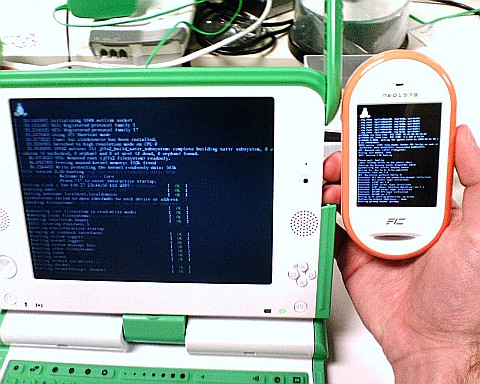
I forgot to mention the coolest thing about the last Ubucon in my summary. I heard that my friend Sean Moss-Pultz (the person who started the OpenMoko project) would be in New York the week of Ubucon so I managed to contact him and get him to drop by on his way to the airport so we could have lunch. To my surprise, he had one of the early versions of the free-phone for me (I wasn't expecting one for several weeks). I had brought my OLPC XO so, for the first time ever (as far as we know) we managed to get the two coolest, and most important, technology platform projects in the world together. While the XO and OpenMoko share a commitment to freedom, the similarities between the projects are, in fact, also skin deep. If we all work hard, we can look forward to a future that is free. Apparently, it's also white with bright trim.
/copyrighteous/images/xo_plus_openmoko-03-boot.jpg
/copyrighteous/images/xo_plus_openmoko-01.jpg
Apologies for the pictures taken from my current inferior, both ethically and technically, mobile phone.

Benjamin Mako Hill: Ubucon NYC

I had a great time at Ubucon a couple of weeks ago. I ended up running two sessions. After an initial opening, I opened the conference with a talk on how folks can participate in Ubuntu. The talk was roughly based on Andreas Lloyd's absolutely wonderful Contribute To Ubuntu page in the Ubuntu wiki. His page was, in turn, based on my own Participate In Ubuntu page. The talk tried to provide a solution to the common question of, "I love Ubuntu and want to give back! How can I?" -- when I was answering info@ubuntu.com (for my sins), I would get this question several times each day. The talk was a relatively straight forward walk through the different teams and group working in Ubuntu along with examples of their projects and fun anecdotes from my experience in the community along the way. I worked in a bit of talking about different community governance structures and issues and the membership process. Trying to cram an overview of the community and its different subsections into an hour is a pretty sobering experience. There's a lot going on and I barely had a chance to give a poor description of the most visible things going on. In the afternoon, I reminded folks (and myself) that I know a little of this tech stuff too by walking folks through a quick introduction to building and modifying Debian or Ubuntu packages. It was a quick variant on the "Debian Packaging for Sysadmins" talks that I've given in the past. Of course, the best part was getting to hang out with some folks I know from the community and to meet a bunch of new people. It was a blast and I'm definitely looking forward to the next one.

26 February 2007

Julien Valroff: Now on Planet Debian!

Thanks to Mako, my weblog (at least part of it) is now syndicated on Planet Debian! I thus ought to introduce myself: I’m Julien, 28 years old, living in the North East of France. I already (co-)maintain a bunch of packages in the official archive, and try to actively report bugs. I also used to acting as a translator for the French l10n team, which I will resume once time allows it. I may plan to enter the New Maintainer process in the next couple of months. I take this as an occasion to thank all my sponsors and co-maintainers (Christoph, Free, Cl ment, Micah and Lo c) for their interest in working with me and for their patience. I hope being on Planet Debian will allow me to better integrate into the Debian community.

24 February 2007

Jurij Smakov: Debian kernel configs

For a while now there has been a small but consistent demand for a simple way to obtain the kernel configuration files, used to build official Debian kernel packages. I’ve been working on a solution for that problem, and I think by now it’s working reasonably well to announce it to the world :-) . Ladies and gentlemen, without further ado I bring you the Debian Official Kernel Configuration Files. It works by scanning the archive nightly for new linux-image and linux-modules packages and extracting configs from them. If you have any comments or proposals on how to improve it, feel free to contact me by email.

Benjamin Mako Hill: Fit For an Emperor

I found this box outside my apartment labeled, "The Emperor Clothes." Fortunately, the contents were exactly what I was expecting.    Surely clothing fit for an emperor. That is of course, if you are fit enough to appreciate them.

23 February 2007

Stefano Zacchiroli: xs vcs browser

XS-Vcs-Browser: the brother of Xs-Vcs-* A couple of day ago godog (thanks!) applied my patch for the PTS which add the long overdue support for the XS-Vcs-Browser field in debian/controls. Here is a summary of the Version Control System related fields now supported by the web interface of the PTS: Here is an example of the two field usage from the debian/control of the (not yet uploaded) Vim package:
Source: vim
Section: editors
Priority: optional
Maintainer: Debian VIM Maintainers <pkg-vim-maintainers@lists.alioth.debian.org>
Standards-Version: 3.7.2
...
XS-Vcs-Svn: svn://svn.debian.org/svn/pkg-vim/trunk/packages/vim
XS-Vcs-Browser: http://svn.debian.org/wsvn/pkg-vim/trunk/packages/vim/

The current sample rendering can be seen, for example, in the PTS page of the mako package. More information can be found in the current patch for the Developer's Reference documenting the support for the two fields in the web interface of the PTS. /me hurries-up writing a small post to -devel before John yells at me again for (ab)using the planet for such announcements :-)

22 February 2007

Benjamin Mako Hill: Notorious in Libraries

My Overprice Tags projects from a few days back has been getting a bunch of attention. Perhaps most interesting, the MIT libraries -- whose journals we defaced augmented in the project -- have been unbelievably positive about the project! They've written up a very positive description of the event on their website and published an interview with me as well!

Biella Coleman: The power of analogy

The other night I was rocking out to a newly acquired swath of rock and techno from the 1970s and 1980s when Mako pinged me on IRC to chat about my recent blog post, the outcome of which the was his following blog entry. And indeed, I made the associations and links very quickly to gesture to the absurdity of how these example are collapsed and under the umbrella of IP law and as a move to argue for maximalist positions. He took the time to explain how certain folks, like Pat Choate in Hot Property used these very examples to argue for more not less protection. Does anyone know of a case of people using these types of examples to argue the opposite or differently as I think can also be done?? (that is aside from Mako’s wonderful post)

21 February 2007

Benjamin Mako Hill: Trademark Violation and Greater Evils

Biella Coleman recently mentioned counterfeit drugs in a blog post:
A pirated movie carries little consequence, except for that the movie industry may lose some cash flow. A fake Rolex purchased on the bustling streets of NYC saves you a lot of money (and robs you of a warranty). But counterfeit drugs, the consequences and stakes are at a whole other, more serious, order of things.
Biella's intentions in drawing the analogy are harmless -- people really do lose their lives because of fake drugs while rock-off movies and Rolexes are relatively harmless. However, her aside reminds me of the much less harmless, fair, and honest analogies drawn by Pat Choate in Hot Property who used examples like counterfeit drugs and dishonestly labeled aircraft parts to support a high protectionist position on IP. Because of the arguments made by people like Choate, I believe that there is a subtle danger in the type of analogy that Biella draws that I think we should try to guard against in the future. The danger lies in the fact that these comparisons tend to conflate at least two very different kinds of illegal activity. Trademark violations are illegal. So it selling drugs without approval from regulatory bodies. So is manslaughter and murder -- both terms used in the Times article Biella links to to describe the actions of drug counterfeiters. Laws in most countries already prohibit all of these things and offer increasingly harsh punishments for each action. In fact, selling unlicensed drugs and killing people is much more illegal than violating trademark and making knockoffs. And it should be. When someone commit IP violations in the process of committing much worse crimes, we should focus on highlighting, condemning, and punishing the much worse crime, not the IP violation which in comparison is almost inconsequential. The punishment for counterfeiting drugs may only be a slap on the wrist and that's probably an appropriate punishment for the counterfeiting component of the crime. The other worse crimes that the counterfeiter is also committing should be punished much more harshly. If, as the Dr. Reggi quoted in the Times article complains, "counterfeiting a medicine can be [only] a misdemeanor," we need stronger laws against selling unregulated drugs -- not stronger IP laws. If we confuse and compare bootleg movies and knock-off Rolexes with fake malaria or AIDS drugs, we're likely to come to the opposite conclusion. Our reactions to such situations should be, "People are killing people with fake drugs! We need stronger laws against killing people in these ways." They should not be "People are killing people with fake drugs! Interesting to note that they are also violating trademark laws like other counterfeiters." The former reaction will frame the discussion in a way that lets us treat the bad components of the crime more harshly and will not help IP high protectionists argue for stronger IP through a disingenuous process of guilt by association.

20 February 2007

Benjamin Mako Hill: Overprice Tags

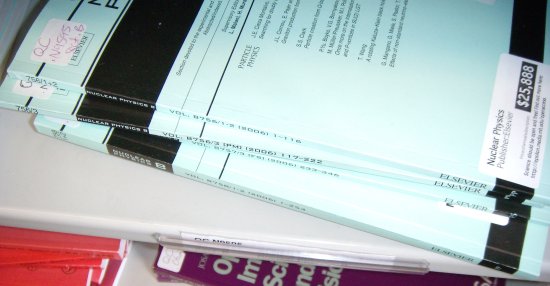
Last Thursday (February 15, 2007) was declared National Day of Action for Open Access. To help raise awareness of the movement for open access in scholarly publications at MIT, I got together with a number of other MIT students and placed price tags -- we called them overprice tags -- onto the 100 journals that MIT subscribes to at a cost of more than $5,000 USD per annum.
/copyrighteous/images/overpricetagged_journal.jpg
The project, inspired by a similar project called Seeing Red carried out by a Brown librarian a few years back, was a huge success. You can find information about the project, motivation and experience, see pictures, and find out how you might run a similar event at your institution on the Overprice Tags homepage.

Benjamin Mako Hill: Novartis, Stop It

Swiss pharmaceutical company Novartis is currently suing the Indian government over its patent law in an effort to further limit production of generic drugs in India. Among other drugs, the company is trying to stop India's production of generic AIDS medicines that supplies more than half of the developing world. M decins Sans Fronti res (MSF) has a great FAQ and bunch of other information on their access to essential medicines (AEM) site that you should check out if you are unfamiliar with the case. Mika has been working on a variety of AEM projects for a while with quite a few important successes. From a certain perspective, some of the core calls for access to knowledge share common ground with free software, free culture, and anti software patent advocacy that I've been involved in. Of course, it puts things in perspective to see Mika and others in the AEM community point to millions of people and say that those people will die because of an IP maximilist position. Last week, I went with Mika to a protest of Novartis near MIT. It was just below freezing, slushy, raining, sleeting, and probably the worst weather I've ever experienced in Cambridge. Despite all that, it was wonderful to join a large group of activists in Cambridge/Boston and around the world to send a strong message to Novartis. You can watch a video of the protest or see a set of photographs. Both were taken by my friend Jay.

18 February 2007

Evan Prodromou: 28 Pluvi se CCXV

Ugh. I have some blogging catching-up to do, which I'm going to try to take at a fast clip. I tend to get bogged down in the daily details, which can make getting my info down electronically kind of difficult.

Trip to New York City Maj, Amita June and I drove down through upstate New York for LinuxWorld OpenSolutions Summit. It was a good drive -- really pretty going through the Adirondacks in winter. There were icicles hanging dozens of meters from stone cliffs -- really dramatic. We spent Tuesday night with our friends Jen Bohner and Massoud Marzban. Jen is a friend of mine from high school, and Massoud is her husband. They live in Sunnyside, Queens now, after a year stint here in Montreal just before Amita was born. We miss having them around here, but they seem to have settled in well in NYC. Jen is working way too hard on a master's of education while teaching 5 classes during the day in New York public schools. Despite this, they found time to make us a great dinner, open a bottle of wine, and spend the evening chatting. Really decent people. tags:

LWOSS The next morning, Valentine's Day, I got up early to go into Manhattan for LWOSS. I called for a car service that Jen and Massoud use, but they failed to show up, and when I called back they hung up on me. Deborah's Car Service, there. Make sure to miss them if you're in the area. Anyways, I managed to flag down a cab and get into Manhattan anyways. It wasn't too much fun -- there'd been a big snowstorm the night before, and traffic was gnarled and bitter. Still, I got to the event hotel -- the New York Marriott Marquis on Times Square, got checked in, and registered for the event just fine. The keynote speaker was security expert Bruce Schneier, who gave an extremely insightful talk about economic laws as they apply to computer security. It was very interesting, if hard to follow at times -- it's not always easy to keep economic theories and security practices juggling in your brain at the same time. I met up with Don Marti, who'd invited me to participate at LWOSS, in the speakers' lounge. He had assembled a great team of interesting people who know a lot about Linux and Open Source: John Mark Walker, Jeremy Allison and Jerry Carter of the Samba project, and Jeremy Garcia of LinuxQuestions. Sadly, the snowstorm had canceled the flights of two more participants, Donald Becker and Sascha Chua. (Those weren't the only two people who couldn't come because of the flying problems. I overheard dozens of conversations on cell phones of people whose colleagues couldn't make it for the show. In retrospect, it's pretty surprising that we had the event at all. Schools and businesses were closed all across New York on the 14th and 15th.) Don's plan was simple: to hold an "unconference" at the heart of the conference. We took a section of the showroom floor, set up some chairs and a big monitor for demoing, plus a whiteboard, and just started some interesting conversations. I talked about Web APIs, since I wrote an article on Web APIs for LinuxWorld.com in December. Other people talked about their own projects, about Linux distros, about tools in the Open Source toolkit, about the process itself, and all kinds of things. It was really fun and productive. (I'm realizing now that I should put Don in touch with Ted Ernst, who's been instrumental in organizing three of the Open Space events I went to in the last year. It would be really interesting to have an Open Space event the day before or after the main conference... making mental note, here.) Otherwise, the event was really pretty good. I talked a lot with Jeremy Garcia, who started using MediaWiki about the same time we started using it for Wikitravel. LQ is a really great project, and a nice mix of different community platforms. I managed to luck into an LQ t-shirt, which I'll wear proudly. The other big news, for me, was getting a loaner Nokia N800 to use during the event. The N800 is an Internet tablet, about the size of a cell phone, but without phone features. I liked it so much that I asked the Nokia team to loan me the device for a long-term review, and they agreed. So I took it home with me. Meanwhile, Maj and Amita June had a nice time tooling around New York. They went to the American Museum of Natural History on Thursday, which was pretty great -- Amita loved looking at the animals. We had dinner on Wednesday at a pub off of Times Square called The Perfect Pint -- although the food was a little more upscale than pubby. Thursday night we got a babysitter through the hotel and had drinks at the Broadway Bar (in the hotel) and dinner at The View (also in the hotel). The View is a rotating restaurant at the top of the Marriott Marquis -- pretty fun to do. tags:

UbuCon On Friday, I went to the Google HQ in Manhattan for TheUbucon, another (!) unconference, this time about Ubuntu and the people who love it. I got to hear Mako talk about the Ubuntu community process, how it works, and how to get involved. It was pretty impressive. I also did some key-signings and talked to a lot of interesting people. Including Kevin Mark, who had lots of comments on my blog. Hi, Kevin! I had to take off just as the event was getting started, to go pick up Maj and Amita June at the hotel and check out. We took a cab back to Queens, where we'd stashed the car so we didn't have pay outrageous Manhattan parking fees. Sadly, someone had taken the opportunity to key our paint job. I love you back, New York. tags:

Drive home I wanted to drive back through Connecticut, Massachusetts and Vermont on the way back, for variety, so we turned east and headed up through Westchester County. It turned out to be a real mistake -- traffic on a Friday afternoon out of New York is apparently pretty miserable. We took 4 hours to get to Hartford, by which time the baby was miserable and the rest of us were feeling pretty punked out, too. We ended up in the Motel 6 in Enfield (Connecticut) where we ordered pizza, took showers, and just got our heads back together. Today we got up early and had a nice drive through Western Mass and Vermont. The little northern New England towns were pretty beautiful in the snow, and we passed a lot of barns and farmhouses that looked like movie sets. We stopped in Burlington for lunch, and had a leisurely drive over the border and back home. When we got to our house, I had to shovel drifted snow -- about 3-4 feet deep -- out of our parking space so I can pull the car in. But otherwise the house is in good order. I'm glad to be back. tags:

14 February 2007

Benjamin Mako Hill: A Definition of Free Cultural Works

Last year, I announced a project to bring together artists, content creators, and others who care about freedom to come up with a clear set of goals around which a social movement for essential freedoms around culture might be based. There has been a lot of discussion and a number of important changes to the document over the last year. A few days ago, we finally released "1.0" of our definition with this announcement:
A diverse group of writers has released the first version of the "Definition of Free Cultural Works." The authors have identified a minimum set of freedoms which they believe should be granted to all users of copyrighted materials. Created on a wiki with the feedback of Wikipedia users, open source hackers, artists, scientists, and lawyers, the definition lists the following core freedoms:
  • The freedom to use and perform the work
  • The freedom to study the work and apply the information
  • The freedom to redistribute copies
  • The freedom to distribute derivative works.
Inspired by the Free Software Definition and the ideals of the free software and open source movements, these conditions are meant to apply to any conceivable work. In reality, these freedoms must be granted explicitly by authors, through the use of licenses which confer them. On the website of the definition a list of these licenses can be found. Furthermore, authors are encouraged to identify their works as Free Cultural Works using a set of logos and buttons. The definition was initiated by Benjamin Mako Hill, a Debian GNU/Linux developer, and Erik M ller, an author and long-time Wikipedia user. Wikipedia already follows similar principles to those established by the definition. Angela Beesley, Wikimedia Advisory Board Chair and co-founder of Wikia.com; Mia Garlick, general counsel of Creative Commons; and Elizabeth Stark of the Free Culture Student Movement acted as moderators, while Richard Stallman of the Free Software Foundation and Lawrence Lessig of Creative Commons provided helpful feedback. As more and more people recognize that there are alternatives to traditional copyright, phrases like "open source," "open access," "open content," "free content," and "commons" are increasingly used. But many of these phrases are ambiguous when it comes to distinguishing works and licenses which grant all the above freedoms, and those which only confer limited rights. For example, a popular license restricts the commercial use of works, whereas the authors believe that such use must be permitted for a work to be considered Free. Instead of limiting commercial use, they recommend using a clever legal trick called "copyleft:" requiring all users of the work to make their combined and derivative works freely available. M ller and Hill encourage authors to rethink copyright law and use one of the Free Culture Licenses to help build a genuine free and open culture.
If you haven't yet, please check out the project at freedomdefined.org. If you're still curious feel free to read about my motivation and why I think that everyone should stand up for what they feel are essential freedoms.

13 February 2007

Benjamin Mako Hill: Ubucon

I'm coming down to New York this Friday for the second Ubuncon. Ubucon is a small(ish) user organized and oriented Ubuntu "unconference." Apparently, that means that it's not very organized -- which adds flexibility and is considered a good thing! Both Ubucons to date have been held at Google offices. This one will be held in the Google office in New York City. I'll be giving at least one talk. In all likelihood, I will be giving a talk about participation in the Ubuntu community and another more technical crash introductory course in building Ubuntu packages. Finally, I've had Pearson's ship a dozen or so copies of the Official Ubuntu Book which I'll be signing and handing out. If you want to go, you should check out the schedule, and the info pages in the wiki and maybe even RSVP. You will need a LP/wiki account to do so. See you in New York! Please contact me if you want to get together while I'm in New York.

Jurij Smakov: SCALE highlights

I had a chance of visiting the annual South California Linux Expo (SCALE) over the weekend. It was fun, as usual. People at Gentoo booth were emerging something continuously, NetBSD people had their traditional toaster running NetBSD, FreeBSD had some pretty funky crowd, and Debian booth was too small to accomodate all the people :-) . Newbie-friendly FreeSpire had some very enthusiastic folks, showing off their new Click and Run service. They got pretty excited when I mentioned debtags to them. Krugle is a relatively new source code search engine with some nice features. Unfortunately, they were not indexing the Debian’s code repositories, but promised to fix it ASAP (and add support for crawling git repositories as an added bonus). Zenoss presented their impressive open-source monitoring system, and I had a chance to fiddle with the new TrollTech’s Linux-powered GreenPhone. Coming with its own software development kit, this gadget has some serious geek-appeal, however at a price tag of $700 I’m afraid I’ll have to pass for now. And it was exciting to learn that there are still people who feel like writing their own OS pretty much from scratch.
There was one inquiry regarding the Debian’s accessibility features for the visually impaired. Unfortunately, it turned out that the Speakup-enabled kernel flavour we used to have in Sarge is no longer available in Etch. I think that reintroducing it (at least, for i386) should be a release goal for Lenny, I’ll definitely try to see what I can do about it.

Next.

Previous.