Search Results: "jan"

22 December 2020

Jan Wagner: Call for testing: monitoring-plugins 2.3 in experimental

As announced recently I prepared a monitoring-plugins 2.3 package for experimental. If there is enough positive feedback until 12th January 2021, I intend to upload this into unstable targeted for Debian Bullseye.

Happy testing.

20 December 2020

Shirish Agarwal: Insane Logic and Farming in other countries

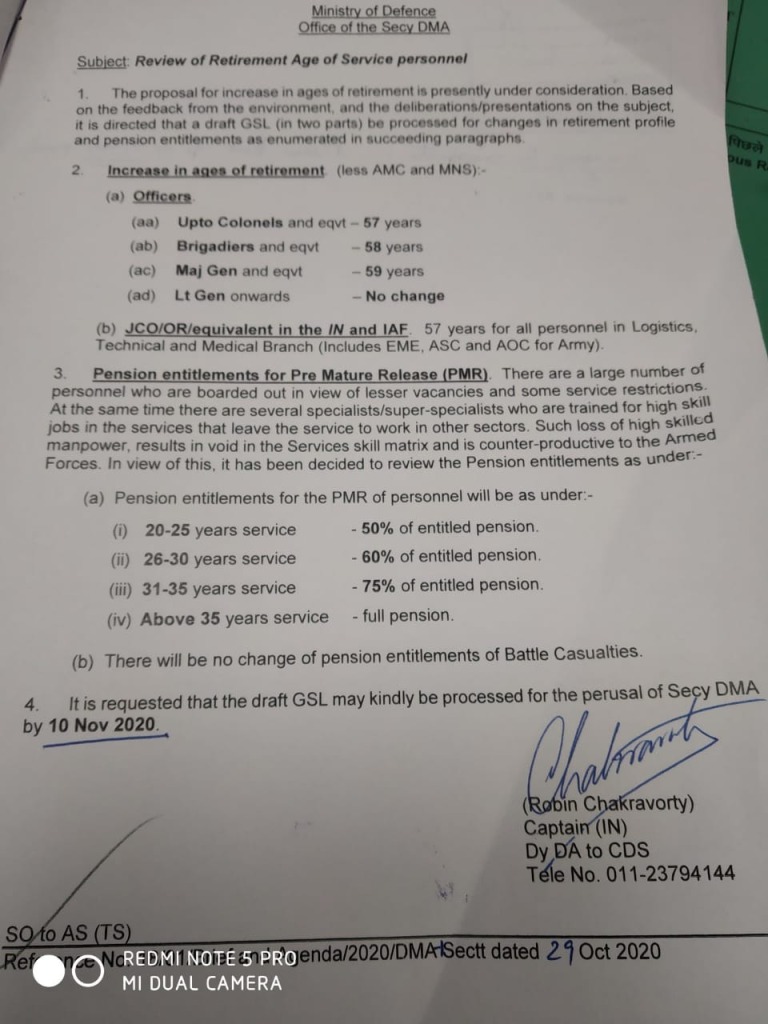
The people who are pro-Government and in this case pro-Corporate do not have any success stories that they can share. Hence, most of the time the arguments are that the other are bad. For e.g. quite a few people argue that we don t need farmers, we can just order from restaurant. They have completely disassociated the idea that even then you need farmers as unless the farmers put the seed in, till the soil and wait for the rains or have irrigation you won t get ripe vegetables which then has to be taken out, and somehow sold to the wholesaler from where it comes to the restaurant and then to your plate. Sadly, even the farm-to-fork infographics are so depressingly sad, you want to look away. If you see the infographic you see it is just not non-veg but also vegetarian food grains which go under lot of questionable practices. Even, with such scenarios that is done by corporations our people want to go ahead. I will share stories from other countries which tell how they are doing more. The Soldier-Farmer Another sad part of these protests have been soldiers who have been returning their medals. The ones who oppose have the gall to say they should return the cash rewards they got. So just like farmers, seems soldiers also do not need money to survive. They are supposed to live only on air and water. This is after the present Govt. has reduced their pensions after retirement and that too without any discussion
GOI pensions to ex-servicemen
Now I nor anybody else would have minded if these conditions were shared going forward rather than doing it retrospectively. People who usually go to the army are not in it for money but for the adventure and glory they bring. But they do also have a family and have a family responsibility. In most other countries, the soldier and his families are well-looked after. If you know that even after you die, the Government would look after your family, you will do your best. Unfortunately, many veterans in India themselves are asked to help by many war widows as the widows don t get family pensions. The proposal naturally has left many miffed. In fact many of the veterans who used to advise people to join the armed forces now advise young people to pursue civilian life and careers. This is when Indian Army has been ironically having shortage of officers from well over a decade and stresses felt by Army personnel also known for a long time. Even under this nationalistic Government, if it cannot take care of its soldiers, then forget about others.
India Defence Spending vis-a-vis other countries.
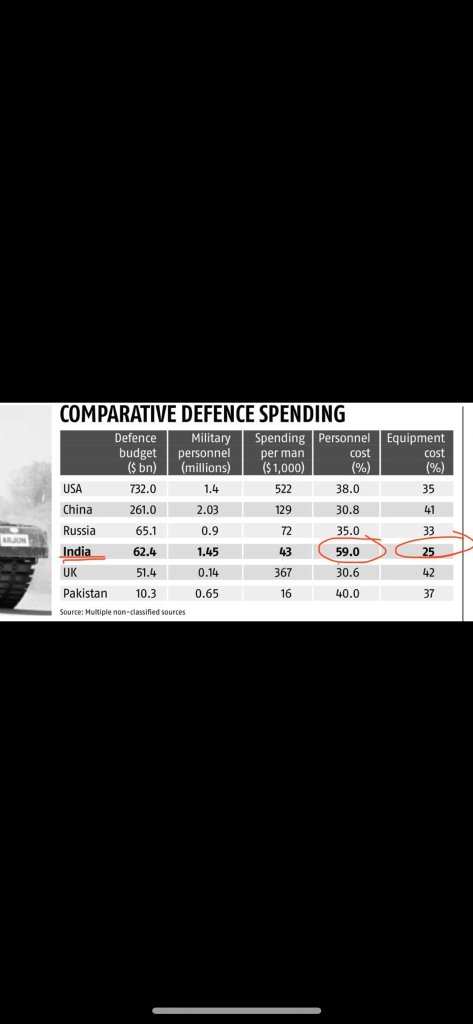
Now it is nobody s argument that India needs to improve its tooth-to-tail ratio but this is the wrong way to go about it. I would probably talk about that some other time as that totally needs its whole place. Even OROP, which was the mandate of this Government hasn t had been done in full as there are quite a few cases in the Supreme Court. Almost all the cases have been heard and only decisions have to be given which the SC for whatever reason doesn t want to give. They just keep changing the date of the hearing. Nowadays, in many suits/cases, the SC asks for fresh hearings even though all the old records are there. This is a newish phenomena which is being observed in SC. Why is it being done? Your guess is as good as mine. One thing for sure has changed, the SC which used to be citizen-focussed or enabler of human rights and used to be held as a beacon for judicial activism has changed but these are other topics which need their own space. Update 16/12/2020 The SC recommends setting up a committee to discuss farmer issues. And this is nothing new. This is called death by committee. When there is already so much literature on the subject, including the works done by Swaminathan Commission. There has been 6 reports which do look at farmer issues in a holistic manner. This is the Supreme Court giving an escape route to GOI. They also have abstained from having a whole session citing Covid. This is when the ruling Govt. is putting a massive 1000 crore on a new building on which the SC has put on hold. And even then the GOI went ahead and did a Bhoomi-Pujan (traditional ceremony when making a new construction from scratch.) Naturally due to the double whammy of both the pension reforms and now the laws to make corporate farming more aggressive has left a deep impact on the soldier-farmer that the state does not think or feel for him. Even the United States farm-aid eloquently describes how corporate farming has made independent farmers suffer. You read that, and it seems it is as the state of our farmers here in India. Even their average land-holding has dropped a bit. I have shared about the state of farmers in India, in two blog posts previously. And it is not just farm owners who have had it bad, even farm workers in U.S. The issue may look to be about the pandemic but goes far deeper. The Israeli Model The Israelis have always used collective farming and do have a large share in farming there. The old model called Kibbutz is what made Israelis self-sufficient in food and water and actually are world-leaders where they export their services to other nations on the same thing. France Just like many other countries, France also seems to have favored farmer co-operatives. Almost 75% of all farmers are in co-operatives. Italy The country world-famous for its wines and cheese are made by its co-operatives. In fact co-ops are the buzzword it seems in Italy, more so in Northern Italy. Asian economies Even Asian economies, especially East Asian economies by and large have been turning to co-operatives. Brazil Now Brazil is almost 40% more than India. In fact, in most of the indices, Brazil beats India handsomely. So one would be forgiven to think that Brazil must have corporate farming. But nothing could be further from the truth. The only downer is that they have high crime in some areas. Otherwise, they are in many ways better than India. In fact, I was surprised a few years ago to learn about Mercsour. I would have to admit though I learned much about Brazil when Debian was holding a debconf about a year back. Otherwise, I had known about the country for number of years but apart from its carnival and samba, hadn t known much about it. I did come to know that most of Latin America also loves spices as much as Indians do. They show that love by using hot sauces. I do one day wanna try one of their sauces to see what makes it tick. I do know they like to barbecue vegetables as much as barbecuing non-veg food. This is going a bit OT but then that s the foodie in me  Conclusion I could have shared more countries which have chosen the co-operative way rather than corporate farming and that is simply because they know what is best for their people and what is best even politically. The new farm laws are neither grounded in farmer s welfare nor anything else. The Govt. has been trying to undermine the farmers for years together. In fact, Madhya Pradesh has openly said that they will not allow farmers from other states to sell in their state. Although, even before these laws there was nothing to restrict the farmer from selling his produce anywhere in the country. Angering the farmers is not good politics as was found sometime back but guessing some lessons need to be re-learned. One comment though, on social media I have seen many people especially youngsters having no real understanding of what inflation is all about. For e.g. if you ask them how come we are having a sort of record inflation in a technical recession (there has been a contraction, actually) and you see them putting themselves into bigger and bigger ditches. This does explain in part why the BJP wins in elections. If you do more rhetoric, which BJP is good as, rather than educating people than you are bound to win. You don t need plans, you don t need a vision, just rhetoric will do. What more evidence is needed when the economy is and was in a worse shape even before the pandemic and BJP won. I would probably write about that as that again needs lot of background and understanding as well as related terms.

18 December 2020

Raphaël Hertzog: Freexian s report about Debian Long Term Support, November 2020

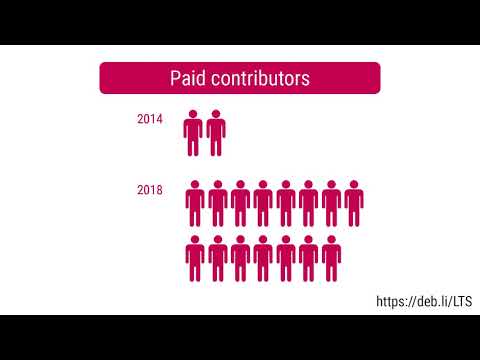
A Debian LTS logo Like each month, here comes a report about the work of paid contributors to Debian LTS. Individual reports In November, 239.25 work hours have been dispatched among 13 paid contributors. Their reports are available: Evolution of the situation In November we held the last LTS team meeting for 2020 on IRC, with the next one coming up at the end of January.
We announced a new formalized initiative for Funding Debian projects with money from Freexian s LTS service.
Finally, we would like to remark once again that we are constantly looking for new contributors. Please contact Holger if you are interested! We re also glad to welcome two new sponsors, Moxa, a device manufacturer, and a French research lab (Institut des Sciences Cognitives Marc Jeannerod). The security tracker currently lists 37 packages with a known CVE and the dla-needed.txt file has 40 packages needing an update. Thanks to our sponsors Sponsors that joined recently are in bold.

One comment Liked this article? Click here. My blog is Flattr-enabled.

14 December 2020

Raphaël Hertzog: Funding Debian development projects with Freexian, first project received!

After an unexpectedly short discussion on debian-project, we re moving forward with this new initiative. The Debian security team submitted a project proposal requesting some improvements to tracker.debian.org, and since nobody of the security team wants to be paid to implement the project, we have opened a request for bids to find someone to implement this on a contractor basis. If you can code in Python following test-driven development and know the Django framework, feel free to submit a bid! Ideally you have some experience with the security tracker too but that s not a strong requirement. About the project If you haven t read the discussion on debian-project, Freexian is putting aside part of the money collected for Debian LTS to use it to fund generic Debian development projects. The goal is two-fold:
  1. First, the LTS work necessarily had an impact on other Debian teams that made the project possible (security team, DSA, buildd, ftpmasters, debian-www mainly) and we wanted to be able to give back to those teams by funding improvements to their infrastructure.
  2. We have always allowed paid contributors to go beyond just preparing security updates for the LTS release. They can pick tasks that improve the LTS project at large (we try to collect such tasks here: https://salsa.debian.org/lts-team/lts-extra-tasks/-/issues) but they should not go over 25% of their allocated monthly hours so this limits their ability to tackle bigger projects and we would like to be able to tackle bigger projects that can have a meaningful impact on the LTS project and/or Debian in general.
We have tried to formalize a process to follow from project submission up to its implementation in this salsa project:
https://salsa.debian.org/freexian-team/project-funding
https://salsa.debian.org/freexian-team/project-funding/-/blob/master/Rules-LTS.md We highly encourage the above-mentioned Debian teams to make proposals. A member of those teams can implement the project and be paid for it. Or they can decide to let someone else implement it (we expect some of the paid LTS contributors to be willing to implement such projects), and just play the reviewer role driving the person doing the work in the right direction. Contrary to Google s Summer of code and other similar projects, we put the focus on the results (and not in recruiting new volunteers), so we expect to work with experienced persons to implement the project. But if the reviewer is happy to be a mentor and spend more time, then it s OK for us too. The reviewer is (usually) not a paid position. If you re not among those teams, but if you have a project that can have a positive impact on Debian LTS (even if only indirectly in the distant future), feel free to try your chance and to submit a proposal.

No comment Liked this article? Click here. My blog is Flattr-enabled.

13 December 2020

Jan Wagner: Monitoring Plugins 2.3 released

While our last release has matured for quite a little time, there raised demands within our community for a new release. The development has settled this fall and @sni was already using master for a while in production, so we thought about to release. Anyway Debian Freeze is coming, let's cut a new upstream release! The last question was: Who should cut the release? The last releases was done by @JeremyHolger, but these days everybody is short on time. Fortunately Holger has documented the whole release process very well, so I jumped on the band wagon and slipped into the release wizard role.
Surprisingly it seems I was able to fix all faults I've done in the release process (beside using the 2.2 link in the release announcement mail) and kicked the release of monitoring-plugins 2.3 successfully. Grab the new Monitoring Plugins release while it's hot (and give the new check_curl a try)!
Hopefully monitoring-plugins 2.3 will hit Debian experimental soon.

8 December 2020

Russell Coker: Links December 2020

Business Insider has an informative article about the way that Google users can get locked out with no apparent reason and no recourse [1]. Something to share with clients when they consider putting everything in the cloud . Vice has an interestoing article about people jailbreaking used Teslas after Tesla has stolen software licenses that were bought with the car [2]. The Atlantic has an interesting article titled This Article Won t Change Your Mind [3]. It s one of many on the topic of echo chambers but has some interesting points that others don t seem to cover, such as regarding the benefits of groups when not everyone agrees. Inequality.org has lots of useful information about global inequality [4]. Jeffrey Goldberg has an insightful interview with Barack Obama for the Atlantic about the future course of American politics and a retrospective on his term in office [5]. A Game Designer s Analysis Of QAnon is an insightful Medium article comparing QAnon to an augmented reality game [6]. This is one of the best analysis of QAnon operations that I ve seen. Decrypting Rita is one of the most interesting web comics I ve read [7]. It makes good use of side scrolling and different layers to tell multiple stories at once. PC Mag has an article about the new features in Chrome 87 to reduce CPU use [8]. On my laptop I have 1/3 of all CPU time being used when it is idle, the majority of which is from Chrome. As the CPU has 2 cores this means the equivalent of 1 core running about 66% of the time just for background tabs. I have over 100 tabs open which I admit is a lot. But it means that the active tabs (as opposed to the plain HTML or PDF ones) are averaging more than 1% CPU time on an i7 which seems obviously unreasonable. So Chrome 87 doesn t seem to live up to Google s claims. The movie Bad President starring Stormy Daniels as herself is out [9]. Poe s Law is passe. Interesting summary of Parler, seems that it was designed by the Russians [10]. Wired has an interesting article about Indistinguishability Obfuscation, how to encrypt the operation of a program [11]. Joerg Jaspert wrote an interesting blog post about the difficulties packagine Rust and Go for Debian [12]. I think that the problem is many modern languages aren t designed well for library updates. This isn t just a problem for Debian, it s a problem for any long term support of software that doesn t involve transferring a complete archive of everything and it s a problem for any disconnected development (remote sites and sites dealing with serious security. Having an automatic system for downloading libraries is fine. But there should be an easy way of getting the same source via an archive format (zip will do as any archive can be converted to any other easily enough) and with version numbers.

1 December 2020

Paul Wise: FLOSS Activities November 2020

Focus This month I didn't have any particular focus. I just worked on issues in my info bubble.

Changes

Issues

Review

Administration
  • Debian wiki: disable attachments due to security issue, approve accounts

Communication
  • Respond to queries from Debian users and contributors on the mailing lists and IRC

Sponsors The visdom, apt-listchanges work and lintian-brush bug report were sponsored by my employer. All other work was done on a volunteer basis.

30 November 2020

Chris Lamb: Free software activities in November 2020

Here is my monthly update covering what I have been doing in the free software world during November 2020 (previous month):

Reproducible Builds One of the original promises of open source software is that distributed peer review and transparency of process results in enhanced end-user security. However, whilst anyone may inspect the source code of free and open source software for malicious flaws, almost all software today is distributed as pre-compiled binaries. This allows nefarious third-parties to compromise systems by injecting malicious code into ostensibly secure software during the various compilation and distribution processes. The motivation behind the Reproducible Builds effort is to ensure no flaws have been introduced during this compilation process by promising identical results are always generated from a given source, thus allowing multiple third-parties to come to a consensus on whether a build was compromised. The project is proud to be a member project of the Software Freedom Conservancy. Conservancy acts as a corporate umbrella allowing projects to operate as non-profit initiatives without managing their own corporate structure. If you like the work of the Conservancy or the Reproducible Builds project, please consider becoming an official supporter.
This month, I:
I also made the following changes to diffoscope:

Debian I performed the following uploads to the Debian Linux distribution this month: I also filed a release-critical bug against the minidlna package which could not be successfully purged from the system without reporting a cannot remove '/var/log/minidlna' error. (#975372)

Debian LTS This month I have worked 18 hours on Debian Long Term Support (LTS) and 12 hours on its sister Extended LTS project, including: You can find out more about the Debian LTS project via the following video:

25 November 2020

Shirish Agarwal: Women state in India and proposal for corporates in Indian banking

Gradle and Kotlin in Debian Few months back, I was looking at where Gradle and Kotlin were in Debian. They still seem to be a work in progress. I found the Android-tools salsa repo which tells me the state of things. While there has been movement on both, a bit more on Kotlin, it still seems it would take a while. For kotlin, the wiki page is most helpful as well as the android-tool salsa kotlin board page . Ironically, some of the more important info. is shared in a blog post which ideally should also have been reflected in kotlin board page . I did see some of the bugs so know it s pretty much dependency hell. I can only congratulate and encourage Samyak Jain and Raman Sarda. I also played a bit with the google-android-emulator-installer which is basically a hook which downloads the binary from google. I do not know what the plans are, but perhaps in the future they also might be build locally, who knows. Just sharing/stating here so it s part of my notes whenever I wanna see what s happening

Women in India I am sure some of you might remember my blog post from last year. It is almost close to a year 2020 now and the question to be asked is, has much changed ? After a lot or hue and cry the Government of India shared the NCRB data of crimes against women and caste crimes. The report shared that crimes against women had risen by 7.3% in a year, similarly crimes against lower castes also went by similar percentage . With the 2020 pandemic, I am sure the number has gone up more. And there is a possibility that just like last year, next year the Government would cite the pandemic and say no data. This year they have done it for migrant deaths during lockdown , for job losses due to the pandemic and so on and so forth. So, it will be no surprise if the Govt. says about NCRB data next year as well. Although media has been showing some in spite of the regular threats to the journalists as shared in the last blog post. There is also data that shows that women participation in labor force has fallen sharply especially in the last few years and the Government seems to have no neither idea nor do they seem to care for the same. There aren t any concrete plans to bring back the balance even a little bit.

Few Court judgements But all hope is not lost. There have been a couple of good judgements, one from the CIC (Chief Information Commissioner) wherein in specific cases a wife can know salary details of her husband, especially if there is some kind of maintenance due from the husband. There was so much of hue and cry against this order that it was taken down from the livelaw RTI corner. Luckily, I had downloaded it, hence could upload and share it. Another one was a case/suit about a legally matured women who had decided to marry without parental consent. In this case, the Delhi High Court had taken women s side and stated she can marry whom she wants. Interestingly, about a week back Uttar Pradesh (most notorious about crime against women) had made laws called Love Jihad and 2 -3 states have followed them. The idea being to create an atmosphere of hate against Muslims and women have no autonomy about what they want. This is when in a separate suit/case against Sudharshan TV (a far-right leaning channel promoting hate against Muslims) , the Government of India itself put an affidavit stating that Tablighis (a sect of Muslims who came from Malaysia to India for religious discourse and assembly) were not responsible for dissemination of the virus and some media has correctly portrayed the same. Of course, those who are on the side of the Govt. on this topic think a traitor has written. They also thought that the Govt. had taken a wrong approach but couldn t tell of a better approach to the matter. There are too many matters in the Supreme Court of women asking for justice to tell all here but two instances share how the SC has been buckling under the stress of late, one is a webinar which was chaired by Justice Subramaniam where he shared how the executive is using judicial appointments to do what it wants. The gulf between the executive and the SC has been since Indira Gandhi days, especially the judicial orders which declared that the Emergency is valid by large, it has fallen much more recently and the executive has been muscling in which have resulted in more regressive decisions than progressive.

This observation is also in tune with another study which came to the same result although using data. The raw data from the study could give so much more than what has been shared. For e.g. as an idea for the study, of the ones cited, how many have been in civil law, personal law, criminal or constitutional law. This would give a better understanding of things. Also what is shocking is none of our court orders have been cited in the west in the recent past, when there used to be a time when the west used to take guidance from Indian jurisprudence sometimes and cite the orders to reach similar conclusion or if not conclusion at least be used as a precedent. I guess those days are over.

Government giving Corporate ownership to Private Sector Banks There was an Internal Working Group report to review extant ownership guidelines and Corporate Structure for Indian Private Sector Banks. This is the actual title of the report. Now there were and are concerns about the move which were put forth by Dr. Raghuram Rajan and Viral Acharya. While Dr. Rajan had been the 23rd Governor of RBI from 4th September 2013 to 4th September 2016. His most commendable work which largely is unknown to most people was the report A hundred small steps which you buy from sage publications. Viral Acharya was the deputy governor from 23rd January 2017 23rd July 2019. Mr. Acharya just recently published his book Quest for Restoring Financial Stability in India which can be bought from the same publication house as well. They also wrote a three page article stating that does India need corporates in banking? More interestingly, he shares two points from history both world war 1 and world war 2. In both cases, the allies had to cut down the businesses who had owned banks. In Germany, it was the same and in Japan, the zaibatsu s dissolution, both of which were needed to make the world safe again. Now, if we don t learn lessons from history it is our fault, not history s. What was also shared that this idea was taken up in 2013 but was put into cold-storage. He also commented on the pressure on RBI as all co-operative banks have come under its ambit in the last few months. RBI has had a patchy record, especially in the last couple of years, with big scams like ILFS, Yes Bank, PMC Bank, Laxmi Vilas Bank among others. The LVB Bank being the most recent one. If new banking licenses have to be given they can be given to good NBFC s who have been in the market for a long time and have shown maturity while dealing with public money. What is the hurry for giving it to Corporate/business houses ? There are many other good points in the report with which both Mr. Rajan and Mr. Acharya are in agreement and do hope the other points/suggestions/proposals are implemented. There was and is an interesting report by Reserve Bank of India called financial sector legislative reforms commission report volume 1 . If and when it gets deleted from RBI, I have put up a copy at my WordPress account, so we shall always have one. Interestingly, while looking through the people who were part of the committee was a somewhat familiar name Murmu . This is perhaps the first time you see people from a sort of political background being in what should be a cut and dry review which have people normally from careers in finance or Accounts. It also turns out that only one person was in favor of banks going to corporates, all the rest were against. It seems that the specific person hadn t heard the terms self-lending , connected-lending and conflict of interest. One of the more interesting comments in the report is if a corporate has a bank, then why would he go to Switzerland, he would just wash the money in his own bank. And if banks were to become to big to fail like it happened in the United States, it would be again private gains, public losses. There was also a Washington Post article which shares some of the reasons that Indian banks fail. I think we need to remind ourselves once again, how things can become
https://www.youtube.com/watch?v=2gK3s5j7PgA

Positive News at end At the end I do not want to end on a sour notes, hence sharing a YouTube channel of Films Division India where you can see of the very classic works and interviews of some of the greats in Indian art cinema.

https://www.youtube.com/user/FilmsDivision/videos Also sharing a bit of funny story I came to know about youtube-dl, apparently it was taken off from github but thanks to efforts from EFF, Hackernews and others, it is now back in action.

11 November 2020

Reproducible Builds: Reproducible Builds in October 2020

Welcome to the October 2020 report from the Reproducible Builds project. In our monthly reports, we outline the major things that we have been up to over the past month. As a brief reminder, the motivation behind the Reproducible Builds effort is to ensure flaws have not been introduced in the binaries we install on our systems. If you are interested in contributing to the project, please visit our main website.

General On Saturday 10th October, Morten Linderud gave a talk at Arch Conf Online 2020 on The State of Reproducible Builds in Arch. The video should be available later this month, but as a teaser:
The previous year has seen great progress in Arch Linux to get reproducible builds in the hands of the users and developers. In this talk we will explore the current tooling that allows users to reproduce packages, the rebuilder software that has been written to check packages and the current issues in this space.
During the Reproducible Builds summit in Marrakesh in 2019, developers from the GNU Guix, NixOS and Debian distributions were able to produce a bit-for-bit identical GNU Mes binary despite using three different versions of GCC. Since this summit, additional work resulted in a bit-for-bit identical Mes binary using tcc, and last month a fuller update was posted to this effect by the individuals involved. This month, however, David Wheeler updated his extensive page on Fully Countering Trusting Trust through Diverse Double-Compiling, remarking that:
GNU Mes rebuild is definitely an application of [Diverse Double-Compiling]. [..] This is an awesome application of DDC, and I believe it s the first publicly acknowledged use of DDC on a binary
There was a small, followup discussion on our mailing list. In openSUSE, Bernhard M. Wiedemann published his monthly Reproducible Builds status update. This month, the Reproducible Builds project restarted our IRC meetings, managing to convene twice: the first time on October 12th (summary & logs), and later on the 26th (logs). As mentioned in previous reports, due to the unprecedented events throughout 2020, there will be no in-person summit event this year. On our mailing list this month El as Alejandro posted a request for help with a local configuration

Software development This month, we tried to fix a large number of currently-unreproducible packages, including: Bernhard M. Wiedemann also reported three issues against bison, ibus and postgresql12.

Tools diffoscope is our in-depth and content-aware diff utility. Not only could you locate and diagnose reproducibility issues, it provides human-readable diffs of all kinds too. This month, Chris Lamb uploaded version 161 to Debian (later backported by Mattia Rizzolo), as well as made the following changes:
  • Move test_ocaml to the assert_diff helper. [ ]
  • Update tests to support OCaml version 4.11.1. Thanks to Sebastian Ramacher for the report. (#972518)
  • Bump minimum version of the Black source code formatter to 20.8b1. (#972518)
In addition, Jean-Romain Garnier temporarily updated the dependency on radare2 to ensure our test pipelines continue to work [ ], and for the GNU Guix distribution Vagrant Cascadian diffoscope to version 161 [ ]. In related development, trydiffoscope is the web-based version of diffoscope. This month, Chris Lamb made the following changes:
  • Mark a --help-only test as being a superficial test. (#971506)
  • Add a real, albeit flaky, test that interacts with the try.diffoscope.org service. [ ]
  • Bump debhelper compatibility level to 13 [ ] and bump Standards-Version to 4.5.0 [ ].
Lastly, disorderfs version 0.5.10-2 was uploaded to Debian unstable by Holger Levsen, which enabled security hardening via DEB_BUILD_MAINT_OPTIONS [ ] and dropped debian/disorderfs.lintian-overrides [ ].

Website and documentation This month, a number of updates to the main Reproducible Builds website and related documentation were made by Chris Lamb:
  • Add a citation link to the academic article regarding dettrace [ ], and added yet another supply-chain security attack publication [ ].
  • Reformatted the Jekyll s Liquid templating language and CSS formatting to be consistent [ ] as well as expand a number of tab characters [ ].
  • Used relative_url to fix missing translation icon on various pages. [ ]
  • Published two announcement blog posts regarding the restarting of our IRC meetings. [ ][ ]
  • Added an explicit note regarding the lack of an in-person summit in 2020 to our events page. [ ]

Testing framework The Reproducible Builds project operates a Jenkins-based testing framework that powers tests.reproducible-builds.org. This month, Holger Levsen made the following changes:
  • Debian-related changes:
    • Refactor and improve the Debian dashboard. [ ][ ][ ]
    • Track bugs which are usertagged as filesystem , fixfilepath , etc.. [ ][ ][ ]
    • Make a number of changes to package index pages. [ ][ ][ ]
  • System health checks:
    • Relax disk space warning levels. [ ]
    • Specifically detect build failures reported by dpkg-buildpackage. [ ]
    • Fix a regular expression to detect outdated package sets. [ ]
    • Detect Lintian issues in diffoscope. [ ]
  • Misc:
    • Make a number of updates to reflect that our sponsor Profitbricks has renamed itself to IONOS. [ ][ ][ ][ ]
    • Run a F-Droid maintenance routine twice a month to utilise its cleanup features. [ ]
    • Fix the target name in OpenWrt builds to ath79 from ath97. [ ]
    • Add a missing Postfix configuration for a node. [ ]
    • Temporarily disable Arch Linux builds until a core node is back. [ ]
    • Make a number of changes to our thanks page. [ ][ ][ ]
Build node maintenance was performed by both Holger Levsen [ ][ ] and Vagrant Cascadian [ ][ ][ ], Vagrant Cascadian also updated the page listing the variations made when testing to reflect changes for in build paths [ ] and Hans-Christoph Steiner made a number of changes for F-Droid, the free software app repository for Android devices, including:
  • Do not fail reproducibility jobs when their cleanup tasks fail. [ ]
  • Skip libvirt-related sudo command if we are not actually running libvirt. [ ]
  • Use direct URLs in order to eliminate a useless HTTP redirect. [ ]

If you are interested in contributing to the Reproducible Builds project, please visit the Contribute page on our website. However, you can also get in touch with us via:

1 November 2020

Utkarsh Gupta: FOSS Activites in October 2020

Here s my (thirteenth) monthly update about the activities I ve done in the F/L/OSS world.

Debian
This was my 22nd month of contributing to Debian. I became a DM in late March last year and a DD last Christmas! \o/ Whilst busy with my undergrad, I could still take some time out for contributing to Debian (I always do!). Here are the following things I did in Debian this month:

Uploads and bug fixes:

Other $things:
  • Attended the Debian Ruby team meeting. Logs here.
  • Mentoring for newcomers.
  • FTP Trainee reviewing.
  • Moderation of -project mailing list.
  • Sponsored phpmyadmin, php-bacon-baconqrcode, twig, php-dasprid-enum, sql-parser, and mariadb-mysql-kbs for William.

Debian (E)LTS
Debian Long Term Support (LTS) is a project to extend the lifetime of all Debian stable releases to (at least) 5 years. Debian LTS is not handled by the Debian security team, but by a separate group of volunteers and companies interested in making it a success. And Debian Extended LTS (ELTS) is its sister project, extending support to the Jessie release (+2 years after LTS support). This was my thirteenth month as a Debian LTS and fourth month as a Debian ELTS paid contributor.
I was assigned 20.75 hours for LTS and 30.00 hours for ELTS and worked on the following things:
(for ELTS, I worked for 5.25 hours extra, so my total hours this month for ELTS were 35.25!)

LTS CVE Fixes and Announcements:
  • Issued DLA 2389-1, fixing CVE-2019-18978, for ruby-rack-cors.
    For Debian 9 Stretch, these problems have been fixed in version 0.4.0-1+deb9u2.
  • Issued DLA 2390-1, fixing CVE-2019-18848, for ruby-json-jwt.
    For Debian 9 Stretch, these problems have been fixed in version 1.6.2-1+deb9u2.
  • Issued DLA 2391-1, fixing CVE-2020-25613, for ruby2.3.
    For Debian 9 Stretch, these problems have been fixed in version 2.3.3-1+deb9u9.
  • Issued DLA 2392-1, fixing CVE-2020-25613, for jruby.
    For Debian 9 Stretch, these problems have been fixed in version 1.7.26-1+deb9u3.
  • Uploaded ruby2.5 to buster, fixing CVE-2020-25613. For Debian 10 Buster, these problems have been fixed in version 2.5.5-3+deb10u3.
  • Uploaded ruby2.7 to unstable, fixing CVE-2020-25613. For Debian Sid, these problems have been fixed in version 2.7.1-4.
  • Uploaded rails to unstable, fixing CVE-2020-8264. For Debian Sid, these problems have been fixed in version 2:6.0.3.4+dfsg-1.

ELTS CVE Fixes and Announcements:

Other (E)LTS Work:
  • Front-desk duty from 28-09 to 04-10 and from 26-10 until 01-10 for both LTS and ELTS.
  • Triaged libproxy, libvirt, libonig, ant, erlang, ruby2.3, jruby, dpdk, php7.0, spice, spice-gtk, wireshark, djangorestframework, python-urllib3, python-cryptography, qtsvg-opensource-src, and open-build-service.
  • Marked CVE-2020-26137/python-urllib3 as no-dsa for Stretch and Jessie.
  • Marked CVE-2020-1437 4,5,6,7,8 /dpdk as no-dsa for Stretch.
  • Marked CVE-2020-2586 2,3 /wireshark as postponed for Stretch.
  • Marked CVE-2020-25626/djangorestframework as no-dsa for Stretch.
  • Marked CVE-2020-11979/ant as not-affected for Jessie.
  • Marked CVE-2020-25623/erlang as not-affected for Jessie.
  • Marked CVE-2020-25659/python-cryptography as no-dsa for Stretch and Jessie.
  • Auto EOL ed jruby, libjs-handlebars, linux, pluxml, mupdf, and djangorestframework for Jessie.
  • [E/LTS] Worked on putting survey online, deployed LTS Team Pages \o/
  • [ELTS] Fix suite-name in ela-needed file and fix other tags and ordering of triages to fix errors in the security tracker.
  • [LTS] Sent out invitations for the meeting.
  • Attended the sixth private LTS meeting.
  • General discussion on LTS private and public mailing list.

Until next time.
:wq for today.

31 October 2020

Chris Lamb: Free software activities in October 2020

Here is my monthly update covering what I have been doing in the free software world during October 2020 (previous month): For Lintian, the static analysis tool for Debian packages, I uploaded versions 2.97.0, 2.98.0, 2.99.0 & 2.100.0 as well as updated the declares-possibly-conflicting-debhelper-compat-versions tag as we may specify the Debhelper compatibility level in debian/rules or debian/control (#972464) and dropped a reference to missing manual page [...].

Reproducible Builds One of the original promises of open source software is that distributed peer review and transparency of process results in enhanced end-user security. However, whilst anyone may inspect the source code of free and open source software for malicious flaws, almost all software today is distributed as pre-compiled binaries. This allows nefarious third-parties to compromise systems by injecting malicious code into ostensibly secure software during the various compilation and distribution processes. The motivation behind the Reproducible Builds effort is to ensure no flaws have been introduced during this compilation process by promising identical results are always generated from a given source, thus allowing multiple third-parties to come to a consensus on whether a build was compromised. The project is proud to be a member project of the Software Freedom Conservancy. Conservancy acts as a corporate umbrella allowing projects to operate as non-profit initiatives without managing their own corporate structure. If you like the work of the Conservancy or the Reproducible Builds project, please consider becoming an official supporter. This month, I: I also updated the main Reproducible Builds website and documentation:
Lastly, I made the following changes to diffoscope, including preparing and uploading version 161 to Debian: trydiffoscope is the web-based version of diffoscope. This month, I made the following changes:

Debian Debian LTS This month I have worked 18 hours on Debian Long Term Support (LTS) and 12 hours on its sister Extended LTS project. You can find out more about the project via the following video:

Uploads Bugs filed

Jonathan Carter: Free Software Activities for 2020-10

Another month, another bunch of uploads. The freeze for Debian 11 (bullseye) is edging closer, so I ve been trying to get my package list in better shape ahead of that. Thanks to those who worked on fixing lintian.debian.org and the lintian reports on the QA pages, those are immensely useful and it s great to have that back! 2020-10-04: Upload package gnome-shell-extension-draw-on-your-screen (8-1) to Debian unstable. 2020-10-05: Sponsor package flask-restful (0.3.8-4) for Debian unstable (Python Team request). 2020-10-05: Sponsor package python-potr (1.0.2-3) for Debian unstable (Python Team request). 2020-10-06: Sponsor package python-pyld (2.0.3-1) for Debian unstable (Python Team request). 2020-10-06: Sponsor package flask-openid (1.2.5+dfsg-4) for Debian unstable (Python Team request). 2020-10-06: Sponsor package qosmic (1.6.0-4) for Debian unstable (E-mail request). 2020-10-07: File removal for gnome-shell-extension-workspace-to-dock (RC Buggy, no longer maintained: #971803). 2020-10-07: Upload package gnome-shell-extension-pixelsaver (1.20-2) to Debian unstable (Closes: #971689). 2020-10-07: Upload package calamares (3.2.31-1) to Debian unstable. 2020-10-07: Upload package gnome-shell-extension-dashtodock (69-1) to Debian unstable (Closes: #971654). 2020-10-08: Sponsor package python3-libcloud (3.020-1) for Debian unstable. 2020-10-09: Upload package gnome-shell-extension-dashtopanel (40-1) to Debian unstable (Closes: #971087). 2020-10-09: Upload package gnome-shell-extension-draw-on-your-screen (8.1-1) to Debian unstable. 2020-10-12: Upload package gnome-shell-extension-pixelsaver (1.24-1) to Debian unstable. 2020-10-14: Sponsor package python3-onewire (0.2-1) for Debian unstable (Python Team request). 2020-10-15: Sponsor package cheetah (3.2.5-1) for Debian unstable (Python Team request). 2020-10-15: Sponsor package xmodem (0.4.6+dfsg-1) for Debian unstable (Python Team request). 2020-10-15: Sponsor package ansi (0.1.5-1) for Debian unstable (Python Team request). 2020-10-15: Sponsor package cbor2 (5.2.0-1) for Debian unstable (Python Team request). 2020-10-16: Upload package calamares (3.2.32-1) to Debian unstable. 2020-10-17: Upload package calamares (3.2.32.1-1) to Debian unstable. 2020-10-18: Upload package kpmcore (4.2.0-1) to Debian unstable. 2020-10-18: Upload package gnome-shell-extension-draw-on-your-screen (9-1) to Debian unstable. 2020-10-18: Upload package bundlewrap (4.2.1-1) to Debian unstable. 2020-10-18: Upload package bcachefs-tools (0.1+git20201017.8a4408-1~exp1) to Debian experimental. 2020-10-18: Upload package calamares (3.2.32.1-2) to Debian unstable. 2020-10-18: Upload package partitionmanager (4.1.0-2) to Debian unstable. 2020-10-19: Upload package kpmcore (4.2.0-2) to Debian unstable. 2020-10-21: Upload package calamares (3.2.32.1-3) to Debian unstable. 2020-10-21: Upload package calamares-settings-debian (11.0.3-1) to Debian unstable (Closes: #969930, #941301). 2020-10-21: Upload package partitionmanager (4.2.0-1) to Debian unstable. 2020-10-21: Upload package gnome-shell-extension-hard-disk-led (22-1) to Debian unstable (Closes: #971041). 2020-10-21: Merge MR!1 for catimg (Janitor improvements). 2020-10-21: Sponsor package r4d (1.7-1) for Debian unstable (Python Team request). 2020-10-22: Upload package aalib (1.4rc5-47) to Debian unstable. 2020-10-22: Upload package fabulous (0.3.0+dfsg1-8) to Debian unstable. 2020-10-22: Merge MR!1 for gdisk (Janitor improvements). 2020-10-22: Merge MR!1 for gnome-shell-extension-arc-menu (New upstream URLs, thanks Edward Betts). 2020-10-22: Upload package gnome-shell-extension-arc-menu (49-1) to Debian unstable. 2020-10-22: Upload package gnome-shell-extension-draw-on-your-screen (10-1) to Debian unstable. 2020-10-22: Merge MR!1 for vim-airline (Janitor improvements). 2020-10-22: Merge MR!1 for vim-airline-themes (Janitor improvements). 2020-10-22: Merge MR!1 for preload (Janitor improvements). 2020-10-22: Upload package aalib (1.4rc5-48) to Debian unstable. 2020-10-22: Upload package gnome-shell-extension-trash (0.2.0-git20200326.3425fcf1-1). 2020-10-26: Upload package bcachefs-tools (0.1+git20201025.742dbbdb-1) to Debian unstable. 2020-10-26: Sponsor package dunst (1.5.0-1) for Debian unstable (mentors.debian.net request).

24 October 2020

Jelmer Vernooij: Debian Janitor: Hosters used by Debian packages

The Debian Janitor is an automated system that commits fixes for (minor) issues in Debian packages that can be fixed by software. It gradually started proposing merges in early December. The first set of changes sent out ran lintian-brush on sid packages maintained in Git. This post is part of a series about the progress of the Janitor. The Janitor knows how to talk to different hosting platforms. For each hosting platform, it needs to support the platform- specific API for creating and managing merge proposals. For each hoster it also needs to have credentials. At the moment, it supports the GitHub API, Launchpad API and GitLab API. Both GitHub and Launchpad have only a single instance; the GitLab instances it supports are gitlab.com and salsa.debian.org. This provides coverage for the vast majority of Debian packages that can be accessed using Git. More than 75% of all packages are available on salsa - although in some cases, the Vcs-Git header has not yet been updated. Of the other 25%, the majority either does not declare where it is hosted using a Vcs-* header (10.5%), or have not yet migrated from alioth to another hosting platform (9.7%). A further 2.3% are hosted somewhere on GitHub (2%), Launchpad (0.18%) or GitLab.com (0.15%), in many cases in the same repository as the upstream code. The remaining 1.6% are hosted on many other hosts, primarily people s personal servers (which usually don t have an API for creating pull requests). Packages per hoster

Outdated Vcs-* headers It is possible that the 20% of packages that do not have a Vcs-* header or have a Vcs header that say there on alioth are actually hosted elsewhere. However, it is hard to know where they are until a version with an updated Vcs-Git header is uploaded. The Janitor primarily relies on vcswatch to find the correct locations of repositories. vcswatch looks at Vcs-* headers but has its own heuristics as well. For about 2,000 packages (6%) that still have Vcs-* headers that point to alioth, vcswatch successfully finds their new home on salsa.
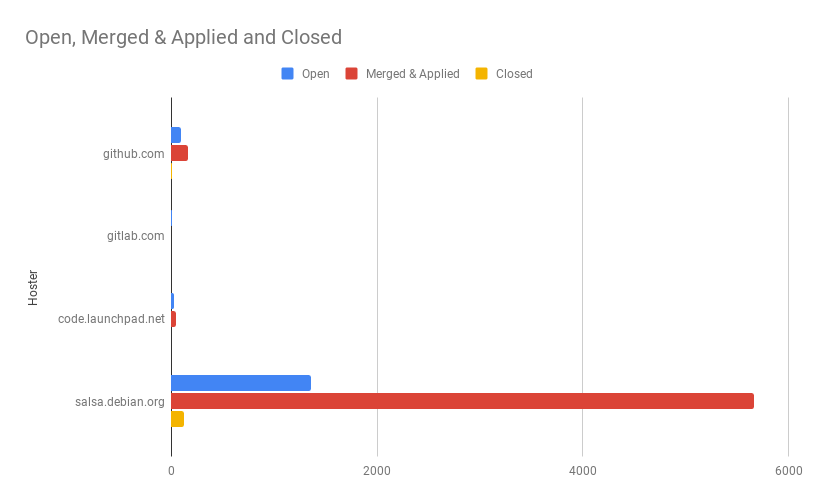
Merge Proposals by Hoster These proportions are also visible in the number of pull requests created by the Janitor on various hosters. The vast majority so far has been created on Salsa.
Hoster Open Merged & Applied Closed
github.com921685
gitlab.com1230
code.launchpad.net24511
salsa.debian.org1,3605,657126
Merge Proposal statistics In this graph, Open means that the pull request has been created but likely nobody has looked at it yet. Merged means that the pull request has been marked as merged on the hoster, and applied means that the changes have ended up in the packaging branch but via a different route (e.g. cherry-picked or manually applied). Closed means that the pull request was closed without the changes being incorporated. Note that this excludes ~5,600 direct pushes, all of which were to salsa-hosted repositories. See also:

For more information about the Janitor's lintian-fixes efforts, see the landing page.

19 October 2020

Louis-Philippe V ronneau: Musings on long-term software support and economic incentives

Although I still read a lot, during my college sophomore years my reading habits shifted from novels to more academic works. Indeed, reading dry textbooks and economic papers for classes often kept me from reading anything else substantial. Nowadays, I tend to binge read novels: I won't touch a book for months on end, and suddenly, I'll read 10 novels back to back1. At the start of a novel binge, I always follow the same ritual: I take out my e-reader from its storage box, marvel at the fact the battery is still pretty full, turn on the WiFi and check if there are OS updates. And I have to admit, Kobo Inc. (now Rakuten Kobo) has done a stellar job of keeping my e-reader up to date. I've owned this model (a Kobo Aura 1st generation) for 7 years now and I'm still running the latest version of Kobo's Linux-based OS. Having recently had trouble updating my Nexus 5 (also manufactured 7 years ago) to Android 102, I asked myself:
Why is my e-reader still getting regular OS updates, while Google stopped issuing security patches for my smartphone four years ago?
To try to answer this, let us turn to economic incentives theory. Although not the be-all and end-all some think it is3, incentives theory is not a bad tool to analyse this particular problem. Executives at Google most likely followed a very business-centric logic when they decided to drop support for the Nexus 5. Likewise, Rakuten Kobo's decision to continue updating older devices certainly had very little to do with ethics or loyalty to their user base. So, what are the incentives that keep Kobo updating devices and why are they different than smartphone manufacturers'? A portrait of the current long-term software support offerings for smartphones and e-readers Before delving deeper in economic theory, let's talk data. I'll be focusing on 2 brands of e-readers, Amazon's Kindle and Rakuten's Kobo. Although the e-reader market is highly segmented and differs a lot based on geography, Amazon was in 2015 the clear worldwide leader with 53% of the worldwide e-reader sales, followed by Rakuten Kobo at 13%4. On the smartphone side, I'll be differentiating between Apple's iPhones and Android devices, taking Google as the barometer for that ecosystem. As mentioned below, Google is sadly the leader in long-term Android software support. Rakuten Kobo According to their website and to this Wikipedia table, the only e-readers Kobo has deprecated are the original Kobo eReader and the Kobo WiFi N289, both released in 2010. This makes their oldest still supported device the Kobo Touch, released in 2011. In my book, that's a pretty good track record. Long-term software support does not seem to be advertised or to be a clear selling point in their marketing. Amazon According to their website, Amazon has dropped support for all 8 devices produced before the Kindle Paperwhite 2nd generation, first sold in 2013. To put things in perspective, the first Kindle came out in 2007, 3 years before Kobo started selling devices. Like Rakuten Kobo, Amazon does not make promises of long-term software support as part of their marketing. Apple Apple has a very clear software support policy for all their devices:
Owners of iPhone, iPad, iPod or Mac products may obtain a service and parts from Apple or Apple service providers for five years after the product is no longer sold or longer, where required by law.
This means in the worst-case scenario of buying an iPhone model just as it is discontinued, one would get a minimum of 5 years of software support. Android Google's policy for their Android devices is to provide software support for 3 years after the launch date. If you buy a Pixel device just before the new one launches, you could theoretically only get 2 years of support. In 2018, Google decided OEMs would have to provide security updates for at least 2 years after launch, threatening not to license Google Apps and the Play Store if they didn't comply. A question of cost structure From the previous section, we can conclude that in general, e-readers seem to be supported longer than smartphones, and that Apple does a better job than Android OEMs, providing support for about twice as long. Even Fairphone, who's entire business is to build phones designed to last and to be repaired was not able to keep the Fairphone 1 (2013) updated for more than a couple years and seems to be struggling to keep the Fairphone 2 (2015) running an up to date version of Android. Anyone who has ever worked in IT will tell you: maintaining software over time is hard work and hard work by specialised workers is expensive. Most commercial electronic devices are sold and developed by for-profit enterprises and software support all comes down to a question of cost structure. If companies like Google or Fairphone are to be expected to provide long-term support for the devices they manufacture, they have to be able to fund their work somehow. In a perfect world, people would be paying for the cost of said long-term support, as it would likely be cheaper then buying new devices every few years and would certainly be better for the planet. Problem is, manufacturers aren't making them pay for it. Economists call this type of problem externalities: things that should be part of the cost of a good, but aren't for one a reason or another. A classic example of an externality is pollution. Clearly pollution is bad and leads to horrendous consequences, like climate change. Sane people agree we should drastically cut our greenhouse gas emissions, and yet, we aren't. Neo-classical economic theory argues the way to fix externalities like pollution is to internalise these costs, in other words, to make people pay for the "real price" of the goods they buy. In the case of climate change and pollution, neo-classical economic theory is plain wrong (spoiler alert: it often is), but this is where band-aids like the carbon tax comes from. Still, coming back to long-term software support, let's see what would happen if we were to try to internalise software maintenance costs. We can do this multiple ways. 1 - Include the price of software maintenance in the cost of the device This is the choice Fairphone makes. This might somewhat work out for them since they are a very small company, but it cannot scale for the following reasons:
  1. This strategy relies on you giving your money to an enterprise now, and trusting them to "Do the right thing" years later. As the years go by, they will eventually look at their books, see how much ongoing maintenance is costing them, drop support for the device, apologise and move on. That is to say, enterprises have a clear economic incentive to promise long-term support and not deliver. One could argue a company's reputation would suffer from this kind of behaviour. Maybe sometime it does, but most often people forget. Political promises are a great example of this.
  2. Enterprises go bankrupt all the time. Even if company X promises 15 years of software support for their devices, if they cease to exist, your device will stop getting updates. The internet is full of stories of IoT devices getting bricked when the parent company goes bankrupt and their servers disappear. This is related to point number 1: to some degree, you have a disincentive to pay for long-term support in advance, as the future is uncertain and there are chances you won't get the support you paid for.
  3. Selling your devices at a higher price to cover maintenance costs does not necessarily mean you will make more money overall raising more money to fund maintenance costs being the goal here. To a certain point, smartphone models are substitute goods and prices higher than market prices will tend to drive consumers to buy cheaper ones. There is thus a disincentive to include the price of software maintenance in the cost of the device.
  4. People tend to be bad at rationalising the total cost of ownership over a long period of time. Economists call this phenomenon hyperbolic discounting. In our case, it means people are far more likely to buy a 500$ phone each 3 years than a 1000$ phone each 10 years. Again, this means OEMs have a clear disincentive to include the price of long-term software maintenance in their devices.
Clearly, life is more complex than how I portrayed it: enterprises are not perfect rational agents, altruism exists, not all enterprises aim solely for profit maximisation, etc. Still, in a capitalist economy, enterprises wanting to charge for software maintenance upfront have to overcome these hurdles one way or another if they want to avoid failing. 2 - The subscription model Another way companies can try to internalise support costs is to rely on a subscription-based revenue model. This has multiple advantages over the previous option, mainly:
  1. It does not affect the initial purchase price of the device, making it easier to sell them at a competitive price.
  2. It provides a stable source of income, something that is very valuable to enterprises, as it reduces overall risks. This in return creates an incentive to continue providing software support as long as people are paying.
If this model is so interesting from an economic incentives point of view, why isn't any smartphone manufacturer offering that kind of program? The answer is, they are, but not explicitly5. Apple and Google can fund part of their smartphone software support via the 30% cut they take out of their respective app stores. A report from Sensor Tower shows that in 2019, Apple made an estimated US$ 16 billion from the App Store, while Google raked in US$ 9 billion from the Google Play Store. Although the Fortune 500 ranking tells us this respectively is "only" 5.6% and 6.5% of their gross annual revenue for 2019, the profit margins in this category are certainly higher than any of their other products. This means Google and Apple have an important incentive to keep your device updated for some time: if your device works well and is updated, you are more likely to keep buying apps from their store. When software support for a device stops, there is a risk paying customers will buy a competitor device and leave their ecosystem. This also explains why OEMs who don't own app stores tend not to provide software support for very long periods of time. Most of them only make money when you buy a new phone. Providing long-term software support thus becomes a disincentive, as it directly reduces their sale revenues. Same goes for Kindles and Kobos: the longer your device works, the more money they make with their electronic book stores. In my opinion, it's likely Amazon and Rakuten Kobo produce quarterly cost-benefit reports to decide when to drop support for older devices, based on ongoing support costs and the recurring revenues these devices bring in. Rakuten Kobo is also in a more precarious situation than Amazon is: considering Amazon's very important market share, if your device stops getting new updates, there is a greater chance people will replace their old Kobo with a Kindle. Again, they have an important economic incentive to keep devices running as long as they are profitable. Can Free Software fix this? Yes and no. Free Software certainly isn't a magic wand one can wave to make everything better, but does provide major advantages in terms of security, user freedom and sometimes costs. The last piece of the puzzle explaining why Rakuten Kobo's software support is better than Google's is technological choices. Smartphones are incredibly complex devices and have become the main computing platform of many. Similar to the web, there is a race for features and complexity that tends to create bloat and make older devices slow and painful to use. On the other hand, e-readers are simpler devices built for a single task: display electronic books. Control over the platform is also a key aspect of the cost structure of providing software updates. Whereas Apple controls both the software and hardware side of iPhones, Android is a sad mess of drivers and SoCs, all providing different levels of support over time6. If you take a look at the platforms the Kindle and Kobo are built on, you'll quickly see they both use Freescale I.MX SoCs. These processors are well known for their excellent upstream support in the Linux kernel and their relative longevity, chips being produced for either 10 or 15 years. This in turn makes updates much easier and less expensive to provide. So clearly, open architectures, free drivers and open hardware helps tremendously, but aren't enough on their own. One of the lessons we must learn from the (amazing) LineageOS project is how lack of funding hurts everyone. If there is no one to do the volunteer work required to maintain a version of LOS for your device, it won't be supported. Worse, when purchasing a new device, users cannot know in advance how many years of LOS support they will get. This makes buying new devices a frustrating hit-and-miss experience. If you are lucky, you will get many years of support. Otherwise, you risk your device becoming an expensive insecure paperweight. So how do we fix this? Anyone with a brain understands throwing away perfectly good devices each 2 years is not sustainable. Government regulations enforcing a minimum support life would be a step in the right direction, but at the end of the day, Capitalism is to blame. Like the aforementioned carbon tax, band-aid solutions can make things somewhat better, but won't fix our current economic system's underlying problems. For now though, I'll leave fixing the problem of Capitalism to someone else.

  1. My most recent novel binge has been focused on re-reading the Dune franchise. I first read the 6 novels written by Frank Herbert when I was 13 years old and only had vague and pleasant memories of his work. Great stuff.
  2. I'm back on LineageOS! Nice folks released an unofficial LOS 17.1 port for the Nexus 5 last January and have kept it updated since then. If you are to use it, I would also recommend updating TWRP to this version specifically patched for the Nexus 5.
  3. Very few serious economists actually believe neo-classical rational agent theory is a satisfactory explanation of human behavior. In my opinion, it's merely a (mostly flawed) lens to try to interpret certain behaviors, a tool amongst others that needs to be used carefully, preferably as part of a pluralism of approaches.
  4. Good data on the e-reader market is hard to come by and is mainly produced by specialised market research companies selling their findings at very high prices. Those particular statistics come from a MarketWatch analysis.
  5. If they were to tell people: You need to pay us 5$/month if you want to receive software updates, I'm sure most people would not pay. Would you?
  6. Coming back to Fairphones, if they had so much problems providing an Android 9 build for the Fairphone 2, it's because Qualcomm never provided Android 7+ support for the Snapdragon 801 SoC it uses.

15 October 2020

Jelmer Vernooij: Debian Janitor: How to Contribute Lintian-Brush Fixers

The Debian Janitor is an automated system that commits fixes for (minor) issues in Debian packages that can be fixed by software. It gradually started proposing merges in early December. The first set of changes sent out ran lintian-brush on sid packages maintained in Git. This post is part of a series about the progress of the Janitor. lintian-brush can currently fix about 150 different issues that lintian can report, but that's still a small fraction of the more than thousand different types of issue that lintian can detect. If you're interested in contributing a fixer script to lintian-brush, there is now a guide that describes all steps of the process:

  1. how to identify lintian tags that are good candidates for automated fixing
  2. creating test cases
  3. writing the actual fixer

For more information about the Janitor's lintian-fixes efforts, see the landing page.

30 September 2020

Paul Wise: FLOSS Activities September 2020

Focus This month I didn't have any particular focus. I just worked on issues in my info bubble.

Changes

Issues

Review

Administration
  • Debian wiki: unblock IP addresses, approve accounts

Communication

Sponsors The gensim, cython-blis, python-preshed, pytest-rerunfailures, morfessor, nmslib, visdom and pyemd work was sponsored by my employer. All other work was done on a volunteer basis.

Antoine Beaupr : Presentation tools

I keep forgetting how to make presentations. I had a list of tools in a wiki from a previous job, but that's now private and I don't see why I shouldn't share this (even if for myself!). So here it is. What's your favorite presentation tool?

Tips
  • if you have some text to present, outline keywords so that you can present your subject without reading every word
  • ideally, don't read from your slides - they are there to help people follow, not for people to read
  • even better: make your slides pretty with only a few words, or don't make slides at all
Further advice: I'm currently using Pandoc with PDF input (with a trip through LaTeX) for most slides, because PDFs are more reliable and portable than web pages. I've also used Libreoffice, Pinpoint, and S5 (through RST) in the past. I miss Pinpoint, too bad that it died. Some of my presentations are available in my GitLab.com account: See also my list of talks and presentations which I can't seem to keep up to date.

Tools

Beamer (LaTeX)
  • LaTeX class
  • Do not use directly unless you are a LaTeX expert or masochist, see Pandoc below
  • see also powerdot
  • Home page

Darkslide
  • HTML, Javascript
  • presenter notes, table of contents, Markdown, RST, Textile, themes, code samples, auto-reload
  • Home page, demo

Impress.js

Impressive
  • simply displays PDFs or images
  • page transitions, overview screen, highlighting
  • Home page

Libreoffice Impress
  • Powerpoint clone
  • Makes my life miserable
  • PDF export, presenter notes, outline view, etc
  • Home page, screenshots

Magicpoint
  • ancestor of everyone else (1997!)
  • text input format, image support, talk timer, slide guides, HTML/Postscript export, draw on slides, X11 output
  • no release since 2008
  • Home page

mdp and lookatme (commandline)

Pandoc
  • Allows converting from basically whatever into slides, including Beamer, DZSlides, reveal.js, slideous, slidy, Powerpoint
  • PDF, HTML, Powerpoint export, presentation notes, full screen background images
  • nice plain text or markdown input format
  • Home page, documentation

PDF Presenter
  • PDF presentation tool, shows presentation notes
  • basically "Keynote for Linux"
  • Home page, pdf-presenter-console in Debian

Pinpoint
  • Native GNOME app
  • Full screen slides, PDF export, live change, presenter notes, pango markup, video, image backgrounds
  • Home page
  • Abandoned since at least 2019

Reveal.js
  • HTML, Javascript
  • PDF export, Markdown, LaTeX support, syntax-highlighting, nested slides, speaker notes
  • Source code, demo

S5
  • HTML, CSS
  • incremental, bookmarks, keyboard controls
  • can be transformed from ReStructuredText (RST) with rst2s5 with python-docutils
  • Home page, demo

sent
  • X11 only
  • plain text, black on white, image support, and that's it
  • from the suckless.org elitists
  • Home page

Sozi
  • Entire presentation is one poster, zooming and jumping around
  • SVG + Javascript
  • Home page, demo

Other options Another option I have seriously considered is just generate a series of images with good resolution, hopefully matching the resolution (or at least aspect ratio) of the output device. Then you flip through a series of images one by one. In that case, any of those image viewers (not an exhaustive list) would work: Update: it turns out I already wrote a somewhat similar thing when I did a recent presentation. If you're into rants, you might enjoy the README file accompanying the Kubecon rant presentation. TL;DR: "makes me want to scream" and "yet another unsolved problem space, sigh" (refering to "display images full-screen" specifically).

Chris Lamb: Free software activities in September 2020

Here is my monthly update covering what I have been doing in the free software world during September 2020 (previous month):

Reproducible Builds One of the original promises of open source software is that distributed peer review and transparency of process results in enhanced end-user security. However, whilst anyone may inspect the source code of free and open source software for malicious flaws, almost all software today is distributed as pre-compiled binaries. This allows nefarious third-parties to compromise systems by injecting malicious code into ostensibly secure software during the various compilation and distribution processes. The motivation behind the Reproducible Builds effort is to ensure no flaws have been introduced during this compilation process by promising identical results are always generated from a given source, thus allowing multiple third-parties to come to a consensus on whether a build was compromised. The project is proud to be a member project of the Software Freedom Conservancy. Conservancy acts as a corporate umbrella allowing projects to operate as non-profit initiatives without managing their own corporate structure. If you like the work of the Conservancy or the Reproducible Builds project, please consider becoming an official supporter. This month, I:

diffoscope I made the following changes to diffoscope, including preparing and uploading versions 159 and 160 to Debian:

Debian Lintian For Lintian, the static analysis tool for Debian packages, I uploaded versions 2.93.0, 2.94.0, 2.95.0 & 2.96.0 (not counting uploads to the backports repositories), as well as: Debian LTS This month I've worked 18 hours on Debian Long Term Support (LTS) and 12 hours on its sister Extended LTS project. You can find out more about the project via the following video:
Uploads Bugs filed

20 September 2020

Russell Coker: Links September 2020

MD5 cracker, find plain text that matches MD5 hash [1]. Debian Quick Image Baker Debian VM images for various architectures [2]. Insightful article on Scientific American about how dental and orthodontic problems are caused by our modern lifestyle [3]. Cory Doctorow wrote an insightful article for Locus Magazine about Intellectual Property [4]. He makes the case that we are losing our rights due to changes in the legal system that benefits corporations. Anarcat has an informative blog post about how to stop people using your Mailman installation to attack others [5]. Since version 1:2.1.27-1 the Debian package of Mailman has created a SUBSCRIBE_FORM_SECRET by default on install, but any installation upgraded from an older version of the Debian package won t have it.

Next.

Previous.