Raphaël Hertzog: People behind Debian: Sam Hartman, Kerberos package maintainer

 Sam Hartman is a Debian developer since 2000. He has never taken any sort of official role within Debian (that is besides package maintainer), yet I know him for his very thoughtful contributions to discussions both on mailing lists and IRL during Debconf.
Until I met him at Debconf, I didn t know that he was blind, and the first reaction was to be impressed because it must be some tremendous effort to read the volume of information that Debian generates on mailing lists. In truth he s at ease with his computer much like I am although he uses it in a completely different way. Read on to learn more, my questions are in bold, the rest is by Sam.
Raphael: Who are you?
Sam: I m Sam Hartman. I m a 35-year-old software engineer. I am a principal consultant and co-owner of a small consulting company, called Painless Security. I started using Debian in the mid 1990 s around the time of the bo release. I ended up deciding to join the project as a developer in 2000.
Raphael: You re blind and yet you re using your computer as effectively as I am. Can you explain us how you setup your computer ?
Sam: I gave a talk at Debconf9 on how my computer is set up; you can watch the video for full details.
My main laptop runs Debian. I use the gnome-orca package as my primary screen reader. It speaks the Gnome desktop. It does a relatively good job of speaking Iceweasel/Firefox and Libreoffice.
While it does speak gnome-terminal, it s not really good enough at speaking terminal programs that I am comfortable using it. So, I run Emacs with the Emacspeak package. Within that, I run the Emacs terminal emulator, and within that, I tend to run Screen. For added fun, I often run additional instances of Emacs within the inner screens.
Raphael: Are there important problems in Debian in terms of accessibility to blind people?
KDE documentation talks a lot about accessibility, but at least for blind users, the code completely fails to deliver. That means there are a lot of good packages a blind user cannot use.
The non-free Adobe Flash player has some accessibility, but it could be a lot better. The free alternatives have none.
The free PDF readers have basically no accessibility. You can use pdftotext, but you cannot actually read a PDF in a graphical application.
It s way too easy for a misbehaving program to lock up the entire
accessibility infrastructure. Gnash is a big culprit here: if my
Iceweasel starts Gnash, there s a good chance that either Iceweasel or
the entire desktop will appear to hang from an accessibility
standpoint. Other programs, including gksu tend to fail in this way.
Some of the more dynamic website features like pop up menus or selection lists are really difficult to find and click without causing them to disappear. This gets better and worse over time as the accessibility support in Iceweasel changes and as websites change.
Raphael: What s your biggest achievement within Debian?
Sam: I decided to be a Debian developer because I thought that in 2000,
Debian support for using enterprise security and infrastructure
software was lacking. Back then, any software that included crypto
functionality was segregated into a special non-us archive. Some of
the software was missing; I started by packaging MIT Kerberos for
Debian. Other software had security or enterprise features disabled in
the packages. At the height of working on this, I was maintaining
krb5, some SASL modules, PAM, some PAM modules,OpenAFS, a version of
and Ssh with Kerberos support.
I was also involved in the effort to resolve the legal issues so that
we could move security software into the main archive. I think this
work has been a huge success. In fact, it s been such a success that
other people are now doing most of the work. I still maintain the krb5
package. When I started I felt like I was pushing against the flow
trying to get people to add patches, sometimes even having to fork a
package. However, now, I can maintain just one component and there are enough others who shared my original goal that the work continues.
These days, I m working on something that s an evolution of this
enterprise security work. I m packaging Project Moonshot for
Debian and Ubuntu. Project Moonshot is a response to the wide variety
of identity management systems such as OpenID, Oauth, SAML, and the
like. Moonshot works to create an identity management approach that
works well both for the web and for client-server and other
applications.
The project is a lot of fun, but the role of Debian in
the project is also interesting. One of the things we want to show
with Moonshot is how our technology can be effective when it is
integrated throughout a platform. To really show the potential it
needs to work with as many applications in a given platform as
possible.
The open and collaborative nature of the Debian community
makes it possible to introduce a new technology and have that
technology evaluated based on its merits. We don t need huge business
relationships or marketing deals to integrate our technology: we need some combination of doing the work ourselves and showing others the benefits of working with us.
For someone trying to do innovative work, the Debian model is powerful.
Raphael: If you could spend all your time on Debian, what would you work on?
Sam: I d really love to work with
the embedded Debian folks. The vision of a single source base that
could be the stack from devices from small embedded devices all the way
up to high-end servers is very appealing. Doing that with Debian
involves a number of challenges. However with the right people working
on meeting these challenges full-time, I think we could offer
something promising. I d also love to have the time to contribute to
project infrastructure: working on the release team, helping
ftpmaster, that sort of thing. However I don t. I m just happy that so much of my consulting practice involves working on open-source software.
Raphael: What s the biggest problem of Debian?
Sam: There s something really not right about how we transition libraries
from unstable to testing. Every time I get involved in a library
transition I m shocked at how complicated it is and how disruptive it
is both to testing and unstable. We need to look at technology and
processes to break up the dependency snarles. For example we don t
have good archive tools for keeping old versions of libraries around
to ease transitions.
If you haven t thought about this issue you ll
probably say that I m being overly picky and this can t be the major
problem for Debian. However, if you think about how much this impacts
our ability to introduce things into unstable around the times of the
freeze or about how much it slows the release process, you may begin to appreciate how big of an issue this is.
Raphael: Is there someone in Debian that you admire for their contributions?
Sam: There are a number of people who have been role models for me over the
years. Anthony Towns really helped me understand a lot of what drives
free-software projects and what needs to be true for positive
motivation. Joey Hess showed us all that sometimes, social problems
do have technical solutions. If the tools are so good that doing the
right thing is far easier than any other course of action, quality
improves.
Thank you to Sam for the time spent answering my questions. I hope you enjoyed reading his answers as I did. Subscribe to my newsletter to get my monthly summary of the Debian/Ubuntu news and to not miss further interviews. You can also follow along on Identi.ca, Twitter and Facebook.
5 comments Liked this article? Click here. My blog is Flattr-enabled.
 APT vs dpkg, which one is the package manager?
In the Debian world, we re usually thinking of APT-based software when we re referring to a package manager . But in truth, the real package manager is dpkg. It s the low-level tool that takes a
 No GNOME 3 for Debian 6.0
Don t hold your breath, it s highly unlikely that anyone of the Debian GNOME team will prepare backports of GNOME 3 for Debian 6.0 Squeeze. It s already difficult enough to do everything right in unstable with a solid upgrade path from the current versions in Squeeze
But if you are brave enough to want to install GNOME 3 with Debian 6.0 on your machine then I would suggest that you re the kind of person who should run Debian testing instead (or even Debian unstable, it s
 You should not install GNOME 3 from experimental if you re not ready to deal with some problems and glitches. Beware: once you upgraded to GNOME 3 it will be next to impossible to go back to GNOME 2.32 (you can try it, but it s not officially supported by Debian).
 I mentioned this briefly yesterday, but now I'll try to summarize the
story of a great surprise and a big moment for me.
 Why not use the wireless connection?
Because debian-installer in Squeeze doesn t support WPA encryption, but only WEP. So if you re using WPA, picking the wireless connection will lead to no working network during the installation and this is to be avoided.
If you re still using WEP, you can go ahead of course.
If you only have a wireless connection with WPA, your might want to help the debian-installer team and add the required support. Matthew Palmer did some work on it a few months ago (see

 The near-term goals are certainly:

 I have been
Doing some work towards Debian Rolling
At the start of the month, the discussions about Debian rolling were still very active on debian-devel. Declaring that testing would be rolling did not make it (as
 Improving dpkg triggers
The third week was a vacation week, in theory I should have stayed away from my computer but I really wanted to take this opportunity to improve the state of dpkg triggers in Debian.
I already covered my work in another article:
 From a packager s perspective
The implementation of triggers has several consequences on the status that packages can have.
Let s assume that the package A installs a file in a directory that is watched by package B (and that B is currently in the installed state). When A is unpacked, dpkg adds B to its Triggers-Awaited field and lists the activated trigger in B s Triggers-Pending field. Package A is in unpacked state, but B has been changed to triggers-pending .
When A is configured, instead of going to the installed state, it will go to the triggers-awaited state. In that state the package is assumed to NOT fulfill dependencies. However, B which is still in triggers-pending state does fulfill dependencies.
A and B will switch to installed at the same time when the trigger has been processed.
The fact that the triggers-awaited status does not fulfill dependencies means that some common triggers like man-db have to be processed regularly just to be able to ensure dependencies are satisfied before running the postinst of other installed packages.
But a package which ships a manual page can certainly be considered as configured when its postinst has been run even if man-db has not yet updated its cache to know about the new/updated manual page.
When you activate a trigger with the dpkg-trigger command you have an option



 Since this has been a major request from users for a long time, I can only cool with the idea of seeing the Debian project support a rolling release. However I m not pleased with the
 I ve been running this code for more than 2 months and it works fine. I want to see it merged. I m ready to update my code should anything need to be changed to please Guillem. But without any feedback we re in a deadlock.
Misc dpkg work
While fixing a bug in update-alternatives (found in one of the valid reports on launchpad), I noticed that there was room for improvements in the error messages output by update-alternatives. I changed them to reuse the same strings that were already used in other parts of dpkg. The result is that there are a few strings less to translate (always a nice thing for the poor translators who have to deal with the thousands of strings that dpkg contains).
I also tried to fix some of the most cryptic error messages in dpkg (see
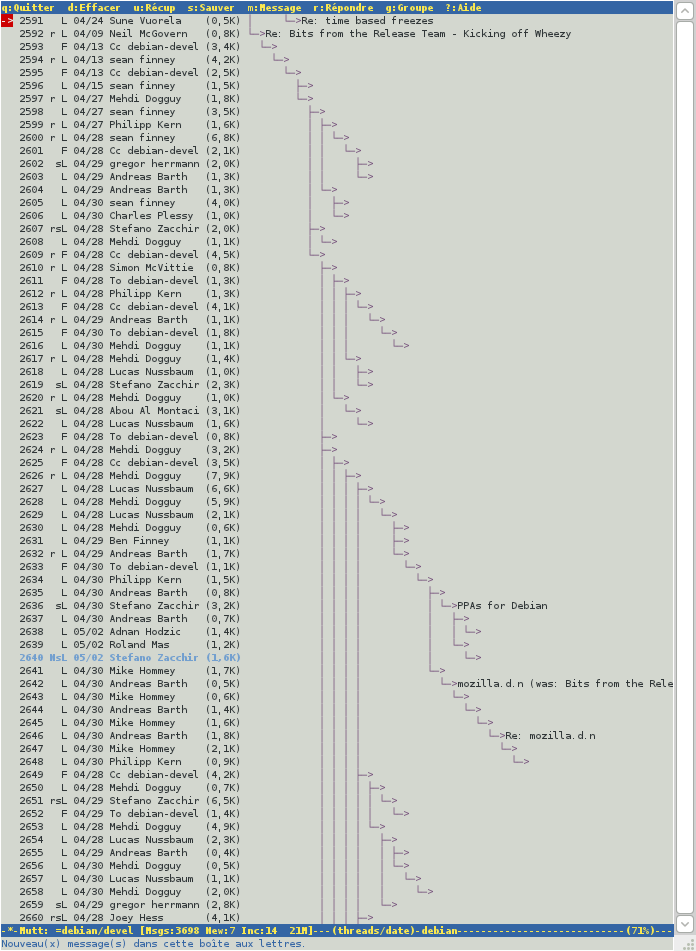
 Here is my attempt at a summary of the rolling discussion currently happening on debian-devel@. It might not be complete, it s probably a bit biased, but I hope that it s still better than nothing. It was also posted on
 I am thus considering to submit a general resolution to that effect. My current draft is below.
 A few days ago I did an
 My responses to the objections
Those are the two major objections that we ll have to respond to. Let s try to analyze them a bit more.
It s not testing vs rolling
On the first objection I would like to respond that we must not put testing and rolling/unstable in opposition. The fact that a contributor can t do its work as usual in unstable does not mean that he will instead choose to work on fixing RC bugs in testing. Probably that some do, but in my experience we simply spend our time differently, either working more on non-Debian stuff or doing mostly hidden work that is then released in big batches at the start of the next cycle (which tends to create problems of its own).
I would also like to argue that by giving more exposure to rolling and encouraging developers to properly support their packages in rolling, it probably means that the overall state of rolling should become gradually better compared to what we re currently used to with testing.
The objection that rolling would divert resources from getting testing in a releasable shape is difficult to prove and/or disprove. The best way to have some objective data would be to setup a questionnaire and to ask all maintainers. Any volunteer for that?
Unstable as a test-bed for RC bugfixes?
It s true that unstable will quickly diverge from testing and that it will be more difficult to cherry-pick updates from unstable into testing. This cannot be refuted, it s a downside given the current workflow of the release team.
But I wonder if the importance of this workflow is not overdone. The reason why they like to cherry-pick from unstable is because it gives them some confidence that the update has not caused other regressions and ensures that testing is improving.
But if they re considering to cherry-pick an update, it s because the current package in testing is plagued by an RC bug. Supposing that the updated package has introduced a regression, is it really better to keep the current RC bug compared to trading it for a new regression? It sure depends on the precise bugs involved so that s why they prefer to know up-front about the regression instead of making a blind bet.
Given this, I think we should use testing-proposed-updates (tpu) as a test-bed for RC bug fixes. We should ask beta-testers to activate this repository and to file RC bugs for any regression. And instead of requiring a full review by a release manager for all uploads to testing-proposed-updates, uploads should be auto-accepted provided that they do not change the upstream version and that they do not add/remove binary packages. Other uploads would still need manual approval by the release managers.
On top of this, we can also add an infrastructure to encourage peer-reviews of t-p-u uploads so that reviews become more opportunistic instead of systematic. Positive reviews would help reduce the aging required in t-p-u before being accepted into testing.
This changes the balance by giving a bit more freedom to maintainers but still keeps the safety net that release managers need to have. It should also reduce the overall amount of work that the release team has to do.
Comments welcome
Do you see other important objections beside the two that I mentioned?
Do you have other ideas to overcome those objections?
What do you think of my responses? Does your experience infirm or confirm my point of view?
 Testing without freezes = rolling
The first one is that testing is no longer testing during freezes. The regular flow of new upstream versions that makes testing so interesting for many users is stalled because we re using testing to finalize the next stable version. That s why I d like to introduce a new suite called rolling that would work like the current testing except that it never freezes. Testing would no longer be a permanent suite, it would only exist during the freeze and it would be branched off from rolling.
Rolling should be a supported distribution
The second obstacle is not really technical. We must advertise rolling as a distribution that ordinary people can use but we should make it clear that it s never going to have the same level of polish that a stable release can have. And to back up this assertion, we must empower Debian developers to be able to provide good support of their software in rolling, this probably means using rolling-proposed-updates more often to push fixes and security updates when the natural flow of updates is blocked by transitions or other problems. Some maintainers won t have the time required to provide the same level of support as they currently do for a stable release and that s okay, it s not worse than the current testing. The goal is to treat it on a best-effort basis and to try to gradually improve the situation.
My goal for wheezy
This is the the minimal implementation of CUT that I would like to target in the wheezy timeframe. Having testing as a temporary branch of rolling is not a strict requirement, although I d argue that it s important to not waste resources towards maintaining two separate yet very similar distributions.
Should Debian embrace those goals?
Ignoring all possible problems that will surface while trying to implement those goals, can we agree that Debian should embrace those goals because it means providing a better service to a class of users that is not satisfied by the current stable release?
I will come back to the expected problems in a subsequent post and we will have the opportunity to discuss them. Here I just want to see whether we can have broad buy-in on the principles behind Debian rolling and CUT.