Search Results: "ean"

15 June 2025

Iustin Pop: Markdown lint and site cleanup

I was not aware that one can write bad Markdown, since Markdown has such a simple syntax, that I thought you just write, and it s fine. Na ve, I know! I ve started editing the files for this blog/site with Visual Studio Code too, and I had from another project the markdown lint extension installed, so as I was opening old files, more and more problems appeared. On a whim, I searched and found the lint all files command, and after running it, oops more than 400 problems! Now, some of them were entirely trivial and a matter of subjective style, like mixing both underscore and asterisk for emphasis in a single file, and asterisks and dashes for list items. Others, seemingly trivial like tab indentation, were actually also causing rendering issues, so fixing that solved a real cosmetic issue. But some of the issues flagged were actual problems. For example, one sentence that I had, was:
there seems to be some race condition between <something> and ntp
Here something was interpreted as an (invalid) HTML tag, and not rendered at all. Another problem, but more minor, was that I had links to Wikipedia with spaces in the link name, which Visual Studio Code breaks at first space, rather than encoded spaces or underscores-based, as Wikipedia generates today. In the rendered output, Pandoc seemed to do the right think though. However, the most interesting issue that was flagged was no details in HTML links, i.e. links of the form:
for more details, see [here](http://example.com).
Which works for non-visually impaired people, but not for people using assistive technologies. And while trying to fix this, it turns out that you can do much better, for everyone, because here is really non-descriptive. You can use either the content as label ( an article about configuring BIND ), or the destination ( an article on this-website ), rather than the plain here . The only, really only check I disabled, was tweaking the trailing punctuation checks in headers, as I really like to write a header that ends with exclamation marks. I like exclamation marks in general! So why not use them in headers too. The question mark is allowlisted by default, though that I use rarely. During the changes/tweaks, I also did random improvements, but I didn t change the updated tag, since most of them were minor. But a non-minor thing was tweaking the CSS for code blocks, since I had a really stupid non-symmetry between top and bottom padding (5px vs 0), and which I don t know where it came from. But the MDN article on padding has as an example exactly what I had (except combined, I had it split). Did I just copy blindly? Possible So, all good and then, and I hope this doesn t trigger a flow of updates on any aggregators, since all the changes were really trivial. And while I don t write often, I did touch about 60 posts or pages, ouch! Who knew that changing editors can have such a large impact

Sahil Dhiman: A Look at .UA ccTLD Authoritative Name Servers

I find the case of the .UA country code top level domain (ccTLD) interesting simply because of the different name server secondaries they have now. Post Russian invasion, the cyber warfare peaked, and critical infrastructure like getting one side ccTLD down would be big news in anycase. Most (g/cc)TLDs are served by two (and less likely) by three or more providers. Even in those cases, not all authoritative name servers are anycasted. Take, example of .NL ccTLD name servers:
$ dig ns nl +short
ns1.dns.nl.
ns3.dns.nl.
ns4.dns.nl.
ns1.dns.nl is SIDN which also manages their registry. ns3.dns.nl is ReCodeZero/ipcom, another anycast secondary. ns4.dns.nl is CIRA, anycast secondary. That s 3 diverse, anycast networks to serve the .NL ccTLD. .DE has a bit more at name servers at 6 but only 3 seems anycasted. Now let s take a look at .UA. Hostmaster LLC is the registry operator of the .UA ccTLD since 2001.
$ dig soa ua +short
in1.ns.ua. domain-master.cctld.ua. 2025061434 1818 909 3024000 2020
Shows in1.ns.ua as primary nameserver (which can be intentionally deceptive too). I used bgp.tools for checking anycast and dns.coffee for timeline of when secondary nameserver was added. dns.coffee only has data going back till 2011 though. Let s deep dive at who s hosting each of the name servers:

in1.ns.ua by Intuix LLC
  • 74.123.224.40
  • 2604:ee00:0:101:0:0:0:40
  • unicast
  • Serving .UA since 13/12/2018.
  • Company by Dmitry Kohmanyuk and Igor Sviridov who re administrative and technical contacts for .UA zone as well as the IANA DB.

ho1.ns.ua by Hostmaster LLC
  • 195.47.253.1
  • 2001:67c:258:0:0:0:0:1
  • bgp.tools doesn t mark the prefix as anycast but basis test from various location, this is indeed anycasted (visible in atleast DE, US, UA etc.). Total POPs unknown.
  • Serving .UA atleast since 2011.
  • The registry themselves.

bg.ns.ua by ClouDNS
  • 185.136.96.185 and 185.136.97.185
  • 2a06:fb00:1:0:0:0:4:185 and 2a06:fb00:1:0:0:0:2:185
  • anycast
  • Serving .UA since 01/03/2022.
  • atleast 62 PoPs

cz.ns.ua by NIC.cz

nn.ns.ua by Netnod
  • 194.58.197.4
  • 2a01:3f1:c001:0:0:0:0:53
  • anycast
  • atleast 80 PoPs.
  • Serving .UA since 01/12/2022.
  • Netnod has the distinction of being one of the 13 root server operator (i.root-servers.net) and .SE operator.

pch.ns.ua by PCH
  • 204.61.216.12
  • 2001:500:14:6012:ad:0:0:1
  • anycast
  • atleast 328 POPs.
  • Serving .UA atleast since 2011.
  • With more than 36 years of production anycast DNS experience, two of the root name server operators and more than 172 top-level domain registries using our infrastructure, and more than 120 million resource records in service from https://www.pch.net/services/anycast.

rcz.ns.ua by RcodeZero
  • 193.46.128.10
  • 2a02:850:ffe0:0:0:0:0:10
  • anycast
  • Atleast 56 PoPs via 2 different cloud providers.
  • Serving .UA since 04/02/2022.
  • sister company of nic.at (.AT operator).

Some points to note
  • That s 1 unicast and 6 anycast name servers with hundreds of POPs from 7 different organizations.
  • Having X number of Point of Presence (POP) doesn t always mean each location is serving the .UA nameserver prefix.
  • Number of POPs keeps going up or down based on operational requirements and optimizations.
  • Highest concentration of DNS queries for a ccTLD would essentially originate in the country (or larger region) itself. If one of the secondaries doesn t have POP inside UA, the query might very well be served from outside the country, which can affect resolution and may even stop during outages and fiber cuts (which have become common there it seems). - Global POPs do help in faster resolutions for others/outside users though and ofcourse availability.
  • Having this much diversity does lessen the chance of the ccTLD going down. Theoretically, the adversary has to bring down 7 different networks/setups before resolution starts failing (post TTLs expiry).

11 June 2025

Iustin Pop: This blog finally goes git-annex!

A long, long time ago I have a few pictures on this blog, mostly in earlier years, because even with small pictures, the git repository became 80MiB soon this is not much in absolute terms, but the actual Markdown/Haskell/CSS/HTML total size is tiny compared to the picture, PDFs and fonts. I realised I need a better solution, probably about ten years ago, and that I should investigate git-annex. Then time passed, and I heard about git-lfs, so I thought that s the way forward. Now, I recently got interested again into doing something about this repository, and started researching.

Detour: git-lfs I was sure that git-lfs, being supported by large providers, would be the modern solution. But to my surprise, git-lfs is very server centric, which in hindsight makes sense, but for a home setup, it s not very good. Maybe I misunderstood, but git-lfs is more a protocol/method for a forge to store files, rather than an end-user solution. But then you need to backup those files separately (together with the rest of the forge), or implement another way of safeguarding them. Further details such as the fact that it keeps two copies of the files (one in the actual checked-out tree, one in internal storage) means it s not a good solution. Well, for my blog yes, but not in general. Then posts on Reddit about horror stories people being locked out of github due to quota, as an example, or this Stack Overflow post about git-lfs constraining how one uses git, convinced me that s not what I want. To each their own, but not for me I might want to push this blog s repo to github, but I definitely wouldn t want in that case to pay for github storage for my blog images (which are copies, not originals). And yes, even in 2025, those quotas are real GitHub limits and I agree with GitHub, storage and large bandwidth can t be free.

Back to the future: git-annex So back to git-annex. I thought it s going to be a simple thing, but oh boy, was I wrong. It took me half a week of continuous (well, in free time) reading and discussions with LLMs to understand a bit how it works. I think, honestly, it s a bit too complex, which is why the workflows page lists seven (!) levels of workflow complexity, from fully-managed, to fully-manual. IMHO, respect to the author for the awesome tool, but if you need a web app to help you manage git, it hints that the tool is too complex. I made the mistake of running git annex sync once, to realise it actually starts pushing to my upstream repo and creating new branches and whatnot, so after enough reading, I settled on workflow 6/7, since I don t want another tool to manage my git history. Maybe I m an outlier here, but everything automatic is a bit too much for me. Once you do managed yourself how git-annex works (on the surface, at least), it is a pretty cool thing. It uses a git-annex git branch to store metainformation, and that is relatively clean. If you do run git annex sync, it creates some extra branches, which I don t like, but meh.

Trick question: what is a remote? One of the most confusing things about git-annex was understanding its remote concept. I thought a remote is a place where you replicate your data. But not, that s a special remote. A normal remote is a git remote, but which is expected to be git/ssh/with command line access. So if you have a git+ssh remote, git-annex will not only try to push it s above-mentioned branch, but also copy the files. If such a remote is on a forge that doesn t support git-annex, then it will complain and get confused. Of course, if you read the extensive docs, you just do git config remote.<name>.annex-ignore true, and it will understand that it should not sync to it. But, aside, from this case, git-annex expects that all checkouts and clones of the repository are both metadata and data. And if you do any annex commands in them, all other clones will know about them! This can be unexpected, and you find people complaining about it, but nowadays there s a solution:
git clone   dir && cd dir
git config annex.private true
git annex init "temp copy"
This is important. Any leaf git clone must be followed by that annex.private true config, especially on CI/CD machines. Honestly, I don t understand why by default clones should be official data stores, but it is what it is. I settled on not making any of my checkouts stable , but only the actual storage places. Except those are not git repositories, but just git-annex storage things. I.e., special remotes. Is it confusing enough yet ?

Special remotes The special remotes, as said, is what I expected to be the normal git annex remotes, i.e. places where the data is stored. But well, they exist, and while I m only using a couple simple ones, there is a large number of them. Among the interesting ones: git-lfs, a remote that allows also storing the git repository itself (git-remote-annex), although I m bit confused about this one, and most of the common storage providers via the rclone remote. Plus, all of the special remotes support encryption, so this is a really neat way to store your files across a large number of things, and handle replication, number of copies, from which copy to retrieve, etc. as you with.

And many of other features git-annex has tons of other features, so to some extent, the sky s the limit. Automatic selection of what to add git it vs plain git, encryption handling, number of copies, clusters, computed files, etc. etc. etc. I still think it s cool but too complex, though!

Uses Aside from my blog post, of course. I ve seen blog posts/comments about people using git-annex to track/store their photo collection, and I could see very well how the remote encrypted repos any of the services supported by rclone could be an N+2 copy or so. For me, tracking photos would be a bit too tedious, but it could maybe work after more research. A more practical thing would probably be replicating my local movie collection (all legal, to be clear) better than just run rsync from time to time and tracking the large files in it via git-annex. That s an exercise for another day, though, once I get more mileage with it - my blog pictures are copies, so I don t care much if they get lost, but movies are primary online copies, and I don t want to re-dump the discs. Anyway, for later.

Migrating to git-annex Migrating here means ending in a state where all large files are in git-annex, and the plain git repo is small. Just moving the files to git annex at the current head doesn t remove them from history, so your git repository is still large; it won t grow in the future, but remains with old size (and contains the large files in its history). In my mind, a nice migration would be: run a custom command, and all the history is migrated to git-annex, so I can go back in time and the still use git-annex. I na vely expected this would be easy and already available, only to find comments on the git-annex site with unsure git-filter-branch calls and some web discussions. This is the discussion on the git annex website, but it didn t make me confident it would do the right thing. But that discussion is now 8 years old. Surely in 2025, with git-filter-repo, it s easier? And, maybe I m missing something, but it is not. Not from the point of view of plain git, that s easy, but because interacting with git-annex, which stores its data in git itself, so doing this properly across successive steps of a repo (when replaying the commits) is, I think, not well defined behaviour. So I was stuck here for a few days, until I got an epiphany: As I m going to rewrite the repository, of course I m keeping a copy of it from before git-annex. If so, I don t need the history, back in time, to be correct in the sense of being able to retrieve the binary files too. It just needs to be correct from the point of view of the actual Markdown and Haskell files that represent the meat of the blog. This simplified the problem a lot. At first, I wanted to just skip these files, but this could also drop commits (git-filter-repo, by default, drops the commits if they re empty), and removing the files loses information - when they were added, what were the paths, etc. So instead I came up with a rather clever idea, if I might say so: since git-annex replaces files with symlinks already, just replace the files with symlinks in the whole history, except symlinks that are dangling (to represent the fact that files are missing). One could also use empty files, but empty files are more valid in a sense than dangling symlinks, hence why I settled on those. Doing this with git-filter-repo is easy, in newer versions, with the new --file-info-callback. Here is the simple code I used:
import os
import os.path
import pathlib

SKIP_EXTENSIONS= 'jpg', 'jpeg', 'png', 'pdf', 'woff', 'woff2' 
FILE_MODES =  b"100644", b"100755" 
SYMLINK_MODE = b"120000"

fas_string = filename.decode()
path = pathlib.PurePosixPath(fas_string)
ext = path.suffix.removeprefix('.')

if ext not in SKIP_EXTENSIONS:
  return (filename, mode, blob_id)

if mode not in FILE_MODES:
  return (filename, mode, blob_id)

print(f"Replacing ' filename ' (extension '. ext ') in  os.getcwd() ")

symlink_target = '/none/binary-file-removed-from-git-history'.encode()
new_blob_id = value.insert_file_with_contents(symlink_target)
return (filename, SYMLINK_MODE, new_blob_id)
This goes and replaces files with a symlink to nowhere, but the symlink should explain why it s dangling. Then later renames or moving the files around work naturally , as the rename/mv doesn t care about file contents. Then, when the filtering is done via:
git-filter-repo --file-info-callback <(cat ~/filter-big.py ) --force
It is easy to onboard to git annex:
  • remove all dangling symlinks
  • copy the (binary) files from the original repository
  • since they re named the same, and in the same places, git sees a type change
  • then simply run git annex add on those files
For me it was easy as all such files were in a few directories, so just copying those directories back, a few git-annex add commands, and done. Of course, then adding a few rsync remotes, git annex copy --to, and the repository was ready. Well, I also found a bug in my own Hakyll setup: on a fresh clone, when the large files are just dangling symlinks, the builder doesn t complain, just ignores the images. Will have to fix.

Other resources This is a blog that I read at the beginning, and I found it very useful as an intro: https://switowski.com/blog/git-annex/. It didn t help me understand how it works under the covers, but it is well written. The author does use the sync command though, which is too magic for me, but also agrees about its complexity

The proof is in the pudding And now, for the actual first image to be added that never lived in the old plain git repository. It s not full-res/full-size, it s cropped a bit on the bottom. Earlier in the year, I went to Paris for a very brief work trip, and I walked around a bit it was more beautiful than what I remembered from way way back. So a bit random selection of a picture, but here it is:
Un bateau sur la Seine Un bateau sur la Seine
Enjoy!

Freexian Collaborators: Monthly report about Debian Long Term Support, May 2025 (by Roberto C. S nchez)

Like each month, have a look at the work funded by Freexian s Debian LTS offering.

Debian LTS contributors In May, 22 contributors have been paid to work on Debian LTS, their reports are available:
  • Abhijith PA did 8.0h (out of 0.0h assigned and 8.0h from previous period).
  • Adrian Bunk did 26.0h (out of 26.0h assigned).
  • Andreas Henriksson did 1.0h (out of 15.0h assigned and 3.0h from previous period), thus carrying over 17.0h to the next month.
  • Andrej Shadura did 3.0h (out of 10.0h assigned), thus carrying over 7.0h to the next month.
  • Bastien Roucari s did 20.0h (out of 20.0h assigned).
  • Ben Hutchings did 8.0h (out of 20.0h assigned and 4.0h from previous period), thus carrying over 16.0h to the next month.
  • Carlos Henrique Lima Melara did 12.0h (out of 11.0h assigned and 1.0h from previous period).
  • Chris Lamb did 15.5h (out of 0.0h assigned and 15.5h from previous period).
  • Daniel Leidert did 25.0h (out of 26.0h assigned), thus carrying over 1.0h to the next month.
  • Emilio Pozuelo Monfort did 21.0h (out of 16.75h assigned and 11.0h from previous period), thus carrying over 6.75h to the next month.
  • Guilhem Moulin did 11.5h (out of 8.5h assigned and 6.5h from previous period), thus carrying over 3.5h to the next month.
  • Jochen Sprickerhof did 3.5h (out of 8.75h assigned and 17.5h from previous period), thus carrying over 22.75h to the next month.
  • Lee Garrett did 26.0h (out of 12.75h assigned and 13.25h from previous period).
  • Lucas Kanashiro did 20.0h (out of 18.0h assigned and 2.0h from previous period).
  • Markus Koschany did 20.0h (out of 26.25h assigned), thus carrying over 6.25h to the next month.
  • Roberto C. S nchez did 20.75h (out of 24.0h assigned), thus carrying over 3.25h to the next month.
  • Santiago Ruano Rinc n did 15.0h (out of 12.5h assigned and 2.5h from previous period).
  • Sean Whitton did 6.25h (out of 6.0h assigned and 2.0h from previous period), thus carrying over 1.75h to the next month.
  • Sylvain Beucler did 26.25h (out of 26.25h assigned).
  • Thorsten Alteholz did 15.0h (out of 15.0h assigned).
  • Tobias Frost did 12.0h (out of 12.0h assigned).
  • Utkarsh Gupta did 1.0h (out of 15.0h assigned), thus carrying over 14.0h to the next month.

Evolution of the situation In May, we released 54 DLAs. The LTS Team was particularly active in May, publishing a higher than normal number of advisories, as well as helping with a wide range of updates to packages in stable and unstable, plus some other interesting work. We are also pleased to welcome several updates from contributors outside the regular team.
  • Notable security updates:
    • containerd, prepared by Andreas Henriksson, fixes a vulnerability that could cause containers launched as non-root users to be run as root
    • libapache2-mod-auth-openidc, prepared by Moritz Schlarb, fixes a vulnerability which could allow an attacker to crash an Apache web server with libapache2-mod-auth-openidc installed
    • request-tracker4, prepared by Andrew Ruthven, fixes multiple vulnerabilities which could result in information disclosure, cross-site scripting and use of weak encryption for S/MIME emails
    • postgresql-13, prepared by Bastien Roucari s, fixes an application crash vulnerability that could affect the server or applications using libpq
    • dropbear, prepared by Guilhem Moulin, fixes a vulnerability which could potentially result in execution of arbitrary shell commands
    • openjdk-17, openjdk-11, prepared by Thorsten Glaser, fixes several vulnerabilities, which include denial of service, information disclosure or bypass of sandbox restrictions
    • glibc, prepared by Sean Whitton, fixes a privilege escalation vulnerability
  • Notable non-security updates:
    • wireless-regdb, prepared by Ben Hutchings, updates information reflecting changes to radio regulations in many countries
This month s contributions from outside the regular team include the libapache2-mod-auth-openidc update mentioned above, prepared by Moritz Schlarb (the maintainer of the package); the update of request-tracker4, prepared by Andrew Ruthven (the maintainer of the package); and the updates of openjdk-17 and openjdk-11, also noted above, prepared by Thorsten Glaser. Additionally, LTS Team members contributed stable updates of the following packages:
  • rubygems and yelp/yelp-xsl, prepared by Lucas Kanashiro
  • simplesamlphp, prepared by Tobias Frost
  • libbson-xs-perl, prepared by Roberto C. S nchez
  • fossil, prepared by Sylvain Beucler
  • setuptools and mydumper, prepared by Lee Garrett
  • redis and webpy, prepared by Adrian Bunk
  • xrdp, prepared by Abhijith PA
  • tcpdf, prepared by Santiago Ruano Rinc n
  • kmail-account-wizard, prepared by Thorsten Alteholz
Other contributions were also made by LTS Team members to packages in unstable:
  • proftpd-dfsg DEP-8 tests (autopkgtests) were provided to the maintainer, prepared by Lucas Kanashiro
  • a regular upload of libsoup2.4, prepared by Sean Whitton
  • a regular upload of setuptools, prepared by Lee Garrett
Freexian, the entity behind the management of the Debian LTS project, has been working for some time now on the development of an advanced CI platform for Debian-based distributions, called Debusine. Recently, Debusine has reached a level of feature implementation that makes it very usable. Some members of the LTS Team have been using Debusine informally, and during May LTS coordinator Santiago Ruano Rinc n has made a call for the team to help with testing of Debusine, and to help evaluate its suitability for the LTS Team to eventually begin using as the primary mechanism for uploading packages into Debian. Team members who have started using Debusine are providing valuable feedback to the Debusine development team, thus helping to improve the platform for all users. Actually, a number of updates, for both bullseye and bookworm, made during the month of May were handled using Debusine, e.g. rubygems s DLA-4163-1. By the way, if you are a Debian Developer, you can easily test Debusine following the instructions found at https://wiki.debian.org/DebusineDebianNet. DebConf, the annual Debian Conference, is coming up in July and, as is customary each year, the week preceding the conference will feature an event called DebCamp. The DebCamp week provides an opportunity for teams and other interested groups/individuals to meet together in person in the same venue as the conference itself, with the purpose of doing focused work, often called sprints . LTS coordinator Roberto C. S nchez has announced that the LTS Team is planning to hold a sprint primarily focused on the Debian security tracker and the associated tooling used by the LTS Team and the Debian Security Team.

Thanks to our sponsors Sponsors that joined recently are in bold.

9 June 2025

Sergio Cipriano: Why package X is installed in your Debian

Why package X is installed in your Debian When I was looking for alternatives to mount a USB flash drive without sudo, I came across udisks2. To my surprise, this package was already installed on my machine. I found these two methods to understand why:
$ apt rdepends udisks2 --installed
udisks2
Reverse Depends:
  Depends: gnome-disk-utility (>= 2.7.6)
  Depends: gvfs-daemons
  Recommends: fwupd
$ aptitude why udisks2
i   task-gnome-desktop Depends gnome-core                
i A gnome-core         Depends gnome-disk-utility (>= 46)
i A gnome-disk-utility Depends udisks2 (>= 2.7.6)
The i marker means installed packages. The A marker means the package was installed automatically.

8 June 2025

Colin Watson: Free software activity in May 2025

My Debian contributions this month were all sponsored by Freexian. Things were a bit quieter than usual, as for the most part I was sticking to things that seemed urgent for the upcoming trixie release. You can also support my work directly via Liberapay or GitHub Sponsors. OpenSSH After my appeal for help last month to debug intermittent sshd crashes, Michel Casabona helped me put together an environment where I could reproduce it, which allowed me to track it down to a root cause and fix it. (I also found a misuse of strlcpy affecting at least glibc-based systems in passing, though I think that was unrelated.) I worked with Daniel Kahn Gillmor to fix a regression in ssh-agent socket handling. I fixed a reproducibility bug depending on whether passwd is installed on the build system, which would have affected security updates during the lifetime of trixie. I backported openssh 1:10.0p1-5 to bookworm-backports. I issued bookworm and bullseye updates for CVE-2025-32728. groff I backported a fix for incorrect output when formatting multiple documents as PDF/PostScript at once. debmirror I added a simple autopkgtest. Python team I upgraded these packages to new upstream versions: In bookworm-backports, I updated these packages: I fixed problems building these packages reproducibly: I backported fixes for some security vulnerabilities to unstable (since we re in freeze now so it s not always appropriate to upgrade to new upstream versions): I fixed various other build/test failures: I added non-superficial autopkgtests to these packages: I packaged python-django-hashids and python-django-pgbulk, needed for new upstream versions of python-django-pgtrigger. I ported storm to Python 3.14. Science team I fixed a build failure in apertium-oci-fra.

7 June 2025

Evgeni Golov: show your desk - 2025 edition

Back in 2020 I posted about my desk setup at home. Recently someone in our #remotees channel at work asked about WFH setups and given quite a few things changed in mine, I thought it's time to post an update. But first, a picture! standing desk with a monitor, laptop etc (Yes, it's cleaner than usual, how could you tell?!) desk It's still the same Flexispot E5B, no change here. After 7 years (I bought mine in 2018) it still works fine. If I'd have to buy a new one, I'd probably get a four-legged one for more stability (they got quite affordable now), but there is no immediate need for that. chair It's still the IKEA Volmar. Again, no complaints here. hardware Now here we finally have some updates! laptop A Lenovo ThinkPad X1 Carbon Gen 12, Intel Core Ultra 7 165U, 32GB RAM, running Fedora (42 at the moment). It's connected to a Lenovo ThinkPad Thunderbolt 4 Dock. It just works . workstation It's still the P410, but mostly unused these days. monitor An AOC U2790PQU 27" 4K. I'm running it at 150% scaling, which works quite decently these days (no comparison to when I got it). speakers As the new monitor didn't want to take the old Dell soundbar, I have upgraded to a pair of Alesis M1Active 330 USB. They sound good and were not too expensive. I had to fix the volume control after some time though. webcam It's still the Logitech C920 Pro. microphone The built in mic of the C920 is really fine, but to do conference-grade talks (and some podcasts ), I decided to get something better. I got a FIFINE K669B, with a nice arm. It's not a Shure, for sure, but does the job well and Christian was quite satisfied with the results when we recorded the Debian and Foreman specials of Focus on Linux. keyboard It's still the ThinkPad Compact USB Keyboard with TrackPoint. I had to print a few fixes and replacement parts for it, but otherwise it's doing great. Seems Lenovo stopped making those, so I really shouldn't break it any further. mouse Logitech MX Master 3S. The surface of the old MX Master 2 got very sticky at some point and it had to be replaced. other notepad I'm still terrible at remembering things, so I still write them down in an A5 notepad. whiteboard I've also added a (small) whiteboard on the wall right of the desk, mostly used for long term todo lists. coaster Turns out Xeon-based coasters are super stable, so it lives on! yubikey Yepp, still a thing. Still USB-A because... reasons. headphones Still the Bose QC25, by now on the third set of ear cushions, but otherwise working great and the odd 15 cushion replacement does not justify buying anything newer (which would have the same problem after some time, I guess). I did add a cheap (~10 ) Bluetooth-to-Headphonejack dongle, so I can use them with my phone too (shakes fist at modern phones). And I do use the headphones more in meetings, as the Alesis speakers fill the room more with sound and thus sometimes produce a bit of an echo. charger The Bose need AAA batteries, and so do some other gadgets in the house, so there is a technoline BC 700 charger for AA and AAA on my desk these days. light Yepp, I've added an IKEA Tertial and an ALDI "face" light. No, I don't use them much. KVM switch I've "built" a KVM switch out of an USB switch, but given I don't use the workstation that often these days, the switch is also mostly unused.

6 June 2025

Reproducible Builds: Reproducible Builds in May 2025

Welcome to our 5th report from the Reproducible Builds project in 2025! Our monthly reports outline what we ve been up to over the past month, and highlight items of news from elsewhere in the increasingly-important area of software supply-chain security. If you are interested in contributing to the Reproducible Builds project, please do visit the Contribute page on our website. In this report:
  1. Security audit of Reproducible Builds tools published
  2. When good pseudorandom numbers go bad
  3. Academic articles
  4. Distribution work
  5. diffoscope and disorderfs
  6. Website updates
  7. Reproducibility testing framework
  8. Upstream patches

Security audit of Reproducible Builds tools published The Open Technology Fund s (OTF) security partner Security Research Labs recently an conducted audit of some specific parts of tools developed by Reproducible Builds. This form of security audit, sometimes called a whitebox audit, is a form testing in which auditors have complete knowledge of the item being tested. They auditors assessed the various codebases for resilience against hacking, with key areas including differential report formats in diffoscope, common client web attacks, command injection, privilege management, hidden modifications in the build process and attack vectors that might enable denials of service. The audit focused on three core Reproducible Builds tools: diffoscope, a Python application that unpacks archives of files and directories and transforms their binary formats into human-readable form in order to compare them; strip-nondeterminism, a Perl program that improves reproducibility by stripping out non-deterministic information such as timestamps or other elements introduced during packaging; and reprotest, a Python application that builds source code multiple times in various environments in order to to test reproducibility. OTF s announcement contains more of an overview of the audit, and the full 24-page report is available in PDF form as well.

When good pseudorandom numbers go bad Danielle Navarro published an interesting and amusing article on their blog on When good pseudorandom numbers go bad. Danielle sets the stage as follows:
[Colleagues] approached me to talk about a reproducibility issue they d been having with some R code. They d been running simulations that rely on generating samples from a multivariate normal distribution, and despite doing the prudent thing and using set.seed() to control the state of the random number generator (RNG), the results were not computationally reproducible. The same code, executed on different machines, would produce different random numbers. The numbers weren t just a little bit different in the way that we ve all wearily learned to expect when you try to force computers to do mathematics. They were painfully, brutally, catastrophically, irreproducible different. Somewhere, somehow, something broke.
Thanks to David Wheeler for posting about this article on our mailing list

Academic articles There were two scholarly articles published this month that related to reproducibility: Daniel Hugenroth and Alastair R. Beresford of the University of Cambridge in the United Kingdom and Mario Lins and Ren Mayrhofer of Johannes Kepler University in Linz, Austria published an article titled Attestable builds: compiling verifiable binaries on untrusted systems using trusted execution environments. In their paper, they:
present attestable builds, a new paradigm to provide strong source-to-binary correspondence in software artifacts. We tackle the challenge of opaque build pipelines that disconnect the trust between source code, which can be understood and audited, and the final binary artifact, which is difficult to inspect. Our system uses modern trusted execution environments (TEEs) and sandboxed build containers to provide strong guarantees that a given artifact was correctly built from a specific source code snapshot. As such it complements existing approaches like reproducible builds which typically require time-intensive modifications to existing build configurations and dependencies, and require independent parties to continuously build and verify artifacts.
The authors compare attestable builds with reproducible builds by noting an attestable build requires only minimal changes to an existing project, and offers nearly instantaneous verification of the correspondence between a given binary and the source code and build pipeline used to construct it , and proceed by determining that t he overhead (42 seconds start-up latency and 14% increase in build duration) is small in comparison to the overall build time.
Timo Pohl, Pavel Nov k, Marc Ohm and Michael Meier have published a paper called Towards Reproducibility for Software Packages in Scripting Language Ecosystems. The authors note that past research into Reproducible Builds has focused primarily on compiled languages and their ecosystems, with a further emphasis on Linux distribution packages:
However, the popular scripting language ecosystems potentially face unique issues given the systematic difference in distributed artifacts. This Systemization of Knowledge (SoK) [paper] provides an overview of existing research, aiming to highlight future directions, as well as chances to transfer existing knowledge from compiled language ecosystems. To that end, we work out key aspects in current research, systematize identified challenges for software reproducibility, and map them between the ecosystems.
Ultimately, the three authors find that the literature is sparse , focusing on few individual problems and ecosystems, and therefore identify space for more critical research.

Distribution work In Debian this month:
Hans-Christoph Steiner of the F-Droid catalogue of open source applications for the Android platform published a blog post on Making reproducible builds visible. Noting that Reproducible builds are essential in order to have trustworthy software , Hans also mentions that F-Droid has been delivering reproducible builds since 2015 . However:
There is now a Reproducibility Status link for each app on f-droid.org, listed on every app s page. Our verification server shows or based on its build results, where means our rebuilder reproduced the same APK file and means it did not. The IzzyOnDroid repository has developed a more elaborate system of badges which displays a for each rebuilder. Additionally, there is a sketch of a five-level graph to represent some aspects about which processes were run.
Hans compares the approach with projects such as Arch Linux and Debian that provide developer-facing tools to give feedback about reproducible builds, but do not display information about reproducible builds in the user-facing interfaces like the package management GUIs.
Arnout Engelen of the NixOS project has been working on reproducing the minimal installation ISO image. This month, Arnout has successfully reproduced the build of the minimal image for the 25.05 release without relying on the binary cache. Work on also reproducing the graphical installer image is ongoing.
In openSUSE news, Bernhard M. Wiedemann posted another monthly update for their work there.
Lastly in Fedora news, Jelle van der Waa opened issues tracking reproducible issues in Haskell documentation, Qt6 recording the host kernel and R packages recording the current date. The R packages can be made reproducible with packaging changes in Fedora.

diffoscope & disorderfs diffoscope is our in-depth and content-aware diff utility that can locate and diagnose reproducibility issues. This month, Chris Lamb made the following changes, including preparing and uploading versions 295, 296 and 297 to Debian:
  • Don t rely on zipdetails --walk argument being available, and only add that argument on newer versions after we test for that. [ ]
  • Review and merge support for NuGet packages from Omair Majid. [ ]
  • Update copyright years. [ ]
  • Merge support for an lzma comparator from Will Hollywood. [ ][ ]
Chris also merged an impressive changeset from Siva Mahadevan to make disorderfs more portable, especially on FreeBSD. disorderfs is our FUSE-based filesystem that deliberately introduces non-determinism into directory system calls in order to flush out reproducibility issues [ ]. This was then uploaded to Debian as version 0.6.0-1. Lastly, Vagrant Cascadian updated diffoscope in GNU Guix to version 296 [ ][ ] and 297 [ ][ ], and disorderfs to version 0.6.0 [ ][ ].

Website updates Once again, there were a number of improvements made to our website this month including:

Reproducibility testing framework The Reproducible Builds project operates a comprehensive testing framework running primarily at tests.reproducible-builds.org in order to check packages and other artifacts for reproducibility. However, Holger Levsen posted to our mailing list this month in order to bring a wider awareness to funding issues faced by the Oregon State University (OSU) Open Source Lab (OSL). As mentioned on OSL s public post, recent changes in university funding makes our current funding model no longer sustainable [and that] unless we secure $250,000 in committed funds, the OSL will shut down later this year . As Holger notes in his post to our mailing list, the Reproducible Builds project relies on hardware nodes hosted there. Nevertheless, Lance Albertson of OSL posted an update to the funding situation later in the month with broadly positive news.
Separate to this, there were various changes to the Jenkins setup this month, which is used as the backend driver of for both tests.reproducible-builds.org and reproduce.debian.net, including:
  • Migrating the central jenkins.debian.net server AMD Opteron to Intel Haswell CPUs. Thanks to IONOS for hosting this server since 2012.
  • After testing it for almost ten years, the i386 architecture has been dropped from tests.reproducible-builds.org. This is because that, with the upcoming release of Debian trixie, i386 is no longer supported as a regular architecture there will be no official kernel and no Debian installer for i386 systems. As a result, a large number of nodes hosted by Infomaniak have been retooled from i386 to amd64.
  • Another node, ionos17-amd64.debian.net, which is used for verifying packages for all.reproduce.debian.net (hosted by IONOS) has had its memory increased from 40 to 64GB, and the number of cores doubled to 32 as well. In addition, two nodes generously hosted by OSUOSL have had their memory doubled to 16GB.
  • Lastly, we have been granted access to more riscv64 architecture boards, so now we have seven such nodes, all with 16GB memory and 4 cores that are verifying packages for riscv64.reproduce.debian.net. Many thanks to PLCT Lab, ISCAS for providing those.

Outside of this, a number of smaller changes were also made by Holger Levsen:
  • reproduce.debian.net-related:
    • Only use two workers for the ppc64el architecture due to RAM size. [ ]
    • Monitor nginx_request and nginx_status with the Munin monitoring system. [ ][ ]
    • Detect various variants of network and memory errors. [ ][ ][ ][ ]
    • Add a prominent link to reproducible-builds.org. [ ]
    • Add a rebuilderd-cache-cleanup.service and run it daily via timer. [ ][ ][ ][ ][ ]
    • Be more verbose what sources are being downloaded. [ ]
    • Correctly deal with packages with an epoch in their version [ ] and deal with binNMUs versions with an epoch as well [ ][ ].
    • Document how to reschedule all other errors on all archs. [ ]
    • Misc documentation improvements. [ ][ ][ ][ ]
    • Include the $HOSTNAME variable in the rebuilderd logfiles. [ ]
    • Install the equivs package on all worker nodes. [ ][ ]
  • Jenkins nodes:
    • Permit the sudo tool to fix up permission issues. [ ][ ]
    • Document how to manage diskspace with OpenStack. [ ]
    • Ignore a number of spurious monitoring errors on riscv64, FreeBSD, etc.. [ ][ ][ ][ ]
    • Install ntpsec-ntpdate (instead of ntpdate) as the former is available on Debian trixie and bookworm. [ ][ ]
    • Use the same SSH ControlPath for all nodes. [ ]
    • Make sure the munin user uses the same SSH config as the jenkins user. [ ]
  • tests.reproducible-builds.org-related:
    • Disable testing of the i386 architecture. [ ][ ][ ][ ][ ]
    • Document the current disk usage. [ ][ ]
    • Address some image placement now that we only test three architectures. [ ]
    • Keep track of build performance. [ ]
  • Misc:
    • Fix a (harmless) typo in the multiarch_versionskew script. [ ]
In addition, Jochen Sprickerhof made a series of changes related to reproduce.debian.net:
  • Add out of memory detection to the statistics page. [ ]
  • Reverse the sorting order on the statistics page. [ ][ ][ ][ ]
  • Improve the spacing between statistics groups. [ ]
  • Update a (hard-coded) line number in error message detection pertaining to a debrebuild line number. [ ]
  • Support Debian unstable in the rebuilder-debian.sh script. [ ] ]
  • Rely on rebuildctl to sync only arch-specific packages. [ ][ ]

Upstream patches The Reproducible Builds project detects, dissects and attempts to fix as many currently-unreproducible packages as possible. This month, we wrote a large number of such patches, including:

Finally, if you are interested in contributing to the Reproducible Builds project, please visit our Contribute page on our website. However, you can get in touch with us via:

5 June 2025

Matthew Garrett: Twitter's new encrypted DMs aren't better than the old ones

(Edit: Twitter could improve this significantly with very few changes - I wrote about that here. It's unclear why they'd launch without doing that, since it entirely defeats the point of using HSMs)

When Twitter[1] launched encrypted DMs a couple
of years ago, it was the worst kind of end-to-end
encrypted - technically e2ee, but in a way that made it relatively easy for Twitter to inject new encryption keys and get everyone's messages anyway. It was also lacking a whole bunch of features such as "sending pictures", so the entire thing was largely a waste of time. But a couple of days ago, Elon announced the arrival of "XChat", a new encrypted message platform built on Rust with (Bitcoin style) encryption, whole new architecture. Maybe this time they've got it right?

tl;dr - no. Use Signal. Twitter can probably obtain your private keys, and admit that they can MITM you and have full access to your metadata.

The new approach is pretty similar to the old one in that it's based on pretty straightforward and well tested cryptographic primitives, but merely using good cryptography doesn't mean you end up with a good solution. This time they've pivoted away from using the underlying cryptographic primitives directly and into higher level abstractions, which is probably a good thing. They're using Libsodium's boxes for message encryption, which is, well, fine? It doesn't offer forward secrecy (if someone's private key is leaked then all existing messages can be decrypted) so it's a long way from the state of the art for a messaging client (Signal's had forward secrecy for over a decade!), but it's not inherently broken or anything. It is, however, written in C, not Rust[2].

That's about the extent of the good news. Twitter's old implementation involved clients generating keypairs and pushing the public key to Twitter. Each client (a physical device or a browser instance) had its own private key, and messages were simply encrypted to every public key associated with an account. This meant that new devices couldn't decrypt old messages, and also meant there was a maximum number of supported devices and terrible scaling issues and it was pretty bad. The new approach generates a keypair and then stores the private key using the Juicebox protocol. Other devices can then retrieve the private key.

Doesn't this mean Twitter has the private key? Well, no. There's a PIN involved, and the PIN is used to generate an encryption key. The stored copy of the private key is encrypted with that key, so if you don't know the PIN you can't decrypt the key. So we brute force the PIN, right? Juicebox actually protects against that - before the backend will hand over the encrypted key, you have to prove knowledge of the PIN to it (this is done in a clever way that doesn't directly reveal the PIN to the backend). If you ask for the key too many times while providing the wrong PIN, access is locked down.

But this is true only if the Juicebox backend is trustworthy. If the backend is controlled by someone untrustworthy[3] then they're going to be able to obtain the encrypted key material (even if it's in an HSM, they can simply watch what comes out of the HSM when the user authenticates if there's no validation of the HSM's keys). And now all they need is the PIN. Turning the PIN into an encryption key is done using the Argon2id key derivation function, using 32 iterations and a memory cost of 16MB (the Juicebox white paper says 16KB, but (a) that's laughably small and (b) the code says 16 * 1024 in an argument that takes kilobytes), which makes it computationally and moderately memory expensive to generate the encryption key used to decrypt the private key. How expensive? Well, on my (not very fast) laptop, that takes less than 0.2 seconds. How many attempts to I need to crack the PIN? Twitter's chosen to fix that to 4 digits, so a maximum of 10,000. You aren't going to need many machines running in parallel to bring this down to a very small amount of time, at which point private keys can, to a first approximation, be extracted at will.

Juicebox attempts to defend against this by supporting sharding your key over multiple backends, and only requiring a subset of those to recover the original. I can't find any evidence that Twitter's does seem to be making use of this,Twitter uses three backends and requires data from at least two, but all the backends used are under x.com so are presumably under Twitter's direct control. Trusting the keystore without needing to trust whoever's hosting it requires a trustworthy communications mechanism between the client and the keystore. If the device you're talking to can prove that it's an HSM that implements the attempt limiting protocol and has no other mechanism to export the data, this can be made to work. Signal makes use of something along these lines using Intel SGX for contact list and settings storage and recovery, and Google and Apple also have documentation about how they handle this in ways that make it difficult for them to obtain backed up key material. Twitter has no documentation of this, and as far as I can tell does nothing to prove that the backend is in any way trustworthy. (Edit to add: The Juicebox API does support authenticated communication between the client and the HSM, but that relies on you having some way to prove that the public key you're presented with corresponds to a private key that only exists in the HSM. Twitter gives you the public key whenever you communicate with them, so even if they've implemented this properly you can't prove they haven't made up a new key and MITMed you the next time you retrieve your key)

On the plus side, Juicebox is written in Rust, so Elon's not 100% wrong. Just mostly wrong.

But ok, at least you've got viable end-to-end encryption even if someone can put in some (not all that much, really) effort to obtain your private key and render it all pointless? Actually no, since you're still relying on the Twitter server to give you the public key of the other party and there's no out of band mechanism to do that or verify the authenticity of that public key at present. Twitter can simply give you a public key where they control the private key, decrypt the message, and then reencrypt it with the intended recipient's key and pass it on. The support page makes it clear that this is a known shortcoming and that it'll be fixed at some point, but they said that about the original encrypted DM support and it never was, so that's probably dependent on whether Elon gets distracted by something else again. And the server knows who and when you're messaging even if they haven't bothered to break your private key, so there's a lot of metadata leakage.

Signal doesn't have these shortcomings. Use Signal.

[1] I'll respect their name change once Elon respects his daughter

[2] There are implementations written in Rust, but Twitter's using the C one with these JNI bindings

[3] Or someone nominally trustworthy but who's been compelled to act against your interests - even if Elon were absolutely committed to protecting all his users, his overarching goals for Twitter require him to have legal presence in multiple jurisdictions that are not necessarily above placing employees in physical danger if there's a perception that they could obtain someone's encryption keys

comment count unavailable comments

4 June 2025

Gunnar Wolf: Humanities and big data in Ibero-America Theory, methodology and practical applications

This post is an unpublished review for Humanities and big data in Ibero-America Theory, methodology and practical applications
Digital humanities is a young though established field. It deals with different expressions in which digital data manipulation techniques can be applied and used to analyze subjects that are identified as belonging to the humanities. Although most often used to analyze different aspects of literature or social network analysis, it can also be applied to other humanistic disciplines or artistic expressions. Digital humanities employs many tools, but those categorized as big data are among the most frequently employed. This book samples different takes on digital humanities, with the particularity that it focuses on Ibero-American uses. It is worth noting that this book is the second in a series of four volumes, published or set to be published between 2022 and 2026. Being the output of a field survey, I perceive this book to be targeted towards fellow Digital Humanists people interested in applying computational methods to further understand and research topics in the humanities. It is not a technical book in the sense Computer Science people would recognize as such, but several of the presented works do benefit from understanding some technical concepts. The 12 articles (plus an introduction) that make up this book are organized in three parts: (1) Theoretical Framework presents the ideas and techniques of data science (that make up the tools for handling big data), and explores how data science can contribute to literary analysis, all while noting that many such techniques are usually frowned upon in Latin America as data science smells neoliberal ; (2) Methodological Issues looks at specific issues through the lens of how they can be applied to big data, with specific attention given to works in Spanish; and (3) Practical Applications analyzes specific Spanish works and communities based on big data techniques. Several chapters treat a recurring theme: the simultaneous resistance and appropriation of big data by humanists. For example, at least three of the chapters describe the tensions between humanism ( aesthesis ) and cold, number-oriented data analysis ( mathesis ). The analyzed works of Parts 2 and 3 are interesting and relatively easy to follow. Some inescapable ideological gleans from several word uses from the book s and series name, which refers to the Spanish-speaking regions as Ibero-America , often seen as Eurocentric, in contrast with the Latin America term much more widely used throughout the region. I will end with some notes about the specific versions of the book I reviewed. I read both an EPUB version and a print copy. The EPUB did not include links for easy navigation to footnotes, that is, the typographical superindexes are not hyperlinked to the location of the notes, so it is very impractical to try to follow them. The print version (unlike the EPUB) did not have an index, that is, the six pages before the introduction are missing from the print copy I received. For a book such as this one, not having an index hampers the ease of reading and referencing.

Gunnar Wolf: Computational modelling of robot personhood and relationality

This post is an unpublished review for Computational modelling of robot personhood and relationality
If humans and robots were to be able to roam around the same spaces, mutually recognizing each other for what they are, how would interaction be? How can we model such interactions in a way that we can reason about and understand the implications of a given behavior? This book aims at answering this question. The book is split into two very different parts. Chapters 1 through 3 are mostly written with a philosophical angle. It starts by framing the possibility of having sentient androids exist in the same plane as humans, without them trying to pass as us or vice versa. The first chapters look at issues related to personhood, that is, how androids can be treated as valid interaction partners in a society with humans, and how interactions with them can be seen as meaningful. In doing so, several landmarks of the past 40 years in the AI field are reviewed. The issues of the Significant Concerns that make up a society and give it coherence and of Personhood and Relationality , describing how this permeates from a society into each of the individuals that make it up, the relations between them and the social objects that bring individuals closer together (or farther apart) are introduced and explained. The second part of the book is written from a very different angle, and the change in pace took me somewhat by surprise. Each subsequent chapter presents a different angle of the Affinity system, a model that follows some aspects of human behavior over time and in a given space. Chapter 4 introduces the Affinity environment: a 3D simulated environment with simulated physical laws and characteristics, where a number of agents (30-50 is mentioned as usual) interact. Agents have a series of attributes ( value memory ), can adhere to different programs ( narratives ), and gain or lose on some vectors ( economy ). They can sense the world around them with sensors, and can modify the world or signal other agents using effectors. The last two chapters round out the book, as expected: the first presents a set of results from analyzing a given set of value systems, and the second gives readers the conclusions reached by the author. However, I was expecting more either having at least a link to download the Affinity system and continue exploring it or modifying some of the aspects it models to get it to model a set of agents with different stories and narratives, or extend it to yet unforseen behaviors, or at least have the author present a more complete comparison of results than the evaluation of patterns resulting from a given run. The author is a well-known, prolific author in the field, and I was expecting bigger insights from this book. Nevertheless, the book is an interesting and fun read, with important insights in both the first and second parts. There is a certain lack of connection between their respective rhythms, and the second part indeed builds on the concepts introduced in the first one. Overall, I enjoyed reading the book despite expecting more.

Russell Coker: Trying DeepSeek R1

I saw this document on running DeepSeek R1 [1] and decided to give it a go. I downloaded the llama.cpp source and compiled it and downloaded the 131G of data as described. Running it with the default options gave about 7 CPU cores in use. Changing the --threads parameter to 44 caused it to use 17 CPU cores (changing it to larger numbers like 80 made it drop to 2.5 cores). I used the --n-gpu-layers parameter with the value of 1 as I currently have a GPU with only 6G of RAM (AliExpress is delaying my delivery of a PCIe power adaptor for a better GPU). Running it like this makes the GPU take 12W more power than standby and using 5.5G of VRAM according to nvidia-smi so it is doing a small amount of work, but not much. The documentation refers to the DeepSeek R1 1.58bit model which I m using as having 61 layers so presumably less than 2% of the work is done on the GPU. Running like this it takes 2 hours of CPU time (just over 3 minutes of elapsed time at 17 cores) to give 8 words of output. I didn t let any tests run long enough to give complete output. The documentation claims that it will run on CPU with 20G of RAM. In my tests it takes between 161G and 195G of RAM to run depending on the number of threads. The documentation describes running on the CPU as very slow which presumably means 3 words per minute on a system with a pair of E5-2699A v4 CPUs and 256G of RAM. When I try to use more than 44 threads I get output like system_info: n_threads = 200 (n_threads_batch = 200) / 44 and it seems that I only have a few threads actually in use. Apparently there s some issue with having more threads than the 44 CPU cores in the system. I was expecting this to go badly and it met my expectations in that regard. But it was interesting to see exactly how it went badly. It seems that if I had a GPU with 24G of VRAM I d still have 54/61 layers running on the CPU so even the largest of home GPUs probably wouldn t make much difference. Maybe if I configured the server to have hyper-threading enabled and 88 HT cores then I could have 88 threads and about 34 CPU cores in use which might help. But even if I got the output speed from 3 to 6 words per minute that still wouldn t be very usable.

1 June 2025

Guido G nther: Free Software Activities May 2025

Another short status update of what happened on my side last month. Larger blocks besides the Phosh 0.47 release are on screen keyboard and cell broadcast improvements, work on separate volume streams, the switch of phoc to wlroots 0.19.0 and effort to make Phosh work on Debian's upcoming stable release (Trixie) out of the box. Trixie will ship with Phosh 0.46, if you want to try out 0.47 you can fetch it from Debian's experimental suite. See below for details on the above and more: phosh phoc phosh-mobile-settings phosh-osk-stub / stevia phosh-tour phosh-osk-data pfs xdg-desktop-portal-phosh phrog phosh-debs meta-phosh feedbackd feedbackd-device-themes gmobile GNOME calls Debian ModemManager osmo-cbc gsm-cell-testing mobile-broadband-provider-info Cellbroadcastd phosh-site pipewire wireplumber python-dbusmock Bugs Reviews This is not code by me but reviews on other peoples code. The list is (as usual) slightly incomplete. Thanks for the contributions! Help Development If you want to support my work see donations. Comments? Join the Fediverse thread

Emmanuel Kasper: ARM64 desktop as daily driver

I have bought myself an expensive ARM64 workstation, the System 76 Thelio Astra that I intend to use as my main desktop computer for the next 15 years, running Debian. The box is basically a server motherboard repurposed in a good desktop chassis. In Europe it seems you can order similar ready systems here. The hardware is well supported by Debian 12 and Debian testing.I had some initial issues with graphics, due to the board being designed for a server use, but I am solving these as we go. Annoyances I got so far:
  • When you power on the machine using the power supply switch, you have to wait for the BMC to finished its startup sequence, before the front power button does anything. As starting the BMC can take 90 seconds, I thought initially the machine was dead on arrival.
  • The default graphical output is redirected to the BMC Serial over LAN, which means if you want to install Debian using an attached display you need to force the output on the attached display passing console=tty0 as an installer parameter.
  • Finally the Xorg Nouveau driver does not work with the Nvidia A400 GPU I got with the machine. After passing nodemodeset as a kernel parameter, I can force Xorg to use an unaccelerated framebuffer, which at least displays something. I passed this parameter to the installer, so that I could install in graphical mode. The driver from Nvidia works, but I d like very much to get Nouveau running.
Ugly point
  • A server mother board we said. This mean there is NO suspend to RAM, you have to power off if you don t want to keep the machine on all the time. As the boot sequence is long (server board again) I am pondering setting a startup time in the UEFI firmware to turn the box on at specific usage time.
Good points
  • The firmware of the machine is a standard EFI, which means you can use the debian arm64 installer on an USB stick straight away, without any kind of device tree / bootloader fiddling.
  • The 3 Nics, Wifi, bluetooth were all recognized on first boot.
  • I was afraid the machine would be loud. However it is quiet, you hear the humming of a fan, but it is quieter than most desktops I owned, from the Atari TT to an all in one Lenovo M92z I used for 10 years. I am certainly not a hardware and cooling specialist, but meseems the quietness comes from slow rotating but very large fans.
  • Due the clean design of Linux and Debian, thousands of packages working correctly on ARM64, starting with the Gnome desktop environment and Firefox.
  • The documentation from system76 is fine, their Ubuntu 20.04 setup guide was helpful to understand the needed parameters mentioned above.
Update: The display is working correctly with the nouveau driver after installing the non-free Nvidia firmware. See the Debian wiki.

31 May 2025

Antoine Beaupr : Traffic meter per ASN without logs

Have you ever found yourself in the situation where you had no or anonymized logs and still wanted to figure out where your traffic was coming from? Or you have multiple upstreams and are looking to see if you can save fees by getting into peering agreements with some other party? Or your site is getting heavy load but you can't pinpoint it on a single IP and you suspect some amoral corporation is training their degenerate AI on your content with a bot army? (You might be getting onto something there.) If that rings a bell, read on.

TL;DR: ... or just skip the cruft and install asncounter:
pip install asncounter
Also available in Debian 14 or later, or possibly in Debian 13 backports (soon to be released) if people are interested:
apt install asncounter
Then count whoever is hitting your network with:
awk ' print $2 ' /var/log/apache2/*access*.log   asncounter
or:
tail -F /var/log/apache2/*access*.log   awk ' print $2 '   asncounter
or:
tcpdump -q -n   asncounter --input-format=tcpdump --repl
or:
tcpdump -q -i eth0 -n -Q in "tcp and tcp[tcpflags] & tcp-syn != 0 and (port 80 or port 443)"   asncounter --input-format=tcpdump --repl
Read on for why this matters, and why I wrote yet another weird tool (almost) from scratch.

Background and manual work This is a tool I've been dreaming of for a long, long time. Back in 2006, at Koumbit a colleague had setup TAS ("Traffic Accounting System", " " in Russian, apparently), a collection of Perl script that would do per-IP accounting. It was pretty cool: it would count bytes per IP addresses and, from that, you could do analysis. But the project died, and it was kind of bespoke. Fast forward twenty years, and I find myself fighting off bots at the Tor Project (the irony...), with our GitLab suffering pretty bad slowdowns (see issue tpo/tpa/team#41677 for the latest public issue, the juicier one is confidential, unfortunately). (We did have some issues caused by overloads in CI, as we host, after all, a fork of Firefox, which is a massive repository, but the applications team did sustained, awesome work to fix issues on that side, again and again (see tpo/applications/tor-browser#43121 for the latest, and tpo/applications/tor-browser#43121 for some pretty impressive correlation work, I work with really skilled people). But those issues, I believe were fixed.) So I had the feeling it was our turn to get hammered by the AI bots. But how do we tell? I could tell something was hammering at the costly /commit/ and (especially costly) /blame/ endpoint. So at first, I pulled out the trusted awk, sort uniq -c sort -n tail pipeline I am sure others have worked out before:
awk ' print $1 ' /var/log/nginx/*.log   sort   uniq -c   sort -n   tail -10
For people new to this, that pulls the first field out of web server log files, sort the list, counts the number of unique entries, and sorts that so that the most common entries (or IPs) show up first, then show the top 10. That, other words, answers the question of "which IP address visits this web server the most?" Based on this, I found a couple of IP addresses that looked like Alibaba. I had already addressed an abuse complaint to them (tpo/tpa/team#42152) but never got a response, so I just blocked their entire network blocks, rather violently:
for cidr in 47.240.0.0/14 47.246.0.0/16 47.244.0.0/15 47.235.0.0/16 47.236.0.0/14; do 
  iptables-legacy -I INPUT -s $cidr -j REJECT
done
That made Ali Baba and his forty thieves (specifically their AL-3 network go away, but our load was still high, and I was still seeing various IPs crawling the costly endpoints. And this time, it was hard to tell who they were: you'll notice all the Alibaba IPs are inside the same 47.0.0.0/8 prefix. Although it's not a /8 itself, it's all inside the same prefix, so it's visually easy to pick it apart, especially for a brain like mine who's stared too long at logs flowing by too fast for their own mental health. What I had then was different, and I was tired of doing the stupid thing I had been doing for decades at this point. I had recently stumbled upon pyasn recently (in January, according to my notes) and somehow found it again, and thought "I bet I could write a quick script that loops over IPs and counts IPs per ASN". (Obviously, there are lots of other tools out there for that kind of monitoring. Argos, for example, presumably does this, but it's a kind of a huge stack. You can also get into netflows, but there's serious privacy implications with those. There are also lots of per-IP counters like promacct, but that doesn't scale. Or maybe someone already had solved this problem and I just wasted a week of my life, who knows. Someone will let me know, I hope, either way.)

ASNs and networks A quick aside, for people not familiar with how the internet works. People that know about ASNs, BGP announcements and so on can skip. The internet is the network of networks. It's made of multiple networks that talk to each other. The way this works is there is a Border Gateway Protocol (BGP), a relatively simple TCP-based protocol, that the edge routers of those networks used to announce each other what network they manage. Each of those network is called an Autonomous System (AS) and has an AS number (ASN) to uniquely identify it. Just like IP addresses, ASNs are allocated by IANA and local registries, they're pretty cheap and useful if you like running your own routers, get one. When you have an ASN, you'll use it to, say, announce to your BGP neighbors "I have 198.51.100.0/24" over here and the others might say "okay, and I have 216.90.108.31/19 over here, and I know of this other ASN over there that has 192.0.2.1/24 too! And gradually, those announcements flood the entire network, and you end up with each BGP having a routing table of the global internet, with a map of which network block, or "prefix" is announced by which ASN. It's how the internet works, and it's a useful thing to know, because it's what, ultimately, makes an organisation responsible for an IP address. There are "looking glass" tools like the one provided by routeviews.org which allow you to effectively run "trace routes" (but not the same as traceroute, which actively sends probes from your location), type an IP address in that form to fiddle with it. You will end up with an "AS path", the way to get from the looking glass to the announced network. But I digress, and that's kind of out of scope. Point is, internet is made of networks, networks are autonomous systems (AS) and they have numbers (ASNs), and they announced IP prefixes (or "network blocks") that ultimately tells you who is responsible for traffic on the internet.

Introducing asncounter So my goal was to get from "lots of IP addresses" to "list of ASNs", possibly also the list of prefixes (because why not). Turns out pyasn makes that really easy. I managed to build a prototype in probably less than an hour, just look at the first version, it's 44 lines (sloccount) of Python, and it works, provided you have already downloaded the required datafiles from routeviews.org. (Obviously, the latest version is longer at close to 1000 lines, but it downloads the data files automatically, and has many more features). The way the first prototype (and later versions too, mostly) worked is that you feed it a list of IP addresses on standard input, it looks up the ASN and prefix associated with the IP, and increments a counter for those, then print the result. That showed me something like this:
root@gitlab-02:~/anarcat-scripts# tcpdump -q -i eth0 -n -Q in "(udp or tcp)"   ./asncounter.py --tcpdump                                                                                                                                                                          
tcpdump: verbose output suppressed, use -v[v]... for full protocol decode                                                                
listening on eth0, link-type EN10MB (Ethernet), snapshot length 262144 bytes                                                             
INFO: collecting IPs from stdin, using datfile ipasn_20250523.1600.dat.gz                                                                
INFO: loading datfile /root/.cache/pyasn/ipasn_20250523.1600.dat.gz...                                                                   
INFO: loading /root/.cache/pyasn/asnames.json                       
ASN     count   AS               
136907  7811    HWCLOUDS-AS-AP HUAWEI CLOUDS, HK                                                                                         
[----]  359     [REDACTED]
[----]  313     [REDACTED]
8075    254     MICROSOFT-CORP-MSN-AS-BLOCK, US
[---]   164     [REDACTED]
[----]  136     [REDACTED]
24940   114     HETZNER-AS, DE  
[----]  98      [REDACTED]
14618   82      AMAZON-AES, US                                                                                                           
[----]  79      [REDACTED]
prefix  count                                         
166.108.192.0/20        1294                                                                                                             
188.239.32.0/20 1056                                          
166.108.224.0/20        970                    
111.119.192.0/20        951              
124.243.128.0/18        667                                         
94.74.80.0/20   651                                                 
111.119.224.0/20        622                                         
111.119.240.0/20        566           
111.119.208.0/20        538                                         
[REDACTED]  313           
Even without ratios and a total count (which will come later), it was quite clear that Huawei was doing something big on the server. At that point, it was responsible for a quarter to half of the traffic on our GitLab server or about 5-10 queries per second. But just looking at the logs, or per IP hit counts, it was really hard to tell. That traffic is really well distributed. If you look more closely at the output above, you'll notice I redacted a couple of entries except major providers, for privacy reasons. But you'll also notice almost nothing is redacted in the prefix list, why? Because all of those networks are Huawei! Their announcements are kind of bonkers: they have hundreds of such prefixes. Now, clever people in the know will say "of course they do, it's an hyperscaler; just ASN14618 (AMAZON-AES) there is way more announcements, they have 1416 prefixes!" Yes, of course, but they are not generating half of my traffic (at least, not yet). But even then: this also applies to Amazon! This way of counting traffic is way more useful for large scale operations like this, because you group by organisation instead of by server or individual endpoint. And, ultimately, this is why asncounter matters: it allows you to group your traffic by organisation, the place you can actually negotiate with. Now, of course, that assumes those are entities you can talk with. I have written to both Alibaba and Huawei, and have yet to receive a response. I assume I never will. In their defence, I wrote in English, perhaps I should have made the effort of translating my message in Chinese, but then again English is the Lingua Franca of the Internet, and I doubt that's actually the issue.

The Huawei and Facebook blocks Another aside, because this is my blog and I am not looking for a Pullitzer here. So I blocked Huawei from our GitLab server (and before you tear your shirt open: only our GitLab server, everything else is still accessible to them, including our email server to respond to my complaint). I did so 24h after emailing them, and after examining their user agent (UA) headers. Boy that was fun. In a sample of 268 requests I analyzed, they churned out 246 different UAs. At first glance, they looked legit, like:
Mozilla/5.0 (Macintosh; Intel Mac OS X 10_15_7) AppleWebKit/537.36 (KHTML, like Gecko) Chrome/131.0.0.0 Safari/537.36
Safari on a Mac, so far so good. But when you start digging, you notice some strange things, like here's Safari running on Linux:
Mozilla/5.0 (X11; U; Linux i686; en-US) AppleWebKit/534.3 (KHTML, like Gecko) Chrome/6.0.457.0 Safari/534.3
Was Safari ported to Linux? I guess that's.. possible? But here is Safari running on a 15 year old Ubuntu release (10.10):
Mozilla/5.0 (X11; Linux i686) AppleWebKit/534.24 (KHTML, like Gecko) Ubuntu/10.10 Chromium/12.0.702.0 Chrome/12.0.702.0 Safari/534.24
Speaking of old, here's Safari again, but this time running on Windows NT 5.1, AKA Windows XP, released 2001, EOL since 2019:
Mozilla/5.0 (Windows; U; Windows NT 5.1; en-CA) AppleWebKit/534.13 (KHTML like Gecko) Chrome/9.0.597.98 Safari/534.13
Really? Here's Firefox 3.6, released 14 years ago, there were quite a lot of those:
Mozilla/5.0 (Windows; U; Windows NT 6.1; lt; rv:1.9.2) Gecko/20100115 Firefox/3.6
I remember running those old Firefox releases, those were the days. But to me, those look like entirely fake UAs, deliberately rotated to make it look like legitimate traffic. In comparison, Facebook seemed a bit more legit, in the sense that they don't fake it. most hits are from:
meta-externalagent/1.1 (+https://developers.facebook.com/docs/sharing/webmasters/crawler)
which, according their documentation:
crawls the web for use cases such as training AI models or improving products by indexing content directly
From what I could tell, it was even respecting our rather liberal robots.txt rules, in that it wasn't crawling the sprawling /blame/ or /commit/ endpoints, explicitly forbidden by robots.txt. So I've blocked the Facebook bot in robots.txt and, amazingly, it just went away. Good job Facebook, as much as I think you've given the empire to neo-nazis, cause depression and genocide, you know how to run a crawler, thanks. Huawei was blocked at the web server level, with a friendly 429 status code telling people to contact us (over email) if they need help. And they don't care: they're still hammering the server, from what I can tell, but then again, I didn't block the entire ASN just yet, just the blocks I found crawling the server over a couple hours.

A full asncounter run So what does a day in asncounter look like? Well, you start with a problem, say you're getting too much traffic and want to see where it's from. First you need to sample it. Typically, you'd do that with tcpdump or tailing a log file:
tail -F /var/log/apache2/*access*.log   awk ' print $2 '   asncounter
If you have lots of traffic or care about your users' privacy, you're not going to log IP addresses, so tcpdump is likely a good option instead:
tcpdump -q -n   asncounter --input-format=tcpdump --repl
If you really get a lot of traffic, you might want to get a subset of that to avoid overwhelming asncounter, it's not fast enough to do multiple gigabit/second, I bet, so here's only incoming SYN IPv4 packets:
tcpdump -q -n -Q in "tcp and tcp[tcpflags] & tcp-syn != 0 and (port 80 or port 443)"   asncounter --input-format=tcpdump --repl
In any case, at this point you're staring at a process, just sitting there. If you passed the --repl or --manhole arguments, you're lucky: you have a Python shell inside the program. Otherwise, send SIGHUP to the thing to have it dump the nice tables out:
pkill -HUP asncounter
Here's an example run:
> awk ' print $2 ' /var/log/apache2/*access*.log   asncounter
INFO: using datfile ipasn_20250527.1600.dat.gz
INFO: collecting addresses from <stdin>
INFO: loading datfile /home/anarcat/.cache/pyasn/ipasn_20250527.1600.dat.gz...
INFO: finished reading data
INFO: loading /home/anarcat/.cache/pyasn/asnames.json
count   percent ASN AS
12779   69.33   66496   SAMPLE, CA
3361    18.23   None    None
366 1.99    66497   EXAMPLE, FR
337 1.83    16276   OVH, FR
321 1.74    8075    MICROSOFT-CORP-MSN-AS-BLOCK, US
309 1.68    14061   DIGITALOCEAN-ASN, US
128 0.69    16509   AMAZON-02, US
77  0.42    48090   DMZHOST, GB
56  0.3 136907  HWCLOUDS-AS-AP HUAWEI CLOUDS, HK
53  0.29    17621   CNCGROUP-SH China Unicom Shanghai network, CN
total: 18433
count   percent prefix  ASN AS
12779   69.33   192.0.2.0/24    66496   SAMPLE, CA
3361    18.23   None        
298 1.62    178.128.208.0/20    14061   DIGITALOCEAN-ASN, US
289 1.57    51.222.0.0/16   16276   OVH, FR
272 1.48    2001:DB8::/48   66497   EXAMPLE, FR
235 1.27    172.160.0.0/11  8075    MICROSOFT-CORP-MSN-AS-BLOCK, US
94  0.51    2001:DB8:1::/48 66497   EXAMPLE, FR
72  0.39    47.128.0.0/14   16509   AMAZON-02, US
69  0.37    93.123.109.0/24 48090   DMZHOST, GB
53  0.29    27.115.124.0/24 17621   CNCGROUP-SH China Unicom Shanghai network, CN
Those numbers are actually from my home network, not GitLab. Over there, the battle still rages on, but at least the vampire bots are banging their heads against the solid Nginx wall instead of eating the fragile heart of GitLab. We had a significant improvement in latency thanks to the Facebook and Huawei blocks... Here are the "workhorse request duration stats" for various time ranges, 20h after the block:
range mean max stdev
20h 449ms 958ms 39ms
7d 1.78s 5m 14.9s
30d 2.08s 3.86m 8.86s
6m 901ms 27.3s 2.43s
We went from two seconds mean to 500ms! And look at that standard deviation! 39ms! It was ten seconds before! I doubt we'll keep it that way very long but for now, it feels like I won a battle, and I didn't even have to setup anubis or go-away, although I suspect that will unfortunately come. Note that asncounter also supports exporting Prometheus metrics, but you should be careful with this, as it can lead to cardinal explosion, especially if you track by prefix (which can be disabled with --no-prefixes . Folks interested in more details should read the fine manual for more examples, usage, and discussion. It shows, among other things, how to effectively block lots of networks from Nginx, aggregate multiple prefixes, block entire ASNs, and more! So there you have it: I now have the tool I wish I had 20 years ago. Hopefully it will stay useful for another 20 years, although I'm not sure we'll have still have internet in 20 years. I welcome constructive feedback, "oh no you rewrote X", Grafana dashboards, bug reports, pull requests, and "hell yeah" comments. Hacker News, let it rip, I know you can give me another juicy quote for my blog. This work was done as part of my paid work for the Tor Project, currently in a fundraising drive, give us money if you like what you read.

30 May 2025

Russell Coker: Service Setup Difficulties

Marco wrote a blog post opposing hyperscale systems which included We want to use an hyperscaler cloud because our developers do not want to operate a scalable and redundant database just means that you need to hire competent developers and/or system administrators. [1]. I previously wrote a blog post Why Clusters Usually Don t Work [2] and I believe that all the points there are valid today and possibly exacerbated by clusters getting less direct use as clustering is increasingly being done by hyperscale providers. Take a basic need, a MySQL or PostgreSQL database for example. You want it to run and basically do the job and to have good recovery options. You could set it up locally, run backups, test the backups, have a recovery plan for failures, maybe have a hot-spare server if it s really important, have tests for backups and hot-spare server, etc. Then you could have documentation for this so if the person who set it up isn t available when there s a problem they will be able to find out what to do. But the hyperscale option is to just select a database in your provider and have all this just work. If the person who set it up isn t available for recovery in the event of failure the company can just put out a job advert for person with experience on cloud company X and have them just immediately go to work on it. I don t like hyperscale providers as they are all monopolistic companies that do anti-competitive actions. Google should be broken up, Android development and the Play Store should be separated from Gmail etc which should be separated from search and adverts, and all of them should be separated from the GCP cloud service. Amazon should be broken up, running the Amazon store should be separated from selling items on the store, which should be separated from running a video on demand platform, and all of them should be separated from the AWS cloud. Microsoft should be broken up, OS development should be separated from application development all of that should be separated from cloud services (Teams and Office 365), and everything else should be separate from the Azure cloud system. But the cloud providers offer real benefits at small scale. Running a MySQL or PostgreSQL database for local services is easy, it s a simple apt command to install it and then it basically works. Doing backup and recovery isn t so easy. One could say just hire competent people but if you do hire competent people do you want them running MySQL databases etc or have them just click on the create mysql database option on a cloud control panel and then move on to more important things? The FreedomBox project is a great project for installing and managing home/personal services [3]. But it s not about running things like database servers, it s for a high level running mail servers and other things for the user not for the developer. The Debian packaging of Open Stack looks interesting [4], it s a complete setup for running your own hyper scale cloud service. For medium and large organisations running Open Stack could be a good approach. But for small organisations it s cheaper and easier to just use a cloud service to run things. The issue of when to run things in-house and when to put them in the cloud is very complex. I think that if the organisation is going to spend less money on cloud services than on the salary of one sysadmin then it s probably best to have things in the cloud. When cloud costs start to exceed the salary of one person who manages systems then having them spend the extra time and effort to run things locally starts making more sense. There is also an opportunity cost in having a good sysadmin work on the backups for all the different systems instead of letting the cloud provider just do it. Another possibility of course is to run things in-house on low end hardware and just deal with the occasional downtime to save money. Knowingly choosing less reliability to save money can be quite reasonable as long as you have considered the options and all the responsible people are involved in the discussion. The one situation that I strongly oppose is having hyper scale services setup by people who don t understand them. Running a database server on a cloud service because you don t want to spend the time managing it is a reasonable choice in many situations. Running a database server on a cloud service because you don t understand how to setup a database server is never a good choice. While the cloud services are quite resilient there are still ways of breaking the overall system if you don t understand it. Also while it is quite possible for someone to know how to develop for databases including avoiding SQL injection etc but be unable to setup a database server that s probably not going to be common, probably if someone can t set it up (a generally easy task) then they can t do the hard tasks of making it secure.

29 May 2025

Dirk Eddelbuettel: #48: r2u Talk Re-Recorded

Welcome to post 48 in the R4 series, and to video 8 in this series. Last week I had the honour of giving the opening talk at the 11eme Rencontres R at the Universit de Mons in Belgium as an invited plenary talk. Big thanks again to Philippe Grosjean and Kathy Huet for the invitation, and for organising a lovely conference. Being the opening talk, we were still sorting out projector issues when I started so I forgot to set a timer, and consequently ran out of time like a newbie. It occured to me that I could simply re-record the talk in front of my slides just as I do for my STAT 447 students. So I sat down this morning and did this, and the video is now online:

The slides are available as well. For questions or other feedback, please consider using the r2u GitHub repo issues section.

This post by Dirk Eddelbuettel originated on his Thinking inside the box blog. If you like this or other open-source work I do, you can now sponsor me at GitHub.

Arthur Diniz: Bringing Kubernetes Back to Debian

I ve been part of the Debian Project since 2019, when I attended DebConf held in Curitiba, Brazil. That event sparked my interest in the community, packaging, and how Debian works as a distribution. In the early years of my involvement, I contributed to various teams such as the Python, Golang and Cloud teams, packaging dependencies and maintaining various tools. However, I soon felt the need to focus on packaging software I truly enjoyed, tools I was passionate about using and maintaining. That s when I turned my attention to Kubernetes within Debian.

A Broken Ecosystem The Kubernetes packaging situation in Debian had been problematic for some time. Given its large codebase and complex dependency tree, the initial packaging approach involved vendorizing all dependencies. While this allowed a somewhat functional package to be published, it introduced several long-term issues, especially security concerns. Vendorized packages bundle third-party dependencies directly into the source tarball. When vulnerabilities arise in those dependencies, it becomes difficult for Debian s security team to patch and rebuild affected packages system-wide. This approach broke Debian s best practices, and it eventually led to the abandonment of the Kubernetes source package, which had stalled at version 1.20.5. Due to this abandonment, critical bugs emerged and the package was removed from Debian s testing channel, as we can see in the package tracker.

New Debian Kubernetes Team Around this time, I became a Debian Maintainer (DM), with permissions to upload certain packages. I saw an opportunity to both contribute more deeply to Debian and to fix Kubernetes packaging. In early 2024, just before DebConf Busan in South Korea, I founded the Debian Kubernetes Team. The mission of the team was to repackage Kubernetes in a maintainable, security-conscious, and Debian-compliant way. At DebConf, I shared our progress with the broader community and received great feedback and more visibility, along with people interested in contributing to the team. Our first tasks was to migrate existing Kubernetes-related tools such as kubectx, kubernetes-split-yaml and kubetail into a dedicated namespace on Salsa, Debian s GitLab instance. Many of these tools were stored across different teams (like the Go team), and consolidating them helped us organize development and focus our efforts.

De-vendorizing Kubernetes Our main goal was to un-vendorize Kubernetes and bring it up-to-date with upstream releases. This meant:
  • Removing the vendor directory and all embedded third-party code.
  • Trimming the build scope to focus solely on building kubectl, Kubernetes CLI.
  • Using Files-Excluded in debian/copyright to cleanly drop unneeded files during source imports.
  • Rebuilding the dependency tree, ensuring all Go modules were separately packaged in Debian.
We used uscan, a standard Debian packaging tool that fetches upstream tarballs and prepares them accordingly. The Files-Excluded directive in our debian/copyright file instructed uscan to automatically remove unnecessary files during the repackaging process:
$ uscan
Newest version of kubernetes on remote site is 1.32.3, specified download version is 1.32.3
Successfully repacked ../v1.32.3 as ../kubernetes_1.32.3+ds.orig.tar.gz, deleting 30616 files from it.
The results were dramatic. By comparing the original upstream tarball with our repackaged version, we can see that our approach reduced the tarball size by over 75%:
$ du -h upstream-v1.32.3.tar.gz kubernetes_1.32.3+ds.orig.tar.gz
14M	upstream-v1.32.3.tar.gz
3.2M	kubernetes_1.32.3+ds.orig.tar.gz
This significant reduction wasn t just about saving space. By removing over 30,000 files, we simplified the package, making it more maintainable. Each dependency could now be properly tracked, updated, and patched independently, resolving the security concerns that had plagued the previous packaging approach.

Dependency Graph To give you an idea of the complexity involved in packaging Kubernetes for Debian, the image below is a dependency graph generated with debtree, visualizing all the Go modules and other dependencies required to build the kubectl binary. kubectl-depgraph This web of nodes and edges represents every module and its relationship during the compilation process of kubectl. Each box is a Debian package, and the lines connecting them show how deeply intertwined the ecosystem is. What might look like a mess of blue spaghetti is actually a clear demonstration of the vast and interconnected upstream world that tools like kubectl rely on. But more importantly, this graph is a testament to the effort that went into making kubectl build entirely using Debian-packaged dependencies only, no vendoring, no downloading from the internet, no proprietary blobs.
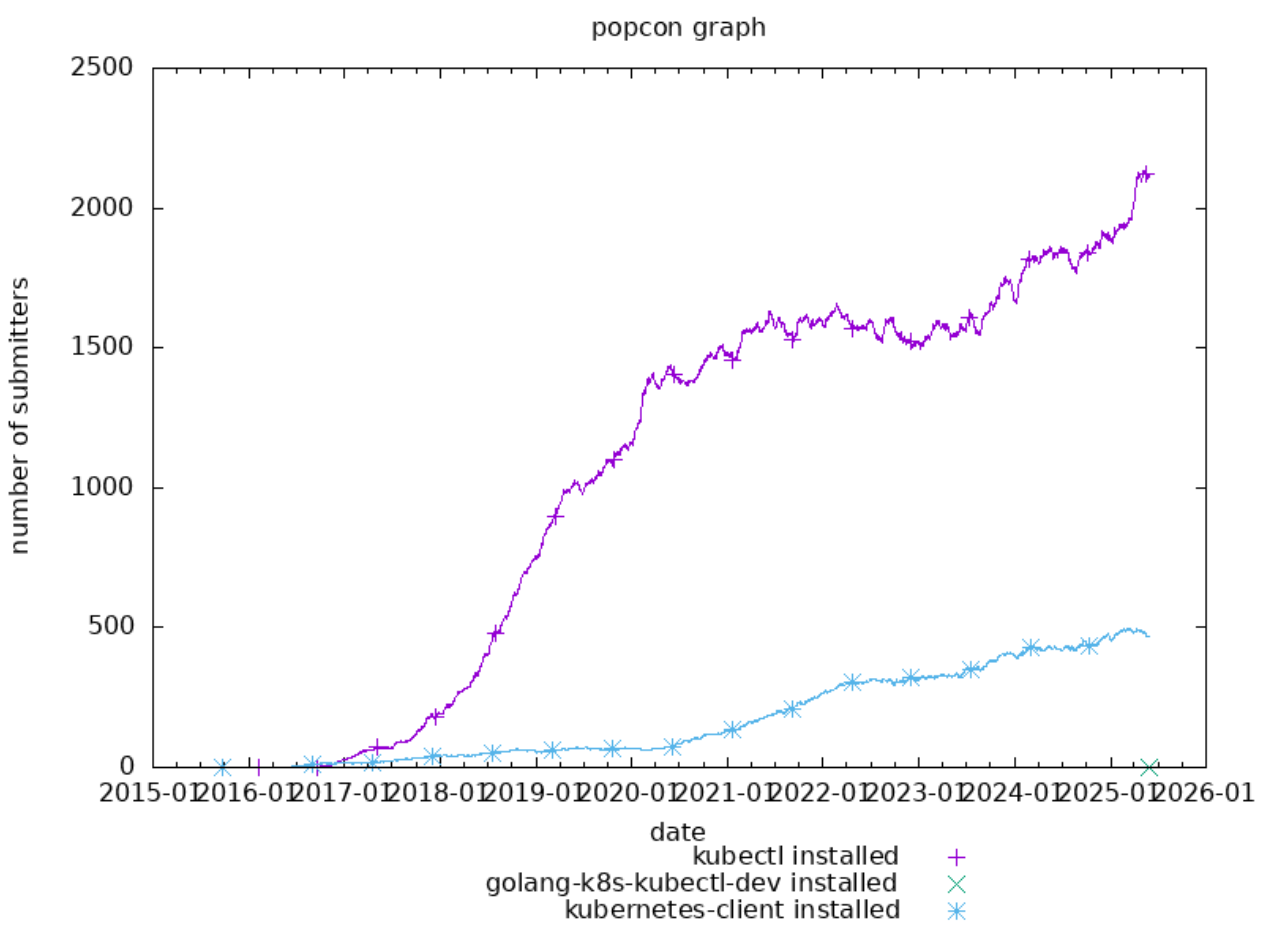
Upstream Version 1.32.3 and Beyond After nearly two years of work, we successfully uploaded version 1.32.3+ds of kubectl to Debian unstable. kubernetes/-/merge_requests/1 The new package also includes:
  • Zsh, Fish, and Bash completions installed automatically
  • Man pages and metadata for improved discoverability
  • Full integration with kind and docker for testing purposes

Integration Testing with Autopkgtest To ensure the reliability of kubectl in real-world scenarios, we developed a new autopkgtest suite that runs integration tests using real Kubernetes clusters created via Kind. Autopkgtest is a Debian tool used to run automated tests on binary packages. These tests are executed after the package is built but before it s accepted into the Debian archive, helping catch regressions and integration issues early in the packaging pipeline. Our test workflow validates kubectl by performing the following steps:
  • Installing Kind and Docker as test dependencies.
  • Spinning up two local Kubernetes clusters.
  • Switching between cluster contexts to ensure multi-cluster support.
  • Deploying and scaling a sample nginx application using kubectl.
  • Cleaning up the entire test environment to avoid side effects.
  • debian/tests/kubectl.sh

Popcon: Measuring Adoption To measure real-world usage, we rely on data from Debian s popularity contest (popcon), which gives insight into how many users have each binary installed. popcon-graph popcon-table Here s what the data tells us:
  • kubectl (new binary): Already installed on 2,124 systems.
  • golang-k8s-kubectl-dev: This is the Go development package (a library), useful for other packages and developers who want to interact with Kubernetes programmatically.
  • kubernetes-client: The legacy package that kubectl is replacing. We expect this number to decrease in future releases as more systems transition to the new package.
Although the popcon data shows activity for kubectl before the official Debian upload date, it s important to note that those numbers represent users who had it installed from upstream source-lists, not from the Debian repositories. This distinction underscores a demand that existed even before the package was available in Debian proper, and it validates the importance of bringing it into the archive.
Also worth mentioning: this number is not the real total number of installations, since users can choose not to participate in the popularity contest. So the actual adoption is likely higher than what popcon reflects.

Community and Documentation The team also maintains a dedicated wiki page which documents:
  • Maintained tools and packages
  • Contribution guidelines
  • Our roadmap for the upcoming Debian releases
https://debian-kubernetes.org

Looking Ahead to Debian 13 (Trixie) The next stable release of Debian will ship with kubectl version 1.32.3, built from a clean, de-vendorized source. This version includes nearly all the latest upstream features, and will be the first time in years that Debian users can rely on an up-to-date, policy-compliant kubectl directly from the archive. By comparing with upstream, our Debian package even delivers more out of the box, including shell completions, which the upstream still requires users to generate manually. In 2025, the Debian Kubernetes team will continue expanding our packaging efforts for the Kubernetes ecosystem. Our roadmap includes:
  • kubelet: The primary node agent that runs on each node. This will enable Debian users to create fully functional Kubernetes nodes without relying on external packages.
  • kubeadm: A tool for creating Kubernetes clusters. With kubeadm in Debian, users will then be able to bootstrap minimum viable clusters directly from the official repositories.
  • helm: The package manager for Kubernetes that helps manage applications through Kubernetes YAML files defined as charts.
  • kompose: A conversion tool that helps users familiar with docker-compose move to Kubernetes by translating Docker Compose files into Kubernetes resources.

Final Thoughts This journey was only possible thanks to the amazing support of the debian-devel-br community and the collective effort of contributors who stepped up to package missing dependencies, fix bugs, and test new versions. Special thanks to:
  • Carlos Henrique Melara (@charles)
  • Guilherme Puida (@puida)
  • Jo o Pedro Nobrega (@jnpf)
  • Lucas Kanashiro (@kanashiro)
  • Matheus Polkorny (@polkorny)
  • Samuel Henrique (@samueloph)
  • Sergio Cipriano (@cipriano)
  • Sergio Durigan Junior (@sergiodj)
I look forward to continuing this work, bringing more Kubernetes tools into Debian and improving the developer experience for everyone.

Arthur Diniz: Bringing Kubernetes Back to Debian

I ve been part of the Debian Project since 2019, when I attended DebConf held in Curitiba, Brazil. That event sparked my interest in the community, packaging, and how Debian works as a distribution. In the early years of my involvement, I contributed to various teams such as the Python, Golang and Cloud teams, packaging dependencies and maintaining various tools. However, I soon felt the need to focus on packaging software I truly enjoyed, tools I was passionate about using and maintaining. That s when I turned my attention to Kubernetes within Debian.

A Broken Ecosystem The Kubernetes packaging situation in Debian had been problematic for some time. Given its large codebase and complex dependency tree, the initial packaging approach involved vendorizing all dependencies. While this allowed a somewhat functional package to be published, it introduced several long-term issues, especially security concerns. Vendorized packages bundle third-party dependencies directly into the source tarball. When vulnerabilities arise in those dependencies, it becomes difficult for Debian s security team to patch and rebuild affected packages system-wide. This approach broke Debian s best practices, and it eventually led to the abandonment of the Kubernetes source package, which had stalled at version 1.20.5. Due to this abandonment, critical bugs emerged and the package was removed from Debian s testing channel, as we can see in the package tracker.

New Debian Kubernetes Team Around this time, I became a Debian Maintainer (DM), with permissions to upload certain packages. I saw an opportunity to both contribute more deeply to Debian and to fix Kubernetes packaging. In early 2024, just before DebConf Busan in South Korea, I founded the Debian Kubernetes Team. The mission of the team was to repackage Kubernetes in a maintainable, security-conscious, and Debian-compliant way. At DebConf, I shared our progress with the broader community and received great feedback and more visibility, along with people interested in contributing to the team. Our first tasks was to migrate existing Kubernetes-related tools such as kubectx, kubernetes-split-yaml and kubetail into a dedicated namespace on Salsa, Debian s GitLab instance. Many of these tools were stored across different teams (like the Go team), and consolidating them helped us organize development and focus our efforts.

De-vendorizing Kubernetes Our main goal was to un-vendorize Kubernetes and bring it up-to-date with upstream releases. This meant:
  • Removing the vendor directory and all embedded third-party code.
  • Trimming the build scope to focus solely on building kubectl, Kubernetes CLI.
  • Using Files-Excluded in debian/copyright to cleanly drop unneeded files during source imports.
  • Rebuilding the dependency tree, ensuring all Go modules were separately packaged in Debian.
We used uscan, a standard Debian packaging tool that fetches upstream tarballs and prepares them accordingly. The Files-Excluded directive in our debian/copyright file instructed uscan to automatically remove unnecessary files during the repackaging process:
$ uscan
Newest version of kubernetes on remote site is 1.32.3, specified download version is 1.32.3
Successfully repacked ../v1.32.3 as ../kubernetes_1.32.3+ds.orig.tar.gz, deleting 30616 files from it.
The results were dramatic. By comparing the original upstream tarball with our repackaged version, we can see that our approach reduced the tarball size by over 75%:
$ du -h upstream-v1.32.3.tar.gz kubernetes_1.32.3+ds.orig.tar.gz
14M	upstream-v1.32.3.tar.gz
3.2M	kubernetes_1.32.3+ds.orig.tar.gz
This significant reduction wasn t just about saving space. By removing over 30,000 files, we simplified the package, making it more maintainable. Each dependency could now be properly tracked, updated, and patched independently, resolving the security concerns that had plagued the previous packaging approach.

Dependency Graph To give you an idea of the complexity involved in packaging Kubernetes for Debian, the image below is a dependency graph generated with debtree, visualizing all the Go modules and other dependencies required to build the kubectl binary. kubectl-depgraph This web of nodes and edges represents every module and its relationship during the compilation process of kubectl. Each box is a Debian package, and the lines connecting them show how deeply intertwined the ecosystem is. What might look like a mess of blue spaghetti is actually a clear demonstration of the vast and interconnected upstream world that tools like kubectl rely on. But more importantly, this graph is a testament to the effort that went into making kubectl build entirely using Debian-packaged dependencies only, no vendoring, no downloading from the internet, no proprietary blobs.
Upstream Version 1.32.3 and Beyond After nearly two years of work, we successfully uploaded version 1.32.3+ds of kubectl to Debian unstable. kubernetes/-/merge_requests/1 The new package also includes:
  • Zsh, Fish, and Bash completions installed automatically
  • Man pages and metadata for improved discoverability
  • Full integration with kind and docker for testing purposes

Integration Testing with Autopkgtest To ensure the reliability of kubectl in real-world scenarios, we developed a new autopkgtest suite that runs integration tests using real Kubernetes clusters created via Kind. Autopkgtest is a Debian tool used to run automated tests on binary packages. These tests are executed after the package is built but before it s accepted into the Debian archive, helping catch regressions and integration issues early in the packaging pipeline. Our test workflow validates kubectl by performing the following steps:
  • Installing Kind and Docker as test dependencies.
  • Spinning up two local Kubernetes clusters.
  • Switching between cluster contexts to ensure multi-cluster support.
  • Deploying and scaling a sample nginx application using kubectl.
  • Cleaning up the entire test environment to avoid side effects.
  • debian/tests/kubectl.sh

Popcon: Measuring Adoption To measure real-world usage, we rely on data from Debian s popularity contest (popcon), which gives insight into how many users have each binary installed. popcon-graph popcon-table Here s what the data tells us:
  • kubectl (new binary): Already installed on 2,124 systems.
  • golang-k8s-kubectl-dev: This is the Go development package (a library), useful for other packages and developers who want to interact with Kubernetes programmatically.
  • kubernetes-client: The legacy package that kubectl is replacing. We expect this number to decrease in future releases as more systems transition to the new package.
Although the popcon data shows activity for kubectl before the official Debian upload date, it s important to note that those numbers represent users who had it installed from upstream source-lists, not from the Debian repositories. This distinction underscores a demand that existed even before the package was available in Debian proper, and it validates the importance of bringing it into the archive.
Also worth mentioning: this number is not the real total number of installations, since users can choose not to participate in the popularity contest. So the actual adoption is likely higher than what popcon reflects.

Community and Documentation The team also maintains a dedicated wiki page which documents:
  • Maintained tools and packages
  • Contribution guidelines
  • Our roadmap for the upcoming Debian releases
https://debian-kubernetes.org

Looking Ahead to Debian 13 (Trixie) The next stable release of Debian will ship with kubectl version 1.32.3, built from a clean, de-vendorized source. This version includes nearly all the latest upstream features, and will be the first time in years that Debian users can rely on an up-to-date, policy-compliant kubectl directly from the archive. By comparing with upstream, our Debian package even delivers more out of the box, including shell completions, which the upstream still requires users to generate manually. In 2025, the Debian Kubernetes team will continue expanding our packaging efforts for the Kubernetes ecosystem. Our roadmap includes:
  • kubelet: The primary node agent that runs on each node. This will enable Debian users to create fully functional Kubernetes nodes without relying on external packages.
  • kubeadm: A tool for creating Kubernetes clusters. With kubeadm in Debian, users will then be able to bootstrap minimum viable clusters directly from the official repositories.
  • helm: The package manager for Kubernetes that helps manage applications through Kubernetes YAML files defined as charts.
  • kompose: A conversion tool that helps users familiar with docker-compose move to Kubernetes by translating Docker Compose files into Kubernetes resources.

Final Thoughts This journey was only possible thanks to the amazing support of the debian-devel-br community and the collective effort of contributors who stepped up to package missing dependencies, fix bugs, and test new versions. Special thanks to:
  • Carlos Henrique Melara (@charles)
  • Guilherme Puida (@puida)
  • Jo o Pedro Nobrega (@jnpf)
  • Lucas Kanashiro (@kanashiro)
  • Matheus Polkorny (@polkorny)
  • Samuel Henrique (@samueloph)
  • Sergio Cipriano (@cipriano)
  • Sergio Durigan Junior (@sergiodj)
I look forward to continuing this work, bringing more Kubernetes tools into Debian and improving the developer experience for everyone.

27 May 2025

Russell Coker: Leaf ZE1

I ve just got a second hand Nissan LEAF. It s not nearly as luxurious as the Genesis EV that I test drove [1]. It s also just over 5 years old so it s not as slick as the MG4 I test drove [2]. But the going rate for a LEAF of that age is $17,000 vs $35,000 or more for a new MG4 or $130,000+ for a Genesis. At this time the LEAF is the only EV in Australia that s available on the second hand market in quantity. Apparently the cheapest new EV in Australia is a Great Wall one which is $32,000 and which had a wait list last time I checked, so $17,000 is a decent price if you want an electric car and aren t interested in paying the price of a new car. Starting the Car One thing I don t like about most recent cars (petrol as well as electric) is that they needlessly break traditions of car design. Inserting a key and turning it clockwise to start a car is a long standing tradition that shouldn t be broken without a good reason. With the use of traditional keys you know that when a car has the key removed it can t be operated, there s no situation of the person with the key walking away and leaving the car driveable and there s no possibility of the owner driving somewhere without the key and then being unable to start it. To start a LEAF you have to have the key fob device in range, hold down the brake pedal, and then press the power button. To turn on accessories you do the same but without holding down the brake pedal. They also have patterns of pushes, push twice to turn it on, push three times to turn it off. This is all a lot easier with a key where you can just rotate it as many clicks as needed. The change of car design for the key means that no physical contact is needed to unlock the car. If someone stands by a car fiddling with the door lock it will get noticed which deters certain types of crime. If a potential thief can sit in a nearby car to try attack methods and only walk to the target vehicle once it s unlocked it makes the crime a lot easier. Even if the electronic key is as secure as a physical key allowing attempts to unlock remotely weakens security. Reports on forums suggest that the electronic key is vulnerable to replay attacks. I guess I just have to hope that as car thieves typically get less than 10% of the value of a car it s just not worth their effort to steal a $17,000 car. Unlocking doors remotely is a common feature that s been around for a while but starting a car without a key being physically inserted is a new thing. Other Features The headlights turn on automatically when the car thinks that the level of ambient light warrants it. There is an option to override this to turn on lights but no option to force the lights to be off. So if you have your car in the on state while parked the headlights will be on even if you are parked and listening to the radio. The LEAF has a bunch of luxury features which seem a bit ridiculous like seat warmers. It also has a heated steering wheel which has turned out to be a good option for me as I have problems with my hands getting cold. According to the My Nissan LEAF Forum the seat warmer uses a maximum of 50W per seat while the car heater uses a minimum of 250W [3]. So if there are one or two people in the car then significantly less power is used by just heating the seats and also keeping the car air cool reduces window fog. The Bluetooth audio support works well. I ve done hands free calls and used it for playing music from my phone. This is the first car I ve owned with Bluetooth support. It also has line-in which might have had some use in 2019 but is becoming increasingly useless as phones with Bluetooth become more popular. It has support for two devices connecting via Bluetooth at the same time which could be handy if you wanted to watch movies on a laptop or tablet while waiting for someone. The LEAF has some of the newer safety features, it tracks lane markers and notifies the driver via beeps and vibration if they stray from their lane. It also tries to read speed limit signs and display the last observed speed limit on the dash display. It also has a skid alert which in my experience goes off under hard acceleration when it s not skidding but doesn t go off if you lose grip when cornering. The features for detecting changing lanes when close to other cars and for emergency braking when another car is partly in the lane (even if moving out of the lane) don t seem well tuned for Australian driving, the common trend on Australian roads is lawful-evil to use DND terminology. Range My most recent driving was just over 2 hours driving with a distance of a bit over 100Km which took the battery from 62% to 14%. So it looks like I can drive a bit over 200Km at an average speed of 50Km/h. I have been unable to find out the battery size for my car, my model will have either a 40KWh or 62KWh battery. Google results say it should be printed on the B pillar (it s not) and that it can be deduced from the VIN (it can t). I m guessing that my car is the cheaper option which is supposed to do 240Km when new which means that a bit over 200Km at an average speed of 50Km/h when 6yo is about what s expected. If it has the larger battery designed to do 340Km then doing 200Km in real use would be rather disappointing. Assuming the battery is 40KWh that means it s 5Km/KWh or 10KW average for the duration. That means that the 250W or so used by the car heater should only make a about 2% difference to range which is something that a human won t usually notice. If I was to drive to another state I d definitely avoid using the heater or airconditioner as an extra 4km could really matter when trying to find a place to charge when you aren t familiar with the area. It s also widely reported that the LEAF is less efficient at highway speeds which is an extra difficulty for that. It seems that the LEAF just isn t designed for interstate driving in Australia, it would be fine for driving between provinces of the Netherlands as it s difficult to drive for 200km without leaving that country. Driving 700km to another city in a car with 200km range would mean charging 3 times along the way, that s 2 hours of charging time when using fast chargers. This isn t a problem at all as the average household in Australia has 1.8 cars and the battery electric vehicles only comprise 6.3% of the market. So if a household had a LEAF and a Prius they could just use the Prius for interstate driving. A recent Prius could drive from Melbourne to Canberra or Adelaide without refuelling on the way. If I was driving to another state a couple of times a year I could rent an old fashioned car to do that and still be saving money when compared to buying petrol all the time. Running Cost Currently I m paying about $0.28 per KWh for electricity, it s reported that the efficiency of charging a LEAF is as low as 83% with the best efficiency when fast charging. I don t own the fast charge hardware and don t plan to install it as that would require getting a replacement of the connection to my home from the street, a new switchboard, and other expenses. So I expect I ll be getting 83% efficiency when charging which means 48KWh for 200KM or 96KWH for the equivalent of a $110 tank of petrol. At $0.28/KWh it will cost $26 for the same amount of driving as $110 of petrol. I also anticipate saving money on service as there s no need for engine oil changes and all the other maintenance of a petrol engine and regenerative braking will reduce the incidence of brake pad replacement. I expect to save over $1100 per annum on using electricity instead of petrol even if I pay the full rate. But if I charge my car in the middle of the day when there is over supply and I don t get paid for feeding electricity from my solar panels into the grid (as is common nowadays) it could be almost free to charge the car and I could save about $1500 on fuel. Comfort Electric cars are much quieter than cars with petrol or Diesel engines which is a major luxury feature. This car is also significantly newer than any other car I ve driven much so it has features like Bluetooth audio which weren t in other cars I ve driven. When doing 100Km/h I can hear a lot of noise from the airflow, part of that would be due to the LEAF not having the extreme streamlining features that are associated with Teslas (such as retracting door handles) and part of that would be due to the car being older and the door seals not being as good as they were when new. It s still a very quiet car with a very smooth ride. It would be nice if they used the quality of seals and soundproofing that VW uses in the Passat but I guess the car would be heavier and have a shorter range if they did that. This car has less space for the driver than any other car I ve driven (with the possible exception of a 1989 Ford Laser AKA Mazda 323). The front seats have less space than the Prius. Also the batteries seem to be under the front seats so there s a bulge in the floor going slightly in front of the front seats when they are moved back which gives less space for the front passenger to move their legs and less space for the driver when sitting in a parked car. There are a selection of electric cars from MG, BYD, and Great Wall that have more space in the front seats, if those cars were on the second hand market I might have made a different choice but a second hand LEAF is the only option for a cheap electric car in Australia now. The heated steering wheel and heated seats took a bit of getting used to but I have come to appreciate the steering wheel and the heated seats are a good way of extending the range of the car. Misc Notes The LEAF is a fun car to drive and being quiet is a luxury feature, it s no different to other EVs in this regard. It isn t nearly as fast as a Tesla, but is faster than most cars actually drive on the road. When I was looking into buying a LEAF from one of the car sales sites I was looking at models less than 5 years old. But the ZR1 series went from 2017 to 2023 so there s probably not much difference between a 2019 model and a 2021 model but there is a significant price difference. I didn t deliberately choose a 2019 car, it was what a relative was selling at a time when I needed a new car. But knowing what I know now I d probably look at that age of LEAF if choosing from the car sales sites. Problems When I turn the car off the side mirrors fold in but when I turn it on they usually don t automatically unfold if I have anything connected to the cigarette lighter power port. This is a well known problem and documented on forums. This is something that Nissan really should have tested before release because phone chargers that connect to the car cigarette lighter port have been common for at least 6 years before my car was manufactured and at least 4 years before the ZE1 model was released. The built in USB port doesn t supply enough power to match the power use of a Galaxy Note 9 running Google maps and playing music through Bluetooth. On it s own this isn t a big deal but combined with the mirror issue of using a charger in the cigarette lighter port it s a problem. The cover over the charging ports doesn t seem to lock easily enough, I had it come open when doing 100Km/h on a freeway. This wasn t a big deal but as the cover opens in a suicide-door manner at a higher speed it could have broken off. The word is that LEAF service in Australia is not done well. Why do you need regular service of an electric car anyway? For petrol and Diesel cars it s engine oil replacement that makes it necessary to have regular service. Surely you can just drive it until either the brakes squeak or the tires seem worn. I have been having problems charging, sometimes it will charge from ~20% to 100% in under 24 hours, sometimes in 14+ hours it only gets to 30%. Conclusion This is a good car and the going price on them is low. I generally recommend them as long as you aren t really big and aren t too worried about the poor security. It s a fun car to drive even with a few annoying things like the mirrors not automatically extending on start. The older ones like this are cheap enough that they should be able to cover the entire purchase cost in 10 years by the savings from not buying petrol even if you don t drive a lot. With a petrol car I use about 13 tanks of petrol a year so my driving is about half the average for Australia. Some people could cover the purchase price of a second hand leaf in under 5 years.

Next.

Previous.