Search Results: "don"

20 October 2025

Dirk Eddelbuettel: RcppArmadillo 15.2.0-0 on GitHub: New Upstream, Simpler OpenMP

armadillo image Armadillo is a powerful and expressive C++ template library for linear algebra and scientific computing. It aims towards a good balance between speed and ease of use, has a syntax deliberately close to Matlab, and is useful for algorithm development directly in C++, or quick conversion of research code into production environments. RcppArmadillo integrates this library with the R environment and language and is widely used by (currently) 1270 other packages on CRAN, downloaded 42 million times (per the partial logs from the cloud mirrors of CRAN), and the CSDA paper (preprint / vignette) by Conrad and myself has been cited 650 times according to Google Scholar. This versions updates to the 15.2.0 upstream release made today. It brings a few changes over Armadillo 15.0 (see below for more). It follows the most recent RcppArmadillo 15.0.2-2 release and the Armadillo 15 upstream transition with its dual focus on moving on from C++11 and deprecation of a number of API access points. As we had a few releases last month to manage the transition, we will sit this upgrade out and not upload to CRAN in order to normalize our update cadence towards the desired about six in six months (that the CRAN Policy asks for). One can of course install as usual directly from the GitHub repository as well as from r-universe which also offers binaries for all CRAN platforms. The transition to Armadillo 15 appears to be going slowly but steadily. We had well over 300 packages with either a need to relax the C++11 setting and/or update away from now-deprecated API access points. That number has been cut in half thanks to a lot of work from a lot of package maintainers which is really appreciated! Of course, a lot remains to be done. Issues #489 and #491 contain the over sixty PRs and patches I prepared for all packages with at least one reverse dependency. Most (but not all) have aided in CRAN updates, some packages are still outstanding in terms of updates. As before meta-issue #475 regroups all the resources for the transition. If you, dear reader, have a package that is affected and I could be of assistance please do reach out. The other change we made is to greatly simplify the detection and setup of OpenMP. As before, we rely on configure to attempt compilation of a minimal OpenMP-using program in order to pass the success or failure onto Armadillo as a can-or-cannot use OpenMP. In the year 2025 one of the leading consumer brands still cannot ship an OS where this works out of the box, so we try to aide there. For all others systems, R actually covers this pretty well and has a reliable configuration variable that we rely upon. Just as we recommend for downstream users of the package. This setup should be robust, but is a change so by all means if you knowingly rely on OpenMP please test and report back. The detailed changes since the last CRAN release follow.

Changes in RcppArmadillo version 15.2.0-0 (2025-10-20) (GitHub Only)
  • Upgraded to Armadillo release 15.2.0 (Medium Roast Deluxe)
    • Added rande() for generating matrices with elements from exponential distributions
    • shift() has been deprecated in favour of circshift(), for consistency with Matlab/Octave
    • Reworked detection of aliasing, leading to more efficient compiled code
  • OpenMP detection in configure has been simplified

More detailed information is on the RcppArmadillo page. Questions, comments etc should go to the rcpp-devel mailing list off the Rcpp R-Forge page.

This post by Dirk Eddelbuettel originated on his Thinking inside the box blog. If you like this or other open-source work I do, you can sponsor me at GitHub.

Birger Schacht: A plea for <dialog>

A couple of weeks ago there was an article on the Freexian blog about Using JavaScript in Debusine without depending on JavaScript. It describes how JavaScript is used in the Debusine Django app, namely for progressive enhancement rather than core functionality . This is an approach I also follow when implementing web interfaces and I think developments in web technologies and standardization in recent years have made this a lot easier. One of the examples described in the post, the Bootstrap toast messages, was something that I implemented myself recently, in a similar but slightly different way. In the main app I develop for my day job we also use the Bootstrap framework. I have also used it for different personal projects (for example the GSOC project I did for Debian in 2018, was also a Django app that used Bootstrap). Bootstrap is still primarily a CSS framework, but it also comes with a JavaScript library for some functionality. Previous versions of Bootstrap depended on jQuery, but since version 5 of Bootstrap, you don t need jQuery anymore. In my experience, two of the more commonly used JavaScript utilities of Bootstrap are modals (also called lightbox or popup, they are elements that are displayed above the main content of a website) and toasts (also called alerts, they are little notification windows that often disappear after a timeout). The thing is, Bootstrap 5 was released in 2021 and a lot has happened since then regarding web technologies. I believe that both these UI components can nowadays be implemented using standard HTML5 elements. An eye opening talk I watched was Stop using JS for that from last years JSConf(!). In this talk the speaker argues that the Rule of least power is one of the core principles of web development, which means we should use HTML over CSS and CSS over JavaScript. And the speaker also presents some CSS rules and HTML elements that added recently and that help to make that happen, one of them being the dialog element:
The <dialog> HTML element represents a modal or non-modal dialog box or other interactive component, such as a dismissible alert, inspector, or subwindow. The Dialog element at MDN
The baseline for this element is widely available :
This feature is well established and works across many devices and browser versions. It s been available across browsers since March 2022. The Dialog element at MDN
This means there is an HTML element that does what a modal Bootstrap does! Once I had watched that talk I removed all my Bootstrap modals and replaced them with HTML <dialog> elements (JavaScript is still needed to .show() and .close() the elements, though, but those are two methods instead of a full library). This meant not only that I replaced code that depended on an external library, I m now also a lot more flexible regarding the styling of the elements. When I started implementing notifications for our app, my first approach was to use Bootstrap toasts, similar to how it is implemented in Debusine. But looking at the amount of HTML code I had to write for a simple toast message, I thought that it might be possible to also implement toasts with the <dialog> element. I mean, basically it is the same, only the styling is a bit different. So what I did was that I added a #snackbar area to the DOM of the app. This would be the container for the toast messages. All the toast messages are simply <dialog> elements with the open attribute, which means that they are visible right away when the page loads.
<div id="snackbar">
   % for message in messages % 
    <dialog class="mytoast alert alert-  message.tags  " role="alert" open>
        message  
    </dialog>
   % endfor % 
</div>
This looks a lot simpler than the Bootstrap toasts would have. To make the <dialog> elements a little bit more fancy, I added some CSS to make them fade in and out:
.mytoast  
    z-index: 1;
    animation: fadein 0.5s, fadeout 0.5s 2.6s;
 
@keyframes fadein  
    from  
        opacity: 0;
     
    to  
        opacity: 1;
     
 
@keyframes fadeout  
    from  
        opacity: 1;
     
    to  
        opacity: 0;
     
 
To close a <dialog> element once it has faded away, I had to add one JavaScript event listener:
window.addEventListener('load', () =>  
    document.querySelectorAll(".mytoast").forEach((element) =>  
        element.addEventListener('animationend', function(e)  
            e.animationName == "fadeout" && element.close();
         );
     );
 );
(If one would want to use the same HTML code for both script and noscript users, then the CSS should probably adapted: it fades away and if there is no JavaScript to close the element, it stays visible after the animation is over. A solution would for example be to use a close button and for noscript users simply let it stay visible - this is also what happens with the noscript messages in Debusine). So there are many new elements in HTML and a lot of new features of CSS. It makes sense to sometimes ask ourselves if instead of the solutions we know (or what a web search / some AI shows us as the most common solution) there might be some newer solution that was not there when the first choice was created. Using standardized solutions instead of custom libraries makes the software more maintainable. In web development I also prefer standardized elements over a third party library because they have usually better accessibility and UX. In How Functional Programming Shaped (and Twisted) Frontend Development the author writes:
Consider the humble modal dialog. The web has <dialog>, a native element with built-in functionality: it manages focus trapping, handles Escape key dismissal, provides a backdrop, controls scroll-locking on the body, and integrates with the accessibility tree. It exists in the DOM but remains hidden until opened. No JavaScript mounting required. [ ] you ve trained developers to not even look for native solutions. The platform becomes invisible. When someone asks how do I build a modal? , the answer is install a library or here s my custom hook, never use <dialog>. Ahmad Alfy

19 October 2025

Colin Watson: Mistaken dichotomies about dgit

In Could the XZ backdoor have been detected with better Git and Debian packaging practices? , Otto contrasts git-buildpackage managed git repositories with dgit managed repositories , saying that the dgit managed repositories cannot incorporate the upstream git history and are thus less useful for auditing the full software supply-chain in git . Otto does qualify this earlier with a package that has not had the history recorded in dgit earlier , but the last sentence of the section is a misleading oversimplification. It s true for repositories that have been synthesized by dgit (which indeed was the focus of that section of Otto s article), but it s not true in general for repositories that are managed by dgit. I suspect this was just slightly unclear writing, so I don t want to nitpick here, but rather to take the opportunity to try to clear up some misconceptions around dgit that I ve often heard at conferences and seen on mailing lists. I m not a dgit developer, although I m a happy user of it and I ve tried to help out in various design discussions over the years.
dgit and git-buildpackage sit at different layers It seems very common for people to think of git-buildpackage and dgit as alternatives, as the example I quoted at the start of this article suggests. It s really better to think of dgit as a separate and orthogonal layer. You can use dgit together with tools such as git-buildpackage. In that case, git-buildpackage handles the general shape of your git history, such as helping you to import new upstream versions, and dgit handles gatewaying between the archive and git. The advantages become evident when you start using tag2upload, in which case you can just use git debpush to push a tag and the tag2upload service deals with building the source package and uploading it to the archive for you. This is true regardless of how you put your package s git history together. (There s currently a wrinkle around pristine-tar support, so at the moment I personally tend to use dgit push-source for new upstream versions and git debpush for new Debian revisions, since I haven t yet convinced myself that I see no remaining value in pristine upstream tarballs.)
dgit supports complete history If the maintainer has never used dgit, and so dgit clone synthesizes a repository based on the current contents of the Debian archive, then there s indeed no useful history there; in that situation it doesn t go back and import everything from the snapshot archive the way that gbp import-dscs --debsnap does. However, if the maintainer uses dgit, then dgit s view will include more history, and it s absolutely possible for that to include complete upstream git history as well. Try this:
$ dgit clone man-db
canonical suite name for unstable is sid
fetching existing git history
last upload to archive: specified git info (debian)
downloading http://ftp.debian.org/debian//pool/main/m/man-db/man-db_2.13.1.orig.tar.xz...
  % Total    % Received % Xferd  Average Speed   Time    Time     Time  Current
                                 Dload  Upload   Total   Spent    Left  Speed
100 2060k  100 2060k    0     0  4643k      0 --:--:-- --:--:-- --:--:-- 4652k
downloading http://ftp.debian.org/debian//pool/main/m/man-db/man-db_2.13.1.orig.tar.xz.asc...
  % Total    % Received % Xferd  Average Speed   Time    Time     Time  Current
                                 Dload  Upload   Total   Spent    Left  Speed
100   833  100   833    0     0  16322      0 --:--:-- --:--:-- --:--:-- 16660
HEAD is now at 167835b0 releasing package man-db version 2.13.1-1
dgit ok: ready for work in man-db
$ git -C man-db log --graph --oneline   head
* 167835b0 releasing package man-db version 2.13.1-1
*   f7910493 New upstream release (2.13.1)
 \
  *   3073b72e Import man-db_2.13.1.orig.tar.xz
   \
    * 349ce503 Release man-db 2.13.1
    * 0d6635c1 Update Russian manual page translation
    * cbf87caf Update Italian translation
    * fb5c5017 Update German manual page translation
    * dae2057b Update Brazilian Portuguese manual page translation
That package uses git-dpm, since I prefer the way it represents patches. But it works fine with git-buildpackage too:
$ dgit clone isort
canonical suite name for unstable is sid
fetching existing git history
last upload to archive: specified git info (debian)
downloading http://ftp.debian.org/debian//pool/main/i/isort/isort_7.0.0.orig.tar.gz...
  % Total    % Received % Xferd  Average Speed   Time    Time     Time  Current
                                 Dload  Upload   Total   Spent    Left  Speed
100  786k  100  786k    0     0  1772k      0 --:--:-- --:--:-- --:--:-- 1774k
HEAD is now at f812aae releasing package isort version 7.0.0-1
dgit ok: ready for work in isort
$ git -C isort log --graph --oneline   head
* f812aae releasing package isort version 7.0.0-1
*   efde62f Update upstream source from tag 'upstream/7.0.0'
 \
  * 9694f3d New upstream version 7.0.0
*   9cbfe0b releasing package isort version 6.1.0-1
*   5423ffe Mark isort and python3-isort Multi-Arch: foreign
*   5eaf5bf Update upstream source from tag 'upstream/6.1.0'
 \ 
  * edafbfc New upstream version 6.1.0
*     aedfd25 Merge branch 'debian/master' into fix992793
If you look closely you ll see another difference here: the second only includes one commit representing the new upstream release, and doesn t have complete upstream history. This doesn t represent a difference between git-dpm and git-buildpackage. Both tools can operate in both ways: for example, git-dpm import-new-upstream --parent and gbp import-orig --upstream-vcs-tag do broadly similar things, and something like gbp import-dscs --debsnap --upstream-vcs-tag='%(version)s' can be used to do a bulk import provided that upstream s tags are named consistently enough. This is not generally the default because adding complete upstream history requires extra setup: the maintainer has to add an extra git remote pointing to upstream and select the correct tag when importing a new version, and some upstreams forget to push git tags or don t have the sort of consistency you might want. The Debian Python team s policy says that Complete upstream Git history should be avoided in the upstream branch , which is why the isort history above looks the way it does. I don t love this because I think the results are less useful, but I understand why it s there: in a moderately large team maintaining thousands of packages, getting everyone to have the right git remotes set up would be a recipe for frustrating inconsistency. However, in packages I maintain myself, I strongly value having complete upstream history in order to make it easier to debug problems, and I think it makes things a bit more transparent to auditors too, so I m willing to go to a little extra work to make that happen. Doing that is completely compatible with using dgit.

Otto Kek l inen: Could the XZ backdoor have been detected with better Git and Debian packaging practices?

Featured image of post Could the XZ backdoor have been detected with better Git and Debian packaging practices?The discovery of a backdoor in XZ Utils in the spring of 2024 shocked the open source community, raising critical questions about software supply chain security. This post explores whether better Debian packaging practices could have detected this threat, offering a guide to auditing packages and suggesting future improvements. The XZ backdoor in versions 5.6.0/5.6.1 made its way briefly into many major Linux distributions such as Debian and Fedora, but luckily didn t reach that many actual users, as the backdoored releases were quickly removed thanks to the heroic diligence of Andres Freund. We are all extremely lucky that he detected a half a second performance regression in SSH, cared enough to trace it down, discovered malicious code in the XZ library loaded by SSH, and reported promtly to various security teams for quick coordinated actions. This episode makes software engineers pondering the following questions: As a Debian Developer, I decided to audit the xz package in Debian, share my methodology and findings in this post, and also suggest some improvements on how the software supply-chain security could be tightened in Debian specifically. Note that the scope here is only to inspect how Debian imports software from its upstreams, and how they are distributed to Debian s users. This excludes the whole story of how to assess if an upstream project is following software development security best practices. This post doesn t discuss how to operate an individual computer running Debian to ensure it remains untampered as there are plenty of guides on that already.
Downloading Debian and upstream source packages Let s start by working backwards from what the Debian package repositories offer for download. As auditing binaries is extremely complicated, we skip that, and assume the Debian build hosts are trustworthy and reliably building binaries from the source packages, and the focus should be on auditing the source code packages. As with everything in Debian, there are multiple tools and ways to do the same thing, but in this post only one (and hopefully the best) way to do something is presented for brevity. The first step is to download the latest version and some past versions of the package from the Debian archive, which is easiest done with debsnap. The following command will download all Debian source packages of xz-utils from Debian release 5.2.4-1 onwards:
$ debsnap --verbose --first 5.2.4-1 xz-utils
Getting json https://snapshot.debian.org/mr/package/xz-utils/
...
Getting dsc file xz-utils_5.2.4-1.dsc: https://snapshot.debian.org/file/a98271e4291bed8df795ce04d9dc8e4ce959462d
Getting file xz-utils_5.2.4.orig.tar.xz.asc: https://snapshot.debian.org/file/59ccbfb2405abe510999afef4b374cad30c09275
Getting file xz-utils_5.2.4-1.debian.tar.xz: https://snapshot.debian.org/file/667c14fd9409ca54c397b07d2d70140d6297393f
source-xz-utils/xz-utils_5.2.4-1.dsc:
Good signature found
validating xz-utils_5.2.4.orig.tar.xz
validating xz-utils_5.2.4.orig.tar.xz.asc
validating xz-utils_5.2.4-1.debian.tar.xz
All files validated successfully.
Once debsnap completes there will be a subfolder source-<package name> with the following types of files:
  • *.orig.tar.xz: source code from upstream
  • *.orig.tar.xz.asc: detached signature (if upstream signs their releases)
  • *.debian.tar.xz: Debian packaging source, i.e. the debian/ subdirectory contents
  • *.dsc: Debian source control file, including signature by Debian Developer/Maintainer
Example:
$ ls -1 source-xz-utils/
...
xz-utils_5.6.4.orig.tar.xz
xz-utils_5.6.4.orig.tar.xz.asc
xz-utils_5.6.4-1.debian.tar.xz
xz-utils_5.6.4-1.dsc
xz-utils_5.8.0.orig.tar.xz
xz-utils_5.8.0.orig.tar.xz.asc
xz-utils_5.8.0-1.debian.tar.xz
xz-utils_5.8.0-1.dsc
xz-utils_5.8.1.orig.tar.xz
xz-utils_5.8.1.orig.tar.xz.asc
xz-utils_5.8.1-1.1.debian.tar.xz
xz-utils_5.8.1-1.1.dsc
xz-utils_5.8.1-1.debian.tar.xz
xz-utils_5.8.1-1.dsc
xz-utils_5.8.1-2.debian.tar.xz
xz-utils_5.8.1-2.dsc

Verifying authenticity of upstream and Debian sources using OpenPGP signatures As seen in the output of debsnap, it already automatically verifies that the downloaded files match the OpenPGP signatures. To have full clarity on what files were authenticated with what keys, we should verify the Debian packagers signature with:
$ gpg --verify --auto-key-retrieve --keyserver hkps://keyring.debian.org xz-utils_5.8.1-2.dsc
gpg: Signature made Fri Oct 3 22:04:44 2025 UTC
gpg: using RSA key 57892E705233051337F6FDD105641F175712FA5B
gpg: requesting key 05641F175712FA5B from hkps://keyring.debian.org
gpg: key 7B96E8162A8CF5D1: public key "Sebastian Andrzej Siewior" imported
gpg: Total number processed: 1
gpg: imported: 1
gpg: Good signature from "Sebastian Andrzej Siewior" [unknown]
gpg: aka "Sebastian Andrzej Siewior <bigeasy@linutronix.de>" [unknown]
gpg: aka "Sebastian Andrzej Siewior <sebastian@breakpoint.cc>" [unknown]
gpg: WARNING: This key is not certified with a trusted signature!
gpg: There is no indication that the signature belongs to the owner.
Primary key fingerprint: 6425 4695 FFF0 AA44 66CC 19E6 7B96 E816 2A8C F5D1
Subkey fingerprint: 5789 2E70 5233 0513 37F6 FDD1 0564 1F17 5712 FA5B
The upstream tarball signature (if available) can be verified with:
$ gpg --verify --auto-key-retrieve xz-utils_5.8.1.orig.tar.xz.asc
gpg: assuming signed data in 'xz-utils_5.8.1.orig.tar.xz'
gpg: Signature made Thu Apr 3 11:38:23 2025 UTC
gpg: using RSA key 3690C240CE51B4670D30AD1C38EE757D69184620
gpg: key 38EE757D69184620: public key "Lasse Collin <lasse.collin@tukaani.org>" imported
gpg: Total number processed: 1
gpg: imported: 1
gpg: Good signature from "Lasse Collin <lasse.collin@tukaani.org>" [unknown]
gpg: WARNING: This key is not certified with a trusted signature!
gpg: There is no indication that the signature belongs to the owner.
Primary key fingerprint: 3690 C240 CE51 B467 0D30 AD1C 38EE 757D 6918 4620
Note that this only proves that there is a key that created a valid signature for this content. The authenticity of the keys themselves need to be validated separately before trusting they in fact are the keys of these people. That can be done by checking e.g. the upstream website for what key fingerprints they published, or the Debian keyring for Debian Developers and Maintainers, or by relying on the OpenPGP web-of-trust .

Verifying authenticity of upstream sources by comparing checksums In case the upstream in question does not publish release signatures, the second best way to verify the authenticity of the sources used in Debian is to download the sources directly from upstream and compare that the sha256 checksums match. This should be done using the debian/watch file inside the Debian packaging, which defines where the upstream source is downloaded from. Continuing on the example situation above, we can unpack the latest Debian sources, enter and then run uscan to download:
$ tar xvf xz-utils_5.8.1-2.debian.tar.xz
...
debian/rules
debian/source/format
debian/source.lintian-overrides
debian/symbols
debian/tests/control
debian/tests/testsuite
debian/upstream/signing-key.asc
debian/watch
...
$ uscan --download-current-version --destdir /tmp
Newest version of xz-utils on remote site is 5.8.1, specified download version is 5.8.1
gpgv: Signature made Thu Apr 3 11:38:23 2025 UTC
gpgv: using RSA key 3690C240CE51B4670D30AD1C38EE757D69184620
gpgv: Good signature from "Lasse Collin <lasse.collin@tukaani.org>"
Successfully symlinked /tmp/xz-5.8.1.tar.xz to /tmp/xz-utils_5.8.1.orig.tar.xz.
The original files downloaded from upstream are now in /tmp along with the files renamed to follow Debian conventions. Using everything downloaded so far the sha256 checksums can be compared across the files and also to what the .dsc file advertised:
$ ls -1 /tmp/
xz-5.8.1.tar.xz
xz-5.8.1.tar.xz.sig
xz-utils_5.8.1.orig.tar.xz
xz-utils_5.8.1.orig.tar.xz.asc
$ sha256sum xz-utils_5.8.1.orig.tar.xz /tmp/xz-5.8.1.tar.xz
0b54f79df85912504de0b14aec7971e3f964491af1812d83447005807513cd9e xz-utils_5.8.1.orig.tar.xz
0b54f79df85912504de0b14aec7971e3f964491af1812d83447005807513cd9e /tmp/xz-5.8.1.tar.xz
$ grep -A 3 Sha256 xz-utils_5.8.1-2.dsc
Checksums-Sha256:
0b54f79df85912504de0b14aec7971e3f964491af1812d83447005807513cd9e 1461872 xz-utils_5.8.1.orig.tar.xz
4138f4ceca1aa7fd2085fb15a23f6d495d27bca6d3c49c429a8520ea622c27ae 833 xz-utils_5.8.1.orig.tar.xz.asc
3ed458da17e4023ec45b2c398480ed4fe6a7bfc1d108675ec837b5ca9a4b5ccb 24648 xz-utils_5.8.1-2.debian.tar.xz
In the example above the checksum 0b54f79df85... is the same across the files, so it is a match.

Repackaged upstream sources can t be verified as easily Note that uscan may in rare cases repackage some upstream sources, for example to exclude files that don t adhere to Debian s copyright and licensing requirements. Those files and paths would be listed under the Files-Excluded section in the debian/copyright file. There are also other situations where the file that represents the upstream sources in Debian isn t bit-by-bit the same as what upstream published. If checksums don t match, an experienced Debian Developer should review all package settings (e.g. debian/source/options) to see if there was a valid and intentional reason for divergence.

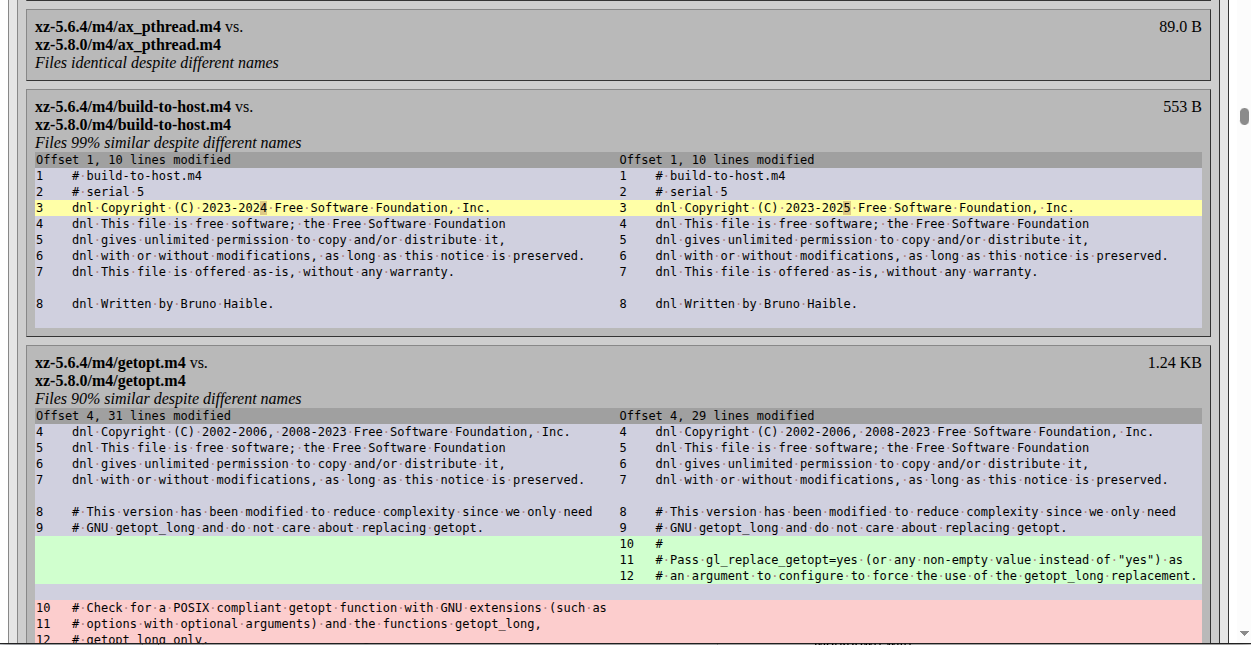
Reviewing changes between two source packages using diffoscope Diffoscope is an incredibly capable and handy tool to compare arbitrary files. For example, to view a report in HTML format of the differences between two XZ releases, run:
diffoscope --html-dir xz-utils-5.6.4_vs_5.8.0 xz-utils_5.6.4.orig.tar.xz xz-utils_5.8.0.orig.tar.xz
browse xz-utils-5.6.4_vs_5.8.0/index.html
Inspecting diffoscope output of differences between two XZ Utils releases If the changes are extensive, and you want to use a LLM to help spot potential security issues, generate the report of both the upstream and Debian packaging differences in Markdown with:
diffoscope --markdown diffoscope-debian.md xz-utils_5.6.4-1.debian.tar.xz xz-utils_5.8.1-2.debian.tar.xz
diffoscope --markdown diffoscope.md xz-utils_5.6.4.orig.tar.xz xz-utils_5.8.0.orig.tar.xz
The Markdown files created above can then be passed to your favorite LLM, along with a prompt such as:
Based on the attached diffoscope output for a new Debian package version compared with the previous one, list all suspicious changes that might have introduced a backdoor, followed by other potential security issues. If there are none, list a short summary of changes as the conclusion.

Reviewing Debian source packages in version control As of today only 93% of all Debian source packages are tracked in git on Debian s GitLab instance at salsa.debian.org. Some key packages such as Coreutils and Bash are not using version control at all, as their maintainers apparently don t see value in using git for Debian packaging, and the Debian Policy does not require it. Thus, the only reliable and consistent way to audit changes in Debian packages is to compare the full versions from the archive as shown above. However, for packages that are hosted on Salsa, one can view the git history to gain additional insight into what exactly changed, when and why. For packages that are using version control, their location can be found in the Git-Vcs header in the debian/control file. For xz-utils the location is salsa.debian.org/debian/xz-utils. Note that the Debian policy does not state anything about how Salsa should be used, or what git repository layout or development practices to follow. In practice most packages follow the DEP-14 proposal, and use git-buildpackage as the tool for managing changes and pushing and pulling them between upstream and salsa.debian.org. To get the XZ Utils source, run:
$ gbp clone https://salsa.debian.org/debian/xz-utils.git
gbp:info: Cloning from 'https://salsa.debian.org/debian/xz-utils.git'
At the time of writing this post the git history shows:
$ git log --graph --oneline
* bb787585 (HEAD -> debian/unstable, origin/debian/unstable, origin/HEAD) Prepare 5.8.1-2
* 4b769547 d: Remove the symlinks from -dev package.
* a39f3428 Correct the nocheck build profile
* 1b806b8d Import Debian changes 5.8.1-1.1
* b1cad34b Prepare 5.8.1-1
* a8646015 Import 5.8.1
* 2808ec2d Update upstream source from tag 'upstream/5.8.1'
 \
  * fa1e8796 (origin/upstream/v5.8, upstream/v5.8) New upstream version 5.8.1
  * a522a226 Bump version and soname for 5.8.1
  * 1c462c2a Add NEWS for 5.8.1
  * 513cabcf Tests: Call lzma_code() in smaller chunks in fuzz_common.h
  * 48440e24 Tests: Add a fuzzing target for the multithreaded .xz decoder
  * 0c80045a liblzma: mt dec: Fix lack of parallelization in single-shot decoding
  * 81880488 liblzma: mt dec: Don't modify thr->in_size in the worker thread
  * d5a2ffe4 liblzma: mt dec: Don't free the input buffer too early (CVE-2025-31115)
  * c0c83596 liblzma: mt dec: Simplify by removing the THR_STOP state
  * 831b55b9 liblzma: mt dec: Fix a comment
  * b9d168ee liblzma: Add assertions to lzma_bufcpy()
  * c8e0a489 DOS: Update Makefile to fix the build
  * 307c02ed sysdefs.h: Avoid <stdalign.h> even with C11 compilers
  * 7ce38b31 Update THANKS
  * 688e51bd Translations: Update the Croatian translation
*   a6b54dde Prepare 5.8.0-1.
*   77d9470f Add 5.8 symbols.
*   9268eb66 Import 5.8.0
*   6f85ef4f Update upstream source from tag 'upstream/5.8.0'
 \ \
  *   afba662b New upstream version 5.8.0
   /
  * 173fb5c6 doc/SHA256SUMS: Add 5.8.0
  * db9258e8 Bump version and soname for 5.8.0
  * bfb752a3 Add NEWS for 5.8.0
  * 6ccbb904 Translations: Run "make -C po update-po"
  * 891a5f05 Translations: Run po4a/update-po
  * 4f52e738 Translations: Partially fix overtranslation in Serbian man pages
  * ff5d9447 liblzma: Count the extra bytes in LZMA/LZMA2 decoder memory usage
  * 943b012d liblzma: Use SSE2 intrinsics instead of memcpy() in dict_repeat()
This shows both the changes on the debian/unstable branch as well as the intermediate upstream import branch, and the actual real upstream development branch. See my Debian source packages in git explainer for details of what these branches are used for. To only view changes on the Debian branch, run git log --graph --oneline --first-parent or git log --graph --oneline -- debian. The Debian branch should only have changes inside the debian/ subdirectory, which is easy to check with:
$ git diff --stat upstream/v5.8
debian/README.source   16 +++
debian/autogen.sh   32 +++++
debian/changelog   949 ++++++++++++++++++++++++++
...
debian/upstream/signing-key.asc   52 +++++++++
debian/watch   4 +
debian/xz-utils.README.Debian   47 ++++++++
debian/xz-utils.docs   6 +
debian/xz-utils.install   28 +++++
debian/xz-utils.postinst   19 +++
debian/xz-utils.prerm   10 ++
debian/xzdec.docs   6 +
debian/xzdec.install   4 +
33 files changed, 2014 insertions(+)
All the files outside the debian/ directory originate from upstream, and for example running git blame on them should show only upstream commits:
$ git blame CMakeLists.txt
22af94128 (Lasse Collin 2024-02-12 17:09:10 +0200 1) # SPDX-License-Identifier: 0BSD
22af94128 (Lasse Collin 2024-02-12 17:09:10 +0200 2)
7e3493d40 (Lasse Collin 2020-02-24 23:38:16 +0200 3) ###############
7e3493d40 (Lasse Collin 2020-02-24 23:38:16 +0200 4) #
426bdc709 (Lasse Collin 2024-02-17 21:45:07 +0200 5) # CMake support for building XZ Utils
If the upstream in question signs commits or tags, they can be verified with e.g.:
$ git verify-tag v5.6.2
gpg: Signature made Wed 29 May 2024 09:39:42 AM PDT
gpg: using RSA key 3690C240CE51B4670D30AD1C38EE757D69184620
gpg: issuer "lasse.collin@tukaani.org"
gpg: Good signature from "Lasse Collin <lasse.collin@tukaani.org>" [expired]
gpg: Note: This key has expired!
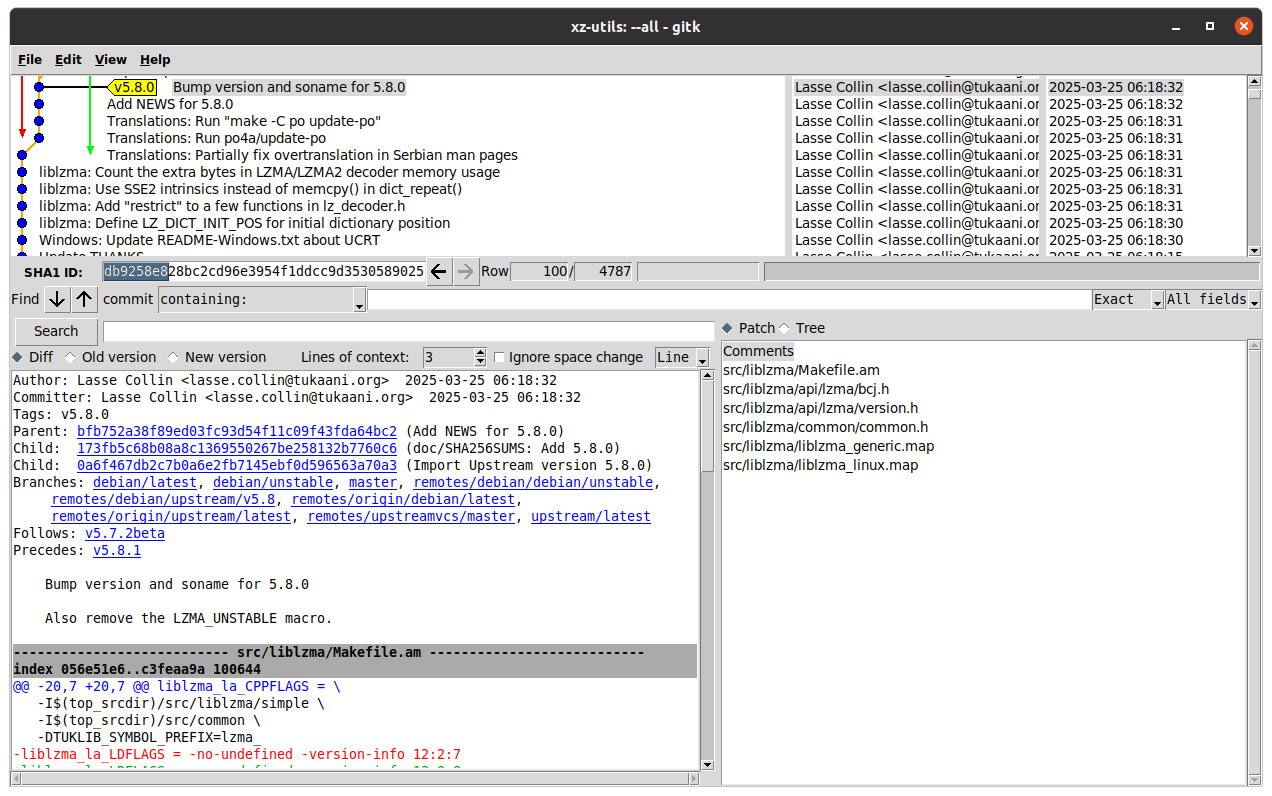
The main benefit of reviewing changes in git is the ability to see detailed information about each individual change, instead of just staring at a massive list of changes without any explanations. In this example, to view all the upstream commits since the previous import to Debian, one would view the commit range from afba662b New upstream version 5.8.0 to fa1e8796 New upstream version 5.8.1 with git log --reverse -p afba662b...fa1e8796. However, a far superior way to review changes would be to browse this range using a visual git history viewer, such as gitk. Either way, looking at one code change at a time and reading the git commit message makes the review much easier. Browsing git history in gitk --all

Comparing Debian source packages to git contents As stated in the beginning of the previous section, and worth repeating, there is no guarantee that the contents in the Debian packaging git repository matches what was actually uploaded to Debian. While the tag2upload project in Debian is getting more and more popular, Debian is still far from having any system to enforce that the git repository would be in sync with the Debian archive contents. To detect such differences we can run diff across the Debian source packages downloaded with debsnap earlier (path source-xz-utils/xz-utils_5.8.1-2.debian) and the git repository cloned in the previous section (path xz-utils):
diff
$ diff -u source-xz-utils/xz-utils_5.8.1-2.debian/ xz-utils/debian/
diff -u source-xz-utils/xz-utils_5.8.1-2.debian/changelog xz-utils/debian/changelog
--- debsnap/source-xz-utils/xz-utils_5.8.1-2.debian/changelog 2025-10-03 09:32:16.000000000 -0700
+++ xz-utils/debian/changelog 2025-10-12 12:18:04.623054758 -0700
@@ -5,7 +5,7 @@
 * Remove the symlinks from -dev, pointing to the lib package.
 (Closes: #1109354)

- -- Sebastian Andrzej Siewior <sebastian@breakpoint.cc> Fri, 03 Oct 2025 18:32:16 +0200
+ -- Sebastian Andrzej Siewior <sebastian@breakpoint.cc> Fri, 03 Oct 2025 18:36:59 +0200
In the case above diff revealed that the timestamp in the changelog in the version uploaded to Debian is different from what was committed to git. This is not malicious, just a mistake by the maintainer who probably didn t run gbp tag immediately after upload, but instead some dch command and ended up with having a different timestamps in the git compared to what was actually uploaded to Debian.

Creating syntetic Debian packaging git repositories If no Debian packaging git repository exists, or if it is lagging behind what was uploaded to Debian s archive, one can use git-buildpackage s import-dscs feature to create synthetic git commits based on the files downloaded by debsnap, ensuring the git contents fully matches what was uploaded to the archive. To import a single version there is gbp import-dsc (no s at the end), of which an example invocation would be:
$ gbp import-dsc --verbose ../source-xz-utils/xz-utils_5.8.1-2.dsc
Version '5.8.1-2' imported under '/home/otto/debian/xz-utils-2025-09-29'
Example commit history from a repository with commits added with gbp import-dsc:
$ git log --graph --oneline
* 86aed07b (HEAD -> debian/unstable, tag: debian/5.8.1-2, origin/debian/unstable) Import Debian changes 5.8.1-2
* f111d93b (tag: debian/5.8.1-1.1) Import Debian changes 5.8.1-1.1
* 1106e19b (tag: debian/5.8.1-1) Import Debian changes 5.8.1-1
 \
  * 08edbe38 (tag: upstream/5.8.1, origin/upstream/v5.8, upstream/v5.8) Import Upstream version 5.8.1
   \
    * a522a226 (tag: v5.8.1) Bump version and soname for 5.8.1
    * 1c462c2a Add NEWS for 5.8.1
    * 513cabcf Tests: Call lzma_code() in smaller chunks in fuzz_common.h
An online example repository with only a few missing uploads added using gbp import-dsc can be viewed at salsa.debian.org/otto/xz-utils-2025-09-29/-/network/debian%2Funstable An example repository that was fully crafted using gbp import-dscs can be viewed at salsa.debian.org/otto/xz-utils-gbp-import-dscs-debsnap-generated/-/network/debian%2Flatest. There exists also dgit, which in a similar way creates a synthetic git history to allow viewing the Debian archive contents via git tools. However, its focus is on producing new package versions, so fetching a package with dgit that has not had the history recorded in dgit earlier will only show the latest versions:
$ dgit clone xz-utils
canonical suite name for unstable is sid
starting new git history
last upload to archive: NO git hash
downloading http://ftp.debian.org/debian//pool/main/x/xz-utils/xz-utils_5.8.1.orig.tar.xz...
downloading http://ftp.debian.org/debian//pool/main/x/xz-utils/xz-utils_5.8.1.orig.tar.xz.asc...
downloading http://ftp.debian.org/debian//pool/main/x/xz-utils/xz-utils_5.8.1-2.debian.tar.xz...
dpkg-source: info: extracting xz-utils in unpacked
dpkg-source: info: unpacking xz-utils_5.8.1.orig.tar.xz
dpkg-source: info: unpacking xz-utils_5.8.1-2.debian.tar.xz
synthesised git commit from .dsc 5.8.1-2
HEAD is now at f9bcaf7 xz-utils (5.8.1-2) unstable; urgency=medium
dgit ok: ready for work in xz-utils
$ dgit/sid   git log --graph --oneline
* f9bcaf7 xz-utils (5.8.1-2) unstable; urgency=medium 9 days ago (HEAD -> dgit/sid, dgit/dgit/sid)
 \
  * 11d3a62 Import xz-utils_5.8.1-2.debian.tar.xz 9 days ago
* 15dcd95 Import xz-utils_5.8.1.orig.tar.xz 6 months ago
Unlike git-buildpackage managed git repositories, the dgit managed repositories cannot incorporate the upstream git history and are thus less useful for auditing the full software supply-chain in git.

Comparing upstream source packages to git contents Equally important to the note in the beginning of the previous section, one must also keep in mind that the upstream release source packages, often called release tarballs, are not guaranteed to have the exact same contents as the upstream git repository. Projects might strip out test data or extra development files from their release tarballs to avoid shipping unnecessary files to users, or projects might add documentation files or versioning information into the tarball that isn t stored in git. While a small minority, there are also upstreams that don t use git at all, so the plain files in a release tarball is still the lowest common denominator for all open source software projects, and exporting and importing source code needs to interface with it. In the case of XZ, the release tarball has additional version info and also a sizeable amount of pregenerated compiler configuration files. Detecting and comparing differences between git contents and tarballs can of course be done manually by running diff across an unpacked tarball and a checked out git repository. If using git-buildpackage, the difference between the git contents and tarball contents can be made visible directly in the import commit. In this XZ example, consider this git history:
* b1cad34b Prepare 5.8.1-1
* a8646015 Import 5.8.1
* 2808ec2d Update upstream source from tag 'upstream/5.8.1'
 \
  * fa1e8796 (debian/upstream/v5.8, upstream/v5.8) New upstream version 5.8.1
  * a522a226 (tag: v5.8.1) Bump version and soname for 5.8.1
  * 1c462c2a Add NEWS for 5.8.1
The commit a522a226 was the upstream release commit, which upstream also tagged v5.8.1. The merge commit 2808ec2d applied the new upstream import branch contents on the Debian branch. Between these is the special commit fa1e8796 New upstream version 5.8.1 tagged upstream/v5.8. This commit and tag exists only in the Debian packaging repository, and they show what is the contents imported into Debian. This is generated automatically by git-buildpackage when running git import-orig --uscan for Debian packages with the correct settings in debian/gbp.conf. By viewing this commit one can see exactly how the upstream release tarball differs from the upstream git contents (if at all). In the case of XZ, the difference is substantial, and shown below in full as it is very interesting:
$ git show --stat fa1e8796
commit fa1e8796dabd91a0f667b9e90f9841825225413a
(debian/upstream/v5.8, upstream/v5.8)
Author: Sebastian Andrzej Siewior <sebastian@breakpoint.cc>
Date: Thu Apr 3 22:58:39 2025 +0200
New upstream version 5.8.1
.codespellrc   30 -
.gitattributes   8 -
.github/workflows/ci.yml   163 -
.github/workflows/freebsd.yml   32 -
.github/workflows/netbsd.yml   32 -
.github/workflows/openbsd.yml   35 -
.github/workflows/solaris.yml   32 -
.github/workflows/windows-ci.yml   124 -
.gitignore   113 -
ABOUT-NLS   1 +
ChangeLog   17392 +++++++++++++++++++++
Makefile.in   1097 +++++++
aclocal.m4   1353 ++++++++
build-aux/ci_build.bash   286 --
build-aux/compile   351 ++
build-aux/config.guess   1815 ++++++++++
build-aux/config.rpath   751 +++++
build-aux/config.sub   2354 +++++++++++++
build-aux/depcomp   792 +++++
build-aux/install-sh   541 +++
build-aux/ltmain.sh   11524 ++++++++++++++++++++++
build-aux/missing   236 ++
build-aux/test-driver   160 +
config.h.in   634 ++++
configure   26434 ++++++++++++++++++++++
debug/Makefile.in   756 +++++
doc/SHA256SUMS   236 --
doc/man/txt/lzmainfo.txt   36 +
doc/man/txt/xz.txt   1708 ++++++++++
doc/man/txt/xzdec.txt   76 +
doc/man/txt/xzdiff.txt   39 +
doc/man/txt/xzgrep.txt   70 +
doc/man/txt/xzless.txt   36 +
doc/man/txt/xzmore.txt   31 +
lib/Makefile.in   623 ++++
m4/.gitignore   40 -
m4/build-to-host.m4   274 ++
m4/gettext.m4   392 +++
m4/host-cpu-c-abi.m4   529 +++
m4/iconv.m4   324 ++
m4/intlmacosx.m4   71 +
m4/lib-ld.m4   170 +
m4/lib-link.m4   815 +++++
m4/lib-prefix.m4   334 ++
m4/libtool.m4   8488 +++++++++++++++++++++
m4/ltoptions.m4   467 +++
m4/ltsugar.m4   124 +
m4/ltversion.m4   24 +
m4/lt~obsolete.m4   99 +
m4/nls.m4   33 +
m4/po.m4   456 +++
m4/progtest.m4   92 +
po/.gitignore   31 -
po/Makefile.in.in   517 +++
po/Rules-quot   66 +
po/boldquot.sed   21 +
po/ca.gmo   Bin 0 -> 15587 bytes
po/cs.gmo   Bin 0 -> 7983 bytes
po/da.gmo   Bin 0 -> 9040 bytes
po/de.gmo   Bin 0 -> 29882 bytes
po/en@boldquot.header   35 +
po/en@quot.header   32 +
po/eo.gmo   Bin 0 -> 15060 bytes
po/es.gmo   Bin 0 -> 29228 bytes
po/fi.gmo   Bin 0 -> 28225 bytes
po/fr.gmo   Bin 0 -> 10232 bytes
To be able to easily inspect exactly what changed in the release tarball compared to git release tag contents, the best tool for the job is Meld, invoked via git difftool --dir-diff fa1e8796^..fa1e8796. Meld invoked by git difftool --dir-diff afba662b..fa1e8796 to show differences between git release tag and release tarball contents To compare changes across the new and old upstream tarball, one would need to compare commits afba662b New upstream version 5.8.0 and fa1e8796 New upstream version 5.8.1 by running git difftool --dir-diff afba662b..fa1e8796. Meld invoked by git difftool --dir-diff afba662b..fa1e8796 to show differences between to upstream release tarball contents With all the above tips you can now go and try to audit your own favorite package in Debian and see if it is identical with upstream, and if not, how it differs.
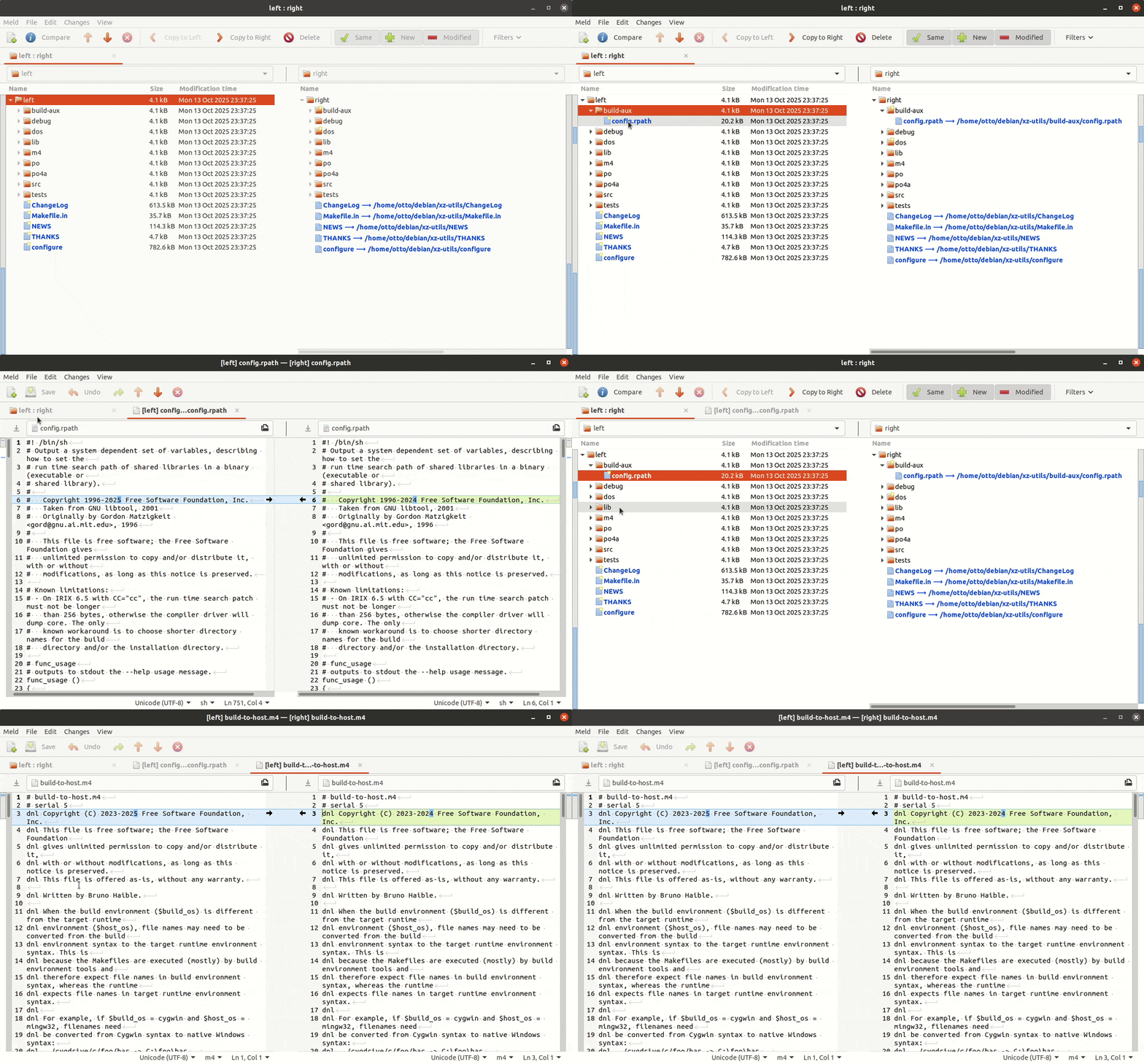
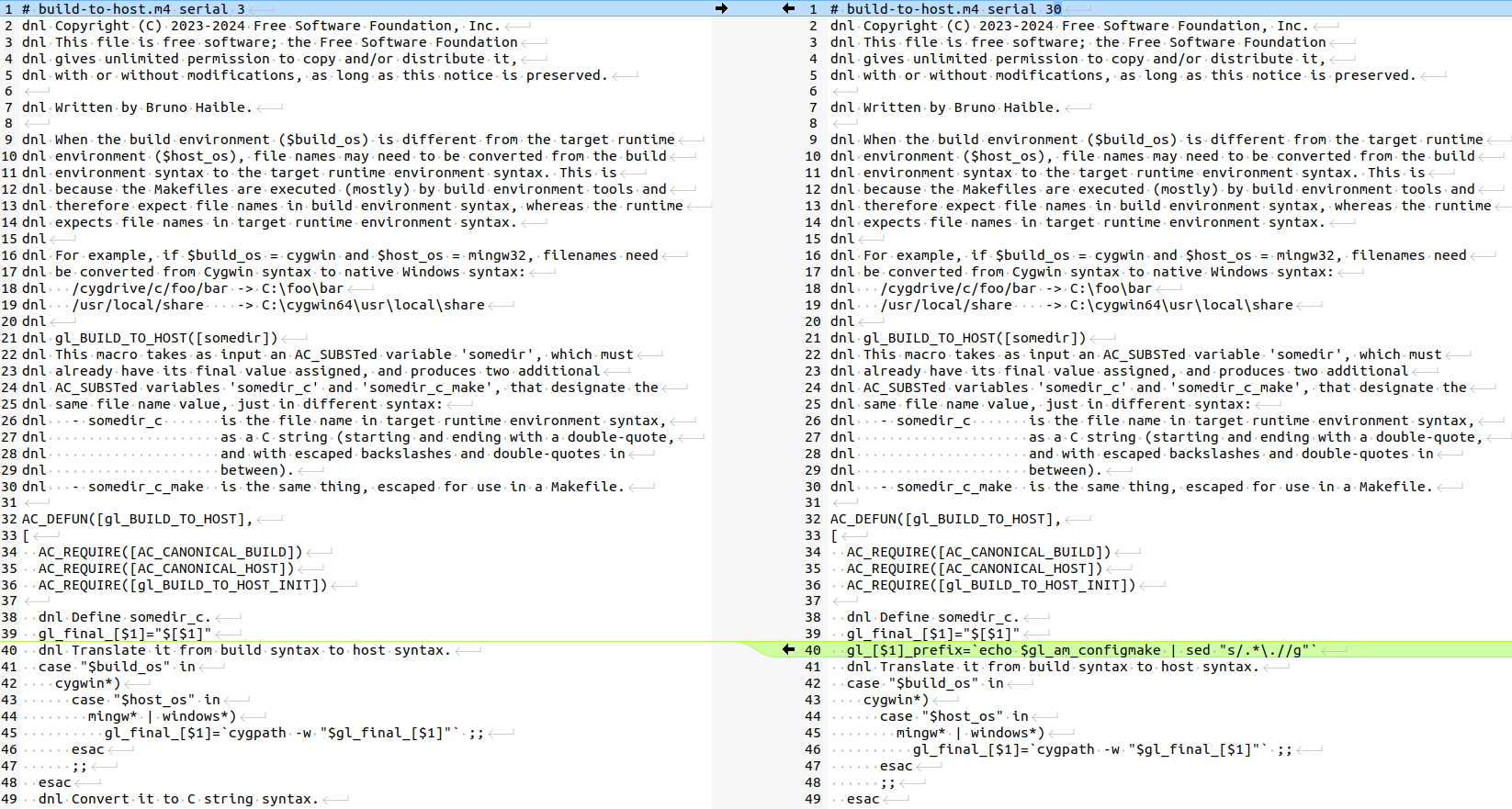
Should the XZ backdoor have been detected using these tools? The famous XZ Utils backdoor (CVE-2024-3094) consisted of two parts: the actual backdoor inside two binary blobs masqueraded as a test files (tests/files/bad-3-corrupt_lzma2.xz, tests/files/good-large_compressed.lzma), and a small modification in the build scripts (m4/build-to-host.m4) to extract the backdoor and plant it into the built binary. The build script was not tracked in version control, but generated with GNU Autotools at release time and only shipped as additional files in the release tarball. The entire reason for me to write this post was to ponder if a diligent engineer using git-buildpackage best practices could have reasonably spotted this while importing the new upstream release into Debian. The short answer is no . The malicious actor here clearly anticipated all the typical ways anyone might inspect both git commits, and release tarball contents, and masqueraded the changes very well and over a long timespan. First of all, XZ has for legitimate reasons for several carefully crafted .xz files as test data to help catch regressions in the decompression code path. The test files are shipped in the release so users can run the test suite and validate that the binary is built correctly and xz works properly. Debian famously runs massive amounts of testing in its CI and autopkgtest system across tens of thousands of packages to uphold high quality despite frequent upgrades of the build toolchain and while supporting more CPU architectures than any other distro. Test data is useful and should stay. When git-buildpackage is used correctly, the upstream commits are visible in the Debian packaging for easy review, but the commit cf44e4b that introduced the test files does not deviate enough from regular sloppy coding practices to really stand out. It is unfortunately very common for git commit to lack a message body explaining why the change was done, and to not be properly atomic with test code and test data together in the same commit, and for commits to be pushed directly to mainline without using code reviews (the commit was not part of any PR in this case). Only another upstream developer could have spotted that this change is not on par to what the project expects, and that the test code was never added, only test data, and thus that this commit was not just a sloppy one but potentially malicious. Secondly, the fact that a new Autotools file appeared (m4/build-to-host.m4) in the XZ Utils 5.6.0 is not suspicious. This is perfectly normal for Autotools. In fact, starting from XZ Utils version 5.8.1 it is now shipping a m4/build-to-host.m4 file that it actually uses now. Spotting that there is anything fishy is practically impossible by simply reading the code, as Autotools files are full custom m4 syntax interwoven with shell script, and there are plenty of backticks ( ) that spawn subshells and evals that execute variable contents further, which is just normal for Autotools. Russ Cox s XZ post explains how exactly the Autotools code fetched the actual backdoor from the test files and injected it into the build. Inspecting the m4/build-to-host.m4 changes in Meld launched via git difftool There is only one tiny thing that maybe a very experienced Autotools user could potentially have noticed: the serial 30 in the version header is way too high. In theory one could also have noticed this Autotools file deviates from what other packages in Debian ship with the same filename, such as e.g. the serial 3, serial 5a or 5b versions. That would however require and an insane amount extra checking work, and is not something we should plan to start doing. A much simpler solution would be to simply strongly recommend all open source projects to stop using Autotools to eventually get rid of it entirely.

Not detectable with reasonable effort While planting backdoors is evil, it is hard not to feel some respect to the level of skill and dedication of the people behind this. I ve been involved in a bunch of security breach investigations during my IT career, and never have I seen anything this well executed. If it hadn t slowed down SSH by ~500 milliseconds and been discovered due to that, it would most likely have stayed undetected for months or years. Hiding backdoors in closed source software is relatively trivial, but hiding backdoors in plain sight in a popular open source project requires some unusual amount of expertise and creativity as shown above.

Is the software supply-chain in Debian easy to audit? While maintaining a Debian package source using git-buildpackage can make the package history a lot easier to inspect, most packages have incomplete configurations in their debian/gbp.conf, and thus their package development histories are not always correctly constructed or uniform and easy to compare. The Debian Policy does not mandate git usage at all, and there are many important packages that are not using git at all. Additionally the Debian Policy also allows for non-maintainers to upload new versions to Debian without committing anything in git even for packages where the original maintainer wanted to use git. Uploads that bypass git unfortunately happen surpisingly often. Because of the situation, I am afraid that we could have multiple similar backdoors lurking that simply haven t been detected yet. More audits, that hopefully also get published openly, would be welcome! More people auditing the contents of the Debian archives would probably also help surface what tools and policies Debian might be missing to make the work easier, and thus help improve the security of Debian s users, and improve trust in Debian.

Is Debian currently missing some software that could help detect similar things? To my knowledge there is currently no system in place as part of Debian s QA or security infrastructure to verify that the upstream source packages in Debian are actually from upstream. I ve come across a lot of packages where the debian/watch or other configs are incorrect and even cases where maintainers have manually created upstream tarballs as it was easier than configuring automation to work. It is obvious that for those packages the source tarball now in Debian is not at all the same as upstream. I am not aware of any malicious cases though (if I was, I would report them of course). I am also aware of packages in the Debian repository that are misconfigured to be of type 1.0 (native) packages, mixing the upstream files and debian/ contents and having patches applied, while they actually should be configured as 3.0 (quilt), and not hide what is the true upstream sources. Debian should extend the QA tools to scan for such things. If I find a sponsor, I might build it myself as my next major contribution to Debian. In addition to better tooling for finding mismatches in the source code, Debian could also have better tooling for tracking in built binaries what their source files were, but solutions like Fraunhofer-AISEC s supply-graph or Sony s ESSTRA are not practical yet. Julien Malka s post about NixOS discusses the role of reproducible builds, which may help in some cases across all distros.

Or, is Debian missing some policies or practices to mitigate this? Perhaps more importantly than more security scanning, the Debian Developer community should switch the general mindset from anyone is free to do anything to valuing having more shared workflows. The ability to audit anything is severely hampered by the fact that there are so many ways to do the same thing, and distinguishing what is a normal deviation from a malicious deviation is too hard, as the normal can basically be almost anything. Also, as there is no documented and recommended default workflow, both those who are old and new to Debian packaging might never learn any one optimal workflow, and end up doing many steps in the packaging process in a way that kind of works, but is actually wrong or unnecessary, causing process deviations that look malicious, but turn out to just be a result of not fully understanding what would have been the right way to do something. In the long run, once individual developers workflows are more aligned, doing code reviews will become a lot easier and smoother as the excess noise of workflow differences diminishes and reviews will feel much more productive to all participants. Debian fostering a culture of code reviews would allow us to slowly move from the current practice of mainly solo packaging work towards true collaboration forming around those code reviews. I have been promoting increased use of Merge Requests in Debian already for some time, for example by proposing DEP-18: Encourage Continuous Integration and Merge Request based Collaboration for Debian packages. If you are involved in Debian development, please give a thumbs up in dep-team/deps!21 if you want me to continue promoting it.

Can we trust open source software? Yes and I would argue that we can only trust open source software. There is no way to audit closed source software, and anyone using e.g. Windows or MacOS just have to trust the vendor s word when they say they have no intentional or accidental backdoors in their software. Or, when the news gets out that the systems of a closed source vendor was compromised, like Crowdstrike some weeks ago, we can t audit anything, and time after time we simply need to take their word when they say they have properly cleaned up their code base. In theory, a vendor could give some kind of contractual or financial guarantee to its customer that there are no preventable security issues, but in practice that never happens. I am not aware of a single case of e.g. Microsoft or Oracle would have paid damages to their customers after a security flaw was found in their software. In theory you could also pay a vendor more to have them focus more effort in security, but since there is no way to verify what they did, or to get compensation when they didn t, any increased fees are likely just pocketed as increased profit. Open source is clearly better overall. You can, if you are an individual with the time and skills, audit every step in the supply-chain, or you could as an organization make investments in open source security improvements and actually verify what changes were made and how security improved. If your organisation is using Debian (or derivatives, such as Ubuntu) and you are interested in sponsoring my work to improve Debian, please reach out.

14 October 2025

Freexian Collaborators: Debian Contributions: Old Debian Printing software and C23, Work to decommission packages.qa.debian.org, rebootstrap uses *-for-host and more! (by Anupa Ann Joseph)

Debian Contributions: 2025-09 Contributing to Debian is part of Freexian s mission. This article covers the latest achievements of Freexian and their collaborators. All of this is made possible by organizations subscribing to our Long Term Support contracts and consulting services.

Updating old Debian Printing software to meet C23 requirements, by Thorsten Alteholz The work of Thorsten fell under the motto gcc15 . Due to the introduction of gcc15 in Debian, the default language version was changed to C23. This means that for example, function declarations without parameters are no longer allowed. As old software, which was created with ANSI C (or C89) syntax, made use of such function declarations, it was a busy month. One could have used something like -std=c17 as compile flags, but this would have just postponed the tasks. As a result Thorsten uploaded modernized versions of ink, nm2ppa and rlpr for the Debian printing team.

Work done to decommission packages.qa.debian.org, by Rapha l Hertzog Rapha l worked to decommission the old package tracking system (packages.qa.debian.org). After figuring out that it was still receiving emails from the bug tracking system (bugs.debian.org), from multiple debian lists and from some release team tools, he reached out to the respective teams to either drop those emails or adjust them so that they are sent to the current Debian Package Tracker (tracker.debian.org).

rebootstrap uses *-for-host, by Helmut Grohne Architecture cross bootstrapping is an ongoing effort that has shaped Debian in various ways over the years. A longer effort to express toolchain dependencies now bears fruit. When cross compiling, it becomes important to express what architecture one is compiling for in Build-Depends. As these packages have become available in trixie , more and more packages add this extra information and in August, the libtool package gained a gfortran-for-host dependency. It was the first package in the essential build closure to adopt this and required putting the pieces together in rebootstrap that now has to build gcc-defaults early on. There still are hundreds of packages whose dependencies need to be updated though.

Miscellaneous contributions
  • Rapha l dropped the Build Log Scan integration in tracker.debian.org since it was showing stale data for a while as the underlying service has been discontinued.
  • Emilio updated pixman to 0.46.4.
  • Emilio coordinated several transitions, and NMUed guestfs-tools to unblock one.
  • Stefano uploaded Python 3.14rc3 to Debian unstable. It s not yet used by any packages, but it allows testing the level of support in packages to begin.
  • Stefano upgraded almost all of the debian-social infrastructure to Debian trixie .
  • Stefano published the sponsorship brochures for DebConf 26.
  • Stefano attended the Debian Technical Committee meeting.
  • Stefano uploaded routine upstream updates for a handful of Python packages (pycparser, beautifulsoup4, platformdirs, pycparser, python-authlib, python-cffi, python-mitogen, python-resolvelib, python-super-collections, twine).
  • Stefano reviewed and responded to DebConf 25 feedback.
  • Stefano investigated and fixed a request visibility bug in debian-reimbursements (for admin-altered requests).
  • Lucas reviewed a couple of merge requests from external contributors for Go and Ruby packages.
  • Lucas updated some ruby packages to its latest upstream version (thin, passenger, and puma is still WIP).
  • Lucas set up the build environment to run rebuilds of reverse dependencies of ruby using ruby3.4. As an alternative, he is looking for personal repositories provided by Debusine to perform this task more easily. This is the preparation for the transition to ruby3.4 as the default in Debian.
  • Lucas helped on the next round of the Outreachy internship program.
  • Helmut sent patches for 30 cross build failures and responded to cross building support questions on the mailing list.
  • Helmut continued to maintain rebootstrap. As gcc version 15 became the default, test jobs for version 14 had to be dropped. A fair number of patches were applied to packages and could be dropped.
  • Helmut resumed removing RC-buggy packages from unstable and sponsored a termrec upload to avoid its deletion. This work was paused to give packages some time to migrate to forky .
  • Santiago reviewed different merge requests created by different contributors. Those MRs include a new test to build reverse dependencies, created by Aquila Macedo as part of his GSoC internship; restore how lintian was used in experimental, thanks Otto Kek l inen; and the fix by Christian Bayle to support again extra repositories in deb822-style sources, whose support was broken with the move to sbuild+unshare last month.
  • While doing some new upstream release updates, thanks to Debusine s reverse dependencies autopkgtest checks, Santiago discovered that paramiko 4.0 will introduce a regression in libcloud by the drop of support for the obsolete DSA keys. Santiago finally uploaded to unstable both paramiko 4.0, and a regression fix for libcloud.
  • Santiago has taken part in different discussions and meetings for the preparation of DebConf 26. The DebConf 26 local team aims to prepare for the conference with enough time in advance.
  • Carles kept working on the missing-package-relations and reporting missing Recommends. He improved the tooling to detect and report bugs creating 269 bugs and followed up comments. 37 bugs have been resolved, others acknowledged. The missing Recommends are a mixture of packages that are gone from Debian, packages that changed name, typos and also packages that were recommended but are not packaged in Debian.
  • Carles improved the missing-package-relations to report broken Suggests only for packages that used to be in Debian but are removed from it now. No bugs have been created yet for this case but identified 1320 of them.
  • Colin spent much of the month chasing down build/test regressions in various Python packages due to other upgrades, particularly relating to pydantic, python-pytest-asyncio, and rust-pyo3.
  • Colin optimized some code in ubuntu-dev-tools (affecting e.g. pull-debian-source) that made O(n) HTTP requests when it could instead make O(1).
  • Anupa published Micronews as part of Debian Publicity team work.

13 October 2025

Russell Coker: WordPress Spam Users

Just over a year ago I configured my blog to only allow signed in users to comment to reduce spam [1]. This has stopped all spam comments, it was even more successful than expected but spammers keep registering accounts. I ve now got almost 5000 spam accounts, an average of more than 10 per day. I don t know why they keep creating them without trying to enter comments. At first I thought that they were trying to assemble a lot of accounts for a deluge of comment spam but that hasn t happened. There are some WordPress plugins for bulk deletion of users but I couldn t find one with support for delete all users who haven t submitted a comment . So I do it a page at a time, but of course I don t want to do it 100 at a time so I used the below SQL to change it to 400 at a time. I initially tried larger numbers like 2000 but got Chrome timeouts when trying to click the check-box to select all users. From experimenting it seems that the time taken to check that is worse than linear. Doing it for 2000 users is obviously much more than 5* the duration of doing it for 400. 800 users was one attempt which resulted in it being possible to select them all but then it gave an error about the URL being too long when it came to actually delete them. After a binary search I found that 450 was too many but 400 worked. So now it s 12 operations to delete all the spam accounts. Each bulk delete operation is 5 GUI operations so it s 60 operations to delete 15 months of spam users. This is annoying, but less than the other problems of spam.
UPDATE  wp_usermeta  SET  meta_value  = 400 WHERE  user_id  = 2 AND  meta_key  = 'users_per_page';
Deleting the spam users reduced the size of the backup (zstd -9 of a mysql dump) for my blog by 6.5%. Then changing from zstd -9 to -19 reduced it by another 13%. After realising this difference I configured all my mysql backups to be compressed with zstd -19, this will make a difference on the system with over 30G of zstd compressed mysql backups.

11 October 2025

John Goerzen: A Mail Delivery Mystery: Exim, systemd, setuid, and Docker, oh my!

On mail.quux, a node of NNCPNET (the NNCP-based peer-to-peer email network), I started noticing emails not being delivered. They were all in the queue, frozen, and Exim s log had entries like:
unable to set gid=5001 or uid=5001 (euid=100): local delivery to [redacted] transport=nncp
Weird. Stranger still, when I manually ran the queue with sendmail -qff -v, they all delivered fine. Huh. Well, I thought, it was a one-off weird thing. But then it happened again. Upon investigating, I observed that this issue was happening only on messages submitted by SMTP. Which, on these systems, aren t that many. While trying different things, I tried submitting a message to myself using SMTP. Nothing to do with NNCP at all. But look at this:
 jgoerzen@[redacted] R=userforward defer (-1): require_files: error for /home/jgoerzen/.forward: Permission denied
Strraaannnge . All the information I could find about this, even a FAQ entry, said that the problem is that Exim isn t setuid root. But it is:
-rwsr-xr-x 1 root root 1533496 Mar 29  2025 /usr/sbin/exim4
This problem started when I upgraded to Debian Trixie. So what changed there? There are a lot of possibilities; this is running in Docker using my docker-debian-base system, which runs a regular Debian in Docker, including systemd. I eventually tracked it down to Exim migrating from init.d to systemd in trixie, and putting a bunch of lockdowns in its service file. After a bunch of trial and error, I determined that I needed to override this set of lockdowns to make it work. These overrides did the trick:
ProtectClock=false
PrivateDevices=false
RestrictRealtime=false
ProtectKernelModules=false
ProtectKernelTunables=false
ProtectKernelLogs=false
ProtectHostname=false
I don t know for sure if the issue is related to setuid. But if it is, there s nothing that immediately jumps out at me about any of these that would indicate a problem with setuid. I also don t know if running in Docker makes any difference. Anyhow, problem fixed, but mystery not solved!

10 October 2025

Reproducible Builds: Reproducible Builds in September 2025

Welcome to the September 2025 report from the Reproducible Builds project! Welcome to the very latest report from the Reproducible Builds project. Our monthly reports outline what we ve been up to over the past month, and highlight items of news from elsewhere in the increasingly-important area of software supply-chain security. As ever, if you are interested in contributing to the Reproducible Builds project, please see the Contribute page on our website. In this report:

  1. Reproducible Builds Summit 2025
  2. Can t we have nice things?
  3. Distribution work
  4. Tool development
  5. Reproducibility testing framework
  6. Upstream patches

Reproducible Builds Summit 2025 Please join us at the upcoming Reproducible Builds Summit, set to take place from October 28th 30th 2025 in Vienna, Austria! We are thrilled to host the eighth edition of this exciting event, following the success of previous summits in various iconic locations around the world, including Venice, Marrakesh, Paris, Berlin, Hamburg and Athens. Our summits are a unique gathering that brings together attendees from diverse projects, united by a shared vision of advancing the Reproducible Builds effort. During this enriching event, participants will have the opportunity to engage in discussions, establish connections and exchange ideas to drive progress in this vital field. Our aim is to create an inclusive space that fosters collaboration, innovation and problem-solving. If you re interesting in joining us this year, please make sure to read the event page which has more details about the event and location. Registration is open until 20th September 2025, and we are very much looking forward to seeing many readers of these reports there!

Can t we have nice things? Debian Developer Gunnar Wolf blogged that George V. Neville-Neil s Kode Vicious column in Communications of the ACM in which reproducible builds is mentioned without needing to introduce it (assuming familiarity across the computing industry and academia) . Titled, Can t we have nice things?, the article mentions:
Once the proper measurement points are known, we want to constrain the system such that what it does is simple enough to understand and easy to repeat. It is quite telling that the push for software that enables reproducible builds only really took off after an embarrassing widespread security issue ended up affecting the entire Internet. That there had already been 50 years of software development before anyone thought that introducing a few constraints might be a good idea is, well, let s just say it generates many emotions, none of them happy, fuzzy ones. [ ]

Distribution work In Debian this month, Johannes Starosta filed a bug against the debian-repro-status package, reporting that it does not work on Debian trixie. (An upstream bug report was also filed.) Furthermore, 17 reviews of Debian packages were added, 10 were updated and 14 were removed this month adding to our knowledge about identified issues. In March s report, we included the news that Fedora would aim for 99% package reproducibility. This change has now been deferred to Fedora 44 according to Phoronix. Lastly, Bernhard M. Wiedemann posted another openSUSE monthly update for their work there.

Tool development diffoscope version 306 was uploaded to Debian unstable by Chris Lamb. It included contributions already covered in previous months as well as some changes by Zbigniew J drzejewski-Szmek to address issues with the fdtump support [ ] and to move away from the deprecated codes.open method. [ ][ ] strip-nondeterminism version 1.15.0-1 was uploaded to Debian unstable by Chris Lamb. It included a contribution by Matwey Kornilov to add support for inline archive files for Erlang s escript [ ]. kpcyrd has released a new version of rebuilderd. As a quick recap, rebuilderd is an automatic build scheduler that tracks binary packages available in a Linux distribution and attempts to compile the official binary packages from their (purported) source code and dependencies. The code for in-toto attestations has been reworked, and the instances now feature a new endpoint that can be queried to fetch the list of public-keys an instance currently identifies itself by. [ ] Lastly, Holger Levsen bumped the Standards-Version field of disorderfs, with no changes needed. [ ][ ]

Reproducibility testing framework The Reproducible Builds project operates a comprehensive testing framework running primarily at tests.reproducible-builds.org in order to check packages and other artifacts for reproducibility. In August, however, a number of changes were made by Holger Levsen, including:
  • Setting up six new rebuilderd workers with 16 cores and 16 GB RAM each.
  • reproduce.debian.net-related:
    • Do not expose pending jobs; they are confusing without explaination. [ ]
    • Add a link to v1 API specification. [ ]
    • Drop rebuilderd-worker.conf on a node. [ ]
    • Allow manual scheduling for any architectures. [ ]
    • Update path to trixie graphs. [ ]
    • Use the same rebuilder-debian.sh script for all hosts. [ ]
    • Add all other suites to all other archs. [ ][ ][ ][ ]
    • Update SSH host keys for new hosts. [ ]
    • Move to the pull184 branch. [ ][ ][ ][ ][ ]
    • Only allow 20 GB cache for workers. [ ]
  • OpenWrt-related:
    • Grant developer aparcar full sudo control on the ionos30 node. [ ][ ]
  • Jenkins nodes:
    • Add a number of new nodes. [ ][ ][ ][ ][ ]
    • Dont expect /srv/workspace to exist on OSUOSL nodes. [ ]
    • Stop hardcoding IP addresses in munin.conf. [ ]
    • Add maintenance and health check jobs for new nodes. [ ]
    • Document slight changes in IONOS resources usage. [ ]
  • Misc:
    • Drop disabled Alpine Linux tests for good. [ ]
    • Move Debian live builds and some other Debian builds to the ionos10 node. [ ]
    • Cleanup some legacy support from releases before Debian trixie. [ ]
In addition, Jochen Sprickerhof made the following changes relating to reproduce.debian.net:
  • Do not expose pending jobs on the main site. [ ]
  • Switch the frontpage to reference Debian forky [ ], but do not attempt to build Debian forky on the armel architecture [ ].
  • Use consistent and up to date rebuilder-debian.sh script. [ ]
  • Fix supported worker architectures. [ ]
  • Add a basic excuses page. [ ]
  • Move to the pull184 branch. [ ][ ][ ][ ]
  • Fix a typo in the JavaScript. [ ]
  • Update front page for the new v1 API. [ ][ ]
Lastly, Roland Clobus did some maintenance relating to the reproducibility testing of the Debian Live images. [ ][ ][ ][ ]

Upstream patches The Reproducible Builds project detects, dissects and attempts to fix as many currently-unreproducible packages as possible. We endeavour to send all of our patches upstream where appropriate. This month, we wrote a large number of such patches, including:

Finally, if you are interested in contributing to the Reproducible Builds project, please visit our Contribute page on our website. However, you can get in touch with us via:

John Goerzen: I m Not Very Popular, Thankfully. That Makes The Internet Fun Again

Like and subscribe! Help us get our next thousand (or million) followers! I was using Linux before it was popular. Back in the day where you had to write Modelines for your XF86Config file and do it properly, or else you might ruin your monitor. Back when there wasn t a word processor (thankfully; that forced me to learn LaTeX, which I used to write my papers in college). I then ran Linux on an Alpha, a difficult proposition in an era when web browsers were either closed-source or too old to be useful; all sorts of workarounds, including emulating Digital UNIX. Recently I wrote a deep dive into the DOS VGA text mode and how to achieve it on a modern UEFI Linux system. Nobody can monetize things like this. I am one of maybe a dozen or two people globally that care about that sort of thing. That s fine. Today, I m interested in things like asynchronous communication, NNCP, and Gopher. Heck, I m posting these words on a blog. Social media displaced those, right? Some of the things I write about here have maybe a few dozen people on the planet interested in them. That s fine. I have no idea how many people read my blog. I have no idea where people hear about my posts from. I guess I can check my Mastodon profile to see how many followers I have, but it s not something I tend to do. I don t know if the number is going up or down, or if it is all that much in Mastodon terms (probably not). Thank goodness. Since I don t have to care about what s popular, or spend hours editing video, or thousands of dollars on video equipment, I can just sit down and write about what interests me. If that also interests you, then great. If not, you can find what interests you also fine. I once had a colleague that was one of these plugged into Silicon Valley types. He would periodically tell me, with a mixture of excitement and awe, that one of my posts had made Hacker News. This was always news to me, because I never paid a lot of attention over there. Occasionally that would bring in some excellent discussion, but more often than not, it was comments from people that hadn t read or understood the article trying to appear smart by arguing with what it or rather, what they imagined it said, I guess. The thing I value isn t subscriber count. It s discussion. A little discussion in the comments or on Mastodon that s perfect, even if only 10 people read the article. I have the most fun in a community. And I ll go on writing about NNCP and Gopher and non-square DOS pixels, with audiences of dozens globally. I have no advertisers to keep happy, and I enjoy it, so why not?

9 October 2025

Thorsten Alteholz: My Debian Activities in September 2025

Debian LTS This was my hundred-thirty-fifth month that I did some work for the Debian LTS initiative, started by Raphael Hertzog at Freexian. During my allocated time I uploaded or worked on: An upload of spim was not needed, as the corresponding CVE could be marked as ignored. I also started to work on an open-vm-tools and attended the monthly LTS/ELTS meeting. Debian ELTS This month was the eighty-sixth ELTS month. During my allocated time I uploaded or worked on: The CVEs for open-vm-tools could be marked as not-affeceted as the corresponding plugin was not yet available. I also attended the monthly LTS/ELTS meeting. Debian Printing This month I uploaded a new upstream version or a bugfix version of: This work is generously funded by Freexian! Debian Astro This month I uploaded a new upstream version or a bugfix version of: Debian IoT This month I uploaded a new upstream version or a bugfix version of: Debian Mobcom This month I uploaded a new upstream version or a bugfix version of: misc The main topic of this month has been gcc15 and cmake4, so my upload rate was extra high. This month I uploaded a new upstream version or a bugfix version of: I wonder what MBF will happen next, I guess the /var/lock-issue will be a good candidate. On my fight against outdated RFPs, I closed 30 of them in September. Meanwhile only 3397 are still open, so don t hesitate to help closing one or another. FTP master This month I accepted 294 and rejected 28 packages. The overall number of packages that got accepted was 294.

Charles: How to Build an Incus Buster Image

It s always nice to have container images of Debian releases to test things, run applications or explore a bit without polluting your host machine. From some Brazilian friends (you know who you are ;-), I ve learned the best way to debug a problem or test a fix is spinning up an incus container, getting to it and finding the minimum reproducer. So the combination incus + Debian is something that I m very used to, but the problem is there are no images for Debian ELTS and testing security fixes to see if they actually fix the vulnerability and don t break anything else is very important. Well, the regular images don t materialize out of thin air, right? So we can learn how they are made and try to generate ELTS images in the same way - shouldn t be that difficult, right? Well, kinda ;-) The images available by default in incus come from images.linuxcontainers.org and are built by Jenkins using distrobuilder. If you follow the links, you will find the repository containing the yaml image definitions used by distrobuilder at github.com/lxc/lxc-ci. With a bit of investigation work, a fork, an incus VM with distrobuilder installed and some magic (also called trial and error) I was able to build a buster image! Whooray, but VM and stretch images are still work in progress. Anyway, I wanted to share how you can build your images and document this process so I don t forget, so here we are

Building Instructions We will use an incus trixie VM to perform the build so we don t clutter our own machine.
incus launch images:debian/trixie <instance-name> --vm
Then let s hop into the machine and install the dependencies.
incus shell <instance-name>
And
apt install git distrobuilder
Let s clone the repository with the yaml definition to build a buster container.
git clone --branch support-debian-buster https://github.com/charles2910/lxc-ci.git
# and cd into it
cd lxc-ci
Then all we need is to pass the correct arguments to distrobuilder so it can build the image. It can output the image in the current directory or in a pre-defined place, so let s create an easy place for the images.
mkdir -p /tmp/images/buster/container
# and perform the build
distrobuilder build-incus images/debian.yaml /tmp/images/buster/container/ \
            -o image.architecture=amd64 \
            -o image.release=buster \
            -o image.variant=default  \
            -o source.url="http://archive.debian.org/debian"
It requires a build definition written in yaml format to perform the build. If you are curious, check the images/ subdir. If all worked correctly, you should have two files in your pre-defined target directory. In our case, /tmp/images/buster/container/ contains:
incus.tar.xz  rootfs.squashfs
Let s copy it to our host so we can add the image to our incus server.
incus file pull <instance-name>/tmp/images/buster/container/incus.tar.xz .
incus file pull <instance-name>/tmp/images/buster/container/rootfs.squashfs .
# and import it as debian/10
incus image import incus.tar.xz rootfs.squashfs --alias debian/10
If we are lucky, we can run our Debian buster container now!
incus launch local:debian/10 <debian-buster-instance>
incus shell <debian-buster-instance>
Well, now all that is left is to install Freexian s ELTS package repository and update the image to get a lot of CVE fixes.
apt install --assume-yes wget
wget https://deb.freexian.com/extended-lts/archive-key.gpg -O /etc/apt/trusted.gpg.d/freexian-archive-extended-lts.gpg
cat <<EOF >/etc/apt/sources.list.d/extended-lts.list
deb http://deb.freexian.com/extended-lts buster-lts main contrib non-free
EOF
apt update
apt --assume-yes upgrade

8 October 2025

Colin Watson: Free software activity in September 2025

About 90% of my Debian contributions this month were sponsored by Freexian. You can also support my work directly via Liberapay or GitHub Sponsors. Some months I feel like I m pedalling furiously just to keep everything in a roughly working state. This was one of those months. Python team I upgraded these packages to new upstream versions: I had to spend a fair bit of time this month chasing down build/test regressions in various packages due to some other upgrades, particularly to pydantic, python-pytest-asyncio, and rust-pyo3: After some upstream discussion I requested removal of pydantic-compat, since it was more trouble than it was worth to keep it working with the latest pydantic version. I filed dh-python: pybuild-plugin-pyproject doesn t know about headers and added it to Python/PybuildPluginPyproject, and converted some packages to pybuild-plugin-pyproject: I updated dh-python to suppress generated dependencies that would be satisfied by python3 >= 3.11. pkg_resources is deprecated. In most cases replacing it is a relatively simple matter of porting to importlib.resources, but packages that used its old namespace package support need more complicated work to port them to implicit namespace packages. We had quite a few bugs about this on zope.* packages, but fortunately upstream did the hard part of this recently. I went round and cleaned up most of the remaining loose ends, with some help from Alexandre Detiste. Some of these aren t completely done yet as they re awaiting new upstream releases: This work also caused a couple of build regressions, which I fixed: I fixed jupyter-client so that its autopkgtests would work in Debusine. I fixed waitress to build with the nocheck profile. I fixed several other build/test failures: I fixed some other bugs: Code reviews Other bits and pieces I fixed several CMake 4 build failures: I got CI for debbugs passing (!22, !23). I fixed a build failure with GCC 15 in trn4. I filed a release-notes bug about the tzdata reorganization in the trixie cycle. I filed and fixed a git-dpm regression with bash 5.3. I upgraded libfilter-perl to a new upstream version. I optimized some code in ubuntu-dev-tools that made O(1) HTTP requests when it could instead make O(n).

3 October 2025

Dirk Eddelbuettel: #053: Adding llvm Snapshots for R Package Testing

Welcome to post 53 in the R4 series. Continuing with posts #51 from Tuesday and #52 from Wednesday and their stated intent of posting some more here is another quick one. Earlier today I helped another package developer who came to the r-package-devel list asking for help with a build error on the Fedora machine at CRAN running recent / development clang. In such situations, the best first step is often to replicate the issue. As I pointed out on the list, the LLVM team behind clang maintains an apt repo at apt.llvm.org/ making it a good resource to add to Debian-based container such as Rocker r-base or the offical r-base (the two are in fact interchangeable, and I take care of both). A small pothole, however, is that the documentation at the top of apt.llvm.org site is a bit stale and behind two aspects that changed on current Debian systems (i.e. unstable/testing as used for r-base). First, apt now prefers files ending in .sources (in a nicer format) and second, it now really requires a key (which is good practice). As it took me a few minutes to regather how to meet both requirements, I reckoned I might as well script this. Et voil the following script does that:
#!/bin/sh

## Update does not hurt but is not strictly needed
#apt update --quiet --quiet
#apt upgrade --yes

## wget -qO- https://apt.llvm.org/llvm-snapshot.gpg.key   sudo tee /etc/apt/trusted.gpg.d/apt.llvm.org.asc
## or as we are root in container
wget -qO- https://apt.llvm.org/llvm-snapshot.gpg.key > /etc/apt/trusted.gpg.d/apt.llvm.org.asc

cat <<EOF >/etc/apt/sources.list.d/llvm-dev.sources
Types: deb
URIs: http://apt.llvm.org/unstable/
# for clang-21 
#   Suites: llvm-toolchain-21
# for current clang
Suites: llvm-toolchain
Components: main
Signed-By: /etc/apt/trusted.gpg.d/apt.llvm.org.asc
EOF

test -d ~/.R   mkdir ~/.R
cat <<EOF >~/.R/Makevars
CLANGVER=-22
# CLANGLIB=-stdlib=libc++
CXX=clang++\$(CLANGVER) \$(CLANGLIB)
CXX11=clang++\$(CLANGVER) \$(CLANGLIB)
CXX14=clang++\$(CLANGVER) \$(CLANGLIB)
CXX17=clang++\$(CLANGVER) \$(CLANGLIB)
CXX20=clang++\$(CLANGVER) \$(CLANGLIB)
CC=clang\$(CLANGVER)
SHLIB_CXXLD=clang++\$(CLANGVER) \$(CLANGLIB)
EOF

apt update
apt install --yes clang-22
Once the script is run, one can test a package (or set of packages) against clang-22 and clang++-22. This may help R package developers. The script is also generic enough for other development communities who can ignore (or comment-out / delete) the bit about ~/.R/Makevars and deploy the compiler differently. Updating the softlink as apt-preferences does is one way and done in many GitHub Actions recipes. As we only need wget here a basic Debian container should work, possibly with the addition of wget. For R users r-base hits a decent sweet spot.

This post by Dirk Eddelbuettel originated on his Thinking inside the box blog. If you like this or other open-source work I do, you can now sponsor me at GitHub.

Guido G nther: Free Software Activities September 2025

Another short status update of what happened on my side last month. Nothing stands out too much, I enjoyed doing the OSK changes the most as that helped to improve the typing experience further. Also doing a small bit of kernel work again was fun (still need to figure out the 6mq's touch controller repsonsiveness though). See below for details on the above and more: phosh phoc phosh-mobile-settings stevia (formerly phosh-osk-stub) xdg-desktop-portal-phosh pfs libphosh-rs Phrog feedbackd feedbackd-device-themes Debian gnome-settings-daemon git-buildpackage govarnam Sessions twenty-twenty-hugo tuwunnel Linux mutter Phosh debs phosh-site Reviews This is not code by me but reviews I did on other peoples code. The list is (as usual) slightly incomplete. Thanks for the contributions! Help Development If you want to support my work see donations. Comments? Join the Fediverse thread

2 October 2025

John Goerzen: A Twisty Maze of Ill-Behaved Bots

Like many, bot traffic has been causing significant issues for my hosted server recently. I ve been noticing a dramatic increase in bots that do not respect robots.txt, especially the crawl-delay I have set there. Not only that, but many of them are sending user-agent strings that are quite precisely matching what desktop browsers send. That is, they don t identify themselves. They posed a particular problem on two sites: my blog, and the lists.complete.org archives. The list archives is a completely static site, but it has many pages, so the bots that are ill-behaved absolutely hammer it following links. My blog runs WordPress. It has fewer pages, but by using PHP, doesn t need as many hits to start to bog down. Also, there is a Mastodon thundering herd problem, and since I participate on Mastodon, this hits my server. The solution was one of layers. I had already added a crawl-delay line to robots.txt. It helped a bit, but many bots these days aren t well-behaved. Next, I added WP Super Cache to my WordPress installation. I also enabled APCu in PHP and installed APCu Manager. Again, each step helped. Again, not quite enough. Finally, I added Anubis. Installing it (especially if using the Docker container) was under-documented, but I figured it out. By default, it is designed to block AI bots and try to challenge everything with Mozilla in its user-agent (which is most things) with a Javascript challenge. That s not quite what I want. If a bot is well-behaved, AI or otherwise, it will respect my robots.txt and I can more precisely control it there. Also, I intentionally support non-Javascript browsers on many of the sites I host, so I wanted to be judicious. Eventually I configured Anubis to only challenge things that present a user-agent that looks fully like a real browser. In other words, real browsers should pass right through, and bad bots pretending to be real browsers will fail. That was quite effective. It reduced load further to the point where things are ordinarily fairly snappy. I had previously been using mod_security to block some bots, but it seemed to be getting in the way of the Fediverse at times. When I disabled it, I observed another increase in speed. Anubis was likely going to get rid of those annoying bots itself anyhow. As a final step, I migrated to a faster hosting option. This post will show me how well it survives the Mastodon thundering herd! Update: Yes, it handled it quite nicely now.

30 September 2025

Jonathan McDowell: Local Voice Assistant Step 5: Remote Satellite

The last (software) piece of sorting out a local voice assistant is tying the openWakeWord piece to a local microphone + speaker, and thus back to Home Assistant. For that we use wyoming-satellite. I ve packaged that up - https://salsa.debian.org/noodles/wyoming-satellite - and then to run I do something like:
$ wyoming-satellite --name 'Living Room Satellite' \
    --uri 'tcp://[::]:10700' \
    --mic-command 'arecord -r 16000 -c 1 -f S16_LE -t raw -D plughw:CARD=CameraB409241,DEV=0' \
    --snd-command 'aplay -D plughw:CARD=UACDemoV10,DEV=0 -r 22050 -c 1 -f S16_LE -t raw' \
    --wake-uri tcp://[::1]:10400/ \
    --debug
That starts us listening for connections from Home Assistant on port 10700, uses the openWakeWord instance on localhost port 10400, uses aplay/arecord to talk to the local microphone and speaker, and gives us some debug output so we can see what s going on. And it turns out we need the debug. This setup is a bit too flaky for it to have ended up in regular use in our household. I ve had some problems with reliable audio setup; you ll note the Python is calling out to other tooling to grab audio, which feels a bit clunky to me and I don t think is the actual problem, but the main audio for this host is hooked up to the TV (it s a media box), so the setup for the voice assistant needs to be entirely separate. That means not plugging into Pipewire or similar, and instead giving direct access to wyoming-satellite. And sometimes having to deal with how to make the mixer happy + non-muted manually. I ve also had some issues with the USB microphone + speaker; I suspect a powered USB hub would help, and that s on my list to try out. When it does work I have sometimes found it necessary to speak more slowly, or enunciate my words more clearly. That s probably something I could improve by switching from the base.en to small.en whisper.cpp model, but I m waiting until I sort out the audio hardware issue before poking more. Finally, the wake word detection is a little bit sensitive sometimes, as I mentioned in the previous post. To be honest I think it s possible to deal with that, if I got the rest of the pieces working smoothly. This has ended up sounding like a more negative post than I meant it to. Part of the issue in a resolution is finding enough free time to poke things (especially as it involves taking over the living room and saying Hey Jarvis a lot), part of it is no doubt my desire to actually hook up the pieces myself and understand what s going on. Stay tuned and see if I ever manage to resolve it all!

Antoine Beaupr : Proper services

During 2025-03-21-another-home-outage, I reflected upon what's a properly ran service and blurted out what turned out to be something important I want to outline more. So here it is, again, on its own for my own future reference.
Typically, I tend to think of a properly functioning service as having four things:
  1. backups
  2. documentation
  3. monitoring
  4. automation
  5. high availability (HA)
Yes, I miscounted. This is why you need high availability. A service doesn't properly exist if it doesn't at least have the first 3 of those. It will be harder to maintain without automation, and inevitably suffer prolonged outages without HA.

The five components of a proper service

Backups Duh. If data is maliciously or accidentally destroyed, you need a copy somewhere. Preferably in a way that malicious Joe can't get to. This is harder than you think.

Documentation I have an entire template for this. Essentially, it boils down to using https://diataxis.fr/ and this "audit" guide. For me, the most important parts are:
  • disaster recovery (includes backups, probably)
  • playbook
  • install/upgrade procedures (see automation)
You probably know this is hard, and this is why you're not doing it. Do it anyways, you'll think it sucks, it will grow out of sync with reality, but you'll be really grateful for whatever scraps you wrote when you're in trouble. Any docs, in other words, is better than no docs, but are no excuse for doing the work correctly.

Monitoring If you don't have monitoring, you'll know it fails too late, and you won't know it recovers. Consider high availability, work hard to reduce noise, and don't have machine wake people up, that's literally torture and is against the Geneva convention. Consider predictive algorithm to prevent failures, like "add storage within 2 weeks before this disk fills up". This is also harder than you think.

Automation Make it easy to redeploy the service elsewhere. Yes, I know you have backups. That is not enough: that typically restores data and while it can also include configuration, you're going to need to change things when you restore, which is what automation (or call it "configuration management" if you will) will do for you anyways. This also means you can do unit tests on your configuration, otherwise you're building legacy. This is probably as hard as you think.

High availability Make it not fail when one part goes down. Eliminate single points of failures. This is easier than you think, except for storage and DNS ("naming things" not "HA DNS", that is easy), which, I guess, means it's harder than you think too.

Assessment In the above 5 items, I currently check two in my lab:
  1. backups
  2. documentation
And barely: I'm not happy about the offsite backups, and my documentation is much better at work than at home (and even there, I have a 15 year backlog to catchup on). I barely have monitoring: Prometheus is scraping parts of the infra, but I don't have any sort of alerting -- by which I don't mean "electrocute myself when something goes wrong", I mean "there's a set of thresholds and conditions that define an outage and I can look at it". Automation is wildly incomplete. My home server is a random collection of old experiments and technologies, ranging from Apache with Perl and CGI scripts to Docker containers running Golang applications. Most of it is not Puppetized (but the ratio is growing). Puppet itself introduces a huge attack vector with kind of catastrophic lateral movement if the Puppet server gets compromised. And, fundamentally, I am not sure I can provide high availability in the lab. I'm just this one guy running my home network, and I'm growing older. I'm thinking more about winding things down than building things now, and that's just really sad, because I feel we're losing (well that escalated quickly).

Side note about Tor The above applies to my personal home lab, not work! At work, of course, it's another (much better) story:
  1. all services have backups
  2. lots of services are well documented, but not all
  3. most services have at least basic monitoring
  4. most services are Puppetized, but not crucial parts (DNS, LDAP, Puppet itself), and there are important chunks of legacy coupling between various services that make the whole system brittle
  5. most websites, DNS and large parts of email are highly available, but key services like the the Forum, GitLab and similar applications are not HA, although most services run under replicated VMs that can trivially survive a total, single-node hardware failure (through Ganeti and DRBD)

Utkarsh Gupta: FOSS Activites in September 2025

Here s my monthly but brief update about the activities I ve done in the F/L/OSS world.

Debian
Whilst I didn t get a chance to do much, here s still a few things that I worked on:

Ubuntu
I joined Canonical to work on Ubuntu full-time back in February 2021. Whilst I can t give a full, detailed list of things I did, here s a quick TL;DR of what I did:
  • Successfully and timely released 25.10 (Questing Quokka) Beta! \o/
  • Continued to hold weekly release syncs, et al.
  • Granted FFe and triaged a bunch of other bugs from both, Release team and Archive Admin POV. :)
  • 360s were fab - I was a peak performer again. Yay!
  • Preparing for the 25.10 Release sprints in London and then the Summit.
  • Roadmap planning for the Release team.

Debian (E)LTS
This month I have worked 16.50 hours on Debian Long Term Support (LTS) and 05.50 hours on its sister Extended LTS project and did the following things:
  • [E/LTS] Frontdesk duty from 22nd September to 28th September.
    • Triaged lemonldap-ng, ghostscript, dovecot, node-ip, webkit2gtk, wpewebkit, libscram-java, keras, openbabel, gegl, tiff, zookeeper, squid, ogre-1.12, mapserver, ruby-rack.
    • Auto-EOL d a few packages.
    • Also circled back on previously opened ticket for supported packages for ELTS.
    • Partially reviewed and added comment on Emilio s MP.
    • Re-visited an old thread (in order to fully close it) about issues being fixed in buster & bookworm but not in bullseye. And brought it up in the LTS meeting, too.
  • [LTS] Partook in some internal discussions about introducing support for handling severity of CVEs, et al.
    • Santiago had asked for an input from people doing FD so spent some time reflecting on his proposal and getting back with thoughts and suggestions.
  • [LTS] Helped Lee with testing gitk and git-gui aspects of his git update.
  • [LTS] Attended the monthly LTS meeting on IRC. Summary here.
    • It was also followed by a 40-minute discussion of technical questions/reviews/discussions - which in my opinion was pretty helpful. :)
  • [LTS] Prepared the LTS update for wordpress, bumping the package from 5.7.11 to 5.7.13.
    • Prepared an update for stable, Craig approved. Was waiting on the Security team s +1 to upload.
    • Now we ve waited enough that we have new CVEs. Oh well.
  • [ELTS] Finally setup debusine for ELTS uploads.
    • Since I use Ubuntu, this required installing debusine* from bookworm-backport but that required Python 3.11.
    • So I had to upgrade from Jammy (22.04) to Noble (24.04) - which was anyway pending.. :)
    • And then followed the docs to configure it. \o/
  • [E/LTS] Started working on new ruby-rack CVE.

Until next time.
:wq for today.

Russ Allbery: Review: Deep Black

Review: Deep Black, by Miles Cameron
Series: Arcana Imperii #2
Publisher: Gollancz
Copyright: 2024
ISBN: 1-3996-1506-8
Format: Kindle
Pages: 509
Deep Black is a far-future science fiction novel and the direct sequel to Artifact Space. You do not want to start here. I regretted not reading the novels closer together and had to refresh my memory of what happened in the first book. The shorter fiction in Beyond the Fringe takes place between the two series novels and leads into some of the events in this book, although reading it is optional. Artifact Space left Marca Nbaro at the farthest point of the voyage of the Greatship Athens, an unexpected heroine and now well-integrated into the crew. On a merchant ship, however, there's always more work to be done after a heroic performance. Deep Black opens with that work: repairs from the events of the first book, the never-ending litany of tasks required to keep the ship running smoothly, and of course the trade with aliens that drew them so far out into the Deep Black. We knew early in the first book that this wouldn't be the simple, if long, trading voyage that most of the crew of the Athens was expecting, but now they have to worry about an unsettling second group of aliens on top of a potential major war between human factions. They don't yet have the cargo they came for, they have to reconstruct their trading post, and they're a very long way from home. Marca also knows, at this point in the story, that this voyage had additional goals from the start. She will slowly gain a more complete picture of those goals during this novel. Artifact Space was built around one of the most satisfying plots in military science fiction (at least to me): a protagonist who benefits immensely from the leveling effect and institutional inclusiveness of the military slowly discovering that, when working at its best, the military can be a true meritocracy. (The merchant marine of the Athens is not military, precisely, since it's modeled on the trading ships of Venice, but it's close enough for the purposes of this plot.) That's not a plot that lasts into a sequel, though, so Cameron had to find a new spine for the second half of the story. He chose first contact (of a sort) and space battle. The space battle parts are fine. I read a ton of children's World War II military fiction when I was a boy, and I always preferred the naval battles to the land battles. This part of Deep Black reminded me of those naval battles, particularly a book whose title escapes me about the Arctic convoys to the Soviet Union. I'm more interested in character than military adventure these days, but every once in a while I enjoy reading about a good space battle. This was not an exemplary specimen of the genre, but it delivered on all the required elements. The first contact part was more original, in part because Cameron chose an interesting medium ground between total incomprehensibility and universal translators. He stuck with the frustrations of communication for considerably longer than most SF authors are willing to write, and it worked for me. This is the first book I've read in a while where superficial alien fluency with the mere words of a human language masks continuing profound mutual incomprehension. The communication difficulties are neither malicious nor a setup for catastrophic misunderstanding, but an intrinsic part of learning about a truly alien species. I liked this, even though it makes for slower and more frustrating progress. It felt more believable than a lot of first contact, and it forced the characters to take risks and act on hunches and then live with the consequences. One of the other things that Cameron does well is maintain the steady rhythm of life on a working ship as a background anchor to the story. I've read a lot of science fiction that shows the day-to-day routine only until something more interesting and plot-focused starts happening and then seems to forget about it entirely. Not here. Marca goes through intense and adrenaline-filled moments requiring risk and fast reactions, and then has to handle promotion write-ups, routine watches, and studying for advancement. Cameron knows that real battles involve long periods of stressful waiting and incorporates them into the book without making them too boring, which requires a lot of writing skill. I prefer the emotional magic of finding a place where one belongs, so I was not as taken with Deep Black as I was with Artifact Space, but that's the inevitable result of plot progression and not really a problem with this book. Marca is absurdly central to the story in ways that have a whiff of "chosen one" dynamics, but if one can suspend one's disbelief about that, the rest of the book is solid. This is, fundamentally, a book about large space battles, so save it when you're in the mood for that sort of story, but it was a satisfying continuation of the series. I will definitely keep reading. Recommended if you enjoyed Artifact Space. If you didn't, Deep Black isn't going to change your mind. Followed by Whalesong, which is not yet released (and is currently in some sort of limbo for pre-orders in the US, which I hope will clear up). Rating: 7 out of 10

29 September 2025

Russ Allbery: Review: The Incandescent

Review: The Incandescent, by Emily Tesh
Publisher: Tor
Copyright: 2025
ISBN: 1-250-83502-X
Format: Kindle
Pages: 417
The Incandescent is a stand-alone magical boarding school fantasy.
Your students forgot you. It was natural for them to forget you. You were a brief cameo in their lives, a walk-on character from the prologue. For every sentimental my teacher changed my life story you heard, there were dozens of my teacher made me moderately bored a few times a week and then I got through the year and moved on with my life and never thought about them again. They forgot you. But you did not forget them.
Doctor Saffy Walden is Director of Magic at Chetwood, an elite boarding school for prospective British magicians. She has a collection of impressive degrees in academic magic, a specialization in demonic invocation, and a history of vague but lucrative government job offers that go with that specialty. She turned them down to be a teacher, and although she's now in a mostly administrative position, she's a good teacher, with the usual crop of promising, lazy, irritating, and nervous students. As the story opens, Walden's primary problem is Nikki Conway. Or, rather, Walden's primary problem is protecting Nikki Conway from the Marshals, and the infuriating Laura Kenning in particular. When Nikki was seven, she summoned a demon who killed her entire family and left her a ward of the school. To Laura Kenning, that makes her a risk who should ideally be kept far away from invocation. To Walden, that makes Nikki a prodigious natural talent who is developing into a brilliant student and who needs careful, professional training before she's tempted into trying to learn on her own. Most novels with this setup would become Nikki's story. This one does not. The Incandescent is Walden's story. There have been a lot of young-adult magical boarding school novels since Harry Potter became a mass phenomenon, but most of them focus on the students and the inevitable coming-of-age story. This is a story about the teachers: the paperwork, the faculty meetings, the funding challenges, the students who repeat in endless variations, and the frustrations and joys of attempting to grab the interest of a young mind. It's also about the temptation of higher-paying, higher-status, and less ethical work, which however firmly dismissed still nibbles around the edges. Even if you didn't know Emily Tesh is herself a teacher, you would guess that before you get far into this novel. There is a vividness and a depth of characterization that comes from being deeply immersed in the nuance and tedium of the life that your characters are living. Walden's exasperated fondness for her students was the emotional backbone of this book for me. She likes teenagers without idealizing the process of being a teenager, which I think is harder to pull off in a novel than it sounds.
It was hard to quantify the difference between a merely very intelligent student and a brilliant one. It didn't show up in a list of exam results. Sometimes, in fact, brilliance could be a disadvantage when all you needed to do was neatly jump the hoop of an examiner's grading rubric without ever asking why. It was the teachers who knew, the teachers who could feel the difference. A few times in your career, you would have the privilege of teaching someone truly remarkable; someone who was hard work to teach because they made you work harder, who asked you questions that had never occurred to you before, who stretched you to the very edge of your own abilities. If you were lucky as Walden, this time, had been lucky your remarkable student's chief interest was in your discipline: and then you could have the extraordinary, humbling experience of teaching a child whom you knew would one day totally surpass you.
I also loved the world-building, and I say this as someone who is generally not a fan of demons. The demons themselves are a bit of a disappointment and mostly hew to one of the stock demon conventions, but the rest of the magic system is deep enough to have practitioners who approach it from different angles and meaty enough to have some satisfying layered complexity. This is magic, not magical science, so don't expect a fully fleshed-out set of laws, but the magical system felt substantial and satisfying to me. Tesh's first novel, Some Desperate Glory, was by far my favorite science fiction novel of 2023. This is a much different book, which says good things about Tesh's range and the potential of her work yet to come: adult rather than YA, fantasy rather than science fiction, restrained and subtle in places where Some Desperate Glory was forceful and pointed. One thing the books do have in common, though, is some structure, particularly the false climax near the midpoint of the book. I like the feeling of uncertainty and possibility that gives both books, but in the case of The Incandescent, I was not quite in the mood for the second half of the story. My problem with this book is more of a reader preference than an objective critique: I was in the mood for a story about a confident, capable protagonist who was being underestimated, and Tesh was writing a novel with a more complicated and fraught emotional arc. (I'm being intentionally vague to avoid spoilers.) There's nothing wrong with the story that Tesh wanted to tell, and I admire the skill with which she did it, but I got a tight feeling in my stomach when I realized where she was going. There is a satisfying ending, and I'm still very happy I read this book, but be warned that this might not be the novel to read if you're in the mood for a purer competence porn experience. Recommended, and I am once again eagerly awaiting the next thing Emily Tesh writes (and reminding myself to go back and read her novellas). Content warnings: Grievous physical harm, mind control, and some body horror. Rating: 8 out of 10

Next.

Previous.