Search Results: "dom"

13 April 2024

Russell Coker: Software Needed for Work

When I first started studying computer science setting up a programming project was easy, write source code files and a Makefile and that was it. IRC was the only IM system and email was the only other communications system that was used much. Writing Makefiles is difficult but products like the Borland Turbo series of IDEs did all that for you so you could just start typing code and press a function key to compile and run (F5 from memory). Over the years the requirements and expectations of computer use have grown significantly. The typical office worker is now doing many more things with computers than serious programmers used to do. Running an IM system, an online document editing system, and a series of web apps is standard for companies nowadays. Developers have to do all that in addition to tools for version control, continuous integration, bug reporting, and feature tracking. The development process is also more complex with extra steps for reproducible builds, automated tests, and code coverage metrics for the tests. I wonder how many programmers who started in the 90s would have done something else if faced with Github as their introduction. How much of this is good? Having the ability to send instant messages all around the world is great. Having dozens of different ways of doing so is awful. When a company uses multiple IM systems such as MS-Teams and Slack and forces some of it s employees to use them both it s getting ridiculous. Having different friend groups on different IM systems is anti-social networking. In the EU the Digital Markets Act [1] forces some degree of interoperability between different IM systems and as it s impossible to know who s actually in the EU that will end up being world-wide. In corporations document management often involves multiple ways of storing things, you have Google Docs, MS Office online, hosted Wikis like Confluence, and more. Large companies tend to use several such systems which means that people need to learn multiple systems to be able to work and they also need to know which systems are used by the various groups that they communicate with. Microsoft deserves some sort of award for the range of ways they have for managing documents, Sharepoint, OneDrive, Office Online, attachments to Teams rooms, and probably lots more. During WW2 the predecessor to the CIA produced an excellent manual for simple sabotage [2]. If something like that was written today the section General Interference with Organisations and Production would surely have something about using as many incompatible programs and web sites as possible in the work flow. The proliferation of software required for work is a form of denial of service attack against corporations. The efficiency of companies doesn t really bother me. It sucks that companies are creating a demoralising workplace that is unpleasant for workers. But the upside is that the biggest companies are the ones doing the worst things and are also the most afflicted by these problems. It s almost like the Bureau of Sabotage in some of Frank Herbert s fiction [3]. The thing that concerns me is the effect of multiple standards on free software development. We have IRC the most traditional IM support system which is getting replaced by Matrix but we also have some projects using Telegram, and Jabber hasn t gone away. I m sure there are others too. There are also multiple options for version control (although github seems to dominate the market), forums, bug trackers, etc. Reporting bugs or getting support in free software often requires interacting with several of them. Developing free software usually involves dealing with the bug tracking and documentation systems of the distribution you use as well as the upstream developers of the software. If the problem you have is related to compatibility between two different pieces of free software then you can end up dealing with even more bug tracking systems. There are real benefits to some of the newer programs to track bugs, write documentation, etc. There is also going to be a cost in changing which gives an incentive for the older projects to keep using what has worked well enough for them in the past, How can we improve things? Use only the latest tools? Prioritise ease of use? Aim more for the entry level contributors?


12 April 2024

Freexian Collaborators: Monthly report about Debian Long Term Support, March 2024 (by Roberto C. S nchez)

Like each month, have a look at the work funded by Freexian s Debian LTS offering.

Debian LTS contributors In March, 19 contributors have been paid to work on Debian LTS, their reports are available:
  • Abhijith PA did 0.0h (out of 10.0h assigned and 4.0h from previous period), thus carrying over 14.0h to the next month.
  • Adrian Bunk did 59.5h (out of 47.5h assigned and 52.5h from previous period), thus carrying over 40.5h to the next month.
  • Bastien Roucari s did 22.0h (out of 20.0h assigned and 2.0h from previous period).
  • Ben Hutchings did 9.0h (out of 2.0h assigned and 22.0h from previous period), thus carrying over 15.0h to the next month.
  • Chris Lamb did 18.0h (out of 18.0h assigned).
  • Daniel Leidert did 12.0h (out of 12.0h assigned).
  • Emilio Pozuelo Monfort did 0.0h (out of 3.0h assigned and 57.0h from previous period), thus carrying over 60.0h to the next month.
  • Guilhem Moulin did 22.5h (out of 7.25h assigned and 15.25h from previous period).
  • Holger Levsen did 0.0h (out of 0.5h assigned and 11.5h from previous period), thus carrying over 12.0h to the next month.
  • Lee Garrett did 0.0h (out of 0.0h assigned and 60.0h from previous period), thus carrying over 60.0h to the next month.
  • Markus Koschany did 40.0h (out of 40.0h assigned).
  • Ola Lundqvist did 19.5h (out of 24.0h assigned), thus carrying over 4.5h to the next month.
  • Roberto C. S nchez did 9.25h (out of 3.5h assigned and 8.5h from previous period), thus carrying over 2.75h to the next month.
  • Santiago Ruano Rinc n did 19.0h (out of 16.5h assigned and 2.5h from previous period).
  • Sean Whitton did 4.5h (out of 4.5h assigned and 1.5h from previous period), thus carrying over 1.5h to the next month.
  • Sylvain Beucler did 25.0h (out of 24.5h assigned and 35.5h from previous period), thus carrying over 35.0h to the next month.
  • Thorsten Alteholz did 14.0h (out of 14.0h assigned).
  • Tobias Frost did 12.0h (out of 12.0h assigned).
  • Utkarsh Gupta did 19.5h (out of 0.0h assigned and 48.75h from previous period), thus carrying over 29.25h to the next month.

Evolution of the situation In March, we have released 31 DLAs. Adrian Bunk was responsible for updating gtkwave not only in LTS, but also in unstable, stable, and old-stable as well. This update involved an upload of a new upstream release of gtkwave to each target suite to address 82 separate CVEs. Guilhem Moulin prepared an update of libvirt which was particularly notable, as it fixed multiple vulnerabilities which would lead to denial of service or information disclosure. In addition to the normal security updates, multiple LTS contributors worked at getting various packages updated in more recent Debian releases, including gross for bullseye/bookworm (by Adrian Bunk), imlib2 for bullseye, jetty9 and tomcat9/10 for bullseye/bookworm (by Markus Koschany), samba for bullseye, py7zr for bullseye (by Santiago Ruano Rinc n), cacti for bullseye/bookwork (by Sylvain Beucler), and libmicrohttpd for bullseye (by Thorsten Alteholz). Additionally, Sylvain actively coordinated with cacti upstream concerning an incomplete fix for CVE-2024-29894.

Thanks to our sponsors Sponsors that joined recently are in bold.

11 April 2024

Jonathan McDowell: Sorting out backup internet #1: recursive DNS

I work from home these days, and my nearest office is over 100 miles away, 3 hours door to door if I travel by train (and, to be honest, probably not a lot faster given rush hour traffic if I drive). So I m reliant on a functional internet connection in order to be able to work. I m lucky to have access to Openreach FTTP, provided by Aquiss, but I worry about what happens if there s a cable cut somewhere or some other long lasting problem. Worst case I could tether to my work phone, or try to find some local coworking space to use while things get sorted, but I felt like arranging a backup option was a wise move. Step 1 turned out to be sorting out recursive DNS. It s been many moons since I had to deal with running DNS in a production setting, and I ve mostly done my best to avoid doing it at home too. dnsmasq has done a decent job at providing for my needs over the years, covering DHCP, DNS (+ tftp for my test device network). However I just let it forward to my ISP s nameservers, which means if that link goes down it ll no longer be able to resolve anything outside the house. One option would have been to either point to a different recursive DNS server (Cloudfare s 1.1.1.1 or Google s Public DNS being the common choices), but I ve no desire to share my lookup information with them. As another approach I could have done some sort of failover of resolv.conf when the primary network went down, but then I would have to get into moving files around based on networking status and that felt a bit clunky. So I decided to finally setup a proper local recursive DNS server, which is something I ve kinda meant to do for a while but never had sufficient reason to look into. Last time I did this I did it with BIND 9 but there are more options these days, and I decided to go with unbound, which is primarily focused on recursive DNS. One extra wrinkle, pointed out by Lars, is that having dynamic name information from DHCP hosts is exceptionally convenient. I ve kept dnsmasq as the local DHCP server, so I wanted to be able to forward local queries there. I m doing all of this on my RB5009, running Debian. Installing unbound was a simple matter of apt install unbound. I needed 2 pieces of configuration over the default, one to enable recursive serving for the house networks, and one to enable forwarding of queries for the local domain to dnsmasq. I originally had specified the wildcard address for listening, but this caused problems with the fact my router has many interfaces and would sometimes respond from a different address than the request had come in on.

/etc/unbound/unbound.conf.d/network-resolver.conf
server:
  interface: 192.0.2.1
  interface: 2001::db8:f00d::1
  access-control: 192.0.2.0/24 allow
  access-control: 2001::db8:f00d::/56 allow

/etc/unbound/unbound.conf.d/local-to-dnsmasq.conf
server:
  domain-insecure: "example.org"
  do-not-query-localhost: no
forward-zone:
  name: "example.org"
  forward-addr: 127.0.0.1@5353

I then had to configure dnsmasq to not listen on port 53 (so unbound could), respond to requests on the loopback interface (I have dnsmasq restricted to only explicitly listed interfaces), and to hand out unbound as the appropriate nameserver in DHCP requests - once dnsmasq is not listening on port 53 it no longer does this by default.
/etc/dnsmasq.d/behind-unbound
interface=lo
port=5353
dhcp-option=option6:dns-server,[2001::db8:f00d::1]
dhcp-option=option:dns-server,192.0.2.1

With these minor changes in place I now have local recursive DNS being handled by unbound, without losing dynamic local DNS for DHCP hosts. As an added bonus I now get 10/10 on Test IPv6 - previously I was getting dinged on the ability for my DNS server to resolve purely IPv6 reachable addresses. Next step, actually sorting out a backup link.

Reproducible Builds: Reproducible Builds in March 2024

Welcome to the March 2024 report from the Reproducible Builds project! In our reports, we attempt to outline what we have been up to over the past month, as well as mentioning some of the important things happening more generally in software supply-chain security. As ever, if you are interested in contributing to the project, please visit our Contribute page on our website. Table of contents:
  1. Arch Linux minimal container userland now 100% reproducible
  2. Validating Debian s build infrastructure after the XZ backdoor
  3. Making Fedora Linux (more) reproducible
  4. Increasing Trust in the Open Source Supply Chain with Reproducible Builds and Functional Package Management
  5. Software and source code identification with GNU Guix and reproducible builds
  6. Two new Rust-based tools for post-processing determinism
  7. Distribution work
  8. Mailing list highlights
  9. Website updates
  10. Delta chat clients now reproducible
  11. diffoscope updates
  12. Upstream patches
  13. Reproducibility testing framework

Arch Linux minimal container userland now 100% reproducible In remarkable news, Reproducible builds developer kpcyrd reported that that the Arch Linux minimal container userland is now 100% reproducible after work by developers dvzv and Foxboron on the one remaining package. This represents a real world , widely-used Linux distribution being reproducible. Their post, which kpcyrd suffixed with the question now what? , continues on to outline some potential next steps, including validating whether the container image itself could be reproduced bit-for-bit. The post, which was itself a followup for an Arch Linux update earlier in the month, generated a significant number of replies.

Validating Debian s build infrastructure after the XZ backdoor From our mailing list this month, Vagrant Cascadian wrote about being asked about trying to perform concrete reproducibility checks for recent Debian security updates, in an attempt to gain some confidence about Debian s build infrastructure given that they performed builds in environments running the high-profile XZ vulnerability. Vagrant reports (with some caveats):
So far, I have not found any reproducibility issues; everything I tested I was able to get to build bit-for-bit identical with what is in the Debian archive.
That is to say, reproducibility testing permitted Vagrant and Debian to claim with some confidence that builds performed when this vulnerable version of XZ was installed were not interfered with.

Making Fedora Linux (more) reproducible In March, Davide Cavalca gave a talk at the 2024 Southern California Linux Expo (aka SCALE 21x) about the ongoing effort to make the Fedora Linux distribution reproducible. Documented in more detail on Fedora s website, the talk touched on topics such as the specifics of implementing reproducible builds in Fedora, the challenges encountered, the current status and what s coming next. (YouTube video)

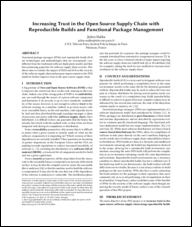
Increasing Trust in the Open Source Supply Chain with Reproducible Builds and Functional Package Management Julien Malka published a brief but interesting paper in the HAL open archive on Increasing Trust in the Open Source Supply Chain with Reproducible Builds and Functional Package Management:
Functional package managers (FPMs) and reproducible builds (R-B) are technologies and methodologies that are conceptually very different from the traditional software deployment model, and that have promising properties for software supply chain security. This thesis aims to evaluate the impact of FPMs and R-B on the security of the software supply chain and propose improvements to the FPM model to further improve trust in the open source supply chain. PDF
Julien s paper poses a number of research questions on how the model of distributions such as GNU Guix and NixOS can be leveraged to further improve the safety of the software supply chain , etc.

Software and source code identification with GNU Guix and reproducible builds In a long line of commendably detailed blog posts, Ludovic Court s, Maxim Cournoyer, Jan Nieuwenhuizen and Simon Tournier have together published two interesting posts on the GNU Guix blog this month. In early March, Ludovic Court s, Maxim Cournoyer, Jan Nieuwenhuizen and Simon Tournier wrote about software and source code identification and how that might be performed using Guix, rhetorically posing the questions: What does it take to identify software ? How can we tell what software is running on a machine to determine, for example, what security vulnerabilities might affect it? Later in the month, Ludovic Court s wrote a solo post describing adventures on the quest for long-term reproducible deployment. Ludovic s post touches on GNU Guix s aim to support time travel , the ability to reliably (and reproducibly) revert to an earlier point in time, employing the iconic image of Harold Lloyd hanging off the clock in Safety Last! (1925) to poetically illustrate both the slapstick nature of current modern technology and the gymnastics required to navigate hazards of our own making.

Two new Rust-based tools for post-processing determinism Zbigniew J drzejewski-Szmek announced add-determinism, a work-in-progress reimplementation of the Reproducible Builds project s own strip-nondeterminism tool in the Rust programming language, intended to be used as a post-processor in RPM-based distributions such as Fedora In addition, Yossi Kreinin published a blog post titled refix: fast, debuggable, reproducible builds that describes a tool that post-processes binaries in such a way that they are still debuggable with gdb, etc.. Yossi post details the motivation and techniques behind the (fast) performance of the tool.

Distribution work In Debian this month, since the testing framework no longer varies the build path, James Addison performed a bulk downgrade of the bug severity for issues filed with a level of normal to a new level of wishlist. In addition, 28 reviews of Debian packages were added, 38 were updated and 23 were removed this month adding to ever-growing knowledge about identified issues. As part of this effort, a number of issue types were updated, including Chris Lamb adding a new ocaml_include_directories toolchain issue [ ] and James Addison adding a new filesystem_order_in_java_jar_manifest_mf_include_resource issue [ ] and updating the random_uuid_in_notebooks_generated_by_nbsphinx to reference a relevant discussion thread [ ]. In addition, Roland Clobus posted his 24th status update of reproducible Debian ISO images. Roland highlights that the images for Debian unstable often cannot be generated due to changes in that distribution related to the 64-bit time_t transition. Lastly, Bernhard M. Wiedemann posted another monthly update for his reproducibility work in openSUSE.

Mailing list highlights Elsewhere on our mailing list this month:

Website updates There were made a number of improvements to our website this month, including:
  • Pol Dellaiera noticed the frequent need to correctly cite the website itself in academic work. To facilitate easier citation across multiple formats, Pol contributed a Citation File Format (CIF) file. As a result, an export in BibTeX format is now available in the Academic Publications section. Pol encourages community contributions to further refine the CITATION.cff file. Pol also added an substantial new section to the buy in page documenting the role of Software Bill of Materials (SBOMs) and ephemeral development environments. [ ][ ]
  • Bernhard M. Wiedemann added a new commandments page to the documentation [ ][ ] and fixed some incorrect YAML elsewhere on the site [ ].
  • Chris Lamb add three recent academic papers to the publications page of the website. [ ]
  • Mattia Rizzolo and Holger Levsen collaborated to add Infomaniak as a sponsor of amd64 virtual machines. [ ][ ][ ]
  • Roland Clobus updated the stable outputs page, dropping version numbers from Python documentation pages [ ] and noting that Python s set data structure is also affected by the PYTHONHASHSEED functionality. [ ]

Delta chat clients now reproducible Delta Chat, an open source messaging application that can work over email, announced this month that the Rust-based core library underlying Delta chat application is now reproducible.

diffoscope diffoscope is our in-depth and content-aware diff utility that can locate and diagnose reproducibility issues. This month, Chris Lamb made a number of changes such as uploading versions 259, 260 and 261 to Debian and made the following additional changes:
  • New features:
    • Add support for the zipdetails tool from the Perl distribution. Thanks to Fay Stegerman and Larry Doolittle et al. for the pointer and thread about this tool. [ ]
  • Bug fixes:
    • Don t identify Redis database dumps as GNU R database files based simply on their filename. [ ]
    • Add a missing call to File.recognizes so we actually perform the filename check for GNU R data files. [ ]
    • Don t crash if we encounter an .rdb file without an equivalent .rdx file. (#1066991)
    • Correctly check for 7z being available and not lz4 when testing 7z. [ ]
    • Prevent a traceback when comparing a contentful .pyc file with an empty one. [ ]
  • Testsuite improvements:
    • Fix .epub tests after supporting the new zipdetails tool. [ ]
    • Don t use parenthesis within test skipping messages, as PyTest adds its own parenthesis. [ ]
    • Factor out Python version checking in test_zip.py. [ ]
    • Skip some Zip-related tests under Python 3.10.14, as a potential regression may have been backported to the 3.10.x series. [ ]
    • Actually test 7z support in the test_7z set of tests, not the lz4 functionality. (Closes: reproducible-builds/diffoscope#359). [ ]
In addition, Fay Stegerman updated diffoscope s monkey patch for supporting the unusual Mozilla ZIP file format after Python s zipfile module changed to detect potentially insecure overlapping entries within .zip files. (#362) Chris Lamb also updated the trydiffoscope command line client, dropping a build-dependency on the deprecated python3-distutils package to fix Debian bug #1065988 [ ], taking a moment to also refresh the packaging to the latest Debian standards [ ]. Finally, Vagrant Cascadian submitted an update for diffoscope version 260 in GNU Guix. [ ]

Upstream patches This month, we wrote a large number of patches, including: Bernhard M. Wiedemann used reproducibility-tooling to detect and fix packages that added changes in their %check section, thus failing when built with the --no-checks option. Only half of all openSUSE packages were tested so far, but a large number of bugs were filed, including ones against caddy, exiv2, gnome-disk-utility, grisbi, gsl, itinerary, kosmindoormap, libQuotient, med-tools, plasma6-disks, pspp, python-pypuppetdb, python-urlextract, rsync, vagrant-libvirt and xsimd. Similarly, Jean-Pierre De Jesus DIAZ employed reproducible builds techniques in order to test a proposed refactor of the ath9k-htc-firmware package. As the change produced bit-for-bit identical binaries to the previously shipped pre-built binaries:
I don t have the hardware to test this firmware, but the build produces the same hashes for the firmware so it s safe to say that the firmware should keep working.

Reproducibility testing framework The Reproducible Builds project operates a comprehensive testing framework running primarily at tests.reproducible-builds.org in order to check packages and other artifacts for reproducibility. In March, an enormous number of changes were made by Holger Levsen:
  • Debian-related changes:
    • Sleep less after a so-called 404 package state has occurred. [ ]
    • Schedule package builds more often. [ ][ ]
    • Regenerate all our HTML indexes every hour, but only every 12h for the released suites. [ ]
    • Create and update unstable and experimental base systems on armhf again. [ ][ ]
    • Don t reschedule so many depwait packages due to the current size of the i386 architecture queue. [ ]
    • Redefine our scheduling thresholds and amounts. [ ]
    • Schedule untested packages with a higher priority, otherwise slow architectures cannot keep up with the experimental distribution growing. [ ]
    • Only create the stats_buildinfo.png graph once per day. [ ][ ]
    • Reproducible Debian dashboard: refactoring, update several more static stats only every 12h. [ ]
    • Document how to use systemctl with new systemd-based services. [ ]
    • Temporarily disable armhf and i386 continuous integration tests in order to get some stability back. [ ]
    • Use the deb.debian.org CDN everywhere. [ ]
    • Remove the rsyslog logging facility on bookworm systems. [ ]
    • Add zst to the list of packages which are false-positive diskspace issues. [ ]
    • Detect failures to bootstrap Debian base systems. [ ]
  • Arch Linux-related changes:
    • Temporarily disable builds because the pacman package manager is broken. [ ][ ]
    • Split reproducible_html_live_status and split the scheduling timing . [ ][ ][ ]
    • Improve handling when database is locked. [ ][ ]
  • Misc changes:
    • Show failed services that require manual cleanup. [ ][ ]
    • Integrate two new Infomaniak nodes. [ ][ ][ ][ ]
    • Improve IRC notifications for artifacts. [ ]
    • Run diffoscope in different systemd slices. [ ]
    • Run the node health check more often, as it can now repair some issues. [ ][ ]
    • Also include the string Bot in the userAgent for Git. (Re: #929013). [ ]
    • Document increased tmpfs size on our OUSL nodes. [ ]
    • Disable memory account for the reproducible_build service. [ ][ ]
    • Allow 10 times as many open files for the Jenkins service. [ ]
    • Set OOMPolicy=continue and OOMScoreAdjust=-1000 for both the Jenkins and the reproducible_build service. [ ]
Mattia Rizzolo also made the following changes:
  • Debian-related changes:
    • Define a systemd slice to group all relevant services. [ ][ ]
    • Add a bunch of quotes in scripts to assuage the shellcheck tool. [ ]
    • Add stats on how many packages have been built today so far. [ ]
    • Instruct systemd-run to handle diffoscope s exit codes specially. [ ]
    • Prefer the pgrep tool over grepping the output of ps. [ ]
    • Re-enable a couple of i386 and armhf architecture builders. [ ][ ]
    • Fix some stylistic issues flagged by the Python flake8 tool. [ ]
    • Cease scheduling Debian unstable and experimental on the armhf architecture due to the time_t transition. [ ]
    • Start a few more i386 & armhf workers. [ ][ ][ ]
    • Temporarly skip pbuilder updates in the unstable distribution, but only on the armhf architecture. [ ]
  • Other changes:
    • Perform some large-scale refactoring on how the systemd service operates. [ ][ ]
    • Move the list of workers into a separate file so it s accessible to a number of scripts. [ ]
    • Refactor the powercycle_x86_nodes.py script to use the new IONOS API and its new Python bindings. [ ]
    • Also fix nph-logwatch after the worker changes. [ ]
    • Do not install the stunnel tool anymore, it shouldn t be needed by anything anymore. [ ]
    • Move temporary directories related to Arch Linux into a single directory for clarity. [ ]
    • Update the arm64 architecture host keys. [ ]
    • Use a common Postfix configuration. [ ]
The following changes were also made by:
  • Jan-Benedict Glaw:
    • Initial work to clean up a messy NetBSD-related script. [ ][ ]
  • Roland Clobus:
    • Show the installer log if the installer fails to build. [ ]
    • Avoid the minus character (i.e. -) in a variable in order to allow for tags in openQA. [ ]
    • Update the schedule of Debian live image builds. [ ]
  • Vagrant Cascadian:
    • Maintenance on the virt* nodes is completed so bring them back online. [ ]
    • Use the fully qualified domain name in configuration. [ ]
Node maintenance was also performed by Holger Levsen, Mattia Rizzolo [ ][ ] and Vagrant Cascadian [ ][ ][ ][ ]

If you are interested in contributing to the Reproducible Builds project, please visit our Contribute page on our website. However, you can get in touch with us via:

9 April 2024

Matthew Palmer: How I Tripped Over the Debian Weak Keys Vulnerability

Those of you who haven t been in IT for far, far too long might not know that next month will be the 16th(!) anniversary of the disclosure of what was, at the time, a fairly earth-shattering revelation: that for about 18 months, the Debian OpenSSL package was generating entirely predictable private keys. The recent xz-stential threat (thanks to @nixCraft for making me aware of that one), has got me thinking about my own serendipitous interaction with a major vulnerability. Given that the statute of limitations has (probably) run out, I thought I d share it as a tale of how huh, that s weird can be a powerful threat-hunting tool but only if you ve got the time to keep pulling at the thread.
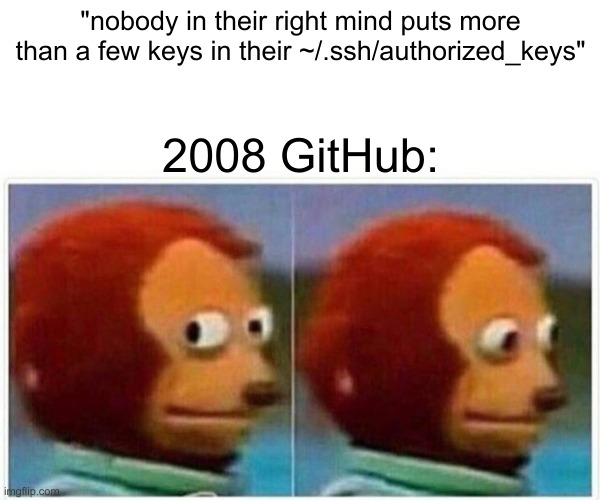
Prelude to an Adventure Our story begins back in March 2008. I was working at Engine Yard (EY), a now largely-forgotten Rails-focused hosting company, which pioneered several advances in Rails application deployment. Probably EY s greatest claim to lasting fame is that they helped launch a little code hosting platform you might have heard of, by providing them free infrastructure when they were little more than a glimmer in the Internet s eye. I am, of course, talking about everyone s favourite Microsoft product: GitHub. Since GitHub was in the right place, at the right time, with a compelling product offering, they quickly started to gain traction, and grow their userbase. With growth comes challenges, amongst them the one we re focusing on today: SSH login times. Then, as now, GitHub provided SSH access to the git repos they hosted, by SSHing to git@github.com with publickey authentication. They were using the standard way that everyone manages SSH keys: the ~/.ssh/authorized_keys file, and that became a problem as the number of keys started to grow. The way that SSH uses this file is that, when a user connects and asks for publickey authentication, SSH opens the ~/.ssh/authorized_keys file and scans all of the keys listed in it, looking for a key which matches the key that the user presented. This linear search is normally not a huge problem, because nobody in their right mind puts more than a few keys in their ~/.ssh/authorized_keys, right?
2008-era GitHub giving monkey puppet side-eye to the idea that nobody stores many keys in an authorized_keys file
Of course, as a popular, rapidly-growing service, GitHub was gaining users at a fair clip, to the point that the one big file that stored all the SSH keys was starting to visibly impact SSH login times. This problem was also not going to get any better by itself. Something Had To Be Done. EY management was keen on making sure GitHub ran well, and so despite it not really being a hosting problem, they were willing to help fix this problem. For some reason, the late, great, Ezra Zygmuntowitz pointed GitHub in my direction, and let me take the time to really get into the problem with the GitHub team. After examining a variety of different possible solutions, we came to the conclusion that the least-worst option was to patch OpenSSH to lookup keys in a MySQL database, indexed on the key fingerprint. We didn t take this decision on a whim it wasn t a case of yeah, sure, let s just hack around with OpenSSH, what could possibly go wrong? . We knew it was potentially catastrophic if things went sideways, so you can imagine how much worse the other options available were. Ensuring that this wouldn t compromise security was a lot of the effort that went into the change. In the end, though, we rolled it out in early April, and lo! SSH logins were fast, and we were pretty sure we wouldn t have to worry about this problem for a long time to come. Normally, you d think patching OpenSSH to make mass SSH logins super fast would be a good story on its own. But no, this is just the opening scene.

Chekov s Gun Makes its Appearance Fast forward a little under a month, to the first few days of May 2008. I get a message from one of the GitHub team, saying that somehow users were able to access other users repos over SSH. Naturally, as we d recently rolled out the OpenSSH patch, which touched this very thing, the code I d written was suspect number one, so I was called in to help.
The lineup scene from the movie The Usual Suspects They're called The Usual Suspects for a reason, but sometimes, it really is Keyser S ze

Eventually, after more than a little debugging, we discovered that, somehow, there were two users with keys that had the same key fingerprint. This absolutely shouldn t happen it s a bit like winning the lottery twice in a row1 unless the users had somehow shared their keys with each other, of course. Still, it was worth investigating, just in case it was a web application bug, so the GitHub team reached out to the users impacted, to try and figure out what was going on. The users professed no knowledge of each other, neither admitted to publicising their key, and couldn t offer any explanation as to how the other person could possibly have gotten their key. Then things went from weird to what the ? . Because another pair of users showed up, sharing a key fingerprint but it was a different shared key fingerprint. The odds now have gone from winning the lottery multiple times in a row to as close to this literally cannot happen as makes no difference.
Milhouse from The Simpsons says that We're Through The Looking Glass Here, People
Once we were really, really confident that the OpenSSH patch wasn t the cause of the problem, my involvement in the problem basically ended. I wasn t a GitHub employee, and EY had plenty of other customers who needed my help, so I wasn t able to stay deeply involved in the on-going investigation of The Mystery of the Duplicate Keys. However, the GitHub team did keep talking to the users involved, and managed to determine the only apparent common factor was that all the users claimed to be using Debian or Ubuntu systems, which was where their SSH keys would have been generated. That was as far as the investigation had really gotten, when along came May 13, 2008.

Chekov s Gun Goes Off With the publication of DSA-1571-1, everything suddenly became clear. Through a well-meaning but ultimately disasterous cleanup of OpenSSL s randomness generation code, the Debian maintainer had inadvertently reduced the number of possible keys that could be generated by a given user from bazillions to a little over 32,000. With so many people signing up to GitHub some of them no doubt following best practice and freshly generating a separate key it s unsurprising that some collisions occurred. You can imagine the sense of oooooooh, so that s what s going on! that rippled out once the issue was understood. I was mostly glad that we had conclusive evidence that my OpenSSH patch wasn t at fault, little knowing how much more contact I was to have with Debian weak keys in the future, running a huge store of known-compromised keys and using them to find misbehaving Certificate Authorities, amongst other things.

Lessons Learned While I ve not found a description of exactly when and how Luciano Bello discovered the vulnerability that became CVE-2008-0166, I presume he first came across it some time before it was disclosed likely before GitHub tripped over it. The stable Debian release that included the vulnerable code had been released a year earlier, so there was plenty of time for Luciano to have discovered key collisions and go hmm, I wonder what s going on here? , then keep digging until the solution presented itself. The thought hmm, that s odd , followed by intense investigation, leading to the discovery of a major flaw is also what ultimately brought down the recent XZ backdoor. The critical part of that sequence is the ability to do that intense investigation, though. When I reflect on my brush with the Debian weak keys vulnerability, what sticks out to me is the fact that I didn t do the deep investigation. I wonder if Luciano hadn t found it, how long it might have been before it was found. The GitHub team would have continued investigating, presumably, and perhaps they (or I) would have eventually dug deep enough to find it. But we were all super busy myself, working support tickets at EY, and GitHub feverishly building features and fighting the fires in their rapidly-growing service. As it was, Luciano was able to take the time to dig in and find out what was happening, but just like the XZ backdoor, I feel like we, as an industry, got a bit lucky that someone with the skills, time, and energy was on hand at the right time to make a huge difference. It s a luxury to be able to take the time to really dig into a problem, and it s a luxury that most of us rarely have. Perhaps an understated takeaway is that somehow we all need to wrestle back some time to follow our hunches and really dig into the things that make us go hmm .

Support My Hunches If you d like to help me be able to do intense investigations of mysterious software phenomena, you can shout me a refreshing beverage on ko-fi.
  1. the odds are actually probably more like winning the lottery about twenty times in a row. The numbers involved are staggeringly huge, so it s easiest to just approximate it as really, really unlikely .

5 April 2024

Dirk Eddelbuettel: RcppArmadillo 0.12.8.2.0 on CRAN: Upstream Fix

armadillo image Armadillo is a powerful and expressive C++ template library for linear algebra and scientific computing. It aims towards a good balance between speed and ease of use, has a syntax deliberately close to Matlab, and is useful for algorithm development directly in C++, or quick conversion of research code into production environments. RcppArmadillo integrates this library with the R environment and language and is widely used by (currently) 1136 other packages on CRAN, downloaded 33.5 million times (per the partial logs from the cloud mirrors of CRAN), and the CSDA paper (preprint / vignette) by Conrad and myself has been cited 578 times according to Google Scholar. This release brings a new upstream bugfix release Armadillo 12.8.2 prepared by Conrad two days ago. It took the usual day to noodle over 1100+ reverse dependencies and ensure two failures were independent of the upgrade (i.e., no change to worse in CRAN parlance). It took CRAN another because we hit a random network outage for (spurious) NOTE on a remote URL, and were then caught in the shrapnel from another large package ecosystem update spuriously pointing some build failures that were due to a missing rebuild to us. All good, as human intervention comes to the rescue. The set of changes since the last CRAN release follows.

Changes in RcppArmadillo version 0.12.8.2.0 (2024-04-02)
  • Upgraded to Armadillo release 12.8.2 (Cortisol Injector)
    • Workaround for FFTW3 header clash
    • Workaround in testing framework for issue under macOS
    • Minor cleanups to reduce code bloat
    • Improved documentation

Courtesy of my CRANberries, there is a diffstat report relative to previous release. More detailed information is on the RcppArmadillo page. Questions, comments etc should go to the rcpp-devel mailing list off the Rcpp R-Forge page. If you like this or other open-source work I do, you can sponsor me at GitHub.

This post by Dirk Eddelbuettel originated on his Thinking inside the box blog. Please report excessive re-aggregation in third-party for-profit settings.

Bits from Debian: apt install dpl-candidate: Andreas Tille

The Debian Project Developers will shortly vote for a new Debian Project Leader known as the DPL. The Project Leader is the official representative of The Debian Project tasked with managing the overall project, its vision, direction, and finances. The DPL is also responsible for the selection of Delegates, defining areas of responsibility within the project, the coordination of Developers, and making decisions required for the project. Our outgoing and present DPL Jonathan Carter served 4 terms, from 2020 through 2024. Jonathan shared his last Bits from the DPL post to Debian recently and his hopes for the future of Debian. Recently, we sat with the two present candidates for the DPL position asking questions to find out who they really are in a series of interviews about their platforms, visions for Debian, lives, and even their favorite text editors. The interviews were conducted by disaster2life (Yashraj Moghe) and made available from video and audio transcriptions: Voting for the position starts on April 6, 2024. Editors' note: This is our official return to Debian interviews, readers should stay tuned for more upcoming interviews with Developers and other important figures in Debian as part of our "Meet your Debian Developer" series. We used the following tools and services: Turboscribe.ai for the transcription from the audio and video files, IRC: Oftc.net for communication, Jitsi meet for interviews, and Open Broadcaster Software (OBS) for editing and video. While we encountered many technical difficulties in the return to this process, we are still able and proud to present the transcripts of the interviews edited only in a few areas for readability. 2024 Debian Project Leader Candidate: Andrea Tille Andreas' Interview Who are you? Tell us a little about yourself. [Andreas]:
How am I? Well, I'm, as I wrote in my platform, I'm a proud grandfather doing a lot of free software stuff, doing a lot of sports, have some goals in mind which I like to do and hopefully for the best of Debian.
And How are you today? [Andreas]:
How I'm doing today? Well, actually I have some headaches but it's fine for the interview. So, usually I feel very good. Spring was coming here and today it's raining and I plan to do a bicycle tour tomorrow and hope that I do not get really sick but yeah, for the interview it's fine.
What do you do in Debian? Could you mention your story here? [Andreas]:
Yeah, well, I started with Debian kind of an accident because I wanted to have some package salvaged which is called WordNet. It's a monolingual dictionary and I did not really plan to do more than maybe 10 packages or so. I had some kind of training with xTeddy which is totally unimportant, a cute teddy you can put on your desktop. So, and then well, more or less I thought how can I make Debian attractive for my employer which is a medical institute and so on. It could make sense to package bioinformatics and medicine software and it somehow evolved in a direction I did neither expect it nor wanted to do, that I'm currently the most busy uploader in Debian, created several teams around it. DebianMate is very well known from me. I created the Blends team to create teams and techniques around what we are doing which was Debian TIS, Debian Edu, Debian Science and so on and I also created the packaging team for R, for the statistics package R which is technically based and not topic based. All these blends are covering a certain topic and R is just needed by lots of these blends. So, yeah, and to cope with all this I have written a script which is routing an update to manage all these uploads more or less automatically. So, I think I had one day where I uploaded 21 new packages but it's just automatically generated, right? So, it's on one day more than I ever planned to do.
What is the first thing you think of when you think of Debian? Editors' note: The question was misunderstood as the worst thing you think of when you think of Debian [Andreas]:
The worst thing I think about Debian, it's complicated. I think today on Debian board I was asked about the technical progress I want to make and in my opinion we need to standardize things inside Debian. For instance, bringing all the packages to salsa, follow some common standards, some common workflow which is extremely helpful. As I said, if I'm that productive with my own packages we can adopt this in general, at least in most cases I think. I made a lot of good experience by the support of well-formed teams. Well-formed teams are those teams where people support each other, help each other. For instance, how to say, I'm a physicist by profession so I'm not an IT expert. I can tell apart what works and what not but I'm not an expert in those packages. I do and the amount of packages is so high that I do not even understand all the techniques they are covering like Go, Rust and something like this. And I also don't speak Java and I had a problem once in the middle of the night and I've sent the email to the list and was a Java problem and I woke up in the morning and it was solved. This is what I call a team. I don't call a team some common repository that is used by random people for different packages also but it's working together, don't hesitate to solve other people's problems and permit people to get active. This is what I call a team and this is also something I observed in, it's hard to give a percentage, in a lot of other teams but we have other people who do not even understand the concept of the team. Why is working together make some advantage and this is also a tough thing. I [would] like to tackle in my term if I get elected to form solid teams using the common workflow. This is one thing. The other thing is that we have a lot of good people in our infrastructure like FTP masters, DSA and so on. I have the feeling they have a lot of work and are working more or less on their limits, and I like to talk to them [to ask] what kind of change we could do to move that limits or move their personal health to the better side.
The DPL term lasts for a year, What would you do during that you couldn't do now? [Andreas]:
Yeah, well this is basically what I said are my main issues. I need to admit I have no really clear imagination what kind of tasks will come to me as a DPL because all these financial issues and law issues possible and issues [that] people who are not really friendly to Debian might create. I'm afraid these things might occupy a lot of time and I can't say much about this because I simply don't know.
What are three key terms about you and your candidacy? [Andreas]:
As I said, I like to work on standards, I d like to make Debian try [to get it right so] that people don't get overworked, this third key point is be inviting to newcomers, to everybody who wants to come. Yeah, I also mentioned in my term this diversity issue, geographical and from gender point of view. This may be the three points I consider most important.
Preferred text editor? [Andreas]:
Yeah, my preferred one? Ah, well, I have no preferred text editor. I'm using the Midnight Commander very frequently which has an internal editor which is convenient for small text. For other things, I usually use VI but I also use Emacs from time to time. So, no, I have not preferred text editor. Whatever works nicely for me.
What is the importance of the community in the Debian Project? How would like to see it evolving over the next few years? [Andreas]:
Yeah, I think the community is extremely important. So, I was on a lot of DebConfs. I think it's not really 20 but 17 or 18 DebCons and I really enjoyed these events every year because I met so many friends and met so many interesting people that it's really enriching my life and those who I never met in person but have read interesting things and yeah, Debian community makes really a part of my life.
And how do you think it should evolve specifically? [Andreas]:
Yeah, for instance, last year in Kochi, it became even clearer to me that the geographical diversity is a really strong point. Just discussing with some women from India who is afraid about not coming next year to Busan because there's a problem with Shanghai and so on. I'm not really sure how we can solve this but I think this is a problem at least I wish to tackle and yeah, this is an interesting point, the geographical diversity and I'm running the so-called mentoring of the month. This is a small project to attract newcomers for the Debian Med team which has the focus on medical packages and I learned that we had always men applying for this and so I said, okay, I dropped the constraint of medical packages. Any topic is fine, I teach you packaging but it must be someone who does not consider himself a man. I got only two applicants, no, actually, I got one applicant and one response which was kind of strange if I'm hunting for women or so. I did not understand but I got one response and interestingly, it was for me one of the least expected counters. It was from Iran and I met a very nice woman, very open, very skilled and gifted and did a good job or have even lose contact today and maybe we need more actively approach groups that are underrepresented. I don't know if what's a good means which I did but at least I tried and so I try to think about these kind of things.
What part of Debian has made you smile? What part of the project has kept you going all through the years? [Andreas]:
Well, the card game which is called Mao on the DebConf made me smile all the time. I admit I joined only two or three times even if I really love this kind of games but I was occupied by other stuff so this made me really smile. I also think the first online DebConf in 2020 made me smile because we had this kind of short video sequences and I tried to make a funny video sequence about every DebConf I attended before. This is really funny moments but yeah, it's not only smile but yeah. One thing maybe it's totally unconnected to Debian but I learned personally something in Debian that we have a do-ocracy and you can do things which you think that are right if not going in between someone else, right? So respect everybody else but otherwise you can do so. And in 2020 I also started to take trees which are growing widely in my garden and plant them into the woods because in our woods a lot of trees are dying and so I just do something because I can. I have the resource to do something, take the small tree and bring it into the woods because it does not harm anybody. I asked the forester if it is okay, yes, yes, okay. So everybody can do so but I think the idea to do something like this came also because of the free software idea. You have the resources, you have the computer, you can do something and you do something productive, right? And when thinking about this I think it was also my Debian work. Meanwhile I have planted more than 3,000 trees so it's not a small number but yeah, I enjoy this.
What part of Debian would you have some criticisms for? [Andreas]:
Yeah, it's basically the same as I said before. We need more standards to work together. I do not want to repeat this but this is what I think, yeah.
What field in Free Software generally do you think requires the most work to be put into it? What do you think is Debian's part in the field? [Andreas]:
It's also in general, the thing is the fact that I'm maintaining packages which are usually as modern software is maintained in Git, which is fine but we have some software which is at Sourceport, we have software laying around somewhere, we have software where Debian somehow became Upstream because nobody is caring anymore and free software is very different in several things, ways and well, I in principle like freedom of choice which is the basic of all our work. Sometimes this freedom goes in the way of productivity because everybody is free to re-implement. You asked me for the most favorite editor. In principle one really good working editor would be great to have and would work and we have maybe 500 in Debian or so, I don't know. I could imagine if people would concentrate and say five instead of 500 editors, we could get more productive, right? But I know this will not happen, right? But I think this is one thing which goes in the way of making things smooth and productive and we could have more manpower to replace one person who's [having] children, doing some other stuff and can't continue working on something and maybe this is a problem I will not solve, definitely not, but which I see.
What do you think is Debian's part in the field? [Andreas]:
Yeah, well, okay, we can bring together different Upstreams, so we are building some packages and have some general overview about similar things and can say, oh, you are doing this and some other person is doing more or less the same, do you want to join each other or so, but this is kind of a channel we have to our Upstreams which is probably not very successful. It starts with code copies of some libraries which are changed a little bit, which is fine license-wise, but not so helpful for different things and so I've tried to convince those Upstreams to forward their patches to the original one, but for this and I think we could do some kind of, yeah, [find] someone who brings Upstream together or to make them stop their forking stuff, but it costs a lot of energy and we probably don't have this and it's also not realistic that we can really help with this problem.
Do you have any questions for me? [Andreas]:
I enjoyed the interview, I enjoyed seeing you again after half a year or so. Yeah, actually I've seen you in the eating room or cheese and wine party or so, I do not remember we had to really talk together, but yeah, people around, yeah, for sure. Yeah.

4 April 2024

Lukas M rdian: Netplan v1.0 paves the way to stable, declarative network management

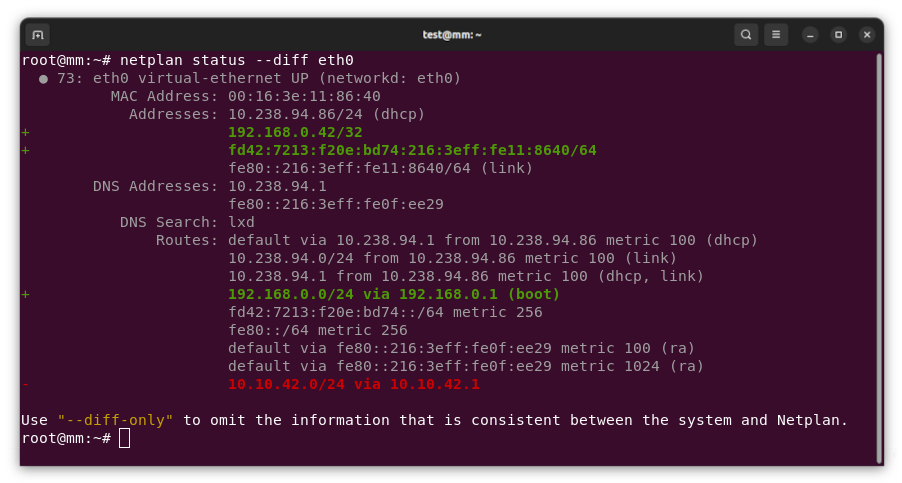
New netplan status diff subcommand, finding differences between configuration and system state As the maintainer and lead developer for Netplan, I m proud to announce the general availability of Netplan v1.0 after more than 7 years of development efforts. Over the years, we ve so far had about 80 individual contributors from around the globe. This includes many contributions from our Netplan core-team at Canonical, but also from other big corporations such as Microsoft or Deutsche Telekom. Those contributions, along with the many we receive from our community of individual contributors, solidify Netplan as a healthy and trusted open source project. In an effort to make Netplan even more dependable, we started shipping upstream patch releases, such as 0.106.1 and 0.107.1, which make it easier to integrate fixes into our users custom workflows. With the release of version 1.0 we primarily focused on stability. However, being a major version upgrade, it allowed us to drop some long-standing legacy code from the libnetplan1 library. Removing this technical debt increases the maintainability of Netplan s codebase going forward. The upcoming Ubuntu 24.04 LTS and Debian 13 releases will ship Netplan v1.0 to millions of users worldwide.

Highlights of version 1.0 In addition to stability and maintainability improvements, it s worth looking at some of the new features that were included in the latest release:
  • Simultaneous WPA2 & WPA3 support.
  • Introduction of a stable libnetplan1 API.
  • Mellanox VF-LAG support for high performance SR-IOV networking.
  • New hairpin and port-mac-learning settings, useful for VXLAN tunnels with FRRouting.
  • New netplan status diff subcommand, finding differences between configuration and system state.
Besides those highlights of the v1.0 release, I d also like to shed some light on new functionality that was integrated within the past two years for those upgrading from the previous Ubuntu 22.04 LTS which used Netplan v0.104:
  • We added support for the management of new network interface types, such as veth, dummy, VXLAN, VRF or InfiniBand (IPoIB).
  • Wireless functionality was improved by integrating Netplan with NetworkManager on desktop systems, adding support for WPA3 and adding the notion of a regulatory-domain, to choose proper frequencies for specific regions.
  • To improve maintainability, we moved to Meson as Netplan s buildsystem, added upstream CI coverage for multiple Linux distributions and integrations (such as Debian testing, NetworkManager, snapd or cloud-init), checks for ABI compatibility, and automatic memory leak detection.
  • We increased consistency between the supported backend renderers (systemd-networkd and NetworkManager), by matching physical network interfaces on permanent MAC address, when the match.macaddress setting is being used, and added new hardware offloading functionality for high performance networking, such as Single-Root IO Virtualisation virtual function link-aggregation (SR-IOV VF-LAG).
The much improved Netplan documentation, that is now hosted on Read the Docs , and new command line subcommands, such as netplan status, make Netplan a well vested tool for declarative network management and troubleshooting.

Integrations Those changes pave the way to integrate Netplan in 3rd party projects, such as system installers or cloud deployment methods. By shipping the new python3-netplan Python bindings to libnetplan, it is now easier than ever to access Netplan functionality and network validation from other projects. We are proud that the Debian Cloud Team chose Netplan to be the default network management tool in their official cloud-images for Debian Bookworm and beyond. Ubuntu s NetworkManager package now uses Netplan as it s default backend on Ubuntu 23.10 Desktop systems and beyond. Further integrations happened with cloud-init and the Calamares installer.
Please check out the Netplan version 1.0 release on GitHub! If you want to learn more, follow our activities on Netplan.io, GitHub, Launchpad, IRC or our Netplan Developer Diaries blog on discourse.

31 March 2024

Russell Coker: Links March 2024

Bruce Schneier wrote an interesting blog post about his workshop on reimagining democracy and the unusual way he structured it [1]. It would be fun to have a security conference run like that! Matthias write an informative blog post about Wayland Wayland really breaks things Just for now which links to a blog debate about the utility of Wayland [2]. Wayland seems pretty good to me. Cory Doctorow wrote an insightful article about the AI bubble comparing it to previous bubbles [3]. Charles Stross wrote an insightful analysis of the implications if the UK brought back military conscription [4]. Looks like the era of large armies is over. Charles Stross wrote an informative blog post about the Worldcon in China, covering issues of vote rigging for location, government censorship vs awards, and business opportunities [5]. The Paris Review has an interesting article about speaking to the CIA s Creative Writing Group [6]. It doesn t explain why they have a creative writing group that has some sort of semi-official sanction. LongNow has an insightful article about the threats to biodiversity in food crops and the threat that poses to humans [7]. Bruce Schneier and Albert Fox Cahn wrote an interesting article about the impacts of chatbots on human discourse [8]. If it makes people speak more precisely then that would be great for all Autistic people!

21 March 2024

Ian Jackson: How to use Rust on Debian (and Ubuntu, etc.)

tl;dr: Don t just apt install rustc cargo. Either do that and make sure to use only Rust libraries from your distro (with the tiresome config runes below); or, just use rustup. Don t do the obvious thing; it s never what you want Debian ships a Rust compiler, and a large number of Rust libraries. But if you just do things the obvious default way, with apt install rustc cargo, you will end up using Debian s compiler but upstream libraries, directly and uncurated from crates.io. This is not what you want. There are about two reasonable things to do, depending on your preferences. Q. Download and run whatever code from the internet? The key question is this: Are you comfortable downloading code, directly from hundreds of upstream Rust package maintainers, and running it ? That s what cargo does. It s one of the main things it s for. Debian s cargo behaves, in this respect, just like upstream s. Let me say that again: Debian s cargo promiscuously downloads code from crates.io just like upstream cargo. So if you use Debian s cargo in the most obvious way, you are still downloading and running all those random libraries. The only thing you re avoiding downloading is the Rust compiler itself, which is precisely the part that is most carefully maintained, and of least concern. Debian s cargo can even download from crates.io when you re building official Debian source packages written in Rust: if you run dpkg-buildpackage, the downloading is suppressed; but a plain cargo build will try to obtain and use dependencies from the upstream ecosystem. ( Happily , if you do this, it s quite likely to bail out early due to version mismatches, before actually downloading anything.) Option 1: WTF, no I don t want curl bash OK, but then you must limit yourself to libraries available within Debian. Each Debian release provides a curated set. It may or may not be sufficient for your needs. Many capable programs can be written using the packages in Debian. But any upstream Rust project that you encounter is likely to be a pain to get working, unless their maintainers specifically intend to support this. (This is fairly rare, and the Rust tooling doesn t make it easy.) To go with this plan, apt install rustc cargo and put this in your configuration, in $HOME/.cargo/config.toml:
[source.debian-packages]
directory = "/usr/share/cargo/registry"
[source.crates-io]
replace-with = "debian-packages"
This causes cargo to look in /usr/share for dependencies, rather than downloading them from crates.io. You must then install the librust-FOO-dev packages for each of your dependencies, with apt. This will allow you to write your own program in Rust, and build it using cargo build. Option 2: Biting the curl bash bullet If you want to build software that isn t specifically targeted at Debian s Rust you will probably need to use packages from crates.io, not from Debian. If you re doing to do that, there is little point not using rustup to get the latest compiler. rustup s install rune is alarming, but cargo will be doing exactly the same kind of thing, only worse (because it trusts many more people) and more hidden. So in this case: do run the curl bash install rune. Hopefully the Rust project you are trying to build have shipped a Cargo.lock; that contains hashes of all the dependencies that they last used and tested. If you run cargo build --locked, cargo will only use those versions, which are hopefully OK. And you can run cargo audit to see if there are any reported vulnerabilities or problems. But you ll have to bootstrap this with cargo install --locked cargo-audit; cargo-audit is from the RUSTSEC folks who do care about these kind of things, so hopefully running their code (and their dependencies) is fine. Note the --locked which is needed because cargo s default behaviour is wrong. Privilege separation This approach is rather alarming. For my personal use, I wrote a privsep tool which allows me to run all this upstream Rust code as a separate user. That tool is nailing-cargo. It s not particularly well productised, or tested, but it does work for at least one person besides me. You may wish to try it out, or consider alternative arrangements. Bug reports and patches welcome. OMG what a mess Indeed. There are large number of technical and social factors at play. cargo itself is deeply troubling, both in principle, and in detail. I often find myself severely disappointed with its maintainers decisions. In mitigation, much of the wider Rust upstream community does takes this kind of thing very seriously, and often makes good choices. RUSTSEC is one of the results. Debian s technical arrangements for Rust packaging are quite dysfunctional, too: IMO the scheme is based on fundamentally wrong design principles. But, the Debian Rust packaging team is dynamic, constantly working the update treadmills; and the team is generally welcoming and helpful. Sadly last time I explored the possibility, the Debian Rust Team didn t have the appetite for more fundamental changes to the workflow (including, for example, changes to dependency version handling). Significant improvements to upstream cargo s approach seem unlikely, too; we can only hope that eventually someone might manage to supplant it.
edited 2024-03-21 21:49 to add a cut tag


comment count unavailable comments

Ravi Dwivedi: Thailand Trip

This post is the second and final part of my Malaysia-Thailand trip. Feel free to check out the Malaysia part here if you haven t already. Kuala Lumpur to Bangkok is around 1500 km by road, and so I took a Malaysian Airlines flight to travel to Bangkok. The flight staff at the Kuala Lumpur only asked me for a return/onward flight and Thailand immigration asked a few questions but did not check any documents (obviously they checked and stamped my passport ;)). The currency of Thailand is the Thai baht, and 1 Thai baht = 2.5 Indian Rupees. The Thailand time is 1.5 hours ahead of Indian time (For example, if it is 12 noon in India, it will be 13:30 in Thailand). I landed in Bangkok at around 3 PM local time. Fletcher was in Bangkok that time, leaving for Pattaya and we had booked the same hostel. So I took a bus to Pattaya from the airport. The next bus for which the tickets were available was at 7 PM, so I took tickets for that one. The bus ticket cost was 143 Thai Baht. I didn t buy SIM at the airport, thinking there must be better deals in the city. As a consequence, there was no way to contact Fletcher through internet. Although I had a few minutes call remaining out of my international roaming pack.
A welcome sign at Bangkok's Suvarnabhumi airport.

Bus from Suvarnabhumi Airport to Jomtien Beach in Pattaya.

Our accommodation was near Jomtien beach, so I got off at the last stop, as the bus terminates at the Jomtien beach. Then I decided to walk towards my accommodation. I was using OsmAnd for navigation. However, the place was not marked on OpenStreetMap, and it turned out I missed the street my hostel was on and walked around 1 km further as I was chasing a similarly named incorrect hostel on OpenStreetMap. Then I asked for help from two men sitting at a caf . One of them said he will help me find the street my hostel is on. So, I walked with him, and he told me he lives in Thailand for many years, but he is from Kuwait. He also gave me valuable information. Like, he told me about shared hail-and-ride songthaews which run along the Jomtien Second Road and charge 10 Baht for any distance on their route. This tip significantly reduced our expenses. Further, he suggested me 7-Eleven shops for buying a local SIM. Like Malaysia, Thailand has 24/7 7-Eleven convenience stores, a lot of them not even 100 m apart. The Kuwaiti person dropped me at the address where my hostel was. I tried searching for a person in-charge of that hostel, and soon I realized there was no reception. After asking for help from locals for some time, I bumped into Fletcher, who also came to this address and was searching for the same. After finding a friend, I felt a sigh of relief. Adjacent to the property, there was a hairdresser shop. We went there and asked about this property. The woman called the owner, and she also told us the required passcodes to go inside. Our accommodation was in a room on the second floor, which required us to put a passcode for opening. We entered the passcode and entered the room. So, we stayed at this hostel which had no reception. Due to this, it took 2 hours to find our room and enter. It reminded me of a difficult experience I had in Albania, where me and Akshat were not able to find our apartment in one of the hottest days and the owner didn t know our language. Traveling from the place where the bus dropped me to the hostel, I saw streets were filled with bars and massage parlors, which was expected. Prostitutes were everywhere. We went out at night towards the beach and also roamed around in 7-Elevens to buy a SIM card for myself. I got a SIM for 7 day unlimited internet for 399 baht. Turns out that the rates of SIM cards at the airport were not so different from inside the city.
Road near Jomtien beach in Pattaya
Photo of a songthaew in Pattaya. There are shared songthaews which run along Jomtien Second road and takes 10 bath to anywhere on the route.

Jomtien Beach in Pattaya.
In terms of speaking English, locals didn t know English at all in both Pattaya and Bangkok. I normally don t expect locals to know English in a non-English speaking country, but the fact that Bangkok is one of the most visited places by tourists made me expect locals to know some English. Talking to locals is an integral part of travel for me, which I couldn t do a lot in Thailand. This aspect is much more important for me than going to touristy places. So, we were in Pattaya. Next morning, Fletcher and I went to Tiger park using shared songthaew. After that, we planned to visit Pattaya Floating market which is near the Tiger Park, but we felt the ticket prices were higher than it was worth. Fletcher had to leave for Bangkok on that day. I suggested him to go to Suvarnabhumi Airport from the Jomtien beach bus terminal (this was the route I took the last day in opposite direction) to avoid traffic congestion inside Bangkok, as he can follow up with metro once he reaches the airport. From the floating market, we were walking in sweltering heat to reach the Jomtien beach. I tried asking for a lift and eventually got successful as a scooty stopped, and surprisingly the person gave a ride to both of us. He was from Delhi, so maybe that s the reason he stopped for us. Then we took a songthaew to the bus terminal and after having lunch, Fletcher left for Bangkok.
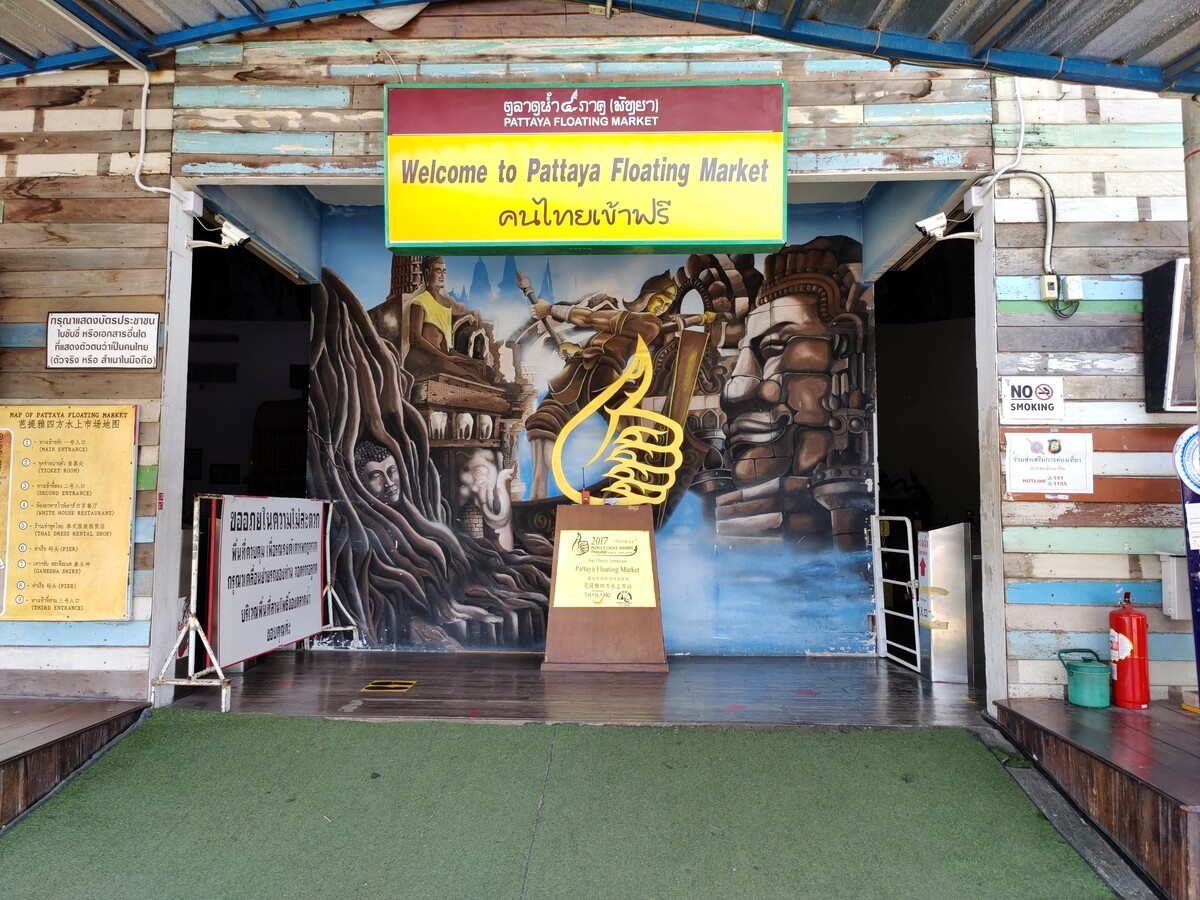
A welcome sign at Pattaya Floating market.

This Korean Vegetasty noodles pack was yummy and was available at many 7-Eleven stores.

Next day I went to Bangkok, but Fletcher already left for Kuala Lumpur. Here I had booked a private room in a hotel (instead of a hostel) for four nights, mainly because of my luggage. This costed 5600 INR for four nights. It was 2 km from the metro station, which I used to walk both sides. In Bangkok, I visited Sukhumvit and Siam by metro. Going to some areas require crossing the Chao Phraya river. For this, I took Chao Phraya Express Boat for going to places like Khao San road and Wat Arun. I would recommend taking the boat ride as it had very good views. In Bangkok, I met a person from Pakistan staying in my hotel and so here also I got some company. But by the time I met him, my days were almost over. So, we went to a random restaurant selling Indian food where we ate some paneer dish with naan and that restaurant person was from Myanmar.
Wat Arun temple stamps your hand upon entry

Wat Arun temple

Khao San Road

A food stall at Khao San Road

Chao Phraya Express Boat

For eating, I mainly relied on fruits and convenience stores. Bananas were very tasty. This was the first time I saw banana flesh being yellow. Mangoes were delicious and pineapples were smaller and flavorful. I also ate Rose Apple, which I never had before. I had Chhole Kulche once in Sukhumvit. That was a little expensive as it costed 164 baht. I also used to buy premix coffee packets from 7-Eleven convenience stores and prepare them inside the stores.
Banana with yellow flesh
Fruits at a stall in Bangkok

Trimmed pineapples from Thailand.

Corn in Bangkok.
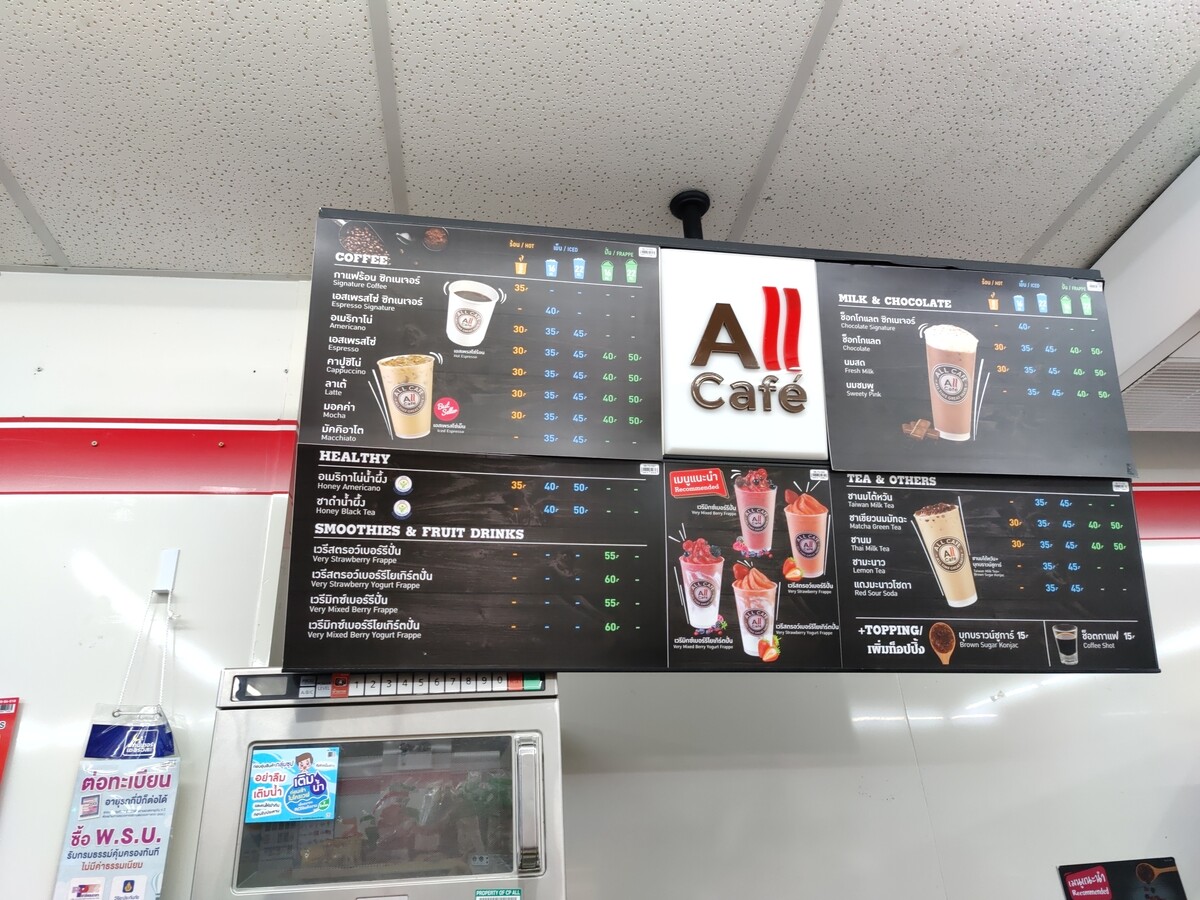
A board showing coffee menu at a 7-Eleven store along with rates in Pattaya.
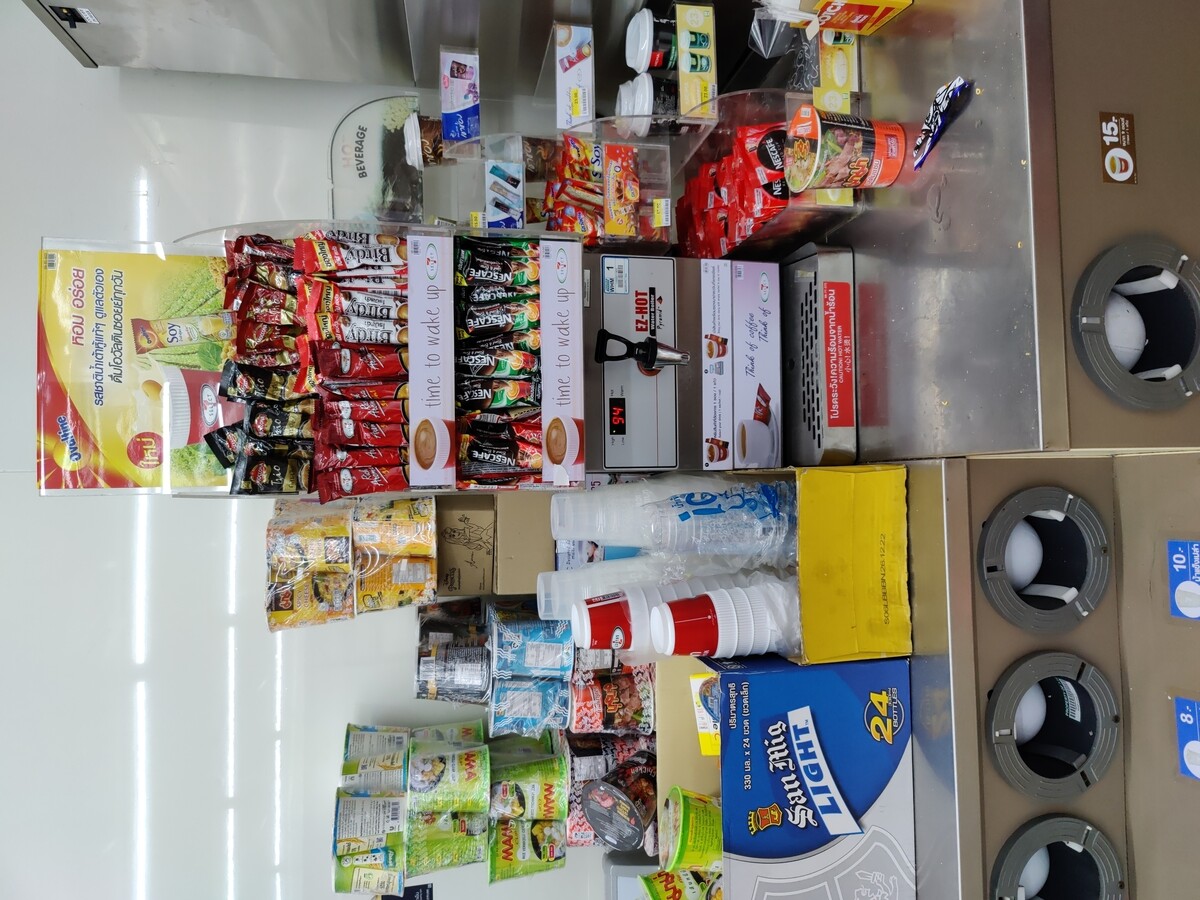
In this section of 7-Eleven, you can buy a premix coffee and mix it with hot water provided at the store to prepare.

My booking from Bangkok to Delhi was in Air India flight, and they were serving alcohol in the flight. I chose red wine, and this was my first time having alcohol in a flight.
Red wine being served in Air India

Notes
  • In this whole trip spanning two weeks, I did not pay for drinking water (except for once in Pattaya which was 9 baht) and toilets. Bangkok and Kuala Lumpur have plenty of malls where you should find a free-of-cost toilet nearby. For drinking water, I relied mainly on my accommodation providing refillable water for my bottle.
  • Thailand seemed more expensive than Malaysia on average. Malaysia had discounted price due to the Chinese New year.
  • I liked Pattaya more than Bangkok. Maybe because Pattaya has beach and Bangkok doesn t. Pattaya seemed more lively, and I could meet and talk to a few people as opposed to Bangkok.
  • Chao Phraya River express boat costs 150 baht for one day where you can hop on and off to any boat.

14 March 2024

Freexian Collaborators: Monthly report about Debian Long Term Support, February 2024 (by Roberto C. S nchez)

Like each month, have a look at the work funded by Freexian s Debian LTS offering.

Debian LTS contributors In February, 18 contributors have been paid to work on Debian LTS, their reports are available:
  • Abhijith PA did 10.0h (out of 14.0h assigned), thus carrying over 4.0h to the next month.
  • Adrian Bunk did 13.5h (out of 24.25h assigned and 41.75h from previous period), thus carrying over 52.5h to the next month.
  • Bastien Roucari s did 20.0h (out of 20.0h assigned).
  • Ben Hutchings did 2.0h (out of 14.5h assigned and 9.5h from previous period), thus carrying over 22.0h to the next month.
  • Chris Lamb did 18.0h (out of 18.0h assigned).
  • Daniel Leidert did 10.0h (out of 10.0h assigned).
  • Emilio Pozuelo Monfort did 3.0h (out of 28.25h assigned and 31.75h from previous period), thus carrying over 57.0h to the next month.
  • Guilhem Moulin did 7.25h (out of 4.75h assigned and 15.25h from previous period), thus carrying over 12.75h to the next month.
  • Holger Levsen did 0.5h (out of 3.5h assigned and 8.5h from previous period), thus carrying over 11.5h to the next month.
  • Lee Garrett did 0.0h (out of 18.25h assigned and 41.75h from previous period), thus carrying over 60.0h to the next month.
  • Markus Koschany did 40.0h (out of 40.0h assigned).
  • Roberto C. S nchez did 3.5h (out of 8.75h assigned and 3.25h from previous period), thus carrying over 8.5h to the next month.
  • Santiago Ruano Rinc n did 13.5h (out of 13.5h assigned and 2.5h from previous period), thus carrying over 2.5h to the next month.
  • Sean Whitton did 4.5h (out of 0.5h assigned and 5.5h from previous period), thus carrying over 1.5h to the next month.
  • Sylvain Beucler did 24.5h (out of 27.75h assigned and 32.25h from previous period), thus carrying over 35.5h to the next month.
  • Thorsten Alteholz did 14.0h (out of 14.0h assigned).
  • Tobias Frost did 12.0h (out of 12.0h assigned).
  • Utkarsh Gupta did 11.25h (out of 26.75h assigned and 33.25h from previous period), thus carrying over 48.75 to the next month.

Evolution of the situation In February, we have released 17 DLAs. The number of DLAs published during February was a bit lower than usual, as there was much work going on in the area of triaging CVEs (a number of which turned out to not affect Debia buster, and others which ended up being duplicates, or otherwise determined to be invalid). Of the packages which did receive updates, notable were sudo (to fix a privilege management issue), and iwd and wpa (both of which suffered from authentication bypass vulnerabilities). While this has already been already announced in the Freexian blog, we would like to mention here the start of the Long Term Support project for Samba 4.17. You can find all the important details in that post, but we would like to highlight that it is thanks to our LTS sponsors that we are able to fund the work from our partner, Catalyst, towards improving the security support of Samba in Debian 12 (Bookworm).

Thanks to our sponsors Sponsors that joined recently are in bold.

11 March 2024

Joachim Breitner: Convenient sandboxed development environment

I like using one machine and setup for everything, from serious development work to hobby projects to managing my finances. This is very convenient, as often the lines between these are blurred. But it is also scary if I think of the large number of people who I have to trust to not want to extract all my personal data. Whenever I run a cabal install, or a fun VSCode extension gets updated, or anything like that, I am running code that could be malicious or buggy. In a way it is surprising and reassuring that, as far as I can tell, this commonly does not happen. Most open source developers out there seem to be nice and well-meaning, after all.

Convenient or it won t happen Nevertheless I thought I should do something about this. The safest option would probably to use dedicated virtual machines for the development work, with very little interaction with my main system. But knowing me, that did not seem likely to happen, as it sounded like a fair amount of hassle. So I aimed for a viable compromise between security and convenient, and one that does not get too much in the way of my current habits. For instance, it seems desirable to have the project files accessible from my unconstrained environment. This way, I could perform certain actions that need access to secret keys or tokens, but are (unlikely) to run code (e.g. git push, git pull from private repositories, gh pr create) from the outside , and the actual build environment can do without access to these secrets. The user experience I thus want is a quick way to enter a development environment where I can do most of the things I need to do while programming (network access, running command line and GUI programs), with access to the current project, but without access to my actual /home directory. I initially followed the blog post Application Isolation using NixOS Containers by Marcin Sucharski and got something working that mostly did what I wanted, but then a colleague pointed out that tools like firejail can achieve roughly the same with a less global setup. I tried to use firejail, but found it to be a bit too inflexible for my particular whims, so I ended up writing a small wrapper around the lower level sandboxing tool https://github.com/containers/bubblewrap.

Selective bubblewrapping This script, called dev and included below, builds a new filesystem namespace with minimal /proc and /dev directories, it s own /tmp directories. It then binds-mound some directories to make the host s NixOS system available inside the container (/bin, /usr, the nix store including domain socket, stuff for OpenGL applications). My user s home directory is taken from ~/.dev-home and some configuration files are bind-mounted for convenient sharing. I intentionally don t share most of the configuration for example, a direnv enable in the dev environment should not affect the main environment. The X11 socket for graphical applications and the corresponding .Xauthority file is made available. And finally, if I run dev in a project directory, this project directory is bind mounted writable, and the current working directory is preserved. The effect is that I can type dev on the command line to enter dev mode rather conveniently. I can run development tools, including graphical ones like VSCode, and especially the latter with its extensions is part of the sandbox. To do a git push I either exit the development environment (Ctrl-D) or open a separate terminal. Overall, the inconvenience of switching back and forth seems worth the extra protection. Clearly, isn t going to hold against a determined and maybe targeted attacker (e.g. access to the X11 and the nix daemon socket can probably be used to escape easily). But I hope it will help against a compromised dev dependency that just deletes or exfiltrates data, like keys or passwords, from the usual places in $HOME.

Rough corners There is more polishing that could be done.
  • In particular, clicking on a link inside VSCode in the container will currently open Firefox inside the container, without access to my settings and cookies etc. Ideally, links would be opened in the Firefox running outside. This is a problem that has a solution in the world of applications that are sandboxed with Flatpak, and involves a bunch of moving parts (a xdg-desktop-portal user service, a filtering dbus proxy, exposing access to that proxy in the container). I experimented with that for a bit longer than I should have, but could not get it to work to satisfaction (even without a container involved, I could not get xdg-desktop-portal to heed my default browser settings ). For now I will live with manually copying and pasting URLs, we ll see how long this lasts.
  • With this setup (and unlike the NixOS container setup I tried first), the same applications are installed inside and outside. It might be useful to separate the set of installed programs: There is simply no point in running evolution or firefox inside the container, and if I do not even have VSCode or cabal available outside, so that it s less likely that I forget to enter dev before using these tools. It shouldn t be too hard to cargo-cult some of the NixOS Containers infrastructure to be able to have a separate system configuration that I can manage as part of my normal system configuration and make available to bubblewrap here.
So likely I will refine this some more over time. Or get tired of typing dev and going back to what I did before

The script
The dev script (at the time of writing)

9 March 2024

Reproducible Builds: Reproducible Builds in February 2024

Welcome to the February 2024 report from the Reproducible Builds project! In our reports, we try to outline what we have been up to over the past month as well as mentioning some of the important things happening in software supply-chain security.

Reproducible Builds at FOSDEM 2024 Core Reproducible Builds developer Holger Levsen presented at the main track at FOSDEM on Saturday 3rd February this year in Brussels, Belgium. However, that wasn t the only talk related to Reproducible Builds. However, please see our comprehensive FOSDEM 2024 news post for the full details and links.

Maintainer Perspectives on Open Source Software Security Bernhard M. Wiedemann spotted that a recent report entitled Maintainer Perspectives on Open Source Software Security written by Stephen Hendrick and Ashwin Ramaswami of the Linux Foundation sports an infographic which mentions that 56% of [polled] projects support reproducible builds .

Mailing list highlights From our mailing list this month:

Distribution work In Debian this month, 5 reviews of Debian packages were added, 22 were updated and 8 were removed this month adding to Debian s knowledge about identified issues. A number of issue types were updated as well. [ ][ ][ ][ ] In addition, Roland Clobus posted his 23rd update of the status of reproducible ISO images on our mailing list. In particular, Roland helpfully summarised that all major desktops build reproducibly with bullseye, bookworm, trixie and sid provided they are built for a second time within the same DAK run (i.e. [within] 6 hours) and that there will likely be further work at a MiniDebCamp in Hamburg. Furthermore, Roland also responded in-depth to a query about a previous report
Fedora developer Zbigniew J drzejewski-Szmek announced a work-in-progress script called fedora-repro-build that attempts to reproduce an existing package within a koji build environment. Although the projects README file lists a number of fields will always or almost always vary and there is a non-zero list of other known issues, this is an excellent first step towards full Fedora reproducibility.
Jelle van der Waa introduced a new linter rule for Arch Linux packages in order to detect cache files leftover by the Sphinx documentation generator which are unreproducible by nature and should not be packaged. At the time of writing, 7 packages in the Arch repository are affected by this.
Elsewhere, Bernhard M. Wiedemann posted another monthly update for his work elsewhere in openSUSE.

diffoscope diffoscope is our in-depth and content-aware diff utility that can locate and diagnose reproducibility issues. This month, Chris Lamb made a number of changes such as uploading versions 256, 257 and 258 to Debian and made the following additional changes:
  • Use a deterministic name instead of trusting gpg s use-embedded-filenames. Many thanks to Daniel Kahn Gillmor dkg@debian.org for reporting this issue and providing feedback. [ ][ ]
  • Don t error-out with a traceback if we encounter struct.unpack-related errors when parsing Python .pyc files. (#1064973). [ ]
  • Don t try and compare rdb_expected_diff on non-GNU systems as %p formatting can vary, especially with respect to MacOS. [ ]
  • Fix compatibility with pytest 8.0. [ ]
  • Temporarily fix support for Python 3.11.8. [ ]
  • Use the 7zip package (over p7zip-full) after a Debian package transition. (#1063559). [ ]
  • Bump the minimum Black source code reformatter requirement to 24.1.1+. [ ]
  • Expand an older changelog entry with a CVE reference. [ ]
  • Make test_zip black clean. [ ]
In addition, James Addison contributed a patch to parse the headers from the diff(1) correctly [ ][ ] thanks! And lastly, Vagrant Cascadian pushed updates in GNU Guix for diffoscope to version 255, 256, and 258, and updated trydiffoscope to 67.0.6.

reprotest reprotest is our tool for building the same source code twice in different environments and then checking the binaries produced by each build for any differences. This month, Vagrant Cascadian made a number of changes, including:
  • Create a (working) proof of concept for enabling a specific number of CPUs. [ ][ ]
  • Consistently use 398 days for time variation rather than choosing randomly and update README.rst to match. [ ][ ]
  • Support a new --vary=build_path.path option. [ ][ ][ ][ ]

Website updates There were made a number of improvements to our website this month, including:

Reproducibility testing framework The Reproducible Builds project operates a comprehensive testing framework (available at tests.reproducible-builds.org) in order to check packages and other artifacts for reproducibility. In February, a number of changes were made by Holger Levsen:
  • Debian-related changes:
    • Temporarily disable upgrading/bootstrapping Debian unstable and experimental as they are currently broken. [ ][ ]
    • Use the 64-bit amd64 kernel on all i386 nodes; no more 686 PAE kernels. [ ]
    • Add an Erlang package set. [ ]
  • Other changes:
    • Grant Jan-Benedict Glaw shell access to the Jenkins node. [ ]
    • Enable debugging for NetBSD reproducibility testing. [ ]
    • Use /usr/bin/du --apparent-size in the Jenkins shell monitor. [ ]
    • Revert reproducible nodes: mark osuosl2 as down . [ ]
    • Thanks again to Codethink, for they have doubled the RAM on our arm64 nodes. [ ]
    • Only set /proc/$pid/oom_score_adj to -1000 if it has not already been done. [ ]
    • Add the opemwrt-target-tegra and jtx task to the list of zombie jobs. [ ][ ]
Vagrant Cascadian also made the following changes:
  • Overhaul the handling of OpenSSH configuration files after updating from Debian bookworm. [ ][ ][ ]
  • Add two new armhf architecture build nodes, virt32z and virt64z, and insert them into the Munin monitoring. [ ][ ] [ ][ ]
In addition, Alexander Couzens updated the OpenWrt configuration in order to replace the tegra target with mpc85xx [ ], Jan-Benedict Glaw updated the NetBSD build script to use a separate $TMPDIR to mitigate out of space issues on a tmpfs-backed /tmp [ ] and Zheng Junjie added a link to the GNU Guix tests [ ]. Lastly, node maintenance was performed by Holger Levsen [ ][ ][ ][ ][ ][ ] and Vagrant Cascadian [ ][ ][ ][ ].

Upstream patches The Reproducible Builds project detects, dissects and attempts to fix as many currently-unreproducible packages as possible. We endeavour to send all of our patches upstream where appropriate. This month, we wrote a large number of such patches, including:

If you are interested in contributing to the Reproducible Builds project, please visit our Contribute page on our website. However, you can get in touch with us via:

7 March 2024

Gunnar Wolf: Constructed truths truth and knowledge in a post-truth world

This post is a review for Computing Reviews for Constructed truths truth and knowledge in a post-truth world , a book published in Springer Link
Many of us grew up used to having some news sources we could implicitly trust, such as well-positioned newspapers and radio or TV news programs. We knew they would only hire responsible journalists rather than risk diluting public trust and losing their brand s value. However, with the advent of the Internet and social media, we are witnessing what has been termed the post-truth phenomenon. The undeniable freedom that horizontal communication has given us automatically brings with it the emergence of filter bubbles and echo chambers, and truth seems to become a group belief. Contrary to my original expectations, the core topic of the book is not about how current-day media brings about post-truth mindsets. Instead it goes into a much deeper philosophical debate: What is truth? Does truth exist by itself, objectively, or is it a social construct? If activists with different political leanings debate a given subject, is it even possible for them to understand the same points for debate, or do they truly experience parallel realities? The author wrote this book clearly prompted by the unprecedented events that took place in 2020, as the COVID-19 crisis forced humanity into isolation and online communication. Donald Trump is explicitly and repeatedly presented throughout the book as an example of an actor that took advantage of the distortions caused by post-truth. The first chapter frames the narrative from the perspective of information flow over the last several decades, on how the emergence of horizontal, uncensored communication free of editorial oversight started empowering the netizens and created a temporary information flow utopia. But soon afterwards, algorithmic gatekeepers started appearing, creating a set of personalized distortions on reality; users started getting news aligned to what they already showed interest in. This led to an increase in polarization and the growth of narrative-framing-specific communities that served as echo chambers for disjoint views on reality. This led to the growth of conspiracy theories and, necessarily, to the science denial and pseudoscience that reached unimaginable peaks during the COVID-19 crisis. Finally, when readers decide based on completely subjective criteria whether a scientific theory such as global warming is true or propaganda, or question what most traditional news outlets present as facts, we face the phenomenon known as fake news. Fake news leads to post-truth, a state where it is impossible to distinguish between truth and falsehood, and serves only a rhetorical function, making rational discourse impossible. Toward the end of the first chapter, the tone of writing quickly turns away from describing developments in the spread of news and facts over the last decades and quickly goes deep into philosophy, into the very thorny subject pursued by said discipline for millennia: How can truth be defined? Can different perspectives bring about different truth values for any given idea? Does truth depend on the observer, on their knowledge of facts, on their moral compass or in their honest opinions? Zoglauer dives into epistemology, following various thinkers ideas on what can be understood as truth: constructivism (whether knowledge and truth values can be learnt by an individual building from their personal experience), objectivity (whether experiences, and thus truth, are universal, or whether they are naturally individual), and whether we can proclaim something to be true when it corresponds to reality. For the final chapter, he dives into the role information and knowledge play in assigning and understanding truth value, as well as the value of second-hand knowledge: Do we really own knowledge because we can look up facts online (even if we carefully check the sources)? Can I, without any medical training, diagnose a sickness and treatment by honestly and carefully looking up its symptoms in medical databases? Wrapping up, while I very much enjoyed reading this book, I must confess it is completely different from what I expected. This book digs much more into the abstract than into information flow in modern society, or the impact on early 2020s politics as its editorial description suggests. At 160 pages, the book is not a heavy read, and Zoglauer s writing style is easy to follow, even across the potentially very deep topics it presents. Its main readership is not necessarily computing practitioners or academics. However, for people trying to better understand epistemology through its expressions in the modern world, it will be a very worthy read.

29 February 2024

Russell Coker: Links February 2024

In 2018 Charles Stross wrote an insightful blog post Dude You Broke the Future [1]. It covers AI in both fiction and fact and corporations (the real AIs) and the horrifying things they can do right now. LongNow has an interesting article about the concept of the Magnum Opus [2]. As an aside I ve been working on SE Linux for 22 years. Cory Doctorow wrote an insightful article about the incentives for enshittification of the Internet and how economic issues and regulations shape that [3]. CCC has a lot of great talks, and this talk from the latest CCC about the Triangulation talk on an attak on Kaspersky iPhones is particularly epic [4]. GoodCar is an online sales site for electric cars in Australia [5]. Ulrike wrote an insightful blog post about how the reliance on volunteer work in the FOSS community hurts diversity [6]. Cory Doctorow wrote an insightful article about The Internet s Original Sin which is misuse of copyright law [7]. He advocates for using copyright strictly for it s intended purpose and creating other laws for privacy, labor rights, etc. David Brin wrote an interesting article on neoteny and sexual selection in humans [8]. 37C3 has an interesting lecture about software licensing for a circular economy which includes environmental savings from better code [9]. Now they track efficiency in KDE bug reports!

26 February 2024

Freexian Collaborators: Long term support for Samba 4.17

Freexian is pleased to announce a partnership with Catalyst to extend the security support of Samba 4.17, which is the version packaged in Debian 12 Bookworm. Samba 4.17 will reach upstream s end-of-support this upcoming March (2024), and the goal of this partnership is to extend it until June 2028 (i.e. the end of Debian 12 s regular security support). One of the main aspects of this project is that it will also include support for Samba as Active Directory Domain Controller (AD-DC). Unfortunately, support for Samba as AD-DC in Debian 11 Bullseye, Debian 10 Buster and older releases has been discontinued before the end of the life cycle of those Debian releases. So we really expect to improve the situation of Samba in Debian 12 Bookworm, ensuring full support during the 5 years of regular security support. We would like to mention that this is an experiment, and we will do our best to make it a success, and to try to continue it for Samba versions included in future Debian releases. Our long term goal is to bring confidence to Samba s upstream development community that they can mark some releases as being supported for 5 years (or more) and that the corresponding work will be funded by companies that benefit from this work (because we would have already built that community). If your company relies on Samba and wants to help sustain LTS versions of Samba, please reach out to us. For companies using Debian, the simplest way is to subscribe to our Debian LTS offer at a gold level (or above) and let us know that you want to contribute to Samba LTS when you send your subscription form. For others, please reach out to us at sales@freexian.com and we will figure out a way to contribute. In the mean time, this project has been possible thanks to the current LTS sponsors and ELTS customers. We hope the whole community of Debian and Samba users will benefit from it. For any question, don t hesitate to contact us.

23 February 2024

Gunnar Wolf: 10 things software developers should learn about learning

This post is a review for Computing Reviews for 10 things software developers should learn about learning , a article published in Communications of the ACM
As software developers, we understand the detailed workings of the different components of our computer systems. And probably due to how computers were presented since their appearance as digital brains in the 1940s we sometimes believe we can transpose that knowledge to how our biological brains work, be it as learners or as problem solvers. This article aims at making the reader understand several mechanisms related to how learning and problem solving actually work in our brains. It focuses on helping expert developers convey knowledge to new learners, as well as learners who need to get up to speed and start coding. The article s narrative revolves around software developers, but much of what it presents can be applied to different problem domains. The article takes this mission through ten points, with roughly the same space given to each of them, starting with wrong assumptions many people have about the similarities between computers and our brains. The first section, Human Memory Is Not Made of Bits, explains the brain processes of remembering as a way of strengthening the force of a memory ( reconsolidation ) and the role of activation in related network pathways. The second section, Human Memory Is Composed of One Limited and One Unlimited System, goes on to explain the organization of memories in the brain between long-term memory (functionally limitless, permanent storage) and working memory (storing little amounts of information used for solving a problem at hand). However, the focus soon shifts to how experience in knowledge leads to different ways of using the same concepts, the importance of going from abstract to concrete knowledge applications and back, and the role of skills repetition over time. Toward the end of the article, the focus shifts from the mechanical act of learning to expertise. Section 6, The Internet Has Not Made Learning Obsolete, emphasizes that problem solving is not just putting together the pieces of a puzzle; searching online for solutions to a problem does not activate the neural pathways that would get fired up otherwise. The final sections tackle the differences that expertise brings to play when teaching or training a newcomer: the same tools that help the beginner s productivity as training wheels will often hamper the expert user s as their knowledge has become automated. The article is written with a very informal and easy-to-read tone and vocabulary, and brings forward several issues that might seem like commonsense but do ring bells when it comes to my own experiences both as a software developer and as a teacher. The article closes by suggesting several books that further expand on the issues it brings forward. While I could not identify a single focus or thesis with which to characterize this article, the several points it makes will likely help readers better understand (and bring forward to consciousness) mental processes often taken for granted, and consider often-overlooked aspects when transmitting knowledge to newcomers.

13 February 2024

Matthew Palmer: Not all TLDs are Created Equal

In light of the recent cancellation of the queer.af domain registration by the Taliban, the fragile and difficult nature of country-code top-level domains (ccTLDs) has once again been comprehensively demonstrated. Since many people may not be aware of the risks, I thought I d give a solid explainer of the whole situation, and explain why you should, in general, not have anything to do with domains which are registered under ccTLDs.

Top-level What-Now? A top-level domain (TLD) is the last part of a domain name (the collection of words, separated by periods, after the https:// in your web browser s location bar). It s the com in example.com, or the af in queer.af. There are two kinds of TLDs: country-code TLDs (ccTLDs) and generic TLDs (gTLDs). Despite all being TLDs, they re very different beasts under the hood.

What s the Difference? Generic TLDs are what most organisations and individuals register their domains under: old-school technobabble like com , net , or org , historical oddities like gov , and the new-fangled world of words like tech , social , and bank . These gTLDs are all regulated under a set of rules created and administered by ICANN (the Internet Corporation for Assigned Names and Numbers ), which try to ensure that things aren t a complete wild-west, limiting things like price hikes (well, sometimes, anyway), and providing means for disputes over names1. Country-code TLDs, in contrast, are all two letters long2, and are given out to countries to do with as they please. While ICANN kinda-sorta has something to do with ccTLDs (in the sense that it makes them exist on the Internet), it has no authority to control how a ccTLD is managed. If a country decides to raise prices by 100x, or cancel all registrations that were made on the 12th of the month, there s nothing anyone can do about it. If that sounds bad, that s because it is. Also, it s not a theoretical problem the Taliban deciding to asssert its bigotry over the little corner of the Internet namespace it has taken control of is far from the first time that ccTLDs have caused grief.

Shifting Sands The queer.af cancellation is interesting because, at the time the domain was reportedly registered, 2018, Afghanistan had what one might describe as, at least, a different political climate. Since then, of course, things have changed, and the new bosses have decided to get a bit more active. Those running queer.af seem to have seen the writing on the wall, and were planning on moving to another, less fraught, domain, but hadn t completed that move when the Taliban came knocking.

The Curious Case of Brexit When the United Kingdom decided to leave the European Union, it fell foul of the EU s rules for the registration of domains under the eu ccTLD3. To register (and maintain) a domain name ending in .eu, you have to be a resident of the EU. When the UK ceased to be part of the EU, residents of the UK were no longer EU residents. Cue much unhappiness, wailing, and gnashing of teeth when this was pointed out to Britons. Some decided to give up their domains, and move to other parts of the Internet, while others managed to hold onto them by various legal sleight-of-hand (like having an EU company maintain the registration on their behalf). In any event, all very unpleasant for everyone involved.

Geopolitics on the Internet?!? After Russia invaded Ukraine in February 2022, the Ukranian Vice Prime Minister asked ICANN to suspend ccTLDs associated with Russia. While ICANN said that it wasn t going to do that, because it wouldn t do anything useful, some domain registrars (the companies you pay to register domain names) ceased to deal in Russian ccTLDs, and some websites restricted links to domains with Russian ccTLDs. Whether or not you agree with the sort of activism implied by these actions, the fact remains that even the actions of a government that aren t directly related to the Internet can have grave consequences for your domain name if it s registered under a ccTLD. I don t think any gTLD operator will be invading a neighbouring country any time soon.

Money, Money, Money, Must Be Funny When you register a domain name, you pay a registration fee to a registrar, who does administrative gubbins and causes you to be able to control the domain name in the DNS. However, you don t own that domain name4 you re only renting it. When the registration period comes to an end, you have to renew the domain name, or you ll cease to be able to control it. Given that a domain name is typically your brand or identity online, the chances are you d prefer to keep it over time, because moving to a new domain name is a massive pain, having to tell all your customers or users that now you re somewhere else, plus having to accept the risk of someone registering the domain name you used to have and capturing your traffic it s all a gigantic hassle. For gTLDs, ICANN has various rules around price increases and bait-and-switch pricing that tries to keep a lid on the worst excesses of registries. While there are any number of reasonable criticisms of the rules, and the Internet community has to stay on their toes to keep ICANN from totally succumbing to regulatory capture, at least in the gTLD space there s some degree of control over price gouging. On the other hand, ccTLDs have no effective controls over their pricing. For example, in 2008 the Seychelles increased the price of .sc domain names from US$25 to US$75. No reason, no warning, just pay up .

Who Is Even Getting That Money? A closely related concern about ccTLDs is that some of the cool ones are assigned to countries that are not great. The poster child for this is almost certainly Libya, which has the ccTLD ly . While Libya was being run by a terrorist-supporting extremist, companies thought it was a great idea to have domain names that ended in .ly. These domain registrations weren t (and aren t) cheap, and it s hard to imagine that at least some of that money wasn t going to benefit the Gaddafi regime. Similarly, the British Indian Ocean Territory, which has the io ccTLD, was created in a colonialist piece of chicanery that expelled thousands of native Chagossians from Diego Garcia. Money from the registration of .io domains doesn t go to the (former) residents of the Chagos islands, instead it gets paid to the UK government. Again, I m not trying to suggest that all gTLD operators are wonderful people, but it s not particularly likely that the direct beneficiaries of the operation of a gTLD stole an island chain and evicted the residents.

Are ccTLDs Ever Useful? The answer to that question is an unqualified maybe . I certainly don t think it s a good idea to register a domain under a ccTLD for vanity purposes: because it makes a word, is the same as a file extension you like, or because it looks cool. Those ccTLDs that clearly represent and are associated with a particular country are more likely to be OK, because there is less impetus for the registry to try a naked cash grab. Unfortunately, ccTLD registries have a disconcerting habit of changing their minds on whether they serve their geographic locality, such as when auDA decided to declare an open season in the .au namespace some years ago. Essentially, while a ccTLD may have geographic connotations now, there s not a lot of guarantee that they won t fall victim to scope creep in the future. Finally, it might be somewhat safer to register under a ccTLD if you live in the location involved. At least then you might have a better idea of whether your domain is likely to get pulled out from underneath you. Unfortunately, as the .eu example shows, living somewhere today is no guarantee you ll still be living there tomorrow, even if you don t move house. In short, I d suggest sticking to gTLDs. They re at least lower risk than ccTLDs.

+1, Helpful If you ve found this post informative, why not buy me a refreshing beverage? My typing fingers (both of them) thank you in advance for your generosity.

Footnotes
  1. don t make the mistake of thinking that I approve of ICANN or how it operates; it s an omnishambles of poor governance and incomprehensible decision-making.
  2. corresponding roughly, though not precisely (because everything has to be complicated, because humans are complicated), to the entries in the ISO standard for Codes for the representation of names of countries and their subdivisions , ISO 3166.
  3. yes, the EU is not a country; it s part of the roughly, though not precisely caveat mentioned previously.
  4. despite what domain registrars try very hard to imply, without falling foul of deceptive advertising regulations.

12 February 2024

Freexian Collaborators: Monthly report about Debian Long Term Support, January 2024 (by Roberto C. S nchez)

Like each month, have a look at the work funded by Freexian s Debian LTS offering.

Debian LTS contributors In January, 16 contributors have been paid to work on Debian LTS, their reports are available:
  • Abhijith PA did 14.0h (out of 7.0h assigned and 7.0h from previous period).
  • Bastien Roucari s did 22.0h (out of 16.0h assigned and 6.0h from previous period).
  • Ben Hutchings did 14.5h (out of 8.0h assigned and 16.0h from previous period), thus carrying over 9.5h to the next month.
  • Chris Lamb did 18.0h (out of 18.0h assigned).
  • Daniel Leidert did 10.0h (out of 10.0h assigned).
  • Emilio Pozuelo Monfort did 10.0h (out of 14.75h assigned and 27.0h from previous period), thus carrying over 31.75h to the next month.
  • Guilhem Moulin did 9.75h (out of 25.0h assigned), thus carrying over 15.25h to the next month.
  • Holger Levsen did 3.5h (out of 12.0h assigned), thus carrying over 8.5h to the next month.
  • Markus Koschany did 40.0h (out of 40.0h assigned).
  • Roberto C. S nchez did 8.75h (out of 9.5h assigned and 2.5h from previous period), thus carrying over 3.25h to the next month.
  • Santiago Ruano Rinc n did 13.5h (out of 8.25h assigned and 7.75h from previous period), thus carrying over 2.5h to the next month.
  • Sean Whitton did 0.5h (out of 0.25h assigned and 5.75h from previous period), thus carrying over 5.5h to the next month.
  • Sylvain Beucler did 9.5h (out of 23.25h assigned and 18.5h from previous period), thus carrying over 32.25h to the next month.
  • Thorsten Alteholz did 14.0h (out of 14.0h assigned).
  • Tobias Frost did 12.0h (out of 10.25h assigned and 1.75h from previous period).
  • Utkarsh Gupta did 8.5h (out of 35.75h assigned), thus carrying over 24.75h to the next month.

Evolution of the situation In January, we have released 25 DLAs. A variety of particularly notable packages were updated during January. Among those updates were the Linux kernel (both versions 5.10 and 4.19), mariadb-10.3, openjdk-11, firefox-esr, and thunderbird. In addition to the many other LTS package updates which were released in January, LTS contributors continue their efforts to make impactful contributions both within the Debian community.

Thanks to our sponsors Sponsors that joined recently are in bold.

Next.

Previous.