Search Results: "dark"

21 September 2010

Joey Hess: solar charge controller adventure

Xantrex controller, temporarily badly installed
As planned I have installed the Xantrex C-35 charge controller in the offgrid house. This was a bit of an adventure.. First I had to wait around in town all day for the UPS man to deliver the thing. Of course he didn't until 4, so by the time I got over to the house it was almost dusk. Further delayed by necessary visiting with the nearest neighbor (a country thing), who claims there are "panthers" up this holler.. So by the time I was ready to work, it was nearly too dark. First I checked the battery bank which I had left charging for a week without a controller or backflow diode. It had gained only half a volt (to 10.5v), so now I knew I really did need the controller in order for the sun to work for me while I am away. Then, barely able to see, I swapped that bank to provide house power. By 10 pm, using just my laptop, I'd drained 1.5 volts from it and it was as low as it should go. I had 4 hours of laptop battery. This was a bit of a problem since I tend to stay up until 3 am on it. Instead, I spent 2 hours, by kerosine lantern light, exposing, tracing, and testing wiring. I was able to find 2 wires that were clearly going to the battery bank and had current, and 2 others that were labeled as going to the panels, and, in the dead of night, had no current. Great, I thought, that's the wires I need, let's hook up the controller.. And I did, although only to the battery, since after all I couldn't be certain the other two wires were for the panels, without seeing voltage on them in the daytime. (This turned out to be probably wise, because in the morning, when I tried it, the controller reported no PV voltage. They turned out to be mislabled, and actually connected the battery to the breaker box.)
The problem with doing all that stuff at midnight is it took me quite a long time to wind down. I normally start winding down at 10 am and get to sleep at 3. Last night I got to sleep at 5. My four hours of battery for my laptop were nursed all hours through the night. Mostly thanks to powertop and the improved power saving of the kernel these days. And to not having wifi or anything enabled. I do wonder if my recent use of redshift to redden the screen causes the it to use less power at night, as I have never gotten five hours out of this laptop before.
Anyway, to get the controller hooked up to the PV array and actually charging the batteries, I ended up having to rip lots of wiring out of the wall, until I simplified the mess to something I could understand. And at the moment I've bypassed the PV array's breaker, which is certainly a safety hazard. So more wiring to do, but I did get it working. Finally, I hooked the house wiring up to the same battery bank that is being charged from the panel. This house had been using a 2 battery bank setup, because without a charge controller to moderate the PV voltage (17-25 volts), you can't also connect a load that expects 12 volts. The charge controller fixes that problem. The other battery bank is sitting unused for now. Later, I will equalize and connect the two, in order to get one large(ish) battery bank. Now, during the sunny fall daytime, I can use all the power I want; it's free from the sun. Battery bank shouldn't drain at all when I use power during the day, and the controller should charge them up and keep them topped off, so they'll be there for me at night. Now to verify that it's working like it's supposed to!
(I posted some documents and more thoughts from this here).

17 September 2010

Steve Kemp: Room for another reverse-proxy?

Like many people I use Apache's mod_proxy to proxy from *:80 to a bunch of servers running upon 127.0.0.1:XX. (I've mentioned this too often; but in short I have a bunch of sites all running with thttpd under their own UID). Why do I use apache soley as a reverse proxy, instead of pound, varnish, nginx, or lighttpd? After all it is pretty heavy-weight. Well the answer to that is that I have a bunch of mod_rewrite rules. So I'm wondering, could I drop apache if I were to hack together a simple network proxy that would listen upon port 80, reading requests, and directing them to local servers? The answer to that is plainly "yes". There are many reverse-proxies around and writing them isn't hard. So what would be the point? Imagine a reverse-proxy that understood mod_rewrite rules. That would rock. In short we'd have to define three things: Given something like this:
LISTEN 1.2.3.4:80
host example.net or host www.example.net
 
   #redirect traffic here
   proxy_to 127.0.0.1 1011
   RewriteRule /about /cgi-bin/index.cgi
 
When the proxy received an incoming request to http://example.net/about it would actually send the request /cgi-bin/index.cgi to the host 127.0.0.1:1011. That seems neither too complex nor too impossible. The hard part would be emulating mod_rewrite 100%. Especially chained requests. I would be willing to write the trivial version, but I suspect the full emulation would be a job of diminishing returns. Am I right? ObSubject: You crossed the line first, sir. - "The Dark Knight"

16 September 2010

Andrew McMillan: Changing an old habit

I'm a keen amateur photographer and have been since I was at school. Of course back then it involved smelly chemicals, strange lights and dark rooms. The expense and hassle of film eventually did it in for me and in 2000 I bought my first digital camera. After a series of increasingly sophisticated devices, back in 2007 I bought a Nikon D80 and soon thereafter I discovered that you can do things with raw camera files that have some analogies to the darkroom processing of my youth. For most of the time since then I've used UFraw for processing my raw images, combined with increasingly sophisticated batch files to harass it into shape. It has increasingly frustrated me that UFraw doesn't do several things that are essential to processing most files, since once the image leaves that programming it usually ends up in an 8-bpp processing path. It seems to me that the saving the processed image into an 8bpp format like jpeg is the last step before leaving the image alone. Of course this can't always be the case since sometimes a judicious use of the 'Resynthesizer' plugin can make some unsightly elements just disappear, or one needs to carefully apply some censorship to the 14 year old in the background so that the 7 year-old's parents can put the photo on the mantelpiece without worrying about what Granny will say about how much better children's manners were in her day. I'm hoping too, that when I have grandchildren I'll be able to tell them that 'in my day we only had 8 bits per pixel, and we were lucky', but The Gimp isn't there yet, no matter how much promise Gegl seems to offer. The thing that has particularly annoyed me is sharpening. UFraw doesn't, and as a result my workflow has either involved applying some blanket sharpening, much like the camera does, or moving the image into a second tool just to apply some sharpening. This week has been particularly demanding, as the school asked me to 'take some photographs of the production'. So of course that's a thousand-odd photos that I want to do a cull down to a hundred or so, and then I want to quickly do justice to the good ones so I can move on to other stuff. Well this time my frustration with UFraw hit that ceiling that got me to try something else. I've done this in the past, and found myself going full circle and ending up right back at UFraw with a few extra lines added to my script, but this time I tried rawstudio and in processing the 'can you do the class shots overnight please' test it produced much nicer results in much less time than I have ever been able to with UFraw. So I've switched, and the more I use it the more convinced I am that UFraw will be getting uninstalled pretty soon. That's not to say that rawstudio is perfect: it isn't. In particular it has some user interface failures that are kind of annoying to me, but they aren't enough to stop me using it. In fact I liked it so much that I immediately had to pull the nightly repository and build that, just to get the new saturation handling. The user-interface niggles that do get to me are: Things that I immediately love, over what UFraw gave me: Things that I immediately miss from UFraw: There are a bunch of things that RawStudio also does that I haven't particularly found a use for yet, but which I suspect I will quite like when I do. The image classification and stuff seems likely to be useful, for sure. In choosing to switch RawStudio I also looked at RawTherapee, which has recently relicensed under the GPL, but I chose RawStudio because it has vastly better performance on my laptop, and because I found the interface much more immediately accessible. RawTherapee also exceeds what UFraw can do in many ways, and looks like it might be useful for the really difficult cases, but learning to drive it with any facility could take some time. Especially if you only have an i7 740QM with 6G RAM, it would seem.

15 September 2010

Gunnar Wolf: On enjoying history, opposed to what happens around me

Portadas de los discos de Diana Uribe I have always liked learning and understanding history. Since I discovered him, for a couple of years already I always try to catch Javier Garciadiego's program Conversaciones sobre historia, Saturday 9AM in the Horizonte 108 radio station (can be listened to online). This program started by going over the events just before the beginning of the 1910 revolution in Mexico - and along slightly over five years, one hour per week and following different threads, the program has reached the end of the Cristiada, in the early 1930s. Garciadiego has a very nice, followable, amenable way of telling history, and I have recommended his program to many friends. This last June, I spent some days in Guatemala City, for DrupalCamp Centroam rica. I stayed with my good Colombian friend, Dilson, and at his house he had framed a poster of the History of the Civilizations. Of course, I got my nose close to it, guessing as many faces as possible in the lot. And he showed me his last Christmas present: Two books, each of them with 6 CDs. One is Historia de las Civilizaciones, the second one is Historia de las independencias. They are made by Colombia's very well known and well regarded historian Diana Uribe. I copied the CDs in order to listen to them later And wow, was I impressed! Diana Uribe makes a great narrative about topics that to some people would seem boring and dry. As I said, I have always found passion in understanding the human processes that have shaped civilization and brought us all the way to where we stand now. Well, Diana Uribe manages to bring more "normal" people to this passion. While looking for information on her to share in this blog post, I found so many places offering download of her disks, with apparently young people talking about how she has got them all so excited and interested in history... That's, I think, the best "thank you" any academician can get: having non-specialists say how her work has opened up the passion of one of the world's least sexy professions to them. And yes there are so many "thank you" and "I want" commentaries, so much of what I would call "fan mail", that it took me a bit to find an online library carrying both works. And yes, at ~US$50 each, I do intend to buy them. Now, why am I writing this today? Well, yes, because I finished listening to the series today, but besides During this year, most of Latin American countries conmemorate their 200 years of existence. Most of the independentist struggles in the continent started in 1809-1810. And today is the "partying" day in Mexico Says the legend that in the night between September 15 and 16, 1810, a priest who is always painted as old and charismatic called on his small town urging the people to rise and fight for independence, and as a result of that, only 11 years later Mexico was a fully independent country, spanning from Costa Rica to California, and... well, a nice and very idealized myth. A century later, in 1910, after a very long stability and growth period (attained mostly through repression, the same abstract thing named as "the people" rose against the dictator Porfirio D az, who had been Mexico's president for 30 years. The revolution deeply changed the social face of the country, but politically... After ~15 years of fighting, the result was that a 30 year long dictatorship was replaced by a 70 year long one... And our political system still has not evolved beyond that model. Now, comparing what has not improved nor even stayed the same but went backwards... A century ago, the festivities of the hundred years of independence were a time for showing pride, for showing to the guests from more "civilized" countries how ours was by then a modern, thriving country worth believing in, worth investing in: Besides the important, majestic and well built monuments that were erected and still stand today (i.e. the Column of the Independence or Hemiciclo a Ju rez, many institutions that would socially shape the next century even after D az's death, even after he had been declared not the role model we wanted after all were born: The National University (nowadays the most important university in Latin America), the National School for Professors, the Railroad Technical School and many others (see Javier Aranda's note for some more details)... The celebration was well-thought and planned. Of course, it didn't go into some darker corners, the country was as uneven and unfair as it can be for the poorer indigenous population (which back then was a majority), and what not. But this year? Well, we are expecting an impressive show tonight (which I won't see, even though I'd like to, as I no longer have a TV and even if I had wanted to go downtown for the celebration, different government branches are insisting we should just sit and watch it by TV at home as it can be too crowded... so not even that was well thought out Of course not every Mexican can go to the same square and see the same de-facto president do the ritual, but some more redundancy could be thought, spreading acts through all of the city instead of concentrating the festivities all along Reforma. But anyway Leaving aside our current de-facto ruler's inabilities to do anything worthy, which are already well known and documented... I took this opportunity to listen to a great work, and am most happy to do it, and to be able to share it with you.

13 August 2010

Joey Hess: DebConf10 report: Eben Moglen

Long before I took the train up to New York for DebConf10, I was sure that Eben Moglen's talk, the followup to his earlier, excellent "Freedom in the Cloud", would be a highlight of the conference. Even though it was scheduled for an ugly 9 am slot the morning after that other certain highlight, the wine and cheese party. I was not disappointed. The amazing DebConf video team has already put up the video of "How We Can Be the Silver Lining of the Cloud". Embedded below for those with html5. If you watch one video from DebConf, this should be it. <video controls="controls" src="http://meetings-archive.debian.net/pub/debian-meetings/2010/debconf10/high/1252_How_We_Can_Be_the_Silver_Lining_of_the_Cloud.ogv"></video> (Note that the audio stops cutting in and out after he switches mics a few minutes in.) In this talk, Eben goes far past the earlier "Freedom in the Cloud" talk, changing the focus from scraping Facebook, to laying down a concrete, detailed vision of the "FreedomBox", and how it could be a game changer. After the first standing ovation I can remember at a DebConf, given to the first speaker in a suit I can remember at a DebConf, many of us ended up in this huddle in the hall. Which turned into an impromptu BoF in a nearby room, which led to this wiki page, which was followed by seemingly everyone buzzing about it for the rest of the conference, and a second BoF that probably exceeded its room's occupancy limit. Which led to ... ??
I will spend the next several months trying to find other things we can do to help make this suddenly happen. And believe me, to the rest of the world, this will happen very suddenly. We will disrupt a lot of games we would like to have disrupted.
-- Eben Moglen


My thoughts:

9 August 2010

John Goerzen: Being A Butterfly

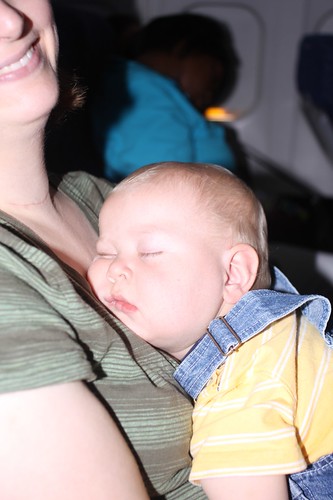
Well, I m back in Kansas after a bit over a week in New York for Debconf. I didn t have time to write much, so I ll probably be posting about it a few times. I already wrote about the trip to New York, and now will say just a bit about the time there and trip back home. I have to start with a quote from Jacob. We went on the Q train from Coney Island a few stops down to Brighton Beach. It s elevated, and provides an excellent view of the amusement park. Jacob s excited comment, face pressed to window, was: Wow! I see lots of everything! Which, come to think of it, sums up NYC itself pretty well. Speaking of faces pressed to windows: this was Jacob s default mode of operating in NYC. Get into any subway car, bus, whatever and he wants to stand on the seat nearest the window and look out it. It s a real problem if no such seats are available. More than once, though, we ll get on the subway and he ll run to the nearest window seat to claim it, no matter who will be his neighbors for the next few minutes. And after a few days of this, Oliver started picking up on it. Pretty soon both boys wanted to be pressed to the windows watching interesting things (to me, it was a dark tunnel with occasional lights, but interesting to them) go by. Which brings me to today. Today was Oliver s first time flying, and Jacob s second though he was an infant the first time he flew and doesn t remember it. Jacob has been perhaps cautiously optimistic about flying. The idea of it was exciting, but then again it s something completely new, which he doesn t care for so much. So we had no idea what to expect. What was got was excitement. And lots of it. From the La Guardia terminal, Dad, is this our plane? No, not that one. Well, is THIS our plane? No, not that one either. Well, is *THIS* our plane? At this point, a parent has to confront the question: which is worse, causing serious disappointment to a 3-year-old and possibly inviting a meltdown in the middle of the D concourse, or a bit of harmless encouragement that might not be 100% literally true? Uhmm . that might be it (Ah, so I went for the literally true but still exciting route ) YAY!! *jumping and clapping* Terah reminds me at this point of our security adventure. I, wearing socks, carried Oliver (1 year old) through the security checkpoint at La Guardia. But oh! I failed to remove his shoes (not really shoes). TSA made me go back through, put them in the bowl, and run them through the scanner. A nearby pilot, getting screened, noticed this and made this ironic comment well within TSA earshot: Look at his face! He s gonna get us all! Good thing you re checking his shoes! Terah and the pilot both just about bust up laughing. Meanwhile, I m carrying Oliver through, and the agent that made me take off his shoes had this look of I m sorry, I know this is stupid, but I have to. (For an excellent pilot s rant about TSA, read this). Anyhow, we got on the plane, and of course Jacob nabbed the window seat. IMG_4458.JPG There was plenty interesting to see. At each step of the way, I told him what was going to happen next, so there wouldn t be any surprises. I told him once we got in the air, and got a breathy Woooooooow .. I told him, Jacob, we are flying! And his reply has to be his best quote of the week:
Dad, I don t know that I ve ever been a butterfly before!
I pointed out that we were above the clouds, which was also exciting. About every 5 minutes, he d poke me, and say, Dad, look out the window. Look down. WE ARE UP IN THE SKY! Meanwhile, Oliver slept. IMG_4461.JPG On the second flight, Jacob slept (and was in a very foul mood when he woke up on the ground) while Oliver tried his best to squirm out of the seat and onto the ground. Now, to wind up this post, I would like to leave you with some statistics and photos comparing my home with New York.
Item NYC Marion County, KS
Land Area 469 sq mi 954 sq mi
Population 8,391,881 12,952 (6871 excluding the 3 largest towns quite some distance away)
Population Density 27,532/sq mi 14/sq mi (7 if excluding large towns)
I think of this as a wonderful difference! I ve said before how much fun it is to spend some time in NYC, where we can just walk to a fruit stand, any number of grocery stores, restaurants, etc. And finally, I leave you with two street scenes. The first is from our hotel s front door. IMG_4352.JPG That s our fruit guy there, and the bagel and roll place is across the street by the RadioShack. Now, the street view from our front door after we got home: IMG_4466.JPG OK, so that s sort of misleading. You can t actually see the street scene because it s on the other side of the hill. That s just our driveway to get to the street. (Not that the street looks much different. It has the weeds growing on the sides instead of in the middle, as one notable difference.) We loved New York and I m certain we ll go back again. It s also nice to be home and enjoy the peace of the countryside. Thanks to Debconf for a wonderful conference a topic I ll have more to say about in the coming days.

6 August 2010

John Goerzen: Really Dark Blue

As we were walking home tonight, Jacob started singing, over and over:
Really dark blue,
really dark blue,
really dark blue
The tune changed a bit, but the words didn t. Terah and I wondered what was really dark blue, until finally we heard:
Really dark blue,
really dark blue,
really dark blue sky. Really dark blue
Then a little while later, we heard:
Really dark blue,
really dark blue,
really dark blue with morning stars.
It was such a cute moment that it s hard to convey it in words. I even got an audio recording of it on my phone, which I ll perhaps post someday. Update 21:05: For Jacob s usual bedtime song tonight, I offered to sing the really dark blue song for him. When I sang really dark blue with morning stars, he said, no, that s not it. It s MOONLIT stars. So I guess my 3-year-old just corrected my blog post. I see a career in copy editing in his future

2 August 2010

Christine Spang: lolbikeride to debconf

DebConf being in New York City this year, clearly the right way to get there was to bike, together with Molly and Daf. Being touring newbs, there were a few mishaps.

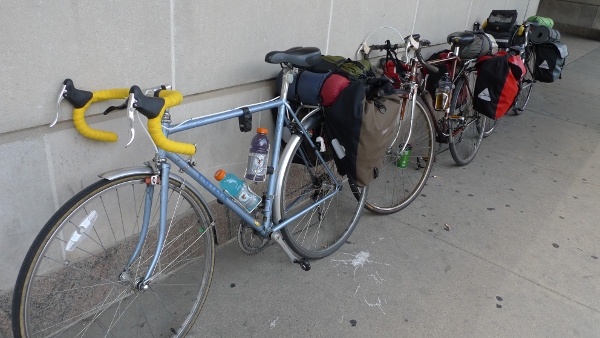
Day 1 We aimed to catch the 10:00 commuter rail train from Boston to Providence, Rhode Island, but we ran late (predictable) and had problems with the bicycle rack for my racing bike, which attaches without frame mounts (also predictable, since Mako and Mika test-rode it earlier in the week), so we didn't make it in to the station until around 10:20. We used the extra time to eat and fix up the bikes, though, so it's not clear how much of a setback that was. Here are our bikes ready to go at the Providence commuter rail station. bikes at Providence We then had some problems with Molly's brakes, and it took a long time to navigate out of the city, but eventually we found ourself on the "Washington Secondary Trail" a wonderful bike path along an old rail line. Every couple miles there'd be an old covered rail bridge over the river, and it was a well-paved straight shot for about ten miles, with no cars and no need to navigate. Molly on a train bridge Just as we were getting into things after the bike trail ended, something completely unexpected happened. This is Daf's derailleur after it sheared off in the middle as we attempted to start after a red light outside Tractor Supply Co. broken derailleur Luckily, John and his son Chris lent us a hand and hauled Daf and his bike to the nearest bicycle shop in the back of their pickup truck. They'd just come from there, where John had bought Chris a new helmet. Greenway Cycles, the only bike shop in a twenty mile radius, was three miles away. We got there an hour before it closed and Rick replaced the derailleur and straightened the hanger in a jiffy. Due to all these things, we didn't get as far as we'd planned in the first day and ended up camping in Seaport Campground in Mystic, Connecticut, rolling in at around 22:00. We did about 65 miles, including six due to the detour to the cycle shop. Carrying camping gear is heavy! Several delicious peanut butter and jelly bagels and some wheatberry and couscous salad later, we were passed out.

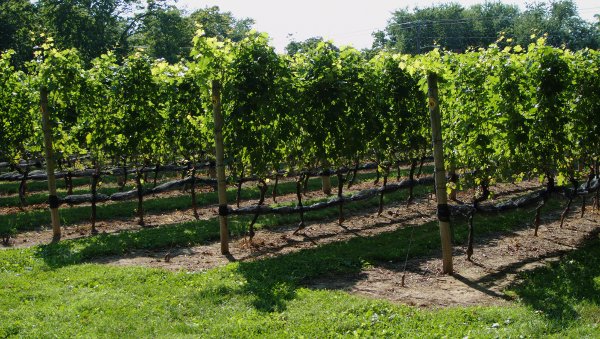
Day 2 Molly at the campground The second day included less bike trouble, but was no less eventful, and we were tired from the previous day's riding. The highlights included taking a tiny sidewalk path that I'm baffled how Google knows about up onto a sidewalk alongside the I-95 bridge across the Thames to New London, Connecticut. the Thames bridge The 13:00 ferry from New London to Orient Point, New York, where we got some remarkably good veggie burgers (whole edamame visible!) for lunch. Cross Sound Ferry And a vineyard on the north fork of Long Island, where we stopped for a quick tasting and ended up picking up a bottle of barrel-fermented chardonnay. The vineyard was small 23 acres, with 11 acres of grapes and the proprietors were friendly and extremely interested in our trip. They gave us a dollar off on the bottle due to our method of transport. The Old Field Vineyard It turns out there are only two trains a day on the Long Island rail, and we just barely caught the 18:52 return from Riverhead. We had mere seconds in the station and ended up without enough cash to pay for tickets onboard, but the conductor just took what we had and gave us tickets to Penn Station anyway. Outside Penn, a girl with a mohawk and a messenger bag overheard us talking about biking up Broadway and told us to bike up 8th Avenue instead. "Always bike up 8th and down Broadway because they have bike lanes in those directions." Thus, we didn't die dodging taxis in the dark. So basically, due to various people being extremely nice to us for no good reason, we made it to Columbia University around 22:30, on the correct day. Warm fuzzies for humanity all around. :)

31 July 2010

Aigars Mahinovs: Debcamp 10 the early days

After I finished an re-read my epic post describing my first day and a half at Debconf10 I suddenly realised that if I continue to describe the rest of 13 days here in such style and verbosity this would become a book, a boring one at that, so I decided to limit myself to 2 posts for Debcamp and then a post a day for the Debconf. But about the first half of the Debcamp week there are things that are as usual and there are things that are not. Let s start with the usual bits: more people arriving every day, evening parties are getting more and more fun and wild (or so people say) and the Internet and power at the hacklabs magically becomes more and more reliable day by day, the cabling mess grows organically trying to spread out evenly and not overload any individual socket, extension cords with non-local plugs appear and spread the load some more, people stress out, volunteer, crash out and repeat. All in all nothing can stop the freight train of few hundred Debian developers determined to have fun. With out own DFSG-free definition of fun. (But this year we appear to be running very close to the edge on volunteers if we run out of those, there will be a train-wreck, so please volunteer!) Now off to the unusual stuff. The City is well it is cool and very, very impressive. It is not terribly different to me at least I am used to such structure of the city: grid based layout of the downtown city (with some parks) and then branching out to separate, but different across-the-river districts and then sprawling out to slightly chaotic suburbs. Riga is very much like New York in the design. The difference is that New York is 10-20 times larger: the areas are 10 times larger, the buildings are 3-4 times higher on average, the streets are 2-3 times wider and yet have more traffic and there are far, far more shops, shows and restaurants. Also there is the subway. It is a great thing in that it hides the size of the city take a bus downtown once, to find out what I mean it takes ages to drive the distance that takes 20 minutes on the subway. I like this city, I am getting a feeling, that I could live here without much problem for me. So far I ve only had this feeling in Riga and Berlin. On the other hand this is USA. I ve so far only encountered one bad thing about it, but it is a pretty big one food. Basically all food that I ve tried so far in the USA has been crap. It was tasty salt, sugars and fat took care on my brain thinking it s food, but underneath that it was pretty crap: there was no texture, no content, no soul. The John Jay cafeteria where we are eating lunch and dinner is better than the most other options, because it is an all-you-can-eat buffet where you can choose your poison and it was also the place where I had the best piece of food in USA so far a slice of pepperoni pizza, that had a bit of taste behind the fat. Also, surprisingly, the fast food options (McDonalds, Burger King, ) are better than the equivalents in Europe, far better. In fact the fast food is cheap and in some cases tastes better than regular food, so there is no wonder why people might prefer it in some situations. So it is easy to see how people just accept shoving bland fast food or bland all-you-can-eat food into their mouths and not think much about it and thus become fat and put undue stress on their health. I expect the average weight of Debian developers to increase by 5 kg by the end of the conference. If you want to prove me wrong, running with bubulle would help you a lot with that. Events downtown. New York is a huge city with a lot of events going on every day, so everyone should be able to find something of interest for them. For me it was the free tickets for tapeings of The Daily Show and The Colbert Report. I got into both of those and for me The Colbert Report was by far the better experience. For one you can not get into Daily Show without a ticket (some tickets show up on the web site on the morning of the shoot around 11am), while 18 people from the stand-by list at Colbert Report got in. At The Daily Show you stand in a live line with ticket holders in one line and stand-by line separate. If you have tickets and arrive around 3pm you should be fine any later than that and you risk to be standing outside even with a ticket. You find that out around 4.30pm when they hand out physical tickets you have one, you get in. If not you might rush over to Colbert Report where a more humane system is used a staffer takes down your name and email on a numbered list and then you can walk around until 5.30pm then they let the ticket holders in and after that call the names of stand-by people that get in. The Colbert Report studio is brighter, more colourful and closer to the action, also it is very rare that cameras block the view from the audience (which is common on The Daily Show). It might have also been my luck when I got on the most boring The Daily Show episode I can remember, ever. The best joke was a woman asking John is she could get a ticket for her friend in August. The warm-up act and crowd control at The Colbert Report was also way better: Colbert staff was hyper, security was ever-present, warm-up was funnier and very engaging (he grilled me for several minutes and I replied making the audience laugh very hard explaining that Latvia was like India of Eastern Europe in regards to IT exports) and Colbert himself was very gracious talking to us out-of-character before the show for a good 10 minutes. Location, location, location. The talk rooms and event rooms and hacklabs are spread out across multiple buildings and there is a lot of other activities going on in those buildings besides Debconf, so moving between place might be confusing for the first day or two. Also the rooms are quite dark that might cause a noise problem for me and the video team as we ll have to up the sensitivity settings on our gear. The video team is working on fixing that by throwing a bit more light on to the speakers. Elevators are wicked fast, but can also be confusing, because the ground floor is on a different number for different buildings it can be G, 1 or even 4. Usually on campus there is a star next to the level with the exit. The dorms. I am in the Carman building and it looks like its interior has not been updated since it was built large ceramic bricks with very visible gaps (for the interior walls), raise-to-open windows, huge aircon fans that take up the whole bottom of the window, plumbing from the 60ies (at least). The security is weird on one hand you have to give your room card to the guard when entering the building, but on the other hand the room cleaning crew can simply forget to close your door after they are done. Like this Thursday I returned to the dorm just before lunch only to find the door of my room open. No one was around and nothing was missing, but it s still worrying. In any case I am steadily uploading photos from Debconf 10 to my Flickr page and new stuff should show up every day.

25 July 2010

Rapha&#235;l Hertzog: Ubuntu default bookmarks pointing to Debian

Just noticed that the default bookmarks in Ubuntu include one entry pointing back to Debian. It even says that Ubuntu is based on Debian. It s a small thing but it made my day. It s nice to see this kind of acknowledgement. Click on the screenshot to see the picture in full size (and yes, most favicons suck with a dark background). For those wondering, the screenshot is taken on a default install of Ubuntu 10.04 Netbook Edition. Flattr this Share/Bookmark 3 comments Support my work

28 June 2010

Steve Kemp: Because I don't trust myself with you.

Debian Packages
Every now and again I look over server logs and see people downloading random .deb packages from my mirrors, or from my servers, via wget or Firefox (rather than with apt-get/aptitude). Personally I don't often download random binaries even from people I believe I can trust. Instead I'll download source and rebuild. But it bugs me that somebody might download a work-in-progress, decide it isn't complete or otherwise good enough, and miss out on an update of awesome-sauce a day or two later. I suspect there is no real solution to this "problem", and that including /etc/apt/sources.list.d/ entries inside a binary package to "force" an upgrade behind the scenes is a little too evil to tolerate. And yet .. something something dark-side .. something something seductive something?
Blog Update
This is my last film-subject entry. In the future I will have more accurate subjects, albeit more dull ones. I still amuse myself with quotations, and before that the song lyrics, but I guess that now is a good time to call it a day with that.
ObFilm: Cruel Intentions

22 June 2010

Craig Small: Book: Do Androids Dream of Electric Sheep?

Actually they're more interested in freedom, to be no longer slaves to humans. I don't think it's any spoiler to mention that an electric sheep does appear in the book.

This is a classic science fiction story of a dark not-so-distant future. In fact given that it's over 40 years old it could be set in some alternate now. Some disaster has occurred and many have either left earth or died. Some andriods, or andys have escaped and bounty hunters are after them.

You may not know the book by its correct title, but you may of heard the movie that is based upon it, called Blade Runner. Like most movies based on books, it takes some of the concepts and ideas of the book but in my opinion is a pale imitation.

I'm glad I read this book. It hasn't aged that much and it's very though provoking. Sci-Fi often uses some alternate reality to put a mirror up to what happens in the real world and this book is no exception.

And a token link to Debian, if you want you own electric sheep you can install the screensaver electricsheep package which draw pretty fractals on your screen.

<script defer="defer" src="http://static.zemanta.com/readside/loader.js" type="text/javascript"></script>

20 June 2010

Stefano Zacchiroli: debian meeting guidelines RFC

How to have a (Debian) summit without turning into a secret cabal It seems rather uncontroversial that sponsoring various kinds of Debian meetings (conferences, sprints, BSPs, etc.) is a good way to spend, actually invest, Debian money. Historically, that has not always saved the Debian community from muttering about "cabal-ish" meetings in very few specific occasions. (No, there is no cabal, in case you wonder.) I've always believed in the good faith of people and I don't think that we have ever had "secret meetings" on purpose. Nevertheless the question of how to have meetings in a community-compatible way is a sound one. Answering properly to such a question is something that it's harder than what it might seem at first sight (at least for me). In particular, organizers have to carefully balance the high efficiency that meetings offer (e.g.: communication bandwidth is higher than when working remotely, people have less distractions, more enthusiasm, more fun!, etc.) with the risk of cutting out the rest of the community which cannot attend the meeting, for whatever reason. Note also that since Debian is not a company, we cannot just require that everybody who is interested attend the meeting. As DPL, I'm starting to get quite some requests for meeting sponsorship, and that's just wonderful: it means that we have thrilling groups of people that are eager to get together and hack to improve Debian! Still, in doing so, we should all try to minimize the above risk; that's why I've started to apply the following Debian meeting guidelines, as a kind of prerequisite for sponsoring.
  1. Before the meeting: the meeting should be announced to the most relevant public mailing list(s); ideally, the tentative agenda of the meeting should be included in the announcement.
    That will enable people interested in the meeting topics to provide their inputs and more generally to know what is going on.
  2. During the meeting (preparation): expenses should be minimized, as a form of respect for all people that donate to Debian. Since we value their contributions, we do our best not to waste them. (TTBOMK, we've always done that, but making it explicit won't hurt.)
  3. After the meeting: meeting minutes should be sent to the most relevant public mailing list(s), usually to d-d-a for meetings that cover topics of general development interest.
    As an obvious consequence, minutes should be taken during the meeting; it is a bit of extra burden, but the risk of leaving the rest of the community in the dark is just not acceptable a community as wide and diverse as ours.
  4. In general, think about communication, e.g.: (micro)blog about the meeting, contact press/-publicity to prepare a news item about it, enable others to attend virtually on IRC or other media, etc.
For now, the above is just a brain dump.
Now, what do you think? Are the above reasonable demands? What else should we ask for?
Feel free to leave a comment or mail me about that.

12 June 2010

Russell Coker: Links June 2010

Seth Berkley gave an interesting TED talk about developing vaccines against the HIV and Influenza viruses [1]. The part I found most interesting was the description of how vaccines against viruses are currently developed using eggs and how they plan to use bacteria instead for faster and cheaper production. One of the problems with using eggs is that if the chickens catch the disease and die then you can t make a vaccine. Aigars Mahinovs wrote a really good review of Microsoft Azure and compared it to Amazon EC2 [2]. It didn t surprise me that Azure compared poorly to the competition. Johanna Blakley gave an insightful TED talk about IP lessons from the fashion industry [3]. She explained how an entire lack of IP protection other than trademark law was an essential part of the success of the fashion industry. She also compared the profits in various industries and showed that industries with little or no IP protection involve vastly larger amounts of money than industries with strong IP protection. Lisa D wrote an insightful post about whether Autism Spectrum Disorders (such as Asperger Syndrome) should be considered to be disabilities [4]. I don t entirely agree with her, but she makes some really good points. Sharmeen Obaid-Chinoy gave an interesting TED talk about the way the Taliban train young children to become suicide bombers [5]. Apparently the Taliban prey on large poor families, sometimes paying the parents for taking children away to school . At the Taliban schools the children are beaten, treated poorly, and taught theology by liars who will say whatever it takes to get a result. Then after being brain-washed they are sent out to die. Wired has an interesting article about Charles Komanoff s research into New York traffic problems [6]. He aims to track all the economic externalities of traffic patterns and determine incentives to encourage people to do things that impose less costs on the general economy. His suggestions include making all bus travel free as the externality of the time spent collecting fares is greater than the fare revenue. It s a really interesting article, his research methods should be implemented when analysing traffic in all large cities, and many of his solutions can be implemented right now without further analysis such as free buses and variable ticket pricing according to the time of day. William Li gave an interesting TED talk about starving cancer by preventing new blood vessels from growing to feed it [7]. Drugs to do this have been shown to increase the life expectancy of cancer patients by more than 100% on average. Also autopsies of people who died in car accidents show that half the women in their 40 s had breast cancer and half the men in their 50 s prostate cancer but those cancers didn t grow due to a natural lack of blood supply, so the aim here is to merely promote what naturally happens in terms of regulating cancers and preventing them from growing larger than 0.5mm^3. There are a number of foods that prevent blood vessels growing to cancers which includes dark chocolate! ;) Also drugs which prevent blood vessel growth also prevent obesity, I always thought that eating chocolate all the time prevented me from getting fat due to the central nervous system stimulants that kept me active Graham Hill gave an inspiring TED talk about becoming a weekday vegetarian [8]. Instead of making a commitment to being always vegetarian he s just mostly vegetarian (only eating meat on Sundays). He saves most of the environmental cost and doesn t feel guilty if he ever misses a day. It s an interesting concept. Cory Doctorow wrote an insightful article for the Guardian about the phrase Information Wants To Be Free [9]. He points out that really it s people who want to be free from the tyranny that is being imposed on us in the name of anti-piracy measures. He also points out that it s a useful straw-man for the MAFIAA to use when claiming that we are all pirates. The Atlantic has an interesting article about the way that Google is working to save journalistic news [10]. Adam Sadowsky gave an interesting TED talk about creating a Rube Goldberg machine for the OK Go video This Too Shall Pass [11]. At the end of the talk they include a 640*480 resolution copy of the music video. Brian Cox gave an interesting TED talk advocating increased government spending on scientific research [12]. Among other things he pointed out that the best research indicates that the amount of money the US government invested in the Apollo program was returned 14* to the US economy due to exports of new American products that were based on that research. It s surprising that any justification other than the return on investment for the Apollo program is needed! Moot gave an interesting TED talk about Anonymity [13]. I don t think that he made a good case for anonymity, he cited one person being identified and arrested for animal cruelty due to the efforts of 4chan people and also the campaign against the Cult of Scientology (which has not been very successful so far). Rory Sutherland gave an intriguing TED talk titled Sweat the Small Stuff [14]. He describes how small cheap changes can often provide greater benefits than huge expensive changes and advocates corporations having a Chief Detail Officer to take charge of identifying and implementing such changes. TED Hosted an interesting debate between pro and anti nuclear campaigners [15]. They agreed that global warming is a significant imminent problem but disagree on what methods should be implemented to solve it.

1 June 2010

Julien Danjou: Thoughts and rambling on the X protocol

Two years ago, while working on awesome, I joined the Freedesktop initiative to work on XCB. I had to learn the arcane of the X11 protocol and all the mysterious and old world that goes with it. Now that I've swum all this months in this mud, I just feel like I need to share my thoughts about what become a mess over the decades. When I was unborn

the Toto band were releasing their song "Africa" and some smart guys were working on a windowing system: the X Window System (this is its full name) which therefore has a (too) long history. The latest version of its protocol, the 11th one, has been designed in the 80's. You can learn more about the history in the Wikipedia article about X. In 2010, we still listen disco music and we still use various protocols designed in the 80's and even before X. Music have evolved, protocols have evolved, and so did X11. The problem is that X11 did not evolve that well. The guys at MIT-and-some other-places-with-very-smart-people-in-it created X version 1 in 1984, and updated it until X version 11 (the one we're still using) in 1987. Eleven version in 3 years, that was following the "release early, release often" model. But I don't know why, it just stopped to happen for the last 23 years1. I don't know what changes have been made in the first 11 major versions of the X protocol, but I'm rather sure we should have deserve a couple of major version updates this last 2 decades. In my humble opinion, X11 was not designed to live 23 years. But hey, I'm not blaming anyone here: I was 4 years old and playing Lego when they released this latest version of the X protocol, so there is little chance I'd have done something better.

1. That's not totally true: they added (and then deprecated) many extensions. We won't fix. We'll work-around.

That is probably one of the guideline of the X protocol for the last years. And don't misread me: I'm not bashing anyone thereafter. Since the X11 protocol was aging, the X guys started to add extensions. They added tons of them over the years. This, in application of one of the early principles of X:

It is as important to decide what a system is not as to decide what it is. Do not serve all the world's needs; rather, make the system extensible so that additional needs can be met in an upwardly compatible fashion.

All of them with no exception were added because, bad luck, the X11 protocol did not anticipated the things that happened in the last 23 years, like video, OpenGL, multiple monitors, or the pleasure to draw oval windows. Some of this extensions are still in use, while some of them have been dropped. While this is not a bad thing to extends the protocol, it seems like a bad thing to try to fix the protocol with for example the XFixes extension, even with all the good intentions Keith Packard might have in his greatness. Actually it's even worst than you think

The X11 protocol (without extensions) defines about 120 types of requests: create a window, move a window, etc. Nowadays, there's at least 25 % of them which are useless: usage of server-side font, or the drawing of squares and polygon, are unused by any modern application or toolkit. All of this is superseded by requests from extensions, like the XRender one. The handling of multiple monitors displays has totally been screwed up. X11 has been designed to work in Zaphod mode (independent monitors). But Xinerama, and nowadays XRandR have replaced it up: recent X servers (released after ~2007) does not support Zaphod mode anymore, even if it's a core piece of the X11 protocol. Worst: on many requests, there's limitation or design flaws, like described in this document: Why X Is Not Our Ideal Window System by DEC researchers. We'll add more broken standard on top of that

Following its early principle, X does not define policies but only mechanisms, which seems like a good thing, Consequently, people started writing specifications to determine a number of stuff and dogmas: ICCCM. That was 22 years ago in 1988. It's useless to add that many things in this specification are now obsolete, useless, or that it misses many modern stuff. I was not the only one to think that. The people from what will be the major desktop environments, KDE and GNOME, saw that too in the 90's while I was learning to count. So they wrote EWMH, another standard that comes on top of ICCCM and extends it with nifty features like maximization, full screen mode, etc. The problem is that this standard has also been written by narrow-minded people who at that time, were working on GNOME or KDE (and maybe others). This desktop environments were having and still have some strong concepts of how should work a desktop: "it should have work-spaces", "a window is only on one workspace", "we only see a workspace at a time", "you do not have multiple screens", etc. Dude, we don't care: we have toolkits!

This vision of how the desktop should work have now been written in marble in all applications and libraries implementing EWMH, like GTK+ or Qt. Nowadays, everybody forgot about all of this standards. Toolkits have implemented this, circumvented the X11 protocol limitation and flaws, and nobody wants to look back. Like all standards, obviously some people implemented them badly. This had some side effects, like OpenOffice acting like a pager. We don't look back? Worst, we forgot where we came from!

With all these layers of bad designed standards, the desktop continued to evolve for more than a decade. They continued to add more standard, the more recent ones being based on D-Bus like the Desktop Notification Specification or the latest Status Notifier Specification developed by KDE. The Status Notifier is a new implementation of the good old system tray based on XEmbed, using D-Bus instead of the X11 mechanisms, and adding the possibility to show the system tray with something else than icons. This specification draft saw an important issue and design flaw raised by Wolfgang Draxinger in this thread on the XDG mailing-list. What Wolfgang points out, is that X is network-oriented, and D-Bus is not. Therefore, making the Status Notifier specification to use D-Bus to pass system tray messages around is a bad idea, since running a X application from host A on host B will draw the system tray on the wrong host! Apparently, reading the thread, this does not fear some of the KDE people:

of course this is a bizarre corner case not worth much thought. at least that's what you'll think until you actually run into it yourself (be it because you are testing something or because you are setting up some weird kiosk environment).

What Oswald describes as a corner case is an actual common use case for many of us. Of course, YMMV. From my point of view, this is a step back in the wrong direction. But we can conclude that the network part of X is now worthless, to at least KDE. I used to believe in XCB

When I joined Freedesktop, it was to work on XCB, the X C Binding. XCB is a nice, clean, 21st century technology based API to play with the X11 protocol. Its code is auto generated based on XML file describing the protocol. In comparison, Xlib is 80's obfuscated code with almost no comments and hard-coded things. Only a few people can understand some of its corner like its i18n or XKB implementations. And all its code is synchronous. For people not knowing it yet, X is a network protocol where you send request (like a GET in HTTP) and then get a response. Xlib forces the application to wait for the reply to its request, so the application is blocked until the X server sends the reply to the request. XCB on the other hand does not block and allows the application to send a batch of requests, do some other stuff in the mean time, and then gets the replies. It's like your Web browser would send one request at a time to a Web server, and would wait until you downloaded all the images one by one to display the page. In cases where X and all its clients are on the same host, the latency is small and not really visible, therefore the gain for XCB to be asynchronous is small. On slow network however, the gain can be huge, as proved in the rewrite of xlsclients with XCB by Peter Harris. One of the long standing goal of the XCB folks is to kick-out Xlib, to increase speed and hides latency in X11 applications. That requires to port many libraries, because almost none of them (Cairo being an exception) supports XCB. From where I stand, I don't really see if the work is worth it now. The desktop world is trusted by GNOME and KDE, meaning GTK+ and Qt. It seems none of this toolkits are interested to work on XCB, neither on the X protocol. They probably put hard effort in bypassing X limitation and flaws, and they now sit on top of crap of workarounds and broken-by-design-standard implementation. It seems to me they don't want to go back in the layers and improves things. They're too high to go back down and they don't see what the gain would be. Enlightenment with its EFL was the first toolkit to have an XCB back-end with the work of Vincent Torri. Unfortunately, the back-end is not maintained and nobody cares about it. Last time I tried it, it did not compile at all. X12 ?

There's a page called X12 on the Freedesktop wiki, listing all the things that should be fixed some days. Unfortunately, the list continues to grow up an no one talks about working on X12. On the other hand, there's a handset of people trying to work when they will have time on XKB2, the second version of the "let's-try-to-fix-up-the keyboard-part-of-the-protocol-we-wrote-23-years-ago-a-second-time" extension. To me, it does not seem X12 will happen in the next decade neither. Alternative ?

Do we got alternative to X ? There's Wayland, but it's far from being usable. There's DirectFB, but that's not very portable. None seems candidate to replace X some days to me. Anyhow, none of the main toolkits around support this alternative. GTK+ once supported DirectFB, but as far as I know, it is not supported nor works nowadays, as stated by Josselin Mouette. This is why recent versions of the Debian installer have migrated to X for the graphic part, thanks to Cyril Brulebois work. Conclusion

XCB has been around for more than half-a-decade, and very few people showed interested in it. As far as I can see, nobody is interested to use the X protocol and everybody tries to encapsulate it in some higher-level API as soon as possible to stop seeing it. This leads to poorly written application and toolkits, with a lot of ugly hack. All of that also means that starting to write applications and graphical toolkits based on XCB would be a very interesting project, but that would lead to spend too much time learning to circumvent the X protocol flaws, things that have been done in years by predecessors like Qt and GTK+. Major toolkits implementations have almost nothing to win in going back in the dark water of X. I guess most of their folks prefer to work on shiny 3D effects based on your GPS location, rather than redefining better basis for everyone. The manpower available in the X world is very small. Debian lacking of X maintainers is just the summit of that. There is very smart and very competent and skilled guys in the X world, as you can see by simply reading blog posts on Planet Freedesktop for example (me excluded). Unfortunately, there's not enough of them to cover all the things involved in X: input devices, graphics devices, new protocol extension specification and so on. The X server is really late, and it seems most of the developers prefers to work on the server itself than on the protocol behalf. Which is understandable. I'm curious to see where all of that will lead in the upcoming years. I've been walking in the X world hallways for about 3 years now, and I feel desktop alternatives to KDE and GNOME will all die sooner or later. The time were you could choose between a dozen "modern" window managers has passed away. After all, maybe that is simply Darwinism applied to computer software.

31 May 2010

Marco T&uacute;lio Gontijo e Silva: Summer of Code weekly report #3

My project This week I followed an advice of my mentor, Simon Marlow, and started to play with the code including print statements in interesting places in order to understand it s flow. It s indeed much better than just reading the source code and the documentation on the wiki. As usual, I had a lot of doubts about some parts of the code, and noted them down. But now, I m seeing that I m resolving most of them just by playing more with the code, without need to ask in the mailing list. There are still some left, and I m planning to send them to the list in a next oportunity. The first thing I noticed was the high number of objects, from my perspective, that are created and collected in: main = return () I measured how much times evacuate() was called. This function moves an object to the next generation of the Garbage Collector. It s called 775 times, in 1 call to GarbageCollect(), with 479 different objects (with different pointers to their Info Tables). Also, there were pinned objects and large objects in this count. This was surprising to me. I also made a small draw of the memory allocation in lines using diagrams. The draw: The source code: import Prelude hiding (tan)
import Control.Monad
import Data.Colour.RGBSpace
import Data.List
import Graphics.Rendering.Diagrams
import System.Random objectMaxLength :: Double
objectMaxLength = 50 objectMinLength :: Double
objectMinLength = 10 nObjects :: Int
nObjects = 10 main :: IO ()
main
= do
objects <- replicateM nObjects $ randomRIO (objectMinLength, objectMaxLength)
let objects = [18,50,12,46,16,41,14,30,49,23]
renderAs PNG "mem.png" Auto
$ vsep
10
[text 40 "(1)" <> continuous objects
, text 40 "(2)" <> lineByLine objects
, text 40 "(3)" <> allocated] continuous :: [Double] -> Diagram
continuous = memory colors lineByLine :: [Double] -> Diagram
lineByLine = memory (intersperse white colors ++ [white]) . objectsLine allocated :: Diagram
allocated
= memory
(intersperse white colors ++ [white])
[18, 82, 50, 0, 12, 0, 46, 0, 16, 0, 41, 35, 14, 0, 30, 0, 49, 7, 23] objectsLine :: [Double] -> [Double]
objectsLine [] = []
objectsLine (x : xs) = x : objectMaxLength x : objectsLine xs memory :: Color color => [color] -> [Double] -> Diagram
memory colours objects
= unionA
top
left
[hcat
$ map (uncurry fc)
$ zip (cycle colours)
$ map (lw 0 . flip rect objectMaxLength) objects
, lines_] lines_ :: Diagram
lines_ = hcat $ replicate nObjects $ rect objectMaxLength 50 colors :: (Ord colour, Floating colour) => [Colour colour]
colors
= [red, green, blue, yellow, magenta, cyan
, darkred, darkgreen, darkblue, darkmagenta, darkcyan]

19 May 2010

Bernd Zeimetz: new css for bzed.de

After more than a year of using ikiwiki to run bzed.de I thought it would be a good time replace the darkish-brown style by something bright. Also I wanted to get righ of the massive changes I had to do on the template files to make the old layout work. Unfortunately I hit one of the - in my opinion - major problems in the ikiwiki templates again: You can't rely on all <div>s being available on all pages, which is quite annoying when you need them to style the page with CSS. So I had to make a tiny change to page.tmpl:
diff --git a/templates/page.tmpl b/templates/page.tmpl
index 8a9911f..dbf78a0 100644
--- a/templates/page.tmpl
+++ b/templates/page.tmpl
@@ -111,8 +111,8 @@
 <TMPL_VAR CONTENT>
 <TMPL_IF HTML5></section><TMPL_ELSE></div></TMPL_IF>
-<TMPL_IF COMMENTS>
 <TMPL_IF HTML5><section id="comments"><TMPL_ELSE><div id="comments"></TMPL_IF>
+<TMPL_IF COMMENTS>
 <TMPL_VAR COMMENTS>
 <TMPL_IF ADDCOMMENTURL>
 <div class="addcomment">
@@ -121,8 +121,8 @@
 <TMPL_ELSE>
 <div class="addcomment">Comments on this page are closed.</div>
 </TMPL_IF>
-<TMPL_IF HTML5></section><TMPL_ELSE></div></TMPL_IF>
 </TMPL_IF>
+<TMPL_IF HTML5></section><TMPL_ELSE></div></TMPL_IF>
 <TMPL_IF HTML5><footer id="footer" class="pagefooter"><TMPL_ELSE><div id="footer" class="pagefooter"></TMPL_IF>
 <TMPL_IF HTML5><nav id="pageinfo"><TMPL_ELSE><div id="pageinfo"></TMPL_IF>
Everything else is a bit of CSS in local.css and some images. There are still various things which could be optimized, but there are more important things to do now :).

28 April 2010

Wouter Verhelst: It was a dark and stormy night.

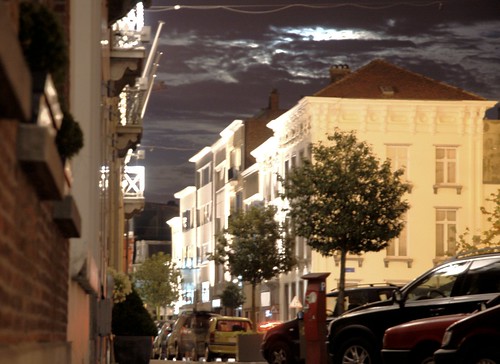
Onze-Lieve-Vrouwestraat The moon shone through the clouds. The sun didn't. The lightning did. Or, well, didn't. The beer flew wildly, and changed the food into something of the past. Discussions arose about lasers, ceramic knifes, and stormy nights. Promises were made that were only kept by some, including me, but not including him. Much was said that mattered little. Little was said that should've been forgotten. Yet much was. He would've been proud.

11 April 2010

John Goerzen: Final comments on our trip to Europe

I wrote a lot about our trip to Europe here, and I had a few more comments to share. I had a great time there. It was fun to stay with people, and it was also fun to explore cities on our own. I am eager to be able to go back. Communication
I ll admit I wasn t sure how I d do there. I speak only a little German, and no Czech at all. I have never been in a situation in which I don t speak the dominant language, and this is probably typical for Americans. (I m not going to count the few exceptions of eating at small Mexican restaurants in the USA where the staff speaks little English, as it s not really the same experience to be in that situation for an hour or two.) I was most apprehensive about our time in Berlin and Prague. In those cities, we didn t know anyone. And, although I speak a little German, I speak no Czech at all. In the end, though, it all worked out fine. I never saw anyone get frustrated with us for our lack of language knowledge, and we also never got rattled. With patience and a bit of ingenuity, we figured things out in every different situation. I feel a sense of accomplishment from that, and I think it s left me more ready to travel in the future. And, I d also have to say, that was one of the most interesting lessons of the trip: how two people that don t share a common language can still communicate. It might be slow, but it s also rewarding and easier than I might ever have thought. I remember particularly buying a couple of fragile carved wood souvenirs at the Zeidler Holzkunst (wood art) shop in the Altes Rathaus in Leipzig (Seiffener Volkskunsterzeugnisse was on the window). The shopkeeper spoke no English. We were interested in some rather fragile items, and I wanted to ask her if she could pack it in a box. I didn t know the German words for pack or box . So after a couple seconds thought, I realized I knew how to tell her, in German, that we re from America. And then I asked, Can you? (in German) and gestured for a square box, figuring maybe she d put it together that we d need to pack it well to take it home with us. Success. She quickly produced a box, and asked if that s what we wanted. A few minutes later, a bit of pointing towards the glass case communicated what we wanted to buy. It took a little longer than it would have from someone that spoke English, but this was more rewarding in the end. The train station in Prague was another challenge. It didn t have nearly as much English signage as other train stations we d been in. We did a little wondering around, and some educated guesses, and a brief English conversation in a bank, we eventually found an ATM, a place to change the big bills for smaller ones, and a Metro ticket shop that was open. Clothes Many Americans, and American travel books, suggest not wearing jeans and tennis shoes in Europe. Many commented that people dressed more formally in Europe. That advice appeared to be rather wrong, especially in L beck, where it appeared that many people dressed less formally than in the USA. As we went south and east, we saw fewer jeans, but still they were rather common. Our biggest blunder here was probably the shoes that we brought for Terah. She brought some shoes that looked nice, but weren t very good for walking. She wound up with some painful blisters on her feet, and wished she had just brought her regular tennis shoes. Luggage and Packing We try to travel light when we can. All of our luggage for the entire trip fit into two carryon-size suitcases, though we sometimes separated some items out into a backpack for ease of use in airports/airplanes. This worked out about right. We did laundry once in Germany so we didn t have to pack enough clothes for the entire trip. As far as electronics go, we brought along an international GSM phone from onesimcard.com, my Droid (which could use Wifi but not GSM), Terah s iPod Touch, a GPS, my digital camera, and a laptop. That also was about right. We used the Droid to call back to Indiana to check on the boys, using SIP over WiFi for free calling via Google Voice. The laptop is a small one, so didn t add a lot of weight or bulk. It was nice to have to check out maps and Facebook. The GPS was somewhat less useful than I had anticipated. I had pre-loaded it with street-level maps of most of Europe, and also put on it points in Berlin that had been suggested to us. The transit maps were really more useful most places, especially when combined with a detailed street-level map. In Berlin, though, the detail on the street-level map from our hotel was somewhat lacking, so the GPS came in handy. It was also nice to quickly be able to see where the nearest S-Bahn and U-Bahn stops were, then cross-referencing with our transit map to figure out how to get where we wanted to go. One night in Leipzig, after a concert at the Gewandhaus, we made a couple of wrong turns on our way to a tram stop. The GPS would have saved us 15 minutes of walking had we brought it along, but we figured it out with our street map and it wasn t really a problem. Rick Steves is a big advocate of money belts when traveling. These are a belt with a zippered pouch, and are worn under your pants (though over your shirt, if it s tucked in). The idea is that it s hard to pickpocket. He suggests having a days worth of cash in a front pocket, and passports and larger bills in the money belt. We brought one but never used it. I kept small cash in my pocket, and we kept passports and my wallet (with larger bills) in Terah s purse, which was on a strap around her neck, zippered shut, and held under her arm. We had no problems. I tend not to keep my wallet in my back pocket even when traveling in the USA. Also, the hotels we stayed in had safes, and the residences were of course plenty safe, so we had no problem leaving valuables there. I brought only a single lens for my Digital Rebel XTi, a 28mm fixed lens that is small and light. That was just fine, and I was happy to have a fixed lens for photography in dark churches. Also, I wouldn t have wanted to carry around a bulky zoom lens all over. We sometimes took the camera with us, and sometimes not. In Berlin in particular, we just left it in the hotel room. I figured (correctly) that there would be plenty of photos on Flickr of the sites we were visiting, and we could just enjoy the time a little better if we weren t worrying about a camera too. But I was glad to have it along. Transportation The transportation systems in the cities we visited felt more, well, balanced than they often are in the USA. It s not that there weren t busy car-filled avenues, but more that there were also quiet shopping streets where cars were banned. Cars often seemed to be more of an option than a necessity, and not always the best option at that. Public transportation was common, as were pedestrian routes and bicycle lanes. The only American city I ve visited that felt even close to this approach was Portland, OR. I wish we adopted it more often here. I also admire the German intercity rail service, operated by Deutsche Bahn. You can get all over the country pretty quickly. The trains we rode on were quiet, smooth, and timely. I wish we had that kind of service in more parts of the USA.

30 March 2010

Michal &#268;iha&#345;: Summer of Code is almost here

It looks like being separate organisation in GSoC definitely brings more attention than last years where we were under MySQL. Hopefully this will allow us to choose really enthusiastic students who will do their work properly and without much kicking. So if you are interested in participation in GSoC 2010 with phpMyAdmin, please take care filling up the proposal and showing us some previous contributions (see student checklist for more hints) in order to be selected. The dark side of this is enormous increase of mails on our devel mailing list and combined with my illness last week and vacation few days before, it makes constant volume of 50 unread mails there for me :-).

Next.

Previous.