Search Results: "angel"

28 March 2017

Keith Packard: DRM-lease

DRM display resource leasing (kernel side) So, you've got a fine head-mounted display and want to explore the delights of virtual reality. Right now, on Linux, that means getting the window system to cooperate because the window system is the DRM master and holds sole access to all display resources. So, you plug in your device, play with RandR to get it displaying bits from the window system and then carefully configure your VR application to use the whole monitor area and hope that the desktop will actually grant you the boon of page flipping so that you will get reasonable performance and maybe not even experience tearing. Results so far have been mixed, and depend on a lot of pieces working in ways that aren't exactly how they were designed to work. We could just hack up the window system(s) and try to let applications reserve the HMD monitors and somehow removing them from the normal display area so that other applications don't randomly pop up in the middle of the screen. That would probably work, and would take advantage of much of the existing window system infrastructure for setting video modes and performing page flips. However, we've got a pretty spiffy standard API in the kernel for both of those, and getting the window system entirely out of the way seems like something worth trying. I spent a few hours in Hobart chatting with Dave Airlie during LCA and discussed how this might actually work. Goals
  1. Use KMS interfaces directly from the VR application to drive presentation to the HMD.
  2. Make sure the window system clients never see the HMD as a connected monitor.
  3. Maybe let logind (or other service) manage the KMS resources and hand them out to the window system and VR applications.
Limitations
  1. Don't make KMS resources appear and disappear. It turns out applications get confused when the set of available CRTCs, connectors and encoders changes at runtime.
An Outline for Multiple DRM masters By the end of our meeting in Hobart, Dave had sketched out a fairly simple set of ideas with me. We'd add support in the kernel to create additional DRM masters. Then, we'd make it possible to 'hide' enough state about the various DRM resources so that each DRM master would automagically use disjoint subsets of resources. In particular, we would.
  1. Pretend that connectors were always disconnected
  2. Mask off crtc and encoder bits so that some of them just didn't seem very useful.
  3. Block access to resources controlled by other DRM masters, just in case someone tried to do the wrong thing.
Refinement with Eric over Swedish Pancakes A couple of weeks ago, Eric Anholt and I had breakfast at the original pancake house and chatted a bit about this stuff. He suggested that the right interface for controlling these new DRM masters was through the existing DRM master interface, and that we could add new ioctls that the current DRM master could invoke to create and manage them. Leasing as a Model I spent some time just thinking about how this might work and came up with a pretty simple metaphor for these new DRM masters. The original DRM master on each VT "owns" the output resources and has final say over their use. However, a DRM master can create another DRM master and "lease" resources it has control over to the new DRM master. Once leased, resources cannot be controlled by the owner unless the owner cancels the lease, or the new DRM master is closed. Here's some terminology:
DRM Master
Any DRM file which can perform mode setting.
Owner
The original DRM Master, created by opening /dev/dri/card*
Lessor
A DRM master which has leased out resources to one or more other DRM masters.
Lessee
A DRM master which controls resources leased from another DRM master. Each Lessee leases resources from a single Lessor.
Lessee ID
An integer which uniquely identifies a lessee within the tree of DRM masters descending from a single Owner.
Lease
The contract between the Lessor and Lessee which identifies which resources which may be controlled by the Lessee. All of the resources must be owned by or leased to the Lessor.
With Eric's input, the interface to create a lease was pretty simple to write down:
int drmModeCreateLease(int fd,
               const uint32_t *objects,
               int num_objects,
               int flags,
               uint32_t *lessee_id);
Given an FD to a DRM master, and a list of objects to lease, a new DRM master FD is returned that holds a lease to those objects. 'flags' can be any combination of O_CLOEXEC and O_NONBLOCK for the newly minted file descriptor. Of course, the owner might want to take some resources back, or even grant new resources to the lessee. So, I added an interface that rewrites the terms of the lease with a new set of objects:
int drmModeChangeLease(int fd,
               uint32_t lessee_id,
               const uint32_t *objects,
               int num_objects);
Note that nothing here makes any promises about the state of the objects across changes in the lease status; the lessor and lessee are expected to perform whatever modesetting is required for the objects to be useful to them. Window System Integration There are two ways to integrate DRM leases into the window system environment:
  1. Have logind "lease" most resources to the window system. When a HMD is connected, it would lease out suitable resources to the VR environment.
  2. Have the window system "own" all of the resources and then add window system interfaces to create new DRM masters leased from its DRM master.
I'll probably go ahead and do 2. in X and see what that looks like. One trick with any of this will be to hide HMDs from any RandR clients listening in on the window system. You probably don't want the window system to tell the desktop that a new monitor has been connected, have it start reconfiguring things, and then have your VR application create a new DRM master, making the HMD appear to have disconnected to the window system and have that go reconfigure things all over again. I'm not sure how this might work, but perhaps having the VR application register something like a passive grab on hot plug events might make sense? Essentially, you want it to hear about monitor connect events, go look to see if the new monitor is one it wants, and if not, release that to other X clients for their use. This can be done in stages, with the ability to create a new DRM master over X done first, and then cleaning up the hotplug stuff later on. Current Status I hacked up the kernel to support the drmModeCreateLease API, and then hacked up kmscube to run two threads with different sets of KMS resources. That ran for nearly a minute before crashing and requiring a reboot. I think there may be some locking issues with page flips from two threads to the same device. I think I also made the wrong decision about how to handle lessors closing down. I tried to let the lessors get deleted and then 'orphan' the lessees. I've rewritten that so that lessees hold a reference on their lessor, keeping the lessor in place until the lessee shuts down. I've also written the kernel parts of the drmModeChangeLease support. Questions

Axel Beckert: Maintaining Debian Packages of Perl Modules with dh-dist-zilla

Maintaining Debian packages of Perl modules usually can be done with the common git-buildpackage (aka gbp) workflow with its three git branches master (or debian), upstream and pristine-tar: This also works more or less fine for Perl modules, where the Debian package maintainer is also the upstream developer. In that case mostly the upstream branch is used (and then maybe called master while the Debian packaging branch is then called debian). But the files needed for a proper so called CPAN distribution of a Perl module often contain redundant information (version numbers, required modules, etc.) which needs to be maintained. And for that, many people prefer Don t Repeat Yourself (DRY) as a principle. Dist::Zilla One nice and common tool for that is Dist::Zilla or short dzil. It generates most redundant but required data out of a central source, e.g. Dist::Zilla s dist.ini or the contained .pm files, etc. dzil build creates tar ball which contains all files necessary by CPAN. But now we have a dilemma: Debian expects those generated files inside the upstream branch while the files are only generated from other files in that branch. There are multiple solutions, but all of them involve committing generated files to the git repository: librun-parts-perl aka Run::Parts (a Perl wrapper around and a pure-perl implementation of Debian s run-parts tool) was initially maintained in the latter way. But especially in cases where we just need a Perl module packaged as .deb without uploading it to CPAN (e.g. project-internal modules), this is a tedious workflow and overkill. It would be much nicer if debhelper would just call dzil to generate all the stuff it needs to build the package. dh-dist-zilla Well, you can do that now, at least with Debian Jessie. This is what dh-dist-zilla does: It is a debhelper sequence plugin which calls dzil build and dzil clean in the right moment and takes care that all dh_auto_* commands look in the directory with the generated files instead of the rather clean project root directory. To use dh-dist-zilla, you just need to add a build-dependency on it and the Dist::Zilla plugins you use, and add --with dist-zilla to your minimal dh-style debian/rules file:
#!/usr/bin/make -f
%:
	dh $@ --with dist-zilla
That s it. With regards to workflow and git branches, you may still want to use separate branches for upstream work and debian work, and you may want to continue to use pristine-tar, but you don t have to commit generated files to git anymore and you can maintain a clean master branch with nearly no redundancy. And if you need to generate to final upstream tar ball for you debian package, just call dh get-orig-source or maybe easier to use with tab completion dh_dist_zilla_origtar. This is how the librun-parts-perl package is maintained nowadays. There s otherwise not much difference to the old, classically maintained versions. More DRY Next step in the DRY evolution is to reduce redundancies between upstream (Dist::Zilla based) packaging and the Debian packaging. There are a few tools available, partially brand new, partially not yet packaged: I wouldn t be surprised if there s more to come in this area. P.S.: I actually started this blog posting in September 2014 and never finished it until now. Had to kick out some already outdated again stuff, but also could add some more recent things.

24 March 2017

Gunnar Wolf: Dear lazyweb: How would you visualize..?

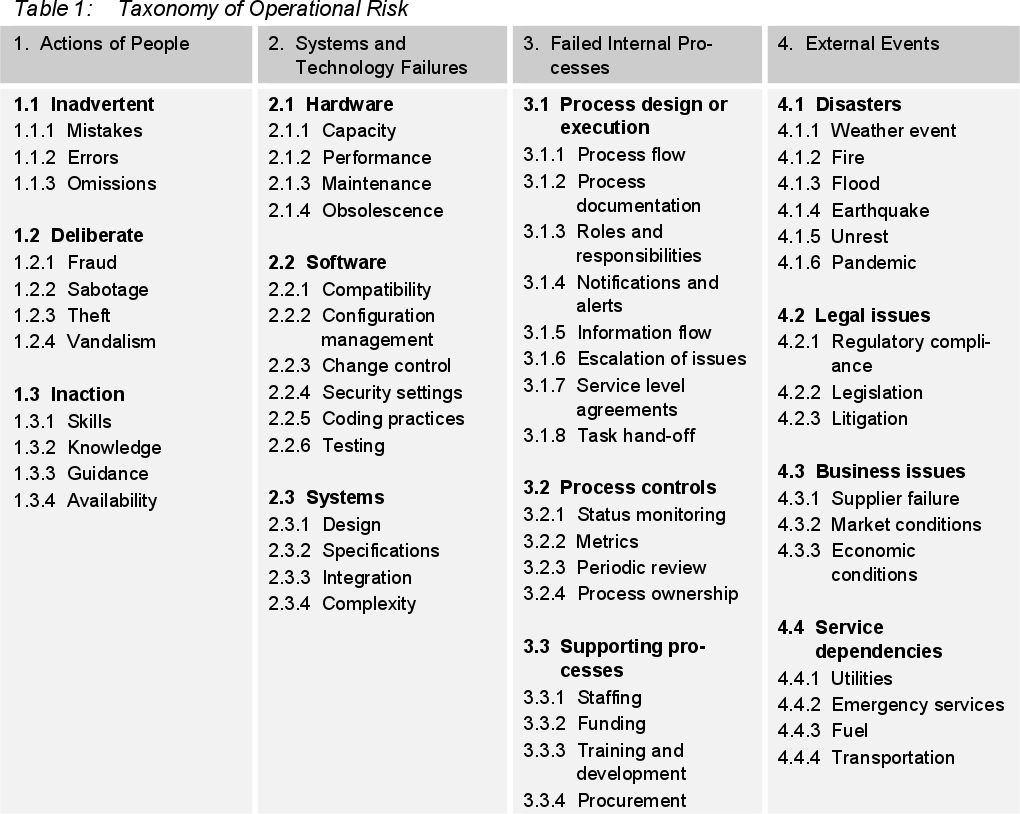
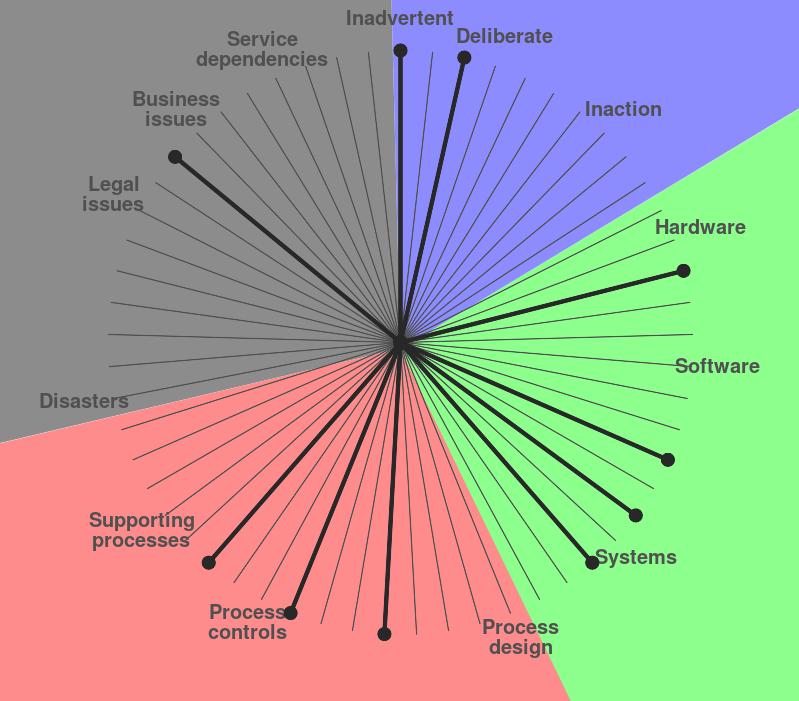
Dear lazyweb, I am trying to get a good way to present the categorization of several cases studied with a fitting graph. I am rating several vulnerabilities / failures according to James Cebula et. al.'s paper, A taxonomy of Operational Cyber Security Risks; this is a somewhat deep taxonomy, with 57 end items, but organized in a three levels deep hierarchy. Copying a table from the cited paper (click to display it full-sized): My categorization is binary: I care only whether it falls within a given category or not. My first stab at this was to represent each case using a star or radar graph. As an example: As you can see, to a "bare" star graph, I added a background color for each top-level category (blue for actions of people, green for systems and technology failures), red for failed internal processes and gray for external events), and printed out only the labels for the second level categories; for an accurate reading of the graphs, you have to refer to the table and count bars. And, yes, according to the Engineering Statistics Handbook:
Star plots are helpful for small-to-moderate-sized multivariate data sets. Their primary weakness is that their effectiveness is limited to data sets with less than a few hundred points. After that, they tend to be overwhelming.
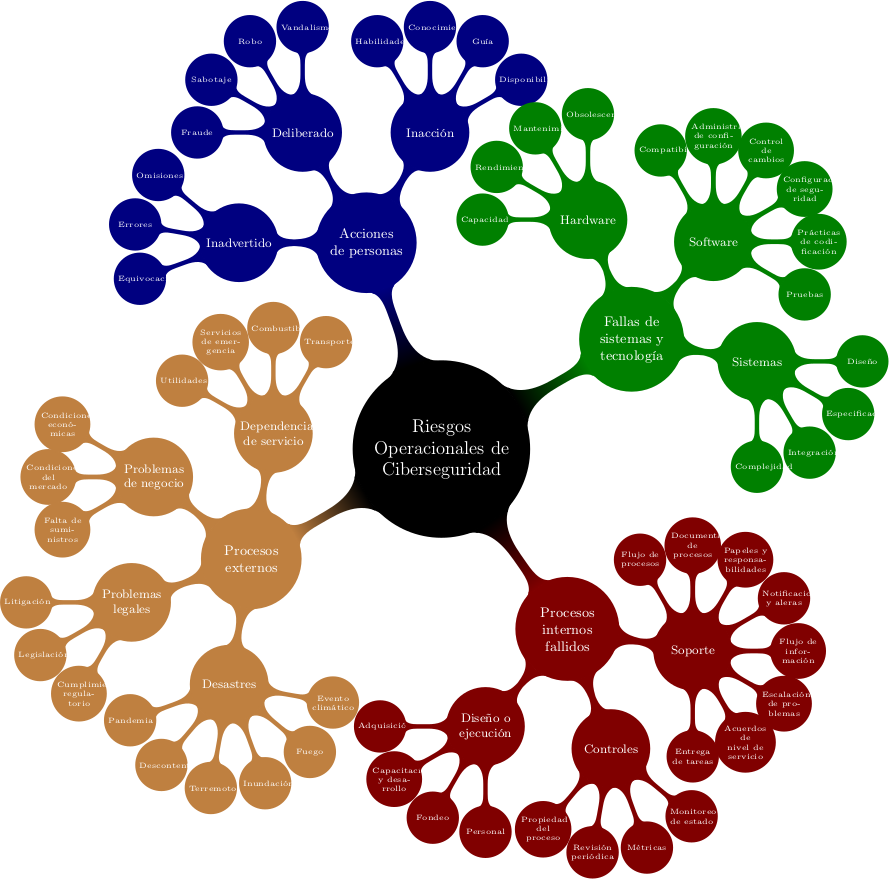
I strongly agree with the above statement And stating that "a few hundred points" can be understood is even an overstatement. 50 points are just too much. Now, trying to increase usability for this graph, I came across the Sunburst diagram. One of the proponents for this diagram, John Stasko, has written quite a bit about it. Now... How to create my beautiful Sunburst diagram? That's a tougher one. Even though the page I linked to in the (great!) Data visualization catalogue presents even some free-as-in-software tools to do this... They are Javascript projects that will render their beautiful plots (even including an animation)... To the browser. I need them for a static (i.e. to be printed) document. Yes, I can screenshot and all, but I want them to be automatically generated, so I can review and regenerate them all automatically. Oh, I could just write JSON and use SaaS sites such as Aculocity to do the heavy-lifting, but if you know me, you will understand why I don't want to. So... I set out to find a Gunnar-approved way to display the information I need. Now, as the Protovis documentation says, an icicle is simply a sunburst transformed from polar to cartesian coordinates... But I came to a similar conclusion: The tools I found are not what I need. OK, but an icicle graph seems much simpler to produce I fired up my Emacs, and started writing using Ruby, RMagick and RVG... I decided to try a different way. This is my result so far: So... What do you think? Does this look right to you? Clearer than the previous one? Worst? Do you have any idea on how I could make this better? Oh... You want to tell me there is something odd about it? Well, yes, of course! I still need to tweak it quite a bit. Would you believe me if I told you this is not really a left-to-right icicle graph, but rather a strangely formatted Graphviz non-directed graph using the dot formatter? I can assure you you don't want to look at my Graphviz sources... But in case you insist... Take them and laugh. Or cry. Of course, this file comes from a hand-crafted template, but has some autogenerated bits to it. I have still to tweak it quite a bit to correct several of its usability shortcomings, but at least it looks somewhat like what I want to achieve. Anyway, I started out by making a "dear lazyweb" question. So, here it goes: Do you think I'm using the right visualization for my data? Do you have any better suggestions, either of a graph or of a graph-generating tool? Thanks! [update] Thanks for the first pointer, Lazyweb! I found a beautiful solution; we will see if it is what I need or not (it is too space-greedy to be readable... But I will check it out more thoroughly). It lays out much better than anything I can spew out by myself Writing it as a mindmap using TikZ directly from within LaTeX, I get the following result:

19 March 2017

Dirk Eddelbuettel: Rcpp 0.12.10: Some small fixes

The tenth update in the 0.12.* series of Rcpp just made it to the main CRAN repository providing GNU R with by now over 10,000 packages. Windows binaries for Rcpp, as well as updated Debian packages will follow in due course. This 0.12.10 release follows the 0.12.0 release from late July, the 0.12.1 release in September, the 0.12.2 release in November, the 0.12.3 release in January, the 0.12.4 release in March, the 0.12.5 release in May, the 0.12.6 release in July, the 0.12.7 release in September, the 0.12.8 release in November, and the 0.12.9 release in January --- making it the fourteenth release at the steady and predictable bi-montly release frequency. Rcpp has become the most popular way of enhancing GNU R with C or C++ code. As of today, 975 packages on CRAN depend on Rcpp for making analytical code go faster and further. That is up by sixtynine packages over the two months since the last release -- or just over a package a day! The changes in this release are almost exclusively minor bugfixes and enhancements to documentation and features: James "coatless" Balamuta rounded out the API, I aki Ucar fixed a bug concerning one-character output, Jeroen Ooms allowed for finalizers on XPtr objects, Nathan Russell corrected handling of lower (upper) triangular matrices, Dan Dillon and I dealt with Intel compiler quirks for his algorithm.h header, and I added a C++17 plugin along with some (overdue!) documentation regarding the various C++ standards that are supported by Rcpp (which is in essence whatever your compiler supports, i.e., C++98, C++11, C++14 all the way to C++17 but always keep in mind what CRAN and different users may deploy).

Changes in Rcpp version 0.12.10 (2017-03-17)
  • Changes in Rcpp API:
    • Added new size attribute aliases for number of rows and columns in DataFrame (James Balamuta in #638 addressing #630).
    • Fixed single-character handling in Rstreambuf (I aki Ucar in #649 addressing #647).
    • XPtr gains a parameter finalizeOnExit to enable running the finalizer when R quits (Jeroen Ooms in #656 addressing #655).
  • Changes in Rcpp Sugar:
    • Fixed sugar functions upper_tri() and lower_tri() (Nathan Russell in #642 addressing #641).
    • The algorithm.h file now accomodates the Intel compiler (Dirk in #643 and Dan in #645 addressing issue #640).
  • Changes in Rcpp Attributes
    • The C++17 standard is supported with a new plugin (used eg for g++-6.2).
  • Changes in Rcpp Documentation:
    • An overdue explanation of how C++11, C++14, and C++17 can be used was added to the Rcpp FAQ.

Thanks to CRANberries, you can also look at a diff to the previous release. As always, even fuller details are on the Rcpp Changelog page and the Rcpp page which also leads to the downloads page, the browseable doxygen docs and zip files of doxygen output for the standard formats. A local directory has source and documentation too. Questions, comments etc should go to the rcpp-devel mailing list off the R-Forge page.

This post by Dirk Eddelbuettel originated on his Thinking inside the box blog. Please report excessive re-aggregation in third-party for-profit settings.

Petter Reinholdtsen: Free software archive system Nikita now able to store documents

The Nikita Noark 5 core project is implementing the Norwegian standard for keeping an electronic archive of government documents. The Noark 5 standard document the requirement for data systems used by the archives in the Norwegian government, and the Noark 5 web interface specification document a REST web service for storing, searching and retrieving documents and metadata in such archive. I've been involved in the project since a few weeks before Christmas, when the Norwegian Unix User Group announced it supported the project. I believe this is an important project, and hope it can make it possible for the government archives in the future to use free software to keep the archives we citizens depend on. But as I do not hold such archive myself, personally my first use case is to store and analyse public mail journal metadata published from the government. I find it useful to have a clear use case in mind when developing, to make sure the system scratches one of my itches. If you would like to help make sure there is a free software alternatives for the archives, please join our IRC channel (#nikita on irc.freenode.net) and the project mailing list. When I got involved, the web service could store metadata about documents. But a few weeks ago, a new milestone was reached when it became possible to store full text documents too. Yesterday, I completed an implementation of a command line tool archive-pdf to upload a PDF file to the archive using this API. The tool is very simple at the moment, and find existing fonds, series and files while asking the user to select which one to use if more than one exist. Once a file is identified, the PDF is associated with the file and uploaded, using the title extracted from the PDF itself. The process is fairly similar to visiting the archive, opening a cabinet, locating a file and storing a piece of paper in the archive. Here is a test run directly after populating the database with test data using our API tester:
~/src//noark5-tester$ ./archive-pdf mangelmelding/mangler.pdf
using arkiv: Title of the test fonds created 2017-03-18T23:49:32.103446
using arkivdel: Title of the test series created 2017-03-18T23:49:32.103446
 0 - Title of the test case file created 2017-03-18T23:49:32.103446
 1 - Title of the test file created 2017-03-18T23:49:32.103446
Select which mappe you want (or search term): 0
Uploading mangelmelding/mangler.pdf
  PDF title: Mangler i spesifikasjonsdokumentet for NOARK 5 Tjenestegrensesnitt
  File 2017/1: Title of the test case file created 2017-03-18T23:49:32.103446
~/src//noark5-tester$
You can see here how the fonds (arkiv) and serie (arkivdel) only had one option, while the user need to choose which file (mappe) to use among the two created by the API tester. The archive-pdf tool can be found in the git repository for the API tester. In the project, I have been mostly working on the API tester so far, while getting to know the code base. The API tester currently use the HATEOAS links to traverse the entire exposed service API and verify that the exposed operations and objects match the specification, as well as trying to create objects holding metadata and uploading a simple XML file to store. The tester has proved very useful for finding flaws in our implementation, as well as flaws in the reference site and the specification. The test document I uploaded is a summary of all the specification defects we have collected so far while implementing the web service. There are several unclear and conflicting parts of the specification, and we have started writing down the questions we get from implementing it. We use a format inspired by how The Austin Group collect defect reports for the POSIX standard with their instructions for the MANTIS defect tracker system, in lack of an official way to structure defect reports for Noark 5 (our first submitted defect report was a request for a procedure for submitting defect reports :). The Nikita project is implemented using Java and Spring, and is fairly easy to get up and running using Docker containers for those that want to test the current code base. The API tester is implemented in Python.

14 March 2017

John Goerzen: Parsing the GOP s Health Insurance Statistics

There has been a lot of noise lately about the GOP health care plan (AHCA) and the differences to the current plan (ACA or Obamacare). A lot of statistics are being misinterpreted. The New York Times has an excellent analysis of some of this. But to pick it apart, I want to highlight a few things: Many Republicans are touting the CBO s estimate that, some years out, premiums will be 10% lower under their plan than under the ACA. However, this carries with it a lot of misleading information. First of all, many are spinning this as if costs would go down. That s not the case. The premiums would still rise they would just have risen less by the end of the period than under ACA. That also ignores the immediate spike and throwing millions out of the insurance marketplace altogether. Now then, where does this 10% number come from? First of all, you have to understand the older people are substantially more expensive to the health system, and therefore more expensive to insure. ACA limited the price differential from the youngest to the oldest people, which meant that in effect some young people were subsidizing older ones on the individual market. The GOP plan removes that limit. Combined with other changes in subsidies and tax credits, this dramatically increases the cost to older people. For instance, the New York Times article cites a CBO estimate that the price an average 64-year-old earning $26,500 would need to pay after using a subsidy would increase from $1,700 under Obamacare to $14,600 under the Republican plan. They further conclude that these exceptionally high rates would be so unaffordable to older people that the older people will simply stop buying insurance on the individual market. This means that the overall risk pool of people in that market is healthier, and therefore the average price is lower. So, to sum up: the reason that insurance premiums under the GOP plan will rise at a slightly slower rate long-term is that the higher-risk people will be unable to afford insurance in the first place, leaving only the cheaper people to buy in.

11 March 2017

John Goerzen: Silent Data Corruption Is Real

Here s something you never want to see:
ZFS has detected a checksum error:
   eid: 138
 class: checksum
  host: alexandria
  time: 2017-01-29 18:08:10-0600
 vtype: disk
This means there was a data error on the drive. But it s worse than a typical data error this is an error that was not detected by the hardware. Unlike most filesystems, ZFS and btrfs write a checksum with every block of data (both data and metadata) written to the drive, and the checksum is verified at read time. Most filesystems don t do this, because theoretically the hardware should detect all errors. But in practice, it doesn t always, which can lead to silent data corruption. That s why I use ZFS wherever I possibly can. As I looked into this issue, I saw that ZFS repaired about 400KB of data. I thought, well, that was unlucky and just ignored it. Then a week later, it happened again. Pretty soon, I noticed it happened every Sunday, and always to the same drive in my pool. It so happens that the highest I/O load on the machine happens on Sundays, because I have a cron job that runs zpool scrub on Sundays. This operation forces ZFS to read and verify the checksums on every block of data on the drive, and is a nice way to guard against unreadable sectors in rarely-used data. I finally swapped out the drive, but to my frustration, the new drive now exhibited the same issue. The SATA protocol does include a CRC32 checksum, so it seemed (to me, at least) that the problem was unlikely to be a cable or chassis issue. I suspected motherboard. It so happened I had a 9211-8i SAS card. I had purchased it off eBay awhile back when I built the server, but could never get it to see the drives. I wound up not filling it up with as many drives as planned, so the on-board SATA did the trick. Until now. As I poked at the 9211-8i, noticing that even its configuration utility didn t see any devices, I finally started wondering if the SAS/SATA breakout cables were a problem. And sure enough I realized I had a reverse cable and needed a forward one. $14 later, I had the correct cable and things are working properly now. One other note: RAM errors can sometimes cause issues like this, but this system uses ECC DRAM and the errors would be unlikely to always manifest themselves on a particular drive. So over the course of this, had I not been using ZFS, I would have had several megabytes of reads with undetected errors. Thanks to using ZFS, I know my data integrity is still good.

2 March 2017

Antoine Beaupr : A short history of password hashers

These are notes from my research that led to the publication of the password hashers article. This article is more technical than the previous ones and compares the various cryptographic primitives and algorithms used in the various software I have reviewed. The criteria for inclusion on this list is fairly vague: I mostly included a password hasher if it was significantly different from the previous implementations in some way, and I have included all the major ones I could find as well.

The first password hashers Nic Wolff claims to be the first to have written such a program, all the way back in 2003. Back then the hashing algorithm was MD5, although Wolff has now updated the algorithm to use SHA-1 and still maintains his webpage for public use. Another ancient but unrelated implementation, is the Standford University Applied Cryptography's pwdhash software. That implementation was published in 2004 and unfortunately, that implementation was not updated and still uses MD5 as an hashing algorithm, but at least it uses HMAC to generate tokens, which makes the use of rainbow tables impractical. Those implementations are the simplest password hashers: the inputs are simply the site URL and a password. So the algorithms are, basically, for Wolff's:
token = base64(SHA1(password + domain))
And for Standford's PwdHash:
token = base64(HMAC(MD5, password, domain)))

SuperGenPass Another unrelated implementation that is still around is supergenpass is a bookmarklet that was created around 2007, originally using MD5 as well but now supports SHA512 now although still limited to 24 characters like MD5 (which needlessly limits the entropy of the resulting password) and still defaults MD5 with not enough rounds (10, when key derivation recommendations are more generally around 10 000, so that it's slower to bruteforce). Note that Chris Zarate, the supergenpass author, actually credits Nic Wolff as the inspiration for his implementation. Supergenpass is still in active development and is available for the browser (as a bookmarklet) or mobile (as an webpage). Supergenpass allows you to modify the password length, but also add an extra profile secret which adds to the password and generates a personalized identicon presumably to prevent phishing but it also introduces the interesting protection, the profile-specific secret only found later in Password Hasher Plus. So the Supergenpass algorithm looks something like this:
token = base64(SHA512(password + profileSecret + ":" + domain, rounds))

The Wijjo Password Hasher Another popular implementation is the Wijjo Password Hasher, created around 2006. It was probably the first shipped as a browser extension which greatly improved the security of the product as users didn't have to continually download the software on the fly. Wijjo's algorithm also improved on the above algorithms, as it uses HMAC-SHA1 instead of plain SHA-1 or HMAC-MD5, which makes it harder to recover the plaintext. Password Hasher allows you to set different password policies (use digits, punctuation, mixed case, special characters and password length) and saves the site names it uses for future reference. It also happens that the Wijjo Password Hasher, in turn, took its inspiration on different project, hashapass.com, created in 2006 and also based on HMAC-SHA-1. Indeed, hashapass "can easily be generated on almost any modern Unix-like system using the following command line pattern":
echo -n parameter \
  openssl dgst -sha1 -binary -hmac password \
  openssl enc -base64 \
  cut -c 1-8
So the algorithm here is obviously:
token = base64(HMAC(SHA1, password, domain + ":" + counter)))[:8]
... although in the case of Password Hasher, there is a special routine that takes the token and inserts random characters in locations determined by the sum of the values of the characters in the token.

Password Hasher Plus Years later, in 2010, Eric Woodruff ported the Wijjo Password Hasher to Chrome and called it Password Hasher Plus. Like the original Password Hasher, the "plus" version also keeps those settings in the extension and uses HMAC-SHA-1 to generate the password, as it is designed to be backwards-compatible with the Wijjo Password Hasher. Woodruff did add one interesting feature: a profile-specific secret key that gets mixed in to create the security token, like what SuperGenPass does now. Stealing the master password is therefore not enough to generate tokens anymore. This solves one security concern with Password Hasher: an hostile page could watch your keystrokes and steal your master password and use it to derive passwords on other sites. Having a profile-specific secret key, not accessible to the site's Javascript works around that issue, but typing the master password directly in the password field, while convenient, is just a bad idea, period. The final algorithm looks something like:
token = base64(HMAC(SHA1, password, base64(HMAC(SHA1, profileSecret, domain + ":" + counter))))
Honestly, that seems rather strange, but it's what I read from the source code, which is available only after decompressing the extension nowadays. I would have expected the simplest version:
token = base64(HMAC(SHA1, HMAC(SHA1, profileSecret, password), domain + ":" + counter))
The idea here would be "hide" the master password from bruteforce attacks as soon as possible... But maybe this is all equivalent. Regardless, Password Hasher Plus then takes the token and applies the same special character insertion routine as the Password Hasher.

LessPass Last year, Guillaume Vincent a french self-described "humanist and scuba diving fan" released the lesspass extension for Chrome, Firefox and Android. Lesspass introduces several interesting features. It is probably the first to include a commandline version. It also uses a more robust key derivation algorithm (PBKDF2) and takes into account the username on the site, allowing multi account support. The original release (version 1) used only 8192 rounds which is now considered too low. In the bug report it was interesting to note that LessPass couldn't do the usual practice of running the key derivation for 1 second to determine the number of rounds needed as the results need to be deterministic. At first glance, the LessPass source code seems clear and easy to read which is always a good sign, but of course, the devil is in the details. One key feature that is missing from Password Hasher Plus is the profile-specific seed, although it should be impossible, for a hostile web page to steal keystrokes from a browser extension, as far as I know. The algorithm then gets a little more interesting:
entropy = PBKDF2(SHA256, masterPassword, domain + username + counter, rounds, length)
where
    rounds=10000
    length=32
entropy is then used to pick characters to match the chosen profile. Regarding code readability, I got quickly confused by the PBKDF2 implementation: SubtleCrypto.ImportKey() doesn't seem to support PBKDF2 in the API, yet it's how it is used there... Is it just something to extract key material? We see later what looks like a more standard AES-based PBKDF2 implementation, but this code looks just strange to me. It could be me unfamilarity with newer Javascript coding patterns, however. There is also a lesspass-specific character picking routing that is also not base64, and different from the original Password Hasher algorithm.

Master Password A review of password hashers would hardly be complete without mentioning the Master Password and its elaborate algorithm. While the applications surrounding the project are not as refined (there is no web browser plugin and the web interface can't be easily turned into a bookmarklet), the algorithm has been well developed. Of all the password managers reviewed here, Master Password uses one of the strongest key derivation algorithms out there, scrypt:
key = scrypt( password, salt, cost, size, parallelization, length )
where
salt = "com.lyndir.masterpassword" + len(username) + name
cost = 32768
size = 8
parallelization = 2
length = 64
entropy = hmac-sha256(key, "com.lyndir.masterpassword" + len(domain) + domain + counter )
Master Password the uses one of 6 sets of "templates" specially crafted to be "easy for a user to read from a screen and type using a keyboard or smartphone" and "compatible with most site's password policies", our "transferable" criteria defined in the first passwords article. For example, the default template mixes vowels, consonants, numbers and symbols, but carefully avoiding possibly visibly similar characters like O and 0 or i and 1 (although it does mix 1 and l, oddly enough). The main strength of Master Password seems to be the clear definition of its algorithm (although Hashpass.com does give out OpenSSL commandline examples...), which led to its reuse in another application called freepass. The Master Password app also doubles as a stateful password manager...

Other implementations I have also considered including easypasswords, which uses PBKDF2-HMAC-SHA1, in my list of recommendations. I discovered only recently that the author wrote a detailed review of many more password hashers and scores them according to their relative strength. In the end, I ended up covering more LessPass since the design is very similar and LessPass does seem a bit more usable. Covering LessPass also allowed me to show the contrast and issues regarding the algorithm changes, for example. It is also interesting to note that the EasyPasswords author has criticized the Master Password algorithm quite severely:
[...] scrypt isn t being applied correctly. The initial scrypt hash calculation only depends on the username and master password. The resulting key is combined with the site name via SHA-256 hashing then. This means that a website only needs to break the SHA-256 hashing and deduce the intermediate key as long as the username doesn t change this key can be used to generate passwords for other websites. This makes breaking scrypt unnecessary[...]
During a discussion with the Master Password author, he outlined that "there is nothing "easy" about brute-force deriving a 64-byte key through a SHA-256 algorithm." SHA-256 is used in the last stage because it is "extremely fast". scrypt is used as a key derivation algorithm to generate a large secret and is "intentionnally slow": "we don't want it to be easy to reverse the master password from a site password". "But it' unnecessary for the second phase because the input to the second phase is so large. A master password is tiny, there are only a few thousand or million possibilities to try. A master key is 8^64, the search space is huge. Reversing that doesn't need to be made slower. And it's nice for the password generation to be fast after the key has been prepared in-memory so we can display site passwords easily on a mobile app instead of having to lock the UI a few seconds for every password." Finally, I considered covering Blum's Mental Hash (also covered here and elsewhere). This consists of an algorithm that can basically be ran by the human brain directly. It's not for the faint of heart, however: if I understand it correctly, it will require remembering a password that is basically a string of 26 digits, plus compute modulo arithmetics on the outputs. Needless to say, most people don't do modulo arithmetics every day...

28 February 2017

Chris Lamb: Free software activities in February 2017

Here is my monthly update covering what I have been doing in the free software world (previous month):
Reproducible builds

Whilst anyone can inspect the source code of free software for malicious flaws, most software is distributed pre-compiled to end users. The motivation behind the Reproducible Builds effort is to permit verification that no flaws have been introduced either maliciously or accidentally during this compilation process by promising identical results are always generated from a given source, thus allowing multiple third-parties to come to a consensus on whether a build was compromised. (I have been awarded a grant from the Core Infrastructure Initiative to fund my work in this area.) This month I:
I also made the following changes to our tooling:
diffoscope

diffoscope is our in-depth and content-aware diff utility that can locate and diagnose reproducibility issues.

  • New features:
    • Add a machine-readable JSON output format. (Closes: #850791).
    • Add an --exclude option. (Closes: #854783).
    • Show results from debugging packages last. (Closes: #820427).
    • Extract archive members using an auto-incrementing integer avoiding the need to sanitise filenames. (Closes: #854723).
    • Apply --max-report-size to --text output. (Closes: #851147).
    • Specify <html lang="en"> in the HTML output. (re. #849411).
  • Bug fixes:
    • Fix errors when comparing directories with non-directories. (Closes: #835641).
    • Device and RPM fallback comparisons require xxd. (Closes: #854593).
    • Fix tests that call xxd on Debian Jessie due to change of output format. (Closes: #855239).
    • Add missing Recommends for comparators. (Closes: #854655).
    • Importing submodules (ie. parent.child) will attempt to import parent. (Closes: #854670).
    • Correct logic of module_exists ensuring we correctly skip the debian.deb822 tests when python3-debian is not installed. (Closes: #854745).
    • Clean all temporary files in the signal handler thread instead of attempting to pass the exception back to the main thread. (Closes: #852013).
    • Fix behaviour of setting report maximums to zero (ie. no limit).
  • Optimisations:
    • Don't uselessly run xxd(1) on non-directories.
    • No need to track libarchive directory locations.
    • Optimise create_limited_print_func.
  • Tests:
    • When comparing two empty directories, ensure that the mtime of the directory is consistent to avoid non-deterministic failures.
    • Ensure we can at least import the "deb_fallback" and "rpm_fallback" modules.
    • Add test for symlink differing in destination.
    • Add tests for --progress, --status-fd and profiling output options as well as the Deb Changes,Buildinfo,Dsc and RPM fallback comparisons.
    • Add get_data and @skip_unless_module_exists test helpers.
    • Mark impossible-to-reach code to improve test coverage.

buildinfo.debian.net

buildinfo.debian.net is my experiment into how to process, store and distribute .buildinfo files after the Debian archive software has processed them.

  • Drop raw_text fields now as we've moved these to Amazon S3.
  • Drop storage of Installed-Build-Depends and subsequently-orphaned Binary package instances to recover diskspace.

strip-nondeterminism

strip-nondeterminism is our tool to remove specific non-deterministic results from a completed build.

  • Print log entry when fixing a file. (Closes: #777239).
  • Run our entire testsuite in autopkgtests, not just the first test. (Closes: #852517).
  • Don't test for stat(2)'s blksize and block attributes. (Closes: #854937).
  • Use error() from Dh_Lib.pm over "manual" die().


Debian
Debian LTS

This month I have been paid to work 13 hours on Debian Long Term Support (LTS). In that time I did the following:
  • "Frontdesk" duties, triaging CVEs, etc.
  • Issued DLA 817-1 for libphp-phpmailer, correcting a local file disclosure vulnerability where insufficient parsing of HTML messages could potentially be used by attacker to read a local file.
  • Issued DLA 826-1 for wireshark which fixes a denial of service vulnerability in wireshark, where a malformed NATO Ground Moving Target Indicator Format ("STANAG 4607") capture file could cause a memory exhausion/infinite loop.

Uploads
  • python-django (1:1.11~beta1-1) New upstream beta release.
  • redis (3:3.2.8-1) New upstream release.
  • gunicorn (19.6.0-11) Use $ misc:Pre-Depends to populate Pre-Depends for dpkg-maintscript-helper.
  • dh-virtualenv (1.0-1~bpo8+1) Upload to jessie-backports.

I sponsored the following uploads: I also performed the following QA uploads:
  • dh-kpatches (0.99.36+nmu4) Make kernel kernel builds reproducible.
Finally, I made the following non-maintainer uploads:
  • cpio (2.12+dfsg-3) Remove rmt.8.gz to prevent a piuparts error.
  • dot-forward (1:0.71-2.2) Correct a FTBFS; we don't install anything to /usr/sbin, so use GNU Make's $(wildcard ..) over the shell's own * expansion.


FTP Team

As a Debian FTP assistant I ACCEPTed 116 packages: autobahn-cpp, automat, bglibs, bitlbee, bmusb, bullet, case, certspotter, checkit-tiff, dash-el, dash-functional-el, debian-reference, el-x, elisp-bug-hunter, emacs-git-messenger, emacs-which-key, examl, genwqe-user, giac, golang-github-cloudflare-cfssl, golang-github-docker-goamz, golang-github-docker-libnetwork, golang-github-go-openapi-spec, golang-github-google-certificate-transparency, golang-github-karlseguin-ccache, golang-github-karlseguin-expect, golang-github-nebulouslabs-bolt, gpiozero, gsequencer, jel, libconfig-mvp-slicer-perl, libcrush, libdist-zilla-config-slicer-perl, libdist-zilla-role-pluginbundle-pluginremover-perl, libevent, libfunction-parameters-perl, libopenshot, libpod-weaver-section-generatesection-perl, libpodofo, libprelude, libprotocol-http2-perl, libscout, libsmali-1-java, libtest-abortable-perl, linux, linux-grsec, linux-signed, lockdown, lrslib, lua-curses, lua-torch-cutorch, mariadb-10.1, mini-buildd, mkchromecast, mocker-el, node-arr-exclude, node-brorand, node-buffer-xor, node-caller, node-duplexer3, node-ieee754, node-is-finite, node-lowercase-keys, node-minimalistic-assert, node-os-browserify, node-p-finally, node-parse-ms, node-plur, node-prepend-http, node-safe-buffer, node-text-table, node-time-zone, node-tty-browserify, node-widest-line, npd6, openoverlayrouter, pandoc-citeproc-preamble, pydenticon, pyicloud, pyroute2, pytest-qt, pytest-xvfb, python-biomaj3, python-canonicaljson, python-cgcloud, python-gffutils, python-h5netcdf, python-imageio, python-kaptan, python-libtmux, python-pybedtools, python-pyflow, python-scrapy, python-scrapy-djangoitem, python-signedjson, python-unpaddedbase64, python-xarray, qcumber, r-cran-urltools, radiant, repo, rmlint, ruby-googleauth, ruby-os, shutilwhich, sia, six, slimit, sphinx-celery, subuser, swarmkit, tmuxp, tpm2-tools, vine, wala & x265. I additionally filed 8 RC bugs against packages that had incomplete debian/copyright files against: checkit-tiff, dash-el, dash-functional-el, libcrush, libopenshot, mkchromecast, pytest-qt & x265.

21 February 2017

Reproducible builds folks: Reproducible Builds: week 95 in Stretch cycle

Here's what happened in the Reproducible Builds effort between Sunday February 12 and Saturday February 18 2017: Upcoming Events The Reproducible Build Zoo will be presented by Vagrant Cascadian at the Embedded Linux Conference in Portland, Oregon, February 22nd. Introduction to Reproducible Builds will be presented by Vagrant Cascadian at Scale15x in Pasadena, California, March 5th. Toolchain development and fixes Ximin Luo posted a preliminary spec for BUILD_PATH_PREFIX_MAP, bringing together work and research from previous weeks. Ximin refactored and consolidated much of our existing documentation on both SOURCE_DATE_EPOCH and BUILD_PATH_PREFIX_MAP into one unified page, Standard Environment Variables, with extended discussion on related solutions and how these all fit into people's ideas of what reproducible builds should look like in the long term. The specific pages for each variable still remain, at Timestamps Proposal and Build Path Proposal, only without content that was previously duplicated on both pages. Ximin filed #855282 against devscripts for debsign(1) to support buildinfo files, and wrote an initial series of patches for it with some further additions from Guillem Jover. Packages reviewed and fixed, and bugs filed Chris Lamb: Reviews of unreproducible packages 35 package reviews have been added, 1 have been updated and 17 have been removed in this week, adding to our knowledge about identified issues. 1 issue type has been added: Weekly QA work During our reproducibility testing, the following FTBFS bugs have been detected and reported by: diffoscope development diffoscope 77 was uploaded to unstable by Mattia Rizzolo. It included contributions from: strip-nondeterminism development strip-nondeterminism 0.031-1 was uploaded to unstable by Chris Lamb. It included contributions from: strip-nondeterminism 0.031-1~bpo8+1 was uploaded to jessie-backports by Mattia. tests.reproducible-builds.org Misc. This week's edition was written by Ximin Luo & reviewed by a bunch of Reproducible Builds folks on IRC & the mailing lists.

17 February 2017

Ingo Juergensmann: Migrating from Owncloud 7 on Debian to Nextcloud 11

These days I got a mail by my hosting provider stating that my Owncloud instance is unsecure, because the online scan from scan.nextcloud.com mailed them. However the scan seemed quite bogus: it reported some issues that were listed as already solved in Debians changelog file. But unfortunately the last entry in changelog was on January 5th, 2016. So, there has been more than a whole year without security updates for Owncloud in Debian stable. In an discussion with the Nextcloud team I complained a little bit that the scan/check is not appropriate. The Nextcloud team replied very helpful with additional information, such as two bug reports in Debian to clarify that the Owncloud package will most likely be removed in the next release: #816376 and #822681. So, as there is no nextcloud package in Debian unstable as of now, there was no other way to manually upgrade & migrate to Nextcloud. This went fairly well:
ownCloud 7 -> ownCloud 8.0 -> ownCloud 8.1 -> ownCloud 8.2 -> ownCloud 9.0 -> ownCloud 9.1 -> Nextcloud 10 -> Nextcloud 11
There were some smaller caveats:
  1. When migrating from OC 9.0 to OC 9.1 you need to migrate your addressbooks and calendars as described in the OC 9.0 Release Notes
  2. When migrating from OC 9.1 to Nextcloud 10, the OC 9.1 is higher than expected by the Mextcloud upgrade script, so it warns about that you can't downgrade your installation. The fix was simply to change the OC version in the config.php
  3. The Documents App of OC 7 is no longer available in Nextcloud 11 and is replaced by Collabora App, which is way more complex to setup
The installation and setup of the Docker image for collabora/code was the main issue, because I wanted to be able to edit documents in my cloud. For some reason Nextcloud couldn't connect to my docker installation. After some web searches I found "Can't connect to Collabora Online" which led me to the next entry in the Nextcloud support forum. But in the end it was this posting that finally made it work for me. So, in short I needed to add...
DOCKER_OPTS="--storage-driver=devicemapper"
to /etc/default/docker. So, in the end everything worked out well and my cloud instance is secure again. :-) UPDATE 2016-02-18 10:52:
Sadly with that working Collabora Online container from Docker I now face this issue of zombie processes for loolforkit inside of that container.
Kategorie:

Dirk Eddelbuettel: littler 0.3.2

max-heap image The third release of littler as a CRAN package is now available, following in the now more than ten-year history as a package started by Jeff in the summer of 2006, and joined by me a few weeks later. littler is the first command-line interface for R and predates Rscript. It is still faster, and in my very biased eyes better as it allows for piping as well shebang scripting via #!, uses command-line arguments more consistently and still starts faster. It prefers to live on Linux and Unix, has its difficulties on OS X due to yet-another-braindeadedness there (who ever thought case-insensitive filesystems where a good idea?) and simply does not exist on Windows (yet -- the build system could be extended -- see RInside for an existence proof, and volunteers welcome!). This release brings several new examples script to run package checks, use the extraordinary R Hub, download RStudio daily builds, and more -- see below for details. No internals were changed. The NEWS file entry is below.

Changes in littler version 0.3.2 (2017-02-14)
  • Changes in examples
    • New scripts getRStudioServer.r and getRStudioDesktop.r to download daily packages, currently defaults to Ubuntu amd64
    • New script c4c.r calling rhub::check_for_cran()
    • New script rd2md.r to convert Rd to markdown.
    • New script build.r to create a source tarball.
    • The installGitHub.r script now use package remotes (PR #44, #46)

Courtesy of CRANberries, there is a comparison to the previous release. Full details for the littler release are provided as usual at the ChangeLog page. The code is available via the GitHub repo, from tarballs off my littler page and the local directory here -- and now of course all from its CRAN page and via install.packages("littler"). Binary packages are available directly in Debian as well as soon via Ubuntu binaries at CRAN thanks to the tireless Michael Rutter. Comments and suggestions are welcome at the GitHub repo.

This post by Dirk Eddelbuettel originated on his Thinking inside the box blog. Please report excessive re-aggregation in third-party for-profit settings.

11 February 2017

Reproducible builds folks: Reproducible Builds: week 93 in Stretch cycle

Here's what happened in the Reproducible Builds effort between Sunday January 29 and Saturday February 4 2017: Media coverage Dennis Gilmore and Holger Levsen presented "Reproducible Builds and Fedora" (Video, Slides) at Devconf.cz on February 27th 2017. On February 1st, stretch/armhf reached 90% reproducible packages in our test framework, so that now all four tested architectures are 90% reproducible in stretch. Yay! For armhf this means 22472 reproducible source packages (in main); for amd64, arm64 and i386 these figures are 23363, 23062 and 22607 respectively. Chris Lamb appeared on the Changelog podcast to talk about reproducible builds: Holger Levsen pitched Reproducible Builds and our need for a logo in the "Open Source Design" room at FOSDEM 2017 (Video, 09:36 - 12:00). Upcoming Events Reproducible work in other projects We learned that the "slightly more secure" Heads firmware (a Coreboot payload) is now reproducibly built regardless of host system or build directory. A picture says more than a thousand words: reproducible heads build on two machines Docker started preliminary work on making image builds reproducible. Toolchain development and fixes Ximin Luo continued to write code and test cases for the BUILD_PATH_PREFIX_MAP environment variable. He also did extensive research on cross-platform and cross-language issues with enviroment variables, filesystem paths, and character encodings, and started preparing a draft specification document to describe all of this. Chris Lamb asked CPython to implement an environment variable PYTHONREVERSEDICTKEYORDER to add an an option to reverse iteration order of items in a dict. However this was rejected because they are planning to formally fix this order in the next language version. Bernhard Wiedemann and Florian Festi added support for our SOURCE_DATE_EPOCH environment variable, to the RPM Package Manager. James McCoy uploaded devscripts 2.17.1 with a change from Guillem Jover for dscverify(1), adding support for .buildinfo files. (Closes: #852801) Piotr O arowski uploaded dh-python 2.20170125 with a change from Chris Lamb for a patch to fix #835805. Chris Lamb added documentation to diffoscope, strip-nondeterminism, disorderfs, reprotest and trydiffoscope about uploading signed tarballs when releasing. He also added a link to these on our website's tools page. Packages reviewed and bugs filed Bugs filed: Reviews of unreproducible packages 83 package reviews have been added, 86 have been updated and 276 have been removed in this week, adding to our knowledge about identified issues. 2 issue types have been updated: Weekly QA work During our reproducibility testing, the following FTBFS bugs have been detected and reported by: diffoscope development Work on the next version (71) continued in git this week: reproducible-website development Daniel Shahaf added more notes on our "How to chair a meeting" document. tests.reproducible-builds.org Holger unblacklisted pspp and tiledarray. If you think further packages should also be unblacklisted (possibly only on some architectures), please tell us. Misc. This week's edition was written by Ximin Luo, Holger Levsen and Chris Lamb & reviewed by a bunch of Reproducible Builds folks on IRC & the mailing lists.

8 February 2017

Alberto Garc a: QEMU and the qcow2 metadata checks

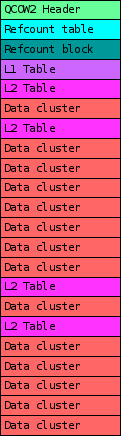
When choosing a disk image format for your virtual machine one of the factors to take into considerations is its I/O performance. In this post I ll talk a bit about the internals of qcow2 and about one of the aspects that can affect its performance under QEMU: its consistency checks. As you probably know, qcow2 is QEMU s native file format. The first thing that I d like to highlight is that this format is perfectly fine in most cases and its I/O performance is comparable to that of a raw file. When it isn t, chances are that this is due to an insufficiently large L2 cache. In one of my previous blog posts I wrote about the qcow2 L2 cache and how to tune it, so if your virtual disk is too slow, you should go there first. I also recommend Max Reitz and Kevin Wolf s qcow2: why (not)? talk from KVM Forum 2015, where they talk about a lot of internal details and show some performance tests. qcow2 clusters: data and metadata A qcow2 file is organized into units of constant size called clusters. The cluster size defaults to 64KB, but a different value can be set when creating a new image: qemu-img create -f qcow2 -o cluster_size=128K hd.qcow2 4G Clusters can contain either data or metadata. A qcow2 file grows dynamically and only allocates space when it is actually needed, so apart from the header there s no fixed location for any of the data and metadata clusters: they can appear mixed anywhere in the file. Here s an example of what it looks like internally:
In this example we can see the most important types of clusters that a qcow2 file can have: Metadata overlap checks In order to detect corruption when writing to qcow2 images QEMU (since v1.7) performs several sanity checks. They verify that QEMU does not try to overwrite sections of the file that are already being used for metadata. If this happens, the image is marked as corrupted and further access is prevented. Although in most cases these checks are innocuous, under certain scenarios they can have a negative impact on disk write performance. This depends a lot on the case, and I want to insist that in most scenarios it doesn t have any effect. When it does, the general rule is that you ll have more chances of noticing it if the storage backend is very fast or if the qcow2 image is very large. In these cases, and if I/O performance is critical for you, you might want to consider tweaking the images a bit or disabling some of these checks, so let s take a look at them. There are currently eight different checks. They re named after the metadata sections that they check, and can be divided into the following categories:
  1. Checks that run in constant time. These are equally fast for all kinds of images and I don t think they re worth disabling.
    • main-header
    • active-l1
    • refcount-table
    • snapshot-table
  2. Checks that run in variable time but don t need to read anything from disk.
    • refcount-block
    • active-l2
    • inactive-l1
  3. Checks that need to read data from disk. There is just one check here and it s only needed if there are internal snapshots.
    • inactive-l2
By default all tests are enabled except for the last one (inactive-l2), because it needs to read data from disk. Disabling the overlap checks Tests can be disabled or enabled from the command line using the following syntax: -drive file=hd.qcow2,overlap-check.inactive-l2=on
-drive file=hd.qcow2,overlap-check.snapshot-table=off It s also possible to select the group of checks that you want to enable using the following syntax: -drive file=hd.qcow2,overlap-check.template=none
-drive file=hd.qcow2,overlap-check.template=constant
-drive file=hd.qcow2,overlap-check.template=cached
-drive file=hd.qcow2,overlap-check.template=all Here, none means that no tests are enabled, constant enables all tests from group 1, cached enables all tests from groups 1 and 2, and all enables all of them. As I explained in the previous section, if you re worried about I/O performance then the checks that are probably worth evaluating are refcount-block, active-l2 and inactive-l1. I m not counting inactive-l2 because it s off by default. Let s look at the other three: Conclusion The qcow2 consistency checks are useful to detect data corruption, but they can affect write performance. If you re unsure and you want to check it quickly, open an image with overlap-check.template=none and see for yourself, but remember again that this will only affect write operations. To obtain more reliable results you should also open the image with cache=none in order to perform direct I/O and bypass the page cache. I ve seen performance increases of 50% and more, but whether you ll see them depends a lot on your setup. In many cases you won t notice any difference. I hope this post was useful to learn a bit more about the qcow2 format. There are other things that can help QEMU perform better, and I ll probably come back to them in future posts, so stay tuned! Acknowledgments My work in QEMU is sponsored by Outscale and has been made possible by Igalia and the help of the rest of the QEMU development team.

5 February 2017

Shirish Agarwal: Flights of fancy how to figure trends for Airline tickets.

Google Flights Fees tracking

Google Flights Fees tracking between PNQ and YUL and back, economy fares.

Couple of weeks ago, either on some mailing list, on IRC or somewhere else, somebody mentioned that people always put higher amount of airline expenditure for self when asking for sponsorship. Now last year, between sending the application and getting the approval for sponsorship, there was 3 months of difference between the two. Now if you put up an application for sponsorship like I did last year, I had added 10% to the cost of flight tickets of the cheapest prevailing prices at that point in time on skyscanner or any of the meta-search-engines were showing me at that point in time. I was sceptical whether the amount that I had put for the to and fro tickets would be enough or not. Strangely, I was lucky enough to get my ticket around the new estimated price. I would have to mention though that there were only 2 tickets left at the new price and if I had waited just a few hours more, those tickets would have gone too and all other tickets were around 25% more than before. The only reasons I could fathom are a. Luck, pure and simple. b. Going at the end of the tourism season This was evident as I was able to book my extended stay at any hostel just 2 days before my stay at UCT (University of Cape Town) was over. Was corroborated by hostel staff, shop-owners as well as whatever info. I found on the web before and during my stay in SA. c. South Africa being more lenient than probably Canada is giving and processing visas. While looking at the third point, thought I better check world tourism rankings and saw the Wikipedia page for it. Interestingly, South Africa seems to have a slight edge over Canada when it comes to statistics and hence strengthens my assumptions that probably more people apply for SA than Canada as they know the possibility of more people making through visa processing. It would stand to be logical that more people would apply for a tourist or similar short-term resident visas if they know they have a good chance going through. While researching on the topic I also came across/ hunted to find the hardest places to get a Visa for and was surprised to find India being lasted therein.Coincidentally, that site also has a UK domain.It does burst the bubble in Incredible India a little bit. As a newbie who had no clue I knew I was probably a victim of Information Asymmetry where the airlines have much more information about travel trends, ongoing trends at Airports, Politics and Economics of Countries, Price of Crude Oil, Profit, Competition and probably many more factors that I haven t taken into account which decide fares. While researching on the topic, one of the interesting finds I had while trying to figure the above is that Airlines didn t pass on fuel savings to their customers. Now I don t know whether this was the same around the world or was this only in UK. I am shocked that British (and by definition EU, as UK was part of EU at that time) travellers or consumer groups didn t file a suit in the court of law as reading the above smells of anticompetitive behaviour. The most shocking statement was this Average fares to Spain rose by 10 per cent over the same period. Telegraph, UK. In order to lessen this information asymmetry a bit, I used google flights and its data of the past 2 months to see how the fares have been changing to have some insight of where the fares might end up. I know google is hated by one and all, but in this instance I couldn t find any comparable site which does this kind of thing. As can be seen in the graph, the tickets had started relatively cheap from around INR 65k ish to around 80k ish at this point in time. That is a jump of around 30% in the last couple of months. All of these flights have a layover somewhere in Europe and taking a second flight from there to Canada. The one which didn t show much of action is the direct plan between BOM YUL and back but then this seems to be a premium service . Taking a direct flight from BOM YUL is north of INR 90k/- which doesn t make much sense unless one is fond of spending 13+ hours in flight. Definitely not my cup of tea. With layovers it makes the experience a bit more bearable. While the real action is probably 3 or bit more months away, its interesting to see how things are panning out at least on airline price tickets and the dynamics involved therein. Even with all the above attempts at finding the answer, I m no closer to figuring out to estimate airline ticket prices when window is largish 3 months in making. Any ideas anybody? If the previous jump is any indication, then 10-15% escalation bit might not hack this time around. Any strategies that people could advise while trying to put a ball-park figure.
Filed under: Miscellenous Tagged: #air-travel, #Airfares, #Competition, #Price Estimation, #Sponsorship

4 February 2017

Chris Lamb: The ChangeLog #237: Reproducible Builds and Secure Software

I recently appeared on the Changelog podcast to talk about the Reproducible Builds project:


Whilst I am an avid podcast listener, this was actually my first appearance on one. It was an curious and somewhat disconcerting feeling to be "just" talking to Adam and Jerod in the moment yet knowing all the time that anything and everything I said would be distributed more widely in the future.

3 February 2017

Sven Hoexter: chromium --enable-remote-extensions

From time to time I've to use chromium for creepy stuff like lifesize video conferencing with document sharing. The document sharing requires a chromium extension. Suddenly that stopped working today and I could not reinstall the extension. After trying a lot of stuff I had a look at the debian changelog and found out about:
chromium --enable-remote-extensions
See also #851927.

31 January 2017

Chris Lamb: Free software activities in January 2017

Here is my monthly update covering what I have been doing in the free software world (previous month):
Reproducible builds

Whilst anyone can inspect the source code of free software for malicious flaws, most software is distributed pre-compiled to end users. The motivation behind the Reproducible Builds effort is to permit verification that no flaws have been introduced either maliciously or accidentally during this compilation process by promising identical results are always generated from a given source, thus allowing multiple third-parties to come to a consensus on whether a build was compromised. (I have previously been awarded a grant from the Core Infrastructure Initiative to fund my work in this area.) This month I:
I also made the following changes to our tooling:
diffoscope

diffoscope is our in-depth and content-aware diff utility that can locate and diagnose reproducibility issues.

  • Comparators:
    • Display magic file type when we know the file format but can't find file-specific details. (Closes: #850850).
    • Ensure our "APK metadata" file appears first, fixing non-deterministic tests. (998b288)
    • Fix APK extration with absolute filenames. (Closes: #850485).
    • Don't error if directory containing ELF debug symbols already exists. (Closes: #850807).
    • Support comparing .ico files (Closes: #850730).
    • If we don't have a tool (eg. apktool), don't blow up when attempting to unpack it.
  • Output formats:
    • Add Markdown output format. (Closes: #848141).
    • Add RestructuredText output format.
    • Use an optimised indentation routine throughout all presenters.
    • Move text presenter to use the Visitor pattern.
    • Correctly escape value of href="" elements (re. #849411).
  • Tests:
    • Prevent FTBFS by loading fixtures as UTF-8 in case surrounding terminal is not Unicode-aware. (Closes: #852926).
    • Skip tests if binutils can't handle the object file format. (Closes: #851588).
    • Actually compare the output of text/ReST/Markdown formats to fixtures.
    • Add tests for: Comparing two empty directories, HTML output, image.ICOImageFile, --html-dir, --text-color & no arguments (beyond the filenames) emits the text output.
  • Profiling:
    • Count the number of calls, not just the total time.
    • Skip as much profiling overhead when not enabled for a ~2% speedup.
  • Misc:
    • Alias an expensive Config() lookup for a 10% optimisation.
    • Avoid expensive regex creation until we actually need it, speeding up diff parsing by 2X.
    • Use Pythonic logging functions based on __name__, etc.
    • Drop milliseconds from logging output.

buildinfo.debian.net

buildinfo.debian.net is my experiment into how to process, store and distribute .buildinfo files after the Debian archive software has processed them.

  • Store files directly onto S3.
  • Drop big unique_together index to save disk space.
  • Show SHA256 checksums where space permits.


Debian LTS

This month I have been paid to work 12.75 hours on Debian Long Term Support (LTS). In that time I did the following:
  • "Frontdesk" duties, triaging CVEs, etc.
  • Issued DLA 773-1 for python-crypto fixing a vulnerability where calling AES.new with an invalid parameter could crash the Python interpreter.
  • Issued DLA 777-1 for libvncserver addressing two heap-based buffer overflow attacks based on invalid FramebufferUpdate data.
  • Issued DLA 778-1 for pcsc-lite correcting a use-after-free vulnerability.
  • Issued DLA 795-1 for hesiod which fixed a weak SUID check as well as removed the hard-coding of a fallback domain if the configuration file could not be found.
  • Issued DLA 810-1 for libarchive fixing a heap buffer overflow.

Uploads
  • python-django:
    • 1:1.10.5-1 New upstream stable release.
    • 1:1.11~alpha1-1 New upstream experimental release.
  • gunicorn (19.6.0-10) Moved debian/README.Debian to debian/NEWS so that the recent important changes will be displayed to users when upgrading to stretch.
  • redis:
    • 3:3.2.6-2 & 4:4.0-rc2-2 Tidy patches and rename RunTimeDirectory to RuntimeDirectory in .service files. (Closes: #850534)
    • 3:3.2.6-3 Remove a duplicate redis-server binary by symlinking /usr/bin/redis-check-rdb. This was found by the dedup service.
    • 3:3.2.6-4 Expand the documentation in redis-server.service and redis-sentinel.service regarding the default hardening options and how, in most installations, they can be increased.
    • 3:3.2.6-5, 3:3.2.6-6, 4:4.0-rc2-3 & 4:4.0-rc2-4 Add taskset calls to try and avoid build failures due to parallelism in upstream test suite.

I also made the following non-maintainer uploads:
  • cpio:
    • 2.12+dfsg-1 New upstream release (to experimental), refreshing all patches, etc.
    • 2.12+dfsg-2 Add missing autoconf to Build-Depends.
  • xjump (2.7.5-6.2) Make the build reproducible by passing -n to gzip calls in debian/rules. (Closes: #777354)
  • magicfilter (1.2-64.1) Make the build reproducible by passing -n to gzip calls in debian/rules. (Closes: #777478)


Reproducible builds folks: Reproducible Builds: week 92 in Stretch cycle

Here's what happened in the Reproducible Builds effort between Sunday January 22 and Saturday January 28 2017: Media coverage Upcoming Events Reproducible work in other projects John Gilmore wrote an interesting mail about how Cygnus.com worked on reproducible builds in the early 1990s. It's eye opening to see how the dealt with basically the very same problems we're dealing with today, how they solved them and then to realize that most of this has been forgotten and bit-rotted in the last 20 years. How will we prevent history repeating itself here? Toolchain development and fixes Christoph Biedl wrote a mail describing an interesting problem in to the way binNMUs are done in Debian. Guillem Jover made a number of changes to dpkg that affect the Reproducible Builds effort within Debian: Packages reviewed and fixed, and bugs filed Chris Lamb: Dhole: Reviews of unreproducible packages 17 package reviews have been added, 4 have been updated and 6 have been removed in this week, adding to our knowledge about identified issues. 2 issue types have been added: 1 issue type has been removed: Weekly QA work During our reproducibility testing, the following FTBFS bugs have been detected and reported by: diffoscope development reprotest development buildinfo.debian.net development tests.reproducible-builds.org Misc. This week's edition was written by Chris Lamb and Holger Levsen & reviewed by a bunch of Reproducible Builds folks on IRC & the mailing lists.

28 January 2017

Sven Hoexter: Am I a target now?

While reading the Tails 2.10 changelog I stumbled upon the fact that Tails now supports exFAT. Since Tails is Debian based I just checked the image and indeed it contains the fuse-exfat package. Do I've to assume that I've now another set of crosshairs on my back just because it's one possible maintainer you could attack to place malicious code into Tails? I'm not sure, and I'm also not sure if it would change much. I've always assumed to be a target just because I'm contributing to Debian, and because I'm working in IT operations. But to be honest so far my contributions to Debian are not on crucial packages and unexpected strange looking NMUs would always raise alarm bells for everyone. BTW the exfat fuse driver package builds reproducible. Maybe a good opportunity to thank the reproducible build team for this effort!

Next.

Previous.