Search Results: "Dirk Eddelbuettel"

16 December 2021

Dirk Eddelbuettel: RProtoBuf 0.4.18: Multiple Updates

A new release 0.4.18 of RProtoBuf arrived on CRAN earlier today. RProtoBuf provides R with bindings for the Google Protocol Buffers ( ProtoBuf ) data encoding and serialization library used and released by Google, and deployed very widely in numerous projects as a language and operating-system agnostic protocol. This release, the first since March of last year, contains two contributed pull requests improving or extending the package, some internal maintance updating the CI setup as well as retiring an old-yet-unused stub interface for RPC, as well as an update for UCRT builds on Windows. The following section from the NEWS.Rd file has more details.

Changes in RProtoBuf version 0.4.18 (2021-12-15)
  • Support string_view in FindMethodByName() (Adam Cozzette in #72).
  • CI use was updated first at Travis, later at GitHub and now uses r-ci (Dirk in #74 and (parts of) #76).
  • The (to the best of our knowledge) unused minimal RPC mechanism has been removed, retiring one method and one class as well as the import of the RCurl package (Dirk in #76).
  • The toJSON() method supports two (upstream) formatting toggles (Vitali Spinu in #79 with minor edit by Dirk).
  • Windows UCRT builds are now supported (Jeroen in #81, Dirk and Tomas Kalibera in #82).

Thanks to my CRANberries, there is a diff to the previous release. The RProtoBuf page has copies of the (older) package vignette, the quick overview vignette, and the pre-print of our JSS paper. Questions, comments etc should go to the GitHub issue tracker off the GitHub repo. If you like this or other open-source work I do, you can now sponsor me at GitHub.

This post by Dirk Eddelbuettel originated on his Thinking inside the box blog. Please report excessive re-aggregation in third-party for-profit settings.

Dirk Eddelbuettel: BH 1.78.0-0: New Upstream, Two New Libraries

Boost Boost is a very large and comprehensive set of (peer-reviewed) libraries for the C++ programming language, containing well over 100 individual libraries. The BH package provides a sizeable subset of header-only libraries for (easier, no linking required) use by R. It is fairly widely used: the (partial) CRAN mirror logs (aggregated from the cloud mirrors) show over 28 million package downloads. Version 1.78.0 of Boost was released in a few days ago on their schedule with April, August and December releases. We follow these releases at a lower (annual) cadence, and BH 1.78.0-0 catches up to Boost 1.78 from the 1.75 version packaged last winter. Three reverse-depends checks revealed only minors needs for changes (after I corrected a fat-finger typo, whoops) in a handful of packages whose maintainers I contacted via PRs or emails. With that, CRAN permitted the upload yesterday. My thanks once again to the maintainers of these packages for helping it along promptly, and of course to the CRAN team. This release adds the new header-only library Boost Lambda2 offering simple but functional lambda functions (for C++14 and later), as well as Boost Process to manage system processes.

Changes in version 1.78.0-0 (2020-12-14)

Via my CRANberries, there is a diffstat report relative to the previous release. Comments and suggestions about BH are welcome via the issue tracker at the GitHub repo. If you like this or other open-source work I do, you can now sponsor me at GitHub.

This post by Dirk Eddelbuettel originated on his Thinking inside the box blog. Please report excessive re-aggregation in third-party for-profit settings.

15 December 2021

Dirk Eddelbuettel: nanotime 0.3.5 on CRAN: Update

Another (minor) nanotime release, now at version 0.3.5, just arrived at CRAN. It follows the updates RDieHarder 0.2.3 and RcppCCTZ 0.2.10 earlier today in bringing a patch kindly prepared by Tomas Kalibera for the upcoming (and very useful) UCRT changes for Windows involving small build changes for the updated Windows toolchain. nanotime relies on the RcppCCTZ package for (efficient) high(er) resolution time parsing and formatting up to nanosecond resolution, and the bit64 package for the actual integer64 arithmetic. Initially implemented using the S3 system, it has benefitted greatly from a rigorous refactoring by Leonardo who not only rejigged nanotime internals in S4 but also added new S4 types for periods, intervals and durations. The NEWS snippet adds more details.

Changes in version 0.3.5 (2021-12-14)
  • Applied patch by Tomas Kalibera for Windows UCRT under the upcoming R 4.2.0 expected for April.

Thanks to my CRANberries there is also a diff to the previous version. More details and examples are at the nanotime page; code, issue tickets etc at the GitHub repository. If you like this or other open-source work I do, you can now sponsor me at GitHub.

This post by Dirk Eddelbuettel originated on his Thinking inside the box blog. Please report excessive re-aggregation in third-party for-profit settings.

Dirk Eddelbuettel: RcppCCTZ 0.2.10: Updates

A new release 0.2.10 of RcppCCTZ is now on CRAN. RcppCCTZ uses Rcpp to bring CCTZ to R. CCTZ is a C++ library for translating between absolute and civil times using the rules of a time zone. In fact, it is two libraries. One for dealing with civil time: human-readable dates and times, and one for converting between between absolute and civil times via time zones. And while CCTZ is made by Google(rs), it is not an official Google product. The RcppCCTZ page has a few usage examples and details. This package was the first CRAN package to use CCTZ; by now four others packages include its sources too. Not ideal, but beyond our control. This version switches to r-ci, and just like RDieHarder includes a patch kindly prepared by Tomas Kalibera for the upcoming (and very useful) UCRT changes for Windows involving small build changes for the updated Windows toolchain.

Changes in version 0.2.10 (2021-12-14)
  • Switch CI use to r-ci
  • Applied patch by Tomas Kalibera for Windows UCRT under the upcoming R 4.2.0 expected for April.

We also have a diff to the previous version thanks to my CRANberries. More details are at the RcppCCTZ page; code, issue tickets etc at the GitHub repository. If you like this or other open-source work I do, you can now sponsor me at GitHub.

This post by Dirk Eddelbuettel originated on his Thinking inside the box blog. Please report excessive re-aggregation in third-party for-profit settings.

14 December 2021

Dirk Eddelbuettel: RDieHarder 0.2.3 on CRAN: Packaging Updates

An new version 0.2.3 of the random-number generator tester RDieHarder (based on the DieHarder suite developed / maintained by Robert Brown with contributions by David Bauer and myself) is now on CRAN. This release comes only about one and half months after the previous release 0.2.2 and is once again related to R and CRAN changes. The upcoming (and very useful) UCRT changes for Windows involve small build changes for the updated Windows toolchain so this release includes a patch kindly prepared by Tomas Kalibera. And because compilers get cleverer and cleverer over time, I also address a warning and error found by the newest gcc in what is otherwise unchanged and years old C code In addition, two other warnings were fixed right after the previous release. Thanks to CRANberries, you can also look at the most recent diff. If you like this or other open-source work I do, you can now sponsor me at GitHub.

This post by Dirk Eddelbuettel originated on his Thinking inside the box blog. Please report excessive re-aggregation in third-party for-profit settings.

9 December 2021

Dirk Eddelbuettel: qlcal 0.0.1 on CRAN: New Package

A new package of mine arrived on CRAN yesterday in its inaugural 0.0.1 upload: qlcal. qlcal is based on the calendaring subset of QuantLib. It is provided (for the R package) as a set of included files, so the package is self-contained and does not depend on an external QuantLib library (which can be challenging to build). The only build requirements are Rcpp for the seamless R/C++ integration, and BH for Boost headers. qlcal covers over sixty country / market calendars and can compute holiday lists, its complement (i.e. business day lists) and much more. As a teaser see this two-liner for 2022 holiday for the Federal Reserve calendar in the United States, now including Juneteenth (on June 20 next year) as the most recently added holiday:
> library(qlcal)
> setCalendar("UnitedStates/FederalReserve")
> getHolidays(as.Date("2022-01-01"), as.Date("2022-12-31"))
 [1] "2022-01-17" "2022-02-21" "2022-05-30" "2022-06-20" "2022-07-04" "2022-09-05" "2022-10-10"
 [8] "2022-11-11" "2022-11-24" "2022-12-26"
> 
See the project page and package documentation for more details, and more examples. Going forward, and time permitting, it would be nice to slowly reduce the Boost dependency to make the underlying qlcal C++ library more self-sufficient. If you like this or other open-source work I do, you can now sponsor me at GitHub.

This post by Dirk Eddelbuettel originated on his Thinking inside the box blog. Please report excessive re-aggregation in third-party for-profit settings.

8 December 2021

Dirk Eddelbuettel: #34: Less Is More

Less Is More. Ludwig Mies van der Rohe
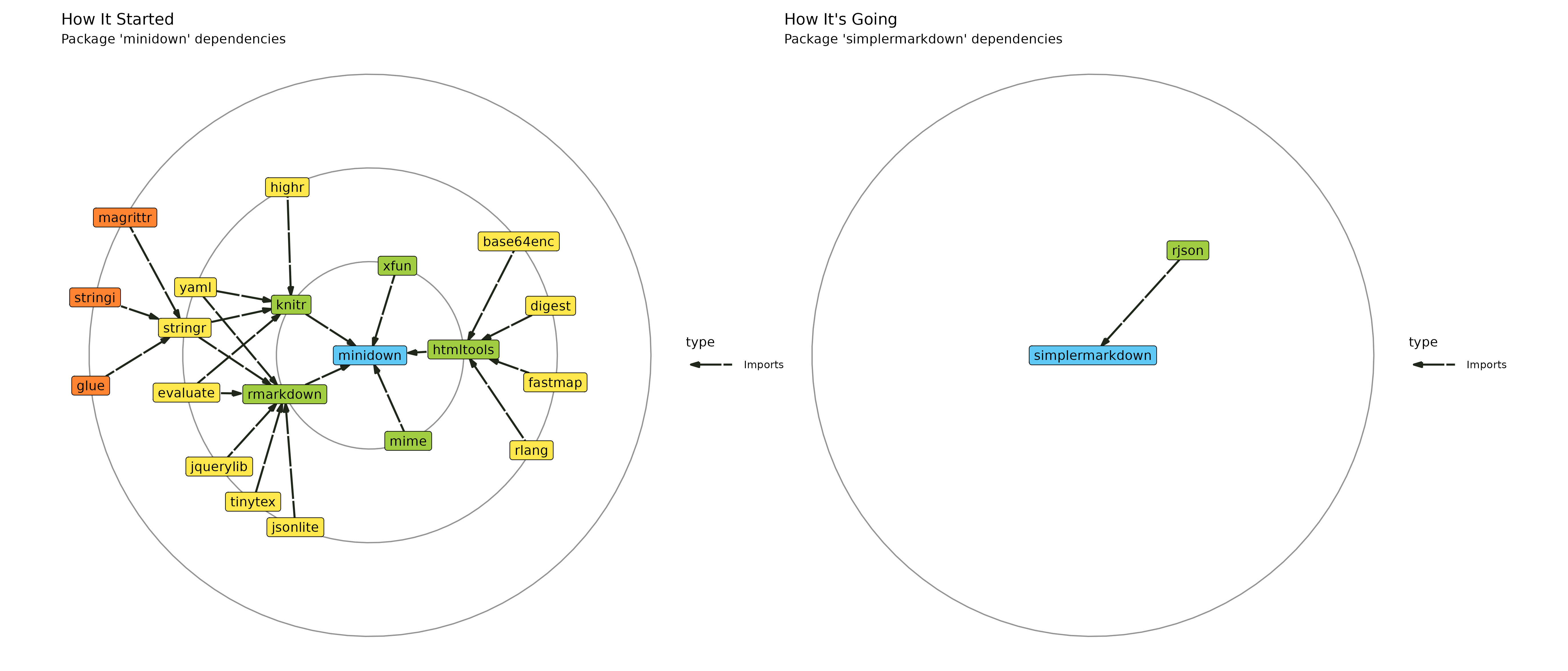
Welcome to the 34th post in the rambunctiously refreshing R recitations, or R4. Today s post is about architecture. Mies defined modernism. When still in Europe, I had been to the Neue Nationalgalerie in Berlin which provides a gorgeous space for the arts. Twenty-five years ago, I worked next to his Toronto-Dominion Center in Toronto. Here in Chicago we have numerous buildings: the Federal Center (the Dirksen, the Kluczynski and the US Post Office rounding out the square in the Loop), multiple buildings on the Illinois Tech (aka IIT) Campus where he taught in the architecture department he created and lead, the (formerly called) IBM Plaza building at the river and more. Structure and minimalism, often based on the same core elements of black steel beams and glass, are a landmark of these buildings. One immediately senses that there is nothing left to take away. Code and programming can be similar. We too compose based on parts we assemble and combine to create something hopefully larger than the parts. The difficulty arising from too many dependencies is something we discussed before both here in this 2018 post but also via the tinyverse site. Over the last seven days, and via uploads to new versions to CRAN, I have switched the vignettes of seven packages from using minidown (which in turn requires rmarkdown and knitr, plus their aggregate dependencies) to using simplermarkdown with its sole dependency. That is, of course, a personal choice. I tend to not even knit much in my vignettes (and simplermarkdown supports what I do) but to rely mostly on pandoc for code rendering. So I only need a small subset of the functionality provided, but I can not access just that as the default comes with numerous bells, whistles as well as enough other instruments to form a small marching band. A picture may express this better: (courtesy of the deepdep package for the figures). Which of these two setups is less likely to surprise you with random breaks, say in continuous integration? Which takes less time to install, and burns fewer cpu cycles just to be set up, each time we run a new test? Which is taxing your students, colleagues, collaborators, users, less on setup for use or replication? The first, comprises a total of 29 dependencies, or the second with just one? My money is on the second choice. Less is more.

7 December 2021

Dirk Eddelbuettel: Rblpapi 0.3.12: Fixes and Updates

The Rblp team is happy to announce a new version 0.3.12 of Rblpapi which just arrived at CRAN. Rblpapi provides a direct interface between R and the Bloomberg Terminal via the C++ API provided by Bloomberg (but note that a valid Bloomberg license and installation is required). This is the twelveth release since the package first appeared on CRAN in 2016. Changes are detailed below and include both extensions to functionality, actual bug fixes and changes to the package setup. Special thanks goes to Michael Kerber, Yihui Xie and Kai Lin for contributing pull requests!

Changes in Rblpapi version 0.3.12 (2021-12-07)
  • bdh() supports new option returnAs (Michael Kerber and Dirk in #335 fixing #206)
  • Remove extra backtick in vignette (Yihui Xie in #343)
  • Fix a segfault from bulk access with bds (Kai Lin in #347 fixing #253)
  • Support REQUEST_STATUS in bdh (Kai Lin and John in #349 fixing #348)
  • Vignette now uses simplermarkdown (Dirk in #350)

Courtesy of my CRANberries, there is also a diffstat report for the this release. As always, more detailed information is on the Rblpapi page. Questions, comments etc should go to the issue tickets system at the GitHub repo. If you like this or other open-source work I do, you can now sponsor me at GitHub.

This post by Dirk Eddelbuettel originated on his Thinking inside the box blog. Please report excessive re-aggregation in third-party for-profit settings.

6 December 2021

Dirk Eddelbuettel: tidyCpp 0.0.6 on CRAN: Package Maintenance

Another small release of the tidyCpp package arrived on CRAN this morning. The packages offers a clean C++ layer (as well as one small C++ helper class) on top of the C API for R which aims to make use of this robust (if awkward) C API a little easier and more consistent. See the vignette for motivating examples. This release makes a tiny code change, remove a YAML file for the disgraced former continuous integration service we shall not name (yet that we all used to use). And just like digest five days ago, drat four days ago, littler three days ago, RcppAPT two days ago, and RcppSpdlog yesterday, we converted the vignettes from using the minidown package to the (fairly new) simplermarkdown package which is so much more appropriate for our use of the minimal water.css style. The NEWS entry follows.

Changes in tidyCpp version 0.0.6 (2021-12-06)
  • Assign nullptr in dtor for Protect class
  • Switch vignette engine to simplermarkdown

Thanks to my CRANberries, there is also a diffstat report for this release. For questions, suggestions, or issues please use the issue tracker at the GitHub repo. If you like this or other open-source work I do, you can now sponsor me at GitHub.

This post by Dirk Eddelbuettel originated on his Thinking inside the box blog. Please report excessive re-aggregation in third-party for-profit settings.

5 December 2021

Dirk Eddelbuettel: RcppSpdlog 0.0.7 on CRAN: Package Maintenance

A new version 0.0.7 of RcppSpdlog is now on CRAN. RcppSpdlog bundles spdlog, a wonderful header-only C++ logging library with all the bells and whistles you would want that was written by Gabi Melman, and also includes fmt by Victor Zverovich. This release brings upstream bugfix releases 1.9.1 and 1.9.2 of spdlog. We also removed the YAML file (and badge) for the disgraced former continuous integration service we shall not name (yet that we all used to use). And just like digest four days ago, drat three days ago, littler two days ago, and RcppAPT yesterday, we converted the vignettes from using the minidown package to the (fairly new) simplermarkdown package which is so much more appropriate for our use of the minimal water.css style. The (minimal) NEWS entry for this release follows.

Changes in RcppSpdlog version 0.0.7 (2021-12-05)
  • Upgraded to upstream bug fix releases spdlog 1.9.1 and 1.9.2
  • Travis artifacts and badges have been pruned
  • Vignette now uses simplermarkdown

Courtesy of my CRANberries, there is also a diffstat report. More detailed information is on the RcppSpdlog page, or the package documention site. If you like this or other open-source work I do, you can sponsor me at GitHub.

This post by Dirk Eddelbuettel originated on his Thinking inside the box blog. Please report excessive re-aggregation in third-party for-profit settings.

4 December 2021

Dirk Eddelbuettel: RcppAPT 0.0.8: Package Maintenance

A new version of the RcppAPT package interfacing from R to the C++ library behind the awesome apt, apt-get, apt-cache, commands and their cache powering Debian, Ubuntu and the like arrived on CRAN earlier today. RcppAPT allows you to query the (Debian or Ubuntu) package dependency graph at will, with build-dependencies (if you have deb-src entries), reverse dependencies, and all other goodies. See the vignette and examples for illustrations. This release updates some package metadata, adds a new package testing helper, and, just like digest three days ago, drat two days ago, and littler yesterday, we converted the vignettes from using the minidown package to the (fairly new) simplermarkdown package which is so much more appropriate for our use of the minimal water.css style.

Changes in version 0.0.8 (2021-12-04)
  • New test file version.R ensures NEWS file documents current package version
  • Travis artifacts and badges have been pruned
  • Vignettes now use simplermarkdown

Courtesy of my CRANberries, there is also a diffstat report for this release. A bit more information about the package is available here as well as as the GitHub repo. If you like this or other open-source work I do, you can now sponsor me at GitHub.

This post by Dirk Eddelbuettel originated on his Thinking inside the box blog. Please report excessive re-aggregation in third-party for-profit settings.

3 December 2021

Dirk Eddelbuettel: littler 0.3.15 on CRAN: Package Updates

max-heap image The sixteenth release of littler as a CRAN package just landed, following in the now fifteen year history (!!) as a package started by Jeff in 2006, and joined by me a few weeks later. littler is the first command-line interface for R as it predates Rscript. It allows for piping as well for shebang scripting via #!, uses command-line arguments more consistently and still starts faster. It also always loaded the methods package which Rscript only started to do in recent years. littler lives on Linux and Unix, has its difficulties on macOS due to yet-another-braindeadedness there (who ever thought case-insensitive filesystems as a default were a good idea?) and simply does not exist on Windows (yet the build system could be extended see RInside for an existence proof, and volunteers are welcome!). See the FAQ vignette on how to add it to your PATH. A few examples are highlighted at the Github repo, as well as in the examples vignette. This release brings a more robust and featureful install2.r script (thanks to Gergely Dar czi), corrects some documentation typos (thanks to John Kerl), and now compacts pdf vignette better when using the build.r helper. It also one more updates the URLs for the two RStudio downloaders, and adds a simplermarkdown wrapper. Next, we removed the YAML file (and badge) for the disgraced former continuous integration service we shall not name (yet that we all used to use). And, following digest two days ago and drat yesterday, we converted the vignettes from using the minidown package to the (fairly new) simplermarkdown package which is so much more appropriate for our use of the minimal water.css style. The full change description follows.

Changes in littler version 0.3.15 (2021-12-03)
  • Changes in examples
    • The install2 script can select download methods, and cope with errors from parallel download (thanks to Gergely Daroczi)
    • The build.r now uses both as argument to --compact-vignettes
    • The RStudio download helper were once again updated for changed URLs
    • New caller for simplermarkdown::mdweave_to_html
  • Changes in package
    • Several typos were correct (thanks to John Kerl)
    • Travis artifacts and badges have been pruned
    • Vignettes now use simplermarkdown

My CRANberries service provides a comparison to the previous release. Full details for the littler release are provided as usual at the ChangeLog page, and also on the package docs website. The code is available via the GitHub repo, from tarballs and now of course also from its CRAN page and via install.packages("littler"). Binary packages are available directly in Debian as well as soon via Ubuntu binaries at CRAN thanks to the tireless Michael Rutter. Comments and suggestions are welcome at the GitHub repo. If you like this or other open-source work I do, you can now sponsor me at GitHub.

This post by Dirk Eddelbuettel originated on his Thinking inside the box blog. Please report excessive re-aggregation in third-party for-profit settings.

2 December 2021

Dirk Eddelbuettel: drat 0.2.2 on CRAN: Package Maintenance

drat user A fresh and new minor release of drat arrived on CRAN overnight. This is another small update relative to the 0.2.0 release in April followed by a 0.2.1 update in July. This release follows the changes made in digest yesterday. We removed the YAML file (and badge) for the disgraced former continuous integration service we shall not name (yet that we all used to use). And we converted the vignette from using the minidown package to the (fairly new) simplermarkdown package which is so much more appropriate for our use of the minimal water.css style. drat stands for drat R Archive Template, and helps with easy-to-create and easy-to-use repositories for R packages. Since its inception in early 2015 it has found reasonably widespread adoption among R users because repositories with marked releases is the better way to distribute code. See below for a few custom reference examples. Because for once it really is as your mother told you: Friends don t let friends install random git commit snapshots. Properly rolled-up releases it is. Just how CRAN shows us: a model that has demonstrated for two-plus decades how to do this. And you can too: drat is easy to use, documented by six vignettes and just works. Detailed information about drat is at its documentation site. The NEWS file summarises the release as follows:

Changes in drat version 0.2.2 (2021-12-01)
  • Travis artifacts and badges have been pruned
  • Vignettes now use simplermarkdown

Courtesy of my CRANberries, there is a comparison to the previous release. More detailed information is on the drat page as well as at the documentation site. If you like this or other open-source work I do, you can now sponsor me at GitHub.

This post by Dirk Eddelbuettel originated on his Thinking inside the box blog. Please report excessive re-aggregation in third-party for-profit settings.

1 December 2021

Dirk Eddelbuettel: digest 0.6.29 on CRAN: Package Maintenance

Release 0.6.29 of the digest package arrived at CRAN earlier today, and will be uploaded Debian shortly. digest creates hash digests of arbitrary R objects (using the md5, sha-1, sha-256, sha-512, crc32, xxhash32, xxhash64, murmur32, spookyhash, and blake3 algorithms) permitting easy comparison of R language objects. It is a mature and widely-used as many tasks may involve caching of objects for which it provides convenient general-purpose hash key generation. This release only contains two smaller internal changes. We removed the YAML file (and badge) for the disgraced former continuous integration service we shall not name (yet that we all used to use). And we converted the vignette from using the minidown package to the (fairly new) simplermarkdown package which is so much more appropriate for our use of the minimal water.css style. My CRANberries provides the usual summary of changes to the previous version. For questions or comments use the issue tracker off the GitHub repo. If you like this or other open-source work I do, you can now sponsor me at GitHub.

This post by Dirk Eddelbuettel originated on his Thinking inside the box blog. Please report excessive re-aggregation in third-party for-profit settings.

24 November 2021

Dirk Eddelbuettel: nanotime 0.3.4 on CRAN: Maintenance Update

Another (minor) nanotime release, now at version 0.3.4, arrived at CRAN overnight. It exports some nanoperiod functionality via a C++ header, and Leonardo and I will use this in an upcoming package that we hope to talk about a little more in a few days. It also adds a few as.character.*() methods that had not been included before. nanotime relies on the RcppCCTZ package for (efficient) high(er) resolution time parsing and formatting up to nanosecond resolution, and the bit64 package for the actual integer64 arithmetic. Initially implemented using the S3 system, it has benefitted greatly from a rigorous refactoring by Leonardo who not only rejigged nanotime internals in S4 but also added new S4 types for periods, intervals and durations. The NEWS snippet adds more details.

Changes in version 0.3.4 (2021-11-24)
  • Added a few more as.character conversion function (Dirk)
  • Expose nanoperiod functionality via header file for use by other packages (Leonardo in #95 fixing #94).

Thanks to CRANberries there is also a diff to the previous version. More details and examples are at the nanotime page; code, issue tickets etc at the GitHub repository. If you like this or other open-source work I do, you can now sponsor me at GitHub.

This post by Dirk Eddelbuettel originated on his Thinking inside the box blog. Please report excessive re-aggregation in third-party for-profit settings.

19 November 2021

Dirk Eddelbuettel: RcppArmadillo 0.10.7.3.0 on CRAN: Bugfix, New Features

armadillo image Armadillo is a powerful and expressive C++ template library for linear algebra aiming towards a good balance between speed and ease of use with a syntax deliberately close to a Matlab. RcppArmadillo integrates this library with the R environment and language and is widely used by (currently) 928 other packages on CRAN. I somehow missed to blog and tweet about the recent release based on the Armadillo 10.7.3 upstream release. Conrad is in long-term support mode , and 10.7.* is meant to provide fixes and stability relative to the most recent release which we did on September 30. We did actually find a regression when checking reverse-dependencies requiring an upstream move to 10.7.3. At the same time, we folded pull request #352 in. It addresses an old bug of ours where Armadillo fields types were not converted correctly in all dimensions. So no we do have 0.10.7.3.0 on CRAN, as well as 0.10.7.3.1 with the (opt-in) field) fixes on the drat repo) repo. As the change perturbs a few existing packages, it is opt-in for now. We will likely aim at a proper deprecation of the old behaviour and give packages time to adjust. Stay tuned. With that, big thanks to Jonathan Berrisch for filing issue #351 and basically addressing it in pull request #352. Very nice work, and I basically just wrapped a few more tests around it. The full set of changes (since the last CRAN release 0.10.7.0.) follows.

Changes in RcppArmadillo version 0.10.7.3.1 (2021-11-18)
  • Correct dimensions setting in import/export of arma::field types, protected by #define (Jonathan Berrisch in #352 fixing #351)
  • Add unit tests for fields both with and without new #define (Dirk)

Changes in RcppArmadillo version 0.10.7.3.0 (2021-11-04)
  • Upgraded to Armadillo release 10.7.3
    • fix regression in alias handling by fliplr(), flipud(), reverse()

Changes in RcppArmadillo version 0.10.7.2.0 (2021-11-02)
  • Upgraded to Armadillo release 10.7.2
    • more robust handling of diagonal matrices by pinv()

Changes in RcppArmadillo version 0.10.7.1.0 (2021-10-08)
  • Upgraded to Armadillo release 10.7.1
    • fix regression in interactions between dense matrix subviews and sparse matrices

Courtesy of my CRANberries, there is a diffstat report relative to previous release. More detailed information is on the RcppArmadillo page. Questions, comments etc should go to the rcpp-devel mailing list off the R-Forge page. If you like this or other open-source work I do, you can sponsor me at GitHub.

This post by Dirk Eddelbuettel originated on his Thinking inside the box blog. Please report excessive re-aggregation in third-party for-profit settings.

3 November 2021

Dirk Eddelbuettel: RDieHarder 0.2.2 on CRAN: Simpler Build, Fixes

An updated version 0.2.2 of the random-number generator tester RDieHarder (based on the DieHarder suite developed / maintained by Robert Brown with contributions by David Bauer and myself) is now on CRAN. I should dub this the due to Brian Ripley release. He sent me a detailed five-point email a few days ago which detailed a change I could not have tested ( no access ), a change I would not have known ( somewhat obscure C language bit-level manipulation ), a change I had missed (how my build setup failed for M1mac), another advanced C level fix, and one more simple fix I actually knew. Speechless. The man (I presume) does not sleep and is just so generous with his time and expertise. So based on the input I rejigged the package over the weekend and made two more (substantial) changes. First, extending on what 0.2.0 brought, I will no longer attempt to use an external libdieharder library (or build one on the fly) that was issue one. Now we just declare all C files as dependents of the package shared library, and things are simpler and more consistent. Sadly, that also implies everything is in the package so I had to edit out a metric ton of stdout or exit() reference with the appropriate R C API hooks to appease the CRAN Policy deities. Win some, loose some. But the package is now simpler, and cleaner, and should be in good standing. (Or so one hopes. Earlier today, and within hours of it hitting CRAN, I got an issue ticket from a motivated user about yet another ( mostly harmless in the Douglas Adams sense) compiler warning Good now too.) Thanks to CRANberries, you can also look at the most recent diff. If you like this or other open-source work I do, you can now sponsor me at GitHub.

This post by Dirk Eddelbuettel originated on his Thinking inside the box blog. Please report excessive re-aggregation in third-party for-profit settings.

30 October 2021

Dirk Eddelbuettel: RcppQuantuccia 0.1.0 on CRAN: Full QuantLib Business Calendar Support

Another new release of RcppQuantuccia arrived on CRAN today, just a week after the previous release which brought full calendaring support. RcppQuantuccia started from the Quantuccia header-only subset / variant of QuantLib which it brings it to R. As of this release, the QuantLib code is only minimally modified. In other words we no longer follow the Quantuccia route of header-izing the file but include both cpp and hpp directly. The minimal changes, documented in a diff file in the repo, consists chiefly of removing includes for headers we do not use (given the pure calendaring focus) and accomodating CRAN Policies (by eschewing #pragma directives). We do follow Quantuccia by not having any external linking requirement: the R package only depends on Rcpp (for the glue) and BH for the Boost headers (and system-level Boost headers can be used as drop-in). The our knowledge, this provides the only small and self-contained (apart from Boost headers) library with current (and regularly updated within QuantLib, which I intend to shadow here) calendaring code on a global scale. Every exchange that matters is likely included. The screenshot provides quick demo. The complete list changes for this release follows.

Changes in version 0.1.0 (2021-10-30)
  • Code reorganized to have minimal (documented) changes relative to upstream, essentially just removing unused headers, and pragma
  • Added example for full calendaring to README.md

Time permitting, I may look into other bindings from this sub-library; see a first email thread on this. Courtesy of CRANberries, there is also a diffstat report relative to the previous release. More information is on the RcppQuantuccia page. Issues and bugreports should go to the GitHub issue tracker. If you like this or other open-source work I do, you can now sponsor me at GitHub.

This post by Dirk Eddelbuettel originated on his Thinking inside the box blog. Please report excessive re-aggregation in third-party for-profit settings.

Dirk Eddelbuettel: dang 0.0.15: Small Correction

A bug-fix release of the dang package arrived at CRAN a little while ago. The dang package regroups a few functions of mine that had no other home as for example lsos() from a StackOverflow question from 2009 (!!), the overbought/oversold price band plotter from an older blog post, the market monitor from the last release as well the checkCRANStatus() function tweeted about by Tim Taylor. This release corrects a small mistake wrapping extern "C" ... around code that is not actually C but C++ which g++ kept silent about yet clang++ complains about, correctly. So CRAN asked me to correct this, which this version does. The NEWS entry follows.

Changes in version 0.0.15 (2021-10-26)
  • Corrected scope of 'extern "C"' declaration to the actually C-callable function (noticed by clang++, change requested by CRAN)

Courtesy of my CRANberries, there is a comparison to the previous release. For questions or comments use the issue tracker off the GitHub repo. If you like this or other open-source work I do, you can now sponsor me at GitHub.

This post by Dirk Eddelbuettel originated on his Thinking inside the box blog. Please report excessive re-aggregation in third-party for-profit settings.

Next.

Previous.