Search Results: "ms"

19 March 2017

Clint Adams: Measure once, devein twice

Ophira lived in a wee house in University Square, Tampa. It had one floor, three bedrooms, two baths, a handful of family members, a couple pets, some plants, and an occasional staring contest. Mauricio lived in Lowry Park North, but Ophira wasn t allowed to go there because Mauricio was afraid that someone would tell his girlfriend. Ophira didn t like Mauricio s girlfriend and Mauricio s girlfriend did not like Ophira. Mauricio did not bring his girlfriend along when he and Ophira went to St. Pete Beach. They frolicked in the ocean water, and attempted to have sex. Mauricio and Ophira were big fans of science, so Somewhat quickly they concluded that it is impossible to have sex underwater, and absconded to Ophira s car to have sex therein. I hate Mauricio s girlfriend, Ophira told Amit on the telephone. She s not even pretty. Hey, listen, said Amit. I m going to a wedding on Captiva. Oh, my family used to go to Captiva every year. There s bioluminescent algae and little crabs and stuff. Yeah? Do you want to come along? You could pick me up at the airport. Why would I want to go to a wedding? Well, it s on the beach and they re going to have a bouncy castle. A bouncy castle Are you serious? Yes. Well, okay. Amit prepared to go to the wedding and Ophira became terse then unresponsive. After he landed at RSW, he called Ophira, but instead of answering the phone she startled and fell out of her chair. Amit arranged for other transportation toward the Sanibel Causeway. Ophira bit her nails for a few hours, then went to her car and drove to Cape Coral. Ophira cruised around Cape Coral for a while, until she spotted a teenager cleaning a minivan. She parked her car and approached him. Whatcha doing? asked Ophira, pretending to chew on imaginary gum. The youth slid the minivan door open. I m cleaning, he said hesitantly. Didn t your parents teach you not to talk to strangers? I could do all kinds of horrible things to you. They conversed for a bit. She recounted a story of her personal hero, a twelve-year-old girl who seduced and manipulated older men into ruin. She rehashed the mysteries of Mauricio s girlfriend. She waxed poetic on her love of bouncy castles. The youth listened, hypnotized. What s your name, kid? Ophira yawned. Arjun, he replied. How old are you? Arjun thought about it. 15, he said. Hmm, Ophira stroked her chin. Can you sneak me into your room so that your parents never find out about it? Arjun s eyes went wide. MEANWHILE, on Captiva Island, Amit had learned that even though the Tenderly had multiple indoor jacuzzis, General Fitzpatrick and Mrs. Fitzpatrick had decided it prudent to have sex in the hot tub on the deck; that the execution of this plan had somehow necessitated a lengthy cleaning process before the hot tub could be used again; that that s why workmen were cleaning the hot tub; and that the Fitzpatrick children had gotten General Fitzpatrick and Mrs. Fitzpatrick to agree to not do that again, with an added suggestion that they not be seen doing anything else naked in public. A girl walked up to Amit. Hey, I heard you lost your plus-one. Are you here alone? What a loser! she giggled nervously, then stared. Leave me alone, Darlene, sighed Amit. Darlene s face reddened as she spun on her heels and stormed over to Lisette. Oh my god, did you see that? I practically threw myself at him and he was abusive toward me. He probably has all the classic signs of being an abuser. Did you hear about that girl he dated in Ohio? I bet I know why that ended. Oh really? said Lisette distractedly, looking Amit up and down. So he s single now? Darlene glared at Lisette as Amit wandered back outside to stare at the hot tub. Hey kid, said Ophira, bring me some snacks. I don t bring food into my room, said Arjun. It attracts pests. Is that what your parents told you? scoffed Ophira. Don t be such a wuss. Three minutes later, Ophira was finishing a bag of paprika puffs. These are great, Arjun! Where do you get these? My cousin sends them from Europe, he explained. Now get me a diet soda. Amit strolled along the beach, then yelped. What s biting my legs? he cried out. Those are sand fleas, said Nessarose. What are sand fleas? asked Amit incredulously. Nessarose rolled her eyes. Stop being a baby and have a drink. After the sun went down, Amit began to notice the crabs, and this made him drink more. When everyone was soused, General Fitzpatrick announced that they were going for a swim in the Gulf, in direct contravention of safety guidelines. Most of the guests were wise enough to refuse, but an eightsome swam out, occasionally stopping to slap the algae, but continuing until they reached the sandbar that General Fitzpatrick correctly claimed was there. Then screams echoed through the night as all the jellyfish attacked everyone invading their sandbar. The crestfallen swimming party eventually made it back to shore. Pee on the jellyfish sting, commanded Nessarose. It s the best cure. No! shouted General Fitzpatrick s daughter. Urine makes it worse. Things quickly escalated from Nessarose and General Fitzpatrick s daughter screaming at each other to the beach dividing into three factions: those siding with Nessarose, those siding with General Fitzpatrick s daughter, and those who had no idea what was going on. General Fitzpatrick had no interest in any of this, and went straight to bed. It s getting late, kid, said Ophira. I m taking your bed. What? squeaked Arjun. Look, said Ophira, your bed is small and there isn t room for both of us. You may sleep on the floor if you re quiet and don t bother me. What? squeaked Arjun. Are you deaf, kid? Ophira grunted and then went to bed. Arjun blinked in confusion, then tried to fall asleep on the floor, without much success. Ophira got up in the morning and said, Before I go, I want to teach you a valuable lesson. What? groaned Arjun, getting to his feet. You should be careful talking to strangers. Now, I told you that I could do horrible things to you, so this is not my fault; it s yours, she announced, then sucker-punched him in the gut. Ophira climbed out the window as Arjun doubled over. As the ceremony began, only a small minority of the wedding party was visibly suffering from jellyfish stings, which may or may not have helped with ignoring the sand fleas. The ceremony ended shortly thereafter, and now that marriage had been accomplished, everyone turned their attention to food and drink and swimming less irresponsibly than the night before. Guests that needed to return home sooner departed in waves and Amit started to appreciate the more peaceful environment. He heard the deck door slide open behind him and turned his attention away from the hot tub. Hey, mofo, Ophira shouted as strode stylishly out onto the deck. Where s this bouncy castle? Amit blinked in surprise. That was yesterday. You missed it. Oh, she frowned. So I met this South Slav guy with a really sexy forehead, and I need some advice. I don t know if I should call him or wait. Amit pointed to the hot tub and told her the story of General Fitzpatrick and Mrs. Fitzpatrick and the hot tub. What? said Ophira. How could they have sex underwater? What do you mean? asked Amit. Well, it s impossible, she replied.
Posted on 2017-03-19
Tags: mintings

17 March 2017

Shirish Agarwal: Science Day at GMRT, Khodad 2017

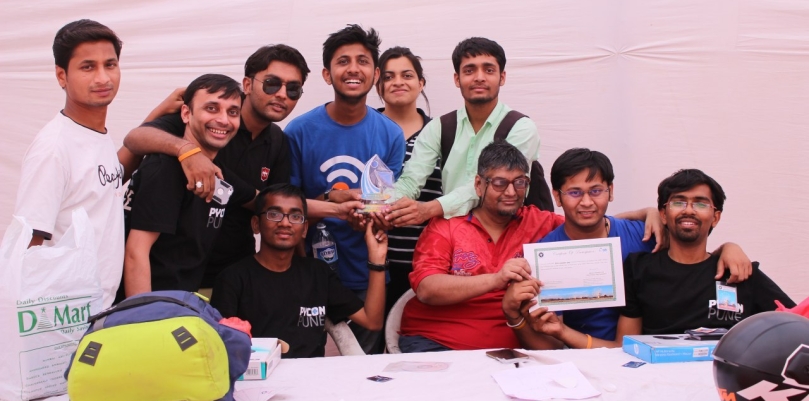
The whole team posing at the end of day 2 The above picture is the blend of the two communities from foss community and mozilla India. And unless you were there you wouldn t know who is from which community which is what FOSS is all about. But as always I m getting a bit ahead of myself. Akshat, who works at NCRA as a programmer, the standing guy on the left shared with me in January this year that this year too, we should have two stalls, foss community and mozilla India stalls next to each other. While we had the banners, we were missing stickers and flyers. Funds were and are always an issue and this year too, it would have been emptier if we didn t get some money saved from last year minidebconf 2016 that we had in Mumbai. Our major expenses included printing stickers, stationery and flyers which came to around INR 5000/- and couple of LCD TV monitors which came for around INR 2k/- as rent. All the labour was voluntary in nature, but both me and Akshat easily spending upto 100 hours before the event. Next year, we want to raise to around INR 10-15k so we can buy 1 or 2 LCD monitors and we don t have to think for funds for next couple of years. How will we do that I have no idea atm. Printing leaflets Me and Akshat did all the printing and stationery runs and hence had not been using my lappy for about 3-4 days. Come to the evening before the event and the laptop would not start. Coincidentally, or not few months or even last at last year s Debconf people had commented on IBM/Lenovo s obsession with proprietary power cords and adaptors. I hadn t given it much thought but when I got no power even after putting it on AC power for 3-4 hours, I looked up on the web and saw that the power cord and power adaptors were all different even in T440 and even that under existing models. In fact I couldn t find mine hence sharing it via pictures below. thinkpad power cord male thinkpad power adaptor female I knew/suspected that thinkpads would be rare where I was going, it would be rarer still to find the exact power cord and I was unsure whether it was the power cord at fault or adaptor or whatever goes for SMPS in laptop or memory or motherboard/CPU itself. I did look up the documentation at support.lenovo.com and was surprised at the extensive documentation that Lenovo has for remote troubleshooting. I did the usual take out the battery, put it back in, twiddle with the little hole in the bottom of the laptop, trying to switch on without the battery on AC mains, trying to switch on with battery power only but nothing worked. Couple of hours had gone by and with a resigned thought went to bed, convincing myself that anyways it s good I am not taking the lappy as it is extra-dusty there and who needs a dead laptop anyways. Update After the event was over, I did contact Lenovo support and within a week, with one visit from a service engineer, he was able to identify that it was a faulty cable which was at fault and not the the other things which I was afraid of. Another week gone by and lenovo replaced the cable. Going by service standards that I have seen of other companies, Lenovo deserves a gold star here for the prompt service they provided. I probably would end up subscribing to their extended 2-year warranty service when my existing 3 year warranty is about to be over. Next day, woke up early morning, two students from COEP hostel were volunteering and we made our way to NCRA, Pune University Campus. Ironically, though we were under the impression that we would be the late arrivals, it turned out we were the early birds. 5-10 minutes passed by and soon enough we were joined by Aniket and we played catch-up for a while. We hadn t met each other for a while so it was good to catch-up. Then slowly other people starting coming in and around 07:10-07:15 we started for GMRT, Khodad. Now I had been curious as had been hearing for years that the Pune-Nashik NH-50 highway would be concreted and widened to six-lane highways but the experience was below par. Came back and realized the proposal has now been pushed back to 2020. From the mozilla team, only Aniket was with us, the rest of the group was coming straight from Nashik. Interestingly, all the six people who came, came on bikes which depending upon how you look at it was either brave or stupid. Travelling on bikes on Indian highways you either have to be brave or stupid or both, we have more than enough accidents due to quality of road construction, road design, lane-changing drivers and many other issues. This is probably not the place for it hence will use some other blog post to rant about that. We reached around 10:00 hrs. IST and hung around till lunch as Akshat had all the marketing material, monitors etc. The only thing we had were couple of lappies and couple of SBC s, an RPI 3 and a BBB. Aarti Kashyap sharing something about SBC Our find for the event was Aarti Kashyap who you can see above. She is a third-year student at COEP and one of the rare people who chose to interact with hardware rather than software. From last several years, we had been trying, successfully and unsuccessfully to get more Indian women and girls interested into technology. It is a vicious circle as till a girl/woman doesn t volunteer we are unable to share our knowledge to the extent we can which leads them to not have much interest in FOSS or even technology in general. While there are groups are djangogirls, Pyladies and railgirls and even Outreachy which tries to motivate getting girls into computing but it s a long road ahead. We are short of both funds and ideas as to how to motivate more girls to get into computing and then to get into playing with hardware. I don t know where to start and end for whoever wants to play with hardware. From SBC s, routers to blade servers the sky is the limit. Again this probably isn t the place for it, hence probably we can chew it on more at some other blog post. This year, we had a lowish turnout due to the fact that the 12th board exams 1st paper was on the day we had opened. So instead of 20-25k, we probably had 5-7k fewer people pass through. There were two-three things that we were showing, we were showing Debian on one of the systems, we were showing the output from the SBC s on the other monitor but the glare kept hitting the monitors. While the organizers had done exemplary work over last year. They had taped the carpets on the ground so there was hardly any dust moving around. However, I wished the organizers had taken the pains to have two cloth roofs over our head instead of just one, the other roof head could be say 2 feet up, this would have done two things a. It probably would have cooled the place a bit more as b. We could get diffused sunlight which would have lessened the glare and reflection the LCD s kept throwing back. At times we also got people to come to our side as can be seen in Aarti s photo as can be seen above. If these improvements can be made for next year, this would result in everybody in our Pandal would benefit, not just us and mozilla. This would be benefiting around 10-15 organizations which were within the same temporary structure. Of course, it depends very much on the budget they are able to have and people who are executing, we can just advise. The other thing which had been missing last year and this year is writing about Single Board Computers in Marathi. If we are to promote them as something to replace a computer or something for a younger brother/sister to learn computing upon at a lower cost, we need leaflets written in their language to be more effective. And this needs to be in the language and mannerisms that people in that region understand. India, as probably people might have experienced is a dialect-prone country. Which means every 2-5 kms, the way the language is spoken is different from anywhere else. The Marathi spoken by somebody who has lived in Ravivar Peth for his whole life and a person who has lived in say Kothrud are different. The same goes from any place and this place, Khodad, Narayangaon would have its own dialect, its own mini-codespeak. Just to share, we did have one in English but it would have been a vast improvement if we could do it in the local language. Maybe we can discuss about this and ask for help from people. Outside, Looking in Mozillians helping FOSS community and vice-versa What had been interesting about the whole journey were the new people who were bringing all their passion and creativity to the fore. From the mozilla community, we had Akshay who is supposed to be a wizard on graphics, animation, editing anything to do with the visual medium. He shared some of the work he had done and also shared a bit about how blender works with people who wanted to learn about that. Mayur, whom you see in the picture pointing out something about FOSS and this was the culture that we strove to have. I know and love and hate the browser but haven t been able to fathom the recklessness that Mozilla has been doing the last few years, which has just been having one mis-adventure after another. For instance, mozstumbler was an effort which I thought would go places. From what little I understood, it served/serves as a user-friendly interface to a potential user while still sharing all the data with OSM . They (Mozilla) seems/seemed to have a fatalistic take as it provided initial funding but then never fully committing to the project. Later, at night we had the whole free software and open-source sharings where I tried to emphasize that without free software, the term open-source would not have come into existence. We talked and talked and somewhere around 02:00 I slept, the next day was an extension of the first day itself where we ribbed each other good-naturedly and still shared whatever we could share with each other. I do hope that we continue this tradition for great many years to come and engage with more and more people every passing year.

Filed under: Miscellenous Tagged: #budget, #COEP< #volunteering, #debian, #Events, #Expenses, #mozstumbler, #printing, #SBC's, #Science Day 2017, #thinkpad cable issue, FOSS, mozilla

Antonio Terceiro: Patterns for Testing Debian Packages

At the and of 2016 I had the pleasure to attend the 11th Latin American Conference on Pattern Languages of Programs, a.k.a SugarLoaf PLoP. PLoP is a series of conferences on Patterns (as in Design Patterns ), a subject that I appreciate a lot. Each of the PLoP conferences but the original main big conference has a funny name. SugarLoaf PLoP is called that way because its very first edition was held in Rio de Janeiro, so the organizers named it after a very famous mountain in Rio. The name stuck even though a long time has passed since it was held in Rio for the last time. 2016 was actually the first time SugarLoaf PLoP was held outside of Brazil, finally justifying the Latin American part of its name. I was presenting a paper I wrote on patterns for testing Debian packages. The Debian project funded my travel expenses through the generous donations of its supporters. PLoP s are very fun conferences with a relaxed atmosphere, and is amazing how many smart (and interesting!) people gather together for them. My paper is titled Patterns for Writing As-Installed Tests for Debian Packages , and has the following abstract:
Large software ecosystems, such as GNU/Linux distributions, demand a large amount of effort to make sure all of its components work correctly invidually, and also integrate correctly with each other to form a coherent system. Automated Quality Assurance techniques can prevent issues from reaching end users. This paper presents a pattern language originated in the Debian project for automated software testing in production-like environments. Such environments are closer in similarity to the environment where software will be actually deployed and used, as opposed to the development environment under which developers and regular Continuous Integration mechanisms usually test software products. The pattern language covers the handling of issues arising from the difference between development and production-like environments, as well as solutions for writing new, exclusive tests for as-installed functional tests. Even though the patterns are documented here in the context of the Debian project, they can also be generalized to other contexts.
In practical terms, the paper documents a set of patterns I have noticed in the last few years, when I have been pushing the Debian Continous Integration project. It should be an interesting read for people interested in the testing of Debian packages in their installed form, as done with autopkgtest. It should also be useful for people from other distributions interested in the subject, as the issues are not really Debian-specific. I have recently finished the final version of the paper, which should be published in the ACM Digital Library at any point now. You can download a copy of the paper in PDF. Source is also available, if you are into markdown, LaTeX, makefiles and this sort of thing. If everything goes according to plan, I should be presenting a talk on this at the next Debconf in Montreal.

16 March 2017

Joey Hess: end of an era

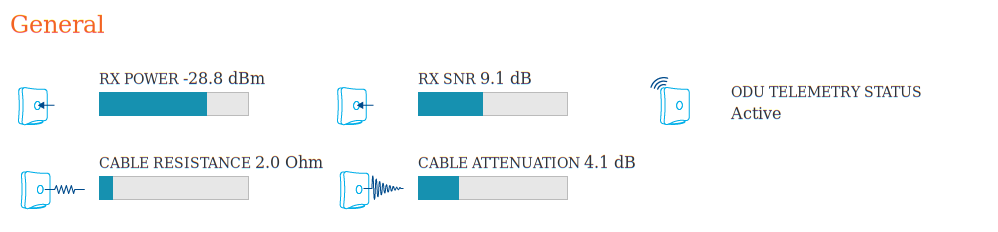
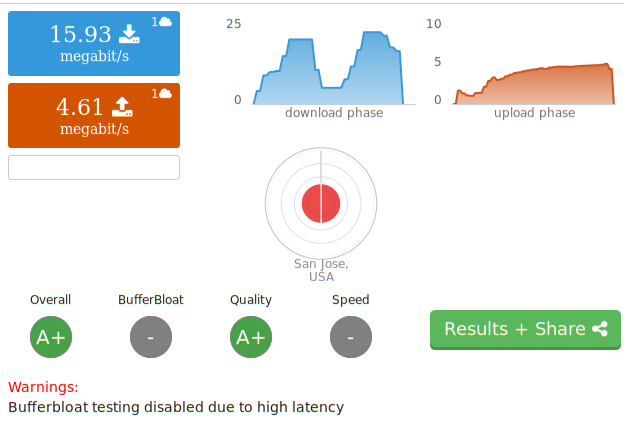
I'm at home downloading hundreds of megabytes of stuff. This is the first time I've been in position of "at home" + "reasonably fast internet" since I moved here in 2012. It's weird! Satellite internet dish with solar panels in foreground While I was renting here, I didn't mind dialup much. In a way it helps to focus the mind and build interesting stuff. But since I bought the house, the prospect of only dialup at home ongoing became more painful. While I hope to get on the fiber line that's only a few miles away eventually, I have not convinced that ISP to build out to me yet. Not enough neighbors. So, satellite internet for now. 9.1 dB SNR speedtest results: 15 megabit down / 4.5 up with significant variation Dish seems well aligned, speed varies a lot, but is easily hundreds of times faster than dialup. Latency is 2x dialup. The equipment uses more power than my laptop, so with the current solar panels, I anticipate using it only 6-9 months of the year. So I may be back to dialup most days come winter, until I get around to adding more PV capacity. It seems very cool that my house can capture sunlight and use it to beam signals 20 thousand miles into space. Who knows, perhaps there will even be running water one day. Satellite dish

Rapha&#235;l Hertzog: Freexian s report about Debian Long Term Support, February 2017

A Debian LTS logoLike each month, here comes a report about the work of paid contributors to Debian LTS. Individual reports In January, about 154 work hours have been dispatched among 13 paid contributors. Their reports are available: Evolution of the situation The number of sponsored hours increased slightly thanks to Bearstech and LiHAS joining us. The security tracker currently lists 45 packages with a known CVE and the dla-needed.txt file 39. The number of open issues continued its slight increase, this time it could be explained by the fact that many contributors did not spend all the hours allocated (for various reasons). There s nothing worrisome at this point. Thanks to our sponsors New sponsors are in bold.

No comment Liked this article? Click here. My blog is Flattr-enabled.

Wouter Verhelst: Codes of Conduct

These days, most large FLOSS communities have a "Code of Conduct"; a document that outlines the acceptable (and possibly not acceptable) behaviour that contributors to the community should or should not exhibit. By writing such a document, a community can arm itself more strongly in the fight against trolls, harassment, and other forms of antisocial behaviour that is rampant on the anonymous medium that the Internet still is. Writing a good code of conduct is no easy matter, however. I should know -- I've been involved in such a process twice; once for Debian, and once for FOSDEM. While I was the primary author for the Debian code of conduct, the same is not true for the FOSDEM one; I was involved, and I did comment on a few early drafts, but the core of FOSDEM's current code was written by another author. I had wanted to write a draft myself, but then this one arrived and I didn't feel like I could improve it, so it remained. While it's not easy to come up with a Code of Conduct, there (luckily) are others who walked this path before you. On the "geek feminism" wiki, there is an interesting overview of existing Open Source community and conference codes of conduct, and reading one or more of them can provide one with some inspiration as to things to put in one's own code of conduct. That wiki page also contains a paragraph "Effective codes of conduct", which says (amongst others) that a good code of conduct should include
Specific descriptions of common but unacceptable behaviour (sexist jokes, etc.)
The attentive reader will notice that such specific descriptions are noticeably absent from both the Debian and the FOSDEM codes of conduct. This is not because I hadn't seen the above recommendation (I had); it is because I disagree with it. I do not believe that adding a list of "don't"s to a code of conduct is a net positive to it. Why, I hear you ask? Surely having a list of things that are not welcome behaviour is a good thing, which should be encouraged? Surely such a list clarifies the kind of things your does not want to see? Having such a list will discourage that bad behaviour, right? Well, no, I don't think so. And here's why.

Enumerating badness A list of things not to do is like a virus scanner. For those not familiar with these: on some operating systems, there is specific piece of software that everyone recommends you run, which checks if particular blobs of data appear in files on the disk. If they do, then these files are assumed to be bad, and are kicked out. If they do not, then these files are assumed to be not bad, and are left alone (for the most part). This works if we know all the possible types of badness; but as soon as someone invents a new form of badness, suddenly your virus scanner is ineffective. Additionally, it also means you're bound to continually have to update your virus scanner (or, as the case may be, code of conduct) to a continually changing hostile world. For these (and other) reasons, enumerating badness is listed as number 2 in security expert Markus Ranum's "six dumbest ideas in computer security," which was written in 2005. In short, a list of "things not to do" is bound to be incomplete; if the goal is to clarify the kind of behaviour that is not welcome in your community, it is usually much better to explain the behaviour that is wanted, so that people can infer (by their absense) the kind of behaviour that isn't welcome. This neatly brings me to my next point...

Black vs White vs Gray. The world isn't black-and-white. We could define a list of welcome behaviour -- let's call that the whitelist -- or a list of unwelcome behaviour -- the blacklist -- and assume that the work is done after doing so. However, that wouldn't be true. For every item on either the white or black list, there's going to be a number of things that fall somewhere in between. Let's call those things as being on the "gray" list. They're not the kind of outstanding behaviour that we would like to see -- they'd be on the white list if they were -- but they're not really obvious CoC violations, either. You'd prefer it if people don't do those things, but it'd be a stretch to say they're jerks if they do. Let's clarify that with an example: Is it a code of conduct violation if you post links to pornography websites on your community's main development mailinglist? What about jokes involving porn stars? Or jokes that denigrate women, or that explicitly involve some gender-specific part of the body? What about an earring joke? Or a remark about a user interacting with your software, where the women are depicted as not understanding things as well as men? Or a remark about users in general, that isn't written in a gender-neutral manner? What about a piece of self-deprecating humor? What about praising someone else for doing something outstanding? I'm sure most people would agree that the first case in the above paragraph should be a code of conduct violation, whereas the last case should not be. Some of the items in the list in between are clearly on one or the other side of the argument, but for others the jury is out. Let's call those as being in the gray zone. (Note: no, I did not mean to imply that the list is ordered in any way ;-) If you write a list of things not to do, then by implication (because you didn't mention them), the things in the gray area are okay. This is especially problematic when it comes to things that are borderline blacklisted behaviour (or that should be blacklisted but aren't, because your list is incomplete -- see above). In such a situation, you're dealing with people who are jerks but can argue about it because your definition of jerk didn't cover teir behaviour. Because they're jerks, you can be sure they'll do everything in their power to waste your time about it, rather than improving their behaviour. In contrast, if you write a list of things that you want people to do, then by implication (because you didn't mention it), the things in the gray area are not okay. If someone slips and does something in that gray area anyway, then that probably means they're doing something borderline not-whitelisted, which would be mildly annoying but doesn't make them jerks. If you point that out to them, they might go "oh, right, didn't think of it that way, sorry, will aspire to be better next time". Additionally, the actual jerks and trolls will have been given less tools to argue about borderline violations (because the border of your code of conduct is far, far away from jerky behaviour), so less time is wasted for those of your community who have to police it (yay!). In theory, the result of a whitelist is a community of people who aspire to be nice people, rather than a community of people who simply aspire to be "not jerks". I know which kind of community I prefer.

Giving the wrong impression During one of the BOFs that were held while I was drafting the Debian code of conduct, it was pointed out to me that a list of things not to do may give the impression to people that all these things on this list do actually happen in the code's community. If that is true, then a very long list may produce the impression that the given community is a community with a lot of problems. Instead, a whitelist-based code of conduct will provide the impression that you're dealing with a healthy community. Whether that is the case obviously depends on more factors than just the code of conduct itself, but it will put people in the right mindset for this to become something of a self-fulfilling prophecy.

Conclusion Given all of the above, I think a whitelist-based code of conduct is a better idea than a blacklist-based one. Additionally, in the few years since the Debian code of conduct was accepted, it is my impression that the general atmosphere in the Debian project has improved, which would seem to confirm that the method works (but YMMV, of course). At any rate, I'm not saying that blacklist-based codes of conduct are useless. However, I do think that whitelist-based ones are better; and hopefully, you now agree, too ;-)

Ben Hutchings: Debian LTS work, February 2017

I was assigned 13 hours of work by Freexian's Debian LTS initiative and carried over 15.25 from January. I worked 19 hours and have returned the remaining 9.25 hours to the general pool. I prepared a security update for the Linux kernel and issued DLA-833-1. However, I spent most of my time catching up with a backlog of fixes for the Linux 3.2 longterm stable branch. I issued two stable updates (3.2.85, 3.2.86).

15 March 2017

Dirk Eddelbuettel: RcppEigen 0.3.2.9.1

A new maintenance release 0.3.2.9.1 of RcppEigen, still based on Eigen 3.2.9 is now on CRAN and is now going into Debian soon. This update ensures that RcppEigen and the Matrix package agree on their #define statements for the CholMod / SuiteSparse library. Thanks to Martin Maechler for the pull request. I also added a file src/init.c as now suggested (soon: requested) by the R CMD check package validation. The complete NEWS file entry follows.

Changes in RcppEigen version 0.3.2.9.1 (2017-03-14)
  • Synchronize CholMod header file with Matrix package to ensure binary compatibility on all platforms (Martin Maechler in #42)
  • Added file init.c with calls to R_registerRoutines() and R_useDynamicSymbols(); also use .registration=TRUE in useDynLib in NAMESPACE

Courtesy of CRANberries, there is also a diffstat report for the most recent release.

This post by Dirk Eddelbuettel originated on his Thinking inside the box blog. Please report excessive re-aggregation in third-party for-profit settings.

Michal &#268;iha&#345;: Life of free software project

During last week I've noticed several interesting posts about challenges being free software maintainer. After being active in open source for 16 years I can share much of the feelings I've read and I can also share my dealings with the things. First of all let me link some of the other posts on the topic: I guess everybody involved in in some popular free software project knows it - there is much more work to be done than people behind the project can handle. It really doesn't matter it those are bug reports, support requests, new features or technical debt, it's simply too much of that. If you are the only one behind the project it can feel even more pressing. There can be several approaches how to deal with that, but you have to choose what you prefer and what is going to work for you and your project. I've used all of the below mentioned approaches on some of the projects, but I don't think there is a silver bullet. Finding more people Obviously if you can not cope with the work, let's find more people to do the work. Unfortunately it's not that easy. Sometimes people come by, contribute few patches, but it's not that easy to turn them into regular contributor. You should encourage them to stay and to care about the part of the project they have touched. You can try to attract completely new contributors through programs as Google Summer of Code (GSoC) or Outreachy, but that has it's own challenges as well. With phpMyAdmin we're participating regularly in GSoC (we've only missed last year as we were not chosen by Google that year) and it indeed helps to bring new people on the board. Many of them even stay around your project (currently 3 of 5 phpMyAdmin team members are former GSoC students). But I think this approach really works only for bigger organizations. You can also motivate people by money. It's way which is not really much used on free software projects, partly because lack of funding (I'll get to that later) and partly because it doesn't necessarily bring long time contributors, just cash hunters. I've been using Bountysource for some of my projects (Weblate and Gammu) and so far it mostly works other way around - if somebody posts bounty on the issue, it means it's quite important for him to get that fixed, so I use that as indication for myself. On attracting new developers it never really worked well, even when I've tried to post bounties to some easy to fix issues, where newbies could learn our code base and get paid for that. These issues stayed opened for months and in the end I've fixed them myself because they annoyed me. Don't care too much I think this is most important aspect - you simply can never fix all the problems. Let's face it and work according to that. There can be various levels of don't caring. I find it always better to try to encourage people to fix their problem, but you can't expect big success rate in that, so you might find it not worth of the time. What I currently do: If you still can't handle that, you should consider abandoning the project as well. Does it bring something to you other than frustration of not completed work? I know it can be hard decision, in the end it is your child, but sometimes it's the best think you can do. Get paid to do the work Are you doing your fulltime job and then work on free software on nights or weekends? It can probably work for some time, but unless you find some way to make these two match, you will lack free time to relax and spend with friends or family. There are several options to make these work together. You can find job where doing free software will be natural part of it. This worked for me pretty well at SUSE, but I'm sure there are more companies where it will work. It can happen that the job will not cover all your free software activities, but this still helps. You can also make your project to become your employer. This can be sometimes challenging to make volunteers and paid contractors to work on one project, but I think this can be handled. Such setup currently works currently quite well for phpMyAdmin (we will announce second contractor soon) and works quite well for me with Weblate as well. Funding free software projects Once your project is well funded, you can fix many problems by money. You can pay yourself to do the work, hire additional developers, get better infrastructure or travel to conferences to spread word about it. But the question is how to get to the point of being well funded. There are several crowdfunding platforms which can help you with that (Liberapay, Bountysource salt, Gratipay or Snowdrift to mention some). You can also administer the funding yourself or using some legal entity such as Software Freedom Conservancy which handles this for phpMyAdmin. But the most important thing is to persuade people and companies to give back. You know there are lot of companies relying on your project, but how to make them fund the project? I really don't know, I still struggle with this as I don't want to be too pushy in asking for money, but I'd really like to see them to give back. What kind of works is giving your sponsors logo / link placement on your website. If your website is well ranked, you can expect to get quite a lot of SEO sponsors and the question is where to draw a line what you still find acceptable. Obviously the most willing to pay companies will have nothing to do with what you do and they just want to get the link. The industry you can expect is porn, gambling, binary options and various MFA sites. You will get some legitimate sponsors related to your project as well. We felt we've gone too far with phpMyAdmin last year and we've stricten the rules recently, but the outcome is still not visible on our website (as we've just limited new sponsors, but existing contracts will be honored). Another option is to monetize your project more directly. You can offer consulting services or provide it as a service (this is what I currently do with Weblate). It really depends on the product if you can build customer base on that or not, but certainly this is not something what would work well for all projects. Thanks for reading this and I hope it's not too chaotic, as I've moved parts there and back while writing and I'm afraid it got too long in the end.

Filed under: Debian English Gammu phpMyAdmin SUSE Weblate 0 comments

Bits from Debian: Build Android apps with Debian: apt install android-sdk

In Debian stretch, the upcoming new release, it is now possible to build Android apps using only packages from Debian. This will provide all of the tools needed to build an Android app targeting the "platform" android-23 using the SDK build-tools 24.0.0. Those two are the only versions of "platform" and "build-tools" currently in Debian, but it is possible to use the Google binaries by installing them into /usr/lib/android-sdk. This doesn't cover yet all of the libraries that are used in the app, like the Android Support libraries, or all of the other myriad libraries that are usually fetched from jCenter or Maven Central. One big question for us is whether and how libraries should be included in Debian. All the Java libraries in Debian can be used in an Android app, but including something like Android Support in Debian would be strange since they are only useful in an Android app, never for a Debian app. Building apps with these packages Here are the steps for building Android apps using Debian's Android SDK on Stretch.
  1. sudo apt install android-sdk android-sdk-platform-23
  2. export ANDROID_HOME=/usr/lib/android-sdk
  3. In build.gradle, set compileSdkVersion to 23 and buildToolsVersion to 24.0.0
  4. run gradle build
The Gradle Android Plugin is also packaged. Using the Debian package instead of the one from online Maven repositories requires a little configuration before running gradle. In the buildscript block: Currently there is only the target platform of API Level 23 packaged, so only apps targeted at android-23 can be built with only Debian packages. There are plans to add more API platform packages via backports. Only build-tools 24.0.0 is available, so in order to use the SDK, build scripts need to be modified. Beware that the Lint in this version of Gradle Android Plugin is still problematic, so running the :lint tasks might not work. They can be turned off with lintOptions.abortOnError in build.gradle. Google binaries can be combined with the Debian packages, for example to use a different version of the platform or build-tools. Why include the Android SDK in Debian? While Android developers could develop and ship apps right now using these Debian packages, this is not very flexible since only build-tools-24.0.0 and android-23 platform are available. Currently, the Debian Android Tools Team is not aiming to cover the most common use cases. Those are pretty well covered by Google's binaries (except for the proprietary license on the Google binaries), and are probably the most work for the Android Tools Team to cover. The current focus is on use cases that are poorly covered by the Google binaries, for example, like where only specific parts of the whole SDK are used. Here are some examples: In the long run, the Android Tools Team aims to cover more use cases well, and also building the Android NDK. This all will happen more quickly if there are more contributors on the Android Tools team! Android is the most popular mobile OS, and can be 100% free software like Debian. Debian and its derivatives are one of the most popular platforms for Android development. This is an important combination that should grow only more integrated. Last but not least, the Android Tools Team wants feedback on how this should all work, for example, ideas for how to nicely integrate Debian's Java libraries into the Android gradle workflow. And ideally, the Android Support libraries would also be reproducibly built and packaged somewhere that enforces only free software. Come find us on IRC and/or email! https://wiki.debian.org/AndroidTools#Communication_Channels

14 March 2017

John Goerzen: Parsing the GOP s Health Insurance Statistics

There has been a lot of noise lately about the GOP health care plan (AHCA) and the differences to the current plan (ACA or Obamacare). A lot of statistics are being misinterpreted. The New York Times has an excellent analysis of some of this. But to pick it apart, I want to highlight a few things: Many Republicans are touting the CBO s estimate that, some years out, premiums will be 10% lower under their plan than under the ACA. However, this carries with it a lot of misleading information. First of all, many are spinning this as if costs would go down. That s not the case. The premiums would still rise they would just have risen less by the end of the period than under ACA. That also ignores the immediate spike and throwing millions out of the insurance marketplace altogether. Now then, where does this 10% number come from? First of all, you have to understand the older people are substantially more expensive to the health system, and therefore more expensive to insure. ACA limited the price differential from the youngest to the oldest people, which meant that in effect some young people were subsidizing older ones on the individual market. The GOP plan removes that limit. Combined with other changes in subsidies and tax credits, this dramatically increases the cost to older people. For instance, the New York Times article cites a CBO estimate that the price an average 64-year-old earning $26,500 would need to pay after using a subsidy would increase from $1,700 under Obamacare to $14,600 under the Republican plan. They further conclude that these exceptionally high rates would be so unaffordable to older people that the older people will simply stop buying insurance on the individual market. This means that the overall risk pool of people in that market is healthier, and therefore the average price is lower. So, to sum up: the reason that insurance premiums under the GOP plan will rise at a slightly slower rate long-term is that the higher-risk people will be unable to afford insurance in the first place, leaving only the cheaper people to buy in.

Reproducible builds folks: Reproducible Builds: week 98 in Stretch cycle

Here's what happened in the Reproducible Builds effort between Sunday March 5 and Saturday March 11 2017: Upcoming events Reproducible Builds Hackathon Hamburg The Reproducible Builds Hamburg Hackathon 2017, or RB-HH-2017 for short, is a 3 day hacking event taking place in the CCC Hamburg Hackerspace located inside the Frappant, which is collective art space located in a historical monument in Hamburg, Germany. The aim of the hackathon is to spent some days working on Reproducible Builds in every distribution and project. The event is open to anybody interested on working on Reproducible Builds issues in any distro or project, with or without prio experience! Packages filed Chris Lamb: Toolchain development Reviews of unreproducible packages 39 package reviews have been added, 7 have been updated and 9 have been removed in this week, adding to our knowledge about identified issues. 2 issue types have been added: Weekly QA work During our reproducibility testing, FTBFS bugs have been detected and reported by: buildinfo.debian.net development reproducible-website development tests.reproducible-builds.org Misc. This week's edition was written by Chris Lamb, Holger Levsen, Vagrant Cascadian & reviewed by a bunch of Reproducible Builds folks on IRC & the mailing lists.

13 March 2017

Sean Whitton: Initial views of 5th edition DnD

I ve been playing in a 5e campaign for around two months now. In the past ten days or so I ve been reading various source books and Internet threads regarding the design of 5th edition. I d like to draw some comparisons and contrasts between 5th edition, and the 3rd edition family of games (DnD 3.5e and Paizo s Pathfinder, which may be thought of as 3.75e). The first thing I d like to discuss is that wizards and clerics are no longer Vancian spellcasters. In rules terms, this is the idea that individual spells are pieces of ammunition. Spellcasters have a list of individual spells stored in their heads, and as they cast spells from that list, they cross off each item. Barring special rules about spontaneously converting prepared spells to healing spells, for clerics, the only way to add items back to the list is to take a night s rest. Contrast this with spending points from a pool of energy in order to use an ability to cast a fireball. Then the limiting factor on using spells is having enough points in your mana pool, not having further castings of the spell waiting in memory. One of the design goals of 5th edition was to reduce the dominance of spellcasters at higher levels of play. The article to which I linked in the previous paragraph argues that this rebalancing requires the removal of Vancian magic. The idea, to the extent that I ve understood it, is that Vancian magic is not an effective restriction on spellcaster power levels, so it is to be replaced with other restrictions adding new restrictions while retaining the restrictions inherent in Vancian magic would leave spellcasters crippled. A further reason for removing Vancian magic was to defeat the so-called five minute adventuring day . The compat ability of a party that contains higher level Vancian spellcasters drops significantly once they ve fired off their most powerful combat spells. So adventuring groups would find themselves getting into a fight, and then immediately retreating to fully rest up in order to get their spells back. This removes interesting strategic and roleplaying possibilities involving the careful allocation of resources, and continuing to fight as hit points run low. There are some other related changes. Spell components are no longer used up when casting a spell. So you can use one piece of bat guano for every fireball your character ever casts, instead of each casting requiring a new piece. Correspondingly, you can use a spell focus, such as a cool wand, instead of a pouch full of material components since the pouch never runs out, there s no mechanical change if a wizard uses an arcane focus instead. 0th level spells may now be cast at will (although Pathfinder had this too). And there are decent 0th level attack spells, so a spellcaster need not carry a crossbow or shortbow in order to have something to do on rounds when it would not be optimal to fire off one of their precious spells. I am very much in favour of these design goals. The five minute adventuring day gets old fast, and I want it to be possible for the party to rely on the cool abilities of non-spellcasters to deal with the challenges they face. However, I am concerned about the flavour changes that result from the removal of Vancian magic. These affect wizards and clerics differently, so I ll take each case in turn. Firstly, consider wizards. In third edition, a wizard had to prepare and cast Read Magic (the only spell they could prepare without a spellbook), and then set about working through their spellbook. This involved casting the spells they wanted to prepare, up until the last few triggering words or gestures that would cause the effect of the spell to manifest. They would commit these final parts of the spell to memory. When it came to casting the spell, the wizard would say the final few words and make the required gestures, and bring out relevant material components from their component pouch. The completed spell would be ripped out of their mind, to manifest its effect in the world. We see that the casting of a spell is a highly mentally-draining activity it rips the spell out of the caster s memory! not to be undertaken lightly. Thus it is natural that a wizard would learn to use a crossbow for basic damage-dealing. Magic is not something that comes very naturally to the wizard, to be deployed in combat as readily as the fighter swings their sword. They are not a superhero or video game character, pew pew ing their way to victory. This is a very cool starting point upon which to roleplay an academic spellcaster, not really available outside of tabletop games. I see it as a distinction between magical abilities and real magic. Secondly, consider clerics. Most of the remarks in the previous paragraph apply, suitably reworked to be in terms of requesting certain abilities from the deity to whom the cleric is devoted. Additionally, there is the downgrading of the importance of the cleric s healing magic in 5th edition. Characters can heal themselves by taking short and long rests. Previously, natural healing was very slow, so a cleric would need to convert all their remaining magic to healing spells at the end of the day, and hope that it was enough to bring the party up to fighting shape. Again, this made the party of adventurers seem less like superheroes or video game characters. Magic had a special, important and unique role, that couldn t be replaced by the abilities of other classes.
There are some rules in the back of the DMG Slow Natural Healing , Healing Kit Dependency , Lingering Wounds which can be used to make healing magic more important. I m not sure how well they would work without changes to the cleric class.
I would like to find ways to restore the feel and flavour of Vancian clerics and wizards to 5th edition, without sacrificing the improvements that have been made that let other party members do cool stuff too. I hope it is possible to keep magic cool and unique without making it dominate the game. It would be easy to forbid the use of arcane foci, and say that material component pouches run out if the party do not visit a suitable marketplace often enough. This would not have a significant mechanical effect, and could enhance roleplaying possibilities. I am not sure how I could deal with the other issues I ve discussed without breaking the game. The second thing I would like to discuss is bounded accuracy. Under this design principle, the modifiers to dice rolls grow much more slowly. The gain of hit points remains unbounded. Under third edition, it was mechanically impossible for a low-level monster to land a hit on a higher-level adventurer, rendering them totally useless even in overwhelming numbers. With bounded accuracy, it s always possible for a low-level monster to hit a PC, even if they do insigificant damage. That means that multiple low-level monsters pose a threat. This change opens up many roleplaying opportunities by keeping low-level character abilities relevant, as well as monster types that can remain involves in stories without giving them implausible new abilities so they don t fall far behind the PCs. However, I m a little worried that it might make high level player characters feel a lot less powerful to play. I want to cease a be a fragile adventurer and become a world-changing hero at later levels, rather than forever remain vulnerable to the things that I was vulnerable to at the start of the game. This desire might just be the result of the video games which I played growing up. In the JRPGs I played and in Diablo II, enemies in earlier areas of the map were no threat at all once you d levelled up by conquering higher-level areas. My concerns about bounded accuracy might just be that it clashes with my own expectations of how fantasy heroes work. A good DM might be able to avoid these worries entirely. The final thing I d like to discuss is the various simplifications to the rules of 5th edition, when it is compared with 3rd edition and Pathfinder. Attacks of opportunity are only provoked when leaving a threatened square; you can go ahead and cast a spell when in melee with someone. There is a very short list of skills, and party members are much closer to each other in skills, now that you can t pump more and more ranks into one or two abilities. Feats as a whole are an optional rule. At first I was worried about these simplifications. I thought that they might make character building and tactics in combat a lot less fun. However, I am now broadly in favour of all of these changes, for two reasons. Firstly, they make the game so much more accessible, and make it far more viable to play without relying on a computer program to fill in the boxes on your character sheet. In my 5th edition group, two of us have played 3rd edition games, and the other four have never played any tabletop games before. But nobody has any problems figuring out their modifiers because it is always simply your ability bonus or penalty, plus your proficiency bonus if relevant. And advantage and disadvantage is so much more fun than getting an additional plus or minus two. Secondly, these simplifications downplay the importance of the maths, which means it is far less likely to be broken. It is easier to ensure that a smaller core of rules is balanced than it is to keep in check a larger mass of rules, constantly being supplemented by more and more addon books containing more and more feats and prestige classes. That means that players make their characters cool by roleplaying them in interesting ways, not making them cool by coming up with ability combos and synergies in advance of actually sitting down to play. Similarly, DMs can focus on flavouring monsters, rather than writing up longer stat blocks. I think that this last point reflects what I find most worthwhile about tabletop RPGs. I like characters to encounter cool NPCs and cool situations, and then react in cool ways. I don t care that much about character creation. (I used to care more about this, but I think it was mainly because of interesting options for magic items, which hasn t gone away.) The most important thing is exercising group creativity while actually playing the game, rather than players and DMs having to spend a lot of time preparing the maths in advance of playing. Fifth edition enables this by preventing the rules from getting in the way, because they re broken or overly complex. I think this is why I love Exalted: stunting is vital, and there is social combat. I hope to be able to work out a way to restore Vancian magic, but even without that, on balance, fifth edition seems like a better way to do group storytelling about fantasy heroes. Hopefully I will have an opportunity to DM a 5th edition campaign. I am considering disallowing all homebrew and classes and races from supplemental books. Stick to the well-balanced core rules, and do everything else by means of roleplaying and flavour. This is far less gimmicky, if more work for unimaginative players (such as myself!). Some further interesting reading:

12 March 2017

Iustin Pop: A recipe for success

It is said that with age comes wisdom. I would be happy for that to be true, because today I must have been very very young then. For example, if you want to make a long bike ride in order to hit some milestone, like your first metric century, it is not indicated to follow ANY of the following points: For bonus points, if you somehow manage to reach the third peak in the above ride, and have mostly only flat/down to the destination, do the following: be so glad you're done with climbing, that you don't pay attention to the map and start a wrong descent, on a busy narrow road, so that you can't stop immediately as you realise you've lost the track; it will cost you only an extra ~80 meters of height towards the end of the ride. Which are pretty cheap, since all the food is gone and the water almost as well, so the backpack is light. Right. However, if you do follow all the above, you're rewarded with a most wonderful thing for the second half of the ride: your will receive a +5 boost on your concentration skill. You will be able to focus on, and think about a single thing for hours at a time, examining it (well, its contents) in minute detail. Plus, when you get home and open that thing I mean, of course, the FRIDGE with all the wonderful FOOD it contains everything will taste MAGICAL! You can now recoup the roughly 1500 calories deficit on the ride, and finally no longer feel SO HUNGRY. That's all. Strava said "EXTREME" suffer score, albeit less than 20% points in the red, which means I was just slugging through the ride (total time confirms it), like a very very very old man. But definitely not a wise one.

Mike Hommey: When the memory allocator works against you

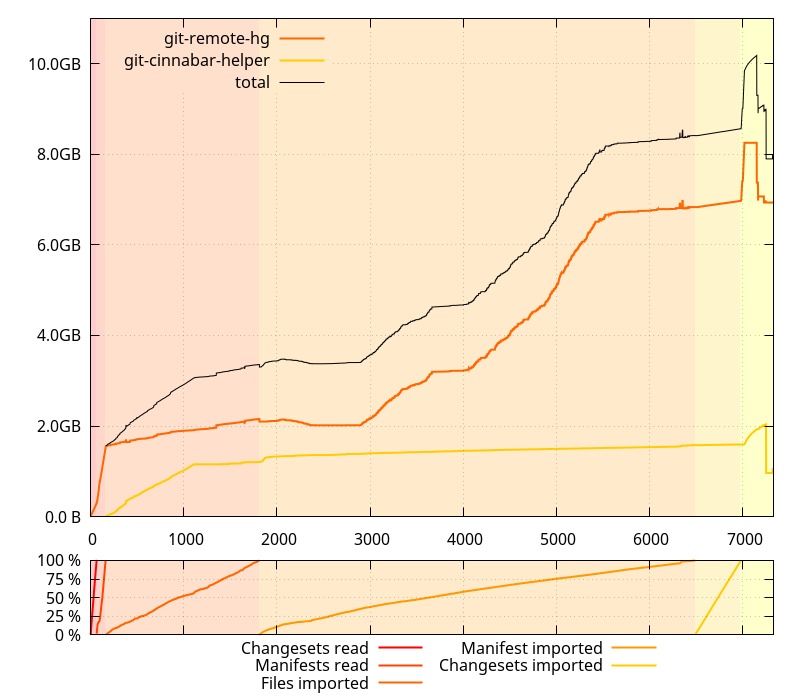
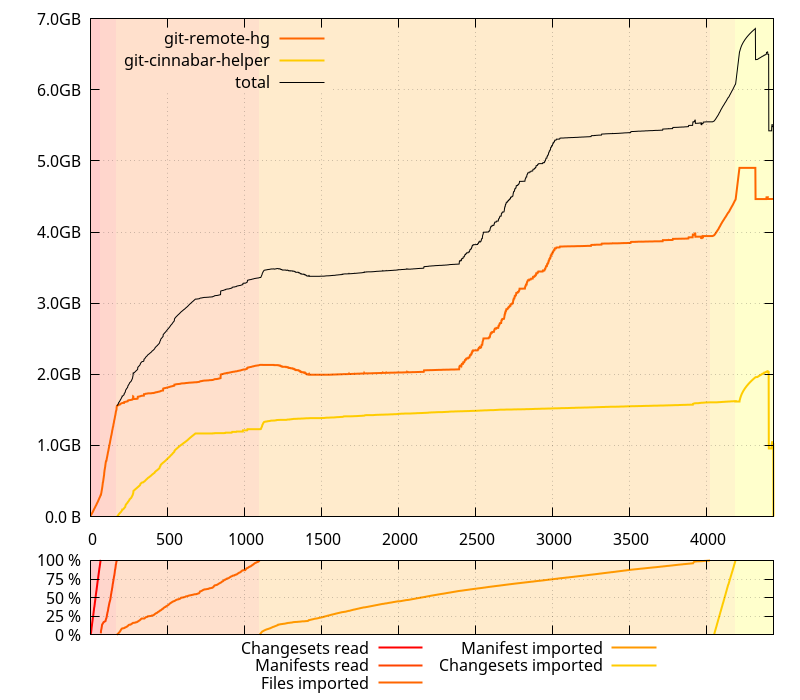
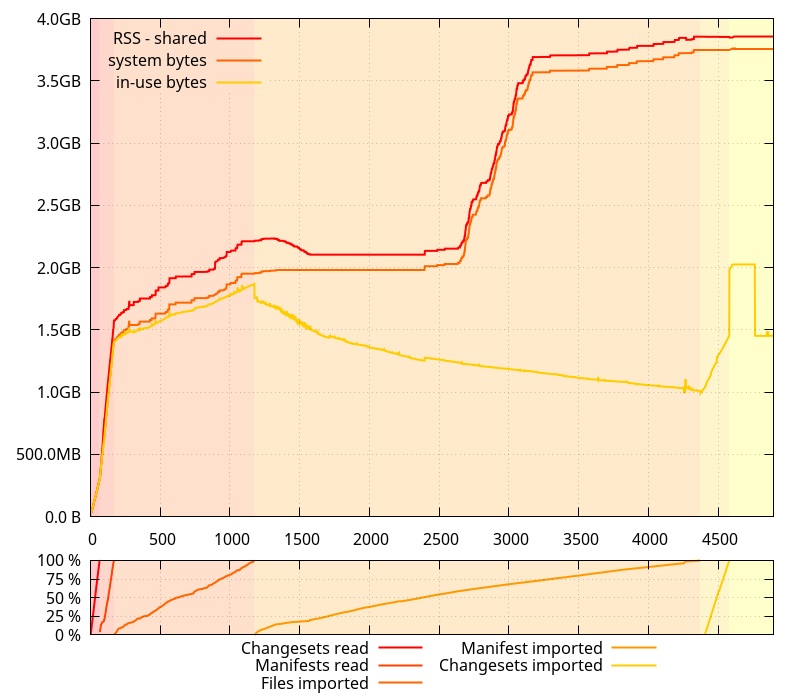
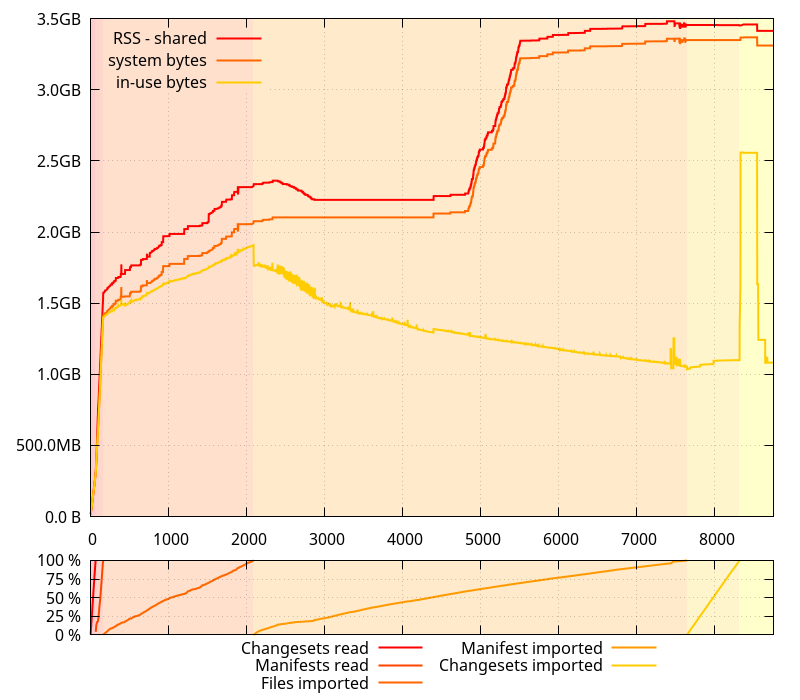
Cloning mozilla-central with git-cinnabar requires a lot of memory. Actually too much memory to fit in a 32-bits address space. I hadn t optimized for memory use in the first place. For instance, git-cinnabar keeps sha-1s in memory as hex values (40 bytes) rather than raw values (20 bytes). When I wrote the initial prototype, it didn t matter that much, and while close(ish) to the tipping point, it didn t require more than 2GB of memory at the time. Time passed, and mozilla-central grew. I suspect the recent addition of several thousands of commits and files has made things worse. In order to come up with a plan to make things better (short or longer term), I needed data. So I added some basic memory resource tracking, and collected data while cloning mozilla-central. I must admit, I was not ready for what I witnessed. Follow me for a tale of frustrations (plural). I was expecting things to have gotten worse on the master branch (which I used for the data collection) because I am in the middle of some refactoring and did many changes that I was suspecting might have affected memory usage. I wasn t, however, expecting to see the clone command using 10GB(!) memory at peak usage across all processes. (Note, those memory sizes are RSS, minus shared ) It also was taking an unexpected long time, but then, I hadn t cloned a large repository like mozilla-central from scratch in a while, so I wasn t sure if it was just related to its recent growth in size or otherwise. So I collected data on 0.4.0 as well. Less time spent, less memory usage ok. There s definitely something wrong on master. But wait a minute, that slope from ~2GB to ~4GB on the git-remote-hg process doesn t actually make any kind of sense. I mean, I d understand it if it were starting and finishing with the Import manifest phase, but it starts in the middle of it, and ends long before it finishes. WTH? First things first, since RSS can be a variety of things, I checked /proc/$pid/smaps and confirmed that most of it was, indeed, the heap. That s the point where you reach for Google, type something like python memory profile and find various tools. One from the results that I remembered having used in the past is guppy s heapy. Armed with pdb, I broke execution in the middle of the slope, and tried to get memory stats with heapy. SIGSEGV. Ouch. Let s try something else. I reached out to objgraph and pympler. SIGSEGV. Ouch again. Tried working around the crashes for a while (too long while, retrospectively, hindsight is 20/20), and was somehow successful at avoiding them by peaking at a smaller set of objects. But whatever I did, despite being attached to a process that had 2.6GB RSS, I wasn t able to find more than 1.3GB of data. This wasn t adding up. It surely didn t help that getting to that point took close to an hour each time. Retrospectively, I wish I had investigated using something like Checkpoint/Restore in Userspace. Anyways, after a while, I decided that I really wanted to try to see the whole picture, not smaller peaks here and there that might be missing something. So I resolved myself to look at the SIGSEGV I was getting when using pympler, collecting a core dump when it happened. Guess what? The Debian python-dbg package does not contain the debug symbols for the python package. The core dump was useless. Since I was expecting I d have to fix something in python, I just downloaded its source and built it. Ran the command again, waited, and finally got a backtrace. First Google hit for the crashing function? The exact (unfixed) crash reported on the python bug tracker. No patch. Crashing code is doing:
((f)->f_builtins != (f)->f_tstate->interp->builtins)
And (f)->f_tstate is NULL. Classic NULL deref. Added a guard (assessing it wouldn t break anything). Ran the command again. Waited. Again. SIGSEGV. Facedesk. Another crash on the same line. Did I really use the patched python? Yes. But this time (f)->f_tstate->interp is NULL. Sigh. Same player, shoot again. Finally, no crash but still stuck on only 1.3GB accounted for. Ok, I know not all python memory profiling tools are entirely reliable, let s try heapy again. SIGSEGV. Sigh. No debug info on the heapy module, where the crash happens. Sigh. Rebuild the module with debug info, try again. The backtrace looks like heapy is recursing a lot. Look at %rsp, compare with the address space from /proc/$pid/maps. Confirmed. A stack overflow. Let s do ugly things and increase the stack size in brutal ways. Woohoo! Now heapy tells me there s even less memory used than the 1.3GB I found so far. Like, half less. Yeah, right. I m not clear on how I got there, but that s when I found gdb-heap, a tool from Red Hat s David Malcolm, and the associated talk Dude, where s my RAM? A deep dive into how Python uses memory (slides). With a gdb attached, I would finally be able to rip python s guts out and find where all the memory went. Or so I thought. The gdb-heap tool only found about 600MB. About as much as heapy did, for that matter, but it could be coincidental. Oh. Kay. I don t remember exactly what went through my mind then, but, since I was attached to a running process with gdb, I typed the following on the gdb prompt:
gdb> call malloc_stats()
And that s when the truth was finally unvealed: the memory allocator was just acting up the whole time. The ouput was something like:
Arena 0:
system bytes    =  some number above (but close to) 2GB
in use bytes    =  some number above (but close to) 600MB
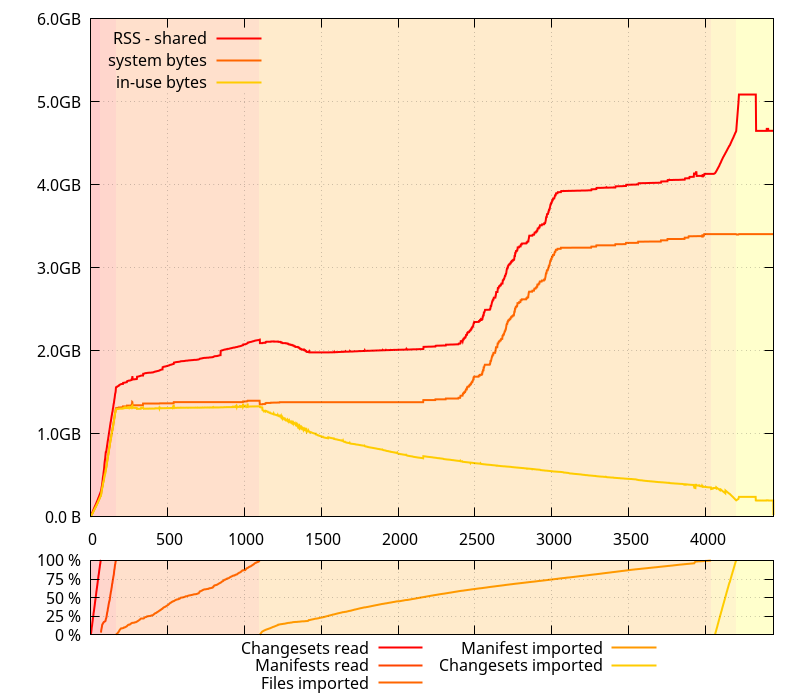
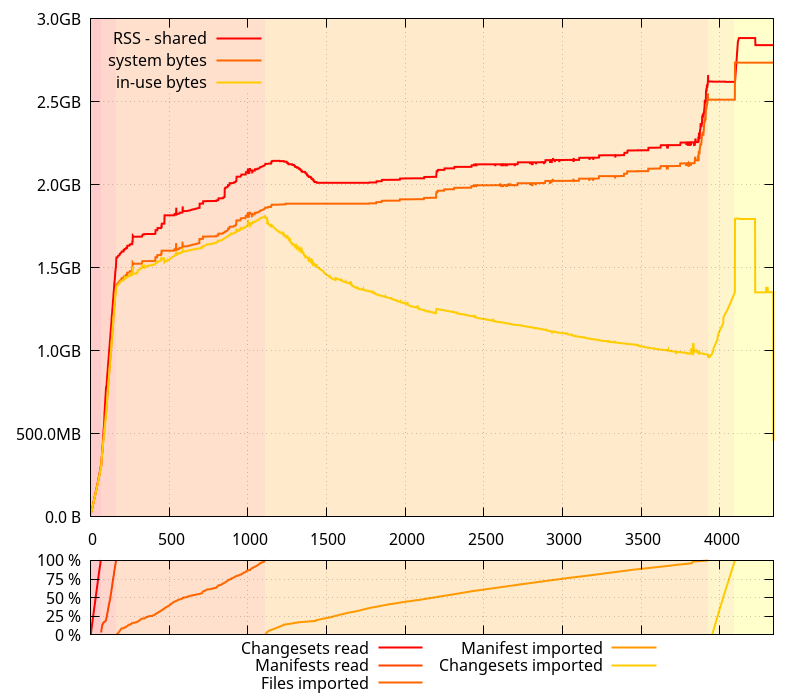
Yes, the glibc allocator was just telling it had allocated 600MB of memory, but was holding onto 2GB. I must have found a really bad allocation pattern that causes massive fragmentation. One thing that David Malcolm s talk taught me, though, is that python uses its own allocator for small sizes, so the glibc allocator doesn t know about them. And, roughly, adding the difference between RSS and what glibc said it was holding to to the use bytes it reported somehow matches the 1.3GB I had found so far. So it was time to see how those things evolved in time, during the entire clone process. I grabbed some new data, tracking the evolution of system bytes and in use bytes . There are two things of note on this data: In fact, the latter is exactly how git-cinnabar is supposed to work: It reads changesets and manifests chunks, and holds onto them while importing files. Then it throws away those manifests and changesets chunks one by one while it imports them. There is, however, some extra bookkeeping that requires some additional memory, but it s expected to be less memory consuming than keeping all the changesets and manifests chunks in memory. At this point, I thought a possible explanation is that since both python and glibc are mmap()ing their own arenas, they might be intertwined in a way that makes things not go well with the allocation pattern happening during the Import manifest phase (which, in fact, allocates and frees increasingly large buffers for each manifest, as manifests grow in size in the mozilla-central history). To put the theory at work, I patched the python interpreter again, making it use malloc() instead of mmap() for its arenas. Aha! I thought. That definitely looks much better. Less gap between what glibc says it requested from the system and the RSS size. And, more importantly, no runaway increase of memory usage in the middle of nowhere. I was preparing myself to write a post about how mixing allocators could have unintended consequences. As a comparison point, I went ahead and ran another test, with the python allocator entirely disabled, this time. Heh. It turns out glibc was acting up all alone. So much for my (plausible) theory. (I still think mixing allocators can have unintended consequences.) (Note, however, that the reason why the python allocator exists is valid: without it, the overall clone took almost 10 more minutes) And since I had been getting all this data with 0.4.0, I gathered new data without the python allocator with the master branch. This paints a rather different picture than the original data on that branch, with much less memory use regression than one would think. In fact, there isn t much difference, except for the spike at the end, which got worse, and some of the noise during the Import manifests phase that got bigger, implying larger amounts of temporary memory used. The latter may contribute to the allocation patterns that throw glibc s memory allocator off. It turns out tracking memory usage in python 2.7 is rather painful, and not all the tools paint a complete picture of it. I hear python 3.x is somewhat better in that regard, and I hope it s true, but at the moment, I m stuck with 2.7. The most reliable tool I ve used here, it turns out, is pympler. Or rebuilding the python interpreter without its allocator, and asking the system allocator what is allocated. With all this data, I now have some defined problems to tackle, some easy (the spike at the end of the clone), and some less easy (working around glibc allocator s behavior). I have a few hunches as to what kind of allocations are causing the runaway increase of RSS. Coincidentally, I m half-way through a refactor of the code dealing with manifests, and it should help dealing with the issue. But that will be the subject of a subsequent post.

Steve Kemp: How I started programming

I've written parts of this story in the past, but never in one place and never in much detail. So why not now? In 1982 my family moved house, so one morning I went to school and at lunch-time I had to walk home to a completely different house. We moved sometime towards the end of the year, and ended up spending lots of money replacing the windows of the new place. For people in York I was born in Farrar Street, Y010 3BY, and we moved to a place on Thief Lane, YO1 3HS. Being named as it was I "ironically" stole at least two street-signs and hung them on my bedroom wall. I suspect my parents were disappointed. Anyway the net result of this relocation, and the extra repairs meant that my sisters and I had a joint Christmas present that year, a ZX Spectrum 48k. I tried to find pictures of what we received but unfortunately the web doesn't remember the precise bundle. All together though we received: I know we also received Horace and the Spiders, and I have vague memories of some other things being included, including a Space Invaders clone. No doubt my parents bought them separately. Highlights of my Spectrum-gaming memories include R-Type, Strider, and the various "Dizzy" games. Some of the latter I remember very fondly. Unfortunately this Christmas was pretty underwhelming. We unpacked the machine, we cabled it up to the family TV-set - we only had the one, after all - and then proceeded to be very disappointed when nothing we did resulted in a successful game! It turns out our cassette-deck was not good enough. Being back in the 80s the shops were closed over Christmas, and my memory is that it was around January before we received a working tape-player/recorder, such that we could load games. Happily the computer came with manuals. I read one, skipping words and terms I didn't understand. I then read the other, which was the spiral-bound orange book. It contained enough examples and decent wording that I learned to write code in BASIC. Not bad for an 11/12 year old. Later I discovered that my local library contained "computer books". These were colourful books that promised "The Mystery of Silver Mounter", or "Write your own ADVENTURE PROGRAMS". But were largely dry books that contained nothing but multi-page listings of BASIC programs to type in. Often with adjustments that had to be made for your own computer-flavour (BASIC varying between different systems).
If you want to recapture the magic scroll to the foot of this Osbourne page and you can download them!
Later I taught myself Z80 Assembly Language, partly via the Spectrum manual and partly via such books as these two (which I still own 30ish years later): Pretty much the only reason I continued down this path is because I wanted infinite/extra lives in the few games I owned. (Which were largely pirated via the schoolboy network of parents with cassette-copiers.) Eventually I got some of my l33t POKES printed in magazines, and received free badges from the magazines of the day such as Your Sinclair & Sinclair User. For example I was "Hacker of the Month" in the Your Sinclair issue 67 , Page 32, apparently because I "asked so nicely in my letter". Terrible scan is terrible: Anyway that takes me from 1980ish to 1984. The only computer I ever touched was a Spectrum. Friends had other things, and there were Sega consoles, but I have no memories of them. Suffice it to say that later when I first saw a PC (complete with Hercules graphics, hard drives, and similar sourcery, running GEM IIRC) I was pleased that Intel assembly was "similar" to Z80 assembly - and now I know the reason why. Some time in the future I might document how I got my first computer job. It is hillarious. As was my naivete.

11 March 2017

John Goerzen: Silent Data Corruption Is Real

Here s something you never want to see:
ZFS has detected a checksum error:
   eid: 138
 class: checksum
  host: alexandria
  time: 2017-01-29 18:08:10-0600
 vtype: disk
This means there was a data error on the drive. But it s worse than a typical data error this is an error that was not detected by the hardware. Unlike most filesystems, ZFS and btrfs write a checksum with every block of data (both data and metadata) written to the drive, and the checksum is verified at read time. Most filesystems don t do this, because theoretically the hardware should detect all errors. But in practice, it doesn t always, which can lead to silent data corruption. That s why I use ZFS wherever I possibly can. As I looked into this issue, I saw that ZFS repaired about 400KB of data. I thought, well, that was unlucky and just ignored it. Then a week later, it happened again. Pretty soon, I noticed it happened every Sunday, and always to the same drive in my pool. It so happens that the highest I/O load on the machine happens on Sundays, because I have a cron job that runs zpool scrub on Sundays. This operation forces ZFS to read and verify the checksums on every block of data on the drive, and is a nice way to guard against unreadable sectors in rarely-used data. I finally swapped out the drive, but to my frustration, the new drive now exhibited the same issue. The SATA protocol does include a CRC32 checksum, so it seemed (to me, at least) that the problem was unlikely to be a cable or chassis issue. I suspected motherboard. It so happened I had a 9211-8i SAS card. I had purchased it off eBay awhile back when I built the server, but could never get it to see the drives. I wound up not filling it up with as many drives as planned, so the on-board SATA did the trick. Until now. As I poked at the 9211-8i, noticing that even its configuration utility didn t see any devices, I finally started wondering if the SAS/SATA breakout cables were a problem. And sure enough I realized I had a reverse cable and needed a forward one. $14 later, I had the correct cable and things are working properly now. One other note: RAM errors can sometimes cause issues like this, but this system uses ECC DRAM and the errors would be unlikely to always manifest themselves on a particular drive. So over the course of this, had I not been using ZFS, I would have had several megabytes of reads with undetected errors. Thanks to using ZFS, I know my data integrity is still good.

10 March 2017

Jonathan Dowland: Nintendo NES Classic Mini

After months of trying, I've finally got my hands on a Nintendo NES Classic Mini. It's everything I wish retropie was: simple, reliable, plug-and-play gaming. I didn't have a NES at the time, so the games are all mostly new to me (although I'm familiar with things like Super Mario Brothers).
NES classic and 8bitdo peripherals NES classic and 8bitdo peripherals
The two main complaints about the NES classic are the very short controller cable and the need to press the "reset" button on the main unit to dip in and out of games. Both are addressed by the excellent 8bitdo Retro Receiver for NES Classic bundle. You get a bluetooth dongle that plugs into the classic and a separate wireless controller. The controller is a replica of the original NES controller. However, they've added another two buttons on the right-hand side alongside the original "A" and "B", and two discrete shoulder buttons which serve as turbo-repeat versions of "A" and "B". The extra red buttons make it look less authentic which is a bit of a shame, and are not immediately useful on the NES classic (but more on that in a minute). With the 8bitdo controller, you can remotely activate the Reset button by pressing "Down" and "Select" at the same time. Therefore the whole thing can be played from the comfort of my sofa. That's basically enough for me, for now, but in the future if I want to expand the functionality of the classic, it's possible to mod it. A hack called "Hakchi2" lets you install additional NES ROMs; install retroarch-based emulator cores and thus play SNES, Megadrive, N64 (etc. etc.) games; as well as other hacks like adding "down+select" Reset support to the wired controller. If you were playing non-NES games on the classic, then the extra buttons on the 8bitdo become useful.

Reproducible builds folks: Reproducible Builds: week 97 in Stretch cycle

Here's what happened in the Reproducible Builds effort between Sunday February 26 and Saturday March 4 2017: Upcoming Events Ed Maste will present Reproducible Builds in FreeBSD at AsiaBSDCon 2017. Ximin Luo will present Reproducible builds, its uses and the future at Open Source Days in Copenhagen on March 18. Holger Levsen will give a talk at the German Unix User Group's "Fr hjahrsfachgespr ch" in Darmstadt, Germany, about Reproducible Builds everywhere on March 23. Verifying Software Freedom with Reproducible Builds will be presented by Vagrant Cascadian at Libreplanet2017 in Boston, March 25th-26th. Media coverage Aspiration Tech published a very detailed report on our Reproducible Builds World Summit 2016 in Berlin. Reproducible work in other projects Duncan published a very thorough post on the Rust Programming Language Forum about reproducible builds in the Rust compiler and toolchain. In particular, he produced a table recording the reproducibility of different build products under different individual variations, totalling 187 build+variation combinations. Packages reviewed and fixed, and bugs filed Chris Lamb: Dhole: Reviews of unreproducible packages 60 package reviews have been added, 8 have been updated and 13 have been removed in this week, adding to our knowledge about identified issues. 1 issue type has been added: Weekly QA work During our reproducibility testing, FTBFS bugs have been detected and reported by: diffoscope development diffoscope 78 was uploaded to unstable and jessie-backports by Mattia Rizzolo. It included contributions from: In addition, the following changes were made on the experimental branch: reproducible-website development tests.reproducible-builds.org Misc. This week's edition was written by Ximin Luo, Chris Lamb, Holger Levsen & reviewed by a bunch of Reproducible Builds folks on IRC & the mailing lists.

Mart n Ferrari: SunCamp happening again this May!

As I announced in mailing lists a few days ago, the Debian SunCamp (DSC2017) is happening again this May. SunCamp different to most other Debian events. Instead of a busy schedule of talks, SunCamp focuses on the hacking and socialising aspect, without making it just a Debian party/vacation.
DSC2016 - Hacking and discussing
The idea is to have 4 very productive days, staying in a relaxing and comfy environment, working on your own projects, meeting with your team, or presenting to fellow Debianites your most recent pet project.
DSC2016 - Tincho talking about Prometheus
We have tried to make this event the simplest event possible, both for organisers and attendees. There will be no schedule, except for the meal times at the hotel. But these can be ignored too, there is a lovely bar that serves snacks all day long, and plenty of restaurants and caf s around the village. DSC2016 - Hacking and discussing The SunCamp is an event to get work done, but there will be time for relaxing and socialising too.
DSC2016 - Well deserved siesta
DSC2016 - Playing P tanque
Do you fancy a hack-camp in a place like this? Swimming pool Caf Caf  terrace One of the things that makes the event simple, is that we have negotiated a flat price for accommodation that includes usage of all the facilities in the hotel, and optionally food. We will give you a booking code, and then you arrange your accommodation as you please, you can even stay longer if you feel like it! The rooms are simple but pretty, and everything has been renovated very recently. Room Room view We are not preparing a talks programme, but we will provide the space and resources for talks if you feel inclined to prepare one. You will have a huge meeting room, divided in 4 areas to reduce noise, where you can hack, have team discussions, or present talks. Hacklab Hacklab Do you want to see more pictures? Check the full gallery
Debian SunCamp 2017 Hotel Anabel, LLoret de Mar, Province of Girona, Catalonia, Spain May 18-21, 2017

Tempted already? Head to the wikipage and register now, it is only 2 months away! Please try to reserve your room before the end of March. The hotel has reserved a number of rooms for us until that time. You can reserve a room after March, but we can't guarantee the hotel will still have free rooms. Comment

Next.

Previous.