Search Results: "ina"

27 October 2016

Russ Allbery: DocKnot 1.00

I'm a bit of a perfectionist about package documentation, and I'm also a huge fan of consistency. As I've slowly accumulated more open source software packages (alas, fewer new ones these days since I have less day-job time to work on them), I've developed a standard format for package documentation files, particularly the README in the package and the web pages I publish. I've iterated on these, tweaking them and messing with them, trying to incorporate all my accumulated wisdom about what information people need. Unfortunately, this gets very tedious, since I have dozens of packages at this point and rarely want to go through the effort of changing every one of them every time I come up with a better way of phrasing something or change some aspect of my standard package build configuration. I also have the same information duplicated in multiple locations (the README and the web page for the package). And there's a lot of boilerplate that's common for all of my packages that I don't want to keep copying (or changing when I do things like change all eyrie.org URLs to HTTPS). About three years ago, I started seriously brainstorming ways of automating this process. I made a start on it during one self-directed day at my old job at Stanford, but only got it far enough to generate a few basic files. Since then, I keep thinking about it, keep wishing I had it, and keep not putting the work into finishing it. During this vacation, after a week and a half of relaxing and reading, I finally felt like doing a larger development project and finally started working on this for long enough to build up some momentum. Two days later, and this is finally ready for an initial release. DocKnot uses metadata (which I'm putting in docs/metadata) that's mostly JSON plus some documentation fragments and generates README, the web page for the package (in thread, the macro language I use for all my web pages), and (the other thing I've wanted to do and didn't want to tackle without this tool) README.md, a Markdown version of README that will look nice on GitHub. The templates that come with the package are all rather specific to me, particularly the thread template which would be unusable by anyone else. I have no idea if anyone else will want to use this package (and right now the metadata format is entirely undocumented). But since it's a shame to not release things as free software, and since I suspect I may need to upload it to Debian since, technically, this tool is required to "build" the README file distributed with my packages, here it is. I've also uploaded it to CPAN (it's my first experiment with the App::* namespace for things that aren't really meant to be used as a standalone Perl module). You can get the latest version from the DocKnot distribution page (which is indeed generated with DocKnot). Also now generated with DocKnot are the rra-c-util and C TAP Harness distribution pages. Let me know if you see anything weird; there are doubtless still a few bugs.

26 October 2016

Christoph Egger: Installing a python systemd service?

As web search engines and IRC seems to be of no help, maybe someone here has a helpful idea. I have some service written in python that comes with a .service file for systemd. I now want to build&install a working service file from the software's setup.py. I can override the build/build_py commands of setuptools, however that way I still lack knowledge wrt. the bindir/prefix where my service script will be installed. Solution Turns out, if you override the install command (not the install_data!), you will have self.root and self.install_scripts (and lots of other self.install_*). As a result, you can read the template and write the desired output file after calling super's run method. The fix was inspired by GateOne (which, however doesn't get the --root parameter right, you need to strip self.root from the beginning of the path to actually make that work as intended). As suggested on IRC, the snippet (and my software) no use pkg-config to get at the systemd path as well. This is a nice improvement orthogonal to the original problem. The implementation here follows bley.

def systemd_unit_path():
    try:
        command = ["pkg-config", "--variable=systemdsystemunitdir", "systemd"]
        path = subprocess.check_output(command, stderr=subprocess.STDOUT)
        return path.decode().replace('\n', '')
    except (subprocess.CalledProcessError, OSError):
        return "/lib/systemd/system"
class my_install(install):
    _servicefiles = [
        'foo/bar.service',
        ]
    def run(self):
        install.run(self)
        if not self.dry_run:
            bindir = self.install_scripts
            if bindir.startswith(self.root):
                bindir = bindir[len(self.root):]
            systemddir = "%s%s" % (self.root, systemd_unit_path())
            for servicefile in self._servicefiles:
                service = os.path.split(servicefile)[1]
                self.announce("Creating %s" % os.path.join(systemddir, service),
                              level=2)
                with open(servicefile) as servicefd:
                    servicedata = servicefd.read()
                with open(os.path.join(systemddir, service), "w") as servicefd:
                    servicefd.write(servicedata.replace("%BINDIR%", bindir))
Comments, suggestions and improvements, of course, welcome!

Steinar H. Gunderson: Why does software development take so long?

Nageru 1.4.0 is out (and on its way through the Debian upload process right now), so now you can do live video mixing with multichannel audio to your heart's content. I've already blogged about most of the interesting new features, so instead, I'm trying to answer a question: What took so long? To be clear, I'm not saying 1.4.0 took more time than I really anticipated (on the contrary, I pretty much understood the scope from the beginning, and there was a reason why I didn't go for building this stuff into 1.0.0); but if you just look at the changelog from the outside, it's not immediately obvious why multichannel audio support should take the better part of three months of develoment. What I'm going to say is of course going to be obvious to most software developers, but not everyone is one, and perhaps my experiences will be illuminating. Let's first look at some obvious things that isn't the case: First of all, development is not primarily limited by typing speed. There are about 9,000 lines of new code in 1.4.0 (depending a bit on how you count), and if it was just about typing them in, I would be done in a day or two. On a good keyboard, I can type plain text at more than 800 characters per minute but you hardly ever write code for even a single minute at that speed. Just as when writing a novel, most time is spent thinking, not typing. I also didn't spend a lot of time backtracking; most code I wrote actually ended up in the finished product as opposed to being thrown away. (I'm not as lucky in all of my projects.) It's pretty common to do so if you're in an exploratory phase, but in this case, I had a pretty good idea of what I wanted to do right from the start, and that plan seemed to work. This wasn't a difficult project per se; it just needed to be done (which, in a sense, just increases the mystery). However, even if this isn't at the forefront of science in any way (most code in the world is pretty pedestrian, after all), there's still a lot of decisions to make, on several levels of abstraction. And a lot of those decisions depend on information gathering beforehand. Let's take a look at an example from late in the development cycle, namely support for using MIDI controllers instead of the mouse to control the various widgets. I've kept a pretty meticulous TODO list; it's just a text file on my laptop, but it serves the purpose of a ghetto bugtracker. For 1.4.0, it contains 83 work items (a single-digit number is not ticked off, mostly because I decided not to do those things), which corresponds roughly 1:2 to the number of commits. So let's have a look at what the ~20 MIDI controller items went into. First of all, to allow MIDI controllers to influence the UI, we need a way of getting to it. Since Nageru is single-platform on Linux, ALSA is the obvious choice (if not, I'd probably have to look for a library to put in-between), but seemingly, ALSA has two interfaces (raw MIDI and sequencer). Which one do you want? It sounds like raw MIDI is what we want, but actually, it's the sequencer interface (it does more of the MIDI parsing for you, and generally is friendlier). The first question is where to start picking events from. I went the simplest path and just said I wanted all events anything else would necessitate a UI, a command-line flag, figuring out if we wanted to distinguish between different devices with the same name (and not all devices potentially even have names), and so on. But how do you enumerate devices? (Relatively simple, thankfully.) What do you do if the user inserts a new one while Nageru is running? (Turns out there's a special device you can subscribe to that will tell you about new devices.) What if you get an error on subscription? (Just print a warning and ignore it; it's legitimate not to have access to all devices on the system. By the way, for PCM devices, all of these answers are different.) So now we have a sequencer device, how do we get events from it? Can we do it in the main loop? Turns out it probably doesn't integrate too well with Qt, but it's easy enough to put it in a thread. The class dealing with the MIDI handling now needs locking; what mutex granularity do we want? (Experience will tell you that you nearly always just want one mutex. Two mutexes give you all sorts of headaches with ordering them, and nearly never gives any gain.) ALSA expects us to poll() a given set of descriptors for data, but on shutdown, how do you break out of that poll to tell the thread to go away? (The simplest way on Linux is using an eventfd.) There's a quirk where if you get two or more MIDI messages right after each other and only read one, poll() won't trigger to alert you there are more left. Did you know that? (I didn't. I also can't find it documented. Perhaps it's a bug?) It took me some looking into sample code to find it. Oh, and ALSA uses POSIX error codes to signal errors (like nothing more is available ), but it doesn't use errno. OK, so you have events (like controller 3 was set to value 47 ); what do you do about them? The meaning of the controller numbers is different from device to device, and there's no open format for describing them. So I had to make a format describing the mapping; I used protobuf (I have lots of experience with it) to make a simple text-based format, but it's obviously a nightmare to set up 50+ controllers by hand in a text file, so I had to make an UI for this. My initial thought was making a grid of spinners (similar to how the input mapping dialog already worked), but then I realized that there isn't an easy way to make headlines in Qt's grid. (You can substitute a label widget for a single cell, but not for an entire row. Who knew?) So after some searching, I found out that it would be better to have a tree view (Qt Creator does this), and then you can treat that more-or-less as a table for the rows that should be editable. Of course, guessing controller numbers is impossible even in an editor, so I wanted it to respond to MIDI events. This means the editor needs to take over the role as MIDI receiver from the main UI. How you do that in a thread-safe way? (Reuse the existing mutex; you don't generally want to use atomics for complicated things.) Thinking about it, shouldn't the MIDI mapper just support multiple receivers at a time? (Doubtful; you don't want your random controller fiddling during setup to actually influence the audio on a running stream. And would you use the old or the new mapping?) And do you really need to set up every single controller for each bus, given that the mapping is pretty much guaranteed to be similar for them? Making a guess bus button doesn't seem too difficult, where if you have one correctly set up controller on the bus, it can guess from a neighboring bus (assuming a static offset). But what if there's conflicting information? OK; then you should disable the button. So now the enable/disable status of that button depends on which cell in your grid has the focus; how do you get at those events? (Install an event filter, or subclass the spinner.) And so on, and so on, and so on. You could argue that most of these questions go away with experience; if you're an expert in a given API, you can answer most of these questions in a minute or two even if you haven't heard the exact question before. But you can't expect even experienced developers to be an expert in all possible libraries; if you know everything there is to know about Qt, ALSA, x264, ffmpeg, OpenGL, VA-API, libusb, microhttpd and Lua (in addition to C++11, of course), I'm sure you'd be a great fit for Nageru, but I'd wager that pretty few developers fit that bill. I've written C++ for almost 20 years now (almost ten of them professionally), and that experience certainly helps boosting productivity, but I can't say I expect a 10x reduction in my own development time at any point. You could also argue, of course, that spending so much time on the editor is wasted, since most users will only ever see it once. But here's the point; it's not actually a lot of time. The only reason why it seems like so much is that I bothered to write two paragraphs about it; it's not a particular pain point, it just adds to the total. Also, the first impression matters a lot if the user can't get the editor to work, they also can't get the MIDI controller to work, and is likely to just go do something else. A common misconception is that just switching languages or using libraries will help you a lot. (Witness the never-ending stream of software that advertises written in Foo or uses Bar as if it were a feature.) For the former, note that nothing I've said so far is specific to my choice of language (C++), and I've certainly avoided a bunch of battles by making that specific choice over, say, Python. For the latter, note that most of these problems are actually related to library use libraries are great, and they solve a bunch of problems I'm really glad I didn't have to worry about (how should each button look?), but they still give their own interaction problems. And even when you're a master of your chosen programming environment, things still take time, because you have all those decisions to make on top of your libraries. Of course, there are cases where libraries really solve your entire problem and your code gets reduced to 100 trivial lines, but that's really only when you're solving a problem that's been solved a million times before. Congrats on making that blog in Rails; I'm sure you're advancing the world. (To make things worse, usually this breaks down when you want to stray ever so slightly from what was intended by the library or framework author. What seems like a perfect match can suddenly become a development trap where you spend more of your time trying to become an expert in working around the given library than actually doing any development.) The entire thing reminds me of the famous essay No Silver Bullet by Fred Brooks, but perhaps even more so, this quote from John Carmack's .plan has struck with me (incidentally about mobile game development in 2006, but the basic story still rings true):
To some degree this is already the case on high end BREW phones today. I have a pretty clear idea what a maxed out software renderer would look like for that class of phones, and it wouldn't be the PlayStation-esq 3D graphics that seems to be the standard direction. When I was doing the graphics engine upgrades for BREW, I started along those lines, but after putting in a couple days at it I realized that I just couldn't afford to spend the time to finish the work. "A clear vision" doesn't mean I can necessarily implement it in a very small integral number of days.
In a sense, programming is all about what your program should do in the first place. The how question is just the what , moved down the chain of abstractions until it ends up where a computer can understand it, and at that point, the three words multichannel audio support have become those 9,000 lines that describe in perfect detail what's going on.

Daniel Pocock: FOSDEM 2017 Real-Time Communications Call for Participation

FOSDEM is one of the world's premier meetings of free software developers, with over five thousand people attending each year. FOSDEM 2017 takes place 4-5 February 2017 in Brussels, Belgium. This email contains information about:
  • Real-Time communications dev-room and lounge,
  • speaking opportunities,
  • volunteering in the dev-room and lounge,
  • related events around FOSDEM, including the XMPP summit,
  • social events (the legendary FOSDEM Beer Night and Saturday night dinners provide endless networking opportunities),
  • the Planet aggregation sites for RTC blogs
Call for participation - Real Time Communications (RTC) The Real-Time dev-room and Real-Time lounge is about all things involving real-time communication, including: XMPP, SIP, WebRTC, telephony, mobile VoIP, codecs, peer-to-peer, privacy and encryption. The dev-room is a successor to the previous XMPP and telephony dev-rooms. We are looking for speakers for the dev-room and volunteers and participants for the tables in the Real-Time lounge. The dev-room is only on Saturday, 4 February 2017. The lounge will be present for both days. To discuss the dev-room and lounge, please join the FSFE-sponsored Free RTC mailing list. To be kept aware of major developments in Free RTC, without being on the discussion list, please join the Free-RTC Announce list. Speaking opportunities Note: if you used FOSDEM Pentabarf before, please use the same account/username Real-Time Communications dev-room: deadline 23:59 UTC on 17 November. Please use the Pentabarf system to submit a talk proposal for the dev-room. On the "General" tab, please look for the "Track" option and choose "Real-Time devroom". Link to talk submission. Other dev-rooms and lightning talks: some speakers may find their topic is in the scope of more than one dev-room. It is encouraged to apply to more than one dev-room and also consider proposing a lightning talk, but please be kind enough to tell us if you do this by filling out the notes in the form. You can find the full list of dev-rooms on this page and apply for a lightning talk at https://fosdem.org/submit Main track: the deadline for main track presentations is 23:59 UTC 31 October. Leading developers in the Real-Time Communications field are encouraged to consider submitting a presentation to the main track. First-time speaking? FOSDEM dev-rooms are a welcoming environment for people who have never given a talk before. Please feel free to contact the dev-room administrators personally if you would like to ask any questions about it. Submission guidelines The Pentabarf system will ask for many of the essential details. Please remember to re-use your account from previous years if you have one. In the "Submission notes", please tell us about:
  • the purpose of your talk
  • any other talk applications (dev-rooms, lightning talks, main track)
  • availability constraints and special needs
You can use HTML and links in your bio, abstract and description. If you maintain a blog, please consider providing us with the URL of a feed with posts tagged for your RTC-related work. We will be looking for relevance to the conference and dev-room themes, presentations aimed at developers of free and open source software about RTC-related topics. Please feel free to suggest a duration between 20 minutes and 55 minutes but note that the final decision on talk durations will be made by the dev-room administrators. As the two previous dev-rooms have been combined into one, we may decide to give shorter slots than in previous years so that more speakers can participate. Please note FOSDEM aims to record and live-stream all talks. The CC-BY license is used. Volunteers needed To make the dev-room and lounge run successfully, we are looking for volunteers:
  • FOSDEM provides video recording equipment and live streaming, volunteers are needed to assist in this
  • organizing one or more restaurant bookings (dependending upon number of participants) for the evening of Saturday, 4 February
  • participation in the Real-Time lounge
  • helping attract sponsorship funds for the dev-room to pay for the Saturday night dinner and any other expenses
  • circulating this Call for Participation (text version) to other mailing lists
See the mailing list discussion for more details about volunteering. Related events - XMPP and RTC summits The XMPP Standards Foundation (XSF) has traditionally held a summit in the days before FOSDEM. There is discussion about a similar summit taking place on 2 and 3 February 2017. XMPP Summit web site - please join the mailing list for details. We are also considering a more general RTC or telephony summit, potentially in collaboration with the XMPP summit. Please join the Free-RTC mailing list and send an email if you would be interested in participating, sponsoring or hosting such an event. Social events and dinners The traditional FOSDEM beer night occurs on Friday, 3 February. On Saturday night, there are usually dinners associated with each of the dev-rooms. Most restaurants in Brussels are not so large so these dinners have space constraints and reservations are essential. Please subscribe to the Free-RTC mailing list for further details about the Saturday night dinner options and how you can register for a seat. Spread the word and discuss If you know of any mailing lists where this CfP would be relevant, please forward this email (text version). If this dev-room excites you, please blog or microblog about it, especially if you are submitting a talk. If you regularly blog about RTC topics, please send details about your blog to the planet site administrators:
Planet site Admin contact
All projects Free-RTC Planet (http://planet.freertc.org) contact planet@freertc.org
XMPP Planet Jabber (http://planet.jabber.org) contact ralphm@ik.nu
SIP Planet SIP (http://planet.sip5060.net) contact planet@sip5060.net
SIP (Espa ol) Planet SIP-es (http://planet.sip5060.net/es/) contact planet@sip5060.net
Please also link to the Planet sites from your own blog or web site as this helps everybody in the free real-time communications community. Contact For any private queries, contact us directly using the address fosdem-rtc-admin@freertc.org and for any other queries please ask on the Free-RTC mailing list. The dev-room administration team:

Joachim Breitner: Showcasing Applicative

My plan for this week s lecture of the CIS 194 Haskell course at the University of Pennsylvania is to dwell a bit on the concept of Functor, Applicative and Monad, and to highlight the value of the Applicative abstraction. I quite like the example that I came up with, so I want to share it here. In the interest of long-term archival and stand-alone presentation, I include all the material in this post.1

Imports In case you want to follow along, start with these imports:
import Data.Char
import Data.Maybe
import Data.List
import System.Environment
import System.IO
import System.Exit

The parser The starting point for this exercise is a fairly standard parser-combinator monad, which happens to be the result of the student s homework from last week:
newtype Parser a = P (String -> Maybe (a, String))
runParser :: Parser t -> String -> Maybe (t, String)
runParser (P p) = p
parse :: Parser a -> String -> Maybe a
parse p input = case runParser p input of
    Just (result, "") -> Just result
    _ -> Nothing -- handles both no result and leftover input
noParserP :: Parser a
noParserP = P (\_ -> Nothing)
pureParserP :: a -> Parser a
pureParserP x = P (\input -> Just (x,input))
instance Functor Parser where
    fmap f p = P $ \input -> do
	(x, rest) <- runParser p input
	return (f x, rest)
instance Applicative Parser where
    pure = pureParserP
    p1 <*> p2 = P $ \input -> do
        (f, rest1) <- runParser p1 input
        (x, rest2) <- runParser p2 rest1
        return (f x, rest2)
instance Monad Parser where
    return = pure
    p1 >>= k = P $ \input -> do
        (x, rest1) <- runParser p1 input
        runParser (k x) rest1
anyCharP :: Parser Char
anyCharP = P $ \input -> case input of
    (c:rest) -> Just (c, rest)
    []       -> Nothing
charP :: Char -> Parser ()
charP c = do
    c' <- anyCharP
    if c == c' then return ()
               else noParserP
anyCharButP :: Char -> Parser Char
anyCharButP c = do
    c' <- anyCharP
    if c /= c' then return c'
               else noParserP
letterOrDigitP :: Parser Char
letterOrDigitP = do
    c <- anyCharP
    if isAlphaNum c then return c else noParserP
orElseP :: Parser a -> Parser a -> Parser a
orElseP p1 p2 = P $ \input -> case runParser p1 input of
    Just r -> Just r
    Nothing -> runParser p2 input
manyP :: Parser a -> Parser [a]
manyP p = (pure (:) <*> p <*> manyP p)  orElseP  pure []
many1P :: Parser a -> Parser [a]
many1P p = pure (:) <*> p <*> manyP p
sepByP :: Parser a -> Parser () -> Parser [a]
sepByP p1 p2 = (pure (:) <*> p1 <*> (manyP (p2 *> p1)))  orElseP  pure []
A parser using this library for, for example, CSV files could take this form:
parseCSVP :: Parser [[String]]
parseCSVP = manyP parseLine
  where
    parseLine = parseCell  sepByP  charP ',' <* charP '\n'
    parseCell = do
        charP '"'
        content <- manyP (anyCharButP '"')
        charP '"'
        return content

We want EBNF Often when we write a parser for a file format, we might also want to have a formal specification of the format. A common form for such a specification is EBNF. This might look as follows, for a CSV file:
cell = '"',  not-quote , '"';
line = (cell,  ',', cell    ''), newline;
csv  =  line ;
It is straightforward to create a Haskell data type to represent an EBNF syntax description. Here is a simple EBNF library (data type and pretty-printer) for your convenience:
data RHS
  = Terminal String
    NonTerminal String
    Choice RHS RHS
    Sequence RHS RHS
    Optional RHS
    Repetition RHS
  deriving (Show, Eq)
ppRHS :: RHS -> String
ppRHS = go 0
  where
    go _ (Terminal s)     = surround "'" "'" $ concatMap quote s
    go _ (NonTerminal s)  = s
    go a (Choice x1 x2)   = p a 1 $ go 1 x1 ++ "   " ++ go 1 x2
    go a (Sequence x1 x2) = p a 2 $ go 2 x1 ++ ", "  ++ go 2 x2
    go _ (Optional x)     = surround "[" "]" $ go 0 x
    go _ (Repetition x)   = surround " " " " $ go 0 x
    surround c1 c2 x = c1 ++ x ++ c2
    p a n   a > n     = surround "(" ")"
            otherwise = id
    quote '\'' = "\\'"
    quote '\\' = "\\\\"
    quote c    = [c]
type Production = (String, RHS)
type BNF = [Production]
ppBNF :: BNF -> String
ppBNF = unlines . map (\(i,rhs) -> i ++ " = " ++ ppRHS rhs ++ ";")

Code to produce EBNF We had a good time writing combinators that create complex parsers from primitive pieces. Let us do the same for EBNF grammars. We could simply work on the RHS type directly, but we can do something more nifty: We create a data type that keeps track, via a phantom type parameter, of what Haskell type the given EBNF syntax is the specification:
newtype Grammar a = G RHS
ppGrammar :: Grammar a -> String
ppGrammar (G rhs) = ppRHS rhs
So a value of type Grammar t is a description of the textual representation of the Haskell type t. Here is one simple example:
anyCharG :: Grammar Char
anyCharG = G (NonTerminal "char")
Here is another one. This one does not describe any interesting Haskell type, but is useful when spelling out the special characters in the syntax described by the grammar:
charG :: Char -> Grammar ()
charG c = G (Terminal [c])
A combinator that creates new grammar from two existing grammars:
orElseG :: Grammar a -> Grammar a -> Grammar a
orElseG (G rhs1) (G rhs2) = G (Choice rhs1 rhs2)
We want the convenience of our well-known type classes in order to combine these values some more:
instance Functor Grammar where
    fmap _ (G rhs) = G rhs
instance Applicative Grammar where
    pure x = G (Terminal "")
    (G rhs1) <*> (G rhs2) = G (Sequence rhs1 rhs2)
Note how the Functor instance does not actually use the function. How should it? There are no values inside a Grammar! We cannot define a Monad instance for Grammar: We would start with (G rhs1) >>= k = , but there is simply no way of getting a value of type a that we can feed to k. So we will do without a Monad instance. This is interesting, and we will come back to that later. Like with the parser, we can now begin to build on the primitive example to build more complicated combinators:
manyG :: Grammar a -> Grammar [a]
manyG p = (pure (:) <*> p <*> manyG p)  orElseG  pure []
many1G :: Grammar a -> Grammar [a]
many1G p = pure (:) <*> p <*> manyG p
sepByG :: Grammar a -> Grammar () -> Grammar [a]
sepByG p1 p2 = ((:) <$> p1 <*> (manyG (p2 *> p1)))  orElseG  pure []
Let us run a small example:
dottedWordsG :: Grammar [String]
dottedWordsG = many1G (manyG anyCharG <* charG '.')
*Main> putStrLn $ ppGrammar dottedWordsG
'', ('', char, ('', char, ('', char, ('', char, ('', char, ('',  
Oh my, that is not good. Looks like the recursion in manyG does not work well, so we need to avoid that. But anyways we want to be explicit in the EBNF grammars about where something can be repeated, so let us just make many a primitive:
manyG :: Grammar a -> Grammar [a]
manyG (G rhs) = G (Repetition rhs)
With this definition, we already get a simple grammar for dottedWordsG:
*Main> putStrLn $ ppGrammar dottedWordsG
'',  char , '.',  char , '.' 
This already looks like a proper EBNF grammar. One thing that is not nice about it is that there is an empty string ('') in a sequence ( , ). We do not want that. Why is it there in the first place? Because our Applicative instance is not lawful! Remember that pure id <*> g == g should hold. One way to achieve that is to improve the Applicative instance to optimize this case away:
instance Applicative Grammar where
    pure x = G (Terminal "")
    G (Terminal "") <*> G rhs2 = G rhs2
    G rhs1 <*> G (Terminal "") = G rhs1
    (G rhs1) <*> (G rhs2) = G (Sequence rhs1 rhs2)
	 
Now we get what we want:
*Main> putStrLn $ ppGrammar dottedWordsG
 char , '.',  char , '.' 
Remember our parser for CSV files above? Let me repeat it here, this time using only Applicative combinators, i.e. avoiding (>>=), (>>), return and do-notation:
parseCSVP :: Parser [[String]]
parseCSVP = manyP parseLine
  where
    parseLine = parseCell  sepByP  charG ',' <* charP '\n'
    parseCell = charP '"' *> manyP (anyCharButP '"') <* charP '"'
And now we try to rewrite the code to produce Grammar instead of Parser. This is straightforward with the exception of anyCharButP. The parser code for that inherently monadic, and we just do not have a monad instance. So we work around the issue by making that a primitive grammar, i.e. introducing a non-terminal in the EBNF without a production rule pretty much like we did for anyCharG:
primitiveG :: String -> Grammar a
primitiveG s = G (NonTerminal s)
parseCSVG :: Grammar [[String]]
parseCSVG = manyG parseLine
  where
    parseLine = parseCell  sepByG  charG ',' <* charG '\n'
    parseCell = charG '"' *> manyG (primitiveG "not-quote") <* charG '"'
Of course the names parse are not quite right any more, but let us just leave that for now. Here is the result:
*Main> putStrLn $ ppGrammar parseCSVG
 ('"',  not-quote , '"',  ',', '"',  not-quote , '"'    ''), '
' 
The line break is weird. We do not really want newlines in the grammar. So let us make that primitive as well, and replace charG '\n' with newlineG:
newlineG :: Grammar ()
newlineG = primitiveG "newline"
Now we get
*Main> putStrLn $ ppGrammar parseCSVG
 ('"',  not-quote , '"',  ',', '"',  not-quote , '"'    ''), newline 
which is nice and correct, but still not quite the easily readable EBNF that we saw further up.

Code to produce EBNF, with productions We currently let our grammars produce only the right-hand side of one EBNF production, but really, we want to produce a RHS that may refer to other productions. So let us change the type accordingly:
newtype Grammar a = G (BNF, RHS)
runGrammer :: String -> Grammar a -> BNF
runGrammer main (G (prods, rhs)) = prods ++ [(main, rhs)]
ppGrammar :: String -> Grammar a -> String
ppGrammar main g = ppBNF $ runGrammer main g
Now we have to adjust all our primitive combinators (but not the derived ones!):
charG :: Char -> Grammar ()
charG c = G ([], Terminal [c])
anyCharG :: Grammar Char
anyCharG = G ([], NonTerminal "char")
manyG :: Grammar a -> Grammar [a]
manyG (G (prods, rhs)) = G (prods, Repetition rhs)
mergeProds :: [Production] -> [Production] -> [Production]
mergeProds prods1 prods2 = nub $ prods1 ++ prods2
orElseG :: Grammar a -> Grammar a -> Grammar a
orElseG (G (prods1, rhs1)) (G (prods2, rhs2))
    = G (mergeProds prods1 prods2, Choice rhs1 rhs2)
instance Functor Grammar where
    fmap _ (G bnf) = G bnf
instance Applicative Grammar where
    pure x = G ([], Terminal "")
    G (prods1, Terminal "") <*> G (prods2, rhs2)
        = G (mergeProds prods1 prods2, rhs2)
    G (prods1, rhs1) <*> G (prods2, Terminal "")
        = G (mergeProds prods1 prods2, rhs1)
    G (prods1, rhs1) <*> G (prods2, rhs2)
        = G (mergeProds prods1 prods2, Sequence rhs1 rhs2)
primitiveG :: String -> Grammar a
primitiveG s = G (NonTerminal s)
The use of nub when combining productions removes duplicates that might be used in different parts of the grammar. Not efficient, but good enough for now. Did we gain anything? Not yet:
*Main> putStr $ ppGrammar "csv" (parseCSVG)
csv =  ('"',  not-quote , '"',  ',', '"',  not-quote , '"'    ''), newline ;
But we can now introduce a function that lets us tell the system where to give names to a piece of grammar:
nonTerminal :: String -> Grammar a -> Grammar a
nonTerminal name (G (prods, rhs))
  = G (prods ++ [(name, rhs)], NonTerminal name)
Ample use of this in parseCSVG yields the desired result:
parseCSVG :: Grammar [[String]]
parseCSVG = manyG parseLine
  where
    parseLine = nonTerminal "line" $
        parseCell  sepByG  charG ',' <* newline
    parseCell = nonTerminal "cell" $
        charG '"' *> manyG (primitiveG "not-quote") <* charG '"
*Main> putStr $ ppGrammar "csv" (parseCSVG)
cell = '"',  not-quote , '"';
line = (cell,  ',', cell    ''), newline;
csv =  line ;
This is great!

Unifying parsing and grammar-generating Note how simliar parseCSVG and parseCSVP are! Would it not be great if we could implement that functionality only once, and get both a parser and a grammar description out of it? This way, the two would never be out of sync! And surely this must be possible. The tool to reach for is of course to define a type class that abstracts over the parts where Parser and Grammer differ. So we have to identify all functions that are primitive in one of the two worlds, and turn them into type class methods. This includes char and orElse. It includes many, too: Although manyP is not primitive, manyG is. It also includes nonTerminal, which does not exist in the world of parsers (yet), but we need it for the grammars. The primitiveG function is tricky. We use it in grammars when the code that we might use while parsing is not expressible as a grammar. So the solution is to let it take two arguments: A String, when used as a descriptive non-terminal in a grammar, and a Parser a, used in the parsing code. Finally, the type classes that we except, Applicative (and thus Functor), are added as constraints on our type class:
class Applicative f => Descr f where
    char :: Char -> f ()
    many :: f a -> f [a]
    orElse :: f a -> f a -> f a
    primitive :: String -> Parser a -> f a
    nonTerminal :: String -> f a -> f a
The instances are easily written:
instance Descr Parser where
    char = charP
    many = manyP
    orElse = orElseP
    primitive _ p = p
    nonTerminal _ p = p
instance Descr Grammar where
    char = charG
    many = manyG
    orElse = orElseG
    primitive s _ = primitiveG s
    nonTerminal s g = nonTerminal s g
And we can now take the derived definitions, of which so far we had two copies, and define them once and for all:
many1 :: Descr f => f a -> f [a]
many1 p = pure (:) <*> p <*> many p
anyChar :: Descr f => f Char
anyChar = primitive "char" anyCharP
dottedWords :: Descr f => f [String]
dottedWords = many1 (many anyChar <* char '.')
sepBy :: Descr f => f a -> f () -> f [a]
sepBy p1 p2 = ((:) <$> p1 <*> (many (p2 *> p1)))  orElse  pure []
newline :: Descr f => f ()
newline = primitive "newline" (charP '\n')
And thus we now have our CSV parser/grammar generator:
parseCSV :: Descr f => f [[String]]
parseCSV = many parseLine
  where
    parseLine = nonTerminal "line" $
        parseCell  sepBy  char ',' <* newline
    parseCell = nonTerminal "cell" $
        char '"' *> many (primitive "not-quote" (anyCharButP '"')) <* char '"'
We can now use this definition both to parse and to generate grammars:
*Main> putStr $ ppGrammar2 "csv" (parseCSV)
cell = '"',  not-quote , '"';
line = (cell,  ',', cell    ''), newline;
csv =  line ;
*Main> parse parseCSV "\"ab\",\"cd\"\n\"\",\"de\"\n\n"
Just [["ab","cd"],["","de"],[]]

The INI file parser and grammar As a final exercise, let us transform the INI file parser into a combined thing. Here is the parser (another artifact of last week s homework) again using applicative style2:
parseINIP :: Parser INIFile
parseINIP = many1P parseSection
  where
    parseSection =
        (,) <$  charP '['
            <*> parseIdent
            <*  charP ']'
            <*  charP '\n'
            <*> (catMaybes <$> manyP parseLine)
    parseIdent = many1P letterOrDigitP
    parseLine = parseDecl  orElseP  parseComment  orElseP  parseEmpty
    parseDecl = Just <$> (
        (,) <*> parseIdent
            <*  manyP (charP ' ')
            <*  charP '='
            <*  manyP (charP ' ')
            <*> many1P (anyCharButP '\n')
            <*  charP '\n')
    parseComment =
        Nothing <$ charP '#'
                <* many1P (anyCharButP '\n')
                <* charP '\n'
    parseEmpty = Nothing <$ charP '\n'
Transforming that to a generic description is quite straightforward. We use primitive again to wrap letterOrDigitP:
descrINI :: Descr f => f INIFile
descrINI = many1 parseSection
  where
    parseSection =
        (,) <*  char '['
            <*> parseIdent
            <*  char ']'
            <*  newline
            <*> (catMaybes <$> many parseLine)
    parseIdent = many1 (primitive "alphanum" letterOrDigitP)
    parseLine = parseDecl  orElse  parseComment  orElse  parseEmpty
    parseDecl = Just <$> (
        (,) <*> parseIdent
            <*  many (char ' ')
            <*  char '='
            <*  many (char ' ')
            <*> many1 (primitive "non-newline" (anyCharButP '\n'))
	    <*  newline)
    parseComment =
        Nothing <$ char '#'
                <* many1 (primitive "non-newline" (anyCharButP '\n'))
		<* newline
    parseEmpty = Nothing <$ newline
This yields this not very helpful grammar (abbreviated here):
*Main> putStr $ ppGrammar2 "ini" descrINI
ini = '[', alphanum,  alphanum , ']', newline,  alphanum,  alphanum ,  ' ' 
But with a few uses of nonTerminal, we get something really nice:
descrINI :: Descr f => f INIFile
descrINI = many1 parseSection
  where
    parseSection = nonTerminal "section" $
        (,) <$  char '['
            <*> parseIdent
            <*  char ']'
            <*  newline
            <*> (catMaybes <$> many parseLine)
    parseIdent = nonTerminal "identifier" $
        many1 (primitive "alphanum" letterOrDigitP)
    parseLine = nonTerminal "line" $
        parseDecl  orElse  parseComment  orElse  parseEmpty
    parseDecl = nonTerminal "declaration" $ Just <$> (
        (,) <$> parseIdent
            <*  spaces
            <*  char '='
            <*  spaces
            <*> remainder)
    parseComment = nonTerminal "comment" $
        Nothing <$ char '#' <* remainder
    remainder = nonTerminal "line-remainder" $
        many1 (primitive "non-newline" (anyCharButP '\n')) <* newline
    parseEmpty = Nothing <$ newline
    spaces = nonTerminal "spaces" $ many (char ' ')
*Main> putStr $ ppGrammar "ini" descrINI
identifier = alphanum,  alphanum ;
spaces =  ' ' ;
line-remainder = non-newline,  non-newline , newline;
declaration = identifier, spaces, '=', spaces, line-remainder;
comment = '#', line-remainder;
line = declaration   comment   newline;
section = '[', identifier, ']', newline,  line ;
ini = section,  section ;

Recursion (variant 1) What if we want to write a parser/grammar-generator that is able to generate the following grammar, which describes terms that are additions and multiplications of natural numbers:
const = digit,  digit ;
spaces =  ' '   newline ;
atom = const   '(', spaces, expr, spaces, ')', spaces;
mult = atom,  spaces, '*', spaces, atom , spaces;
plus = mult,  spaces, '+', spaces, mult , spaces;
expr = plus;
The production of expr is recursive (via plus, mult, atom). We have seen above that simply defining a Grammar a recursively does not go well. One solution is to add a new combinator for explicit recursion, which replaces nonTerminal in the method:
class Applicative f => Descr f where
     
    recNonTerminal :: String -> (f a -> f a) -> f a
instance Descr Parser where
     
    recNonTerminal _ p = let r = p r in r
instance Descr Grammar where
     
    recNonTerminal = recNonTerminalG
recNonTerminalG :: String -> (Grammar a -> Grammar a) -> Grammar a
recNonTerminalG name f =
    let G (prods, rhs) = f (G ([], NonTerminal name))
    in G (prods ++ [(name, rhs)], NonTerminal name)
nonTerminal :: Descr f => String -> f a -> f a
nonTerminal name p = recNonTerminal name (const p)
runGrammer :: String -> Grammar a -> BNF
runGrammer main (G (prods, NonTerminal nt))   main == nt = prods
runGrammer main (G (prods, rhs)) = prods ++ [(main, rhs)]
The change in runGrammer avoids adding a pointless expr = expr production to the output. This lets us define a parser/grammar-generator for the arithmetic expressions given above:
data Expr = Plus Expr Expr   Mult Expr Expr   Const Integer
    deriving Show
mkPlus :: Expr -> [Expr] -> Expr
mkPlus = foldl Plus
mkMult :: Expr -> [Expr] -> Expr
mkMult = foldl Mult
parseExpr :: Descr f => f Expr
parseExpr = recNonTerminal "expr" $ \ exp ->
    ePlus exp
ePlus :: Descr f => f Expr -> f Expr
ePlus exp = nonTerminal "plus" $
    mkPlus <$> eMult exp
           <*> many (spaces *> char '+' *> spaces *> eMult exp)
           <*  spaces
eMult :: Descr f => f Expr -> f Expr
eMult exp = nonTerminal "mult" $
    mkPlus <$> eAtom exp
           <*> many (spaces *> char '*' *> spaces *> eAtom exp)
           <*  spaces
eAtom :: Descr f => f Expr -> f Expr
eAtom exp = nonTerminal "atom" $
    aConst  orElse  eParens exp
aConst :: Descr f => f Expr
aConst = nonTerminal "const" $ Const . read <$> many1 digit
eParens :: Descr f => f a -> f a
eParens inner =
    id <$  char '('
       <*  spaces
       <*> inner
       <*  spaces
       <*  char ')'
       <*  spaces
And indeed, this works:
*Main> putStr $ ppGrammar "expr" parseExpr
const = digit,  digit ;
spaces =  ' '   newline ;
atom = const   '(', spaces, expr, spaces, ')', spaces;
mult = atom,  spaces, '*', spaces, atom , spaces;
plus = mult,  spaces, '+', spaces, mult , spaces;
expr = plus;

Recursion (variant 2) Interestingly, there is another solution to this problem, which avoids introducing recNonTerminal and explicitly passing around the recursive call (i.e. the exp in the example). To implement that we have to adjust our Grammar type as follows:
newtype Grammar a = G ([String] -> (BNF, RHS))
The idea is that the list of strings is those non-terminals that we are currently defining. So in nonTerminal, we check if the non-terminal to be introduced is currently in the process of being defined, and then simply ignore the body. This way, the recursion is stopped automatically:
nonTerminalG :: String -> (Grammar a) -> Grammar a
nonTerminalG name (G g) = G $ \seen ->
    if name  elem  seen
    then ([], NonTerminal name)
    else let (prods, rhs) = g (name : seen)
         in (prods ++ [(name, rhs)], NonTerminal name)
After adjusting the other primitives of Grammar (including the Functor and Applicative instances, wich now again have nonTerminal) to type-check again, we observe that this parser/grammar generator for expressions, with genuine recursion, works now:
parseExp :: Descr f => f Expr
parseExp = nonTerminal "expr" $
    ePlus
ePlus :: Descr f => f Expr
ePlus = nonTerminal "plus" $
    mkPlus <$> eMult
           <*> many (spaces *> char '+' *> spaces *> eMult)
           <*  spaces
eMult :: Descr f => f Expr
eMult = nonTerminal "mult" $
    mkPlus <$> eAtom
           <*> many (spaces *> char '*' *> spaces *> eAtom)
           <*  spaces
eAtom :: Descr f => f Expr
eAtom = nonTerminal "atom" $
    aConst  orElse  eParens parseExp
Note that the recursion is only going to work if there is at least one call to nonTerminal somewhere around the recursive calls. We still cannot implement many as naively as above.

Homework If you want to play more with this: The homework is to define a parser/grammar-generator for EBNF itself, as specified in this variant:
identifier = letter,  letter   digit   '-' ;
spaces =  ' '   newline ;
quoted-char = non-quote-or-backslash   '\\', '\\'   '\\', '\'';
terminal = '\'',  quoted-char , '\'', spaces;
non-terminal = identifier, spaces;
option = '[', spaces, rhs, spaces, ']', spaces;
repetition = ' ', spaces, rhs, spaces, ' ', spaces;
group = '(', spaces, rhs, spaces, ')', spaces;
atom = terminal   non-terminal   option   repetition   group;
sequence = atom,  spaces, ',', spaces, atom , spaces;
choice = sequence,  spaces, ' ', spaces, sequence , spaces;
rhs = choice;
production = identifier, spaces, '=', spaces, rhs, ';', spaces;
bnf = production,  production ;
This grammar is set up so that the precedence of , and is correctly implemented: a , b c will parse as (a, b) c. In this syntax for BNF, terminal characters are quoted, i.e. inside ' ', a ' is replaced by \' and a \ is replaced by \\ this is done by the function quote in ppRHS. If you do this, you should able to round-trip with the pretty-printer, i.e. parse back what it wrote:
*Main> let bnf1 = runGrammer "expr" parseExpr
*Main> let bnf2 = runGrammer "expr" parseBNF
*Main> let f = Data.Maybe.fromJust . parse parseBNF. ppBNF
*Main> f bnf1 == bnf1
True
*Main> f bnf2 == bnf2
True
The last line is quite meta: We are using parseBNF as a parser on the pretty-printed grammar produced from interpreting parseBNF as a grammar.

Conclusion We have again seen an example of the excellent support for abstraction in Haskell: Being able to define so very different things such as a parser and a grammar description with the same code is great. Type classes helped us here. Note that it was crucial that our combined parser/grammars are only able to use the methods of Applicative, and not Monad. Applicative is less powerful, so by giving less power to the user of our Descr interface, the other side, i.e. the implementation, can be more powerful. The reason why Applicative is ok, but Monad is not, is that in Applicative, the results do not affect the shape of the computation, whereas in Monad, the whole point of the bind operator (>>=) is that the result of the computation is used to decide the next computation. And while this is perfectly fine for a parser, it just makes no sense for a grammar generator, where there simply are no values around! We have also seen that a phantom type, namely the parameter of Grammar, can be useful, as it lets the type system make sure we do not write nonsense. For example, the type of orElseG ensures that both grammars that are combined here indeed describe something of the same type.

  1. It seems to be the week of applicative-appraising blog posts: Brent has posted a nice piece about enumerations using Applicative yesterday.
  2. I like how in this alignment of <*> and <* the > point out where the arguments are that are being passed to the function on the left.

Dirk Eddelbuettel: Rblpapi 0.3.5

A new release of Rblpapi is now on CRAN. Rblpapi provides a direct interface between R and the Bloomberg Terminal via the C++ API provided by Bloomberg Labs (but note that a valid Bloomberg license and installation is required). This is the sixth release since the package first appeared on CRAN last year. This release brings new functionality via new (getPortfolio()) and extended functions (getTicks()) as well as several fixes:

Changes in Rblpapi version 0.3.5 (2016-10-25)
  • Add new function getPortfolio to retrieve portfolio data via bds (John in #176)
  • Extend getTicks() to (optionally) return non-numeric data as part of data.frame or data.table (Dirk in #200)
  • Similarly extend getMultipleTicks (Dirk in #202)
  • Correct statement on timestamp for getBars (Closes issue #192)
  • Minor edits to a few files in order to either please R(-devel) CMD check --as-cran, or update documentation

Courtesy of CRANberries, there is also a diffstat report for the this release. As always, more detailed information is on the Rblpapi page. Questions, comments etc should go to the issue tickets system at the GitHub repo.

This post by Dirk Eddelbuettel originated on his Thinking inside the box blog. Please report excessive re-aggregation in third-party for-profit settings.

25 October 2016

Laura Arjona Reina: Rankings, Condorcet and free software: Calculating the results for the Stretch Artwork Survey

We had 12 candidates for the Debian Stretch Artwork and a survey was set up for allowing people to vote which one they prefer.

The survey was run in my LimeSurvey instance, surveys.larjona.net. LimeSurvey its a nice free software with a lot of features. It provides a Ranking question type, and it was very easy for allowing people to vote in the Debian style (Debian uses the Condorcet method in its elections).

However, although LimeSurvey offers statistics and even graphics to show the results of many type of questions, its output for the Ranking type is not useful, so I had to export the data and use another tool to find the winner.
Export the data from LimeSurvey
I ve created a read-only user to visit the survey site. With this visitor you can explore the survey questionnaire, its results, and export the data.
Username: stretch
Password: artwork
First attempt, the quick and easy (and nonfree, I guess)
There is an online tool to calculate the Condorcet winner, http://www.ericgorr.net/condorcet/
The steps I followed to feed the tool with the data from LimeSurvey were these:
1.- Went to admin interface of lime survey, selected the stretch artwork survey, responses and statistics, export results to application
2.- Selected Completed responses only , Question codes , Answer codes , and exported to CSV. (results_stretch1.csv)
3.- Opened the CSV with LibreOffice Calc, and removed these columns:
id submitdate lastpage startlanguage
4.- Remove the first row containing the headers and saved the result (results_stretch2.csv)
5.- In commandline:
sort results_stretch2.csv   uniq -c > results_stretch3.csv
6.- Opened results_stretch3.csv with LibreOffice Calc and merge delimitors when importing.
7.- Removed the first column (blank) and added a column between the numbers and the first ranked option, and fulfilled that column with : value. Saved (results_stretch4.csv)
8.- Opened results_stretch4.csv with my preferred editor and search and replace ,:, for : and after that, search and replace , for > . Save the result (results_stretch5.csv)
9.- Went to http://condorcet.ericgorr.net/, selected Condorcet basic, tell me some things , and pasted the contents of results_stretch5.csv there.
The results are in results_stretch1.html
But where is the source code of this Condorcet tool?
I couldn t find the source code (nor license) of the solver by Eric Gorr.
The tool is mentioned in http://www.accuratedemocracy.com/z_tools.htm where other tools are listed and when the tool is libre software, is noted so. But not in this case.
There, I found another tool, VoteEngine, which is open source, so I tried with that.
Second attempt: VoteEngine, a Free Open Source Software tool made with Python
I used a modification of voteengine-0.99 (the original zip is available in http://vote.sourceforge.net/ and a diff with the changes I made (basically, Numeric -> numpy and Int -> int, inorder that works in Debian stable), here.
Steps 1 to 4 are the same as in the first attempt.
5.- Sorted alphabetically the different 12 options to vote, and
assigned a letter to each one (saved the assignments in a file called
6.- Opened results_stretch2.csv with my favorite editor, and search
and replace the name of the different options, for their corresponding
letter in stretch_key.txt file.
Searched and replaced , for (space). Then, saved the results into
7.- Copied the input.txt file from voteengine-0.99 into stretch.txt and edited the options
to our needs. Pasted the contents of results_stretch3_voteengine.cvs
at the end of stretch.txt
8.-In the commandline
./voteengine.py <stretch.txt  > winner.txt
(winner.txt contains the results for the Condorcet method).
9.- I edited again stretch.txt to change the method to shulze and
calculated the results, and again with the smith method. The winner in
the 3 methods is the same. I pasted the summary of these 3 methods
(shulze and smith provide a ranked list) in stretch_results.txt
If it can be done, it can be done with R
I found the algstat R package:
which includes a condorcet function but I couldn t make it work with the data.
I m not sure how the data needs to be shaped. I m sure that this can be done in R and the problem is me, in this case. Comments are welcome, and I ll try to ask to a friend whose R skills are better than mine!
And another SaaS
I found https://www.condorcet.vote/ and its source code. It would be interesting to deploy a local instance to drive future surveys, but for this time I didn t want to fight with PHP in order to use only the solver part, nor install another SaaS in my home server just to find that I need some other dependency or whatever.
I ll keep an eye on this, though, because it looks like a modern and active project.
Finally, devotee
Well and which software Debian uses for its elections?
There is a git repository with devotee, you can clone it:
I found that although the tool is quite modular, it s written specifically for the Debian case (votes received by mail, GPG signed, there is a quorum, and other particularities) and I was not sure if I could use it with my data. It is written in Perl and then I understood it worse than the Python from VoteEngine.
Maybe I ll return to it, though, when I have more time, to try to put our data in the shape of a typicall tally.txt file and then see if the module solving the condorcet winner can work for me.
That s all, folks! (for now )
Comments
You can coment on this blog post in this pump.io thread

Filed under: Tools Tagged: data mining, Debian, English, SaaS, statistics

Gunnar Wolf: On the results of vote "gr_private2"

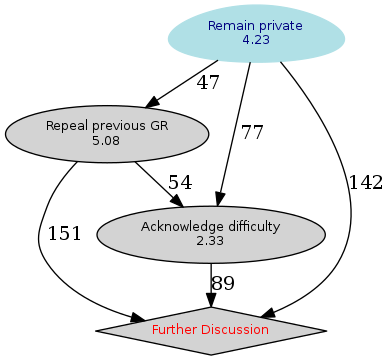
Given that I started the GR process, and that I called for discussion and votes, I feel somehow as my duty to also put a simple wrap-around to this process. Of course, I'll say many things already well-known to my fellow Debian people, but also non-debianers read this. So, for further context, if you need to, please read my previous blog post, where I was about to send a call for votes. It summarizes the situation and proposals; you will find we had a nice set of messages in debian-vote@lists.debian.org during September; I have to thank all the involved parties, much specially to Ian Jackson, who spent a lot of energy summing up the situation and clarifying the different bits to everyone involved. So, we held the vote; you can be interested in looking at the detailed vote statistics for the 235 correctly received votes, and most importantly, the results: Results for gr_private2 First of all, I'll say I'm actually surprised at the results, as I expected Ian's proposal (acknowledge difficulty; I actually voted this proposal as my top option) to win and mine (repeal previous GR) to be last; turns out, the winner option was Iain's (remain private). But all in all, I am happy with the results: As I said during the discussion, I was much disappointed with the results to the previous GR on this topic And, yes, it seems the breaking point was when many people thought the privacy status of posted messages was in jeopardy; we cannot really compare what I would have liked to have in said vote if we had followed the strategy of leaving the original resolution text instead of replacing it, but I believe it would have passed. In fact, one more surprise of this iteration was that I expected Further Discussion to be ranked higher, somewhere between the three explicit options. I am happy, of course, we got such an overwhelming clarity of what does the project as a whole prefer. And what was gained or lost with this whole excercise? Well, if nothing else, we gain to stop lying. For over ten years, we have had an accepted resolution binding us to release the messages sent to debian-private given such-and-such-conditions... But never got around to implement it. We now know that debian-private will remain private... But we should keep reminding ourselves to use the list as little as possible. For a project such as Debian, which is often seen as a beacon of doing the right thing no matter what, I feel being explicit about not lying to ourselves of great importance. Yes, we have the principle of not hiding our problems, but it has long been argued that the use of this list is not hiding or problems. Private communication can happen whenever you have humans involved, even if administratively we tried to avoid it. Any of the three running options could have won, and I'd be happy. My #1 didn't win, but my #2 did. And, I am sure, it's for the best of the project as a whole.

24 October 2016

Russ Allbery: Review: The Design of Everyday Things

Review: The Design of Everyday Things, by Don Norman
Publisher: Basic Books
Copyright: 2013
ISBN: 0-465-05065-4
Format: Trade paperback
Pages: 298
There are several editions of this book (the first under a different title, The Psychology of Everyday Things). This review is for the Revised and Expanded Edition, first published in 2013 and quite significantly revised compared to the original. I probably read at least some of the original for a class in human-computer interaction around 1994, but that was long enough ago that I didn't remember any of the details. I'm not sure how much impact this book has had outside of the computer field, but The Design of Everyday Things is a foundational text of HCI (human-computer interaction) despite the fact that many of its examples and much of its analysis is not specific to computers. Norman's goal is clearly to write a book that's fundamental to the entire field of design; not having studied the field, I don't know if he succeeded, but the impact on computing was certainly immense. This is the sort of book that everyone ends up hearing about, if not necessarily reading, in college. I was looking forward to filling a gap in my general knowledge. Having now read it cover-to-cover, would I recommend others invest the time? Maybe. But probably not. There are several things this book does well. One of the most significant is that it builds a lexicon and a set of general principles that provide a way of talking about design issues. Lexicons are not the most compelling reading material (see also Design Patterns), but having a common language is useful. I still remember affordances from college (probably from this book or something else based on it). Norman also adds, and defines, signifiers, constraints, mappings, and feedback, and talks about the human process of building a conceptual model of the objects with which one is interacting. Even more useful, at least in my opinion, is the discussion of human task-oriented behavior. The seven stages of action is a great systematic way of analyzing how humans perform tasks, where those actions can fail, and how designers can help minimize failure. One thing I particularly like about Norman's presentation here is the emphasis on the feedback cycle after performing a task, or a step in a task. That feedback, and what makes good or poor feedback, is (I think) an underappreciated part of design and something that too often goes missing. I thought Norman was a bit too dismissive of simple beeps as feedback (he thinks they don't carry enough information; while that's not wrong, I think they're far superior to no feedback at all), but the emphasis on this point was much appreciated. Beyond these dry but useful intellectual frameworks, though, Norman seems to have a larger purpose in The Design of Everyday Things: making a passionate argument for the importance of design and for not tolerating poor design. This is where I think his book goes a bit off the rails. I can appreciate the boosterism of someone who feels an aspect of creating products is underappreciated and underfunded. But Norman hammers on the unacceptability of bad design to the point of tedium, and seems remarkably intolerant of, and unwilling to confront, the reasons why products may be released with poor designs for their eventual users. Norman clearly wishes that we would all boycott products with poor designs and prize usability above most (all?) other factors in our decisions. Equally clearly, this is not happening, and Norman knows it. He even describes some of the reasons why not, most notably (and most difficultly) the fact that the purchasers of many products are not the eventual users. Stoves are largely sold to builders, not kitchen cooks. Light switches are laid out for the convenience of the electrician; here too, the motive for the builder to spend additional money on better lighting controls is unclear. So much business software is purchased by people who will never use it directly, and may have little or no contact with the people who do. These layers of economic separation result in deep disconnects of incentive structure between product manufacturers and eventual consumers. Norman acknowledges this, writes about it at some length, and then seems to ignore the point entirely, returning to ranting about the deficiencies of obviously poor design and encouraging people to care more about design. This seems weirdly superficial in this foundational of a book. I came away half-convinced that these disconnects of incentive (and some related problems, such as the unwillingness to invest in proper field research or the elaborate, expensive, and lengthy design process Norman lays out as ideal) are the primary obstacle in the way of better-designed consumer goods. If that's the case, then this is one of the largest, if not the largest, obstacle in the way of doing good design, and I would have expected this foundational of a book to tackle it head-on and provide some guidance for how to fight back against this problem. But Norman largely doesn't. There is some mention of this in the introduction. Apparently much of the discussion of the practical constraints on product design in the business world was added in this revised edition, and perhaps what I'm seeing is the limitations of attempting to revise an existing text. But that also implies that the original took an even harder line against poor design. Throughout, Norman is remarkably high-handed in his dismissal of bad design, focusing more on condemnation than on an investigation of why bad design might happen and what we, as readers, can learn from that process to avoid repeating it. Norman does provide extensive analysis of the design process and the psychology of human interaction, but still left me with the impression that he believes most design failures stem from laziness and stupidity. The negativity and frustration got a bit tedious by the middle of the book. There's quite a lot here that someone working in design, particularly interface design, should be at least somewhat familiar with: affordances, signifiers, the importance of feedback, the psychological model of tasks and actions, and the classification of errors, just to name a few. However, I'm not sure this book is the best medium for learning those things. I found it a bit tedious, a bit too arrogant, and weirdly unconcerned with feasible solutions to the challenge of mismatched incentives. I also didn't learn that much from it; while the concepts here are quite important, most of them I'd picked up by osmosis from working in the computing field for twenty years. In that way, The Design of Everyday Things reminded me a great deal of the Gang of Four's Design Patterns, even though it's a more readable book and less of an exercise in academic classification. The concepts presented are useful and important, but I'm not sure I can recommend the book as a book. It may be better to pick up the same concepts as you go, with the help of Internet searches and shorter essays. Rating: 6 out of 10

Dirk Eddelbuettel: Word Marathon Majors: Five Star Finisher!

A little over eight years ago, I wrote a short blog post which somewhat dryly noted that I had completed the five marathons constituting the World Marathon Majors. I had completed Boston, Chicago and New York during 2007, adding London and then Berlin (with a personal best) in 2008. The World Marathon Majors existed then, but I was not aware of a website. The organisation was aiming to raise the profile of the professional and very high-end aspect of the sport. But marathoning is funny as they let somewhat regular folks like you and me into the same race. And I always wondered if someone kept track of regular folks completing the suite... I have been running a little less the last few years, though I did get around to complete the Illinois Marathon earlier this year (only tweeted about it and still have not added anything to the running section of my blog). But two weeks ago, I was once again handing out water cups at the Chicago Marathon, sending along two tweets when the elite wheelchair and elite male runners flew by. To the first, the World Marathon Majors account replied, which lead me to their website. Which in turn lead me to the Five Star Finisher page, and the newer / larger Six Star Finisher page now that Tokyo has been added. And in short, one can now request one's record to be added (if they check out). So I did. And now I am on the Five Star Finisher page! I don't think I'll ever surpass that as a runner. The table header and my row look like this: Table header Dirk Eddelbuettel If only my fifth / sixth grade physical education teacher could see that---he was one of those early running nuts from the 1970s and made us run towards / around this (by now enlarged) pond and boy did I hate that :) Guess it did have some long lasting effects. And I casually circled the lake a few years ago, starting much further away from my parents place. Once you are in the groove for distance... But leaving that aside, running has been fun and I with some luck I may have another one or two marathons or Ragnar Relays left. The only really bad part about this is that I may have to get myself to Tokyo after all (for something that is not an ISM workshop) ...

This post by Dirk Eddelbuettel originated on his Thinking inside the box blog. Please report excessive re-aggregation in third-party for-profit settings.

Francois Marier: Tweaking Referrers For Privacy in Firefox

The Referer header has been a part of the web for a long time. Websites rely on it for a few different purposes (e.g. analytics, ads, CSRF protection) but it can be quite problematic from a privacy perspective. Thankfully, there are now tools in Firefox to help users and developers mitigate some of these problems.

Description In a nutshell, the browser adds a Referer header to all outgoing HTTP requests, revealing to the server on the other end the URL of the page you were on when you placed the request. For example, it tells the server where you were when you followed a link to that site, or what page you were on when you requested an image or a script. There are, however, a few limitations to this simplified explanation. First of all, by default, browsers won't send a referrer if you place a request from an HTTPS page to an HTTP page. This would reveal potentially confidential information (such as the URL path and query string which could contain session tokens or other secret identifiers) from a secure page over an insecure HTTP channel. Firefox will however include a Referer header in HTTPS to HTTPS transitions unless network.http.sendSecureXSiteReferrer (removed in Firefox 52) is set to false in about:config. Secondly, using the new Referrer Policy specification web developers can override the default behaviour for their pages, including on a per-element basis. This can be used both to increase or reduce the amount of information present in the referrer.

Legitimate Uses Because the Referer header has been around for so long, a number of techniques rely on it. Armed with the Referer information, analytics tools can figure out:
  • where website traffic comes from, and
  • how users are navigating the site.
Another place where the Referer is useful is as a mitigation against cross-site request forgeries. In that case, a website receiving a form submission can reject that form submission if the request originated from a different website. It's worth pointing out that this CSRF mitigation might be better implemented via a separate header that could be restricted to particularly dangerous requests (i.e. POST and DELETE requests) and only include the information required for that security check (i.e. the origin).

Problems with the Referrer Unfortunately, this header also creates significant privacy and security concerns. The most obvious one is that it leaks part of your browsing history to sites you visit as well as all of the resources they pull in (e.g. ads and third-party scripts). It can be quite complicated to fix these leaks in a cross-browser way. These leaks can also lead to exposing private personally-identifiable information when they are part of the query string. One of the most high-profile example is the accidental leakage of user searches by healthcare.gov.

Solutions for Firefox Users While web developers can use the new mechanisms exposed through the Referrer Policy, Firefox users can also take steps to limit the amount of information they send to websites, advertisers and trackers. In addition to enabling Firefox's built-in tracking protection by setting privacy.trackingprotection.enabled to true in about:config, which will prevent all network connections to known trackers, users can control when the Referer header is sent by setting network.http.sendRefererHeader to:
  • 0 to never send the header
  • 1 to send the header only when clicking on links and similar elements
  • 2 (default) to send the header on all requests (e.g. images, links, etc.)
It's also possible to put a limit on the maximum amount of information that the header will contain by setting the network.http.referer.trimmingPolicy to:
  • 0 (default) to send the full URL
  • 1 to send the URL without its query string
  • 2 to only send the scheme, host and port
or using the network.http.referer.XOriginTrimmingPolicy option (added in Firefox 52) to only restrict the contents of referrers attached to cross-origin requests. Site owners can opt to share less information with other sites, but they can't share any more than what the user trimming policies allow. Another approach is to disable the Referer when doing cross-origin requests (from one site to another). The network.http.referer.XOriginPolicy preference can be set to:
  • 0 (default) to send the referrer in all cases
  • 1 to send a referrer only when the base domains are the same
  • 2 to send a referrer only when the full hostnames match

Breakage If you try to remove all referrers (i.e. network.http.sendRefererHeader = 0, you will most likely run into problems on a number of sites, for example: The first two have been worked-around successfully by setting network.http.referer.spoofSource to true, an advanced setting which always sends the destination URL as the referrer, thereby not leaking anything about the original page. Unfortunately, the last two are examples of the kind of breakage that can only be fixed through a whitelist (an approach supported by the smart referer add-on) or by temporarily using a different browser profile.

My Recommended Settings As with my cookie recommendations, I recommend strengthening your referrer settings but not disabling (or spoofing) it entirely. While spoofing does solve many the breakage problems mentioned above, it also effectively disables the anti-CSRF protections that some sites may rely on and that have tangible user benefits. A better approach is to limit the amount of information that leaks through cross-origin requests. If you are willing to live with some amount of breakage, you can simply restrict referrers to the same site by setting:
network.http.referer.XOriginPolicy = 2
or to sites which belong to the same organization (i.e. same ETLD/public suffix) using:
network.http.referer.XOriginPolicy = 1
This prevent leaks to third-parties while giving websites all of the information that they can already see in their own server logs. On the other hand, if you prefer a weaker but more compatible solution, you can trim cross-origin referrers down to just the scheme, hostname and port:
network.http.referer.XOriginTrimmingPolicy = 2
I have not yet found user-visible breakage using this last configuration. Let me know if you find any!

23 October 2016

Vincent Sanders: Rabbit of Caerbannog

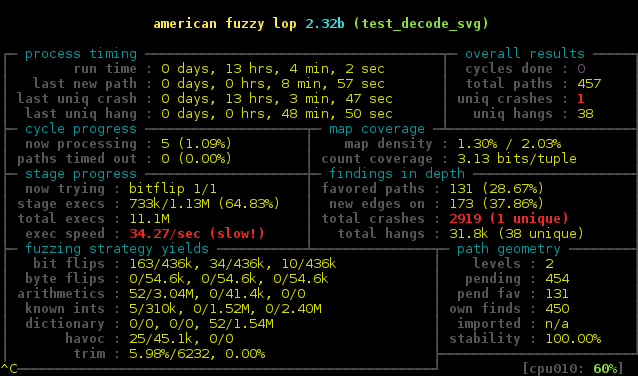
Subsequent to my previous use of American Fuzzy Lop (AFL) on the NetSurf bitmap image library I applied it to the gif library which, after fixing the test runner, failed to produce any crashes but did result in a better test corpus improving coverage above 90%

I then turned my attention to the SVG processing library. This was different to the bitmap libraries in that it required parsing a much lower density text format and performing operations on the resulting tree representation.

The test program for the SVG library needed some improvement but is very basic in operation. It takes the test SVG, parses it using libsvgtiny and then uses the parsed output to write out an imagemagick mvg file.

The libsvg processing uses the NetSurf DOM library which in turn uses an expat binding to parse the SVG XML text. To process this with AFL required instrumenting not only the XVG library but the DOM library. I did not initially understand this and my first run resulted in a "map coverage" indicating an issue. Helpfully the AFL docs do cover this so it was straightforward to rectify.

Once the test program was written and environment set up an AFL run was started and left to run. The next day I was somewhat alarmed to discover the fuzzer had made almost no progress and was running very slowly. I asked for help on the AFL mailing list and got a polite and helpful response, basically I needed to RTFM.

I must thank the members of the AFL mailing list for being so helpful and tolerating someone who ought to know better asking dumb questions.

After reading the fine manual I understood I needed to ensure all my test cases were as small as possible and further that the fuzzer needed a dictionary as a hint to the file format because the text file was of such low data density compared to binary formats.

Rabbit of Caerbannog. Death awaits you with pointy teeth
I crafted an SVG dictionary based on the XML one, ensured all the seed SVG files were as small as possible and tried again. The immediate result was thousands of crashes, nothing like being savaged by a rabbit to cause a surprise.

Not being in possession of the appropriate holy hand grenade I resorted instead to GDB and electric fence. Unlike the bitmap library crashes memory bounds issues simply did not feature in the crashes.Instead they mainly centered around actual logic errors when constructing and traversing the data structures.

For example Daniel Silverstone fixed an interesting bug where the XML parser binding would try and go "above" the root node in the tree if the source closed more tags than it opened which resulted in wild pointers and NULL references.

I found and squashed several others including dealing with SVG which has no valid root element and division by zero errors when things like colour gradients have no points.

I find it interesting that the type and texture of the crashes completely changed between the SVG and binary formats. Perhaps it is just the nature of the textural formats that causes this although it might be due to the techniques used to parse the formats.

Once all the immediately reproducible crashes were dealt with I performed a longer run. I used my monster system as previously described and ran the fuzzer for a whole week.

Summary stats
=============

Fuzzers alive : 10
Total run time : 68 days, 7 hours
Total execs : 9268 million
Cumulative speed : 15698 execs/sec
Pending paths : 0 faves, 2501 total
Pending per fuzzer : 0 faves, 250 total (on average)
Crashes found : 9 locally unique

After burning almost seventy days of processor time AFL found me another nine crashes and possibly more importantly a test corpus that generates over 90% coverage.

A useful tool that AFL provides is afl-cmin. This reduces the number of test files in a corpus to only those that are required to exercise all the code paths reached by the test set. In this case it reduced the number of files from 8242 to 2612

afl-cmin -i queue_all/ -o queue_cmin -- test_decode_svg @@ 1.0 /dev/null
corpus minimization tool for afl-fuzz by

[+] OK, 1447 tuples recorded.
[*] Obtaining traces for input files in 'queue_all/'...
Processing file 8242/8242...
[*] Sorting trace sets (this may take a while)...
[+] Found 23812 unique tuples across 8242 files.
[*] Finding best candidates for each tuple...
Processing file 8242/8242...
[*] Sorting candidate list (be patient)...
[*] Processing candidates and writing output files...
Processing tuple 23812/23812...
[+] Narrowed down to 2612 files, saved in 'queue_cmin'.

Additionally the actual information within the test files can be minimised with the afl-tmin tool. This must be run on each file individually and can take a relatively long time. Fortunately with GNU parallel one can run many of these jobs simultaneously which merely required another three days of CPU time to process. The resulting test corpus weighs in at a svelte 15 Megabytes or so against the 25 Megabytes before minimisation.

The result is yet another NetSurf library significantly improved by the use of AFL both from finding and squashing crashing bugs and from having a greatly improved test corpus to allow future library changes with a high confidence there will not be any regressions.

Jaldhar Vyas: What I Did During My Summer Vacation

Thats So Raven If I could sum up the past year in one word, that word would be distraction. There have been so many strange, confusing or simply unforseen things going on I have had trouble focusing like never before. For instance, on the opposite side of the street from me is one of Jersey City's old resorvoirs. It's not used for drinking water anymore and the city eventually plans on merging it into the park on the other side. In the meantime it has become something of a wildlife refuge. Which is nice except one of the newly settled critters was a bird of prey -- the consensus is possibly some kind of hawk or raven. Starting your morning commute under the eyes of a harbinger of death is very goth and I even learned to deal with the occasional piece of deconstructed rodent on my doorstep but nighttime was a big problem. For contrary to popular belief, ravens do not quoth "nevermore" but "KRRAAAA". Very loudly. Just as soon as you have drifted of to sleep. Eventually my sleep-deprived neighbors and I appealed to the NJ division of enviromental protection to get it removed but by the time they were ready to swing into action the bird had left for somewhere more congenial like Transylvania or Newark. Or here are some more complete wastes of time: I go the doctor for my annual physical. The insurance company codes it as Adult Onset Diabetes by accident. One day I opened the lid of my laptop and there's a "ping" sound and a piece of the hinge flies off. Apparently that also severed the connection to the screen and naturally the warranty had just expired so I had to spend the next month tethered to an external monitor until I could afford to buy a new one. Mix in all the usual social, political, family and work drama and you can see that it has been a very trying time for me. Dovecot I have managed to get some Debian work done. On Dovecot, my principal package, I have gotten tremendous support from Apollon Oikonomopolous who I belatedly welcome as a member of the Dovecot maintainer team. He has been particularly helpful in fixing our systemd support and cleaning out a lot of the old and invalid bugs. We're in pretty good shape for the freeze. Upstream has released an RC of 2.2.26 and hopefully the final version will be out in the next couple of days so we can include it in Stretch. We can always use more help with the package so let me know if you're interested. Debian-IN Most of the action has been going on without me but I've been lending support and sponsoring whenever I can. We have several new DDs and DMs but still no one north of the Vindhyas I'm afraid. Debian Perl Group gregoa did a ping of inactive maintainers and I regretfully had to admit to myself that I wasn't going to be of use anytime soon so I resigned. Perl remains my favorite language and I've actually been more involved in the meetings of my local Perlmongers group so hopefully I will be back again one day. And I still maintain the Perl modules I wrote myself. Debian-Axe-Murderers* May have gained a recruit. *Stricly speaking it should be called Debian-People-Who-Dont-Think-Faults-in-One-Moral-Domain-Such-As-For-Example-Axe-Murdering-Should-Leak-Into-Another-Moral-Domain-Such-As-For-Example-Debian but come on, that's just silly.

22 October 2016

Ingo Juergensmann: Automatically update TLSA records on new Letsencrypt Certs

I've been using DNSSEC for some quite time now and it is working quite well. When LetsEncrypt went public beta I jumped on the train and migrated many services to LE-based TLS. However there was still one small problem with LE certs: When there is a new cert, all of the old TLSA resource records are not valid anymore and might give problems to strict DNSSEC checking clients. It took some while until my pain was big enough to finally fix it by some scripts. There are at least two scripts involved: 1) dnssec.sh
This script does all of my DNSSEC handling. You can just do a "dnssec.sh enable-dnssec domain.tld" and everything is configured so that you only need to copy the appropriate keys into the webinterface of your DNS registry.
host:~/bin# dnssec.sh
No parameter given.
Usage: dnsec.sh MODE DOMAIN
MODE can be one of the following:
enable-dnssec : perform all steps to enable DNSSEC for your domain
edit-zone     : safely edit your zone after enabling DNSSEC
create-dnskey : create new dnskey only
load-dnskey   : loads new dnskeys and signs the zone with them
show-ds       : shows DS records of zone
zoneadd-ds    : adds DS records to the zone file
show-dnskey   : extract DNSKEY record that needs to uploaded to your registrar
update-tlsa   : update TLSA records with new TLSA hash, needs old and new TLSA hashes as additional parameters
For updating zone-files just do a "dnssech.sh edit-zone domain.tld" to add new records and such and the script will take care e.g. of increasing the serial of the zone file. I find this very convenient, so I often use this script for non-DNSSEC-enabled domains as well. However you can spot the command line option "update-tlsa". This option needs the old and the new TLSA hashes beside the domain.tld parameter. However, this option is used from the second script: 2) check_tlsa.sh
This is a quite simple Bash script that parses the domains.txt from letsencrypt.sh script, looking up the old TLSA hash in the zone files (structured in TLD/domain.tld directories), compare the old with the new hash (by invoking tlsagen.sh) and if there is a difference in hashes, call dnssec.sh with the proper parameters:
#!/bin/bash
set -e
LEPATH="/etc/letsencrypt.sh"
for i in  cat /etc/letsencrypt.sh/domains.txt   awk ' print $1 '  ; do
  domain= echo $i   awk 'BEGIN  FS="."  ;  print $(NF-1)"."$NF ' 
  #echo -n "Domain: $domain"
  TLD= echo $i   awk 'BEGIN  FS="." ;  print $NF ' 
  #echo ", TLD: $TLD"
  OLDTLSA= grep -i "in.*tlsa" /etc/bind/$ TLD /$ domain    grep $ i    head -n 1   awk ' print $NF ' 
  if [ -n "$ OLDTLSA " ] ; then
  #echo "--> $ OLDTLSA "
  # Usage: tlsagen.sh cert.pem host[:port] usage selector mtype
  NEWTLSA= /path/to/tlsagen.sh $LEPATH/certs/$ i /fullchain.pem $ i  3 1 1   awk ' print $NF ' 
  #echo "==> $NEWTLSA"
  if [ "$ OLDTLSA " != "$ NEWTLSA " ] ; then
  /path/to/dnssec.sh update-tlsa $ domain  $ OLDTLSA  $ NEWTLSA  > /dev/null
  echo "TLSA RR update for $ i "
  fi
  fi
done
So, quite simple and obviously a quick hack. For sure someone else can write a cleaner and more sophisticated implementation to do the same stuff, but at least it works for meTM. Use it on your own risk and do whatever you want with these scripts (licensed under public domain). You can invoke check_tlsa.sh right after your crontab call for letsencrypt.sh. In a more sophisticated way it should be fairly easy to invoke these scripts from letsencrypt.sh post hooks as well.
Please find the files attached to this page (remove the .txt extension after saving, of course).
AttachmentSize
check_tlsa.sh.txt812 bytes
dnssec.sh.txt3.88 KB
Kategorie:

Matthieu Caneill: Debugging 101

While teaching this semester a class on concurrent programming, I realized during the labs that most of the students couldn't properly debug their code. They are at the end of a 2-year cursus, know many different programming languages and frameworks, but when it comes to tracking down a bug in their own code, they often lacked the basics. Instead of debugging for them I tried to give them general directions that they could apply for the next bugs. I will try here to summarize the very first basic things to know about debugging. Because, remember, writing software is 90% debugging, and 10% introducing new bugs (that is not from me, but I could not find the original quote). So here is my take at Debugging 101. Use the right tools Many good tools exist to assist you in writing correct software, and it would put you behind in terms of productivity not to use them. Editors which catch syntax errors while you write them, for example, will help you a lot. And there are many features out there in editors, compilers, debuggers, which will prevent you from introducing trivial bugs. Your editor should be your friend; explore its features and customization options, and find an efficient workflow with them, that you like and can improve over time. The best way to fix bugs is not to have them in the first place, obviously. Test early, test often I've seen students writing code for one hour before running make, that would fail so hard that hundreds of lines of errors and warnings were outputted. There are two main reasons doing this is a bad idea: I recommend to test your code (compilation and execution) every few lines of code you write. When something breaks, chances are it will come from the last line(s) you wrote. Compiler errors will be shorter, and will point you to the same place in the code. Once you get more confident using a particular language or framework, you can write more lines at once without testing. That's a slow process, but it's ok. If you set up the right keybinding for compiling and executing from within your editor, it shouldn't be painful to test early and often. Read the logs Spot the places where your program/compiler/debugger writes text, and read it carefully. It can be your terminal (quite often), a file in your current directory, a file in /var/log/, a web page on a local server, anything. Learn where different software write logs on your system, and integrate reading them in your workflow. Often, it will be your only information about the bug. Often, it will tell you where the bug lies. Sometimes, it will even give you hints on how to fix it. You may have to filter out a lot of garbage to find relevant information about your bug. Learn to spot some keywords like error or warning. In long stacktraces, spot the lines concerning your files; because more often, your code is to be blamed, rather than deeper library code. grep the logs with relevant keywords. If you have the option, colorize the output. Use tail -f to follow a file getting updated. There are so many ways to grasp logs, so find what works best with you and never forget to use it! Print foobar That one doesn't concern compilation errors (unless it's a Makefile error, in that case this file is your code anyway). When the program logs and output failed to give you where an error occured (oh hi Segmentation fault!), and before having to dive into a memory debugger or system trace tool, spot the portion of your program that causes the bug and add in there some print statements. You can either print("foo") and print("bar"), just to know that your program reaches or not a certain place in your code, or print(some_faulty_var) to get more insights on your program state. It will give you precious information.
stderr >> "foo" >> endl;
my_db.connect(); // is this broken?
stderr >> "bar" >> endl;
In the example above, you can be sure it is the connection to the database my_db that is broken if you get foo and not bar on your standard error. (That is an hypothetical example. If you know something can break, such as a database connection, then you should always enclose it in a try/catch structure). Isolate and reproduce the bug This point is linked to the previous one. You may or may not have isolated the line(s) causing the bug, but maybe the issue is not always raised. It can depend on many other things: the program or function parameters, the network status, the amount of memory available, the decisions of the OS scheduler, the user rights on the system or on some files, etc. More generally, any assumption you made on any external dependency can appear to be wrong (even if it's right 99% of the time). According to the context, try to isolate the set of conditions that trigger the bug. It can be as simple as "when there is no internet connection", or as complicated as "when the CPU load of some external machine is too high, it's a leap year, and the input contains illegal utf-8 characters" (ok, that one is fucked up; but it surely happens!). But you need to reliably be able to reproduce the bug, in order to be sure later that you indeed fixed it. Of course when the bug is triggered at every run, it can be frustrating that your program never works but it will in general be easier to fix. RTFM Always read the documentation before reaching out for help. Be it man, a book, a website or a wiki, you will find precious information there to assist you in using a language or a specific library. It can be quite intimidating at first, but it's often organized the same way. You're likely to find a search tool, an API reference, a tutorial, and many examples. Compare your code against them. Check in the FAQ, maybe your bug and its solution are already referenced there. You'll rapidly find yourself getting used to the way documentation is organized, and you'll be more and more efficient at finding instantly what you need. Always keep the doc window open! Google and Stack Overflow are your friends Let's be honest: many of the bugs you'll encounter have been encountered before. Learn to write efficient queries on search engines, and use the knowledge you can find on questions&answers forums like Stack Overflow. Read the answers and comments. Be wise though, and never blindly copy and paste code from there. It can be as bad as introducing malicious security issues into your code, and you won't learn anything. Oh, and don't copy and paste anyway. You have to be sure you understand every single line, so better write them by hand; it's also better for memorizing the issue. Take notes Once you have identified and solved a particular bug, I advise to write about it. No need for shiny interfaces: keep a list of your bugs along with their solutions in one or many text files, organized by language or framework, that you can easily grep. It can seem slightly cumbersome to do so, but it proved (at least to me) to be very valuable. I can often recall I have encountered some buggy situation in the past, but don't always remember the solution. Instead of losing all the debugging time again, I search in my bug/solution list first, and when it's a hit I'm more than happy I kept it. Further reading degugging Remember this was only Debugging 101, that is, the very first steps on how to debug code on your own, instead of getting frustrated and helplessly stare at your screen without knowing where to begin. When you'll write more software, you'll get used to more efficient workflows, and you'll discover tools that are here to assist you in writing bug-free code and spotting complex bugs efficiently. Listed below are some of the tools or general ideas used to debug more complex software. They belong more to a software engineering course than a Debugging 101 blog post. But it's good to know as soon as possible these exist, and if you read the manuals there's no reason you can't rock with them! Don't hesitate to comment on this, and provide your debugging 101 tips! I'll be happy to update the article with valuable feedback. Happy debugging!

Dirk Eddelbuettel: RcppArmadillo 0.7.500.0.0

armadillo image A few days ago, Conrad released Armadillo 7.500.0. The corresponding RcppArmadillo release 0.7.500.0.0 is now on CRAN (and will get into Debian shortly). Armadillo is a powerful and expressive C++ template library for linear algebra aiming towards a good balance between speed and ease of use with a syntax deliberately close to a Matlab. RcppArmadillo integrates this library with the R environment and language--and is widely used by (currently) 274 other packages on CRAN. Changes in this release relative to the previous CRAN release are as follows:

Changes in RcppArmadillo version 0.7.500.0.0 (2016-10-20)
  • Upgraded to Armadillo release 7.500.0 (Coup d'Etat)
    • Expanded qz() to optionally specify ordering of the Schur form
    • Expanded each_slice() to support matrix multiplication

Courtesy of CRANberries, there is a diffstat report. More detailed information is on the RcppArmadillo page. Questions, comments etc should go to the rcpp-devel mailing list off the R-Forge page.

This post by Dirk Eddelbuettel originated on his Thinking inside the box blog. Please report excessive re-aggregation in third-party for-profit settings.

Christoph Egger: Running Debian on the ClearFog

Back in August, I was looking for a Homeserver replacement. During FrOSCon I was then reminded of the Turris Omnia project by NIC.cz. The basic SoC (Marvel Armada 38x) seemed to be nice hand have decent mainline support (and, with the turris, users interested in keeping it working). Only I don't want any WIFI and I wasn't sure the standard case would be all that usefully. Fortunately, there's also a simple board available with the same SoC called ClearFog and so I got one of these (the Base version). With shipping and the SSD (the only 2242 M.2 SSD with 250 GiB I could find, a ADATA SP600) it slightly exceeds the budget but well. ClearFog with SSD When installing the machine, the obvious goal was to use mainline FOSS components only if possible. Fortunately there's mainline kernel support for the device as well as mainline U-Boot. First attempts to boot from a micro SD card did not work out at all, both with mainline U-Boot and the vendor version though. Turns out the eMMC version of the board does not support any micro SD cards at all, a fact that is documented but others failed to notice as well. U-Boot As the board does not come with any loader on eMMC and booting directly from M.2 requires removing some resistors from the board, the easiest way is using UART for booting. The vendor wiki has some shell script wrapping an included C fragment to feed U-Boot to the device but all that is really needed is U-Boot's kwboot utility. For some reason the SPL didn't properly detect UART booting on my device (wrong magic number) but patching the if (in arch-mvebu's spl.c) and always assume UART boot is an easy way around. The plan then was to boot a Debian armhf rootfs with a defconfig kernel from USB stick. and install U-Boot and the rootfs to eMMC from within that system. Unfortunately U-Boot seems to be unable to talk to the USB3 port so no kernel loading from there. One could probably make UART loading work but switching between screen for serial console and xmodem seemed somewhat fragile and I never got it working. However ethernet can be made to work, though you need to set eth1addr to eth3addr (or just the right one of these) in U-Boot, saveenv and reboot. After that TFTP works (but is somewhat slow). eMMC There's one last step required to allow U-Boot and Linux to access the eMMC. eMMC is wired to the same PINs as the SD card would be. However the SD card has an additional indicator pin showing whether a card is present. You might be lucky inserting a dummy card into the slot or go the clean route and remove the pin specification from the device tree.

--- a/arch/arm/dts/armada-388-clearfog.dts
+++ b/arch/arm/dts/armada-388-clearfog.dts
@@ -306,7 +307,6 @@
                        sdhci@d8000  
                                bus-width = <4>;
-                               cd-gpios = <&gpio0 20 GPIO_ACTIVE_LOW>;
                                no-1-8-v;
                                pinctrl-0 = <&clearfog_sdhci_pins
                                             &clearfog_sdhci_cd_pins>;
Next Up is flashing the U-Boot to eMMC. This seems to work with the vendor U-Boot but proves to be tricky with mainline. The fun part boils down to the fact that the boot firmware reads the first block from eMMC, but the second from SD card. If you write the mainline U-Boot, which was written and tested for SD card, to eMMC the SPL will try to load the main U-Boot starting from it's second sector from flash -- obviously resulting in garbage. This one took me several tries to figure out and made me read most of the SPL code for the device. The fix however is trivial (apart from the question on how to support all different variants from one codebase, which I'll leave to the U-Boot developers):
--- a/include/configs/clearfog.h
+++ b/include/configs/clearfog.h
@@ -143,8 +143,7 @@
 #define CONFIG_SPL_LIBDISK_SUPPORT
 #define CONFIG_SYS_MMC_U_BOOT_OFFS             (160 << 10)
 #define CONFIG_SYS_U_BOOT_OFFS                 CONFIG_SYS_MMC_U_BOOT_OFFS
-#define CONFIG_SYS_MMCSD_RAW_MODE_U_BOOT_SECTOR        ((CONFIG_SYS_U_BOOT_OFFS / 512)\
-                                                + 1)
+#define CONFIG_SYS_MMCSD_RAW_MODE_U_BOOT_SECTOR        (CONFIG_SYS_U_BOOT_OFFS / 512)
 #define CONFIG_SYS_U_BOOT_MAX_SIZE_SECTORS     ((512 << 10) / 512) /* 512KiB */
 #ifdef CONFIG_SPL_BUILD
 #define CONFIG_FIXED_SDHCI_ALIGNED_BUFFER      0x00180000      /* in SDRAM */
Linux Now we have a System booting from eMMC with mainline U-Boot (which is a most welcome speedup compared to the UART and TFTP combination from the beginning). Getting to fine-tune linux on the device -- we want to install the armmp Debian kernel and have it work. As all the drivers are build as modules for that kernel this also means initrd support. Funnily U-Boots bootz allows booting a plain vmlinux kernel but I couldn't get it to boot a plain initrd. Passing a uImage initrd and a normal kernel however works pretty well. Back when I first tried there were some modules missing and ethernet didn't work with the PHY driver built as a module. In the meantime the PHY problem was fixed in the Debian kernel and almost all modules already added. Ben then only added the USB3 module on my suggestion and as a result, unstable's armhf armmp kernel should work perfectly well on the device (you still need to patch the device tree similar to the patch above). Still missing is an updated flash-kernel to automatically generate the initrd uImage which is work in progress but got stalled until I fixed the U-Boot on eMMC problem and everything should be fine -- maybe get debian u-boot builds for that board. Pro versus Base The main difference so far between the Pro and the Base version of the ClearFog is the switch chip which is included on the Pro. The Base instead "just" has two gigabit ethernet ports and a SFP. Both, linux' and U-Boot's device tree are intended for the Pro version which makes on of the ethernet ports unusable (it tries to find the switch behind the ethernet port which isn't there). To get both ports working (or the one you settled on earlier) there's a second patch to the device tree (my version might be sub-optimal but works), U-Boot -- the linux-kernel version is a trivial adaption:
--- a/arch/arm/dts/armada-388-clearfog.dts
+++ b/arch/arm/dts/armada-388-clearfog.dts
@@ -89,13 +89,10 @@
                internal-regs  
                        ethernet@30000  
                                mac-address = [00 50 43 02 02 02];
+                               managed = "in-band-status";
+                               phy = <&phy1>;
                                phy-mode = "sgmii";
                                status = "okay";
-
-                               fixed-link  
-                                       speed = <1000>;
-                                       full-duplex;
-                                ;
                         ;
                        ethernet@34000  
@@ -227,6 +224,10 @@
                                pinctrl-0 = <&mdio_pins>;
                                pinctrl-names = "default";
+                               phy1: ethernet-phy@1   /* Marvell 88E1512 */
+                                    reg = <1>;
+                                ;
+
                                phy_dedicated: ethernet-phy@0  
                                        /*
                                         * Annoyingly, the marvell phy driver
@@ -386,62 +386,6 @@
                tx-fault-gpio = <&expander0 13 GPIO_ACTIVE_HIGH>;
         ;
-       dsa@0  
-               compatible = "marvell,dsa";
-               dsa,ethernet = <&eth1>;
-               dsa,mii-bus = <&mdio>;
-               pinctrl-0 = <&clearfog_dsa0_clk_pins &clearfog_dsa0_pins>;
-               pinctrl-names = "default";
-               #address-cells = <2>;
-               #size-cells = <0>;
-
-               switch@0  
-                       #address-cells = <1>;
-                       #size-cells = <0>;
-                       reg = <4 0>;
-
-                       port@0  
-                               reg = <0>;
-                               label = "lan1";
-                        ;
-
-                       port@1  
-                               reg = <1>;
-                               label = "lan2";
-                        ;
-
-                       port@2  
-                               reg = <2>;
-                               label = "lan3";
-                        ;
-
-                       port@3  
-                               reg = <3>;
-                               label = "lan4";
-                        ;
-
-                       port@4  
-                               reg = <4>;
-                               label = "lan5";
-                        ;
-
-                       port@5  
-                               reg = <5>;
-                               label = "cpu";
-                        ;
-
-                       port@6  
-                               /* 88E1512 external phy */
-                               reg = <6>;
-                               label = "lan6";
-                               fixed-link  
-                                       speed = <1000>;
-                                       full-duplex;
-                                ;
-                        ;
-                ;
-        ;
-
        gpio-keys  
                compatible = "gpio-keys";
                pinctrl-0 = <&rear_button_pins>;
Conclusion Apart from the mess with eMMC this seems to be a pretty nice device. It's now happily running with a M.2 SSD providing enough storage for now and still has a mSATA/mPCIe plug left for future journeys. It seems to be drawing around 5.5 Watts with SSD and one Ethernet connected while mostly idle and can feed around 500 Mb/s from disk over an encrypted ethernet connection which is, I guess, not too bad. My plans now include helping to finish flash-kernel support, creating a nice case and probably get it deployed. I might bring it to FOSDEM first though. Working on it was really quite some fun (apart from the frustrating parts finding the one-block-offset ..) and people were really helpful. Big thanks here to Debian's arm folks, Ben Hutchings the kernel maintainer and U-Boot upstream (especially Tom Rini and Stefan Roese)

Matthew Garrett: Fixing the IoT isn't going to be easy

A large part of the internet became inaccessible today after a botnet made up of IP cameras and digital video recorders was used to DoS a major DNS provider. This highlighted a bunch of things including how maybe having all your DNS handled by a single provider is not the best of plans, but in the long run there's no real amount of diversification that can fix this - malicious actors have control of a sufficiently large number of hosts that they could easily take out multiple providers simultaneously.

To fix this properly we need to get rid of the compromised systems. The question is how. Many of these devices are sold by resellers who have no resources to handle any kind of recall. The manufacturer may not have any kind of legal presence in many of the countries where their products are sold. There's no way anybody can compel a recall, and even if they could it probably wouldn't help. If I've paid a contractor to install a security camera in my office, and if I get a notification that my camera is being used to take down Twitter, what do I do? Pay someone to come and take the camera down again, wait for a fixed one and pay to get that put up? That's probably not going to happen. As long as the device carries on working, many users are going to ignore any voluntary request.

We're left with more aggressive remedies. If ISPs threaten to cut off customers who host compromised devices, we might get somewhere. But, inevitably, a number of small businesses and unskilled users will get cut off. Probably a large number. The economic damage is still going to be significant. And it doesn't necessarily help that much - if the US were to compel ISPs to do this, but nobody else did, public outcry would be massive, the botnet would not be much smaller and the attacks would continue. Do we start cutting off countries that fail to police their internet?

Ok, so maybe we just chalk this one up as a loss and have everyone build out enough infrastructure that we're able to withstand attacks from this botnet and take steps to ensure that nobody is ever able to build a bigger one. To do that, we'd need to ensure that all IoT devices are secure, all the time. So, uh, how do we do that?

These devices had trivial vulnerabilities in the form of hardcoded passwords and open telnet. It wouldn't take terribly strong skills to identify this at import time and block a shipment, so the "obvious" answer is to set up forces in customs who do a security analysis of each device. We'll ignore the fact that this would be a pretty huge set of people to keep up with the sheer quantity of crap being developed and skip straight to the explanation for why this wouldn't work.

Yeah, sure, this vulnerability was obvious. But what about the product from a well-known vendor that included a debug app listening on a high numbered UDP port that accepted a packet of the form "BackdoorPacketCmdLine_Req" and then executed the rest of the payload as root? A portscan's not going to show that up[1]. Finding this kind of thing involves pulling the device apart, dumping the firmware and reverse engineering the binaries. It typically takes me about a day to do that. Amazon has over 30,000 listings that match "IP camera" right now, so you're going to need 99 more of me and a year just to examine the cameras. And that's assuming nobody ships any new ones.

Even that's insufficient. Ok, with luck we've identified all the cases where the vendor has left an explicit backdoor in the code[2]. But these devices are still running software that's going to be full of bugs and which is almost certainly still vulnerable to at least half a dozen buffer overflows[3]. Who's going to audit that? All it takes is one attacker to find one flaw in one popular device line, and that's another botnet built.

If we can't stop the vulnerabilities getting into people's homes in the first place, can we at least fix them afterwards? From an economic perspective, demanding that vendors ship security updates whenever a vulnerability is discovered no matter how old the device is is just not going to work. Many of these vendors are small enough that it'd be more cost effective for them to simply fold the company and reopen under a new name than it would be to put the engineering work into fixing a decade old codebase. And how does this actually help? So far the attackers building these networks haven't been terribly competent. The first thing a competent attacker would do would be to silently disable the firmware update mechanism.

We can't easily fix the already broken devices, we can't easily stop more broken devices from being shipped and we can't easily guarantee that we can fix future devices that end up broken. The only solution I see working at all is to require ISPs to cut people off, and that's going to involve a great deal of pain. The harsh reality is that this is almost certainly just the tip of the iceberg, and things are going to get much worse before they get any better.

Right. I'm off to portscan another smart socket.

[1] UDP connection refused messages are typically ratelimited to one per second, so it'll take almost a day to do a full UDP portscan, and even then you have no idea what the service actually does.

[2] It's worth noting that this is usually leftover test or debug code, not an overtly malicious act. Vendors should have processes in place to ensure that this isn't left in release builds, but ha well.

[3] My vacuum cleaner crashes if I send certain malformed HTTP requests to the local API endpoint, which isn't a good sign

comment count unavailable comments

Russell Coker: Another Broken Nexus 5

In late 2013 I bought a Nexus 5 for my wife [1]. It s a good phone and I generally have no complaints about the way it works. In the middle of 2016 I had to make a warranty claim when the original Nexus 5 stopped working [2]. Google s warranty support was ok, the call-back was good but unfortunately there was some confusion which delayed replacement. Once the confusion about the IMEI was resolved the warranty replacement method was to bill my credit card for a replacement phone and reverse the charge if/when they got the original phone back and found it to have a defect covered by warranty. This policy meant that I got a new phone sooner as they didn t need to get the old phone first. This is a huge benefit for defects that don t make the phone unusable as you will never be without a phone. Also if the user determines that the breakage was their fault they can just refrain from sending in the old phone. Today my wife s latest Nexus 5 developed a problem. It turned itself off and went into a reboot loop when connected to the charger. Also one of the clips on the rear case had popped out and other clips popped out when I pushed it back in. It appears (without opening the phone) that the battery may have grown larger (which is a common symptom of battery related problems). The phone is slightly less than 3 years old, so if I had got the extended warranty then I would have got a replacement. Now I m about to buy a Nexus 6P (because the Pixel is ridiculously expensive) which is $700 including postage. Kogan offers me a 3 year warranty for an extra $108. Obviously in retrospect spending an extra $100 would have been a benefit for the Nexus 5. But the first question is whether new phone going to have a probability greater than 1/7 of failing due to something other than user error in years 2 and 3? For an extended warranty to provide any benefit the phone has to have a problem that doesn t occur in the first year (or a problem in a replacement phone after the first phone was replaced). The phone also has to not be lost, stolen, or dropped in a pool by it s owner. While my wife and I have a good record of not losing or breaking phones the probability of it happening isn t zero. The Nexus 5 that just died can be replaced for 2/3 of the original price. The value of the old Nexus 5 to me is less than 2/3 of the original price as buying a newer better phone is the option I want. The value of an old phone to me decreases faster than the replacement cost because I don t want to buy an old phone. For an extended warranty to be a good deal for me I think it would have to cost significantly less than 1/10 of the purchase price due to the low probability of failure in that time period and the decreasing value of a replacement outdated phone. So even though my last choice to skip an extended warranty ended up not paying out I expect that overall I will be financially ahead if I keep self-insuring, and I m sure that I have already saved money by self-insuring all my previous devices.

21 October 2016

Dirk Eddelbuettel: anytime 0.0.4: New features and fixes

A brand-new release of anytime is now on CRAN following the three earlier releases since mid-September. anytime aims to convert anything in integer, numeric, character, factor, ordered, ... format to POSIXct (or Date) objects -- and does so without requiring a format string. See the anytime page for a few examples. With release 0.0.4, we add two nice new features. First, NA, NaN and Inf are now simply skipped (similar to what the corresponding Base R functions do). Second, we now also accept large numeric values so that, _e.g., anytime(as.numeric(Sys.time()) also works, effectively adding another input type. We also have squashed an issue reported by the 'undefined behaviour' sanitizer, and the widened the test for when we try to deploy the gettz package get missing timezone information. A quick example of the new features:
anydate(c(NA, NaN, Inf, as.numeric(as.POSIXct("2016-09-01 10:11:12"))))
[1] NA           NA           NA           "2016-09-01"
The NEWS file summarises the release:

Changes in anytime version 0.0.4 (2016-10-20)
  • Before converting via lexical_cast, assign to atomic type via template logic to avoid an UBSAN issue (PR #15 closing issue #14)
  • More robust initialization and timezone information gathering.
  • More robust processing of non-finite input also coping with non-finite values such as NA, NaN and Inf which all return NA
  • Allow numeric POSIXt representation on input, also creating proper POSIXct (or, if requested, Date)

Courtesy of CRANberries, there is a comparison to the previous release. More information is on the anytime page. For questions or comments use the issue tracker off the GitHub repo.

This post by Dirk Eddelbuettel originated on his Thinking inside the box blog. Please report excessive re-aggregation in third-party for-profit settings.

Next.

Previous.