Search Results: "dom"

23 July 2008

MJ Ray: LugRadio Live Event Review, Part Web2.0


LUGRadioLive 2008 by sheilaellen (cc-by-2.0) One aspect I didn’t mention in the LugRadio Live Event Review was how old-fashioned it seemed in some ways. I guess I’ve got used to seeing conferences experimenting with various web2.0 toys like live-blogging, feedback walls and so on, or the excellent live video streaming of DebConfs, but it was a bit of a surprise to find myself the only person in the audience who connected to the IRC channel from the event. One possible reason for that was that the wireless network was a bit difficult, or at least that was what I was told. I felt quite smug with my 3G smartphone IRC client (which I’ll blog about later) until Rufus Pollock mentioned the 800+ patents involved in 3G. Damn - I guess I hate freedom. In one way, I guess it’s appropriate if the network wasn’t up to the task. Broken networks were a regular feature of early ALUG meetings, as the end of this email hints. Web2.0 was there a little bit. There was a facebook page (which I accidentally spammed while travelling to the event), flickr:lugradiolive and a twitter link of #lugradiolive - but how does that work? There’s no user called lugradiolive and you can’t have usernames containing # Update: twitter:#lugradiolive (thanks to Dave Briggs for the explanation in a comment). Anyway, seeing as there will be another LUG Radio Live, maybe we can arrange something more interactive but free-software-friendly for 2009? More reviews I’ve read: davee: Lugradio-in makes me feel good , Peter Cannon: The party’s over for LugRadio Live and No’: Lugradio Undead - but why aren’t more people writing about this event? There seemed to be enough there. Or are they out there but I’m just not seeing them?

22 July 2008

Michal Čihař: Phone synchronisation, finally

One of long standing things on my todo list was to make synchronisation work from my cell phone (Sony-Ericsson K750i) to some PIM application on Linux side (as a GNOME user Evolution is the natural choice). I tried it several times but it never actually worked. Today I gave it yet another try and I finally succeeded on first attempt :-). As a first step I just wanted to make a backup of all things. Gammu can do it quite well and it's the tool I trust for this purpose:
gammu backup /tmp/phonebook.vcf
gammu backup /tmp/calendar.vcs
Now it's time to play with OpenSync. We will use setup guide and SyncML guide as a starting point. As I had in past problems with both sides - both phone and Evolution failed with some random errors, I wanted to go step by step. So I started with setting up phone to files synchronisation:
msynctool --addgroup file2phone
msynctool --addmember file2phone file-sync
msynctool --addmember file2phone syncml-obex-client
Now we need to configure file storage, just tell it where it should store the data:
msynctool --configure file2phone 1
And change path in your editor to something like:
<?xml version="1.0"?>
<config>
  <!-- directory path for file-sync -->
  <path>/home/foo/phone-backup/</path>
  <!-- should care of subdirectories (TRUE or FALSE) -->
  <recursive>FALSE</recursive>
</config>
Now the more tricky part comes, we need to set up phone end:
msynctool --configure file2phone 2
Fortunately we can use example from the SyncML guide and just fill in Bluetooth address (you can get it using hcitool scan) and channel (sdptool browse 00:b0:0b:fa:ce:00):
<?xml version="1.0"?>
<config>
  <bluetooth_address>00:b0:0b:fa:ce:00</bluetooth_address>
  <bluetooth_channel>7</bluetooth_channel>
  <identifier>Sony Ericss</identifier>
  <version>1</version>
  <wbxml>1</wbxml>
  <username></username>
  <password></password>
  <type>2</type>
  <usestringtable>0</usestringtable>
  <onlyreplace>0</onlyreplace>
  <onlyLocaltime>0</onlyLocaltime>
  <recvLimit>0</recvLimit>
  <maxObjSize>0</maxObjSize>
  <contact_db>Contacts</contact_db>
  <calendar_db>Agenda</calendar_db>
  <note_db>Notes</note_db>
</config>
And now we should be able to synchronise whole phonebook from phone to selected directory:
msynctool --sync file2phone
Okay, this works, let's try more complicated thing - include Evolution in the chain. The steps are the same, config file for phone is the same, Evolution plugin has sane defaults you usually don't have to touch:
msynctool --addgroup phone2evo
msynctool --addmember phone2evo evo2-sync
msynctool --addmember phone2evo syncml-obex-client
msynctool --configure phone2evo 1
msynctool --configure phone2evo 2
But now comes the tricky thing - Sony-Ericsson phones usually have something broken around notes (or it is broken in OpenSync, I don't care, simply synchronisation fails without this step) and we have to avoid synchronisation of them. This can be done by changing filter file in group we've created above (usually in file ~/.opensync-0.22/group2/filter.conf):
<?xml version="1.0"?>
<filter>
  <note/>
</filter>
And finally we can start the synchronisation and it should work:
msynctool --sync phone2evo
You can also GUI multisync0.90 to do the configuration and start synchronisation, but it is not much different, you also still have to edit XML files.

21 July 2008

Clint Adams:

This is the night of second-hand thoughts. Oh, the shame. I'm gonna do this in mostly-chronological order. Mostly. I vaguely remember the first great meal I had in Paris. I got off the plane, went through immigration and customs, hopped on the RER, got out and dragged my suitcase to Le Chat Gripp . I walked through the door in my T-shirt and jeans, and said well, I don't remember what I said, but I ended up getting a table and ordering the tasting menu. I don't remember very much about the food, but I remember that the waiter had to wake me up between courses. I've kinda had a thing for tasting menus ever since. Tonight I made a reservation at a fine dining establishment that was advertised as having a couple of tasting menus. I wasn't going to commit myself to a tasting menu, but there was a good chance I would find it irresistable. I timed my departure pretty well, and after walking the 2.5 miles to the restaurant, I was only a couple minutes early. Now the funny thing about this is I did not happen to notice that I had entered Molecular Gastronomy Hut. The signs outside did not say Molecular Gastronomy Hut, neither in cuneiform, hieroglyphs, nor any language I could read. The menu did not advertise the fact that this was Molecular Gastronomy Hut. Had I known that this was Molecular Gastronomy Hut, I would have not ordered the tasting menu, especially since I was not hungry and should probably have not even eaten a whole course. Had I known that the wine pairings would only include two reds, I wouldn't have ordered those either. Normally I expect wine pairings to include a white. It's the thing to do; it adds contrast. You drink it and get it over with and then you enjoy the rest of your meal. This had at least three whites and one ros . Mother of God. For the moment, though, I had no foreknowledge of the wines, and was was entranced by the knives, which were twisted such that if the handle was lying flat on the table, the blade stood vertically. Not only was this incredibly distracting, it seemed to have some practical value; if there were foodstuffs on your knife, they would remain elevated and not touch the tablecloth. Anyway, the food comes out, course by course, wine by wine. I wonder if Richard from Top Chef is hiding back in the kitchen. There are random foams and gastriques lying conspicuously on my plates. My second course had a lemon sorbet sitting on top of various types of vegetable matter. My third course involved arthropods. Ever wonder what to pair with fried arthropod? That's right, ros . My fourth course was actually tasty, much to my surprise. It was a pumpkin flower cappuccino. It is hubris to call it cappuccino, but they did and I am going to maintain the tradition. It tasted like warm infused buttery goodness, even though I was picking insect legs out of my mouth while drinking it. You may or may not be surprised to learn that the lemon sorbet made a reappearance in a later course. The waiter recommended mixing it with the other ingredients. Tom Colicchio was hiding in the back of my head asking why, if it was meant to be mixed, wouldn't they serve it mixed. I am forced to agree. The only other thing worth having was the cheese plate. It was populated with cheese I had never had before, and fruit concoctions to go with each. Most of the cheese were nothing special, but one was orgasmic. No, I'm not going to tell you what it was. Oh, all right, it was the middle one. One hundred fifty-six courses later, I was asked if I wanted any coffee. I didn't really want caffeine, but as I didn't want to sabotage the experience, I acquiesced and consented to an espresso. I'm not sure how I was understood, as by this time I had stopped speaking the local language and was presently shouting about bacon-burger dogs, the Huxtables, and Freebird. Then after coffee and being ignored, I asked for the check. Surprise, surprise: there was an additional dessert course to go. Didn't I look foolish? The bill came out to about half the country's GDP. The last time I had seen that many digits was when a bunch of hipsters tried to calculate while spaz-dancing to Fischerspooner and playing Space Channel Five. I wondered how it must feel for one of those guys who decides to order all kinds of extravagant room service in a luxury hotel right before committing suicide. After I paid, which seemed to confuse them a bit, they offered to call me a cab. I refused politely several times. I don't like cabs to begin with, aside from the whole plutocrat-fatcat I-might-as-well-get-a-maid-and-a-butler-and-a-valet feel to them, and the practical aspects of the drivers being douchebags. I had just spent a ridiculous amount of money on food that wasn't worth it, and I saw no reason to add insult to injury by paying for a taxi. It could probably have been $10 or $15 more. Mother of Christ. So I walked. It was only four or so miles to my bed, and I passed the time by singing songs of cormorants and racial disharmony and seventeen-year-old prostitutes and the time the Rescue Rangers got sentenced to maximum-security prison. All in all it was a terribly unpleasant contrast to the happy song about alfajores I was singing before dinner. Mmm alfajores.

Benjamin Mako Hill: OSCON and More

I'm in Portland, Oregon for the week where I'll be at OSCON. I'll be giving two talks on the final day of the conference (July 25): the first will be a 15 minute keynote on Revealing Errors at 8:45 in the Portland Ballroom; the second is a full-length normal talk on Selectricity at 11:35AM in Portland 255. It will be my first long-form talk about Selectricity and I'm looking forward to it. Because myself, a few Free Software Foundation staff members including Campaign Manager Joshua Gay, and quite a few FSF associate members will be in town, we're going to hold a small FSF Associate Members event in Portland (the first outside Boston!). It's going to be in the form of a pizza party with a few small talks from FSF folk including myself. Here are the details:
FSF Associate Members (& friends!) Event
July 22nd 6:30-9:00PM
Old Town Pizza
226 NW Davis St
Portland, OR 97209
It's free and open to all but is designed to provide a forum for members and friends. If you are an FSF member, please consider coming. If you're not a member yet, please don't let it keep you away; staff will be able to sign up new members there. RSVPs to Deborah Nicholson aren't necessary to attend but would be welcome. I'll be heading to Seattle right after the conference for a few days. If you would like to meet up in Seattle or Portland this week, please don't hesitate to get in contact.

Benjamin Mako Hill: I Will Revise

Once again, Wikimania was wonderful. I gave my scheduled talk on Autonomo.us and network freedom and network services. I also filled in for a few speakers to give a "Zotero for Wikipedians" demo and to say a few words about the BY-SA/FDL work as part of a Creative Commons panel. Perhaps the most memorable part of the conference was the writing and performance of I Will Revise. A couple days before the conference, a small group of Wikipedians -- The Difftones -- wrote the song at a karaoke bar in Alexandria. We had a wonderful time leading a room full of lightning talk attendees in song and a final rendition by a massive, fully-packed, stage at the party on the final night! It's online on meta.wikimedia.org. You should feel free to revise it, add verses, and improve it!

19 July 2008

Luciano Bello: Exploiting DSA-1571: How to break PFS in SSL with EDH

( I love acronyms :-D )

At this point, all of you should know and see how the H D Moore s toys work. Those toys attack SSH public-key authentication using clone keys and online brute force.

Furthermore, many of you know that there are other effects produced by a biased PRNG besides this one.

Strangely, I could not find more of those toys exploiting these aspects. So, I would like to show you a Wireshark patch which attacks Perfect Forward Secrecy (PFS) provided by Ephemeral Diffie Hellman (EDH).
Introduction to EDHLet s put it in plain words (if you know what we are talking about, ignore this and jump to the next heading):
In an insecure communications channel the parties agree a common key to cipher their dialog. This is what happens in SSL (in most of the cases, depending on the cipher suite):
The exploit If an eavesdropper can explore the complete private key space (the all possible numbers for Xc or Xs), he/she will be able to get access to the shared secret. With it all the communication can be deciphered. That s what this patch can do.

A Wireshark with this patch and a list of possible private keys will try to brute force the share secret. If one of the parties is using the vulnerable OpenSSL package the communication is totally insecure and will be decrypted.


The patch was submitted in order to be committed on the Wireshark trunk. There you can find the patch against the on-develop source revision 25765.
Issues that can be improvedWe (the other developers and myself) detected few things to be improved. But we will do nothing for them. So, if you want to contribute with some code, start from these items and submit the patches to the Wireshark s bugzilla:CreditsPaolo Abeni <paolo.abeni at email.it>
Luciano Bello <luciano at debian.org>
Maximiliano Bertacchini <mbertacchini at citefa.gov.ar>

This work was partially supported by Si6 Labs at CITEFA, Argentina.

UPDATE Jul. 21st: See more and updated info here, especially this.

Luciano Bello: Exploiting DSA-1571: How to break PFS in SSL with EDH

( I love acronyms :-D )

At this point, all of you should know and see how the H D Moore s toys work. Those toys attack SSH public-key authentication using clone keys and online brute force.

Furthermore, many of you know that there are other effects produced by a biased PRNG besides this one.

Strangely, I could not find more of those toys exploiting these aspects. So, I would like to show you a Wireshark patch which attacks Perfect Forward Secrecy (PFS) provided by Ephemeral Diffie Hellman (EDH).
Introduction to EDHLet s put it in plain words (if you know what we are talking about, ignore this and jump to the next tittle):
In an insecure communications channel the parties agree a common key to cipher their dialog. This is what happens in SSL (in most of the cases, depending on the cipher suite):
The exploit If an eavesdropper can explore the complete private key space (the all possible numbers for Xc or Xs), he/she will be able to get access to the share secret. With it all the communication can be deciphered. That s what this patch can do.

A Wireshark with this patch and a list of possible private keys will try to brute force the share secret. If one of the parties is using the vulnerable OpenSSL package the communication is totally insecure and will be decrypted.


The patch was submitted in order to be committed on the Wireshark trunk. There you can find the patch against the on-develop source revision 25765.
Issues that can be improvedWe (the other developers and myself) detected few things to be improved. But we will do nothing for them. So, If you want to contribute with some code, start from these items and submit the patches to the Wireshark s bugzilla:CreditsPaolo Abeni <paolo.abeni at email.it>
Luciano Bello <luciano at debian.org>
Maximiliano Bertacchini <mbertacchini at citefa.gov.ar>

This work was partially supported by Si6 Labs at CITEFA, Argentina.

18 July 2008

Nicolas Valc rcel: Augeas

I’ve been writing a lot about Augeas and all the process i go through to get it included in debian/ubuntu. It seems that a lot of people was following it, but some of them don’t actually understand the whole picture and what is augeas for, so i’ve been asked to write a post explaining what it is, so here we go: From the upstream homepage:
Augeas is a configuration editing tool. It parses configuration files in their native formats and transforms them into a tree. Configuration changes are made by manipulating this tree and saving it back into native config files.
Actually, it is a library which does all that stuff and can be manipulated using its public API. But what does this actually means? I will explain it using augtool and /etc/hosts as an example. As you might know it has the information of the host names and their IP addresses, so let’s take this hosts as an example:
127.0.0.1 localhost localhost.localdomain host.domain
After parsing it on augeas we will end with:
/files/etc/hosts/
- - - - - - - - - - - 1/
- - - - - - - - - - - - ipaddr = 127.0.0.1
- - - - - - - - - - - - canonical = localhost
- - - - - - - - - - - - alias = localhost.localdomain
- - - - - - - - - - - - alias = host.domain
So, then we might want to change some values:
augtool> set /files/etc/hosts/1/alias[2] myhost.domain
Ending with:
/files/etc/hosts/
- - - - - - - - - - - 1/
- - - - - - - - - - - - ipaddr = 127.0.0.1
- - - - - - - - - - - - canonical = localhost
- - - - - - - - - - - - alias = localhost.localdomain
- - - - - - - - - - - - alias = myhost.domain
or add new values:
augtool> ins alias after /files/etc/hosts/1/alias[1]
what will turn into:
/files/etc/hosts/
- - - - - - - - - - - 1/
- - - - - - - - - - - - ipaddr = 127.0.0.1
- - - - - - - - - - - - canonical = localhost
- - - - - - - - - - - - alias = localhost.localdomain
- - - - - - - - - - - - alias
- - - - - - - - - - - - alias = myhost.domain
then we need to set a value since now it’s NULL:
augtool> set /files/etc/hosts/1/alias[2] myhost
ending like:
/files/etc/hosts/
- - - - - - - - - - - 1/
- - - - - - - - - - - - ipaddr = 127.0.0.1
- - - - - - - - - - - - canonical = localhost
- - - - - - - - - - - - alias = localhost.localdomain
- - - - - - - - - - - - alias = myhost
- - - - - - - - - - - - alias = myhost.domain
Then you can save it using:
augtool> save
Also you can add a new host, or whatever you want, just need to play with the tree. Ok, but how this Black Magic work and how can i expand it to read new configuration files? Augeas uses lenses which are a Meta Data type using regular expressions that is being used for parsing, reading and writing configuration files. If you want to play around with lenses you can check this step-by-step tutorial written by Raphael Pinson (Thank you!)

17 July 2008

Russell Coker: Pollution and Servers

There is a lot of interest in making organisations “green” nowadays. One issue is how to make the IT industry green. People are talking about buying “offsets” for CO2 production, but the concern is that some of the offset schemes are fraudulent. Of course the best thing to do is to minimise the use of dirty power as much as possible. Of course the first thing to do is to pay for “green power” (if available) and if possible install solar PV systems on building roofs. While the roof space of a modern server room would only supply a small amount of the electricity needed (maybe less than needed to power the cooling) every little bit helps. The roof space of an office building can supply a significant portion of the electricity needs, two years ago Google started work on instralling Solar PV panels on the roof of the “Googleplex” [1] with the aim of supplying 30% of the building’s power needs. For desktop machines a significant amount of power can be saved if they are turned off overnight. For typical office work the desktop machines should be idle most of the time, so if the machine is turned off outside business hours then it will use something close to 45/168 of the power that it might otherwise use. Of course this requires that the OS support hibernation (which isn’t supported well enough in Linux for me to want to use it) or that applications can be easily stopped and restarted so that the system can be booted every morning. One particular corner case is that instant-messaging systems need to be server based with an architecture that supports storing messages on the server (as Jabber does [2]) rather than requiring that users stay connected (as IRC does). Of course there are a variety of programs to proxy the IRC protocol and using screen on a server to maintain a persistent IRC presence is popular among technical users (for a while I used that at a client site so that I could hibernate the PowerMac I had on my desktop when I left the office). It seems that most recent machines have BIOS support for booting at a pre-set time. This would allow the sys-admin to configure the desktop machines to boot at 8:00AM on every day that the office is open. That way most employees will arrive at work to find that their computer is already booted up and waiting for them. We have to keep in mind the fact that when comparing the minimum pay (about $13 per hour in Australia) with the typical electricity costs ($0.14 per KWh - which means that a desktop computer might use $0.14 of electricity per day) there is no chance of saving money if employee time is wasted. While companies are prepared to lose some money in the process of going green, they want to minimise that loss as much as possible. The LessWatts.org project dedicated to saving energy on Linux systems reports that Gigabit Ethernet uses about 2W more power than 100baseT on the same adapter [3]. It seems most likely that similar savings can be achieved from other operating systems and also from other network hardware. So I expect that using 100baseT speed would not only save about 2W at the desktop end, but it would also save about 2W at the switch in the server-room and maybe 1W in cooling as well. If you have a 1RU switch with 24 Gig-E ports then that could save 48W if the entire switch ran at 100baseT speed, compared to a modern 1RU server which might take a minimum of 200W that isn’t very significant. The choice of server is going to be quite critical to power use, it seems that all vendors are producing machines that consume less power (if only so that they can get more servers installed without adding more air-conditioning), so some effort in assessing power use before purchase could produce some good savings. When it comes time to decommission old servers it is a good idea to measure the power use and decommission the most power hungry ones first whenever convenient. I am not running any P4 systems 24*7 but have a bunch of P3 systems running as servers, this saves me about 40W per machine. It’s usually the case that the idle power is a significant portion of the maximum power use. In the small amount of testing I’ve done I’ve never been able to find a case where idle power was less than 50% of the maximum power - of course if I spun-down a large number of disks when idling this might not be the case. So if you can use one virtual server that’s mostly busy instead of a number of mostly idle servers then you can save significant amounts of power. Before I started using Xen I had quite a number of test and development machines and often left some running idle for weeks (if I was interrupted in the middle of a debugging session it might take some time to get back to it). Now if one of my Xen DomU’s doesn’t get used for a few weeks it uses little electricity that wouldn’t otherwise be used. It is also possible to suspend Xen DomU’s to disk when they are not being used, but I haven’t tried going that far. Xen has a reputation for preventing the use of power saving features in hardware. For a workstation this may be a problem, but for a server that is actually getting used most of the time it should not be an issue. KVM development is apparently making good progress, and KVM does not suffer from any such problems. Of course the down-side to KVM is that it requires an AMD64 (or Intel clone) system with hardware virtualisation, and such systems often aren’t the most energy efficient. A P3 system running Xen will use significantly less power than a Pentium-D running KVM - server consolidation on a P3 server really saves power! I am unsure of the energy benefits of thin-client computing. I suspect that thin clients can save some energy as the clients take ~30W instead of ~100W so even if a server for a dozen users takes 400W there will still be a net benefit. One of my clients does a lot of thin-client work so I’ll have to measure the electricity use of their systems. Disks take a significant amount of power. For a desktop system they can be hibernated at times (an office machine can be configured such that the disks can spin-down during a lunch break). This can save 7W per disk (the exact amount depends on the type of disk and the efficiency of the PSU - (see the Compaq SFF P3 results and the HP/Compaq Celeron 2.4GHz on my computer power use page [4]). Network booting of diskless workstations could save 7W for the disk (and also reduce the noise which makes the users happy) but would drive the need for Gigabit Ethernet which then wastes 4W per machine (2W at each end of the Ethernet cable). Recently I’ve been reading about the NetApp devices [5]. By all accounts the advanced features of the NetApp devices (which includes their algorithms for the use of NVRAM as write-back cache and the filesystem journaling which allows most writes to be full stripes of the RAID) allow them to deliver performance that is significantly greater than a basic RAID array with a typical filesystem. It seems to me that there is the possibility of using a small number of disks in a NetApp device to replace a larger number of disks that are directly connected to hosts. Therefore use of NetApp devices could save electricity. Tele-commuting has the potential to save significant amounts of energy in employee travel. A good instant-messaging system such as Jabber could assist tele-commuters (it seems that a Jabber server is required for saving energy in a modern corporate environment). Have I missed any ways that sys-admins can be involved in saving energy use in a corporation? Update: Albert pointed out that SSD (Solid State Disks) can save some power. They also reduce the noise of the machine both by removing one moving part and by reducing heat (and therefore operation of the cooling fan). They are smaller than hard disks, but are large enough for an OS to boot from (some companies deliberately only use a small portion of the hard drives in desktop machines to save space on backup tapes). It’s strange that I forgot to mention this as I’m about to buy a laptop with SSD.

16 July 2008

David Nusinow: Goings On

I've been rather disconnected lately, trying to finish my PhD, find a job, etc. I got permission from my committee to start writing my thesis a few weeks ago, so I've been trying to get that in gear, as well as finishing up data for publication. This should all be done by November, if all goes well, so I can get back to spending more time on the things that I love.

I've tried to stay somewhat current with what's going on, and there's been a noticeable change over the past couple weeks in the tone of discussion around the community. I've personally been fascinated by the appearance of two things: the Linux Hater's Blog and the debate about Gtk 3.0. What's striking about both of these things is that they focus very much on the more consumer-oriented side of Linux. It's all about pleasing the independent vendors and grandma, and not about doing cool things. This is a huge shift from a few years ago. When I (and I assume many of us) got started with Free Software it wasn't really about these things, but more about getting your own work done and less about pleasing other people. Pleasing others was good of course, but it wasn't really expected. Just getting the system up and running was cool at the time, but using it exclusively for all your work? Only if you were in the right line of work!

We've come to a point where we expect a hell of a lot more though. We've got very vocal community members who want to spread Linux far and wide, and they want to do it today. And arguably, Linux is ready for it. We have good software that works rather well, can be easily installed and set up, and will run most of what people need. Yay us. On the other hand, after spending the better part of the decade using Linux on the desktop I'm finding that I agree with almost everything that the Linux Hater's Blog says. It's hard to argue with the truth, and the truth is that things are still difficult for people. I've spent the last few years trying to make X in Debian easier for people to deal with, and I've barely made a dent in just this one problem. And there's plenty more to pick and choose from. Sure, you can talk about how Windows and OSX have problems too, but we can't just be as good as them. We have to be better if we want to spread Linux and Free Software far and wide.

But do we really want to do that? Well, to be honest, I don't think it matters. No matter whether or not you care about grandma using Linux, we all want to have systems that work well and are easy to manage. Currently we have a lot of things in modern distros that could be a hell of a lot better. And many of them are directly related to fundamental assumptions we've made that don't really hold up as well as they should. They lead to lots of extra work leading to a sub-par product. We can do better and we should do better. If we have the absolute best system, world domination would be a natural side effect.

That's why I think that things like this need to stop and that we need more things like this. Sure, one is a hell of a lot harder, but no one cares if you solve an easy problem. It's the hard ones that matter, and provide the real payoff in the end. We need a better system to stop the hemorrhage of developers to OSX. When Miguel talks about how the people pushing for gtk 3.0 are all using OSX, I get very worried. If we want to be in control of our own destiny then we need to face our problems head on, and solve them.

15 July 2008

Sandro Tosi: Having fun fixing a bug (with ParallelPython)

Lenny general freeze is approaching, so I'm walking thru my packages bugs and I found this one reported against fdupes.

I got 4Gb of memory, so how to reproduce an OoM? Let's start with a rather large file base, but I need a script to generate it. With 4 cores and a fast Raptor hd, I want something to stess them while learning something: Python + ParallelPython was the answer!

I wrote a small script that takes 3 parameters: the destination directory, the number of dirs to create and the number of files (with random contents) to created inside each of the created dirs. I ran it with 1000 dirs and 1000 files, so it generated 1M files set to work on.

But even with so many files, fdupes ran fine... At that point I realized that ulimit could be my friend, and the "-v" option would have saved me some time, but without the fun to write the script :)

If you don't know pp, here is a little explanation of the main part of the script (I forgot to comment the script well enough):
ParallelPython is more powerful than this: for examples, it allows to send your jobs to job nodes, machine dedicated to execute tasks (while you keep your own machine as the administration one), and more! Give it a try ;)

14 July 2008

Benjamin Mako Hill: Autonomo.us and the Franklin Street Statement

Recently, I've been doing a lot of thinking -- and a bit of talking -- about what software freedom means in the context of network services. I gave a talk on this subject at the most recent FSF members meeting and at Sun's Community One. In a few days, I'll be giving another at Wikimania in Alexandria, Egypt. A few months ago, I worked with the FSF to organize a meeting of free software hackers and scholars to talk about the issues. Today, that group is announcing the first two concrete results of that project. The first is a blog and a wiki called autonomo.us. The project aims to provide a space to continue, expand, and open up the work that was done at the FSF in March. Our aim is to explore the implications and responses to network services in relation to software. We're going to do that by continuing to take notes in the wiki and by publishing articles, essays, and documents that help inform the discussion about software freedom and network policies. We will be working independently from, but closely with, the Free Software Foundation, and with others in the free and open source software communities. Our goal is not to set policy, but to explore the space and inform the discussion about autonomy and user freedom in cloud computing and software as a service. The second announcement is the first concrete product of autonomo.us's work: a statement we're calling the Franklin Street Statement on Freedom and Network Services. It lays out our initial consensus on positive steps that developers, service providers, and users can take. If you want to follow our work, please subscribe to the autonomo.us blog and check out some of our work so far. If you've got thoughts and things to contribute, you can mail or get to work in our wiki. You can read our about page for more information about us and our goals. In a coordinated move, the Open Knowledge Foundation (which I help advise) is launching the 1.0 version of their Open Software Service Definition. There is a whole lot we need to learn, think through, and do before we have reasonable answers to the problems to freedom posed by network services. Today marks the beginning of several wonderful steps toward some of these answers.

Evan Prodromou: 26 Messidor CCXVI

Since the launch of Identi.ca a few weeks ago, I've had a very busy time. Not much sleep, but lots of fulfilling and exciting work. It's invigorating to work on something that is popular and that you believe in. And I'm glad that the Franklin Street Statement so succinctly encapsulates those beliefs. As some people may have read in my previous blog post about the motivations behind creating Identi.ca (see Journal/14 Messidor CCXVI), I was part of a group convened at the FSF to discuss the impact of the growth of software as a service on user autonomy. It was a very loose organization of hackers, activists, and scholars who come from different backgrounds but all share an interest in user rights online. As computing moves into "the cloud" (see cloud computing), what power does the user retain to control their own computing experience? As much of our social lives -- romance, family, work, friends -- becomes Web-enhanced, what can we do to assert our right to manage that data and its use? How can software developers and service providers gauge their own proper ethical behaviour, and how can users of services judge what is and is not acceptable to use? We didn't come up with any easy answers, but we've summarized our thinking in a new document: the Franklin Street Statement on Freedom and Network Services. In essence, we've tried to point a direction towards what software developers, service providers, and software users should think hard about when thinking about network services. [image] Our group will continue to explore these issues on our new group blog, http://autonomo.us/ . We're going to concentrate on the effects of software services on user autonomy -- people's ability to make their own informed choices about their data and creative works and the software that processes them. It is a realm that as a society -- a cluster of societies -- we're only beginning to understand, and I think that there is still a lot of exploration to do. Autonomo.us includes a wiki where we'll be exploring some of these ideas, and the blog will feature guest submissions about the subject. We're a loose and unofficial group with some smiling benevolence but no sanction from the FSF or any related organization, so we're really going to dig into some of the gray areas of this issue without worrying about making official statements for any one organization. I'm looking forward to the coming months and I hope this issue captures the imagination of the Web's Open Source and Open Content communities. P.S. You can see the FSF press release about the statement and the launch of autonomo.us. tags:

Open Service Definition On a related note, one of the first organizations to approach the issue of Open Services has been the Open Knowledge Foundation. Today they've launched the 1.0 version of the Open Software Service Definition (OSSD). I think the OSSD 1.0 is a great step. It's a bar against which we can start measuring Open Software Services. For example, I think that Identi.ca meets the requirements of the OSSD. Other sites, like Wikipedia, are also clearly compliant. Some services that I really like, such as OpenStreetMap and geonames.org, seem to be compliant. But are they? It's good to start this investigation. I think other kinds of services are on their way there. The announcement by Reddit that their code will now be Open Source is a great step for user autonomy in the social news arena. Now, Reddit needs to consider what an Open Content/Open Data policy would mean for their service... or see others implement it on other sites. I look forward to a rich ecology of open software services growing, now that we have a name for it and a clear community of people interested in the topic. tags:

13 July 2008

William Pitcock: Thoughts about Dan Kaminsky s DNS vulnerability and it s effects for DNSBLs

Rumour has it that Kaminsky’s vulnerability is that it is possible to hijack the NS records for a TLD registry’s root servers, by spoofing the response from a hostile machine and guessing the transaction id. Obviously transaction spoofing is nothing new. Anyway, here’s a way how it works: Other methods on how to do this, including spoofing transaction IDs and UDP packets are left up to the reader. The problem in this case is that: So, that’s the vulnerability. Now, the important question I propose is, “can someone use this same concept to hijack a DNSBL?”. The answer is yes. By adjusting the values for the attack, one can still poison the cache for a specific domain if seen as desirable. This is a problem because spammers will now likely try to poison cache for DNSBLs in order to buy more time for their botnets… But maybe I am missing something. Luckily caching times out eventually so even if it’s poisoned, it won’t stay that way forever.

Matthew Garrett: My trip to Istanbul by Matthew Garrett aged 28 and 4/365ths

Saturday

Arrive at Heathrow. Richard gets to be my special lounge buddy - we later discover Bastien sitting outside looking like a lost puppy. Flight is delayed by a mere hour, so we get to the hotel with little trouble and check in. Dinner with Luis and co on pillows on the street. This becomes a recurring theme. Drinking is involved. This also becomes a recurring theme. People complain about my shortcut finding skills.

Sunday

See beautiful things. Thankful to finally get to see buildings older than my old college. Dinner under some bridge with Red Hat folks where we discover the joys of the "special price". People once more complain about my shortcut finding skills. Suspect pillows are involved, but hazy recollections.

Monday

Arrive at the university by taxi. More to the point, arrive at the university by taxi without taking a 30km detour. Dinner with Canonical people, then a party in some overpriced bar on the top of a very big hill. Discover that taxi drivers in Istanbul either have no fucking clue where anything in the entire world is, or that driving tourists to bizarre locations is a national pastime. Avoid this fate and arrive home at something like 4AM.

Tuesday

Corporate whoring continues with dinner with Collabora people (delayed by two and a half hours because Christian values getting sweaty with other men over eating, or something), followed by more drinks on the pillows. Am vindicated when it turns out that my route back to the hotel would in fact be the shortest possible route back if people didn't keep insisting on making random left turns when we're almost there.

Wednesday

Fascinating (and increasingly drunken) discussion of the neurobiological aspects of colour spaces with Pippin precedes drinks on the roof of the university. Narrowly prevent Luis' attempt to leave the foundation open to flagrant copyright violation suits. More pillows.

Thursday

Wake up with a twisted ankle and a broken laptop. I had a good birthday, it seems. Collabora host a party on a boat. Miraculously, nobody falls off the boat. We head back to the pillows while others trudge up the hill to Taksim. Aaron wins the inaugural Aaron Bockover award for services to the GNOME community.

Friday

Dinner with Novell, demonstrating my even-handedness when it comes to accepting corporate favours. Miguel reveals his true nature as a Microsoft shill by admitting to owning an XBox. I advise him to raise his free software credentials by getting a Freerunner - as a bonus it'll crash whenever anyone tries to call him, preventing Microsoft from whispering more sweet nothings in his ear. A foolproof plan. Party paid for by Google. Ear bleedingly loud. Some drinking involved. Return to bizarro deviant pillows where we are treated to the spectacle of child labour. Spend some time wondering why Planet Fedora is discussing upskirt photos and decide that hating the entire human race is probably the best option.

Saturday

Turns out that while the Grand Bazaar is effectively just a shopping centre, it's a fucking giant shopping centre that sells nothing I can find any excuse to want. Wander over to Asia for dinner. Conversation with Lennart about using cgroups as a mechanism for providing application latency requirements and how the current lack of standardisation of mountpoints and exposure of irritating implementation details makes it almost impossible to use them for anything. Fascinating diversion into how to deal with getting a SIGBUS when your mmap()ed soundcard gets hotswapped, including deciding that the easiest way of getting a reliable indication of your current process maps is by, erm, parsing /proc/self/maps. Final pillows trip. Emotional farewells (by which I mean more drinking)

Sunday

Airport. Plane. Train. Home. Transfer hard drive into laptop with working screen. Discover that productivity not actually enhanced by having more than a 300x200 pixel area of functionality. Decide to write libelous article about previous week instead.

10 July 2008

John Goerzen: My DNS happiness is complete

I have been using Gandi as my preferred register for some years now. They have probably the most customer-friendly AUP out there, are reliable, and good decent folks. I have liked everything about them.

Except the fact that they don't have whois privacy. But now they do! Woohoo! They did have whois spam protection all along, but your address and phone number was visible to everyone.

Whois privacy services are something that you have to keep a close eye on. What you want is for your name to still show up in the public whois database, but just nothing else. Some whois privacy services put *their* name there, which means technically they own the domain. I wouldn't trust that. Gandi is better about it. Your name, their address and phone number.

Of course, you still have to give Gandi your real contact info, and there are some situations in which it will be revealed. But all in all, I am very happy to see them doing this.

I had looked at other registrars that provided whois privacy, and never liked them for various reasons. Many happened to also have quite restrictive terms of service (hello Dynadot), maybe were good people but had restrictive ToS and crappy interface (register4less), etc.

Now I get to stick with Gandi and get the features I want. I'm very happy with that.

Kapil Paranjape: DNS cache poisoning quickfix

A number of security sites have announced a DNS protocol problem which was discovered by Dan Kaminsky. For example the advisories for Debian are at: The attack works if the victim machine uses a predictable source port when it makes DNS queries. Thus the current solution to the problem is to try to randomize the source port of the query. Now, the default resolving library that is part of glibc and the resolver that comes with BIND 8 do not randomise source ports and are thus subject to attack. This means that until glibc is patched every machine that uses glibc is vulnerable unless one installs a source port randomising DNS caching resolver on each such machine. Here is what appears to be a simpler alternative:

iptables -t nat -A POSTROUTING -o ! lo -p udp --dport 53 \
    -j MASQUERADE --to-ports 1024-65535 --random
iptables -t nat -A POSTROUTING -o ! lo -p tcp --dport 53 \
    -j MASQUERADE --to-ports 1024-65535 --random

WARNING: The above suggestion may or may not work and may break your machine in all kinds of awful ways! Will someone more knowledgable than me about the various RFC's confirm whether this would indeed be a "quickfix"? Ideally, we should expect a suitably patched glibc soon and that would be a better solution Update: The --random switch only works in Linux kernels with version at least 2.6.22

9 July 2008

David Welton: Google, Android, and the case of the missing communication

Like many people, I participated in the Google Android contest this spring, and like most of them, I didn't win, but I did enjoy working with the platform, and am very excited about the idea of an open source mobile platform that's relatively powerful. From the outset, due to the lack of actual source code for a lot of the system, there have been "doubters" about what Google is really up to. I'm not one of them, and am largely ok with their reasons for holding back: I buy their reasoning that the long term benefits of a strong, properly QA'ed launch probably outweigh the possibility of failure that might come from the press and the public at large that doesn't care much about software freedom seeing phones come out with half-baked, early implementations. I think most of us working with Android were ok with that strategy, and the ones who weren't self-selected out of the platform, most likely. However, lately Google has made something of a mess of their communications regarding Android. The problem stems from the fact that they gave an updated version of the SDK only to the winners of the competition, which for a lot of people felt like a bit of a slap in the face: they helped popularize the platform by participating in the contest and writing applications for it, and in return got excluded from the upgrade path. Personally, it's not really any skin off my nose, as I'm sanguine about the Hecl port proceeding apace when the new SDK is public, but I can see that if you were, say, a company porting your app to the platform and now are left behind the competition winners, you might be a bit irritated. The biggest mistake they've made though, is a big lack of communication regarding this business. As I said, I don't really have that much skin in the game, and if they explained in a convincing way why they needed to do things that way, they would go a long ways to allaying the frustrations felt by many. I'm not much of a believer in conspiracy theories and plots, especially where companies are concerned. Inept bumbling is a far more likely explanation in most cases, including this one. What is odd, though, is that Google has a lot of people who "get it". I met Dan Morrill at the Munich Android event, and he definitely gets it. He writes about his frustrations as a developer advocate and all the crazy things people say. Well, one way to reduce the number of batty internet theories (eliminating them is clearly impossible due to the alien mind control rays) is to consistently communicate quality information about what's really going on, something that has been lacking with regards to the SDK question. Here's another Google employee who understands this need to communicate, and apparently does so despite being worried about being "slapped for talking publicy about all this": http://groups.google.com/group/android-developers/msg/244edfad99870c63
But the root of the problem is certainly not licensing but that there hasn't been a new public SDK release since M5, while at the same time a small group of people received updated versions privately. I really don't know precisely why this happened; but I'm sure it has more to do with logistics and reducing the burden of support while we shift priorities (to shipping real devices) rather than politics or any will of our part to "hurt the community" (come one guys, we are not that stupid... !) While others in the team may disagree, I think it was very very unfortunate; some of us are trying to prepare a new SDK release, but it's a lot harder than I can comment on here, so don't hold your breath because it might not happen that soon.
This explains things in part, but still leaves us in the dark, and leaves me with the feeling that someone in power, somewhere at Google, despite his or her clued in colleagues, really doesn't get it with regards to open source. I'm still unconcerned about the Android source code: I think we'll see it, but to be a true open source project, Android will need an open community as well, not one where decisions are taken exclusively at Google, and not even communicated to the development community at large. All in all, this mistake is more molehill than mountain, but however you look at it, in terms of open source, it is a step backwards.

8 July 2008

Russell Coker: Is a GPG pass-phrase Useful?

Does a GPG pass-phrase provide a real benefit to the majority of users? It seems that there will be the following categories of attack which result in stealing the secret-key data:

  1. User-space compromise of account (EG exploiting a bug in a web browser or IRC client).
  2. System compromise (EG compromising a local account and exploiting a kernel vulnerability to get root access).
  3. Theft of the computer system while powered down when the system was configured to not use swap or to encrypt the swap space with a random key at boot time.

  4. Theft of a computer system while running or that did not have encrypted swap.

  5. Theft of unencrypted backup media.

Category 1 will permit an attacker to monitor user processes and intercept one that asks for a GPG pass-phrase as well as to copy the secret key. Category 2 will do the same but for all users on the system. Category 3 will give the potential for stealing the private key (if it’s not encrypted) but no direct potential for getting the pass-phrase. Category 4 has the potential for copying a pass-phrase from memory or swap. I am inclined to trust Werner Koch (and anyone else who submitted code to the GPG project) to have written code to correctly lock memory and scrub pass-phrase data and decrypted private key data from memory after use. But I really doubt the ability of most people who write code to interface with GPG to do the same. So every time that a GUI program prompts for a GPG pass-phrase I think that there is the potential for it to be stored in swap or to remain indefinitely in RAM. Therefore stealing a machine that does not have it’s swap-space encrypted with a random key (which is the most practical way of encrypting swap) or stealing a running machine (as mentioned in a previous post [1]) can potentially grant a hostile party access to the pass-phrase. So it seems to me that out of all the possible ways of getting access to a GPG private key, the only ones where a pass-phrase ones is going to really do some good are categories 3 and 5. While it’s good to protect against those situations, it seems to me that the greatest risk to a GPG key is from category 1, with category 2 following close behind. I previously wrote about the slow progress towards using SE Linux and GPG code changes to make it more difficult to steal the secret key [2] - something that I’ve been occasionally working on over the last 6 years. Now it seems to me that the same benefits can and should be made available to people who don’t use SE Linux. If a system directory such as /var/spool/gpg was mode 1770 then gpg could be setgid to group “gpg” so that it could create and access secret keys for users under /var/spool/gpg while the users in question could not directly access them. Then the sys-admin would be responsible for backing up GPG keys. Of course it would probably be ideal to have an option as to whether a new secret key would be created in the system spool or in the user home directory, and migrating the key from the user home directory to the system spool would be supported (but not migrating it back). This would mean that an attacker who compromised a local user account (maybe through a vulnerability in a web browser or MUA) would not be able to get the GPG secret key. They could probably get the pass-phrase by ptracing the MUA (or some other GUI process that calls GPG) but without the secret key itself that would not do as much good - of course once they had the pass-phrase and local access they could use the machine so sign and decrypt data which would still be a bad thing. But it would not have the same scope as stealing the secret key and the pass-phrase. I look forward to reading comments on this post.

6 July 2008

John Goerzen: Look out Nebraska, Here Comes Jacob!

img_5195.jpg

This weekend, the three of us got in the car and drove up to Tekamah, NE for Blogstock 08 at Cliff's. That's Jacob when we were stopped at a park halfway there. Sure looks like he's about to do something ornery, doesn't it? I think he looks even more ornery than the photo of Cliff. That's saying something.

We all really enjoyed Blogstock. Ralph, Cliff, and the rest of the Morrows sure know how to have an event. Ralph said that Cliff's BBQ smoked chicken is the best we'll ever have, and he may just have been right.

I'm going to include a few of my photos in this post; you can see all of my 200+ Blogstock photos on Flickr. (In case anyone else uploads Blogstock photos, you might tag them blogstock08).

Jacob had a blast, and I think he took special pleasure in keeping Terah and me busy. I recall saying something like this, all strung together:

"Jacob, please stop throwing dirt at the cat. That cat doesn't like to have dirt thrown on it. Jacob, stop throwing grass on the cat. Jacob, stop hitting the cat. The cat doesn't like to be hit. Can you pet the cat gently like this? Good job! Jacob, stop sitting on the cat. That hurts the cat. Stop throwing dirt at the cat. Would you like to go play in the corn?"

The Morrow cat was the most tolerant cat I've ever seen, and didn't really seem to mind having a toddler sit on its head. However, we noticed this morning that Jacob's legs mysteriously have some scratches that look very much like cat scratches. We didn't see anything happen, and Jacob didn't come crying to us or anything. I suspect the cat found a way to communicate that it doesn't very much like to have someone sit on it. I also suspect that Jacob understood the message.

img_4996.jpg

As for corn -- Jacob loves corn. He first noticed it within the past week or two, and always gets excited when we drove past some. He calls it "koh!", and particularly tall corn is "koh-koh" or "ah-koh". Cliff has tall corn, and when I first asked Jacob if he wanted to see it, he immediately stopped pestering the cat, yelled "KOOHHHHH!!! KOH KOH KOH KOH!!!" and started running towards it. He started by carefully inspecting the corn from the edge of the field. (I can't help but thinking he looks a bit like is great-grandpa Yoder in this picture.) I can almost hear him saying "yep, this corn looks pretty good" in a couple of years.

img_5051.jpg

The real fun begins when you get into the corn, apparently. With a little bit of holding my hand to balance while walking over the rows of dirt, he'd get between the rows of corn and have a blast. That means mainly picking up a full handful of dirt, running to another random corn plant somewhere, throwing the dirt in the general direction of the corn, and cackling like this was the best thing ever. I had to watch out with the camera, because I didn't really care for it to be hit by dirt, and well, I was in the general direction of corn, too.

img_5062.jpg

And, in case you didn't know, having fun in the corn is serious business.

Now, what can a toddler possibly do after playing in the corn, eating some cherries off a tree, and smearing some dirt on his face with cherry juice?

img_5088.jpg

Well, plan his next activity, of course! From the look on his face, it will be another one to keep Terah and me busy.

Jacob seemed to get along really well with everyone. But Ralph said that everytime he came close, Jacob would give him a nasty glare. Here's Ralph holding Jacob. Was this the look, Ralph?
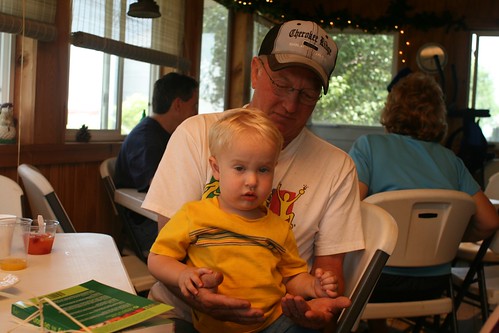
img_5078.jpg

Or maybe it was this:

img_5116.jpg

Friday evening, Cliff and Ralph made up some great hamburgers, hot dogs, and sausages. We all ate under the big tent, and had a nice time visiting. It was sort of an unusual thing -- meeting people you already know for the first time -- but very nice. We left somewhere around 8. Jacob enjoyed the hotel room, too.

img_5027r.jpg

That's Jacob talking on the telephone. Well, I would normally use it as a TV remote, but to Jacob it looks like a phone, so a phone it is. (I can see his point.) This is Jacob answering the phone by saying Hi! Jacob's word for a phone, by the way, is "hi." He'll find a remote by the TV in the room, point to it, and yell "hi!"

Jacob's usual bedtime is 6:30PM. He normally falls asleep fairly easily and sleeps soundly until 6:30AM. Well, we got him in bed well after 6:30PM. Then he made the discovery that the hotel crib/playpen has a mattress that is not attached to the bottom like our mattresses at home are. This was good for at least an hour of excited playing. As Terah and I were trying to sleep, we'd hear these cackles from Jacob's crib, and the noises of a very active boy. I'd peek around and see him using the mattress as a tent, as a peek-a-boo toy, or just as something to throw. I think he fell asleep at about 11.

And woke up promptly at 6:30 on Saturday, just like clockwork, ready to make some phone calls and start the day.

Now, just a tidbit for anyone that doesn't have kids: a toddler, low on sleep, and endless excitement all combine to make for busy parents. Jacob did pretty well, and got in a good long nap in the afternoon. We did take several trips to the corn field.

For most of us, Saturday was a day for brunch, for sitting around and visiting under the tent, for horse rides, and maybe a massage for those that wanted it. Terah got to ride a horse, and Jacob got to ride a pony, too.

For Jacob, it was a day to make new friends, too.
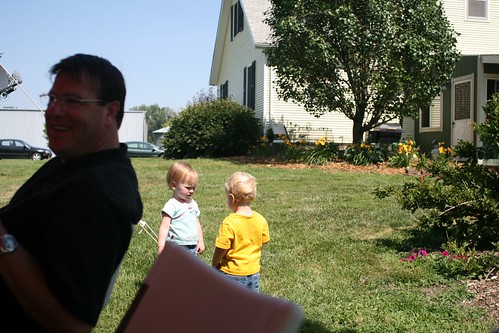
img_5095.jpg

I took this picture just a second after she had given him a hug. I was just a little too slow whipping out the camera.

But when it comes to cherry picking, it's all serious business once again.

img_5098.jpg

Jacob loved eating these sour cherries. At first, he would pick one cherry off the tree, run over to the tent, give it to Terah for her to get the pit out, eat it, then go back to the tree for another one. He must have decided this was inefficient not long after I did. After a few roundtrips, he started trying to get the closest adult, whoever that might be, to pit the cherry for him. When he found one that would do it, he'd keep bringing cherries back to that person.

And then he was under the tree for a long time. Terah and I noticed, and had a conversation about just how many cherry pits it's OK to swallow. But when I checked it out, I found out that Jacob had figured out how to pit cherries himself. He did lose about half a cherry each time he did it, but I guess that was more efficient than pestering adults to do it for him. Though it may have also worked to carry two cherries to the tent at a time.
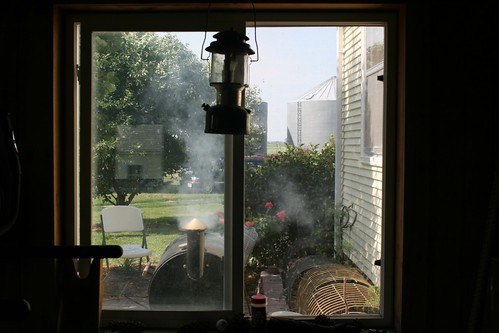
img_5123.jpg

Late in the afternoon, Cliff started up the smoker for the chicken. He had rented a big smoker for the occasion, but it wasn't working, so he made do with his regular smoker, ovens for the corn, and an array of dutch ovens or side grills for everything else. I couldn't keep track of it all, and I was just watching, but somehow it all turned out perfect.
img_5140.jpg

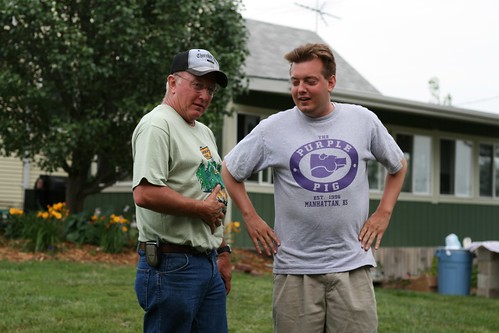
While the chicken was cooking, Ralph and son-of-Ralph (SOR) were having a conversation and patting their bellies. I couldn't hear, and didn't ask questions, so I'm choosing to believe that they were discussing how many pieces of chicken they could eat. When they heard my camera click, Ralph said, "He didn't just take a photo, did he?" Thereby guaranteeing a spot on my blog.

I had the distinction, I think, of being the least-read blogger at Blogstock. I can't quite remember how many times I'd meet someone, and they'd say, "Oh, you're the computer guy, right? I tried reading your blog, but I didn't understand it, sorry!" Completely understandable, I assure you!

After dinner Saturday, we talked about how we got started blogging (hi, Marty and Andy if you're reading), why we were there. Cliff said some very kind things about Terah and me, which really meant a lot.

Later, Cliff told me how Terah showed up in the kitchen with her tray of deviled eggs. Cliff saw them, and said, "Terah, I love you." Later, Cliff said "I love you" to someone else. From the next room, Terah piped up, "What food did she bring?"

Saturday evening, Terah took her horse ride. Jacob was quite tired by that point, and threw a tantrum about not being able to go with mom and ride a horse, too. We were talking about it when Rachel came over. Jacob asked her to pick him up, she did, and he instantly stopped fussing. Maybe it was a "so there" to me, since I had been holding him a minute before, and he took the opportunity to scream in my ear. But in any case, Jacob loved Rachel. She let him sit on a pony, carried him all around the yard, and he managed to hold it together until Terah came back at 9:30.

Saturday evening it was time for goodbyes. We all had a blast and I'm sure we'll do this again. If you weren't there, here's what Blogstock looks like:
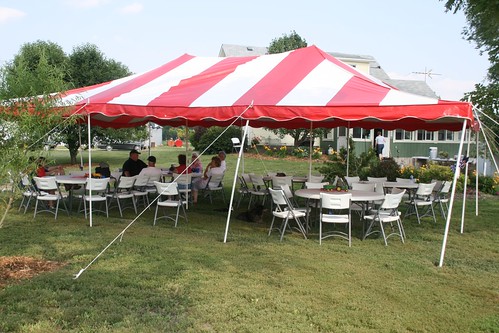
img_4991.jpg

A bunch of friends sitting around chatting under a tent pretty well sums it up.

(There was a full tent of people; some were just elsewhere when this particular photo was taken.)

Jacob shared his thoughts on the whole trip on the way home, too. Well put, Jacob.

img_5202.jpg

Next.

Previous.