Search Results: "az"

18 April 2008

Gerfried Fuchs: On freedom

One of the freedoms I value is the freedom to choose what you spend your time on and who you spend it with. And while I believe that people in key roles in Debian still have those freedoms (hey, 2.1(1), don't you know), reality these days even confirms that. So long, and thanks for the fish.

Robert McQueen: Lazyweb request: gadgets I would like to have

Last night I thought of a few gadgets which I’d like to have, and although I’m pretty sure you should be able to get hold of them, I had trouble finding anything that looked quite right: So, answers on a postcard…

Anthony Towns: On freedom

One of the freedoms I value is the freedom to choose what you spend your time on and who you spend it with. And while I’ve spent a lot of time arguing that people in key roles in Debian still have those freedoms (hey, 2.1(1), don’t you know), reality these days seems to be otherwise. But hey, solving that quandry just requires a mail to DSA. To folks on the core teams I’ve been involved with: it’s been a pleasure and an honour working with you; if not always, at least mostly. Best of luck, and I hope y’all accept patches.

17 April 2008

Pablo Lorenzzoni: Wow! Fisl exploded!

I have never seem so many people at fisl. Seriously! All the rooms were crowded, all the time same as the expo and the user-group area. Our official counter were stopped at 6667 participants, but that is just because we ve taken the registration database off-line in order to process new registrations on-site. By the end of fisl all the numbers will be summed up, but I heard rumors of 7 thousand people! Awesome! I spent this first day mostly in the TVSL room. We ve had problems with the network all day long. PUCRS technicians and our link providers personnel were trying to figure out where the problem seems to be. Being stuck with a non-functioning stuff, to me this day was mostly a sequence of frustrating attempts to get over the blockage. By the end of the day I was told that they were close to a solution It reminded me of our second year trying to stream fisl, as was best told by Fluendo s Thomas ... This just leads me to an unavoidable conclusion: our network sucks! I had to hear from a Brazilian friend who lives in Europe how wonderful her Gigabit network is grrrrrrr Bored as I was, I went walking around. That, surely, were the best part of fisl so far: meeting old friends. I had the most pleasant chat (yet quick) with Otavio Salvador and Felipe van de Wiel, both friends of long time. I took some pictures of the crowd: And, since I was not available in the morning, when the huge crowd was arriving, I took a picture of a picture taken by Marlon of this initial moments: (It is not really clear in this picture, but beyond the red gates there were as many people as inside)

Neil Williams: Data Centric programming - a new start at Alioth.

It's time for me to stop complaining about the commercialisation of SourceForge and vote with my code. I'm leaving for brighter, bluer pastures at Alioth.

Query Object Framework is first (libqof1). The others will follow. I'm leaving because of unusable mailing list archives, impossibly slow web pages and wiki and the general amount of work involved in the SF interface. I'm gaining sane mailing lists, a friendly and usable ikiwiki and a simpler (although very similar) interface.

I'm also migrating most of those packages to subversion. With so many other changes, it's not exactly a problem to add cvs2svn into the mix.

Now, of course, this does not mean that these upstream packages suddenly become Debian-only or Debian-native. It does mean that I have a chance of encouraging new developers to join the team by providing the kinds of services and support that people need when starting off with a new project. (I suppose the one thing I don't yet have is an IRC channel. Not sure if it is worthwhile but I'll see what happens.)

QOF will form the basis of the support available for each of the other projects - all will share the same low-volume QOF-devel mailing list and QOF Wiki as provided by Alioth. I'll also migrate QuickList because I'm looking at restarting development on a stalled project allied to QOF and which could provide missing functionality in QuickList. I did look at Gaby in this mix but a botched Gtk1->Gtk2 transition that ended up with two incompatible forks running different parts of the original codebase put me off completely (and neither of the forks actually worked). (Some packages deserve to be dead upstream.)

I'm looking for new blood, fresh faces and a new desire to take these projects forwards. The driving force is data freedom - creating data-driven applications that are completely agnostic to where and how the data happens to be stored. It is user data, it should be as free as the source code that wrote it. Who cares what format it is in? Let's get it into a format that some other program can use and make use of the existing data instead of duplicating it all the time. (The observant will note that my old haunt of GnuCash is stubbornly ignorant of the merits of a decent import/export implementation that actually covers more than 50% of the data in the application. No wonder I took the chance to sponsor homebank.)

DWI Data With Interaction (aka DUI -- Data Under the Interface) is what can provide the missing interfaces. It'll take a while to get it back up to date and available in Debian but it can provide the link between data and interfaces. GNU/Linux users should be able to design an interface purely on the basis of the data that it needs to handle and not care one jot about how that data comes from one free software app and goes on to the next free software app. QOF is gaining a connection to libgda which means that data can go to and fro between a whole range of databases and file formats. Homebank and pilot-qof can gain new data inputs (and possibly outputs) by utilising the existing import/export support in new ways via DWI/QOF (as libqof2). That can give a complete interface for all PIM and financial data for a typical SOHO user and all based on SQL-type queries so that every stage of the process can be tweaked and optimised according to user requirements at runtime.

(Where does Emdebian come into this? Well, many people like me need to record and process PIM/financial data on the move so Emdebian means that those users can have the same data processing on their handhelds as on the desktop. Smaller apps to capture the data quickly and efficiently whilst on the move; larger apps to refine, optimise and filter the data on the desktop entirely under user control but with a simple, scriptable, interface based on runtime queries so that the user can do exactly the same conversions tomorrow with new data but none of the configuration. Easy!)

Is this groupware ? No - it is personal, ultimately flexible and entirely customised for particular users by the users themselves. It's about small niche markets, about independent business people with bespoke and highly specialised requirements. No one is going to spend time writing their reports in Scheme or Haskell, because they are the only people who need that particular report. Instead, that individual user needs to be empowered through a simple and intuitive interface to take a piece of data from one source, correlate it with a static piece of data from individual configuration sources, calculate a result according to a third piece of data from a completely separate source and combine them all into a new set of objects that can be used in other queries. It's about preparing invoices from Palm data, it's about handling customer accounts for a one-man company or handling a stocks and shares portfolio for a partnership. Ultimately customised, ultimately flexible and completely format-agnostic.

These are the kind of applications that hold people back from GNU/Linux migrations - bespoke applications that are developed for just a few small companies or just a few situations. Free software finds it hard to provide those apps because free software depends (currently) on someone else being motivated to write a bespoke program and that person rarely understands the niche. This is a chance to put the development into the hands of those with the motivation to do the work, by making the development process more WYSIWYG.

The question is: Can we come up with a better name for DWI, dear lazyweb?

"DWI is a fairly simple environment for quickly creating data-driven applications, that is, graphical applications that manipulate and show info from a database. This environment differs from others in that it is focused on native GTK/Gnome support through the Glade GUI designer, and thus allows you to build user interfaces as elegant as you can make them in Glade."
http://dwi.sourceforge.net/

The big appeal is that DWI is database-agnostic - it only cares about the data structure, not the file format. Ally that with QOF which provides data-centric SQL-based queries and conversions between objects (including combining elements from one object into one or more other objects without having to hardcode the connection between the objects at compile time) and we have an interesting and powerful combination of engines, frontends and backends that are all data-centric.

Please, if this sparks your interest, join the QOF-devel mailing list, have a play with the ikiwiki at http://qof.alioth.debian.org/ and have a go with the code. This whole area is begging for development but it is just so far from being usable by the target audience at this stage. There is a lot of programming to be done by current developers before the principles can be let loose on the masses.
:-)

This is about working between existing projects and between distributions - no longer dedicated to a single application, platform or file format, no more tunnel vision. Work on the edges of existing applications (and indeed projects), remove the sharp edges of applications that should work together but can't. The majority of the code in these libraries and applications is already stable and mature. Like so many parts of free software, it is time, IMHO, to put aside our egotistical devotion to the one-true-executable and come up with an actual solution.

Bah! I'm beginning to sound like a PR exec instead of a dedicated geek. What does it take to motivate people and get things done around here?
:-)

MJ Ray: 21 today! MJR around the web...

Not done one of these round-ups for a while and I'm really pushed for time today, so here are some sites that I've written on:
  1. Property of a Lady Wicca on House
  2. Ross Burton: The End Of Homeopathy?
  3. Enough with the dried yoghurt covered raisins Korerorero: Just random ranting and raving
  4. How to host a free software advocacy event Free Software Magazine
  5. Raw Output: AGPL
  6. One for the Morning Glory: Facebook comments
  7. Sam Liddicott GPL3 Questions and Implications
  8. Drugs and an Election etbe
  9. New Tropicana images
  10. robmyers - Support BY-SA/SFDL Compatibility, Not BY-SA/FDL Compatibility
  11. Internet Psychology: Teenagers do not need our help online - we need them to help us oldies by Graham Jones, Internet Psychologist
  12. Wanting Your Opinions about Blog Comments and City Attorneys : David Lee King
  13. Zookoda - I Don't Recommend them Anymore
  14. Solar Water Heating :: ShowBlog
  15. Internet Psychology: Forget email - it's old hat by Graham Jones, Internet Psychologist
  16. Drake.org.uk: That's a wrap! Time to roll the end credits..
  17. Internet Psychology: Internet criminals are going to have a field day by Graham Jones, Internet Psychologist
  18. A Cambridge Co-operator: Rebranded Stores
  19. robmyers - Two Common Errors
  20. Lucas Nussbaum's Blog Blog Archive Where is the NM bottleneck?
  21. NM: FD is fixed - MadBlog

Gunnar Wolf: Dear lazyweb: Large volumes strategy?

Wouter, you seem to enjoy using huge filesystem volumes. So, dear lazyweb...
I have a 500GB disk for my users' home partitions - they mainly use it to back up their desktop data, but I do expect them to give it more usage. Anyway - I am currently using around 350GB of it, leaving the rest still unpartitioned. I have switched over to ReiserFS, as online resizing it is way faster than online resizing ext3 - it's basically instantaneous.
It seems I do belong to the old sysadmin school, and I value highly the reliability that comes from not having filesystems too large for their own good - After all, recovering from failure in 10GB is way more probable than doing the same in 100 or 1000, isn't it? But then again, it's just impractical to create /home/samba/ 1,2,3,4,5,6,7,8,9 / and randomly split users' directories inside them. Most users won't use more than a couple MB, but some users (legitimately!) back up tens of GB... It's hard for me to anticipate their needs.
Does any of you have scary stories regarding huge volumes? Or any data supporting the idea that I'm just too old fashioned and that half a TB is a good partition size?
Note that I _am_ holding full backups :)
[update]: So I'm undoubtley an old fart? Everybody seems to have partitions larger than me. Ok, I will stop crying...

Russell Coker: Making Linux DVDs

Anthony Towns writes about using an improved version of jigdo to download CD/DVD images [1]. His improvement is basically to pipeline operation for better performance. Jigdo (the Jigsaw download) is a tool to download a set of files and then use them to create a CD or DVD image [2]. The idea is that most web sites that have CD or DVD images also have a collection of files which comprise the DVD image available. This removes the need to store the data twice (wasting disk space on mirrors and in some situations breaking web caching). I have never used jigdo, and for all Debian installations in recent times (the last few years at least) I download a small net-inst CD image and then have it download the other files from the net. I have Squid set up to cache large objects so this doesn’t waste too much of my precious network bandwidth (which is limited and expensive in Australia). Now I’m thinking about what the optimum method for doing installs might be. One thing that would be good would be to support multiple repositories, the packages have unique file names and checksums so it should be possible to check one repository and then check another if it’s not working. I don’t mean multiple “deb” lines in the APT configuration. What I would like to do is to have an NFS file server or web server with an archive of downloaded packages and have APT check there first before downloading a file. So APT could get a list of packages from the net and then get the actual files locally if they are available. The next thing that would be good is the ability to create a CD or DVD image dynamically and to store all temporary files. So I could download files from the repository and create a DVD image with just the packages that I need. Every time I create a DVD image my sub-set of the Debian archives would increase and the number of files actually downloaded in the creation process would be reduced. The effect would be to incrementally create a local mirror of the Debian repository. Then I would like to see a two-stage DVD install process. I would like to boot from a CD or DVD and start the install and then have it give a list of files needed (which could be stored on a USB device or floppy) to create further CDs or DVDs for installation. One situation where this could have been beneficial was when I was doing an emergency install of CentOS. I did the first part of the install (selecting packages etc) to determine which CDs were needed. It turned out that almost all CDs were needed even though some of the CDs had only a few files that I was installing. If the installer could have written a list of packages to a USB device then I could have downloaded just those packages and got the install working a lot sooner. It seems to me that it’s fairly common to do one test install and then do some dozens of other installs with the same settings. So the ability to create a DVD of exactly the needed files for the other dozens of installs would be a great benefit. Now this is just random commentary, unfortunately don’t have time to do any coding on this. But it seems obvious that something has to be done to improve the situation for developers and IT staff who need some degree of mirroring of the Debian package pool but who can’t do a full mirror. Back in 1996 I was able to mirror Debian over a 28K8 modem link and fit it on what was a reasonable hard drive by the standards of the day (incredibly tiny by today’s standards). Now I can’t practically mirror Debian over an Australian cable broadband connection and even by the standards of about 4 years ago (the age of most of my hard disks) the space requirements are significant. I hope this post helps inspire some interest in developing these features. As delays in joining Debian [3] is the topic of the day it should be noted that work on preparing DVD images can easily be done by people who are not DDs. Such software should work from Debian archives without requiring any changes to them, and thus nothing special is needed from the Debian project to start work.

16 April 2008

Matthew Palmer: When you think you're good...

It's stories like the following that make you realise just how puny your talents are... (Reposted from a place not to be named, by the legendary Al Viro)
Give them what I got yesterday. As in, box that got
        a) Linux kernel running.
        b) init and bash running.
        c) serial and floppy - built as modules. And not loaded.
        d) no sash.
        e) no ethernet.
        f) bloody large number-crunching that Should Not Be Aborted(tm).
        g) libc and ld-linux.so - unlinked (self-LART by owner).
Now, I could tell the guy to piss off, but... WTF? He had decent beer and
was properly scared. Oh, well... So we have no exec() for anything
dynamically
linked. And we have no chance to access any external stuff - insmod is
linked
dynamically, so no insmod floppy for you. Shutting the system down was not
an
option due to (f) (aside of dealing with fsck later - umount(8) is
dynamically
linked too). Now, I knew that both /lib/libc.so-2.1.2 and
/lib/ld-linux.so-2.1.2 were still alive - mmaped by init, for one. And
/proc/1/maps would even contain their inumbers. So the plan of attack was
to create a file in root and then cannibalize the entry (change inumber in
the directory). Alas - not enough. In-core inode got zero i_nlink and
if I would just create a link by hands it would not become positive. I.e.
still remove-upon-close. But. But if we will manage to call link() on the
hand-made link we will get i_nlink raised to 1 - iget() will find the same
in-core inode, so we are OK. We'll have to revert the phony link to avoid
PO'd fsck, but that's not a problem...
        So there we go: assuming that we got static ln
echo >foo
ln foo bar
flip inumber in foo entry to point to libc
ln foo /lib/libc.so-2.1.2
flip inumber.......................... bar
repeat for ld-linux.so
rm foo bar
begin recovering other damage (self-LART was a bit larger).
        But... we don't have this flip stuff and we don't have (aaarrgh)
static
ln. Oh, shit... OK, but all we really need is a couple of syscalls, right?
There we go:
        eax=__NR_link;
        ebx=s1;
        ecx=s2;
        int 0x80;
        eax=__NR_exit;
        ebx=0;
        int 0x80;
s1:     "foo"
s2:     "bar"
The next step was getting the syscall numbers. grep? We don't need no
stinkin'
grep.
# while read i; do case $i in *__NR_link*) echo $i;; esac;
done </usr/include/asm/unistd.h
#define __NR_link 9
# while read i; do case $i in *__NR_exit*) echo $i;; esac;
done </usr/include/asm/unistd.h
#define __NR_exit 1
#define __NR__exit __NR_exit
Now, scratching the head and recalling intel code...
start:  b8 09 00 00 00
        bb (address of s1)
        b9 (address of s2)
        cd 80
        b8 01 00 00 00
        bb 00 00 00 00
        cd 80
s1:     66 6f 6f 00
s2:     62 61 72 00
Fine, but... a.out support is compiled... you guessed it, as module and not
currently loaded. So we are in for crufting up an ELF binary. OK, we don't
actually need 100%-correct ELF, just something that will pass for the
exec(). Now, we don't have shell scripts, but . will work. So the next
step was rolling more(1) in shell and reading through the relevant code
(surprisingly small - binfmt_elf.c and two headers). After much swearing
the following abortion was created:
7f 45 4c 46 00 00 00 00 00 00 00 00 00 00 00 00
02 00 03 00 01 00 00 00 start______ 34 00 00 00
00 00 00 00 00 00 00 00 34 00 20 00 01 00 28 00
00 00 00 00 01 00 00 00 00 00 00 00 base_______
base_______ size_______ size_______ 05 00 00 00
00 10 00 00
start:
b8 09 00 00 00 bb start+1d___ b9 start+21___ cd
80 b8 01 00 00 00 bb 00 00 00 00 cd 80 66 6f 6f
00 62 61 72 00
OK, set base to something page-aligned, start=base+54, size=79. There we go:
7f 45 4c 46 00 00 00 00 00 00 00 00 00 00 00 00
02 00 03 00 01 00 00 00 54 00 00 80 34 00 00 00
00 00 00 00 00 00 00 00 34 00 20 00 01 00 28 00
00 00 00 00 01 00 00 00 00 00 00 00 00 00 00 80
00 00 00 80 79 00 00 00 79 00 00 00 05 00 00 00
00 10 00 00 b8 09 00 00 00 bb 71 00 00 80 b9 75
00 00 80 cd 80 b8 01 00 00 00 bb 00 00 00 00 cd
80 66 6f 6f 00 62 61 72 00
well, while read l; do for i in  echo $l ; do echo -ne "\\$i"; done; done
made for oct2bin, overwriting /usr/bin/emacs with the output of that gave
us static equivalent of ln foo bar. And it worked. The rest was essentially
the same - the only tricky part was to find the location of directory entry.
Which was done with (lseek, read byte, exit(said_byte)) and shell wrapper
around that. So we had a way to read a block and dump it on the console.
The rest was obvious - start from relevant block in inode table and walk
through the references... Once we got that, it was an easy ride - trick
with inumber flipping brought libc and dynamic linker back and after that
we had 99% of system back into the working state. Amazing how little you
actually need to bring the system back to life...
Hot damn that's some deep hackery...

Jeff Bailey: Physio, T-shirts, and the end of the contest!

Updates of the moment:

* I can put a t-shirt on now! About 3 days ago, I got brave and decided to give it a try. So, yay, no more zip up sweaters!

* Had my 6-week checkup yesterday, and everything is looking good. The incision is still a bit red and since my skin is so sensitive, the surgeon doesn't want me in the hottub for another 2 weeks. *pout*

* I started physiotherapy today. I can only give it a mixed review. The therapist was absolutely wonderful, it turns out that I got the clinic director. However, she doesn't actually have time to see me 3 days a week. Her schedule is so booked up that I'd be lucky to see her once a week. On top of that, the receptionists and assistants were not terribly professional (tending not to articulate, getting flustered, sort of tossing sheets of paper at me expecting me to know what to do with them), and the place was not clean. It was also in one big room, so the therapy is done in front of everyone else. Blech. So I have an appointment with a different clinic on Friday. Hopefully this one will go better.

* I don't think I've mentioned Leif recently. He's walking, can open the doors in the house now, and can clearly say "All Done". He also climbed onto my lap the other day and cuddled with me. So cute!

* Lastly, this is the end of the contest of "Guess the cost!" And the final total for the bill was.... $199,849.24. Our running total is of all things combined at UCSF is now somewhere around $280k, so I'm guessing the final total for everything will be around $300k when we're all said and done. Crazy. The closest guess was by [info]runasand at $192,000, whoever you are. Linked-in says the winner is in Norway. So finding that vegan restaurant might be interesting. I still remember Debconf 3 in Norway when the caterer told me "In Norway, we have a special way of preparing vegetables... We feed them to the animals." And the meat-eaters begging the vegetarians who were going elsewhere for food for their meals so that they had something other than slabs of meat to eat.

I think because of this, I'm going to have to award the prize to [info]mmmmtino in the meantime, who came in second place at $185k. That way I can pay it out hopefully within the next year. I'll still keep the other as a raincheque in case I happen to wind up in Norway sometime again. =)

Further on the OMG-This-medical-system-is-barbaric, It looks like the insurance company negotiates the hospital down in price, because they're in network. I've only seen the payout information for that one day overnight stay, but the insurance company will only be paying 10% of the cost. So if I didn't have insurance, I'd have to pay $67k. But the insurance company gets to pay around $7k. Do they charge so much because they don't make enough money when someone is insured? How does that all work?

Simon McVittie: Implementing D-Bus services with telepathy-glib

16:46 < epmf> tp-glib is made of magic

—#telepathy, 2008-04-15

Rob pointed out today that I'd been promising to blog about telepathy-glib for several months and still haven't done so. I think there's too much to cover in one blog post, so I'll start with the oldest part - implementing a service (typically a Telepathy connection manager).

While telepathy-glib is (obviously) intended for Telepathy implementors, I think the ideas we've been implementing are likely to be useful for any D-Bus API, particularly flexible/complex APIs where an object implements many interfaces.

Introduction to telepathy-glib telepathy-glib started out as a collection of code extracted from our XMPP connection manager, telepathy-gabble, but at some point it grew beyond that into a wrapper around/partial replacement for dbus-glib. We've been quite pleased with it, really :-) My first major round of work on telepathy-glib, during the first half of 2007, was to split it out from telepathy-gabble (versions up to 0.5.9 were released as part of Gabble 0.5.x tarballs, in fact), leading to the release of the 0.6.x stable branch in late September. This was very helpful for implementing connection managers - Salut, Idle and telepathy-sofiasip (our connection managers for link-local XMPP, IRC and SIP) all started off by forking/cargo-culting from Gabble, and achieved huge code reductions by porting to telepathy-glib. Also, Will Thompson used it in his Summer of Code project, telepathy-haze, to go from nothing to a working and useful Telepathy implementation based on libpurple in a matter of a few months. The second major round of work, which I'll discuss in a later article, added client code to telepathy-glib, obsoleting the older/worse libtelepathy and allowing client programs like Empathy and telepathy-stream-engine to be written using telepathy-glib. In the process, I accidentally reinvented DBusGProxy :-) More details to come later!
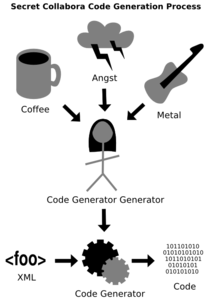
Some background: service-side code generation
The secret Collabora code-generation process

(credit: daf)

Supporting D-Bus in the GObject world has always involved quite a lot of code generation. The core API of dbus-glib is heavily reliant on varargs functions, which aren't type-safe and are easy to get wrong. dbus-glib contains a program called dbus-binding-tool, which is meant to generate reasonably sane GObject APIs for D-Bus objects. Unfortunately, it seems to be intended to generate a whole GObject at a time. Early versions of telepathy-gabble used dbus-binding-tool plus a script called gengobject.py to generate API stubs for the exported objects; developers then filled in the blanks, and hey presto, we had a GObject on D-Bus. This was fine up to a point, but had a couple of major drawbacks. Whenever we changed the D-Bus API (quite common during the early development of Telepathy), there was a very laborious and error-prone merging process. We ended up with the following process:
  • copy the D-Bus introspection XML from the telepathy-spec repository into a directory xml/pristine (actually, the canonical form for the spec was Python for a while, and we had a script that exported a contrived object onto D-Bus and introspected itself to get the XML - but that's another story!)
  • preprocess the introspection XML to add the dbus-glib CFunctionName annotation, resulting in a directory xml/modified
  • run dbus-binding-tool and a Python script gengobject.py to generate C source in xml/src
  • three-way-diff the old version of xml/src, the new version of xml/src, and the real C code in src to create a new version of src
  • pray that the diff process hadn't randomly exchanged functions' implementations
  • update the resulting code in src so it worked
  • check the whole mess back into darcs
  • hope that nobody else had made changes that would result in darcs conflicts
If you haven't yet gathered, this was a bit of a nightmare. Also, it was very easy to return the wrong thing from a method without noticing - because all the APIs were varargs, the compiler didn't notice, and the first we'd know about it was a mysterious segfault under certain circumstances.
How telepathy-glib fixes code generation telepathy-glib improves on this by taking advantage of this innocuous-looking feature in dbus-glib:
commit 355ef78d98d6fc65715845d56232199162cab12a
Author: Steve Frécinaux <steve istique net>
Date:   Thu Aug 17 11:48:20 2006 +0200
    Interface support for bindings.
Instead of running dbus-binding-tool or creating GObjects with D-Bus interfaces, we put the entire Telepathy spec through glib-ginterface-gen.py, a distant descendant of Gabble's gengobject.py. For each interface in the spec, we generate a GInterface that mirrors the D-Bus interface. Any GObject that implements the GInterface automatically gets the D-Bus interface if it's exported onto D-Bus. There are a few non-obvious refinements, though:
  • The signature of the method implementation is always in the mode that dbus-glib calls "asynchronous", where the method implementation can either send a reply message before or after it returns. For "slow" methods, this is the only thing you can do. For instance, many Telepathy D-Bus methods can't return anything until some TCP round-trips to the server have happened. This is also the only thing you can do if you want to extract extra information, like the sender's unique name, from the method-call message (dbus-glib's "synchronous" API doesn't allow this to be done). For "fast" methods, sending a reply message before returning is just as easy as using the "synchronous" API (it's just a difference of syntax), and has an API consistent with that of the "slow" methods, making it easier for service authors.

  • The layout of the GInterface vtable is private, and (auto-generated) accessor functions are used to fill in implementations. This means our ABI doesn't change just because we re-ordered functions in the spec.

  • If no implementation is provided for a method, we just raise an appropriate error (org.freedesktop.Telepathy.Errors.NotImplemented), rather than suffering an assertion failure. This means we can safely add methods to an interface.

  • While we're generating code anyway, we generate some static inline wrapper functions which wrap dbus_g_method_return(), to have type-safe method returns. You can easily check that a method replies with correct types, by checking that the implementation of Foo() replies by calling tp_svc_some_interface_return_from_foo().

  • Similarly, we generate wrapper functions to emit signals, to get type-safe signal emission.

Not all interfaces are stable enough to be included in telepathy-glib's stable API and ABI, so some of our other projects include a copy of the telepathy-glib code-generation tools, and generate their own "mini-telepathy-glib" (traditionally in a /extensions/ directory) for their implementation-specific (drafts of) interfaces. This isn't yet as polished as it ought to be (mainly because we don't want to freeze the augmented-introspection-XML format that we write the Telepathy spec in, because it's rather ad-hoc and hackish in places) but it works quite well in practice. To see what this looks like in practice, have a look at the examples in telepathy-glib, or at a Telepathy connection manager like telepathy-gabble.
Mixins and base classes Another feature of telepathy-glib which makes life easier for connection manager authors is that it provides "mixins" and base classes which implement some of the GInterfaces. There's absolutely nothing magic about the base classes - they don't have any access to private implementation details of the GInterfaces, they just implement them like everyone else does. The "mixins" are only slightly more magical - they store some extra state inside the structures representing GObjects and their classes, and use it to provide default implementations of some or all of the methods on a particular interface (or two interfaces, in the case of the new TpMessageMixin). I'll leave it up to Rob to explain those in greater detail, since I seem to remember that he invented them :-P The examples and regression tests in telepathy-glib are quite good examples of how these work in practice.

Miriam Ruiz: More on OOXML: ISO tries to recover lost credibility through press notes

After the unfortunate show that Microsoft and ISO provided us recently, ISO’s response is a FAQ note about ISO/IEC 29500 (OOXML, that’s it) in which they threaten Microsoft with the most severe of penalties if they’re tricking on as. Funny. In that statement, they try to answer all the issues that initially were concerns but that now has turned into proven facts about the OOXML standard and it’s approval, and to try to recover some of their lost credibility. It’s sad to be commenting on this, words don’t come easy, as if to say. Microsoft has already proven who’s the one in charge here, who owns the committees, who takes the decisions and in which terms, and nothing happens. It’s gonna take more than to publish a FAQ note saying how well you did it and to threaten Microsoft to behave or else. No one seriously believe you at the moment, you know? A funny thing is that ISO dismisses any responsibility about standardization, and relies on the market taking the decisions for them. Microsoft has said many times that they consider something positive and healthy to have multiple standards for the same, and let the market decide. Now ISO declares to think along the same lines: “After a period of co-existence, it is basically the market that decides which survives”. We don’t really need an organization for standardization for that, do we? We already have the market for that. Will ISO apply the same policy for every standard from now on? Like, say, having a couple of competing standards at least for every need, and let the market decide? ISO tries to recover from their credibility loss with this note (“the standards development process is credible, works well and is delivering the standards needed, and widely implemented, by the market“), without much success at least in what I’m concerned. If they keep trying to convince with press notes instead of with real acts, no one is gonna believe them ever again.

15 April 2008

Anthony Towns: Jigdo Downloads

Last month we had a brief discussion on debian-devel about what images would be good to have for lenny – we’re apparently up to about 30 CDs or 4 DVDs per architecture, which over 12 architectures adds to about 430GB in total. That’s a lot, given it’s only one release, and meanwhile the entire Debian archive is only 324GB. The obvious way to avoid that is to make use of jigdo – which lets you recreate an iso from a small template and the existing Debian mirror network. I’ve personally never used jigdo much, half because I don’t usually use isos anyway, but also because the few times I have tried jigdo it always seemed really unnecessarily slow. So the other day I tried writing my own jigdo download tool focussed on making sure it was as fast as possible. The official jigdo download tool, ttbomk, is jigdo-lite – which you give a .jigdo file, and the url of a local mirror. It then downloads the first ten files using wget, and once they’re all downloaded, it calls jigdo-file to get them merged into the output image. This gets repeated until all the files have been downloaded. By doing the download in sequence like this, you miss out on using your full network connection in two ways: one during the connection setup latency when starting to download the next package, and also while jigdo-lite stops downloading to run jigdo-file. And if you’ve got a fast download link, but a slower CPU or disk, you can also find yourself constrained in that you’re maxing those out while running jigdo-file, but leaving them more or less idle while downloading. To avoid this, you want to do multiple things at once: most importantly, to be writing data to the image at the same time as you’re downloading more data. With jigdodl (the name I’ve given to my little program), I went a little bit overboard, and made it not only do that, but also manage four downloads and the decompression of the raw data from the template. That’s partly due to not being entirely sure what needed to be done to get a speedy jigdo program, and partly because the communicate module I’d just written to deal with this sort of parallelism making that somewhat natural. In the end, it works: from wireless over ADSL to my ISP’s Debian mirror, I get the following output:
Jigsaw download:
  Filename: debian-40r3-amd64-CD-1.iso
  Length:   675477504
  MD5sum:   d3924cdaceeb6a3706a6e2136e5cfab2
Total: 679 s; d/l: 586 MB at 883 kB/s; dump: 57 MB at 57 MB/s          
Finished!
which is only slightly short of maxing out my downstream bandwidth, taking a total of about 11m20s. Running jigdodl with a closer mirror works pretty well too, though evidently some of my more recent changes weren’t so great, because I’ve gone from 9153 kB/s on a 100 Mbps link down to 7131 kB/s or lower. The CPU usage also seems a bit high, hovering at between five to ten percent at 900 kB/s. For comparison, running jigdo-lite on the same file took 17m41s, which is about 566 kB/s, with the overhead being about 6m20s. What that means is if I doubled my bandwidth to about 20Mbps, jigdodl would halve its time for the download to about 5m50s, while jigdo-lite would still have about the same non-download overhead, and thus take 12m10, which is still 69% of its original speed. Going from 10Mbps ADSL speed to 100Mbps LAN gets jigdodl down to 1m31s (13% of the time, with optimal being 10%), while jigdo-lite would be expected to still be about 7m51s (43% of its original time). I suspect the next thing to do is to rewrite the downloading code to use python-curl instead of running curl, and thus downloading multiple files with a single connection, and tweaking the code so that it writes the file in order, rather than updating whichever parts are ready first. Anyway, debs are available for anyone who wants to try it out, along with source in the new git source package format.

Amaya Rodrigo: The absurd farce

It happens that when I get burnt out by Debian (I might blog about that later, but then I just might not) I am forced to face the real world just to learn that Debian was not so bad to begin with. Oh, the irony! I need to smoke more so that I spend less time involved in this crap nobody can change. It is hard enough to change Debian, I don't even want to think about the rest.

If you want to understand the world crisis you are living in...

Lars Wirzenius: Stolen laptop, call home!

The Finnish computer magazine Tietokone has an article on stolen laptops calling home and the police using this to track down thieves. The article reads like a press release from the proprietary software company mentioned in the article, although perhaps that's just because it only mentions that one company. However, the main point is that by having the stolen laptop report its IP number, police can trace it and recover it. In the interest of helping Unix users have similar protection, I provide you with the following crontab snippet:
*/15 * * * * wget -q -O /dev/null http://your.home.page/call-home; true
That page does not need to exist, you just need to be able to access the httpd logs for the web server it accesses to be able to find out the IP number. By using a distinctive URL, you make it easier to grep. Perhaps someone would like to turn that into a Debian package? Add some debconf magic to specify the URL to access, and it should be easily usable. For all the people without a web site of their own, perhaps there would be people interested in operating a server people could use for that. (There's some privacy issues involved, but it's an opt-in thing, obviously, so that lessens them.) Now, to be fair, the proprietary software package mentioned does more than my cron job. For example, they can take control of the system remotely, and wipe it out and make it inoperable. Personally, I don't want that, since it's a huge security risk, but if that kind of thing interests you, you could enhance the cron job a bit. For example, it could download the file and verify that it's GnuPG signed with your key, and if so, execute it as a shell script. One of the risks with this is that if anyone ever happens to get a copy of a file you've made like that, say, your web hosting provider, they can put it there whenever they want to, and boom goes your laptop. I'm sure there are ways around that, but if you want the system, you'll have to solve that yourself.

14 April 2008

Anthony Towns: A New DPL...

In a couple of days, DPL-elect Steve McIntyre takes over as DPL, after being elected by around four hundred of his peers… Because I can’t help myself, I thought I might poke at election numbers and see if anything interesting fell out. First the basics: I get the same results as the official ones when recounting the vote. Using first-past-the-post, Steve wins with 147 first preference votes against Raphael’s 124, Marc’s 90 and NOTA’s 19 (with votes that specify a tie for first dropped). Using instant-runoff / single transferable vote, the winner is also Steve, with NOTA elimited first and Marc collecting collecting 5 votes, Steve 4 and Raphael 2, followed by Marc getting eliminated with Steve collecting 50 votes, against Raphael’s 26. So, as usual, different voting systems would have given the same result, presuming people voted in basically the same way. NOTA really didn’t fare well at all in this election, with a majority of voters ranking it beneath all candidates (268 of 401, 53.5%). For comparison, only 18 voters ranked all candidates beneath NOTA, with 9 of those voters then ranking all candidates equally. (For comparison, in 2007, 312 of 482 voters (about 65%) ranked some candidate below NOTA, though that drops to 225 voters (47%) if you ignore voters that just left some candidates unranked. Only 98 voters (20%) voted every candidate above NOTA) With NOTA excluded from consideration, things simplify considerably, with only 13 possible different votes remaining. Those come in four categories: ranking everyone equal (17 votes, 9 below NOTA as mentioned above, and 8 above NOTA), ranking one candidate below the others (13 votes total, 7 ranking Raphael last, 3 each for Steve and Marc), ranking one candidate above the others (66 votes; 30 ranking Steve first, 18 each ranking Raphael and Marc first), and the remainder with full preferences between the candidates:
     70 V: 213
     63 V: 123
     56 V: 132
     52 V: 231
     38 V: 312
     26 V: 321
The most interesting aspect of that I can see is that of the people who ranked Raphael first, there was a 1.8:1 split in preferring Steve to Marc, and for those who preferred Marc first, there was a 2:1 split preferring Steve to Raphael. For those who preferred Steve, there was only a 1.1:1 split favouring Raphael over Marc. I think it’s fair to infer from that that not only was Steve the preferred candidate overall, but that he’s considered a good compromise canidate for supporters of both the alternative candidates (though if all the people who ended up supporting Steve hadn’t been voting, Raphael would have won by something like 26 votes (129:103) with a 1.25:1 majority; if they had been voting, but Steve hadn’t been a candidate, Raphael’s margin would’ve increased absolutely to 33 votes (192:159) but decreased in ratio to a 1:1.2 majority.

James Morrison: Niti days

I don't think any of these are mine, but this needs to be published to the general public (at least until it rests on AlumNit).

Poo Alliterations
- The Earl of Excrement
- The Duke of Dung
- The Prince of Poop
- The Sultan of Shit
- The Father of Feces
- The Matriarch of Merde
- The Steward of Stink
- The Dignitary of Dangleberries
- The Grand Poohbah of Grand Poo
- The Tyrant of Turd
- The Shogun of Scheisse
- The Baron of Bowels
- The Cardinal of Crap
- The Director of Dump
- The Surveyor of Stool
- The Lord of the Log
- The Crown Prince of Cow Patties
- The Royal Archbishop of Road Apples
- The Duchess of Droppings
- The Princess of Poodie
- The Legionnaire of Loaf
- The Supervisor of Stinkers
- The Pharaoh of Floaters
- The Magnate of Manure
- The Tycoon of TCPDumps
- The Czar of Czesspools
- The Mogul of Bowel Movements
- The Ruler of the Runs
- The Dean of Diarrhea
- The Royal Ringleader of Rump Raisins
- The Denizen of Doo-doo
- The Emperor of Evacuations
- The Headmaster of Horrible Odors
- The Titan of the Trots
- The King of Klingons
- The Big Boss of Bum Beans
- The Taskmaster of Turtleheads
- The Supervising Sovereign of Sewer Serpents
- The Colonel of Colon Cobras
- The Nobleman of Number Two
- The Top Dog of Toilet Twinkies
- The Kingpin of Keester Cakes
- The Shepherd of Sea Pickles
- The Head Navigator of Heinie Nuggets
- Rectal Representative
- The Commander of Cow Pie
- The First Mate of Fecal Matter
- The Creator of Cloth Touchers
- The Protector of Porcelan
- The Theologian of the Throne
- The God of Grunts
- The Small Insignificant Yodeling President of Shit in your Pants
- The Diaper Destroyer
- The Loader of Loincloths
- The Pontiff of Plum Pudding
- The Daiymo of Dysentery
- The Master of Montezuma's revenge
- The Squire of Squirts
- The [Weaver] of [WvLog]s
- The Primary Contact of Pudding Cookies
- The Best Producer of Brown Puddles
- The Senior Partner of Steaming Piles
- The Fine Baker of Fudge Brownies
- The Sheriff of Stench
- The Don of the Deuce
- The Torrid Putrid Tainted Pervert of Two-Ply Toilet Paper
- The Sacred Monarch of Skid Marks
- The Main Scientist of Microfeceological Studies
- The G.I. Joe of Gastro Intestinal Journeys
- The Premier of Polyps
- The Brigadier General of Bedpan Gold
- The Plunger Pilot
- The Specialist of Splashers
- The Foreman of Fake Farts
- The Ambassador's Under-Secretary of Astounding Unearthly Scents
- The Old Man and the Sea of Odiferous Monsters in the Sink
- The Bafflingly Blunt and Blasphemous Bearer of Big Bad Beastly Booty Burdens
- The Crisp Pungence of Chain Pooping
- The Goddess of Groundhogging
- The Burly Bobby's Brief Battle with Brim Blasting Bowel Bombs
- The Nasty Neighbour's Noisy and Nefarious Neglect of Normal Nasal Niceties
- The Judge Jury and Executor of Jolly Jumper Excrement
- The Forwarder of the Forwarded
- The Wizard of the Water-closet
- The Grunting Lobber of Great Logs
- The Annoyingly Arrogant Architect of Awful and Abhorrent yet Amazingly Aerodynamic Anal Atrocities
- The Dark, Dangerous and Delusional Dealer of Death-Defying Doses of Disturbingly Decadent Dung
- The Shakespeare of Sinfully Smelly and Supremely Scary Scripture with Soggy Stains and Screaming Splashes
- The Wise but Weakened Warlord Whose Willful Wrath Was Wholly Wrought With Wicked and Wretched Winds from Within
- The Languid and Lackluster Legend of the Little Log from the Loo and its Lavish Life of Luxury in a Lasagna
- The Kahuna of Kaka
- The Emergency Evacuator of Enraged Entrails
- The Squire of Sultry Stinknuggets
- The Deadening Discomfort of a Dearth of Dumps
- The Far From Favourable Fragrance of Four Fragments of Fantastically Fresh Feces
- The Principal of Prodigiously Putrid Pellets
- The Markedly Morose Maintenance of Maniacally Mounded Midden Movements and Mostly Meaty Meals Mysteriously Made Mushy
- The Crass and Cranky Coroner Connecting Clues Concerning a Cornucopia of Casualties Caused by a Crude Cluster of Completely Contemptible Colon Concoctions
- The Thinking Thoughts of a Thinker
- The Horrible, Hubristic Heathen Hoarding Hoary Humps of Hideousness Hailing from His Huge Hairy Heinie in His Harmfully Heady Hovel
- Inane Writings on Irritated Wreathing of the Incubator of Wrath
- That Special Numbness from Sniffing Noodled Stink Nougat
- The Moral Sanctity of the Mystery Shit
- The Ornery Opressor's Opulent Outpost Overseeing the Ordinary Occupants' Outrageous and Ongoing Observance Of an Occasional but Offensive Orgy Of Offal
- The Rector of Relief
- The Rectal Regurgitator
- The Shit Squat
- The Smelly Surprise
- The World Wide Wisdom
- The Slayer Supreme of System Shock

Kartik Mistry: Custom Keywords


* Accidently, I found this ‘Mozilla Custom Keywords‘ and tried with Debian BTS. It works. 1. Bookmark: http://bugs.debian.org/%s 2. Give it keyword: bugs (or whatever you want, like if you hate bugs, you can give it, ‘hate’ also…) 3. Type: bugs nnnnnn (where nnnnnn is bug number). Done. No need to type entire url or use broken search engines. Btw, this is really cheap hack, I need to really something cool that will bring some excitement in current boring life :P

13 April 2008

Axel Beckert: New mobile phone and what the Nokia 6310i did better than the E51

Habits control our choice sometimes more than we would like to admit… New mobile phone Since about two weeks ago I’ve a new mobile phone. The Nokia E51 will replace my slowly dying Nokia 6130i. I knew I needed a new mobile phone when my 6310i started to turn off itself shortly after I turned it on. I needed up to about ten times switching it on to make it stay on. Sometimes it already switched itself off before I could enter the PIN. Looks like a loose contact, but I never figured out where it is. Although I know about Nokia’s behaviour in Germany, I still had to buy a Nokia, because after using a 6130 (the GSM 1800 only clone of 6110 and 6150), a 6210i and the already mentioned 6130i over the last decade, I got so used to how Nokia mobile phones are navigated and how you type with Nokia phones (blank on 0, point and comma on 1, case changing on #), everything else (especially those with blank on 0 and case changing on *) would be worse than the half-dead mobile phone, I’m currently using. Spoilt for choice So which Nokia? For a long time I refused to buy a mobile phone with a camera or radio in it. But since the E70 was no more available (and is said to have quite buggy software) and the E61 has been replaced with the E61i, there are no more smartphones without a camera, at least not from Nokia. But I also found some useful uses of camera phones. After a while I could track down the number of choices to four: Communicator E90, E61i, E65 or E51:
Sizeasy Size Comparison: Nokia E90 vs Nokia 6310i vs Nokia E61i vs Nokia E51 vs Nokia E65
The picture above shows that the main differences of those models is size: Although having a QWERTY keyboard on the phone would be nice (for ssh, Jabber, the web, etc.) and the E90 being only slightly bigger than the 6310i on the paper, the size difference to the 6130i is more than only noticeable since the 6310i tapers off at the top. Besides, for the price of an E90, I get an E51 and an EeePC together… (Thanks to maol in whose blog I read about Sizeasy.) The E61i also has a (very small) QWERTY keyboard and is primarily only much wider than any of the other phones. It even has no bigger screen resolution than the E51 or E65. (Only the no more available E60 – a normal monoblock smart phone like the E51 – had a better resolution: 352x416 pixel instead of 240x320 pixels.) And since I usually carry my mobile phone in my trouser pockets, width matters most. So I had the choice to either get a phone which is too big for my trouser pockets or one without a QWERTY keyboard. The I remembered those foldable external keyboards for PDAs. There are at least three different makers of foldable bluetooth keyboards said to be working with Nokia Symbian S60 3rd Edition phones, so a QWERTY keyboard on the phone itself was no more important. (Only passwords will need to be entered over the number keypad since I don’t want to broadcast them… ;-) The choice between E65 and E51 was made easier by their reviews (E65, E51) at Xonio: The E65 seems to have not that good standby and phoning times while the E51 seems to be quite good regarding endurance. I looked through the usual shops around Z¨rich HB: Swisscom Shop, MobileZone, Phonehouse: All had the same prices (about CHF 250 for a two years contract at CHF 25 per month), except that Phonehouse had no E51 available in the shop. Interestingly digitec had a much lower price (CHF 100 for the same contract) and the choice of color (the shops always only offered one color), so I ordered a black one there. Converting a prepaid card to a postpaid contract isn’t that easy I wanted to change from a prepaid card to a postpaid contract, both at Swisscom, so I already own a SIM card. But digitec only offers new contracts including a SIM card or contract renewals, but no switching to a contract with keeping the number. And a new SIM card costs CHF 40 extra in their online shop. So I called their hotline and asked. The answer was: I need a new SIM card since prepaid SIM cards can’t be converted to postpaid SIM cards (but can be used with different providers). When I came to the shop, the employee needed three tries to fill out the Swisscom form for the number migration and still did it wrong somehow. No postpaid contract acknowledgement from Swisscom after two workdays. So I called their hotline. They told me, the wrong SIM card number has been entered and I need to make digitec to enter the correct one. A few days later back at the shop they were overextended. After a while an internal e-mail was on the employee’s screen which clearly stated that in case of prepaid to postpaid conversions (and a few other cases) no new SIM card must be given out and if this happens too often for the same employee he will be charged the CHF 30 a new SIM card costs digitec… (So they have a 25% margin of every sold SIM card…) About one hour after they closed their doors (I was there about ten minutes before shop closing time) Swisscom had accepted the contract changes and I had a credit note of CHF 40 for the erroneously sold SIM card. And the mobile phone became even cheaper than in all the other shops. :-) New gadget, new features So after a week, I can say that in general I’m quite happy with the new phone. It has a nice web browser, an IMAP over SSL capable mail reader and a feed reader, it can connect to the internet via WLAN and the 240x320 resolution isn’t as bad as I expected. I already have a Symbian port of PuTTY on it and sshing into my workstation works fine, even if I currently only have the phone keyboard and T9 as input device and helper. I also have Opera and Opera Mini installed, but to my own surprise the included web browser from Nokia (said to be based on Apple’s HTML rendering engine WebKit which itself is based on KDE’s HTML rendering engine KHTML) is way better, especially in navigation, even although Opera Mini 4.1 caught up a little bit in comparison to Opera Mini 4.0. (Hey, and you hear that from a web browser fetishist and Opera fan!) The only thing which currently really bugs me on the builtin web browser is that even an enforced updating of my feeds sometimes just results in nothing. Maybe a firmware upgrade can help… As barcode reader, I have installed the i-nigma Reader. (The Quickmark QR Code Reader download just showed the content of something which seems to be a Windows DLL instead of downloading it. *plonk*) It’s amazing how fast the i-nigma Reader recognizes a 2D barcode from Semapedia on my laptop screen. Of course I also have ScummVM on my new Symbian phone. I will also play around with Amora which turns your Symbian S60 mobile phone into a remote control for your presentations on Linux (or any other unixoid operating system) running laptop as soon as I managed to get an amd64 Debian package of it. (Currently there seems only i386 packages and no source packages available, but this may be due to the “Show all downloads” link gives a server error…) Oh, and many thanks to foosel since I found Amora in her blog. BTW: Any recommendations for a free (preferably free as in DFSG) Jabber and/or IRC client for Symbian S60 3rd Edition? I already downloaded and installed Gizmo5, but somehow it refuses to work each time I try to create an Gizmo account. Accessories Since the E51 has no QWERTY keyboard, I ordered a Nokia SU-8W Foldable Bluetooth Keyboard at Brack. It was a little bit bigger and thicker than expected, but OTOH the metal case seems to be very stable and robust. Since this keyboard is designed to fit on Nokia mobile phones it also has the two Nokia typical soft keys and the middle select key. So nearly all phone functions can be used with the external keyboard, even turning off the phone’s key lock. Only locking the phone’s keys again doesn’t work via the external keyboard. Additionally I equipped my E51 with a 2GB microSD card. Probably a bluetooth headset for driving will come once, too. What the Nokia 6310i did better than the E51 There are a few things which are annoying regarding Nokia’s UI consistency over the years. That the backspace key is no more the right soft-key is ok. It took me only five tries to get my e-mail account setup without hitting the abort key (no “Do you really want to abort?” questions ;-) instead of backspace key. But what’s really annoying is that the menu navigation via number keys only works for the first level and no more for all levels. So no more “menu 4 4 4” to switch to manual network selection. It’s also annoying that you (or at least I ;-) can’t enter phone numbers as the recipient of SMS directly anymore, at least those SMS never reach their receipient neither do I get an error message. Same counts for the missing acoustic acknowledgment of locking the keypad. You only hear pressing the first key but not even the second key anymore. And if you press the volume keys on the side of the phone, you also have neither acoustic nor visual feedback if you pressed them hard enough so that the volume changed. The 6310i had visual and acoustic feedback. The alarm clock in the E51 seems to be artifically castrated: After having pressed the snooze button two or three times there is no more snooze button on the right the soft key anymore. With the 6310i you could press snooze as often as you want. Only disadvantage with the 6310i in regards of the alarm clock: the snooze time was much too long (10 minutes)… Oh, and what’s also annoying is that I can’t move over the whole addressbook of my 6310i in one piece but have to send each contact via bluetooth or infrared and then the E51 even get’s the contact names mixed up: ‘Beckert, Axel’ becomes ‘Firstname: “Beckert,” Lastname: “Axel”’… Great! I have to edit nearly all contacts manually… The cut and paste feature helps here, but it takes about one to two dozens of key clicks to copy the whole content of a filed into the clipboard… The E51 can run several applications at the same time and that you can switch between them any time. While that’s generally a nice feature I started using quite soon, it’s sometimes annoying that you have to wait up to a second or so after you’ve chosen some menu entry until you can do anything further. Also the screen often flickers while loading applications, showing them, then showing only the background, showing them again, etc. … but finally I already got used to the new mobile phone so much that I already have the feeling that my old 6310i became more thick since I have the E51. (Won’t think about how thick the about ten years old 6130 feels now compared to the slim E51… :-)

Matthew Garrett

Dear RSA,

Turing Lives? Leaving aside the fact that your biography entirely fails to mention the manner of his death (security through prejudice? Wait, hang on...), this bit really seems excessive:

There s no telling what Turing would do if he were around today, but one thing is certain, he would attend RSA Conference to gather and share new ideas and inspiration


Speaking for the dead in order to further commercial concerns? The dead baby Jesus weeps bitter tears, so buy my t-shirts.

Next.

Previous.