Search Results: "agi"

18 May 2010

Wouter Verhelst: Can I have my Debian back?

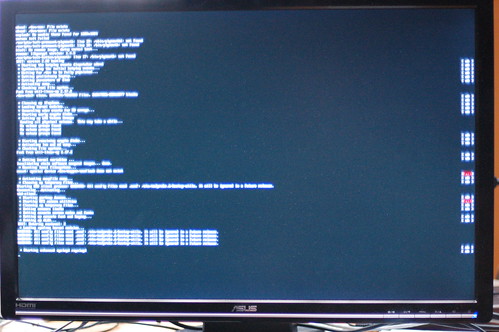
So someone thought it might be a good idea to switch the default from the time-honoured Debian style ("booting foo... ok") to the RedHat style ("<left-align>booting foo... <right-align>[ok]"). I don't think the switch adds any value (it's not like it looked bad or anything in the past); in fact, I think it's a bad idea. And I even have a technical reason. On my 26" 1920x1200 screen (when the i950 driver detects it properly and actually sets the framebuffer to that resolution), the output looks like this: bootscreen Now imagine you get to see that screen for about two to five seconds. Please tell me which two initscripts failed. And no, you cannot use a ruler. Bonus points for if you manage to do so while the text is also moving upwards, which tends to happen when systems boot. Also note that because kernel mode-settings has become the default, a lot more people are going to be using framebuffers. Am I the only one who thinks this is a bad idea?

Sune Vuorela: The Debian-KDE specific things II

I wrote a bit ago a blog post about what debian kde is missing of distribution specific things Some of the more important things includes: Installer
I don t think it is the most important thing. Wether or not the graphical installer is using gtk or qt is not that important. I would love to see it happen, but it is not something I feel like putting my time in. Others are most welcome.
It will give the advantage of giving the installer the possibility to use the framebuffer directly. Modules and firmwares and such
Someone is saying that ubuntu has something called jockey that does this exact thing, with a KDE and a Gnome frontend. Unfortunately, it is python, so it is something I will really avoid. I m hoping that me mentioning it here will make someone into python&debian pick it up and bring it to debian.
It is apparantly some nice magic around discover-data. Debconf frontend that fits
A lot of work has been put into proper perl-qt bindings and they will hopefully be ready for kde4.5, which is unfortunately a series too late for Squeeze :/. But when that has happened, we just need some perl guy to adapt the old frontend to debconf. Reportbug interface
There is already a tool called reportbug-ng that is a qt interface to reporting bugs. All in all, it looks like we are quite far already. We just need to get the last bits put together. Someone: pickup jockey. And note that the comment field isn t a place to report bugs. They will be removed.

17 May 2010

Matt Zimmerman: Ubuntu 10.10 (Maverick) Developer Summit

I spent last week at the Ubuntu Developer Summit in Belgium, where we kicked off the 10.10 development cycle. Due to our time-boxed release cycle, not everything discussed here will necessarily appear in Ubuntu 10.10, but this should provide a reasonable overview of the direction we re taking. Presentations While most of our time at UDS is spent in small group meetings to discuss specific topics, there are also a handful of presentations to convey key information and stimulate creative thinking. A few of the more memorable ones for me were: The talks were all recorded, though they may not all be online yet. Foundations The Foundations team provides essential infrastructure, tools, packages and processes which are central to the development of all Ubuntu products. They make it possible for the desktop and server teams to focus on their areas of expertise, building on a common base system and development procedures. Highlights from their track: Desktop The desktop team manages both Desktop Edition and Netbook Edition, on a mission to provide a top-notch experience to users across a range of client computing devices. Highlights from their track: Server/Cloud The server team is charging ahead with making Ubuntu the premier server OS for cloud computing environments. Highlights from their track: ARM Kiko Reis gave a talk introducing ARM and the corresponding opportunity for Ubuntu. The ARM team ran a full track during the week on all aspects of their work, from the technical details of the kernel and toolchain, to the assembly of a complete port of Netbook Edition 10.10 for several ARM platforms. Kernel The kernel team provided essential input and support for the above efforts, and also held their own track where they selected 2.6.35 as their target version, agreed on a variety of changes to the Ubuntu kernel configuration, and created a plan for providing backports of newer kernels to LTS releases to support deployment on newer hardware. Security Like the kernel team, the security team provided valuable input into the technical plans being developed by other teams, and also organized a security track to tackle some key security topics such as clarifying the duration of maintenance for various collections of packages, and the ongoing development of AppArmor and Ubuntu s AppArmor profiles. QA The QA team focuses on testing, test automation and bug management throughout the project. While quality is everyone s responsibility, the QA team helps to coordinate these activities across different teams, establish common standards, and maintain shared infrastructure and tools. Highlights from their track include: Design The design team organized a track at UDS for the first time this cycle, and team manager Ivanka Majic gave a presentation to help explain its purpose and scope. Toward the end of the week, I joined in a round table discussion about some of the challenges faced by the team in engaging with the Ubuntu community and building support for their work. This is a landmark effort in mating professional design with free software community, and there is still much to learn about how to do this well. Community The community track discussed the usual line-up of events, outreach and advocacy programs, organizational tools, and governance housekeeping for the 10.10 cycle, as well as goals for improving the translation of Ubuntu and related resources into many languages. One notable project is an initiative to aggressively review patches submitted to the bug tracker, to show our appreciation for these contributions by processing them more quickly and completely.

13 May 2010

John Goerzen: Bicycling Update

I ve been bicycling to work for awhile now. It s become pretty much routine for dry days. I can reliably ride the 10 miles to work in less than an hour, even with heavy winds. My biggest enemy right now: rain. My first few miles are on gravel and sand roads, which aren t maintained to the highest of standards. When it rains, there will be mud. I ride a Trek 7.3FX, which I bought with the idea of just riding when it s dry. It works quite well for that. But its slick tires don t work so well in mud. Plus our mud is sticky, and the tires pick it up, then deposit it on the frame that goes around the wheel and the brake arm. So I have a mess to clean up. My current dilemma is: do I buy a second bike for use when it s wet, or there s a chance of rain? My 7.3FX can t use tires that are very wide, and a different bike of course could. There would be expense involved, obviously, but I would really like to be able to ride more often than I can now. Winter was pretty damp here and I didn t get to ride much at all over the winter months. Or, would different tires plus fenders do the trick on the 7.3FX? (I m thinking not.) If I do get a different bike, then the question would be whether to sell the 7.3FX. I really like that bike, and imagine it would be faster on the 7 miles or so of paved roads that I ride every day. Perhaps I d keep it as a fair weather or long-distance bike. I plan to visit the bike shop tonight and see what my options are.

11 May 2010

Sune Vuorela: The Debian-KDE specific things ?

So. I was wondering, which nice distro specific tools do exist in debian/gnome or in $other/kde that debian/kde is missing? We have kalternatives for managing alternatives, we have a update notifier frontend in progress and after google summer of code, hopefully a package management frontend, aptitude-qt. (Made by Piotr). But what other distribution specific tools are we missing for Debian-KDE ?

Torsten Werner: Ubuntu Developer Summit

That is my second day at the UDS in Brussels. I have attended some sessions about server and cloud yesterday. The Ubuntu people are better organized than the Debian people during Debconf. They are collaboratively preparing the sessions in Launchpad and make notes with the Gobby editor during the session. Gobby allows group editing via Internet. The release date helps to keep the focus on stuff that can be done within the time frame and helps to concentrate on getting results.

It will probably be only 5 months for Maverick because Mark asked for a release on 10.10.10 which is an interesting date after removing the dots and converting it to a decimal number. I am comparing it to Debian: Toy Story 3 will be shown in cinemas soon and the Squeeze character is promoting the film. Will we use such a coincidence for more public attention and will will we release our Squeeze soon? I am afraid that it won't happen.

Our last session yesterday was about Tomcat packaging improvements. Debian and Ubuntu are using and maintaining identical packages of tomcat6 using the alioth infrastructure of the pkg-java team. Some of our plans are:

Andrew Pollock: [life] One week later

Zoe's a week old today. As such things tend to do, this feels like both an eternity and no time at all. We've been back to the paediatrician twice since I last blogged. Zoe's weight is now on the increase again. Today she weighed in at 6 lbs 3 oz (2806 grams) (I think. My brain has gone a bit fuzzy) We're largely sticking with bottle feeding pumped breast milk for now. Apparently 7 lbs is the magic size where they've got enough strength to feed exclusively at the breast. Sleep-wise, I think we're all doing reasonably well. Zoe just eats, sleeps and poops. Sometimes we need to wake her up to have a feed. I think the longest we've let her got is 4.5 hours. She's taking a lot of milk at each feeding session - up to 90 mL, so I expect that she'll have blasted past her birth weight by the time she's two weeks old. It'll be good when she's exclusively breastfeeding. The current regime is a little bit tiring. Zoe wakes up (or gets woken up). I change her diaper and give her a bottle. Sarah tries a little bit of breastfeeding. I put Zoe back in her crib. Sarah pumps some milk for the next feeding session, and I go and wash and sterilise bottles and pumping paraphernalia. If Zoe's feeding every three hours, this only really gives us two hours to get anything else done. Not that I'm complaining, mind you. At the paediatrician's this morning, there was another father with the same LPCH diaper bag that we'd received while we were in the hospital. Turned out he had a two-week old boy. I asked how the sleep levels were going, and he exclaimed about how they were only getting 2.5 hours at a time, and his son would raise the roof. I mentioned the 4.5 hour stint that we'd managed to have, and he was totally gobsmacked. In other news, it seems like Sarah has a bit of UTI, which has totally wiped her out this afternoon. She got a 3 day course of antibiotics this afternoon, so hopefully that'll fix her up. Zoe at 6 days of age

7 May 2010

Andrew Pollock: [life] And we're home

It took longer than expected, but we were finally discharged from the hospital early this afternoon. There was some concern about jaundice in Zoe, so the hospital paediatrician ordered a bilirubin blood test, which we had to wait for the results from. It came back fine though. The other concern was weight loss. She's still hovering around the 5 lbs 13 oz mark, which is at some magical 10% of birth weight lost, which seems to cause some concern for the doctors. So for the next week or so, we're going to bottle feed her breast milk, as she seems very sleepy when she tries to nurse, and we want to make sure she's getting enough. It's nice to be able to more actively participate in the feeding routine. Since we've been home, Zoe's not been sleeping terribly well on her own, so right now her and Sarah are having a nap together. We've got our first appointment with Zoe's ongoing paediatrician tomorrow. She was the recommendation of a friend, and seems to be highly regarded by all of the hospital paediatricians we saw. I'm feeling very disorganised in the nursery, because I didn't really participate in any of the set up of it. I knew where everything was in the hospital, so for a diaper change, everything was under control. I'm going to have to get a couple of totes tomorrow, so everything is on hand. I may also go berserk with a label maker. Looking forward to a hot shower and some shut-eye after this next feeding.

5 May 2010

Ana Beatriz Guerrero Lopez: KDE 4.4.3 in unstable

Following Qt 4.6.2, uploaded a couple of weeks ago, KDE 4.4.3, has finally found its way to unstable in the last 48 hours.
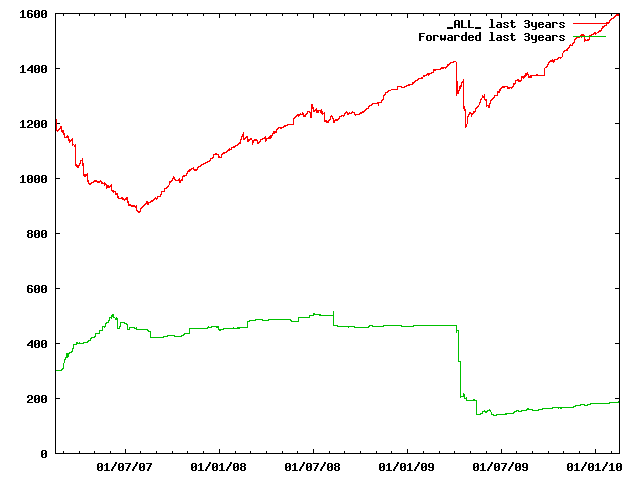
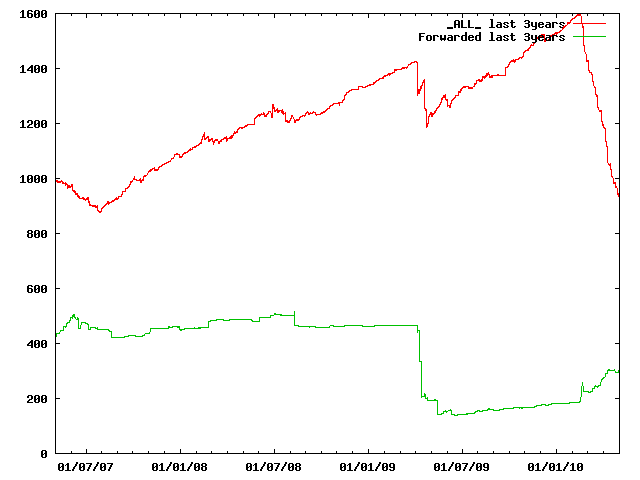
Given KDE 4.5.0 is not expected until August, it is likely the next point release, 4.4.4, will be the KDE version included in next Debian stable, Squeeze. What this means: go and update to 4.4.3, test, and when you find a bug, please, follow this instructions. If you are lazy to read it: report upstream bugs at the KDE Bugzilla and report the packaging/integration bugs in the Debian BTS. When in doubt, you have the Debian KDE mailing list, that is being successful so far in maintaining a good signal-noise ratio. I would like highlight the drop in the open bugs in the BTS experimented in the last 2-3 months, I published this graph in February: Number of bugs reported against KDE in Debian in the last 3 years - February 2010 And look at the situation now: Number of bugs reported against KDE in Debian in the last 3 years -May 2010 This is mainly due to the great work of Eckhart W rner. Also there is other people who contributed to it more modestly, a big thank you to all of you! As you can see in the second graph, there are less than 1000 bugs open now in the BTS, they are still too much and time has taught us it is very easy going over 1000 again, so we still welcome more volunteers looking at bugs. If you are not the bugsquasher type, you can write HTML and you do some IRC, we also need somebody to help us reorganize a bit the pkg-kde website. I will help you personally on this task, but it is good if you can lurk by IRC and you are not scared to share your doubts with the rest of the team there. Finally, I promise I will publish something about the status of KOffice pre-2.2 in Debian, but I still can not say whether it will be in Squeeze.

Christian Perrier: New progress in samba packaging

SambaXP day 2 for me. More progress on samba packaging. Today, I completed the backport of samba 3.4.7 to backports.org. We already had that version but it was desynced with the version in testing (2:3.4.7~dfsg-2 in testing while we had -1 in backports.org). As the difference is noticeable (dropping the old smbfs package in favoir of cifs-utils, which I blogged about yesterday), I wanted to resync all this. So a new 2:3.4.7~dfsg-2~bpo50+1 package (what a funky numbering scheme, isn't it?) was just uploaded today in backports.org. The transition between smbfs and cifs-utils should be smooth (as soon as autobuilders complete the entire build which may be quite long, for samba). I also completed a full resync of packages we have in experimental. Here, we do provide the bleeding edge samba version, namely 3.5.2. It's very likely that we don't provide samba 3.5 in squeeze, the option being conservative and keeping up with the 3.4 branch. So, for our users wanting the last samba version, having it in experimental is interesting. Next step is building 3.5.2 backported packages. These will be provided "as is", for i386 and probably very soon amd64, on the pkg-samba team's unofficial repository. I'll be working on this tomorrow^Wtoday.

4 May 2010

Erich Schubert: Facebook tracking users via "like" function.

Facebook recently launched the "Like" function, which basically can be embedded into arbitrary web sites. Naively, it does two things:
  1. Provide a "Like" button for sharing the web site
  2. Show you how many other users like the web site
Sounds good, doesn't it?But now reconsider: even when you don't use the "Like" function, facebook is in fact notified of which web sites you visit!.Encouraging you to "share" content with friends is the hanger for this function. This is what makes web masters install it on their sites: they expect to get some extra traffic from your friends, so they just add it.But whether you like it or not, it basically allows Facebook to track your complete web viewing habits. And it's the target web site that opts in, not the user! Combined with all the personal information Facebook already has on you, this is a major privacy concern. Combining this information might even be illegal in some countries (but probably not in the US where Facebook lives, privacy unfortunately has a low role here).The best workaround currently is to blacklist Facebooks "Like" function using some kind of AdBlock, for example using this element filter:
IFRAME[src^="http://www.facebook.com/plugins/like.php"]
But in general, we should try to make this kind of data aggregation illegal without explicit consent and force Facebook to make this an opt-in feature. Political work needed here ...P.S.: Make sure to check if your AdBlock actually blocks and not just hides. As far as I can tell, WebKit Adblock, including Chromes, only hide ads. Firefoxs AdblockPlus seems to be more powerful.P.P.S.: yes I've read the claim that Facebook doesn't track. No wait, all they basically said was that they are not going to announce at F8 they will be selling web surfing behaviour based ads to their customers. They actually did NOT state (or guarantee) they will NOT use data mining on this data. Just that you probably will not be able to buy eyeballs based on rules such as "has visited/liked disney.com" ...P.P.P.S.: I've been told that facebook.com/widgets/like.php also needs to be blocked, since some sites use this URI scheme. And of course, Privoxy and similar privacy-increasing proxies are a useful addition, too.

3 May 2010

Lucas Nussbaum: Castles in the air

When people ask me why I m so fond of computers , I already answer that it s like being able to build very large buildings or bridges, super-fast cars, etc without having to care about buying the raw material needed, or about the consequences: computers are like a giant Lego box which is only limited by the programmer s abilities. What I discovered today is that there s a quote from Frederick P. Brooks that says about the same thing:
The programmer, like the poet, works only slightly removed from pure thought-stuff. He builds his castles in the air, from air, creating by exertion of the imagination. Few media of creation are so flexible, so easy to polish and rework, so readily capable of realizing grand conceptual structures.

David Welton: Mochiweb proto-deb and hacking

I had some time over the weekend to play a bit with Mochiweb. It's a very nice little bit of work, but kind of strange for an open source project. I think both things come from the fact that it was built to do some very specific things in a business, and once those goals were accomplished, that suited the owner just fine. There is no nice/fancy project home page, no links to documentation, and in general, all of the stuff you're supposed to do for a successful open source project. The code, however, is good, fast, and pretty easy to deal with. Anyway, I wanted to use it for a thing or two I'm working on, so I created some .deb packaging for it. It's been ages since I've done that (indeed, I officially retired from Debian), so it's probably missing something, but I thought I'd throw it out there for people to have a look. The git repository is here: http://github.com/davidw/mochiweb - my changes live in the 'deb' branch. The big thing I've tried to do is make it so that if you have several mochiweb projects on the same machine, they'll all be started/stopped by the init scripts, if you so choose. What you do is add a file with the path to the application to the /etc/mochiweb/apps directory, and when you do /etc/init.d/mochiweb start, it will start all of those. At stop time, it will run the stop.sh script, which shuts things down. It runs things as the user that owns the start.sh script, unless it's root, in which case it simply doesn't run. The thing that's missing right now is a way to get the thing to write logs somewhere, and I'm not quite sure how to do that, so here's hoping someone will write in with a suggestion. The .deb file I generated ought to be attached to this post, although there are no guarantees that I'll keep it up to date.

2 May 2010

Dominique Dumont: Improve config file upgrades Ep 01

Hello The GSoC project Krzysztof and I are working aims to facilitate configuration upgrade during package upgrades. Most of the cases, this upgrade should not require any input from the user, even if the user had previously customized his configuration file. Currently configuration upgrade may ask questions to the user which may be hard to answer for most non-technical users. For more details see PackageConfigUpgrade on Debian wiki. (If you are not familiar with upgrade issues, you might want to read this page.) At the 2 extremes of upgrade tools, we have: Each tool has its own advantages and drawbacks. On the plus side of diff3 tools : On the other hand, here are the issues with diff3 based tools: For more details on diff3 issues, see Benjamin Pierce s paper (thanks to David Lutterkort from Augeas for the info) On the other end of the spectrum, Config::Model pros are: But, Config::Model main problem is: diff3 tools is lackluster for users. While Config::Model puts too much strain on packagers because it requires configuration models where all parameters are defined and declared in the model. For fast evolving projects, this can be a huge recurrent task (been there, done that for Xorg) . (Well, this recurrent task is a problem until doc, implementation and config model can be extracted from a single meta-description But I digress, this may be a project for GSoC 2011 :-p ) So, this GSoC project (for 2010) aims to find a compromise between these 2 extreme cases. On Config::Model, I ve always had a drawer statement whenever I was asked why Config::Model does not handle unknown parameter:
a configuration file cannot be validated if an unknown parameter can t be distinguished from a user typo.
This stance is fine for casual user interaction on a stable system: an unknown parameter is most likely an error. And the user must be warned of his error as soon as possible. For a stable distro release, packagers should have the time to provide complete models, so basing upgrade on complete models should be possible (famous last words ?). On the other hand, a lot of configuration upgrades will be done on unstable systems where software evolve quite fast, where models will likely fall behind software evolutions. Another shorcoming of my drawer statement is that it assumes user interaction where erroneous input is more likely. In case of configuration upgrades, there should be no user interaction. And we can assume that the config file to be upgraded was used (and thus validated) by the old version of the software. So unknown parameters should be tolerated and managed as best as possible. Now, the big question is: how ? In all attempts I ve seen in managing upgrades that goes beyond diff3 tools, the configuration is stored as structured data. Sometimes this structure can be infered from the configuration file syntax (shell vars, INI files, YAML, XML), sometimes not (sshd config file). In the latter case, some structural knowledge must be built in the upgrade tool. Currently, Config::Model is designed to bring a complete description of the structure and semantics of a configuration file. This is perceived as bringing too much structural and semantic knowledge ( too semantic ). So the maintenance cost is perceived as too important. That may be right or wrong, but that does not matter. Perception is more important here. So, let s figure out a way to reduce the amount of work required to perform upgrades (you may want to read a little bit more on configuration model creation before going on ) One possibility would be to support configuration models that allow unknown leaves in nodes. Such a model would provide a kind of fallback leaf description. Something like: this parameter is unknown, let s assume it s a simple string value . Let s consider sshd_config example to see how such a behavior would pan out for some upgrade scenarios. sshd model is made of 2 main classes:
- Sshd
- SshdMatchElement The second one contains all parameters allowed in a Match class (in fact, Match parameter is the only one in sshd that defines a new hierarchical level. All other parameters are simple leaves). Now let s consider typical upgrade scenarios from old version (with old models) to a more modern version. Let s assume that the model is lagging behind and the model does not follow sshd evolutions. So Config::Model will face 3 upgrade cases (extracted from sshd config history):
  1. Unexpected parameter that are actually simple leaf parameters. E.g. introduction of ClientAliveInterval.
  2. Obsolete parameters that should be migrated. E.g KeepAlive is renamed into TCPKeepAlive
  3. New structural parameters (introduction of Match element)
So what would happen with a model allowing unknown parameters but lacking specific instructions for these upgrades:
  1. ClientAliveInterval value would be kept. :-)
  2. KeepAlive would be kept as is.TCPKeepAlive would also be kept. No migration is performed, but the configuration would be good. As long as sshd supports the old parameter, we re good. :-/
  3. Without knowledge of the structure brought by Match parameters, Config::Model would consider that parameter in Match block would duplicate parameters in the main block and remove the duplicate. User data may be lost. :-(
So, there s not silver bullet. Let s resume what we ve learnt: Next step is to figure out what would happen if the same strategy is applied to other types of configuration files. But that will be for another blog. All the best

Petter Reinholdtsen: Forcing new users to change their password on first login

One interesting feature in Active Directory, is the ability to create a new user with an expired password, and thus force the user to change the password on the first login attempt. I'm not quite sure how to do that with the LDAP setup in Debian Edu, but did some initial testing with a local account. The account and password aging information is available in /etc/shadow, but unfortunately, it is not possible to specify an expiration time for passwords, only a maximum age for passwords. A freshly created account (using adduser test) will have these settings in /etc/shadow:
root@tjener:~# chage -l test
Last password change                                    : May 02, 2010
Password expires                                        : never
Password inactive                                       : never
Account expires                                         : never
Minimum number of days between password change          : 0
Maximum number of days between password change          : 99999
Number of days of warning before password expires       : 7
root@tjener:~#
The only way I could come up with to create a user with an expired account, is to change the date of the last password change to the lowest value possible (January 1th 1970), and the maximum password age to the difference in days between that date and today. To make it simple, I went for 30 years (30 * 365 = 10950) and January 2th (to avoid testing if 0 is a valid value). After using these commands to set it up, it seem to work as intended:
root@tjener:~# chage -d 1 test; chage -M 10950 test
root@tjener:~# chage -l test
Last password change                                    : Jan 02, 1970
Password expires                                        : never
Password inactive                                       : never
Account expires                                         : never
Minimum number of days between password change          : 0
Maximum number of days between password change          : 10950
Number of days of warning before password expires       : 7
root@tjener:~#  
So far I have tested this with ssh and console, and kdm (in Squeeze) login, and all ask for a new password before login in the user (with ssh, I was thrown out and had to log in again). Perhaps we should set up something similar for Debian Edu, to make sure only the user itself have the account password? If you want to comment on or help out with implementing this for Debian Edu, please contact us on debian-edu@lists.debian.org. Update 2010-05-02 17:20: Paul T tterman tells me on IRC that the shadow(8) page in Debian/testing now state that setting the date of last password change to zero (0) will force the password to be changed on the first login. This was not mentioned in the manual in Lenny, so I did not notice this in my initial testing. I have tested it on Squeeze, and 'chage -d 0 username' do work there. I have not tested it on Lenny yet. Update 2010-05-02-19:05: Jim Paris tells me via email that an equivalent command to expire a password is 'passwd -e username', which insert zero into the date of the last password change.

Romain Beauxis: SPIP is cool

I have been playing around with SPIP for some time today. I am really happy with the software and its current packaging ! I have packaged this application because I believed it was missing among the possible powerful CMS for Debian. I hope this will be a good package for squeeze !

1 May 2010

Sean Finney: Nouveau, Gallium3D, and Compiz on Debian

update: 20100503: It's been brought to my attention that there might have been a regression in one of the libraries, mesa, maybe, so that master might not be as reliable a reference point for this guide. so, just in case, here are the commit hashes that were used from the different projects: for the non-git-savvy: git checkout -b mybranch <hash> we now return to your regular broadcasting... A week or two ago I figured it was about time that I took the plung and tried out the latest nouveau drivers from experimental on my laptop. Unfortunately, it meant bidding adieu to compiz (apart from the bling it does actually provide some pretty damned useful features). I thought I'd give it a shot at least for a while on principal, since I've always had to think of the nvidia drivers as a necessary evil, and their lack of proper xrandr support is really, really annoying. Since then I haven't noticed any problems, apart from the following message after every suspend/resume:
[  931.213239] Uhhuh. NMI received for unknown reason 80 on CPU 0.
[  931.213240] You have some hardware problem, likely on the PCI bus.
[  931.213242] Dazed and confused, but trying to continue

No idea what's causing it, but otherwise the system is stable and functional. If anyone knows what can be done about this, I'd appreciate hearing from you. My graphics card, by the way:
01:00.0 VGA compatible controller: nVidia Corporation G72M [Quadro NVS 110M/GeForce Go 7300] (rev a1)

In the time since then, the nouveau driver has made its way into unstable, and a lot of distros (ubuntu, fedora, ...) are even using it as the default driver. So before going any further with the 3d/compiz stuff, I highly recommend that you get the packaged version working first. This will not only make sure that the basic driver works, but it will also make recovery/rollback a lot easier. Since it's all packaged in the standard repositories, it's not much harder than installing a few packages and editing a few files... so come on give it a try :) Getting the 2d driver working in Debian sid Really, this is so easy it's hardly worth writing up, but i'm running with the -v flag this morning... Make sure you don't have any reference to nvidia in /etc/modules or other places that might cause it to be automatically loaded. Then remove the proprietary glx bindings, which would otherwise interfere with the nouveau driver.
sudo apt-get remove nvidia-glx

Next, you'll need to install a kernel that includes updated drm support. Normally this would require a kernel >= 2.6.33.1, but the debian kernel maintainers have graciously backported this code to the 2.6.32-4 kernel package. note this isn't the default kernel version in testing/unstable at the time of writing so you have to explicitly install it along with the nouveau driver.
sudo apt-get install linux-image-2.6.32-4-amd64 xserver-xorg-video-nouveau

If you are already running this kernel and using the proprietary nvidia drivers, via module-assistant or otherwise, you /might/ need to uninstall them first. On my system I left them installed in the old kernel version but did not install them on the new kernel version. Required xorg configuration I don't believe that nouveau is picked by default if available at the time of writing, so you have to have the following in your xorg.conf:
sudo sh -c "cat > /etc/X11/xorg.conf" << EOF
Section "Device"
    Identifier     "nVidia Corporation G72M [Quadro NVS 110M/GeForce Go 7300]"
    Driver         "nouveau"
EndSection
EOF

This was all I needed to do, apart from rebooting into the new kernel. For those who don't want to venture outside the packaging system, this is about as far as you can go for the time being. Though really, if you're bothering to read this far along, you're probably more interested in what comes next :) Getting 3d working (without voiding your distro warranty) So I thought I'd give the 3d-accelerated gallium a go. Their wiki page certainly makes one think twice, but at this point I was seriously fiending to get my bling back (well, the compiz scale plugin, anyway) and figured it wouldn't hurt too much to try. Via google and trawling around in various forums I found a number of how-to documents for getting Gallium3d on debian/ubuntu systems, but most of them recommended doing things in a way that wasn't easily reversible and that could totally hose your system in a not-so-hypothetical worst-case scenario. It's pretty hard to roll back a make install done into /usr, for example, and subsequent package upgrades can leave your system even worse off as they will probably clobber half of what you just did, leaving the other half totally broken. And if you have a laptop which requires the gui for networking (i.e. network-manager), then fixing/rolling-back the changes is not entirely trivial, since you'd likely have to re-download the various drm/mesa/xorg packages. So enter the tried and true unix utility stow (apt-get install stow, of course). stow is a utility that lets you install software into arbitrary folders, and then manage the system-wide installation of the software via a farm of symlinks pointing at the installed location. It's probably more well known among the sysadmin crowd than the desktop user crowd, but it's incredibly useful for the task at hand as it will let us easily install multiple copies of different software in a way that's very easy to update and/or roll-back. RTFM stow(1) for more information. So, on to the juicy stuff... Install needed software, remove problematic packages, setup, etc At least on my system, I had to remove libdrm-dev to keep things from accidentally linking against it instead of the updated version that we install later on below. There's probably a way to override this with CFLAGS but I figure this is simpler.
sudo apt-get remove libdrm-dev
sudo apt-get install stow build-essential xorg-dev git-core libtool mesa-common-dev automake autoconf 
mkdir ~/nouveau

Compile a linux-2.6.34 RC kernel
cd ~/nouveau
git clone git://git.kernel.org/pub/scm/linux/kernel/git/torvalds/linux-2.6.git
cd linux-2.6
git remote add -f nouveau git://anongit.freedesktop.org/nouveau/linux-2.6
git checkout -b nouveau-master nouveau/master
make menuconfig

Enable device drivers -> staging drivers -> nouveau. Make any other changes you might want to make (I just took defaults for everything else).
make deb-pkg

The linux-firmware-free debian package ships some of the same stuff from the generated linux-firmware-image package. I decided to opt for the upstream firmware, though I'm not sure that this is necessary:
sudo apt-get remove linux-firmware-free
sudo dpkg -i ~/nouveau/linux-image*.deb ~/nouveau/linux-firmware-image*.deb
sudo update-grub

Install a copy of dri2proto
cd ~/nouveau
git clone git://anongit.freedesktop.org/xorg/proto/dri2proto
cd dri2proto
./autogen.sh --prefix=/usr/local/stow/dri2proto-20100428
sudo mkdir -p /usr/local/stow/dri2proto-20100428
sudo make install
sudo stow -d /usr/local/stow dri2proto-20100428

Install a cutting-edge version of libdrm
cd ~/nouveau
git clone git://anongit.freedesktop.org/git/mesa/drm/
cd drm
./autogen.sh --prefix=/usr/local/stow/drm-20100428 --disable-intel --disable-radeon --enable-nouveau-experimental-api
make
sudo mkdir -p /usr/local/stow/drm-20100428
sudo make install
sudo stow  -d /usr/local/stow  drm-20100428

Likewise for mesa
cd ~/nouveau
git clone git://anongit.freedesktop.org/git/mesa/mesa
cd mesa
./autogen.sh --prefix=/usr/local/stow/mesa-20100428  --enable-debug --enable-glx-tls --disable-asm --with-dri-drivers= --enable-gallium-nouveau --disable-gallium-intel --disable-gallium-radeon --disable-gallium-svga --with-state-trackers=glx,dri --with-demos=xdemos,demos,trivial,tests
make
sudo mkdir -p /usr/local/stow/mesa-20100428 
sudo make install
sudo stow -d /usr/local/stow mesa-20100428

And now the xorg driver...
cd ~/nouveau
git clone git://anongit.freedesktop.org/git/nouveau/xf86-video-nouveau/
cd xf86-video-nouveau
./autogen.sh --prefix=/usr/local/stow/xf86-video-nouveau-20100428
make
sudo mkdir -p /usr/local/stow/xf86-video-nouveau-20100428
sudo make install
sudo stow -d /usr/local/stow xf86-video-nouveau-20100428

Configuration Configure xorg to look in alternate location for xorg modules and set up DRI
sudo sh -c "cat > /etc/X11/xorg.conf" << EOF
Section "Files"
    ModulePath "/usr/local/lib/xorg/modules,/usr/lib/xorg/modules"
EndSection
Section "ServerFlags"
    Option "GlxVisuals" "all"
Endsection
Section "Device"
    Identifier     "nVidia Corporation G72M [Quadro NVS 110M/GeForce Go 7300]"
    Driver         "nouveau"
EndSection
EOF

I've /heard/ that disabling TV out is a necessity on some cards, though I haven't seen this myself:
sudo sh -c "cat > /etc/modprobe.d/nouveau.conf" << EOF
# not entirely sure this is necessary, but heard it helped with vsync
options nouveau tv_disable=1
EOF

Finally, the one thing that can not be done in /usr/local is making the nouveau DRI driver available. From what I could tell the path that mesa uses to find the DRI libraries is hard-coded (corrections welcome). Since you won't already have this file (otherwise, why would you be following along here?), just drop in a symlink to the file in /usr/local:
sudo ln -s /usr/local/lib/dri/nouveau_dri.so /usr/lib/dri/

Finally, reboot, and hope for the best :) Riding the bleeding edge: how to upgrade later on Again, stow really shows its usefullness here. Using drm as an example case, upgrading an individual component would look something like:
cd ~/nouveau/drm
git clean -dfx
git pull
today= date +%Y%m%d 
./autogen.sh --prefix=/usr/local/stow/drm-$today --disable-intel --disable-radeon --enable-nouveau-experimental-api
make
sudo mkdir -p /usr/local/stow/drm-$today
sudo make install
sudo stow -d /usr/local/stow -D drm-20100428
sudo stow -d /usr/local/stow  drm-$today

Note how the old version is still installed, so you can switch components around pretty freely. Abort! Abort!: How to roll back changes In case your system becomes totally unusable, or you've decided that you just want to go back to the safe and cozy world of what's provided by the debian packages, simply do the following: Assuming that you're using the nouveau driver from unstable, this should be all that is necessary. Conclusion Overall impression I am very, very happy with the resulting setup. I was led to believe that this whole thing was much more unstable and unusable than it actually is! While there are certainly some glitches and missing features, I feel comfortable enough using it that I don't have plans to switch back. But if I find myself in a situation where I can't use the new setup, rolling back shouldn't be a problem either. I figure I'm happy with what I have now and it will only get better. What works, at least to a "kinda works" level. What still doesn't work Further reading, references Thanks A couple shoutouts to those who helped me with this on the way: Feedback / Corrections Unforunately, I've had to disable comments for the time being due to overwhelming quantities of spam. So please drop me a line via email or on IRC (seanius on oftc/freenode).

30 April 2010

Michael Banck: 30 Apr 2010

Science Track at Debconf10 This year's Debconf will probably have for the first time tracks pertaining to certain subjects. One of the proposed tracks will be "Math and Science and Debian" and I was asked to organize it. We have some talk proposals already, and we will have a panel discussion about Debian science packaging between the major contributors of the various packaging teams, but more talks are welome! Talks could be about science with/on Debian, or Debian development in scientific fields. Additionally, I would like to encourage contributions on three types of topics: Full length talks are not required, we could split up each topic among a number of people depending on interest and submissions. Talks can be officially submitted until the end of tomorrow (Saturday May 1st, 23h59 UTC), but even afterwards, if you plan to go to Debconf and would like to give a talk about Math, Science and Debian, please contact me and we will see what can be done. Especially contributions to the three topics above can be made later as the events will be registered already.

Andrew Pollock: [tech] How to set up my Mustek 1200 UB Plus scanner under Linux

One for the note-to-self file... Strangely, it's labeled as a "Mustek 1200 UB Plus" on the unit itself, but lsusb says it's a "Ultima Electronics Corp. Artec Ultima 2000 (GT6801 based)/Lifetec LT9385/ScanMagic 1200 UB Plus Scanner" apt-get install xsane sane-utils http://www.meier-geinitz.de/sane/gt68xx-backend/ says I should be downloading sbfw.usb, which needs to go into /usr/share/sane/gt68xx Uncomment override "mustek-scanexpress-1200-ub-plus" in /etc/sane.d/gt68xx.conf adduser apollock scanner newgrp scanner scanimage -L should now report something like "device gt68xx:libusb:001:002' is a Mustek ScanExpress 1200 UB Plus flatbed scanner"

28 April 2010

Sam Hartman: Debconf 10 Enterprise Track

I ve been asked by the Debconf 10 talks team to coordinate a Debian Enterprise track at the upcoming Debconf 10 conference. I m really excited about this, and I could use your help. From my standpoint, this all started with a BOF proposal looking at better coordination and what is missing in Debian enterprise integration. The track will also include talks and other events on what exciting things are happening with Debian in the enterprise. I need your help in the form of suggestions for talks, panels and the like (especially if you would be willing to give the talk or coordinate an activity). We re under a fairly tight deadline; ideally proposals would be in by May 1, but if they are not, it s still definitely worth discussing with me. From my standpoint, topics include: Obviously, many other things could fit in and I d be interested in your ideas as well.

Next.

Previous.