Search Results: "tb"

19 November 2009

Josselin Mouette: Why python2.6 is still not in unstable

Getting python2.6 as the default ASAP is currently the #1 priority for the Python modules team. I also consider it very important and tried to help with it, but it is starting to get depressing. The plan is to fix all packages in unstable to be compatible with python2.6 first. This would be easy if there hadn t been a very badly planned change in the installation paths that came together. Because of it, quite a number of packages have to be fixed. Two months ago, I filed a lot of bugs in that order. I missed a number of issues, but overall, almost all packages have been fixed, thanks to Kumar Appaiah, Bastian Venthur and everyone else who sent patches and NMUs. One of the biggest issues, though, comes from python-central. Since it doesn t handle some of the new paths that were introduced (which is somehow ironic, since the python-central maintainer, Matthias Klose, is also the python maintainer who did this change), a large number of packages FTBFS when built against python2.6. In Ubuntu, it turned out to be a giant mess, most packages using python-central needing changes, and we wanted to avoid that. This is why Piotr O arowski sent a NMU for python-central that fixes these issues for good. Guess what happened? Matthias Klose uploaded a new version that does not include the python2.6 fixes, completely discarding the work that has been done. And of course, making the upload of python2.6 to unstable, which was ready to be done in a few days, impossible. I think it s fine if Ubuntu maintainers don t have the time to handle their packages in Debian. But it is clearly not acceptable to hold back development in Debian, nor to treat it as a garbage dumpster where you can send all the crappy software solutions that were badly designed in Ubuntu to duplicate them in Debian. This is what Matthias has been doing for several years. For how long are we going to tolerate such behavior? For how long will we leave such a critical package in the hands of a single person with no interest in Debian?

17 November 2009

Biella Coleman: The Winners

These are the winners from my yearly class contest : SERIOUS BABY lol ..sometimes Did I just Get Rejected From McDonalds? (Watch to the end) This is one of my all time favorites funny videos and it has a nice catchy tune and I will also post one of my ALL TIME favorites after I show it in class next week.

Russell Coker: Debian SSH and SE Linux

I have just filed Debian bug report #556644 against the version of openssh-server in Debian/Unstable (Squeeze). It has a patch that moves the code to set the SE Linux context for the child process before calling chroot. Without this a chroot environment on a SE Linux system can only work correctly if /proc and /selinux are mounted in the chroot environment. deb http://www.coker.com.au squeeze selinux I ve created the above APT repository for Squeeze which has a package that fixes this bug. I will continue to use that repository for a variety of SE Linux patches to Squeeze packages, at the moment it s packages from Unstable but I will also modify released packages as needed. The bug report #498684 has a fix for a trivial uninitialised variable bug. The fix is also in my build. Also I filed the bug report #556648 about the internal version of sftp being
incompatible with SE Linux (it doesn t involve an exec so the context doesn t change). The correct thing to do is for sshd to refuse to run an internal sftpd at least if the system is in enforcing mode, and probably even in permissive mode. deb http://www.coker.com.au lenny selinux Update: I ve also backported my sshd changes to Lenny at the above APT repository.

16 November 2009

Kartik Mistry: foss.in/2009: be there!


* What am going to do there? 1. Debian Workout: Where we are going to get some more people hacking on Debian packaging. My focus will be on collaborative-maintainance, RC Bug Fixes, things we could not finished last year (I wasn t there, but Kapil took the lead..). Kunal & friends are very much interested in fixing some things in reportbug so it will be fun.
2. Debian Development BOF: This is all about things we did in talks in last years. BOF is better than talk . I m going to re-prove it! Foss.in/2009: Be there!

15 November 2009

Jonathan McDowell: Playing with an e-reader

I've always preferred dead tree to reading things on screen; I just find it easier. I've tried reading fiction in the past off a laptop and just didn't find it as enjoyable an experience; whether it was the form factor (hard to curl up with a laptop, even a netbook), the quality of the screen or the interface I don't know. Equally with technical documentation if it's something I'm using a lot I prefer a printed copy to flick through. However e-ink based e-readers are becoming much more common and affordable and I figured I should give the whole ebook experience another try.

I spent 3 weeks in October in the Bay Area on work, so I borrowed my Dad's Sony PR505 for the trip. First problem is that it's picky about USB charging - works fine if attached to a computer, but using a Blackberry charger looks like it's fine but then results in what looks like a hanging reader. However once charged it lasts for ages - I charged it before I went and only hooked it up to my laptop once during the trip to transfer some new content onto it. The form factor is also quite good; a bit heavier than a book, but not excessively so. Holdable in one hand, big enough screen that I wasn't squinting at it. Slightly too big physically to easily go in a coat pocket the way a paperback would unfortunately, but perfectly fine for taking to read at breakfast every morning in the hotel.

The screen was also much better than I'd expected. I knew the technology was different and supposed to be easier to read than traditional LCDs, but I was sceptical. Overall I had no problems with it. I was even quite impressed with the Sony's zoom function - one of the PDFs I was reading was too small when view full screen, so I zoomed in so it was readable. The nice feature was that then the "next page" button gave me the next bit of text to read, rather than the actual next page, so it remained very easy to navigate through as I read. A small touch, but very welcome.

This isn't intended to be a review of the Sony reader; that just happened to be the model I was easily able to borrow. I happened to see a Kindle in use on the plane and I was struck by how much bulkier it seemed, though having looked at the relative specs it seems this is entirely due to the keyboard rather than any difference in screen size. The Nook was also announced during my trip and I'd quite like a play with that as it looks quite nice.

Despite my positive experience with the Sony I'm not planning to go out and get one just yet. And that's the lack of sensibly priced content. When I bought my first mp3 player I could take my exising CD collection, rip it and be able to play it on my new device. This meant I got an immediate benefit of having my entire music collection with me all the time, just by buying the player. If I buy an e-reader then in order to get all my existing books on it I have to go and buy them again. What's worse is they'll cost me the same or more than I paid for the paperbacks. I can't go and exchange my Pratchett collection for the electronic versions for a nominal fee. I can't easily scan them in myself and produce some decent ebooks. I can't even go and buy the entire set for 20; I'd have to spend something like ten times that. With mp3s I can continue to buy the real item and also have it on my portable player. Or, while albums still don't seem to be much cheaper electronically than on CD, there is at least the ability to buy a single track if that's all I want. Books don't have a comparison. I'm not going to want to buy a single chapter, am I?

There are some sites out there that can provide cheaper ebooks - Rachel Willmer runs ebookprice.info which lets you compare pricing from different vendors. There's also Project Gutenberg if you're looking for out of copyright books. Finally Peter Corlett pointed me at the Baen Free Library, which I haven't downloaded anything from but will definitely investigate at some point. I still maintain that none of these are enough and that content provision will continue to be a hinderance for e-reader mass adoption until there is some fundemental change in the way its provision is handled.

Russell Coker: Backing up MySQL

I run a number of MySQL databases, the number of mysqld installations that I run is something like 8, but I may have forgotten some. With the number of servers that I run on a do nothing except when it breaks basis it s difficult to remember the details. The number of actual databases that I run would be something like 30, four databases running on a database server (not counting mysql is fairly common. Now I need to maintain some sort of automated backup of these, this fact became obvious to me a couple of days ago when I found myself trying to recreate blog entries and comments from Google s cache There are two types of database that I run. There are ones of significant size (more than 1GB) and tiny ones I don t think I run any database which has a MySQL dump file that is more than 20M and less than 2G in size. For the machines with small databases I have the following script run daily from a cron job (with db1 etc replaced with real database names and /mysql-backup replaced by something more appropriate). The --skip-extended-insert option allows the possibility of running diff on the dump files but at the cost of increasing file size, when the raw file size is less than 20M this overhead doesn t matter and gzip should handle some extra redundancy well. #!/bin/bash -e for n in db1 etc ; do
/usr/bin/mysqldump --skip-extended-insert $n gzip -9 > /mysql-backup/$n- date +%Y-%m-%d .gz
done Then I have a backup server running the following script from a cron job to copy all the dump files off the machines. #!/bin/bash -e
cd /backup-store
for n in server1 server2 ; do
scp $n:/mysql-backup/*- date +%Y-%m-%d .gz $n
done This script relies on being run after the script that generates the dump files. Which is a little more tricky than it should be, it s a pity that cron jobs can t be set to have UTC run times. I could have run the dumps more frequently and used rsync to transfer the data, but it seems that the risk of losing one day s worth of data is acceptable. For my blog I can get any posts that I might lose from Planet installations in that time period. For the bigger databases my backup method starts by putting the database and the binary log files on the same filesystem not /var. This requires some minor hackery of the MySQL configuration. Then I use rsync to copy the contents of an LVM snapshot of the block device. The risks of data consistency problems involved in doing this should be no greater than the risks from an unexpected power fluctuation and the system should be able to recover from that without any problems. My experience with MySQL dumps is that they take too long and too much system resources for large databases so I only use them for backing up small databases (where a dump can be completed in a matter of seconds so even without using a transaction it doesn t hurt).

13 November 2009

Russell Coker: What to do When You Break a Server

Everyone who does any significant amount of sysadmin work will break a server. Most people who have any significant experience will have broken several. Anyone who has never broken one should be treated with suspicion by other members of the sysadmin team, they probably haven t learned the caution that most of us learn from stuffing something up badly. When you break a server there are some things that you can do to greatly mitigate the scale of the disaster. Firstly carefully watch what happens, for example don t type rm -rf * and then walk away, watch the command if it takes unusually long then press ^C and double-check that you are removing the right files. Fixing a half broken server is often easier than fixing one that has been broken properly and completely! If you don t know what to do then do nothing! Doing the wrong thing can make things worse. Seek advice from the most experienced sysadmin who is available. If backups are inadequate then leave the server in a broken state while seeking advice, particularly if you were working at the end of the day and it doesn t need to be up for a while. There is often time to seek advice by email before doing something. Do not reboot the system! Even if your backups are perfect there is probably some important data that has been recently modified and can be salvaged. Certain types of corruption (such as filesystem metadata corruption) will leave good data in memory where it can be recovered. Do not logout! If you do then you may not be able to login again and this may destroy your chances of fixing the system or recovering data. Do not terminate any programs that you have running. There have been more than a few instances where the first step towards recovering from disaster involved using an open editor session (such as vi or emacs). If the damage prevents an editor from being used (EG by removing the editor s program or a shared object it relies on) then having one running is very important. These procedures are particularly important if you are unable to visit the server. For example when using a hosted server at an ISP the more cost effective plans give you no option to ever gain physical access. So plugging the disks into another machine for recovery is not an option. Does anyone have any other suggestions as to what to do in such a catastrophy? PS This post is related to the fact that I had to recover the last couple of weeks of blog comments and posts from Google s cache Update: I got my data back, not I have to copy one day of blog stuff from one database to another.

12 November 2009

Cyril Brulebois: Haste

Recipe for a smile:
  1. Notice digikam's FTBFS on GNU/kFreeBSD.
  2. Work on a patch, send it to the BTS.
  3. Receive the ACK from the BTS.
  4. Receive the upstream commit notification a dozen of minutes later.
Denightening lights or enlightening nights or nightening delights Kudos, Luka.

Russell Coker: Links November 2009

Credit Writedowns has a populist interpretation of the latest Boom-Bust cycle [1]. It s an interesting analysis of the way the US economy is working. Bono writes for the NY Times about Rebranding America [2]. He praises Barack Obama suggesting a different reason to believe that the peace prize is deserved and describes what he believes to be the world s hope for the US. IsMyBlogWorking.com is a useful site that analyses your blog [3]. It gives some advice on how to improve some things as well as links to feed validation sites. Evgeny Morozov gave an interesting TED talk How the Net Aids Dictatorships [4]. I don t agree with his conclusion, he has some evidence to support his claims but I think that a large part of that is due to people not using the Internet well. I expect things to improve. The one claim that was particularly weak was when he mentioned radio stations in Rwanda as an example of technology being used for bad purposes the entire point about the first-world discussion about such things is the radio vs the Internet. Ray Anderson gave an inspiring talk about The Business Logic of Sustainability [5]. He transformed his carpet company, decreasing it s environmental impact by 82% and it s impact per volume of product by more than 90% while also significantly increasing it s profitability. He says that corporate managers who don t protect the environment should be regarded as criminals. Making his company more environmentally friendly reduced expenses (through efficiency), attracted more skillful employees, and attracted environmentally aware customers. Managers who don t follow Ray s example are not only doing the wrong thing for the environment, they are doing the wrong thing for their stockholders! Ray s company Flor takes carpet orders over the web [6]. They won t ship a catalogue outside the US, so presumably they only sell carpet to the US too. Marc Koska gave an interesting TED talk about a new syringe design that prevents re-use [7]. His main aim is to prevent the spread of AIDS in the developing world where even hospital staff knowingly reuse syringes. It will also do some good in developed countries that try to prohibit drug use. David Logan gave an interesting TED talk about tribal leadership [8]. His use of the word tribe seems rather different from most other uses, and I am a bit dubious about some of his points. But it is definitely a talk worth seeing and considering. Deirdre Walker is a recently retired Assistant Chief of Police who has worked for 24 years as a police officer, she describes in detail her analysis of the flaws in the TSA security checks at US airports [9]. Brian Krebs wrote an article for the Washington Post recommending that Linux Live CDs be used for Internet banking [10]. Windows trojans have been used to take over bank accounts that were accessed by security tokens, that could only be accessed by certain IP addresses, and that required two people to login. It seems that nothing less than a Linux system that is solely used for banking is adequate when a lot of money is at stake. The NY Times has an interesting review of the book Ayn Rand and the World She Made [11]. It seems that Ayn was even madder than I thought. Gary Murphy has written an interesting analysis of the latest stage in the collapse of the US Republican party [12]. The ABC (AU) Law Report has an interesting article about Evony s (of China and the US) attempting to sue Bruce Everiss (of the UK) in Australia [13]. The Guardian has an insightful article about the IEA making bogus claims about the remaining oil reserves [14]. It seems that the experts who work for the IEA estimate that oil is running out rapidly while the US is forcing them to claim otherwise. Dean Baker of the Center for Economic and Policy Research has written an interesting article about the economic effects of the war in Iraq [15]. Apparently it caused the loss of over 2,000,000 jobs considerably more than the job losses that could ever result from efforts to combat global warming.

11 November 2009

Yves-Alexis Perez: Key transition (this is _not_ a meme)

Ok, so following the trend, I created some time ago a new GPG key, which I'm now transitioning too. I've set up a transition document, available at http://molly.corsac.net/~corsac/key-transition.txt. It's signed by both the old and the new keys and is reproduced below:
-----BEGIN PGP SIGNED MESSAGE-----
Hash: RIPEMD160,SHA512
Wed, 11 Nov 2009 13:44:05 +0100
I've recently set up a new RSA-based GPG key, and will be transitioning away
from my old DSA-based one.  The old key will be revoked soon, so I prefer all
future correspondence to use the new one.  I would also like to ensure that
this new key is well-integrated into the web of trust.  This message is signed
by both keys to certify the transition.
The old DSA key was:
pub   1024D/C5C05BAE 2004-11-11
      Key fingerprint = DE26 2FC4 7097 FFC6 DE2C  D8C0 4D44 C020 C5C0 5BAE
The new RSA key is:
pub   4096R/71EF0BA8 2009-05-06
      Key fingerprint = 4510 DCB5 7ED4 7040 60C6  6476 3055 0F78 71EF 0BA8
If you already know my old key, you can verify that the new key is
signed by the old one:
  gpg --check-sigs 71EF0BA8
If you don't already know my old key, or if you're extra-paranoid, you
can check the fingerprint against the one given above:
  gpg --fingerprint 71EF0BA8
If you have previously signed my old DSA key, and if you're satisfied
that you've got the correct new RSA key, then I'd appreciate it if you
would sign my new key as well:
  caff 71EF0BA8
The caff program is in the signing-party package in Debian.  Please be careful
to generate signatures that don't rely on the weakening SHA-1 hash algorithm,
which requires some careful configuration even if you've already configured
gpg correctly.  See http://www.gag.com/bdale/blog/posts/Strong_Keys.html for
the gory details.
Thanks,
- --
Yves-Alexis Perez
-----BEGIN PGP SIGNATURE-----
Version: GnuPG v1.4.10 (GNU/Linux)
iEYEAREDAAYFAkr6sqQACgkQTUTAIMXAW64HiACeIyabQueDHAeiAX8EkIeApiDj
++UAn2z7YkjHx0lQh0+s5WdhikG0YztiiQIcBAEBCgAGBQJK+rKkAAoJEDBVD3hx
7wuodUcQAKMbG9Rehxz+uZ6fST99cHt5Fjnv9TorY4hQaQK+85ZgiwPaHMHfYM1G
5hcrXI+JFUpz8j40deZuaWuspOdHBHwnHNQril8MqT0CJgtB6HFTo+w/7Lmmui5M
DDMMed39UJl7bF73hV9ywGecxPpeh+dtoVnh0VT16uK2xTvW6ICEZgaPw1xfPUHS
+jxQ7I05X1OWQkPpmhxXJqGclDyO+qx4CJZsOxUAvt2LphHxhZxB3QE5OUdudGKQ
AH6KhC4rpNQdJVMX20SG8PybL/AipN3Y8N/63VkoqVC2heRlaQ69HjsuqIAkIyan
hHnqmJH8Q+TDTbdKZvOQv6jcd4o3VSibz0T9MwnOfqQ0uRYyTpaXC0vLUH6lXaC4
eK+VVWbY8vCAFHR3h80Q61i2me2HU5ly7a/W22dz19zzDNNC5q9MO78uIYkUK78N
Z0wzJrmOxRyhvs5DOSOpNVlXZhffNQM1f42xxG8cUDaIf7pR5jK+xqHV7tIBQE1D
CrD0mt+YQCnngK0i4wQTO7VT/vjypf4A9W+VSsoJJpRhBbngU4pHu9JWqO84/7AA
j5FN8ug15MWysaS+FQ/EqzHmT7BGBWaTPv3yGlHKUjx0w4bPEpbH7y3fwHAcmOFf
xFRzvZFQ03zeer06yAqTVNuwr77HZgrCzgyQVgIkegAg6iUPiZcs
=CBT+
-----END PGP SIGNATURE-----

10 November 2009

Gunnar Wolf: PieSpy: Modelling IRC interactions

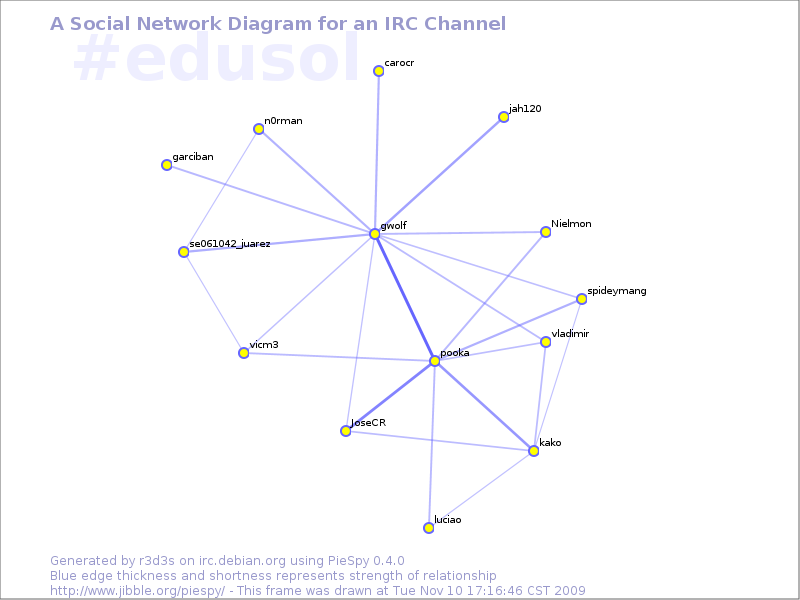
As some of you know, yesterday we started the two weeks of activities for the Fifth On-line Encounter of Free Education, Culture and Software. This year, the main topic for the conference is social networks, but not in the twitter-facebook sense Social networks as ways of understanding and modelling human-to-human interactions. Of course, there is interest from many attendees in using and taking advantage of said social network systems (and others), but the topic is far broader. One of the core tools of EDUSOL, and the only tool that is constantly active through our two weeks of activity, is IRC Which is somewhat of a challenge, as we receive some not-tech-savvy users from all over the world. The first year or two we asked everybody to connect via an IRC client (and we had even decided that it would be a technological filter We thought we would not cater for people without the technical skills to install and use IRC). Life proved us wrong, and we ended up using two web-to-IRC gateways: One of them, via an instance of CGI:IRC, and the other one via a third-party service, Mibbit. Now, the core mind behind EDUSOL is Alejandro Miranda, Pooka; I am not really into education (it is a very interesting topic but far from what I am good at). Pooka has been invovled in on-line communities analysis for several years already, since we worked together at FES Iztacala. For a long time he wanted to graph the interactions at EDUSOL, which was obviously possible given it was all centered on three tools (IRC for live chat, Drupal for generic information and Moodle for the talks and workshops' material This has changed this year, as we are giving much more weight to Drupal and taking it off Moodle), and so last year he was finally able to generate a EDUSOL 2008 conference photo (warning: 2MB image, 4311x3352px), where each person's avatar appears where most of his interactions were. This photo was (unfortunately) achieved using non-free software, but is very much looking at! Now, this year Pooka stumbled upon a great tool, PieSpy (available in Debian package piespy). Piespy generates very interesting interaction graph for IRC channels, as you can see here: Piespy is a bot that sits in the IRC channel logging everything that any given user "says" directly to another one, and graphs it. Not much to say here, only that it generates a very good (and practically real-time) view of what happens on the channel. For this particular channel, and during EDUSOL, you can see here the latest IRC snapshots. Very fun to see - and somewhat addictive how it morphs across time :)

AttachmentSize
EDUSOL 2008 - Conference photo1.97 MB
Current (Monday+Tuesday) interaction graph for our IRC channel39.89 KB

Martin Michlmayr: Project management lessons from the FreeDOS Project

A lot of people seem to think that open source is a magic solution to project management and that open source projects will automatically attract a large and healthy community of contributors and users who will improve the software. This, of course, is not the case. In fact, creating a successful open source project is a really major and difficult effort. You have to deliver an initial promise that people find interesting, attract other people, then facilitate and lead the community, etc. You just have to look at all the failed projects on SourceForge that never delivered any code to see that "open source" is not a guarantee for success. Even though project management is a key element of every open source project, there are only few resources about this topic. That's why I always enjoy reading about the experience from open source project leaders. Jim Hall, the founder of the FreeDOS project, recently posted a series of four articles which I find particularly interesting. Here are links to the articles along with a quick summary: I really like these articles from Jim Hall since they contain a lot of great insights that apply to other projects, so I suggest you check them out! (Originally published on FOSSBazaar)

9 November 2009

MJ Ray: Book Review: Creating a World Without Poverty

I was referred to Creating a World Without Poverty during a discussion on advogato some months ago, but it took rather a long time to obtain the book for various reasons and then I forgot about this review until a recent discussion on new Cooperatives-UK Chief Ed Mayo s site. Better late than never, here s my review of it. Let me know what you think of this book. About the Book Author Muhammad Yunus is founder of the Grameen Bank, Bangladesh, one of the microcredit pioneers, but that story has been told in another book Banker to the Poor. The prologue of this book starts with the creation of Grameen Danone a joint venture between the bank and the France-based Groupe Danone then part one describes problems in capitalism and introduces the idea of Social Businesses as a complement to what the book calls Profit-Maximising Businesses (PMBs), or what most people know as usual shareholder companies. Part two then covers the Grameen Group from its start in banking, through an impressive list of short company case studies some Social, some PMBs, some joint-ventures up to the first year or so of Grameen Danone. The final part then talks about creating a marketplace which is open to Social Businesses, harnessing Information Technology to spread these ideas (more on this in a later article on this site) and using those innovations to banish poverty from the world. The epilogue is the Nobel Prize Lecture Poverty Is a Threat to Peace which seemed to read almost as a simplified summary of the book s main ideas. Annoyance I got quite annoyed with this book because I feel there is a lurking absurdity in its main big idea:- On the one hand, the argument seems to be that profit-maximising businesses are problematic because of their single-minded focus on profit-maximisation. This is an argument that I largely agree with, as you may remember from my short review of Joel Bakan: The Corporation. On the other hand, it proposes to remedy this by creating Social Businesses with equally single-minded focus on social problems this seems like a recipe for disaster! If profit-maximisers threaten to wreck the environment, human rights or whatever else isn t in their goals, why won t Social Businesses using similar single-purpose company formation rules just as easily threaten to wreck whatever mentioned isn t in their goals? If this book is correct and entrepreneurs are multi-faceted human beings who will act to promote social aims (which they must if they are to invest in Social Businesses), then the only robust way forward is to promote businesses that do not try to simplify that multi-faceted nature, whether for profit-maximisation or for a subset of social aims. The best form of businesses that I know for trying to represent all interests of their owners are cooperatives. Dismissed after less than a page Cooperatives are examined in part one of the book and dismissed after less than a page (p35) because they are not inherently oriented towards helping the poor or producing any other specific social benefit (which is a misleading claim because concern for community is a basic principle of cooperatives which all should uphold), they can be owned equally by the wealthy as well as the needy (why is this a problem?) and they can sometimes be demutualised into PMBs. Ultimately, if that s the will of the people, that can t be completely prevented, but recent developments have found ways to make that much less attractive (so-called anti-carpetbagging rules). Doing what people want is not usually a problem in other spheres it s democracy. What s really infuriating is that the author proceeds to describe Social Business which are aimed at specific social benefits (rather than all), can only be owned by the needy but can access the resources they need by donations from the wealthy or by forming joint ventures with them (even very unequal ones) and can be desocialised into profit-maximisers (p178). The same problems which were used to reject cooperatives exist just as badly, if not worse! Conclusion: a bit disappointing So, ultimately, I found this book a bit disappointing. There are lots of good ideas, but when presented with a ready-made round wheel for the basic problem of tempering profit maximisation, this book reinvents an oval one. I suppose I shouldn t be surprised. The misleading criticism of cooperatives is sadly typical of much of the current social enterprise movement, which I mentioned as a drawback in the recent case study of our co-op by Cooperatives-UK. I don t know if social enterprise enthusiasts are informed by the thinking of people like Muhammad Yunus, or if the high-profile authors simply reflect the movement. Have you read this book? Did you spot this contradiction? Do you feel it has other problems that I m ignoring? Or is it a work of genius and I shouldn t be disappointed with it?

8 November 2009

Russell Coker: I m an Aspie

I ve recently been diagnosed with Asperger Syndrome (AS) [1]. Among other things this means that I am genetically predisposed to have an interest in solving technical problems and give lectures about how I solved them, but that I tend not to be a people-person . AS is generally regarded as an Autism Spectrum Disorder (ASD), but there is a lot of debate among the experts about the exact relationship. Some people (such as the psychologist who assessed me) believe that AS is a synonym for High Functioning Autism (HFA), however one theory I ve heard is that HFA people are more sensory oriented and Aspies differ by being information oriented in that case I would not be regarded as HFA. I m not bothered by this issue, I m sure that in a few years time the experts will have some consistent definitions for such things that most people can agree on. There is no Boolean assessment for AS, the assessment is based on a sliding scale of number of criteria. People who are almost Aspies but don t quite pass the test (or more commonly don t get assessed because they don t think they would pass) are sometimes referred to as Asperger Cousins (AC), this is a slang term that is not formally recognised but is often used in online discussions. I m sure that a significant portion of the readers of my blog would regard themselves as being at least ACs if they investigated the issue. The test at Glenn Rowe s web site [2] can give you an idea of how you rate by some criteria but note that this is not at all conclusive and it s based on the theories of Professor Simon Baron-Cohen [3], not all of which have general agreement. Leif Ekblad is running a project to analyse long-term changes to the Aspie score of adults [4]. The main quiz for that project seems quite popular for self-diagnosis, but again it s not conclusive. I think that diagnosing oneself for an ASD is not nearly as crazy as most things which might fall in the category of being one s own psychologist, but I still strongly recommend getting a formal assessment if you believe that you are an Aspie. In Australia it costs about $600 and there s a waiting list of about 3 months. Chaotic Idealism has an insightful post about the pros and cons of self-diagnosis [5], if you suspect that you may be an Aspie then I recommend that you read it before doing the tests.

7 November 2009

Stefano Zacchiroli: RC bugs of the week - week 9

RCBW - week #9 Here is this week squashes, by yours truly: This week NMUs have been mostly dominated by Haskell's "ambiguous type variable e" squashing.

Martin Michlmayr: Marvell publishes roadmap of its ARM series called Armada

For those who haven't seen it yet, LinuxDevices published an article recently looking at the roadmap of Marvell's ARM line. The new line is called Armada and for Debian the Armada 510 (known as Dove) is of particular interest. To me, it essentially looks like a Kirkwood (the current platform) but with ARMv6/v7 (instead of ARMv5), integrated VGA and some other features. According to the article, the Armada 510 is aimed at "high-end smartbooks and tablets". I'm happy to see the integration of VGA because I'd like to see more ARM based smartbooks, tablets and thin clients. At the same time, I'm worried that the VGA will be some proprietary chip without proper open source drivers and I'm surprised that the new chip only offers 1.2 GHz. After all, the current Kirkwood chip clocks 1.2 GHz already, so I'd have expected an increase to 2.0 GHz for the next generation.

6 November 2009

Matt Brubeck: Android 2.0 ships with V8 JavaScript engine

Google has not yet released most of the Android 2.0 source code, but they did publish source for a very small number of components, including a WebKit snapshot. I was very excited to see that the snapshot includes Google's V8 virtual machine! (Previous Android releases used Safari's JavaScriptCore/"SquirrelFish Extreme" VM.) But without the rest of the source tree, there was no way to build and run this on a real Android phone. The SDK includes a binary image that runs only in the qemu-based emulator. Today I got to try out a Motorola Droid. Here is how its browser compares to Android 1.6 on my HTC Dream (Android Dev Phone / T-Mobile G1) in the V8 Benchmark Suite (version 5):
Test Dream Droid Change
Richards 13.5 15.6 16%
DeltaBlue 5.23 12.9 147%
Crypto 13.2 10.9 -17%
RayTrace 10.9 80.1 635%
EarleyBoyer 23.5 74.7 218%
RegExp did not complete 16.5
Splay did not complete did not complete
Some tests (Richards, Crypto) see little or no improvement, while others (DeltaBlue, RayTrace, EarleyBoyer) are dramatically faster. Just for comparison, let's run the same benchmark on Safari 4 (JavaScriptCore) and a Chromium 4 nightly build (V8) on a Mac Pro:
Test Safari Chromium Change
Richards 4103 4640 13%
DeltaBlue 3171 4418 39%
Crypto 3331 3643 9%
RayTrace 3509 6662 90%
EarleyBoyer 4737 7643 61%
RegExp 1268 1187 -6%
Splay 1198 7290 509%
The precise ratios are different, but the same tests that showed the most improvement from Android 1.6 to 2.0 also show the most improvement from Safari to Chrome. Based on this plus the source code snapshot, I'm pretty sure that Android 2.0 is indeed using V8. This is exciting news. It makes Droid the first shipping product I know that uses V8 on an ARM processor, although V8 has included an ARM JIT compiler for some time now. For mobile web developers (like me), it means we're one step closer to having desktop-quality rich web applications on low-power handheld devices. Final thought: Although the Motorola Droid is still 100 times slower than Chromium on a Mac Pro, it's actually faster at some benchmarks than IE8 on a low-end Windows machine, or Firefox 2 on hardware from just a few years ago.

5 November 2009

Martin Michlmayr: New devices from QNAP: TS-110, TS-210 and TS-410

When I visited Taiwan last week to talk about Debian at a conference on smartbooks, I used the opportunity to meet up with the folks from QNAP. It was really nice to meet many of my contacts at QNAP in person. We talked about their roadmap and existing products and I found out that they had just released a number of new devices that may be of interest to Debian users. I really like the hardware from QNAP but one downside of their high quality is also that the devices are fairly expensive. Last week they introduced a number of lower cost alternatives: in addition to the TS-119 and TS-219, you now have the TS-110 and TS-210. They feature a 800 MHz CPU (instead of 1.2 GHz on the TS-119/TS-219), 256 MB (instead of 512 MB) and have a plastic case (as a result of which, the TS-110 now has a fan unlike the TS-119). Similarly, in addition to the TS-419 and TS-419U, you now have a TS-410 and TS-410U. Since the TS-110/TS-210 and TS-119/TS-219 are compatible, the Debian installer will work out of the box.

4 November 2009

Kartik Mistry: Kavin@School


* This really deserve more than twit , so I am putting it here as NEWS. We selected nearby no-nonsense, no-hype, no-big-fees kind of school running in somewhat 4 BHK kind of bungalow in residential area. He is in Playgroup where primary motive is to interact with others, to learn by monkey business and to learn some good (hopefully) stuffs. I was glad that he did not cried while going to school, but we had to drag him to home and he cried a lot :P Current school timings are 9.30 AM to 11.30 AM, so I must help K and need to wake up early in the morning and probably stop (or reduce) useless hacking till late night. However, I m kind of down due to RCT, Stomach issues and now some pain in shoulder but still alive to write this.

Next.

Previous.
