Search Results: "nic"

22 August 2014

Russell Coker: Men Commenting on Women s Issues

A lecture at LCA 2011 which included some inappropriate slides was followed by long discussions on mailing lists. In February 2011 I wrote a blog post debunking some of the bogus arguments in two lists [1]. One of the noteworthy incidents in the mailing list discussion concerned Ted Ts o (an influential member of the Linux community) debating the definition of rape. My main point on that issue in Feb 2011 was that it s insensitive to needlessly debate the statistics. Recently Valerie Aurora wrote about another aspect of this on The Ada Initiative blog [2] and on her personal blog. Some of her significant points are that conference harassment doesn t end when the conference ends (it can continue on mailing lists etc), that good people shouldn t do nothing when bad things happen, and that free speech doesn t mean freedom from consequences or the freedom to use private resources (such as conference mailing lists) without restriction. Craig Sanders wrote a very misguided post about the Ted Ts o situation [3]. One of the many things wrong with his post is his statement I m particularly disgusted by the men who intervene way too early without an explicit invitation or request for help or a clear need such as an immediate threat of violence in womens issues . I believe that as a general rule when any group of people are involved in causing a problem they should be involved in fixing it. So when we have problems that are broadly based around men treating women badly the prime responsibility should be upon men to fix them. It seems very clear that no matter what scope is chosen for fixing the problems (whether it be lobbying for new legislation, sociological research, blogging, or directly discussing issues with people to change their attitudes) women are doing considerably more than half the work. I believe that this is an indication that overall men are failing. Asking for Help I don t believe that members of minority groups should have to ask for help. Asking isn t easy, having someone spontaneously offer help because it s the right thing to do can be a lot easier to accept psychologically than having to beg for help. There is a book named Women Don t Ask which has a page on the geek feminism Wiki [4]. I think the fact that so many women relate to a book named Women Don t Ask is an indication that we shouldn t expect women to ask directly, particularly in times of stress. The Wiki page notes a criticism of the book that some specific requests are framed as complaining , so I think we should consider a complaint from a woman as a direct request to do something. The geek feminism blog has an article titled How To Exclude Women Without Really Trying which covers many aspects of one incident [5]. Near the end of the article is a direct call for men to be involved in dealing with such problems. The geek feminism Wiki has a page on Allies which includes Even a blog post helps [6]. It seems clear from public web sites run by women that women really want men to be involved. Finally when I get blog comments and private email from women who thank me for my posts I take it as an implied request to do more of the same. One thing that we really don t want is to have men wait and do nothing until there is an immediate threat of violence. There are two massive problems with that plan, one is that being saved from a violent situation isn t a fun experience, the other is that an immediate threat of violence is most likely to happen when there is no-one around to intervene. Men Don t Listen to Women Rebecca Solnit wrote an article about being ignored by men titled Men Explain Things to Me [7]. When discussing women s issues the term Mansplaining is often used for that sort of thing, the geek feminism Wiki has some background [8]. It seems obvious that the men who have the greatest need to be taught some things related to women s issues are the ones who are least likely to listen to women. This implies that other men have to teach them. Craig says that women need space to discover and practice their own strength and their own voices . I think that the best way to achieve that goal is to listen when women speak. Of course that doesn t preclude speaking as well, just listen first, listen carefully, and listen more than you speak. Craig claims that when men like me and Matthew Garrett comment on such issues we are making women s spaces more comfortable, more palatable, for men . From all the discussion on this it seems quite obvious that what would make things more comfortable for men would be for the issue to never be discussed at all. It seems to me that two of the ways of making such discussions uncomfortable for most men are to discuss sexual assault and to discuss what should be done when you have a friend who treats women in a way that you don t like. Matthew has covered both of those so it seems that he s doing a good job of making men uncomfortable I think that this is a good thing, a discussion that is comfortable and palatable for the people in power is not going to be any good for the people who aren t in power. The Voting Aspect It seems to me that when certain issues are discussed we have a social process that is some form of vote. If one person complains then they are portrayed as crazy. When other people agree with the complaint then their comments are marginalised to try and preserve the narrative of one crazy person. It seems that in the case of the discussion about Rape Apology and LCA2011 most men who comment regard it as one person (either Valeria Aurora or Matthew Garrett) causing a dispute. There is even some commentary which references my blog post about Rape Apology [9] but somehow manages to ignore me when it comes to counting more than one person agreeing with Valerie. For reference David Zanetti was the first person to use the term apologist for rapists in connection with the LCA 2011 discussion [10]. So we have a count of at least three men already. These same patterns always happen so making a comment in support makes a difference. It doesn t have to be insightful, long, or well written, merely I agree and a link to a web page will help. Note that a blog post is much better than a comment in this regard, comments are much like conversation while a blog post is a stronger commitment to a position. I don t believe that the majority is necessarily correct. But an opinion which is supported by too small a minority isn t going to be considered much by most people. The Cost of Commenting The Internet is a hostile environment, when you comment on a contentious issue there will be people who demonstrate their disagreement in uncivilised and even criminal ways. S. E. Smith wrote an informative post for Tiger Beatdown about the terrorism that feminist bloggers face [11]. I believe that men face fewer threats than women when they write about such things and the threats are less credible. I don t believe that any of the men who have threatened me have the ability to carry out their threats but I expect that many women who receive such threats will consider them to be credible. The difference in the frequency and nature of the terrorism (and there is no other word for what S. E. Smith describes) experienced by men and women gives a vastly different cost to commenting. So when men fail to address issues related to the behavior of other men that isn t helping women in any way. It s imposing a significant cost on women for covering issues which could be addressed by men for minimal cost. It s interesting to note that there are men who consider themselves to be brave because they write things which will cause women to criticise them or even accuse them of misogyny. I think that the women who write about such issues even though they will receive threats of significant violence are the brave ones. Not Being Patronising Craig raises the issue of not being patronising, which is of course very important. I think that the first thing to do to avoid being perceived as patronising in a blog post is to cite adequate references. I ve spent a lot of time reading what women have written about such issues and cited the articles that seem most useful in describing the issues. I m sure that some women will disagree with my choice of references and some will disagree with some of my conclusions, but I think that most women will appreciate that I read what women write (it seems that most men don t). It seems to me that a significant part of feminism is about women not having men tell them what to do. So when men offer advice on how to go about feminist advocacy it s likely to be taken badly. It s not just that women don t want advice from men, but that advice from men is usually wrong. There are patterns in communication which mean that the effective strategies for women communicating with men are different from the effective strategies for men communicating with men (see my previous section on men not listening to women). Also there s a common trend of men offering simplistic advice on how to solve problems, one thing to keep in mind is that any problem which affects many people and is easy to solve has probably been solved a long time ago. Often when social issues are discussed there is some background in the life experience of the people involved. For example Rookie Mag has an article about the street harassment women face which includes many disturbing anecdotes (some of which concern primary school students) [12]. Obviously anyone who has lived through that sort of thing (which means most women) will instinctively understand some issues related to threatening sexual behavior that I can t easily understand even when I spend some time considering the matter. So there will be things which don t immediately appear to be serious problems to me but which are interpreted very differently by women. The non-patronising approach to such things is to accept the concerns women express as legitimate, to try to understand them, and not to argue about it. For example the issue that Valerie recently raised wasn t something that seemed significant when I first read the email in question, but I carefully considered it when I saw her posts explaining the issue and what she wrote makes sense to me. I don t think it s possible for a man to make a useful comment on any issue related to the treatment of women without consulting multiple women first. I suggest a pre-requisite for any man who wants to write any sort of long article about the treatment of women is to have conversations with multiple women who have relevant knowledge. I ve had some long discussions with more than a few women who are involved with the FOSS community. This has given me a reasonable understanding of some of the issues (I won t claim to be any sort of expert). I think that if you just go and imagine things about a group of people who have a significantly different life-experience then you will be wrong in many ways and often offensively wrong. Just reading isn t enough, you need to have conversations with multiple people so that they can point out the things you don t understand. This isn t any sort of comprehensive list of ways to avoid being patronising, but it s a few things which seem like common mistakes. Anne Onne wrote a detailed post advising men who want to comment on feminist blogs etc [13], most of it applies to any situation where men comment on women s issues.

Ian Donnelly: Wrapping Up

Hi Everybody! I have been keeping very busy on this blog the past few days with some very exciting updates! Everything is now in place for my Google Summer of Code project! Elektra now has the ability to merge KeySets, ucf has been patched to allow custom merge commands, we included a new elektra-merge script to use in conjunction with the new ucf command, and we wrote a great tutorial on how to use Elektra to merge configuration files in any package using ucf. There are few things I have missed updating you all on or are still wrapping up. First of all, I would like to address the Debian packages. While Elektra includes everything needed for my Google Summer of Code Project, it must be built from source right now. Unfortunately, with the rapid development Elektra has seen the past few months, we did not pay enough attention to the Debian packages and they became dusty and riddles with bugs. Fortunately, we have a solution and his name is Pino Toscano. Pino has, very graciously, agreed to help us fix our Debian packages back into shape. If you wish to see the current progress of the packages, you can check his repo. Pino has already made fantastic progress creating the Debian packages. I will post here when packages are all fixed up and the latest versions of Elektra are into the Debian repo. Some great news that we just received is that Elektra 0.8.7 has just been accepted into Debian unstable! This is huge progress for our team and means that users can now download our packages directly from Debian s unstable repo and test out these new features. Obviously, the normal caveats apply for any packages in unstable but this is still an amazing piece of news and I would like to thank Pino again for all the support he has provided. Another worthy piece of news that I unfortunately haven t had time to cover is that thanks to Felix Berlakovich Elektra has a new plug-in called ini. In case you couldn t guess, this new plug-in is used to mount ini files and the good news is that it is a vast improvement on our older simpleini plug-in. While it is still a work in progress, this new plug-in is much more powerful than simpleini. The new plug-in supports section and comments and works with many more ini files than the old plug-in. You may have noticed that I used this new plug-in to mount smb.conf in my technical demo of Samba using Elektra from configuration merging. Since smb.conf follows the same syntax as an ini file this new plug-in works great for mounting this file into the Elektra Key Database. I hope my blogs so far have been very informative and helpful. Sincerely,
Ian S. Donnelly

21 August 2014

Dirk Eddelbuettel: RcppEigen 0.3.2.2.0

A new upstream release of the Eigen C++ template library for linear algebra was released a few days ago. And Yixuan Qiu did some really nice work rolling this into a new RcppEigen released and then sent me a nice pull requent. The new version is now on CRAN, and I will prepare a Debian in a moment too. Upstream changes for Eigen are summarized in their changelog. On the RcppEigen side, Yixuan also rolled in some more changes on as() and wrap() converters as noted below in the NEWS entry.
Changes in RcppEigen version 0.3.2.2.0 (2014-08-19)
  • Updated to version 3.2.2 of Eigen
  • Rcpp::as() now supports the conversion from R vector to row array , i.e., Eigen::Array<T, 1, Eigen::Dynamic>
  • Rcpp::as() now supports the conversion from dgRMatrix (row oriented sparse matrices, defined in Matrix package) to Eigen::MappedSparseMatrix<T, Eigen::RowMajor>
  • Conversion from R matrix to Eigen::MatrixXd and Eigen::ArrayXXd using Rcpp::as() no longer gives compilation errors
Courtesy of CRANberries, there are diffstat reports for the most recent release. Questions, comments etc about RcppEigen should go to the rcpp-devel mailing list off the R-Forge page.

This post by Dirk Eddelbuettel originated on his Thinking inside the box blog. Please report excessive re-aggregation in third-party for-profit settings.

Wouter Verhelst: Multiarchified eID libraries, now public

Yesterday, I spent most of the day finishing up the multiarch work I'd been doing on introducing multiarch to the eID middleware, and did another release of the Linux builds. As such, it's now possible to install 32-bit versions of the eID middleware on a 64-bit Linux distribution. For more details, please see the announcement. Learning how to do multiarch (or biarch, as the case may be) for three different distribution families has been a, well, learning experience. Being a Debian Developer, figuring out the technical details for doing this on Debian and its derivatives wasn't all that hard. You just make sure the libraries are installed to the multiarch-safe directories (i.e., /usr/lib/<gnu arch triplet>), you add some Multi-Arch: foreign or Multi-Arch: same headers where appropriate, and you're done. Of course the devil is in the details (define "where appropriate"), but all in all it's not that difficult and fairly deterministic. The Fedora (and derivatives, like RHEL) approach to biarch is that 64-bit distributions install into /usr/lib64 and 32-bit distributions install into /usr/lib. This goes for any architecture family, not just the x86 family; the same method works on ppc and ppc64. However, since fedora doesn't do powerpc anymore, that part is a detail of little relevance. Once that's done, yum has some heuristics whereby it will prefer native-architecture versions of binaries when asked, and may install both the native-architecture and foreign-architecture version of a particular library package at the same time. Since RPM already has support for installing multiple versions of the same package on the same system (a feature that was originally created, AIUI, to support the installation of multiple kernel versions), that's really all there is to it. It feels a bit fiddly and somewhat fragile, since there isn't really a spec and some parts seem fairly undefined, but all in all it seems to work well enough in practice. The openSUSE approach is vastly different to the other two. Rather than installing the foreign-architecture packages natively, as in the Debian and Fedora approaches, openSUSE wants you to take the native foo.ix86.rpm package and convert that to a foo-32bit.x86_64.rpm package. The conversion process filters out non-unique files (only allows files to remain in the package if they are in library directories, IIUC), and copes with the lack of license files in /usr/share/doc by adding a dependency header on the native package. While the approach works, it feels like unnecessary extra work and bandwidth to me, and obviously also wouldn't scale beyond biarch. It also isn't documented very well; when I went to openSUSE IRC channels and started asking questions, the reply was something along the lines of "hand this configuration file to your OBS instance". When I told them I wasn't actually using OBS and had no plans of migrating to it (because my current setup is complex enough as it is, and replacing it would be far too much work for too little gain), it suddenly got eerily quiet. Eventually I found out that the part of OBS which does the actual build is a separate codebase, and integrating just that part into my existing build system was not that hard to do, even though it doesn't come with a specfile or RPM package and wants to install files into /usr/bin and /usr/lib. With all that and some more weirdness I've found in the past few months that I've been building packages for openSUSE I now have... Ideas(TM) about how openSUSE does things. That's for another time, though. (disclaimer: there's a reason why I'm posting this on my personal blog and not on an official website... don't take this as an official statement of any sort!)

Gunnar Wolf: Walking without crutches

Walking without crutches
I still consider myself a newbie teacher. I'm just starting my fourth semester. And yes, I really enjoy it. Now, how did I come to teaching? Well, my training has been mostly on stages for different conferences. More technical, more social, whatever I have been giving ~10 talks a year for ~15 years, and I must have learnt something from that. Some good things, some bad habits. When giving presentations, a most usual technique is to prepare a set of slides to follow/support the ideas. And yes, that's what I did for my classes: Since my first semester, I prepared a nice set of slides, thematically split in 17 files, with ~30 to ~110 pages each (yes, huge variation). Given the course spans 32 classes (72 hours, 2 hours per class), each slide lasts for about two classes. But, yes, this tends to make the class much less dynamic, much more scripted, rigid, and... Boring. From my feedback, I understand the students don't think I am a bad teacher, but still, I want to improve! So, today I was to give the introduction to memory management. Easy topic, with few diagrams and numbers, mostly talking about the intuitive parts of a set of functions. I started scribbling and shortening the main points on a piece of paper (yes, the one on the picture). I am sure I can get down to more reduction But this does feel like an improvement! The class was quite successful. I didn't present the 100% of the material (which is one of the reasons I cling to my presentations I don't want to skip important material), and at some point I do feel I was a bit going in circles. However, Operating Systems is a very intuitive subject, and getting the students to sketch by themselves the answers that describe the working of real operating systems was a very pleasant experience! Of course, when I use my slides I do try to make it as interactive and collaborative as possible. But it is often unfeasible when I'm following a script. Today I was able to go around with the group's questions, find my way back to the outline I prepared. I don't think I'll completely abandon my slides, specially for some subjects which include many diagrams or pictures. But I'll try to have this alternative closer to my mind.

20 August 2014

Ian Donnelly: Technical Demo

Hi Everybody, Today I wanted to talk a bit about our technical demo. We patched a version of Samba to use our elektra-merge script in order to handle it s configuration file smb.conf. Using the steps from my previous tutorial, we patched Samba to use this new technique of config merging. This patched version of Samba mounts it s configuration to system/samba/smb in the Elektra Key Database. Then, during package upgrades, it uses the new --threeway-merge-command command with elektra-merge as the specified command. The result is automatic handling of smb.conf that is conffile-like (thanks ucf!) and the ability to have a powerful, automatic, three-way merge solution on package upgrades. The main thing I would like to discuss is how this project is an improvement upon the current implementation of three-way merges in ucf. Before this project, ucf could attempt three-way merges on files it controlled using the diff3 tool. The main limitation of tools like diff3 are that they are line based and don t inherently understand the files they are dealing with. Elektra on the other hand allows for a powerful system of backends which use plug-ins to understand configuration files. Elektra doesn t store configuration data on a line-by-line basis, but in a more abstract way that is tailored to each configuration file using backends. smb.conf is a great example of this because it uses the syntax of an ini file so Elektra can mount it in a way that is intuitive to an ini file. Since data is stored in a format of key=data within ini files, Elektra stores this data in a similar way. For each key in smb.conf store a Key in Elektra with the value of that key store in a string. Then, during a merge, we can compare Keys in each version of smb.conf and easily see which ones changed and how they need to be merged into the result. On the other hand, diff3 has no concept of ini files or keys, it just compares the different versions line by line which results in many more conflicts than using elektra-merge. Moreover, a traditional weakness of diff is moving lines or data around. While diff3 does a very good job at handling this, it s not perfect. In Elektra, Keys are named in an intelligent way based on their backend, so for smb.conf the line workgroup = HOME would always be saved under system/samba/smb/workgroup. It doesn t matter if the lines are changed between versions because Elektra just has to check for the Key and its value. My favorite example is a shortcoming in the diff3 algorithm (at least in my opinion). If something is changed to the same value in ours and theirs, but they differ from base, diff3 reports a conflict. On the other hand elektra-merge can easily handle this problem. A simple example of this would be changing the max log size value in Samba. Here is that line in each version of smb.conf:
Base:
max log size = 1000
Ours:
max log size = 2000
Theirs:
max log size = 2000
Obviously, in the merged version, result, one would expect this line to be:
max log size = 2000 Let s check the result from elektra-merge:
max log size = 2000

Great! How about diff3:
<<<<<<< smb.conf.base
max log size = 1000
=======
max log size = 2000
>>>>>>> smb.conf.theirs

Whoops! As I mentioned the diff3 algorithm can t handle this type of change, it just results in a conflict. Note that smb.conf.base is just representative of the file used as base and that smb.conf.theirs is representative of the file used as theirs. The file names were changed for the sake of clarity. There are many other examples of the benefits to storing configuration data in a database of Keys that can better conform to actual data as opposed to storing configuration parameters in files where they can only be compared on a line to line basis. With the help of storage plug-ins, Elektra can understand the configurations stored in it s Key Database. Since we store the data in a way that makes sense for configuration data, we can easily merge actual configuration data as opposed to just lines in a file. A good example of this is in-line comments. Many of our storage plug-ins understand the difference between comments and actual configuration data. So if a configuration file has an inline comment like so:
max log size = 10000 ; Controls the size of the log file (in KiB)
we can compare the actual Keys, value pairs between versions max log size = 10000 and deal with the comments separately. As a result, if we have a base:
max log size = 1000 ; Size in KiB

Ours:
max log size = 10000 ; Size in KiB

Theirs:
max log size = 1000 ; Controls the size of the log file (in KiB)

The result using elektra-merge would be:
max log size = 10000 ; Controls the size of the log file (in KiB)

Obviously, this line would cause a conflict on any line-based merge algorithm such as diff3 or git. It is worth noting that the ability of elektra-merge is directly related to the quality of the storage plug-ins that Elektra relies on. elektra-merge only looks at the name, value, and any metadata affiliated with each key. As a result, using the line plug-in would result in a merge only as powerful as any other line-based merge. Yet by using the ini plug-in on an ini file we get a much more advanced merge like the one described above. As you can tell, this new method offers clear advantages to the traditional method of using diff3 to handle configuration merges. Also, I hope this demo shows how easy it is to implement these great features into your Debian packages. The community can only benefit if maintainers take advantage of these great features. I am glad to say that my Google Summer of Code Project has been a success, even if we had to do a little change of plans. The ucf integration ended up working great and is really easy for maintainers to implement. Hope you enjoyed this demo and better understand the power of using Elektra. Sincerely,
Ian S. Donnelly

Aurelien Jarno: MIPS Creator CI20

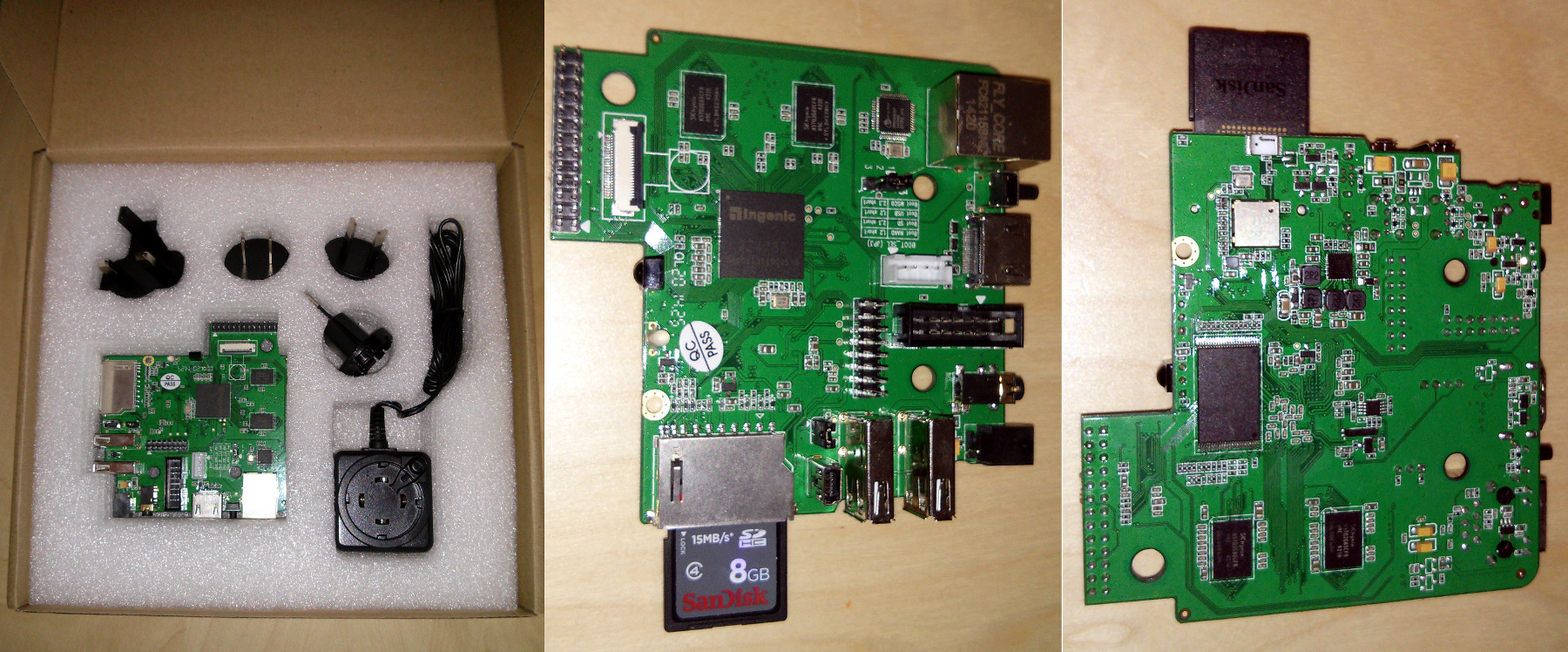
I have received two MIPS Creator CI20 boards, thanks to Imagination Technologies. It s a small MIPS32 development board: mips-ci20 As you can see it comes in a nice packaging with a world-compatible power adapter. It uses a Ingenic JZ4780 SoC with a dual core MIPS32 CPU running at 1.2GHz with a PowerVR SGX540 GPU. The board is fitted with 1GB of RAM, 8GB of NOR flash, HDMI output, USB 2.0 ports, Ethernet + Wi-Fi + BlueTooth, SD card slot, IR receiver, expansion headers and more. The schematics are available. The Linux kernel and the U-Boot bootloader sources are also available. Powering this board with a USB keyboard, a USB mouse and a HDMI display, it boots off the internal flash on a Debian Wheezy up to the XFCE environment. Besides the kernel, the Wi-Fi + Bluetooth firmware, and very few configuration changes, it runs a vanilla Debian. Unfortunately I haven t found time to play more with it yet, but it looks already quite promising. The board has not been formally announced yet, so I do not know when it will become available, nor the price, but if you are interested I ll bring it to DebConf14. Don t hesitate to ask me if you want to look at it or play with it.

Gunnar Wolf: Bigger than the cloud

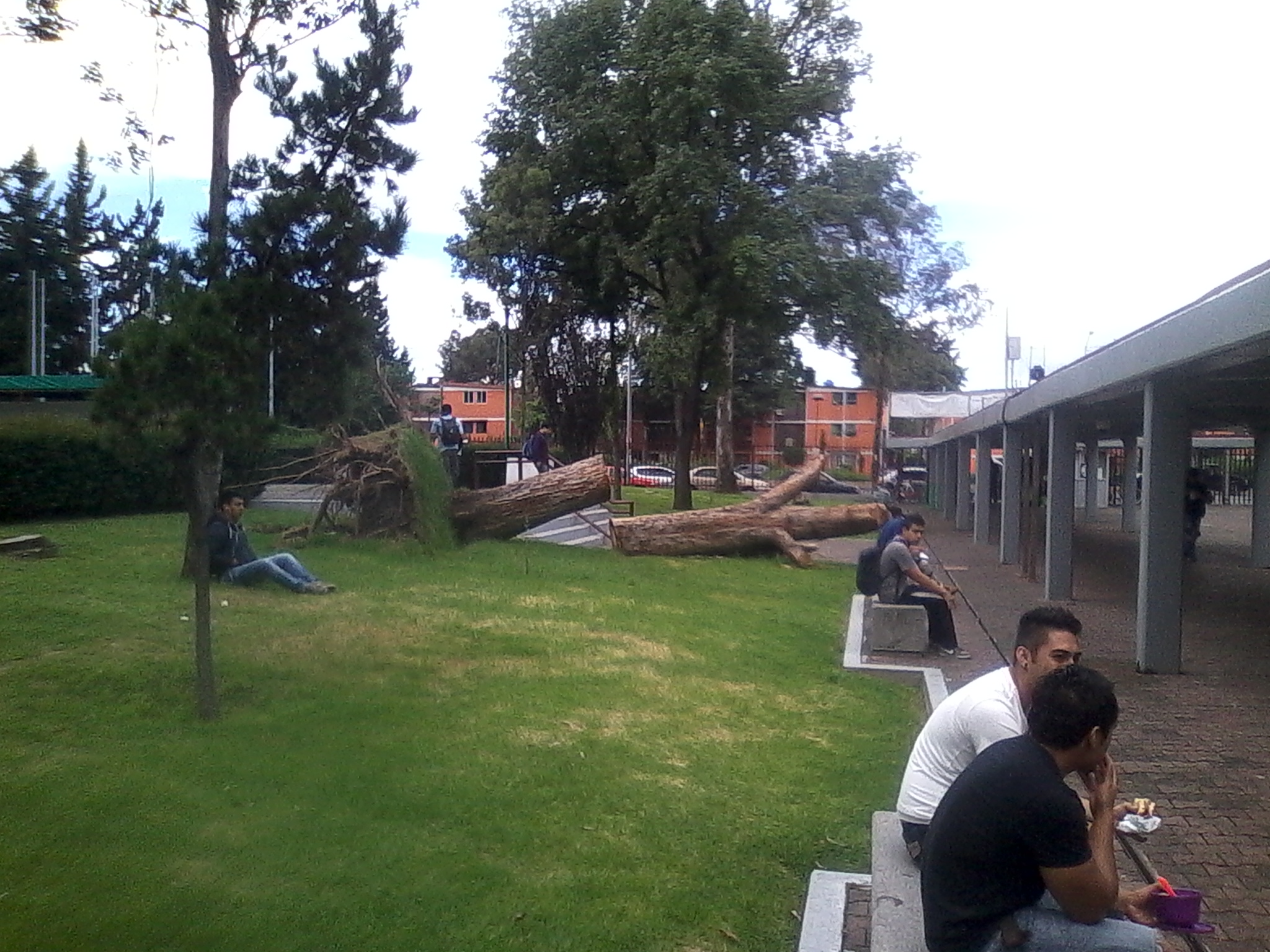
Summer is cool in Mexico City. It is cool because, unlike Spring, this is our rainy season And rains are very predictable. Almost every day we wake up with a gorgeous, clean, blue sky. Cool, nice temperature, around 15 C. The sun slowly evaporates the rain throughout the morning; when I go out for lunch, the sky is no longer so blue, giving way to a seemingly dirty white/grayish tint. No, it's not our world-famous pollution: It's just yesterday's rain. Rain starts falling usually between 4 and 7 PM. Sometimes it starts as a light rain, sometimes it starts with all of its thunder, all of its might. But anyway, almost every night, there is a moment of awe, of not believing how much rain we are getting today. It slowly fades away during the late night. And when I wake up, early next morning, everything is wet and still smells fresh. Yes, I love our summer, even though it makes shy away from my much enjoyed cycling to work and school. And I love taking some minutes off work, look through the window of my office (located ~70m over the level of our mostly flat city) and watching how different parts of the city have sun or rain; learning to estimate the distance to the clouds, adding it to the direction and guessing which of my friends have which weather. But I didn't realize our city had so clearly defined micro-climates... (would they really be *micro*-climates?) In fact, it even goes against my knowledge of Mexico City's logic I always thought Coyoac n, towards the South of the city, got more rain than the Center and North because we are near the mountains, and the dominant air currents go Southwards, "clumping" the clouds by us. But no, or at least, not this year. Regina (still in the far South Far because she's too far away from me and I'm too egocentric; she returns home after DebConf) often asks me about the weather, as our friends working nearer the center of the city. According to the photos they post on their $social_media_of_the_day accounts, rains are really heavier there. Today I heard on the radio accounts of yesterday's chaos after the rain. This evening, at ESIME-Culhuac n, I saw one of the reported fallen trees (of course, I am not sure if it's from yesterday's rain). And the media pushes galleries of images of a city covered in hail... While in Copilco we only had a regular rain, I'd even say a mild one. This city is bigger than any cloud you can throw at it.
AttachmentSize
IMG_20140819_155052.jpg929.69 KB

Dirk Eddelbuettel: RcppArmadillo 0.4.400.0

After two pre-releases in the last few days, Conrad finalised a new Armadillo version 4.400 today. I had kept up with the pre-releases, tested twice against all eighty (!!) CRAN dependents of RcppArmadillo and have hence uploaded RcppArmadillo 0.4.400.0 to CRAN and into Debian. This release brings a number of new upstream features which are detailed below. As included is s bugfix for sparse matrix creation at the RcppArmadillo end which was found by the ASAN tests at CRAN --- which are similar to the sanitizers tests I recently blogged. I was able to develop and test the fix in the very docker r-devel-san images I had written about which was nice. Special thanks also to Ryan Curtin for help with the fix.
Changes in RcppArmadillo version 0.4.400.0 (2014-08-19)
  • Upgraded to Armadillo release Version 4.400 (Winter Shark Alley)
    • added gmm_diag class for statistical modelling using Gaussian Mixture Models; includes multi-threaded implementation of k-means and Expectation-Maximisation for parameter estimation
    • added clamp() for clamping values to be between lower and upper limits
    • expanded batch insertion constructors for sparse matrices to add values at repeated locations
    • faster handling of subvectors by dot()
    • faster handling of aliasing by submatrix views
  • Corrected a bug (found by the g++ Address Sanitizer) in sparse matrix initialization where space for a sentinel was allocated, but the sentinel was not set; with extra thanks to Ryan Curtin for help
  • Added a few unit tests for sparse matrices
Courtesy of CRANberries, there is also a diffstat report for the most recent release. As always, more detailed information is on the RcppArmadillo page. Questions, comments etc should go to the rcpp-devel mailing list off the R-Forge page.

This post by Dirk Eddelbuettel originated on his Thinking inside the box blog. Please report excessive re-aggregation in third-party for-profit settings.

18 August 2014

Daniel Pocock: Is WebRTC private?

With the exciting developments at rtc.debian.org, many people are starting to look more closely at browser-based real-time communications. Some have dared to ask: does it solve the privacy problems of existing solutions? Privacy is a relative term Perfect privacy and its technical manifestations are hard to define. I had a go at it in a blog on the Gold Standard for free communications technology on 5 June 2013. By pure co-incidence, a few hours later, the first Snowden leaks appeared and this particular human right was suddenly thrust into the spotlight. WebRTC and ICE privacy risk WebRTC does not give you perfect privacy. At least one astute observer at my session at Paris mini-DebConf 2014 questioned the privacy of Interactive Connectivity Establishment (ICE, RFC 5245). In its most basic form, ICE scans all the local IP addresses on your machine and NAT gateway and sends them to the person calling you so that their phone can find the optimal path to contact you. This clearly has privacy implications as a caller can work out which ISP you are connected to and some rough details of your network topology at any given moment in time. What WebRTC does bring to the table Some of this can be mitigated though: an ICE implementation can be tuned so that it only advertises the IP address of a dedicated relay host. If you can afford a little latency, your privacy is safe again. This privacy protecting initiative could be made by a browser vendor such as Mozilla or it can be done in JavaScript by a softphone such as JSCommunicator. Many individuals are now using a proprietary softphone to talk to family and friends around the world. The softphone in question has properties like a virus, siphoning away your private information. This proprietary softphone is also an insidious threat to open source and free operating systems on the desktop. WebRTC is a positive step back from the brink. It gives people a choice. WebRTC is a particularly relevant choice for business. Can you imagine going to a business and asking them to make all their email communication through hotmail? When a business starts using a particular proprietary softphone, how is it any different? WebRTC offers a solution that is actually easier for the user and can be secured back to the business network using TLS. WebRTC is based on open standards, particularly HTML5. Leading implementations, such as the SIP over WebSocket support in reSIProcate, JSCommunicator and the DruCall module for Drupal are fully open source. Not only is it great to be free, it is possible to extend and customize any of these components. What is missing There are some things that are not quite there yet and require a serious effort from the browser vendors. At the top of the list for privacy:
  • ZRTP support - browsers currently support DTLS-SRTP, which is based on X.509. ZRTP is more like PGP, a democratic and distributed peer-to-peer privacy solution without needing to trust some central certificate authority.
  • TLS with PGP - the TLS protocol used to secure the WebSocket signalling channel is also based on X.509 with the risk of a central certificate authority. There is increasing chatter about the need for TLS to use PGP instead of X.509 and WebRTC would be a big winner if this were to eventuate and be combined with ZRTP.
You may think "I'll believe it when I see it". Each of these features, including WebRTC itself, is a piece of the puzzle and even solving one piece at a time brings people further out of danger from the proprietary mess the world lives with today. To find out more about practical integration of WebRTC into free software solutions, consider coming to my talk at xTupleCon in October.

Junichi Uekawa: sigaction bit me.

sigaction bit me. There's a system call and a libc function of the similar (sigaction vs rt_sigaction) name but they behave differently.

16 August 2014

Daniel Pocock: WebRTC: what works, what doesn't

With the release of the latest rtc.debian.org portal update, there are numerous improvements but there are still some known problems too. The good news is that if you have a web browser, you can probably make successful WebRTC calls from one developer to another without any need to install or configure anything else. The bad news is that not every permutation of browser and client will work. Here I list some of the limitations so people won't waste time on them. The SIP proxy supports any SIP client Just about any SIP client can connect to the proxy server and register. This does not mean that every client will be able to call each other. Generally speaking, modern WebRTC clients will be able to call each other. Standalone softphones or deskphones will call each other. Calling from a normal softphone or deskphone to a WebRTC browser, or vice-versa, will not work though. Some softphones, like Jitsi, have implemented most of the protocols to communicate with WebRTC but they are yet to put the finishing touches on it. Chat should just work for any combination of clients The new WebRTC frontend supports SIP chat messaging. There is no presence or buddy list support yet. You can even use a tool like sipsak to accept or send SIP chats from a script. Chat works for any client new or old. Although a WebRTC user can't call a softphone user, for example, they can send chats to each other. WebRTC support in Iceweasel 24 on wheezy systems is very limited On a wheezy system, the most recent Iceweasel update is version 24.7. This version supports most of WebRTC but does not support TURN relay servers to help you out of a NAT network. If you call between two wheezy machines on the same NAT network it will work. If the call has to traverse a NAT boundary it will not work. Wheezy users need to either download a newer Firefox version or use Chromium. JsSIP doesn't handle ICE elegantly Internet Connectivity Establishment (ICE, RFC 5245) is meant to prevent calls from being answered with missing audio or video streams. ICE is a mandatory part of WebRTC. When correctly implemented, the JavaScript application will exchange ICE candidates and run the connectivity checks before alerting anybody that a call is ringing. If the checks fail (for example, with Iceweasel 24 and NAT), the caller should be told the call can't be made and the callee shouldn't be disturbed at all. JsSIP is not operating in this manner though. It alerts the callee before telling the browser to start the connectivity checks. Then it even waits for the callee to answer. Only then does it tell the browser to start checking connectivity. This is not a fault with the ICE standard or the browser, it is an implementation problem. Therefore, until this is fully fixed, people may still see some calls that appear to answer but don't have any media stream. After this is fixed, such calls really will be a thing of the past. Debian RTC testing is more than just a pipe dream Although these glitches are not ideal for end users, there is a clear roadmap to resolve them. There are also a growing collection of workarounds to minimize the inconvenience. For example, JSCommunicator has a hack to detect when somebody is using Iceweasel 24 and just refuse to make the call. See the option require_relay_candidate in the config.js settings file. This also ensures that it will refuse to make a call if the TURN server is offline. Better to give the user a clear error than a call without any audio or video stream. require_relay_candidate is enabled on freephonebox.net because it makes life easier for end users. It is not enabled on rtc.debian.org because some DDs may be willing to tolerate this issue when testing on a local LAN. To find out more about practical integration of WebRTC into free software solutions, consider coming to my talk at xTupleCon in October.

Matthias Klumpp: AppStream/DEP-11 Debian progress

There hasn t been a progress-report on DEP-11 for some time, but that doesn t mean there was no work going on on it. DEP-11 is Debian s implementation of AppStream, as well as an effort to enhance the metadata available about software in Debian. While initially, AppStream was only about applications, DEP-11 was designed with a larger scope, to collect data about libraries, binaries and things like Python modules. Now, since AppStream 0.6, DEP-11 and AppStream have essentially the same scope, with the difference of DEP-11 metadata being described in YAML, while official AppStream data is XML. That was due to a request by our ftpmasters team, which doesn t like XML (which is also not used anywhere in Debian, as opposed to YAML). But this doesn t mean that people will have to deal with the YAML file format: The libappstream library will just take DEP-11 data as another data source for it s Xapian database, allowing anything using libappstream to access that data just like the XML stuff. Richards libappstream-glib will also receive support for the DEP-11 format soon, filling it s in-memory data cache and enabling the use of GNOME-Software on Debian. So, what has been done so far? The past months, my Google Summer of Code student. Abhishek Bhattacharjee, was working hard to integrate DEP-11 support into dak, the Debian Archive Kit, which maintains the whole Debian archive. The result will be an additional metadata table in our internal Postgres database, storing detailed information about the software available in a Debian package, as well as Components-<arch>.yml.gz files in the Debian repositories. Dak will also produce an application icon-cache and a screenshots repository. During the time of the SoC, Abhishek focused mainly on the applications part of things, and less on the other components (like extracting data about Python modules or libraries) these things can easily be implemented later. The remaining steps will be to polish the code and make it merge-ready for Debian s dak (as soon as it has received enough testing, we will likely give it a try on the Tanglu Debian derivative). Following that, Apt will be extended to fetch the DEP-11 data on-demand on systems where it is useful (which is currently mostly desktop-systems) if you want to save a little bit of space, you will be able to disable downloading this extra metadata in Apt. From there, libappstream will take the data for it s Xapian db. This will lead to the removal of the much-hated (from ftpmasters and maintainers side) app-install-data package, which has not been updated for two years and only contains a small fraction of the metadata provided by DEP-11. What Debian will ultimately gain from this effort is support for software-centers like GNOME-Software, and improved support for tools like Apper and Muon in displaying applications. Long-term, with more metadata being available, It would be cool to add support for it to specialized package managers , like Python s pip, npm or gem, to make them fetch information about available distribution software and install that instead of their own copies from 3rd-party repositories, if possible. This should ultimatively lead to less code duplication on distributions and will likely result in fewer security issues, since the officially maintained and integrated distribution packages can easily be used, if possible. This is no attempt to make tools like pip obsolete, but an attempt to have the different tools installing software on your machine communicate better, instead of creating parallel worlds in terms of software management. Another nice sideeffect of more metadata will be options to search for tools handling mimetypes in the software repos (in case you can t open a file), smart software centers installing missing firmware, and automatic suggestions for developers which software they need to install in order to build a specific software package. Also, the data allows us to match software across distributions, for that, I will have some news soon (not sure how soon though, as I am currently in thesis-writing-mode, and therefore have not that much spare time). Since the goal is to have these features available on all distributions supporting AppStream, it will take longer to realize but we are on a good way. So, if you want some more information about my student s awesome work, you can read his blogpost about it. He will also be at Debconf 14 (Portland). (I can t make it this time, but I surely won t miss the next Debconf) Sadly, I only see a very small chance to have the basic DEP-11 stuff land in-time for Jessie (lots of review work needs to be done, and some more code needs to be written), but we will definitively have it in Jessie+1. A small example on how this data will look like can be found here a larger, actual file is available here. Any questions and feedback are highly appreciated.

14 August 2014

Juliana Louback: JSCommunicator 2.0 (Beta) is Live!

This is the last week of Google Summer of Code 2014 - all good things must come to an end. To wrap things up, I ve merged all my work on JSCommunicator into a new version with all the added features. You can now demo the new and improved (or at least so I hope) JSCommunicator on rtc.debian.org! JSCommunicator 2.0 has an assortment of new add-ons, the most important new features are the Instant Messaging component and the internationalization support. The UI has been reorganized but we are currently not using a skin for color scheme - will be posting about that in a bit. The idea is to have a more neutral look that can be easily customized and integrated with other web apps. A chat session is automatically opened when you begin a call with someone - unless you already started a chat session with said someone. Sound alerts for new incoming messages are optional in the config file, visual alerts occur when an inactive chat tab receives a new message. Future work includes multiple user chat sessions and adapting the layout to a large amount of chat tabs. Currently it only handles 6. (Should I allow more? Who chats with more than 6 people at once? 14 year old me would, but now I just can t handle that. Anyway, I welcome advice on how to go about this. Should we do infinite tabs or if not, what s the cut-off?) About internationalization, I m uber proud to say we currently run in 6 languages! The 6 are English (default), Spanish, French, Portuguese, Hebrew and German. But one thing I must mention is that since I added new stuff to JSCommunicator, some of the new stuff doesn t have a translation. I took care of the Portuguese translation and Yehuda Korotkin quickly turned in the Hebrew translation, but we are still missing an update for Spanish, French and German. If you can contribute, please do. There are about 10 new labels to translate, you can fix the issue here. Or if you re short on time, shoot me an email with the translation for what s on the right side of the = : welcome = Welcome, call = Call chat = Chat enter_contact = Enter contact type_to_chat = type to chat start_chat = start chat me = me logout = Logout no_contact = Please enter a contact. remember_me = Remember me I ll merge it myself but I ll be sure to add you to the authors list.

13 August 2014

Daniel Pocock: WebRTC in CRM/ERP solutions at xTupleCon 2014

In October this year I'll be visiting the US and Canada for some conferences and a wedding. The first event will be xTupleCon 2014 in Norfolk, Virginia. xTuple make the popular open source accounting and CRM suite PostBooks. The event kicks off with a keynote from Apple co-founder Steve Wozniak on the evening of October 14. On October 16 I'll be making a presentation about how JSCommunicator makes it easy to add click-to-call real-time communications (RTC) to any other web-based product without requiring any browser plugins or third party softphones. Juliana Louback has been busy extending JSCommunicator as part of her Google Summer of Code project. When finished, we hope to quickly roll out the latest version of JSCommunicator to other sites including rtc.debian.org, the WebRTC portal for the Debian Developer community. Juliana has also started working on wrapping JSCommunicator into a module for the new xTuple / PostBooks web-based CRM. Versatility is one of the main goals of the JSCommunicator project and it will be exciting to demonstrate this in action at xTupleCon. xTupleCon discounts for developers xTuple has advised that they will offer a discount to other open source developers and contributers who wish to attend any part of their event. For details, please contact xTuple directly through this form. Please note it is getting close to their deadline for registration and discounted hotel bookings. Potential WebRTC / JavaScript meet-up in Norfolk area For those who don't or can't attend xTupleCon there has been some informal discussion about a small WebRTC-hacking event at some time on 15 or 16 October. Please email me privately if you may be interested.

11 August 2014

Cyril Brulebois: Mark a mail as read across maildirs

Problem Discussions are sometimes started by mailing a few different mailing lists so that all relevant parties have a chance to be aware of a new topic. It s all nice when people can agree on a single venue to send their replies to, but that doesn t happen every time. Case in point, I m getting 5 copies of a bunch of mails, through the following debian-* lists: accessibility, boot, cd, devel, project. Needless to say: Reading, or marking a given mail as read once per maildir rapidly becomes a burden. Solution I know some people use a duplicate killer at procmail time (hello gregor) but I d rather keep all mails in their relevant maildirs. So here s mark-read-everywhere.pl which seems to do the job just fine for my particular setup: all maildirs below ~/mails/* with the usual cur, new, tmp subdirectories. Basically, given a mail piped from mutt, compute a hash on various headers, look at all new mails (new subdirectories), and mark the matching ones as read (move to the nearby cur subdirectories, and change suffix from , to ,S). Mutt key binding (where X is short for cross post):
macro index X "<pipe-message>~/bin/mark-as-read-everywhere.pl<enter>"
This isn t pretty or bulletproof but it already started saving time! Now to wonder: was it worth the time to automate that?

Juliana Louback: JSCommunicator - Setup and Architecture

Preface During Google Summer of Code 2014, I got to work on the Debian WebRTC portal under the mentorship of Daniel Pocock. Now I had every intention of meticulously documenting my progress at each step of development in this blog, but I was a bit late in getting the blog up and running. I ll now be publishing a series of posts to recap all I ve done during GSoC. Better late than never. Intro JSCommunicator is a SIP communication tool developed in HTML and JavaScript. The code was designed to make integrating JSCommunicator with a website or web app as simple as possible. It s quite easy, really. However, I do think a more detailed explanation on how to set things up and a guide to the JSCommunicator architecture could be of use, particularly for those wanting to modify the code in any way. Setup To begin, please fork the JSCommunicator repo. If you are new to git, feel free to follow the steps in section Setup and Clone in this post. If you read the README file (which you always should), you ll see that JSCommunicator needs a SIP proxy that supports SIP over Websockets transport. Some options are: I didn t find a tutorial for Kamailio setup, I did find one for repro setup. And bonus, here you have a great tutorial on how to setup and configure your SIP proxy AND your TURN server. In your project s root directory, you ll see a file named config-sample.js. Make a copy of that file named config.js. The config-sample.js file has comments that are very instructive. In sum, the only thing you have to modify is the turn_servers property and the websocket property. In my case, debrtc.org was the domain registered for testing my project, so my config file has:
turn_servers: [
	  server:"turn:debrtc.org"       
],
Note that unlike the sample, I didn t set a username and password so SIP credentials will be used. Now fill in the websocket property here we use sip5060.net.
websocket:  
    servers: 'wss://ws.sip5060.net',
    connection_recovery_min_interval: 2,
    connection_recovery_max_interval: 30,
   ,
I m pretty sure you can set the connection_recovery properties to whatever you like. Everything else is optional. If you set the user property, specifically display_name and uri, that will be used to fill in the Login form and takes preference over any Remember me data. If you also set sip_auth_password, JSCommunicator will automatically log in. All the other properties are for other optional functionalities and are well explained. You ll need some third-party javascript that is not included in the JSCommunicator git repo. Namely jQuery version 1.4 or higher and ArbiterJS version 1.0. Download jQuery here and ArbiterJS here and place the .js files in your project s root directory. Do make sure that you are including the correct filename in your html file. For example, in phone-dev.shtml, a file named jquery.js is included. The file you downloaded will likely have version numbers in it s file name. So rename the downloaded file or change the content of src in your includes. This is uber trivial, but I ve made the mistake several times. You ll also need JsSIP.js which can be downloaded here. Same naming care must be taken as is the case for jQuery and ArbiterJS. The recently added Instant Messaging component and some of the new features need jQuery-UI - so far version 1.11.* is known to work. From the downloaded .zip all you need is the jquery-ui-...js file and the jquery-ui-...css file, also to be placed in the project s root directory. If you ll be using the internationalization support you ll also need jquery.i18n.properties.js. To try out JSCommunicator, deploy the website locally by copying your project directory to the apache document root directory (provided you are using apache, which is a good idea.). You ll likely have to restart your server before this works. Now the demo .shtml pages only have a header with all the necessary includes, then a Server Side Include for the body of the page, with all the JSCommunicator html. The html content is in the file jscommunicator.inc. You can enable SSI on apache, OR you can simply copy and paste the content of jscommunicator.inc into phone-dev.shmtl. Start up apache, open a browser and navigate to localhost/jscommunicator/phone-dev.shmtl and you should see: jscommunicatorRaw Actually, pending updates to JSCommunicator, you should see a brand new UI! But all the core stuff will be the same. Architecture Disclaimer: I m explaining my view of the JSCommunicator architecture, which currently may not be 100% correct. But so far it s been enough for me to make my modifications and additions to the code, so it could be of use. One I get a JSCommunicator Founding Father s stamp of approval, I ll be sure to confirm the accuracy. Now to explain how the JSCommunicator code interacts, the use of each code item is described, ignoring all the html and css which will vary according to how you choose to use JSCommunicator. I m also not going to explain jQuery which is a dependency but not specific to WebRTC. The core JSCommunicator code is the following: Each of these files will be presented in what I hope is an intuitive order. The next three files could be considered utils : These two are where the magic happens: Now for some extras: Third party code: Here s a diagram of sorts to help you visualize how the code interacts: jscommArch In sum, 1 - JSCommUI.js handles what is displayed in the UI and feeds data to JSCommManager.js; 2 - JSCommManager.js actually does stuff, feeding data to be displayed to JSCommUI.js; 3 - JSCommManager.js calls functions from the three utils , parseuri.js, webrtc-check.js and jssip-helpher.js which organizes the data from config.js; 4 - JSCommManager.js initializes a SIP User Agent based on the implementation in Arbiter.js. When making any changes to JSCommunicator, you will likely only be working with JSCommUI.js and JSCommManager.js.
Juliana Louback: JSCommunicator - Setup and Architecture

Preface During Google Summer of Code 2014, I got to work on the Debian WebRTC portal under the mentorship of Daniel Pocock. Now I had every intention of meticulously documenting my progress at each step of development in this blog, but I was a bit late in getting the blog up and running. I ll now be publishing a series of posts to recap all I ve done during GSoC. Better late than never. Intro JSCommunicator is a SIP communication tool developed in HTML and JavaScript. The code was designed to make integrating JSCommunicator with a website or web app as simple as possible. It s quite easy, really. However, I do think a more detailed explanation on how to set things up and a guide to the JSCommunicator architecture could be of use, particularly for those wanting to modify the code in any way. Setup To begin, please fork the JSCommunicator repo. If you are new to git, feel free to follow the steps in section Setup and Clone in this post. If you read the README file (which you always should), you ll see that JSCommunicator needs a SIP proxy that supports SIP over Websockets transport. Some options are: I didn t find a tutorial for Kamailio setup, I did find one for repro setup. And bonus, here you have a great tutorial on how to setup and configure your SIP proxy AND your TURN server. In your project s root directory, you ll see a file named config-sample.js. Make a copy of that file named config.js. The config-sample.js file has comments that are very instructive. In sum, the only thing you have to modify is the turn_servers property and the websocket property. In my case, debrtc.org was the domain registered for testing my project, so my config file has:
turn_servers: [
	  server:"turn:debrtc.org"       
],
Note that unlike the sample, I didn t set a username and password so SIP credentials will be used. Now fill in the websocket property here we use sip5060.net.
websocket:  
    servers: 'wss://ws.sip5060.net',
    connection_recovery_min_interval: 2,
    connection_recovery_max_interval: 30,
   ,
I m pretty sure you can set the connection_recovery properties to whatever you like. Everything else is optional. If you set the user property, specifically display_name and uri, that will be used to fill in the Login form and takes preference over any Remember me data. If you also set sip_auth_password, JSCommunicator will automatically log in. All the other properties are for other optional functionalities and are well explained. You ll need some third-party javascript that is not included in the JSCommunicator git repo. Namely jQuery version 1.4 or higher and ArbiterJS version 1.0. Download jQuery here and ArbiterJS here and place the .js files in your project s root directory. Do make sure that you are including the correct filename in your html file. For example, in phone-dev.shtml, a file named jquery.js is included. The file you downloaded will likely have version numbers in it s file name. So rename the downloaded file or change the content of src in your includes. This is uber trivial, but I ve made the mistake several times. You ll also need JsSIP.js which can be downloaded here. Same naming care must be taken as is the case for jQuery and ArbiterJS. The recently added Instant Messaging component and some of the new features need jQuery-UI - so far version 1.11.* is known to work. From the downloaded .zip all you need is the jquery-ui-...js file and the jquery-ui-...css file, also to be placed in the project s root directory. If you ll be using the internationalization support you ll also need jquery.i18n.properties.js. To try out JSCommunicator, deploy the website locally by copying your project directory to the apache document root directory (provided you are using apache, which is a good idea.). You ll likely have to restart your server before this works. Now the demo .shtml pages only have a header with all the necessary includes, then a Server Side Include for the body of the page, with all the JSCommunicator html. The html content is in the file jscommunicator.inc. You can enable SSI on apache, OR you can simply copy and paste the content of jscommunicator.inc into phone-dev.shmtl. Start up apache, open a browser and navigate to localhost/jscommunicator/phone-dev.shmtl and you should see: jscommunicatorRaw Actually, pending updates to JSCommunicator, you should see a brand new UI! But all the core stuff will be the same. Architecture Disclaimer: I m explaining my view of the JSCommunicator architecture, which currently may not be 100% correct. But so far it s been enough for me to make my modifications and additions to the code, so it could be of use. One I get a JSCommunicator Founding Father s stamp of approval, I ll be sure to confirm the accuracy. Now to explain how the JSCommunicator code interacts, the use of each code item is described, ignoring all the html and css which will vary according to how you choose to use JSCommunicator. I m also not going to explain jQuery which is a dependency but not specific to WebRTC. The core JSCommunicator code is the following: Each of these files will be presented in what I hope is an intuitive order. The next three files could be considered utils : These two are where the magic happens: Now for some extras: Third party code: Here s a diagram of sorts to help you visualize how the code interacts: jscommArch In sum, 1 - JSCommUI.js handles what is displayed in the UI and feeds data to JSCommManager.js; 2 - JSCommManager.js actually does stuff, feeding data to be displayed to JSCommUI.js; 3 - JSCommManager.js calls functions from the three utils , parseuri.js, webrtc-check.js and jssip-helpher.js which organizes the data from config.js; 4 - JSCommManager.js initializes a SIP User Agent based on the implementation in Arbiter.js. When making any changes to JSCommunicator, you will likely only be working with JSCommUI.js and JSCommManager.js.

10 August 2014

Cyril Brulebois: Why is my package blocked?

A bit of history: A while ago udeb-producing packages were getting frozen on a regular fashion, when a d-i release was about to be cut. While I wasn t looking at the time, I can easily understand the reasons behind that: d-i is built upon many components, it takes some time to make sure it s basically in shape for a release, and it s very annoying when a regression sneaks in right before the installation images get built. I took over d-i release maintenance in May 2012 and only a few uploads happened before the wheezy freeze. I was only discovering the job at the time, and I basically released whatever was in testing then. The freeze began right after that (end of June), so I started double checking things affecting d-i (in addition to or instead of the review performed by other release team members), and unblocking packages when changes seemed safe, or once they were tested. A few uploads happened after the wheezy release and there s already a Jessie Alpha 1 release. I was about to release Jessie Beta 1 after some fair bits of testing, a debian-installer upload, and the only remaining bits were: building installation images (hello Steve), and of course communication (mail announce and website update). Unfortunately a new upstream release reached testing in the meanwhile, breaking the installer in several ways. I ll give details below, of course not because I want to point finger at the maintainer, but to illustrate the ramifications that a single package s migrating to testing can induce. Since I d like to avoid such experience in the future, I ll probably reintroduce the old method and freeze all udeb-producing packages during next d-i releases. So you know why it might happen. Your next question might be: What to do when your package is getting caught in that net? . In that case, please get in touch with both debian-release@ and debian-boot@ asking for an unblock. I ll then review your particular package, and either let it migrate to testing, or delay it until after the release. Update: official announcement.

9 August 2014

Russell Coker: Being Obviously Wrong About Autism

I m watching a Louis Theroux documentary about Autism (here s the link to the BBC web site [1]). The main thing that strikes me so far (after watching 7.5 minutes of it) is the bad design of the DLC-Warren school for Autistic kids in New Jersey [2]. A significant portion of people on the Autism Spectrum have problems with noisy environments, whether most Autistic people have problems with noise depends on what degree of discomfort is considered a problem. But I think it s reasonable to assume that the majority of kids on the Autism Spectrum will behave better in a quiet environment. So any environment that is noisy will cause more difficult behavior in most Autistic kids and the kids who don t have problems with the noise will have problems with the way the other kids act. Any environment that is more prone to noise pollution than is strictly necessary is hostile to most people on the Autism Spectrum and all groups of Autistic people. The school that is featured in the start of the documentary is obviously wrong in this regard. For starters I haven t seen any carpet anywhere. Carpeted floors are slightly more expensive than lino but the cost isn t significant in terms of the cost of running a special school (such schools are expensive by private-school standards). But carpet makes a significant difference to ambient noise. Most of the footage from that school included obvious echos even though they had an opportunity to film when there was the least disruption presumably noise pollution would be a lot worse when a class finished. It s not difficult to install carpet in all indoor areas in a school. It s also not difficult to install rubber floors in all outdoor areas in a school (it seems that most schools are doing this already in play areas for safety reasons). For a small amount of money spent on installing and maintaining noise absorbing floor surfaces the school could achieve better educational results. The next step would be to install noise absorbing ceiling tiles and wallpaper, that might be a little more expensive to install but it would be cheap to maintain. I think that the hallways in a school for Autistic kids should be as quiet as the lobby of a 5 star hotel. I don t believe that there is any technical difficulty in achieving that goal, making a school look as good as an expensive hotel would be expensive but giving it the same acoustic properties wouldn t be difficult or expensive. How do people even manage to be so wrong about such things? Do they never seek any advice from any adult on the Autism Spectrum about how to run their school? Do they avoid doing any of the most basic Google searches for how to create a good environment for Autistic people? Do they just not care at all and create an environment that looks good to NTs? If they are just trying to impress NTs then why don t they have enough pride to care that people like me will know how bad they are? These aren t just rhetorical questions, I d like to know what s wrong with those people that makes them do their jobs in such an amazingly bad way.

Next.

Previous.