Search Results: "ina"

6 November 2016

Shirish Agarwal: The long tail in a common s man journey to debconf16 1

I was going to put a technical post but saw the discussion of one of the meetings of the debconf meets and decided to share a novice s travel experience. Before I start here s the discussion log http://meetbot.debian.net/debconf-team/2016/debconf-team.2016-10-20-20.01.log.html and specifically this part which hit me (using fake names for discussion as haven t taken permission from the folks to cite them by name.)
20:36:52 abcd: $100 CAD is a lot for some, but you d only need it if you won t sleep in sponsored accom, which arguably is acceptable.
20:37:04 it would, efgh, fixed sponsorship sum for everybody and allocation of rooms completely decoupled. Hotel gets the money from everybody and the base fee from DebConf.
20:37:15 people who can t afford also have special needs and may be uncomfortable in sharing rooms. That s quite frequently in our community. Managing each case will be much more complicated.
20:37:31 hijk: we could set aside budget for such special needs, for sure.
20:37:43 I m talking about managing each case
20:37:46 hijk: yes, but we ll have the special cases no matter what.
20:37:48 yes, and the special cases need to be catered for regardless of how everybody else is housed
20:38:06 hijk: room allocation already includes this.
20:38:19 people having to expose their personal problems to have us permitting them staying in the hotel
20:38:23 that s just too weird
It just goes on. I dunno whether I m weird or not or the experience I would share is just normal, this I would leave for you to decide. As have shared before, some friends of mine from the free software community had cajoled me last year to apply for debconf bursary (debconf15), which surprisingly got approved, but as it was late and my pre-conceived myths/notions of visas taking a looooong time decided not to go further. Many things take a long time to happen in the Indian bureaucratic maze. For instance have been in a civil case for almost a decade now among other things so know and accept that things take their own sweet time otherwise known as Indian patience  Did the application and again, surprise, surprise this time too I was approved. Luckily, had done the application for bursary early so was a bit positive on the visa-front. There was a goof-up at the embassay but thanks to people at travel.stackexchange.com where I asked quite a few questions, I was a bit informed and travel was relatively hassle-free. Internally though, I was nervous as hell. I had been feeling like a conman or a fraud or being an imposter because I knew before-hand that the project is so huge and had done the mistake of putting up a talk and a workshop where the big guns would be, which again was accepted (not good). The only thing I was thinking of as a saving grace is that there might be some newbies who don t know about the project at all (on Open Day) and hopefully I could help with that but as you will see, even there I was fully inadequate. I live in Pune which is around 3.5 hours from Mumbai (BOM) from where international flights take off. While Pune has an Airport, due to defence considerations, there cannot be much improvement either for domestic or International carriers. There have been attempts to have an exclusive civilian Airport for a long time (almost a decade) and would still take a decade or more. Hence had decided to take an early morning train from Pune to Mumbai, change couple of locals and finally land up at the Mumbai International Airport. Hind-sight as they say is 50:50, while I do have friends in Mumbai, I also found about a homestay which is closer to the Airport and still relatively budget-friendly. Anyways, met few friends but as was paranoid about missing connections found myself in front of the Airport at 20:00 hrs. with about 7 hours + to go before my flight. While there is nothing to do around the airport rather than hanging around, just hung around outside the airport as knew that inside the airport will be chilling and once you go in, you cannot come out or at least it s an inconvenience to the security therein. The International Airport in on three levels, the basement is for vehicles, the first level to receive International and Domestic passengers and the upper-most level exclusively for people flying internationally. This again, came to know when I tried to enter into the ones meant for Domestic and International Passengers coming into the city. Came to the check-in counter at around 02:00 hrs, did the security thing and just had to wait as the flight was of 0400 hrs (from my limited search experience, the cheapest flights are at such times when nobody else (i.e.civilized people) wants to fly). Entered Doha around 5:15 Doha time and saw a much much bigger airport than either the Mumbai International Airport or/and the Delhi International Airport . While I have written some negative stuff about Doha, there were two positives that I am sure, I had forgotten to share a. There were no transit Visa Fees that I had to pay. Most countries and airports I researched have something called transit visa and that can really get expensive, so saved money on that. b. The free ride into the city and back with voluntary tipping the driver or/and guide (approx. 3-4 hours) While the second from what I could tell/know is a gimmick, this is something I wish other countries and airports emulate. There are hotels in the airport and I could have had hotel accommodation if I had booked a slightly more expensive ticket, roughly INR 5k/- each way which would have given me a bit more legroom as well as stay as my layover was more than 24 hours. But this information was known at last minute. Qatar Airways has just a toll-free number and trying more than a few times gave up. They don t have an office in the city. When I reached the check-in counter they said if I had upgraded to Y class I would have had the hotel thing. Changing tickets at the last moment was too expensive and anyways for hotel accommodation for layovers they required at least 24 hours notice. Had to make do with recliners and chairs which are not really comfortable. There were only a couple of waiting rooms on air-side which had a view of the aircraft and hence were a bit more pleasing than those which were on the land-side and were fully blocked without a view. I wish there was a map of the Airport from within the Airport as even with the single terminal it is really easy to get lost. Somehow the day and night went by and took my second flight and reached Cape Town, South Africa. Throughout the journey had been stressed as had to be awake at all times and make sure that nothing gets stolen. Having attendants at toilets were also good so that there is no possibility of any violence there. So it had been 2 days, no shower and no sleep. Later also came to know about Airport Sleeping Pods and shower stalls but these also seem to be less in number, at few airports and there always be a bit of premium attached to them as airports are a monopoly business. Anyways, reached the venue. Throughout the travel there was quite a bit of unnamed fear which I later came to know after seeing Dr. Ramanujan s The Man who knew Infinity . It was/is the fear or unknown, while in the movie it is articulated as fear of crossing seven seas, symbolically it is the fear or unknown. Now while I was dead tired, I still pushed myself as I didn t want to have the effects of jet lag interfere with the normal sleeping and waking patterns. I did freshen myself but didn t allow myself the luxury of the bath-tub as I knew that if I went in, I would not come out that day. Met all the people, learnt who s who, where things are happening etc. and slowly night came. Night came and I was so-looking forward to sleep but sleep was not to be. I later learnt it could be either of the two reasons, it could either have been travel-induced insomnia or/and what is known as the first night effect . It was only on the second day when I was in bath-tub for about 2/3 hours I could feel the tension leaving my body. I finally realized that I am in Cape Town, South Africa and could enjoy and be surprised at seeing birds within few feet of me . Now I don t know whether I m the only weird/paranoid one, I do know that it would not have been easier for me at least for the first night as I was turning and twisting throughout the night. I opened the lights, read for some time hoping for sleep to take over but that didn t work. Tried quite a few things but sleep didn t come. If I had been sleeping with other people I dunno how they would have reacted. I myself am a light sleeper (most of the time) and if I had sleep coming and somebody else acted or been the way I was, I wouldn t been able to sleep. However much you try, whatever is the natural reaction is, will be. There are still some bits to share but that would be in part 2.
Filed under: Miscellenous Tagged: #air-travel, #Debconf16, #paranoia, #sleep

Russ Allbery: Review: Digger

Review: Digger, by Ursula Vernon
Publisher: Sofawolf
Copyright: October 2013
ISBN: 1-936689-32-4
Format: Graphic novel
Pages: 837
As Digger opens, the eponymous wombat is digging a tunnel. She's not sure why, or where to, since she hit a bad patch of dirt. It happens sometimes, underground: pockets of cave gas and dead air that leave one confused and hallucinating. But this one was particularly bad, it's been days, she broke into a huge cave system, and she's thoroughly lost. Tripping on an ammonite while running from voices in the dark finally helps her come mostly to her senses and start tunneling up, only to break out at the feet of an enormous statue of Ganesh. A talking statue of Ganesh. Digger is a web comic that ran from 2005 to 2011. The archives are still on the web, so you can read the entire saga for free. Reviewed here is the complete omnibus edition, which collects the entire strip (previously published in six separate graphic novels containing two chapters each), a short story, a bonus story that was published in volume one, a bunch of random illustrated bits about the world background, author's notes from the web version, and all of the full-color covers of the series chapters (the rest of the work is in black and white). Publication of the omnibus was originally funded by a Kickstarter, but it's still available for regular sale. (I bought it normally via Amazon long after the Kickstarter finished.) It's a beautiful and durable printing, and I recommend it if you have the money to buy things you can read for free. This was a very long-running web comic, but Digger is a single story. It has digressions, of course, but it's a single coherent work with a beginning, middle, and end. That's one of the impressive things about it. Another is that it's a fantasy work involving gods, magic, oracles, and prophecies, but it's not about a chosen one, and it's not a coming of age story. Digger (Digger-of-Needlessly-Convoluted-Tunnels, actually, but Digger will do) is an utterly pragmatic wombat who considers magic to be in poor taste (as do all right-thinking wombats), gods to be irritating underground obstacles that require care and extra bracing, and prophecies to not be worth the time spent listening to them. It's a bit like the famous Middle Earth contrast between the concerns of the hobbits and the affairs of the broader world, if the hobbits were well aware of the broader world, able to deal with it, but just thought all the magic was tacky and irritating. Magic and gods do not, of course, go away just because one is irritated by them, and Digger eventually has to deal with quite a lot of magic and mythology while trying to figure out where home is and how to get back to it. However, she is drawn into the plot less by any grand danger to the world and more because she keeps managing to make friends with everyone, even people who hate each other. It's not really an explicit goal, but Digger is kind-hearted, sensible, tries hard to do the right thing, and doesn't believe in walking away from problems. In this world, that's a recipe for eventual alliances from everything from warrior hyenas to former pirate shrews, not to mention a warrior cult, a pair of trolls, and a very confused shadow... something. All for a wombat who would rather be digging out a good root cellar. (She does, at least, get a chance to dig out a good root cellar.) The characters are the best part, but I love everything about this story. Vernon's black and white artwork isn't as detailed as, say, Dave Sim at his best, and some of the panels (particularly mostly dark ones) seemed a bit scribbly. But it's mostly large-panel artwork with plenty of room for small touches and Easter eggs (watch for the snail, and the cave fish graffiti that I missed until it was pointed out by the author's notes), and it does the job of telling the story. Honestly, I like the black and white panels better than the color chapter covers reproduced in the back. And the plot is solid and meaty, with a satisfying ending and some fantastic detours (particularly the ghosts). I think my favorite bits, though, are the dialogue.
"Do you have any idea how long twelve thousand years is?"
"I know it's not long enough to make a good rock."
Digger is snarky in all the right ways, and sees the world in terms of tunnels, digging, and geology. Vernon is endlessly creative in how she uses that to create comebacks, sayings, analysis, and an entire culture. This is one of the best long-form comics I've read: a solid fantasy story with great characters, reliably good artwork, a coherent plot arc, wonderful dialogue, a hard-working and pragmatic protagonist (who happens to be female), and a wonderfully practical sense of morality and ethics. I'm sorry it's over. If you've not already read it, I highly recommend it. Remember tunnel 17! Rating: 9 out of 10

Russell Coker: Is a Thinkpad Still Like a Rolls-Royce

For a long time the Thinkpad has been widely regarded as the Rolls-Royce of laptops . Since 2003 one could argue that Rolls-Royce is no longer the Rolls-Royce of cars [1]. The way that IBM sold the Think business unit to Lenovo and the way that Lenovo is producing both Thinkpads and cheaper Ideapads is somewhat similar to the way the Rolls-Royce trademark and car company were separately sold to companies that are known for making cheaper cars. Sam Varghese has written about his experience with Thinkpads and how he thinks it s no longer the Rolls-Royce of laptops [2]. Sam makes some reasonable points to support this claim (one of which only applies to touchpad users not people like me who prefer the Trackpoint), but I think that the real issue is whether it s desirable to have a laptop that could be compared to a Rolls-Royce nowadays. Support The Rolls-Royce car company is known for great reliability and support as well as features that other cars lack (mostly luxury features). The Thinkpad marque (both before and after it was sold to Lenovo) was also known for great support. You could take a Thinkpad to any service center anywhere in the world and if the serial number indicated that it was within the warranty period it would be repaired without any need for paperwork. The Thinkpad service centers never had any issue with repairing a Thinkpad that lacked a hard drive just as long as the problem could be demonstrated. It was also possible to purchase an extended support contract at any time which covered all repairs including motherboard replacement. I know that not everyone had as good an experience as I had with Thinkpad support, but I ve been using them since 1998 without problems which is more than I can say for most hardware. Do we really need great reliability from laptops nowadays? When I first got a laptop hardly anyone I knew owned one. Nowadays laptops are common. Having a copy of important documents on a USB stick is often a good substitute for a reliable laptop, when you are in an environment where most people own laptops it s usually not difficult to find someone who will let you use theirs for a while. I think that there is a place for a laptop with RAID-1 and ECC RAM, it s a little known fact that Thinkpads have a long history of supporting the replacement of a CD/DVD drive with a second hard drive (I don t know if this is still supported) but AFAIK they have never supported ECC RAM. My first Thinkpad cost $3,800. In modern money that would be something like $7,000 or more. For that price you really want something that s well supported to protect the valuable asset. Sam complains about his new Thinkpad costing more than $1000 and needing to be replaced after 2.5 years. Mobile phones start at about $600 for the more desirable models (IE anything that runs Pokemon Go) and the new Google Pixel phones range from $1079 to $1,419. Phones aren t really expected to be used for more than 2.5 years. Phones are usually impractical to service in any way so for most of the people who read my blog (who tend to buy the more expensive hardware) they are pretty much a disposable item costing $600+. I previously wrote about a failed Nexus 5 and the financial calculations for self-insuring an expensive phone [3]. I think there s no way that a company can provide extended support/warranty while making a profit and offering a deal that s good value to customers who can afford to self-insure. The same applies for the $499 Lenovo Ideapad 310 and other cheaper Lenovo products. Thinkpads (the higher end of the Lenovo laptop range) are slightly more expensive than the most expensive phones but they also offer more potential for the user to service them. Features My first Thinkpad was quite underpowered when compared to desktop PCs, it had 32M of RAM and could only be expanded to 96M at a time when desktop PCs could be expanded to 128M easily and 256M with some expense. It had a 800*600 display when my desktop display was 1280*1024 (37% of the pixels). Nowadays laptops usually start at about 8G of RAM (with a small minority that have 4G) and laptop displays start at about 1366*768 resolution (51% of the pixels in a FullHD display). That compares well to desktop systems and also is capable of running most things well. My current Thinkpad is a T420 with 8G of RAM and a 1600*900 display (69% of FullHD), it would be nice to have higher resolution but this works well and it was going cheap when I needed a new laptop. Modern Thinkpads don t have some of the significant features that older ones had. The legendary Butterfly Keyboard is long gone, killed by the wide displays that economies of scale and 16:9 movies have forced upon us. It s been a long time since Thinkpads had some of the highest resolution displays and since anyone really cared about it (you only need pixels to be small enough that you can t see them). For me one of the noteworthy features of the Thinkpads has been the great keyboard. Mechanical keys that feel like a desktop keyboard. It seems that most Thinkpads are getting the rubbery keyboard design made popular by Apple. I guess this is due to engineering factors in designing thin laptops and the fact that most users don t care. Matthew Garrett has blogged about the issue of Thinkpad storage configured as RAID mode without any option to disable it [4]. This is an annoyance (which incidentally has been worked around) and there are probably other annoyances like it. Designing hardware and an OS are both complex tasks. The interaction between Windows and the hardware is difficult to get right from both sides and the people who design the hardware often don t think much about Linux support. It has always been this way, the early Thinkpads had no Linux support for special IBM features (like fan control) and support for ISA-PnP was patchy. It is disappointing that Lenovo doesn t put a little extra effort into making sure that Linux works well on their hardware and this might be a reason for considering another brand. Service Life I bought my curent Thinkpad T420 in October 2013 [5] It s more than 3 years old and has no problems even though I bought it refurbished with a reduced warranty. This is probably the longest I ve had a Thinkpad working well, which seems to be a data point against the case that modern Thinkpads aren t as good. I bought a T61 in February 2010 [6], it started working again (after mysteriously not working for a month in late 2013) and apart from the battery lasting 5 minutes and a CPU cooling problem it still works well. If that Thinkpad had cost $3,800 then I would have got it repaired, but as it cost $796 (plus the cost of a RAM upgrade) and a better one was available for $300 it wasn t worth repairing. In the period 1998 to 2010 I bought a 385XD, a 600E, a T21, a T43, and a T61 [6]. During that time I upgraded laptops 4 times in 12 years (I don t have good records of when I bought each one). So my average Thinkpad has lasted 3 years. The first 2 were replaced to get better performance, the 3rd was replaced when an employer assigned me a Thinkpad (and sold it to be when I left), and 4 and 5 were replaced due to hardware problems that could not be fixed economically given the low cost of replacement. Conclusion Thinkpads possibly don t have the benefits over other brands that they used to have. But in terms of providing value for the users it seems that they are much better than they used to be. Until I wrote this post I didn t realise that I ve broken a personal record for owning a laptop. It just keeps working and I hadn t even bothered looking into the issue. For some devices I track how long I ve owned them while thinking can I justify replacing it yet , but the T420 just does everything I want. The battery still lasts 2+ hours which is a new record too, with every other Thinkpad I ve owned the battery life has dropped to well under an hour within a year of purchase. If I replaced this Thinkpad T420 now it will have cost me less than $100 per year (or $140 per year including the new SSD I installed this year), that s about 3 times better than any previous laptop! I wouldn t feel bad about replacing it as I ve definitely got great value for money from it. But I won t replace it as it s doing everything I want. I ve just realised that by every measure (price, reliability, and ability to run all software I want to run) I ve got the best Thinkpad I ve ever had. Maybe it s not like a Rolls-Royce, but I d much rather drive a 2016 Tesla than a 1980 Rolls-Royce anyway.

5 November 2016

Steinar H. Gunderson: Multithreaded OpenGL

Multithreading continues to be hard (although the alternatives are not really a lot better). While debugging a user issue in Nageru, I found and fixed a few races (mostly harmless in practice, though) in my own code, but also two issues that I filed patches for in Mesa. But that's not enough, it seems; there are still issues that are too subtle for me to figure out on-the-fly. But at least with those patches, I can use interlaced video sources in Nageru on Intel GPUs without segfaulting pretty much immediately. My laptop's GPU isn't fast enough to actually run the YADIF interlacer realtime in 1080p60, though, but it's nice at least not take the program down. (These things are super-sensitive to timing, of course, which is probably why I didn't see them when developing the feature a year or so ago.) As usual, NVIDIA's proprietary drivers seem to be near-flawless in this regard. I'm starting to think maybe it's about massive amounts of QA resources.

3 November 2016

Iain R. Learmonth: PATHspider Plugins

This post is cross-posted on the MAMI Project blog here. In today s Internet we see an increasing deployment of middleboxes. While middleboxes provide in-network functionality that is necessary to keep networks manageable and economically viable, any packet mangling whether essential for the needed functionality or accidental as an unwanted side effect makes it more and more difficult to deploy new protocols or extensions of existing protocols. For the evolution of the protocol stack, it is important to know which network impairments exist and potentially need to be worked around. While classical network measurement tools are often focused on absolute performance values, PATHspider performs A/B testing between two different protocols or different protocol extensions to perform controlled experiments of protocol-dependent connectivity problems as well as differential treatment. PATHspider 1.0.1 has been released today and is now available from GitHub, PyPI and Debian unstable. This is a small stable update containing a documentation fix for the example plugin. PATHspider now contains 3 built-in plugins for measuring path transparency to explicit congestion notification, DiffServ code points and TCP Fast Open. It s easy to write your own plugins, and if they re good enough, they may be included in the PATHspider distribution at the next feature release. We have a GitHub repository you can fork that has a premade directory structure for new plugins. You ll need to implement logic for performing the two connections, for the A and the B tests. Once you ve verified your connection logic is working with Wireshark, you can move on to writing Observer functions to analyse the connections made in real time as PATHspider runs. The final step is to merge the results of the connection logic (e.g. did the operating system report a timeout?) with the results of your observer functions (e.g. was ECN successfully negotiated?) and write out the final result. We have dedicated a section of the manual to the development of plugins and we really see plugins as first-class citizens in the PATHspider ecosystem. While future releases of PATHspider may contain new plugins, we re also making it easier to write plugins by providing reusable library functions such as the tcp_connect() function of the SynchronisedSpider that allows for easy A/B testing of TCP connections with any globally configured state set. We also provide reusable observer functions for simple tasks such as determining if a 3-way handshake completed or if there was an ICMP unreachable message received.
If you d like to check out PATHspider, you can find the website at https://pathspider.net/. Current development of PATHspider is supported by the European Union s Horizon 2020 project MAMI. This project has received funding from the European Union s Horizon 2020 research and innovation programme under grant agreement No 688421. The opinions expressed and arguments employed reflect only the authors view. The European Commission is not responsible for any use that may be made of that information.

Simon Josefsson: Why I don t Use 2048 or 4096 RSA Key Sizes

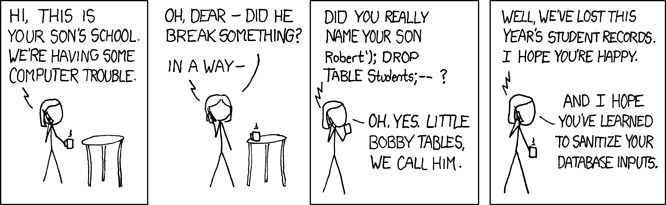
I have used non-standard RSA key size for maybe 15 years. For example, my old OpenPGP key created in 2002. With non-standard key sizes, I mean a RSA key size that is not 2048 or 4096. I do this when I generate OpenPGP/SSH keys (using GnuPG with a smartcard like this) and PKIX certificates (using GnuTLS or OpenSSL, e.g. for XMPP or for HTTPS). People sometimes ask me why. I haven t seen anyone talk about this, or provide a writeup, that is consistent with my views. So I wanted to write about my motivation, so that it is easy for me to refer to, and hopefully to inspire others to think similarily. Or to provoke discussion and disagreement that s fine, and hopefully I will learn something. Before proceeding, here is some context: When building new things, it is usually better to use the Elliptic Curve technology algorithm Ed25519 instead of RSA. There is also ECDSA which has had a comparatively slow uptake, for a number of reasons that is widely available and is a reasonable choice when Ed25519 is not available. There are also post-quantum algorithms, but they are newer and adopting them today requires a careful cost-benefit analysis. First some background. RSA is an asymmetric public-key scheme, and relies on generating private keys which are the product of distinct prime numbers (typically two). The size of the resulting product, called the modulus n, is usually expressed in bit length and forms the key size. Historically RSA key sizes used to be a couple of hundred bits, then 512 bits settled as a commonly used size. With better understanding of RSA security levels, the common key size evolved into 768, 1024, and later 2048. Today s recommendations (see keylength.com) suggest that 2048 is on the weak side for long-term keys (5+ years), so there has been a trend to jump to 4096. The performance of RSA private-key operations starts to suffer at 4096, and the bandwidth requirements is causing issues in some protocols. Today 2048 and 4096 are the most common choices. My preference for non-2048/4096 RSA key sizes is based on the simple and na ve observation that if I would build a RSA key cracker, there is some likelihood that I would need to optimize the implementation for a particular key size in order to get good performance. Since 2048 and 4096 are dominant today, and 1024 were dominent some years ago, it may be feasible to build optimized versions for these three key sizes. My observation is a conservative decision based on speculation, and speculation on several levels. First I assume that there is an attack on RSA that we don t know about. Then I assume that this attack is not as efficient for some key sizes than others, either on a theoretical level, at implementation level (optimized libraries for certain characteristics), or at an economic/human level (decision to focus on common key sizes). Then I assume that by avoiding the efficient key sizes I can increase the difficulty to a sufficient level. Before analyzing whether those assumptions even remotely may make sense, it is useful to understand what is lost by selecting uncommon key sizes. This is to understand the cost of the trade-off. A significant burden would be if implementations didn t allow selecting unusual key sizes. In my experience, enough common applications support uncommon key sizes, for example GnuPG, OpenSSL, OpenSSH, FireFox, and Chrome. Some applications limit the permitted choices; this appears to be rare, but I have encountered it once. Some environments also restrict permitted choices, for example I have experienced that LetsEncrypt has introduced a requirement for RSA key sizes to be a multiples of 8. I noticed this since I chose a RSA key size of 3925 for my blog and received a certificate from LetsEncrypt in December 2015 however during renewal in 2016 it lead to an error message about the RSA key size. Some commercial CAs that I have used before restrict the RSA key size to one of 1024, 2048 or 4096 only. Some smart-cards also restrict the key sizes, sadly the YubiKey has this limitation. So it is not always possible, but possible often enough for me to be worthwhile. Another cost is that RSA signature operations are slowed down. This is because the exponentiation function is faster than multiplication, and if the bit pattern of the RSA key is a 1 followed by several 0 s, it is quicker to compute. I have not done benchmarks, but I have not experienced that this is a practical problem for me. I don t notice RSA operations in the flurry of all of other operations (network, IO) that is usually involved in my daily life. Deploying this on a large scale may have effects, of course, so benchmarks would be interesting. Back to the speculation that leads me to this choice. The first assumption is that there is an attack on RSA that we don t know about. In my mind, until there are proofs that the currently known attacks (GNFS-based attacks) are the best that can be found, or at least some heuristic argument that we can t do better than the current attacks, the probability for an unknown RSA attack is therefor, as strange as it may sound, 100%. The second assumption is that the unknown attack(s) are not as efficient for some key sizes than others. That statement can also be expressed like this: the cost to mount the attack is higher for some key sizes compared to others. At the implementation level, it seems reasonable to assume that implementing a RSA cracker for arbitrary key sizes could be more difficult and costlier than focusing on particular key sizes. Focusing on some key sizes allows optimization and less complex code. At the mathematical level, the assumption that the attack would be costlier for certain types of RSA key sizes appears dubious. It depends on the kind of algorithm the unknown attack is. For something similar to GNFS attacks, I believe the same algorithm applies equally for a RSA key size of 2048, 2730 and 4096 and that the running time depends mostly on the key size. Other algorithms that could crack RSA, such as some approximation algorithms, does not seem likely to be thwarted by using non-standard RSA key sizes either. I am not a mathematician though. At the economical or human level, it seems reasonable to say that if you can crack 95% of all keys out there (sizes 1024, 2048, 4096) then that is good enough and cracking the last 5% is just diminishing returns of the investment. Here I am making up the 95% number. Currently, I would guess that more than 95% of all RSA key sizes on the Internet are 1024, 2048 or 4096 though. So this aspect holds as long as people behave as they have done. The final assumption is that by using non-standard key sizes I raise the bar sufficiently high to make an attack impossible. To be honest, this scenario appears unlikely. However it might increase the cost somewhat, by a factor or two or five. Which might make someone target a lower hanging fruit instead. Putting my argument together, I have 1) identified some downsides of using non-standard RSA Key sizes and discussed their costs and implications, and 2) mentioned some speculative upsides of using non-standard key sizes. I am not aware of any argument that the odds of my speculation is 0% likely to be true. It appears there is some remote chance, higher than 0%, that my speculation is true. Therefor, my personal conservative approach is to hedge against this unlikely, but still possible, attack scenario by paying the moderate cost to use non-standard RSA key sizes. Of course, the QA engineer in me also likes to break things by not doing what everyone else does, so I end this with an ObXKCD.
Norbert Preining: Debian/TeX Live 2016.20161103-1

This month s update falls onto a national holiday in Japan. My recent start as a normal company employee in Japan doesn t leave me enough time during normal days to work on Debian, so things have to wait for holidays. There have been a few notable changes in the current packages, and above all I wanted to fix an RC bug and on the way fixed also several other (sometimes rather old) bugs.

texlive2016-debian From the list of new packages I want to pick apxproof: I have written something myself for one of my rather long papers (with proofs about 60pp), where at times I had to factor out the proofs into an appendix. I did this my own way, but I would have preferred to have a nice package! Another interesting change is the upstream merge of collection-mathextra (which translated to the Debian package texlive-math-extra) and collection-science (Debian: texlive-science) into a new collection collection-mathscience. Since introducing new packages and phasing out old ones is generally a pain in Debian, I decided to digress from the upstream naming convention and use texlive-science for the new collection-mathscience. In the end Mathematics is the most important science of all  Finally also a word about removals: Several ConTeXt packages have been removed due to the fact that they are outdated. These removals will find their way in an update of the Debian ConTeXt package in near future. The TeX Live packages lost voss-mathmode, which was retracted by the author due to various reasons. He is working on an updated version that will hopeful reappear in both TeX Live and Debian in near future. Well, that s it for now. Here now the full list with links. Enjoy. New packages apxproof, bangorexam, biblatex-gb7714-2015, biblatex-lni, biblatex-sbl, context-cmscbf, context-cmttbf, context-inifile, context-layout, delimset, latex2nemeth, latexbangla, latex-papersize, ling-macros, notex-bst, platex-tools, testidx, uppunctlm, wtref, xcolor-material. Removed packages voss-mathmode. Updated packages apa6, autoaligne, babel-german, biblatex-abnt, biblatex-anonymous, biblatex-apa, biblatex-manuscripts-philology, biblatex-nature, biblatex-realauthor, bibtex, bidi, boondox, bxcjkjatype, chickenize, churchslavonic, cjk-gs-integrate, context-filter, cooking-units, ctex, denisbdoc, dvips, europasscv, fixme, glossaries, gzt, handout, imakeidx, ipaex-type1, jsclasses, jslectureplanner, kpathsea, l3build, l3experimental, l3kernel, l3packages, latexindent, latexmk, listofitems, luatexja, marginnote, mcf2graph, minted, multirow, nameauth, newpx, newtx, noto, nucleardata, optidef, overlays, pdflatexpicscale, pst-eucl, reledmac, repere, scanpages, semantic-markup, tableaux, tcolorbox, tetex, texlive-scripts, ticket, todonotes, tracklang, tudscr, turabian-formatting, updmap-map, uspace, visualtikz, xassoccnt, xecjk, yathesis.

Jan Wagner: Container Orchestration Thoughts

Container Orchestration ThoughtsSince some time everybody (read developer) want to run his new microservice stacks in containers. I can understand that building and testing an application is important for developers.
One of the benefits of containers is, that developer (in theory) can put their new version of applications into production on their own. This is the point where operations is affected and operations needs to evaluate, if that might evolve into better workflow. For yolo^WdevOps people there are some challenges that needs to be solved, or at least mitigated, when things needs to be done in large(r) scale.

Orchestration Engine Running Docker, which is actual the most preferred container solution, on a single host with docker command line client is something you can do, but there you leave the gap between dev and ops.

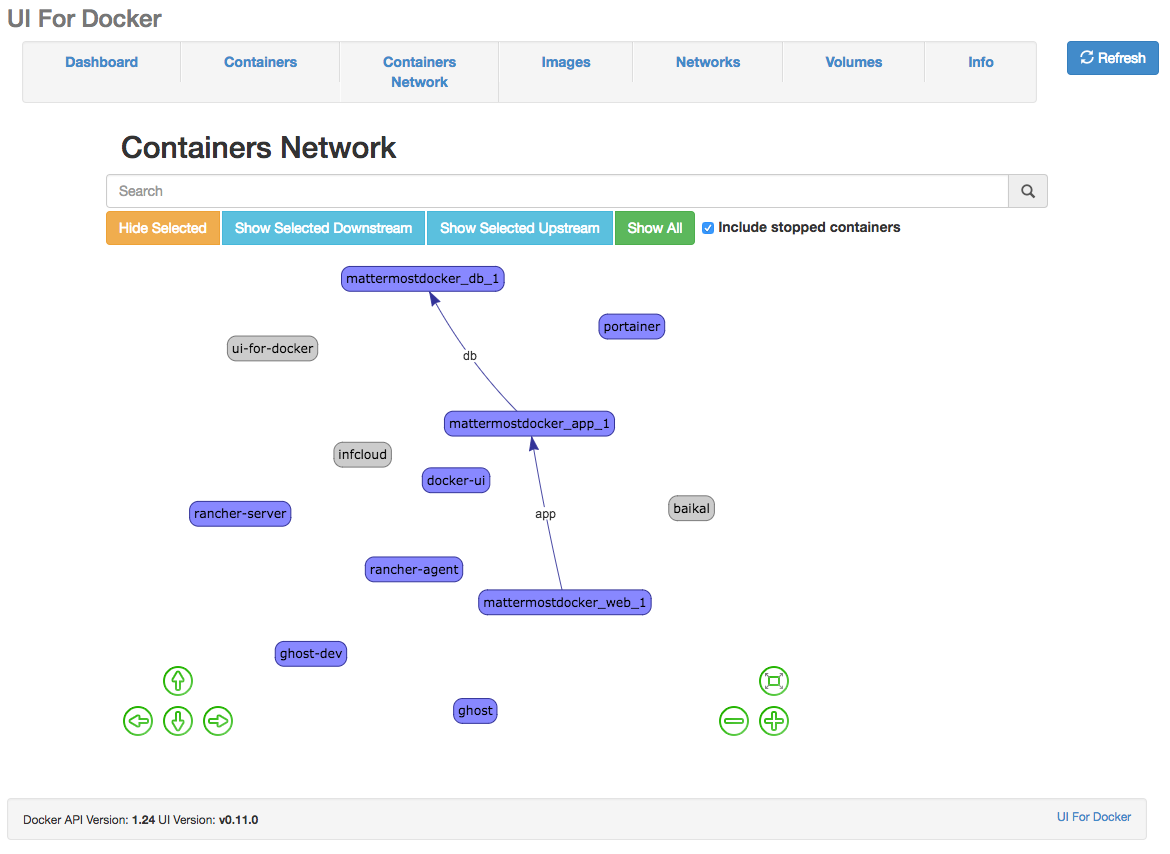
UI For Docker Since some time there is UI For Docker available for visualizing and managing containers on a single docker node. It's pretty awesome and the best feature so far is the Container Network view, which also shows the linked container. Container Orchestration Thoughts

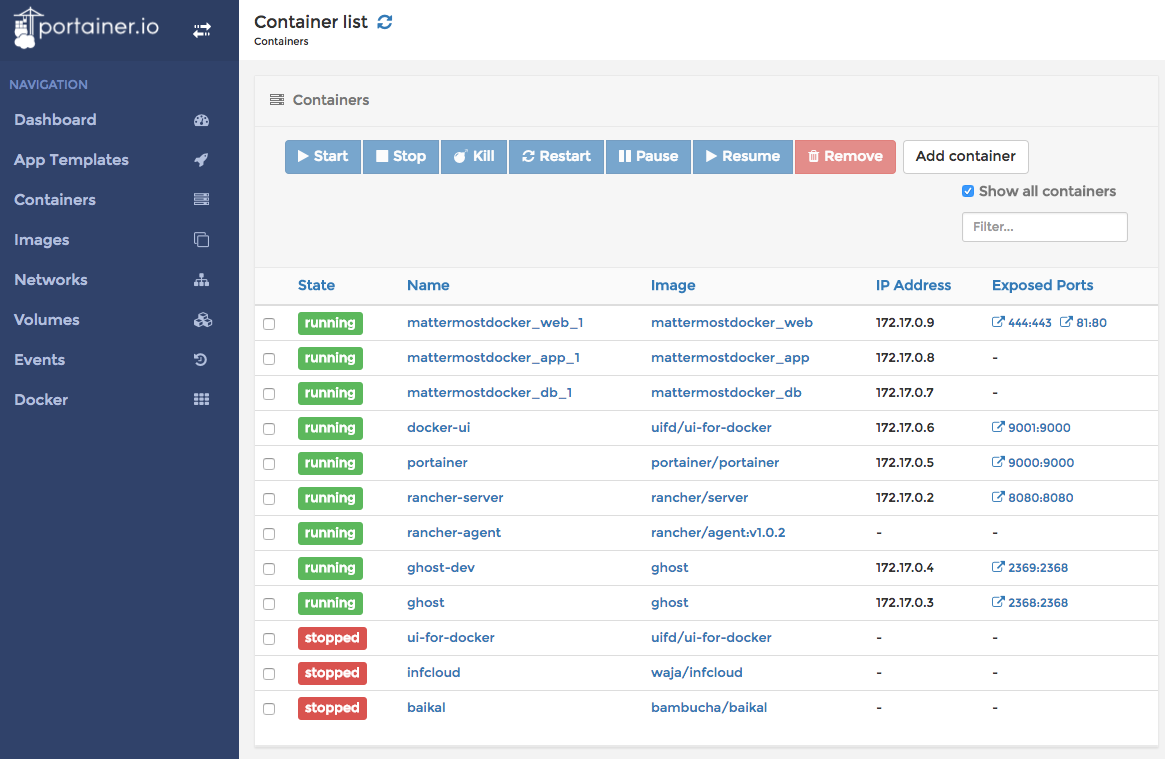
Portainer Portainer is pretty new and it can be deployed as easy as UI For Docker. But the (first) great advantage: it can handle Docker Swarm. Beside that it has many other great features. Container Orchestration Thoughts

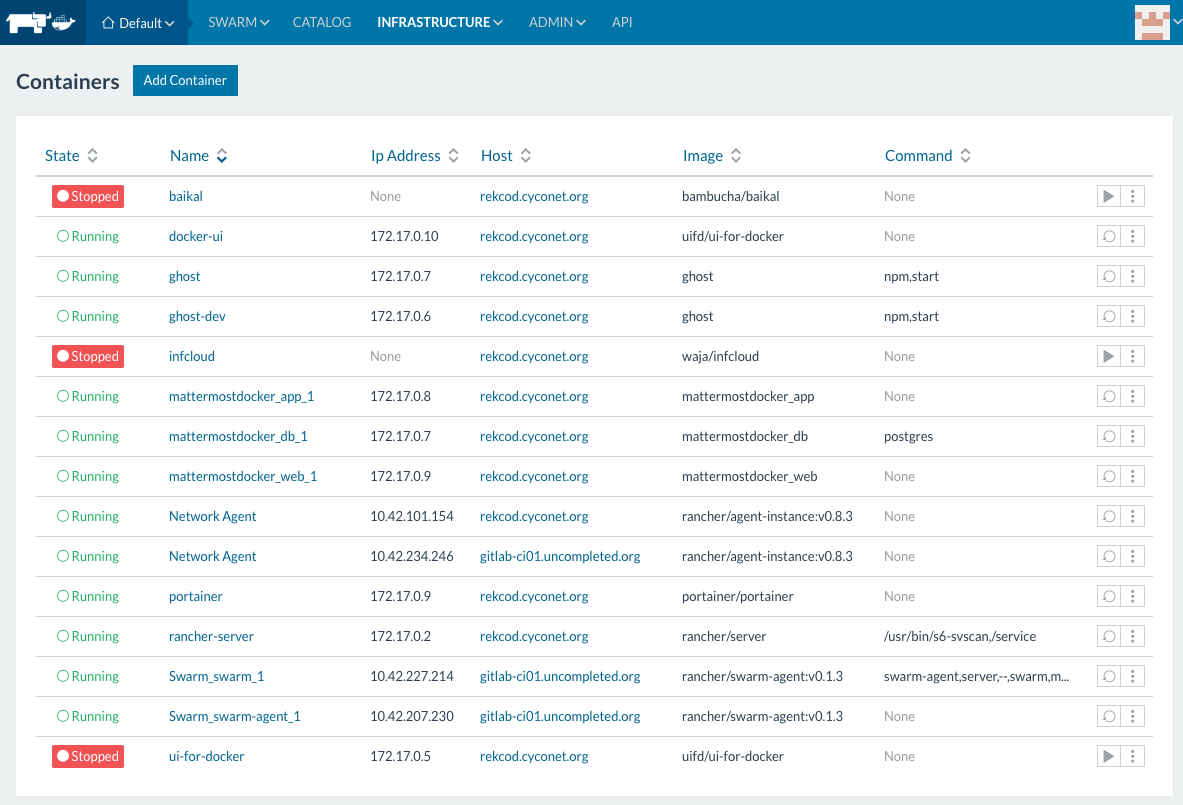
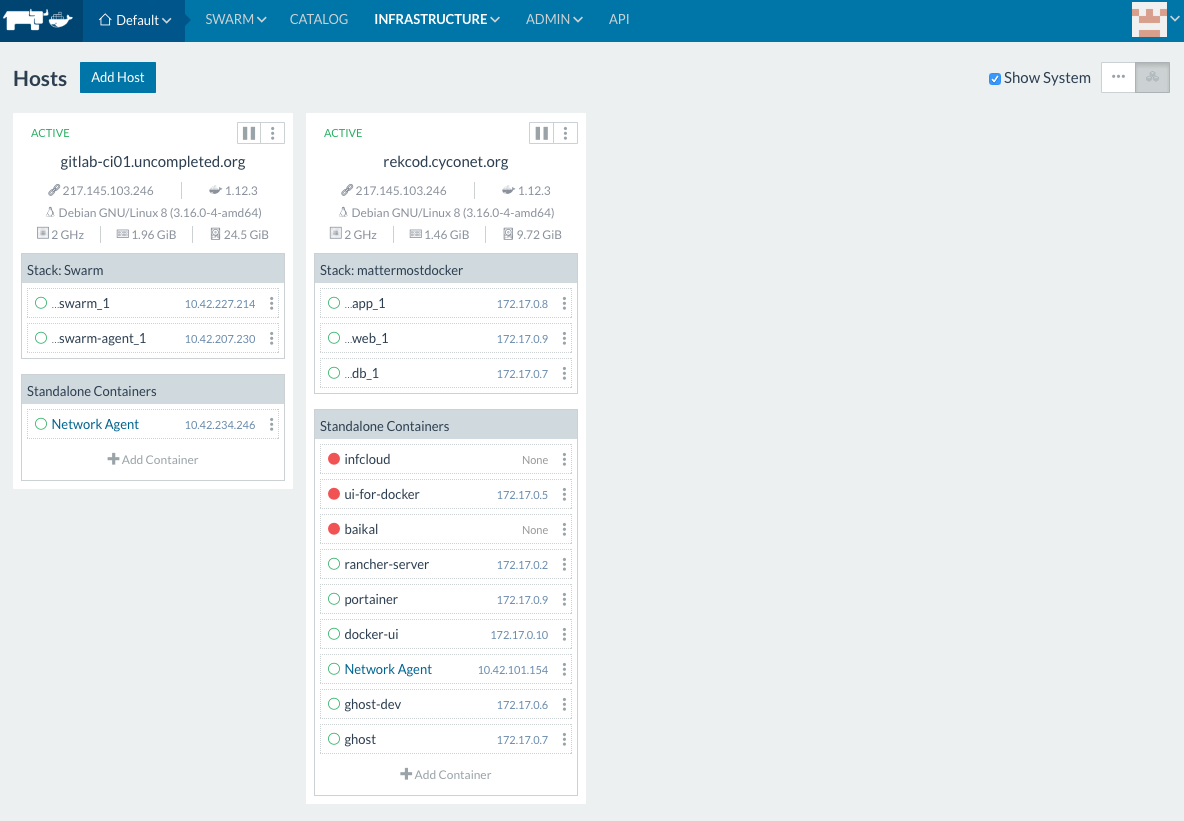
Rancher Rancher describes themselves as 'container management platform' that 'supports and manages all of your Kubernetes, Mesos, and Swarm clusters'. This is great because this are all of the relevant docker cluster orchestrations at the market actually. Container Orchestration Thoughts For the use cases, we are facing, Kubernetes and Mesos seems both like bloated beasts. Usman Ismail has written a really good comparison of Orchestration Engine options which goes into details. Container Orchestration Thoughts

Docker Swarm As there is actually no clear defacto standard/winner of the (container) orchestration wars, I would prevent to be in a vendor lock-in situation (yet). Docker swarm seems to be evolving and is getting more nice features other competitors doesn't provide.
Due the native integration into the docker framework and great community I believe Docker Swarm will be the Docker Orchestration of the choice on the long run. This should be supported by Rancher 1.2 which is not released yet.
From this point of view it looks very reasonable that Docker Swarm in combination with Rancher (1.2) might be a good strategy to maintain your container farms in the future. If you think to put Docker Swarm into production in the actual state, I recommend to read Docker swarm mode: What to know before going live on production by Panjamapong Sermsawatsri.

Persistent Storage While it is a best practice to use data volume container these days, providing persistent storage across multiple hosts for shared volumes seems to be tricky. In theory you can mount a shared-storage volume as a data volume and there are several volume plugins which supports shared storage. For example you can use the convoy plugin which gives you:
  • thin provisioned volumes
  • snapshots of volumes
  • backup of snapshots
  • restore volumes
As backend you can use:
  • Device Mapper
  • Virtual File System(VFS)/Network File System(NFS)
  • Amazon Elastic Block Store(EBS)
The good thing is, that convoy is integrated into Rancher. For more information I suggest to read Setting Up Shared Volumes with Convoy-NFS, which also mentions some limitations. If you want test Persistent Storage Service, Rancher provides some documentation. Actually I did not evaluate shared-storage volumes yet, but I don't see a solution I would love to use in production (at least on-premise) without strong downsides. But maybe things will go further and there might be a great solution for this caveats in the future.

Keeping base images up-to-date Since some time there are many projects that tries to detect security problems in your container images in several ways.
Beside general security considerations you need to deal somehow with issues in your base images that you build your applications on. Of course, even if you know you have a security issue in your application image, you need to fix it, which depends on the way how you based your application upon.

Ways to base your application image
  • You can build your application image entire from scratch, which leaves all the work to your development team and I wouldn't recommend it that way.
  • You also can create one (or more) intermediate image(s) that will be used by your development team.
  • The development team might ground their work on images in public available or private (for example the one bundled to your gitlab CI/CD solution) registries.

Whats the struggle with the base image? If you are using images being not (well) maintained by other people, you have to wait for them to fix your base image. Using external images might also lead into trust problems (can you trust those people in general?).
In an ideal world, your developers have always fresh base images with fixed security issues. This can probably be done by rebuilding every intermediate image periodically or when the base image changes.

Paradigm change Anyway, if you have a new application image available (with no known security issues), you need to deploy it to production. This is summarized by Jason McKay in his article Docker Security: How to Monitor and Patch Containers in the Cloud:
To implement a patch, update the base image and then rebuild the application image. This will require systems and development teams to work closely together.
So patching security issues in the container world changes workflow significant. In the old world operation teams mostly rolled security fixes for the base systems independent from development teams.
Now hitting containers the production area this might change things significant.

Bringing updated images to production Imagine your development team doesn't work steady on a project, cause the product owner consider it feature complete. The base image is provided (in some way) consistently without security issues. The application image is build on top of that automatically on every update of the base image.
How do you push in such a scenario the security fixes to production? From my point of view you have two choices:
  • Let the development team require to test the resulting application image and put it into production
  • Push the new application image without review by the development team into production
The first scenario might lead into a significant delay until the fixes hit production created by the probably infrequent work of the development team. The latter one brings your security fixes early to production by the notable higher risk to break your application. This risk can be reduced by implementing massive tests into CI/CD pipelines by the development team. Rolling updates provided by Docker Swarm might also reduce the risk of ending with a broken application. When you are implementing an update process of your (application) images to production, you should consider Watchtower that provides Automatic Updates for Docker Containers.

Conclusion Not being a product owner or the operations part of an application that is facing a widely adopted usage that would compensate the actual tradeoffs we are still facing I tend not to move large scale production projects into a container environment.
This means not that this might be a bad idea for others, but I'd like to sort out some of the caveats before. I'm still interested to put smaller projects into production, being not scared to reimplement or move them on a new stack.
For smaller projects with a small number of hosts Portainer looks not bad as well as Rancher with the Cattle orchestration engine if you just want to manage a couple of nodes. Things are going to be interesting if Rancher 1.2 supports Docker swarm cluster out of the box. Let's see what the future will bring us to the container world and how to make a great stack out of it.

Update I suggest to read Docker in Production: A History of Failure and the answer Docker in Production: A retort to understand the actual challenges when running Docker in larger scale production environments.

2 November 2016

Sandro Tosi: Debian source package name from the binary name

it looks like i forgot all the times how to do that, and apparently i'm not able to use google good enough to find it out quickly, let's write down one way to get the source package name from the binary package name:

dpkg-query -W -f='$ source:package \n' <list of bin pkgs>

(since it accepts a list of packages, you can xargs it).

there are probably another million ways to do that, so dont be shy and comment this post if you want to share your method

Enrico Zini: schroot connector for ansible

I accidentally made an ansible connector plugin for schroot. I haven't even used ansible yet, so I have no idea what I am doing. You can choose the chroot type by setting something like schroot_type: jessie in your variables. You can install this locally as connection_plugins/schroot.py.
# Based on chroot.py (c) 2013, Maykel Moya <mmoya@speedyrails.com>
# Based on chroot.py (c) 2015, Toshio Kuratomi <tkuratomi@ansible.com>
# (c) 2016, Enrico Zini <enrico@debian.org>
#
# This is free software: you can redistribute it and/or modify
# it under the terms of the GNU General Public License as published by
# the Free Software Foundation, either version 3 of the License, or
# (at your option) any later version.
#
# Ansible is distributed in the hope that it will be useful,
# but WITHOUT ANY WARRANTY; without even the implied warranty of
# MERCHANTABILITY or FITNESS FOR A PARTICULAR PURPOSE.  See the
# GNU General Public License for more details.
#
# You should have received a copy of the GNU General Public License
# along with Ansible.  If not, see <http://www.gnu.org/licenses/>.
from __future__ import (absolute_import, division, print_function)
__metaclass__ = type
import distutils.spawn
import os
import os.path
import pipes
import subprocess
import traceback
from ansible import constants as C
from ansible.errors import AnsibleError
from ansible.plugins.connection import ConnectionBase, BUFSIZE
from ansible.module_utils.basic import is_executable
from ansible.utils.unicode import to_bytes
try:
    from __main__ import display
except ImportError:
    from ansible.utils.display import Display
    display = Display()
class Connection(ConnectionBase):
    ''' Local chroot based connections '''
    transport = 'schroot'
    has_pipelining = True
    # su currently has an undiagnosed issue with calculating the file
    # checksums (so copy, for instance, doesn't work right)
    # Have to look into that before re-enabling this
    become_methods = frozenset(C.BECOME_METHODS).difference(('su',))
    def __init__(self, play_context, new_stdin, *args, **kwargs):
        super(Connection, self).__init__(play_context, new_stdin, *args, **kwargs)
        self.chroot = self._play_context.remote_addr
        #if os.geteuid() != 0:
            #raise AnsibleError("chroot connection requires running as root")
        # we're running as root on the local system so do some
        # trivial checks for ensuring 'host' is actually a chroot'able dir
        #if not os.path.isdir(self.chroot):
        #    raise AnsibleError("%s is not a directory" % self.chroot)
        #chrootsh = os.path.join(self.chroot, 'bin/sh')
        ## Want to check for a usable bourne shell inside the chroot.
        ## is_executable() == True is sufficient.  For symlinks it
        ## gets really complicated really fast.  So we punt on finding that
        ## out.  As long as it's a symlink we assume that it will work
        #if not (is_executable(chrootsh) or (os.path.lexists(chrootsh) and os.path.islink(chrootsh))):
        #    raise AnsibleError("%s does not look like a chrootable dir (/bin/sh missing)" % self.chroot)
        self.chroot_cmd = distutils.spawn.find_executable('schroot')
        if not self.chroot_cmd:
            raise AnsibleError("chroot command not found in PATH")
        self.chroot_id = "session:" + self.chroot
        self.chroot_type = "stable"
        existing = subprocess.check_output([self.chroot_cmd, "--list", "--all"])
        self.chroot_exists = False
        for line in existing.splitlines():
            if line == self.chroot_id:
                self.chroot_exists = True
    def set_host_overrides(self, host, hostvars=None):
        super(Connection, self).set_host_overrides(host, hostvars)
        self.chroot_type = hostvars.get("schroot_type", self.chroot_type)
    def _connect(self):
        ''' connect to the chroot; nothing to do here '''
        super(Connection, self)._connect()
        if not self._connected:
            if not self.chroot_exists:
                self.chroot_id = subprocess.check_output([self.chroot_cmd, "-b", "-c", self.chroot_type, "-n", self.chroot]).strip()
                subprocess.check_call([self.chroot_cmd, "-r", "-c", self.chroot_id, "-u", "root", "--", "apt-get", "update"])
                subprocess.check_call([self.chroot_cmd, "-r", "-c", self.chroot_id, "-u", "root", "--", "apt-get", "-y", "install", "python"])
            display.vvv("THIS IS A LOCAL CHROOT DIR", host=self.chroot)
            self._connected = True
    def _buffered_exec_command(self, cmd, stdin=subprocess.PIPE):
        ''' run a command on the chroot.  This is only needed for implementing
        put_file() get_file() so that we don't have to read the whole file
        into memory.
        compared to exec_command() it looses some niceties like being able to
        return the process's exit code immediately.
        '''
        executable = C.DEFAULT_EXECUTABLE.split()[0] if C.DEFAULT_EXECUTABLE else '/bin/sh'
        local_cmd = [self.chroot_cmd, "-r", "-c", self.chroot_id, "-u", "root", "--", executable, '-c', cmd]
        display.vvv("EXEC %s" % (local_cmd), host=self.chroot)
        local_cmd = [to_bytes(i, errors='strict') for i in local_cmd]
        p = subprocess.Popen(local_cmd, shell=False, stdin=stdin,
                stdout=subprocess.PIPE, stderr=subprocess.PIPE)
        return p
    def exec_command(self, cmd, in_data=None, sudoable=False):
        ''' run a command on the chroot '''
        super(Connection, self).exec_command(cmd, in_data=in_data, sudoable=sudoable)
        p = self._buffered_exec_command(cmd)
        stdout, stderr = p.communicate(in_data)
        return (p.returncode, stdout, stderr)
    def _prefix_login_path(self, remote_path):
        ''' Make sure that we put files into a standard path
            If a path is relative, then we need to choose where to put it.
            ssh chooses $HOME but we aren't guaranteed that a home dir will
            exist in any given chroot.  So for now we're choosing "/" instead.
            This also happens to be the former default.
            Can revisit using $HOME instead if it's a problem
        '''
        if not remote_path.startswith(os.path.sep):
            remote_path = os.path.join(os.path.sep, remote_path)
        return os.path.normpath(remote_path)
    def put_file(self, in_path, out_path):
        ''' transfer a file from local to chroot '''
        super(Connection, self).put_file(in_path, out_path)
        display.vvv("PUT %s TO %s" % (in_path, out_path), host=self.chroot)
        out_path = pipes.quote(self._prefix_login_path(out_path))
        try:
            with open(to_bytes(in_path, errors='strict'), 'rb') as in_file:
                try:
                    p = self._buffered_exec_command('dd of=%s bs=%s' % (out_path, BUFSIZE), stdin=in_file)
                except OSError:
                    raise AnsibleError("chroot connection requires dd command in the chroot")
                try:
                    stdout, stderr = p.communicate()
                except:
                    traceback.print_exc()
                    raise AnsibleError("failed to transfer file %s to %s" % (in_path, out_path))
                if p.returncode != 0:
                    raise AnsibleError("failed to transfer file %s to %s:\n%s\n%s" % (in_path, out_path, stdout, stderr))
        except IOError:
            raise AnsibleError("file or module does not exist at: %s" % in_path)
    def fetch_file(self, in_path, out_path):
        ''' fetch a file from chroot to local '''
        super(Connection, self).fetch_file(in_path, out_path)
        display.vvv("FETCH %s TO %s" % (in_path, out_path), host=self.chroot)
        in_path = pipes.quote(self._prefix_login_path(in_path))
        try:
            p = self._buffered_exec_command('dd if=%s bs=%s' % (in_path, BUFSIZE))
        except OSError:
            raise AnsibleError("chroot connection requires dd command in the chroot")
        with open(to_bytes(out_path, errors='strict'), 'wb+') as out_file:
            try:
                chunk = p.stdout.read(BUFSIZE)
                while chunk:
                    out_file.write(chunk)
                    chunk = p.stdout.read(BUFSIZE)
            except:
                traceback.print_exc()
                raise AnsibleError("failed to transfer file %s to %s" % (in_path, out_path))
            stdout, stderr = p.communicate()
            if p.returncode != 0:
                raise AnsibleError("failed to transfer file %s to %s:\n%s\n%s" % (in_path, out_path, stdout, stderr))
    def close(self):
        ''' terminate the connection; nothing to do here '''
        super(Connection, self).close()
        #subprocess.check_command([self.chroot_cmd, "-e", "-c", self.chroot_id])
        self._connected = False

1 November 2016

Jonathan Wiltshire: Reflecting on a year of regular, public IRC meetings

The release team first started holding a regular, public planning and status meeting a little over a year ago, in September 2015. At that time, FTP masters had experimented along similar lines and I took some inspiration from that, including the keeping of proper minutes that anyone can look at. I wanted to open up our discussion processes and allow other developers and users to see (and perhaps influence) our plans for the release taking shape month by month, and how we reached certain decisions with a lot of mature discussion and not just on a whim. A secondary aim, since we are quite geographically distributed and getting together for same-room meetings is hard, was to bring more accountability to ourselves when we decided something ought to happen; if it s in the minutes, there s no escaping someone asking so what happened to ? . That s worked better for us on some topics than on others. Finally, public minutes mean that anyone who might be interested in joining the team can see easily what we re up to and how we shape the release throughout the cycle. That might help lower the barrier to entry, which can only be good for the team. I had hoped that regular meetings would inspire other teams to do similar; I haven t seen any indication of that to date (though perhaps it s just down to awareness). The Reproducible Builds contributors held fortnightly meetings for a period in 2015, though not inspired by ours, and I heard recent talk of starting those again. I still think that there is plenty of scope to improve the transparency of core teams in general in Debian, but also that regular meetings aren t going to work for every team. A regular slot which is not varied except when absolutely necessary, is essential for avoiding the temptation to just push it back another week when things are busy. In our office we have an allegedly-regular Thursday afternoon slot for technical demonstrations, which has suffered from exactly that problem for a long time now, and I wanted to avoid that issue. We have a calendar to remind us when each meeting is due, along with other important events like freeze milestones. Our slot is the fourth Wednesday of the month, a fairly arbitrary choice which seems to have worked out quite well. Time zones are more of an issue, even within Europe. We have mostly used a European evening time, but that s not very helpful further West where it s in the middle of the working day, or the middle of the night if you re further East (that one fortunately isn t an issue for us so far). Even within Europe it s difficult, as we have to try and balance commuting time in the UK with dinner on the continent, or dinner with late evening, or adjust for saving changes, or you get the idea. If we gained a far-eastern team member one day, this would be a real issue. We use Meetbot for recording the minutes. I have heard criticism that it publicly archives IRC logs to the web essentially forever, but for us that s the whole point. With a little practice and discipline it does generate really nice minutes, with a bullet summary of the important parts, a summary of actions agreed and a log of the conversation for detailed reference. Anybody reading them can see how we reached a conclusion, and I m of the view that goes some way to avoiding a reputation for cabal-ism. It does pay to use the #info, #agree and #action tags liberally, but other things are slightly unnatural like always remembering to use a URL at the beginning of a line and not in the middle of a sentence, or Meetbot doesn t notice it. Practice goes a long way. I ve naturally fallen into chairing most meetings, for better or worse the consistency seems beneficial, but I worry that I m dominating the discussion sometimes. Discipline in making sure everybody has been included is something I ve had to get better at. It s essential to have a public agenda and to stick to it, and it should include some stock items at the start and end (including making sure the URL to the previous minutes has been given, reviewing outstanding actions, and arranging the next meeting before ending the current one). There is some skill in judging the agenda length and deciding which items can be deferred to make sure it doesn t drag on too late we ve found anything more than an hour is far too long, and between 45 and 60 minutes is pushing it. Getting some easy topics out of the way before starting one which is more contentious can be helpful to avoid having to defer them later. I circulate the URL to the minutes and the date of the next meeting publicly on the mailing list immediately after each meeting, or as soon as possible. With little feedback, I have no idea if our meetings are helpful to those outside the team or not. We do still hold in-person meetings from time to time when we re all together, because they re useful for some circumstances (like some genuinely private topics we occasionally need to discuss, or for sprinting). I would hope that public meetings inspire confidence that we re on top of the release process, that they show we have a mature and transparent decision making process (for example, in deciding to move the freeze date to accommodate an external release schedule as a one-off, and subsequently deciding to not move it back when circumstances changed), and mostly that other teams might benefit for the same reasons. But I can also see that they make more sense in a team with a defined project cycle than they might in one which is more administrative or where work is more sporadic (no point holding a meeting for the sake of it, after all).

Thorsten Alteholz: My Debian Activities in October 2016

FTP assistant This month I caught up from last month and marked 317 packages for accept and rejected 23 packages. I also sent 5 emails to maintainers asking questions. Debian LTS This was my twenty-eighth month that I did some work for the Debian LTS initiative, started by Raphael Hertzog at Freexian. This month my all in all workload has been 13h. During that time I did uploads of The second upload of bind was an embargoed one. Other stuff I uploaded a new version of greylistd and fixed RC bug #837501. A new version of highlight.js fixed RC bug #830189. With a new upstream version of chktex I could close bugs #782342, #782343 and #819885. I also uploaded the new package node-random-bytes and new upstream versions of alljoyn-core-1604 and duktape Finally, after about 4 years, I managed to upload entropybroker and instantly had to deal with #840018, #840019 and #840020. One cannot overemphasize the importance of our QA stuff! I also uploaded a new version of libctl to solve the -fPIC issue but was asked short time after to revert that again :-(. As already mentioned some days ago I adopted libmatthew-java. At that time about 956 package were orphaned and I asked everybody to adopt one of these packages. Unfortunately now there are 982 package orphaned. I guess I have to clear up a misunderstanding. You should adopt those packages and not oprhan more of them!

31 October 2016

Chris Lamb: Free software activities in October 2016

Here is my monthly update covering what I have been doing in the free software world (previously):

Debian & Reproducible builds

Whilst anyone can inspect the source code of free software for malicious flaws, most GNU/Linux distributions provide binary (or "compiled") packages to end users. The motivation behind the Reproducible Builds effort is to allow verification that no flaws have been introduced either maliciously and accidentally during this compilation process by promising identical binary packages are always generated from a given source.

  • Presented a talk entitled "Reproducible Builds" talk at Software Freedom Kosova, in Prishtina, Republic of Kosovo.

  • I filed my 2,500th bug in the Debian BTS: #840972: golang-google-appengine: accesses the internet during build.

  • In order to build packages reproducibly, one not only needs identical sources but also some external and sharable definition of the environment used for a particular build, stipulating such things such as the version numbers of the required build-dependencies. It is not currently clear how to handle these .buildinfo files after the archive software has processed them and how to make them available to the world so I started development on a proof-of-concept server to see what issues arise in practice. It is available at buildinfo.debian.net.

  • Chaired an IRC meeting and ran a poll to determine a regular time .

  • Submitted two design proposals to our wiki page.

  • Improvements to our tests.reproducible-builds.org testing framework:

    • Move regular "Scheduled in..." messages to the #debian-reproducible-changes IRC channel.
    • Use our log_info method instead of manual echo calls.
    • Correct an "all sources packages" "all source packages" typo.
    • Submit .buildinfo files to buildinfo.debian.net.
    • Create GPG key on nodes for buildinfo.debian.net at deploy time, not "lazily".

My work in the Reproducible Builds project was also covered in our weekly reports. (#75, #76, #77 & #78).

I also submitted 14 patches to fix specific reproducibility issues in bio-eagle, cf-python, fastx-toolkit, fpga-icestorm, http-icons, lambda-align, mypy, playitslowly, seabios, stumpwm, sympa, tj3, wims-help & xotcl.
Debian LTS

This month I have been paid to work 13 hours on Debian Long Term Support (LTS). In that time I did the following:
  • Seven days of "frontdesk" duties, triaging CVEs, etc.
  • Issued DLA 647-1 for freeimage correcting an out-of-bounds write vulnerability in the XMP image handling functionality.
  • Issued DLA 649-1 for python-django fixing a possible CSRF protection bypass on sites that use Google Analytics.
  • Issued DLA 654-1 for libxfixes preventing an integer overflow when a malicious client sent INT_MAX as a "length".
  • Issued DLA 662-1 for quagga correcting a programming error where two constants were confused that could cause stack overrun in IPv6 routing code.
  • Issued DLA 688-1 for cairo to prevent a DoS attack where a malicious SVG could generate invalid pointers.

Uploads
  • gunicorn:
    • 19.6.0-7 Set supplementary groups when changing uid, add an example systemd .service file to gunicorn-examples, and expand README.Debian to make it clearer what to do now that /etc/gunicorn.d has been removed.
    • 19.6.0-8 Correct previous supplementary groups patch to be compatible with Python 3.
  • redis:
    • 3:3.2.4-2 Ensure that sentinel's configuration actually writes to a pidfile location so that systemd can detect that the daemon has started.
    • 3:3.2.5-1 New upstream release.
  • libfiu:
    • 0.94-8 Fix FTBFS under Bash due to lack of && in debian/rules.
    • 0.94-9 Ensure the build is reproducible by sorting injected modules.
  • aptfs (2:0.8-2) Minor cosmetic changes.

NMUs
  • libxml-dumper-perl (0.81-1.2) Move away from a unsupported debhelper compat level 4.
  • netatalk (2.2.5-1.1) Drop build-dependency on hardening-includes.

QA uploads
  • anon-proxy (00.05.38+20081230-4) Move to a supported debhelper compatibility level 9.
  • ara (1.0.32) Make the build reproducible.
  • binutils-m68hc1x (1:2.18-8) Make the build reproducible & move to a supported debhelper compatibility level.
  • fracplanet (0.4.0-5) Make the build reproducible.
  • libnss-ldap (265-5) Make the build reproducible.
  • python-uniconvertor (1.1.5-3) Fix an "option release requires an argument" FTBFS. (#839375)
  • ripole (0.2.0+20081101.0215-3) Actually include the ripole binary in package. (#839919) & enable hardening flags.
  • twitter-bootstrap (2.0.2+dfsg-10) Fix incorrect copyright formatting when building under Bash. (#824592)
  • zpaq (1.10-3) Make the build reproducible.


Debian FTP Team

As a Debian FTP assistant I ACCEPTed 147 packages: ace-link, amazon-s2n, avy, basez, bootstrap-vz, bucklespring, camitk, carettah, cf-python, debian-reference, dfcgen-gtk, efivar, entropybroker, fakesleep, gall, game-data-packager, gitano, glare, gnome-panel, gnome-shell-extension-dashtodock, gnome-shell-extension-refreshwifi, gnome-shell-extension-remove-dropdown-arrows, golang-github-gogits-go-gogs-client, golang-github-gucumber-gucumber, golang-github-hlandau-buildinfo, golang-github-hlandau-dexlogconfig, golang-github-hlandau-goutils, golang-github-influxdata-toml, golang-github-jacobsa-crypto, golang-github-kjk-lzma, golang-github-miekg-dns, golang-github-minio-sha256-simd, golang-github-nfnt-resize, golang-github-nicksnyder-go-i18n, golang-github-pointlander-compress, golang-github-pointlander-jetset, golang-github-pointlander-peg, golang-github-rfjakob-eme, golang-github-thecreeper-go-notify, golang-github-twstrike-gotk3adapter, golang-github-unknwon-goconfig, golang-gopkg-dancannon-gorethink.v1, golang-petname, haskell-argon2, haskell-binary-parsers, haskell-bindings-dsl, haskell-deriving-compat, haskell-hackage-security, haskell-hcwiid, haskell-hsopenssl-x509-system, haskell-megaparsec, haskell-mono-traversable-instances, haskell-prim-uniq, haskell-raaz, haskell-readable, haskell-readline, haskell-relational-record, haskell-safe-exceptions, haskell-servant-client, haskell-token-bucket, haskell-zxcvbn-c, irclog2html, ironic-ui, lace, ledger, libdancer2-plugin-passphrase-perl, libdatetime-calendar-julian-perl, libdbix-class-optimisticlocking-perl, libdbix-class-schema-config-perl, libgeo-constants-perl, libgeo-ellipsoids-perl, libgeo-functions-perl, libgeo-inverse-perl, libio-async-loop-mojo-perl, libmojolicious-plugin-assetpack-perl, libmojolicious-plugin-renderfile-perl, libparams-validationcompiler-perl, libspecio-perl, libtest-time-perl, libtest2-plugin-nowarnings-perl, linux, lua-scrypt, mono, mutt-vc-query, neutron, node-ansi-font, node-buffer-equal, node-defaults, node-formatio, node-fs-exists-sync, node-fs.realpath, node-is-buffer, node-jison-lex, node-jju, node-jsonstream, node-kind-of, node-lex-parser, node-lolex, node-loud-rejection, node-random-bytes, node-randombytes, node-regex-not, node-repeat-string, node-samsam, node-set-value, node-source-map-support, node-spdx-correct, node-static-extend, node-test, node-to-object-path, node-type-check, node-typescript, node-unset-value, nutsqlite, opencv, openssl1.0, panoramisk, perl6, pg-rage-terminator, pg8000, plv8, puppet-module-oslo, pymoc, pyramid-jinja2, python-bitbucket-api, python-ceilometermiddleware, python-configshell-fb, python-ewmh, python-gimmik, python-jsbeautifier, python-opcua, python-pyldap, python-s3transfer, python-testing.common.database, python-testing.mysqld, python-testing.postgresql, python-wheezy.template, qspeakers, r-cran-nleqslv, recommonmark, rolo, shim, swift-im, tendermint-go-clist, tongue, uftrace & zaqar-ui.

Antoine Beaupr : My free software activities, October 2016

Debian Long Term Support (LTS) This is my 7th month working on Debian LTS, started by Raphael Hertzog at Freexian, after a long pause during the summer. I have worked on the following packages and CVEs: I have also helped review work on the following packages:
  • imagemagick: reviewed BenH's work to figure out what was done. unfortunately, I forgot to officially take on the package and Roberto started working on it in the meantime. I nevertheless took time to review Roberto's work and outline possible issues with the original patchset suggested
  • tiff: reviewed Raphael's work on the hairy TIFFTAG_* issues, all the gory details in this email
The work on ImageMagick and GraphicsMagick was particularly intriguing. Looking at the source of those programs makes me wonder why were are still using them at all: it's a tangled mess of C code that is bound to bring up more and more vulnerabilities, time after time. It seems there's always an "Magick" vulnerability waiting to be fixed out there... I somehow hoped that the fork would bring more stability and reliability, but it seems they are suffering from similar issues because, fundamentally, they haven't rewritten ImageMagick... It looks this is something that affects all image programs. The review I have done on the tiff suite give me the same shivering sensation as reviewing the "Magick" code. It feels like all image libraries are poorly implemented and then bound to be exploited somehow... Nevertheless, if I had to use a library of the sort in my software, I would stay away from the "Magick" forks and try something like imlib2 first... Finally, I also did some minor work on the user and developer LTS documentation and some triage work on samba, xen and libass. I also looked at the dreaded CVE-2016-7117 vulnerability in the Linux kernel to verify its impact on wheezy users. I also looked at implementing a --lts flag for dch (see bug #762715). It was difficult to get back to work after such a long pause, but I am happy I was able to contribute a significant number of hours. It's a bit difficult to find work sometimes in LTS-land, even if there's actually always a lot of work to be done. For example, I used to be one of the people doing frontdesk work, but those duties are now assigned until the end of the year, so it's unlikely I will be doing any of that for the forseable future. Similarly, a lot of packages were assigned when I started looking at the available packages. There was an interesting discussion on the internal mailing list regarding unlocking package ownership, because some people had packages locked for weeks, sometimes months, without significant activity. Hopefully that situation will improve after that discussion. Another interesting discussion I participated in is the question of whether the LTS team should be waiting for unstable to be fixed before publishing fixes in oldstable. It seems the consensus right now is that it shouldn't be mandatory to fix issues in unstable before we fix security isssues in oldstable and stable. After all, security support for testing and unstable is limited. But I was happy to learn that working on brand new patches is part of our mandate as part of the LTS work. I did work on such a patch for tar which ended up being adopted by the original reporter, although upstream ended up implementing our recommendation in a better way. It's coincidentally the first time since I start working on LTS that I didn't get the number of requested hours, which means that there are more people working on LTS. That is a good thing, but I am worried it may also mean people are more spread out and less capable of focusing for longer periods of time on more difficult problems. It also means that the team is growing faster than the funding, which is unfortunate: now is a good time as any to remind you to see if you can make your company fund the LTS project if you are still running Debian wheezy.

Other free software work It seems like forever that I did such a report, and while I was on vacation, a lot has happened since the last report.

Monkeysign I have done extensive work on Monkeysign, trying to bring it kicking and screaming in the new world of GnuPG 2.1. This was the objective of the 2.1 release, which collected about two years of work and patches, including arbitrary MUA support (e.g. Thunderbird), config files support, and a release on PyPI. I have had to release about 4 more releases to try and fix the build chain, ship the test suite with the program and have a primitive preferences panel. The 2.2 release also finally features Tor suport! I am also happy to have moved more documentation to Read the docs, part of which I mentionned in in a previous article. The git repositories and issues were also moved to a Gitlab instance which will hopefully improve the collaboration workflow, although we still have issues in streamlining the merge request workflow. All in all, I am happy to be working on Monkeysign, but it has been a frustrating experience. In the last years, I have been maintaining the project largely on my own: although there are about 20 contributors in Monkeysign, I have committed over 90% of the commits in the code. New contributors recently showed up, and I hope this will release some pressure on me being the sole maintainer, but I am not sure how viable the project is.

Funding free software work More and more, I wonder how to sustain my contributions to free software. As a previous article has shown, I work a lot on the computer, even when I am not on a full-time job. Monkeysign has been a significant time drain in the last months, and I have done this work on a completely volunteer basis. I wouldn't mind so much except that there is a lot of work I do on a volunteer basis. This means that I sometimes must prioritize paid consulting work, at the expense of those volunteer projects. While most of my paid work usually revolves around free sofware, the benefits of paid work are not always immediately obvious, as the primary objective is to deliver to the customer, and the community as a whole is somewhat of a side-effect. I have watched with interest joeyh's adventures into crowdfunding which seems to be working pretty well for him. Unfortunately, I cannot claim the incredible (and well-deserved) reputation Joey has, and even if I could, I can't live with 500$ a month. I would love to hear if people would be interested in funding my work in such a way. I am hesitant in launching a crowdfunding campaign because it is difficult to identify what exactly I am working on from one month to the next. Looking back at earlier reports shows that I am all over the place: one month I'll work on a Perl Wiki (Ikiwiki), the next one I'll be hacking at a multimedia home cinema (Kodi). I can hardly think of how to fund those things short of "just give me money to work on anything I feel like", which I can hardly ask for of anyone. Even worse, it feels like the audience here is either friends or colleagues. It would make little sense for me to seek funding from those people: colleagues have the same funding problems I do, and I don't want to empoverish my friends... So far I have taken the approach of trying to get funding for work I am doing, bit by bit. For example, I have recently been told that LWN actually pays for contributed articles and have started running articles by them before publishing them here. This is looking good: they will publish an article I wrote about the Omnia router I have recently received. I give them exclusive rights on the article for two weeks, but I otherwise retain full ownership over the article and will publish them after the exclusive period here. Hopefully, I will be able to find more such projects that pays for the work I do on a day to day basis.

Open Street Map editing I have ramped up my OpenStreetMap contributions, having (temporarily) moved to a different location. There are lots of things to map here: trails, gaz stations and lots of other things are missing from the map. Sometimes the effort looks a bit ridiculous, reminding me of my early days of editing OSM. I have registered to OSM Live, a project to fund OSM editors that, I must admit, doesn't help much with funding my work: with the hundreds of edits I did in October, I received the equivalent of 1.80$CAD in Bitcoins. This may be the lowest hourly salary I have ever received, probably going at a rate of 10 per hour! Still, it's interesting to be able to point people to the project if someone wants to contribute to OSM mappers. But mappers should have no illusions about getting a decent salary from this effort, I am sorry to say.

Bounties I feel this is similar to the "bounty" model used by the Borg project: I claimed around $80USD in that project for what probably amounts to tens of hours of work, yet another salary that would qualify as "poor". Another example is a feature I would like to implement in Borg: support for protocols other than SSH. There is currently no bounty on this, but a similar feature, S3 support has one of the largest bounties Borg has ever seen: $225USD. And the claimant for the bounty hasn't actually implemented the feature, instead backing up to S3, the patch (to a third-party tool) actually enables support for Amazon Cloud Drive, a completely different API. Even at $225, I wouldn't be able to complete any of those features and get a decent salary. As well explained by the Snowdrift reviews, bounties just don't work at all... The ludicrous 10% fee charged by Bountysource made sure I would never do business with them ever again anyways.

Other work There are probably more things I did recently, but I am having difficulty keeping track of the last 5 months of on and off work, so you will forgive that I am not as exhaustive as I usually am.

James Bromberger: The Debian Cloud Sprint 2016

I m at an airport, about to board the first of three flights across the world, from timezone +8 to timezone -8. I ll be in transit 27 hours to get to Seattle, Washington state. I m leaving my wife and two young children behind. My work has given me a days worth of leave under the Corporate Social Responsibility program, and I m taking three days annual leave, to do this. 27 hours each way in transit, for 3 days on the ground. Why? Backstory I started playing in technology as a kid in the 1980s; my first PC was a clone (as they were called) 286 running MS-DOS. It was clunky, and the most I could do to extend it was to write batch scripts. As a child I had no funds for commercial compilers, no network connections (this was pre Internet in Australia), no access to documentation, and no idea where to start programming properly. It was a closed world. I hit university in the summer of 1994 to study Computer Science and French. I d heard of Linux, and soon found myself installing the Linux distributions of the day. The Freedom of the licensing, the encouragement to use, modify, share, was in stark contrast to the world of consumer PCs of the late 1980 s. It was there at the UCC at UWA I discovered Debian. Some of the kind network/system admins at the University maintained a Debian mirror on the campus LAN, updated regularly and always online. It was fast, and more importantly, free for me to access. Back in the 1990s, bandwidth in Australia was incredibly expensive. The vast distances of the country mean that bandwidth was scarce. Telcos were in races to put fiber between Perth and the Eastern States, and without that in place, IP connectivity was constrained, and thus costly. Over many long days and nights I huddled down, learning window managers, protocols, programming and scripting languages. I became a system/network administrator, web developer, dev ops engineer, etc. My official degree workload, algorithmic complexity, protocol stacks, were interesting, but fiddling with Linux based implementations was practical. Volunteer After years of consuming the output of Debian and running many services with it I decided to put my hand up and volunteer as a Debian Developer: it was time to give back. I had benefited from Debian, and I saw others benefit from it as well. As the 2000 s started, I had my PGP key in the Debian key ring. I had adopted a package and was maintaining it load balancing Apache web servers. The web was yet to expand to the traffic levels you see today; most web sites were served from one physical web server. Site Reliability Engineering was a term not yet dreamed of. What became more apparent was the applicability of Linux, Open Source, and in my line-of-sight Debian to a wider community beyond myself and my university peers. Debain was being used to revive recycled computers that were being donated to charities; in some cases, unable to transfer commercial software licenses with the hardware that was no longer required by organisations that had upgraded. It appeared that Debian was being used as a baseline above which society in general had access to fundamental capability of computing and network services. The removal of subscriptions, registrations, and the encouragement of distribution meant this occurred at rates that could never be tracked, and more importantly, the consensus was that it should not be automatically tracked. The privacy of the user is paramount more important than some statistics for the Developer to ponder. When the Bosnia-Herzegovina war ended in 1995, I recall an email from academics there, having found some connectivity, writing to ask if they would be able to use Debian as part of their re-deployment of services for the Tertiary institutions in the region. This was an unnecessary request as Debian GNU/Linux is freely available, but it was a reminder that, for the country to have tried to procure commercial solutions at that time would have been difficult. Instead, those that could do the task just got on with it. There s been many similar project where the grass-roots organisations non profits, NGOs, and even just loose collectives of individuals have turned to Linux, Open Source, and sometimes Debian to solve their problems. Many fine projects have been established to make technology accessible to all, regardless of race, gender, nationality, class, or any other label society has used to divide humans. Big hat tip to Humanitarian Open Street Map, Serval Project. I ve always loved Debian s position on being the Universal operating system. Its vast range of packages and wide range of computing architectures supported means that quite often a litmus test of is project X a good project? was met with is it packaged for Debian? . That wide range of architectures has meant that administrators of systems had fewer surprises and a faster adoption cycle when changing platforms, such as the switch from x86 32 bit to x86 64 bit. Enter the Cloud I first laid eyes on the AWS Cloud in 2008. It was nothing like the rich environment you see today. The first thing I looked for was my favourite operating system, so that what I already knew and was familiar with was available in this environment to minimise the learning curve. However there were no official images, which was disconcerting. In 2012 I joined AWS as an employee. Living in Australia they hired me into the field sales team as a Solution Architect a sort of pre-sales tech with a customer focused depth in security. It was a wonderful opportunity, and I learnt a great deal. It also made sense (to me, at least) to do something about getting Debian s images blessed. It turned out, that I had to almost define what that was: images endorsed by a Debian Developer, handed to the AWS Marketplace team. And so since 2013 I have done so, keeping track of Debian s releases across the AWS regions, collaborating with other Debian folk on other cloud platforms to attempt a unified approach to generating and maintaining these images. This included (for a stint) generating them into the AWS GovCloud Region, and still into the AWS China (Beijing) Region the other side of the so-called Great Firewall of China. So why the trip? We ve had focus groups at the Debconf (Debian conference) around the world, but its often difficult to get the right group of people in the same rooms at the same time. So the proposal was to hold a focused Debian Cloud Sprint. Google was good enough to host this, for all the volunteers across all the cloud providers. Furthermore, donated funds were found to secure the travel for a set of people to attend who otherwise could not. I was lucky enough to be given a flight. So here I am, in the terminal in Australia: my kids are tucked up in bed, dreaming of the candy they just collected for Halloween. It will be a draining week I am sure, but if it helps set and improve the state of Debian then its worth it.

30 October 2016

Dirk Eddelbuettel: RProtoBuf 0.4.7: Mostly harmless

CRAN requested a release updating any URLs for Omegahat to the (actually working) omegahat.net URL. The RProtoBuf package had this in one code comment (errr...) and on bibfile entry. Oh well -- so that caused this 0.4.7 release which arrived on CRAN today. It contains the requested change, and pretty much nothing else. RProtoBuf provides R bindings for the Google Protocol Buffers ("Protobuf") data encoding and serialization library used and released by Google, and deployed as a language and operating-system agnostic protocol by numerous projects. The NEWS file summarises the release as follows:

Changes in RProtoBuf version 0.4.7 (2016-10-27)
  • At the request of CRAN, two documentation instances referring to the Omegehat repository were updated to http://omegahat.net

CRANberries also provides a diff to the previous release. The RProtoBuf page has an older package vignette, a 'quick' overview vignette, a unit test summary vignette, and the pre-print for the JSS paper. Questions, comments etc should go to the GitHub issue tracker off the GitHub repo.

This post by Dirk Eddelbuettel originated on his Thinking inside the box blog. Please report excessive re-aggregation in third-party for-profit settings.

Dirk Eddelbuettel: drat 0.1.2: Mostly harmless

CRAN requested a release updating any URLs for Omegahat to the (actually working) omegahat.net URL. So that caused this 0.1.2 release which arrived on CRAN yesterday. It contains the requested change along with one or two other mostly minor changes which accumulated since the last release. drat stands for drat R Archive Template, and helps with easy-to-create and easy-to-use repositories for R packages. Since its inception in early 2015 it has found reasonably widespread adoption among R users because repositories is what we use. In other words, friends don't let friends use install_github(). Just kidding. Maybe. Or not. The NEWS file summarises the release as follows:

Changes in drat version 0.1.2 (2016-10-28)
  • Changes in drat documentation
    • The FAQ vignette added a new question Why use drat
    • URLs were made canonical, omegahat.net was updated from .org
    • Several files (README.md, Description, help pages) were edited

Courtesy of CRANberries, there is a comparison to the previous release. More detailed information is on the drat page.

This post by Dirk Eddelbuettel originated on his Thinking inside the box blog. Please report excessive re-aggregation in third-party for-profit settings.

28 October 2016

Matthew Garrett: Of course smart homes are targets for hackers

The Wirecutter, an in-depth comparative review site for various electrical and electronic devices, just published an opinion piece on whether users should be worried about security issues in IoT devices. The summary: avoid devices that don't require passwords (or don't force you to change a default and devices that want you to disable security, follow general network security best practices but otherwise don't worry - criminals aren't likely to target you.

This is terrible, irresponsible advice. It's true that most users aren't likely to be individually targeted by random criminals, but that's a poor threat model. As I've mentioned before, you need to worry about people with an interest in you. Making purchasing decisions based on the assumption that you'll never end up dating someone with enough knowledge to compromise a cheap IoT device (or even meeting an especially creepy one in a bar) is not safe, and giving advice that doesn't take that into account is a huge disservice to many potentially vulnerable users.

Of course, there's also the larger question raised by the last week's problems. Insecure IoT devices still pose a threat to the wider internet, even if the owner's data isn't at risk. I may not be optimistic about the ease of fixing this problem, but that doesn't mean we should just give up. It is important that we improve the security of devices, and many vendors are just bad at that.

So, here's a few things that should be a minimum when considering an IoT device:
  • Does the vendor publish a security contact? (If not, they don't care about security)
  • Does the vendor provide frequent software updates, even for devices that are several years old? (If not, they don't care about security)
  • Has the vendor ever denied a security issue that turned out to be real? (If so, they care more about PR than security)
  • Is the vendor able to provide the source code to any open source components they use? (If not, they don't know which software is in their own product and so don't care about security, and also they're probably infringing my copyright)
  • Do they mark updates as fixing security bugs? (If not, they care more about hiding security issues than fixing them)
  • Has the vendor ever threatened to prosecute a security researcher? (If so, again, they care more about PR than security)
  • Does the vendor provide a public minimum support period for the device? (If not, they don't care about security or their users)

    I've worked with big name vendors who did a brilliant job here. I've also worked with big name vendors who responded with hostility when I pointed out that they were selling a device with arbitrary remote code execution. Going with brand names is probably a good proxy for many of these requirements, but it's insufficient.

    So here's my recommendations to The Wirecutter - talk to a wide range of security experts about the issues that users should be concerned about, and figure out how to test these things yourself. Don't just ask vendors whether they care about security, ask them what their processes and procedures look like. Look at their history. And don't assume that just because nobody's interested in you, everybody else's level of risk is equal.


  • comment count unavailable comments

    Alessio Treglia: The logical contradictions of the Universe

    Ouroboros

    Ouroboros

    Is Erwin Schr dinger s wave function which did in the atomic and subatomic world an operation altogether similar to the one performed by Newton in the macroscopic world an objective reality or just a subjective knowledge? Physicists, philosophers and epistemologist have debated at length on this matter. In 1960, theoretical physicist Eugene Wigner has proposed that the observer s consciousness is the dividing line that triggers the collapse of the wave function[1], and this theory was later taken up and developed in recent years. The rules of quantum mechanics are correct but there is only one system which may be treated with quantum mechanics, namely the entire material world. There exist external observers which cannot be treated within quantum mechanics, namely human (and perhaps animal) minds, which perform measurements on the brain causing wave function collapse [2]. The English mathematical physicist and philosopher of science Roger Penrose developed the hypothesis called Orch-OR (Orchestrated objective reduction) according to which consciousness originates from processes within neurons, rather than from the connections between neurons (the conventional view). The mechanism is believed to be a quantum physical process called objective reduction which is orchestrated by the molecular structures of the microtubules of brain cells (which constitute the cytoskeleton of the cells themselves). Together with the physician Stuart Hameroff, Penrose has suggested a direct relationship between the quantum vibrations of microtubules and the formation of consciousness.

    <Read More [by Fabio Marzocca]>

    Jaldhar Vyas: Get Ready For Bikini Season With These n Weird Tricks

    It all started last June when my son had his Janoi (Yagnopavita) ceremony -- the ritual by which a Brahmana boy becomes "twice-born" and eligible to study the Vedas. As well as a profound religious experience, it is also an important social occasion with a reception for as many friends and family as can attend. (I think our final guest total was ~250.) This meant new outfits for everyone which might be exciting for some people but not me. I still don't know why I couldn't just keep wearing the khes and pitambar from the puja but no, apparently that's a faux pas. So I relented and agreed to wear my "darbari" suit from my wedding. And it didn't fit. I knew I had gained some weight in the intermediate 17 years but the thing was sitcom levels of too small. I ended up having to purchase a new one, a snazzy (and shiny!) maroon number with gold stripes (or were they black stripes?) Problem having been solved, much was eaten, more weight was gained and then I forgot about the whole thing. Tip 1: Actually Do Something. I have over the years tried to improve my physical condition but it has never gotten very far. For instance I have a treadmill/coatrack and a couple of years ago I began using it in earnest. I got to the point where I actually ran a 10K race without dying. But I did not train systematically and I ended up in some pain which caused me to stop working out for a while and then I never got around to restarting. Diets have also failed because I don't have a clear idea of what and how much I am eating. All I know is that women go into the kitchen and when they come out they have food. By what eldritch process this occurs is a mystery, I just eat whats given to me thankful that the magic happens. Once I was moved to try and help but quickly fell afoul of the lack of well-defined algorithms in Gujarati home cooking.
    "How much saffron should I add?"
    "this much."
    "How much is this much in SI units?"
    "You're annoying me. Get out."
    Fast forward to March of this year. For my birthday, my wife got me a Fitbit fitness tracker. This is what I had needed all this time. It measure heart rate, distance travelled, time slept and several other pieces of info you can use to really plan a fitness regimen rationally. For example, I was chagrined to learn that sometimes when I'm at the computer, I am so immobile that the fitbit thought I was asleep. So I started planning to taken more frequent breaks. (A recent firmware upgrade has added the ability to nudge to walk atleast 250 paces each daytime hour which is handy for this.) Also by checking my heart rate I discovered that I went on the treadmill I ran too fast thereby stressing my body for little gain and ending up going too slow to get much aerobic effect. Now I can pace myself appropriately for maximum cardiac efficiency without ending up injuring myself and giving up. I also get a little more activity each day by simple changes such as taking the stairs instead of the lift and instead of getting off at the 14th street PATH I go all the way to 34th street and walk down. Tip 2: You must have data in order to see what you did right or wrong and to plan what you need to do moving forward. One caveat about these fitness trackers. They are not anywhere as accurate as a proper checkup from a doctor who specializes in such things. If you want to do any kind of pro or amateur athletics you probably should not rely on them but for the average shlub who just wants to avoid appearing on the news being winched off his sofa by the fire brigade they are good enough. Another practice I began was keeping a food diary. It can be a real eye-opener to see how much you are actually eating. It is probably much more than you thought. I am fortunate that my diet is pretty good to begin with. Vegetarian, (not vegan, Hindus eat dairy products,) mostly home-cooked with fresh ingredients, not fried or processed, and I don't drink alcohol. However there were a few optimizations I could make. I drink a lot of soda; atleast two cans a day. I really ought to stop altogether but in lieu of that I have atleast switched from Coke to Coke Zero thereby saving a lot of empty calories. I now eat 4 rotlis with my dinner instead of six. We as a family eat more green vegetables instead of potatos, skim milk instead of whole fat, canola oil instead of corn oil, and less rice and don't slather ghee on everything quite so much. One entirely new practice I've adopted that may seem faddish but works for me is intermittent fasting. The idea is to steadily train your body to need less food by eating all your days allowed amount pf calories during a 6-8 hour window and not eating at all during the remaining time. It's hard to get used to for many people but I fast atleast 2-3 times a month for religious reasons anyway so I adapted pretty quickly. The fitbit tells me how many calories I am expending and how many I can eat to maintain a healthy level of weight loss but other than that I don't bother with "food groups" or specific diets such as paleo, or low-carb etc. As long as what you eat is reasonably balanced and you are burning more calories than you are adding, it should be enough for weight loss. Indeed from the end of March to now, I've lost 3 stones (20Kg) even with the occasional "cheat" day. Tip 3: All published diets are bullshit without scientifically proven efficacy. Don't bother with them. Experiment instead and see what works for you and your metabolism. As long as you are getting all the proper nutrients (you shouldn't need a supplement unless you have an actual medical condition.) and you have a net calorie deficit, it's all good. If you eat food you enjoy, you are more likely to stick to your diet. The proper amount of sleep is one area of a healthy lifestyle I am still doing poorly in and the reasons are not all raven-related. I have always had problems with insomnia and was once actually diagnosed with sleep apnea. Losing weight has helped a lot but the fitbit is still reporting that I toss and turn a lot during the night. And that's when I'm in bed in the first place. I stay up much too late which can also lead to subsidiary bad behaviours such as midnight snacking. It's something I need to work on. Tip 4: Stop blogging at all hours of the night, It's not doing you any good. So that's what I'm doing. Moving forward, I need to deal with the sleep thing and I would also like to start some program of strength-training, I'm doing ok in terms of aerobic exercise but from what I've read, you also have to build up muscles to keep weight loss permanent. The difficulty is that it would involve joining a gym and then actually going to that gym so I've put it off for now. The immediate threat is Diwali (and Thanksgiving and Christmas...) My wife bought 4 lbs of sweets today and I can feel their presence in the fridge calling to me.

    Next.

    Previous.