Search Results: "he"

18 December 2021

Andrew Cater: Debian media team - testing and releasing Debian 11.2 20211218 2030

We've more or less finished the release of the Debian CD/DVD/Blu-Ray and other media for Bullseye 11.2 release. This is one of the (roughly) quarterly point releases and roll-up releases.Thanks firstly to the developers, users, helpers, bug filers who help to keep Debian moving and working and to the release team and press team who more or less finish their job before the media team start theirs.
Thanks to Sledge and RattusRattus and Isy in Cambridge and to Schweer who single-handedly clears all the Debian-edu testing. This release run seemed to be a bit more slick, a bit faster, a few fewer problems and it's always a joy to work with colleagues who are like family.The last couple of years have been more than a bit difficult: this (should) be more or less the last major action from the release team and others for 2021.I'm going to take the opportunity this gives me to wish all concerned with Debian (and every other Linux) the very best wishes for the year to come. Surely, it can only get better - eventually.

17 December 2021

Bits from Debian: 2,000 fonts for Debian

fnt Debian comes with tons of fonts for all kinds of purposes, you can easily list them (almost) all with: apt-cache search ^fonts-. However, sometimes they are not in their latest version, or as a user you would like to get access to new fonts that are not present in Debian stable yet. With the tool fnt you can easily preview, and install fonts from Debian sid and Google Web Fonts (that's about 2,000 fonts that are DSFG compliant). Any user can use the tool to install fonts only for the user itself, or the system administrator can run it as root to install the fonts system wide. The package fnt is already in Bookworm, so if you run Debian testing you can use it to get, test and use many fonts that are in their way of being packaged in Debian: ITP #973779 fnt install scheherazadenew
RFP #944140 fnt install arsenal
RFP #757249 fnt install ekmukta
RFP #724629 fnt install firasans
RFP #766211 fnt install orbitron
RFP #803690 fnt install pompiere
RFP #754784 fnt install raleway
RFP #827735 fnt install reemkufi
RFP #986999 fnt install redhat display,mono,text If you want to learn more you can have a look at the wiki page about fonts (https://wiki.debian.org/Fonts), and if you want to contribute or maintain fonts in Debian, don't hesitate to join the Fonts Team!

Jonathan Dowland: ereader

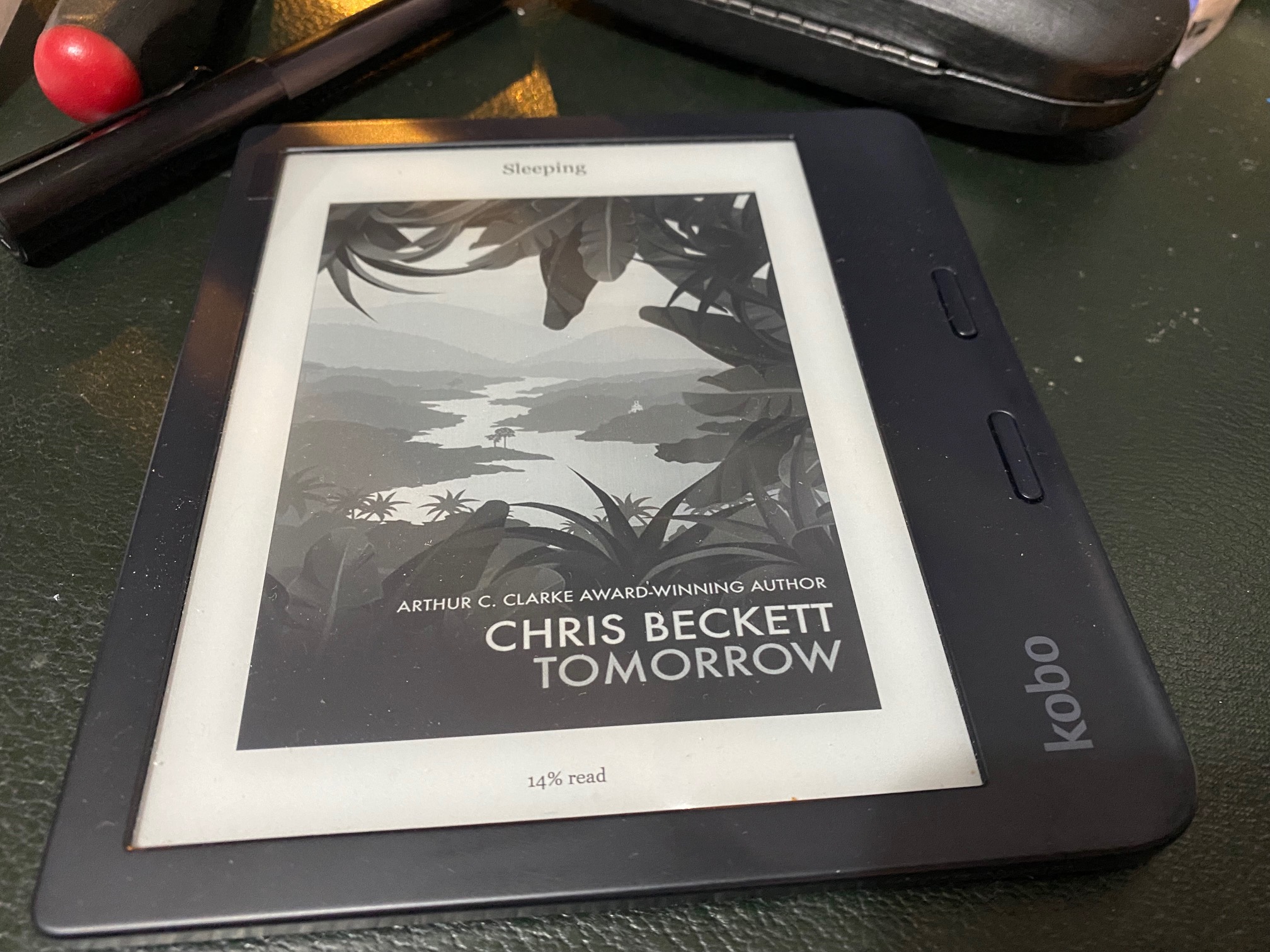
Kobo Libra H2O e-reader Kobo Libra H2O e-reader
This year I finally bought an e-reader: a "Kobo Libra H2O": a 7" 300ppi screen with an adjustable colour temperature front light, waterproof, physical buttons on a "margin"/spine which pushes the case dimensions up to 8", which is sadly a little too big for most jeans pockets. In fact this is the second time I've bought one. Sarah and I bought a pair of Amazon Kindle Paperwhite (2nd generation) readers as Honeymoon gifts for each other in 2013. Sarah took to hers, but after giving mine a try and reading a couple of books on it I ended up giving it to my Father-in-law. The main problem I had with it was the colour temperature of the backlight: it was too blue and "clinical". It's interesting to me to realise how the environment that I read in can become indelibly linked to the memory of that book. One book in particular that I read on the Kindle was James Smythe's "The Machine", a modern twist on a classic horror story. This was perfectly complemented by the somewhat pallid, sick colour of the backlight, especially on its lowest brightness settings. It didn't go so well with other stories.
Broken Libra H2O e-reader Broken Libra H2O e-reader
I got on much better with the Libra H2O. For me, e-books and e-reading has not replaced traditional paper books, but complemented them, giving me an opportunity to read in contexts and situations where I couldn't manage with a real book (such as in the pitch black, lying on my back with a toddler on my chest). I feel that being able to read more often thanks to the e-reader has spurred me on to read even paper books more frequently as well. Unfortunately the screen broke, about 10 months after I bought it! After a bit of soul-searching on what to do about replacing it, and briefly considering the latest Amazon Paperwhite (which now has a 300ppi display and adjustable-colour temperature front-light). This looks like a very nice e-reader: no physical buttons which is a bit of a shame but narrower without the margin/spine of the Kobo, so possibly more pocket-friendly. On the other hand, I really felt that I wanted to avoid giving Amazon the money, for a whole variety of reasons.
Libra 2 e-reader. Spot the difference? Libra 2 e-reader. Spot the difference?
So I instead settled on the "Kobo Libra 2", which is a slight refresh of the Libra H2O, but almost identical. I'm going to pair it with a nice cover for when its not in use and hopefully it will last longer than its predecessor. My current favourite feature on the Libra 2, that I don't remember on the H2O and I'm fairly sure doesn't exist on Kindles is it supports a "night mode", which is effectively a reverse video, white-on-black mode. This is fantastic for keeping the light levels down at night. I was already using the backlight at about 2% brightness and occasionally found even that too bright.

Dirk Eddelbuettel: RcppArmadillo 0.10.7.5.0 on CRAN: Bugfixes

armadillo image Armadillo is a powerful and expressive C++ template library for linear algebra aiming towards a good balance between speed and ease of use with a syntax deliberately close to a Matlab. RcppArmadillo integrates this library with the R environment and language and is widely used by (currently) 937 other packages on CRAN, and downloaded over 22 million times (per the partial logs from the cloud mirrors of CRAN). This release brings another bug fix release 10.7.5 by Conrad in the long-term support 10.7.* series we started with 0.10.7.0 on September 30. As the bug fixes can come a little quicker than the desired monthly cadence CRAN aims for, we skipped a few of those release for CRAN only but of course still provide them via the Rcpp drat repo. The full set of changes (since the last CRAN release 0.10.7.3.0) follows. It includes the nice fixes to the fields type mentioned right after the last release.

Changes in RcppArmadillo version 0.10.7.5.0 (2021-12-16)
  • Upgraded to Armadillo release 10.7.5
    • fix aliasing bug in diagmat()
    • fix detection of 2x2 triangular matrices

Changes in RcppArmadillo version 0.10.7.4.0 (2021-11-23)
  • Upgraded to Armadillo release 10.7.4
    • faster handling of diagonal matrices by inv_sympd(), pinv(), rank()
    • more robust detection of incorrect data format by .load()
  • Correct dimensions setting in import/export of arma::field types, protected by #define (Jonathan Berrisch in #352 fixing #351)
  • Add unit tests for fields both with and without new #define (Dirk)

Courtesy of my CRANberries, there is a diffstat report relative to previous release. More detailed information is on the RcppArmadillo page. Questions, comments etc should go to the rcpp-devel mailing list off the R-Forge page. If you like this or other open-source work I do, you can sponsor me at GitHub.

This post by Dirk Eddelbuettel originated on his Thinking inside the box blog. Please report excessive re-aggregation in third-party for-profit settings.

Reproducible Builds (diffoscope): diffoscope 197 released

The diffoscope maintainers are pleased to announce the release of diffoscope version 197. This version includes the following changes:
[ Chris Lamb ]
* Drop unnecessary has_same_content_as logging calls.
[ Mattia Rizzolo ]
* Ignore the new "binary-with-bad-dynamic-table" Lintian tag.
* Support pgpdump 0.34 in the tests. Thanks to Michael Weiss
  <dev.primeos@gmail.com> for reporting and testing the fix.
You find out more by visiting the project homepage.

16 December 2021

Dirk Eddelbuettel: RProtoBuf 0.4.18: Multiple Updates

A new release 0.4.18 of RProtoBuf arrived on CRAN earlier today. RProtoBuf provides R with bindings for the Google Protocol Buffers ( ProtoBuf ) data encoding and serialization library used and released by Google, and deployed very widely in numerous projects as a language and operating-system agnostic protocol. This release, the first since March of last year, contains two contributed pull requests improving or extending the package, some internal maintance updating the CI setup as well as retiring an old-yet-unused stub interface for RPC, as well as an update for UCRT builds on Windows. The following section from the NEWS.Rd file has more details.

Changes in RProtoBuf version 0.4.18 (2021-12-15)
  • Support string_view in FindMethodByName() (Adam Cozzette in #72).
  • CI use was updated first at Travis, later at GitHub and now uses r-ci (Dirk in #74 and (parts of) #76).
  • The (to the best of our knowledge) unused minimal RPC mechanism has been removed, retiring one method and one class as well as the import of the RCurl package (Dirk in #76).
  • The toJSON() method supports two (upstream) formatting toggles (Vitali Spinu in #79 with minor edit by Dirk).
  • Windows UCRT builds are now supported (Jeroen in #81, Dirk and Tomas Kalibera in #82).

Thanks to my CRANberries, there is a diff to the previous release. The RProtoBuf page has copies of the (older) package vignette, the quick overview vignette, and the pre-print of our JSS paper. Questions, comments etc should go to the GitHub issue tracker off the GitHub repo. If you like this or other open-source work I do, you can now sponsor me at GitHub.

This post by Dirk Eddelbuettel originated on his Thinking inside the box blog. Please report excessive re-aggregation in third-party for-profit settings.

Dirk Eddelbuettel: BH 1.78.0-0: New Upstream, Two New Libraries

Boost Boost is a very large and comprehensive set of (peer-reviewed) libraries for the C++ programming language, containing well over 100 individual libraries. The BH package provides a sizeable subset of header-only libraries for (easier, no linking required) use by R. It is fairly widely used: the (partial) CRAN mirror logs (aggregated from the cloud mirrors) show over 28 million package downloads. Version 1.78.0 of Boost was released in a few days ago on their schedule with April, August and December releases. We follow these releases at a lower (annual) cadence, and BH 1.78.0-0 catches up to Boost 1.78 from the 1.75 version packaged last winter. Three reverse-depends checks revealed only minors needs for changes (after I corrected a fat-finger typo, whoops) in a handful of packages whose maintainers I contacted via PRs or emails. With that, CRAN permitted the upload yesterday. My thanks once again to the maintainers of these packages for helping it along promptly, and of course to the CRAN team. This release adds the new header-only library Boost Lambda2 offering simple but functional lambda functions (for C++14 and later), as well as Boost Process to manage system processes.

Changes in version 1.78.0-0 (2020-12-14)

Via my CRANberries, there is a diffstat report relative to the previous release. Comments and suggestions about BH are welcome via the issue tracker at the GitHub repo. If you like this or other open-source work I do, you can now sponsor me at GitHub.

This post by Dirk Eddelbuettel originated on his Thinking inside the box blog. Please report excessive re-aggregation in third-party for-profit settings.

Rapha&#235;l Hertzog: Freexian s report about Debian Long Term Support, November 2021

A Debian LTS logo
Every month we review the work funded by Freexian s Debian LTS offering. Please find the report for November below. Debian project funding We continue to looking forward to hearing about Debian project proposals from various Debian stakeholders. This month has seen work on a survey that will go out to Debian Developers to gather feedback on what they think should be the priorities for funding in the project. Learn more about the rationale behind this initiative in this article. Debian LTS contributors In November 13 contributors were paid to work on Debian LTS, their reports are available below. If you re interested in participating in the LTS or ELTS teams, we welcome participation from the Debian community. Simply get in touch with Jeremiah if you are interested in participating. Evolution of the situation In November we released 31 DLAs. The security tracker currently lists 23 packages with a known CVE and the dla-needed.txt file has 16 packages needing an update. Thanks to our sponsors Sponsors that joined recently are in bold.

15 December 2021

Dirk Eddelbuettel: nanotime 0.3.5 on CRAN: Update

Another (minor) nanotime release, now at version 0.3.5, just arrived at CRAN. It follows the updates RDieHarder 0.2.3 and RcppCCTZ 0.2.10 earlier today in bringing a patch kindly prepared by Tomas Kalibera for the upcoming (and very useful) UCRT changes for Windows involving small build changes for the updated Windows toolchain. nanotime relies on the RcppCCTZ package for (efficient) high(er) resolution time parsing and formatting up to nanosecond resolution, and the bit64 package for the actual integer64 arithmetic. Initially implemented using the S3 system, it has benefitted greatly from a rigorous refactoring by Leonardo who not only rejigged nanotime internals in S4 but also added new S4 types for periods, intervals and durations. The NEWS snippet adds more details.

Changes in version 0.3.5 (2021-12-14)
  • Applied patch by Tomas Kalibera for Windows UCRT under the upcoming R 4.2.0 expected for April.

Thanks to my CRANberries there is also a diff to the previous version. More details and examples are at the nanotime page; code, issue tickets etc at the GitHub repository. If you like this or other open-source work I do, you can now sponsor me at GitHub.

This post by Dirk Eddelbuettel originated on his Thinking inside the box blog. Please report excessive re-aggregation in third-party for-profit settings.

Dirk Eddelbuettel: RcppCCTZ 0.2.10: Updates

A new release 0.2.10 of RcppCCTZ is now on CRAN. RcppCCTZ uses Rcpp to bring CCTZ to R. CCTZ is a C++ library for translating between absolute and civil times using the rules of a time zone. In fact, it is two libraries. One for dealing with civil time: human-readable dates and times, and one for converting between between absolute and civil times via time zones. And while CCTZ is made by Google(rs), it is not an official Google product. The RcppCCTZ page has a few usage examples and details. This package was the first CRAN package to use CCTZ; by now four others packages include its sources too. Not ideal, but beyond our control. This version switches to r-ci, and just like RDieHarder includes a patch kindly prepared by Tomas Kalibera for the upcoming (and very useful) UCRT changes for Windows involving small build changes for the updated Windows toolchain.

Changes in version 0.2.10 (2021-12-14)
  • Switch CI use to r-ci
  • Applied patch by Tomas Kalibera for Windows UCRT under the upcoming R 4.2.0 expected for April.

We also have a diff to the previous version thanks to my CRANberries. More details are at the RcppCCTZ page; code, issue tickets etc at the GitHub repository. If you like this or other open-source work I do, you can now sponsor me at GitHub.

This post by Dirk Eddelbuettel originated on his Thinking inside the box blog. Please report excessive re-aggregation in third-party for-profit settings.

14 December 2021

Dirk Eddelbuettel: RDieHarder 0.2.3 on CRAN: Packaging Updates

An new version 0.2.3 of the random-number generator tester RDieHarder (based on the DieHarder suite developed / maintained by Robert Brown with contributions by David Bauer and myself) is now on CRAN. This release comes only about one and half months after the previous release 0.2.2 and is once again related to R and CRAN changes. The upcoming (and very useful) UCRT changes for Windows involve small build changes for the updated Windows toolchain so this release includes a patch kindly prepared by Tomas Kalibera. And because compilers get cleverer and cleverer over time, I also address a warning and error found by the newest gcc in what is otherwise unchanged and years old C code In addition, two other warnings were fixed right after the previous release. Thanks to CRANberries, you can also look at the most recent diff. If you like this or other open-source work I do, you can now sponsor me at GitHub.

This post by Dirk Eddelbuettel originated on his Thinking inside the box blog. Please report excessive re-aggregation in third-party for-profit settings.

Timo Jyrinki: Working and warming up cats

How to disable internal keyboard/touchpad when a cat arrives
I m using an external keyboard (1) and mouse (2), but the laptop lid is usually still open for better cooling. That means the internal keyboard (3) and touchpad (4) made of comfortable materials are open to be used by a cat searching for warmth (7), in the obvious every time case that a normal non-heated nest (6) is not enough.
The problem is, everything goes chaotic at that point in the default configuration. The solution is to have quick shortcuts in my Dash to Dock (8) to both disable (10) and enable (9) keyboard and touchpad at a very rapid pace.It is to be noted that I m not disabling the touch screen (5) by default, because most of the time the cat is not leaning on it there is also the added benefit that if one forgets about the internal keyboard and touchpad disabling and detaches the laptop from the USB-C monitor (11), there s the possibility of using the touch screen and on-screen keyboard to type in the password and tap on the keyboard/touchpad enabling shortcut button again. If also touch screen was disabled, the only way would be to go back to an external keyboard or reboot.So here are the scripts. First, the disabling script (pardon my copy-paste use of certain string manipulation tools):
dconf write /org/gnome/desktop/peripherals/touchpad/send-events "'disabled'"
sudo killall evtest
sudo evtest --grab $(sudo libinput list-devices grep -A 1 "AT Translated Set 2 keyboard" tail -n 1 sed 's/.*\/dev/\/dev/') &
sudo evtest --grab $(sudo libinput list-devices grep -A 1 "Dell WMI" tail -n 1 sed 's/.*\/dev/\/dev/') &
sudo evtest --grab $(sudo libinput list-devices grep -A 1 "Power" grep Kernel tail -n 1 sed 's/.*\/dev/\/dev/') &
sudo evtest --grab $(sudo libinput list-devices grep -A 1 "Power" grep Kernel head -n 1 sed 's/.*\/dev/\/dev/') &
sudo evtest --grab $(sudo libinput list-devices grep -A 1 "Sleep" grep Kernel tail -n 1 sed 's/.*\/dev/\/dev/') &
sudo evtest --grab $(sudo libinput list-devices grep -A 1 "HID" grep Kernel head -n 1 sed 's/.*\/dev/\/dev/') &
sudo evtest --grab $(sudo libinput list-devices grep -A 1 "HID" tail -n 1 sed 's/.*\/dev/\/dev/') &
#sudo evtest --grab $(sudo libinput list-devices grep -A 1 "ELAN" tail -n 1 sed 's/.*\/dev/\/dev/') # Touch screen
And the associated ~/.local/share/applications/disable-internal-input.desktop:
[Desktop Entry]
Version=1.0
Name=Disable internal input
GenericName=Disable internal input
Exec=/bin/bash -c /home/timo/Asiakirjat/helpers/disable-internal-input.sh
Icon=yast-keyboard
Type=Application
Terminal=false
Categories=Utility;Development;
Here s the enabling script:
dconf write /org/gnome/desktop/peripherals/touchpad/send-events "'enabled'"
sudo killall evtest
and the desktop file:
[Desktop Entry]
Version=1.0
Name=Enable internal input
GenericName=Enable internal input
Exec=/bin/bash -c /home/timo/Asiakirjat/helpers/enable-internal-input.sh
Icon=/home/timo/.local/share/icons/hicolor/scalable/apps/yast-keyboard-enable.png
Type=Application
Terminal=false
Categories=Utility;Development;
With these, if I sense a cat or am just proactive enough, I press Super+9. If I m about to detach my laptop from the monitor, I press Super+8. If I forget the latter (usually this is the case) and haven t yet locked the screen, I just tap the enabling icon on the touch screen.

12 December 2021

Andrej Shadura: Coffee gear upgrade

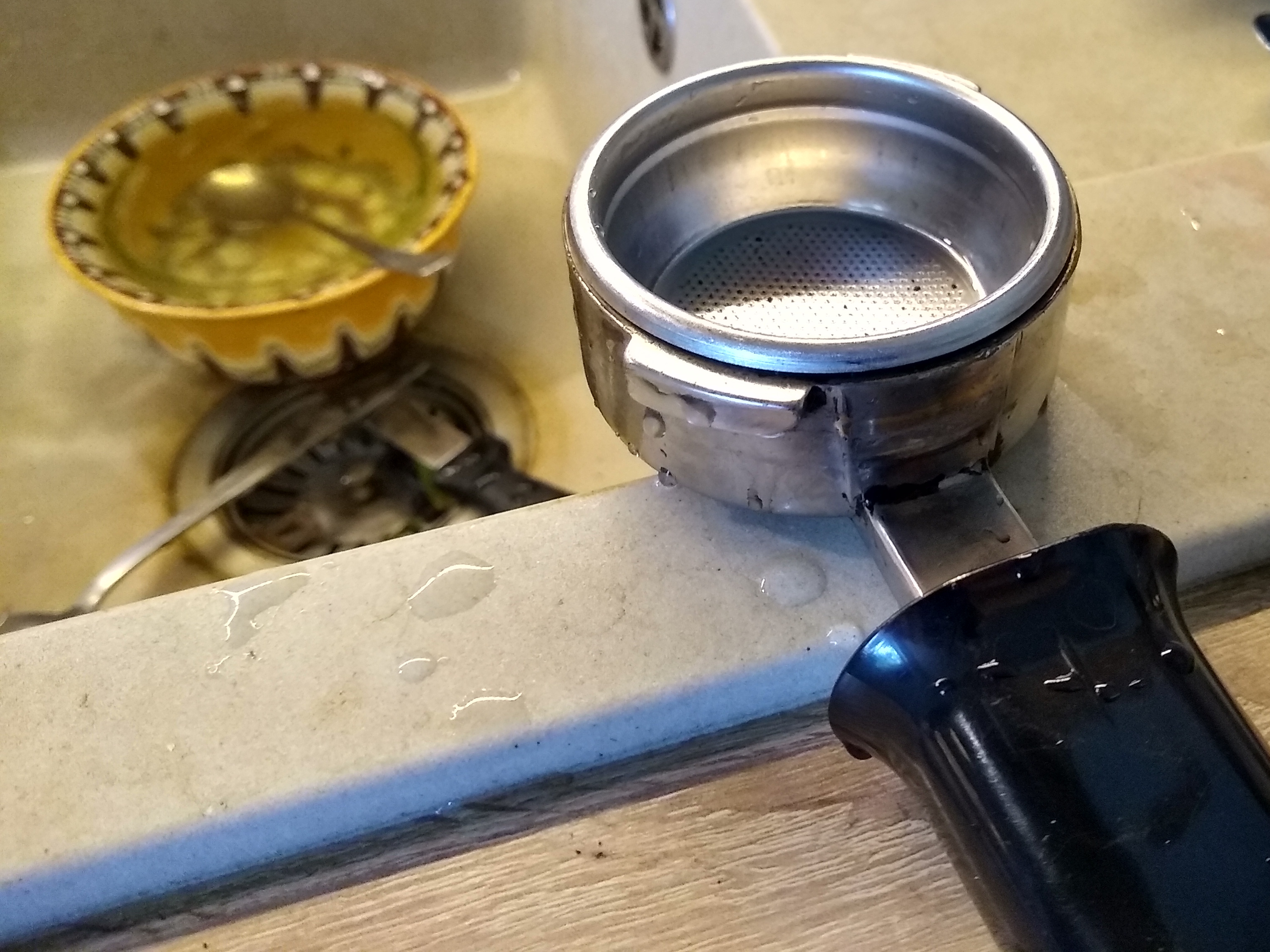
Two weeks ago I decided to make myself a combined birthday and Christmas present and upgrade my coffee gear. I ve got my first espresso machine back in 2013, it was a cheap Saeco Philips Poemia, which made reasonably drinkable coffee, but not being able to make good coffee made me increasingly unhappy about it. However, since it worked, I wasn t motivated enough to change anything until it stopped working. One day the nut holding the shower screen broke, and I couldn t replace it. Having no coffee machine is arguably worse than having a mediocre one, so I started looking for a new one in the budget range. Having spent about two months reading reviews for all sorts of manual espresso machines, I realised the best thing I can probably do for the money I was willing to spend at the time was to buy a second-hand Gaggia Classic. Which is what I did: I paid 260 to a person who apparently decided they prefer to press a button to get their espresso rather than have to prepare it themselves. My first attempts at making espresso weren t very much successful, as my hand grinder couldn t produce the right grind for espresso (without using pressurised baskets), so I quickly upgraded it to the 50 De Longhi electric grinder, which was much better for espresso.
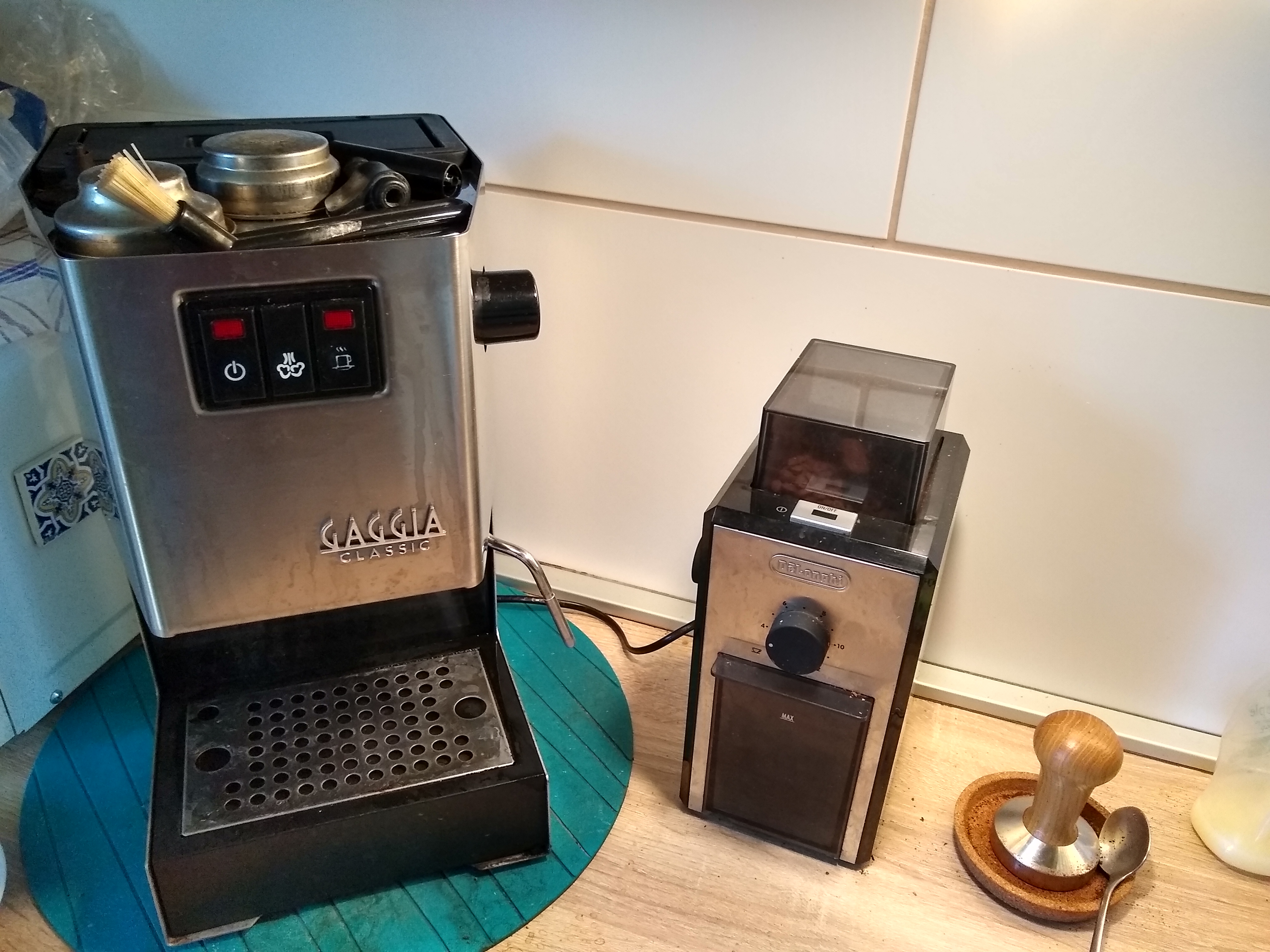
Gaggia Classic 2015 and De Longhi grinderGaggia Classic 2015 and De Longhi grinder
This setup has worked for me for nearly 4 years, but over the time the Gaggia started malfunctioning. See, this particular Gaggia Classic is the 2015 model, which resulted in the overhaul of the design after Gaggia was acquired by Philips. They replaced the boiler, changed the exterior design a bit, and importantly for me replaced the fully metal group head with the metal and plastic version typically found in cheap espresso machines like my old Poemia.
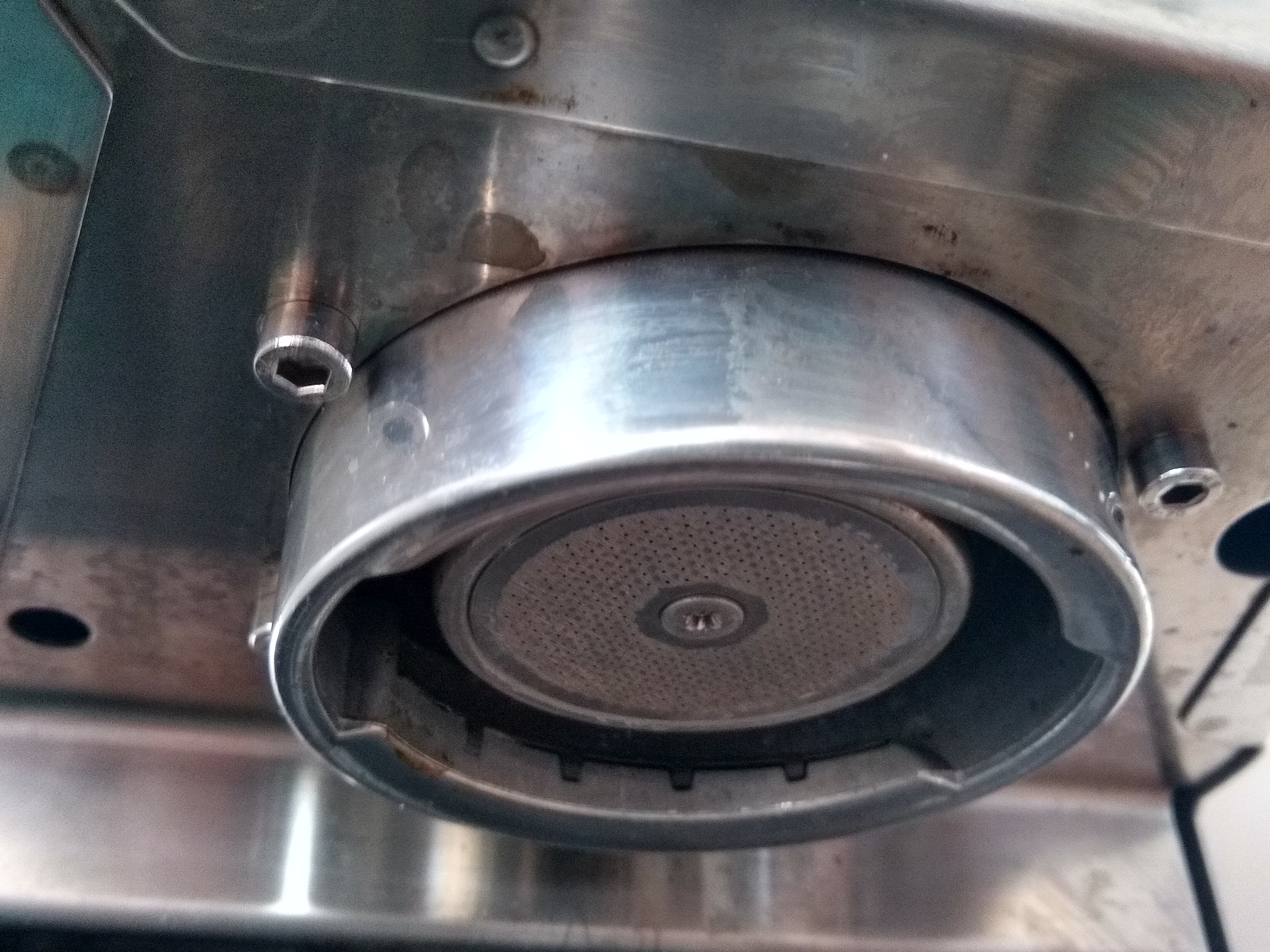
The Gaggia Classic 2015 group headThe Gaggia Classic 2015 group head
The trouble with this one is that the plastic bit (barely seen on the picture, but it s inserted into the notches on the sides of the group head) is that it gets damaged over the time, especially when the portafilter is inserted very tightly. The more damaged it gets, the tigher it is necessary to insert the portafilter to avoid leakage, the more damaged it gets and so on. At one point, the Gaggia was leaking water every time I was making coffee, affecting the quality of the brew and making a mess in the kitchen. I made a mistake and removed the plastic bit only to realise it cannot be purchased separately and nobody knows how to put it back once it s been removed; I ended up paying more than a hundred euro to replace the group head as a whole. Once I ve got the Gaggia back, I became too conscious of the potential damage I can make by overengaging the portafilter, I decided it s probably the time to get a new coffee machine.
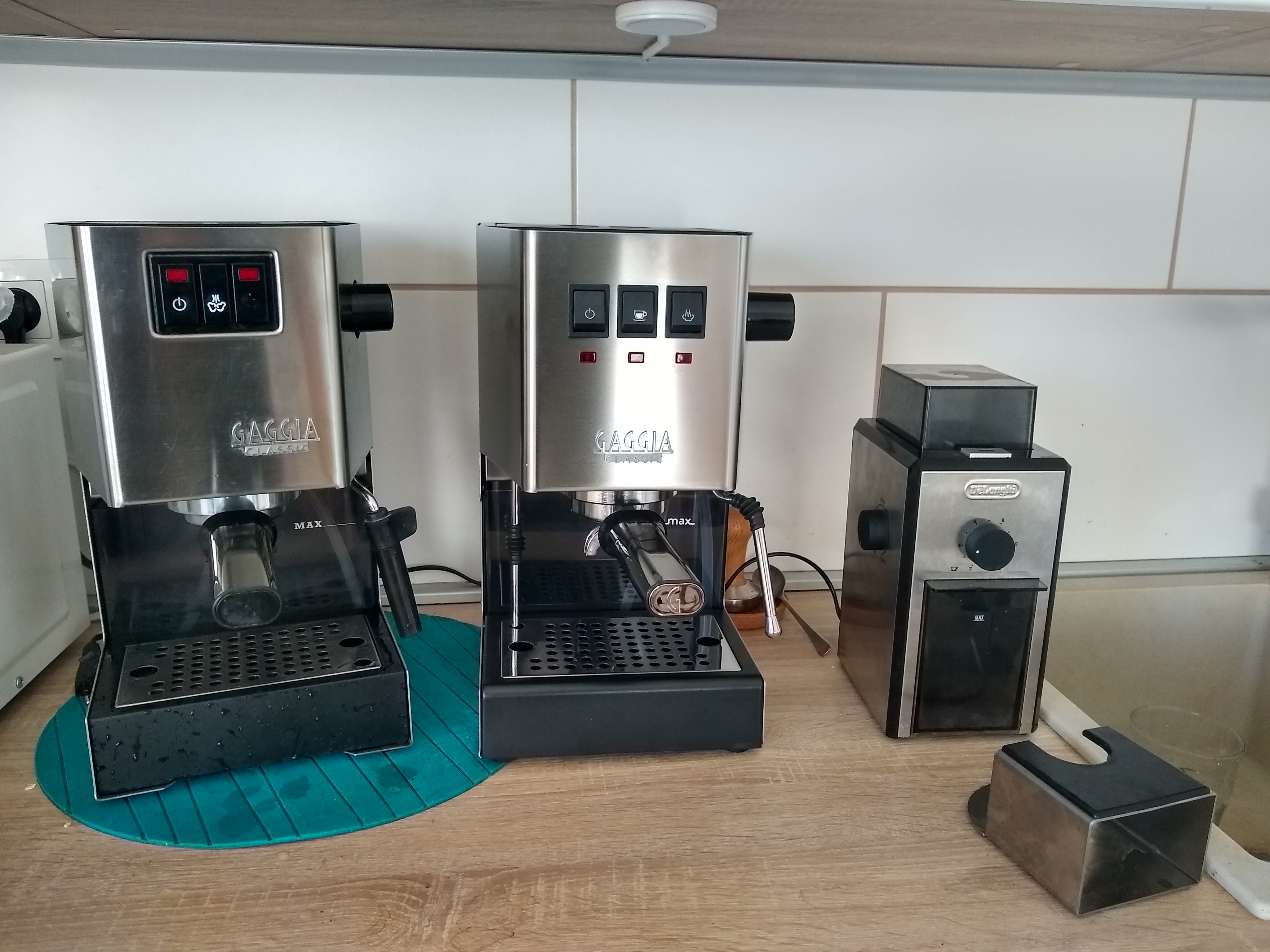
Gaggia Classic 2015 vs 2019Gaggia Classic 2015 vs 2019
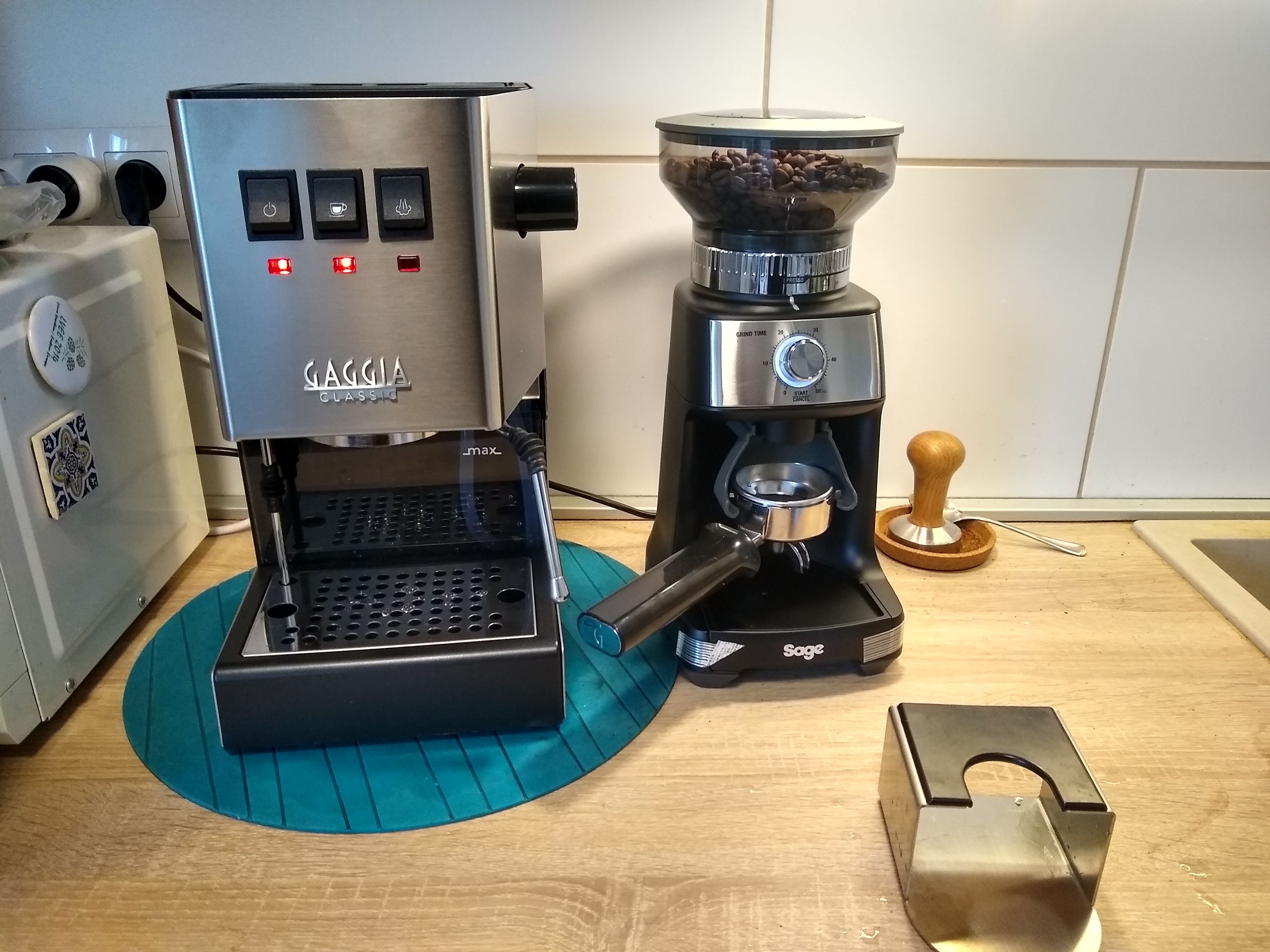
The makers of Gaggia listened to the critics and undid the 2015 changes to the Gaggia Classic design, reverting to the previous one and fixing it they basically merged the fixes many of the owners of the old Gaggia did themselves. The group head is now without any plastic, so I don t have to worry that much about damaging it accidentally. A friend pointed out that my grinder is probably not good enough and recommended a couple of models to me; I checked Kev s Coffee Blog and found a grinder, Sage Dose Control Pro, which was available on sale in my local shop for a reasonable price. I ve also got a portafilter holder to make tamping more comfortable I used to tamp against an edge of the sink:
The final setup:
Gaggia Classic 2019 and Sage BCG600 Dose Control ProGaggia Classic 2019 and Sage BCG600 Dose Control Pro
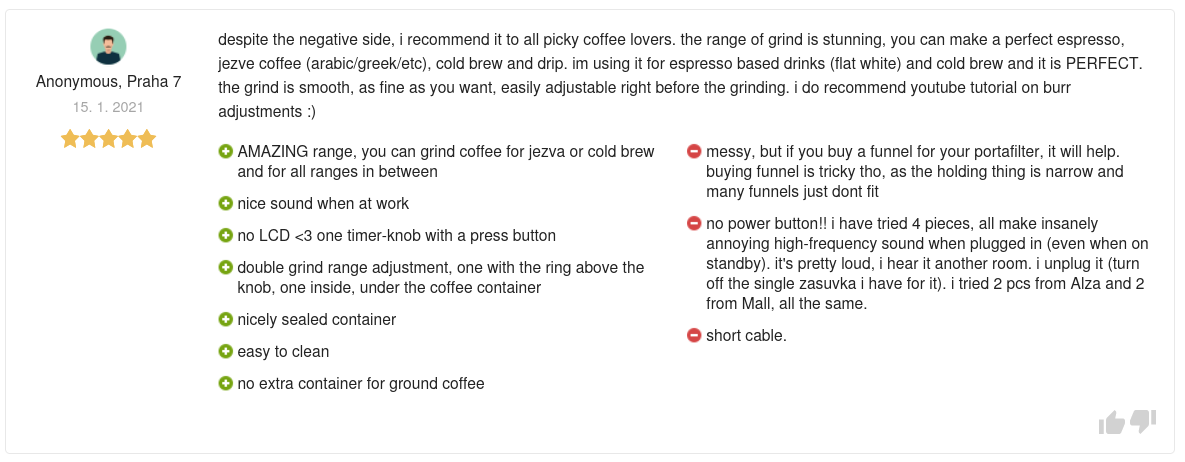
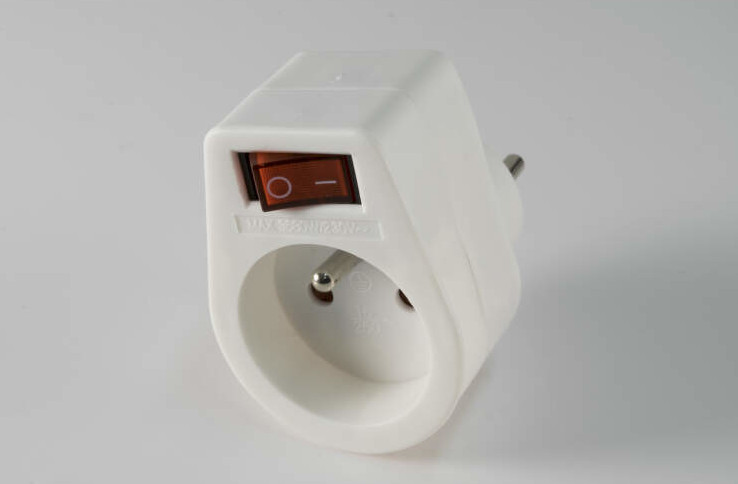
What I learnt from this is that the grinder does indeed make a huge difference. I am now able to consistently produce brews I would only occasionally get with the old De Longhi grinder. There is one downside to the new grinder. Grinder review at Alza.sk Happy with my new purchase, I went to read this review and thought to myself: lucky me, my grinder is absolutely quiet! And then I realised that the noise in my kitchen is not, in fact, produced by the fridge, but the grinder. Well, a cheap switched plug solved the issue completely (I wish sockets here each had a switch like they usually to in the UK!) Switched plug

Russell Coker: Some Ideas for Debian Security Improvements

Debian security is pretty good, but there s always scope for improvement. Here are some ideas that I think could be used to improve things.
  1. A security wizard , basically a set of scripts with support for plugins that will investigate your system and look for things that can be improved. It could give suggestions on LSMs that could be used, sysctl settings, lists of daemons running as root that possibly don t need root privs, etc. Plugins could be for different daemons, so there could be a plugin for Apache that looks for potential issues with Apache configuration. It wouldn t be possible to cover everything, but it would be possible to cover many common cases.
    It appears that we used to have a harden package to do some of these things which disappeared. It appears that the only remnant of that is the hardening-runtime package.
  2. Kali Linux [1] is a distribution designed for penetration testing, I recently tried out many of it s features and I was very impressed. While I don t think that the aim should be to copy all Kali features into Debian there are probably some that are worthy of inclusion. Most Kali features run well in a VM, but the Wifi penetration testing tools need access to the hardware, so they could be a good candidate for inclusion in Debian (license permitting).
  3. We have a Securing Debian Manual [2] that is really good. It s a little out of date and needs some contributions, it also needs to be better known.
  4. The Security Management page of the Debian wiki [3] has links to a number of pages about improving system security. It needs some updates, it doesn t have a link to a page about SE Linux so there s some work for me to do there.
  5. Can training help people? I would be happy to run some Debian SE Linux training sessions over Matrix or Jitsi. We can probably find people to offer training on other aspects of Linux security that are implemented in Debian if there is an audience. I don t think that I and other DDs (Debian Developers) can train everyone, but we could train people who then go on to run other training sessions and make the session notes etc available under the GPL.
    There would also be some benefits to training other DDs as probably no-one has a good overview of all the security features that are supported.
Any other ideas? Feel free to comment here or start a thread on a public mailing list. If you start a mailing list discussion please email me or comment here with the URL if it s a list that I m not on so I can track it via the archives. This post was inspired by a discussion on a private list of a related topic. I think it s better to have a public discussion instead.

11 December 2021

Molly de Blanc: Applications

The first time I applied for grad school it was a bit of a lark. I was serious about it, I wanted to go, I had goals, and I am happy to be here now. However, it was a little fun. I took a white paper and crisped it up with the help of some friends who read it and provided comments. I wrote a personal statement, got some letters of recommendation, and generally felt pretty good about the process. It wasn t stressful. The second time I applied to grad school it was a slog. For several weeks I gave up most of my free time to application writing and when I wasn t working on applications I thought about how I ought to be doing something about it. Applications are due while you re coming up on the end of your semester or end of the year push at work or both! There just isn t enough time for everything. I think even applying for grad school qualifies you to attend. Here are some things I learned in the application process. Note, I haven t gotten in anywhere (yet), so we ll see how it pans out. You have to do a lot of research. This changes by field, school, and even individual faculty preference. Some possible mentors / advisors like to talk with prospective students ahead of time. On two of my applications I was explicitly asked who I spoke with in the department. On others I was asked to list faculty (in order of preference even!) that I would be interested in working with. Some schools requested in essays to list faculty. In general, it s considered important to explain why a particular school: what about that school attracts you? What resources do they have that you want to take advantage of? What research that they are doing interests you? Faculty profiles and department websites are useful for this, but far from complete. A co-worker suggested I contact someone who, based on their profile, I shared no research interests with. However, we talked and it turns out we had things in common! In general, colleagues, peers, other academics, and friends were the best resource I had for investigating schools and potential faculty. I also went to some Q&A sessions / office hours run by schools / departments / labs. Some really cool people wrote blog posts and / or Tweets soliciting grad students. These are great. Sometimes the people you want to work with aren t taking grad students. Most schools I looked at did not maintain lists of who is taking on grad students starting in the fall, but I think two did. Sometimes I contacted people and got back Sorry, not taking on anyone this year. Try $OtherProfessor. This was actually really helpful! But, it s a downer to learn you re not going to get to work with one of your academic heroes because the timing is wrong. It s expensive and waivers might not help. Most applications in the US cost about $100 (USD). In some fields it s recommended you apply to 8-10 schools. That s a lot of money. I think everywhere I applied had a waiver you could apply for, but I generally didn t qualify. Some waivers require you to submit days to weeks ahead of the deadline. Others require that you participate in certain professional organizations, student organizations, or live locally to the school. These might be less useful than you were hoping. Everyone says your writing sample matters, but only five people will read it. This is what I was told anyway. I was told that my writing sample (which was 20 pages!) will probably only be read by faculty who are thinking of taking me on as an advisee. Someone else might pick it up and read it out of curiosity. I was told stories about how the right writing sample turned eh, maybe candidates into enthusiastic yeses. Everyone says letters of recommendation matter and it s extremely frustrating. My recommenders are all amazing people I have so much respect and admiration for it s wild. They re people I want to be like in my academic career. They also all got their letters in the day they were due. I had a moment where I genuinely thought I was just not going to go to grad school because of how close the deadline was. I ve been told that a great letter matters a lot, but meh letters don t hold you back as much as it sounds like they will. I ve been told that where a recommender is affiliated matters a lot. My personal statement radically changed based on school / program. Two of the schools I applied to had very specific requirements for their personal statements. Other schools wanted me to mostly talk about my research interests. One school had a 350 word personal statement, but a 1,000 word research statement. I wrote a research statement and a personal statement and then used them as the basis for what I submitted to different schools. Each application ended up with something pretty different, and not just because I talked about why each program was exciting to me in different ways. I also applied to different kinds of programs, and presented myself a differently depending on the program s focus and the faculty. For the more social science heavy programs I emphasized the empirical research I did, while for others I leaned more heavily on my philosophical background and theoretical interests. Oh, also, I was told to not use contractions. Getting rid of them in all my materials was super tedious. Diversity Statements are becoming more common. A few of my schools had diversity statements either required or optional. The purpose of these, I was told, is not to play some sort of marginalization Olympics, but to show that you can talk about diversity (and equity and inclusion, etc) without being offensive. It s just as valid to write about your own disability as the disability of a parent (though, ask their permission first). Triple check what s required. I made spreadsheets about what each school required. For example, some people wanted official transcripts, some unofficial. Some places required essays rather than generic personal statements, and I needed to build in enough time to manage that. Ask your friends to help. I hate asking for help, but applying for grad school made me shameless. I asked anyone I could to read over materials, proofread, or just talk with me about what I was writing. People picked up on things like you used the word technology five times in this one sentence and it looks real weird. Some schools have projects where current grad students will even look over materials!

Neil Williams: Diversity and gender

As a follow on to a previous blog entry of mine, Free and Open, I feel it worthwhile to do my bit to dismantle the pseudo-science and over simplification in the idea that gender is binary at a biological level.
TL;DR: Science simply does not support binary sexes or binary genders. Truth is a bit more complicated.
There is certainty and there are binary answers in mathematics. Things get less definitive in physics, certainly as soon as quantum is broached. Processes become more of an equilibrium between states in chemistry, never wholly one or the other. Yes, there is the oddity of absolute zero but no experiment has yet achieved that fully. It is accurate to describe physics as a development of applied mathematics and to view chemistry as applied physics. Biology, at the biochemical level, is applied chemistry. The sciences build on each other, "on the shoulders of giants", but at each level, some certainty is lost, some amount of uncertainty is expanded and measurements become probabilities, proportions and percentages. Biology is dependent on biochemistry - chemistry is how a biological change results in a different organism. Physics is how that chemical change occurs - temperature, pressure and physical states are inherent to all chemical changes. Outside laboratory constraints, few chemical reactions, especially in organic chemistry, produce one and only one result from two or more known reagents. In biology, everyone is familiar with genetic mutations but a genetic mutation only happens because a biochemical reaction (hydrogen bonding of nucleobases) does not always produce the expected result. Every cell division, every viral infection, there is a finite probability that a change will occur. It might be a small number but it is never zero and can never be dismissed. This is obvious in the current Covid pandemic - genetic mutations result in new variants. Some variants are inviable, some variants produce no net change in the way that the viral particles infect adjacent cells. Sometimes, a mutation happens that changes everything. These mutations are not mistakes - these are simply changes with undetermined outcomes. Genetic changes are the foundation of biodiversity and variety is what allows lifeforms of all kinds to survive changes in environmental factors and/or changes in prevalent diseases. It is precisely the same in humans, particularly in one of the principle spheres of human life that involves replicating genetic material - the creation of gametes for sexual reproduction. Every single time any DNA is copied, there is a finite chance that a different base will be put in place compared to the original. Copying genetic material is therefore non-binary. Given precisely the same initial conditions, the result is not always predictable and the range of how the results vary from one to another increases with every iteration. Let me stress that - at the molecular level, no genetic operation in any biological lifeform has a truly binary result. Repeat that operation sufficiently often and an unexpected result WILL inevitably occur. It is a mathematical certainty that genetic changes will arise by attempting precisely the same genetic operation enough times. Genetic changes are fundamental to how lifeforms survive changing conditions. Life would likely have died out a long time ago on this planet if every genetic operation was perfect. Diversity is life. Similarity leads to extinction. Viral load is interesting at this point. Someone can be infected with a virus, including coronavirus, by encountering a small number of viral particles. Some viruses, it may be a few hundred, some viruses may need a few thousand particles to infect a vulnerable host. But here's the thing, for that host to be at risk of infecting another host, the virus needs the host to produce billions upon billions of copies of the virus by taking over the genetic machinery within a huge number of cells in the host. This, as is accepted with Covid, is before the virus has been copied enough times to produce symptoms in the host. Before those symptoms become serious, billions more copies will be made. The numbers become unimaginable - and that is within a single host, let alone the 265 million (and counting) hosts in the current Covid19 pandemic. It's also no wonder that viral infections cause tiredness, the infection is diverting huge resources to propagating itself - before even considering the activity of the immune system. It is idiocy of the highest order to expect all those copies to be identical. The rise of variants is inevitable - indeed essential - in all spheres of biology. A single viral particle is absolutely no threat of any kind - it must first get inside and then copy the genetic information in a host cell. This is where the complexity lies in the definition of life itself. A virus can be considered a lifeform but it is only able to reproduce using another, more complex, lifeform. In truth, a viral particle does not and cannot mutate. The infected host mutates the virus. The longer it takes that host to clear the infection, the more mutations that host will create and then potentially spread to others. Now apply this to the creation of gametes in humans. With seven billion humans, the amount of copying of genetic material is not as large as the pandemic but it is still easy for everyone to understand that children do not merely combine the DNA of both parents. Changes happen. Human sexual reproduction is not as simple as 1 + 1 = 2. Sometimes, the copying of the genetic material produces an unexpected result. Sexual reproduction itself is non-binary. Sexual reproduction is not easy or simple for lifeforms to adopt - the diversity which results from the non-binary operations are exactly why so many lifeforms invest so much energy in reproducing in this way. Whilst many genetic changes in humans will be benign or beneficial, I d like to take an example of a genetic disorder that results from the non-binary nature of sex. Humans can be born with the XY phenotype - i.e. at a genetic level, the individual has the same combination of chromosomes as another XY individual but there are changes within the genes in those chromosomes. We accept this, some children of blonde parents do not have blonde hair, etc. There are also genetic changes where an XY phenotype is not binary. Some people, who at a genetic level would be almost identical to another person who is genetically male, have a genetic mutation which makes it impossible for the cells of that individual to respond to androgens (testosterone). (See Androgen insensitivity syndrome). Genetically, that individual has an X and a Y chromosome, just like many other individuals. However, due to a change in how the genes on those chromosomes were copied, that individual is biologically incapable of constructing the secondary sexual characteristics of a male. At a genetic level, the individual has the XY phenotype of a male. At the physical level, the individual has all the sexual characteristics of a female and none of the sexual characteristics of a male. The gender of that individual is not binary. Treatment is centred on supporting the individual and minimising some risks from the inactive genes on the Y chromosome. Human sexual reproduction is non-binary. The results of any sexual reproduction in humans will not always produce the binary option of male or female. It is a lie to claim that human gender is binary. The science is in plain view and cannot be ignored. Identifying as non-binary is not a "cop out" - it can be a biological, genetic, scientific fact. Human sexuality and gender are malleable. Where genetic changes result in symptoms, these can be ameliorated by treatment with human sex hormones, like oestrogen and testosterone. There are valid medical uses for anabolic steroids and hormone replacement therapies to help individuals who, at a genetic level, have non-binary gender. These treatments can help align the physical outer signs with the personality and identity of the individual, whether with or without surgery. It is unacceptable to abandon such people to suffer life long discrimination and harassment by imposing a binary definition that has no basis in science. When a human being has an XY phenotype, that human being is not necessarily male. That individual will be on a spectrum from female (left unaffected by sex hormones in the womb, the foetus will be female, even with an X and a Y chromosome), to various degrees of male. So, at a genetic, biological level, it is a scientific fact that human beings do not have binary gender. There is no evidence that this is new to the modern era, there is no scientific basis for thinking that copying of genetic material was somehow perfectly reliable in earlier history, or that such mutations are specific to homo sapiens. Changes in genetic material provide the diversity to fight infections and adapt to changing environmental factors. Species have and will continue to go extinct if this diversity is absent. With that out of the way, it is no longer a stretch to encompass other aspects of human non-binary genders beyond the known genetic syndromes based on changes in the XY phenotype. Science has not uncovered all of the ways that genes affect personality, behaviour, or identity. How other, less studied, genetic changes affect the much more subtle human facets, especially anything to do with consciousness, identity, personality, sexuality and behaviour, is guesswork. All of these facets can and likely are being affected by genetic factors as well as environmental factors in an endless range of permutations. Personality traits are a beautiful and largely unknowable blend of genes and environment. Genetic information has a finite probability of changes at each and every iteration. Environmental factors are more akin to chaos theory. The idea that the results will fit into binary constructs is laughable. Human society puts huge emphasis on societal norms. Individuals who do not fit into those norms suffer discrimination. The norms themselves have evolved over time as a response to various influences on human civilisation but most are not based on science. It is up to all humans in that society to call out discrimination, to call for changes in the accepted norms and support those who are marginalised. It is a precarious balance, one that humans rarely get right, but it must be based on an acceptance that variation is the natural state. Artificial constraints, like binary genders, must be dismantled because human beings and human sexual reproduction are not binary. To those who think, "well it is for 99%", think again about Covid. 99% (or closer to 98%) of infected humans recover without notable after effects. That has still crippled the nations of the globe and humbled all those who tried to deny it. Five million human beings are dead because "most infected people recover". Just because something only affects a proportion of human beings does not invalidate the suffering of those humans and the discrimination that those humans will face. Societal norms are not necessarily correct. Religious and other influences typically obscure and ignore scientific fact and undermine human kindness. The scientific truth of life on this planet is that gender is not binary. The more complex the lifeform, the more factors will affect where on the spectrum any one individual will appear. Just because we do not yet fully understand how genes affect human personality and sexuality, does not invalidate the science that variation is the natural order. My previous blog about diversity is not just about male vs female, one nationality vs another, one ethnicity compared to another. Diversity is diverse. Diversity requires accepting that every facet of humanity is subject to variation. That leads to tension at times, it is inevitable. Tension against societal norms, tension against discrimination, tension around those individuals who would abuse the tolerance of others for their own gratification or from their own ignorance. None of us are perfect, none of us have any of this fully sorted and all of us will make mistakes. Personally, I try to respect those around me. I will use whatever pronouns and other conventions that the person requests, from their perspective and not mine. To do otherwise is to deny the natural order and to deny the science. Celebrate all diversity, it is the very stuff of life. The discussions around (typically female) bathroom facilities often miss the point. The concern is not about individuals who describe themselves as non-binary. The concern is about individuals who are fully certain of their own sexuality and who act as sexual predators for their own gratification. These people are acting out a lie for their own ends. The problem people are the predators, so stop blaming the victims who are just as at risk as anyone else who identifies as female. Maybe the best people to spot such predators are those who are non-binary, who have had to pretend to fit into societal norms. Just as travel can be a good antidote to racism, openness and discussion can be a tool to undermine the lies of sexual predators and reassure those who are justifiably fearful. There can never be a biological binary test of gender, there can never be any scientific justification for binary division of facilities. Humanity itself is not binary, even life itself has blurry borders around comas, suspended animation and locked-in syndrome. Legal definitions of human death vary around the world. The only common thread I have ever found is: Be kind to each other. If you find anything above objectionable, then I can only suggest that you reconsider the science and learn to be kind to your fellow humans. None of us are getting out of this alive. I Think You ll Find It s a Bit More Complicated Than That - Ben Goldacre ISBN 978-0-00-750514-2 https://www.amazon.co.uk/dp/B00HATQA8K/ https://en.wikipedia.org/wiki/Androgen_insensitivity_syndrome https://www.bbc.co.uk/news/world-51235105 https://en.wikipedia.org/wiki/Nucleobase My degree is in pharmaceutical sciences and I practised community and hospital pharmacy for 20 years before moving into programming. I have direct experience of supporting people who were prescribed hormones to transition their physical characteristics to match their personal identity. I had a Christian upbringing but my work showed me that those religious norms were incompatible with being kind to others, so I rejected religion and I now consider myself a secular humanist.

Junichi Uekawa: Updated my raspberry pi to bullseye and no longer connects to network.

Updated my raspberry pi to bullseye and no longer connects to network. Seems like eth0 got renamed. probably this thing that I was supposed to have migrated away from. Not entirely sure how to recover from this now.

10 December 2021

Reproducible Builds (diffoscope): diffoscope 196 released

The diffoscope maintainers are pleased to announce the release of diffoscope version 196. This version includes the following changes:
[ Roland Clobus ]
* Add a comment/annotation when the GNU_BUILD_ID field has been modified.
[ Brent Spillner ]
* Fix the "Black" version detection.
[ Chris Lamb ]
* Replace "token" with anonymous variable "x" in order to remove extra lines.
You find out more by visiting the project homepage.

9 December 2021

Dirk Eddelbuettel: qlcal 0.0.1 on CRAN: New Package

A new package of mine arrived on CRAN yesterday in its inaugural 0.0.1 upload: qlcal. qlcal is based on the calendaring subset of QuantLib. It is provided (for the R package) as a set of included files, so the package is self-contained and does not depend on an external QuantLib library (which can be challenging to build). The only build requirements are Rcpp for the seamless R/C++ integration, and BH for Boost headers. qlcal covers over sixty country / market calendars and can compute holiday lists, its complement (i.e. business day lists) and much more. As a teaser see this two-liner for 2022 holiday for the Federal Reserve calendar in the United States, now including Juneteenth (on June 20 next year) as the most recently added holiday:
> library(qlcal)
> setCalendar("UnitedStates/FederalReserve")
> getHolidays(as.Date("2022-01-01"), as.Date("2022-12-31"))
 [1] "2022-01-17" "2022-02-21" "2022-05-30" "2022-06-20" "2022-07-04" "2022-09-05" "2022-10-10"
 [8] "2022-11-11" "2022-11-24" "2022-12-26"
> 
See the project page and package documentation for more details, and more examples. Going forward, and time permitting, it would be nice to slowly reduce the Boost dependency to make the underlying qlcal C++ library more self-sufficient. If you like this or other open-source work I do, you can now sponsor me at GitHub.

This post by Dirk Eddelbuettel originated on his Thinking inside the box blog. Please report excessive re-aggregation in third-party for-profit settings.

Next.

Previous.