Search Results: "dom"

7 August 2008

Russell Coker: A Basic IPVS Configuration

I have just configured IPVS on a Xen server for load balancing between multiple virtual hosts. The benefit is not load balancing but management. With two virtual machines providing a service I can gracefully shut one down for maintenance and have the other take the load. When there are two machines providing a service a load balancing configuration is much better than a hot-spare, one reason is the fact that there may be application scaling issues that prevent one machine with twice the resources from giving as much performance as two smaller machines. Another is the fact that if you have a machine configured but never used there will always be some doubt as to whether it would work… The first thing to do is to assign the IP address of the service to the front-end machine so that other machines on the segment (IE routers) will be able to send data to it. If the address for the service is 10.0.0.5 then the command “ip addr add dev eth0 10.0.0.5/24 broadcast +” will make it a secondary address on the eth0 interface. On a Debian system you would add the line “up ip addr add dev eth0 10.0.0.5/24 broadcast + true” to the appropriate section of /etc/network/interfaces, for a Red Hat system it seems that /etc/rc.local is the best place for it. I expect that it would be possible to merely advertise the IP address via ARP without adding it to the interface, but the ability to ping the IPVS server on the service address seems useful and there seems no benefit in not assigning the address. There are three methods used by IPVS for forwarding packets, gatewaying/routing (the default), IPIP encapsulation (tunneling), and masquerading. The gatewaying/routing method requires the back-end server to respond to requests on the service address. That would mean assigning the address to the back-end server without advertising it via ARP (which seems likely to have some issues for managing the system). The IPIP encapsulation method requires setting up IPIP which seemed like it would be excessively difficult (although maybe not more than required to set up masquerading). The masquerading option (which I initially chose) rewrites the packets to have the IP address of the real server. So for example if the service address is 10.0.0.5 and the back-end server has the address 10.0.1.5 then it will see packets addresses to 10.0.1.5. A benefit of masquerading is that it allows you to use different ports, so for example you could have a non-virtualised mail server listening on port 25 and a back-end server for a virtual service listening on port 26. While there is no practical limit to the number of private IP addresses that you might use it seems easier to manage servers listening on different ports with the same IP address - and there is the issue of server programs that are not written to support binding to an IP address. ipvsadm -A -t 10.0.0.5:25 -s lblc -p
ipvsadm -a -t 10.0.0.5:25 -r 10.0.1.5 -m The above two commands create an IPVS configuration that listens on port 25 of IP address 10.0.0.5 and then masquerades connections to 10.0.1.5 on port 25 (the default is to use the same port). Now the problem is in getting the packets to return via the IPVS server. If the IPVS server happens to be your default gateway then it’s not a problem and it will already be working after the above two commands (if a service is listening on 10.0.1.5 port 25). If the IPVS server is not the default gateway and you have only one IP address on the back-end server then this will require using netfilter to mark the packets and then route based on the packet matching. Marking via netfilter also seems to be the only well documented way of doing similar things. I spent some time working on this and didn’t get it working. However having multiple IP addresses per server is a recommended practice anyway (a back-end interface for communication between servers as well as a front-end interface for public data). ip rule add from 10.0.1.5 table 1
ip route add default via 10.0.0.1 table 1 I use the above two commands to set up a new routing table for the data for the virtual service. The first line causes any packets from 10.0.1.5 to be sent to routing table 1 (I currently have a rough plan to have table numbers match ethernet device numbers, the data in question is going out device eth1). The second line adds a default router to table 1 which sends all packets to 10.0.0.1 (the private IP address of the IPVS server). Then it SHOULD all be working, but in the network that I’m using (RHEL4 DomU and RHEL5 Dom0 and IPVS) it doesn’t. For some reason the data packets from the DomU are not seen as part of the same TCP stream (both in Net Filter connection tracking and by the TCP code in the kernel). So I get an established connection (3 way handshake completed) but no data transfer. The server sends the SMTP greeting repeatedly but nothing is received. At this stage I’m not sure whether there is something missing in my configuration or whether there’s a bug in IPVS. I would be happy to send tcpdump output to anyone who wants to try and figure it out. My next attempt at this was via routing. I removed the “-m” option from the ipvsadm command and added the service IP address to the back-end with the command “ifconfig lo:0 10.0.0.5 netmask 255.255.255.255” and configured the mail server to bind to port 25 on address 10.0.0.5. Success at last! Now I just have to get Piranha working to remove back-end servers from the list when they fail. Update: It’s quite important that when adding a single IP address to device lo:0 you use a netmask of 255.255.255.255. If you use the same netmask as the front-end device (which would seem like a reasonable thing to do) then (with RHEL4 kernels at least) you get proxy ARPs by default. For example you used netmask 255.255.255.0 to add address 10.0.0.5 to device lo:0 then on device eth0 the machine will start answering ARP requests for 10.0.0.6 etc. Havoc then ensues.

6 August 2008

Pablo Lorenzzoni: 100-thousand and counting

For those of you wondering how is the battle against the Brazilian Internet Surveillance Bill, I have to report we already got more than 100-thousand people to sign the petition. You can check the current count in the image on the right. I am updating it every 15 minutes, so you can even use its URL in another place (as are some people doing already). The bill will be voted by the Chamber-of-Deputies any time now We heard it would be on yesterday, but apparently it was not even enlisted for this week. This doesn t mean much, since the Deputies can hold an out-of-list voting we ll be watching. Meanwhile, I read an article by S rgio Amadeu that summarizes some of our feeling about that bill. Are we in the Western World (allegedly freedom lovers) turning into control-freaks? A whole lot of people I know are not even offended by this bill! These are the same people that don t think it s weird that USA claimed the right to seize any storage device entering their borders, for any time they want, with no warranted privacy. Are we in a middle of a paradigm shift? Are we accepting less freedom? What would George Orwell think of that? Maybe we got in a wormhole and ended up in 1984

5 August 2008

Sami Haahtinen: Locales, recap

After my post yesterday about locales and my problems, I got some comments. Bryan, Simon and Wouter all pointed out what eventually figured out too but didn't mention in the post (I actually had to re-read the post to see what I wrote) that LC_ALL overrides all of the settings. Even though I figured it out eventually, with these comments it finally me that the purpose is actually to temporarily override the locale. Another thing that didn't occur to me while figuring out the correct locale for my system was that I'm thinking about it all wrong. Since I've already gotten used to broken locales I kept thinking that I want en_US locale with some Finnish settings, but in reality I wanted fi_FI locale with English language. I have to admit that I was pretty sceptical about the solution but decided to try it out. And to my surprise, it actually worked! So the final solution is this: LANG="fi_FI.UTF-8"
LANGUAGE="en"
LC_MESSAGES="en_US.UTF-8"
LC_TIME="en_US.UTF-8"
It is a pretty clean solution and I'm happy to live with it. And as Simon pointed out, administrator changes should be preserved through upgrades. If not, one should file a bug for it. There we go, another problem solved. Thanks for the comments and suggestions.

Martin F. Krafft: The dhclient nightmare

Thank you, Ted Lemon and Paul Vixie for the ISC DHCP server and client! My days would be so boring without them. I revel in your wisdom, experience, and sheer genius when I get behind some of the design decisions you made when writing those pieces of software. My current favourite is the hook integration into dhclient-script(8). Read what the manpage has to say about it:
[ ] the client script checks for the presence of an executable /etc/dhcp3/dhclient-enter-hooks script, and if present, it invokes the script inline, using the Bourne shell . command. The entire environment documented under OPERATION is available to this script, which may modify the environment if needed to change the behaviour of the script.
Hooks which can modify the environment and thus influence all other hooks that follow, as well as the script which applies the network configuration dhclient obtained to the local machine! Yay! Genius! You are my heroes. NP: Pluto: Pipeline under the Ocean

Russell Coker: A New Strategy for Xen MAC Allocation

When installing Xen servers one issue that arises is how to assign MAC addresses. The Wikipedia page about MAC addresses [1] shows that all addresses that have the second least significant bit of the most significant byte set to 1 are “locally administered”. In practice people just use addresses starting with 02: for this purpose although any number congruent to two mod four used in the first octet would give the same result. I prefer to use 02: because it’s best known and therefore casual observers will be more likely to realise what is happening. Now if you have a Xen bridge that is private to one Dom0 (for communication between Xen DomU’s on the same host) or on a private network (a switch that connects servers owned by one organisation and not connected to machines owned by others) then it’s easy to just pick MAC addresses starting with 02: or 00:16:3e: (the range assigned to the Xen project). But if Xen servers run by other people are likely to be on the same network then there is a problem. Currently I’m setting up some Xen servers that have public and private networks. The private network will either be a local bridge (that doesn’t permit sending data out any Ethernet ports) or a bridge to an Ethernet port that is connected to a private switch, for that I am using MAC addresses starting with 02:. As far as I am aware there is no issue with machine A having a particular MAC address on one VLAN while machine B has the same MAC address on another VLAN. My strategy for dealing with the MAC addresses for the public network at the moment is to copy MAC addresses from machines that will never be in the same network. For example if I use the MAC addresses from Ethernet cards in a P3 desktop system running as a router in a small company in Australia then I can safely use them in a Xen server in a co-location center in the US (there’s no chance of someone taking the PCI ethernet cards from the machine in Australia and sending them to the US - and no-one sells servers that can use such cards anyway). Note that I only do this when I have root on the machine in question and where there is no doubt about who runs the machine, so there should not be any risk. Of course if someone from the ISP analyses the MAC addresses on their network it will look like they have some very old machines in their server room. ;) I wonder if there are any protocols that do anything nasty with MAC addresses. I know that IPv6 addresses can be based on the MAC address, but as long as the separate networks have separate IPv6 ranges that shouldn’t be a problem. I’m certainly not going to try bridging networks between Australia and the US! Another possible way of solving this issue would be to have the people who run a server room assign and manage MAC addresses. One way of doing this would be to specify a mapping of IP addresses to MAC addresses, EG you could have the first two bytes be 02:00: and the next four be the same as the IPv4 address assigned to the DomU in question. In the vast majority of server rooms I’ve encountered the number of public IP addresses has been greater than or equal to the number of MAC addresses with the only exception being corporate server rooms where everything runs on private IP address space (but there’s nothing wrong with 02:00:0a: as the prefix for a MAC address). I also wonder if anyone else is thinking about the potential for MAC collisions. I’ve got Xen servers in a couple of server rooms, I told the relevant people in writing of my precise plans (and was assigned extra IP addresses for all the DomUs) but never had anyone mention any scheme for assigning MAC addresses.

4 August 2008

Russell Coker: New HP Server

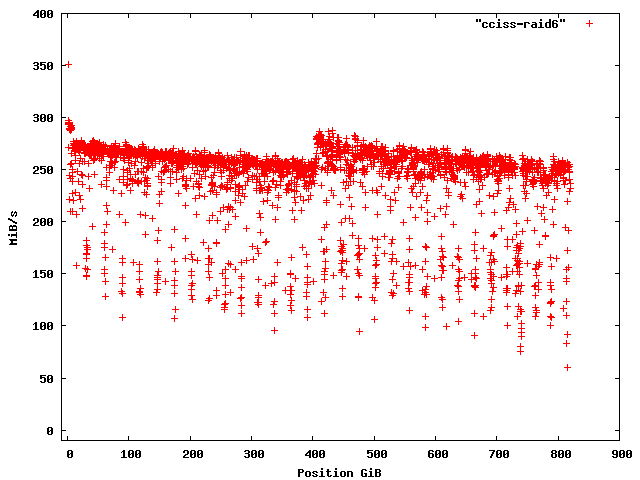
I’ve just started work on a new HP server running RHEL5 AS (needs to be AS to support more than 4 DomU’s). While I still have the Xen issues that made me give up using it on Debian [1] (the killer one being that an AMD64 Xen Dom0 would kernel panic on any serious disk IO) but the Xen implementation in RHEL is quite solid. The first thing I did was run zcav (part of my Bonnie++ benchmark suite) [2] to see how the array performs (as well as ensuring that the entire array actually appears to work). The result is below. For a single disk performance is expected to decrease as you read along the disk (from outer to inner tracks). I don’t know why the performance decreases until the half-way point and then starts with good performance again and again decreases. The next thing was to ensure that the machine had RAID-6 (I have been convinced that that using only RAID-5 verges on professional malpractice). As the machine is rented from a hosting company there was no guarantee that they would follow my clear written instructions involving running RAID-6. The machine is a HP rack-mounted server with a CCISS RAID controller, so to manage the array the command /usr/sbin/hpacucli is used. The command hpacucli controller all show reveals that there is a “Smart Array P400 in Slot 1“. The command hpacucli controller slot=1 show gives the following (amongst a lot of other output):
RAID 6 (ADG) Status: Enabled
Cache Board Present: True
Cache Status: OK
Accelerator Ratio: 25% Read / 75% Write
Drive Write Cache: Disabled
Total Cache Size: 512 MB
Battery Pack Count: 1
Battery Status: OK
SATA NCQ Supported: True So the write-back cache is enabled, 384M of data is for the write-back cache and 128M is for the read cache (hopefully all for read-ahead - the OS should do all the real caching for reads). The command hpacucli controller slot=1 array all show reveals that there is one array: “array A (SAS, Unused Space: 0 MB)“. The command hpacucli controller slot=1 array a show status tells me that the status is “array AOK“. Finally the command hpacucli controller slot=1 show config gives me the data that I really want at this time and says:
Smart Array P400 in Slot 1 (sn: *****)
array A (SAS, Unused Space: 0 MB)
logicaldrive 1 (820.2 GB, RAID 6 (ADG), OK) Then it gives all the data on the disks. It would be nice if there was a command to just dump all that. I would like to be able to show the configuration of all controllers with a single command. Also it would be nice if the fact that hpacucli is the tool to use for managing CCISS RAID arrays when using Linux on HP servers was more widely documented. It took me an unreasonable amount of effort to discover what tool to use for CCISS RAID management.

MJ Ray: Firefox 3 Online Banking List Updates and Wordpress 2.6 Upgrades

Software Cooperative News has been upgraded to Wordpress 2.6 (and other co-hosted sites too), the “subscribe to comments” plugin has been activated and all comments will be pre-moderated from now on. There’s a few more changes to come, but hopefully nothing as dramatic. WP-2.6 has a few more SALTs and KEYs in the config file, but it was a local change to the wp-settings.php to make virtual hosting work across many domains which took us off-line for a few minutes this morning. Sorry if you missed us. There seem to have been a few changes to the rich text editor (the Icon to add align-left etc has disappeared from blog text editor and some users can’t word wrap) which I need to check, too. In other website news, updates from three people have gone onto the list about Online Banking with GNU/Linux, Firefox-based browsers or Free Software - Firefox-3-related breakages at NatWest and Norwich and Peterborough and a report that Nationwide works with FF3. Thanks to those contributors - as usual, I won’t say who told me what, in order to avoid telling people who banks where, but I’ve added more names to the credits.

Russell Coker: Lenny SE Linux on the Desktop

I have been asked about the current status of Lenny SE Linux on the Desktop. The first thing to consider is the combinations of policies and configurations. I will number them if only for the purpose of this post, if the numbering is considered generally helpful it could be more widely adopted to describe configurations.

  1. Default configuration. This has the default policy and is configured with all users having the domain unconfined_t and daemons such as POP servers are allowed to access home directories of type unconfined_home_dir_t. This allows such daemons to attack privileged user accounts.

  2. Some restricted users. This is the same as above but with some users restricted. Daemons such as POP servers are only allowed to access the home directories of restricted users. This means that if a user is to have an unconfined account and receive email they must have two Unix accounts or receive their mail under /var/spool/mail. This is one setsebool command and one (or maybe a few) “semanage login -m” commands from the default configuration.

  3. All users restricted. The system administrator has the domain sysadm_t and users have domains such as user_t. This requires a few more semanage commands. It is equivalent to the old strict policy.

  4. MLS. This is anything that is based around the MLS policy.

Currently I have two Desktop machines running Lenny (a test machine and my EeePC) and one server. I have only just switched my test machine to enforcing mode so have no good data on it (apart from the fact that I can boot it up and login - which is always a good start). The server is running in permissive mode because I have not yet written the policy to allow the POP server to read from unconfined_home_dir_t. I could get it working by switching from level 1 to level 2 or 3, but I want to get level 1 server policy working for the benefit of others else first. My EeePC however is fully functional, I have been doing some work on it - that mostly means running a ssh client under GNOME but that’s OK (desktop environments such as GNOME and KDE are quite complex and demanding, getting a machine to boot and run such a desktop environment tests out many parts of the system). It’s only at level 1 for the moment because I want to get level 1 working everywhere before moving to the higher levels. I want to get things ready for real users ASAP. With the way the policy is managed now it will be possible to move from level 1 to 2 or 3 without rebooting or interrupting running services. So once users have systems running well at level 1 they can easily increase the security at a later date. The problems that I have had are due to text relocations in libraries (see my previous post about execmod permission [1]). I’ve filed bug report #493678 against libtheora0 [2] in regard to this issue and included a patch from Fedora (which disables the non-relocatable assembly code in question). It seems that upstream have some new assembler code to try and fix this issue, so hopefully we’ll have something that can make it into Lenny! I’ve filed bug report #493705 against libswscale0 for the same issue [3]. I included a patch to turn off the assembler code in question but that was not well received. If anyone has some i386 assembler skill and some spare time I would appreciate it if you could try and find a way to make the code position independent while losing little or no performance. One thing to note is that I am now using an Opteron 1212 (2.0GHz dual-core) system for compiling, I run the i386 DomU with a 64bit kernel (I expect that 32bit user-space runs faster with a 64bit kernel than a 32bit kernel), and the disks are reasonably fast. Even so it takes about 15 minutes to build libswscale0 and the other packages from the same source tree. Previously I was using a 1.0GHz Pentium-3 for my Lenny i386 development until I had the libswscale0 build process go for more than 90 minutes before running out of disk space! If your build machine is old enough to only be 32bit then you should probably plan on watching a movie or going to bed while the build is in progress. I have built packages that work around the above bugs and included them in my Lenny repository [4]. If you take the packages from that repository plus the Lenny packages then you should have a functional desktop system at level 1. I would appreciate it if people would start testing that and providing feedback. One important issue is the discovery of libraries that want shared stacks, text relocations, and executable memory. The deadline for fixing them properly is even more of a problem due to the number of people who have to be involved in a solution (as compared to the policy where I can do it on my own). One finally problem is a bug in xdm which causes it to give the wrong context for login sessions due to having an old version of the SE Linux related code [5]. Due to a combination of this and some policy bugs you can not login with xdm. This is not a hugely important issue as most people will use gdm (which has the newer patch) or kdm (which has no SE Linux patch but can use pam_selinux.so). Also another option is wdm which works with pam_selinux.so. I’ve had a response to my bug report suggesting that there’s a bug in the patch (which was taken from gdm so maybe there’s a bug in gdm code too). I haven’t responded to that yet as I’ve been concentrating on the things that will make the most impact for Lenny. At this stage I’m still unsure of when the release team will cut me off and prevent further SE Linux related fixes from going in Lenny. I need at least one more update to the policy packages before Lenny is released. I could release one right now with some useful improvements over what is currently in unstable, but am waiting until I get some other things fixed. If I get everything fully working at level 1 (both client and server) before Lenny then I will provide a similar status report for users and testers of levels 2 and 3. I don’t expect that I will even get a chance to test level 4 (MLS) properly before Lenny releases.

Marcela Tiznado: When did we start attacking each other?

So, I should be at DebCamp, but I'm back home after driving 800km in one day.  
Why? I still don't know.

The main reason for this post is the irrational and unilateral response I got
from the DebConf Orga Team, with no right to replica of any kind, and with
the violence and humiliation we were treated with. I've helped to make
3 DebConf's possible, and have been involved in many ways for the past years
in Debian, so this shocked me deeply.

The short story is that there was an extra bed in the room I was staying in, the
person who was suppose to be in that bed is a close friend of mine, so I asked
if someone else could use it while they weren't, since that meant I could take
the necessary equipment that I managed to get for DebConf, and also introduce
to Debian someone who is very active and well known in our local community
(and also part of the umbrella foundation used for local finance issues).
I was excited about getting there, like every year. Just to make this extra
clear, this person had already booked the full week of DebConf, just not
DebCamp, as he previously thought he couldn't attend. When he found out he
could, he was thrilled to be able to go and help setup. So, I made the mistake
of not notifying the Orga team about the switch. I did this because it truly
was harmless action, where a bed which would otherwise be wasted would get
used, and, I did not notify the Orga team because they've been very
aggressive, inflexible and unhelpful throughout the planning of the
conference. This doesn't justify it, just explains why someone who generally
is helpful decides to take the wrong path to solve something.

Up to here, nothing very exciting. What made this special, is that when one
of the organizers, Margarita Manterola, found out about the switch, instead
of coming to talk to me, even though she's known me for *years*, she went
and informed the hotel that somebody had committed a crime, and checked in
under a different name, as if me or the person that came with me where
some random stranger. All I can say is, WTF?

Let me stress this, the email that was sent out[1] twisted the facts, to the
extent that some of them are a lie, like the problem arrived at check-in,
when it actually happened while we where napping a few hours after we had
arrived, and any effort made by the Orga team with the hotel where wasted,
as it was one of them who had originally created the problem.

Instead of solving this among us as a group, and, again, "solve" is a
bureaucratic thing, because no one was being harmed, Marga decided to
actually *harm* me personally, the person who I had brought, and DebConf
as a group. What got solved? Nothing. I left, along with someone who
would of otherwise been helping out build DebConf, while the Orga team
demanded a ridiculous fee for me to stay in the hotel.
Rules are rules, I understand, but I also understand everybody listens to
downloaded music, people in Germany install[2] nmap, and a very long list
of rules that we tend not to follow because they're unreasonable or
unnecessarily complicated.
Is this really what DebConf is turning into?

All I can say is I'm very sad and shocked that the people I've worked with
for so many years decided to condemn me over such a meaningless issue, and
especially that the local team, Martin Ferrari, Damian Viano, Maximiliano
Curia and Margarita Manterola would do such thing to "one of there own",
and that the international Orga team would mindlessly follow through with it.

I apologized to the hotel, I do want to apologize to the innocent people who
had to deal with this, and, even though my intentions where good and unselfish,
I regret what happened.

Despite all of this, I'm still deeply committed to Debian, have worked during
the year and deserve to relax and enjoy it, so I will be there for DebConf
as a regular attendee.

See you there!

[1] http://lists.debconf.org/lurker/message/20080802.231856.66c7d3fd.en.html
[2] http://it.slashdot.org/article.pl?sid=07/05/31/1629259&from=rss

2 August 2008

Adeodato Sim : Updates

Oh dear, more than a month without posting here. Let’s throw in some random updates:
  • I’m in Dublin for the summer, doing an internship at Google. I’m not exactly thrilled by the project they’ve assigned me to, mostly because it’s C++, but oh well. We’ll see later about getting a full-time position.
  • I’m not going to be at DebConf. Not only I got the “amount unable to fund yourself” box backwards (40% vs 60%), but the money I was hoping to spend in travelling was unexpectedly needed at home. I tried tricking Google into sponsoring me, but as I was told, “In Google we are generous, but not that generous”. This is the first DebConf I’ll be missing since I joined Debian.
  • I didn’t fare too well in my return to University. I abandoned most courses, and got my first failure (ever) in one of the few I didn’t abandon. I’ll continue studying one more year at least, but it’ll be hard deciding what to do if I don’t manage to finish by then, because I really, really need to go forward with my life.

1 August 2008

Russell Coker: Upgrading SE Linux Policy

When I first packaged the SE Linux policy for Debian the only way to adjust the policy was to edit the source files and recompile. Often changes that you might desire involved changing macros so while it would have been theoretically possible to just tack a few type definitions and allow rules at the end, you often wanted to change a macro to have a change apply all through the policy. To deal with that I had the policy source installed on all machines and the package update policy would compile it into a binary form and load it into the kernel. Now there was the issue of merging user changes with changes from a new policy package. For most configuration files on a Unix system you can just leave any files that are modified by the user, not taking the new default configuration might cause the user to miss out on some new features - but presumably they were happy with the way it worked in the past. However due to inter-dependencies this wasn’t possible for SE Linux, if one file was not ungraded due to user changes and other files related to it were then the result could be a compile failure. Another issue was the fact that a newer version of the policy might permit operations that the sys-admin did not desire and therefore not meet their security goals, or it might not permit operations that are essential to the operation of the system and interrupt service. To solve this I wrote a script that prompted for upgrades to policy source files and allowed the sys-admin to choose which files to upgrade. This worked reasonably well in the early days when the number of files was small. But as the policy increased in size it became increasingly painful to upgrade the policy with as many as 100 questions being asked. The solution to this (as implemented in Fedora Core 5, Debian/Etch, and newer distributions) was to have binary policy modules that maintain their dependencies. Now there are binary policy modules which can be loaded at will (the default install for Debian only installs modules that match the installed programs) and the modules can have optional sections with dependencies. So if you remove a module that defines a domain and there are other modules which have rules to allow communication with that domain then the optional sections of policy in the other modules is disabled when the domain becomes undefined. This solves the technical issues related to module inter-dependencies but the issue of intent and interaction with the rest of the system remains. With Red Hat distributions the solution has been to upgrade the running policy every time the policy package is upgraded and be cautious when changing policy. They do a good job of the upgrade process (including relabeling files when the file contexts change) and in terms of policy changes I have not heard complaints from users about that. Users who don’t want a newer version of the policy can always put the package on hold. For the Debian distribution after Lenny I plan to have a policy upgrade process that relabels files and a debconf question as to whether package upgrades should upgrade the policy. But for Lenny the freeze is already in progress so it seems to late to make such changes. Instead I’m going to upload a new version of the selinux-basics package with a program named selinux-policy-upgrade that will upgrade all the policy modules that are in use. This is not the ideal solution, but I think it will keep Lenny users reasonably happy.

Peter Van Eynde: wireless in 2.6.26 considered bad for europeans

After upgrading to 2.6.26 I could not associate with my AP anymore. After searching I noticed that the amount of channels reported by iwlist wlan0 channel had changed. And the channel that my AP was using (13) just disappeared.

I openeded a bug with the iwl people and the end result is: in 2.6.25 the card selected the region for the wireless, in 2.6.26 the cfg80211 system is doing so and the default is 'US'.

So if you are in Europe you need to add a file /etc/modprobe.d/cfg80211-region with as contents:

options cfg80211 ieee80211_regdom=EU

30 July 2008

Juan Luis Belmonte: Open Source people life cycle


First lets talk about freedom. Is not an utopia, freedom can be conquered in a lot of little bits of our life, just because we are not always free somewhere or somehow. We cant forget that there are billions of other things you can do to feel the freedom. You lose your freedom when if you stop looking for it. We can also talk about technology. It is everywhere, satellites, tvs, cell phones, internet, computers, games, microwaves, dvd… Is part of our life. What happen if we mix this all together? Well let’s talk about … me? Fourteen years old. My parents bought a computer , with his Windows 98. Everything works till it brokes. I brought it to a technician, and I had to spent all of my pocket money. So I promised my self not to bring my pc again to a technician. That made me a bit more free, I learned how to fix it and then I was able to do what I want with the machine, so I had the way to fix it without spending money. Great!. The magic tool exists is knowledge. In a couple of years, nothing in that windows was enough so, I started very light to read some about that thing called “linux” affiliate to some news account. But i was 17 when I started to use half linux and half windows. Things weren’t very trivial and I hadn’t broadband, so I had a quite big amount of CDs with different distros, and when i want to use my winmodem, I used suse, for little funny games redhat, and other times, mandrake, Caldera… I didn’t know how anything was working, but was funny and each time easier to deal with it. So the first step in open source was experimenting, sometimes a bit frustrating but… is part of the game. When the broadband was up to my pocket. I got my connection, and started to learn from forums, online tutorials, irc… Debian, seven Debian CDs. … that day I wasn’t conscious, what that will supose for me, and my future. I’ve annoyed a lot of people with questions, read a lot of tutorials, spent hours learning of other people experiences… But all of that is something that one day you will give it back to someone else, is the cycle. One day is you who helps other to begin with his distro, or compiling an app, or making his sound card to work. I’ve studied computer engineering and I’ve been in touch with free software the last 5 years, I don’t have to pay for my software, i can do with it what I want. One more step is promote it. Convincing people, telling how wonderful it is, and how many people you’ve met, and how you can enjoy it, and what advantages are ready for you and for free. 6 years using linux, make me to work as system administrator and i love it. So the free software one day let me to earn money and build my life. Now the last part. CONTRIBUTE! Is the best part, documentation, developing, translating, whatever you want, you can do things for people as people has done for you. A popular sensation when you begin, is that there a lot of gurus, and you are not able to be in this world, everywhere are levels, you can be an user, a contributor, or just become a fan :) Experiment, Use, Share, Work, Contribute. But never finish, is an inphinite cycle where you can always learn from everybody and you have a lot to teach the other. Isn’t that the freedom?. Enjoy it.

John Goerzen: Seen in the Haskell wiki

Someone on the Haskell Cafe mailing list pointed out the Haskell humor page on the wiki. Here are a few snippets:

<shapr> In my experience, Flash is mostly used as the hi-tek replacement for <BLINK>

''sigfpe'': Haskell is so strict about type safety that randomly generated snippets of code that successfully typecheck are likely to do something useful, even if you've no idea what that useful thing is.

28 July 2008

Steve Kemp: I spent my life trying not to be careless

There should be a word for those silly little ways you can fool your body & brain. For example recently I've been having trouble with my boiler - so getting hot water is a challenge. I find myself doing the crazy thing:
  • Turn on hot tap(s)
  • Stick my hands under them to see if the water is hot.
  • Think to myself "Hey it is getting warmer..".
  • Realise actually I just imagined it.
Lather, rinse, repeat. Similarly there are times when you can imaging all kinds of bodily sensations. More than once I've been walking out, or sat at home, convinced that my mobile phone vibrated in my pocket. And it hadn't at all. I remember, random, conversations with people who agreed they sometimes believe their phones are vibrating when they are not. Seems to be a common thing. Which begs the question, is this a modern thing? Ten years ago if you had something vibrating against your body you damn well knew about it ... because you were doing it deliberately! It is only recently that it was possible to have something semi-randomly vibrating against you, without your explicit control. Right? (OK that sounds rude. It'll be our little secret.) ObQuote: Godfather (Pt.1)

Russell Coker: Biba and BLP for Network Services

Michael Janke has written an interesting article about data flows in networks [1], he describes how data from the Internet should be considered to have low integrity (he refers to it as “untrusted”) and that as you get closer to the more important parts of the system it needs to be of higher integrity. It seems to me that his ideas are very similar in concept to the Biba Integrity Model [2]. The Biba model is based around the idea that a process can only write data to a resource that is of equal or lower integrity and only read data from a resource that is of equal or higher integrity, this is often summarised as “no read-down and no write-up“. In a full implementation of Biba the OS would label all data (including network data) as to it’s integrity level and prevent any communication that violates the model (except of course for certain privileged programs - for example the file or database that stores user passwords must have high integrity but any user can run the program to change their password). A full Biba implementation would not work for a typical Internet service, but considering some of the concepts of Biba while designing an Internet service should lead to a much better design (as demonstrated in Michael’s post). While considering the application of Biba to network design it makes sense to also consider consider the Bell LaPadula model (BLP) [3]. In computer systems designed for military use a combination of Biba and BLP is not uncommon, while a strict combination of those technologies would be an almost insurmountable obstacle to development of Internet services I think it’s worth considering the concepts. BLP is a system that is primarily designed around the goal of protecting data confidentiality. Every process (subject) has a sensitivity label (often called a “clearance”) which is comprised of a sensitivity level and a set of categories and every resource that a process might access (object) also has a sensitivity label (often called a “classification”). If the clearance of the subject dominates the classification of the object (IE the level is equal or greater and the set of categories is a super-set) then read access is permitted, if the clearance of the subject is dominated by the classification of the object then write access is permitted, and the clearance and classification have to be equal for read/write access to be permitted. This is often summarised as “no write-down and no read-up“. SGI has published a lot of documentation for their Trusted Irix (TRIX) product on the net, the section about mandatory access control covers Biba and BBLP [4]. I recommend that most people who read my blog not read the description of how Biba and BLP works, it will just give you nightmares. The complexity of either Biba or BLP (including categories) is probably too great for consideration when designing network services which have much lower confidentiality requirements (even the loss of a few million credit card numbers is trivial compared to some of the potential results of leaks of confidential military data). But a simpler case of BLP with only levels is worth considering. You might have credit card numbers stored in a database classified as “Top Secret” and not allow less privileged processes to read from it. The data about customers addresses and phone numbers might be classified as “Secret” and all the other data might merely be “Classified”. One way of using the concepts of Biba and BLP in the design of a complex system would be to label every process and data store in the system according to it’s integrity and classification/clearance. Then for the situations where data flows to processes with lower clearance the code could be well designed and audited to ensure that it does not leak data. For situations where data of low integrity (EG data from a web browser) is received by a process of high integrity (EG the login screen) the code would have to be designed and audited to ensure that it correctly parsed the data and didn’t allow SQL injection or other potential attacks. I expect that many people who have experience with Biba and BLP will be rolling their eyes while reading this. The situation that we are dealing with in regard to PHP and SQL attacks over the Internet is quite different to the environments where proper implementations of Biba and BLP are deployed. We need to do what we can to try and improve things, and I think that the best way of improving things in terms of web application security would involve thinking about clearance and integrity as separate issues in the design phase.

27 July 2008

Russell Coker: New Net Connections

On Thursday my new InterNode ADSL2+ service was connected [1]. I needed to get a connection with a larger download cap and a better upload speed because one of my clients wants me to transfer some significant amounts of data as well as hosting some Xen DomU’s for him. Strangely InterNode couldn’t offer a regular ADSL service but could offer Naked DSL (which means DSL without a phone service on the same pair of wires). So I now have Naked ADSL 2+[2] although unfortunately the line speed is reported as being 8263/814 Kbps - ADSL2 speed. For the moment this will do, but I’ll investigate the possibility of improving this eventually. Another strange thing about this is that Optus is the carrier for the ADSL line, Telstra is the monopoly telco with the vast majority of local-loop copper pairs so it’s surprising that I end up with Optus owning my copper - the wires in question were used by the previous owner of my house for a Telstra connection! On Friday I converted my network to using the new ADSL link and on Saturday I got my SE Linux Play Machine online again [3]. I could have managed the transition without ~20 hours of down-time for the Play Machine, but as I only get a few logins per day it didn’t seem to be worth the effort of rushing it. Also on Friday I got a new 3G modem from Three [4]. They advertise that the USB or PC-Card modem will cost $5 per month on a 24 month plan, but when I ordered it I discovered that as I have an existing mobile phone plan with them the $5 per month is waived. So all that I have to pay is $15 per month for a 1GB data allowance (which is about the best deal available). A client is paying for this so that I can provide remote support for his network. I had previously written about my search for an ideal mobile SSH client [5], I ended up getting an EeePC 701 which cost $300, an 8G SD card and 8G USB stick (for expanding the internal storage and for moving files around respectively) which cost $83, and now $15 per month over 24 months for net access. That gives a total of $743 for two years of mobile net access. This compares well to the $960 that an iPhone would cost over two years and provides a lot more utility (while admittedly not fitting into a pocket). Dave Hall [6] gave me a lot of great advice about selecting and using 3G modems. He recommended that I get the E220 modem as it’s easy to configure (mine was easy on Debian/Lenny but didn’t work with a Debian/Etch kernel as the necessary driver was not available). Three also sells another model the E169G which is apparently tricky to set up. There was one mistake made in the design of the E220, the cable is installed in such a way that the LED which indicates connection status is going to be face-down when connected to almost any laptop which has horizontally mounted USB ports (which includes all the thinner ones). Here is the PPP chatscript for use with an E220 modem (suggested file name /etc/chatscripts/three):

ABORT 'BUSY'
ABORT 'NO CARRIER'
ABORT 'ERROR'
'' AT
OK ATQ0V1E1S0=0&C1&D2+FCLASS=0
OK 'AT+COPS=0,0,"3TELSTRA",2'
OK AT+CGATT=1
OK AT+CGDCONT=1,"IP","3netaccess"
OK ATDT*99**3# Here is the ppp configuration file which references the above chatscript:
/dev/ttyUSB0
230400
noauth
defaultroute
usepeerdns connect "/usr/sbin/chat -v -f /etc/chatscripts/three"

24 July 2008

Russell Coker: SE Linux Policy Loading

One of the most significant tasks performed by a SE Linux system is loading the “policy“. The policy is the set of rules which determine what actions are permitted by each domain. When I first started using SE Linux (in 2001) the kernel knew where to find the policy file and would just read the data from disk as soon as it had mounted the root filesystem. Doing such things is generally considered to be a bad idea, but it was an acceptable mechanism for an early release. One issue is that the policy needs to be loaded very early in the system boot process, before anything significant happens. In the early days the design of SE Linux had no support for a process to change it’s security context other than by executing another process (similar to the way a non-root process in the Unix access control system can not change it’s UID, GID, or groups). Although later on support for this was added, it was only available as the request of the application (an external process could not change the context of an application without using ptrace - a concept that is too horrible to contemplate) and I am not aware of anyone actually using it. So it’s almost a requirement that there be no more than one active process in the system at the time that policy is loaded, therefore it must be init or something before init that loads the policy. When it was decided that a user-space program had to instruct the kernel to load the policy we had to determine which program should do it and when it should be done, with the constraint that it had to be done early. The most obvious solution to this problem was to load the policy in the initramfs (or initrd as it was known at the time). One problem with this is that the initramfs is limited in size by kernel compilation options and may need to be recompiled to fit a bigger policy. As an experiment to work around this limitation I had a small policy (which covered the domains for init and the scripts needed for the early stages for system boot) loaded in the initramfs and then later in the boot process (some time after the root filesystem was mounted read/write) the full policy was loaded. A more serious problem with including policy in the initramfs was that it required rebuilding the initramfs every time the policy changed in a significant way, of course scripts could not determine when a change was significant (neither could most users) so that required needless rebuilds (which wastes time). Even with a small policy for early booting loaded it was still sometimes necessary to change it and update the initramfs. I believe that as a general rule an initramfs should only be rebuilt when a new kernel is installed or when a radical change is made to the boot process (EG moving from single disk to software RAID, changing between AMD and Intel CPU architecture, changing SCSI controller, or anything else that would make the old initramfs not boot the machine). The initramfs that was used to boot my machine is known to actually work, the same can not be said for any new initramfs that I might generate. But the deciding factor for me was support of machines that did not use an initramfs or initrd (such as the Cobalt machines [1] I own). To solve these problems I first experimented with a wrapper for init. The idea was to divert the real init to another file name (or use the init= kernel command-line option) and then have the wrapper load the policy before running the real init. I never intended that to be a real solution, just to demonstrate a point. Once I had proven that it was possible to load the policy from user-space before running the real init program it was a small step to patch init to do this. One slightly tricky aspect of this was in getting the correct security context for init. The policy has always been written to allow a domain transition from kernel_t to init_t when a file of type init_exec_t is executed. The domain kernel_t is applied to all active processes (including kernel threads) at the time the policy is loaded. So init only has to re-exec itself to get the correct context. Fortunately init is designed to do this in the case of an upgrade so this was easy to manage. Since that time every implementation of SE Linux apart from some embedded systems has used init to load the policy. The latest trend in Linux distributions seems to be using upstart [2] as a replacement for the old SysV Init. The Fedora developers decided to make nash (a program that comes from the mkinitrd source tree in Fedora and is a utility program for a Red Hat based initramfs) load the SE Linux policy as it would apparently be painful to patch every init to load the policy. As far as I am aware there are only three different init programs in common use in Linux, the old SysV Init (which used to be used by everyone), Busybox (for rescuing broken systems and for embedded systems), and now Upstart (used by Ubuntu and Red Hat since Fedora 9). Embedded systems need to work differently to other systems in many ways (having the one Busybox program supply the equivalent to most coreutils in one binary is actually a small difference compared to the other things), and modifying the policy load process for embedded systems is trivial compared to all the other SE Linux work needed to get an embedded system working well. There are at least two commonly used initramfs systems (the Debian and Red Hat ones) and probably others. As one init system (SysV Init) already has SE Linux support it seems that only one needs to be patched to have complete coverage. I’ve just written a patch for Upstart (based on the version in Debian/Experimental) and sent it to an Ubuntu developer who’s interested in such things. I also volunteer to patch any other init system that is included in Debian (I am aware of minit and will patch it as soon as it’s description does not include “this package is experimental and not easy to install and use“). It seems to me that repeating the work which was done for SysV Init and upstart for any other init system will be little effort, at worst no greater than patching an initramfs systems (and I’ll do it). As the number of initramfs systems that would need to be patched would exceed the number of init systems it seems that less work is involved in patching the init systems. The amount of RAM required by the initramfs is in some situations a limitation on the use of a system, when I recently did some tests on swap performance by reducing the amount of RAM available to a Xen DomU [3] it was the initramfs that limited how small I could go. So adding extra code to the initramfs is not desired. While this will be a small amount of code in some situations (when I patched /sbin/init from Upstart it took an extra 64 bytes of disk space on AMD64), dragging in the libraries can take a moderate amount of space (the fact that an LVM or encrypted root filesystem causes SE Linux libraries to be included in the initramfs is something that I consider to be a bug and plan to fix). Finally not all boot loaders support an initrd or initramfs. I believe that any decision which prevents using such sweet hardware as Cobalt Qube and Raq machines from being used with SE Linux is a mistake. I have both Qube and Raq machines running fine with Debian SE Linux and plan to continue making sure that Debian will support SE Linux on such hardware (and anything with similar features and limitations).

23 July 2008

Gunnar Wolf: Virtually having fun

Several weeks ago, the people in charge of maintaining the Windows machines in my institute were desperate because of a series of virus outbreaks - Specially, as expected, in the public lab - but the whole network smell virulent. After seeing their desperation, I asked Rolman to help me come up with a solution. He suggested me to try replacing the Windows workstations by substituting local installations by a server having several virtual machines, all regenerated from a clean image every day, and exporting rdesktop sessions. He suggested using Xen for this, as it is the virtualization/paravirtualization solution until now best offered and supported by most Linux distributions (including, of course, RedHat, towards which he is biased, and Debian, towards I am... more than biased, even bent). So far, no hassle, right?
Of course, I could just stay clear of this mess, as everything related to Windows is off my hands... But in October, we will be renewing ~150 antivirus licences. I want to save that money by giving a better solution, even if part of that money gets translated to a big server.
Get the hardware
But problems soon arose. The first issue was hardware. Xen can act in its paravirtualization mode on basically any x86 machine - but it requires a patched guest kernel. That means, I can paravitualize many several different free OSs on just any computer I lay my hands on here, but Windows requires full- or hardware-assisted- virtualization. And, of course, only one of the over 300 computers we have (around 100 of which are recent enough for me to expect to be usable as a proof-of-concept for this) has a CPU with VT extensions - And I'm not going to de-comission my firewall to become a test server! ;-)
When software gets confused for hardware
So, I requested a Intel Core 2 Quad Q9300 CPU, which I could just drop in any box with a fitting motherboard. But, of course, I'm not the only person requiring computer-related stuff. So, after pestering the people in charge for buying stuff on a daily basis for three weeks, the head of acquisitions came smiling to my office with a little box in his hands.
But no, it was not my Core 2 Quad CPU.
It was a box containing... Microsoft Visio. Yes, they spent their effort looking for the wrong computer-related thingy :-/ And meanwhile, Debconf 8 is getting nearer and nearer. Why does that matter? Because I have a deadline: By October, I want the institute to decide not to buy 150 antivirus licenses! Debconf will take some time off that target from me.
Anyway... The university vacations started on July 5. The first week of vacations I went to sweat my ass off at Monterrey, by Monday 14 I came back to my office, and that same day I finally got the box, together with two 2GB DIMMs.
Experiences with a nice looking potential disaster
Anyway, by Tuesday I got the CPU running, and a regular Debian install in place. A very nice workhorse: 5GB RAM, quad core CPU at 2.5GHz, 6MB cache (which seems to be split in two 3MB banks, each for two cores - but that's pure speculation from me). I installed Lenny (Debian testing), which is very soon going to freeze and by the time this becomes a production server will be very close to being a stable release, and I wanted to take advantage of the newest Xen administration tools. Of course, the installation was for AMD64 - Because 64 bitness is a terrible thing to waste.
But I started playing with Xen - And all kind of disasters stroke. First, although there is a Xen-enabled 2.6.25 Linux kernel, it is -686 only (i.e. no 64 bit support). Ok, install a second system on a second partition. Oh, but this kernel is only domU-able (this is, it will correctly run in a Xen paravirtualized host), but not dom0-able (it cannot act as a root domain). Grmbl.
So, get Etch's 2.6.18 AMD64 Xen-enabled kernel, and hope for the best. After all, up to this point, I was basically aware of many of the facts I mentioned (i.e. up to this point I did reinstall once, but not three times)... And I hoped the kernel team would have good news regarding a forward-port of the Xen dom0 patches to 2.6.25 - because losing dom0 support was IMO a big regression.
But quite on time, this revealing thread came up on the debian-devel mailing list. In short: Xen is a disaster. The Xen developers have done their work quite far away from the kernel developers, and the last decent synchronization that was made was in 2.6.18, over two years ago. Not surprisingly, enterprise-editions of other Linux distributions also ship that kernel version. There are some forward-patches, but current support in Xen is... Lacking, to say the least. From my POV, Xen's future in the Linux kernel looks bleakish.
Now, on the lightweight side...
Xen is also a bit too complicated - Of course, its role is also complicated as well, and it has a great deal of tunability. But I decided to keep a clean Lenny AMD64 install, and give KVM, the Kernel Virtual Machine a go. My first gripe? What a bad choice of name. Not only Google searches for KVM gives completely unrelated answers (to a name that's already well known, even in the same context, even in the same community).
KVM takes a much, much simpler approach to virtualization (both para- and full-): We don't need no stinkin' hypervisors. The kernel can just do that task. And then, kvm becomes just another almost-regular process. How nice!
In fact, KVM borrows so very much from qemu that it even refers to qemu's manpage for everything but two command-line switches.
Qemu is a completely different project, which gets to a very similar place but from the other extreme - Qemu started off as Bochs, a very slow but very useful multi-architecture emulator. Qemu started adding all kinds of optimizations, and it is nearly useful (i.e. I use it in my desktop whenever I need a W2K machine).
Instead of a heavyweight framework... KVM is just a modprobe away - Just ask Linux to modprobe kvm, and kvm -hda /path/to/your/hd/image gets you a working machine.
Anyway - I was immediatly happy with KVM. It took me a week to get a whole "lab" of 15 virtual computers (256MB RAM works surprisingly well for a regular XP install!) configured to start at boot time off a single master image over qcow images.
KVM's shortcomings
Xen has already been a long time in the enterprise, and has a nice suite of administrative tools. While Xen depends on having a configuration file for each host, KVM expects them to be passed at the command line. To get a bird-eye view of the system, xen has a load of utilities - KVM does not. And although RedHat's virt-manager is said to support KVM and qemu virtualization (besides its native Xen, of course), it falls short of what I need (i.e. it relies on a configuration file... which lacks expresivity to specify a snapshot-based HD image).
To my surprise, KVM has attained much of Xen's most amazing capabilities, such as the live migration. And although it's easier to just use fully virtualized devices (i.e. to use an emulation of the RTL8139 network card), as they require no drivers extraneous to the operating system, performance can be greatly enhanced by using the VirtIO devices. KVM is quickly evolving, and I predict it will largely overtake Xen's (and of course, vmware and others) places.
Where I am now
So... Well, those of us that adopt KVM and want to get it into production now will have some work of building the tools to gracefully manage and report it, it seems. I won't be touching much my setup until after Debconf, but so far I've done some work over Freddie Cash's kvmctl script. I'm submitting him some patches to make his script (IMHO) more reliable and automatizable (if you are interested, you can get my current version of the script as well). And... Starting September, I expect to start working on a control interface able to cover my other needs (such as distributing configuration to the terminals-to-be, or centrally managing the configurations).

Pablo Lorenzzoni: The new Brazilian Internet surveillance

Here I am writing today to tell something that might not be known outside Brazil at least, I haven t read much in English about it the attempt to turn the Internet into a government surveillance device. This story goes back to 2006 (and even back), when we first successfully blocked the approval of a bill that would, in effect, turn the Brazilian Internet into a giant Big Brother. This bill was introduced by Senator Eduardo Azeredo as a replacement to a series of other similar bills that were attempted before and was followed by a strong resistance by civil organizations, one of those being ASL, of which I am proud of being one of the founders. By that time we ended having it postponed for more debate. It happened that the bill made a come back last weeks, and was pushed into approval by a subcommittee of the Senate (one that was suppose to deal with the constitutionality of bills) and now is heading to the Chamber of Deputies for appreciation. Apart from the first debates back in 2006, nothing happened between then and the approval. The bill have changed a little bit, but not much as to change its effects. In Brazil, we have two legislative houses, Federal Senate and Chamber of Deputies. If a Law Project is proposed by one, is revised by the other. So we have already lost 50% of the fight. Ronaldo Lemos, professor of Funda o Get lio Vargas (think about a Brazilian version of Harvard Law School ) have already stated how dangerous such a Law can be, once approved. In his own words: The wording of the law is too broad, and can be applied in several cases. The interpretation of what is a crime or not will be done by a criminal judge, who is used to deal with homicides and not with technology . Since its approval in Senate, several people have been putting together a resistance. Central to it is a Petition, hosted at Petition Online, that already holds 64-thousand signatures. One of the writers of that petition, Andr Lemos, a university professor and researcher, have said that the regular user will have the feeling of being watched, and not knowing if what he s doing in legal or not: For instance, if I disseminate a virus without knowing, will I be arrested? Can I exchange my files in P2P networks (my pictures, my musics, my text files) without asking for permission? How will the ISPs interpretate these exchanges? Can I copy a part of a text from a blog and paste it into mine? This law creates a feeling of insecurity and generalized fear . FGV s Center for Society and Technology have published an analysis of the Law Project, and have spotted a lot of problems in it. For instance:
  • Unlock a cellphone to be used in another carrier or unlock a DVD player, so it reads disks from different regions, can be a crime punished with 1 to 3 years of imprisonment and a fine, as deals article 285-A;
  • Copy something from a blog that doesn t state access restrictions is turned into a crime since a blog is covered by copyright and, if not stated otherwise, those restrictions should apply, and someone that copies can be punished with the same 1 to 3 years of inprisonment and a fine, as deals article 285-B;
  • Unlock the iPhone using softwares like jailbreak is turned into a crime punished with 2 to 4 years of imprisonment and a fine, as deals article 163-A. Even put a link somewhere in your site pointing to the software jailbreak is considered a crime;
  • The ISP is turned into a surveillance apparatus, and is mandate to inform the authorities about any of the crimes the Law deals with, as states article 22.
Thinking of how I can help, after sending an email to every Deputy whose email address I was able to get, I decided to translate the law into English (I also uploaded a version with indentation, since it s pretty hard to understand the whole law without it, if you re not used to), so the World can be made aware of what s going on in Brazil. I also just sent an email with it to EFF, asking for their help. Not that I think they can do much, but they surely will know one or two strings to pull in order to put more pressure on the Brazilian government. I also hope that, once this post reaches Planet Debian, even more people become aware of the issue. In a sense, this is an appeal for all the Freedom Culture lovers out there to take any actions they can to help us prevent this Law Project to become a Law. (In time, I d like to thank Alexandre Oliva, who revised the translation). Update (2008-07-23 11:50): Steve Langasek also revised the translation of the Law Project and I ve made a cherry-pick merge , which resulted in the version currently linked in the text above. Older version of the plain and the indented documents are still available. Thanks Steve!

Next.

Previous.