Search Results: "ah"

12 June 2007

Antti-Juhani Kaijanaho: On recursion

Note: This entry has been edited a couple of times (and might be edited in the future) to remove errors. Thanks to Benja Fallenstein for critique. My previous post about recursion drew some comments. This is a topic that frequently confuses me, and there is a lot of confusion (some of it mine) in the blog post and its comments. On reflection, it seems prudent to examine what recursion really is. Consider the following recursive definition: 0 is an expression; if T is an expression, then sT is an expression; nothing is an expression that doesn’t have one of these two forms. Now, it is clear that 0 is an expression. It is equally clear that sssssK is not an expression. In some applications, it makes sense to consider infinite expressions like “…ssssss0“; that is, an infinite number of ss before the final 0, and in others it doesn’t. Is that infinite utterance and expression? It does have one of the forms given in the definitions, so it is not forbidden from being an expression, but neither is there anything in the definition requiring that it is. It is helpful to do this a bit more formally. Let us translate the self-referential definition into a set equation: The set of expressions is the set E that satisfies the equation

E = 0 ∪ se e ∈ E

But this definition is bogus! There are more than one set E that satisfies the equation, as remarked above, and thus there is no “the set E”! We need to fix the definition in a way that makes the set E unique. The key question is, do we want to regard the infinite utterance discussed above as an expression. It is simplest to just say “the set of expressions is the smallest set E that …” if we want it to not be an expression, and if we want it to be an expression we should say “the set of expressions is the largest set E that …” Let us make the following definitions:
Consider the set equation S = … S …, in which the set S is alone on the left-hand side and occurs at least once on the right-hand side. This equation is a recursive definition of the smallest set S satisfying this equation, and a corecursive definition of the largest set S satisfying this equation.
Thus, a definition like

E = 0 ∪ se e ∈ E

is not recursive because of its form; it is self-referential. By itself, it is an ambiguous and thus bogus definition. We use the words “recursive” and “corecursive” to indicate the intended method of disambiguation. A rather nice example of this can be seen in the treatment of algebraic data types in strict (ML-style) and nonstrict (Haskell-style) functional programming languages. Consider the declaration (using Haskell syntax)
data IntList = Nil   Cons Int IntList
This can be read as a set equation as follows:

IntList = Nil ∪ Cons n x n ∈ Int ∧ x ∈ IntList

Now, as a recursive definition, it is restricted to finite lists as found in ML, but as a corecursive definition, it also allows infinite lists as found in Haskell. (It unfortunately fails to address the question of bottom-terminated lists, which also can be found in Haskell.) As it happens, the technique is not limited to set definitions; but to generalise it, we need to discuss a bit what we mean by the terms “smallest” and “largest”. In a set context, a set is smaller than another set if it is the other’s subset. Notice how this makes the ordering partial, that is, there are sets that are not comparable (for example 1 and 2 ; neither is smaller than the other, but neither are they equal). A collection of sets does not necessarily have a “smallest” set (that is, one of the sets that is a subset of all the others). However, we can always find the lowest upper bound (”lub” or “join”) of a collection of sets as the union of the sets, and the greatest lower bound (”glb” or “meet”) as the intersection of the sets, and if the lub or glb is itself a member of the collection, it is the smallest or largest set of the collection. Haskellists will find things instantly familiar when I say that the smallest element of a mathematical universe (if it exists) is called bottom and is denoted by ⊥; somewhat less familiar will be that the greatest element (if it exists) is called top and is denoted by ⊤. A partial function is any function that needs not be defined everywhere. For example, f(x) = 1/x is a partial function on the reals (it is not defined for x = 0). We can form a partial ordering of (partial) functions having the same domain and codomain by specifying that f is smaller than g if f(x) = g(x) for all such x that f(x) is defined. Sometimes it will make sense to specify that f is smaller than g if f(x) is smaller than g(x) for all such x that f(x) is defined. Now, it happens that all collections of functions have a lub; and in particular, the partial function that is defined nowhere is the smallest function (the bottom function). Now, with this definition of “ordering” of functions we can apply the definitions of recursion and corecursion to functions. For example, consider f(x) = f(x) + 1. The bottom function (defined nowhere) qualifies, since undefined + 1 is undefined; thus it is the smallest solution to the equation and thus this equation is a recursive definition of bottom. However, consider f(x) = if x = 0 then 1 else x*f(x-1): any solution to this equation must have f(0) = 1 and thus the bottom function is disqualified. In fact, the smallest solution is the factorial function, and thus the equation is a recursive definition of factorial. In the comments to my previous entry, I was asked whether the Haskell definition “ones = 1 : ones” is recursive. Of course, the question in itself is nonsensical; whether it is a recursive definition or something else (such as corecursive) depends on what the programmer intends. I will interpret this question as whether the equation is a recursive definition of the intended result, the infinite list of all ones. First, observe that we can order Haskell lists (including the special “undefined” list) partially as follows: l1 is smaller than l2 if l1 is undefined, if they both are empty lists or if a) the first element of l1 is smaller than the first element of l2 and b) the tail (the list with the first element removed) of l1 is smaller than the tail of l2. The undefined list does not qualify as a solution for “ones = 1 : ones”. No finite list qualifies either. The infinite list of all ones does qualify, and it is the only solution; hence, the equation is a recursive definition of the infinite list of all ones; it is also a corecursive definition of the same list. Finally, let us consider the question that started it all: what should we make of the definition “recursion: see recursion”. First, note that a equation x = x admits all elements of the universe as a solution; hence, the proper reading of “recursion: see recursion” as a definition is that it is ambiguous and hence bad. It is a recursive definition of the bottom element of the universe (whatever that might be for a dictionary), and a corecursive definition of the top element of the universe (whatever that might be). In any case, it does not define recursion (unless of course, the concept of recursion is the smallest or the largest concept in the universe of concepts).

John Goerzen: And the winner is...

To those of you that are wondering what has become of my smelly car, Terah has the scoop.

11 June 2007

MJ Ray: Views on textarea Sizes

Matt Palmer wrote:
"Aaah, OK. I have no idea whether [pingbacks] work or not; they're deeply in the black magic category -- never used them."
They're just a remote procedure call. Shouldn't be black magic at all, but a surprising number of blogs seem to do them brokenly, while supporting the more complicated (but just as spammable) comment and trackback systems. On size:
"40x20 would be a good size for me. I'm not sure why people would complain that the comment box is too big, unless perhaps it interfered with the good layout of the page."
I don't think it interfered with the layout. I'll increase the size again Real Soon Now. Josh Triplett commented:
"For me, the size of the edit box doesn't matter much, because I don't use it. I just click the little "edit" button next to it that the Firefox^WIceweasel extension It's All Text provides, and then type my comment in Emacs. :)"
James commented:
"I use the resizeable form fields extension so I don't have a problem with small textareas, but http://www.sabadelli.it/edoardo/projects/javascript/form.element.resize has a script that'll make it resizeable for everyone."
Well, everyone who lets web site scripts use their CPU and electricity... Thanks for all the helpful comments.

Martín Ferrari: Debconf 7

Ah, finally I'm at Teviot, keeping up with mail and hacking a little. The place is wonderful, as is the hostel. The whole city seems taken from a fairy tale. There are a little too much regulations, and security cameras, but well... A word of advice to other travellers: avoid Iberia at all costs! The fuckers caused us a hell of problems, we arrived 14 hours after what was initially planned, we had to wait long hours in airports, chase our luggage, argue with many employees... On the bright side, the delay of the first flight caused a change of company for the next two flights. The moment we went to the KLM desk in Barajas, all of our problems vanished. Talk about customer satisfaction!

MJ Ray: Stopping the Nixforce.com Sploggers

I asked: Should we try to stop them, or just post that "Nixforce look like an unscrupulous load of swines trying to trade on Debian Developer names without permission" all over their site? Paul wrote:
"They are violating Google's Adsense policies by inviting people to click on their ads on their front page ("If you dont want to enter, at least go to one of our Advertisers below"). You could, at the very least, have this line of their income terminated by reporting them here "
Works for me. It said they'll respond within 24 hours. Brandon Holtsclaw suggested:
"Or set something to look for the referer pulling the feed and redirect just that nixforce domain to a 404 or some nasty pr0n feed :) just a thought."
I would, but I think most things will fail to pull if I send a 40x and I can't think how to do a redirect or proxy neatly without messing with RewriteRule or similar - nixforce aren't worth messing with RewriteRules. I also suspect they're pulling from Planet Debian, rather than my web host, so if I made a mistake, I'd be very unpopular. Also: Russell Coker and Antti-Juhani Kaijanaho

Isaac Clerencia: Is Google the biggest threat to our privacy? I don t think so.

Privacy International has just issued a report slamming Google on privacy.
Google may indeed be the biggest pool of user data out there, but IMHO they do a decent job at protecting its users privacy in most areas.
Google’s Matt Cutts shares his opinions about PI’s article and talks about Google’s goodness in his blog.

Russell Coker: Nixforce unauthorised use

Just over two days ago I sent a DMCA take-down request to nixforce.com for copying my content in violation of the non-commercial license that I offer, I have not had a response from them and they have kept mirroring my site. I have just sent a DMCA take-down to tierzero.net which appears to be their ISP. The email address listed in the whois record for that ISP bounces as does the postmaster address. It seems that I’m not the only person with this problem, Antti-Juhani Kaijanaho is also having problems with them. Any suggestions on how to deal with them would be appreciated. One possibility that I will eventually persue is to file a DMCA request with Google, this can result in their Google Adwords account being terminated.

Antti-Juhani Kaijanaho: Nixforce, cease and desist

Update Amazingly, they seem to have complied with this notice by taking down my content :) Nixforce, you are republishing (parts of) my blog without permission, and without indicating that you are republishing stuff written elsewhere. You are required to do all of the following, or cease and desist from republishing my content: If you do both, you have my permission to continue republishing my content. Additionally, you should verify that you have the legal right to republish content by the other authors. (This has been mailed to their contact email address.)

Antti-Juhani Kaijanaho: Recursion that isn t

Joey’s recent post reminded me of the old joke about an entry in a dictionary:
recursion see recursion
Non-geeks can stop reading here: if you didn’t understand the joke, you won’t understand what’s coming next either. I mean, sure it’s a funny joke, but it doesn’t quite work. Technically, it’s not even an example of recursion, as the base case is missing. Perhaps it’s co-recursion? — but it isn’t, as it’s not progressing. Why can’t we say instead,
recursion if you do not understand it, see recursion
It would still be funny, and it might actually work.

John Goerzen: Tourists

Today as we were getting ready to head out, Terah said to me, "There are people on our yard with cameras and I don't know who they are!"

I looked out and they looked friendly, so I went on out and said hi.

I'm glad I did, too, because these weren't just any random people with cameras. The group included Ed, who grew up in what is now our house. He's probably in his 70s or 80s now. His wife, son, and daughter-in-law were along, too. They had all driven up from Oklahoma and wanted to see the old farm. Ed's family had sold it to my grandparents back in the 40s.

They apologized for tresspassing. I told them, "I don't mind as long as you share a few stories."

Ed told us that he remembered the second story and kitchen being added on to the house when he was about 10, shortly after it was moved to its present location. He remembered his dad building the elevator that still stands on our property. It is quite the marvel of engineering and craftsmanship. I learned that its first power source was an engine from a Model T.

Ed kept looking at the house smiling. A few years ago, maybe 2 or 3, he got to see the place for the first time in 40 years. But it wasn't doing so well then already. He said we had done a wonderful job restoring it. He remembered, back before there was a sidewalk, sitting on the porch letting his feet dangle in the mud. Or sitting out there Sunday evenings making ice cream.

I invited them to take a quick look inside. They politely declined, not wanting to impose. Terah and I assured them that it would be fine, though we did need to leave in a few minutes. They came inside and Ed started describing the place to his family.

He pointed to the oak floor in the living room. "Is that original?" I told him, "Yes, it is; we added on about 2 feet to it but the rest of it is original." He said that he helped lay that floor. I asked him something I had been wondering for awhile: did they put the oak floor on top of a pine floor? He smiled and said, "Yes, we sure did!"

We came to the office. He asked if the wood ceilings were original. Yes, I told him they are. He confirmed what I had heard about the reason for a burned spot on the office floor: that someone had opened a wood stove and a live log fell out. He also asked if we had taken out the chimney. Yes, we did, but we saved the bricks. "Ah! We had a chimney fire in there one time! We all thought the whole house might burn down." I told him that the bricks still were marked from that.

He told me of one time he was standing on the north side of the house, idly throwing stones at it. His sister was playing piano at a window, in what is now the office. One of Ed's stones went through the window and hit her (but didn't hurt her seriously). "Boy did I ever hear about breaking that window!" One of his relatives asked, "What about hitting your sister?" "Well, that wasn't as bad as the window."

This isn't the first time something like this has happened. It's really neat to hear stories about the place and learn about its life before it came to be in my family.

I was glad I went out and said hi to our visitors instead of ignoring them or chasing them off.

Good things can come from strangers sometimes. I think I'm going to gather up a batch of photos and send them to Ed and his family, along with a few questions for them!

10 June 2007

Daniel Burrows: Dear Lazyweb: Mercurial Python API

So, in the midst of trying to convert some Darcs repositories to Mercurial repositories (see here for the reason), I hit an "interesting" bug: tailor processes "rename" patches by deleting the renamed file. A little debugging later, I get to this simulation of what tailor does:


>>> from mercurial import hg,ui
>>> uio = ui.ui(debug=True,verbose=True)
>>> r = hg.repository(ui=uio, path='.', create=True)
>>> f = file('A', 'w')
>>> f.write('Some data\n')
>>> f.close()
>>> r.add('A')
>>> r.commit(text='Add A')
A
'i\xe9\xb4\xc8\x9d\xb8\xeb\xbe\xb1k\xae\xb1\x182\xa9ao\x80\xd0'
>>> r.copy('A', 'B')
B does not exist!


Huh? Of course B doesn't exist, that's why I want to create it! So, we look at the code in localrepo.py to handle copying...


def copy(self, source, dest, wlock=None):
p = self.wjoin(dest)
if not os.path.exists(p):
self.ui.warn(_("%s does not exist!\n") % dest)
elif not os.path.isfile(p):
self.ui.warn(_("copy failed: %s is not a file\n") % dest)
else:
if not wlock:
wlock = self.wlock()
if self.dirstate.state(dest) == '?':
self.dirstate.update([dest], "a")
self.dirstate.copy(source, dest)


Double huh?


  1. Why is this method checking whether the destination exists before it does anything? It appears to me that this is actually necessary; just disabling this test leads to a crash later.
  2. How does mercurial work at all with such huge breakage in its core code? Does /usr/bin/hg use a different implementation of the repository code than mercurial.hg?
  3. Why, in the name of $DEITY, is this a warning and not a fatal exception? One example of what happens when you don't signal to your users that you're ignoring them is this bug: tailor happily goes ahead and removes the original file, safe in the knowledge that mercurial has copied it to the new location. Except, of course, that mercurial hasn't actually copied it. Whoops.


I'm hoping that someone will tell me that it's just too late at night for me and I'm being an idiot. Please tell me this. It would make me very sad if code like that was in my VCS.


:-( --- sad Daniel

Adam Rosi-Kessel: Hospital Thoughts

Hospital CEO Paul Levy is seeking responses to some remarkably frank comments on competition in the hospital industry:
…Please remember that health care is not like other industries, in which companies are rewarded in the marketplace for being the high-quality, low-cost provider. That situation does not yet exist in the health care system. So, am I better off being a industry leader with regard to that approach, or am I better off biding my time and continuing to follow the traditional path until there is a real sign of change in the marketplace?
As I’ve written before, this kind of openness is refreshing and potentially a brilliant business strategy. (It may continue to be so even once every one is doing it.) Paul’s comments and receptivity to feedback remind me of my numerous concerns about Children’s Hospital Boston, which, as far as I know, has no analogous public forum. I’ve sent in comment cards, but they may just drop into a black hole. Two principal complaints about Children’s Hospital: television and food. There are TVs everywhere, including in the waiting rooms. They are always on, even if no one is watching them. On one occasion, we were the only ones in the waiting room. When we attempted to turn the TV off, the staff told us we couldn’t. When we went in examination rooms and our daughter was unhappy, the first response by the medical staff was often to turn on a TV. Our daughter (just over two years old) has never watched TV, and doesn’t find it comforting. Research indicates that TV is not good for young kids, and especially not infants:
Babies are glued to television sets these days, with 40 percent of 3-month- olds and 90 percent of 2-year-olds regularly watching TV, according to a University of Washington study released Monday. …”While appropriate television viewing at the right age can be helpful for both children and parents, excessive viewing before age 3 has been shown to be associated with problems of attention control, aggressive behavior and poor cognitive development,” Frederick Zimmerman, the UW study’s lead author, said in a news release…. The American Academy of Pediatrics recommends no television for children younger than 2, and only one to two hours a day of quality programming for older children.
Recently, we had to stay over in the hospital for a night. There were no private rooms available, so we requested at least not to be stuck in a room where the TV would always be on. They looked at us like we were from Mars. (In the end, our roommate’s TV was always on. The three month old patient didn’t care, but his private nurse wanted to watch TV.) Why is a pediatric healthcare facility encouraging TV for infants? The food complaint is similar: so much of the hospital food provided for children is high in fat, refined sugar, white flour, and artificial ingredients. I was looking for a fruit-juice popsicle for our daughter (what she eats at home), and the only options the hospital could offer had high glucose corn syrup as the first ingredient after water. Again, this is not rocket science — these are not appropriate foods for one- and two-year old children. I realize in both cases (TV and food), the hospital is just mirroring popular culture in an attempt to provide familiarity for most kids, but I wish they would at least provide an option for those families whose kids don’t watch TV and eat a high-sugar diet.

Steve Kemp: You and I in a little toyshop

Surprisingly many local people seem to be catching icky-illnesses of death recently. Both Megan and myself are under the weather recently. I managed to infect her with a nasty cough and cold on Wednesday and the pair of us have been mostly shivering indoors since then. Today is the closing day of The Leith Festival (Leith being a district of Edinburgh. Where we live.) So we made it outside and consumed beer and pies for a while. Now we're back and I'm wishing I'd not left the house. Still it could have been worse I could have been in the sun in a blurry suit and without any books! (Books visible and recognizable include the complete works of Terry Pratchett, minus two, the complete works of Steven Brust (Maybe Vlad will give me the edge in the assassins game!))
Steve in Leith Meg likes pies
All being well we'll be more recovered in time for the Debconf7 activities, although I expect Meg to be driving around Scotland for part of the time with a friend and not completely available. (A three-day roadtrip with Emma - a local girl who is hoping that somebody at Debconf will be able to fix her Ubuntu laptop..?) Update: - Debconf7 game of Settlers of Catan..? (I have only the Zarahemla set myself, but it will suffice for four players in a pinch.)

Matthew Garrett

Modern Intel SATA chipsets (anything from the ICH6m onwards) can be driven in two modes - one that looks awfully like an old-fashioned PATA controller, and one that conforms to the AHCI specification. Windows deals badly with AHCI, so BIOS authors tend to program them to PIIX mode. Some BIOSes have an option to let you choose which is used, but most don't so you end up stuck with PIIX mode.

This is a bit of a shame, since AHCI supports functionality that isn't really present in PIIX mode. For laptop users, one of the more interesting features is AHCI's link-level power saving. At the cost of some performance, it's possible to save 0.5W or so. There are patches beginning to appear for this, but it's no help to people stuck with PIIX support. Over the past couple of days I've been looking into what's necessary to reprogram the chipset into AHCI mode. The biggest issue is finding some MMIO space for the AHCI registers. Most BIOS authors don't program the AHCI base address register, which means trying to find some spare address space to map it. I've hacked support for this into the PCI layer and added a quirk that attempts to reprogram chips into AHCI mode. It's not really ready for proper use yet, but it'd be good to get some amount of testing to see if there are obvious issues. The code is here and ought to apply to current git. Obviously, you'll need ahci support in your kernel.

8 June 2007

Ian Murdock: Where do I download OpenSolaris ?

Quick poll: What do you think of when you hear the name “OpenSolaris”? It’s an operating system? The community version of Solaris? Right? Not quite. Like Linux, OpenSolaris is a kernel. Except that it’s more than a kernel. Or, rather, more than a kernel but not quite a complete operating system. Are you confused yet? This comment from a recent Register article sums up the problem quite nicely:
If you go to the OpenSolaris web site, all bright eyed and eager to download a new operating system, you will walk away in bitter disappointment. Sure, it says the word “open” in two dozen languages on the web page, but when you go hunting for an installer disk to download, suddenly you are cast into a maze. Nevada builds? What the hell is Nevada? Oh, it’s what they’re calling the OpenSolaris code base. You’ll need to download these components and build them. Well, how do I install it? Oh, you can’t do that, you need to have a Solaris machine up already to build on. But you can get started if you go to Sun’s site and download their Solaris Express Enterprise Pro Champion Edition (after dutifully registering), and then enjoy that pleasant install experience. And when that’s done, you still have the work ahead of you of getting ON (what the hell is that? Oh, OS and Network. Sorry, I don’t work at Sun) built and updated. Did I miss anything? We haven’t gotten to packages to make the system usable yet.
Now, I’m willing to wager most of you reading this have probably heard about DTrace, ZFS, Zones, and the other great stuff Solaris has to offer, not to mention that Solaris is about as enterprise grade as they come, having been at the heart of the data center longer than many of the alternatives have even existed. And don’t forget about more mundane but critical things like backward compatibility, where Solaris has excelled for a very long time. But how many of you have actually experienced this great stuff first hand? How many hands go down if you’re under 30 and don’t remember the Sun workstation—i.e., you’re one of the many for whom Linux = Unix for as long as you’ve been in the computer business? How many of you would take Solaris for a spin if doing so was as easy as, say, downloading the latest version of Ubuntu and installing it? In other words, with all the buzz about making Solaris more familiar to Linux users, it turns out the widest part of the familiarity gap isn’t even technological. So, how do we bridge it? We need to make “OpenSolaris” something you can touch, something you can “Download Now!” and run on your laptop to try out the latest and greatest from the OpenSolaris community. We need to clearly articulate the link between Solaris and OpenSolaris in ways the industry understands—namely, that OpenSolaris is the rapidly moving version that delivers the latest innovations, and that Solaris is the enterprise-grade, supported-for-many-years, backward-compatibility- guaranteed version for the data center. Furthermore, the link needs to be more than just “OpenSolaris as upstream for Solaris”. Given how many more copies of Fedora and Ubuntu are running in the world than the enterprise Linuxes, there is significant opportunity here if we can get the model right. In short, to make OpenSolaris (and, by extension, Solaris) more familiar to Linux users, the first thing we need to do is make it a “distro” in the Linux sense of the word. After all, when people say they know “Linux”, that’s what they’re talking about—how many people really care about the Linux kernel underneath? What they care about is the GNU tools, the desktop, the development environment, and all the other things their favorite distro bundles—and the package system that holds it all together. There’s no reason in the world why (Open)Solaris can’t deliver those same things. Oh yeah, and DTrace, ZFS, Zones, enterprise grade security/scalability/performance/etc., backward compatibility, etc. too. Put this way, it’s easy to imagine what OpenSolaris needs to look like. That’s why the issues here are not primarily technological. This is the essence of the Project Indiana you’ve read so much about in the past several weeks. Our goal is to create a binary distribution of OpenSolaris that simultaneously delivers what people have come to expect from “Linux” alongside the great stuff that make Solaris unique. What comes next? We’re working that out in real time. If you’re interested in following along, participating, or just giving us your two cents, I encourage you to join the indiana-discuss mailing list we just created. We’re particularly interested in hearing from you if you consider yourself a “Linux user” and have been interested in taking Solaris for a spin but, for whatever reason, have considered the gap too wide. What would it take to get you running Solaris?

7 June 2007

Miriam Ruiz: Sponsorship of Debian Packages

One of the worse things for a maintainer that happens not to be a DD (Heh!) is finding a sponsor for the packages. I remember some time ago I preferred to send the packages I had developed to upstream so that they could hang them in their own pages, instead of Debian repositories, because it was much more effort for me (and more emotionally stressing) to deal with finding a sponsor than to develop and maintain the package itself. I still have that feeling when I need to find an sponsor for any of my packages. The fact that I’m maintaining much more of them now doesn’t help, and I seem to be needing a sponsor almost every day lately. Even though I might have been spending lots of hours in getting a package ready for Debian, solved the problems with upstream, replaced non-free stuff inside, getting everything ready so that other people can benefit from my work, I still have that strange feeling that they’re doing me a favor by letting me put that package into the repositories. I wonder if the people developing other distributions have that feeling too or if it’s Debian-specific. Of course, having a lot of friends as DDs, knowing them in person, knowing that they trust you, helps a lot. At least you don’t have the feeling that you’re being scrutinized that you have when you’re a newbie to Debian Development. Still, when I need sponsorship for any of my packages, I still have the feeling that I’m appealing to friendship to achieve it, and that I’m pestering my friends. I’ve even been directly accused by some of pestering them about sponsoring my packages. It makes me feel bad. I don’t like spending lots of hours doing something for other people, and afterwards feeling an egoist for wanting to share it. That’s how the current sponsorship process makes me feel, and I guess I’m not the only one out there feeling this way. Do people doing stuff from Ubuntu feel this way too? “Finish your NM, Become a DD“, I’m often told when I complain about this. Yup, it’s true, I agree. Anyway I’m mentioning this not as a personal problem I myself have, but something that many non-DD maintainers feel, and that might be one of the reasons why some of them might decide in the end to jump into another distribution that doesn’t make them feel kinda bad people just for doing stuff. It might be surprising to here, but I don’t feel myself ready for becoming a DD yet. It might be kinda Impostor Syndrome, dunno, but I cannot keep myself from feeling it.

Adam Rosi-Kessel: Religion, Secularism, and Mystery

To follow up on my early post Christopher Hitchens v. God, Jonah at the Frontal Cortex has some insightful comments on religion and secularism. The money quote:
When people like Dawkins attack wimpy agnostics or moderate believers, they forget that many atheists aren’t uber-rationalists. They carry around tarot cards, not The Selfish Gene.
Jonah also makes a good point that science and religion may not have irreconcilable differences:
It’s important to note that science isn’t necessarily in conflict with our need to believe in some sort of mystery. Modern science, after all, has discovered some of the craziest ideas around, from the principles of quantum physics to the fact that our head holds a trillion cells trafficking in minor jolts of electricity. These ideas are both materialist and mysterious, since they hint at a universe that exceeds the current capacities of our imagination. What Hamlet said to Horatio is still true.
This sort of analysis seems to me far more nuanced and interesting than that advanced by what I’ll call the “vulgar atheists” — Dawkins, Hitchens, Dennett, et al.

6 June 2007

Michael Prokop: Python on the console

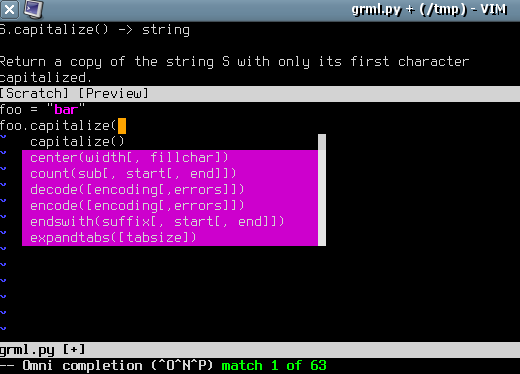
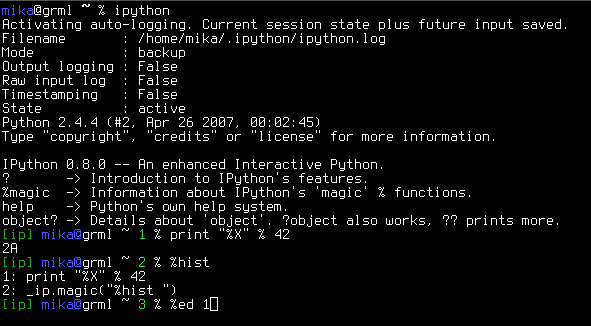
I wrote a small python webpage for the grml-wiki to provide some information regarding Python-development on grml. I just upgraded Vim on my main system to version 7.1 and omnicompletion with vim-python became better once more. So time for a short demo of ctrl-x-o: Python coding in Vim 7.1 - Screenshot I also very much like ‘%ed’ within ipython using the following snippet in my ~/.ipython/ipythonrc:
editor 1
editor /usr/bin/vim.python
Notice: Don’t wonder about the prompt style of the following ipython-screenshot, I customized it a little bit (see python-webpage in the grml-wiki again to get an idea). ipython demo - Screenshot So running the last line containing ‘%ed 1′ will execute /usr/bin/vim.python providing the code from the first command line of ipython and I can use all the magic of Vim for editing the code. When exiting the editor I have the code within ipython. Rocking. :) Oh, don’t forget to check out the Quick tips of ipython when exploring it. Now what’s missing in ipython is the edit-command-line feature of Zsh. That would allow me to edit already typed (but not yet executed) code with an external editor. Anyone out there with an according tip? ;-)

Ross Burton: Generating Random vCards

Again I found myself wanting a pile of realistic vCards to test with, and decided to write a decent and extendable solution for once (instead of the hilarity of this). A while ago I discovered Barnum, which can generate pseudo-realistic data by containing large data sets of names, street addresses, zip codes and credit card numbers. I extended it a little, adding support for creating an email address from a given name (it looks weird when the contact's name is John Smith but the email is john.doe@bar.com) and generating birth dates, then wrote a tiny script to write valid vCards. Et voilà:
$ ./gen_vcard.py 
BEGIN:VCARD
VERSION:3.0
UID:barnum-1107705517
FN:Caleb Barone
N:Barone;Caleb;;;
BDAY:1955-05-06
EMAIL;TYPE=WORK:cbarone@blanditvelit.eu
X-JABBER;TYPE=HOME:cbarone@eratdolore.eu
ADR;TYPE=HOME:;;8270 Kahlden Lane;Thompson;CT;06277;USA
END:VCARD
If this is useful to anyone else, you'll want Barnum, my patched gen_data.py, and gen_vcard.py. NP: More Than Music, Murphin

5 June 2007

Antti-Juhani Kaijanaho: Book selections

A friend recommended me Steve Miller and Sharon Lee’s Liaden books. The first question, reading order, was not very easy to find an answer to. I went with publication order within the Agent of Change sequence – Agent of Change, Conflict of Honors, Carpe Diem, Plan B, and I Dare. In retrospect it would have been better to start with Conflict of Honors followed by Agent of Change, as this corresponds to story chronology, and AoC and CD have the same protagonists while CoH doesn’t. The story speed between Plan B and I Dare was too fast to break the sequence, but it might have made the latter book fuller if I had read the first batch of prequels Local Custom and Scout’s Progress before it. The second prequel sequence Crystal Soldier and Crystal Dragon works well at any point in the series, as does the third (single-book) prequel sequence Balance of Trade. I’m still reading Fledgling and the first short story collection. Confusing? I thought so, but it definitely is worth the investment. Instead of all the usual superlatives, I’ll say something unique to this series: These books changed my perspective in that I now cannot read (in any fiction) about a character bowing without asking in my head “in which mode, dammit!?”. (Update on 8th June: The friend referred to above, after reading this section, said (I paraphrase): “In the peculiar mode of humans, of course”.) The Liaden books are romances in a (very good) science-fictional setting. With two exceptions, each book creates at least one new lifetime romantic pairing, and they’re in my opinion convincing romances. One of the exceptions deepens one of the earlier relationships, so there is no lack of romance there. The only place I know where one can get all the novels reliably is Webscriptions, as e-books. Some of the paper books seem to be hard to find, and the recent closing down of the main publisher Meisha Merlin cannot help there. * * * The promotional material for The Mote in God’s Eye by Larry Niven and Jerry Pournelle includes a quote by Robert Heinlein: Possibly the finest science fiction novel I have ever read. It is hard for me to disagree with that statement (including the qualifier, in all honesty), having recently read this book. Mote is a complex first-contact story, set in Pournelle’s alternate history (originally future history) universe. It begins in the year 3017. The recently created Second Empire of Man gets a visit from the aliens, leading to a counter-visit by humans to the aliens’ star system. The aliens seem friendly, but are they? What could they possibly be hiding? In retrospect, the Moties remind me (in style, not in detail) of Orson Scott Card’s Piggies (Speaker for the Dead and sequels); I would be surprised if Card had not read this book before writing his. The sequel, The Gripping Hand is not the masterpiece that Mote is, but I had no trouble enjoying it. The solution to the Motie problem has held for decades, but it won’t hold forever, and it might actually be breaking down now. The mission: save both humans and Moties from an eventual assured mutual destruction. * * * I actually started reading Pournelle’s alternate/future history from the cronological beginning. This is another series where reading order becomes a complicated matter, as many of the books tell parallel subthreads of the story; and it becomes even more complicated by the fact that there is an omnibus edition in which the story is told in chronological order, this having been accomplished by breaking the books down into chunks and then arranging the chunks in chronological order. My reading order went as follows: West of Honor, The Mercenary, Prince of Mercenaries, Go Tell the Spartans and Prince of Sparta. This is a good reading order; my only problem with it is that the protagonist of West of Honor fails to appear in most of the other books. The following is not in my opinion a real spoiler, even though it reveals certain key events of the series. The premise is that sometime between the 1970’s and the early decades of the 21st Century the United States and the Soviet Union form a union, called the CoDominium, which dominates the international politics of the Earth for most of the 21st Century. In early 21st Century, faster-than-light travel is discovered, and the CoDominium starts to colonise other star systems, first with voluntary colonists and then with convicts and involuntary colonists. The series takes place in the final decades of CoDominium, and focuses on the actions of one John Christian Falkenberg (though he is not the protagonist of all the books), first as an officer in the CoDominium (extraterrestrial) military, and then as the Colonel of a mercenary outfit, Falkenberg’s Legion. The Legion is at the center of events that eventually (after the events described in these books) leads to the creation of the first Empire of Man. The books are entertaining military science fiction, solid, enjoyable journeyman pieces.

Next.

Previous.