Search Results: "xam"

23 April 2011

Russell Coker: Links April 2011

Sebastian Thrun gave an interesting TED talk about the Google driverless car project and explains how his main aim is to avoid all the needless road deaths that are due to human error [1]. Finally a good use for the Google street-view type data! AnnMarie Thomas gave an interesting short TED talk about using play-dough to make circuits [2]. There are two recipies for play-dough, the one made with salt conducts well and the one made with sugar conducts poorly. That allows making wires with salty dough and insulators with the sugar dough. John Robb has published an interesting article about a Chinese fake revolutionary group that is triggering a backlash from Chinese security forces [3]. Even if this isn t accurate it seems like a good way to make people hate their local security forces and thus demand political change. Chris Rock made an interesting observation, we aren t making progress on racial issues, white people are getting less crazy [4]. Red Hill has an interesting article about 486 motherboards with fake cache chips that were sold in the 90 s [5]. One thing I disagree with is that they blame the customers for seeking low prices. When a white-box PC cost $2000 (which is $3000 in today s money) it made sense to try and get the cheapest option possible. Now that major department stores sell name-brand laptops for $400 it really makes sense to buy name-brand quality rather than white-box rubbish. IHollaBack.org is an interesting project to combat street harassment of women [6]. Psychology Today has an interesting article by Joe Navarro (former FBI counter-intelligence agent and author) about the serious implications of attempting to detect lies [7]. His main point is that most people over-estimate their ability to detect lies and because the legal system believes such claims from law enforcement officers many innocent people get found guilty and criminals get away free! Cory Doctorow wrote an informative article about the ways of persuading people to pay for content that can be obtained for free [8]. The main message seems to be that the big media companies are doing things the wrong way in everything that they do. The news satire site CBS Breaking News has an interesting about page explaining their mission [9]. They stopped their automated disaster generator after the Japanese Tsunami, while I can understand them wanting to keep some good taste and be sympathetic to the plight of the Japanese people it seems that they have forgotten that there is always a disaster somewhere. The typical bus plunge is just as bad as the Tsunami to the people on the bus and their relatives! Psychology Today has an interesting blog post by Satoshi Kanazawa explaining how criminals don t specialise, the psychological factors that make someone likely to commit one crime will make them likely to commit others, this makes it logical to collect DNA samples from all criminals [10]. Psychology Today has an interesting blog post by Dave Niose about a landmark US legal case in 1948 where Vashti McCollum had to escalate to the Supreme Court to allow her children to receive secular education [11]. We need something like this in Australia now as the religious extremists are going too far in indoctrinating children. Sam Richards gave a TED talk titled A Radical Experiment in Empathy which aims to teach Americans how to understand the way that people in the middle-east feel [12]. The comments suggest that his talk wasn t successful. Of course the fact that empathy doesn t have a clear definition in the English language doesn t help, and the fact that most people don t seem to interpret it in any way that corresponds to any dictionary and that most people seem unable to define what they mean by it makes things worse. At the moment I can t think of any examples of successfully teaching empathy to unwilling people. The people who want to learn will do so eventually, you can have some good success in helping them to learn faster. Kathryn Schulz gave an interesting TED talk about Being Wrong [13]. One interesting point that she makes concerns the way that people assume that people who disagree are ignorant, stupid, or evil instead of just having a different set of data or a different understanding of the same data. Of course it is possible for someone to be ignorant/stupid/evil AND have a different understanding. Marcin Jakubowski gave an inspiring TED talk about his project to develop free blueprints that allow anyone to create all machines needed to sustain civilisation with minimal cost [14]. His Open Source Ecology project has a blog and a wiki with blueprints and files for CAD/CAM [15]. Dave Meslin gave an insightful TED talk about apathy in the political process [16]. Among other things he compares council notices that supposedly request citizen input with adverts for running shoes which encourage people to buy them. One thing he didn t mention is the difference that technology can make, a short council advert with a QR code is probably a lot more useful than the current dense text-based adverts for today s audience.

21 April 2011

Raphaël Hertzog: People behind Debian: Meike Reichle, member of Debian Women

Meike Reichle is a Debian developer since 2008 but has been involved for longer than that, in particular in Debian Women. She s a great speaker and shared her experience in a Debconf talk. She s also part of the Debian publicity team and managed the live coverage of the last release on identi.ca. Enough introduction, learn more about her by reading the interview. My questions are in bold, the rest is by Meike. Who are you? My name is Meike Reichle, I am a studied information scientist and work as a project manager at Pengutronix, an embedded Linux company probably best known for their ARM kernel work. I live in Germany, more exactly in Lower Saxony, but I was originally born and raised in Swabia. Although I moved here ten years ago I still have a rather strong Swabian cultural identity. (Among other things I pride myself on having introduced a number of fellow DDs to the true promise that are real hand-made Sp tzle ;-) ) I am married to Alexander Reichle-Schmehl, we ll have our third wedding anniversary this summer. Apart from Debian most of my spare time is used for all kinds of crafts and DIY activities. Making things with my hands always gives me a great sense of accomplishment. My Free software history is summed up pretty quickly. Like most women of my age I wasn t introduced to computers until well into my teens. I didn t have a computer of my own until I started studying at the university in 2001. From there on things developed rather quickly: Working on the University s Unix terminals got me hooked on *nixes, so I got me one of those Linuxes everyone talked about. I tried a couple of different distributions, ended up with Debian around 2004, started contributing in 2005, and finally became a full DD what a nice coincidence! exactly this day (Apr 18th) three years ago. You re part of Debian Women. How is the project going? I have the feeling that the number of women involved in Debian has not significantly increased. The amount of women active within Debian is a tricky thing to judge. Here s a quick example why: When the DPL was elected in 2004 there were 911 Debian Developers eligible to vote, 4 of them were female. Shortly after, during DebConf4, debian-women was founded. When the current DPL was reelected last month, there were again 911 Debian Developers eligible to vote, but this time 13 of them were women. You can look at these numbers and say The number of female DDs has more than tripled, what a success! Or you can pull out your calculator and it will tell you that in terms of ratio this puts us from a measly 0.4% to an only slightly less measly 1.4% ratio of female DDs. This still is pardon my language a bloody shame, but sadly also pretty close to the average ratio of women in Free Software. So, while I do think that the debian-women project did already have a significant impact on the Debian project as a whole, I don t think it has achieved its goals yet. Not for a long time. There s still a lot to be done but unfortunately the debian-women project has somewhat run out of steam at the moment. The seven years of its existence divide quite equally into the first half, which was very active and saw great results, and the second half, which was very slow and much more passive. In my impression debian-women is currently undergoing a rather bumpy generational change. On the one hand a lot of the original members, including myself, have reduced their involvement. Speaking for myself this is caused by shift of interests as much as general weariness. On the other hand there are only very few women following up. This development is also reflected quite harshly in DD numbers: If I don t misjudge any first names (and I desperately hope I do!) for the last three years not a single woman has joined Debian as a developer! After the great start debian-women has had, this is a very painful thing to see! That said, things don t look all bad. There is a number of women maintaining packages without being DDs and there s also at least one woman currently in NM, so there s hope this standstill won t last very much longer. But still, the fact remains that debian-women is suffering from a rather serious recruitment problem and I hope that this interview might actually help to spur some new or not yet active members into action. The aim of debian-women is far from achieved and now that its initial members are receding its time for new members to step up and take initiative. What should Debian do to be more attractive to women ? I think the general atmosphere has improved, we re less tolerant with rude behaviour, the usual tone on mailing lists has improved. Yet it doesn t seem to be enough. If there was a female DD for every time I answered that question First of all, I agree, Debian as a community has improved tremendously! Our general tone is much more friendly and cooperative and there is now a much better awareness of the impression we give to outsiders and newcomers. Now on to the difficult part: The question what should be done to get more women into Free Software has been around almost as long as Free Software exists, and it has been answered very well by a lot of people: Twenty years ago Ellen Spertus wrote Why are There so Few Female Computer Scientists? and most of it still holds true. Almost ten years ago Val Henson (now Aurora) wrote HOWTO Encourage Women in Linux and that also is still pretty accurate. In 2006 Floss Pols undertook extensive research to find out why there were so few women in Open Source and Free Software and how that could be changed. They also came up with a very good set of recommendations. All of these texts highlight different aspects of that question and all of them have very good points. I personally have, over the years, arrived at a rather sociological, not to say holistic point of view. In fact I answered the exact same question a few days ago, and the answer I gave then was this: After ~10 years of women in tech advocacy I d say the ultimate and final measure to get more women into Free Software is by finally achieving a truly equal society and at the same time dramatically improving child care support in almost any country. I ve come to the conclusion that what really holds women back in practice is not so much a lack of skill or interest but a simple lack of opportunity. For most of us Free Software is what we do in our spare time and that s something that women, even today, have considerably less of than men. Even in couples where both partners work full-time it is still mostly the woman who does the majority of the housework and child care duties. In most cultures men have a perceived right to their leisure time that does not to the same degree exist for women. That is one major reason, the other is instilled modesty, which has kind of become my personal arch-enemy by now. I ve talked to so many girls and women at all sorts of events about why they won t take up Computer Science studies or join a Free Software project and the answer I hear most often is that they do not consider themselves good enough in one or another aspect. Sometimes they will doubt their technical skills, sometimes their language skills, sometimes their stamina. Needless to say these girls and women were not any less qualified than the people already active in Free Software. So, yes, in the short and medium term making Debian a more welcoming and friendly place is the way to go. As many others pointed out already this will not only benefit prospective contributors but the community as a whole: those new to it as well as those who ve been in it for a long time. In the long term however what we need is empowerment! Women who are just as confident about their skills as men and are not discouraged by uncooperative environments. This is of course something that is culturally deep-rooted and can only happen in a very large time frame. So, for the moment the way to go in my view is accessibility: a cooperative atmosphere, a code of conduct, comprehensive documentation not only of technical aspects but also of structures and processes. The other thing we need to do is to have as many already active women as possible attend as many Linux/Debian/Free Software/Whatever events as possible. In my experience it happens quite often that other women see these women, feel very inspired by them, get to talk to them and then a few days later show up on some mailing list or IRC channel. From what I ve seen personal contact still beats any other kind of recruiting measures. You re a Debian developer but you re also married with a Debian developer (Alexander Reichle-Schmehl). Did you meet because of Debian? If not, who introduced Debian to the other one? :-) We did in fact meet because of Debian. More specifically during our booth shift at the Debian booth at LinuxTag 2005, where I did a talk on the debian-women project and Alex organised the DebianDay. After that our relationship developed pretty much along our Debian activities: After our initial meeting we talked a lot on #debian.de, when Alex went to DebConf5 and I didn t we noticed that we kind of missed each other. The first gift he ever gave me was a Debconf5 shirt and a box Finnish chocolates (I still have one of them today. :) ) Our first secret kiss was at ApacheCon 2005, where we were both staffing the Debian booth (kudos to abe for pretending not to notice). We then became an official couple at Berlinux 2005 where we were both staffing the Debian booth and giving talks on packaging and user motivation. Our first real relationship stress test was when we both joined the DebConf6 orga team. It was a stressful time, but we passed it with flying colours! About a year later we announced our engagement via planet.debian.org. Our wedding was a veritable MiniDebConf, one of the best gifts we got was a Debian cookbook including the favourite recipes of DDs from around the world. By now we ve both finished university and work full-time jobs, so we don t do as many talks and attend as many Debian events as we used to. Instead we now mainly focus on press and publicity work, which is quite practical to work on as a pair. It s actually rather funny that way, Alex and I get confused with each other quite often, since we have almost the same name, often pick up on each other s E-Mail conversations and are most often quoted by our function rather than by name. Because of we have kind of merged into this virtual Debian Press Person in the perception of many of our contacts. You also have another hat : Debian Press Officer. What is this about? What would you suggest to people who would like get involved in that domain? Debian press work is mainly about providing an official and coordinated point of contact to anyone wanting information from or about Debian. The press team answers all sorts of inquiries (the most popular one is is of course always the next release date) and makes sure all important events and developments within Debian receive the attention and recognition they deserve. Debian is a diverse project where every sort of contributor is free to voice his or her opinion in any way. We don t have NDAs or prescribed terminology. That s one of the things I love about Debian but also something that makes us difficult to handle for conventional media. They want official statements, in generally understandable terms, at appointed times. That s what the press team takes care of. Almost all of the press work is done in the publicity team, which coordinates using IRC, Mail and SVN. The publicity team also publishes the Debian Project News, which are very popular among our users and developers. Press work is also an area of work that offers lots of possibilities for non-technical contribution. http://wiki.debian.org/Teams/Publicity lists a number of possibilities for contribution and, like most Debian Teams, we d be more than grateful to get some more helping hands and happy to introduce interested newcomers to our work. What s the biggest problem of Debian? In my view: Overwork. Debian has thousands of contributors but still a lot of the main work rests on very few shoulders. We need more contributors, especially, but not only in the key teams. In order to get more people we need to do some marketing which is very hard for us, since we are very proud of our independence and have a strong focus on purely technical aspects rather than aiming for popularity. However, with the current amount of Open Source and Free Software projects to join we find ourselves not only in a contest on technical excellence but also a sort of popularity contest that is about perception rather than hard facts. This popularity contest is difficult for Debian and currently costs us quite a bunch of very capable people. Do you have wishes for Debian Wheezy? My answer to that is a non-technical one: I think Debian is currently very under-appreciated, we do a lot of great work and maybe even more importantly we do a lot of important work for Software Freedom, sometimes even at the cost of our above-mentioned popularity. I hope people will appreciate that more again in the future. Is there someone in Debian that you admire for their contributions? Over the years I have made a lot of friends within the Debian community, some have even become family. That makes it somewhat hard to single out individual people. I think what I admire most is continuous commitment. I am very impressed by those among us who have kept up a high level of commitment over many years and at the same time managed to bring that in line with a fulfilled personal/family life. That s something that I hope I ll also be able to achieve in the years to come.
Thank you to Meike for the time spent answering my questions. I hope you enjoyed reading her answers as I did. Subscribe to my newsletter to get my monthly summary of the Debian/Ubuntu news and to not miss further interviews. You can also follow along on Identi.ca, Twitter and Facebook.

2 comments Liked this article? Click here. My blog is Flattr-enabled.

20 April 2011

Joey Hess: the popcon problem

I have noticed some problems with how Debian is using the popularity-contest data.

19 April 2011

Julian Andres Klode: this week: apt 0.8.14 (regex pinning), stable updates, and bug triaging

python-apt 0.8.0~exp2 bug fix release On Tuesday, I uploaded python-apt 0.8.0~exp2 to experimental, fixing about 10 bugs reported in Ubuntu and Debian bug trackers. It should know even convert integers correctly on all architectures, previously we could have passed long via varargs where int was expected. Bugs Until Thursday, I went through the bug list in Launchpad and closed/fixed/reassigned/merged about 100 bugs in APT and python-apt. APT & python-apt updates for squeeze Today, I uploaded updates of apt and python-apt to stable. They include support for xz and parsing multi-arch dependencies, as wanted by ftpmasters. APT 0.8.14 and wildcards/regular expression pinning Today, I uploaded apt 0.8.14 to Debian unstable, introducing support for pinning using glob() like Syntax and POSIX extended regular expressions. Let s say we want to pin all packages starting with gnome or kde to 990. The following example does this, using glob-like patterns for gnome, and a regular expression enclosed in / for kde:

Package: gnome* /^kde/
Pin: release a=experimental
Pin-Priority: 990
This closes 10-year-old Bug#121132 in Debian. Have fun with this feature, but please note that it may not be the fastest thing on earth, as it checks every package in the cache on initialization of such queries, which may take a few 10 ms. Since some time already, it s also possible to use such expressions for the Pin field. Thus users of Ubuntu releases could use the following piece of preferences to pin all packages in archives starting with lucid (e.g. lucid, lucid-updates) to 990:

Package: *
Pin: release a=lucid*
Pin-Priority: 990
Those types of pins do not have the negative performance impact of complex expressions in the Package header, as they are only checked against a smaller set of packages, or if Package: * , simply checked against the package files in the cache.
Filed under: Debian

18 April 2011

Sjoerd Simons: Codec bitrate control

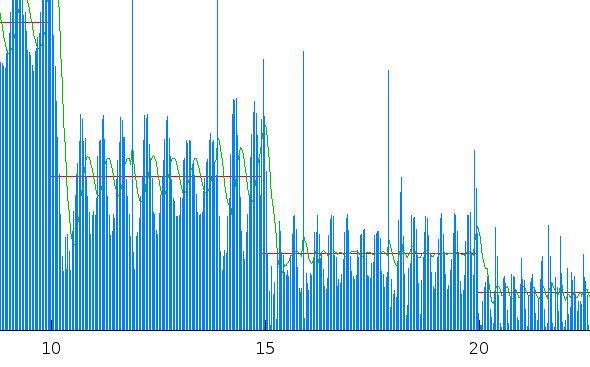
One of the more exciting upcoming features of Farsight is the ability to change the amount of required bandwidth depending on network conditions. Which means Telepathy based VoIP clients will be able to use higher resolutions and better audio/video quality if the network connectivity allows. And ofcourse, when the available bandwidth is low, the bandwidth usage can be lowered such that calls are still possible with lower but hopefully still acceptable quality. One side of the full story is measuring the available bandwidth, which hopefully Olivier will tell at some point. The other part is actually using less bandwidth. In case technical details are not that interesting to you, probably best to stop reading at this point.. An important way to control the bandwidth we're using in a call is setting the target bitrate on the encoding GStreamer element. While previously it was enough for us to set the bitrate before encoding started, we now need to be able to change it at runtime. And not only that, the codec implementation should ideally respond within a few frames and have a reasonable constant per-frame size. All in all, a lot of requirements on codecs we didn't really have before. Which usually means we need to retest the various codecs we often use and make sure we configure them correctly for the behaviour we'd like to see (and fix them if necessary). To do this I've written a small test program, which simply changes the target bitrate over time and outputs some numbers suitable to feed into gnuplot to turn into graphs. For example, when using x264enc with the current default farsight settings a part of the resulting graph looks something like this (full graph here): x264enc bitrate scaling The blue impulses is the per-frame size (scaled), the green line the bitrate average over 10 frames and the red line the target bitrate. Clearly this isn't an ideal picture, we will need to do some more tweaks to our default settings to make x264 behave the way we want. The same will be true for all other codecs and codec elements, at the moment the GStreamer VP8 element doesn't handle run-time bitrate changes at all and the Theora element acts it its very own interesting way (graph here)
Steve McIntyre: Lies, damn lies and voting system lies

So we're just over 2 weeks away from our next set of local elections in the UK (May 5th), and alongside those elections we're also being asked about switching to a new voting system for future elections. For a long time we've used the simple First Past The Post (FPTP) system here, but now we have the possbility of moving to Alternative Vote (AV) instead. First Past The Post FPTP is simple to understand - the person who receives more votes than any single other person wins. But that simplicity is the only good thing, and there are many problems with it. It's unfair: in an election with 10 candidate, it's possible for a winner to have just 11% of the vote, even in the case where the other 89% of voters would consider them to be the worst option. It's also very susceptible to tactical voting, leading to nasty tactics in parties' election literature like claiming "party foo cannot win here, so don't waste your vote on them - vote for us instead!". See this Wikipedia article for more background. Alternative Vote AV is slightly more complicated. Instead of just placing a mark against their single preferred candidate, voters are able to rank as many of the candidates as they like. In the case that there is not a clear winner with more than 50% of the votes from the initial count, the lowest-ranked candidate is eliminated and second-choice votes from their supporters are counted and re-distributed for the other candidates. Iterate this process until one candidate gets more than 50% of the total votes. By re-calculating the votes this way, supporters of less popular candidates / parties should no longer feel the pressure to vote tactically and a more accurate picture of voter intention should emerge. The downsides? AV will tend to lead to slower, more expensive counting due to the potential for several rounds. It's still not real proportional voting, but it's better than FPTP in this regard. Again, Wikipedia has a good article about this subject. Other options? I'd be much happier to see discussion / trials of other voting systems. For example, Debian uses a variation on Condorcet called Cloneproof Schwartz Sequential Dropping which is an excellent system for fair voting, but it's very difficult to explain and counting votes is comparatively very expensive. It's bad enough getting ostensibly-intelligent Debian developers to understand this system; extending this to a national election would be impossible in my opinion. It's also not an option on the ballot here... :-) Politicians spreading lies I know this won't come as a major shock for a nationwide referendum, but there's a lot of campaigning going on. And, in the best traditions of political campaigning, there's a huge amount of bullshit being spread. The worst is coming from the "No to AV" campaign, as far as I can see. Without many positive things to claim, various members of the Conservative party (current government, with most to fear from a change of voting system, of course) are spouting outright lies and sowing FUD in all directions:
  1. Claiming that AV will cost 250 million, most of which would be for the cost of electronic voting machines. Except... there's no evidence that these would be needed, nor are there any plans to use them.
  2. Continuing on, highlighting the alleged "extra costs" of AV: campaign poster FUD saying that we need to choose between cardiac facilities for babies and AV, or between equipment for our soldiers and AV. Except... there's no evidence that costs will be that high, nor that we have to make such binary choices.
  3. Claims from senior Conservative figures that changing to AV would mean more votes and legitimacy for extremists like the British National Party. Except... there is no evidence that AV will boost minority extremist parties. The BNP themselves are urging their supporters to vote against AV. Finally, if these parties have a high enough proportion of votes that they should be getting seats in parliament then they should have those seats - this is one of the tenets of democracy. Why should we be choosing a voting system to deliberately disenfranchise people?
  4. Finally, even David Cameron is at it: "too much of the debate about the alternative vote (AV) had so far been dominated by 'scientific' evaluation of the two systems' merits. But for me, politics shouldn't be some mind-bending exercise. It's about what you feel in your gut - about the values you hold dear and the beliefs you instinctively have. And I just feel it, in my gut, that AV is wrong." Well, it's nice that our Prime Minister wants to ignore all the scientific evidence and go with his gut feeling. After all, why would we want to think about choices like this?
Don't swallow the bullshit If you're eligible to vote in the UK, please ignore the bollocks. Make up your own mind how to vote in this referendum, by looking at the facts. I've done that and I'll be voting in favour of switching to AV.

17 April 2011

Russell Coker: More about the Xperia X10

I ve now had a Sony Ericsson Xperia X10 for almost two months (here is a link for my first review) [1]. This is a phone that people seem to really dislike because the battery life is poor and Sony doesn t allow replacing the kernel. I m happy with mine, happy enough that after buying one for my wife and trying it out I bought one for myself. I knew about it s problems in advance and wanted a relatively cheap phone with a large high resolution screen, and the Xperia X10 was the best match for my criteria.ChargingThere has been a recent trend towards using USB for charging devices. Sony provides a tiny wall-wart PSU which has a USB socket and a short (1m) USB cable that can be used to charge the phone from it s PSU or from a PC. The size is really convenient, as the phone has a short battery life I ll probably want to take the PSU to more places than I would for other phones I ve owned.The short USB cable saves weight and tangle when travelling, but can be inconvenient. I m currently working on the phone while it s plugged into my laptop, that works well and I can make calls while it s connected. If the phone was connected to a USB port on a tower computer that was on the ground then the cable could be too short to make a call, if it was charging on a power point near the floor then I wouldn t even be able to use the computer functionality let alone make calls without kneeling. My Viewty has a 175cm charging cable which alleviates these problems. I ve got a 50cm USB extension cable that I use for charging my phone while I m in bed that is just long enough to allow me to check my email without getting out of bed!The socket for connecting the USB cable is protected by a plastic lid that is connected by a strip of rubber. For a socket that will be used at least twice a day this isn t a good mechanical design. The plastic slide on the LG U990 Viewty seems like a much better design.As an aside it s a pity that they aren t designing cars with USB charging sockets built in. Some new cars have a socket for one USB flash drive to be attached to the radio, but really they need at least one USB charging port per seat. It would also be nice if they made power points with USB charging sockets built in, I d buy a few of those if they made them.Preserving the BatteryI ve been running Juice Defender to reduce the battery use, at the moment it is claiming to have extended battery life by 69%. That combined with turning off things that aren t needed (such as WiFi) has made the phone reasonably usable. I can survive more than 12 hours during which I use the phone a lot without charging it.XperiaX10.net has an interesting review of replacement batteries [5]. I m not going to buy them because the largest battery requires a replacement back case which prevents using an external case to prevent damage and the smaller one doesn t provide enough of a benefit and the design of the phone makes it difficult to change batteries so carrying a spare battery isn t a good option.Cursor Control KeysThe HP/Compaq iPaQs that I own from ~10 years ago have a single button that can be moved up/down/left/right to act as a cursor, it can also be pressed inwards to act as an ENTER key (or whatever the application might want for a fifth function). Having some sort of hardware cursor control is really handy, I often end up deleting several characters when I want to replace one because getting the cursor onto the desired character is too difficult.Adding more hardware keys would require making the phone bigger, but that would be fine by me. As described in my previous post about phone cameras I d like to have a phone that s thicker to have a better camera with a greater focal distance for a larger lens [2].Core Phone FunctionalityI really miss having separate green and red buttons for making/answering calls and for rejecting/ending calls.A really common operation is to call back the last person who called. To do this on my LG U990 Viewty I press the green button twice on my home screen which took less than a second. On the Xperia this involves selecting the phone icon from the home screen, then the call log icon, then the call that is desired, then the Call user line. That is four presses in different parts of the screen compared to pressing the same hardware button twice. I m investigating dialer applets right now, the Dialler One applet has a good interface for calling people who have called or been called recently but it still requires two presses on different parts of the screen. With my old Viewty I could call back the last person by feel without even looking at the phone!In the last 6 years the standard functionality of phones has been to include multiple profiles for noises. My Viewty has profiles named Normal , Silent , Vibrate only , Outdoor , Headset (automatically selected when a headset is connected), and three customised ones. The Xperia has only one setting, and that is three icon presses away from the home screen. It does allow changing the volume by hardware switches on the side which includes going to vibrate-only and silent mode. While this is useful, it s not the best way that two precious hardware keys could be used. It also doesn t allow control over all the different notifications, I d like to be able to activate a noise profile and have every application respond to it in an appropriate manner. This is a deficiency in Android 2.1 not in the phone itself.In many ways this phone has the worst phone functionality of any mobile phone I ve ever owned, I think that this is more the fault of the Android designers than Sony Ericsson.Android UpdatesSony had previously claimed that they wouldn t support Android later than 2.1. Now Sony has announced that they will support Gingerbread Android 2.3 [3]. So one of the major complaints about the Xperia will soon be addressed.TetheringThe build of Android that the Xperia runs at the moment doesn t support Wifi tethering. I m currently using with Easy Tether for USB tethering [4]. It s not free software and requires it s own code to run as root on your Linux system that is being tethered (which is easily locked down with SE Linux), but it basically works. The down-side with Easy Tether is that it proxies all the connections so you can t run traceroute etc and in the free version you can t use UDP.K9 MailK9 Mail fixes some of the problems in the default Android email program that I described in my previous post. It allows selection of SSL with a default port of 993 for IMAPs. It uses mail.example.com as the mail server address for an email address of user@example.com (so I ll add a mail CNAME to the domains I run). When I connected initially it told me that the SSL key was not signed by a CA and asked if I wanted to save it or reject it this is the correct and desired functionality. It also correctly parses URLs from the email (or at least has fixed the bug that I discovered in the default email app).One problem I ve found with K9 is that it seems to timeout on large folders. This is probably partly the fault of Virgin Mobile being slow for IP access, but I wonder whether K9 doesn t pipeline IMAP commands as Virgin can do bulk transfer at reasonable speeds (80KB/s) and it mainly fails on latency (900ms being typical). The result is that a folder with more than 500 messages that need to be copied to the phone will never get synchronised. When I started reading mail on my phone I had to move mail from some of the bigger folders into other folders to avoid timeouts. As an aside the amount of time I ve saved by reading email on the go has already paid for the phone.MediascapeThe Sony Mediascape software is used for categorising photos. One function of this is to assign names to photos, the names come from the contact list so if you photograph someone who you can t phone then you need to add a contact list entry for them. This also means that you couldn t conveniently add names to non-humans, I guess I could have added a contact list entry Mr Crash Dump for photos of system crash logs. But a bigger problem is that it decides what is a picture of a person, a picture of someone who is not centered in the photo or a profile picture can be regarded as not a photo of a person and therefore not subject to being associated with a contact list. Finally when selecting a name for a picture it displays the entire contacts list in a small font instead of displaying favorites, I have the phone numbers of many clients in my contacts list who I will never photograph Mediascape just isn t much good. If I feel the need to do something serious in this regard I ll search the app store for something free that s better.ProtectionFor $15 each I bought one grey and one clear Gel Case from J2K. This case covers the sides and back of the phone with a firm rubber layer that will hopefully allow it to bounce rather than break. It also extends slightly higher than the screen which should stop the screen being scratched if the phone is left face-down on a hard surface on the vibrate setting.One problem with the Gel Case is that by it s design it has to cover the buttons on the sides, due to a design or manufacturing problem the clear case that my wife uses can press slightly on the shutter button which disables the three main buttons on the front. So when the menu or back button stops working she has to slightly move the Gel Case out from the side. I m thinking of just cutting out a section of the Gel Case there, that will make it difficult to press the shutter button, but you can use the touch screen to take photos and there doesn t seem to be any other use for the shutter button so this shouldn t be a problem. The clear and grey cases have different designs, the grey one has a hole over the raised Sony logo which makes it fit a little better as well as not having the shutter problem, so it seems to be a later design I don t know whether all clear cases have the same problem but I recommend that someone who only has one Xperia X10 get the grey case just in case.Web BrowsingI m experimenting with using my own web proxy to compress the data sent to the phone. Unfortunately the Android settings for a web proxy only apply to the main web browser, not to all the other applications that use web services. Also the built-in web browser requires pressing the settings hardware button followed by at least two touch-screen presses to change between windows or close a window and it doesn t seem to support making the short-press action be to open a link in a new window. So I will have to find another web browser to use.Bandwidth UseThe 3G Watchdog applet is really good for tracking the data transfer and optionally cutting off 3G access before the quota is exceeded. Unfortunately Virgin has already sent me a bill with $234 in extra charges for bandwidth use because I used 1.6G instead of my 1.5G quota. A Virgin representative had told me over the phone that the billing period would be based on the end of the month, so while every calendar month has had less than 1.5G used because I used more than average in the end of March and the start of April that counts as excess data in the 14th March to 13th April period.I m going to appeal this to the Telecommunications Industry Ombudsman, I don t think that it s reasonable that I should be billed almost 7* the normal bill for exceeding the quota by 7.4% based on following the instructions of a Virgin employee. While I could have read the previous bill that they sent me to discover the end of billing period dates, I don t think that I should be expected to distrust everything that a Virgin employee says. If they billed me an extra $20 then I d just pay it, but $234 is unreasonable.ConclusionSince using the phone I ve found significant benefits in web browsing and reading email with the major limitation being the small screen (relative to a Netbook or Laptop). So if I was to buy another phone I would probably consider a Dell Streak which seems to be the largest Android phone on the market at the moment.Given the amount of use that I ve got I would be happy to spend more money and therefore consider a more expensive phone. But I don t regret the decision to save money by getting an Xperia X10.Finally when a telco tries to stick me with a $234 excess charge it really detracts from the value of having a phone contract. If I end up having to pay that then it s half the value of a smart-phone lost in one telco scam. This is enough to make a contract with Virgin a bad option, after this contract expires I may use VOIP and a pre-paid SIM from Telstra NextG if their network is still the best. Another possibility is to just use a small tablet and skip having a mobile phone, email and Jabber plus SMS from the people who lack net access will probably do.

16 April 2011

Russell Coker: Who is the Best Free Software Advocate?

TED is offering an audition for future TED.com talks in New York on the 24th of May [1]. It would be good if we could have someone advocate Free Software there. The audition is a 1 minute talk, the speakers who pass the audition may be offered full ~17 minute lecture slots at the next TED conference, and some of the minute long talks will be published on TED.com (which has many viewers).Larry Lessig has previously given a TED talk about laws that strange creativity [2], while this is fairly typical of the type of talk that TED promotes (in terms of politics and presentation quality), a talk doesn t have to be so well produced to make the grade. Firstly some TED talks seem to be accepted with a lower presentation quality due to the speaker having some special knowledge a TED presentation doesn t have to be so slick if the speaker is sufficiently famous or the talk is particularly interesting. Also there are TEDx events which are organised independently, have less international attention, and therefore less competition for speaking slots. Larry gave a more recent talk at the TEDxNYED event about re-examining the remix and lessons that people on the political left can learn from conservatives about remix legislation [3], this talk is much more informal and also unfortunately has a much lower recording quality. But as it s published on TED.com it will still get a large audience.Promoting Free Software to the TED audience (which includes many senior politicians and other VIPs) would be a major achievement. Even a TEDx talk that gets published on TED.com would get seen by a huge and important audience.Who is capable of giving such a talk? Larry got a standing ovation for his TED talk so it seems most likely that he can give another TED talk without going through the public audition process, but it seems that he has other priorities at this time. Probably most people who have more than 10 years experience doing Free Software development and who have a reasonable amount of experience giving lectures at Free Software conferences could at least manage the TEDx quality and a good portion of the speakers from any of the major Linux conferences could potentially give a talk of TED quality if they spent enough time preparing it.What methods of funding are available? There are probably very few people who would travel far to give a 1 minute talk, Mark Shuttleworth is one person who can afford to travel for such things and who could potentially give a great TED talk (his story is the sort of thing that seems popular with the TED audience). Would any of the Free Software organisations sponsor someone to give such an audition? I would support having Debian funds spent on travel for one of the better Debian advocates to travel to NY for the audition I m sure that there are many other Free Software things that can be done in NY to help justify the expense. Maybe this would be something that is suitable for corporate sponsorship.Finally it seems like a good idea to create some very short talks anyway. It would probably be useful to have leaders of the Free Software community publish minute-long video talks about their favorite projects anyway. In some ways a short talk is a higher form of art than a long lecture, I think that the best talk I ever gave was my 5 minute lightning talk about installing SE Linux.UpdateTED now has a blog post with a FAQ about the talks [4]. Larry Lessig is the first example they cite of how to give a great TED talk!Also you can submit a video without attending New York and there is no restriction on publishing the video elsehere. So if you want to make a great 1 minute video about something important you can just send it to TED and see what happens and then publish it on Youtube or one of the other video services too.

15 April 2011

Patrick Schoenfeld: Last time I've used network-manager..

Theres an ongoing thread on the Debian mailing lists about making network-manager installed by default on new Debian installations. I won't say much about the thread. Its just a prototype example for Debian project discussions: Discuss everything to death and if its dead discuss a little more. And - very important - always restate the same arguments as often as you can. Or if its not your own argument you restate, restate the arguments of others. Ending with 100 times stated the same argument. Even if its already disproved.

I don't have a strong opinion about the topic in itself. However there is something I find kinda funny. A statement brought up by the people who strongly oppose network-manager as a default.
A statetement I've heard so often that I can't count it anymore.

The last time I've tried network-manager it sucked.
It often comes in different masquerades, like:

But it basically boils down to that basic essence of the sentence I've written above. Sometimes I ask people who express this opinion a simple question:

When did you test network-manager the last time?
The answers are different but again the basic essence of the answers is mostly the same (even if people would never say it that way):

A long time ago. Must have been around Etch.
And guess what: There was a time when I had a similar opinion. Must have been around Etch.
During the life cycle of network-manager between Etch and now a lot has happened. I restarted using network-manager at some point of the Lenny development.
My daily driver for the management of my network connections on my notebook. Yes, together with ifupdown because, yes, network-manager does not support every possible network-setup with all of the special cases possible. But it supports auto-configuring of wired and wireless devices. Connecting to a new encrypted network, either in a WLAN or in a 802.1x LAN, using UMTS devices, using tethering with a smart phone. And everything: on a few mouse-clicks.

Yes, it had some rough edges in that life cycle. Yes, it had that nasty upgrade bug, which was very annoying.
But face it: It developed a lot. Here are some numbers:

Diffstat between the etch version and the lenny version:
362 files changed, 36589 insertions(+), 36684 deletions(-)

Diffstat between the Lenny version and the current version in sid:
763 files changed, 112713 insertions(+), 56361 deletions(-)

The upgrade bug has been solved recently. Late. But better late then never.

So what does that mean? It means that, if your last network-manager experience was made with Lenny or even worse around Etch, you should better give it another try, if you are interested in knowing what you talk about. For now it seems that a lot of people do not know. Not even in a distance.

14 April 2011

Lars Wirzenius: Project Harmony

It seems that Project Harmony has finally taken itself public. From the website:
Project Harmony is a community-centered group focused on contributor agreements for free and open source software (FOSS).
In reality, this seems to be a closed group that in no way represents the community in general and mainly acts in the interest of various corporations. Their goal is to create a bunch of templates for contracts to make participating in free software projects even more complicated than it already is. Look, we have a bunch of copyright licenses. They're not always easy to understand, and there's enough details and corner cases and interactions with the real world to make your head hurt. My head as well. (They're still easier, and more standardized, than contracts for proprietary software.) Contributing to a free software project is easy enough, in most cases. You make a patch, and if the project accepts it, yay. Your patch will be licensed the same way as all the other code. These Harmony agreements aim at making you give up your copyright to someone else, usually a corporate sponsor of the project. That's a bad thing. If the corporation owns the copyright, or you give them a license to do anything they wish with the project, they can do all sorts of evil things with it. For example, they can release it under a non-free license, or enter into complicated patent agreement with someone else that will require you to pay protection money later on, or something else. There is no end to the evil corporations invent, when given the chance. If, however, you refuse to give the corporation any ownership, or special powers, then their ability to do evil lessens, or at least you aren't helping them do that. It might be possible to use the Harmony agreements, as they are currently written, in ways that do not directly allow evil. However, why bother? By sticking to well-known, court-tested free software free software licenses, there is no need for the Harmony licenses. You get to keep the corporations honest, without having to read piles more legalese. Another way of looking at this: here's a bunch of corporations that want you to start using complicated legal documents for their benefit. Ask yourself, in what scenario is this going to be a good idea for you? Just say no to copyright assignments.

Michal Čihař: phpMyAdmin translation status

We're heading to release candidates for phpMyAdmin 3.4.0 (probably once GSoC application/evaluation rush period is over), so the translators have less time to make the translations better. There is no new complete translation, so we still have 14 translations at 100%: There are still lot of translations which would need some love, for example: Recently two of our prospective GSoC students started to contribute to translations, so there is great progress in Sinhala and Hindi translations. Looking forward to have these completed soon :-). You can also help make translation to your language better! If your language is missing just let me know (either in comments or by email).

Filed under: English Phpmyadmin 0 comments Flattr this!

13 April 2011

Dirk Eddelbuettel: Rcpp 0.9.4, and a paper in the Journal of Statistical Software

A brand new 0.9.4 release of Rcpp is now on CRAN and Debian. This version contains an improvement to loading and initialization of Rcpp modules, a bug fix for vectors of factors, another build issue fix as well as (per common practice with JSS) citation information for the article Rcpp: Seamless R and C++ Integration which is now Volume 40, Issue 8 in the Journal of Statistical Software (or JSS for short). The complete NEWS entry is below; more details are in the ChangeLog file in the package and on the Rcpp Changelog page.
0.9.4   2011-04-12
    o   New R function "loadRcppModules" to load Rcpp modules automatically
        from a package. This function must be called from the .onLoad function
        and works with the "RcppModules" field of the package's DESCRIPTION file
    o   The Modules example wrapped the STL std::vector received some editing
        to disambiguate some symbols the newer compilers did not like
    o   Coercing of vectors of factors is now done with an explicit callback
        to R's "as.character()" as Rf_coerceVector no longer plays along
    o   A CITATION file for the published JSS paper has been added, and 
        references were added to Rcpp-package.Rd and the different vignettes
Thanks to CRANberries, there is also a diff to the previous release 0.9.3:
Diff between Rcpp versions 0.9.3 dated 2011-04-05 and 0.9.4 dated 2011-04-12
 Rcpp-0.9.3/Rcpp/build                                              only
 Rcpp-0.9.3/Rcpp/inst/skeleton/yada.Rd                              only
 Rcpp-0.9.3/Rcpp/inst/unitTests/testRcppModule/R/Modules.R          only
 Rcpp-0.9.3/Rcpp/inst/unitTests/testRcppModule/man/yada.Rd          only
 Rcpp-0.9.4/Rcpp/ChangeLog                                             55 
 Rcpp-0.9.4/Rcpp/DESCRIPTION                                           10 
 Rcpp-0.9.4/Rcpp/NAMESPACE                                             29 
 Rcpp-0.9.4/Rcpp/R/Rcpp.package.skeleton.R                             11 
 Rcpp-0.9.4/Rcpp/R/loadRcppModules.R                                only
 Rcpp-0.9.4/Rcpp/inst/CITATION                                      only
 Rcpp-0.9.4/Rcpp/inst/NEWS                                             17 
 Rcpp-0.9.4/Rcpp/inst/doc/Makefile                                      2 
 Rcpp-0.9.4/Rcpp/inst/doc/Rcpp-FAQ.pdf                              binary
 Rcpp-0.9.4/Rcpp/inst/doc/Rcpp-FAQ/Rcpp-FAQ.Rnw                       153 +-
 Rcpp-0.9.4/Rcpp/inst/doc/Rcpp-extending.pdf                        binary
 Rcpp-0.9.4/Rcpp/inst/doc/Rcpp-extending/Rcpp-extending.Rnw             2 
 Rcpp-0.9.4/Rcpp/inst/doc/Rcpp-introduction.Rnw                       734 ++++------
 Rcpp-0.9.4/Rcpp/inst/doc/Rcpp-introduction.pdf                     binary
 Rcpp-0.9.4/Rcpp/inst/doc/Rcpp-modules.pdf                          binary
 Rcpp-0.9.4/Rcpp/inst/doc/Rcpp-modules/Rcpp-modules.Rnw                36 
 Rcpp-0.9.4/Rcpp/inst/doc/Rcpp-package.pdf                          binary
 Rcpp-0.9.4/Rcpp/inst/doc/Rcpp-package/Rcpp-package.Rnw                 4 
 Rcpp-0.9.4/Rcpp/inst/doc/Rcpp-quickref.pdf                         binary
 Rcpp-0.9.4/Rcpp/inst/doc/Rcpp-quickref/Rcpp-quickref.Rnw              34 
 Rcpp-0.9.4/Rcpp/inst/doc/Rcpp-sugar.pdf                            binary
 Rcpp-0.9.4/Rcpp/inst/doc/Rcpp-sugar/Rcpp-sugar.Rnw                     2 
 Rcpp-0.9.4/Rcpp/inst/doc/Rcpp-unitTests.pdf                        binary
 Rcpp-0.9.4/Rcpp/inst/doc/Rcpp.bib                                     73 
 Rcpp-0.9.4/Rcpp/inst/doc/unitTests-results/Rcpp-unitTests.html        18 
 Rcpp-0.9.4/Rcpp/inst/doc/unitTests-results/Rcpp-unitTests.txt         40 
 Rcpp-0.9.4/Rcpp/inst/include/Rcpp/config.h                             2 
 Rcpp-0.9.4/Rcpp/inst/skeleton/zzz.R                                   11 
 Rcpp-0.9.4/Rcpp/inst/unitTests/runit.Module.client.package.R          27 
 Rcpp-0.9.4/Rcpp/inst/unitTests/runit.Vector.R                         18 
 Rcpp-0.9.4/Rcpp/inst/unitTests/testRcppModule/DESCRIPTION              2 
 Rcpp-0.9.4/Rcpp/inst/unitTests/testRcppModule/NAMESPACE                3 
 Rcpp-0.9.4/Rcpp/inst/unitTests/testRcppModule/R/zzz.R              only
 Rcpp-0.9.4/Rcpp/inst/unitTests/testRcppModule/src/rcpp_module.cpp      6 
 Rcpp-0.9.4/Rcpp/inst/unitTests/testRcppModule/src/stdVector.cpp       18 
 Rcpp-0.9.4/Rcpp/inst/unitTests/testRcppModule/tests/modules.R         21 
 Rcpp-0.9.4/Rcpp/man/Rcpp-package.Rd                                    6 
 Rcpp-0.9.4/Rcpp/man/loadRcppModules.Rd                             only
 Rcpp-0.9.4/Rcpp/src/r_cast.cpp                                         9 
 43 files changed, 647 insertions(+), 696 deletions(-)
As always, even fuller details are on the Rcpp Changelog page and the Rcpp page which also leads to the downloads, the browseable doxygen docs and zip files of doxygen output for the standard formats. A local directory has source and documentation too. Questions, comments etc should go to the rcpp-devel mailing list off the R-Forge page

12 April 2011

Martin Pitt: Improved PyGI documentation

As a followup action to my recent Talk about PyGI I now re-used my notes to provide some real wiki documentation. It would be great if you could add package name info for Fedora/SUSE/etc., and perhaps add more example links for porting different kinds of software! Please also let me know if you have suggestions how to improve the structure of the page.

Dirk Eddelbuettel: The new R compiler package in R 2.13.0: Some first experiments

R 2.13.0 will be released tomorrow. It contains a new package by R Core member Luke Tierney: compiler. What a simple and straightforward name, and something that Luke has been working on for several years. The NEWS file says
    o Package compiler is now provided as a standard package.  See
      ?compiler::compile for information on how to use the compiler.
      This package implements a byte code compiler for R: by default
      the compiler is not used in this release.  See the 'R
      Installation and Administration Manual' for how to compile the
      base and recommended packages.
so the compiler is not yet used for R's own base and recommended packages. While working on my slides for the upcoming Rcpp workshop preceding R/Finance 2011, I thought of a nice test example to illustrate the compiler. Last summer and fall, Radford Neal had sent a very nice, long and detailed list of possible patches for R performance improvements to the development list. Some patches were integrated and some more discussion ensued. One strand was on the difference in parsing between normal parens and curly braces. In isolation, these seem too large, but (as I recall) this is due some things 'deep down' in the parser. However, some folks really harped on this topic. And it just doesn't die as a post from last week demonstrated once more. Last year, Christian Robert had whittled it down to a set of functions, and I made a somewhat sarcastic post argueing that I'd rather use Rcpp to get 80-fold speed increase than spend my time argueing over ten percent changes in code that could be made faster so easily. So let us now examine what the compiler package can do for us. The starting point is the same as last year: five variants of computing 1/(1+x) for a scalar x inside an explicit for loop. Real code would never do it this way as vectorisation comes to the rescue. But for (Christian's) argument's sake, it is useful to highlight differences in the parser. We once again use the nice rbenchmark package to run, time and summarise alternatives:
> ## cf http://dirk.eddelbuettel.com/blog/2010/09/07#straight_curly_or_compiled
> f <- function(n, x=1) for (i in 1:n) x=1/(1+x)
> g <- function(n, x=1) for (i in 1:n) x=(1/(1+x))
> h <- function(n, x=1) for (i in 1:n) x=(1+x)^(-1)
> j <- function(n, x=1) for (i in 1:n) x= 1/ 1+x 
> k <- function(n, x=1) for (i in 1:n) x=1/ 1+x 
> ## now load some tools
> library(rbenchmark)
> ## now run the benchmark
> N <- 1e6
> benchmark(f(N,1), g(N,1), h(N,1), j(N,1), k(N,1),
+           columns=c("test", "replications",
+           "elapsed", "relative"),
+           order="relative", replications=10)
     test replications elapsed relative
5 k(N, 1)           10   9.764  1.00000
1 f(N, 1)           10   9.998  1.02397
4 j(N, 1)           10  11.019  1.12853
2 g(N, 1)           10  11.822  1.21077
3 h(N, 1)           10  14.560  1.49119
This replicates Christian's result. We find that function k() is the fastest using curlies, and that explicit exponentiation in function h() is the slowest with a relative penalty of 49%, or an absolute difference of almost five seconds between the 9.7 for the winner and 14.6 for the worst variant. On the other hand, function f(), the normal way of writing things, does pretty well. So what happens when we throw the compiler into the mix? Let's first create compiled variants using the new cmpfun() function and then try again:
> ## R 2.13.0 brings this toy
> library(compiler)
> lf <- cmpfun(f)
> lg <- cmpfun(g)
> lh <- cmpfun(h)
> lj <- cmpfun(j)
> lk <- cmpfun(k)
> # now run the benchmark
> N <- 1e6
> benchmark(f(N,1), g(N,1), h(N,1), j(N,1), k(N,1),
+           lf(N,1), lg(N,1), lh(N,1), lj(N,1), lk(N,1),
+           columns=c("test", "replications",
+           "elapsed", "relative"),
+           order="relative", replications=10)
       test replications elapsed relative
9  lj(N, 1)           10   2.971  1.00000
10 lk(N, 1)           10   2.980  1.00303
6  lf(N, 1)           10   2.998  1.00909
7  lg(N, 1)           10   3.007  1.01212
8  lh(N, 1)           10   4.024  1.35443
1   f(N, 1)           10   9.479  3.19051
5   k(N, 1)           10   9.526  3.20633
4   j(N, 1)           10  10.775  3.62673
2   g(N, 1)           10  11.299  3.80310
3   h(N, 1)           10  14.049  4.72871
Now things have gotten interesting and substantially faster, for very little cost. Usage is straightforward: take your function and compile it, and reap more than a threefold speed gain. Not bad at all. Also of note, the difference between the different expressions essentially vanishes. The explicit exponentiation is still the loser, but there may be an additional explicit function call involved. So we do see the new compiler as a potentially very useful addition. I am sure more folks will jump on this and run more tests to find clearer corner cases. To finish, we have to of course once more go back to Rcpp for some <emph>real</emph> gains, and some comparison between compiled and byte code compiled code.
> ## now with Rcpp and C++
> library(inline)
> ## and define our version in C++
> src <- 'int n = as<int>(ns);
+         double x = as<double>(xs);
+         for (int i=0; i<n; i++) x=1/(1+x);
+         return wrap(x); '
> l <- cxxfunction(signature(ns="integer",
+                            xs="numeric"),
+                  body=src, plugin="Rcpp")
> ## now run the benchmark again
> benchmark(f(N,1), g(N,1), h(N,1), j(N,1), k(N,1),
+           l(N,1),
+           lf(N,1), lg(N,1), lh(N,1), lj(N,1), lk(N,1),
+           columns=c("test", "replications",
+           "elapsed", "relative"),
+           order="relative", replications=10)
       test replications elapsed relative
6   l(N, 1)           10   0.120   1.0000
11 lk(N, 1)           10   2.961  24.6750
7  lf(N, 1)           10   3.128  26.0667
8  lg(N, 1)           10   3.140  26.1667
10 lj(N, 1)           10   3.161  26.3417
9  lh(N, 1)           10   4.212  35.1000
5   k(N, 1)           10   9.500  79.1667
1   f(N, 1)           10   9.621  80.1750
4   j(N, 1)           10  10.868  90.5667
2   g(N, 1)           10  11.409  95.0750
3   h(N, 1)           10  14.077 117.3083
Rcpp still shoots the lights out by a factor of 80 (or even almost 120 to the worst manual implementation) relative to interpreted code. Relative to the compiled byte code, the speed difference is about 25-fold. Now, these are of course entirely unrealistic code examples that are in no way, shape or form representative of real R work. Effective speed gains will be smaller for both the (pretty exciting new) compiler package and also for our C++ integration package Rcpp. Before I close, two more public service announcements. First, if you use Ubuntu see this post by Michael on r-sig-debian announcing his implementation of a suggestion of mine: we now have R alpha/beta/rc builds via his Launchpad PPA. Last Friday, I had the current R-rc snapshot of R 2.13.0 on my Ubuntu box only about six hours after I (as Debian maintainer for R) uploaded the underlying new R-rc package build to Debian unstable. This will be nice for testing of upcoming releases. Second, as I mentioned, the Rcpp workshop on April 28 preceding R/Finance 2011 on April 29 and 30 still has a few slots available, as has the conference itself.

10 April 2011

Niels Thykier: More fun with cross package checks

About a week ago, I wrote about doing cross package checks in Lintian. At that time I had only played with looking up manpages in direct dependencies, which I hope will greatly improve the current binary-without-manpage stats (around 677 packages and 2750ish tags incl. overrides). Today, I decided to take on another challenge. Detection of circular dependencies between binary packages (created from the same source). We already have a little library for building dependency relationships; however I ended up not using it, since it has an important limitation. It cannot tell how the circular dependencies relate to each other. Let me demonstrate what I mean with an example. Suppose we have a couple packages that depend on each other like this:
pkg-core => pkg-A, pkg-D
# circle 1: A, B, C
pkg-A => pkg-B
pkg-B => pkg-C
pkg-C => pkg-A
# circle 2: D, E, F
pkg-D => pkg-E
pkg-E => pkg-F
pkg-F => pkg-D
In this case, our current tool will be able to tell that all packages (possibly except root I did not check) are in a circular relationship. However, we can find better results by pretending we are trying to find Strongly Connected Components (actually that is exactly what we are trying to do here). So today, I implemented Tarjan s algorithm in Perl to solve this particular issue and committed it to my Lintian branch. If this branch is merged into the Lintian master branch, we can close #316283.

8 April 2011

Dominique Dumont: Configuration doc generation with Config::Model

Hello When a project comes with configuration files, project developers have to write configuration doc. Be it as man pages or as comments in configuration files. This is a boring, but necessary task to provide documentation to users. There s a way to get more with a similar effort. By writing this doc as models (i.e. in a format usable by Config::Model), you will get:
- generated man pages
- configuration GUIs
- configuration command line And with a little extra effort, you will also get:
- immediate validation data entered by user
- configuration upgrade tools But let s focus on generating documentation. A configuration model is more or less a list of configuration parameters with their constraints and description. In previous versions of Config::Model, the parameter description was used to generate online help in the GUI. Parameter description is now also used to generate configuration documentation. The constraints which are used to validate user input, are also used to provide more details to the documentation of the parameters. The help text in the model that will be used to generate doc can be plain text or contain pod markups to enhance the look of the doc (be it generated or displayed in the GUI). Here are some links to some example of models and the corresponding generated documents:
Debian::Dpkg::Source model generated doc
Debian::Dpkg::Copyright model generated doc
Sshd model generated doc
To generate these doc, a command like this one was added to the build process: config-edit -model Sshd -model_dir lib/Config/Model/models -gen_pod lib The generated pod files can then be converted to man pages, plain text, html depending on your needs. Feel free to send a mail on config-model users list (config-model-users at lists.sourceforge.net) if you need help. All the best

7 April 2011

Rapha&#235;l Hertzog: People behind Debian: Adam D. Barratt, release manager

Adam D. Barratt is a Debian developer since 2008, in just a few years he got heavily involved to the point of being now Release manager , a high responsibility role within the community. He worked hard with the other members of the release team to make Squeeze happen. You could expect the release managers to have some rest after a big release, but it s not really the case. With the long freeze, loads of transitions have accumulated and they are now busy to get all those updated packages in the new testing (wheezy). Despite this Adam took some time to answer my questions. He shares with us his impression on the Squeeze release, his opinion on time-based freezes (regular/predictable freeze) and much more. Read on. My questions are in bold, the rest is by Adam. Who are you? I m a 31 year old software developer and part-time sysadmin for a software and IT services company based in the south of England. I have no children, no pets and a long-suffering partner who puts up with me spending far too much time tinkering with things and people making fun of her Macbook during Debconf. As well as being on the release team, I m a member of the maintainer teams for devscripts and lintian. Can you describe your journey in Debian and in the release team? I was introduced to Debian as part of an infrastructure upgrade at work, moving from a set of Red Hat and Solaris-based systems. As part of that, we submitted some bugs for issues we found during the upgrade and for small patches we included in some software to add extra functionality we wanted. From that starting point I became more interested in Debian in general and began following some of the mailing lists and IRC channels. When Julian Gilbey asked for help with the maintenance of devscripts, I submitted some patches for some of the outstanding bug reports and was invited to join the team which was being created to handle maintenance for the package. One of the then Release Managers was also on the team and asked if I d be interested in working on a couple of updates they wanted to the scripts which generate the proposed-updates overview pages. I added the new functionality which was merged in to the live scripts and a little while later I was invited to join the team, shortly before Debconf 9. As most readers will be aware, we unfortunately reached a point during last year where we didn t have anyone filling the Release Manager role. During that period, I became more active in handling transitions and requests for updates to stable and as time went on more people started to suggest that I should put myself forward for the position, or refer to me as already being RM. I procrastinated over the decision for some time but after discussions during Debconf 10 I came round to the idea that we should have the RM role filled again and agreed to take it on, together with Neil. The rest, as they say How much time do you usually spend working for the release team ? I ve been trying to work out how to usefully answer this question. My initial answer was approximately two hours each day , but the longer I thought about it the more I started debating exactly what I should include under the umbrella of release work; after some to-and-fro I ve decided to stick with my initial answer. During periods when Debian is frozen and particularly in the lead up to the release that time commitment increases significantly, particularly over weekends. I m reliably informed that at that point the correct answer to the question is too much time . :-) What s your own retrospective of the Squeeze release? What went well and what needs to be improved? Overall, I believe the release went well and that we should all be proud of the Squeeze release. The parts of the release cycle which highlighted the need for improvement all share, imo, a single root cause communication, particularly around freeze-related plans. We worked hard during the freeze itself to improve our communication with the rest of the project and want to continue in that vein during the Wheezy cycle. One thing that I personally found quite difficult at times before the freeze was keeping track of the transitions which were still waiting for a place in the queue; it s also something that we could improve on at this early stage of the Wheezy cycle. In order to help us keep a clear overview of requests for transitions, stable updates and binNMUs, it would be helpful if they could be filed as appropriately user-tagged bugs. This not only allows us to easily get an overview of the status of requests from the BTS but also aids transparency by allowing anyone else to do so; as a useful additional feature, it means that we can use the BTS s blocking functionality to indicate reasons why a request cannot be fulfilled right now. Are you in favor of time based freeze? I think there s merit in having a time frame that we can work towards in order to achieve the goals which we set ourselves for the release, as individual maintainers, maintenance teams and a project. I do have concerns that even with such a time frame in place there will still be uploads made very close to the proposed freeze point and transitions which may be unfinished, for example because of an unforeseen entanglement with or reliance on the transition of another package. One thing I m interested in is how exact and specific that time frame should be and the balance between predictability and being able to achieve everything we want for a great release; this is something we can cover in the debate on this subject which I know many people have strong opinions about. What are your plans for Debian Wheezy? The Wheezy to-do list I started before the final Squeeze release begins multiarch, multiarch, multiarch . It looks like we re finally going to get that achieved during this release cycle, thanks to a great deal of hard work from various people. I m also interested in seeing the C.UTF-8 locale standardised throughout Debian and continuing to work on our tools and processes to make tracking of transitions and stable updates simpler (or at least appearing to be so :-) and more transparent. With my package maintenance hats on, I d like to help ensure that both devscripts and lintian are able to keep pace with changes in the development landscape in Debian (e.g. more useful package diffing for source format v3 packages) and continue to be tools that are an integral part of package development in Debian. Some people (including me) would like a rolling distribution constantly usable by end-users. Do you think that the release process currently geared towards producing stable can be accommodated to support this? I m not yet convinced that the concept of a rolling, constantly usable distribution can be easily integrated in to the workflow that exists around preparing stable releases in Debian. The testing distribution was created as, and continues to be used as, a tool to enable the release team to create the next stable release that it happens to be something that people can use every day for much of the time is mostly a happy side-effect of the fact that we don t gratuitously break it, but is by no means guaranteed to be the case early in the release cycle or during large, disruptive, transitions. It s been suggested that testing and rolling could be basically the same for most of the cycle, with rolling then continuing to be updated when testing is frozen. This would essentially mean an extra suite which is only used for a few months every couple of years or so, which is one of the things that testing was intended to avoid (i.e. the old frozen suite) and seems like a lot of overhead to introduce in order to reduce disruption to some users during the freeze. The early part of the release cycle also tends to include a number of larger transitions which often require packages to either be removed from testing or broken as part of migrating the transition, if they are not able to be successfully updated in time. What s the biggest problem of Debian? The thing that I ve been noticing myself becoming frustrated by recently is a tendency to debate the minor details of proposals, rather than concentrating on getting the key points right to begin with. Clearly for some projects such as multiarch the details may be as important as the big picture, but in most cases the people working on a development should be allowed to look after the smaller details themselves. That s not meant to imply that feedback from other parts of the project should not be welcomed, simply that if we consider Debian to be a do-ocracy then we need to permit people the freedom to do . Is there someone in Debian that you admire for their contributions? All previous release managers, for making the job look much easier than it seems when you re in the hot seat . :-) Outside of the release team, Joey Hess for his contributions to various parts of the Debian development environment over the years, such as debhelper and debian-installer, and Colin Watson for his enviable willingness to tackle a wide variety of different projects within Debian.

Thank you to Adam for the time spent answering my questions. I hope you enjoyed reading his answers as I did. Subscribe to my newsletter to get my monthly summary of the Debian/Ubuntu news and to not miss further interviews. You can also follow along on Identi.ca, Twitter and Facebook.

No comment Liked this article? Click here. My blog is Flattr-enabled.

Lars Wirzenius: cliapp, a Python command line app framework

Whenever I develop a little command line tool, I end up writing some boilerplate code. For example:
import optparse
p = optparse.OptionParser()
p.add_option('--output', metavar='FILE', help='write output to FILE')
...
Option parsing is one of those things that is easy to do, but doing it over and over again gets tedious. There's a bunch of things that pretty much all of my command line tools end up needing to do, even if they're throwaways: A while ago I decided that it was silly of me to write that code repeatedly, or to copy-paste things from project to project. Instead, I decided, I would write a framework that does things for me, and requires minimal setup code from me. cliapp is the result. Its API seems to now be stabilizing, so I thought I'd mention it publically, in case others might find it useful, too. So far, I've found it quite liberating to be able to crank out small scripts more easily than before. My threshold for switching from shell to Python is now quite a bit lower. I have one example online, to give flavor. The README has some explanation of what's going on. There's a Debian package on my code hosting site; see link from cliapp's home page. I'd welcome any feedback.

6 April 2011

Mehdi Dogguy: Buildd status pages: say goodbye to external dependencies

Last week, I had to put my daily (real) work off for a bit, to get some rest. I took this occasion to implement a few ideas I had for the Buildd Status Pages. Mainly, I wanted to get rid of my external dependencies which are: Besides of getting rid of external dependencies, there were also a few feature requests (#618676, #612174, #518526) waiting for a while and it was good time to fix them. Hopefully, there are related to what I was fixing. The final version is now deployed and can be used. The implemented changes are : I think that I tested well enough this new version and it works okay. Nevertheless, if you encounter a bug or a strange behavior, please don t hesitate to contact me (either by mail or on irc) or submit a bug report against buildd.debian.org. The next steps (probably) are :

5 April 2011

Michal &#268;iha&#345;: phpMyAdmin translation status

We're heading to release candidates for phpMyAdmin 3.4.0, so the translators have less time to make the translations better. The Italian translation got to 100% this week thanks to Rouslan Placella. So there are now 14 translations at 100%: There are still lot of translations which would need some love, for example: The progress recently started to work on Bulgarian and Brazilian Portuguese translations seems to be stalled for now, what is not good. You can help make translation to your language better! If your language is missing just let me know (either in comments or by email).

Filed under: English Phpmyadmin 0 comments Flattr this!

Next.

Previous.