Search Results: "agi"

22 June 2010

Michael Prokop: FAI Developer Workshop 2010

From 2nd to 4th of July 2010 the FAI developer workshop will take place at the Linuxhotel in Essen/Germany. FAI? FAI is the abbreviation for Fully Automatic Installation. It s a non-interactive system to install, customize and manage Linux systems and software configurations on computers as well as virtual machines and chroot environments, from small networks to large-scale infrastructures and clusters. As the name states the workshop is targeted towards FAI developers. We the FAI developers want to get FAI into shape for squeeze, discuss pending issues like Ubuntu packaging, release management and of course meet in real life for networking and socializing. Our rough roadmap for the FAI weekend looks like this: Friday: Saturday: Sunday: Further details are available in the FAI wiki at http://faiwiki.informatik.uni-koeln.de/index.php/DeveloperWorkshopJuly2010. The meeting wouldn t be possible without sponsors so special thanks to: If you are interested in sponsoring the FAI Developer Workshop as well please contact FAI lead developer Thomas Lange.

21 June 2010

Matt Zimmerman: Finishing books

Having invested in some introspection into my reading habits, I made up my mind to dial down my consumption of bite-sized nuggets of online information, and finish a few books. That s where my bottleneck has been for the past year or so. Not in selecting books, not in acquiring books, and not in starting books either. I identify promising books, I buy them, I start reading them, and at some point, I put them down and never pick them back up again. Until now. Over the weekend, I finished two books. I started reading both in 2009, and they each required my sustained attention for a period measured in hours in order to finish them. Taking a tip from Dustin, I decided to try alternating between fiction and non-fiction. Jitterbug Perfume by Tom Robbins This was the first book I had read by Tom Robbins, and I am in no hurry to read any more. It certainly wasn t without merit: its themes were clever and artfully interwoven, and the prose elicited a silent chuckle now and again. It was mainly the characters which failed to earn my devotion. They spoke and behaved in ways I found awkward at best, and problematic at worst. Race, gender, sexuality and culture each endured some abuse on the wrong end of a pervasive white male heteronormative American gaze. I really wanted to like Priscilla, who showed early promise as a smart, self-reliant individual, whose haplessness was balanced by a strong will and sense of adventure. Unfortunately, by the later chapters, she was revealed as yet another vacant vessel yearning to be filled by a man. She s even the steward of a symbolic, nearly empty perfume bottle throughout the book. Yes, really. Managing Humans by Michael Lopp Of the books I ve read on management, this one is perhaps the most outrageously reductionist. Many management books are like this, to a degree. They take the impossibly complex problem domain of getting people to work together, break it down into manageable problems with tidy labels, and prescribe methods for solving them (which are hopefully appropriate for at least some of the reader s circumstances). Managing Humans takes this approach to a new level, drawing neat boxes around such gestalts as companies, roles, teams and people, and assigning them Proper Nouns. Many of these bear a similarity to concepts which have been defined, used and tested elsewhere, such as psychological types, but the text makes no effort to link them to his own. Despite being a self-described collection of tales , it s structured like a textbook, ostensibly imparting nuggets of managerial wisdom acquired through lessons learned in the Real World (so pay attention!). However, as far as I can tell, the author s experience is limited to a string of companies of a very specific type: Silicon Valley software startups in the dot com era. Lopp (also known as Rands) does have substantial insight into this problem domain, though, and does an entertaining job of illustrating the patterns which have worked for him. If you can disregard the oracular tone, grit your teeth through the gender stereotyping, and add an implicit preface that this is (sometimes highly) context-sensitive advice, this book can be appreciated for what it actually is: a coherent, witty and thorough exposition of how one particular manager does their job. I got some good ideas out of this book, and would recommend it to someone working in certain circumstances, but as with Robbins, I m not planning to track down further work by the same author.

20 June 2010

Gregor Herrmann: RC bugs 2010/22 - 2010/24

again, a short overview regarding my RC bug activities:

Neil Williams: World Cup QA

Turns out that the football is insufficiently engaging to distract me from picking up the laptop, but sufficiently noisy that I don't get time to think about more complex problems (leave those for weekday evenings), so weekends seem to offer a brief window to relax and do some QA/RC uploads.

As we're not yet in freeze, I'm not doing 0-day NMU's (although I am offering 7 day NMU's), but QA uploads can all be 0-day. Overall, it's proving to be quite useful and a lot easier than sponsoring NEW packages.

So far, RC uploads:


RC offers:


QA uploads:


Didn't think I'd get time to stuff like that with Squeeze.

19 June 2010

Gunnar Wolf: Once upon a time

With due apologies and thanks to my dear and crazy friend UCH:
Once upon a time
Once, because twice would be a repetitive story
A king
One, because two would mean war
Who was married to a queen
One, because two would be drama
They had a princess daughter
One, because two would be a mess
Who was in love with a knight
One, because two would be a soap opera
He was given the task of killing a dragon
One, because two would be a titanic feat
The hero had an idea
One, because two would be asking too much
Using a unique magic sword
One, because were they two, it would no longer be unique
With which, he took the dragon's life
One, because it was a dragon, not a cat
Then they proceeded with the wedding
One, because two would mean bigamy
And they lived happily forever
One, because two forevers would be like two infinites
The end
One, because two ends would be complicated
The bad translation is completely my fault.

17 June 2010

Steve Kemp: That friend promises his undying friendship if you would do him a small favour.

Perl & Apache?
Once upon a time, within the past year, I saw mention of a simpler version of mod_perl - an apache module which let you write code to run within the context of a persistent perl process. However my DuckDuckGofu is weak, and I'm struggling to find this project. Did I dream it, or could somebody tell me where it lives?
Dynamic Picture Frames
So I've been taking pictures recently. Lots of pictures. Many times many images have been printed and hung upon my walls, and the price of frames is starting to become onerous. I'd love to see some kind of "dynamic" picture wall - but the two alternatives I considered fail:
Metal & Magnets
Place a huge sheet of metal upon your wall. Then put wee magnets inside your frames.
Corkboard
Imagine a full wall that was paneled with what is essentially a large notice-board..
Both of these would look ugly; the metal one perhaps less so. But the idea of having a wall which could have pictures mounted upon it, without having big nail holes if you rearranged and which could cope with dynamic repositioning and sizes is nice .. Invent it for me? I'll buy one. Probably even two...
ObFilm: The Godfather

14 June 2010

Gunnar Wolf: What Mexico feels like

I have been recently approached by several friends, from different countries. Mexico and the violence seems to be a frequent news topic all over the world. I live in Mexico City, as ~25% of the country's population does. This is not an easy city, of course, and I won't deny it has tons of problems of its own. However, Mexico City (and even more so the approximately of it that is politically located in Distrito Federal, the formal country capital) is very lucky in this regard. Still, in most of the country, the violence is mostly in the news, mostly a worrying perception that is every day more insistent. My parents live in Cuernavaca, Morelos, ~80Km south from us. Morelos has been known for decades for being the druglords' getaway and safe haven, so it remained a mostly peaceful state for most of this time. This has changed, and at some points during this year, militarization feels quite creepy... Fortunately, just for a couple of weeks, and then back to what seems like normal. The real problems in Morelos is the undeniable corruption of its successive governments, the lack of regard for the population, the inexistent urban planning... However, I know from several friends living in the North of the country (and all along the very long border - The most drug-related violent states nowadays are Chihuahua, Durango, Sinaloa, Tamaulipas and Nuevo Le n, with only two states in the South Michoac n and Guerrero) that violence is really felt by local population on the streets. Some friends say they have grown used to hearing shootings (Durango), others say that it is now usual that the cartels openly strangle the city's vial system with the express purpose of showing off their strength (Monterrey, Nuevo Le n, one of Mexico's most important cities and taken in the past as a token of industrialization and first-world-like life conditions... Just don't look towards the poor areas). About Chihuahua, I'd rather not even talk, as by all accounts (official even) it rivals Iraq in the lack of control the government has of its territory. Still, with all that as background... I am afraid of what I read today in the news. I know a single declaration is not enough to worry about (as said in El Quijote, una golondrina sola no hace verano , a single swallow does not mean it's summer), but those things always start small... Until they explode. La Jornada reports that The retired general Luis Garfias Maga a recommends suspending constitutional guarantees in the country to be able to properly fight violence. The last century we had a sad and long history of cases where the military took over civilian power and suspended the constitutional rights in basically every nation in Latin America Except for Mexico. Not one of those cases was overall successful. Not one of them went by without raging abuses, without terrible consequences. I don't see imminent we will go over to a military rule nor anything close to it, but the environment is getting each time closer to how it was like before said rights suspension. We should learn that it is just not the way, it leads nowhere. I am convinced, and will keep insisting on it at every ocassion, that the only possible way to fight violence is by reducing the social distance, and that should be achieved most importantly by reducing poverty, but also by making it harder to become incredibly rich. Mexico's percentage of poor people has grown over the last decades, but at the same time, the amount of wealth concentrated in very few hands has grown much faster. A society with terribly rich and terribly poor people leads to hatred, leads to desperation, leads to violence. A flatter society, even if the overall standard was to be somewhat lower, tends to a better equilibrium. And yes, I know the original problem with drugs is that Mexico is a great transit area for drugs to reach the USA (and I could also rant about drug legalization I won't, it's late and I must go to work), but the main fuel for young people to leave everything behind and take the risk of starting a life of open ilegality is the lack of future they face all life long. That leads many to risk their lives attempting to cross the border to the USA (Mexico "exports" 500,000 people every year), but also lures them to jobs where they will have easy money... In exchange for their lifes, ultimately. Anyway... Just to repeat and round off: The answer to this problem is not repression, is not policial or military strength. Our only way out is through social justice.

13 June 2010

Petter Reinholdtsen: Lenny->Squeeze upgrades, removals by apt and aptitude

My testing of Debian upgrades from Lenny to Squeeze continues, and I've finally made the upgrade logs available from http://people.skolelinux.org/pere/debian-upgrade-testing/. I am now testing dist-upgrade of Gnome and KDE in a chroot using both apt and aptitude, and found their differences interesting. This time I will only focus on their removal plans. After installing a Gnome desktop and the laptop task, apt-get wants to remove 72 packages when dist-upgrading from Lenny to Squeeze. The surprising part is that it want to remove xorg and all xserver-xorg-video* drivers. Clearly not a good choice, but I am not sure why. When asking aptitude to do the same, it want to remove 129 packages, but most of them are library packages I suspect are no longer needed. Both of them want to remove bluetooth packages, which I do not know. Perhaps these bluetooth packages are obsolete? For KDE, apt-get want to remove 82 packages, among them kdebase which seem like a bad idea and xorg the same way as with Gnome. Asking aptitude for the same, it wants to remove 192 packages, none which are too surprising. I guess the removal of xorg during upgrades should be investigated and avoided, and perhaps others as well. Here are the complete list of planned removals. The complete logs is available from the URL above. Note if you want to repeat these tests, that the upgrade test for kde+apt-get hung in the tasksel setup because of dpkg asking conffile questions. No idea why. I worked around it by using 'echo >> /proc/pidofdpkg/fd/0' to tell dpkg to continue. apt-get gnome 72
bluez-gnome cupsddk-drivers deskbar-applet gnome gnome-desktop-environment gnome-network-admin gtkhtml3.14 iceweasel-gnome-support libavcodec51 libdatrie0 libgdl-1-0 libgnomekbd2 libgnomekbdui2 libmetacity0 libslab0 libxcb-xlib0 nautilus-cd-burner python-gnome2-desktop python-gnome2-extras serpentine swfdec-mozilla update-manager xorg xserver-xorg xserver-xorg-core xserver-xorg-input-all xserver-xorg-input-evdev xserver-xorg-input-kbd xserver-xorg-input-mouse xserver-xorg-input-synaptics xserver-xorg-input-wacom xserver-xorg-video-all xserver-xorg-video-apm xserver-xorg-video-ark xserver-xorg-video-ati xserver-xorg-video-chips xserver-xorg-video-cirrus xserver-xorg-video-cyrix xserver-xorg-video-dummy xserver-xorg-video-fbdev xserver-xorg-video-glint xserver-xorg-video-i128 xserver-xorg-video-i740 xserver-xorg-video-imstt xserver-xorg-video-intel xserver-xorg-video-mach64 xserver-xorg-video-mga xserver-xorg-video-neomagic xserver-xorg-video-nsc xserver-xorg-video-nv xserver-xorg-video-openchrome xserver-xorg-video-r128 xserver-xorg-video-radeon xserver-xorg-video-radeonhd xserver-xorg-video-rendition xserver-xorg-video-s3 xserver-xorg-video-s3virge xserver-xorg-video-savage xserver-xorg-video-siliconmotion xserver-xorg-video-sis xserver-xorg-video-sisusb xserver-xorg-video-tdfx xserver-xorg-video-tga xserver-xorg-video-trident xserver-xorg-video-tseng xserver-xorg-video-v4l xserver-xorg-video-vesa xserver-xorg-video-vga xserver-xorg-video-vmware xserver-xorg-video-voodoo xulrunner-1.9 xulrunner-1.9-gnome-support aptitude gnome 129
bluez-gnome bluez-utils cpp-4.3 cupsddk-drivers dhcdbd djvulibre-desktop finger gnome-app-install gnome-mount gnome-network-admin gnome-spell gnome-vfs-obexftp gnome-volume-manager gstreamer0.10-gnomevfs gtkhtml3.14 libao2 libavahi-compat-libdnssd1 libavahi-core5 libavcodec51 libbluetooth2 libcamel1.2-11 libcdio7 libcucul0 libcupsys2 libcurl3 libdatrie0 libdirectfb-1.0-0 libdvdread3 libedataserver1.2-9 libeel2-2.20 libeel2-data libepc-1.0-1 libepc-ui-1.0-1 libfaad0 libgail-common libgd2-noxpm libgda3-3 libgda3-common libgdl-1-0 libgdl-1-common libggz2 libggzcore9 libggzmod4 libgksu1.2-0 libgksuui1.0-1 libgmyth0 libgnomecups1.0-1 libgnomekbd2 libgnomekbdui2 libgnomeprint2.2-0 libgnomeprint2.2-data libgnomeprintui2.2-0 libgnomeprintui2.2-common libgnomevfs2-bin libgpod3 libgraphviz4 libgtkhtml2-0 libgtksourceview-common libgtksourceview1.0-0 libgucharmap6 libhesiod0 libicu38 libiw29 libkpathsea4 libltdl3 libmagick++10 libmagick10 libmalaga7 libmetacity0 libmtp7 libmysqlclient15off libnautilus-burn4 libneon27 libnm-glib0 libnm-util0 libopal-2.2 libosp5 libparted1.8-10 libpoppler-glib3 libpoppler3 libpt-1.10.10 libpt-1.10.10-plugins-alsa libpt-1.10.10-plugins-v4l libraw1394-8 libsensors3 libslab0 libsmbios2 libsoup2.2-8 libssh2-1 libsuitesparse-3.1.0 libswfdec-0.6-90 libtalloc1 libtotem-plparser10 libtrackerclient0 libxalan2-java libxalan2-java-gcj libxcb-xlib0 libxerces2-java libxerces2-java-gcj libxklavier12 libxtrap6 libxxf86misc1 libzephyr3 mysql-common nautilus-cd-burner openoffice.org-writer2latex openssl-blacklist p7zip python-4suite-xml python-eggtrayicon python-gnome2-desktop python-gnome2-extras python-gtkhtml2 python-gtkmozembed python-numeric python-sexy serpentine svgalibg1 swfdec-gnome swfdec-mozilla totem-gstreamer update-manager wodim xserver-xorg-video-cyrix xserver-xorg-video-imstt xserver-xorg-video-nsc xserver-xorg-video-v4l xserver-xorg-video-vga zip apt-get kde 82
cupsddk-drivers karm kaudiocreator kcoloredit kcontrol kde kde-core kdeaddons kdeartwork kdebase kdebase-bin kdebase-bin-kde3 kdebase-kio-plugins kdesktop kdeutils khelpcenter kicker kicker-applets knewsticker kolourpaint konq-plugins konqueror korn kpersonalizer kscreensaver ksplash libavcodec51 libdatrie0 libkiten1 libxcb-xlib0 quanta superkaramba texlive-base-bin xorg xserver-xorg xserver-xorg-core xserver-xorg-input-all xserver-xorg-input-evdev xserver-xorg-input-kbd xserver-xorg-input-mouse xserver-xorg-input-synaptics xserver-xorg-input-wacom xserver-xorg-video-all xserver-xorg-video-apm xserver-xorg-video-ark xserver-xorg-video-ati xserver-xorg-video-chips xserver-xorg-video-cirrus xserver-xorg-video-cyrix xserver-xorg-video-dummy xserver-xorg-video-fbdev xserver-xorg-video-glint xserver-xorg-video-i128 xserver-xorg-video-i740 xserver-xorg-video-imstt xserver-xorg-video-intel xserver-xorg-video-mach64 xserver-xorg-video-mga xserver-xorg-video-neomagic xserver-xorg-video-nsc xserver-xorg-video-nv xserver-xorg-video-openchrome xserver-xorg-video-r128 xserver-xorg-video-radeon xserver-xorg-video-radeonhd xserver-xorg-video-rendition xserver-xorg-video-s3 xserver-xorg-video-s3virge xserver-xorg-video-savage xserver-xorg-video-siliconmotion xserver-xorg-video-sis xserver-xorg-video-sisusb xserver-xorg-video-tdfx xserver-xorg-video-tga xserver-xorg-video-trident xserver-xorg-video-tseng xserver-xorg-video-v4l xserver-xorg-video-vesa xserver-xorg-video-vga xserver-xorg-video-vmware xserver-xorg-video-voodoo xulrunner-1.9 aptitude kde 192
bluez-utils cpp-4.3 cupsddk-drivers cvs dcoprss dhcdbd djvulibre-desktop dosfstools eyesapplet fifteenapplet finger gettext ghostscript-x imlib-base imlib11 indi kandy karm kasteroids kaudiocreator kbackgammon kbstate kcoloredit kcontrol kcron kdat kdeadmin-kfile-plugins kdeartwork-misc kdeartwork-theme-window kdebase-bin-kde3 kdebase-kio-plugins kdeedu-data kdegraphics-kfile-plugins kdelirc kdemultimedia-kappfinder-data kdemultimedia-kfile-plugins kdenetwork-kfile-plugins kdepim-kfile-plugins kdepim-kio-plugins kdeprint kdesktop kdessh kdict kdnssd kdvi kedit keduca kenolaba kfax kfaxview kfouleggs kghostview khelpcenter khexedit kiconedit kitchensync klatin klickety kmailcvt kmenuedit kmid kmilo kmoon kmrml kodo kolourpaint kooka korn kpager kpdf kpercentage kpf kpilot kpoker kpovmodeler krec kregexpeditor ksayit ksim ksirc ksirtet ksmiletris ksmserver ksnake ksokoban ksplash ksvg ksysv ktip ktnef kuickshow kverbos kview kviewshell kvoctrain kwifimanager kwin kwin4 kworldclock kxsldbg libakode2 libao2 libarts1-akode libarts1-audiofile libarts1-mpeglib libarts1-xine libavahi-compat-libdnssd1 libavahi-core5 libavc1394-0 libavcodec51 libbluetooth2 libboost-python1.34.1 libcucul0 libcurl3 libcvsservice0 libdatrie0 libdirectfb-1.0-0 libdjvulibre21 libdvdread3 libfaad0 libfreebob0 libgail-common libgd2-noxpm libgraphviz4 libgsmme1c2a libgtkhtml2-0 libicu38 libiec61883-0 libindex0 libiw29 libk3b3 libkcal2b libkcddb1 libkdeedu3 libkdepim1a libkgantt0 libkiten1 libkleopatra1 libkmime2 libkpathsea4 libkpimexchange1 libkpimidentities1 libkscan1 libksieve0 libktnef1 liblockdev1 libltdl3 libmagick10 libmimelib1c2a libmozjs1d libmpcdec3 libneon27 libnm-util0 libopensync0 libpisock9 libpoppler-glib3 libpoppler-qt2 libpoppler3 libraw1394-8 libsmbios2 libssh2-1 libsuitesparse-3.1.0 libtalloc1 libtiff-tools libxalan2-java libxalan2-java-gcj libxcb-xlib0 libxerces2-java libxerces2-java-gcj libxtrap6 mpeglib networkstatus openoffice.org-writer2latex pmount poster psutils quanta quanta-data superkaramba svgalibg1 tex-common texlive-base texlive-base-bin texlive-common texlive-doc-base texlive-fonts-recommended xserver-xorg-video-cyrix xserver-xorg-video-imstt xserver-xorg-video-nsc xserver-xorg-video-v4l xserver-xorg-video-vga xulrunner-1.9

Bernd Zeimetz: signs of bad package maintenance

<rant>Recently I've adopted a package, mainly as Merkaartor uses it now. It made me sad to see in which bad condition the package was. Here are just a few things I had to do to bring it into shape: These points were only the larger issues, a lot more were fixed by me or by QA uploads while the package was orphaned. For me it seems that the former maintainer of that package threw some stuff together just to be able to upload the package - or at least run out of spare time to maintain a package properly several years ago. To all the people who maintain packages - and it doesn't matter if you maintain a single package or hundreds of them: Please orphan or at least RFA your packages if you don't have the proper time to maintain (all of) them. Don't open new ITPs if you obviously don't have the time to maintain the packages you have already. Talk with your upstreams, they're usually happy about it. Look at Lintian warnings and errors instead of overriding them. If you take patches from NMUs, say 'thanks' to the poor soul who had to create them for you in debian/changelog instead of taking the work without any notice. Remember - Debian is a community effort, not a run for the highest number of maintained packages on your QA page.</rant>

12 June 2010

Matt Zimmerman: How to decide what to read (and what not to read)?

Like you, dear Internet readers, I have no shortage of reading material. I have ready access to more engaging, high quality, informative and relevant information than I can possibly digest. Every day, I have to choose what to read, and what to pass by. This seems like an important thing to do well, and I wonder if I do a good enough job of it. This is just one example of a larger breadth/depth problem, but I m finding the general problem difficult to stomach, so I m focusing on reading for the moment. These are my primary sources of reading material on a day-to-day basis: How do you decide what to read, and what not to read? How does your experience differ between your primary information sources? How have you tried to improve?

11 June 2010

Petter Reinholdtsen: Automatic upgrade testing from Lenny to Squeeze

The last few days I have done some upgrade testing in Debian, to see if the upgrade from Lenny to Squeeze will go smoothly. A few bugs have been discovered and reported in the process (#585410 in nagios3-cgi, #584879 already fixed in enscript and #584861 in kdebase-workspace-data), and to get a more regular testing going on, I am working on a script to automate the test. The idea is to create a Lenny chroot and use tasksel to install a Gnome or KDE desktop installation inside the chroot before upgrading it. To ensure no services are started in the chroot, a policy-rc.d script is inserted. To make sure tasksel believe it is to install a desktop on a laptop, the tasksel tests are replaced in the chroot (only acceptable because this is a throw-away chroot). A naive upgrade from Lenny to Squeeze using aptitude dist-upgrade currently always fail because udev refuses to upgrade with the kernel in Lenny, so to avoid that problem the file /etc/udev/kernel-upgrade is created. The bug report #566000 make me suspect this problem do not trigger in a chroot, but I touch the file anyway to make sure the upgrade go well. Testing on virtual and real hardware have failed me because of udev so far, and creating this file do the trick in such settings anyway. This is a known issue and the current udev behaviour is intended by the udev maintainer because he lack the resources to rewrite udev to keep working with old kernels or something like that. I really wish the udev upstream would keep udev backwards compatible, to avoid such upgrade problem, but given that they fail to do so, I guess documenting the way out of this mess is the best option we got for Debian Squeeze. Anyway, back to the task at hand, testing upgrades. This test script, which I call upgrade-test for now, is doing the trick:
#!/bin/sh
set -ex
if [ "$1" ] ; then
    desktop=$1
else
    desktop=gnome
fi
from=lenny
to=squeeze
exec < /dev/null
unset LANG
mirror=http://ftp.skolelinux.org/debian
tmpdir=chroot-$from-upgrade-$to-$desktop
fuser -mv .
debootstrap $from $tmpdir $mirror
chroot $tmpdir aptitude update
cat > $tmpdir/usr/sbin/policy-rc.d <<EOF
#!/bin/sh
exit 101
EOF
chmod a+rx $tmpdir/usr/sbin/policy-rc.d
exit_cleanup()  
    umount $tmpdir/proc
 
mount -t proc proc $tmpdir/proc
# Make sure proc is unmounted also on failure
trap exit_cleanup EXIT INT
chroot $tmpdir aptitude -y install debconf-utils
# Make sure tasksel autoselection trigger.  It need the test scripts
# to return the correct answers.
echo tasksel tasksel/desktop multiselect $desktop   \
    chroot $tmpdir debconf-set-selections
# Include the desktop and laptop task
for test in desktop laptop ; do
    echo > $tmpdir/usr/lib/tasksel/tests/$test <<EOF
#!/bin/sh
exit 2
EOF
    chmod a+rx $tmpdir/usr/lib/tasksel/tests/$test
done
DEBIAN_FRONTEND=noninteractive
DEBIAN_PRIORITY=critical
export DEBIAN_FRONTEND DEBIAN_PRIORITY
chroot $tmpdir tasksel --new-install
echo deb $mirror $to main > $tmpdir/etc/apt/sources.list
chroot $tmpdir aptitude update
touch $tmpdir/etc/udev/kernel-upgrade
chroot $tmpdir aptitude -y dist-upgrade
fuser -mv
I suspect it would be useful to test upgrades with both apt-get and with aptitude, but I have not had time to look at how they behave differently so far. I hope to get a cron job running to do the test regularly and post the result on the web. The Gnome upgrade currently work, while the KDE upgrade fail because of the bug in kdebase-workspace-data I am not quite sure what kind of extract from the huge upgrade logs (KDE 167 KiB, Gnome 516 KiB) it make sense to include in this blog post, so I will refrain from trying. I can report that for Gnome, aptitude report 760 packages upgraded, 448 newly installed, 129 to remove and 1 not upgraded and 1024MB need to be downloaded while for KDE the same numbers are 702 packages upgraded, 507 newly installed, 193 to remove and 0 not upgraded and 1117MB need to be downloaded I am very happy to notice that the Gnome desktop + laptop upgrade is able to migrate to dependency based boot sequencing and parallel booting without a hitch. Was unsure if there were still bugs with packages failing to clean up their obsolete init.d script during upgrades, and no such problem seem to affect the Gnome desktop+laptop packages.

Jan Hauke Rahm: MiniDebConf in Berlin, now

Good morning everyone, after quite some time of organization, we got the MiniDebConf running in Berlin. Yesterday at 9.30, Zack had the pleasure of opening the event which seems to be reflected in the press already. After that, we had nice talks, one every hour from 10 to 6 with mine being the last one of the day at 5 p.m. Yes, I did it :) Slides, links, and all that stuff will follow in a later post, or more official announcements. Right now I m preparing myself to get back to the fairground. The second day starts with another bunch of talks at 10 and I m excited to meet different people again and hear more interesting talks. The BSP went well. :) Actually, we didn t really fix many bugs, I guess. A few maintainers stayed after the event as well as a couple of users completely new to packaging. Thus, it was more like a small social event bit it was really fun. And of course the HackLab is still open today, so we have every chance to fix more bugs This just as a small input from where we stand. More is to come some time later, probably after the weekend, we ll see

10 June 2010

Rog rio Brito: A version of xpdf with the poppler backend available

Well, it s been some time since I last wrote here and things are quite hectic, due to some real-life happenings. Announcement For those people that are insterested in a small PDF viewer, based on an actively maintained backend, and that doesn t bring your computer to a halt when you try to zoom your documents when you need to see some details, then you might want to give this version of xpdf a try. I already received some reports for some bugs and fixed them, with one of them being a problem related by a kind user of Gentoo. Motivation Some people have asked me why this even needs to exist in the first place and I agree that it would be better if it didn t: I would love to spend my time actually using my computers rather than fixing my computers for better tasks (read: studying Mathematics, etc). The upstream maintainer of xpdf uses it as one source of income and keeps it running across many system (even legacy ones). I imagine that this one of the reasons why he tries to keep xpdf almost self contained, with many parts that could be delegated to other libraries, and with some abstraction code that makes the code compile even in the presence of very broken compilers. Of course, this means, in part, that as long as you take more duties, maintaing the code becomes more and more complex. He told me that he doesn t offer an open development tree because he wants to give his customers some advantages over the public version and his reasons are perfectly justifiable, of course. He also manifested the interest of possibly basing xpdf on a more modern toolkit and, when I asked him what that would be, he mentioned that, perhaps, it would be Qt. The development of xpdf will, quite probably, take newer directions. Unfortunately, xpdf has not seen a new upstream release since 2007-02-27. It did, though, have some patchlevel updates released. Taking care of the maintainance of the code is a high concern for distributions. Some people, though, would like to keep it simple (me included). Unfortunately, some efforts to maintain it had not had the necessary coordination and duplication of effort has occured. Proposal I am willing to become a patch aggregator for the code in xpdf with a poppler backend. I would love to give it some refactoring too, drop some of the legacy code that is not used (and only serves to make the code hard to read), and adopt some good coding style standard (I particularly like the one from the Linux Kernel with the proper adaptations for C++). I have already contacted the people at Gentoo, and I would love to get people from Fedora, Ubuntu, and Suse involved also. Alas, the last time I tried to mail their mailing lists, I got messages telling me that my messages were rejected or waiting for moderation, because I was not a subscriber. I never heard back, since. I appreciate it if you could help spread the word. Thanks.

9 June 2010

David Welton: Some difficult decisions?

I am, by nature, a tinkerer. I love to build things to see how they will work or because I have an idea that I think is fun. I am not so much of a natural business guy. I go build something "because it's there". Or rather, it's there in my mind, and I want to make it. I earn money, however, via consulting work. There are problems with this line of business though, namely that it doesn't scale very well unless, besides being good at a skill, you've also got the skills to build up a consulting business, which is very much about adding and managing people, something I'm not all that passionate about and would rather avoid. So what happens is that you go through slumps with less than full capacity, and then things pick up again, and before you know it, you hit your upper limit and can't take on any new work, putting a ceiling over your potential earnings. Sure, you can raise prices a bit, but that'll only get you so far. For a while now, I've been considering this problem, and I think some sort of product would be an ideal way out. Stories like Balsamiq's are inspirational, and along the lines of what I think might be nice. Don't get me wrong, I like my clients and like to help people solve problems a lot, but it's a stressful job in that you're never very far from having no income. I'm not much of an entrepreneur, though, in the sense of someone with a nose for making money. I tend to think about building something cool first, and not really worrying about making money with it. Predictably, some of the sites I have created are popular, but don't make any money. Sure, they have some ads, but that doesn't really make much unless you get really huge page views or have some sort of content that attracts users who will click on very lucrative advertisements. I've started to think that perhaps I should constrain myself in new initiatives to creating things that have a direct source of revenue: you want to use it, you pay. In my daydream world, I'd probably just hack on open source all day long, but there's no money in that for someone like me who is not the author of some huge, famous piece of software, nor a particularly great hacker in any case (I've met some, like Andrew Tridgell, and it's a really humbling experience). So that brings up the question of what to do with the aforementioned sites. One option would be to sell them off via a site like flippa.com, another would be simply to just let them sit there and stew, but they do take up some resources on my server, and require some maintainance now and then, and they're a bit of a distraction too (I start wondering about things to add or how to fiddle with them). Maybe there's a way to make money from some of them, but I'm too blind to see it. The ones I'm thinking about, are, in no particular order:

Gerfried Fuchs: Battle for Wesnoth 1.8

Some people still ask me from time to time when I'll upload Battle for Wesnoth 1.8. My usual answer is that it's there already since before the official announce went out in the wesnoth-1.8 package. The longer answer which also answers Why the name change? goes like this: People asked for a way to be able to install different branches side-by-side so that they can keep the old stable branch around for finishing started campaigns there while still being able to play with their friends multiplayer games using the new stable branch. Also people using the development version wanted to not having to get rid of the stable version just to use the development branch. So there it is! Enjoy! There though is still something missing though, and that's why the question where the 1.8 version of Wesnoth is still pops up: There is no transitional/meta package yet. This requires a bit more work including adding alternative handling (so one can still run wesnoth and not have to use the versioned wesnoth-1.8 binary name) and for that some dpkg-divert magic about the historical unversioned wesnoth packages. Given that my release is requesting quite some support overhead I can't tell yet when these things will be done, but a similarly related support contract will run out by the end of the month so potential I'll be able to find some time next month to finish this for good. If you want to have it done earlier or feel like helping out, feel free to send in patches after talking with me about the fineprints and potential approaches. Thanks in advance!

Andrew Pollock: [debian] ISC DHCP 4.1 package progress report

It's been a while since I've been able to make any progress on the ISC DHCP 4.1 packaging. I had to cannibalise my test infrastructure to deal with hardware failure that would have rendered my MythTV installation out of commission, we bought a condo, did some renovations, and had a baby. I'm still playing catch up. The other day, I was able to recreate a test environment on my laptop using KVM, instead of Xen on a dedicated machine, and it's 37% more awesome than my old setup, so I'm back in the saddle again. I've been able to do some basic testing of the 4.1 packages that are in experimental, and they appear to work, and they upgrade cleanly from the 3.1 packages. There's the small issue of third-party packages that are plonking files in /etc/dhcp3 (it's just /etc/dhcp now). I finished filing bugs for the transition this morning, so I think the next step is to upload to unstable, which I think I'll do on the weekend.

8 June 2010

Adrian von Bidder: Blue Velvet

A somewhat na ve young man, a kidnapping, a policeman's daughter, a night club singer, said policeman's partner being involved, a love triangle, a pervert and (probably because it's Lynch) a cut off ear. What more do you need ... ? Or, in other words, I absolutely regret not having seen Blue Velvet before. In contrast, Pink Flamingos takes its fight over the title of the filthiest woman alive (which sets the whole plot in motion) a bit too literal for my taste. I like movies that leave more things up to the imagination of the spectator. Or perhaps it's just that my sense of aesthetics doesn't agree with John Water's. (And to the person who knew nothing bettter to say than You idiot to my negative critique about Tarantino's Inglourious Basterds: I don't delete comments on my blog that don't agree with me. But I do not tolerate personal attacks. Post it to your own blog. You're as entitled to your opinion as I am.)

7 June 2010

John Goerzen: Boys

Yesterday afternoon, it was nice outside. Terah, Jacob, Oliver, and I went outside. I had my camera to take photos while Jacob and Oliver mostly played. We did try to pose them a bit, but the overall plan was to just take some photos of them doing their own thing. So I wound up taking 824 photos. Hurray for digital cameras. We narrowed that down to a few of our favorites, which you can view as a slideshow. I ll highlight few of those below. IMG_3926.JPG
Jacob walking down the drive way, gazing at all the beans coming up off in the distance IMG_3910.JPG
Hmm, Oliver, let me see too IMG_3823.JPG
Running is fun! IMG_3818.JPG
Peek-a-boo IMG_3802.JPG
Goerzen s Law of Child Photography: If you attempt to get them to pose, a minimum of one boy will have a weird expression at any given time. IMG_3763.JPG
Also, chances are good that a cat will sneak in and also do something. IMG_3710.JPG
My imagined conversation for this one: Here Oliver, this is how you use a piece of bark. Quiet, I m trying to eat this grass. IMG_3718.JPG
Oliver decides that grass stuck on his teeth isn t fun IMG_3684.JPG
No explanation for this one. IMG_3644.JPG
Classic brothers. Jacob is using a piece of bark to mess around in some dirt, while Oliver quietly learns how to do it. He never said it, but I can easily imagine him saying, Here Oliver, here s what you do with bark: you dig up dirt like this! It s funny! IMG_3619.JPG
BONZAI!!! IMG_3580.JPG
Guess I better watch where I point that camera IMG_3477.JPG
Here kitty get ready for some more petting *thwack* Strangely the cat seemed to love it. Our other cat avoids Oliver. IMG_3404.JPG
Jacob deriving a great deal of joy from telling us that his shirt says big SPIDER . He came up with that joke himself and thought it was hilarious. IMG_3366.JPG
This is one of a few photos of Jacob wearing a suit that I once wore. IMG_3292.JPG
It s hard to stand still when the hammock has a great train whistle on it. IMG_3241.JPG
I have no idea what he s planning here. But really, I think I should be afraid. IMG_3191.JPG
It s a fridge door. Yay?

Mart&iacute;n Ferrari: Python WTF

Lately, I have recurring WTF moments when working with Python. I'm still more or less a novice in Python, as I started to use it in my day job last year, so sometimes it could be blamed to ignorance. Today I was writing some code that takes any file descriptor as argument, and thought it could be nice to accept also objects that represent one. But it seems there is no common ancestor to file objects and socket objects, for example. In Perl, I'd just check for IO::Handle. Then, I wrote code to check if a passed argument was a socket, or a file descriptor to one, with some obvious check: isinstance(s, socket.socket). WRONG, when you create sockets with socketpair, they are of an undocumented type which is not a descendant of socket, nor of SocketType! (There is a patch for this since 2007) In general, I have found a lack of any reasonable object hierarchy, and many inconsistencies in the low-level interfaces, which is a pity, because Python is in general quite tidy. Comparing with Perl is unavoidable, and I would have expected that Python had learnt more from it. Another thing that amazes me is the lack of anything like CPAN, which is one of the reasons Perl was so successful. The cheese factory doesn't come close, as you need to publish your files somewhere else, there is no automated testing, no automatically generated documentation, or anything that requires access to the source code. In Perl-land, many people loathe the venerable MakeMaker, and some of the alternatives are ugly as hell. The Python equivalent (or so) to Makemaker, distutils, looks to me like a bad joke: advanced customisation is black magic (if possible at all), and doesn't provide absolutely basic things like running your unit tests! After fighting with it for some days, I decided to go back writing my own Makefile and calling distutils just to build and install. Tags: Planet Debian, Planet Lugfi, Programaci n
Sjoerd Simons: Is that a tea cosy on your head?

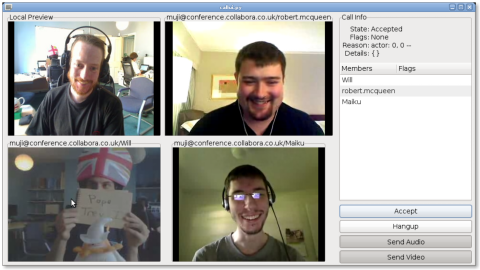
Since some time the good people at NlNet have been sponsoring Collabora to add multi-party audio/video calling to XMPP and do an implementation of this in Telepathy. This project is otherwise known as Muji. This work has resulted in: To proof it actually works, a nice screenshot of the demo client in a 4-way call: 4-way Muji Call The screenshot is featuring myself in Collabora's UK office (top-left), Robert McQueen from a hotelroom in Taipei (top-right), Will Thompson and Magical trevor also from the Collabora UK office (bottom-left) and Mike Ruprecht from somewhere in Missouri. So we were quite spread out over our little planet. Both audio and video quality was quite good, even though the network in robs hotel was a bit flaky from time to time. In case you want to try it out have a look at the MujiDemoClient page.

Next.

Previous.


