Search Results: "tin"

30 April 2021

Chris Lamb: Free software activities in April 2021

Here is my monthly update covering what I have been doing in the free software world during April 2021 (previous month): Reproducible Builds One of the original promises of open source software is that distributed peer review and transparency of process results in enhanced end-user security. However, whilst anyone may inspect the source code of free and open source software for malicious flaws, almost all software today is distributed as pre-compiled binaries. This allows nefarious third-parties to compromise systems by injecting malicious code into ostensibly secure software during the various compilation and distribution processes. The motivation behind the Reproducible Builds effort is to ensure no flaws have been introduced during this compilation process by promising identical results are always generated from a given source, thus allowing multiple third-parties to come to a consensus on whether a build was compromised. The project is proud to be a member project of the Software Freedom Conservancy. Conservancy acts as a corporate umbrella allowing projects to operate as non-profit initiatives without managing their own corporate structure. If you like the work of the Conservancy or the Reproducible Builds project, please consider becoming an official supporter. This month, I:
Debian
Debian Long Term Support (LTS) This month I have worked 18 hours on Debian Long Term Support (LTS) and 12 hours on its sister Extended LTS project: You can find out more about the project via the following video:

Bastian Venthur: Getting the Function keys of a Keychron working on Linux

Having destroyed the third Cherry Stream keyboard in 4 years, I wanted to try a more substantial keyboard for a change. After some research I decided that I want a mechanical, wired, tenkeyless keyboard without any fancy LEDs. At the end I settled for a Keychron C1 with red switches. It meets all requirements, looks very nice and the price is reasonable. Surprise! After the keyboard was delivered, I connected it to my Debian machine and was unpleasantly surprised to notice that the Function-keys did not work at all. The keyboard shares the Multimedia keys with the F-keys and you have an fn key that supposedly switches between the two modes, like you re used to on a laptop. On Linux, however you cannot access the F-keys at all: pressing fn + F1 or F1 makes no difference, you ll always get the Multimedia key. Switching the keyboard between Windows and Mac mode makes no difference either, in both modes the F-keys are not accessible. Apparently Keychron is aware of the problem, because the quick start manual tells you:
We have a Linux user group on facebook. Please search Keychron Linux Group on facebook. So you can better experience with our keyboard.
Customer support at its finest! So at this point you should probably just send the keyboard back, get the refund and buy a proper one with functioning F-keys. The fix Test if this command fixes the issue and enables the Fn + F-key-combos:
# as root:
echo 2 > /sys/module/hid_apple/parameters/fnmode
Depending on the mode the keyboard is in, you should now be able to use the F-keys by simply pressing them, and the Multimedia keys by pressing fn + F-key (or the other way round). To switch the default mode of the F-keys to Function- or Multimedia-mode, press and hold fn + X + L for 4 seconds. If everything works as expected, you can make the change permanent by creating the file /etc/modprobe.d/hid_apple.conf and adding the line:
options hid_apple fnmode=2
This works regardless if the keyboard is in Windows- or Mac-mode, and that might hint at the problem: in both cases the Linux thinks you re connecting a Mac keyboard. The rant Although the fix was not very hard to find and apply, this experience still leaves a foul taste. I naively assumed the problem of having a properly functioning keyboard that simply works when you plug it in, has been thoroughly solved by 2021. To make it worse, I assume Keychron must be aware of the problem because the other Keychron models have the same issue! But instead of fixing it on their end, they forward you to a facebook community and expect you to somehow fix it yourself. So dear Keychron, you do make really beautiful keyboards! But before you release your next model with the same bug, maybe invest a bit on fixing the basics? I see that your keyboards support firmware updates for Windows and Mac maybe you can talk to the folks over at the Linux Vendor Firmware Service and support Linux as well? Maybe you can even fix this annoying bug for the keyboards you ve already sold? I found it really cute that you sent different keycaps for Windows and Mac setups a few disappointed Linux users might accept an apology in form of a Linux cap

Raphaël Hertzog: Freexian s report about Debian Long Term Support, March 2021

A Debian LTS logo
Like each month, have a look at the work funded by Freexian s Debian LTS offering. Debian project funding In March, we put aside 3225 EUR to fund Debian projects but sadly nobody picked up anything, so this one of the many reasons Raphael posted as series of blog posts titled Challenging times for Freexian , posted in 4 parts on the last two days of March and the first two of April. [Part one, two, three and four] So we re still looking forward to receive more projects from various Debian teams! Learn more about the rationale behind this initiative in this article! Debian LTS contributors In March, 11 contributors have been paid to work on Debian LTS, their reports are available: Evolution of the situation In March we released 28 DLAs and held our second LTS team meeting for 2021 on IRC, with the next public IRC meeting coming up at the end of May. At that meeting Holger announced that after 2.5 years he wanted to step back from his role helping Rapha l in coordinating/managing the LTS team. We would like to thank Holger for his continuous work on Debian LTS (which goes back to 2014) and are happy to report that we already found a successor which we will introduce in the upcoming April report from Freexian. Finally, we would like to remark once again that we are constantly looking for new contributors. For a last time, please contact Holger if you are interested! The security tracker currently lists 42 packages with a known CVE and the dla-needed.txt file has 28 packages needing an update. We are also pleased to report that we got 4 new sponsors over the last 2 months : thanks to sipgate GmbH, OVH US LLC, Tilburg University and Observatoire des Sciences de l Univers de Grenoble ! Thanks to our sponsors Sponsors that joined recently are in bold.

Reproducible Builds (diffoscope): diffoscope 173 released

The diffoscope maintainers are pleased to announce the release of diffoscope version 173. This version includes the following changes:
[ Chris Lamb ]
* Add support for showing annotations in PDF files.
  (Closes: reproducible-builds/diffoscope#249)
* Move to assert_diff in test_pdf.py.
[ Zachary T Welch ]
* Difference.__init__: Demote unified_diff argument to a Python "kwarg".
You find out more by visiting the project homepage.

29 April 2021

Anton Gladky: 2021/04, FLOSS activity

LTS This is my second month of working for LTS. I was assigned 12 hrs and worked all of them.

Released DLAs
  1. DLA 2619-1 python3.5_3.5.3-1+deb9u4 CVE-2021-23336 introduced an API-change. It was hard decision to upload this fix, because it can potentially break user s code, if they code uses semicolon as separator. Another option is not to fix it at all, leaving the security issue open. Not the best solution. Also I have fixed the failing autopkgtest, which was introduced in one of latest CVE fixes. CI-pipelines on salsa.d.o are helping now to detect such mistakes.
  2. DLA 2628-1 python2.7_2.7.13-2+deb9u5 CVE-2021-23336 introduced an API-change, same as for python3.5. But the backporting was much harder because python3->2 is not always easy.

CI-pipelines I try to setup for all LTS-packages which I touch CI-pipelines on salsa.d.o. Setting up pipelines for python3.5 and python2.7 was much harder as for other packages. Failing autopkgtests and some other issues. Though it takes at the beginning more time to setup, I believe it improves package quality.

LTS-Meeting I attended the Debian LTS team Jitsi-meeting.

Junichi Uekawa: Setting wake-on-lan in Debian way.

Setting wake-on-lan in Debian way. There's several ways that your network interfaces can be configured. The Debian way is to use ifup/ifdown. Make sure your network is configured with it by checking ifquery. nmcli d and networkctl list are NM and systemd equivalents of commands. After you know which one is managing your device you can go ahead and set up WoL configuration appropriately. Default Debian installation would probably start with a ifup/ifdown config.

Junichi Uekawa: Surrounding a region with Emacs lisp.

Surrounding a region with Emacs lisp. I wanted to surround a region with HTML tags and here's what I learnt today. Specifying "r" in interactive gives two numbers, begin and end. When I want to obtain multiple kinds of values in interactive, I can use newlines to delimit. set-marker is an api to keep a marker at relative position even after edits, API needs making make-marker to create an empty marker first, and seems like the number of markers affects editing speed so the API is made to allow reuse of markers. After I got these going I could now write.

28 April 2021

Antoine Beaupr : Building a status page service with Hugo

The Tor Project now has a status page which shows the state of our major services. You can check status.torprojet.org for news about major outages in Tor services, including v3 and v2 onion services, directory authorities, our website (torproject.org), and the check.torproject.org tool. The status page also displays outages related to Tor internal services, like our GitLab instance. This post documents why we launched status.torproject.org, how the service was built, and how it works.

Why a status page The first step in setting up a service page was to realize we needed one in the first place. I surveyed internal users at the end of 2020 to see what could be improved, and one of the suggestions that came up was to "document downtimes of one hour or longer" and generally improve communications around monitoring. The latter is still on the sysadmin roadmap, but a status page seemed like a good solution for the former. We already have two monitoring tools in the sysadmin team: Icinga (a fork of Nagios) and Prometheus, with Grafana dashboards. But those are hard to understand for users. Worse, they also tend to generate false positives, and don't clearly show users which issues are critical. In the end, a manually curated dashboard provides important usability benefits over an automated system, and all major organisations have one.

Picking the right tool It wasn't my first foray in status page design. In another life, I had setup a status page using a tool called Cachet. That was already a great improvement over the previous solutions, which were to use first a wiki and then a blog to post updates. But Cachet is a complex Laravel app, which also requires a web browser to update. It generally requires more maintenance than what we'd like, needing silly things like a SQL database and PHP web server. So when I found cstate, I was pretty excited. It's basically a theme for the Hugo static site generator, which means that it's a set of HTML, CSS, and a sprinkle of Javascript. And being based on Hugo means that the site is generated from a set of Markdown files and the result is just plain HTML that can be hosted on any web server on the planet.

Deployment At first, I wanted to deploy the site through GitLab CI, but at that time we didn't have GitLab pages set up. Even though we do have GitLab pages set up now, it's not (yet) integrated with our mirroring infrastructure. So, for now, the source is hosted and built in our legacy git and Jenkins services. It is nice to have the content hosted in a git repository: sysadmins can just edit Markdown in the git repository and push to deploy changes, no web browser required. And it's trivial to setup a local environment to preview changes:
hugo serve --baseUrl=http://localhost/
firefox https://localhost:1313/
Only the sysadmin team and gitolite administrators have access to the repository, at this stage, but that could be improved if necessary. Merge requests can also be issued on the GitLab repository and then pushed by authorized personnel later on, naturally.

Availability One of the concerns I have is that the site is hosted inside our normal mirror infrastructure. Naturally, if an outage occurs there, the site goes down. But I figured it's a bridge we'll cross when we get there. Because it's so easy to build the site from scratch, it's actually trivial to host a copy of the site on any GitLab server, thanks to the .gitlab-ci.yml file shipped (but not currently used) in the repository. If push comes to shove, we can just publish the site elsewhere and point DNS there. And, of course, if DNS fails us, then we're in trouble, but that's the situation anyway: we can always register a new domain name for the status page when we need to. It doesn't seem like a priority at the moment. Comments and feedback are welcome!
This article was first published on the Tor Project Blog.

Jonathan McDowell: DeskPi Pro update

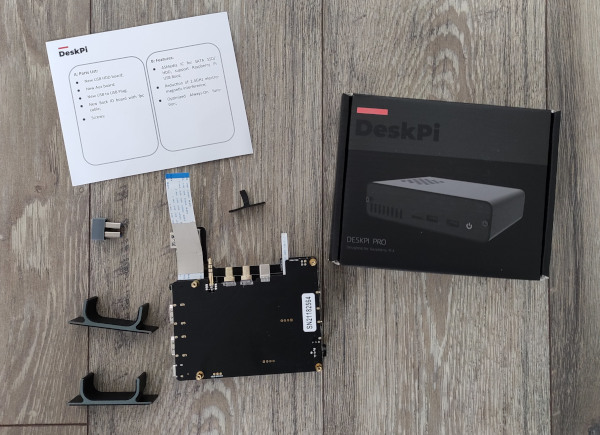
I wrote previously about my DeskPi Pro + 8GB Pi 4 setup. My main complaint at the time was the fact one of the forward facing USB ports broke off early on in my testing. For day to day use that hasn t been a problem, but it did mar the whole experience. Last week I received an unexpected email telling me The new updated PCB Board for your DeskPi order was shipped. . Apparently this was due to problems with identifying SSDs and WiFi/HDMI issues. I wasn t quite sure how much of the internals they d be replacing, so I was pleasantly surprised when it turned out to be most of them; including the PCB with the broken USB port on my device. DeskPi Pro replacement PCB They also provided a set of feet allowing for vertical mounting of the device, which was a nice touch. The USB/SATA bridge chip in use has changed; the original was:
usb 2-1: New USB device found, idVendor=152d, idProduct=0562, bcdDevice= 1.09
usb 2-1: New USB device strings: Mfr=1, Product=2, SerialNumber=3
usb 2-1: Product: RPi_SSD
usb 2-1: Manufacturer: 52Pi
usb 2-1: SerialNumber: DD5641988389F
and the new one is:
usb 2-1: New USB device found, idVendor=174c, idProduct=1153, bcdDevice= 0.01
usb 2-1: New USB device strings: Mfr=2, Product=3, SerialNumber=1
usb 2-1: Product: AS2115
usb 2-1: Manufacturer: ASMedia
usb 2-1: SerialNumber: 00000000000000000000
That s a move from a JMicron 6Gb/s bridge to an ASMedia 3Gb/s bridge. It seems there are compatibility issues with the JMicron that mean the downgrade is the preferred choice. I haven t retried the original SSD I wanted to use (that wasn t detected), but I did wonder if this might have resolved that issue too. Replacing the PCB was easier than the original install; everything was provided pre-assembled and I just had to unscrew the Pi4 and slot it out, then screw it into the new PCB assembly. Everything booted fine without the need for any configuration tweaks. Nice and dull. I ve tried plugging things into the new USB ports and they seem ok so far as well. However I also then ended up pulling in a new backports kernel from Debian (upgrading from 5.9 to 5.10) which resulted in a failure to boot. The kernel and initramfs were loaded fine, but no login prompt ever appeared. Some digging led to the discovery that a change in boot ordering meant USB was not being enabled. The solution is to add reset_raspberrypi to the /etc/initramfs-tools/modules file - that way this module is available in the initramfs, the appropriate pre-USB reset can happen and everything works just fine again. The other niggle with the new kernel was a regular set of errors in the kernel log:
mmc1: Timeout waiting for hardware cmd interrupt.
mmc1: sdhci: ============ SDHCI REGISTER DUMP ===========
and a set of registers afterwards, roughly every 10s or so. This seems to be fallout from an increase in the core clock due to the VC4 driver now being enabled, the fact I have no SD card in the device and a lack of working card-detect line for the MicroSD slot. There s a GitHub issue but I solved it by removing the sdhci_iproc for now - I m not using the wifi so loss of MMC isn t a problem. Credit to DeskPi for how they handled this. I didn t have to do anything and didn t even realise anything was happening until I got the email with my tracking number and a description of what they were sending out in it. Delivery took less than a week. This is a great example of how to handle a product issue - no effort required on the part of the customer.

Martin Michlmayr: Research on FOSS foundations

I worked on research on FOSS foundations and published two reports: Growing Open Source Projects with a Stable Foundation This primer covers non-technical aspects that the majority of projects will have to consider at some point. It also explains how FOSS foundations can help projects grow and succeed. This primer explains: You can download Growing Open Source Projects with a Stable Foundation. Research report The research report describes the findings of the research and aims to help understand the operations and challenges FOSS foundations face. This report covers topics such as: You can download the research report. Acknowledgments This research was sponsored by Ford Foundation and Alfred P. Sloan Foundation. The research was part of their Critical Digital Infrastructure Research initiative, which investigates the role of open source in digital infrastructure.

Russell Coker: Links April 2021

Dr Justin Lehmiller s blog post comparing his official (academic style) and real biographies is interesting [1]. Also the rest of his blog is interesting too, he works at the Kinsey Institute so you know he s good. Media Matters has an interesting article on the spread of vaccine misinformation on Instagram [2]. John Goerzen wrote a long post summarising some of the many ways of having a decentralised Internet [3]. One problem he didn t address is how to choose between them, I could spend months of work to setup a fraction of those services. Erasmo Acosta wrote an interesting medium article Could Something as Pedestrian as the Mitochondria Unlock the Mystery of the Great Silence? [4]. I don t know enough about biology to determine how plausible this is. But it is a worry, I hope that humans will meet extra-terrestrial intelligences at some future time. Meredith Haggerty wrote an insightful Medium article about the love vs money aspects of romantic comedies [5]. Changes in viewer demographics would be one factor that makes lead actors in romantic movies significantly less wealthy in recent times. Informative article about ZIP compression and the history of compression in general [6]. Vice has an insightful article about one way of taking over SMS access of phones without affecting voice call or data access [7]. With this method the victom won t notice that they are having their sservice interfered with until it s way too late. They also explain the chain of problems in the US telecommunications industry that led to this. I wonder what s happening in this regard in other parts of the world. The clown code of ethics (8 Commandments) is interesting [8]. Sam Hartman wrote an insightful blog post about the problems with RMS and how to deal with him [9]. Also Sam Whitton has an interesting take on this [10]. Another insightful post is by Selam G about RMS long history of bad behavior and the way universities are run [11]. Cory Doctorow wrote an insightful article for Locus about free markets with a focus on DRM on audio books [12]. We need legislative changes to fix this!

Russ Allbery: Review: Beyond Shame

Review: Beyond Shame, by Kit Rocha
Series: Beyond #1
Publisher: Kit Rocha
Copyright: December 2013
ASIN: B00GIA4GN8
Format: Kindle
Pages: 270
I read this book as part of the Beyond Series Bundle (Books 1-3), which is what the sidebar information is for. Noelle is a child of Eden, the rich and technologically powerful city of a post-apocalyptic world. As the daughter of a councilman, she had everything she wanted except the opportunity to feel. Eden's religious elite embrace a doctrine of strict Puritanism: Even hugging one's children was frowned upon, let alone anything related to sex. Noelle was too rebellious to settle for that, which is why this book opens with her banished from Eden, ejected into Sector Four. The sectors are the city slums, full of gangs and degenerates and violence, only a slight step up from the horrific farming communes. Luckily for her, she literally stumbles into one of the lieutenants of the O'Kane gang, who are just as violent as their reputations but who have surprising sympathy for a helpless city girl. My shorthand distinction between romance and erotica is that romance mixes some sex into the plot and erotica mixes some plot into the sex. Beyond Shame is erotica, specifically BDSM erotica. The forbidden sensations that Noelle got kicked out of Eden for pursuing run strongly towards humiliation, which is tangled up in the shame she was taught to feel about anything sexual. There is a bit of a plot surrounding the O'Kanes who take her in, their leader, some political skulduggery that eventually involves people she knows, and some inter-sector gang warfare, but it's quite forgettable (and indeed I've already forgotten most of it). The point of the story is Noelle navigating a relationship with Jasper (among others) that involves a lot of very graphic sex. I was of two minds about reviewing this. Erotica is tricky to review, since to an extent it's not trying to do what most books are doing. The point is less to tell a coherent story (although that can be a bonus) than it is to turn the reader on, and what turns the reader on is absurdly personal and unpredictable. Erotica is arguably more usefully marked with story codes (which in this case would be something like MF, MMFF, FF, Mdom, Fdom, bd, ds, rom, cons, exhib, humil, tattoos) so that the reader has an idea whether the scenarios in the story are the sort of thing they find hot. This is particularly true of BDSM erotica, since the point is arousal from situations that wouldn't work or might be downright horrifying in a different sort of book. Often the forbidden or taboo nature of the scene is why it's erotic. For example, in another genre I would complain about the exaggerated and quite sexist gender roles, where all the men are hulking cage fighters who want to control the women, but in male-dominant BDSM erotica that's literally the point. As you can tell, I wrote a review anyway, primarily because of how I came to read this book. Kit Rocha (which is a pseudonym for the writing team of Donna Herren and Bree Bridges) recently published Deal with the Devil, a book about mercenary librarians in a post-apocalyptic future. Like every right-thinking person, I immediately wanted to read a book about mercenary librarians, but discovered that it was set in an existing universe. I hate not starting at the beginning of things, so even though there was probably no need to read the earlier books first, I figured out Beyond Shame was the first in this universe and the bundle of the first three books was only $2. If any of you are immediately hooked by mercenary librarians but are back-story completionists, now you know what you'll be getting into. That said, there are a few notable things about this book other than it has a lot of sex. The pivot of the romantic relationship was more interesting and subtle than most erotica. Noelle desperately wants a man to do all sorts of forbidden things to her, but she starts the book unable to explain or analyze why she wants what she wants, and both Jasper and the story are uncomfortable with that and unwilling to leave it alone. Noelle builds up a more coherent theory of herself over the course of the book, and while it's one that's obviously designed to enable lots of erotic scenes, it's not a bad bit of character development. Even better is Lex, the partner (sort of) of the leader of the O'Kane gang and by far the best character in the book. She takes Noelle under her wing from the start, and while that relationship is sexualized like nearly everything in this book, it also turns into an interesting female friendship that I would have also enjoyed in a different genre. I liked Lex a lot, and the fact she's the protagonist of the next book might keep me reading. Beyond Shame also has a lot more female gaze descriptions of the men than is often the case in male-dominant BDSM. The eye candy is fairly evenly distributed, although the gender roles are very much not. It even passes the Bechdel test, although it is still erotica and nearly all the conversations end up being about sex partners or sex eventually. I was less fond of the fact that the men are all dangerous and violent and the O'Kane leader frequently acts like a controlling, abusive psychopath. A lot of that was probably the BDSM setup, but it was not my thing. Be warned that this is the sort of book in which one of the (arguably) good guys tortures someone to death (albeit off camera). Recommendations are next to impossible for erotica, so I won't try to give one. If you want to read the mercenary librarian novel and are dubious about this one, it sounds like (although I can't confirm) that it's a bit more on the romance end of things and involves a lot fewer group orgies. Having read this book, I suspect it was entirely unnecessary to have done so for back-story. If you are looking for male-dominant BDSM, Beyond Shame is competently written, has a more thoughtful story than most, and has a female friendship that I fully enjoyed, which may raise it above the pack. Rating: 6 out of 10

26 April 2021

Steve Kemp: Writing a text-based adventure game for CP/M

In my previous post I wrote about how I'd been running CP/M on a Z80-based single-board computer. I've been slowly working my way through a bunch of text-based adventure games: Along the way I remembered how much fun I used to have doing this in my early teens, and decided to write my own text-based adventure. Since I'm not a masochist I figured I'd write something with only three or four locations, and solicited facebook for ideas. Shortly afterwards a "plot" was created and I started work. I figured that the very last thing I wanted to be doing was to be parsing text-input with Z80 assembly language, so I hacked up a simple adventure game in C. I figured if I could get the design right that would ease the eventual port to assembly. I had the realization pretty early that using a table-driven approach would be the best way - using structures to contain the name, description, and function-pointers appropriate to each object for example. In my C implementation I have things that look like this:
 name: "generator",
 desc: "A small generator.",
 use: use_generator,
 use_carried: use_generator_carried,
 get_fn: get_generator,
 drop_fn: drop_generator ,
A bit noisy, but simple enough. If an object cannot be picked up, or dropped, the corresponding entries are blank:
 name: "desk",
 desc: "",
 edesc: "The desk looks solid, but old." ,
Here we see something that is special, there's no description so the item isn't displayed when you enter a room, or LOOK. Instead the edesc (extended description) is available when you type EXAMINE DESK. Anyway over a couple of days I hacked up the C-game, then I started work porting it to Z80 assembly. The implementation changed, the easter-eggs were different, but on the whole the two things are the same. Certainly 99% of the text was recycled across the two implementations. Anyway in the unlikely event you've got a craving for a text-based adventure game I present to you:

Vishal Gupta: Ramblings // On Sikkim and Backpacking

What I loved the most about Sikkim can t be captured on cameras. It can t be taped since it would be intrusive and it can t be replicated because it s unique and impromptu. It could be described, as I attempt to, but more importantly, it s something that you simply have to experience to know. Now I first heard about this from a friend who claimed he d been offered free rides and Tropicanas by locals after finishing the Ladakh Marathon. And then I found Ronnie s song, whose chorus goes : Dil hai pahadi, thoda anadi. Par duniya ke maya mein phasta nahi (My heart belongs to the mountains. Although a little childish, it doesn t get hindered by materialism). While the song refers his life in Manali, I think this holds true for most Himalayan states. Maybe it s the pleasant weather, the proximity to nature, the sense of safety from Indian Army being round the corner, independence from material pleasures that aren t available in remote areas or the absence of the pollution, commercialisation, & cutthroat-ness of cities, I don t know, there s just something that makes people in the mountains a lot kinder, more generous, more open and just more alive. Sikkimese people, are honestly some of the nicest people I ve ever met. The blend of Lepchas, Bhutias and the humility and the truthfulness Buddhism ingrains in its disciples is one that ll make you fall in love with Sikkim (assuming the views, the snow, the fab weather and food, leave you pining for more). As a product of Indian parenting, I ve always been taught to be wary of the unknown and to stick to the safer, more-travelled path but to be honest, I enjoy bonding with strangers. To me, each person is a storybook waiting to be flipped open with the right questions and the further I get from home, the wilder the stories get. Besides there s something oddly magical about two arbitrary curvilinear lines briefly running parallel until they diverge to move on to their respective paths. And I think our society has been so busy drawing lines and spreading hate that we forget that in the end, we re all just lines on the universe s infinite canvas. So the next time you travel, and you re in a taxi, a hostel, a bar, a supermarket, or on a long walk to a monastery (that you re secretly wishing is open despite a lockdown), strike up a conversation with a stranger. Small-talk can go a long way.
Header icon made by Freepik from www.flaticon.com

25 April 2021

Junichi Uekawa: Got a new machine Lenovo ThinkCenter M75s gen2, and installed Debian on it.

Got a new machine Lenovo ThinkCenter M75s gen2, and installed Debian on it. I wanted to try out the ryzen CPU. I haven't used a physical x86-64 Debian desktop machine since I threw away my Athlon 64 machine (dx5150), so that's like 15 years? Since then my main devices were macbooks and virtual machines (on GCE and Sakura) and raspberry pi. I got buster installed just fine. Finding the right keystrokes after boot was challenging because the graphical UI doesn't say anything. For BIOS set up to disable secure boot (F1 to enter set up: I wanted to play with kernel) and finding the keystroke to choose the boot disk (F10 to enter the dialog; I needed to choose the one labeled USB CD drive although I put in a USB SD card reader with installer image). The installation went fine for console, but getting X up was tricky, the support for the graphics (Renoir) part of the chip was added in kernel 5.5. Bullseye was 4.19 and I wasn't too comfortable with just updating the kernel. I ended up going for dist-upgrade to Bullseye. With Bullseye default kernel 5.10, X started without problems. So far I only tried out Emacs.

Russell Coker: Scanning with a MFC-9120CN on Bullseye

I previously wrote about getting a Brother MFC-9120CN multifunction printer/scanner to print on Linux [1]. I had also got it scanning which I didn t blog about.
found USB scanner (vendor=0x04f9, product=0x021d) at libusb:003:002
I recently upgraded that Linux system to Debian/Testing (which will soon be released as Debian/Bullseye) and scanning broke. The command sane-find-scanner would find the USB connected scanner (with the above output), but scanimage -L didn t. It turned out that I had to edit /etc/sane.d/dll.d/hplip which had a single uncommented line of hpaio and replace that with brother3 to make SANE load the driver /usr/lib64/sane/libsane-brother3.so from the brscan3 package (which Brother provided from their web site years ago). I have the following script to do the scanning (which can run as non-root):
#!/bin/bash
set -e
if [ "$1" == "" ]; then
  echo "specify output filename"
  exit 1
fi
TMP=$(mktemp)
scanimage > $TMP
convert $TMP $1
rm $TMP
Final Note This blog post doesn t describe everything that needs to be done to setup a scanner, I already had part of it setup from 10 years ago. But for anyone who finds this after having trouble, /etc/sane.d/dll.d is one place you should look for important configuration (especially if sane-find-scanner works and scanimage -L fails). Also the Brother drivers are handy to have although I apparently had it working in the past with the hpaio driver from HP (the Brother device emulates a HP device).

Russ Allbery: Review: Learning React

Review: Learning React, by Alex Banks & Eve Porcello
Publisher: O'Reilly
Copyright: June 2020
ISBN: 1-4920-5172-1
Format: Trade paperback
Pages: 287
My first JavaScript project was a React frontend to a REST service. As part of that project, I read two books: JavaScript: The Definitive Guide to learn the language foundation and this book to learn the framework on top of it. This was an unintentional experiment in the ways programming books can approach the topic. I commented in my review of JavaScript: the Definitive Guide that it takes the reference manual approach to the language. Learning React is the exact opposite. It's goal-driven, example-heavy, and has a problem and solution structure. The authors present a sample application, describe some desired new feature or deficiency in it, and then introduce the specific React technique that solves that problem. There is some rewriting of previous examples using more sophisticated techniques, but most chapters introduce new toy applications along with new parts of the React framework. The best part of this book is its narrative momentum, so I think the authors were successful at their primary goal. The first eight chapters of the book (more on the rest of the book in a moment) feel like a whirlwind tour where one concept flows naturally into the next and one's questions while reading about one technique are often answered in the next section. I thought the authors tried too hard in places and overdid the enthusiasm, but it's very readable in a way that I think may appeal to people who normally find programming books dry. Learning React is also firm and definitive about the correct way to use React, which may appeal to readers who only want to learn the preferred way of using the framework. (For example, React class components are mentioned briefly, mostly to tell the reader not to use them, and the rest of the book only uses functional components.) I had two major problems with this book, however. The first is that this breezy, narrative style turns out to be awful when one tries to use it as a reference. I read through most of this book with both enjoyment and curiosity, sat down to write a React component, and immediately struggled to locate the information I needed. Everything felt logically connected when I was focusing on the problems the authors introduced, but as soon as I started from my own problem, the structure of the book fell apart. I had to page through chapters to locate some nugget buried in the text, or re-read sections of the book to piece together which motivating problem my code was most similar to. It was a frustrating experience. This may be a matter of learning style, since this is why I prefer programming books with a reference structure. But be warned that I can't recommend this book as a reference while you're programming, nor does it prepare you to use the official React documentation as a reference. The second problem is less explicable and less defensible. I don't know what happened with O'Reilly's copy-editing for this book, but the code snippets are a train wreck. The Amazon reviews are full of people complaining about typos, syntax errors, omitted code, and glaring logical flaws, and they are entirely correct. It's so bad that I was left wondering if a very early, untested draft of the examples was somehow substituted into the book at the last minute by mistake. I'm not the sort of person who normally types code in from a book, so I don't care about a few typos or obvious misprints as long as the general shape is correct. The general shape was not correct. In a few places, the code is so completely wrong and incomplete that even combined with the surrounding text I was unable to figure out what it was supposed to be. It's possible this is fixed in a later printing (I read the June 2020 printing of the second edition), but otherwise beware. The authors do include a link to a GitHub repository of the code samples, which are significantly different than what's printed in the book, but that repository is incomplete; many of the later chapter examples are only links to JavaScript web sandboxes, which bodes poorly for the longevity of the example code. And then there's chapter nine of this book, which I found entirely baffling. This is a direct quote from the start of the chapter:
This is the least important chapter in this book. At least, that's what we've been told by the React team. They didn't specifically say, "this is the least important chapter, don't write it." They've only issued a series of tweets warning educators and evangelists that much of their work in this area will very soon be outdated. All of this will change.
This chapter is on suspense and error boundaries, with a brief mention of Fiber. I have no idea what I'm supposed to do with this material as a reader who is new to React (and thus presumably the target audience). Should I use this feature? When? Why is this material in the book at all when it's so laden with weird stream-of-consciousness disclaimers? It's a thoroughly odd editorial choice. The testing chapter was similarly disappointing in that it didn't answer any of my concrete questions about testing. My instinct with testing UIs is to break out Selenium and do integration testing with its backend, but the authors are huge fans of unit testing of React applications. Great, I thought, this should be interesting; unit testing seems like a poor fit for UI code because of how artificial the test construction is, but maybe I'm missing some subtlety. Convince me! And then the authors... didn't even attempt to convince me. They just asserted unit testing is great and explained how to write trivial unit tests that serve no useful purpose in a real application. End of chapter. Sigh. I'm not sure what to say about this book. I feel like it has so many serious problems that I should warn everyone away from it, and yet the narrative introduction to React was truly fun to read and got me excited about writing React code. Even though the book largely fell apart as a reference, I still managed to write a working application using it as my primary reference, so it's not all bad. If you like the problem and solution style and want a highly conversational and informal tone (that errs on the side of weird breeziness), this may still be the book for you. Just be aware that the code examples are a trash fire, so if you learn from examples, you're going to have to chase them down via the GitHub repository and hope that they still exist (or get a later edition of the book where this problem has hopefully been corrected). Rating: 6 out of 10

Antoine Beaupr : Lost article ideas

I wrote for LWN for about two years. During that time, I wrote (what seems to me an impressive) 34 articles, but I always had a pile of ideas in the back of my mind. Those are ideas, notes, and scribbles lying around. Some were just completely abandoned because they didn't seem a good fit for LWN. Concretely, I stored those in branches in a git repository, and used the branch name (and, naively, the last commit log) as indicators of the topic. This was the state of affairs when I left:
remotes/private/attic/novena                    822ca2bb add letter i sent to novena, never published
remotes/private/attic/secureboot                de09d82b quick review, add note and graph
remotes/private/attic/wireguard                 5c5340d1 wireguard review, tutorial and comparison with alternatives
remotes/private/backlog/dat                     914c5edf Merge branch 'master' into backlog/dat
remotes/private/backlog/packet                  9b2c6d1a ham radio packet innovations and primer
remotes/private/backlog/performance-tweaks      dcf02676 config notes for http2
remotes/private/backlog/serverless              9fce6484 postponed until kubecon europe
remotes/private/fin/cost-of-hosting             00d8e499 cost-of-hosting article online
remotes/private/fin/kubecon                     f4fd7df2 remove published or spun off articles
remotes/private/fin/kubecon-overview            21fae984 publish kubecon overview article
remotes/private/fin/kubecon2018                 1edc5ec8 add series
remotes/private/fin/netconf                     3f4b7ece publish the netconf articles
remotes/private/fin/netdev                      6ee66559 publish articles from netdev 2.2
remotes/private/fin/pgp-offline                 f841deed pgp offline branch ready for publication
remotes/private/fin/primes                      c7e5b912 publish the ROCA paper
remotes/private/fin/runtimes                    4bee1d70 prepare publication of runtimes articles
remotes/private/fin/token-benchmarks            5a363992 regenerate timestamp automatically
remotes/private/ideas/astropy                   95d53152 astropy or python in astronomy
remotes/private/ideas/avaneya                   20a6d149 crowdfunded blade-runner-themed GPLv3 simcity-like simulator
remotes/private/ideas/backups-benchmarks        fe2f1f13 review of backup software through performance and features
remotes/private/ideas/cumin                     7bed3945 review of the cumin automation tool from WM foundation
remotes/private/ideas/future-of-distros         d086ca0d modern packaging problems and complex apps
remotes/private/ideas/on-dying                  a92ad23f another dying thing
remotes/private/ideas/openpgp-discovery         8f2782f0 openpgp discovery mechanisms (WKD, etc), thanks to jonas meurer
remotes/private/ideas/password-bench            451602c0 bruteforce estimates for various password patterns compared with RSA key sizes
remotes/private/ideas/prometheus-openmetrics    2568dbd6 openmetrics standardizing prom metrics enpoints
remotes/private/ideas/telling-time              f3c24a53 another way of telling time
remotes/private/ideas/wallabako                 4f44c5da talk about wallabako, read-it-later + kobo hacking
remotes/private/stalled/bench-bench-bench       8cef0504 benchmarking http benchmarking tools
remotes/private/stalled/debian-survey-democracy 909bdc98 free software surveys and debian democracy, volunteer vs paid work
Wow, what a mess! Let's see if I can make sense of this:

Attic Those are articles that I thought about, then finally rejected, either because it didn't seem worth it, or my editors rejected it, or I just moved on:
  • novena: the project is ooold now, didn't seem to fit a LWN article. it was basically "how can i build my novena now" and "you guys rock!" it seems like the MNT Reform is the brain child of the Novena now, and I dare say it's even cooler!
  • secureboot: my LWN editors were critical of my approach, and probably rightly so - it's a really complex subject and I was probably out of my depth... it's also out of date now, we did manage secureboot in Debian
  • wireguard: LWN ended up writing extensive coverage, and I was biased against Donenfeld because of conflicts in a previous project

Backlog Those were articles I was planning to write about next.
  • dat: I already had written Sharing and archiving data sets with Dat, but it seems I had more to say... mostly performance issues, beaker, no streaming, limited adoption... to be investigated, I guess?
  • packet: a primer on data communications over ham radio, and the cool new tech that has emerged in the free software world. those are mainly notes about Pat, Direwolf, APRS and so on... just never got around to making sense of it or really using the tech...
  • performance-tweaks: "optimizing websites at the age of http2", the unwritten story of the optimization of this website with HTTP/2 and friends
  • serverless: god. one of the leftover topics at Kubecon, my notes on this were thin, and the actual subject, possibly even thinner... the only lie worse than the cloud is that there's no server at all! concretely, that's a pile of notes about Kubecon which I wanted to sort through. Probably belongs in the attic now.

Fin Those are finished articles, they were published on my website and LWN, but the branches were kept because previous drafts had private notes that should not be published.

Ideas A lot of those branches were actually just an empty commit, with the commitlog being the "pitch", more or less. I'd send that list to my editors, sometimes with a few more links (basically the above), and they would nudge me one way or the other. Sometimes they would actively discourage me to write about something, and I would do it anyways, send them a draft, and they would patiently make me rewrite it until it was a decent article. This was especially hard with the terminal emulator series, which took forever to write and even got my editors upset when they realized I had never installed Fedora (I ended up installing it, and I was proven wrong!)

Stalled Oh, and then there's those: those are either "ideas" or "backlog" that got so far behind that I just moved them out of the way because I was tired of seeing them in my list.
  • stalled/bench-bench-bench benchmarking http benchmarking tools, a horrible mess of links, copy-paste from terminals, and ideas about benchmarking... some of this trickled out into this benchmarking guide at Tor, but not much more than the list of tools
  • stalled/debian-survey-democracy: "free software surveys and Debian democracy, volunteer vs paid work"... A long standing concern of mine is that all Debian work is supposed to be volunteer, and paying explicitly for work inside Debian has traditionally been frowned upon, even leading to serious drama and dissent (remember Dunc-Tank)? back when I was writing for LWN, I was also doing paid work for Debian LTS. I also learned that a lot (most?) Debian Developers were actually being paid by their job to work on Debian. So I was confused by this apparent contradiction, especially given how the LTS project has been mostly accepted, while Dunc-Tank was not... See also this talk at Debconf 16. I had hopes that this study would show the "hunch" people have offered (that most DDs are paid to work on Debian) but it seems to show the reverse (only 36% of DDs, and 18% of all respondents paid). So I am still confused and worried about the sustainability of Debian.

What do you think? So that's all I got. As people might have noticed here, I have much less time to write these days, but if there's any subject in there I should pick, what is the one that you would find most interesting? Oh! and I should mention that you can write to LWN! If you think people should know more about some Linux thing, you can get paid to write for it! Pitch it to the editors, they won't bite. The worst that can happen is that they say "yes" and there goes two years of your life learning to write. Because no, you don't know how to write, no one does. You need an editor to write. That's why this article looks like crap and has a smiley. :)

24 April 2021

Gunnar Wolf: FLISOL Talking about Jitsi

Every year since 2005 there is a very good, big and interesting Latin American gathering of free-software-minded people. Of course, Latin America is a big, big, big place, and it s not like we are the most economically buoyant region to meet in something equiparable to FOSDEM. What we have is a distributed free software conference originally, a distributed Linux install-fest (which I never liked, I am against install-fests), but gradually it morphed into a proper conference: Festival Latinoamericano de Instalaci n de Software Libre (Latin American Free Software Installation Festival) This FLISOL was hosted by the always great and always interesting Rancho Electr nico, our favorite local hacklab, and has many other interesting talks. I like talking about projects where I am involved as a developer but this time I decided to do otherwise: I presented a talk on the Jitsi videoconferencing server. Why? Because of the relevance videoconferences have had over the last year. So, without further ado Here is a video I recorded locally from the talk I gave (MKV), as well as the slides (PDF).

Antoine Beaupr : A dead game clock

Time flies. Back in 2008, I wrote a game clock. Since then, what was first called "chess clock" was renamed to pychessclock and then Gameclock (2008). It shipped with Debian 6 squeeze (2011), 7 wheezy (4.0, 2013, with a new UI), 8 jessie (5.0, 2015, with a code cleanup, translation, go timers), 9 stretch (2017), and 10 buster (2019), phew! Eight years in Debian over 4 releases, not bad! But alas, Debian 11 bullseye (2021) won't ship with Gameclock because both Python 2 and GTK 2 were removed from Debian. I lack the time, interest, and energy to port this program. Even if I could find the time, everyone is on their phone nowadays. So finding the right toolkit would require some serious thinking about how to make a portable program that can run on Linux and Android. I care less about Mac, iOS, and Windows, but, interestingly, it feels it wouldn't be much harder to cover those as well if I hit both Linux and Android (which is already hard enough, paradoxically). (And before you ask, no, Java is not an option for me thanks. If I switch to anything else than Python, it would be Golang or Rust. And I did look at some toolkit options a few years ago, was excited by none.) So there you have it: that is how software dies, I guess. Alternatives include: PS: Monkeysign also suffered the same fate, for what that's worth. Alternatives include caff, GNOME Keysign, and pius. Note that this does not affect the larger Monkeysphere project, which will ship with Debian bullseye.

Next.

Previous.