Search Results: "ed"

14 November 2021

Ruby Team: Ruby transition and packaging hints #2 - Gemfile.lock created by bundler/setup with Ruby 2.7 preventing successful test with Ruby 3.0

We currently face an issue in all packages requiring bunlder/setup and trying to run the tests for Ruby 2.7 and 3.0. The problem is that the first tests will create Gemfile.lock (or gemfile/gemfile-*.lock) using Ruby 2.7 and the next run for Ruby 3 will report e.g.:
Failure/Error: require 'bundler/setup' # Set up gems listed in the Gemfile.
Bundler::GemNotFound:
  Could not find racc-1.4.16 in any of the sources
or
/usr/share/rubygems-integration/all/gems/bundler-2.2.27/lib/bundler/definition.rb:496:in  materialize':
  Could not find rexml-3.2.3.1 in any of the sources (Bundler::GemNotFound)
Both bugs #996207 and #996302 are incarnations of this issue. The fix is as easy as making sure that the .lock files are removed before each run. This can be done in e.g. debian/ruby-tests.rake as very first task:
File.delete("Gemfile.lock") if File.exist?("Gemfile.lock")
In another case the .lock file is created by the tests in gemfiles/. While the first examples could actually be solved by gem2deb removing Gemfile.lock on its own, I m not quite sure how to handle the last case using packaging tools. The interesting part is that we will unlikely be confronted with this issue anytime soon again. It seems very specific to the Ruby 3.0 transition.
Update After talking to Antonio he added some code to gem2deb-test-runner to moving Gemfile.lock files out of the way. The tool already did this in an autopkgtest environment. In the upcoming 1.7 release it will do it in general and this will fix some more FTBFSes, e.g. #998497 and #996141 - originally reported against ruby-voight-kampff and ruby-bootsnap.

13 November 2021

Ruby Team: Ruby transition and packaging hints #1 - Adjusting Ruby version in commands

This is the first part of a series of short posts about issues that came up during the Ruby 3.0 transition and how to fix them. Hopefully more team members will join in and add their input. During the Ruby 3.0 transition there are essentially two different Ruby versions with two different binaries available, /usr/bin/ruby2.7 and /usr/bin/ruby3.0, while /usr/bin/ruby points to the current default version, which is Ruby 2.7. In some cases the tests shipped by the source packages will use shell commands to run scripts or Ruby code. It is imparative that in these cases the Ruby executable is not invoked by /usr/bin/ruby or ruby, because this will point to Ruby 2.7 only and fail if the tests are invoked with Ruby version 3. The fix is to rely on RbConfig.ruby which will point to the absolute pathname of the ruby command for the current Ruby environment, e.g.
cmd = "# RbConfig.ruby  ..."
This issue appeard for example in ruby-byebug and ruby-backports.

Ruby Team: Ruby Team Sprint 2020 in Paris - Day Four

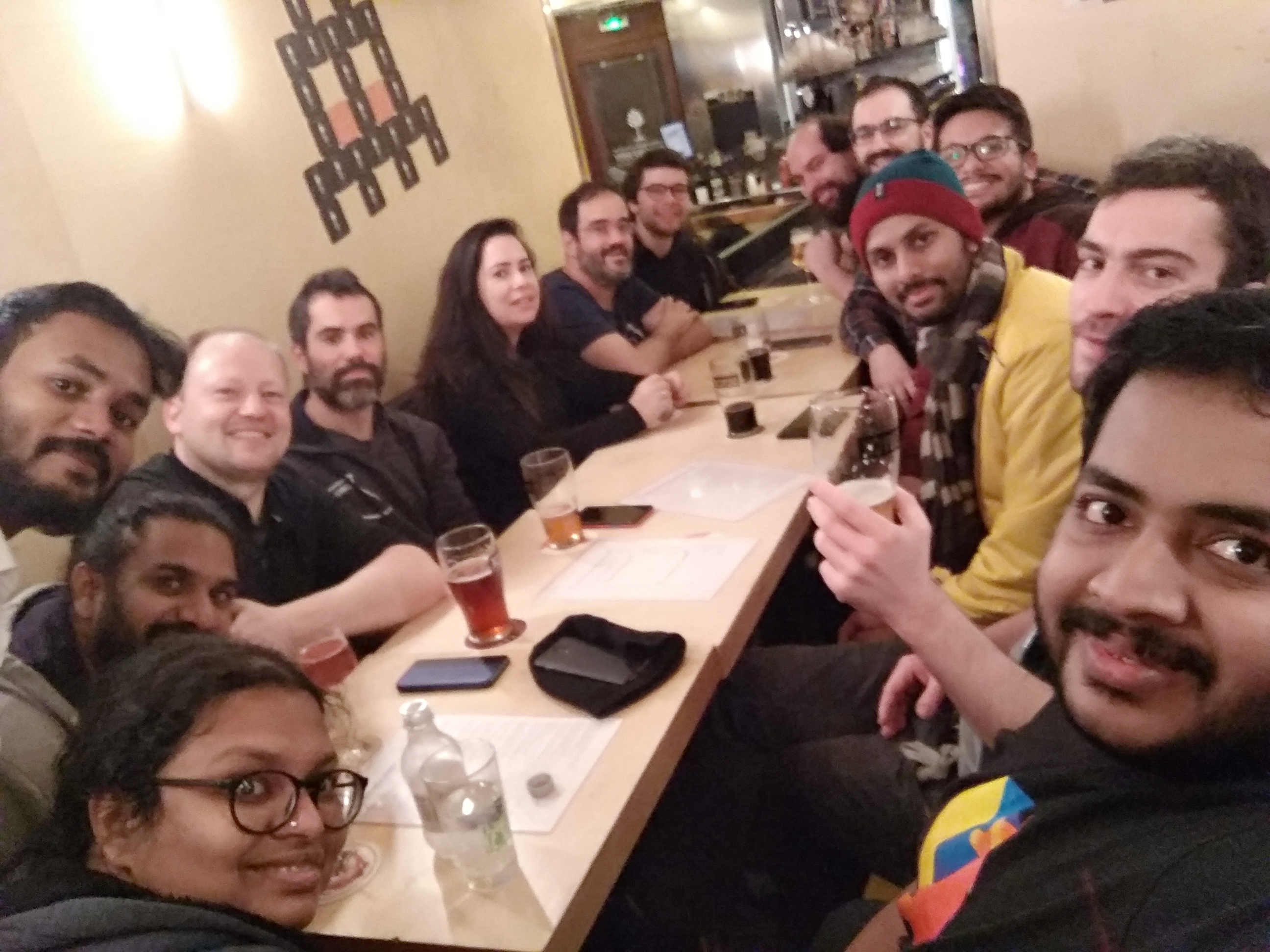
On day four the transition to Ruby 2.7 and Rails 6 went on. Minor transitions took place too, for example the upload of ruby-faraday 1.0 or the upload of bundler 2.1 featuring the (first) contributions by bundler s upstream Deivid (yeah!). Further Red Hat s (and Debian s) Marc Dequ nes (Duck) joined us. We are proud to report, that updating and/or uploading the Kali packages is almost done. Most are in NEW or have already been accepted. The Release team was contacted to start the Ruby 2.7 transition and we already have a transition page. However, the Python 3.8 one is ongoing (almost finished) and the Release team does not want overlaps. So hopefully we can upload ruby-defaults to Debian Unstable soon. In the evening we got together for a well earned collective drink at Brewberry Bar and dinner, joined by local Debian colleague Nicolas Dandrimont (olasd).
Group photo of the Ruby Team in Brewbarry Bar, Paris Group photo of the Ruby Team in Brewberry Bar (Paris 2020)
The evening ended at Paris famous (but heavily damaged) Notre-Dame cathedral.

John Goerzen: Managing an External Display on Linux Shouldn t Be This Hard

I first started using Linux and FreeBSD on laptops in the late 1990s. Back then, there were all sorts of hassles and problems, from hangs on suspend to pure failure to boot. I still worry a bit about suspend on unknown hardware, but by and large, the picture of Linux on laptops has dramatically improved over the last years. So much so that now I can complain about what would once have been a minor nit: dealing with external monitors. I have a USB-C dock that provides both power and a Thunderbolt display output over the single cable to the laptop. I think I am similar to most people in wanting the following behavior from the laptop: This sounds so simple. But somehow on Linux we ve split up these things into a dozen tiny bits: Problems I ve Seen My problems don t even begin with laptops, but with my desktop, running XFCE with xmonad and lightdm. My desktop is hooked to a display that has multiple inputs. This scenario (reproducible in both buster and bullseye) causes the display to be unusable until a reboot on the desktop:
  1. Be logged in and using the desktop
  2. Without locking the desktop screen, switch the display input to another device
  3. Keep the display input on another device long enough for the desktop screen to auto-lock
  4. At this point, it is impossible to re-awaken the desktop screen.
I should not here that the problems aren t limited to Debian, but also extend to Ubuntu and various hardware. Lightdm: which greeter? At some point while troubleshooting things after upgrading my laptop to bullseye, I noticed that while both were running lightdm, I had different settings and a different appearance between the two. Upon further investigation, I realized that one hat slick-greeter and lightdm-settings installed, while the other had lightdm-gtk-greeter and lightdm-gtk-greeter-settings installed. Very strange. XFCE: giving up I eventually gave up on making lightdm work. No combination of settings or greeters would make things work reliably when changing screen configurations. I installed xscreensaver. It doesn t hang, but it does sometimes take a few tries before it figures out what device to display on. Worse, since updating from buster to bullseye, XFCE no longer automatically switches audio output when the docking station is plugged in, and there seems to be no easy way to convince Pulseaudio to do this. X-Based Gnome and derivatives sigh. I also tried Gnome, Mate, and Cinnamon, and all of them had various inabilities to configure things to act the way I laid out above. I ve long not been a fan of Gnome s way of hiding things from the user. It now has a Windows-like situation of three distinct settings programs (settings, tweaks, and dconf editor), which overlap in strange ways and interact with systemd in even stranger ways. Gnome 3 make it quite non-intuitive to make app icons from various programs work, and so forth. Trying Wayland I recently decided to set up an older laptop that I hadn t used in awhile. After reading up on Wayland, I decided to try Gnome 3 under Wayland. Both the Debian and Arch wikis note that KDE is buggy on Wayland. Gnome is the only desktop environment that supports it then, unless I want to go with Sway. There s some appeal to Sway to this xmonad user, but I ve read of incompatibilities of Wayland software when Gnome s not available, so I opted to try Gnome. Well, it s better. Not perfect, but better. After finding settings buried in a ton of different Settings and Tweaks boxes, I had it mostly working, except gdm3 would never shut off power to the external display. Eventually I found /etc/gdm3/greeter.dconf-defaults, and aadded:
sleep-inactive-ac-timeout=60
sleep-inactive-ac-type='blank'
sleep-inactive-battery-timeout=120
sleep-inactive-battery-type='suspend'
Of course, these overlap with but are distinct from the same kinds of things in Gnome settings. Sway? Running without Gnome seems like a challenge; Gnome is switching audio output appropriately, for instance. I am looking at some of the Gnome Shell tiling window manager extensions and hope that some of them may work for me.

12 November 2021

Jonathan Dowland: Frictionless external backups with systemd

Here's a description of how my monthly external backups are managed at a technical level. I didn't realise I hadn't written this all down anywhere yet. What
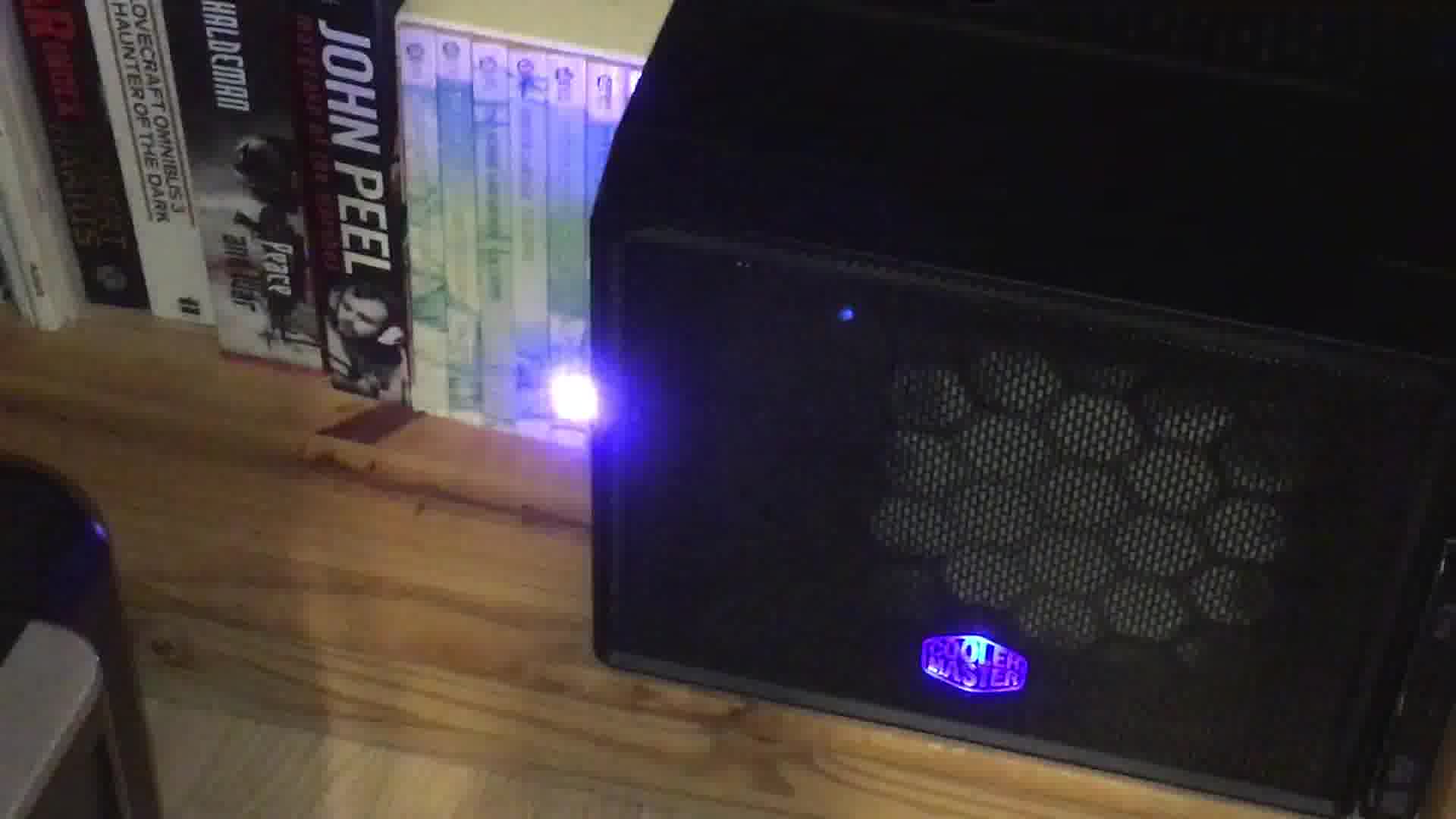
blinkenlights! blinkenlights!
I plug in one of two (prepared) external hard drives into my headless NAS. The NAS contains my primary data backup. A job automatically decrypts the encrypted filesystem on the drive, mounts it and synchronises the copy of my backup data on the drive from that on the NAS. Whilst this is going on, the blinkstick LED on the NAS switches to a colour to signal "in progress". When it's done, the light changes to green to signal "done" and I can remove it. If something goes wrong, it turns red and I get mail. Why I want a third-strand, off-site backup of my and my family's data in case of a disaster in our house. For it to be useful it has to be regular, so I needed to remove as much of the friction of performing the backup as possible. I use two drives alternately so that I don't have all my eggs in one basket in the window when I bring one of them home and perform the backup. How As much as possible I lean on systemd and its ability to trigger actions based on events.
  1. External drive is plugged in. systemd instantiates a corresponding device unit, named dev-disk-by\x2duuid-aaaaaaaa\x2daaaa\x2daaaa\x2daaaa\x2daaaaaaaaaaaa.device, where aaaa is the UUID of a partition on the device
  2. The backup job is a systemd service which has a WantedBy relationship on the device unit, so when the device appears, systemd starts the backup service.
  3. The backup service has Requires and After relationships on systemd-cryptsetup@extbackup.service, a service created by systemd's cryptsetup generator on start-up (but slightly customised, see below). The encrypted device is therefore unlocked.
  4. The backup service defines multiple start and stop commands with ExecStart and ExecStop. These are used to:
    1. set the blinkstick to the working colour (blue-ish)
    2. mount the now-decrypted filesystem
    3. get a lock on the backup repository (so nothing else writes to it) and synchronise the files
    4. unmount the filesystem
    5. set the blinkstick to the success colour (green)
  5. Finally, the systemd-cryptsetup@extbackup.service unit realises it is not required any more. It has been customised with StopWhenUnneeded=true1, so the encrypted filesystem is closed, ready for the drive to be removed.
  6. I notice the LED colour is green, remove the drive, and take it to its off-site home.
If anything goes wrong, all my custom systemd units have, as a matter of course,
OnFailure=status-email-user@%n.service blinkstick-fail.service
Preparing a new backup disk This is mostly just a standard dm-crypt/cryptsetup/LUKS encrypted device, on top of a standard partition on the underlying disk, with a normal filesystem sitting on top: Basically, the most common way to encrypt a drive in Linux. See places like the cryptsetup docs for how to set something like that up. The key things here are The backup service Here's the backup service unit definition in its entirety:
 [Unit]
 OnFailure=status-email-user@%n.service blinkstick-fail.service
 Requires=systemd-cryptsetup@extbackup.service backup.mount
 After=systemd-cryptsetup@extbackup.service backup.mount
 [Service]
 Type=oneshot
 ExecStart=/usr/local/bin/blinkstick --index 1 --limit 10 --set-color 33c280
 ExecStart=/bin/mount /extbackup
 ExecStart=/home/jon/bin/phobos-backup-monthly
 ExecStop=/bin/umount /extbackup
 ExecStop=/usr/local/bin/blinkstick --index 1 --limit 10 --set-color green
 [Install]
 WantedBy=dev-disk-by\x2duuid-aaaaaaaa\x2daaaa\x2daaaa\x2daaaa\x2daaaaaaaaaaaa.device
The dashes in the UUID in WantedBy= need to be encoded as \x2d and then the slashes from the path bit as dashes. Using dashes to encode slashes is possibly the single most frustrating systemd design decision. Issues Sadly (as detailed in Blinkenlights, part 2) there are 2 some frustrating limitations with trying to handle the mount (and unmount) of the filesystem in systemd-land, so instead, it's done using the traditional mount, umount and fstab. If you can point out any improvements to this approach, please let me know!

  1. I customized mine a while ago by copying the generated service file to a static file, but nowadays I think you could do systemd edit systemd-cryptsetup@extbackup.service to add the StopWhenUnneeded to an override file and not need the rest.
  2. or at least were. It's been a while since I revisited this part.

Adnan Hodzic: wp-k8s: WordPress on privately hosted Kubernetes cluster (Raspberry Pi 4 + Synology)

Blog post you re reading right now is privately hosted on Raspberry PI 4 Kubernetes cluster with its data coming from NFS share and MariaDB on... The post wp-k8s: WordPress on privately hosted Kubernetes cluster (Raspberry Pi 4 + Synology) appeared first on FoolControl: Phear the penguin.

Alo s Micard: Laravel: beware of $touches

I have been using Laravel professionally since almost 1year, and I must say: I m very impressed with the framework. Everything s run smoothly, there s a feature for (almost everything) you can think of, so you (almost) never need to reinvent the wheel. This is very advantageous since you only focus on building your product features by features and spend less time working on technical stuff who are less business valuable. Everything is fine until it s not.

Reproducible Builds (diffoscope): diffoscope 191 released

The diffoscope maintainers are pleased to announce the release of diffoscope version 191. This version includes the following changes:
[ Chris Lamb ]
* Detect XML files as XML files if either file(1) claims if they are XML
  files, or if they are named .xml.
  (Closes: #999438, reproducible-builds/diffoscope#287)
* Don't reject Debian .changes files if they contain non-printable
  characters. (Closes: reproducible-builds/diffoscope#286)
* Continue loading a .changes file even if the referenced files inside it do
  not exist, but include a comment in the diff as a result.
* Log the reason if we cannot load a Debian .changes file.
[ Zbigniew J drzejewski-Szmek ]
* Fix inverted logic in the assert_diff_startswith() utility.
You find out more by visiting the project homepage.

Reproducible Builds (diffoscope): diffoscope 192 released

The diffoscope maintainers are pleased to announce the release of diffoscope version 192. This version includes the following changes:
* Update .epub test methodology after improving XML file parsing.
You find out more by visiting the project homepage.

10 November 2021

Jonathan Dowland: LEGO Princess Castle-books

The set The set
My eldest daughter and I visited a LEGO shop recently and I wanted to buy her a gift. The catch was that we were going to be flying on an airplane the next day, so I wanted to find something with the lowest risk of losing parts on the plane. We settled on Ariel, Belle, Cinderella and Tiana's Storybook Adventures which had a number of things going for it: It was reasonably priced at under 20, for the size of the set; it included four human minifigs (albeit in a sub-minifig size, some kind of munchkin size, but that did not seem to matter) and an assortment of animal accompaniments; but mostly, it folded up into a self-contained mock fairytail "book", and opened up into an enclosed "tray" play area, minimising the risk of losses on the flight.
The set in its resting state The set in its resting state
Lego have done a few of these styles of sets, all Disney princess themed, and it looks like they have a few more on their product roadmap. The newer ones incorporate a locking mechanism with a cute Lego key. I love the concept and think it should be extended to other themes/properties. I can imagine a Lego Star Wars-themed version with a little Death Star trench in the middle, or even an original IP like Classic Space, or Medieval.
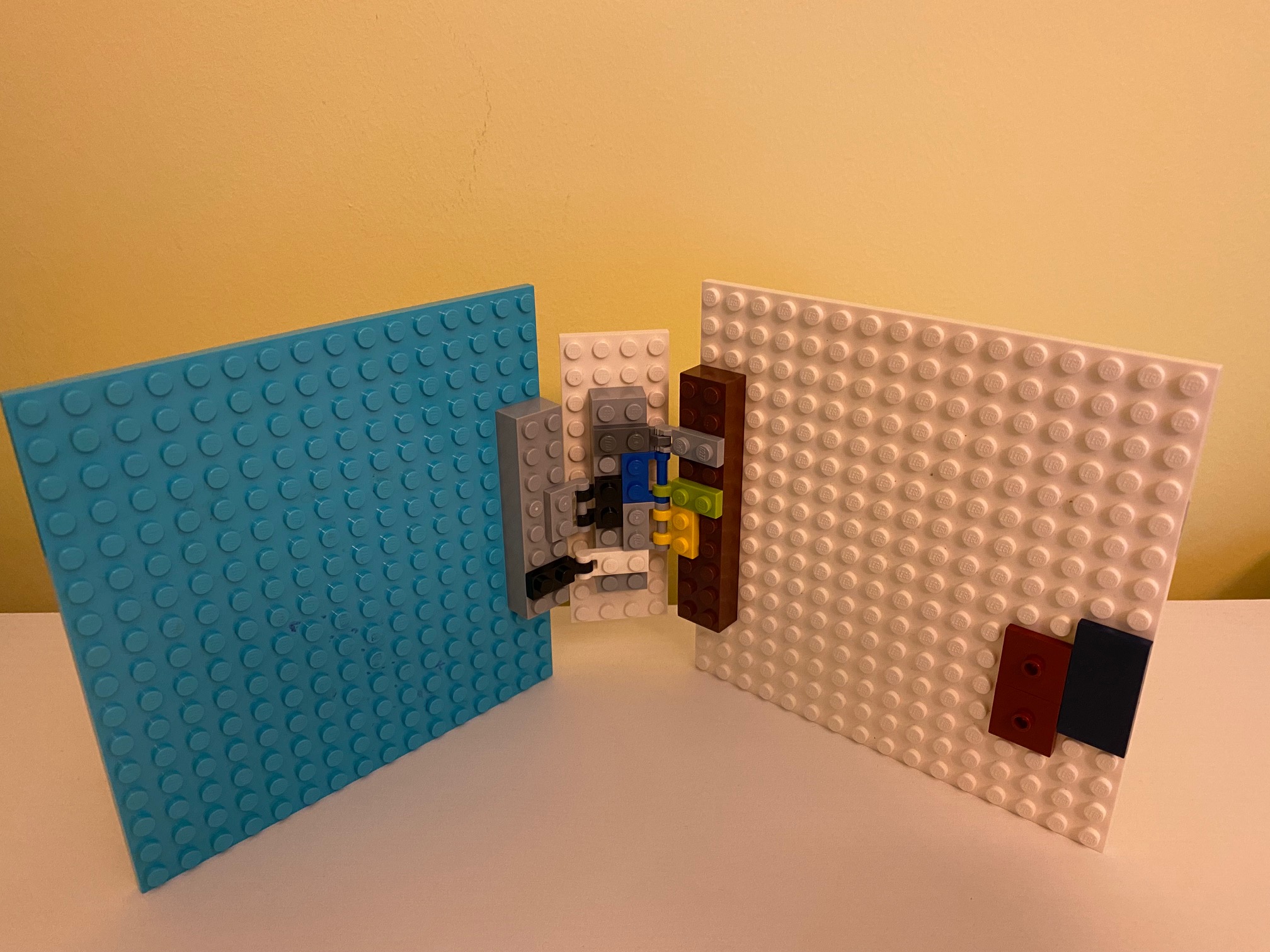
Exploring a DIY Lego book frame Exploring a DIY Lego book frame
I really liked the Book device which reminded me of hollow books as a child. The cover and spine pieces are bespoke Lego bricks made for purpose, but I thought you could create something similar with generic parts. Holly and I had a go at the concept with what bricks we had to hand. It's definitely viable (and you could do a lot better with a wider selection of bricks / more skilled builders) and it will be fun to pick something to try and build on the spine.

Neil Williams: LetsEncrypt with Apache, Gunicorn and Debian Bullseye

This took me far too long to identify and debug, so I'm going to write it up here for my own reference and to possibly help others.
Background Upgrading an old codebase from Python2 on Buster to Python3 ready for Bullseye and from Django1 to Django2 (prepared for Django3). Everything is fine at this stage - the Django test server is happy with HTTP and it gives enough support to do the actual code changes to get to Python3. All well and good so far. The main purpose of this particular code was to support payments, so a chunk of the testing cannot be done without HTTPS, which is where things got awkward. This particular service needs HTTPS using LetsEncrypt and Apache2. To support Django, I typically use Gunicorn. All of this works with HTTP. Moving to HTTPS was easy to test using the default-ssl virtual host that comes with Apache2 in Debian. It's a static page and it worked well with https. The problems all start when trying to use this known-working HTTPS config with the other Apache virtual host to add support for the gunicorn proxy.
Apache reverse proxy AH00898 Error during SSL Handshake with remote server
Investigating Now that I know why this happened, it's easier to see what was happening. At the time, I was swamped in a plethora of options and permutations between the Django HTTPS options and the Apache VirtualHost SSL and proxy commands. Going through all of those took up huge amounts of time, all in the wrong area. In previous configurations using packages in Buster, gunicorn could simply run on http://localhost:8000 and Apache would proxy that as https. In versions in Bullseye, this no longer works and it is that handover from https in Apache to http in the proxy is where it is failing. Apache is using HTTPS because the LetsEncrypt certificates, created using dehydrated, are specified in the VirtualHost configuration. To fix the handshake error, the proxy server needs to know about the certificates created by dehydrated as well.
Gunicorn needs the certificates The clue is in the gunicorn help:
--keyfile FILE        SSL key file [None]
--certfile FILE       SSL certificate file [None]
The final part of the puzzle is that the certificates created by dehydrated are in a private location:
drwx------ 2 root root /var/lib/dehydrated/certs/
To test gunicorn, this will mean using sudo but that's just a step towards running gunicorn as a systemd service (when access to the certs will not be a problem). Starting gunicorn using these options shows the proxy now being available at https://localhost:8000 which is a subtle but very important change.
Environment=LOGLEVEL=DEBUG WORKERS=4 LOGFILE=/var/log/gunicorn/site.log
ExecStart=/usr/bin/gunicorn3 site.wsgi --log-level $LOGLEVEL --log-file $LOGFILE --workers $WORKERS \
--certfile /var/lib/dehydrated/certs/site/cert.pem \
--keyfile /var/lib/dehydrated/certs/site/privkey.pem
The specified locations are symbolic links created by dehydrated to cope with regular updates of the certificates using cron.

Craig Small: Changing Grafana Legends

I m not sure if I just can search Google properly, or this really is just not written down much, but I have had problems with Grafana Legends (I would call them the series labels). The issue is that Grafana queries Prometheus for a time series and you want to display multiple lines, but the time-series labels you get are just not quite right. A simple example is you might be using the black-box exporter to monitor an external TCP port and you would just like the port number separate to display. The default output would look like this:
probe_duration_seconds instance="example.net:5222",job="blackbox",module="xmpp_banner"  = 0.01
probe_duration_seconds instance="example.net:5269",job="blackbox",module="xmpp_banner"  = 0.01
I can graph the number of seconds that it takes to probe the 5222 and 5269 TCP ports, but my graph legend is going to have the hostname, making it cluttered. I just want the legend to be the port numbers on Grafana. The answer is to use a Prometheus function called label_replace that takes an existing label, applies a regular expression, then puts the result into another label. That s right, regular expressions, and if you get them wrong then the label just doesn t appear.
Perl REGEX Problems courtesy of XKCD
The label_replace documentation is a bit terse, and in my opinion, the order of parameters is messed up, but after a few goes I had what I needed:
label_replace(probe_duration_seconds module="xmpp_banner" , "port", "$1", "instance", ".*:(.*)")
probe_duration_seconds instance="example.net:5222",job="blackbox",module="xmpp_banner",port="5222" 	0.001
probe_duration_seconds instance="example.net:5269",job="blackbox",module="xmpp_banner",port="5269" 	0.002
The response now has a new label (or field if you like) called port. So what is this function to our data coming from probe_duration_seconds? The function format is: label_replace(value, dst_label, replacement, src_label, regex) So the function does the following:
  1. Evaluate value, which is generally some sort of query such as probe_duration_seconds
  2. Find the required source label src_label, in this example is instance, in this case the values are example.net:5222 and example.net:5269
  3. Apply regular expression regex, for us its .*:(.*) That says skip everying before : then capture/store everything past : . The brackets mean copy what is after the colon and put it in match #1
  4. Make a new label specified in dst_label, for us this is port
  5. Whatever is in replacement goes into dst_label. For this example it is $1 which means match #1 in our regular expression in the label called port.
In short, the function captures everything after the colon in the instance label and puts that into a new label called port. It does this for each value that is returned into the first parameter. This means I can use the port in my Grafana graph Legend and it will show 5222 or 5269 respectively. I have made the Legend TCP port to give the below result, but I could have used port in Grafana Legend and made the result TCP $1 in the label_replace function to get the same result.
Grafana console showing the use of the label_replace function

Junichi Uekawa: Made a graph for furusato nozei limits.

Made a graph for furusato nozei limits. I wanted a prettier graph for soumusho page. and made one with plot.ly. However I realized that the input is taxable income after deductions, which is not readily available, and those tables that make you input the number of family members make sense.

9 November 2021

Benjamin Mako Hill: The Hidden Costs of Requiring Accounts

Should online communities require people to create accounts before participating? This question has been a source of disagreement among people who start or manage online communities for decades. Requiring accounts makes some sense since users contributing without accounts are a common source of vandalism, harassment, and low quality content. In theory, creating an account can deter these kinds of attacks while still making it pretty quick and easy for newcomers to join. Also, an account requirement seems unlikely to affect contributors who already have accounts and are typically the source of most valuable contributions. Creating accounts might even help community members build deeper relationships and commitments to the group in ways that lead them to stick around longer and contribute more.
In a new paper published in Communication Research, I worked with Aaron Shaw provide an answer. We analyze data from natural experiments that occurred when 136 wikis on Fandom.com started requiring user accounts. Although we find strong evidence that the account requirements deterred low quality contributions, this came at a substantial (and usually hidden) cost: a much larger decrease in high quality contributions. Surprisingly, the cost includes lost contributions from community members who had accounts already, but whose activity appears to have been catalyzed by the (often low quality) contributions from those without accounts.
A version of this post was first posted on the Community Data Science blog. The full citation for the paper is: Hill, Benjamin Mako, and Aaron Shaw. 2020. The Hidden Costs of Requiring Accounts: Quasi-Experimental Evidence from Peer Production. Communication Research, 48 (6): 771 95. https://doi.org/10.1177/0093650220910345. If you do not have access to the paywalled journal, please check out this pre-print or get in touch with us. We have also released replication materials for the paper, including all the data and code used to conduct the analysis and compile the paper itself.

Joachim Breitner: How to audit an Internet Computer canister

I was recently called upon by Origyn to audit the source code of some of their Internet Computer canisters ( canisters are services or smart contracts on the Internet Computer), which were written in the Motoko programming language. Both the application model of the Internet Computer as well as Motoko bring with them their own particular pitfalls and possible sources for bugs. So given that I was involved in the creation of both, they reached out to me. In the course of that audit work I collected a list of things to watch out for, and general advice around them. Origyn generously allowed me to share that list here, in the hope that it will be helpful to the wider community.

Inter-canister calls The Internet Computer system provides inter-canister communication that follows the actor model: Inter-canister calls are implemented via two asynchronous messages, one to initiate the call, and one to return the response. Canisters process messages atomically (and roll back upon certain error conditions), but not complete calls. This makes programming with inter-canister calls error-prone. Possible common sources for bugs, vulnerabilities or simply unexpected behavior are:
  • Reading global state before issuing an inter-canister call, and assuming it to still hold when the call comes back.
  • Changing global state before issuing an inter-canister call, changing it again in the response handler, but assuming nothing else changes the state in between (reentrancy).
  • Changing global state before issuing an inter-canister call, and not handling failures correctly, e.g. when the code handling the callback rolls backs.
If you find such pattern in your code, you should analyze if a malicious party can trigger them, and assess the severity that effect These issues apply to all canisters, and are not Motoko-specific.

Rollbacks Even in the absence of inter-canister calls the behavior of rollbacks can be surprising. In particular, rejecting (i.e. throw) does not rollback state changes done before, while trapping (e.g. Debug.trap, assert , out of cycle conditions) does. Therefore, one should check all public update call entry points for unwanted state changes or unwanted rollbacks. In particular, look for methods (or rather, messages, i.e. the code between commit points) where a state change is followed by a throw. This issues apply to all canisters, and are not Motoko-specific, although other CDKs may not turn exceptions into rejects (which don t roll back).

Talking to malicious canisters Talking to untrustworthy canisters can be risky, for the following (likely incomplete) reasons:
  • The other canister can withhold a response. Although the bidirectional messaging paradigm of the Internet Computer was designed to guarantee a response eventually, the other party can busy-loop for as long as they are willing to pay for before responding. Worse, there are ways to deadlock a canister.
  • The other canister can respond with invalidly encoded Candid. This will cause a Motoko-implemented canister to trap in the reply handler, with no easy way to recover. Other CDKs may give you better ways to handle invalid Candid, but even then you will have to worry about Candid cycle bombs that will cause your reply handler to trap.
Many canisters do not even do inter-canister calls, or only call other trustwothy canisters. For the others, the impact of this needs to be carefully assessed.

Canister upgrade: overview For most services it is crucial that canisters can be upgraded reliably. This can be broken down into the following aspects:
  1. Can the canister be upgraded at all?
  2. Will the canister upgrade retain all data?
  3. Can the canister be upgraded promptly?
  4. Is three a recovery plan for when upgrading is not possible?

Canister upgradeability A canister that traps, for whatever reason, in its canister_preupgrade system method is no longer upgradeable. This is a major risk. The canister_preupgrade method of a Motoko canister consists of the developer-written code in any system func preupgrade() block, followed by the system-generated code that serializes the content of any stable var into a binary format, and then copies that to stable memory. Since the Motoko-internal serialization code will first serialize into a scratch space in the main heap, and then copy that to stable memory, canisters with more than 2GB of live data will likely be unupgradeable. But this is unlikely the first limit: The system imposes an instruction limit on upgrading a canister (spanning both canister_preupgrade and canister_postupgrade). This limit is a subnet configuration value, and sepearate (and likely higher) than the normal per-message limit, and not easily determined. If the canister s live data becomes too large to be serialized within this limit, the canister becomes non-upgradeable. This risk cannot be eliminated completely, as long as Motoko and Stable Variables are used. It can be mitigated by appropriate load testing: Install a canister, fill it up with live data, and exercise the upgrade. If this succeeds with a live data set exceeding the expected amount of data by a margin, this risk is probably acceptable. Bonus points for adding functionality that will prevent the canister s live data to increase above a certain size. If this testing is to be done on a local replica, extra care needs to be taken to make sure the local replica actually performs instruction counting and has the same resource limits as the production subnet. An alternative mitigation is to avoid canister_pre_upgrade as much as possible. This means no use of stable var (or restricted to small, fixed-size configuration data). All other data could be
  • mirrored off the canister (possibly off chain), and manually re-hydrated after an upgrade.
  • stored in stable memory manually, during each update call, using the ExperimentalStableMemory API. While this matches what high-assurance Rust canisters (e.g. the Internet Identity) do, This requires manual binary encoding of the data, and is marked experimental, so I cannot recommend this at the moment.
  • not put into a Motoko canister until Motoko has a scalable solution for stable variable (for example keeping them in stable memory permanently, with smart caching in main memory, and thus obliterating the need for pre-upgrade code.)

Data retention on upgrades Obviously, all live data ought to be retained during upgrades. Motoko automatically ensures this for stable var data. But often canisters want to work with their data in a different format (e.g. in objects that are not shared and thus cannot be put in stable vars, such as HashMap or Buffer objects), and thus may follow following idiom:
stable var fooStable =  ;
var foo = fooFromStable(fooStable);
system func preupgrade()   fooStable := fooToStable(foo);  )
system func postupgrade()   fooStable := (empty);  )
In this case, it is important to check that
  • All non-stable global vars, or global lets with mutable values, have a stable companion.
  • The assignments to foo and fooStable are not forgotten.
  • The fooToStable and fooFromStable form bijections.
An example would be HashMaps stored as arrays via Iter.toArray( .entries()) and HashMap.fromIter( .vals()). It is worth pointiong out that a code view will only look at a single version of the code, but cannot check whether code changes will preserve data on upgrade. This can easily go wrong if the names and types of stable variables are changed in incompatible way. The upgrade may fail loudly in this cases, but in bad cases, the upgrade may even succeed, losing data along the way. This risk needs to be mitigated by thorough testing, and possibly backups (see below).

Prompt upgrades Motoko and Rust canisters cannot be safely upgraded when they are still waiting for responses to inter-canister calls (the callback would eventually reach the new instance, and because of infelicities of the IC s System API, could possibly call arbitrary internal functions). Therefore, the canister needs to be stopped before upgrading, and started again. If the inter-canister calls take a long time, this mean that upgrading may take a long time, which may be undesirable. Again, this risk is reduced if all calls are made to trustworthy canisters, and elevated when possibly untrustworthy canisters are called, directly or indirectly.

Backup and recovery Because of the above risk around upgrades it is advisable to have a disaster recovery strategy. This could involve off-chain backups of all relevant data, so that it is possible to reinstall (not upgrade) the canister and re-upload all data. Note that reinstall has the same issue as upgrade described above in prompt upgrades : It ought to be stopped first to be safe. Note that the instruction limit for messages, as well as the message size limit, limit the amount of data returned. If the canister needs to hold more data than that, the backup query method might have to return chunks or deltas, with all the extra complexity that entails, e.g. state changes between downloading chunks. If large data load testing is performed (as Irecommend anyways to test upgradeability), one can test whether the backup query method works within the resource limits.

Time is not strictly monotonic The timestamps for current time that the Internet Computer provides to its canisters is guaranteed to be monotonic, but not strictly monotonic. It can return the same values, even in the same messages, as long as they are processed in the same block. It should therefore not be used to detect happens-before relations. Instead of using and comparing time stamps to check whether Y has been performed after X happened last, introduce an explicit var y_done : Bool state, which is set to False by X and then to True by Y. When things become more complex, it will be easier to model that state via an enumeration with speaking tag names, and update this state machine along the way. Another solution to this problem is to introduce a var v : Nat counter that you bump in every update method, and after each await. Now v is your canister s state counter, and can be used like a timestamp in many ways. While we are talking about time: The system time (typically) changes across an await. So if you do let now = Time.now() and then await, the value in now may no longer be what you want.

Wrapping arithmetic The Nat64 data type, and the other fixed-width numeric types provide opt-in wrapping arithmetic (e.g. +%, fromIntWrap). Unless explicitly required by the current application, this should be avoided, as usually a too large or negatie value is a serious, unrecoverable logic error, and trapping is the best one can do.

Cycle balance drain attacks Because of the IC s canister pays model, all canisters are prone to DoS attacks by draining their cycle balance, and this risk needs to be taken into account. The most elementary mitigation strategy is to monitor the cycle balance of canisters and keep it far from the (configurable) freezing threshold. On the raw IC-level, further mitigation strategies are possible:
  • If all update calls are authenticated, perform this authentication as quickly as possible, possibly before decoding the caller s argument. This way, a cycle drain attack by an unauthenticated attacker is less effective (but still possible).
  • Additionally, implementing the canister_inspect_message system method allows the above checks to be performed before the message even is accepted by the Internet Computer. But it does not defend against inter-canister messages and is therefore not a complete solution.
  • If an attack from an authenticated user (e.g. a stakeholder) is to be expected, the above methods are not effective, and an effective defense might require relatively involved additional program logic (e.g. per-caller statistics) to detect such an attack, and react (e.g. rate-limiting).
  • Such defenses are pointless if there is only a single method where they do not apply (e.g. an unauthenticated user registration method). If the application is inherently attackable this way, it is not worth the bother to raise defenses for other methods.
Related: A justification why the Internet Identity does not use canister_inspect_message) A motoko-implemented canister currently cannot perform most of these defenses: Argument decoding happens unconditionally before any user code that may reject a message based on the caller, and canister_inspect_message is not supported. Furthermore, Candid decoding is not very cycle defensive, and one should assume that it is possible to construct Candid messages that require many instructions to decode, even for simple argument type signatures. The conclusion for the audited canisters is to rely on monitoring to keep the cycle blance up, even during an attack, if the expense can be born, and maybe pray for IC-level DoS protections to kick in.

Large data attacks Another DoS attack vector exists if public methods allow untrustworthy users to send data of unlimited size that is persisted in the canister memory. Because of the translation of async-await code into multiple message handlers, this applies not only to data that is obviously stored in global state, but also local data that is live across an await point. The effectiveness of such attacks is limited by the Internet Computer s message size limit, which is in the order of a few megabytes, but many of those also add up. The problem becomes much worse if a method has an argument type that allows a Candid space bomb: It is possible to encode very large vectors with all values null in Candid, so if any method has an argument of type [Null] or [?t], a small message will expand to a large value in the Motoko heap. Other types to watch out:
  • Nat and Int: This is an unbounded natural number, and thus can be arbitrarily large. The Motoko representation will however not be much larger than the Candid encoding (so this does not qualify as a space bomb).
It is still advisable to check if the number is reasonable in size before storing it or doing an await. For example, when it denotes an index in an array, throw early if it exceeds the size of the array; if it denotes a token amount to transfer, check it against the available balance, if it denotes time, check it against reasonable bounds.
  • Principal: A Principal is effectively a Blob. The Interface specification says that principals are at most 29 bytes in length, but the Motoko Candid decoder does not check that currently (fixed in the next version of Motoko). Until then, a Principal passed as an argument can be large (the principal in msg.caller is system-provided and thus safe). If you cannot wait for the fix to reach you, manually check the size of the princial (via Principal.toBlob) before doing the await.

Shadowing of msg or caller Don t use the same name for the message context of the enclosing actor and the methods of the canister: It is dangerous to write shared(msg) actor, because now msg is in scope across all public methods. As long as these also use public shared(msg) func , and thus shadow the outer msg, it is correct, but it if one accidentially omits or mis-types the msg, no compiler error would occur, but suddenly msg.caller would now be the original controller, likely defeating an important authorization step. Instead, write shared(init_msg) actor or shared( caller = controller ) actor to avoid using msg.

Conclusion If you write a serious canister, whether in Motoko or not, it is worth to go through the code and watch out for these patterns. Or better, have someone else review your code, as it may be hard to spot issues in your own code. Unfortunately, such a list is never complete, and there are surely more ways to screw up your code in addition to all the non-IC-specific ways in which code can be wrong. Still, things get done out there, so best of luck!

8 November 2021

Dima Kogan: mrcal 2.0: triangulation and stereo

mrcal is my big toolkit for geometric computer vision: making models (camera calibration) and using models (mapping, ranging, etc). Since the release of mrcal 1.0 back in February I've been busy using the tools in the field, fixing things and improving things. Today I'm happy to finally be able to announce the release of mrcal 2.0. A big part of this release is maintenance and cleanup that resulted from me heavily using the tools over the course of this past year, and improving whatever was bugging me. The most notable result of that effort, is that splined models are no longer "experimental". They work well and they're awesome. Go try them. And there're a number of new features, most notably nice dense stereo support and nice sparse triangulation support (with uncertainty propagation!) These are awesome. Go try them. As before, the tour of mrcal provides a good overview of the capabilities of the toolkit, and is a good place to start reading the documentation. Reading these docs would be very illuminating for anybody that calibrates cameras, even for those that have no intent to actually use the mrcal tools. Let me know if you try it out! The most list of most notable improvements, from the release notes:

Enrico Zini: An educational debugging session

This morning we realised that a test case failed on Fedora 34 only (the link is in Italian) and we set to debugging. The initial analysis This is the initial reproducer:
$ PROJ_DEBUG=3 python setup.py test
test_recipe (tests.test_litota3.TestLITOTA3NordArkimetIFS) ... pj_open_lib(proj.db): call fopen(/lib64/../share/proj/proj.db) - succeeded
proj_create: Open of /lib64/../share/proj/proj.db failed
pj_open_lib(proj.db): call fopen(/lib64/../share/proj/proj.db) - succeeded
proj_create: no database context specified
Cannot instantiate source_crs
EXCEPTION in py_coast(): ProjP: cannot create crs to crs from [EPSG:4326] to [+proj=merc +lon_0=0 +k=1 +x_0=0 +y_0=0 +ellps=WGS84 +datum=WGS84 +over +units=m +no_defs]
ERROR
Note that opening /lib64/../share/proj/proj.db sometimes succeeds, sometimes fails. It's some kind of Schr dinger path, which works or not depending on how you observe it:
# ls -lad /lib64
lrwxrwxrwx 1 1000 1000 9 Jan 26  2021 /lib64 -> usr/lib64
$ ls -la /lib64/../share/proj/proj.db
-rw-r--r-- 1 root root 8925184 Jan 28  2021 /lib64/../share/proj/proj.db
$ cd /lib64/../share/proj/
$ cd /lib64
$ cd ..
$ cd share
-bash: cd: share: No such file or directory
And indeed, stat(2) finds it, and sqlite doesn't (the file is a sqlite database):
$ stat /lib64/../share/proj/proj.db
  File: /lib64/../share/proj/proj.db
  Size: 8925184     Blocks: 17432      IO Block: 4096   regular file
Device: 33h/51d Inode: 56907       Links: 1
Access: (0644/-rw-r--r--)  Uid: (    0/    root)   Gid: (    0/    root)
Access: 2021-11-08 14:09:12.334350779 +0100
Modify: 2021-01-28 05:38:11.000000000 +0100
Change: 2021-11-08 13:42:51.758874327 +0100
 Birth: 2021-11-08 13:42:51.710874051 +0100
$ sqlite3 /lib64/../share/proj/proj.db
Error: unable to open database "/lib64/../share/proj/proj.db": unable to open database file
A minimal reproducer Later on we started stripping layers of code towards a minimal reproducer: here it is. It works or doesn't work depending on whether proj is linked explicitly, or via MagPlus:
$ cat tc.cc
#include <magics/ProjP.h>
int main()  
    magics::ProjP p("EPSG:4326", "+proj=merc +lon_0=0 +k=1 +x_0=0 +y_0=0 +ellps=WGS84 +datum=WGS84 +over +units=m +no_defs");
    return 0;
 
$ g++ -o tc  tc.cc -I/usr/include/magics  -lMagPlus
$ ./tc
proj_create: Open of /lib64/../share/proj/proj.db failed
proj_create: no database context specified
terminate called after throwing an instance of 'magics::MagicsException'
  what():  ProjP: cannot create crs to crs from [EPSG:4326] to [+proj=merc +lon_0=0 +k=1 +x_0=0 +y_0=0 +ellps=WGS84 +datum=WGS84 +over +units=m +no_defs]
Aborted (core dumped)
$ g++ -o tc  tc.cc -I/usr/include/magics -lproj  -lMagPlus
$ ./tc
What is going on here? A difference between the two is the path used to link to libproj.so:
$ ldd ./tc   grep proj
    libproj.so.19 => /lib64/libproj.so.19 (0x00007fd4919fb000)
$ g++ -o tc  tc.cc -I/usr/include/magics   -lMagPlus
$ ldd ./tc   grep proj
    libproj.so.19 => /lib64/../lib64/libproj.so.19 (0x00007f6d1051b000)
Common sense screams that this should not matter, but we chased an intuition and found that one of the ways proj looks for its database is relative to its shared library. Indeed, gdb in hand, that dladdr call returns /lib64/../lib64/libproj.so.19. From /lib64/../lib64/libproj.so.19, proj strips two paths from the end, presumably to pass from something like /something/usr/lib/libproj.so to /something/usr. So, dladdr returns /lib64/../lib64/libproj.so.19, which becomes /lib64/../, which becomes /lib64/../share/proj/proj.db, which exists on the file system and is used as a path to the database. But depending how you look at it, that path might or might not be valid: it passes the stat(2) check that stops the lookup for candidate paths, but sqlite is unable to open it. Why does the other path work? By linking libproj.so in the other way, dladdr returns /lib64/libproj.so.19, which becomes /share/proj/proj.db, which doesn't exist, which triggers a fallback to a PROJ_LIB constant defined at compile time, which is a path that works no matter how you look at it. Why that weird path with libMagPlus? To complete the picture, we found that libMagPlus.so is packaged with a rpath set, which is known to cause trouble
# readelf -d /usr/lib64/libMagPlus.so grep rpath
 0x000000000000000f (RPATH)              Library rpath: [$ORIGIN/../lib64]
The workaround We found that one can set PROJ_LIB in the environment to override the normal proj database lookup. Building on that, we came up with a simple way to override it on Fedora 34 only:
    if distro is not None and distro.linux_distribution()[:2] == ("Fedora", "34") and "PROJ_LIB" not in os.environ:
         self.env_overrides["PROJ_LIB"] = "/usr/share/proj/"
This has been a most edifying and educational debugging session, with only the necessary modicum of curses and swearwords. Working in a team of excellent people really helps.

Russell Coker: Installing NextCloud

NextCloud and OwnCloud History Some time ago I tried OwnCloud, it wasn t a positive experience for me. Since that time I ve got a server with a much faster CPU, a faster Internet connection, and the NextCloud code is newer and running on a newer version of PHP, I didn t make good notes so I m not sure which factors were most responsible for having a better experience this time. According to the NextCloud Wikipedia page [1] the fork of NextCloud from the OpenCloud base happened in 2016 so it s obviously been a while since I tried it, it was probably long before 2016. Recently the BBC published an interesting article on Turnover contagion which is when one resignation can trigger many more [2] which is interesting to read in the context of OwnCloud losing critical staff failing after one key developer resigned. I mentioned OwnCloud in a 2012 blog post about Liberty and Mobile Phones [3], since then I haven t done well at achieving those goals. A few days ago I decided to try NextCloud and found it a much better experience than I recall OwnCloud being in the past. Installation I installed OwnCloud on an Oracle Cloud ARM VM (see my previous blog post about the Oracle Cloud Free Tier [4]). This CloudCone article on installing NextCloud on Debian 10 (Buster) covers the basics well [5]. Here is the NextCloud URL for downloading the PHP files (a large ZIP archive) [6]. You have to extract to where Apache is configured to have it s webroot and then run chown -R www-data nextcloud/lib/private/Log nextcloud/config nextcloud/apps (or if you use php-fpm then chown it to the user for that). NextCloud recommend having all of the NextCloud files owned by www-data, but that s just a bad idea, allowing it to rewrite some of it s program files is bad, allowing it to rewrite all of them is worse. For my installation I used the Apache modiles macro, rewrite, ssl, php7.4, and headers (this is more about how I configure Apache than about NextCloud). Also I edited /etc/php/7.4/apache2/php.ini and changed memory_limit to 512M (the default of 128M is not enough). I m currently only testing it, for a production use I would use php-fpm and run it under it s own UID so that it can t interact with other PHP apps. After that it was just a matter of visiting the configuration URL and giving it the details of the database etc. After setting it up the command php -d memory_limit=512M occ app:install richdocumentscode_arm64 when run from the root of the OwnCloud installation installs the Cloudera components for editing LibreOffice documents in OwnCloud, this is the command for ARM64 architecture, I presume the command for other architectures is similar. Conclusion OwnCloud is very usable, it has a decent feature set built in and the option to download modules such as the components for editing LibreOffice files on the web is useful. But I am hesitant to install things that require the sort of access it requires. I think it would be better if there was a documented and supported way of installing things and then locking them down so that at runtime it can only write to data files not any program files or configuration files. It would also be better if it was packaged for Debian and had the Debian update process for security fixes. I can imagine many people installing it, forgetting to update it, and ending up with insecure systems.

Michael Ablassmeier: Libvirt/KVM Backup on Debian Bullseye

The libvirt and qemu versions in Debian Bullseye support a new feature that allows for easier backup and recovery of virtual machines. Instead of using snapshots for backup operation, its now possible to enable dirty bitmaps. Other hypervisors tend to call this changed block tracking . Using the new backup begin approach, its not only possible to create live full backups (without having to create an snapshot) but also track the changes between so called checkpoints, which is very useful for incremental backups. Over the course of the last few months, i have been working on a simple backup and recovery utility called virtnbdbackup It uses the pull based approach in the libvirt api set and currently supports: Preparing the virtual machines The dirty bitmap feature is not enabled by default, users can enable it by adding a new capability to a virtual machine configuration:
 <domain type='kvm' id='1' xmlns:qemu='http://libvirt.org/schemas/domain/qemu/1.0'>
 [..]
 <qemu:capabilities>
   <qemu:add capability='incremental-backup'/>
 </qemu:capabilities>
 [..]
 </domain>
To finally enable the feature, power cycle virtual machine once. Creating backups By default, virtnbdbackup saves the virtual machine config, disks and its logfiles to a given target directory. Its also possible to stream the output into a uncompressed zip archive Taking a backup is as simple as:
# virtnbdbackup -d vm2 -l full -o /tmp/WEEKLY_BACKUP/
 [..]
[2021-11-08 15:43:46] INFO virtnbdbackup - main [MainThread]: Backup jobs finished, stopping backup task.
[2021-11-08 15:43:46] INFO virtnbdbackup - main [MainThread]: Finished
# tree /tmp/WEEKLY_BACKUP/
 /tmp/WEEKLY_BACKUP/
  backup.full.11082021154343.log
  checkpoints
    virtnbdbackup.0.xml
  sda.full.data
  vm2.cpt
  vmconfig.virtnbdbackup.0.xml
From that point on, its now possible to create incremental backups:
 # virtnbdbackup -d vm2 -l inc -o /tmp/WEEKLY_BACKUP/
 # tree /tmp/WEEKLY_BACKUP/
 /tmp/WEEKLY_BACKUP/
  backup.full.11082021154343.log
  backup.inc.11082021154538.log
  checkpoints
    virtnbdbackup.0.xml
    virtnbdbackup.1.xml
  sda.full.data
  sda.inc.virtnbdbackup.1.data
  vm2.cpt
  vmconfig.virtnbdbackup.0.xml
  vmconfig.virtnbdbackup.1.xml
Restoring backups The virtnbdrestore utility can be used to reconstruct the backup sets into usable qcow images, like so:
 # virtnbdrestore -a restore -i /tmp/WEEKLY_BACKUP/ -o /tmp/VM_RESTORE
Using the --until option its also possible to only reconstruct the images to a certain checkpoint, allowing for point in time recovery. Restoring single files Via virtnbdmap you can map full backups back into an usable block device, without having to reconstruct the complete backup image:
# virtnbdmap -f /tmp/WEEKLY_BACKUP/sda.full.data
 [..] INFO virtnbdmap - <module> [MainThread]: Done mapping backup image to [/dev/nbd0]
 [..] INFO virtnbdmap - <module> [MainThread]: Press CTRL+C to disconnect
# fdisk -l /dev/nbd0
Disk /dev/nbd0: 2 GiB, 2147483648 bytes, 4194304 sectors
From here, you can either mount the disc and recover single files, or boot from it via:
qemu-img create -b /dev/nbd0 -f qcow2 bootme.qcow2
qemu-system-x86_64 -enable-kvm -m 2000 -hda bootme.qcow2
Check out the README for the full feature set.

7 November 2021

Russ Allbery: Modifying the Debian resolution process

I have been working on a draft GR to modify the process used by the Technical Committee and for General Resolutions to prepare a ballot for vote, with a goal of fixing several issues that were uncovered by recent votes. My plan is to propose this formally as a GR on November 13th. For those reading my journal who are Debian Developers or who are interested in Debian process, you may want to read the draft resolution and the previous discussion. Constitutional changes require a 3:1 majority, so my goal is to reach as broad of a consensus in the project on these changes as possible. All feedback welcome, and also let me know if there is a reason to postpone making this a formal GR and thus starting the discussion period clock. The most recent draft is at:
https://lists.debian.org/debian-vote/2021/11/msg00034.html
Previous drafts and resulting discussion are at:
https://lists.debian.org/debian-vote/2021/10/msg00002.html
https://lists.debian.org/debian-vote/2021/09/msg00010.html
and also see the discussion thread starting here:
https://lists.debian.org/debian-vote/2021/10/msg00019.html

Next.

Previous.