Search Results: "agi"

8 July 2010

Biella Coleman: Debian in the World: Buidling an Institution vs Managing a Crowd

So there are times that I think of course anyone remotely interested in Free Software, virtual projects, and similar endeavors knows about Debian and its strange rituals. I am pretty mistaken, actually. Recently I have attended various events where it has been made clear to me that there are hordes of folks interested in the politics of openness, access, and free software who have heard about Debian but don t really know what it takes, socially and politically, to manage such a project. Luckily I had the chance to spread some of the esoteric knowledge during a talk at MIT for the Knight News Challenge winners and I have received many emails, excited and some surprised about the governance structures of Debian. If interested, here is a video of my talk, which is quite short, so I don t go into as much detail as I would like. There is a great audio quote from a Debian developer, taken from this class visit for which there is a podcast and which I recommend as well. If you can t play flash, you can download the a video of the talk here (look at the right hand side of the page for download link). update: Interesting blog post on Why the open source way trumps the crowdsourcing way that explores some of the issues I raise in the panel talk. I don t think it always trumps open source but it is certainly a niche form of production that is useful in some cases but all too often confused with expert peer production in quite unproductive and empirically wrong ways.

Aigars Mahinovs: Phoning it in

Currently I own and use an iPhone 3G. I bought it almost two years ago, when the local phone provider LMT started offering the iPhone legally. I had a pretty good experience with it most of the time, but now it is showing its age: I will try to send my iPhone in for repair hoping to extend its usefulness, but frankly it looks that I might have to get a new phone at or before Debconf. So I am considering my options for a new phone and so far I have 3 main options each with some sub-options. The main options are: iPhone 4, MeeGo and Android. Each choice has its benefits and drawbacks and each also has several sub-options related either to specific phone models or to purchase methods. What I need is a phone with: calling function, contact information synchronised to Google, support for Google Mail/Contacts/Calendar simultaneously with one Exchange account also providing mail/contacts/calendars, music, audiobooks saving my place in the audio book and in the list of books, fully featured Twitter client with Twitpic and location support, encrypted password storage application (preferably open source), GPS with maps, ability to download maps for offline use, Geocaching support with offline cache info and logging, Skype client, ability to write in Latvian, English and Russian in all applications, reliable backup and restore of phones data including settings and data of installed apps. Optional features: last.fm streaming and reporting support, ebook applications with purchasable ebooks, high quality video and photo recording (for a phone), ability for me to write applications on the phone, ssh client, wireless data upload to the phone, ability to change the phones battery without loosing data in the phone (on the go), compass, physical keyboard, confidence in getting software upgrades and developer interest for the next 2 years. I ll try to describe all of the options here to organise my thoughts and maybe also help someone else make the choice. Option 1: iPhone 4 To get the iPhone 4 I have two options: LMT and unlocked. The official arrival of iPhone 4 to Latvia is expected in September and it will likely be sold by LMT for the same prices as iPhone 3GS is now. If I choose this scenario, I will need to survive with my semi-broken iPhone for 2-3 more months. Total price over 2 years (LVL): 131 (purchase price) + 24 * 8 (surcharge) = 323 LVL. Note: the surcharge is the extra cost of the iPhone call plan compared to a comparable regular plan (Vien dais 7 + Internets telefon 5). If I go and purchase an unlocked iPhone 4 in a country where such units are sold (UK is the most easily accessible choice, because a few of my workmates travel weekly to and from UK) then the total price over 2 years would be the purchase price: 499 GBP + 65 GBP (2 year warranty extension) = 505 LVL Now lets go over the general benefits and downsides of the iPhone 4, first the positives: Drawbacks: Option 2: Maemo/MeeGo Some of my colleagues at work (in the Riga office of Accenture) have N900 phones and I have been exposed to people with raw enthusiasm towards the Maemo platform ever since the Debconf in Helsinki, where we saw the first N700 devices in the hands of some lucky Debian/Nokia people using it as an Internet tablet. N900 has been a strong leap forward for the platform, before its head was teleported sideways by the whole MeeGo merger/debackle. Again I have two options here: Get a N900 either here in Latvia for 325 LVL (that would be the total cost over 2 years) or get it from USA during Debconf for 399 USD (+129 USD for 2 year warranty) = 317 LVL. And additional option would be to wait until October/November and then buy the new Nokia MeeGo device, rumoured to be N9-00 and likely to be around the same price as N900 was when it was introduced (around 500 LVL). Benefits: Drawbacks: Option 3 Android After looking trough the options for Android phones, I ve narrowed the selection to the ones that are either available from local carriers or can be easily gotten unlocked also the phones need to have announced plans to have at least Android 2.2 version. Currently the choice is limited to HTC Desire (from carrier or unlocked) and Samsung Galaxy S (unlocked). The prices over 2 years break down as follows: HTC Desire (locked to LMT): 69 + 9*24 = 285 LVL
HTC Desire (locked to Bite): 199 + 2*24 = 247 LVL (Note: only 500Mb of data per month available)
HTC Desire (locked to Tele2): 179 + 6*24 = 323 LVL
Note: all the above options would also require me to pay a 45 LVL early termination fee on my current iPhone contract if I choose to do this before September.
HTC Desire (unlocked): 311 LVL
Samsung Galaxy S (unlocked): 350 LVL (import from Germany) Benefits: Drawbacks: Please correct me if I am wrong with something!!! And also it would be cool if you expressed your own opinions in the comments. Currently I am very undecided about what I am going to do, but after completing this entry I am leaning towards an unlocked HTC Desire. Update:
Olivier Cr te shares a N900 vs. Nexus One experience Edit 01-07-2010: Handed my iPhone in for a warranty repair, got a dumbphone Nokia as a loaner during repairs. Very surprised about how long a battery can last on a low powered and cheap phone. In the mean time from all the comments here and elsewhere I am starting to see that I am too annoyed with the iPhone platform (mostly iTunes) to stay there and that I am also not convinced in the direction MeeGo is going (a lot of community developers are annoyed and are jumping ship), so N900 is also out. I will need to see 2-3 MeeGo smartphones and also see how Nokia will treat their smartphone users and developers on this platform, in the long term, before I ll be ready to trust them with my money. Therefore, my choice is becoming pretty clear look for the best Android phone (after my iPhone dies). We have this thing at Accenture, where we can get company phones at a discount and HTC Desire is on that list. If I can get that, it would slash 100 LVL (almost a third of the price!) off it, but to get there I either need to get a promotion (rather rare after just one year with the company) or prove the necessity of the phone for the needs of my project (kinda hard currently). Well, the situation will be a bit clearer next week when I get my iPhone back. (Apparently the Latvia s largest holiday Midsummer Festivities or J i/L go with tons of traditional outdoor activities, caused a lot of phones to become broken and there is a backlog of warranty service :) ) So at this point my plan is: get my iPhone repaired and get a promotion or a project where I can justify a company-paid HTC Desire and then hope that Nokia/Intel really get their stuff together and make MeeGo a great smartphone platform over the next year or two. Update: Got my iPhone 3G back from the warranty . It is in quotes because they just gave me a new iPhone 3G. The battery lasts for 3 days of minimal use and it has not crashed yet. The recovery process was a pain again caused by iTunes: iTunes refused to restore my backup onto the new phone, because my backup was made on a iOS 4.0, while the new phone I got from the warranty has 3.1.3 on it. So I had to set this phone as a new phone, initialise it, make a backup, upgrade to 4.0, restore from the (empty) backup, then reset the phone to factory settings again and only then I could start restoring data from my original (pre-warranty) backup and start copying my data on to the device. All in all it took nearly 3 hours if iTunes doing something and almost a dozen reboots of the phone. Almost half of that time was spent doing completely unnecessary steps to work around the fact that iTunes is braindead. I ll continue using my iPhone for now, keeping my eyes on the newest Android phones and also waiting for the long-promised first MeeGo phone from Nokia.

Michael Prokop: Report from FAI developer workshop 07/2010

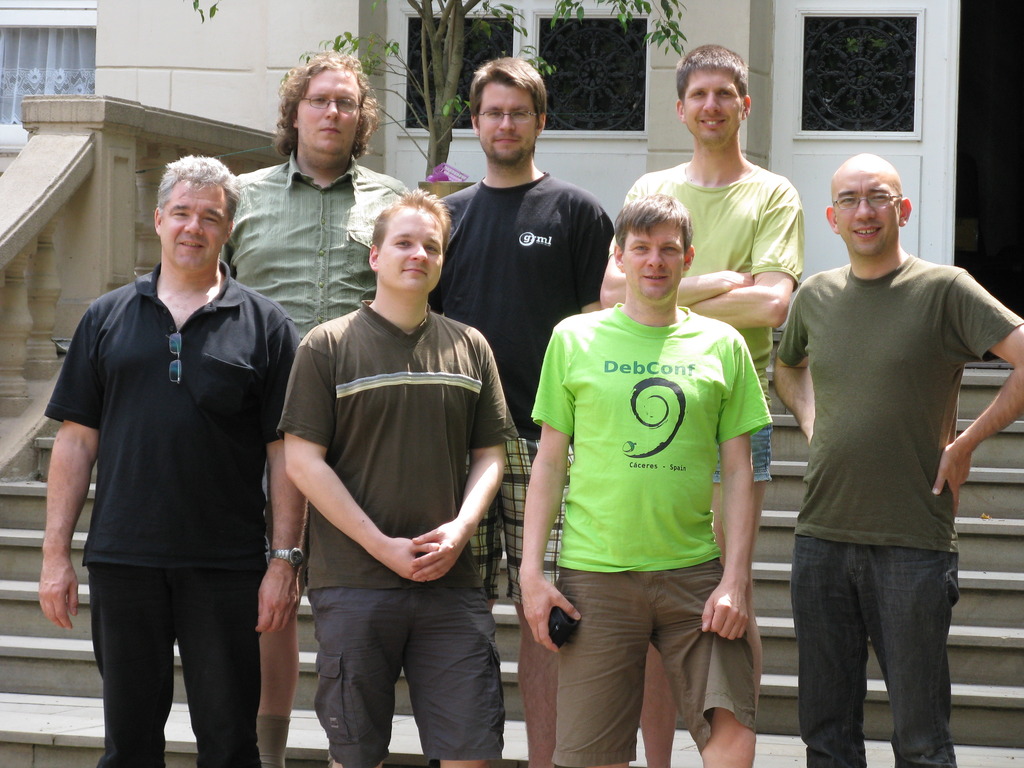
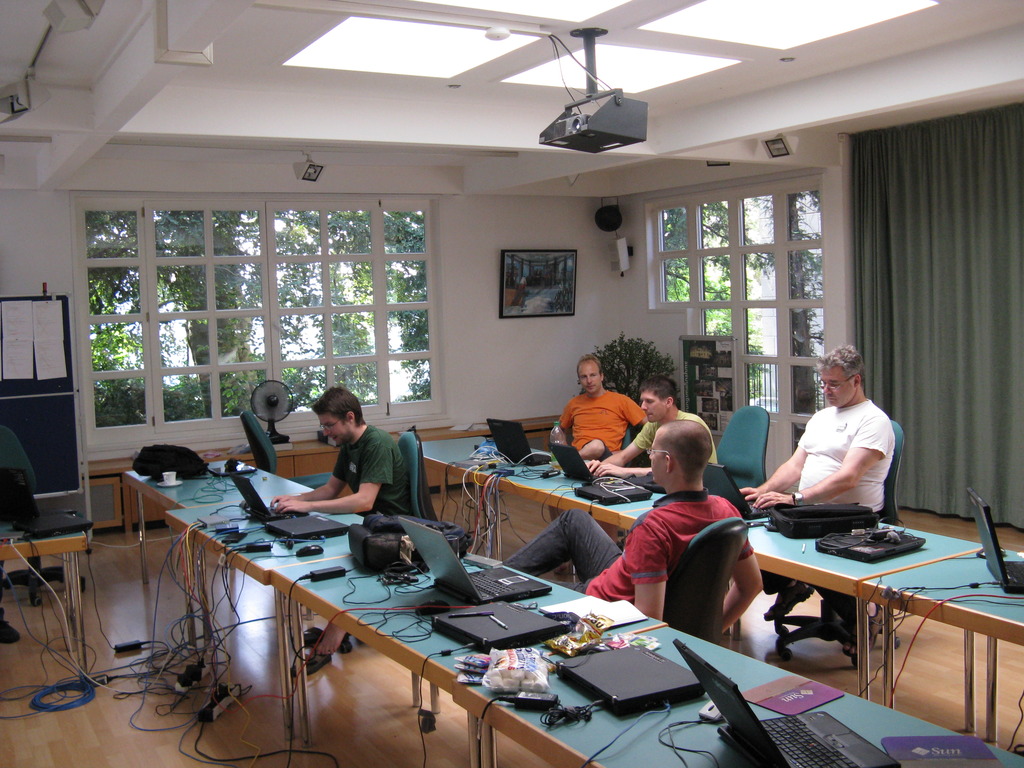
Last weekend (2010-07-02 2010-07-04) nine people met at the FAI developer workshop at Linuxhotel in Essen/Germany. If you can t remember: FAI is a non-interactive system to install, customize and manage Linux systems and software configurations on computers as well as virtual machines and chroot environments, from small networks to large-scale infrastructures and clusters. The participants of the FAI meeting: picture of participants of the FAI developer workshop 2010 second row from left to right: Michael Goetze, Michael Prokop, Andreas Schuldei
first row from left to right: Sebastian Hetze, Manuel Hachtkemper, Thomas Lange, Mattias Jansson
missing on the picture: Thomas Neumann (left on sunday midday) and Stephan Hermann (only part-time) Friday afternoon started with getting to know each other, continuing with discussions all around FAI. On saturday we started to hack on FAI. * Between the hack sessions and discussions the attending people presented their FAI usage and approaches. Some notes from the presentations:
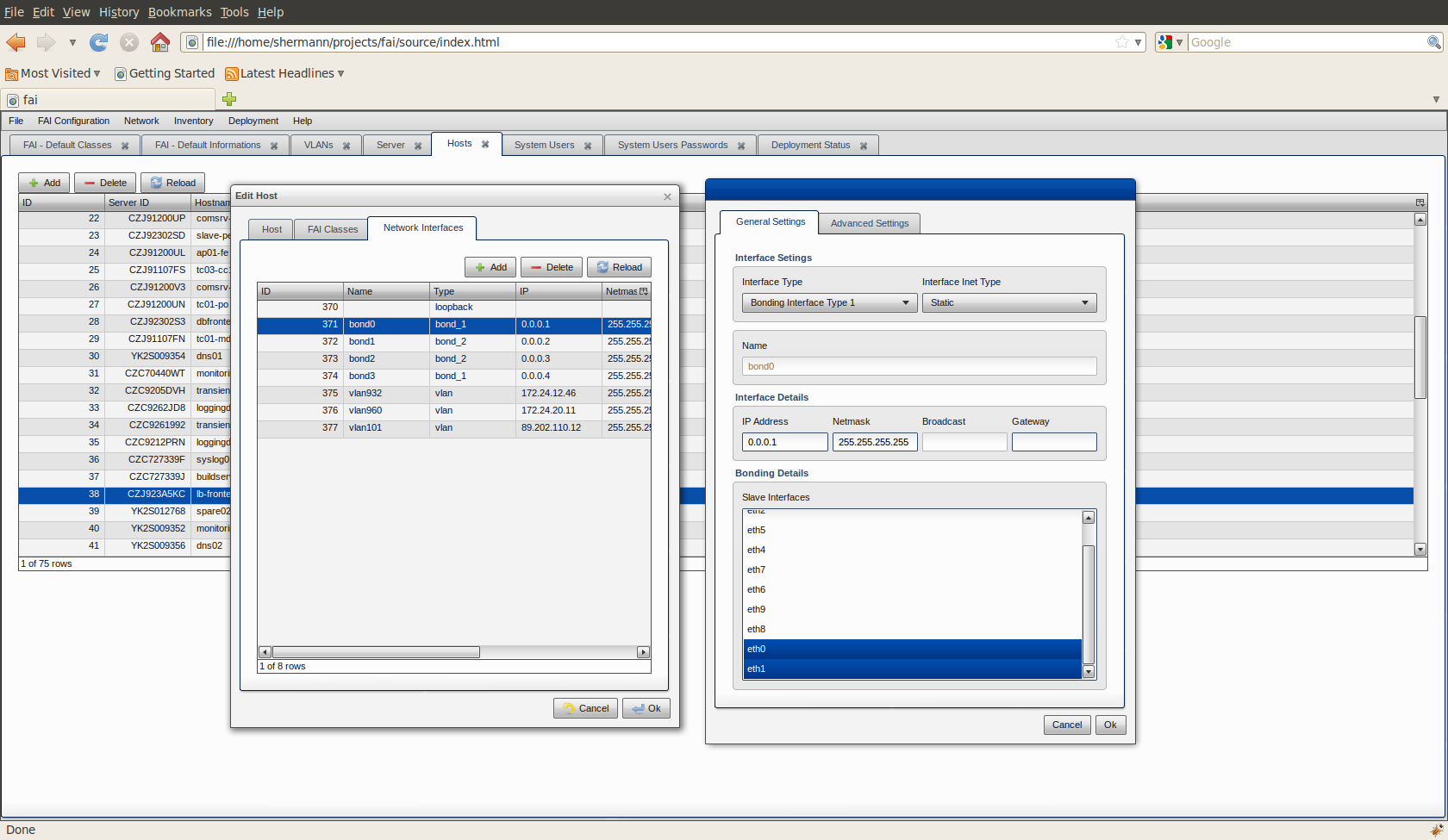
FAI Manager webfrontend / Stephan Hermann Stephan \sh Hermann presented his FAI web frontend which should be released under the GPL license in those days. The frontend uses qooxdoo whereas the backend is based on django, rpc4django and python-tftpy. Screenshot of FAI manager webfrontend A demo video is available at blip.tv. Currently Stephan is searching for a nice name for his FAI management tool please send suggestions either to him or to the linux-fai-devel mailinglist. Grml / Michael Prokop Grml is a Debian based Linux live system specially made for system administrators. Grml uses grml-live for building the ISOs, whereas grml-live itself uses FAI s dirinstall feature to build the live system. This provides the Grml team with a nice way to autobuild 18 ISOs per day, known as daily.grml.org. Mika also presented Grml s netscript bootoption and the ethdevice bootoption of live-initramfs which is useful for booting Grml/FAI via PXE. Host Europe / Michael Goetze Host Europe uses FAI for installing Debian and Ubuntu (32+64 bit) in the support center. They have ~20 FAI classes and use a Debian lenny NFSROOT as base for all deployed systems. Their main problems with FAI aren t related to FAI itself, but instead e.g. broadcom NICs with lack of support for it in Lenny s kernel. They are not using softupdate (yet) and currently use Kickstart for deploying CentOS but are working on deploying CentOS with FAI as well. LIS AG / Sebastian Hetze Linux Information Systems AG (LIS AG) are using FAI 3.2.17 and provide a luma and PyQt based GUI to their customers. They use DHCP, LDAP and DDNS for inventory, configuration and deployment. Mathematical Institute of the University of Bonn / Manuel Hachtkemper The Mathematical Institute of the University of Bonn uses FAI 3.1.8 and 3.3.5 for managing ~150 systems. They are automatically running softupdates every day, reporting how many hosts actually did run the softupdate and how many didn t run. The involved failogwatch tool supports two regex files, one for excluding specific hosts and the other one for grepping for known problems in the logs. Spotify / Andreas Schuldei + Mattias Jansson Spotify is a peer-to-peer music streaming service and the operating people at Spotify use FAI for deploying the systems. Currently they are using FAI 3.3.3 to deploy ~400 bare metal machines and ~150 virtualised machines. They have their class names in DNS using the txt/Text record entry. They are using a self written prepend_class script to manage dependencies between classes. University K ln / Thomas Lange Thomas uses FAI s trunk version (of course :) ), managing ~25 machines with less than 20 FAI classes. He s not using softupdates as Lenny s aptitude ignores the hold status of packages (this bug should be fixed for Squeeze). $COMPANY One of the big telecommunication providers in Germany uses FAI 3.3.3 for installing their bare-metal and virtual servers, providing Debian, Ubuntu and SLES. They are using Debian NFSROOT as a base for all systems as well and their main problems with FAI wasn t FAI itself but how to manage installation of virtual machines.
On Saturday evening we had a nice barbecue which included beer and K lsch *d&r*. ;) On Sunday we continued with discussions and development. Our work-log of the weekend: Important decisions made: We noticed that many FAI users implement their own way how to handle dependency management between classes, we will re-consider how we could provide such a mechanism through FAI s core. We also noted that it s important that any self-written scripts used within FAI are fully idempotent and users should be aware of this. Last but not least many thanks to the sponsors of the FAI developer workshop 07/2010! The workshop wouldn t have been possible without our generous sponsors, namely being:

6 July 2010

Matt Zimmerman: We ve packaged all of the free software what now?

Today, virtually all of the free software available can be found in packaged form in distributions like Debian and Ubuntu. Users of these distributions have access to a library of thousands of applications, ranging from trivial to highly sophisticated software systems. Developers can find a vast array of programming languages, tools and libraries for constructing new applications. This is possible because we have a mature system for turning free software components into standardized modules (packages). Some software is more difficult to package and maintain, and I m occasionally surprised to find something very useful which isn t packaged yet, but in general, the software I want is packaged and ready before I realize I need it. Even the long tail of niche software is generally packaged very effectively. Thanks to coherent standards, sophisticated management tools, and the principles of software freedom, these packages can be mixed and matched to create complete software stacks for a wide range of devices, from netbooks to supercomputing clusters. These stacks are tightly integrated, and can be tested, released, maintained and upgraded as a unit. The Debian system is unparalleled for this purpose, which is why Ubuntu is based on it. The vision, for a free software operating system which is highly modular and customizable, has been achieved. Rough edges This is a momentous achievement, and the Debian packaging system fulfills its intended purpose very well. However, there are a number of areas where it introduces friction, because the package model doesn t quite fit some new problems. Most of these are becoming more common over time as technology evolves and changes shape. Why are we stuck?
I suppose it is tempting, if the only tool you have is a hammer, to treat everything as if it were a nail.
Abraham Maslow
The packaging ecosystem is very strong. Not only do we have powerful tools for working with packages, we also benefit from packages being a well-understood concept, and having established processes for developing, exchanging and talking about them. Once something is packaged, we know what it is and how to work with it, and it fits into everything else. So, it is tempting to package everything in sight, as we already know how to make sense of packages. However, this may not always be the right tool for the job. Various attempts have been made to extend the packaging concept to make it more general, for example: Other package managers aim to solve a specific problem, such as providing lightweight package management for embedded systems, or lazy dependency installation, or fixing the filesystem hierarchy. There is a long list of package managers of various levels which solve different problems. Most of these systems suffer from an important fundamental tradeoff: they are designed to manage the entire system, from the kernel through applications, and so they must be used wholesale in order to reap their full benefit. In other words, in their world, everything is a package, and anything which is not a package is out of scope. Therefore, each of these systems requires a separate collection of packages, and each time we invent a new one, its adherents set about packaging everything in the new format. It takes a very long time to do this, and most of them lose momentum before a mature ecosystem can form around them. This lock-in effect makes it difficult for new packaging technologies to succeed. Divide and Conquer No single package management framework is flexible enough to accommodate all of the needs we have today. Even more importantly, a generic solution won t account for the needs we will have tomorrow. I propose that in order to move forward, we must make it possible to solve packaging problems separately, rather than attempting to solve them all within a single system. But I like things how they are! We don t have a choice. The world is changing around us, and distributions need to evolve with it. If we don t adapt, we will eventually give way to systems which do solve these problems. Take, for example, modern web browsers like Firefox and Chromium. Arguably the most vital application for users, the browser is coming under increasing pressure to keep up with the breakneck pace of innovation on the web. The next wave of real-time collaboration and multimedia applications relies on the rapid development of new capabilities in web browsers. Browser makers are responding by accelerating deployment in the field: both aggressively push new releases to their users. A report from Google found that Chrome upgrades 97% of their users within 21 days of a new release, and Firefox 85% (both impressive numbers). Mozilla recently changed their maintenance policies, discontinuing maintenance of stable releases and forcing Ubuntu to ship new upstream releases to users. These applications are just the leading edge of the curve, and the pressure will only increase. Equally powerful trends are pressing server applications, embedded systems, and data to adapt as well. The ideas I ve presented here are only one possible way forward, and I m sure there are more and better ideas brewing in distribution communities. I m sure that I m not the only one thinking about these problems. Whatever it looks like in the end, I have no doubt that change is ahead.

Martin-Éric Racine: On pohjant hden alla, T koti mulla mainen, M el m st laulan...

My girlfriend and I were out picking up a cake at the bakery last week, when my phone rang: Without knowing, at that moment, I had just become a citizen of the country in which I have been living for the past 12 years. It was only yesterday, upon receiving the decision in the mail and looking at the date on the certificate that I realized that, when I got the phone call, the decision had already been made and the bureaucracy was only looking for reassurances that I fully intend upon acquitting my civic obligations as soon as humanely possible. To say that reading the decision was a highly emotional moment is an understatement. Trying to explain the intensity of this moment to my girlfriend, I compared it to the day when a teenager reaches adulthood. This instant brought a similar feeling: suddenly, the whole EU opens its doors to me and I'm free to decide how to best use the opportunities it offers. What next? For now, completing this government training to become a bureaucrat. Funnily enough, becoming a citizen resolved the whole issue of background checks, which also suddenly triples the number of possible venues for the on-job part of the training. In my case, it looks like I'll be spending the next few months at the Ministry of Employment and Entrepreneurship, working on EU projects that fund R&D efforts and export sales ventures in each member state. After that, I'm not sure. On one hand, I'd like to apply for the Ministry of Foreign Affairs' KAVAKU recruitment program for future diplomats. On the other hand, that ministry is extremely picky about whom it accepts and it's not particularly known for favoring naturalized individuals. This being said, our current Minister recently published rather ambitious plans to completely reform the Ministry by bringing in seasoned professionals from the private sector who could efficiently promote Finnish know-how and products abroad, rather than hiring more of the same Public Administration graduates, so, who knows? Maybe the time is right for someone like me to join the ranks of the Finnish diplomacy? An other option that I'm considering is to permanently move to Estonia. When my last job there ended, I was left with the feeling that I could have accomplished a lot more, if only I were in a legal position to move there, rather than commute a couple of times a week. Beyond the pioneering work that myself and my diplomat friends at the Estonian embassy did in Turkey, there was a demand for us to perform the same magic in other countries of interest to Estonia. Unfortunately, not being in a position to be on-site and no longer having a job that paid for me to be there often enough meant that I had to pass on that opportunity. Now, seeing how one of my friends recently left the diplomacy and is open to new challenges, I'm wondering if now might be a good time to resume our operation and prepare our next campaign? Wow... So much to think about, now that a whole continent opened its doors to me. Hienoa! Olen suomalainen.

4 July 2010

Gregor Herrmann: RC bugs 2010/25, 2010/26

to start with the good news: christine has joined the RCBW initiative yeah! let's see who joins next ...

as usual, a short overview about my own attempts in the RC bugs department:

Christine Spang: Christine Spang: [h]ledger rocks my world

I hate keeping track of money. Bank accounts, credit cards, investing it's such a hassle. Hell, sometimes I even hate the fact that money exists and needs to be dealt with in the first place. But I admit that it's an easier system than bartering for everything. In college I pretty much ignored most things financial. I rarely had more money than I needed, and put little financial planning into deciding what I could and could not spend money on besides, "I'm going to make X dollars this summer," and, "think twice." But now that I have a steady paycheck, it seems like a good idea to know where all my money goes, so I can make better decisions about how I'm spending (and saving) it. But I've kept procrastinating starting to do so, because GUI programs like Gnucash and HomeBank seem like such a hassle. Their first screen is dauntingly complex, and if you don't know much about accounting it's scary and difficult to be asked to set up a big set of accounts when first starting to use the program, without having any prior experience with what you personally would find useful to keep track of. Entering data through menus and dialogs is tedious and slow. hledger (or ledger, which came first) had been appearing on my radar recently, not least because Iron Blogger uses it). hledger changed my opinion of accounting software. In about 15 minutes, using only the sample transactions from the manual, I was able to enter all my assets and liabilities bank accounts, credit card, student loans, money I've borrowed from people and never paid back though I said I would, etc. And then, I could run 'hledger balance' and it would tell me what sorts of things I had spent money on in the past few days, as far back as I could bother looking up actual transactions for, rather than entering a single transaction with a balance forward. Duuude, awesome! I'm a geek. I like statistics and data about my life, as long as it's not a huge pain to collect the data in the first place. More data means more on which to base decisions, decisions which will then be freer from the bias of what I find memorable enough to remember having done. Here's what I like best about ledger: I don't think I'd be enjoying keeping track of my money nearly so much without a tool like hledger. It gets out of your way to let you focus on the hard things, like choosing categories for the things you spend money on and remembering to record the data in the first place.

3 July 2010

Petter Reinholdtsen: Lenny->Squeeze upgrades, apt vs aptitude with the Gnome desktop

Here is a short update on my my Debian Lenny->Squeeze upgrade testing. Here is a summary of the difference for Gnome when it is upgraded by apt-get and aptitude. I'm not reporting the status for KDE, because the upgrade crashes when aptitude try because of missing conflicts (#584861 and #585716). At the end of the upgrade test script, dpkg -l is executed to get a complete list of the installed packages. Based on this I see these differences when I did a test run today. As usual, I do not really know what the correct set of packages would be, but thought it best to publish the difference. Installed using apt-get, missing with aptitude
at-spi cpp-4.3 finger gnome-spell gstreamer0.10-gnomevfs libatspi1.0-0 libcupsys2 libeel2-data libgail-common libgdl-1-common libgnomeprint2.2-data libgnomeprintui2.2-common libgnomevfs2-bin libgtksourceview-common libpt-1.10.10-plugins-alsa libpt-1.10.10-plugins-v4l libservlet2.4-java libxalan2-java libxerces2-java openoffice.org-writer2latex openssl-blacklist p7zip python-4suite-xml python-eggtrayicon python-gtkhtml2 python-gtkmozembed svgalibg1 xserver-xephyr zip
Installed using apt-get, removed with aptitude
bluez-utils dhcdbd djvulibre-desktop epiphany-gecko gnome-app-install gnome-mount gnome-vfs-obexftp gnome-volume-manager libao2 libavahi-compat-libdnssd1 libavahi-core5 libbind9-50 libbluetooth2 libcamel1.2-11 libcdio7 libcucul0 libcurl3 libdirectfb-1.0-0 libdvdread3 libedata-cal1.2-6 libedataserver1.2-9 libeel2-2.20 libepc-1.0-1 libepc-ui-1.0-1 libexchange-storage1.2-3 libfaad0 libgd2-noxpm libgda3-3 libgda3-common libggz2 libggzcore9 libggzmod4 libgksu1.2-0 libgksuui1.0-1 libgmyth0 libgnome-desktop-2 libgnome-pilot2 libgnomecups1.0-1 libgnomeprint2.2-0 libgnomeprintui2.2-0 libgpod3 libgraphviz4 libgtkhtml2-0 libgtksourceview1.0-0 libgucharmap6 libhesiod0 libicu38 libisccc50 libisccfg50 libiw29 libkpathsea4 libltdl3 liblwres50 libmagick++10 libmagick10 libmalaga7 libmtp7 libmysqlclient15off libnautilus-burn4 libneon27 libnm-glib0 libnm-util0 libopal-2.2 libosp5 libparted1.8-10 libpisock9 libpisync1 libpoppler-glib3 libpoppler3 libpt-1.10.10 libraw1394-8 libsensors3 libsmbios2 libsoup2.2-8 libssh2-1 libsuitesparse-3.1.0 libswfdec-0.6-90 libtalloc1 libtotem-plparser10 libtrackerclient0 libvoikko1 libxalan2-java-gcj libxerces2-java-gcj libxklavier12 libxtrap6 libxxf86misc1 libzephyr3 mysql-common swfdec-gnome totem-gstreamer wodim
Installed using aptitude, missing with apt-get
gnome gnome-desktop-environment hamster-applet python-gnomeapplet python-gnomekeyring python-wnck rhythmbox-plugins xorg xserver-xorg-input-all xserver-xorg-input-evdev xserver-xorg-input-kbd xserver-xorg-input-mouse xserver-xorg-input-synaptics xserver-xorg-video-all xserver-xorg-video-apm xserver-xorg-video-ark xserver-xorg-video-ati xserver-xorg-video-chips xserver-xorg-video-cirrus xserver-xorg-video-dummy xserver-xorg-video-fbdev xserver-xorg-video-glint xserver-xorg-video-i128 xserver-xorg-video-i740 xserver-xorg-video-mach64 xserver-xorg-video-mga xserver-xorg-video-neomagic xserver-xorg-video-nouveau xserver-xorg-video-nv xserver-xorg-video-r128 xserver-xorg-video-radeon xserver-xorg-video-radeonhd xserver-xorg-video-rendition xserver-xorg-video-s3 xserver-xorg-video-s3virge xserver-xorg-video-savage xserver-xorg-video-siliconmotion xserver-xorg-video-sis xserver-xorg-video-sisusb xserver-xorg-video-tdfx xserver-xorg-video-tga xserver-xorg-video-trident xserver-xorg-video-tseng xserver-xorg-video-vesa xserver-xorg-video-vmware xserver-xorg-video-voodoo
Installed using aptitude, removed with apt-get
deskbar-applet xserver-xorg xserver-xorg-core xserver-xorg-input-wacom xserver-xorg-video-intel xserver-xorg-video-openchrome
I was told on IRC that the xorg-xserver package was changed in git today to try to get apt-get to not remove xorg completely. No idea when it hits Squeeze, but when it does I hope it will reduce the difference somewhat.

1 July 2010

Russell Coker: libcsoap/libnanohttp

Recently I have been doing a bit of work on libcsoap (the C library for making SOAP XML calls over http) and the libnanohttp library that it depends on. The most important part of my work on it was making it thread-safe with the technique I described in my post about finding thread unsafe code [1]. But I also did some work to make the code faster, reading data one byte at a time is very inefficient. There has been no upstream release of this software for years, email to one of the maintainers bounced and the other one indicated that they are no longer involved in the project. So I m thinking of taking over upstream development. The previous Debian maintainer for the packages in question has recently resigned so I ve taken over the packaging. But for this one I think I can do better work in an upstream capacity, so I d like to get a co-maintainer for the Debian package and possibly someone who will help with upstream work. I would appreciate any offers of assistance with these things.

Sylvain Le Gall: 5 years old CD-RW...

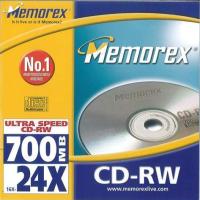
This blog post is a kind of followup of a previous blog post about reading 10 years old CD-R. Today, I get a new shiny ASRock ION 330 to play with, in itself this PC has nothing particular. As usual, I begin by using System Rescue CD to check bad blocks on the hard drive, before working with it (badblocks -v -s -w -c 4096 /dev/sda). Once done, I will check the memory (memtest). This is my standard procedure when receiving a new PC. But I don't have my System Rescue CD at hand. No problem, I download it and and write it on an old CD-RW, bought 5 years ago but still sealed into his blister. For your information, this is a Memorex CD-RW 700MB 16-24x. I blank it (wodim blank=all). I write it at speed 16x, because I don't know how to lower the speed. After writing the CD, I re-read it to check everything is fine (readom dev=/dev/cdrw1 f=test.iso). Ooops:
$ readom dev=/dev/cdrw1 f=test.iso
[...] 
Errno: 5 (Input/output error), read_g1 scsi sendcmd: no error
CDB:  28 00 00 01 3C 00 00 00 40 00
status: 0x2 (CHECK CONDITION)
Sense Bytes: 70 00 03 00 00 00 00 0A 00 00 00 00 11 05 00 00
Sense Key: 0x3 Medium Error, Segment 0
Sense Code: 0x11 Qual 0x05 (l-ec uncorrectable error) Fru 0x0
Sense flags: Blk 0 (not valid) 
cmd finished after 6.614s timeout 40s
readom: Input/output error. Cannot read source disk
readom: Retrying from sector 80896.
.............
readom: Error on sector 80908 corrected after 9 tries. Total of 0 errors.
..............---
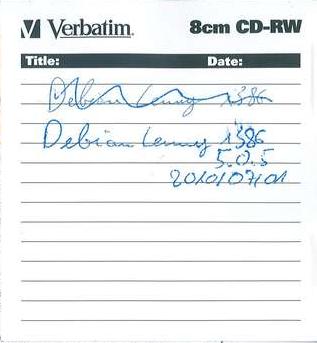
OK, I re-blank it (wodim blank=fast) and rewrite it. The CD seems to be readable this time. But when I try to boot with it my new ASRock, it fails. Enough is enough, I get an heavy used Verbatim 8cm CD-RW. Just to show you how old he is: the first ISO written on it was "Debian Sarge". And the magic happens: it works on the first try!!!! You will probably think that I work for Verbatim. This is not true but I must admit that first-price CD-RW/CD-R seems to be very low quality and don't hold data in time. This is probably related to the chemical compounds of the CD. The failing Memorex CD-RW will end up in a trash and I will continue to use my 5 years old Verbatim CD-RW. Dear reader, in order to find a way not to dump this failing CD-RW, do you know a way to make it to work? What you should now about the failing CD-RW:

30 June 2010

Ingo Juergensmann: Getting hit by a spammer with Exim

Yesterday I was warned by Nagios that something is going on with my server. The number of processes has been gone beyond the limit. The reason for this were a bunch of Exim processes trying to deliver a lot of mails. Apparently a spammer made it happen to send spams via my server. How could this happen? I was seeing a lot of those log entries:
2010-06-28 16:29:25 1OTFKt-0004cZ-1R <= vsvc@euhu.com H=(qknlvj.com) [58.212.194.230] P=esmtpa A=cram_md5:inna S=1455 id=0ec5ff00b06c43369e2582fc4269839e@e12c17c51ec546bf9e7a23e6f9875941
2010-06-28 16:29:27 1OTFKw-0004cZ-KZ <= ebms@ylmdbm.com H=(qknlvj.com) [58.212.194.230] P=esmtpa A=cram_md5:inna S=1520 id=58913c34bde64e908310db7e1280eff5@2dc8ed5998b64e8485c472cae5ef98c3
2010-06-28 16:29:28 1OTFKy-0004cZ-1p <= wiyscy@hegyogz.com H=(qknlvj.com) [58.212.194.230] P=esmtpa A=cram_md5:inna S=1436 id=814a7bdcbe85447a9283d4a0a074830b@0ada3cde4a4c41c38c65bc912639afb6
Apparently the spammer has successfully found a way to bypass the authenticators in Exim. By default only authenticated users can send mails via my mailserver, of course. But this spammer found a way around that problem. A user "inna" is not known, so the spammer shouldn't be able to send mails at all. But he can. Something is broken apparently. The spammer sent an empty password ('') and the database didn't find an user by this name and returned an empty resultset (''). Both sides of the comparison matches and the mail is allowed in. Let's have a look at my Exim config:
cram_md5:
server_debug_print = "running smtp auth $1 $2"
driver = cram_md5
public_name = CRAM-MD5
server_secret = $ lookup pgsql select clear from passwd where passwd.usr='$1' limit 1 $value
server_set_id = $1
On #exim@freenode there was just another user with the very same problem with exactly the same spammer. Apparently the lookup is true for empty passwords or users. The solution is to add a "fail" in the lookup statement:
server_secret = $ lookup pgsql select clear from passwd where passwd.usr='$1' limit 1 $value fail
That's pretty all to do to prevent the spamming. But how could this happen at all? Back then when I was configuring my mailserver (around 2003 or so) I can remember that I tried a "fail" statement in the server_secret as it is described in the Exim documentation, but it didn't work as expected. So I ended up with no "fail". This worked fairly well over the years and I remember that I tested this lookup by trying to send with user/password combinations of all different sorts. So it went into "production". Apparently it doesn't work anymore today. The other guy on the #exim channel said that he found no database lookup example with "fail" at all. Even the example in one of his books was without "fail". So I believe that something changed either in Exim or in PostgreSQL to make submitting an empty password string a positive match for bypassing authentication nowadays. For the records: the spammer send approx. >10.000 mails. Another bunch of 8000 mails were rejected, but this is just slightly over the daily average.

Marco T&uacute;lio Gontijo e Silva: Immix on GHC Summer of Code weekly report #7

My project. This post assumes that the reader has read my last post. This week I had less time to work on my project than the last ones, because it was kind of the last week of the semester for some disciplines. This was unfortunate from a point of view, but it s good in another, because now I ve finished most of my disciplines and can focus more. This is also the reason why the weekly report is slightly delayed. Most of my work this week was continuing the investigation of the segfault caused by my implementation of allocation in lines. The most interesting thing I discovered came after a suggestion from my menthor: to use +RTS -DS to turn on the sanity checker. I runned the code with my allocation implementation and the sanity checker and got a segfault. I runned again only with the code to free memory in lines and I got also a segfault. Then I runned without all my patches, using sweep, and I got the segfault. So it seems that there is something wrong with sweep, and now I m investigating this new segfault. I m using the bernouilli program from nofib to test, running with 148 as a parameter and, naturally, +RTS -w -DS passed to the RunTime System. The output of gdb:
Current directory is /home/marcot/trabalho/livre/ghc/nofib/imaginary/bernouilli/
GNU gdb (GDB) 7.1-debian
Copyright (C) 2010 Free Software Foundation, Inc.
License GPLv3+: GNU GPL version 3 or later <http://gnu.org/licenses/gpl.html>
This is free software: you are free to change and redistribute it.
There is NO WARRANTY, to the extent permitted by law.  Type "show copying"
and "show warranty" for details.
This GDB was configured as "x86_64-linux-gnu".
For bug reporting instructions, please see:
<http://www.gnu.org/software/gdb/bugs/>...
Reading symbols from /home/marcot/trabalho/livre/ghc/nofib/imaginary/bernouilli/Main...done.
(gdb) r 148 +RTS -w -DS
Starting program: /home/marcot/trabalho/livre/ghc/nofib/imaginary/bernouilli/Main 148 +RTS -w -DS
[Thread debugging using libthread_db enabled]
Program received signal SIGSEGV, Segmentation fault.
0x00000000006309cb in LOOKS_LIKE_INFO_PTR_NOT_NULL (p=12297829382473034410) at includes/rts/storage/ClosureMacros.h:225
(gdb) where
#0  0x00000000006309cb in LOOKS_LIKE_INFO_PTR_NOT_NULL (p=12297829382473034410) at includes/rts/storage/ClosureMacros.h:225
#1  0x0000000000630a16 in LOOKS_LIKE_INFO_PTR (p=12297829382473034410) at includes/rts/storage/ClosureMacros.h:230
#2  0x0000000000630a4b in LOOKS_LIKE_CLOSURE_PTR (p=0x7ffff6c84062) at includes/rts/storage/ClosureMacros.h:235
#3  0x0000000000631427 in checkClosure (p=0x7ffff6853a08) at rts/sm/Sanity.c:320
#4  0x00000000006319ef in checkHeap (bd=0x7ffff68014c0) at rts/sm/Sanity.c:479
#5  0x000000000063222f in checkSanity (check_heap=rtsTrue) at rts/sm/Sanity.c:686
#6  0x000000000062dfdb in GarbageCollect (force_major_gc=rtsFalse, gc_type=0, cap=0x8d2ec0) at rts/sm/GC.c:768
#7  0x0000000000620431 in scheduleDoGC (cap=0x8d2ec0, task=0x8f5080, force_major=rtsFalse) at rts/Schedule.c:1420
#8  0x000000000061fa2c in schedule (initialCapability=0x8d2ec0, task=0x8f5080) at rts/Schedule.c:539
#9  0x0000000000620c77 in scheduleWaitThread (tso=0x7ffff6c80000, ret=0x0, cap=0x8d2ec0) at rts/Schedule.c:1902
#10 0x000000000065762b in rts_evalLazyIO (cap=0x8d2ec0, p=0x89d8b0, ret=0x0) at rts/RtsAPI.c:495
#11 0x000000000061d3db in real_main () at rts/RtsMain.c:66
#12 0x000000000061d4ca in hs_main (argc=5, argv=0x7fffffffe6d8, main_init=0x406558 <__stginit_ZCMain>, main_closure=0x89d8b0) at rts/RtsMain.c:115
#13 0x00007ffff6fbcabd in __libc_start_main (main=<value optimized out>, argc=<value optimized out>, ubp_av=<value optimized out>, init=<value optimized out>, fini=<value optimized out>, rtld_fini=<value optimized out>, stack_end=0x7fffffffe6c8) at libc-start.c:222
#14 0x0000000000403a69 in _start ()
I started the investigation with the most obvious test: to remove the call to sweep() in rts/sm/GC.c.
  if (major_gc && oldest_gen->mark)  
      if (oldest_gen->compact)
          compact(gct->scavenged_static_objects);
      // else
      //     sweep(oldest_gen);
The result was the same, same segfault in the same place. So I decided to do it a little stronger and avoid the blocks getting the BF_MARKED flag, so that they are not even marked.
                if (!(bd->flags & BF_FRAGMENTED))  
                    // bd->flags  = BF_MARKED;
                 
This one worked. The code in sweep() is not commented, but it s irrelevant, since it ignores blocks that don t have this flag. My third try was to comment the places where the BF_MARKED flag is read, to see each one was causing the segfault. I got a list of places to search with grep, and there weren t a lot of them.
$ grep BF_MARKED rts/sm/*.c
rts/sm/Compact.c:       if (bd->flags & BF_MARKED)
rts/sm/Evac.c:  if ((bd->flags & (BF_LARGE   BF_MARKED   BF_EVACUATED)) != 0)  
rts/sm/Evac.c:        if (bd->flags & BF_MARKED)  
rts/sm/GCAux.c:    if ((bd->flags & BF_MARKED) && is_marked((P_)q,bd))  
rts/sm/GC.c:                    if (!(bd->flags & BF_MARKED))
rts/sm/GC.c:                        // time, so reset the BF_MARKED flags.
rts/sm/GC.c:                        // compact.  (search for BF_MARKED above).
rts/sm/GC.c:                        bd->flags &= ~BF_MARKED;
rts/sm/GC.c:                // Also at this point we set the BF_MARKED flag
rts/sm/GC.c:                // BF_MARKED is always unset, except during GC
rts/sm/GC.c:                    bd->flags  = BF_MARKED;
rts/sm/Sweep.c:        if (!(bd->flags & BF_MARKED))  
The first one is in rts/sm/Compact.c, so it s not relevant to the use with -w. The second one, in rts/sm/Evac.c, is a bit indirect.
  if ((bd->flags & (BF_LARGE   BF_MARKED   BF_EVACUATED)) != 0)  
      // pointer into to-space: just return it.  It might be a pointer
      // into a generation that we aren't collecting (> N), or it
      // might just be a pointer into to-space.  The latter doesn't
      // happen often, but allowing it makes certain things a bit
      // easier; e.g. scavenging an object is idempotent, so it's OK to
      // have an object on the mutable list multiple times.
      if (bd->flags & BF_EVACUATED)  
          // We aren't copying this object, so we have to check
          // whether it is already in the target generation.  (this is
          // the write barrier).
	  if (bd->gen < gct->evac_gen)  
	      gct->failed_to_evac = rtsTrue;
	      TICK_GC_FAILED_PROMOTION();
	   
	  return;
       
      /* evacuate large objects by re-linking them onto a different list.
       */
      if (bd->flags & BF_LARGE)  
	  info = get_itbl(q);
	  if (info->type == TSO &&
	      ((StgTSO *)q)->what_next == ThreadRelocated)  
	      q = (StgClosure *)((StgTSO *)q)->_link;
              *p = q;
	      goto loop;
	   
	  evacuate_large((P_)q);
	  return;
       
      /* If the object is in a gen that we're compacting, then we
       * need to use an alternative evacuate procedure.
       */
      if (!is_marked((P_)q,bd))  
          mark((P_)q,bd);
          push_mark_stack((P_)q);
       
      return;
   
The first if, in line 466, is executed if any of the three flags is present: BF_LARGE, BF_MARKED or BF_EVACUATED. The second if, in line 474, checks for BF_EVACUATED, and returns. The third if, in line 487, checks for BF_LARGE and returns. The code in lines 502-505 is only executed if BF_MARKED is present, and not the other ones. I tried commenting this code, and got an assertion fail in the user code, so I think this is not a good path to follow. The second occurence of BF_MARKED is in the same file.
        if (bd->flags & BF_MARKED)  
            // must call evacuate() to mark this closure if evac==rtsTrue
            *q = (StgClosure *)p;
            if (evac) evacuate(q);
            unchain_thunk_selectors(prev_thunk_selector, (StgClosure *)p);
            return;
         
Commenting it, with or without the call to sweep() commented, causes the same segfault. So, I m tending to think this part of the code is unrelated to the issue. The third occurence is in rts/sm/GCAux.c. I tried commenting it with all the four combinations of the two others commented and not commented, and all resulted in the segfault in the same place. There s another place to check in rts/sm/GC.c. Again, commenting it made no difference. The last one is part of sweep(), so it s avoided anyway when the call to this function is commented.

25 June 2010

Roland Mas: FusionForge news, June 2010

Another month, another update, but nothing spectacular to be announced in FusionForge-world. We're still working on finishing the transition to the new configuration system, we're testing the migration to a simpler and more flexible set of Apache configuration files, and work is in progress on the RPM packaging. And so on. Possibly the most newsworthy item is the FusionForge presence at next month's Libre Software Meeting in Bordeaux (the RMLL in French). I'll do a FusionForge, one year and a half later talk summarising the status and progress of FusionForge, and there'll also be a *forge devroom where we'll mingle with people interested in all kinds of software forges. Come see us if you're around!

24 June 2010

Joachim Breitner: nagstmon forklet necessary

A while ago, I discovered nagstamon, a very useful piece of software by Henri Wahl. This program sits in the notification area of your desktop and alerts you when your nagios-monitored services have problems. Using nagstamon allows me to keep my servers under close surveillance, and it also adds another channel besides e-mail alerts, which will be helpful in case my mail server has problems. The wish I am not a full time sysadmin, I only monitor very few hosts and the services rarely have problems. Therefore, I do not want nagstamon to constantly sit in the notification area but only use it when there is something, well, to notify me about. It turned out that nagstamon did not support this mode of operation, so I created a ticket and asked whether this feature could be added. The author raised two points, one being that then the user would not know when nagios crashed and the other being that you would not be able to configure nagstamon because you do not see it. He also indicated that he does not have the resources to work on it and asked if I could find the time. The patch Since I really liked nagstamon, but really want to keep my panel uncluttered, I found the time: I created a series of self-containing patches, adding an option for the feature, adding code to prevent more than one instance of nagstamon running in parallel and adding a "nagstamon --settings" flag that would signal the running instance to show the settings similar to how mail-notification is been behaving. The author then raised the valid point that some people run more than one instances in parallel, with different configuration options. I then extended the patch to cater for that. The rebuff The author remained reserved, did not answer my last commend on the ticket and then, six weeks later, closed the bug without explanation and turned off the possibility to add comments. I can understand when people are reluctant to add contributed features to their code, I often feel the same way. But completely blocking more comments is not a nice way of communicating with possible contributors. The fork(let) So I m left with no option but patching each released version with my changes and building my own package. As I have to do this work anyways, I d like to share it. You can find my branch in my git repository. If you happen to want this feature as well and are using a Debian-based distribution, please let me know: I am building modified Debian packages anyways and can publish them as well. As I don t want to maintain this fork of nagstamon I don t plan to diverge any more from Henri s code, so if you have other feature requests, please talk to him first.

Joachim Breitner: nagstamon forklet necessary

A while ago, I discovered nagstamon, a very useful piece of software by Henri Wahl. This program sits in the notification area of your desktop and alerts you when your nagios-monitored services have problems. Using nagstamon allows me to keep my servers under close surveillance, and it also adds another channel besides e-mail alerts, which will be helpful in case my mail server has problems. The wish I am not a full time sysadmin, I only monitor very few hosts and the services rarely have problems. Therefore, I do not want nagstamon to constantly sit in the notification area but only use it when there is something, well, to notify me about. It turned out that nagstamon did not support this mode of operation, so I created a ticket and asked whether this feature could be added. The author raised two points, one being that then the user would not know when nagios crashed and the other being that you would not be able to configure nagstamon because you do not see it. He also indicated that he does not have the resources to work on it and asked if I could find the time. The patch Since I really liked nagstamon, but really want to keep my panel uncluttered, I found the time: I created a series of self-containing patches, adding an option for the feature, adding code to prevent more than one instance of nagstamon running in parallel and adding a "nagstamon --settings" flag that would signal the running instance to show the settings similar to how mail-notification is been behaving. The author then raised the valid point that some people run more than one instances in parallel, with different configuration options. I then extended the patch to cater for that. The rebuff The author remained reserved, did not answer my last commend on the ticket and then, six weeks later, closed the bug without explanation and turned off the possibility to add comments. I can understand when people are reluctant to add contributed features to their code, I often feel the same way. But completely blocking more comments is not a nice way of communicating with possible contributors. The fork(let) So I m left with no option but patching each released version with my changes and building my own package. As I have to do this work anyways, I d like to share it. You can find my branch in my git repository. If you happen to want this feature as well and are using a Debian-based distribution, please let me know: I am building modified Debian packages anyways and can publish them as well. As I don t want to maintain this fork of nagstamon I don t plan to diverge any more from Henri s code, so if you have other feature requests, please talk to him first.

Matthew Garrett: Joojoo

I've had the opportunity to look into the Joojoo tablet recently. It's an interesting device in various ways, ranging from the screen being connected upside down and everything having to be rotated before display, to the ACPI implementation that's so generic it has no support for actually attaching most embedded controller interrupts to ACPI devices and so relies on a hacked kernel that exposes individual interrupts as ACPI events that are parsed in userspace, to the ChangeOrientation binary that's responsible for switching between landscape and portrait modes containing gems like ps aux grep fgplayer grep -v grep and containing references to org.freedesktop.PandaSystem, a somewhat gratuitous namespace grab. Hardware-wise it seems to be little more than battery, generic nvidia reference design board and touchscreen with an accelerometer and LED glued to the chipset's GPIO lines. The entire impression is one of an ambitious project not backed up by the level of technical expertise required to get things done properly. Frankly, I think Michael Arrington came out of this rather better than he could have done - behind the reasonably attractive UI, the entire device is pretty much held together by string and a following wind.

Of course, releasing shoddily put together technology isn't generally illegal and from that point of view Fusion Garage aren't any worse than a number of products I've had the misfortune to actually spend money on. But they're distributing Linux (stock Ubuntu with some additional packages and a modified kernel) without any source or an offer to provide source. I emailed them last week and got the following reply:

Dear Sir,

we are still actively making changes to the joojoo software. We will make
the source release available once we feel we are ready to do so and also
having the resources to get this sorted out and organized for publication.
We seek your kind understanding on our position and appreciate your
patience on this. Thank you.

Best Regards
joojoo Support Team


Strong work, Fusion Garage. Hardware and software may not be your strong points, but you're managing copyright infringement with the best of them.

David Bremner: Yet another tale of converting Debian packaging to Git

racket (previously known as plt-scheme) is an interpreter/JIT-compiler/development environment with about 6 years of subversion history in a converted git repo. Debian packaging has been done in subversion, with only the contents of ./debian in version control. I wanted to merge these into a single git repository. The first step is to create a repo and fetch the relevant history.
TMPDIR=/var/tmp
export TMPDIR
ME= readlink -f $0 
AUTHORS= dirname $ME /authors
mkdir racket && cd racket && git init
git remote add racket git://git.racket-lang.org/plt
git fetch --tags racket
git config  merge.renameLimit 10000
git svn init  --stdlayout svn://svn.debian.org/svn/pkg-plt-scheme/plt-scheme/
git svn fetch -A$AUTHORS
git branch debian
A couple points to note: Now a couple complications arose about upstream's git repo.
  1. Upstream releases seperate source tarballs for unix, mac, and windows. Each of these is constructed by deleting a large number of files from version control, and occasionally some last minute fiddling with README files and so on.
  2. The history of the release tags is not completely linear. For example,
rocinante:~/projects/racket  (git-svn)-[master]-% git diff --shortstat v4.2.4  git merge-base v4.2.4 v5.0 
 48 files changed, 242 insertions(+), 393 deletions(-)
rocinante:~/projects/racket  (git-svn)-[master]-% git diff --shortstat v4.2.1  git merge-base v4.2.1 v4.2.4 
 76 files changed, 642 insertions(+), 1485 deletions(-)
The combination made my straight forward attempt at constructing a history synched with release tarballs generate many conflicts. I ended up importing each tarball on a temporary branch, and the merges went smoother. Note also the use of "git merge -s recursive -X theirs" to resolve conflicts in favour of the new upstream version. The repetitive bits of the merge are collected as shell functions.
import_tgz()  
    if [ -f $1 ]; then
        git clean -fxd;
        git ls-files -z   xargs -0 rm -f;
        tar --strip-components=1 -zxvf $1 ;
        git add -A;
        git commit -m'Importing ' basename $1 ;
    else
        echo "missing tarball $1";
    fi;
 
do_merge()  
    version=$1
    git checkout -b v$version-tarball v$version
    import_tgz ../plt-scheme_$version.orig.tar.gz
    git checkout upstream
    git merge -s recursive -X theirs v$version-tarball
 
post_merge()  
    version=$1
    git tag -f upstream/$version
    pristine-tar commit ../plt-scheme_$version.orig.tar.gz
    git branch -d v$version-tarball
 
The entire merge script is here. A typical step looks like
do_merge 5.0
git rm collects/tests/stepper/automatic-tests.ss
git add  git status -s   egrep ^UA   cut -f2 -d' ' 
git checkout v5.0-tarball doc/release-notes/teachpack/HISTORY.txt
git rm readme.txt
git add  collects/tests/web-server/info.rkt
git commit -m'Resolve conflicts from new upstream version 5.0'
post_merge 5.0
Finally, we have the comparatively easy task of merging the upstream and Debian branches. In one or two places git was confused by all of the copying and renaming of files and I had to manually fix things up with git rm.
cd racket   /bin/true
set -e
git checkout debian
git tag -f packaging/4.0.1-2  git svn find-rev r98 
git tag -f packaging/4.2.1-1  git svn find-rev r113 
git tag -f packaging/4.2.4-2  git svn find-rev r126 
git branch -f  master upstream/4.0.1
git checkout master
git merge packaging/4.0.1-2
git tag -f debian/4.0.1-2
git merge upstream/4.2.1
git merge packaging/4.2.1-1
git tag -f debian/4.2.1-1
git merge upstream/4.2.4
git merge packaging/4.2.4-2
git rm collects/tests/stxclass/more-tests.ss && git commit -m'fix false rename detection'
git tag -f debian/4.2.4-2
git merge -s recursive -X theirs upstream/5.0
git rm collects/tests/web-server/info.rkt
git commit -m 'Merge upstream 5.0'

Uwe Hermann: Using the Oasis UMO19 MCU003 400x USB microscope on Linux via luvcview

Oasis UMO19 MCU003 digital USB microscope I've been buying quite a lot of (usually cheapo) gadgets recently, which I'll probably introduce / review in various blog posts sooner or later. Let me start with a fun little gadget, a digital USB-based microscope. I found out about it via this thread over at lostscrews.com. You can get this (or a very similar device) e.g. on eBay for roughly 50 Euros. Mine seems to be from a company called Oasis (though they're probably just the reseller, not sure). The device doesn't seem to have a nice name, but I can see UMO19 MCU003 on the microscope, so I guess that's the name or model number. It can focus on magnifications of 20x or 400x. The image resolution is said to be a max. of 1600x1200, but in practice most of my images are 640x480, maybe I have to change some settings and/or the resolution depends on the magnification factor and lighting conditions. The device acts as a simple UVC webcam when attached to USB, so you can view the images easily via any compatible webcam software, e.g. luvcview and also save screenshots of the magnified areas (see images). UMO19 chip
UMO19 fabric
UMO19 LED First three from left to right: SMD LED (400x), clothes/jacket (400x), random PCB (20x). The other two below: A via on a PCB (400x), and the "pixels" of a TFT screen (400x). It worked out of the box on Linux for me, the uvcvideo kernel driver was loaded automatically.
 $ lsusb
 Bus 001 Device 013: ID 0ac8:3610 Z-Star Microelectronics Corp.
I set up a wiki page for more details (including full lsusb -vvv) and sample images at: http://randomprojects.org/wiki/Oasis_UMO19_MCU003_USB_microscope I will also post some more images there over the next few days. UMO19 TFT
UMO19 via
This is a really fun device for having a look at stuff you'd normally not see (or not well enough), and also useful for e.g. checking PCB solder joints, checking all kinds of electronics for errors or missing/misaligned parts, finding the chip name / model number of very tiny chips etc. etc. I can also imagine it's quite nice for biological use-cases, e.g. for studying insects, tissue, plants, and so on. Anyway, definately a nice toy for relatively low price, I can highly recommend a device like this. Check eBay (search for e.g. "usb mikroskop 400") and various online shops for similar devices, there seem to be a large number of them with different names and from different vendors. Just make sure it has at least 400x magnification, there are also some with only 80x or 200x which is not as useful as 400x, of course.

23 June 2010

Andrew McMillan: Using dnsmasq to add SRV records for CardDAV and CalDAV

I've been working on implementing CardDAV support into DAViCal at the moment, and the first problem I encountered when I went to try and use it from iCal, was that the configuration on iCal didn't seem to want to let me enter a URL to my addressbook. After I hauled out Wireshark and watched what was happening on the server it was clear that it was doing an SRV request to try and find the CardDAV server for the domain I had entered in. Unfortunately the DNS management front-end that I normally use doesn't support SRV records, so I was all ready to switch my whole DNS infrastructure around (one of those 'round tuit' tasks that's been on my todo list for somewhat more than a year) until I wondered if the magic that is dnsmasq would be able to help me out. It turns out that it can, and so after a little searching I'd managed to track down the magic syntax to do this:
srv-host=_caldav._tcp.home.mcmillan.net.nz.,davical.home.mcmillan.net.nz.,8008
srv-host=_carddav._tcp.home.mcmillan.net.nz.,davical.home.mcmillan.net.nz.,8008
Of course this is a special-case server for testing at home, and I run it on the funny port because it makes for less pollution when I sniff the traffic coming in. In the real world you'd want to add SRV records for caldavs and carddavs, to get SSL for these services, something like:
srv-host=_caldavs._tcp.home.mcmillan.net.nz.,davical.home.mcmillan.net.nz.,443
srv-host=_carddavs._tcp.home.mcmillan.net.nz.,davical.home.mcmillan.net.nz.,443
Once I'd done that, and put in a few more hours of debugging, DAViCal was working with iCal's CardDAV, at least for viewing / editing / deleting contacts - there's still some work to do yet on searching. I've now also got it working with Evolution's 'WebDAV contacts' plugin as well, after a tip from Milan Crha on the Evolution IRC channel. Heather gets home soon with the Apple phone I gave her when I upgraded to Android, so I'll hopefully be able to test against their new OS release and then get a new DAViCal release out next week. Maybe. Hopefully :-)

Next.

Previous.