Search Results: "tim"

28 July 2017

Steve Kemp: So I'm considering a new project

In the past there used to be a puppet-labs project called puppet-dashboard, which would let you see the state of your managed-nodes. Having even a very basic and simple "report user-interface" is pretty neat when you're pushing out a change, and you want to see it be applied across your fleet of hosts. There are some other neat features, such as allowing you to identify failures easily, and see nodes that haven't reported-in recently. This was spun out into a community-supported project which is largely stale: Having a dashboard is nice, but the current state of the software is less good. It turns out that the implementation is pretty simple though: The reporting node can thus receive real-time updates, and do what it wants with them. You can even sidestep the extra server if you wish: For example on my puppet-master I have this:
  root@master /var/lib/puppet/reports # ls   tail -n4
  smaug.dh.bytemark.co.uk
  ssh.steve.org.uk
  www.dns-api.com
  www.steve.org.uk
Inside each directory is a bunch of YAML files which describe the state of the host, and the recipes that were applied. Parsing those is pretty simple, the hardest part would be making a useful/attractive GUI. But happily we have the existing one to "inspire" us. I think I just need to write down a list of assumptions and see if they make sense. After all the existing installation(s) won't break, it's just a matter of deciding whether it is useful/worthwhile way to spend some time. Beyond that you might want to export data about the managed-nodes themselves. For example you might want a list of all the hosts which have "bash" installed on them. Or "All nodes with local user "steve"." I've written that stuff already, as it is very useful for auditing & etc. The hard part about that is that to get the extra data you'll need to include a puppet module to collect it. I suspect a new dashboard would be broadly interesting/useful but unless you have that extra detail it might not be so useful. You can't point to a slightly more modern installation and say "Yes this is worth migrating to". But if you have extra meta-data you can say: And that facility is very useful when you have shellshock, or similar knocking at your door. Anyway as a hacky start I wrote some code to parse reports, avoiding the magic object-fu that the YAML would usually invoke. The end result is this:
 root@master ~# dump-run www.steve.org.uk
 www.steve.org.uk
    Puppet Version: 4.8.2
    /var/lib/puppet/reports/www.steve.org.uk/201707291813.yaml
    Runtime: 2.16
    Status:changed
    Time:2017-07-29 18:13:04 +0000
    Resources
            total -> 176
            skipped -> 2
            failed -> 0
            changed -> 3
            out_of_sync -> 3
            scheduled -> 0
            corrective_change -> 3
    Changed Resources
            Ssh_authorized_key[skx@shelob-s-fi] /etc/puppet/code/environments/production/modules/ssh_keys/manifests/init.pp:17
            Ssh_authorized_key[skx@deagol-s-fi] /etc/puppet/code/environments/production/modules/ssh_keys/manifests/init.pp:22
            Ssh_authorized_key[steve@ssh.steve.org.uk-s-fi] /etc/puppet/code/environments/production/modules/ssh_keys/manifests/init.pp:27
    Skipped Resources
            Exec[clone sysadmin utils]
            Exec[update sysadmin utils]

Joachim Breitner: How is coinduction the dual of induction?

Earlier today, I demonstrated how to work with coinduction in the theorem provers Isabelle, Coq and Agda, with a very simple example. This reminded me of a discussion I had in Karlsruhe with my then colleague Denis Lohner: If coinduction is the dual of induction, why do the induction principles look so different? I like what we observed there, so I d like to share this. The following is mostly based on my naive understanding of coinduction based on what I observe in the implementation in Isabelle. I am sure that a different, more categorial presentation of datatypes (as initial resp. terminal objects in some category of algebras) makes the duality more obvious, but that does not necessarily help the working Isabelle user who wants to make sense of coninduction.

Inductive lists I will use the usual polymorphic list data type as an example. So on the one hand, we have normal, finite inductive lists:
datatype 'a list = nil   cons (hd : 'a) (tl : "'a list")
with the well-known induction principle that many of my readers know by heart (syntax slightly un-isabellized):
P nil   ( x xs. P xs   P (cons x xs))     xs. P xs

Coinductive lists In contrast, if we define our lists coinductively to get possibly infinite, Haskell-style lists, by writing
codatatype 'a llist = lnil   lcons (hd : 'a)  (tl : "'a llist")
we get the following coinduction principle:
(  xs ys.
    R xs ys'   (xs = lnil) = (ys = lnil)  
               (xs   lnil   ys'   lnil  
	         hd xs = hd ys   R (tl xs) (tl ys)))  
  (  xs ys. R xs ys   xs = ys)
This is less scary that it looks at first. It tell you if you give me a relation R between lists which implies that either both lists are empty or both lists are nonempty, and furthermore if both are non-empty, that they have the same head and tails related by R, then any two lists related by R are actually equal. If you think of the infinte list as a series of states of a computer program, then this is nothing else than a bisimulation. So we have two proof principles, both of which make intuitive sense. But how are they related? They look very different! In one, we have a predicate P, in the other a relation R, to point out just one difference.

Relation induction To see how they are dual to each other, we have to recognize that both these theorems are actually specializations of a more general (co)induction principle. The datatype declaration automatically creates a relator:
rel_list :: ('a   'b   bool)   'a list   'b list   bool
The definition of rel_list R xs ys is that xs and ys have the same shape (i.e. length), and that the corresponding elements are pairwise related by R. You might have defined this relation yourself at some time, and if so, you probably introduced it as an inductive predicate. So it is not surprising that the following induction principle characterizes this relation:
Q nil nil  
( x xs y ys. R x y   Q xs ys   Q (cons x xs) (cons y ys))  
( xs ys   rel_list R xs ys   Q xs ys)
Note how how similar this lemma is in shape to the normal induction for lists above! And indeed, if we choose Q xs ys (P xs xs = ys) and R x y (x = y), then we obtain exactly that. In that sense, the relation induction is a generalization of the normal induction.

Relation coinduction The same observation can be made in the coinductive world. Here, as well, the codatatype declaration introduces a function
rel_llist :: ('a   'b   bool)   'a llist   'b llist   bool
which relates lists of the same shape with related elements only that this one also relates infinite lists, and therefore is a coinductive relation. The corresponding rule for proof by coinduction is not surprising and should remind you of bisimulation, too:
( xs ys.
    R xs ys   (xs = lnil) = (ys = lnil)  
              (xs   lnil   ys   lnil  
	        Q (hd xs) (hd ys)   R (tl xs) (tl ys)))  
(  xs ys   R xs ys   rel_llist Q xs ys)
It is even more obvious that this is a generalization of the standard coinduction principle shown above: Just instantiate Q with equality, which turns rel_llist Q into equality on the lists, and you have the theorem above.

The duality With our induction and coinduction principle generalized to relations, suddenly a duality emerges: If you turn around the implication in the conclusion of one you get the conclusion of the other one. This is an example of cosomething is something with arrows reversed . But what about the premise(s) of the rules? What happens if we turn around the arrow here? Although slighty less immediate, it turns out that they are the same as well. To see that, we start with the premise of the coinduction rule, reverse the implication and then show that to be equivalent to the two premises of the induction rule:
( xs ys.
    R xs ys   (xs = lnil) = (ys = lnil)  
              (xs   lnil   ys   lnil  
	        Q (hd xs) (hd ys)   R (tl xs) (tl ys)))
=   case analysis (the other two cases are vacuously true)  
  ( xs ys.
    xs = lnil   ys = lnil  
    R xs ys   (xs = lnil) = (ys = lnil)  
              (xs   lnil   ys   lnil  
	        Q (hd xs) (hd ys)   R (tl xs) (tl ys)))
  ( xs ys.
    xs   lnil   ys   lnil
    R xs ys   (xs = lnil) = (ys = lnil)  
              (xs   lnil   ys   lnil  
	        Q (hd xs) (hd ys)   R (tl xs) (tl ys)))
=   simplification  
  ( xs ys.  xs = lnil   ys = lnil   R xs ys
  ( x xs y ys.  R (cons x xs) (cons y ys)   (Q x y   R xs ys))
=   more rewriting  
  R nil nil
  ( x xs y ys. Q x y   R xs ys   R (cons x xs) (cons y ys))

Conclusion The coinduction rule is not the direct dual of the induction rule, but both are specializations of more general, relational proof methods, where the duality is clearly present. More generally, this little excursion shows that it is often beneficial to think of types less as sets, and more as relations this way of thinking is surprisingly fruitful, and led to proofs of parametricity and free theorems and other nice things.

27 July 2017

Michal Čihař: Weblate 2.16: Call for translations

Weblate 2.16 is almost ready (I expect no further code changes), so it's really great time to contribute to it's translations! Weblate 2.16 will be probably released during my presence at DebConf 17. As you might expect, Weblate is translated using Weblate, so the contributions should be really easy. In case there is something unclear, you can look into Weblate documentation. I'd especially like to see improvements in the Italian translation which was one of the first in Weblate beginnings, but hasn't received much love in past years.

Filed under: Debian English SUSE Weblate

26 July 2017

Norbert Preining: Software Development as mathematician in academia everyone bites the dust

Is it possible to do software development, mathematical or not, as mathematician in academics? This is a question I was asking myself recently a lot, seeing my own development from logician at a state university getting rid of foreigners to software developer. And then, a friend pointed me to this very depressing document: The origins of SageMath by William Stein, the main developer of SageMath. And I realized that it seems to be a global phenomenon that mathematicians who are interested in software development have to leave academics. What a sad affair. SageMath has a clear mission:
Creating a viable free open source alternative to Magma, Maple, Mathematica and Matlab.
All the Ma -software packages are commercial, and expensive. On the other hand they often have very good algorithms implemented. The Sage developers invested lots of time, energy, and brain power to develop excellent algorithm in an open source project for the mathematical researcher, but this investment wasn t honored in academic life. To quote from the presentation:
Issues with software dev in academia
  • Hard money for software development is virtually nonexistent: I can t think of anyone I know who got tenured based on his or her software.
  • Researchers on soft money are systematically discriminated against in favor of tenure-track and tenured faculty.
  • Researchers are increasingly evaluated solely on bibliometric counts rather than an informed assessment of their overall portfolio of papers, code, software, industry engagement, or student supervision.
The origins of SageMath, p.31
I can fully agree to this. Both from my own experience as well as from those around me. The presentation slides are full of other examples, from the developers of NumPy, Jupyter, as well as statements by Stephen Wolfram from Mathematica about this issue. A textbook how to not setup academia. My assumption was that this hits only on non-tenured staff, the academic precariat. It is shocking to see that even William Stein with a tenure position is leaving academics. It seems the times are not ready
Every great open source math library is built on the ashes of someone s academic career.
The origins of SageMath, p.32

25 July 2017

Russell Coker: Forking Mon and DKIM with Mailing Lists

I have forked the Mon network/server monitoring system. Here is a link to the new project page [1]. There hasn t been an upstream release since 2010 and I think we need more frequent releases than that. I plan to merge as many useful monitoring scripts as possible and support them well. All Perl scripts will use strict and use other best practices. The first release of etbe-mon is essentially the same as the last release of the mon package in Debian. This is because I started work on the Debian package (almost all the systems I want to monitor run Debian) and as I had been accepted as a co-maintainer of the Debian package I put all my patches into Debian. It s probably not a common practice for someone to fork upstream of a package soon after becoming a comaintainer of the Debian package. But I believe that this is in the best interests of the users. I presume that there are other collections of patches out there and I hope to merge them so that everyone can get the benefits of features and bug fixes that have been separate due to a lack of upstream releases. Last time I checked mon wasn t in Fedora. I believe that mon has some unique features for simple monitoring that would be of benefit to Fedora users and would like to work with anyone who wants to maintain the package for Fedora. I am also interested in working with any other distributions of Linux and with non-Linux systems. While setting up the mailing list for etbemon I wrote an article about DKIM and mailing lists (primarily Mailman) [2]. This explains how to setup Mailman for correct operation with DKIM and also why that seems to be the only viable option.

Satyam Zode: Maya - the OpenEBS Go Kit Project

The Kit project in Go is the common project containing all the standard libraries or packages used across all the Go projects in the organization. Motivation I attended GopherCon India 2017, there was a talk on Package Oriented Design In Go by William Kennedy. In that talk, William explained some really important and thoughtful design principles which We can apply in our day to day life, while writing Go. Hence, I wanted to apply these design philosophies to the Go projects in which I have been working on as a part of OpenEBS project. I learnt a good practice of having a Go Kit project at the organization level from William s talk. What is the Kit Project? The Kit project in Go is the common project containing all the standard libraries or packages used across all the Go projects in the organization. Packages in the Kit project should follow design philosophies. Need for a Kit project Sometimes, We write same Go packages again and again to do the same task at different levels in the different Go projects under the same organization. For example, we write custom logger package in the different Go projects. If the custom logger package is same across the organization and can be reused by simply importing it, then this custom logger package is the perfect fit for Kit project. You can sense how much time and cost it will save for us when we have a Kit project. How to convert existing projects to have kit Maya is the kit project in the progress. I will walk through our journey of creating a Kit project called maya for OpenEBS organization from existing Go projects. At OpenEBS, as a open source and growing Go project, We value Go principles and We try hard to leverage Go s offerings. Maya is the Kit project for the Application projects like maya-apiserver, maya-storage-bot etc. Maya contains all the kubernetes & nomad API s, common utilities etc. needed for development of maya-apiserver and maya-storage-bot. In the near future, we are trying to push our custom libraries to maya. So that, it will become a promising Go kit project for OpenEBS community. We have specifically followed the package oriented design principles in Go to create maya as a kit project. Project structure for the Maya as Kit project Example usage of maya kit project in maya-apiserver Maya-apiserver uses maya as a Kit project. Maya-apiserver exposes OpenEBS operations in form of REST APIs. This allows multiple clients e.g. volume related plugins to consume OpenEBS storage operations exposed by Maya API server. Conclusion Go Kit project should contain packages which are usable, purposeful and portable. Go Kit projects will improve the efficiency of the organization at both human and code level.

24 July 2017

Bits from Debian: DebConf17 Schedule Published!

The DebConf17 orga team is proud to announce that over 120 activities have been scheduled so far, including 45- and 20-minute talks, team meetings, and workshops, as well as a variety of other events. Most of the talks and BoFs will be streamed and recorded, thanks to our amazing video team! We'd like to remind you that Saturday August 5th is also our much anticipated Open Day! This means a program for a wider audience, including special activities for newcomers, such as an AMA session about Debian, a beginners workshop on packaging, a thoughtful talk about freedom with regard to today's popular gadgets and more. In addition to the published schedule, we'll provide rooms for ad-hoc sessions where attendees will be able to schedule activities at any time during the whole conference. The current schedule is available at https://debconf17.debconf.org/schedule/ This is also available through an XML feed. You can use ConfClerk in Debian to consume this, or Giggity on Android devices: https://debconf17.debconf.org/schedule/mobile/ We look forward to seeing you in Montreal! DebConf17 logo

Norbert Preining: Garmin fenix 5x broken by design

Some month ago I upgrade my (European) fenix3 to a (Japanese) fenix 5x, looking forward to the built-in maps as well as support for Japanese. I was about to write a great review, how content I have been with the fenix 3 and how much better the 5x is. Well, until I realized that Garmin s engineers seem to be brain-damaged and shipping broken by design devices: Just one word: Set an alarm on the watch, and wonder .. because you will never wake up the next day, since the alarm was deleted due to an unattended (so-called) sync operation. Happened to me, several times, worst was when I was with clients working as guide. So the problem is well known, see this link and this link and this link, and it is not restricted to the fenix. The origin of the problem is that Garmin is incapable of implementing a synchronization protocol. They have three sources of data: The Connect website, the Connect application on the smartphone, and the watch itself. And interestingly they only do pushes from Web to application to device, overwriting settings on the lower end. Which means, any alarm that I create on the watch will be overwritten, ie deleted, on every sync sorry, not sync, on every forced push from the mobile. It is a bit depressing, but I think the urgent solution is to exempt alarms from the synchronization completely, and remove them from both the connect web page and the application, until a better, a real, synchronization is implemented. I found a work-around in one of the threads on the Garmin forum, that is: create an alarm on the web or application, better alarms for each of the times you might need it. These will be synced to the device, and can be activated/deactivated on the device without problems. But to be honest this is not a solution I can really trust in when I need to get up in the morning. Besides this issue, which is unfortunately rather severe a restriction for me as mountaineer and mountain guide, I really love the watch and will write a more detailed review soon.

Jonathan Carter: Plans for DebCamp17

In a few days, I ll be attending DebCamp17 in Montr al, Canada. Here are a few things I plan to pay attention to:

Joerg Jaspert: Automated wifi login, update

With recent changes the automated login script for WifiOnICE stopped working. Fortunately a fix is easy, it is enough to add a referrer header to the call and have de/ added to the url. Updated script:
#!/bin/bash
# (Some) docs at
# https://wiki.ubuntuusers.de/NetworkManager/Dispatcher/
IFACE=$ 1:-"none" 
ACTION=$ 2:-"up" 
case $ ACTION  in
    up)
        CONID=$ CONNECTION_ID:-$(iwgetid "$ IFACE " -r) 
        if [[ $ CONID  == WIFIonICE ]]; then
            /usr/bin/timeout -k 20 15 /usr/bin/wget -q -O - --referer http://www.wifionice.de/de/ http://www.wifionice.de/de/?login > /dev/null
        fi
        ;;
    *)
        # We are not interested in this
        :
        ;;
esac

23 July 2017

Gregor Herrmann: RC bugs 2017/08-29

long time no blog post. & the stretch release happened without many RC bug fixes from me; in practice, the auto-removals are faster & more convenient. what I nevertheless did in the last months was to fix RC bugs in pkg-perl packages (it still surprises me how fast rotting & constantly moving code is); prepare RC bug fixes for jessie (also for pkg-perl packages); & in the last weeks provide patches & carry out NMUs for perl packages as part of the ongoing perl 5.26 transition.

22 July 2017

Niels Thykier: Improving bulk performance in debhelper

Since debhelper/10.3, there has been a number of performance related changes. The vast majority primarily improves bulk performance or only have visible effects at larger input sizes. Most visible cases are: For debhelper, this mostly involved: How to take advantage of these improvements in tools that use Dh_Lib: Credits: I would like to thank the following for reporting performance issues, regressions or/and providing patches. The list is in no particular order: Should I have missed your contribution, please do not hesitate to let me know.
Filed under: Debhelper, Debian

Junichi Uekawa: asterisk fails to start on my raspberry pi.

asterisk fails to start on my raspberry pi. I don't quite understand what the error message is but systemctl tells me there was a timeout. Don't know which timeout it hits.

20 July 2017

Norbert Preining: The poison of academia.edu

All those working in academics or research have surely heard about academia.edu. It started out as a service for academics, in their own words:
Academia.edu is a platform for academics to share research papers. The company s mission is to accelerate the world s research.
But as with most of these platforms, they need to get money, and since some months now academia.edu is pressing users to pay into a premium account at the incredible rate of 8.25USD per month. This is about he same you pay for Netflix, or some other streaming service. If you remain on the free side, what remains for you to do is SNS-like stuff, and uploading your papers so that academia.edu can make money from it. What I am really surprised that they can pull this of at a .edu domain. The registry requirements state
For Institutions Within the United States. To obtain an Internet name in the .edu domain, your institution must be a postsecondary institution that is institutionally accredited by an agency on the U.S. Department of Education s list of Nationally Recognized Accrediting Agencies (see recognized accrediting bodies).
Educause web site
Seeing what they are doing I think it is high time to request removal of the domain name. So let us see what they are offering for their paid service: On the other hand, the free service is consisting of SNS elements where you can follow other researchers, see when they upload/input an event, and that is it more or less. They have lured a considerable amount of academics into this service, gathered lots of papers, and now they are showing their real face money. In contrast to LinkedIn, which also offers paid tier, but keeps the free tier reasonably usable, academia.edu has broken its promise to accelerate the world s research and even worse, it is NOT a platform for academics to share research papers . They are collecting papers and sell access to them, like the publisher paywalls. I consider this kind of service highly poisonous for the academic environment and researchers.

Benjamin Mako Hill: Testing Our Theories About Eternal September

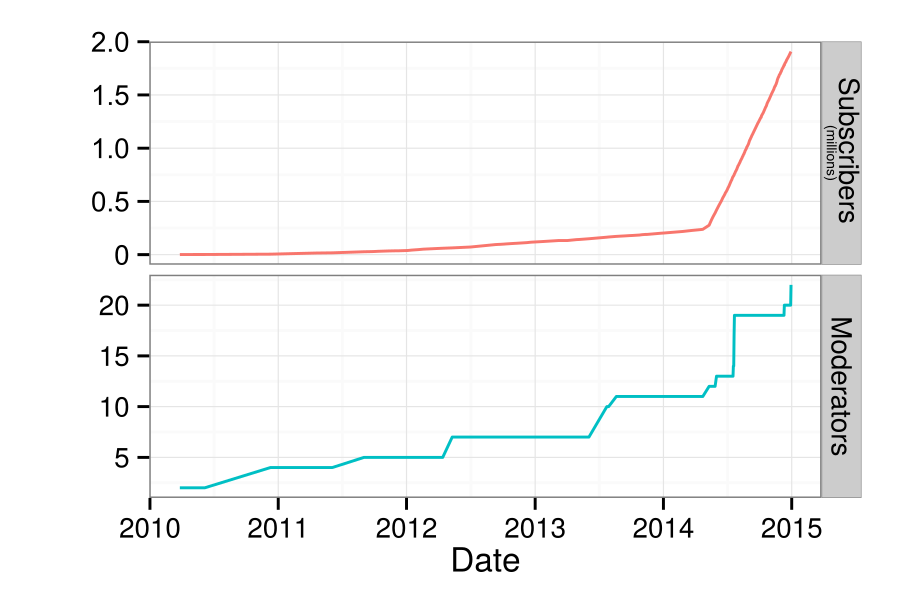
Graph of subscribers and moderators over time in /r/NoSleep. The image is taken from our 2016 CHI paper.
Last year at CHI 2016, my research group published a qualitative study examining the effects of a large influx of newcomers to the /r/nosleep online community in Reddit. Our study began with the observation that most research on sustained waves of newcomers focuses on the destructive effect of newcomers and frequently invokes Usenet s infamous Eternal September. Our qualitative study argued that the /r/nosleep community managed its surge of newcomers gracefully through strategic preparation by moderators, technological systems to reign in on norm violations, and a shared sense of protecting the community s immersive environment among participants. We are thrilled that, less a year after the publication of our study, Zhiyuan Jerry Lin and a group of researchers at Stanford have published a quantitative test of our study s findings! Lin analyzed 45 million comments and upvote patterns from 10 Reddit communities that a massive inundation of newcomers like the one we studied on /r/nosleep. Lin s group found that these communities retained their quality despite a slight dip in its initial growth period. Our team discussed doing a quantitative study like Lin s at some length and our paper ends with a lament that our findings merely reflected, propositions for testing in future work. Lin s study provides exactly such a test! Lin et al. s results suggest that our qualitative findings generalize and that sustained influx of newcomers need not doom a community to a descent into an Eternal September. Through strong moderation and the use of a voting system, the subreddits analyzed by Lin appear to retain their identities despite the surge of new users. There are always limits to research projects work quantitative and qualitative. We think the Lin s paper compliments ours beautifully, we are excited that Lin built on our work, and we re thrilled that our propositions seem to have held up! This blog post was written with Charlie Kiene. Our paper about /r/nosleep, written with Charlie Kiene and Andr s Monroy-Hern ndez, was published in the Proceedings of CHI 2016 and is released as open access. Lin s paper was published in the Proceedings of ICWSM 2017 and is also available online.

18 July 2017

Daniel Silverstone: Yay, finished my degree at last

A little while back, in June, I sat my last exam for what I hoped would be the last module in my degree. For seven years, I've been working on a degree with the Open University and have been taking advantage of the opportunity to have a somewhat self-directed course load by taking the 'Open' degree track. When asked why I bothered to do this, I guess my answer has been a little varied. In principle it's because I felt like I'd already done a year's worth of degree and didn't want it wasted, but it's also because I have been, in the dim and distant past, overlooked for jobs simply because I had no degree and thus was an easy "bin the CV". Fed up with this, I decided to commit to the Open University and thus began my journey toward 'qualification' in 2010. I started by transferring the level 1 credits from my stint at UCL back in 1998/1999 which were in a combination of basic programming in Java, some mathematics including things like RSA, and some psychology and AI courses which at the time were aiming at a degree called 'Computer Science with Cognitive Sciences'. Then I took level 2 courses, M263 (Building blocks of software), TA212 (The technology of music) and MS221 (Exploring mathematics). I really enjoyed the mathematics course and so... At level 3 I took MT365 (Graphs, networks and design), M362 (Developing concurrent distributed systems), TM351 (Data management and analysis - which I ended up hating), and finally finishing this June with TM355 (Communications technology). I received an email this evening telling me the module result for TM355 had been posted, and I logged in to find I had done well enough to be offered my degree. I could have claimed my degree 18+ months ago, but I persevered through another two courses in order to qualify for an honours degree which I have now been awarded. Since I don't particularly fancy any ceremonial awarding, I just went through the clicky clicky and accepted my qualification of 'Batchelor of Science (Honours) Open, Upper Second-class Honours (2.1)' which grants me the letters 'BSc (Hons) Open (Open)' which, knowing me, will likely never even make it onto my CV because I'm too lazy. It has been a significant effort, over the course of the past few years, to complete a degree without giving up too much of my personal commitments. In addition to earning the degree, I have worked, for six of the seven years it has taken, for Codethink doing interesting work in and around Linux systems and Trustable software. I have designed and built Git server software which is in use in some universities, and many companies, along with a good few of my F/LOSS colleagues. And I've still managed to find time to attend plays, watch films, read an average of 2 novel-length stories a week (some of which were even real books), and be a member of the Manchester Hackspace. Right now, I'm looking forward to a stress free couple of weeks, followed by an immense amount of fun at Debconf17 in Montr al!

Foteini Tsiami: Internationalization, part three

The first builds of the LTSP Manager were uploaded and ready for testing. Testing involves installing or purging the ltsp-manager package, along with its dependencies, and using its GUI to configure LTSP, create users, groups, shared folders etc. Obviously, those tasks are better done on a clean system. And the question that emerges is: how can we start from a clean state, without having to reinstall the operating system each time? My mentors pointed me to an answer for that: VirtualBox snapshots. VirtualBox is a virtualization application (others are KVM or VMware) that allows users to install an operating system like Debian in a contained environment inside their host operating system. It comes with an easy to use GUI, and supports snapshots, which are points in time where we mark the guest operating system state, and can revert to that state later on. So I started by installing Debian Stretch with the MATE desktop environment in VirtualBox, and I took a snapshot immediately after the installation. Now whenever I want to test LTSP Manager, I revert to that snapshot, and that way I have a clean system where I can properly check the installation procedure and all of its features!

Reproducible builds folks: Reproducible Builds: week 116 in Stretch cycle

Here's what happened in the Reproducible Builds effort between Sunday July 9 and Saturday July 15 2017: Packages reviewed and fixed, and bugs filed Reviews of unreproducible packages 13 package reviews have been added, 12 have been updated and 19 have been removed in this week, adding to our knowledge about identified issues. 2 issue types have been added: 3 issue types have been updated: Weekly QA work During our reproducibility testing, FTBFS bugs have been detected and reported by: diffoscope development Version 84 was uploaded to unstable by Mattia Rizzolo. It included contributions already reported from the previous weeks, as well as new ones: After the release, development continued in git with contributions from: strip-nondeterminism development Versions 0.036-1, 0.037-1 and 0.038-1 were uploaded to unstable by Chris Lamb. They included contributions from: reprotest development Development continued in git with contributions from: buildinfo.debian.net development tests.reproducible-builds.org Misc. This week's edition was written by Bernhard M. Wiedemann, Chris Lamb, Mattia Rizzolo, Vagrant Cascadian & reviewed by a bunch of Reproducible Builds folks on IRC & the mailing lists.

17 July 2017

Steinar H. Gunderson: Solskogen 2017: Nageru all the things

Solskogen 2017 is over! What a blast that was; I especially enjoyed that so many old-timers came back to visit, it really made the party for me. This was the first year we were using Nageru for not only the stream but also for the bigscreen mix, and I was very relieved to see the lack of problems; I've had nightmares about crashes with 150+ people watching (plus 200-ish more on stream), but there were no crashes and hardly a dropped frame. The transition to a real mixing solution as well as from HDMI to SDI everywhere gave us a lot of new opportunities, which allowed a number of creative setups, some of them cobbled together on-the-spot: It's been a lot of fun, but also a lot of work. And work will continue for an even better show next year after some sleep. :-)

Next.

Previous.