Search Results: "tb"

21 December 2009

David Paleino: RC bug squashing

Just had some time in the last two days, and here's the list of uploaded NMUs. So far, I had only one maintainer complaining (again, sorry!), but I must admit that on Sunday I just didn't follow the correct NMU procedure Sad Anyhow, here's what I have:
  1. #504824 [libnids] FTBFS with GCC 4.4: #elif used instead of #else
  2. #504864 [omnievents] FTBFS with GCC 4.4: missing #include
  3. #504871 [bookmarkbridge] FTBFS with GCC 4.4: missing #include
  4. #504902 [libofa] FTBFS with GCC 4.4: missing #include
  5. #504943 [libassa] FTBFS with GCC 4.4: missing #include
  6. #504963 [libfcgi] FTBFS with GCC 4.4: missing #include
  7. #504970 [italc] FTBFS with GCC 4.4: missing #include
  8. #504973 [libspiff] FTBFS with GCC 4.4: missing #include
  9. #505021 [passepartout] FTBFS with GCC 4.4: missing #include
  10. #505078 [codeine] FTBFS with GCC 4.4: missing #include
  11. #505333 [gloox] FTBFS with GCC 4.4: missing #include
  12. #505372 [bobot++] FTBFS with GCC 4.4: missing #include
  13. #505420 [esteidutil] FTBFS with GCC 4.4: missing #include
  14. #510759 [log4cxx] FTBFS with GCC 4.4: missing #include
  15. #526151 [openmovieeditor] FTBFS with GCC 4.4: missing #include
  16. #551107 [fusecompress] FTBFS with GCC 4.4: missing #include
  17. #551718 [eboard] eboard: FTBFS with latest eglibc and gcc 4.4
Some highlights Most of these bugs, if not all, already had a patch attached. Thanks to Martin Michlmayr for his work on this! Regarding fusecompress, after my upload to DELAYED/2, the maintainer promptly replied asking for sponsorship of a package he already had. So this does not really count Smile If you want to participate in this great game too, and improve our loved distribution, you can have a look at this list of possibly easy bugs to fix. Have fun!

20 December 2009

Jose Luis Rivas Contreras: awesome s awful.spawn grr!

Yesterday I was trying to get some of my old keybindings (from awesome 2.x) to work on awesome 3.4 and it was awful the process. With 2.x I worked with awful.spawn and got any bash command I wanted running. Now it changed to awful.util.spawn but if I wanted anything ran on a shell I had to use awful.util.spawn_with_shell but, at least for me, didn t worked. So I got commands like:
scrot ~/tmp/screenshots/$(date +%Y%m%d-%k%M%S).png
That one didn t ran directly. Nor my commands for volume management. So I got a workaround, used only awful.util.spawn calling scripts on my ~/bin path. So if any of you has got issues with this just put your line on a bash script file, make it executable and use a line like:
awful.key( , "Print", function () awful.util.spawn("scriptpath") end),
BTW, don t use ~ nor any thing needs a shell, use full paths to avoid confusion and bad functioning. I used ~/bin/d/anything and didn t worked nor with awful.util.spawn_with_shell. I hope this help anyone with my same issues.

Gregor Herrmann: RC bugs 2009/51

after attending the Munich BSP 3 weeks ago (thanks for inviting me, & thanks especially to Stefan for hosting me) I've tasted blood & started to look at our RC bugs more often. I'm still far from zack's RCBW frequency; but I thought I'd give a short overview anyway; maybe it motivates others to chime in? So here's a list of RC bugs I've touched in the last weeks (not counting some merges in the BTS): remarks:

Stefano Zacchiroli: RC bugs of the week - week 15

RCBW - week #15 Here are last weektoday squashes, by yours truly: Some highlights:

Wouter Verhelst: QNAP NAS device

A customer called me a while back. They have a pretty high-end NAS (2U server with external disk enclosure) that they use for most of their needs: both document and other storage for management types, as well as storage for their EDA cluster. People familiar with EDA tools will know that they are pretty disk intensive. They tend to require shitloads of diskspace, preferably at high performance. The problem was that extending the storage space of this high-end NAS device is rather expensive. Supported disks only come at 300G units with prices that are higher than the cheap TB disks available today for the desktop market; and while the price and performance of those disks is worth it for the EDA requirements, the number of people storing documents and similar on the same device is not so high that performance would be an issue. Thus, what they wanted was a cheap solution to augment, rather than replace, their current storage solution, with the focus being on low cost at the possible expense of performance and, since bacula runs well there, reliability. They were quite surprised when I offered them a solution based around a QNAP device; they had expected a price, without hard disks, of about three to four times the price of the QNAP, and therefore were very happy with this suggestion. Unfortunately, the devices produced by this manufacturer that are supported by Lenny, the current Debian stable release, were EOL'd just before we placed the order; however, their replacements will be supported by Squeeze, the next release, and with a bit of help from Martin Michlmayr, we were able to install Lenny with a somewhat more recent kernel. This drove the price up somewhat, both because the newer devices are a few tens of euros more expensive, and because we agreed to pay Martin to prioritize work on the specific device that we'd need, so that we wouldn't have to wait for him to get around to it. As of this Thursday, the device, which had finally arrived after some initial delays, has been installed. Unfortunately, one of the disks that they'd bought was DOA; but they had the foresight to buy five, rather than four, disks, so that was not a major problem. In fact, the only real issues that I ran into were this one arm-specific bug, and the fact that the high-end NAS device is still running etch, which means that rsync --acl won't work. That means I'll have to go back there soon to do an upgrade of the high-end device (which had been planned for a while already); for the arm-specific bug, a workaround is already in place. All in all, a pretty good experience.

Russell Coker: I Bought the Bose QC-15

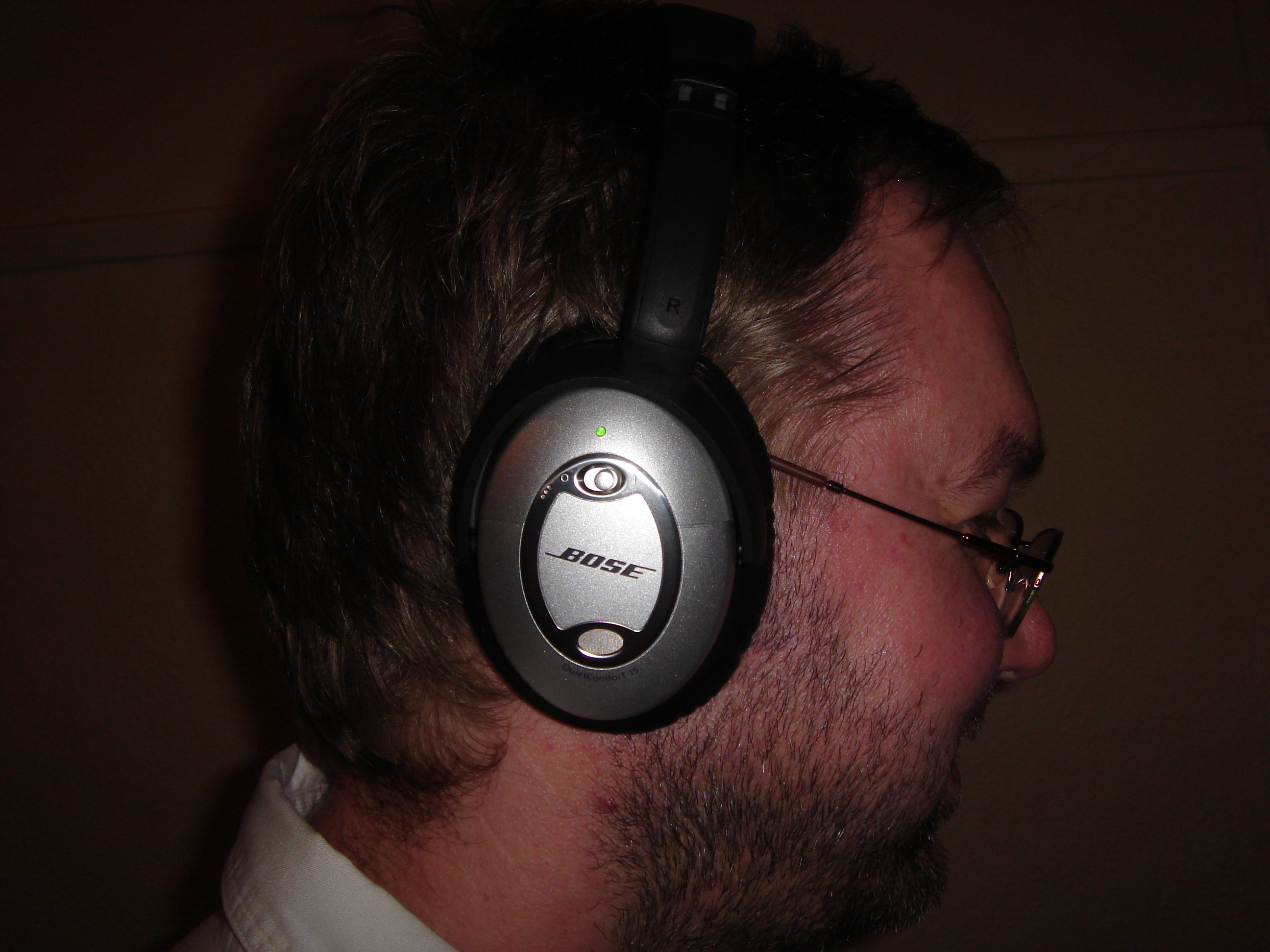
I bought the Bose QC15 noise canceling headphones for my trip back from the US. See my previous posts about Noise Canceling Headphones [1] and Testing Noise Canceling Headphones [2] for the details of my search. I first tried my new headphones in my hotel room and they worked really well at blocking the noise from the nearby road (El Camino Real in Menlo Park) as well as the noise from the heater in my room. At the airport they entirely blocked the sound of the airport air conditioning system (which was surprisingly loud I didn t realise how loud until I tried the headphones). On the flight the headphones worked really well. I used them for hours when they weren t plugged in to any source, just stopping the noise was a huge benefit. I was also able to listen to music (both MP3s on my laptop and the plane sound system) at a relatively low volume with an apparent high quality. The Bose store I visited in Stanford mall has a sound system set up to emulate the noise you experience inside a jet to demonstrate what the headset can do. It really lives up to this demonstration! I recommend them to anyone who wants over-ear noise canceling headphones and can afford $US300 + tax. But one thing to note is that not everyone likes such things my wife didn t like the sound that they generate (the least bad way to describe it is as a soft hiss). This is definitely not something you would want to buy based on reviews alone, it must be tested in-store. The main technical suggestion I can make for improvement to the QC-15 is for it to have slightly softer and thicker padding where it contacts the sides of the wearer s head. I find that my glasses prevent it from making as good contact as I would like, and that when wearing it while eating the contact is significantly broken with every jaw movement which is really annoying. A minor suggestion is that every pair of headphones should have the left and right ear pieces clearly marked, I really shouldn t have to read an instruction manual to discover which way to wear it. One thing that surprised me was the inclusion of business cards for the headset! Here is a picture:

The picture links to a larger picture that also shows the French version of the same text on the other side. I was astonished by this, encouraging happy customers to help sell your products is a reasonable and effective form of product promotion (really this is what I m doing for Bose with this blog post). But giving customers business cards is going too far anyone who wants me to hand out their business cards can offer to pay me to do so (and I probably won t accept). But if such things are considered to be a good idea then here are a few suggestions for other things that they could do:
  1. Create a Bose dating site where one can meet people who like music and traveling (this does sound appealing). In about 10 years the children of people who meet that way would start buying audio gear
  2. Start a Bose fan club.
  3. Create a template that be used by a tattoo parlor to make a Bose tattoo.
  4. Sell Bose fan t-shirts to people who aren t dedicated enough to get a tattoo.
  5. Register Bose as a religion, that gets tax free status among other benefits.
It s a pity that Bose doesn t make any water-proof noise canceling headphones. It would be something for their marketing people to wear while jumping over a shark on water skis [3]. But seriously the best thing that Bose could do to have their products promoted would be to start by printing the web site for each product on the item, my headset has two patent numbers listed which seem unlikely to provide any benefit for anyone, in that space they could have printed the global.bose.com/qc URL that is on the business card. Of course providing the URL really doesn t do any good when the URL actually is useless. It starts by giving me a page asking which country I am in the correct thing to do is to use geoip to determine the country and then give the user the option of selecting another country if that one is not ideal. Then after I select a country it doesn t take me to a specific page for the product! I could have typed in www.bose.com and got the same result (in terms of US shopping at least) while typing six fewer characters! Next like most corporate web sites the Bose site doesn t appear to be configured for longevity of URLs URLs which are clearly designed for the computer rather than humans are expected to change without warning. This discourages linking to any page that one might discover through web searches or navigating the site, and causes them to lose a lot of potential links. Having specific URLs for all the products (including the obsolete ones) that are designed firstly for humans to read and write would be a good idea. It would be really useful to be able to compare the features of new products with the ones that are going cheap on eBay. For someone who is considering buying a new product now the purchase decision would be easier if they knew that the company would provide resources to help them get a better price on eBay in a few years if they want to upgrade to a newer model. One thing to keep in mind is the fact that the reputation of a company (which makes a dramatic impact on the prices customers are prepared to pay) depends largely on a long history of making quality products. Telling customers about those historic products is one of the most sensible things that most corporations fail to do on the Internet.

Jose Luis Rivas Contreras: Collecta, searching on real-time

Real-time search on Collecta of xscreensaver

I haven t read of it, and it seems it has been around since a good time. Collecta is a search engine for things in real-time. It searchs on Twitter, Identi.ca, Youtube, Flickr, Blogs, Ustream and shows you what people is saying. It s like a meta-searcher, I guess using API s from those services. But it has it s own API so it will be great for someone that s into web2.x and wants information on real-time from everywhere with just one API. There s a lot of people doing this already and there s a gallery about their development. Maybe tomorrow I will get a little into it, it looks really nice. BTW, it s what powers search.identi.ca

19 December 2009

Russell Coker: Shared Objects and Big Applications

Some time ago I wrote a little utility named memlockd [1]. Memlockd will lock files into memory which allows significantly faster access when the system pages heavily, in my simulated tests I have found that having the programs and shared objects needed for logging in locked in memory can make it possible to login without a timeout when there is heavy paging, this can make the difference between recovering a system with some processes that are out of control and having to reboot it (often without discovering the root cause). As always happens some people use my software in ways that I never planned. One guy is using it to try and make OpenOffice.org load faster. I m not sure that this is a good idea. In a typical installation when configured for the purpose that I intended it (system recovery from a rabbit process) memlockd will take a bit less than 10M of RAM on an i386 platform (that is for bash, login, sshd, getty, busybox, and all necessary shared objects and a few data files. Since RHEL 4 Red Hat distributions have whinged at boot time if there was less than 256M of RAM available, installation of a Red Hat based system on anything less than 128M of RAM has been impossible for some years, and Debian systems perform very poorly with less than about 128M of RAM when you run apt-get. I initially designed memlockd to run on my SE Linux Play Machine which has 128M of RAM in it s current incarnation. Locking 7.5% of RAM on the system may impact performance, but as a large part of that RAM is used for things like libc and bash which tend to be partially paged in at all times this shouldn t be a noticeable impact. But locking 100M or more of OpenOffice seems more likely to have the potential to hurt performance, I often run OpenOffice on a machine with 512M of RAM and the biggest desktop machine I use has 1.5G of RAM for me it wouldn t make sense to lock OpenOffice into memory. But it could be that there is some unusual aspect of his system that makes running memlockd with OpenOffice likely to give worthy benefits in performance without significantly hurting performance for other programs, for example it could have 4G of RAM and a really slow disk. It is also a possibility that the usage of the system makes OpenOffice so much more important than other programs that any decrease in performance in other areas is not relevant. In any case I m happy to help people use my software to do unusual things so I ll support this use. I ve been asked why memlockd doesn t seem to give much benefit when starting up OpenOffice when run with +/opt/openoffice.org3/program/soffice.bin in the config file, where the + means to lock all shared objects that ldd reports that the binary needs. for n in ldd /usr/lib/openoffice/program/soffice.bin sed -e s/^.*=..// -e s/\ .*// sort -u ; do readlink -f $n ; done sort -u > ldd.txt I used the above command to get a list of all shared objects that ldd reports for the soffice.bin program. On my system (Debian/Lenny i386) it reports 77 shared objects loaded. When memlockd locks all those ps reports that the RSS is 51944K. cat /proc/1234/maps sed -e s/^.*\ // sort -u > /tmp/map.txt Then I used the above command to get a list of the files that are memory mapped by OpenOffice when running OpenOffice calc where 1234 is the PID of the soffice.bin process (I expect that the numbers will be similar for writer, impress, etc I just happened to have a spreadsheet open). It reports 172 memory mapped files which include 9 files related to fonts and 64 shared objects under /usr/lib/openoffice/program which are not found by ldd among other things. It s quite common for a large application to use dlopen(3) at run-time to map shared objects instead of linking against them. Running memlockd with this list gave an RSS of 118644K, which is more likely to give a useful performance boost to OpenOffice load times.

15 December 2009

Russell Coker: Play Machine Online Again

I have returned from the US and my SE Linux Play Machine [1] is online again. It was unfortunate that I forgot to pack one of my Play machine shirts, I ended up attending a meeting of the SDForum [2] on the topic of Cloud Security (it was a joint meeting of the Cloud Services and Security SIGs) and it would have been good to have been wearing a root password.

14 December 2009

Vincent Sanders: Two pussies, one box

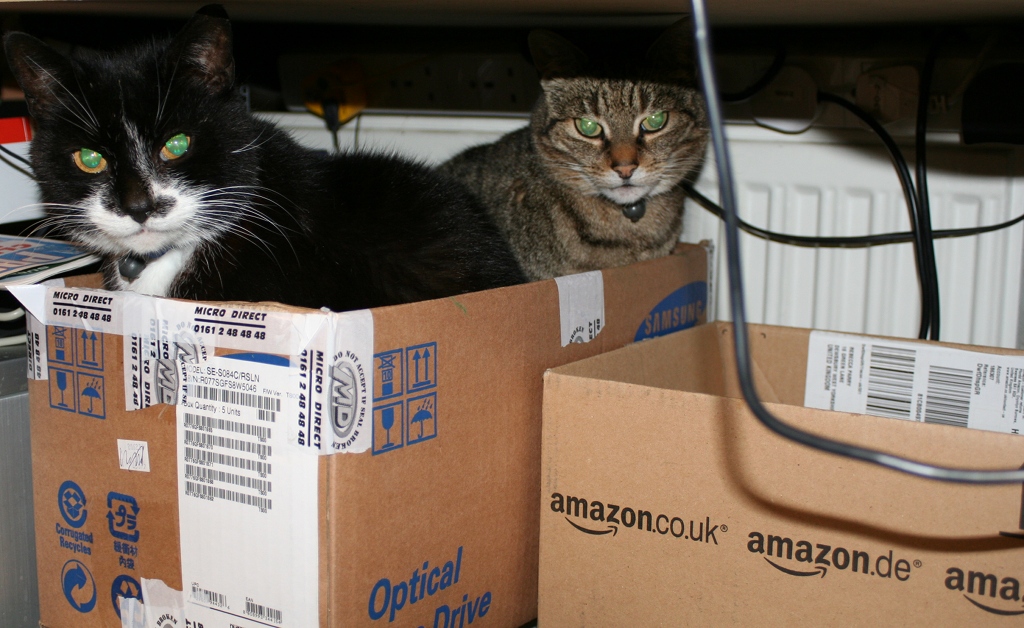
Our household contains two felis catus. These evil creatures (sorry I repeat myself, I already mentioned they were cats) are not sweet kittens, they are grumpy old animals who spend the majority of their lives sleeping indoors and rarely venturing out.

Historically they have had free reign of the house and slept wherever it suited them but with the arrival of the children they were confined to the lower half of the house and provided simple cardboard boxes in which they can reside completely undisturbed.

All well and good you might say and indeed this has produced happy cats for the last eight years. however I recently caused a great deal of discord in the household by providing new boxes never imagining this could possibly cause as much trouble as it has. Currently the two of them are attempting to occupy a single box and win some form of passive aggressive fight for occupancy.

This has been going on for a month now and shows no sign of easing. I do wonder what I need to do to aleviate this situation before it results in a full blown outbreak of evil. Any ideas?

Russell Coker: Nagios and SSL in Debian

I was doing some work on NRPE (the Nagios Remote Plugin Executor) and I noticed bug report #547092 [1] which concerns the fact that the default configuration uses the same SSL certificate for all Debian servers and provides a patch to fix the problem. After building the patched package I followed the advice of the DebianAdministration.org article on creating self-signed SSL certificates [2]. cert_file=/etc/ssl/certs/FOO-cert.pem
privatekey_file=/etc/ssl/private/FOO-key.pem
cacert_file=/etc/ssl/certs/cacert.pem Then I added the above lines to /etc/nagios/nrpe.cfg to instruct the nrpe to use the certificates. For the Nagios server I had the problem that most of the systems I monitor run old versions of NRPE while only a few are recent Debian systems that allow me to easily install a new SSL checking nrpe. So I installed the following script as /usr/lib/nagios/plugins/check_nrpe to run either the old or the new check_nrpe: #!/bin/sh -e
if echo $2 egrep -q server0\ server2\ mail ; then
/usr/local/sbin/check_nrpe -C /etc/cert/cert.pem -k /etc/cert/key.pem -r /etc/cert/cacert.pem $*
else
/usr/lib/nagios/plugins/check_nrpe.orig $*
fi The reason I started working on Nagios was to try and solve bug #560002 [3] which I filed. The bug concerns the fact that applications such as mailq which are run as part of Nagios checks were inheriting a TCP socket file handle from the nrpe. SE Linux prevents such file handles from being inherited, but it does mean that I get audit messages (and this is not a good case for a dontaudit rule). Update:
One thing I forgot to mention is that the SSL key checking requires that the server common name used in the SSL certificate of the nrpe system matches the name that is used by the check_nrpe program. So if you check by IP address then you need to use the IP address in the certificate name which is rather ugly. So I have moved to putting the hostname of each server in /etc/hosts on the NAGIOS system and using the hostname in the SSL certificate. This required using $HOSTNAME$ instead of $HOSTADDRESS$ in the NAGIOS configuration (thanks to John Slee for a tip in that regard). Update2:
I removed some printf debugging from the script. It seems that I included a pre-production version of the script in the first version of this blog post.

Stefano Zacchiroli: RC bugs of the week - week 14

RCBW - week #14 Here are thislast week squashes, by yours truly: Some highlights:

13 December 2009

Russell Coker: Links December 2009

Dan Gilbert gave an insightful TED talk about our mistaken expectations of happiness [1]. Don Marti has an insightful post about net neutrality and public property [2]. When net access requires access to public property then it should be sold in a neutral manner. Rachel Pike gave an interesting TED talk about the scientific research behind a climate headline [3]. The people who claim to be skeptical of the science should watch this. Mark Peters wrote an interesting article A Happy Writer Is a Lousy Writer about the correlation between emotional state and work quality [4]. Apparently watching a film about cancer will make people more careful and focussed on details. CERIAS has an interesting short article about Firefox security as well as some philosophy on why web browser security generally sucks [5]. Cory Doctorow writes in the Guardian about Peter Mandelson s new stupidity in trying to legislate against file sharing [6]. This is going to seriously damage the economy of every country that implements it. Charles Stross has been blogging a series of non-fiction essays about space colonisation, in The Myth of the Starship he describes how most ideas of space travel are bad and how the word ship is always going to be unsuitable [7]. Brent T. White is an associate professor of law at the University of Arizona who has written an interesting paper about mortgages [8]. He says that anyone who is underwater (IE owing more than the value of their house) should walk away. The credit damage from abandoning a bad mortgage apparently isn t that bad, and there is the possibility of negotiating with the bank to reduce the value of the loan to match the value of the house. Mako is working on a project to allow prisoners to blog [9]. It s basically a snail-mail to web gateway as the prisonsers are not allowed Internet access. PracticalEthicsnews.com has an article about the special status that homeopathy is given [10]. It also notes that homeopathic medicines include arsenic and mercury. Such quackery should be outlawed, a life sentence for homeopathy would be appropriate IMHO. Cory Doctorow wrote an interesting essay about why he is not selling one of his books in audio form (he s giving it away) [11]. He concludes by noting that he wants no license agreement except don t violate copyright law . The fact that he can t get anyone to sell an audio book under such terms is a good demonstration of how broken the marketplace is. Thulasiraj Ravilla gave an inspiring TED talk about the Aravind Eye Care System a program to bring the efficiency of McDonalds to eye surgery [12]. Hopefully that program can spawn similar programs for other branches of medicine and spread to more countries. In many ways they are providing better service (both in quality and speed) than people in first-world countries who pay a lot of money can expect to receive. Scott Kim gave an interesting TED talk about his work designing puzzles [13]. He is also a big fan of social networking, unfortunately (for people like me who don t like social networking) his web site ShuffleBrain.com relies on Facebook. Gordon Brown (UK Prime Minister) gave an inspiring TED talk about global ethic vs the national interest [14], with a particular focus on the global effort required to tackle the climate change problem. Now if only we could get Kevin Rudd to listen to that. Brough has written an interesting analysis of the AT&T network problems that are blamed on the iPhone [15]. His essential claim is that the problem is due to overly large buffers which don t cause TCP implementations to throttle the throughput. This seems similar to my observations of the Three network in Australia where ping times of 8 seconds or more will periodically occur. One particularly nasty corner case with this is when using a local DNS server I can have a DNS packet storm where basic requests time out while BIND uses a significant portion of available bandwidth (including ICMP messages from receiving ports that BIND has closed). To alleviate this I am now using the Google public DNS service [16] (the Three DNS servers never worked properly).

Debian News: Debian is moving sieve to its IANA allocated port

The IANA port allocated for ManageSieve is 4190/tcp, and the old port used by timsieved and other managesieve software in many distros (2000/tcp) is allocated for Cisco SCCP usage, according to the IANA registry.

Starting with the version 4.38 of the Debian netbase package, the sieve service will be moved from port 2000 to port 4190 in the /etc/services file. This affects to those using Debian Squeeze, and Debian Sid. Debian Etch and Debian Lenny users are NOT affected.

Any installs which used the sieve service name instead of a numeric port number will switch to the new port number as soon as the services are restarted/reloaded, and in some cases, immediately after /etc/services is updated.

This will affect Cyrus IMAP. This may also affect other sieve-enabled software such as DoveCot.

In order to avoid downtime problems, mail cluster administrators using Debian are urged to verify their Cyrus (and probably also DoveCot) installs, and take measures to avoid services moving from port 2000/tcp to port 4190/tcp by surprise in either servers or clients.

It is worth noting that:

  1. /etc/services will only be automatically updated if you never made any modifications to it. Otherwise, you will be presented with a prompt by ucf or dpkg asking you about the changes.
  2. You can edit /etc/services and change the sieve port back to 2000 if you want (this is not recommended, though).
  3. You can edit /etc/cyrus.conf and any other relevant config files for your mail/webmail cluster (e.g. on the sieve web frontends) ahead of time to force them all to a static port number.
  4. You can configure cyrus master to listen on *both* ports (2000 and 4190) at the same time, and thus avoid the problem entirely. This also allows for a much more smooth migration from port 2000 to port 4190.

Henrique de Moraes Holschuh

René Mayorga: I have my netbook back

Well, not exactly today, but this Tuesday I when to the Acer s tech support to reclaim my netbook, as many people said on the first post, the problem was the CPU Fan, they just replace the Fan, and then put the HDD again and tested the hardware, so far everything looks ok, Now I need to catch up again with some Debian work, I have some people asking me to sponsor some packages, and I stil have a couple of bugs that was solved on my local git repo.

12 December 2009

Russell Coker: US Border Security

Making Light has a post about the Canadian sci-fi author Peter Watts who was beaten and jailed overnight without access to a lawyer by US border guards because he asked what they were doing [1]. Apparently one is supposed to cringe in fear whenever questioned by authority in the US, so much for land of the free . In 12 hours time I will hopefully have got past the security police and be boarding a flight out of the US and it will be a great relief. On a practical note, if al Quaeda was a serious threat, if anyone really cared to stop the importation of drugs, of if any of the other reasons for having security on borders were taken seriously then this sort of thing really wouldn t help to achieve such goals. One of the purposes of a justice system is to encourage cooperation from the population. If a suspect will be treated fairly and considered to be innocent until proven guilty then there is no reason not to report suspicious people to the police. If however a suspect will be summarily beaten and denied access to a lawyer then no decent person can make a police report unless they are certain of the suspect s guilt beyond all reasonable doubt. When Barack Obama was elected the majority of the world s population was greatly relieved, we expected some significant changes in the way things are run. It doesn t seem that he is living up to our expectations.

Jose Luis Rivas Contreras: Chrome font-rendering engine on X11?

Dear Lazyweb, I do love how fonts looks on my Chrome browser, is there a way to have that font-rendering engine on all my X system? Or at least on my Firefox + Thunderbird?

10 December 2009

Kartik Mistry: foss.in/2009: Report from lazy man


* Yes. I m kicking myself for being lazy and not doing stuffs that I supposed to do before, during and after foss.in/2009. I had expected too much that never happened but something too good happened that I wasn t able to imagine. foss.in/2007 was my last foss.in visit where we had lots of fun. Really. But, along with that certain elements (ie Real Life) made it hard to let me enjoy that. Same happened during 2008. Pity. I missed KDE Song and what not.. But, this year I determined and kicked myself several times. Real Life was kind of in happy mood. foss.in team helped me to figure out travel issues. So, I was all set. All days were filled with fun, much better involvement (& RTFM) with Debian and then my small talk at KDE PoTD was surprise to me (and also to that Projector that never worked with my Macbook). I ve made some cool friends Ramkumar, Siddhesh, Shreyank, Rahul Sundaram and many more from Pai hotel discussion group! For those who missed my stupid brown humor and PJs next time. C ya at foss.in/2010! And yes, I took only two pictures during entire conference. But, fossdotin flickr or picasa tag will say you what kind of fun we had.

7 December 2009

Cyril Brulebois: RBCN

I really liked doing stuff like Zack s RCBW in the past, but nowadays I m busy with some buildds, reporting RC bugs because some maintainers don t test their uploads, as well as posting patches to fix FTBFS on GNU/kFreeBSD. But from time to time, it s also fun to close RC bugs. Here s a new concept (that I probably won t reproduce as regularly as Zack and his minions, though): RCBN for Release-Critical Bugs of the Night. Those are now closed: Many thanks to Peter Green, to Ruben Molina, and to Ilya Barygin for their patches. Special thanks to Richard Darst for orpie s patches: he even managed to get rid of embedded code copies while addressing the FTBFS. Nice! Unfortunately, in the same time, I had to open some FTBFS/RC bugs: So, what s next? Get back to work!

6 December 2009

Cyril Brulebois: Early december announcements

Some uploads this week:

Next.

Previous.