Search Results: "he"

9 January 2022

Matthew Garrett: Pluton is not (currently) a threat to software freedom

At CES this week, Lenovo announced that their new Z-series laptops would ship with AMD processors that incorporate Microsoft's Pluton security chip. There's a fair degree of cynicism around whether Microsoft have the interests of the industry as a whole at heart or not, so unsurprisingly people have voiced concerns about Pluton allowing for platform lock-in and future devices no longer booting non-Windows operating systems. Based on what we currently know, I think those concerns are understandable but misplaced.


But first it's helpful to know what Pluton actually is, and that's hard because Microsoft haven't actually provided much in the way of technical detail. The best I've found is a discussion of Pluton in the context of Azure Sphere, Microsoft's IoT security platform. This, in association with the block diagrams on page 12 and 13 of this slidedeck, suggest that Pluton is a general purpose security processor in a similar vein to Google's Titan chip. It has a relatively low powered CPU core, an RNG, and various hardware cryptography engines - there's nothing terribly surprising here, and it's pretty much the same set of components that you'd find in a standard Trusted Platform Module of the sort shipped in pretty much every modern x86 PC. But unlike Titan, Pluton seems to have been designed with the explicit goal of being incorporated into other chips, rather than being a standalone component. In the Azure Sphere case, we see it directly incorporated into a Mediatek chip. In the Xbox Series devices, it's incorporated into the SoC. And now, we're seeing it arrive on general purpose AMD CPUs.

Microsoft's announcement says that Pluton can be shipped in three configurations:as the Trusted Platform Module; as a security processor used for non-TPM scenarios like platform resiliency; or OEMs can choose to ship with Pluton turned off. What we're likely to see to begin with is the former - Pluton will run firmware that exposes a Trusted Computing Group compatible TPM interface. This is almost identical to the status quo. Microsoft have required that all Windows certified hardware ship with a TPM for years now, but for cost reasons this is often not in the form of a separate hardware component. Instead, both Intel and AMD provide support for running the TPM stack on a component separate from the main execution cores on the system - for Intel, this TPM code runs on the Management Engine integrated into the chipset, and for AMD on the Platform Security Processor that's integrated into the CPU package itself.

So in this respect, Pluton changes very little; the only difference is that the TPM code is running on hardware dedicated to that purpose, rather than alongside other code. Importantly, in this mode Pluton will not do anything unless the system firmware or OS ask it to. Pluton cannot independently block the execution of any other code - it knows nothing about the code the CPU is executing unless explicitly told about it. What the OS can certainly do is ask Pluton to verify a signature before executing code, but the OS could also just verify that signature itself. Windows can already be configured to reject software that doesn't have a valid signature. If Microsoft wanted to enforce that they could just change the default today, there's no need to wait until everyone has hardware with Pluton built-in.

The two things that seem to cause people concerns are remote attestation and the fact that Microsoft will be able to ship firmware updates to Pluton via Windows Update. I've written about remote attestation before, so won't go into too many details here, but the short summary is that it's a mechanism that allows your system to prove to a remote site that it booted a specific set of code. What's important to note here is that the TPM (Pluton, in the scenario we're talking about) can't do this on its own - remote attestation can only be triggered with the aid of the operating system. Microsoft's Device Health Attestation is an example of remote attestation in action, and the technology definitely allows remote sites to refuse to grant you access unless you booted a specific set of software. But there are two important things to note here: first, remote attestation cannot prevent you from booting whatever software you want, and second, as evidenced by Microsoft already having a remote attestation product, you don't need Pluton to do this! Remote attestation has been possible since TPMs started shipping over two decades ago.

The other concern is Microsoft having control over the firmware updates. The context here is that TPMs are not magically free of bugs, and sometimes these can have security consequences. One example is Infineon TPMs producing weak RSA keys, a vulnerability that could be rectified by a firmware update to the TPM. Unfortunately these updates had to be issued by the device manufacturer rather than Infineon being able to do so directly. This meant users had to wait for their vendor to get around to shipping an update, something that might not happen at all if the machine was sufficiently old. From a security perspective, being able to ship firmware updates for the TPM without them having to go through the device manufacturer is a huge win.

Microsoft's obviously in a position to ship a firmware update that modifies the TPM's behaviour - there would be no technical barrier to them shipping code that resulted in the TPM just handing out your disk encryption secret on demand. But Microsoft already control the operating system, so they already have your disk encryption secret. There's no need for them to backdoor the TPM to give them something that the TPM's happy to give them anyway. If you don't trust Microsoft then you probably shouldn't be running Windows, and if you're not running Windows Microsoft can't update the firmware on your TPM.

So, as of now, Pluton running firmware that makes it look like a TPM just isn't a terribly interesting change to where we are already. It can't block you running software (either apps or operating systems). It doesn't enable any new privacy concerns. There's no mechanism for Microsoft to forcibly push updates to it if you're not running Windows.

Could this change in future? Potentially. Microsoft mention another use-case for Pluton "as a security processor used for non-TPM scenarios like platform resiliency", but don't go into any more detail. At this point, we don't know the full set of capabilities that Pluton has. Can it DMA? Could it play a role in firmware authentication? There are scenarios where, in theory, a component such as Pluton could be used in ways that would make it more difficult to run arbitrary code. It would be reassuring to hear more about what the non-TPM scenarios are expected to look like and what capabilities Pluton actually has.

But let's not lose sight of something more fundamental here. If Microsoft wanted to block free operating systems from new hardware, they could simply mandate that vendors remove the ability to disable secure boot or modify the key databases. If Microsoft wanted to prevent users from being able to run arbitrary applications, they could just ship an update to Windows that enforced signing requirements. If they want to be hostile to free software, they don't need Pluton to do it.

(Edit: it's been pointed out that I kind of gloss over the fact that remote attestation is a potential threat to free software, as it theoretically allows sites to block access based on which OS you're running. There's various reasons I don't think this is realistic - one is that there's just way too much variability in measurements for it to be practical to write a policy that's strict enough to offer useful guarantees without also blocking a number of legitimate users, and the other is that you can just pass the request through to a machine that is running the appropriate software and have it attest for you. The fact that nobody has actually bothered to use remote attestation for this purpose even though most consumer systems already ship with TPMs suggests that people generally agree with me on that)

comment count unavailable comments

8 January 2022

Jonathan Dowland: 2021 in Fiction

Cover for *This is How You Lose the Time War*
Cover for *Robot*
Cover for *The Glass Hotel*
Following on from last year's round-up of my reading, here's a look at the fiction I enjoyed in 2021. I managed to read 42 books in 2021, up from 31 last year. That's partly to do with buying an ereader: 33/36% of my reading (by pages/by books) was ebooks. I think this demonstrates that ebooks have mostly complemented paper books for me, rather than replacing them. My book of the year (although it was published in 2019) was This is How You Lose the Time War by Amal El-Mohtar and Max Gladstone: A short epistolary love story between warring time travellers and quite unlike anything else I've read for a long time. Other notables were The Glass Hotel by Emily St John Mandel and Robot by Adam Wi niewski-Snerg. The biggest disappointment for me was The Ministry for the Future by Kim Stanley Robinson (KSR), which I haven't even finished. I love KSRs writing: I've written about him many times on this blog, at least in 2002, 2006 and 2009, I think I've read every other novel he's published and most of his short stories. But this one was too much of something for me. He's described this novel a the end-point of a particular journey and approach to writing he's taken, which I felt relieved to learn, assuming he writes any more novels (and I really hope that he does) they will likely be in a different "mode". My "new author discovery" for 2021 was Chris Beckett: I tore through Two Tribes and America City before promptly buying all his other work. He fits roughly into the same bracket as Adam Roberts and Christopher Priest, two of my other favourite authors. 5 of the books I read (12%) were from my "backlog" of already-purchased physical books. I'd like to try and reduce my Backlog further so I hope to push this figure up next year. I made a small effort to read more diverse authors this year. 24% of the books I read (by book count and page count) were by women. 15% by page count were (loosely) BAME (19% by book count). Again I'd like to increase these numbers modestly in 2022. Unlike 2020, I didn't complete any short story collections in 2021! This is partly because there was only one issue of Interzone published in all of 2021, a double-issue which I haven't yet finished. This is probably a sad date point in terms of Interzone's continued existence, but it's not dead yet.

John Goerzen: Make the Internet Yours Again With an Instant Mesh Network

I m going to lead with the technical punch line, and then explain it: Yggdrasil Network is an opportunistic mesh that can be deployed privately or as part of a global-scale network. Each node gets a stable IPv6 address (or even an entire /64) that is derived from its public key and is bound to that node as long as the node wants it (of course, it can generate a new keypair anytime) and is valid wherever the node joins the mesh. All traffic is end-to-end encrypted. Yggdrasil will automatically discover peers on a LAN via broadcast beacons, and requires zero configuration to peer in such a way. It can also run as an overlay network atop the public Internet. Public peers serve as places to join the global network, and since it s a mesh, if one device on your LAN joins the global network, the others will automatically have visibility on it also, thanks to the mesh routing. It neatly solves a lot of problems of portability (my ssh sessions stay live as I move networks, for instance), VPN (incoming ports aren t required since local nodes can connect to a public peer via an outbound connection), security, and so forth. Now on to the explanation: The Tyranny of IP rigidity Every device on the Internet, at one time, had its own globally-unique IP address. This number was its identifier to the world; with an IP address, you can connect to any machine anywhere. Even now, when you connect to a computer to download a webpage or send a message, under the hood, your computer is talking to the other one by IP address. Only, now it s hard to get one. The Internet protocol we all grew up with, version 4 (IPv4), didn t have enough addresses for the explosive growth we ve seen. Internet providers and IT departments had to use a trick called NAT (Network Address Translation) to give you a sort of fake IP address, so they could put hundreds or thousands of devices behind a single public one. That, plus the mobility of devices changing IPs whenever they change locations has meant that a fundamental rule of the old Internet is now broken: Every participant is an equal peer. (Well, not any more.) Nowadays, you can t you host your own website from your phone. Or share files from your house. (Without, that is, the use of some third-party service that locks you down and acts as an intermediary.) Back in the 90s, I worked at a university, and I, like every other employee, had a PC on my desk with an unfirewalled public IP. I installed a webserver, and poof instant website. Nowadays, running a website from home is just about impossible. You may not have a public IP, and if you do, it likely changes from time to time. And even then, your ISP probably blocks you from running servers on it. In short, you have to buy your way into the resources to participate on the Internet. I wrote about these problems in more detail in my article Recovering Our Lost Free Will Online. Enter Yggdrasil I already gave away the punch line at the top. But what does all that mean?
  • Every device that participates gets an IP address that is fully live on the Yggdrasil network.
  • You can host a website, or a mail server, or whatever you like with your Yggdrasil IP.
  • Encryption and authentication are smaller (though not nonexistent) worries thanks to the built-in end-to-end encryption.
  • You can travel the globe, and your IP will follow you: onto a plane, from continent to continent, wherever. Yggdrasil will find you.
  • I ve set up /etc/hosts on my laptop to use the Yggdrasil IPs for other machines on my LAN. Now I can just ssh foo and it will work from home, from a coffee shop, from a 4G tether, wherever. Now, other tools like tinc can do this, obviously. And I could stop there; I could have a completely closed, private Yggdrasil network. Or, I can join the global Yggdrasil network. Each device, in addition to accepting peers it finds on the LAN, can also be configured to establish outbound peering connections or accept inbound ones over the Internet. Put a public peer or two in your configuration and you ve joined the global network. Most people will probably want to do that on every device (because why not?), but you could also do that from just one device on your LAN. Again, there s no need to explicitly build routes via it; your other machines on the LAN will discover the route s existence and use it. This is one of many projects that are working to democratize and decentralize the Internet. So far, it has been quite successful, growing to over 2000 nodes. It is the direct successor to the earlier cjdns/Hyperboria and BATMAN networks, and aims to be a proof of concept and a viable tool for global expansion. Finally, think about how much easier development is when you don t have to necessarily worry about TLS complexity in every single application. When you don t have to worry about port forwarding and firewall penetration. It s what the Internet should be.

    Ayoyimika Ajibade: Nodejs 16 and Webpack 5 transition in Debian

    What is Debian ? Debian is also known as Debian GNU/Linux is a free open-source operating system (OS) based currently on the Linux kernel or the FreeBSD kernel, developed by the community-supported Debian Project; although efforts are in place to provide Debian for other kernels, primarily for the Hurd.

    Fun fact about Debian
    • Debian was the first Linux distribution to include a package management system for easy installation and removal of software. It was also the first Linux distribution that could be upgraded without requiring reinstallation.
    • To protect your system against Trojan horses and other malevolent software, Debian's servers verify that uploaded packages come from their registered Debian maintainers.
    • Debian comes with over 59000 packages; as of this writing (precompiled software that is bundled up in a nice format for easy installation on your machine), a package manager (APT), and other utilities that make it possible to manage thousands of packages on thousands of computers as easily as installing a single application. All of it is FREE!
    • Debian is also the basis for many other distributions, most notably Ubuntu

    What is Webpack ? Webpack is a static module bundler for modern JavaScript applications. When webpack processes your application, it internally builds a dependency graph from one or more entry points and then combines every module your project needs into one or more bundles, which are static assets to serve your content from

    What is nodejs ? Node.js is an open-source, cross-platform built on Chrome's JavaScript runtime for easily building fast and scalable network applications and also developing server-side applications, Here javascript code is no longer limited to the traditional method of running on the web browser

    What does Transitioning mean in Debian? Transitioning is a concept in Debian about maintaining only one version of a library like webpack, nodejs. There is a bottleneck as other libraries and applications may not support the version we have in Debian. So we have to port that software which For example, node-mini-css-extract-plugin, node-mermaid and so many packages uses webpack. In buster we had webpack4 and in bullseye, we want to update it to webpack5. node-mini-css-extract-plugin already supports webpack5, but others like node-mermaid don't support it yet. So either we wait or we help those projects to update their webpack version. Check out this chat between my mentor and a community member on transitioning of rails6

    Getting Started with Creating or Updating packages in Debian To be able to create or maintain packages suitable for uploading to Debian you must be in a sid/unstable environment or distribution. See recommended instructions on how to setup Debian Sid via this link See link on how to debianize a new package See link for brief steps on how to update a package to its new upstream version. For more detailed content on the whys and hows of updating a package to its new upstream version visit here Note In updating to the new upstream version we have to watch out for breaking changes caused by both minor updates or major updates. As per https://semver.org major updates(e.g If the current version is 2.3.4, then 3.0 is a major update) of libraries with versions greater than 1.0 and minor updates(e.g If the current version is 0.10 then 0.11 is a minor update) of libraries with versions less than 1.0 can have breaking changes

    The overall flow of webpack5 and nodejs16 transitioning in Debian After grasping the fundamental process and flow on how to update a package, you are well on your way to transitioning . Transitioning in webpack or nodejs involves building and testing of dependencies or packages that depend on webpack or nodejs respectively called reverse-dependencies, these reverse dependencies are tested and built with the new updated version usually uploaded to the experimental distribution if reverse dependencies are built and tested successfully both reverse dependencies and dependency in this case nodejs or webpack are then uploaded to the unstable/sid distribution for further processing

    The major guidelines to follow while transitioning are
    • Find a list of reverse dependencies to fix
    • See if new upstream versions of reverse dependencies are available that supports the transitioning version
    • See if new upstream of reverse dependencies are available that supports the transitioning version works
    • Report bugs found while rebuilding and testing reverse dependencies in Debian
    • Forward bugs found while rebuilding and testing reverse dependencies upstream
    • Fix or update packages and forward patches upstream
    After a successful transitioning phase users of the Debian OS have access to the latest and also oldest installation of these packages via apt based on their preferences, which implies having the benefit of more features, bug fixes, updated security patches from those packages, all these are possible due to the community of amazing people

    7 January 2022

    Ingo Juergensmann: Moving my repositories from Github to Codeberg.org

    Some weeks ago I moved my repositories from Github (evil, Microsoft, blabla) to Codeberg. Codeberg is a non-profit organisation located in Germany. When you really dislike Microsoft products it is somewhat a natural reaction (at least for me) to move away from Github, which was bought by Microsoft, to some more independent service provider for hosting source code. Nice thing with Codeberg is as well that it offers a migration tool from Github to Codeberg. Additionally Codeberg is also on Mastodon. If you are looking for a good service hosting your git repositories and want to move away from Github as well, please give Codeberg a try. So, please update your git settings to https://github.com/ingoj to https://codeberg.org/Windfluechter (or the specific repo).

    Ayoyimika Ajibade: Everyone Struggles

    Starting anything new always has in it an element of uncertainty, doubt, fears, and struggle to forge ahead, this has been my current situation as an outreachy intern working on the transition of nodejs16 and webpack5 which is about updating all packages that depend on nodejs14 and webpack4 to work well with the updated version of nodejs16 and webpack5 in the Debian operations system. Juicy right! As a software developer struggling to grasp both basic and advanced knowledge of a concept can seem daunting, much like learning anything new, you can be overwhelmed when you are surrounded and know there is a whole lot of other new concept, tools, process, languages you have to learn that are linked to what you are currently learning, as you are struggling to grasp the fundamental idea of what you are currently learning. imbued in any struggle to get a solution to the problem is where innovation and inventions lie in, and our learning becomes improved as we dive into fact-finding, getting your hypothesis after a series of tests and ultimately proffering a solution Some of my struggles as I intern with Debian has been lack of skill of the shell scripting language as that is one of the core languages to understand so as to navigate your way around maintaining packages for Debian, also funny enough having just an intermediate knowledge of the javascript programming language as arguably having a basic knowledge of javascript is necessary to building and testing javascript packages in Debian as I know only the basic of javascript since my core language is Python, that I struggle with. The good thing is that the more I keep at it the faster the chance of the struggles reducing Now to the fun part! having a community of developers who have been through the struggling phase is divine, as they make your learning experience much easier, my mentors and other community member have made learning to package modules for Debian much easier as all hands are on deck to always help out with our challenges. I remember it felt so wonderful when my first contribution got merged and I became more encouraged to update more packages. These helped me a lot in the contribution stage for Debian as I better familiar with how the system worked. I m super grateful to my mentors and co-intern as they are always there to assist me.

    How I Navigate my way through my struggles I guess the first thing about any challenge is to be aware of it and admit your limitations of particular knowledge, then you move on to creatively seek solutions by asking for help from those who know the way. Voila! Now comes the part where you have to take up their solutions, ideas, opinions and make it work for your particular case scenario that is a skill set that all Software developers must-have. Going through documentation has immensely helped solve my problems much faster and build new knowledge, as I get the fundamental idea of why and how things work. I also try to break each concept down into steps, achieve my goals for each step, then build all solutions in each step together, surfing the internet to find solutions also has a huge benefit.

    Vocabulary terms Used in Debian
    1. uscan => a tool to identify and download upstream source code from the repository, also compressing it into the required format.
    2. apt => a package manager to manage packages in Debian, similar to pip in python, npm in javascript.
    3. stretch/buster/bullseye/bookworm/sid => old old stable Debian9 - The codename for the release before the previous stable release (stretch). old stable Debian10 - The previous stable release (Buster). stable Debian11 - The current stable release (Bullseye). testing Debian12 - The next-generation stable release (Bookworm). unstable - The unstable development release (Sid) where new or updated packages are introduced. To understand more on debian release cycle
    4. reverse-rebuild => is building all modules that depend on a package in Debian while building the main package.
    5. lintian => A helper tool used to check for inconsistencies and errors in a Debian Package based on Debian standards.
    6. pkg-js-tools => A collection of tools to aid packaging Node modules in Debian.
    7. dpkg-buildpackage => A command to build upstream code in an unclean chroot or environment.
    8. quilt => A patch creation and management automation script. quilt helps manage a series of patches that a Debian package maintainer needs to be applied to upstream source when building the package.
    9. autopkgtest => a script used to test an installed binary package using the source package's tests
    10. RFS => (Request For Sponsorship) Working in the Debian ecosystem includes two roles either as a Debian Maintainer with restricted rights and privileges like uploading to the Debian archive or as a Debian Developer with all rights and privileges such as uploading to the Debian archive, as a new contributor or a Debian maintainer (with few rights and privileges) in Debian you can RFS so that your pull request (PR) can be merged to the Debian archive by a Debian Developer, much like your contribution has been accepted
    There are so many terms and tools you have to get accustomed to, but they are easy to understand and use, as enough and frequently updated wiki documentation are available to guide you through, plus a whole lot of community members you can ask questions from. strength and growth come only through continuous effort and struggle. Napoleon Hill

    Reproducible Builds (diffoscope): diffoscope 199 released

    The diffoscope maintainers are pleased to announce the release of diffoscope version 199. This version includes the following changes:
    [ Chris Lamb ]
    * Support both variants of "odt2txt", including the one provided by unoconv.
      (Closes: reproducible-builds/diffoscope#298)
    [ Jelle van der Waa ]
    * Add external tool reference on Arch Linux for xb-tool.
    
    You find out more by visiting the project homepage.

    6 January 2022

    Jacob Adams: Linux Hibernation Documentation

    Recently I ve been curious about how hibernation works on Linux, as it s an interesting interaction between hardware and software. There are some notes in the Arch wiki and the kernel documentation (as well as some kernel documentation on debugging hibernation and on sleep states more generally), and of course the ACPI Specification

    The Formal Definition ACPI (Advanced Configuration and Power Interface) is, according to the spec, an architecture-independent power management and configuration framework that forms a subsystem within the host OS which defines a hardware register set to define power states. ACPI defines four global system states G0, working/on, G1, sleeping, G2, soft off, and G3, mechanical off1. Within G1 there are 4 sleep states, numbered S1 through S4. There are also S0 and S5, which are equivalent to G0 and G2 respectively2.

    Sleep According to the spec, the ACPI S1-S4 states all do the same thing from the operating system s perspective, but each saves progressively more power, so the operating system is expected to pick the deepest of these states when entering sleep. However, most operating systems3 distinguish between S1-S3, which are typically referred to as sleep or suspend, and S4, which is typically referred to as hibernation.

    S1: CPU Stop and Cache Wipe The CPU caches are wiped and then the CPU is stopped, which the spec notes is equivalent to the WBINVD instruction followed by the STPCLK signal on x86. However, nothing is powered off.

    S2: Processor Power off The system stops the processor and most system clocks (except the real time clock), then powers off the processor. Upon waking, the processor will not continue what it was doing before, but instead use its reset vector4.

    S3: Suspend/Sleep (Suspend-to-RAM) Mostly equivalent to S2, but hardware ensures that only memory and whatever other hardware memory requires are powered.

    S4: Hibernate (Suspend-to-Disk) In this state, all hardware is completely powered off and an image of the system is written to disk, to be restored from upon reapplying power. Writing the system image to disk can be handled by the operating system if supported, or by the firmware.

    Linux Sleep States Linux has its own set of sleep states which mostly correspond with ACPI states.

    Suspend-to-Idle This is a software only sleep that puts all hardware into the lowest power state it can, suspends timekeeping, and freezes userspace processes. All userspace and some kernel threads5, except those tagged with PF_NOFREEZE, are frozen before the system enters a sleep state. Frozen tasks are sent to the __refrigerator(), where they set TASK_UNINTERRUPTIBLE and PF_FROZEN and infinitely loop until PF_FROZEN is unset6. This prevents these tasks from doing anything during the imaging process. Any userspace process running on a different CPU while the kernel is trying to create a memory image would cause havoc. This is also done because any filesystem changes made during this would be lost and could cause the filesystem and its related in-memory structures to become inconsistent. Also, creating a hibernation image requires about 50% of memory free, so no tasks should be allocating memory, which freezing also prevents.

    Standby This is equivalent to ACPI S1.

    Suspend-to-RAM This is equivalent to ACPI S3.

    Hibernation Hibernation is mostly equivalent to ACPI S4 but does not require S4, only requiring low-level code for resuming the system to be present for the underlying CPU architecture according to the Linux sleep state docs. To hibernate, everything is stopped and the kernel takes a snapshot of memory. Then, the system writes out the memory image to disk. Finally, the system either enters S4 or turns off completely. When the system restores power it boots a new kernel, which looks for a hibernation image and loads it into memory. It then overwrites itself with the hibernation image and jumps to a resume area of the original kernel7. The resumed kernel restores the system to its previous state and resumes all processes.

    Hybrid Suspend Hybrid suspend does not correspond to an official ACPI state, but instead is effectively a combination of S3 and S4. The system writes out a hibernation image, but then enters suspend-to-RAM. If the system wakes up from suspend it will discard the hibernation image, but if the system loses power it can safely restore from the hibernation image.
    1. The difference between soft and mechanical off is that mechanical off is entered and left by a mechanical means (for example, turning off the system s power through the movement of a large red switch)
    2. It s unclear to me why G and S states overlap like this. I assume this is a relic of an older spec that only had S states, but I have not as yet found any evidence of this. If someone has any information on this, please let me know and I ll update this footnote.
    3. Of the operating systems I know of that support ACPI sleep states (I checked Windows, Mac, Linux, and the three BSDs8), only MacOS does not allow the user to deliberately enable hibernation, instead supporting a hybrid suspend it calls safe sleep
    4. The reset vector of a processor is the default location where, upon a reset, the processor will go to find the first instruction to execute. In other words, the reset vector is a pointer or address where the processor should always begin its execution. This first instruction typically branches to the system initialization code. Xiaocong Fan, Real-Time Embedded Systems, 2015
    5. All kernel threads are tagged with PF_NOFREEZE by default, so they must specifically opt-in to task freezing.
    6. This is not from the docs, but from kernel/freezer.c which also notes Refrigerator is place where frozen processes are stored :-).
    7. This is the operation that requires special architecture-specific low-level code .
    8. Interestingly NetBSD has a setting to enable hibernation, but does not actually support hibernation

    5 January 2022

    Reproducible Builds: Reproducible Builds in December 2021

    Welcome to the December 2021 report from the Reproducible Builds project! In these reports, we try and summarise what we have been up to over the past month, as well as what else has been occurring in the world of software supply-chain security. As a quick recap of what reproducible builds is trying to address, whilst anyone may inspect the source code of free software for malicious flaws, almost all software is distributed to end users as pre-compiled binaries. The motivation behind the reproducible builds effort is to ensure no flaws have been introduced during this compilation process by promising identical results are always generated from a given source, thus allowing multiple third-parties to come to a consensus on whether a build was compromised. As always, if you would like to contribute to the project, please get in touch with us directly or visit the Contribute page on our website.
    Early in December, Julien Voisin blogged about setting up a rebuilderd instance in order to reproduce Tails images. Working on previous work from 2018, Julien has now set up a public-facing instance which is providing build attestations. As Julien dryly notes in his post, Currently, this isn t really super-useful to anyone, except maybe some Tails developers who want to check that the release manager didn t backdoor the released image. Naturally, we would contend sincerely that this is indeed useful.
    The secure/anonymous Tor browser now supports reproducible source releases. According to the project s changelog, version 0.4.7.3-alpha of Tor can now build reproducible tarballs via the make dist-reprod command. This issue was tracked via Tor issue #26299.
    Fabian Keil posted a question to our mailing list this month asking how they might analyse differences in images produced with the FreeBSD and ElectroBSD s mkimg and makefs commands:
    After rebasing ElectroBSD from FreeBSD stable/11 to stable/12
    I recently noticed that the "memstick" images are unfortunately
    still not 100% reproducible.
    Fabian s original post generated a short back-and-forth with Chris Lamb regarding how diffoscope might be able to support the particular format of images generated by this command set.

    diffoscope diffoscope is our in-depth and content-aware diff utility. Not only can it locate and diagnose reproducibility issues, it can provide human-readable diffs from many kinds of binary formats. This month, Chris Lamb prepared and uploading versions 195, 196, 197 and 198 to Debian, as well as made the following changes:
    • Support showing Ordering differences only within .dsc field values. [ ]
    • Add support for XMLb files. [ ]
    • Also add, for example, /usr/lib/x86_64-linux-gnu to our local binary search path. [ ]
    • Support OCaml versions 4.11, 4.12 and 4.13. [ ]
    • Drop some unnecessary has_same_content_as logging calls. [ ]
    • Replace token variable with an anonymously-named variable instead to remove extra lines. [ ]
    • Don t use the runtime platform s native endianness when unpacking .pyc files. This fixes test failures on big-endian machines. [ ]
    Mattia Rizzolo also made a number of changes to diffoscope this month as well, such as:
    • Also recognize GnuCash files as XML. [ ]
    • Support the pgpdump PGP packet visualiser version 0.34. [ ]
    • Ignore the new Lintian tag binary-with-bad-dynamic-table. [ ]
    • Fix the Enhances field in debian/control. [ ]
    Finally, Brent Spillner fixed the version detection for Black uncompromising code formatter [ ], Jelle van der Waa added an external tool reference for Arch Linux [ ] and Roland Clobus added support for reporting when the GNU_BUILD_ID field has been modified [ ]. Thank you for your contributions!

    Distribution work In Debian this month, 70 reviews of packages were added, 27 were updated and 41 were removed, adding to our database of knowledge about specific issues. A number of issue types were created as well, including: strip-nondeterminism version 1.13.0-1 was uploaded to Debian unstable by Holger Levsen. It included contributions already covered in previous months as well as new ones from Mattia Rizzolo, particularly that the dh_strip_nondeterminism Debian integration interface uses the new get_non_binnmu_date_epoch() utility when available: this is important to ensure that strip-nondeterminism does not break some kinds of binNMUs.
    In the world of openSUSE, however, Bernhard M. Wiedemann posted his monthly reproducible builds status report.
    In NixOS, work towards the longer-term goal of making the graphical installation image reproducible is ongoing. For example, Artturin made the gnome-desktop package reproducible.

    Upstream patches The Reproducible Builds project attempts to fix as many currently-unreproducible packages as possible. In December, we wrote a large number of such patches, including:

    Testing framework The Reproducible Builds project runs a significant testing framework at tests.reproducible-builds.org, to check packages and other artifacts for reproducibility. This month, the following changes were made:
    • Holger Levsen:
      • Run the Debian scheduler less often. [ ]
      • Fix the name of the Debian testing suite name. [ ]
      • Detect builds that are rescheduling due to problems with the diffoscope container. [ ]
      • No longer special-case particular machines having a different /boot partition size. [ ]
      • Automatically fix failed apt-daily and apt-daily-upgrade services [ ], failed e2scrub_all.service & user@ systemd units [ ][ ] as well as generic build failures [ ].
      • Simplify a script to powercycle arm64 architecture nodes hosted at/by codethink.co.uk. [ ]
      • Detect if the udd-mirror.debian.net service is down. [ ]
      • Various miscellaneous node maintenance. [ ][ ]
    • Roland Clobus (Debian live image generation):
      • If the latest snapshot is not complete yet, try to use the previous snapshot instead. [ ]
      • Minor: whitespace correction + comment correction. [ ]
      • Use unique folders and reports for each Debian version. [ ]
      • Turn off debugging. [ ]
      • Add a better error description for incorrect/missing arguments. [ ]
      • Report non-reproducible issues in Debian sid images. [ ]
    Lastly, Mattia Rizzolo updated the automatic logfile parsing rules in a number of ways (eg. to ignore a warning about the Python setuptools deprecation) [ ][ ] and Vagrant Cascadian adjusted the config for the Squid caching proxy on a node. [ ]

    If you are interested in contributing to the Reproducible Builds project, please visit our Contribute page on our website. However, you can get in touch with us via:

    Jonathan Wiltshire: Continuing adventures of the mystery cable

    My 4 2 has been in action again, trying to find the remainder of the mystery sometimes-4mm/sometimes-2.5mm/sometimes-1.5mm cable. It finally appeared in the tiniest gap possible between back wall and joist. As we had suspected by tracing everything else, the junction is an unfused union of all three cable types with a 230V 32A circuit breaker on one end and a light switch on the other. So in the event of fault current at the kitchen lights, the 1.5mm cable is definitely going to burn out and almost certainly set fire to the flat roof. Delightful. It is no longer like this.
    More hunting for the mystery cable (bonus glimpse of one of the new light fittings)
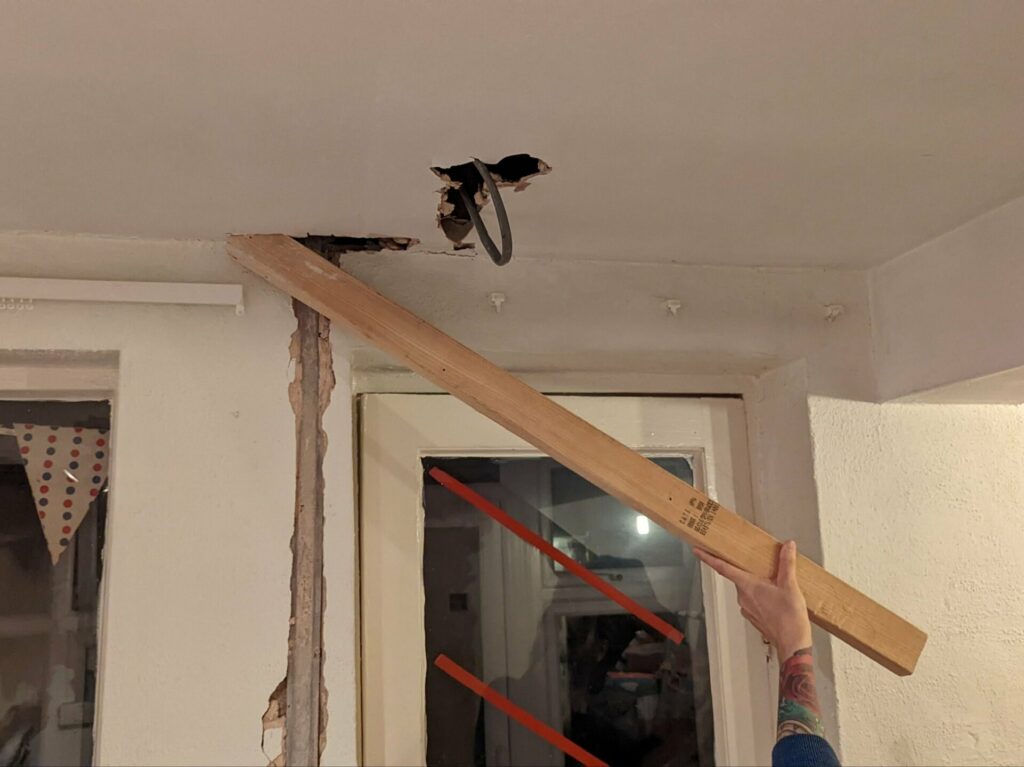
    The 4 2 ceiling removal device in action

    At last, quarry in sight!

    Mystery Cable Junction Box of Fire and Doom  ?
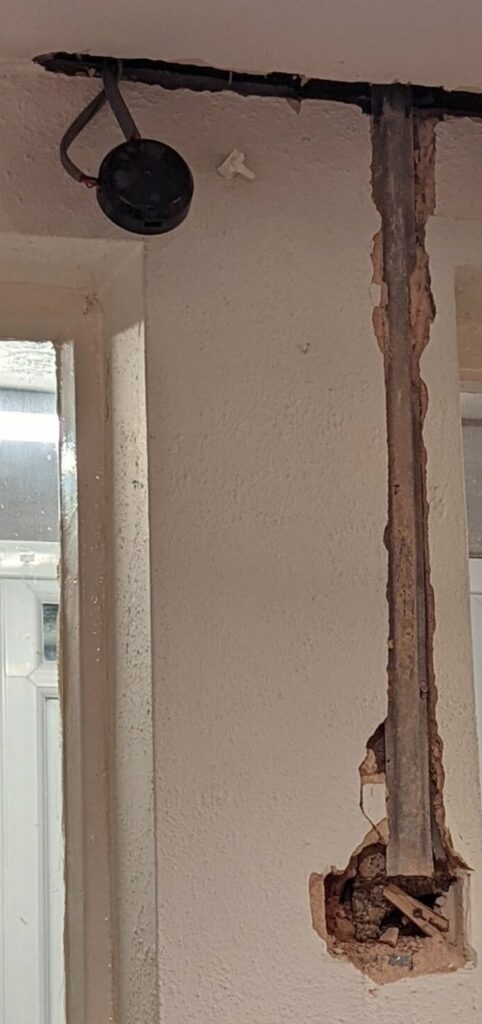
    All the terrifying branches removed and ready to go back into the ceiling for now, until the next room is refurbished

    Thomas Lange: FAI.me service now support backports for Debian 11 (bullseye)

    The FAI.me service for creating customized installation and cloud images now supports a backports kernel for the stable release Debian 11 (aka bullseye). If you enable the backports option, you will currently get kernel 5.14. This will help you if you have newer hardware that is not support by the default kernel 5.10. The backports option is also still available for the images when using the old Debian 10 (buster) release. The URL of the FAI.me service is https://fai-project.org/FAIme/ FAI.me

    4 January 2022

    Russell Coker: Terrorists Inspired by Fiction

    The Tom Clancy book Debt of Honor published in August 1994 first introduced the concept of a heavy passenger aircraft being used as a weapon by terrorists against a well defended building. In April 1994 there was an attempt to hijack and deliberately crash FedEx flight 705. It s possible for a book to be changed 4 months before publication, but it seems unlikely that a significant plot point in a series of books was changed in such a small amount of time so it s likely that Tom Clancy got the idea first. There have been other variations on that theme, such as the Yokosuka_MXY-7 Kamakazi flying bomb (known by the Allies as Baka which is Japanese for idiot). But Tom Clancy seemed to pioneer the idea of a commercial passenger jet being subverted for the purpose of ground attack. 7 years after Tom Clancy s book was published the 911 hijackings happened. The TV series Black Mirror first aired in 2011, and the first episode was about terrorists kidnapping a princess and demanding that the UK PM perform an indecent act with a pig for her release. While the plot was a little extreme (the entire series is extreme) the basic concept of sexual extortion based on terrorist acts is something that could be done in real life, and if terrorists were inspired by this they are taking longer than expected to do it. Most democracies seem to end up with two major parties that are closely matched. Even if a government was strict about not negotiating with terrorists it seems likely that terrorists demanding that a politician perform an unusual sex act on TV would change things, supporters would be divided into groups that support and oppose negotiating. Discussions wouldn t be as civil as when the negotiation involves money or freeing prisoners. If an election result was perceived to have been influenced by such terrorism then supporters of the side that lost would claim it to be unfair and reject the result. If the goal of terrorists was to cause chaos then that would be one way of achieving it, and they have had over 10 years to consider this possibility. Are we overdue for a terror attack inspired by Black Mirror?

    Jelmer Vernooij: Personal Streaming Audio Server

    For a while now, I ve been looking for a good way to stream music from my home music collection on my phone. There are quite a few options for music servers that support streaming. However, Android apps that can stream music from one of those servers tend to be unmaintained, clunky or slow (or more than one of those). It is possible to use something that runs in a web server, but that means no offline caching - which can be quite convenient in spots without connectivity, such as the Underground or other random bits of London with poor cell coverage.
    Server Most music servers today support some form of the subsonic API. I ve tried a couple, with mixed results:
    • supysonic; Python. Slow. Ran into some issues with subsonic clients. No real web UI.
    • gonic; Go. Works well & fast enough. Minimal web UI, i.e. no ability to play music from a browser.
    • airsonic; Java. Last in a chain of (abandoned) forks. More effort to get to work, and resource intensive.
    Eventually, I ve settled on Navidrome. It s got a couple of things going for it:
    • Good subsonic implementation that worked with all the Android apps I used it with.
    • Great Web UI for use in a browser
    I run Navidrome in Kubernetes. It s surprisingly easy to get going. Here s the deployment I m using:
     1
     2
     3
     4
     5
     6
     7
     8
     9
    10
    11
    12
    13
    14
    15
    16
    17
    18
    19
    20
    21
    22
    23
    24
    25
    26
    27
    28
    29
    30
    31
    32
    33
    34
    35
    36
    37
    38
    39
    40
    41
    42
    43
    44
    45
    46
    47
    48
    49
    50
    51
    52
    53
    54
    55
    56
    57
    58
    59
    60
    61
    62
    63
    64
    65
    66
    67
    68
    69
    apiVersion: apps/v1
    kind: Deployment
    metadata:
     name: navidrome
    spec:
     replicas: 1
     selector:
       matchLabels:
         app: navidrome
     template:
       metadata:
         labels:
           app: navidrome
       spec:
         containers:
           - name: navidrome
             image: deluan/navidrome:latest
             imagePullPolicy: Always
             resources:
               limits:
                 cpu: ".5"
                 memory: "2Gi"
               requests:
                 cpu: "0.1"
                 memory: "10M"
             ports:
               - containerPort: 4533
             volumeMounts:
               - name: navidrome-data-volume
                 mountPath: /data
               - name: navidrome-music-volume
                 mountPath: /music
             env:
               - name: ND_SCANSCHEDULE
                 value: 1h
               - name: ND_LOGLEVEL
                 value: info
               - name: ND_SESSIONTIMEOUT
                 value: 24h
               - name: ND_BASEURL
                 value: /navidrome
             livenessProbe:
                httpGet:
                  path: /navidrome/app
                  port: 4533
                initialDelaySeconds: 30
                periodSeconds: 3
                timeoutSeconds: 90
         volumes:
            - name: navidrome-data-volume
              hostPath:
               path: /srv/navidrome
               type: Directory
            - name: navidrome-music-volume
              hostPath:
                path: /srv/media/music
                type: Directory
    ---
    apiVersion: v1
    kind: Service
    metadata:
      name: navidrome
    spec:
      ports:
        - port: 4533
          name: web
      selector:
        app: navidrome
      type: ClusterIP
    
    At the moment, this deployment is still tied to the machine with my music on it since it relies on hostPath volumes, but I m planning to move that to ceph in the future. I then expose this service on /navidrome on my private domain (here replaced with example.com) using an Ingress:
     1
     2
     3
     4
     5
     6
     7
     8
     9
    10
    11
    12
    13
    14
    15
    16
    17
    apiVersion: networking.k8s.io/v1
    kind: Ingress
    metadata:
      name: navidrome
    spec:
      ingressClassName: nginx
      rules:
      - host: example.com
        http:
          paths:
          - backend:
              service:
                name: navidrome
                port:
                  name: web
            path: /navidrome(/ $)(.*)
            pathType: Prefix
    
    Client On the desktop, I usually just use navidrome s web interface. Clementine s support for subsonic is also okay. sublime-music is meant to be a music player specifically for Subsonic, but I ve not really found it stable enough for day-to-day usage. There are various Android clients for Subsonic, but I ve only really considered the Open Source ones that are hosted on F-Droid. Most of those are abandoned, but D-Sub works pretty well - as does my preferred option, Subtracks.

    Jonathan McDowell: Upgrading from a CC2531 to a CC2538 Zigbee coordinator

    Previously I setup a CC2531 as a Zigbee coordinator for my home automation. This has turned out to be a good move, with the 4 gang wireless switch being particularly useful. However the range of the CC2531 is fairly poor; it has a simple PCB antenna. It s also a very basic device. I set about trying to improve the range and scalability and settled upon a CC2538 + CC2592 device, which feature an MMCX antenna connector. This device also has the advantage that it s ARM based, which I m hopeful means I might be able to build some firmware myself using a standard GCC toolchain. For now I fetched the JetHome firmware from https://github.com/jethome-ru/zigbee-firmware/tree/master/ti/coordinator/cc2538_cc2592 (JH_2538_2592_ZNP_UART_20211222.hex) - while it s possible to do USB directly with the CC2538 my board doesn t have those bits so going the external USB UART route is easier. The device had some existing firmware on it, so I needed to erase this to force a drop into the boot loader. That means soldering up the JTAG pins and hooking it up to my Bus Pirate for OpenOCD goodness.
    OpenOCD config
    source [find interface/buspirate.cfg]
    buspirate_port /dev/ttyUSB1
    buspirate_mode normal
    buspirate_vreg 1
    buspirate_pullup 0
    transport select jtag
    source [find target/cc2538.cfg]
    
    Steps to erase
    $ telnet localhost 4444
    Trying ::1...
    Trying 127.0.0.1...
    Connected to localhost.
    Escape character is '^]'.
    Open On-Chip Debugger
    > mww 0x400D300C 0x7F800
    > mww 0x400D3008 0x0205
    > shutdown
    shutdown command invoked
    Connection closed by foreign host.
    
    At that point I can switch to the UART connection (on PA0 + PA1) and flash using cc2538-bsl:
    $ git clone https://github.com/JelmerT/cc2538-bsl.git
    $ cc2538-bsl/cc2538-bsl.py -p /dev/ttyUSB1 -e -w -v ~/JH_2538_2592_ZNP_UART_20211222.hex
    Opening port /dev/ttyUSB1, baud 500000
    Reading data from /home/noodles/JH_2538_2592_ZNP_UART_20211222.hex
    Firmware file: Intel Hex
    Connecting to target...
    CC2538 PG2.0: 512KB Flash, 32KB SRAM, CCFG at 0x0027FFD4
    Primary IEEE Address: 00:12:4B:00:22:22:22:22
        Performing mass erase
    Erasing 524288 bytes starting at address 0x00200000
        Erase done
    Writing 524256 bytes starting at address 0x00200000
    Write 232 bytes at 0x0027FEF88
        Write done
    Verifying by comparing CRC32 calculations.
        Verified (match: 0x74f2b0a1)
    
    I then wanted to migrate from the old device to the new without having to repair everything. So I shut down Home Assistant and backed up the CC2531 network information using zigpy-znp (which is already installed for Home Assistant):
    python3 -m zigpy_znp.tools.network_backup /dev/zigbee > cc2531-network.json
    
    I copied the backup to cc2538-network.json and modified the coordinator_ieee to be the new device s MAC address (rather than end up with 2 devices claiming the same MAC if/when I reuse the CC2531) and did:
    python3 -m zigpy_znp.tools.network_restore --input cc2538-network.json /dev/ttyUSB1
    
    The old CC2531 needed unplugged first, otherwise I got an RuntimeError: Network formation refused, RF environment is likely too noisy. Temporarily unscrew the antenna or shield the coordinator with metal until a network is formed. error. After that I updated my udev rules to map the CC2538 to /dev/zigbee and restarted Home Assistant. To my surprise it came up and detected the existing devices without any extra effort on my part. However that resulted in 2 coordinators being shown in the visualisation, with the old one turning up as unk_manufacturer. Fixing that involved editing /etc/homeassistant/.storage/core.device_registry and removing the entry which had the old MAC address, removing the device entry in /etc/homeassistant/.storage/zha.storage for the old MAC and then finally firing up sqlite to modify the Zigbee database:
    $ sqlite3 /etc/homeassistant/zigbee.db
    SQLite version 3.34.1 2021-01-20 14:10:07
    Enter ".help" for usage hints.
    sqlite> DELETE FROM devices_v6 WHERE ieee = '00:12:4b:00:11:11:11:11';
    sqlite> DELETE FROM endpoints_v6 WHERE ieee = '00:12:4b:00:11:11:11:11';
    sqlite> DELETE FROM in_clusters_v6 WHERE ieee = '00:12:4b:00:11:11:11:11';
    sqlite> DELETE FROM neighbors_v6 WHERE ieee = '00:12:4b:00:11:11:11:11' OR device_ieee = '00:12:4b:00:11:11:11:11';
    sqlite> DELETE FROM node_descriptors_v6 WHERE ieee = '00:12:4b:00:11:11:11:11';
    sqlite> DELETE FROM out_clusters_v6 WHERE ieee = '00:12:4b:00:11:11:11:11';
    sqlite> .quit
    
    So far it all seems a bit happier than with the CC2531; I ve been able to pair a light bulb that was previously detected but would not integrate, which suggests the range is improved. (This post another in the set of things I should write down so I can just grep my own website when I forget what I did to do foo .)

    Russell Coker: Big Smart TVs

    Recently a relative who owned a 50 Plasma TV asked me for advice on getting a new TV. Looking at the options all the TVs seem to be smart TVs (running Android with built in support for YouTube and Netflix) and most of them seem to be 4K resolution. 4K doesn t provide much benefit now as most people don t have BlueRay DVD players and discs, there aren t a lot of 4K YouTube videos, and most streaming services don t offer 4K resolution. But as 4K doesn t cost much more it doesn t make sense not to get it. I gave my relative a list of good options from Kogan (the Australian company that has the cheapest consumer electronics) and they chose a 65 4K Smart TV from Kogan. That only cost $709 plus delivery which is reasonably affordable for something that will presumably last for a long time and be used by many people. Netflix on a web browser won t do more than FullHD resolution unless you use Edge on Windows 10. But Netflix on the smart tv has a row advertising 4K shows which indicates that 4K is supported. There are some 4K videos on YouTube but not a lot at this time. Size It turns out that 65 is very big. It didn t fit on the table that had been used for the 50 Plasma TV. Rtings.com has a good article about TV size vs distance [1]. According to their calculations if you want to sit 2 meters away from a TV and have a 30 degree field of view (recommended for mixed use) then a 45 TV is ideal. According to their calculations on pixel sizes, if you have a FullHD display (or the common modern case a FullHD signal displayed on a 4K monitor) that is between 1.8 and 2.5 meters away from you then a 45 TV is the largest that will be useful. To take proper advantage of a monitor larger than 45 at a distance of 2 meters you need a 4K signal. If you have a 4K signal then you can get best results by having a 45 monitor less than 1.8 meters away from you. As most TV watching involves less than 3 people it shouldn t be inconvenient to be less than 1.8 meters away from the TV. The 65 TV weighs 21Kg according to the specs, that isn t a huge amount for something small, but for something a large and inconvenient as a 65 TV it s impossible for one person to safely move. Kogan sells 43 TVs that weigh 6KG, that s something that most adults could move with one hand. I think that a medium size TV that can be easily moved to a convenient location would probably give an equivalent viewing result to an extremely large TV that can t be moved at all. I currently have a 40 LCD TV, the only reason I have that is because a friend didn t need it, the previous 32 TV that I used was adequate for my needs. Most of my TV viewing is on a 28 monitor, which I find adequate for 2 or 3 people. So I generally wouldn t recommend a 65 TV for anyone. Android for TVs Android wasn t designed for TVs and doesn t work that well on them. Having buttons on the remote for Netflix and YouTube is handy, but it would be nice if there were programmable buttons for other commonly used apps or a way to switch between the last few apps (like ALT-TAB on a PC). One good feature of Android for TV is that it can display a set of rows of shows (similar to the Netflix method of displaying) where each row is from a different app. The apps I ve installed on that TV which support the row view are Netflix, YouTube, YouTube Music, ABC iView (that s Australian ABC), 7plus, 9now, and SBS on Demand. That s nice, now we just need channel 10 s app to support that to have coverage for all Australian free TV stations in the Android TV interface. Conclusion It s a nice TV and it generally works well. Android is OK for TV use but far from great. It is running Android version 9, maybe a newer version of Android works better on TVs. It s too large for reasonable people to use in a home. I ve seen smaller TVs used for 20 people in an office in a video conference. It s cheap enough that most people can afford it, but it s easier and more convenient to have something smaller and lighter.

    Russell Coker: Curiosity Stream

    I have recently signed up for the Curiosity Stream [1] documentary site, this is designed to be like Netflix but for non-fiction content only. The service costs $US15 per annum or $52US per annum for 4K (I think the 4K service was about $US120 per annum when I signed up). The extra price for 4K seems excessive, while it is in line with the bandwidth requirements a large portion of the costs of the service would be about user support and running the service reliably for which 4K makes little difference. My aim in subscribing was to just get a service like Netflix with new documentary content as I have watched every documentary I want to watch on Netflix (I think I ve watched over 1000 hours of Netflix documentaries). So naturally I compare the service to Netflix and I found that it doesn t compare well. Curiosity Stream (CS) has no button to skip the intro and has a problem with using the right arrow to skip forward (seems to only work once and then I have to use the mouse), this costs me about 30 seconds for each episode which adds up when watching documentaries at 1.5* speed. The method of controlling the viewing is a little clunky, sometimes the popup menu at the bottom of the screen to control playback doesn t disappear by itself until you mouse over it and space bar doesn t select pause instead it selects the last action. CS allows selecting individual episodes for your watch list instead of entire series, this could be useful for some people but I just find it annoying, it might be good for classroom use. The method of searching for new shows to watch isn t as good as the Netflix method or the way things are displayed on Android TV (which seems to have an API for multiple video providers to show a list of shows with one row per provider). Some of these things might seem OK if you haven t used other services, but if you are used to Netflix and Amazon Prime then it will seem clunky. The amount of content on Curiosity Stream doesn t seem that large, I don t know how to get a full measure of it, but when I search for things I seem to get less results than on Netflix. That could be something to do with what I m searching for. In terms of value for money $US15 per annum for the content that CS provides is a good deal. Netflix overall offers better value for home users having fiction as well as non-fiction in large quantities. But for documentary content $US15 per annum is pretty cheap. I recommend signing up for CS, but for most people signing up for Netflix first will be a good option.
    1. [1] https://curiositystream.com/

    3 January 2022

    Paul Wise: FLOSS Activities December 2021

    Focus This month I didn't have any particular focus. I just worked on issues in my info bubble.

    Changes

    Issues

    Review
    • Spam: reported 166 Debian mailing list posts
    • Patches: reviewed libpst upstream patches
    • Debian packages: sponsored nsis, memtest86+
    • Debian wiki: RecentChanges for the month
    • Debian BTS usertags: changes for the month
    • Debian screenshots:

    Administration
    • libpst: setup GitHub presence, migrate from hg to git, requested details from bug reporters
    • plac: cleaned up git repo anomalies
    • Debian BTS: unarchive/reopen/triage bugs for reintroduced packages: stardict, node-carto
    • Debian wiki: unblock IP addresses, approve accounts

    Communication
    • Respond to queries from Debian users and contributors on the mailing lists and IRC

    Sponsors The purple-discord, python-plac, sptag, smart-open, libpst, memtest86+, oci-python-sdk work was sponsored. All other work was done on a volunteer basis.

    Ian Jackson: Debian s approach to Rust - Dependency handling

    tl;dr: Faithfully following upstream semver, in Debian package dependencies, is a bad idea. Introduction I have been involved in Debian for a very long time. And I ve been working with Rust for a few years now. Late last year I had cause to try to work on Rust things within Debian. When I did, I found it very difficult. The Debian Rust Team were very helpful. However, the workflow and tooling require very large amounts of manual clerical work - work which it is almost impossible to do correctly since the information required does not exist. I had wanted to package a fairly straightforward program I had written in Rust, partly as a learning exercise. But, unfortunately, after I got stuck in, it looked to me like the effort would be wildly greater than I was prepared for, so I gave up. Since then I ve been thinking about what I learned about how Rust is packaged in Debian. I think I can see how to fix some of the problems. Although I don t want to go charging in and try to tell everyone how to do things, I felt I ought at least to write up my ideas. Hence this blog post, which may become the first of a series. This post is going to be about semver handling. I see problems with other aspects of dependency handling and source code management and traceability as well, and of course if my ideas find favour in principle, there are a lot of details that need to be worked out, including some kind of transition plan. How Debian packages Rust, and build vs runtime dependencies Today I will be discussing almost entirely build-dependencies; Rust doesn t (yet?) support dynamic linking, so built Rust binaries don t have Rusty dependencies. However, things are a bit confusing because even the Debian binary packages for Rust libraries contain pure source code. So for a Rust library package, building the Debian binary package from the Debian source package does not involve running the Rust compiler; it s just file-copying and format conversion. The library s Rust dependencies do not need to be installed on the build machine for this. So I m mostly going to be talking about Depends fields, which are Debian s way of talking about runtime dependencies, even though they are used only at build-time. The way this works is that some ultimate leaf package (which is supposed to produce actual executable code) Build-Depends on the libraries it needs, and those Depends on their under-libraries, so that everything needed is installed. What do dependencies mean and what are they for anyway? In systems where packages declare dependencies on other packages, it generally becomes necessary to support versioned dependencies. In all but the most simple systems, this involves an ordering (or similar) on version numbers and a way for a package A to specify that it depends on certain versions of B. Both Debian and Rust have this. Rust upstream crates have version numbers and can specify their dependencies according to semver. Debian s dependency system can represent that. So it was natural for the designers of the scheme for packaging Rust code in Debian to simply translate the Rust version dependencies to Debian ones. However, while the two dependency schemes seem equivalent in the abstract, their concrete real-world semantics are totally different. These different package management systems have different practices and different meanings for dependencies. (Interestingly, the Python world also has debates about the meaning and proper use of dependency versions.) The epistemological problem Consider some package A which is known to depend on B. In general, it is not trivial to know which versions of B will be satisfactory. I.e., whether a new B, with potentially-breaking changes, will actually break A. Sometimes tooling can be used which calculates this (eg, the Debian shlibdeps system for runtime dependencies) but this is unusual - especially for build-time dependencies. Which versions of B are OK can normally only be discovered by a human consideration of changelogs etc., or by having a computer try particular combinations. Few ecosystems with dependencies, in the Free Software community at least, make an attempt to precisely calculate the versions of B that are actually required to build some A. So it turns out that there are three cases for a particular combination of A and B: it is believed to work; it is known not to work; and: it is not known whether it will work. And, I am not aware of any dependency system that has an explicit machine-readable representation for the unknown state, so that they can say something like A is known to depend on B; versions of B before v1 are known to break; version v2 is known to work . (Sometimes statements like that can be found in human-readable docs.) That leaves two possibilities for the semantics of a dependency A depends B, version(s) V..W: Precise: A will definitely work if B matches V..W, and Optimistic: We have no reason to think B breaks with any of V..W. At first sight the latter does not seem useful, since how would the package manager find a working combination? Taking Debian as an example, which uses optimistic version dependencies, the answer is as follows: The primary information about what package versions to use is not only the dependencies, but mostly in which Debian release is being targeted. (Other systems using optimistic version dependencies could use the date of the build, i.e. use only packages that are current .)
    Precise Optimistic
    People involved in version management Package developers,
    downstream developers/users.
    Package developers,
    downstream developer/users,
    distribution QA and release managers.
    Package developers declare versions V and dependency ranges V..W so that It definitely works. A wide range of B can satisfy the declared requirement.
    The principal version data used by the package manager Only dependency versions. Contextual, eg, Releases - set(s) of packages available.
    Version dependencies are for Selecting working combinations (out of all that ever existed). Sequencing (ordering) of updates; QA.
    Expected use pattern by a downstream Downstream can combine any
    declared-good combination.
    Use a particular release of the whole system. Mixing-and-matching requires additional QA and remedial work.
    Downstreams are protected from breakage by Pessimistically updating versions and dependencies whenever anything might go wrong. Whole-release QA.
    A substantial deployment will typically contain Multiple versions of many packages. A single version of each package, except where there are actual incompatibilities which are too hard to fix.
    Package updates are driven by Top-down:
    Depending package updates the declared metadata.
    Bottom-up:
    Depended-on package is updated in the repository for the work-in-progress release.
    So, while Rust and Debian have systems that look superficially similar, they contain fundamentally different kinds of information. Simply representing the Rust versions directly into Debian doesn t work. What is currently done by the Debian Rust Team is to manually patch the dependency specifications, to relax them. This is very labour-intensive, and there is little automation supporting either decisionmaking or actually applying the resulting changes. What to do Desired end goal To update a Rust package in Debian, that many things depend on, one need simply update that package. Debian s sophisticated build and CI infrastructure will try building all the reverse-dependencies against the new version. Packages that actually fail against the new dependency are flagged as suffering from release-critical problems. Debian Rust developers then update those other packages too. If the problems turn out to be too difficult, it is possible to roll back. If a problem with a depending packages is not resolved in a timely fashion, priority is given to updating core packages, and the depending package falls by the wayside (since it is empirically unmaintainable, given available effort). There is no routine manual patching of dependency metadata (or of anything else). Radical proposal Debian should not precisely follow upstream Rust semver dependency information. Instead, Debian should optimistically try the combinations of packages that we want to have. The resulting breakages will be discovered by automated QA; they will have to be fixed by manual intervention of some kind, but usually, simply updating the depending package will be sufficient. This no longer ensures (unlike the upstream Rust scheme) that the result is expected to build and work if the dependencies are satisfied. But as discussed, we don t really need that property in Debian. More important is the new property we gain: that we are able to mix and match versions that we find work in practice, without a great deal of manual effort. Or to put it another way, in Debian we should do as a Rust upstream maintainer does when they do the regular update dependencies for new semvers task: we should update everything, see what breaks, and fix those. (In theory a Rust upstream package maintainer is supposed to do some additional checks or something. But the practices are not standardised and any checks one does almost never reveal anything untoward, so in practice I think many Rust upstreams just update and see what happens. The Rust upstream community has other mechanisms - often, reactive ones - to deal with any problems. Debian should subscribe to those same information sources, eg RustSec.) Nobbling cargo Somehow, when cargo is run to build Rust things against these Debian packages, cargo s dependency system will have to be overridden so that the version of the package that is actually selected by Debian s package manager is used by cargo without complaint. We probably don t want to change the Rust version numbers of Debian Rust library packages, so this should be done by either presenting cargo with an automatically-massaged Cargo.toml where the dependency version restrictions are relaxed, or by using a modified version of cargo which has special option(s) to relax certain dependencies. Handling breakage Rust packages in Debian should already be provided with autopkgtests so that ci.debian.net will detect build breakages. Build breakages will stop the updated dependency from migrating to the work-in-progress release, Debian testing. To resolve this, and allow forward progress, we will usually upload a new version of the dependency containing an appropriate Breaks, and either file an RC bug against the depending package, or update it. This can be done after the upload of the base package. Thus, resolution of breakage due to incompatibilities will be done collaboratively within the Debian archive, rather than ad-hoc locally. And it can be done without blocking. My proposal prioritises the ability to make progress in the core, over stability and in particular over retaining leaf packages. This is not Debian s usual approach but given the Rust ecosystem s practical attitudes to API design, versioning, etc., I think the instability will be manageable. In practice fixing leaf packages is not usually really that hard, but it s still work and the question is what happens if the work doesn t get done. After all we are always a shortage of effort - and we probably still will be, even if we get rid of the makework clerical work of patching dependency versions everywhere (so that usually no work is needed on depending packages). Exceptions to the one-version rule There will have to be some packages that we need to keep multiple versions of. We won t want to update every depending package manually when this happens. Instead, we ll probably want to set a version number split: rdepends which want version <X will get the old one. Details - a sketch I m going to sketch out some of the details of a scheme I think would work. But I haven t thought this through fully. This is still mostly at the handwaving stage. If my ideas find favour, we ll have to do some detailed review and consider a whole bunch of edge cases I m glossing over. The dependency specification consists of two halves: the depending .deb s Depends (or, for a leaf package, Build-Depends) and the base .deb Version and perhaps Breaks and Provides. Even though libraries vastly outnumber leaf packages, we still want to avoid updating leaf Debian source packages simply to bump dependencies. Dependency encoding proposal Compared to the existing scheme, I suggest we implement the dependency relaxation by changing the depended-on package, rather than the depending one. So we retain roughly the existing semver translation for Depends fields. But we drop all local patching of dependency versions. Into every library source package we insert a new Debian-specific metadata file declaring the earliest version that we uploaded. When we translate a library source package to a .deb, the binary package build adds Provides for every previous version. The effect is that when one updates a base package, the usual behaviour is to simply try to use it to satisfy everything that depends on that base package. The Debian CI will report the build or test failures of all the depending packages which the API changes broke. We will have a choice, then: Breakage handling - update broken depending packages individually If there are only a few packages that are broken, for each broken dependency, we add an appropriate Breaks to the base binary package. (The version field in the Breaks should be chosen narrowly, so that it is possible to resolve it without changing the major version of the dependency, eg by making a minor source change.) When can then do one of the following: Breakage handling - declare new incompatible API in Debian If the API changes are widespread and many dependencies are affected, we should represent this by changing the in-Debian-source-package metadata to arrange for fewer Provides lines to be generated - withdrawing the Provides lines for earlier APIs. Hopefully examination of the upstream changelog will show what the main compat break is, and therefore tell us which Provides we still want to retain. This is like declaring Breaks for all the rdepends. We should do it if many rdepends are affected. Then, for each rdependency, we must choose one of the responses in the bullet points above. In practice this will often be a mass bug filing campaign, or large update campaign. Breakage handling - multiple versions Sometimes there will be a big API rewrite in some package, and we can t easily update all of the rdependencies because the upstream ecosystem is fragmented and the work involved in reconciling it all is too substantial. When this happens we will bite the bullet and include multiple versions of the base package in Debian. The old version will become a new source package with a version number in its name. This is analogous to how key C/C++ libraries are handled. Downsides of this scheme The first obvious downside is that assembling some arbitrary set of Debian Rust library packages, that satisfy the dependencies declared by Debian, is no longer necessarily going to work. The combinations that Debian has tested - Debian releases - will work, though. And at least, any breakage will affect only people building Rust code using Debian-supplied libraries. Another less obvious problem is that because there is no such thing as Build-Breaks (in a Debian binary package), the per-package update scheme may result in no way to declare that a particular library update breaks the build of a particular leaf package. In other words, old source packages might no longer build when exposed to newer versions of their build-dependencies, taken from a newer Debian release. This is a thing that already happens in Debian, with source packages in other languages, though. Semver violation I am proposing that Debian should routinely compile Rust packages against dependencies in violation of the declared semver, and ship the results to Debian s millions of users. This sounds quite alarming! But I think it will not in fact lead to shipping bad binaries, for the following reasons: The Rust community strongly values safety (in a broad sense) in its APIs. An API which is merely capable of insecure (or other seriously bad) use is generally considered to be wrong. For example, such situations are regarded as vulnerabilities by the RustSec project, even if there is no suggestion that any actually-broken caller source code exists, let alone that actually-broken compiled code is likely. The Rust community also values alerting programmers to problems. Nontrivial semantic changes to APIs are typically accompanied not merely by a semver bump, but also by changes to names or types, precisely to ensure that broken combinations of code do not compile. Or to look at it another way, in Debian we would simply be doing what many Rust upstream developers routinely do: bump the versions of their dependencies, and throw it at the wall and hope it sticks. We can mitigate the risks the same way a Rust upstream maintainer would: when updating a package we should of course review the upstream changelog for any gotchas. We should look at RustSec and other upstream ecosystem tracking and authorship information. Difficulties for another day As I said, I see some other issues with Rust in Debian. Thanks all for your attention!

    comment count unavailable comments

    Thorsten Alteholz: My Debian Activities in December 2021

    FTP master This month I accepted 412 and rejected 44 packages. The overall number of packages that got accepted was 423. Debian LTS This was my ninetieth month that I did some work for the Debian LTS initiative, started by Raphael Hertzog at Freexian. This month my all in all workload has been 40h. During that time I did LTS and normal security uploads of: I also started to work on libarchive Further I worked on packages in NEW on security-master. In order to faster process such packages, I added a notification when work arrived there. Last but not least I did some days of frontdesk duties. Debian ELTS This month was the forty-second ELTS month. During my allocated time I uploaded: Last but not least I did some days of frontdesk duties. Debian Astro Related to my previous article about fun with telescopes I uploaded new versions or did source uploads for: Besides the indi-stuff I also uploaded Other stuff I celebrated christmas :-).

    Joachim Breitner: Telegram bots in Python made easy

    A while ago I set out to get some teenagers interested in programming, and thought about a good way to achieve that. A way that allows them to get started with very little friction, build something that s relevant in their currently live quickly, and avoids frustration. They were old enough to have their own smartphone, and they were already happily chatting with their friends, using the Telegram messenger. I have already experimented a bit with writing bots for Telegram (e.g. @Umklappbot or @Kaleidogen), and it occurred to me that this might be a good starting point: Chat bot interactions have a very simple data model: message in, response out, all simple text. Much simpler than anything graphical or even web programming. In a way it combines the simplicity of the typical initial programming exercises on the command-line with the impact and relevance of web programming. But of course real bot programming is still too hard installing a programming environment, setting up a server, deploying, dealing with access tokens, understanding the Telegram Bot API and mapping it to your programming language.
    The IDEThe IDE
    So I built a browser-based Python programming environments for Telegram bots that takes care of all of that. You simply write a single Python function, click the Deploy button, and the bot is live. That s it! This environment provides a much simpler API for the bots: Define a function like the following:
      def private_message(sender, text):
         return "Hello!"
    This gets called upon a message, and if it returns a String, that s the response. That s it! Not enough to build any kind of Telegram bot, but sufficient for many fun applications.
    A chatbotA chatbot
    In fact, my nephew and niece use this to build a simple interactive fiction game, where the player says where they are going ( house , forest , lake ) and thus explore the story, and in the end kill the dragon. And my girlfriend created a shopping list bot that we are using productively . If you are curious, you can follow the instructions to create your own bot. There you can also find the source code and instructions for hosting your own instance (on Amazon Web Services). Help with the project (e.g. improving the sandbox for running untrustworthy python code; making the front-end work better) is of course highly appreciated, too. The frontend is written in PureScript, and the backend in Python, building on Amazon lambda and Amazon DynamoDB.

    Next.

    Previous.