Joey Hess: the real Brazil

 |
|
 I hate the days when I wake up at odd hours for no good reason. This morning I
woke up at 4:30am briefly, with no idea why. It makes me wonder if there was
some sort of external noise, and that's what woke Zoe up yesterday morning.
I got myself going at a reasonable hour this morning, and decided to walk to
the Bulimba post office to collect a package that was waiting for me. It was a
nice enough morning for a walk, and I'm glad I decided to do it.
Along the way, I observed multiple grandmothers walking their grandchildren to
school. I've been thinking a lot about next year lately. I feel very strongly
about Zoe not having to go into after school care. It seems that one of the new
societal norms is the grandparents have to step in with the school
transportation and after school care. That's not going to be particularly
practical in our situation though, so I'm currently leaning towards seeking
some sort of flexible employment next year that will allow me to be able to be
available after Zoe finishes school.
I was fairly motivated to get stuck into my to do list after my walk. A long
standing item was to cancel one of my remaining US credit cards, and the time
difference worked out well to do that, so I finally took care of that. I then
realised it was a good time for the US East Coast, so I did a Hangout with one
of my best friends in New York. It was great to have a catch up.
After that, I finished off my US tax return, and also sorted out some other
stuff that needed finishing off. I had to go to the Valley to find a FedEx
location, so I drove over there, and on the way back stopped off in Bulimba to
get some Mother's Day cards. By that stage it was about time to pick up Zoe
from Kindergarten, so I quickly grabbed some lunch and then drove over to pick
her up.
She didn't nap again today, so that made our departure from Kindergarten nice
and easy. I'd booked both of us in for haircuts at 3pm, so we got home with
enough time for Zoe to ride her scooter to the hairdresser. We had our haircuts
and Zoe had a bit of a play in the play corner, and we headed back home.
I'd bought a venus fly trap from Bunnings last week while we were picking up
other bits and pieces. I wanted to show Zoe how they worked, so we watched a
few YouTube videos. This
one was particularly good. After that, we went down to the rubbish skip
with our fly trap to see if we could catch any flies in it, but Zoe quickly
lost interest. So we headed back upstairs, and triggered one with a toothpick.
I probably could have done this on a Friday and called it a Science Friday
activity with a botany bent.
After that, we just watched some TV together on the couch until Sarah arrived
to pick her up.

 The IT security world is still reeling from the impact of the OpenSSL Heartbleed bug. Thanks to the bug, many experts have been reviewing other technologies to try and find similar risks.
While Heartbleed was hidden away in the depths of the OpenSSL code base, another major security risk has been hiding in plain sight: SMS authentication for web site logins.
Remarkably, a number of firms have started giving customers the ability to receive single-use passwords over SMS for logging into their secure web sites. Some have even insisted that customers can no longer log in without it, denying customers the right to make an important choice about their own security preferences.
 Unfortunately, SMS is no substitute to the one-time-passwords generated using proper authentication tokens or the use of other strong authentication schemes such as cryptographic smart cards. Even telephone companies themselves advise that SMS should not be used to secure financial transactions.
Ocean's 11 in real life: exploiting the weakest link in the chain
To deliver single-use SMS passwords, the SMS must travel through various networks from the firm's headquarters, to a wholesale SMS gateway, international SMS network and finally down the line of the local phone company.
In comparison, properly certified token devices generate a code inside the device in the palm of your hand. The code only travels from the screen to your eyes.
In a litany of frauds coming in all shapes and sizes, telephone networks have been exploited over and over again because they are almost always the weakest link in the chain. Using the mobile SMS network for authentication is not building on solid ground - some experts even feel it is downright stupidity.
One of the most serious examples was the theft of $150,000,000 from a pension fund deposited with JP Morgan: it was described as a real-life case of Ocean's 11. The authentication was meant to be a phone call rather than an SMS: a phone company employee who was in on the scam duly ensured the call never reached the correct place.
 The insecurity of traditional telephone networks has been on display for all the world to see in the ongoing trial of News Corporation executives for phone hacking. If journalists from a tabloid newspaper can allegedly hack a dozen phones before their first cigarette of the day, is it really wise to use an insecure technology like SMS as the cornerstone of a security system for authorizing transactions?
A fraud recently played out on many credit card holders in the UK exploited a low-tech feature of the phone system to trick people to believe they were safe by "calling back" to their bank.
A plethora of new attack vectors
 The staggering reality of the situation is that attackers don't even have to directly hack their victim's phones to access SMS messages.
As the Android API documentation demonstrates, SMS reception is notified to all apps in real-time. Apps can process the messages even when the phone is sleeping and the message is not read by the user.
Just consider all the apps on a phone that have requested permission to read incoming messages. There was an uproar recently when a new version of the Facebook app started demanding permissions to read incoming SMS. The app can't be installed if the user doesn't agree to these new permissions. WhatsApp, another popular app that has SMS access rights, was recently exposed in a major security scandal which revealed they use a phone's IMEI number as the password. When people install an app like Tinder (which does not yet request SMS access) is the security of their bank account likely to be at the front of their mind?
Even if Facebook intends no harm, they have opened the floodgates by further de-sensitizing users to the risks of giving apps un-necessary access to their data.
These companies are looking for every piece of data that could give them an edge in their customer profiling and marketing programs. Having real-time access to your SMS is a powerful way for them to understand your activities and feelings at every moment in the day. To facilitate these data analysis techniques, replicating and archiving your messages into their cloud databases (whether you can see them there or not) is par for the course.
The cloud, of course, has become a virtual smorgasboard for cyber-criminals, including both hackers and occasionally insiders wanting to peek at private data or harvest it en-masse. Social networking and communication sites are built on a philosophy of sharing data to create interaction and excitement. Unfortunately, this is orthogonal to the needs of security.
In this context, the telephone network itself may no longer be the weakest link in the chain. The diligent attacker only needs to look for the cloud operator with an unplugged security hole and use their system as a stepping stone to read any SMS they want, when they want.
Would you notice a stray SMS?
Maybe you feel that you would notice a stray SMS carrying a login code for your bank account. Would you always be able to react faster than the criminal however?
Thanks to social networks, or location data inadvertently leaked by other apps the attacker can easily work out whether you are on holiday, at the gym, at a party or sleeping or in some other situation where you are not likely to check messages immediately.
If you receive a flood of SMS spam messages (deliberately sent by an attacker) in the middle of the night and you put your phone into silent mode and ignore it, you may well miss one message that was a login to your bank account. SMS technology was never designed for secure activities.
The inconvenience of SMS
While security is a headline issue these days, it is also worth reflecting on the inconvenience of SMS in some situations.
Travel is at the top of the list: SMS doesn't work universally when abroad. These are usually the times when the only way to access the bank is through the web site. After dealing with the irritations of the hotel or airport wifi registration, do you really need more stress from your bank's systems too? For some networks, SMS can be delayed by hours or days, sometimes never arriving at all.
Many people swap their SIM cards when travelling to avoid the excessive roaming charges and there is extra inconvenience in swapping SIM cards back again just to log in to a bank account. Worst of all, if you are tethering with a SIM card from the country you are visiting, then it is impossible for you to receive the SMS message from the bank on your regular SIM card while simultaneously maintaining the SSL connection to their web site over your new SIM card.
Other problems like a flat battery, water damage or PIN permanently blocked by children playing with the phone can also leave you without access to your bank account for varying lengths of time.
Is there any up-side to SMS authentication?
The only potential benefit to SMS authentication is that it weeds out some of the most amateur attempts to compromise your bank account, but this is a false sense of security and it opens up new attack vectors through the cloud as we have just demonstrated. For all other purposes, it smells like a new form of security theater.
A more likely reason why it has become popular amongst some firms is that many lenders want to ensure they have mobile phone numbers to contact customers when loan or credit card payments are missed. Making the mobile phone number mandatory for login ensures they almost always have the correct phone number for almost 100% of customers. It is not clear that this benefit justifies the failure to provide proper security and the inconvenience when travelling though.
Opting out
 Next time you log in to a web site, if the firm does try to enrol you in an SMS authentication scheme, it may be a good idea to click the "No thanks" option.
If you have already been registered into an SMS authentication scheme, fill out the online complaint form and inform the firm that you will only accept a proper authentication token or cryptographic smart card. These solutions are tried and tested and they are the correct tool for the job.
 Hot on the heels of my previous annoucement of my systemd PPA for trusty, I m now happy to announce that the latest systemd 204-10ubuntu1 just landed in Utopic, after sorting out enough of the current uninstallability in -proposed. The other fixes (bluez, resolvconf, lightdm, etc.) already landed a few days ago. Compared to the PPA these have a lot of other fixes and cleanups, due to the excellent hackfest that we held last weekend.
So, upgrade today and let us know about problems in bugs tagged systemd-boot .
I think systemd in current utopic works well enough to not break a developer s day to day workflow, so we can now start parallelizing the work of identifying packages which only have upstart jobs and provide corresponding systemd units (or SysV script). Also, this hasn t yet been tested on the phone at all, I m sure that it ll require quite some work (e. g. lxc-android-config has a lot of upstart jobs). To clarify, there is nofixed date/plan/deadline when this will be done, in particular it might well last more than one release cycle. So we ll release (i. e. switch to it as a default) when it s ready
 My alternative option to quitting my day job
so I could spend more time with Zoe was to take three months leave without
pay. That wasn't really a great option, because it would mean that Zoe would
only get one term of Kindergarten, and then I'd be back at work.
Well today is the day that I'd go back to work if I took 3 months leave without
pay.
So far, I have zero regrets from doing the stay year-long at home Dad thing. At
the end of the first week, I was absolutely exhausted, and a little worried
that I'd bitten off more than I could chew, but since that point, I've found my
stride and now I'm mostly just worried about what I'm going to do with myself
next year.
I'm really happy with the range of activities that I've been able to do with
Zoe in the past 90 days. For this term, I'm going to do a combination of
repeating some of the things we've done previously (Zoe's already asking to go
ice skating again), and introduce her to a few new things that we didn't get a
chance to do last term. As it starts to cool down a little bit more, we'll be
looking around for more indoor activities to do, as well.
Today though, I had a bit of a motivational slump. Zoe woke up, briefly, at
4:30am. I can't even remmeber why. I was smack bang in the middle of some
serious REM sleep, so I found getting up to attend to her particularly jarring.
I was a bit sluggish this morning as a result, and Zoe was also doing some
spectacular procrastination. That coupled with rain meant we were a bit late
getting to Kindergarten.
The drop off itself went pretty well, and I drove home and had a late shower.
There was a myriad of things I could have been doing, but I mostly just made a
bunch of phone calls to organise things, did some more planning for Zoe's
birthday party this Saturday, and waited for pick up time to roll around. I'll
need to do a better job of being self-disciplined tomorrow.
Kindergarten pick up was fine. I've been encouraging Zoe to reconsider napping
at rest time, and the last two times I've picked her up, she hasn't napped,
which has made for a much easier departure, and she hasn't been noticeably
worse for wear for it.
We went to take a look at the park we're having her birthday party in on
Saturday, just to get a lie of the land in terms of tables and BBQs, and then
we went to the Valley to clear my PO box. After that we went to the dance store
in the Valley to get a leotard, socks and stockings for her ballet class.
By the time we got home from all of that, there was only about an hour
before Sarah was due to pick Zoe up, so she watched a bit of TV, and then we
played hide and seek for a bit, and watered the seeds we've planted.
I skipped yoga tonight because I'm still on lifting restrictions, and
decided to skip Meatless Monday as well and hang out with my friend Michael
and eat all the ribs I could
handle. Boy was that an eating binge.
 Distributing software efficiently accross your platform can be
difficult. Every distribution comes with a package manager which is
usually suited for this task. APT can be relied upon on when using
Debian or a derivative.
Unfortunately, the official repositories may not contain everything
you need. When you require unpackaged software or more recent versions,
it is possible to setup your own local repository.
Most of what is presented here was setup for Dailymotion and was
greatly inspired by the work done by Rapha l Pinson at Orange.
/etc/apt/sources.list:
deb http://ftp.debian.org/debian/ unstable main contrib non-free
http://ftp.debian.org/debian/ is the repository
and unstable is the distribution. A distribution is subdivided
into components. We have three components: main, contrib and
non-free.
To setup repositories, we will use reprepro. This is not the only
solution but it has a good balance between versatility and
simplicity. reprepro can only handle one repository. So, the first
choice is about how you will split your packages in repositories,
distributions and components.
Here is what matters:
unstable, you choose to get the most recent
versions while with the component main, you choose to get DFSG-free
software only.
$ adduser --system --disabled-password --disabled-login \
>         --home /srv/packages \
>         --group reprepro
conf/ contains the configuration files,gpg/ contains the GPG stuff to sign the repository1,logs/ contains the logs,www/ contains the repository that should be exported by the web server.conf/options:
outdir +b/www
logdir +b/logs
gnupghome +b/gpg
$ GNUPGHOME=gpg gpg --gen-key
Please select what kind of key you want:
   (1) RSA and RSA (default)
   (2) DSA and Elgamal
   (3) DSA (sign only)
   (4) RSA (sign only)
Your selection? 1
RSA keys may be between 1024 and 4096 bits long.
What keysize do you want? (2048) 4096
Requested keysize is 4096 bits
Please specify how long the key should be valid.
         0 = key does not expire
      <n>  = key expires in n days
      <n>w = key expires in n weeks
      <n>m = key expires in n months
      <n>y = key expires in n years
Key is valid for? (0) 10y
Key expires at mer. 08 nov. 2023 22:30:58 CET
Is this correct? (y/N) y
Real name: Dailymotion Archive Automatic Signing Key
Email address: the-it-operations@dailymotion.com
Comment:
[...]
conf/distributions.conf/updates.conf/distributions:
# Ubuntu Precise
Origin: Ubuntu
Label: Ubuntu
Suite: precise
Version: 12.04
Codename: precise
Architectures: i386 amd64
Components: main restricted universe multiverse
UDebComponents: main restricted universe multiverse
Description: Ubuntu Precise 12.04 (with updates and security)
Contents: .gz .bz2
UDebIndices: Packages Release . .gz
Tracking: minimal
Update: - ubuntu-precise ubuntu-precise-updates ubuntu-precise-security
SignWith: yes
precise distribution in our repository. It contains
four components: main, restricted, universe and multiverse
(like the regular distribution in official repositories).
The Update line starts with a dash. This means reprepro will
mark everything as deleted before updating with the provided
sources. Old packages will not be kept when they are removed from
Ubuntu. In conf/updates, we define the sources:
# Ubuntu Precise
Name: ubuntu-precise
Method: http://fr.archive.ubuntu.com/ubuntu
Fallback: http://de.archive.ubuntu.com/ubuntu
Suite: precise
Components: main main multiverse restricted universe
UDebComponents: main restricted universe multiverse
Architectures: amd64 i386
VerifyRelease: 437D05B5
GetInRelease: no
# Ubuntu Precise Updates
Name: ubuntu-precise-updates
Method: http://fr.archive.ubuntu.com/ubuntu
Fallback: http://de.archive.ubuntu.com/ubuntu
Suite: precise-updates
Components: main restricted universe multiverse
UDebComponents: main restricted universe multiverse
Architectures: amd64 i386
VerifyRelease: 437D05B5
GetInRelease: no
# Ubuntu Precise Security
Name: ubuntu-precise-security
Method: http://fr.archive.ubuntu.com/ubuntu
Fallback: http://de.archive.ubuntu.com/ubuntu
Suite: precise-security
Components: main restricted universe multiverse
UDebComponents: main restricted universe multiverse
Architectures: amd64 i386
VerifyRelease: 437D05B5
GetInRelease: no
VerifyRelease lines are GPG key fingerprint to use to check the
remote repository. The key needs to be imported in the local keyring:
$ gpg --keyring /usr/share/keyrings/ubuntu-archive-keyring.gpg \
>     --export 437D05B5   GNUPGHOME=gpg gpg --import
precise, precise-updates and precise-security) into a single
distribution (precise) in our local repository. This may cause some
difficulties with tools expecting the three distributions to be
available (like the Debian Installer2).
Next, you can run reprepro and ask it to update your local mirror:
$ reprepro update
precise), we will configure two distributions:
precise-staging contains packages that have not been fully
tested and not ready to go to production.precise-prod contains production packages copied from
precise-staging.precise-staging where
they can be tested and will be copied to precise-prod when we want
them to be available for production. You can adopt a more complex
workflow if you need. The reprepro part is quite easy. We add the
following blocks into conf/distributions:
# Dailymotion Precise packages (staging)
Origin: Dailymotion #
Label: dm-staging   #
Suite: precise-staging
Codename: precise-staging
Architectures: i386 amd64 source
Components: main role/dns role/database role/web #
Description: Dailymotion Precise staging repository
Contents: .gz .bz2
Tracking: keep
SignWith: yes
NotAutomatic: yes #
Log: packages.dm-precise-staging.log
 --type=dsc email-changes
# Dailymotion Precise packages (prod)
Origin: Dailymotion #
Label: dm-prod      #
Suite: precise-prod
Codename: precise-prod
Architectures: i386 amd64 source
Components: main role/dns role/database role/web #
Description: Dailymotion Precise prod repository
Contents: .gz .bz2
Tracking: keep
SignWith: yes
Log: packages.dm-precise-prod.log
main will contain packages that are not specific to a subset of
the platform. If you put a package in main, it should work
correctly on any host.role/* are components dedicated to a subset of the platform. For
example, in role/dns, we ship a custom version of BIND.NotAutomatic flag (in ) which
disallows the package manager to install those packages except if the
user explicitely requests it. Just below, when a new dsc file is
uploaded, the hook email-changes will be
executed. It should be in the conf/ directory.
The Origin and Label lines (in ) are quite important to be able
to define an explicit policy of which packages should be
installed. Let s say we use the following /etc/apt/sources.list
file:
# Ubuntu packages
deb http://packages.dm.gg/dailymotion precise main restricted universe multiverse
# Dailymotion packages
deb http://packages.dm.gg/dailymotion precise-prod    main role/dns
deb http://packages.dm.gg/dailymotion precise-staging main role/dns
precise-staging distribution. We must ensure
we won t install those packages by mistake. The NotAutomatic
flag is one possible safe-guard. We also use a tailored
/etc/apt/preferences:
Explanation: Dailymotion packages of a specific component should be more preferred
Package: *
Pin: release o=Dailymotion, l=dm-prod, c=role/*
Pin-Priority: 950
Explanation: Dailymotion packages should be preferred
Package: *
Pin: release o=Dailymotion, l=dm-prod
Pin-Priority: 900
Explanation: staging should never be preferred
Package: *
Pin: release o=Dailymotion, l=dm-staging
Pin-Priority: -100
NotAutomatic which sets the priority to 1. When a package exists in
Ubuntu and in our local repository, we ensure that, if this is a
production package, we will use ours by using a priority of 900 (or
950 if we match a specific role component).
Have a look at the How APT Interprets Priorities section of
apt_preferences(5) manual page for additional
information. Keep in mind that version matters only when the priority
is the same. To check if everything works as you expect, use
apt-cache policy:
$ apt-cache policy php5-memcache
  Installed: 3.0.8-1~precise2~dm1
  Candidate: 3.0.8-1~precise2~dm1
  Version table:
 *** 3.0.8-1~precise2~dm1 0
        950 http://packages.dm.gg/dailymotion/ precise-prod/role/web amd64 Packages
        100 /var/lib/dpkg/status
     3.0.8-1~precise1~dm4 0
        900 http://packages.dm.gg/dailymotion/ precise-prod/main amd64 Packages
       -100 http://packages.dm.gg/dailymotion/ precise-staging/main amd64 Packages
     3.0.6-1 0
        500 http://packages.dm.gg/dailymotion/ precise/universe amd64 Packages
apt-get with the -t precise-staging option to raise the
priority of this distribution to 990.
Once you have tested your package, you can copy it from the staging
distribution to the production distribution:
$ reprepro -C main copysrc precise-prod precise-staging wackadoodle
Update
line to conf/distributions:
Origin: Dailymotion
Label: dm-staging
Suite: precise-staging
Components: main role/dns role/database role/web vendor/hp
Update: hp
# [...]
Origin: Dailymotion
Label: dm-prod
Suite: precise-prod
Components: main role/dns role/database role/web vendor/hp
# [...]
vendor/hp component to both the staging and the
production distributions. However, only the staging distribution gets
an Update line (remember, packages will be copied manually into the
production distribution).
We declare the source in conf/updates:
# HP repository
Name: hp
Method: http://downloads.linux.hp.com/SDR/downloads/ManagementComponentPack/
Suite: precise/current
Components: non-free>vendor/hp
Architectures: i386 amd64
VerifyRelease: 2689B887
GetInRelease: no
non-free
component to our local vendor/hp component.
Then, you can synchronize the mirror with reprepro update. Once the
packages have been tested, you will have to copy them in the
production distribution.
debian/
directory. This is the classic way of building Debian
packages. You can start from scratch or use an existing package as
a base. In the latest case, the package can be from the official
archive but for a more recent distribution or a backport or from
an unofficial repository.
debian/changelog. Moreover, you can
use a version control software for the whole debian/ directory.
/etc/pbuilderrc:
DISTRIBUTION=$DIST
NAME="$DIST-$ARCH"
MIRRORSITE=http://packages.dm.gg/dailymotion
COMPONENTS=("main" "restricted" "universe" "multiverse")
OTHERMIRROR="deb http://packages.dm.gg/dailymotion $ DIST -staging main"
HOOKDIR=/etc/pbuilder/hooks.d
BASE=/var/cache/pbuilder/dailymotion
BASETGZ=$BASE/$NAME/base.tgz
BUILDRESULT=$BASE/$NAME/results/
APTCACHE=$BASE/$NAME/aptcache/
DEBBUILDOPTS="-sa"
KEYRING="/usr/share/keyrings/dailymotion-archive.keyring.gpg"
DEBOOTSTRAPOPTS=("--arch" "$ARCH" "--variant=buildd" "$ DEBOOTSTRAPOPTS[@] " "--keyring=$KEYRING")
APTKEYRINGS=("$KEYRING")
EXTRAPACKAGES=("dailymotion-archive-keyring")
pbuilder is expected to be invoked with DIST, ARCH and
optionally ROLE environment variables. Building the initial bases
can be done like this:
for ARCH in i386 amd64; do
  for DIST in precise; do
    export ARCH
    export DIST
    pbuilder --create
  done
done
D hook to
add the appropriate source:
#!/bin/bash
[ -z "$ROLE" ]
  cat >> /etc/apt/sources.list <<EOF
deb http://packages.dm.gg/dailymotion $ DIST -staging role/$ ROLE
EOF

apt-get update
/etc/apt/preferences file
in a E hook:
#!/bin/bash
cat > /etc/apt/preferences <<EOF
Explanation: Dailymotion packages are of higher priority
Package: *
Pin: release o=Dailymotion
Pin-Priority: 900
EOF
C hook to get a shell in case there is an error. This
is convenient to debug a problem:
#!/bin/bash
apt-get install -y --force-yes vim less
cd /tmp/buildd/*/debian/..
/bin/bash < /dev/tty > /dev/tty 2> /dev/tty
$ ARCH=amd64 DIST=precise ROLE=web pbuilder \
>         --build somepackage.dsc
X-Y~preciseZ+dmW.
X is the upstream version5.
Y is the Debian version. If there is no Debian version, use 0.
Z is the Ubuntu backport version. Again, if such a version
doesn t exist, use 0.
W is our version of the package. We increment it when we make a
change to the packaging. This is the only number we are
allowed to control. All the others are set by an upstream entity,
unless it doesn t exist and in this case, you use 0.
wackadoodle. It is available in a
more recent version of Ubuntu as 1.4-3. Your first backport will be
1.4-3~precise0+dm1. After a change to the packaging, the version
will be 1.4-3~precise0+dm2. A new upstream version 1.5
is available and you need it. You will use 1.5-0~precise0+dm1.
Later, this new upstream version will be available in some version of
Ubuntu as 1.5-3ubuntu1. You will rebase your changes on this version
and get 1.5-3ubuntu1~precise0+dm1.
When using Debian instead of Ubuntu, a compatible convention could
be : X-Y~bpo70+Z~dm+W.
.changes file, the build script just issues the
appropriate command to include the result in the archive:
$ reprepro -C main include precise-staging \
>      wackadoodle_1.4-3~precise0+dm4_amd64.changes
1.4-git20130905+1-ae42dc1 which is a snapshot made
after version 1.4 (use 0.0 if no version has ever been
released) at the given date. The following 1 is to be
able to package different snapshots at the same date
while the hash is here in case you need to retrieve
the exact snapshot.
$ sudo appstream-index --refresh |
$ appstream-index -s media |
Identifier: gnome-media-player.desktop [desktop-app] Name: GNOME Media Player Summary: A simple media player for GNOME Package: gnome-media-player ---- Identifier: mediaplayer-app.desktop [desktop-app] Name: Media Player Summary: Media Player Package: mediaplayer-app ---- Identifier: kde4__plasma-mediacenter.desktop [desktop-app] Name: Plasma Media Center Summary: A mediacenter user interface written with the Plasma framework Package: plasma-mediacenter ---- etc. |
$ appstream-index --get lyx.desktop |
Identifier: lyx.desktop [desktop-app] Name: LyX Summary: An advanced document processor with the power of LaTeX. Package: lyx-common Homepage: http://www.lyx.org/ Icon: lyx.png Description: LyX is a document processor that encourages an approach to writing based on the structure of your documents (WYSIWYM) and not simply their appearance (WYSIWYG). LyX combines the power and flexibility of TeX/LaTeX[...] Sample Screenshot URL: http://alt.fedoraproject.org/pub/alt/screenshots/f21/source/lyx-ea535ddf18b5c7328c5e88d2cd2cbd8c.png License: GPLv2+ |
 )
Okay, so far so good. But now it gets really exciting (and this is a feature added with 0.6.1): We can now query a component by the items it provides. For example, I want to know which software provides the library libfoo.2:
appstream-index --what-provides -t lib -v libfoo.so.2 |
appstream-index --what-provides -t bin -v apper |
| Product | Person who carries handset |
|---|---|
| User | Mobile network who wants to discriminate against some types of network traffic to squeeze more money out of the Product |
| Feature | Revealing private information about the way the Product uses his/her Internet so the real User can profit. |
shell@android:/ # ip route
0.0.0.0/1 dev tun0  scope link
default via 100.66.150.89 dev rmnet_usb0
83.224.66.138 via 100.87.31.214 dev rmnet_usb1
83.224.70.94 via 100.87.31.214 dev rmnet_usb1
100.66.150.88/30 dev rmnet_usb0  proto kernel  scope link  src 100.66.150.90
100.66.150.89 dev rmnet_usb0  scope link
100.87.31.212/30 dev rmnet_usb1  proto kernel  scope link  src 100.87.31.213
100.87.31.214 dev rmnet_usb1  scope link
128.0.0.0/1 dev tun0  scope link
192.168.42.0/24 dev rndis0  proto kernel  scope link  src 192.168.42.129
I then looked more closely and found that there is also an extra routing table, it can be found with ip rule
shell@android:/ # ip rule show
0:      from all lookup local
32765:  from 192.168.42.0/24 lookup 60
32766:  from all lookup main
32767:  from all lookup default
shell@android:/ # ip route show table 60
default via 100.87.51.57 dev rmnet_usb1
100.87.51.57 dev rmnet_usb1
192.168.42.0/24 dev rndis0  scope link
In this routing table, it is obvious that data from the tethering subnet (192.168.42.0/24) is sent over the extra device rmnet_usb1. Manually cleaning it up If the phone is rooted, it is possible to very quickly change the routing table to get all the tethering traffic going through the normal rmnet_usb0 interface again. It is necessary to get rid of that alternative routing table first:
ip rule del pref 32765and then update the iptables entries that refer to interface names:
iptables -t nat -I natctrl_nat_POSTROUTING -s 192.168.0.0/16 -o rmnet_usb0 -j MASQUERADE
iptables -I natctrl_FORWARD -i rmmnet_usb0 -j RETURN
This immediately resolved the problem for me on the Vodafone network in Italy. Conclusion If Google can be bullied into accepting this kind of discriminatory routing in the stock Android builds and it can even propagate into CyanogenMod, then I'm just glad I'm not running one of those Android builds that has been explicitly "enhanced" by a carrier. It raises big questions about who really is the owner and user of the device and who is receiving the value when a person pays money to "buy" a device.
On the last UDS we talked about migrating from upstart to systemd to boot Ubuntu, after Mark announced that Ubuntu will follow Debian in that regard. There s a lot of work to do, but it parallelizes well once developers can run systemd on their workstations or in VMs easily and the system boots up enough to still be able to work with it.
So today I merged our systemd package with Debian again, dropped the systemd-services split (which wasn t accepted by Debian and will be unnecessary now), and put it into my systemd PPA. Quite surprisingly, this booted a fresh 14.04 VM pretty much right away (of course there s no Plymouth prettiness). The main two things which were missing were NetworkManager and lightdm, as these don t have an init.d script at all (NM) or it isn t enabled (lightdm). Thus the PPA also contains updated packages for these two which provide a proper systemd unit. With that, the desktop is pretty much fully working, except for some details like cron not running. I didn t go through /etc/init/*.conf with a small comb yet to check which upstart jobs need to be ported, that s now part of the TODO list.
So, if you want to help with that, or just test and tell us what s wrong, take the plunge. In a 14.04 VM (or real machine if you feel adventurous), do
  sudo add-apt-repository ppa:pitti/systemd
  sudo apt-get update
  sudo apt-get dist-upgrade
This will replace
systemd-services with systemd, update network-manager and lightdm, and a few libraries. Up to now, when you reboot you ll still get good old upstart. To actually boot with systemd, press Shift during boot to get the grub menu, edit the Ubuntu stanza, and append this to the linux line: init=/lib/systemd/systemd.
For the record, if pressing shift doesn t work for you (too fast, VM, or similar), enable the grub menu with
  sudo sed -i '/GRUB_HIDDEN_TIMEOUT/ s/^/#/' /etc/default/grub
  sudo update-grub
Once you are satisfied that your system boots well enough, you can make this permanent by adding the
init= option to /etc/default/grub (and possibly remove the comment sign from the GRUB_HIDDEN_TIMEOUT lines) and run sudo update-grub again. To go back to upstart, just edit the file again, remove the init=sudo update-grub again.
I ll be on the Debian systemd/GNOME sprint next weekend, so I feel reasonably well prepared now.
Update: As the comments pointed out, this bricked /etc/resolv.conf. I now uploaded a resolvconf package to the PPA which provides the missing unit (counterpart to the /etc/init/resolvconf.conf upstart job) and this now works fine. If you are in that situation, please boot with upstart, and do the following to clean up:
  sudo rm /etc/resolv.conf
  sudo ln -s ../run/resolvconf/resolv.conf /etc/resolv.conf

Then you can boot back to systemd.
Update 2: If you want to help testing, please file bugs with a systemd-boot tag. See the list of known bugs when booting with systemd.


 After several weeks of review and discussion, the application and
selection period for the 2014 Google Summer of Code is over. 4,420
students proposed a total of 6,313 projects for this summer. From
those, 1,307 students have been accepted
(more
details), and Linaro is one of the 190 Open Source projects that
will be working with students this year.
In our first year as a GSOC mentoring organisation, we received 17
applications and Google allocated us 3 slots for student projects. It
was quite a challenge to pick just 3 projects from the excellent
field, and it's a shame that the limited number of slots meant we had
no choice but to disappoint some people. Thanks to all those who
applied!
I'm delighted to announce our 3 chosen interns for 2014:
Zoe had her first day back at Kindy this morning for Term 2. I couldn't believe
how fast Term 1 flew by, and how little I felt I accomplished on a personal
front. The two weeks of school holidays certainly put the brakes on trying to
get anything much more done for myself, but Zoe and I had a great time.
I was really happy with the variety of activities we were able to do, and it
was nice that Zoe and Megan got to spend a reasonable amount of time together
too. The weather cooperated for the majority of the time, which was the cherry
on top.
Zoe only had Kindergarten today this week, but Sarah has the week off, so she's
going to be taking Zoe for the next couple of days, which is really convenient
timing, as it'll give me time to recover from some minor surgery tomorrow
without having to run around after her. I might also manage to finalise my US
tax return. I'm hoping to catch a few movies with Anshu too, who also has the
week off work.
Zoe slept reasonably well last night. Two wake ups, but they were both quickly
resolved, so we both got back to sleep quickly. I was absolutely exhausted last
night, but felt positively chipper this morning.
We biked to Kindergarten, and I decided to leave the trailer there to make
things a bit easier for myself in the afternoon.
I got home, and just felt like vegging on the couch. Then I remembered Anshu
had the day off, so she came over and we hung out and had lunch. It was really
nice to have a few hours during the day off.
I biked back to Kindergarten, wondering if I'd have to deal with waking up Zoe
from a nap, but she hadn't had a nap. We'd had a bit of a talk at breakfast
about napping at Kindergarten, and I have no idea if it helped or not, but it
meant we could make an orderly departure.
Zoe wanted to participate in Megan's tennis class after Kindergarten, and they
were down a kid, which made the warm up stuff not work so well, so the teacher
was happy for Zoe to take part. I managed to extract her once the real nitty
gritty of the class started. I did get a good opportunity to suss out place
availability for term 3.
We biked home, and I wanted to take my bike in for a service while I'm on
lifting restrictions, so we drove over to Cannon Hill to drop it off. The Gold
Cross bike shop has now merged into the Super Amart store, so Zoe wanted to
look at everything on the way back out. We eventually emerged without buying
anything.
Next, we went over to Bunnings, because Zoe's been asking if we can grow some
veggies and flowers from seed. That ended up being about an hour of trekking
around the nursery section trying to find stuff. It was a good way to use up
the afternoon. We made it out with a bag of potting mix and a few packets of
seeds and a kit for growing stuff that requires a trellis. Unfortunately most
of the climbing stuff (like tomatoes) are out of season now, so I'm not sure
what we're going to be able to grow with the kit.
We got back home, and I put dinner on and we watched a bit of TV together while
it cooked. Bath time and bed time went really smoothly, as I think she was
pretty tired. Here's hoping she sleeps well tonight.
 While researching some security-related stuff for a post I am currently writing, I found some interesting bits here and there that I though I should share, as they were new to me, and probably for many others.
google.com points to sniffer.nsa.gov.
Apart from these ber-cool applications I was thinking about, avoiding DNS-based attacks becomes more and more relevant these days. And I think Debian and the rest of the Free Software world should work on making this available to all end-users as easily as possible.
While adoption still looks pretty low, there are some good news.
First, Google claims its public DNS supports DNSSEC. Of course, you need to trust Google servers, and the path between your machine and them. But if your resolver supports DNSSEC, you can use their servers and validate the answers.
On the other side, I am not too sure about their implementation, as half of the time, it would return a valid answer to a query for an invalid record: dig +dnssec sigfail.verteiltesysteme.net @8.8.8.8). Also, they have not published DNSSEC records for google.com, which seems crazy.
Some packages included in Debian already take advantage of DNSSEC, if available (more on that later), but more importantly, there are a couple of DNSSEC-enabled recursive servers, including bind, unbound, and the more commonly-used dnsmasq (there is a wiki page summarising Debian's status). Sadly, the default configuration for dnsmasq does not enable DNSSEC, and most people will not use it, even if it installed, because DHCP-provided servers are usually preferred. It seems to me that it would be wise to have a package that would install dnsmasq with DNSSEC enabled, and make it the only valid resolver for the system.
If you want to check if your resolver is correctly validating DNSSEC, you can use this test web page.
Another good news is that many top-level domains already support DNSSEC, and in my case, Gandi.net has support in place to set it up. So I am going to look into enabling it for my own domain.
VerifyHostKeyDNS option, will use that information to trust unknown hosts. One downside to this, is that either if you set the option to ask, or if your resolver does not support DNSSEC, you get the same message, which does not warn you about the extra risk.
To help you create your DNS records, you can just run this command:
$ ssh-keygen -r brie.tincho.org
brie.tincho.org IN SSHFP 1 1 6ac93c63379828b5b75847bc37d8ab2b48983343
brie.tincho.org IN SSHFP 2 1 cf0d11515367e3aa7eeb37056688f11b53c8ef23
| Publisher: | Touchstone |
| Copyright: | November 2013 |
| ISBN: | 1-4767-6459-X |
| Format: | Graphic novel |
| Pages: | 373 |
I ordered some alginate the other day, and it arrived yesterday, but we were
out, so I had to pick it up from the post office this morning.
Anshu and I picked it up before Zoe was dropped off. We had a couple of
attempts at making some, but didn't quite get the ratios or the quantity right,
and we were too slow, so we'll have to try again. The plan is to try and make a
cast of Zoe's hand, since we were messing around with plaster of Paris
recently. I've found a good
Instructable to try and follow.
Nana and her dragon boating team were competing in the Australian
Dragon Boat Championships over Easter, and her first race was today. It
also ended up that today was the best day to try and go and watch, so when she
called to say her first race would be around noon, I quickly decided we should
jump in the car and head up to Kawana Waters.
We abandoned the alginate, and I slapped together a picnic lunch for Zoe and I,
and we bid Anshu farewell and drove up.
Zoe's fever seemed to break yesterday afternoon after Sarah picked her up, and
she slept well, but despite all that, she napped in the car on the way up,
which was highly unusual, but helped pass the time. She woke up when we
arrived. I managed to get a car park not too far from the finish line, and we
managed to find Nana, whose team was about the enter the marshaling area.
Her boat was closest to the shore we were watching from, and her boat came
second in their qualifying round for the 200 metre race, meaning they went
straight through to the semi-finals.
The semi-finals were going to be much later, and I wanted to capitalise on the
fact that we were going to have to drive right past my Mum and Dad's place on
the way home to try and see my sister and her family, since we missed them on
Monday.
We headed back after lunch and a little bit of splashing around in the lake,
and ended up staying for dinner at Mum and Dad's. Zoe had a great time catching
up with her cousin Emma, and fooling around with Grandpa and Uncle Michael.
She got to bed a little bit late by the time we got home, but I'm hopeful
she'll sleep well tonight.
 After the whole Heartbleed fiasco, I ve decided to continue my march towards improving my online security. I d already begun the process of using LastPass to store my passwords and generate random passwords for each site, but I hadn t completed the process, with some sites still using the same passwords, and some having less than ideal strength passwords, so I spent some time today improving my password position. Here s some of the bad examples of password policy I ve discovered today.
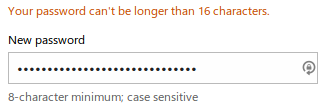
First up we have Live.com. A maximum of 16 characters from the Microsoft auth service. Seems to accept any character though.
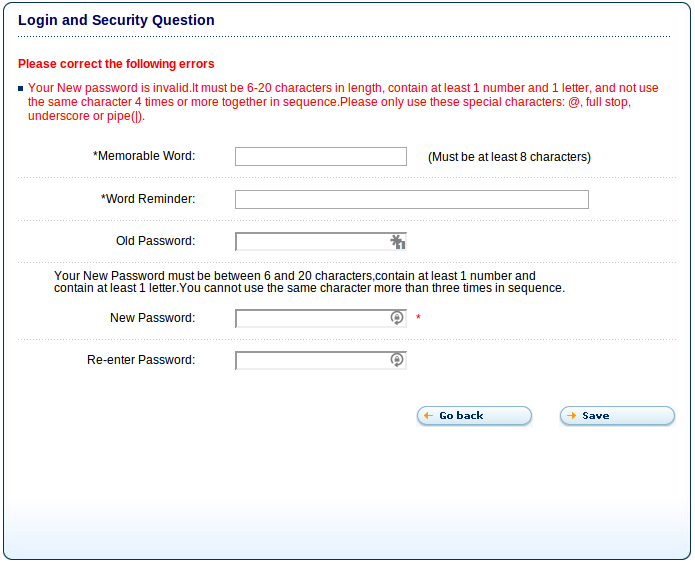
 This excellent example is from creditexpert.co.uk, one of the credit agencies here in the UK. They not only restrict to 20 characters, they restrict you to @, ., _ or . So much for teaching people how to protect themselves online.
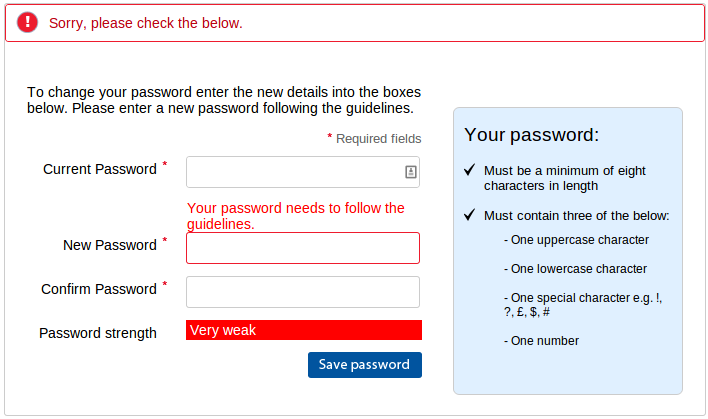
 Here s Tesco.com after attempting to change my password to QvHn#9#kDD%cdPAQ4&b&ACb4x%48#b . If you can figure out how this violates their rules, I d love to know. And before you ask, I tried without numbers and that still failed so it can t be the three and only three thing. The only other idea might be that they meant i.e. rather than e.g. , but I didn t test that.
 Edit: Here is a response from Tesco on Twitter:
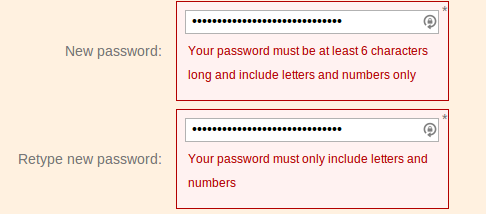
 Here s a poor choice from ft.com, refusing to accept non-alphanumeric characters. On the plus side they did allow the full 30 characters in the password.
 The finest example of a poor security policy is a company who will remain nameless due to their utter lack of security. Not only did they not use HTTPS, they accepted a 30 character password and silently truncated it to 20 characters. The reason I know this is because when I logged out and tried to log in again and then used the forgot my password option, they emailed me the password in plain text.
I have also been setting up two-factor authentication where possible. Most sites use the Google Authenticator application on your mobile to give you a 6 digit code to type in in addition to your password. I highly recommend you set it up too. There s a useful list of sites that implement 2FA and links to their documentation at http://twofactorauth.org/.
I realise that my choice LastPass requires me to trust them, but I think the advantages outweigh the disadvantages of having many sites using the same passwords and/or low strength passwords. I know various people cleverer than me have looked into their system and failed to find any obvious flaws.
Remember people, when you implement a password, allow the following things:
 We had some requests to get GHC (the Glasgow Haskell Compiler) up and running on two new Ubuntu architectures: arm64, added in 13.10, and ppc64el, added in 14.04. This has been something of a saga, and has involved rather more late-night hacking than is probably good for me.
Book the First: Recalled to a life of strange build systems
You might not know it from the sheer bulk of uploads I do sometimes, but I actually don't speak a word of Haskell and it's not very high up my list of things to learn. But I am a pretty experienced build engineer, and I enjoy porting things to new architectures: I'm firmly of the belief that breadth of architecture support is a good way to shake out certain categories of issues in code, that it's worth doing aggressively across an entire distribution, and that, even if you don't think you need something now, new requirements have a habit of coming along when you least expect them and you might as well be prepared in advance. Furthermore, it annoys me when we have excessive noise in our build failure and proposed-migration output and I often put bits and pieces of spare time into gardening miscellaneous problems there, and at one point there was a lot of Haskell stuff on the list and it got a bit annoying to have to keep sending patches rather than just fixing things myself, and ... well, I ended up as probably the only non-Haskell-programmer on the Debian Haskell team and found myself fixing problems there in my free time. Life is a bit weird sometimes.
Bootstrapping packages on a new architecture is a bit of a black art that only a fairly small number of relatively bitter and twisted people know very much about. Doing it in Ubuntu is specifically painful because we've always forbidden direct binary uploads: all binaries have to come from a build daemon. Compilers in particular often tend to be written in the language they compile, and it's not uncommon for them to build-depend on themselves: that is, you need a previous version of the compiler to build the compiler, stretching back to the dawn of time where somebody put things together with a big magnet or something. So how do you get started on a new architecture? Well, what we do in this case is we construct a binary somehow (usually involving cross-compilation) and insert it as a build-dependency for a proper build in Launchpad. The ability to do this is restricted to a small group of Canonical employees, partly because it's very easy to make mistakes and partly because things like the classic "Reflections on Trusting Trust" are in the backs of our minds somewhere. We have an iron rule for our own sanity that the injected build-dependencies must themselves have been built from the unmodified source package in Ubuntu, although there can be source modifications further back in the chain. Fortunately, we don't need to do this very often, but it does mean that as somebody who can do it I feel an obligation to try and unblock other people where I can.
As far as constructing those build-dependencies goes, sometimes we look for binaries built by other distributions (particularly Debian), and that's pretty straightforward. In this case, though, these two architectures are pretty new and the Debian ports are only just getting going, and as far as I can tell none of the other distributions with active arm64 or ppc64el ports (or trivial name variants) has got as far as porting GHC yet. Well, OK. This was somewhere around the Christmas holidays and I had some time. Muggins here cracks his knuckles and decides to have a go at bootstrapping it from scratch. It can't be that hard, right? Not to mention that it was a blocker for over 600 entries on that build failure list I mentioned, which is definitely enough to make me sit up and take notice; we'd even had the odd customer request for it.
Several attempts later and I was starting to doubt my sanity, not least for trying in the first place. We ship GHC 7.6, and upgrading to 7.8 is not a project I'd like to tackle until the much more experienced Haskell folks in Debian have switched to it in unstable. The porting documentation for 7.6 has bitrotted more or less beyond usability, and the corresponding documentation for 7.8 really isn't backportable to 7.6. I tried building 7.8 for ppc64el anyway, picking that on the basis that we had quicker hardware for it and didn't seem likely to be particularly more arduous than arm64 (ho ho), and I even got to the point of having a cross-built stage2 compiler (stage1, in the cross-building case, is a GHC binary that runs on your starting architecture and generates code for your target architecture) that I could copy over to a ppc64el box and try to use as the base for a fully-native build, but it segfaulted incomprehensibly just after spawning any child process. Compilers tend to do rather a lot, especially when they're built to use GCC to generate object code, so this was a pretty serious problem, and it resisted analysis. I poked at it for a while but didn't get anywhere, and I had other things to do so declared it a write-off and gave up.
Book the Second: The golden thread of progress
In March, another mailing list conversation prodded me into finding a blog entry by Karel Gardas on building GHC for arm64. This was enough to be worth another look, and indeed it turned out that (with some help from Karel in private mail) I was able to cross-build a compiler that actually worked and could be used to run a fully-native build that also worked. Of course this was 7.8, since as I mentioned cross-building 7.6 is unrealistically difficult unless you're considerably more of an expert on GHC's labyrinthine build system than I am. OK, no problem, right? Getting a GHC at all is the hard bit, and 7.8 must be at least as capable as 7.6, so it should be able to build 7.6 easily enough ...
Not so much. What I'd missed here was that compiler engineers generally only care very much about building the compiler with older versions of itself, and if the language in question has any kind of deprecation cycle then the compiler itself is likely to be behind on various things compared to more typical code since it has to be buildable with older versions. This means that the removal of some deprecated interfaces from 7.8 posed a problem, as did some changes in certain primops that had gained an associated compatibility layer in 7.8 but nobody had gone back to put the corresponding compatibility layer into 7.6. GHC supports running Haskell code through the C preprocessor, and there's a
__GLASGOW_HASKELL__ definition with the compiler's version number, so this was just a slog tracking down changes in git and adding #ifdef-guarded code that coped with the newer compiler (remembering that stage1 will be built with 7.8 and stage2 with stage1, i.e. 7.6, from the same source tree). More inscrutably, GHC has its own packaging system called Cabal which is also used by the compiler build process to determine which subpackages to build and how to link them against each other, and some crucial subpackages weren't being built: it looked like it was stuck on picking versions from "stage0" (i.e. the initial compiler used as an input to the whole process) when it should have been building its own. Eventually I figured out that this was because GHC's use of its packaging system hadn't anticipated this case, and was selecting the higher version of the ghc package itself from stage0 rather than the version it was about to build for itself, and thus never actually tried to build most of the compiler. Editing ghc_stage1_DEPS in ghc/stage1/package-data.mk after its initial generation sorted this out. One late night building round and round in circles for a while until I had something stable, and a Debian source upload to add basic support for the architecture name (and other changes which were a bit over the top in retrospect: I didn't need to touch the embedded copy of libffi, as we build with the system one), and I was able to feed this all into Launchpad and watch the builders munch away very satisfyingly at the Haskell library stack for a while.
This was all interesting, and finally all that work was actually paying off in terms of getting to watch a slew of several hundred build failures vanish from arm64 (the final count was something like 640, I think). The fly in the ointment was that ppc64el was still blocked, as the problem there wasn't building 7.6, it was getting a working 7.8. But now I really did have other much more urgent things to do, so I figured I just wouldn't get to this by release time and stuck it on the figurative shelf.
Book the Third: The track of a bug
Then, last Friday, I cleared out my urgent pile and thought I'd have another quick look. (I get a bit obsessive about things like this that smell of "interesting intellectual puzzle".) slyfox on the #ghc IRC channel gave me some general debugging advice and, particularly usefully, a reduced example program that I could use to debug just the process-spawning problem without having to wade through noise from running the rest of the compiler. I reproduced the same problem there, and then found that the program crashed earlier (in stg_ap_0_fast, part of the run-time system) if I compiled it with +RTS -Da -RTS. I nailed it down to a small enough region of assembly that I could see all of the assembly, the source code, and an intermediate representation or two from the compiler, and then started meditating on what makes ppc64el special.
You see, the vast majority of porting bugs come down to what I might call gross properties of the architecture. You have things like whether it's 32-bit or 64-bit, big-endian or little-endian, whether char is signed or unsigned, that sort of thing. There's a big table on the Debian wiki that handily summarises most of the important ones. Sometimes you have to deal with distribution-specific things like whether GL or GLES is used; often, especially for new variants of existing architectures, you have to cope with foolish configure scripts that think they can guess certain things from the architecture name and get it wrong (assuming that powerpc* means big-endian, for instance). We often have to update config.guess and config.sub, and on ppc64el we have the additional hassle of updating libtool macros too. But I've done a lot of this stuff and I'd accounted for everything I could think of. ppc64el is actually a lot like amd64 in terms of many of these porting-relevant properties, and not even that far off arm64 which I'd just successfully ported GHC to, so I couldn't be dealing with anything particularly obvious. There was some hand-written assembly which certainly could have been problematic, but I'd carefully checked that this wasn't being used by the "unregisterised" (no specialised machine dependencies, so relatively easy to port but not well-optimised) build I was using. A problem around spawning processes suggested a problem with SIGCHLD handling, but I ruled that out by slowing down the first child process that it spawned and using strace to confirm that SIGSEGV was the first signal received. What on earth was the problem?
From some painstaking gdb work, one thing I eventually noticed was that stg_ap_0_fast's local stack appeared to be being corrupted by a function call, specifically a call to the colourfully-named debugBelch. Now, when IBM's toolchain engineers were putting together ppc64el based on ppc64, they took the opportunity to fix a number of problems with their ABI: there's an OpenJDK bug with a handy list of references. One of the things I noticed there was that there were some stack allocation optimisations in the new ABI, which affected functions that don't call any vararg functions and don't call any functions that take enough parameters that some of them have to be passed on the stack rather than in registers. debugBelch takes varargs: hmm. Now, the calling code isn't quite in C as such, but in a related dialect called "Cmm", a variant of C-- (yes, minus), that GHC uses to help bridge the gap between the functional world and its code generation, and which is compiled down to C by GHC. When importing C functions into Cmm, GHC generates prototypes for them, but it doesn't do enough parsing to work out the true prototype; instead, they all just get something like extern StgFunPtr f(void);. In most architectures you can get away with this, because the arguments get passed in the usual calling convention anyway and it all works out, but on ppc64el this means that the caller doesn't generate enough stack space and then the callee tries to save its varargs onto the stack in an area that in fact belongs to the caller, and suddenly everything goes south. Things were starting to make sense.
Now, debugBelch is only used in optional debugging code; but runInteractiveProcess (the function associated with the initial round of failures) takes no fewer than twelve arguments, plenty to force some of them onto the stack. I poked around the GCC patch for this ABI change a bit and determined that it only optimised away the stack allocation if it had a full prototype for all the callees, so I guessed that changing those prototypes to extern StgFunPtr f(); might work: it's still technically wrong, not least because omitting the parameter list is an obsolescent feature in C11, but it's at least just omitting information about the parameter list rather than actively lying about it. I tweaked that and ran the cross-build from scratch again. Lo and behold, suddenly I had a working compiler, and I could go through the same build-7.6-using-7.8 procedure as with arm64, much more quickly this time now that I knew what I was doing. One upstream bug, one Debian upload, and several bootstrapping builds later, and GHC was up and running on another architecture in Launchpad. Success!
Epilogue
There's still more to do. I gather there may be a Google Summer of Code project in Linaro to write proper native code generation for GHC on arm64: this would make things a good deal faster, but also enable GHCi (the interpreter) and Template Haskell, and thus clear quite a few more build failures. Since there's already native code generation for ppc64 in GHC, getting it going for ppc64el would probably only be a couple of days' work at this point. But these are niceties by comparison, and I'm more than happy with what I got working for 14.04.
The upshot of all of this is that I may be the first non-Haskell-programmer to ever port GHC to two entirely new architectures. I'm not sure if I gain much from that personally aside from a lot of lost sleep and being considered extremely strange. It has, however, been by far the most challenging set of packages I've ported, and a fascinating trip through some odd corners of build systems and undefined behaviour that I don't normally need to touch.
git add foo
git annex add bar
git annex sync
# move to different location with different remotes available
git add quux
git annex add quuux
git annex sync
git annex sync's automagic commit feature (which you
can not disable, it seems) doing its job: Commit what was added
earlier and use "git-annex automatic sync" as commit message.
This is not a problem in and as of itself, but as this is my my
master annex and as I managed to maintain clean commit messages for
the last few years, I felt the need to clean this mess up.
Changing old commit messages is easy:
git rebase --interactive HEAD~3
r option for "reword" and amend the two
commit messages. I did the same on my remote and all the branches I
could find with git branch -a. Problem is, git-annex
pulls in changes from refs which are not shown as branches; run
git annex sync and back are the old commits along with
a merge commit like an ugly cherry on top. Blegh.
I decided to leave my comfort zone and ended up with the
following:
# always back up before poking refs
git clone --mirror repo backup
git reset --hard 1234
git show-ref   grep master
# for every ref returned, do:
  git update-ref $ref 1234
git annex sync, et
voil . And yes, I avoided using an actual loop on purpose;
sometimes, doing things slowly and by hand just feels safer.
For good measure, I am running
git fsck && git annex fsck
Next.