Search Results: "az"

2 June 2008

Luciano Bello: looking for a sponsor to travel to defcon16

The last weeks have been very active. A lot of e-mails from people and magazines, a lot of congratulations and a lot of free beer made me feel like a rock star :) Thanks a lot to everyone. I really appreciated that.

And maybe this petition would sound you like an abuse of this situation. And maybe you are right.

The fact is, I need an sponsor to travel to Defcon16, in Las Vegas, the next August. I need a flight ticket, 3 or 4 nights in a hotel and 2 meals per day.

I've been accepted to explain the Debian/OpenSSL problem and I'm dying to be there. If you work for a company which is looking for a nice way to say "thank you", please consider this option :)

Contact me at luciano <alt+64> debian.org for more details. Thanks.

update (13 minutes later): I just received confirmation from the Black Hat organization to be an alternative speaker there too! So I will need to fund 5 extra nights... :D

MJ Ray: Please Tell Me How To Do It

[Meeting Room]
(Guess I arrived early.) Dear Reader, I'd like to read any opinions on these three:- 1. when I get new information about a story I've already written about, should I make it a new blog post and/or add it to the old post or something else? For example, I've got new links about the Yahoo's good anti-spam actions which is sort-of linked to last week's spammer registrar post. 2. what should I do with links to sites where I've commented? Should I make a new feed like my bookmarks feed, silently ignore them, or something else? Last time I did a link post, mildly irritated comments followed on one of the planets. 3. Tonight is my first full Kewstoke village council meeting. Main (non-routine) topics include Sand Road Lay-by, Crookes Lane Memorial Seat, the newsletter, replacing the gazebo on the village green, coopting more councillors, completing the Crookes Lane Footpath, the 2007-08 accounts and reviewing the Sand Bay Management Plan. Any comments on any of those?

1 June 2008

Axel Beckert: One month with Debian Lenny on the EeePC

I ogled with an ASUS EeePC since it was announced, but didn’t want to order one abroad. So I waited until they became available in Switzerland. Digitec is the official EeePC importer for Switzerland and seeems also to be the moving power for yet to come the Swiss localisation of the EeePC. But initially they only offered imported EeePCs with German keyboard layout, but since I really got used to the US layout, I didn’t want to buy ay new laptops or keyboards with German layout. When asking them about US layouts they told me they won’t import from the US and that their competitor Steg Computer is importing US models. But I wasn’t comfortable with Steg and EeePCs also were more expensive there, so I hesitated ordering at Steg. So it was quite unexpected for me when US models showed up on digitec’s website. (Interestingly I never received any mail from their advertised EeePC newsletter, not even when they added 2G models t their repertoire.) So at the end of March (and therefore later as most other geeks ;-) I ordered an ASUS EeePC at digitec. For me, white laptops look like Macs (and Macs are for sissies or masochists ;-) — so I had no problems to decide that I want a black EeePC with US keyboard layout. 2G was to small for my purposes (and also not that much cheaper) and 8G not available. So I went with the 4G, since Debian doesn’t need so much space if you choose the right packages (i.e. neither or at least not that much of GNOME or KDE ;-). I preferred the 4G over the 4G Surf because of the bigger battery capacity (and not because of the webcam which I consider funny but useless:-). Initially the delivery date was set the 28th of March. Then it was subsequently set to “beginning of April”, “mid of April”, “end of April” and “beginning of May”. It finally arrived on 8th of May. In the meanwhile there were reports that even the 4G has been equipped with the smaller battery of the 4G Surf because of some battery shortage after some battery plant burnt down. But fortunately the delivery problems with black 4G US models doesn’t seem to have its reason there and my 4G has a 5200 mAh battery (at least according to its label and ACPI). I also ordered a 2 GB bar of Corsair ValueSelect RAM so that I can pump up the RAM of my EeePC by factor four (for about 10% of the price of the EeePC itself) resulting in having half as much RAM as disk space. Well, I guess, I won’t do suspend to disk in that configuration… ;-) The original Xandros based Linux only noticed 1 GB of the installed 2 GB as already noted on many other places in the web. But that doesn’t really matter, since it only lasted until I found out how to restore it from DVD in case I want to sell the EeePC later (e.g. for getting the successor). It’s fine for novices, but Linuxes feel strange if you can’t even get a console or a terminal with a command line. ;-) The Debian EeePC installer worked fine except that it argued over a checksum error on our mirror which wasn’t reproducable after the installation anymore. I’ve chosen the EeePC to be my first (nearly) pure Lenny installation — compared to the three machines running Sid (i386, amd64 and kfreebsd-i386). It though has a few packages from experimental (mostly xulrunner-1.9) installed. As window managers I have installed ratpoison, FLWM and FVWM. ratpoison — best described as screen for X (although you can’t detach and reattach) since it’s my personal preferences for being productive without big screen resolutions and flwm for a low-resource window manager which can be used intuitivly by both, geeks and non-geeks (and still doesn’t look like Windows at all ;-). And FVWM is installed because it’s my default window manager on all machines with bigger or multiple screens – to be able to compare it with my usual environment. As web browser I’ve got Opera as primary browser (as everywhere else, too) and Conkeror (the EeePC is the test-case for upcoming Debian package of Conkeror) as well as links2 and lynx on the (nearly) text-only side on it, although I need them seldomly. As office programs (as I would ever need some ;-) I’ve got AbiWord and Gnumeric installed since I already use a few GNOME applications (e.g. Network Manager, Twitux, etc.) and OpenOffice.org would take up 170 MB more disk space (then including OOo Draw and OOo Impress) and Siag Office is no more in Debian since years. (Initially I had OpenOffice.org installed instead of AbiWord and Gnumeric until I noticed that I need some of the GNOME libraries anyway.) I also decided that I will need LaTeX then and when so TeX Live also got its chunk of the 4 GB of disk space. I also have a bunch of games on the EeePC. Unfortunately there are a few games which don’t work well on the EeePC due to it’s resolution being smaller than 800x600, so I deinstalled them already again, e.g. I can’t play Cuyo on the EeePC but flobopuyo. Sauerbraten segfaults, but Doom (prboom with freedoom WADs) works fine. Further non-working games unfortunately include Battle of Wesnoth and XFrisk. Still, although quite some parts of GNOME and GNOME Office, TeX Live, ScummVM with Flight of the Amazon Queen and Beneath a Steel Sky, GNU Emacs 22, Iceweasel 3 (aka Mozilla Firefox 3), Icedove (aka Mozilla Thunderbird) and the Iceowl (aka Mozilla Sunbird) are installed, only 2.3 GB of the available hard disk space are used by the installation (i.e. without my home directory). Oh, and btw: Although except the very compact and a little bit wobbly keyboard the EeePC doesn’t feel really small to me (I’ve got quite small hands), but when I sat down in front of my 14” ThinkPad T61 after a day or two with EeePC, the T61, — especially screen and keyboard — felt huge as if it would be some 17” or even bigger notebook. ;-)
ThinkPad vs EeePC ThinkPad vs EeePC ThinkPad vs EeePC ThinkPad vs EeePC
OTOH I still think that a 1920×1200 (which means nearly four xterms in a row) resolution on a 14” notebook would be a good idea, especially compared to the 1440×900 (which means nearly three xterms in a row) my T61 has. ;-) Personal Resumée after one month Pro EeePCContra EeePCPro ThinkPad (in direct comparision)Pro Lenny on the EeePCCon Lenny on the EeePCSummary I’m very happy with the EeePC and I didn’t expect that it would replace my 14” ThinkPad in so many (but still not all) situations. :-)

Russell Coker: Shelf-life of Hardware

Recently I’ve been having some problems with hardware dying. Having one item mysteriously fail is something that happens periodically, but having multiple items fail in a small amount of time is a concern. One problem I’ve had is with CD-ROM drives. I keep a pile of known good CD-ROM drives because as they have moving parts they periodically break and I often buy second-hand PCs with broken drives. On each of the last two occasions when I needed a CD-ROM drive I had to try several drives before I found one that worked. It appears that over the course of about a year of sitting on a shelf I have had four CD-ROM drives spontaneously die. I expect drives to die if they are used a lot from mechanical wear, I also expect them to die over time as the system cooling fans suck air through them and dust gets caught. I don’t expect them to stop working when stored in a nice dry room. I wonder whether I would find more dead drives if I tested all my CD and DVD drives or whether my practice of using the oldest drives for machines that I’m going to give away caused me to select the drives that were most likely to die. Today I had a problem with hard drives. I needed to test a Xen configuration for a client so I took two 20G disks from my pile of spare disks (which were only added to the pile after being tested). Normally I wouldn’t use a RAID-1 configuration for a test machine unless I was actually testing the RAID functionality, it was only the possibility that the client might want to borrow the machine that made me do it. But it was fortunate as one of the disks died a couple of hours later (just long enough to load all the data on the machine). Yay! RAID saved me losing my work! Then I made a mistake that I wouldn’t make on a real server (I only got lazy because it was a test machine and I didn’t have much risk). I had decided to instead make it a RAID-1 of 30G disks and to save some inconvenience I transfered the LVM from the degraded RAID on the old drive to a degraded RAID on a new disk. I was using a desktop machine and it wasn’t designed for three hard disks so it was easier to transfer the data in a way that doesn’t need to have more than two disks in the machine at any time. Then the new disk died as soon as I had finished moving the LVM data. I could have probably recovered that from the LVM backup data and even if that hadn’t worked I had only created a few LVs and they were contiguous so I could have worked out where the data was. Instead however I decided to cut my losses and reinstall it all. The ironic thing is that I had planned to make a backup of the data in question (so I would have copies of it on two disks in the RAID-1 and another separate disk), but I had a disk die before I got a chance to make a backup. Having two disks out of the four I selected die today is quite a bad result. I’m sure that some people would suggest simply buying newer parts. But I’m not convinced that a disk manufactured in 2007 would survive being kept on a shelf for a year any better than a disk manufactured in 2001. In fact there is some evidence that the failure rates are highest when a disk is new. Apart from stiction I wouldn’t expect drives to cease working from not being used, I would expect drives to last longer if not used. But my rate of losing disks in running machines is minute. Does anyone know of any research into disks dying while on the shelf?

31 May 2008

Bastian Venthur: Linuxtag 2008

Linuxtag 2008 is over. Like last year’s Linuxtag, it was a very nice event. We had a lot of visitors, answered a lot more questions and sold many t-shirts, posters and stickers at our eee-pc *cough* Debian booth. It was also very nice to meet some other people from Debian — one of the rare moments in life where I can feel really young again… sorry guys :P Of course there were many interesting talks and booths from other projects at this year’s Linuxtag. After Nico’s and my yearly Linuxtag raid, I had like a dozen different ball pens, a t-shirt, a handful of cookies, and many many gummy bears. Unlike last year, this year we had no Debian Day — but guess who showed up at our booth yesterday: Ian Murdock and Bastian Venthur at Linuxtag 2008 that’s right, Ian Murdock himself! I was so nervous to meet him, that I almost forgot to ask for a picture. Apropos showing up at our booth: although we where fairly good manned at our booth, we felt that a few more helpers wouldn’t have hurt. We (the staff from this year’s Debian booth) just want to say, that you don’t have to be a Debian Developer / Maintainer or whatever to help at our booth. If you’re an enthusiastic Debian user and can spare some time, you’re very welcome. The tickets for the staff are usually free, so don’t hesitate to ask if you can help next year!

30 May 2008

Craig Sanders: I m sick of all the whinging about petrol prices

Really, who cares? 1. How much petrol do people actually use, anyway? People whinge and bitch and moan about petrol going up a few cents, and queue up for ages to try to buy petrol at the low point of the weekly price cycle - and for what? A tank will hold less than 100 litres. Typically around 50, but let’s say it’s 100 litres. That means that a price difference of 1 cent is worth a whole $1.00. A price difference of 5 cents is a measly $5.00, less than the price of a cheap bought lunch. For the average driver, they’ll buy 100 litres once or maybe twice per week. Who gives a damn? If $1.00 or even $5.00 makes such a difference to someone’s budget then they’re in serious financial trouble anyway - so much trouble that they shouldn’t even think about having a car, because they can’t afford it. Here’s a novel thought: they could drive less, make their kids walk to school, catch public transport, ride a bike, walk to the milkbar rather than drive, make sandwiches to take to work/school, and so on. They could also buy less of the worthless crap they buy (like biscuits and cakes and bottles of coke and other rubbish). There are thousands of things people could do so that they don’t have to give a damn about a few cents per litre. Even better, if people reduce demand enough, they can seriously hurt the speculator bastards who have driven oil prices up so much in recent months….at least a quarter of the current price per barrel of oil is due to commodity speculators driving the price up. Hit the bastards where it hurts, drop demand so much that they lose serious money. If the price of petrol bothers you, don’t whinge, get revenge. Actually, I’m entirely unconvinced that the general public actually care all that much about petrol prices anyway. It looks and feels much more like an astro-turfing campaign by the oil companies and petrol distributors - especially the recent crap about reducing the excise by 5c/litre, anyone can see that if the government does that the petrol companies will, within weeks, increase prices so that THEY get the 5c/litre rather than the government, resulting in yet another transfer of wealth from the public purse to private corporations. Same for all the bullshit about the fuel price watch program - it’s obvious that the opposition to that comes directly from the petrol companies who don’t want buyers to have good information to base their purchasing decisions on. It’s also a useful distraction and pretend-debate for the government and the opposition - they can rant and rave and score points over a trivial, bullshit non-issue like this, and nobody will notice that nothing of any real substance or worth ever gets debated in parliament…and the media are either colluding in this or are too stupid to avoid getting sucked in. 2. We have the fourth-cheapest petrol in the world. So all this moaning is not about petrol being more expensive than it should be, it’s about not being quite as unreasonably privileged as we were in the past. 3. Oil prices are *inevitably* going up, they’re *never* coming back down. Get used to it, it’s only going to get worse from here - much worse. Instead of endlessly whining about the inevitable, focus on alternatives - like *DEMANDING* that the government start paying more than just empty tokenistic lip-service to the idea of alternative/renewable energy sources. 4. IMO, the sooner petrol hits $5.00 per litre or more, the better. By then we’ll really have to have functional alternative energy sources in place. Because if we don’t, we’re completely screwed. Syndicated from Craig Sanders' Errata: Tech Notes and Miscellaneous Thoughts I’m sick of all the whinging about petrol prices

28 May 2008

Dann Frazier: Retrieving a NIC's permanent address

I needed to query a card to get its permanent mac address (the value programmed into the card, even if the admin has ifconfig'd it differently). This can be done with the linux kernel's ethtool API, but the ethtool command doesn't currently support it and google didn't know how either. I had to figure it out myself. Now google, you no longer have an excuse - I expect you to know next time I ask.

27 May 2008

Christian Perrier: Reading blog summary

During the last 4 days, I didn't read Planet. So I started an interesting exercise and wanted to comment very briefly on a few entries I just read quickly to catch up. My Planet premium, so to say..

Raphael Geissert: zsh fun...

from gettext.sh (gettext-base:0.17-2):
# zsh is not POSIX compliant: By default, while ". gettext.sh" is executed,
# it sets $0 to "gettext.sh", defeating the purpose of this test. But
# fortunately we know that when running under zsh, this script is always
# being sourced, not executed, because hardly anyone is crazy enough to
# install zsh as /bin/sh.

:)

Michal &#268;iha&#345;: My cycle computer got crazy

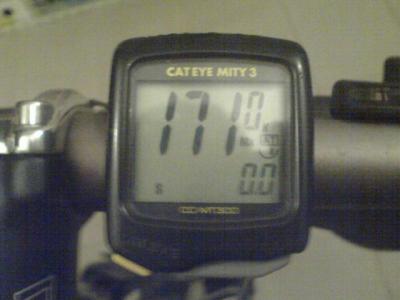
After today short ride, I just wanted to look at how fast I was (well rather slow as my body is slowly getting used to usual travel distances). There was nothing surprising in most values, but maximal speed did really impress me: 171 km/h on bicycle I just hope that it is really mistake of the computer and I did not really go that fast at some point ;-).

Joachim Breitner: My first OpenStreetMap Contribution

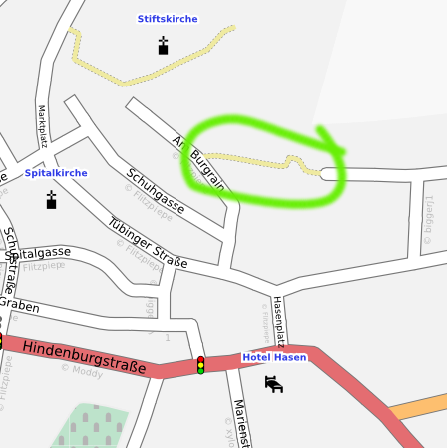
Yesterday I was visiting the Open Source Expo Karlsruhe, a new, quite small conference, at which the guys from OpenStreetMap hat a booth. I was amazed by the progress of OpenStreetMap while I wasn t looking (which is just a few months, I guess); their level of detail in some places like Karlsruhe is astonishing.Anyways, I got hooked and started to try out some of the tools and websites and finally, by tracing the Yahoo satellite image, added my first way to the map: A small footpath in Herrenberg that I know quite well:
The live data can also be seen on the OpenStreetMap map, of course.Unfortunately, there is not much to map around where I live in Karlsruhe, even the driveway to my dorm is included, but maybe I can do some proper mapping (with a GPS device) in Herrenberg someday.

26 May 2008

Chris Lawrence: The use and abuse of technology in the classroom

Michelle’s post‡ today on laptops in the classroom (in a similar vein to this article I read last month on the suggestion of Glenn Reynolds) reminded me that I had a few items from the past few weeks still in my Google Reader queue of “things to blog about” related to Margaret Soltan’s continuing crusade against the use of PowerPoint* and its ilk, and specifically Timothy Burke’s partial rebuttal:
What’s the difference between bad usage of PowerPoint in lectures and bad lectures that involve hand-outs, overhead transparencies and writing on the chalkboard? Are we just complaining about old wine in new bottles here? Is the real culprit professorial droning at classrooms of 200+ students followed by recite-repeat-and-forget examinations? I think it’s at least plausible that the technology is just giving us a new reason to pay attention to a pedagogy whose effectiveness has been suspect for two generations.
I dare say I’m among the last doctoral students who was “trained”—and I use that word loosely—to teach prior to the widespread use of PowerPoint. Four years of full-time in-classroom experience, mostly with small lectures and seminars, has brought me basically to agreement with Burke on this point—complaints about PowerPoint essentially boil down to complaints about either instructional laziness or the whole nature of lecturing, or as a Burke commenter puts it, ”[e]xactly how does one teach even 80† students at once without succumbing to passive data transfer?” The non-use of PowerPoint or some other form of instructional technology seems to me to be a luxury confined to those who only teach small seminars and graduate students, and while my personal career aspirations lean in that direction the reality is that I’m several years away (in terms of research productivity) from being there—if I ever get there. Burke in his comments hits the nail on the head, I think, when it comes to any sort of visual presentation in class:
It seems to me that the absolutely key thing is to avoid speaking the slides literally. They’re best as definitions, key concepts, images: the kind of thing you’d stop your flow of lecturing to write on the chalkboard. They’re not the lecture itself.
I think there are three useful aspects to a lecture: what you put on the board (or slides), what you say, and the general outline. If you’re preparing a handout or something to stick on Blackboard for students, the outline or outline-plus-slides is what they need, along with space to fill in the gaps. An alternative approach is to make the slides/board material the outline; several of the more effective teachers I had (my high school history teacher and a political science professor at Rose-Hulman) took that approach. But you can’t shovel your script into PowerPoint and expect that to work well, any more than you’d expect that writing it up on the board, or for that matter reading a paper verbatim at a conference would be a good presentation, to work. All this discussion leaves aside the question of teaching anything that involves symbols (chemistry, mathematics, statistics) which I think requires a different approach than bullet-points. In class, mathematics and statistics (and, by extension, social science research methods courses) lend themselves to a combination of “passive” PowerPoint-style presentation and more spontaneous problem-solving and brainstorming; for example, one of my early activities is to have the class try to operationalize (define in terms of a measurable quantity or quality) a concept like “globalization,” which you can’t really do with a static slideshow even though you can define terms like “operationalization” that way. Similarly, while you can step through the process of solving a problem in a slideshow I think it’s more effective to demonstrate how to step through the process on the board. Unfortunately, many classrooms aren’t set up to allow you to present and use a board simultaneously; some of TAMIU‘s lecture halls have a nice design where the projection screen is above the board, so you can write on the board without having to do anything special with the slideshow, but rooms most places are designed for “either-or” which can be a real pain—fiddle with the control system to blank the screen, raise the screen, write on the board, then lower the screen, switch the screen back on. After a few iterations of that in a single class, you’ll never do it again. I freely admit I haven’t figured everything out yet; my current methods slides are pretty good lecture notes but pretty rotten for projection. One of my projects for this summer (postponed from last summer after I learned I wouldn’t be teaching any methods courses this year) is to work on my research methods lectures to incorporate advice from Andrew Gelman’s book so I can lay the groundwork for my plot to take over the world effort to produce a workable, but rigorous, methods curriculum at both the undergraduate and master’s levels for political science, sociology, and (at the grad level) public administration. More on this theme from Laura at 11D, who takes note of some of the more positive technological developments associated with academe. And, another of Burke’s commenters links this hilarious example of what not to do with your slides.

* I use “PowerPoint” as shorthand for the use of a computer-projector based slideshow-style sequential presentation of items associated with a lecture, a technique obviously made famous by the Microsoft software package but also available with many other software packages such as Apple’s Keynote, OpenOffice.org Impress, and several PDF viewers including Adobe Reader, xpdf, and GNOME‘s Evince.
† I’d put the cutoff significantly lower, at around 30–40 students. Beyond that point, one might as well just blow the cap off the class.
‡ By the way, it’s nice to see Michelle’s blog back from haïtus! (Where else would I keep up with current Mexican politics?)

25 May 2008

Axel Beckert: Google Open Source Jam and Webtuesday Hackday

I was at two geek events in Zurich this week: At the Google Open Source Jam Zurich on Thursday evening and at the first Webtuesday Hackday on Saturday. Somehow I expected both events to be quite similar, but they weren’t. Google Open Source Jam When I read “Jam” or “Jam Session” I think of Jazz musicians spontaneously playing together. So for me “Open Source Jam” sounded like a hack session where some spontaneous coding is done. But there was no spontaneous collaboration at Open Source Jam at all. It’s just (more or less spontaneous) talks about different topics and chatting. So I was quite disappointed from that event. There were though quite a lot of people I knew from e.g. Webtuesday, Chaostreff or Debian. I even met some people I just knew from IRC until then. Half of the talks were sole propaganda talks though, e.g. for Webtuesday Hackday, OpenExpo and Soaring as a geek sport. Not really wrongly placed talks, but not what I expected in talks at Open Source Jam. The few rooms and floors I saw reminded me very much to IKEA Children’s Paradies, just even more motley. Though it felt all sterile and wasn’t by far as cool as I expected after what I read elsewhere of Google offices. I also think that several of the Google employees showed some contrived friendlyness, and questions I asked e.g. why I have to give them my e-mail address and employer’s name (what do unemployed or self-employed people do?) got answered with answers I do not really believe – like “for security”. A leopard doesn’t change its spots. A data squid probably neither, even not at events labeled with OSS and said to be for the community. I suspect that finding new employees is one of the reasons behind such events at Google. But after my first visit at one of their locations, this company still makes me feel uncomfortable. And I’m even more sure than before that I wouldn’t want to work there. Not sure if I’ll attend the Google Open Source Jam a second time. Webtuesday Hackday Webtuesday Hackday also was not as I expected, but still more close to my expectations: the Webtuesday crowd gathers for hacking instead of having long talks. :-) There were surprisingly many people from outside Zurich, from Munich and Belgium, from Lake Constance and Lausaunne – not only the usual suspects (who were there anyway ;-). The event took place at Liip’s new office. They still look a little bit empty and steril, but all the toys (mini rugby balls, Wii, plush figures on floor lamps) and people around made them very alive. And they had very cool lamps in the form of their company logo in the office. They sure have a good interior designer. :-) Although most participants found time to do some hacking, many found less time than they expected so we hope that we can glue the talks a little bit more together in regards of timing to cause less interruptions of the hacking. The food was also better at Hackday, too, but mostly because we ate outside. ;-) For lunch we were at Lily’s Stomach Supply at Langstrasse (very recommendable!) and in 6he evening we were at Pizzeria Grottino 79 near Helvetiaplatz. Had a Pizza Vesuvio with Gruyère cheese there. Hackday also had a surprise for me: The IRC channel at Hackday was but when I entered the channel there were someone in I didn’t expect there: tklauser aka Tobias Klauser aka tuxedo. Even more surprising, he read about my project idea for Hackday – a semantic feed cache proxy – and liked it, so he decided to come over to Zurich and join the project. We didn’t came that far until Tobias had to leave again, but the progamming language and partially also libraries had been nailed: Ruby and it’s WEBrick framework. After the Hackday I worked on it a few more hours and it now already saves feeds to a cache. The Mercurial repository is at http://noone.org/hg/sfc-proxy. There were several reasons which spoke for using Ruby instead of Perl (my favourite progamming language and the one I’m most experienced in): Ruby brings HTTP and RSS support already in it’s standard classes and Tobias is more experienced in Ruby than Perl. I started to learn Ruby a few years ago to look beyond my own nose and to get my hands dirty on some object-oriented and nice programming language, but I hadn’t found an appropriate project until now, so this was one more reason to not do it in Perl. I also worked on my Debian package of Conkeror during Hackday. It’s already usable and I now use Conkeror as primary web browser on my EeePC, but e.g. the man page is still missing. As soon as I have the minimum in necessary documentation ready I’ll let it upload to Debian Experimental (since its dependency XULRunner 1.9 is also only in Debian Experimental yet). The Mercurial repository for the Debian packaging of Conkeror is at http://noone.org/hg/conkeror/debian Those who were still at Hackday in the evening decided that the Webtuesday Hackday should become a regular institution and should take place approximately every two months, but stay a one day event (for now). I already look forward to the next Webtuesday Hackday.

24 May 2008

John Goerzen: How to Start Bicycling to Work

Yesterday, I wrote about bicycling to work, pointing out that it's a safe, inexpensive, way for many people (including office workers without access to showers) to get to work. There were a lot of thoughtful comments there too.

Today I'd like to provide some tips for getting started commuting on a bicycle. As I'm just getting started on this, these are mainly things I've learned from poking around online, so I'll be including lots of links.

The Bicycle

This varies from person to person, but as a general rule: if you have a very short ride -- say a mile or less -- you can probably just use any old bike and a bicycling helmet. Don't try to use a motorcycle helmet. It won't vent your head, so you could overheat. Also, it won't be comfortable.

Most people will have a longer ride and will want to get a bike that works specifically for them. Each model of bicycle comes in different frame sizes. It's important to get a bicycle that is the right size for you. Also, you'll want to get a quality bicycle that will let you be fast and won't break down along the way.

For all these reasons, I -- and every single other person I've ever seen talk about this -- highly recommend that you buy your bicycle from a bicycle shop. Don't buy a bicycle from a "big box" store like Walmart or Target. They may be cheaper up front, but you'll pay for it in the long run because they won't last as long, won't fit you as well, and may even be unsafe. Bike shop staff will help you find a bike that fits you, which is important for avoiding aches and pains and even injury. They'll be able to help you find appropriate accessories for your bike, as well as repair it. Here is a helpful article on this topic, written by a bike shop.

Generally speaking, bike shops can repair bikes bought at any other bike shops. However, they can instantly recognize bikes bought at big box stores. Many will repair those too, but some refuse to work on some of those bikes on the grounds that it is impossible to bring them to the level of service they expect their mechanics to do.

Aches and Pains

With any sport, when you start it, you can expect a little bit of aches and pains at first, as you start using muscles that you may not have really used at first. Bicycling is no exception, but it's easy to deal with.

Your first stop if you have aches and pains might be the where does it hurt page. It provides detailed, helpful advice. There are also some common things that go wrong for people.

First on the list is wrong size of bike or improper adjustment of your bike. You want a bike frame that is the right size for you, and you want the seat and handlebars adjusted properly for you. A bike shop can help you get this done easily. If your feet can reach the ground while you're on the seat, you almost certainly have the seat too low, which is a common mistake.

Sometimes the way you position yourself on the bike, or your technique, could be to blame.

Also, clothing can be a problem. A good place to start here is with some cycling shorts. Another common complaint from new cyclists appears to be blisters on the feet. This can be caused by improper positioning on the pedals, or by using the wrong type of sock. Typical socks absorb moisture and trap it next to the skin; bicycling socks will wick it away and let it evaporate. In fact, cycling clothes: socks, shorts, and jerseys (shirts) are all designed to wick moisture away from you and let it evaporate, which keeps you cooler and more comfortable. Bicycling gloves are cheap and can help your hands stay comfortable.

Expense

You can easily save thousands of dollars by riding a bicycle instead of driving a car. Bicycles do need periodic maintenance, just like a car. Usually you can do a lot of that yourself. It probably will pay off to take your bike in to the shop for an annual tuneup. If you have no bicycling equipment at all, and buy your equipment at a bike shop new, you can probably get started for around $500. Even that will probably pay for itself in less than a year if you average riding your bike at least a few times a week.

Safety

Safety on a bicycle can usually be summed up with three rules: be visible, be predictable, and ride with traffic.

Unless there are dedicated bicycle-only lanes or paths, the safest way (in the United States) to ride your bike is on the road, riding with traffic (acting like a car). Don't ride on a sidewalk, and never ride against traffic. This may sound counter-intuitive, but it is backed up by solid research. It all has to do with being predictable. Nobody is looking for something the speed of a bicycle to emerge from a sidewalk to cross a road or driveway. Sidewalks often aren't that visible and frequently don't provide enough room to pass. Sidewalk-riding cyclists get into accidents all the time with cars backing pulling out of driveways, making turns, or even just driving down a road where the cyclist cuts in front of them to cross a street.

A great book for learning how to ride in traffic can be viewed free online: the Bicycling Street Smarts book. There are also some safety videos online that are helpful.

Staying visible is certainly important. In some places, like cities where cyclists are common, drivers are going to be on the lookout for you already. In my case, I'm riding on rural roads that have some hills, where cyclists are rare, so I'm putting extra effort into this.

Staying visible in the day or at night starts with high-visibility clothing. A "screaming yellow" jersey or an ANSI safety reflective vest (less than $10) are good ways to do that. Several people recommend a Cateye TL-LD1100 flashing tail light for use at night, or even for daytime use when visibility is critical (such as my situation). If you will ever ride at night, laws require you to have the proper reflectors on your bike. And, you must also have a white headlight that does not cover up your front reflector (in some locations, you may also be required to have a red tail light that doesn't cover up your reflector). Companies like Cateye carry those products as well.

Other tips: avoid drainage covers; they sometimes have slats that a bicycle tire could fall into.

Accessories

Here are some suggestions you might consider as a commuter.

Start with pannier bags. They mount over your rear tire and are cooler for you than a backpack because your back can still breathe. They're more aerodynamic than a front basket. You can get bags suitable for carrying papers, laptops, a change of clothes, etc.

Next on your list might be a bicycle lock, to help keep it from being stolen. Your local bike shop can make suggestions here.

You might want to consider a spare inner tube (about $5) and tire-changing tools (also about $5) to carry with you in your bag. You wouldn't want to have to walk 5 miles if you get a flat.

Along with that goes an air pump. I suggest a frame pump -- it's a small pump that can clip on to your bicycle's frame, so you always have it handy. Obviously you will need this if you have to change a tube, but it could be handy even if you don't.

You can find some more suggestions from bicycling.about.com and from Mike or your local bike shop.

Where to buy

Besides your local bike shop, you can buy a lot of accessories online. I wouldn't suggest buying a bicycle online, because you really want to get a good fit at a bike shop.

When I asked at bikeforums.net, readers suggested three online stores:

www.pricepoint.com
www.bikenashbar.com
www.performancebike.com

You can also find some bicycling accessories at general-purpose stores like Amazon or sporting goods stores like REI. I personally wouldn't recommend local "big box" sporting goods stores any more than I would Walmart or Target for this stuff, though.

More info

For more information, check out my bicycling links at del.icio.us.

23 May 2008

Axel Beckert: Favourite Linux Desktop Applications

foosel tagged me, whatever that means. Perhaps it’s the English word for “Stöckchen” (German for “small stick”) of which I always wondered how the English blogging part of the blogosphere is calling that kind of coercing blog posts… ;-) So these are the rules:
  1. blog a list with your favorite desktop Linux software (as many or few you want)
  2. add links to the software project’s websites
  3. post these rules
  4. tag three other Linux using bloggers
Interestingly splitbrain, who started the thing just calls it “Meme”, but to me memes are the same thing just without duress. ;-) So you want to know about what Linux desktop software I like and use, hmm? Desktop means GUI, doesn’t it? There are only a few GUI application I really use often since, as you probably know, X is primarily a terminal multiplexer and screen resolutions are compared by how many 80×25 xterms with fixed font you can get on one screen without overlapping. ;-) But to be honest: Although I’m more the command line guy hacking cryptic lines into windows with small fonts, there are a few thing where I don’t want to miss X and the GUI applications: For all things web – that means web browser, feed reader, etc. But then there is also a bunch of GUI software I use occasionally or as alternative tool to some text mode or command line software. WebX / Desktop Environment
  • xtrlock – the simplest tool to lock you desktop: The mouse turns into a lock and it only goes away if you enter the right password. No screen saver included though and everyone can see what’s on your desk. I like it though. Use it on low-end machines.
  • XScreenSaver and Really Slick Screensavers (GLX Port) – Configurable and command controllable screen saver daemon. Favourite modes: GLMatrix and Substrate from XScreenSaver and Lattice Sky Rocket and Hufo’s Smoke from RSS GLX.
  • xosview – my favourite system monitor since more than a decade.
  • TerminalsAudio and VideoEditing and DevelopingGraphicsChatOther ToolsGamesNon-Desktop Applications In case someone wonders about my mail client, Jabber client, IRC client, ICQ client, file manager, notes taking application, shell and versioning system – they’re all command line or text-mode applications: Who’s next? That’s difficult: Hmmm, I think I have to look in a different corner of my circle of friends. Hmm. Ah, now I know: And no, I don’t expect posts as comprehensive as mine. :-)

    Robert Collins: 23 May 2008

    This week I've been at UDS in Prague, and looking at some possible ways to deploy bzr for packaging (which is a hot topic: developers don't want to change workflows without a concrete benefit, and definitely don't want to pay a cost for doing so - e.g. having to have all of history locally just to make a trivial change). One of the discussions inspired a scalability test for bzr - not how we think we'd deploy bzr for Ubuntu developers, just a test to understand how it would scale *if* we did it this way. Lars Wirzenius has a habit of testing VCS systems capabilities in various ways, including importing the Debian/Ubuntu source archive into them. He kindly ran a test using bzr, creating a single shared repository, with one branch in it per source packages. This took a few hours to generate (I'm not sure of the exact figure, we forgot to time it, but it was started in the afternoon and finished in the morning). The resulting repository has 21GB in its .bzr/repository/packs directory, and 500MB in its .bzr/repository/indices directory. There are 30 pack files, the largest of which is 16GB, and the smallest a few hundred kB. In general VCS terms this repository has 16000 heads, 16000 commits (because we didn't import deep archive history). But what about performance? Its currently copying to a machine where I can do some serious benchmarks using this repository. I do have some quick and dirty figures though. To branch a single package (libyanfs-java) from its branch within the repository to a new standalone branch with cold cache took ~5 seconds. Branching again from the repository now the needed data is in page cache took 0.6 seconds. Branching from the newly created branch to another new standalone branch took 0.3 seconds. There is a clear slowdown occuring here. Including startup costs the time to make a new branch is doubled by adding the branch to the repository. However as the repository is 16000 times the size, the scaling factor (2/16000) is pretty darn good. I'm stoked at this result, as I think it demonstrates just what the underlying pack store is capable of. We are working on streamlining the upper layers of bzr to make better and better use of the underlying store. For instance, John Meinel has just done this for 'bzr missing' and 'bzr uncommit'. Now I must go, time for breakfast! Woo!

    22 May 2008

    Biella Coleman: The Craft and Aesthetics of Code

    Someone recently asked me whether it was difficult to fill up my syllabus for my hacker course. I wish. The hard part is actually deciding what to put on as there is too much. This is what I have so far but it will likely change over the summer. I have read a lot of the material but what I most excited about is teaching/reading Richard Sennet’s new book on Craft, which was recently reviewed in depth and in relationship to open source (which Sennet does discuss briefly) by Siva Vaidyanathan in the Chronicle of Higher Education (an article that I co-authored also got some props in the review, which is always nice). The question of what type of activity programming is a complex and deeply interesting one. Its craft-like roots, in part, have to do with the UNIX tradition, something written about humorously by Neal Stephenson and more seriously by other folks like Peter Salus and Chris Kelty in his wonderful rich chapter on UNIX. But craft is not enough to understand coding either. The aesthetics of coding also is a literary affair and the two pieces that capture the aesthetics of code in this light are the following two, also on my syllabus: Black, Maurice
    2002 At the Edge of Language: The Art of Code. (a PhD Dissertation from the Department of English at UPenn) Chopra, Samir and Scott Dexter
    2007 Free Software and the Aesthetics of Code. In Decoding Liberation. I am excited to review this material, as I need to work through my own chapter on software coding, which is less about the aesthetics of code and more about the tension between collaboration and individualism in production (which obviously maps onto questions of craft and aesthetics but is not quite the same thing).

    20 May 2008

    Craig Sanders: Twelve Months

    Twelve months ago, I stopped being a part-time cyborg. Twelve months ago last Sunday (18th May), I had a kidney transplant. It basically gave me my life back, so Sunday was kind of like a birthday. The kidney was donated by my mother, so she not only gave birth to me back in 1967, she gave me my life again last year. The operation went well, recovery was un-problematic, and aside from a few initial difficulties getting used to all the anti-rejection drugs I have to take, my health just keeps getting better and better. And although the twice-daily ‘pill-salad’ I have to take kind of sucks, it sure as hell beats the shit out of spending about 6 hours trapped in a chair (comfy as it was), hooked up to a dialysis machine, three times per week. Dialysis added up to about 20 or 25 hours a week including preparation time and cleaning up afterwards, equivalent to a half-time job for both me and my partner (I dialysed at home, thanks to the dialysis machine and supplies provided by the hospital. I am so glad that I live in a civilised country with a public health system for all. I’d probably be dead if I lived somewhere barbaric like the U.S. where access to decent health care is dependent on your income or wealth) As well as the enormous improvement the transplant has made to my daily life, I’m looking forward to travelling again. Travel was basically impossibly impractical on dialysis. Post-transplant, it’s quite possible as long as I’m careful and take appropriate precautions (the anti-rejection drugs partially suppress my immune system, so I’m at higher risk for catching some infectious diseases) Best of all, the greatest risk of losing a transplanted organ is within the first twelve months - if the transplant survives that long, there’s an excellent chance that it will survive ten or twenty years or more. And I’m hoping that, if I ever need another kidney, in five or ten or twenty years time they’ll be able to grow me one “to order” from my own DNA, so no risk of rejection. Syndicated from Craig Sanders' Errata: Tech Notes and Miscellaneous Thoughts Twelve Months

    Andrew Pollock: [life] Zurich to Prague

    Been rather busy, so I haven't had a chance to continue recording the trip... We got into Zurich (albeit late), without incident. Immigration was the biggest joke ever. There was no paperwork at all, and we just handed our passports to the guy, who just looked at them casually, and waved us through. No stamp, no scan, no nothing. It was a bit disappointing really. We got our rental car, and drove around aimlessly for a bit, until the GPS got lock, and then headed for Prague. We went through Austria, where the guy at the border did give our passports a more thorough inspection, more because we were confused and were waving them at him. He also gave us a stamp. The woman from Hertz told us we needed to buy some sort of highway sticker for the car to drive in Austria (wow it's hard to type "Austria", "Australia" just keeps coming out from muscle memory), so we bought one of them and stuck it on the windscreen, and then promptly entered Germany. The autobahns in Germany are wicked! Everyone's screaming along at a ridiculous pace. The fastest I got up to was 180 km/h. The roads themselves were surprisingly quiet, and only two lanes. We stopped off for dinner somewhere in Germany, and finally arrived at the hotel in Prague at about 1am on Sunday morning, so it took about 7 hours instead of the 6 that we'd estimated. We got to bed by about 2am. I woke up at about 10am, then went back to sleep until about 2pm. We finally ventured out for a bit of exploration at about 3pm on Sunday. One observation about Czechs: they seem like a pretty dour bunch. Here we were wandering around, being all wide-eyed and touristy, smiling at everyone, and they'd just scowl back at you, no matter how hard we tried to get a smile out of them. After that initial wander, we discovered that there was a Metro station right across the road from the hotel in another direction, so we caught that to go and check out Prague Castle. The Metro system is another one of those great subway systems that I love. It ran regularly, so you didn't need to concern yourself with a timetable. The ticketing was a bit bizarre. It seemed totally honor-system based. There were no barriers to stop you getting in or out. It was fairly late by the time we got to Prague Castle, so we just wandered around the grounds, took a look inside Saint Vitus's Cathedral, and caught an orchestral performance in Saint George's Basilica, then headed back to the hotel. Everything at Prague Castle was pretty mind-blowing. The size of grounds. The view. Saint Vitus's Cathedral. The Cathedral was huge. When you stepped inside and looked up... words can't describe it. It was amazing. Unfortunately, we didn't bring a camera with us, so we don't have any photos from the Sunday excursion, but Sarah went back this afternoon, and her photos are here. I think the thing that struck me the most was that here were some seriously old buildings - older than my home country, and they were in amazingly good condition. They really built things to last back in the day. The weather so far has been pretty miserable, and if the forecast is anything to go by, will remain miserable until we drive out on Saturday. We've survived, language-wise. The default language of the hotel staff seems to be English, and most random people we've had to interact with seem to speak English. I feel really arrogant and rude just speaking in English to people without first asking if they speak English, but I'm also getting really sick of starting every conversation with "Do you speak English?" The printed language is by and large indecipherable. The currency, which in English is called a "crown" is crazy. One US dollar buys about 16 Czech Koruny, and the prices are ridiculous. A glass of wine at the hotel is maybe 250 CZK. Granted, the hotel prices are obscene, but seeing triple-digit prices for a glass of wine seems totally bizarre. The prices in general seem pretty steep. Sarah said she got a 2 koruny coin in change today. We've got no idea what you'd actually use that for. Last night, after the conference had finished for the day, we wandered off in a different direction again, and wandered through the grounds of Vy ehrad Castle. The Cathedral of Saint Paul and Peter has an amazing graveyard in it, including the grave of the composer Dvorak. We grabbed some dinner at a nearby restaurant, which was substantially cheaper than the hotel restaurants. Again, we forgot to take a camera with us.
    Next.

    Previous.