Search Results: "agi"

31 July 2010

Aigars Mahinovs: Debcamp 10 the early days

After I finished an re-read my epic post describing my first day and a half at Debconf10 I suddenly realised that if I continue to describe the rest of 13 days here in such style and verbosity this would become a book, a boring one at that, so I decided to limit myself to 2 posts for Debcamp and then a post a day for the Debconf. But about the first half of the Debcamp week there are things that are as usual and there are things that are not. Let s start with the usual bits: more people arriving every day, evening parties are getting more and more fun and wild (or so people say) and the Internet and power at the hacklabs magically becomes more and more reliable day by day, the cabling mess grows organically trying to spread out evenly and not overload any individual socket, extension cords with non-local plugs appear and spread the load some more, people stress out, volunteer, crash out and repeat. All in all nothing can stop the freight train of few hundred Debian developers determined to have fun. With out own DFSG-free definition of fun. (But this year we appear to be running very close to the edge on volunteers if we run out of those, there will be a train-wreck, so please volunteer!) Now off to the unusual stuff. The City is well it is cool and very, very impressive. It is not terribly different to me at least I am used to such structure of the city: grid based layout of the downtown city (with some parks) and then branching out to separate, but different across-the-river districts and then sprawling out to slightly chaotic suburbs. Riga is very much like New York in the design. The difference is that New York is 10-20 times larger: the areas are 10 times larger, the buildings are 3-4 times higher on average, the streets are 2-3 times wider and yet have more traffic and there are far, far more shops, shows and restaurants. Also there is the subway. It is a great thing in that it hides the size of the city take a bus downtown once, to find out what I mean it takes ages to drive the distance that takes 20 minutes on the subway. I like this city, I am getting a feeling, that I could live here without much problem for me. So far I ve only had this feeling in Riga and Berlin. On the other hand this is USA. I ve so far only encountered one bad thing about it, but it is a pretty big one food. Basically all food that I ve tried so far in the USA has been crap. It was tasty salt, sugars and fat took care on my brain thinking it s food, but underneath that it was pretty crap: there was no texture, no content, no soul. The John Jay cafeteria where we are eating lunch and dinner is better than the most other options, because it is an all-you-can-eat buffet where you can choose your poison and it was also the place where I had the best piece of food in USA so far a slice of pepperoni pizza, that had a bit of taste behind the fat. Also, surprisingly, the fast food options (McDonalds, Burger King, ) are better than the equivalents in Europe, far better. In fact the fast food is cheap and in some cases tastes better than regular food, so there is no wonder why people might prefer it in some situations. So it is easy to see how people just accept shoving bland fast food or bland all-you-can-eat food into their mouths and not think much about it and thus become fat and put undue stress on their health. I expect the average weight of Debian developers to increase by 5 kg by the end of the conference. If you want to prove me wrong, running with bubulle would help you a lot with that. Events downtown. New York is a huge city with a lot of events going on every day, so everyone should be able to find something of interest for them. For me it was the free tickets for tapeings of The Daily Show and The Colbert Report. I got into both of those and for me The Colbert Report was by far the better experience. For one you can not get into Daily Show without a ticket (some tickets show up on the web site on the morning of the shoot around 11am), while 18 people from the stand-by list at Colbert Report got in. At The Daily Show you stand in a live line with ticket holders in one line and stand-by line separate. If you have tickets and arrive around 3pm you should be fine any later than that and you risk to be standing outside even with a ticket. You find that out around 4.30pm when they hand out physical tickets you have one, you get in. If not you might rush over to Colbert Report where a more humane system is used a staffer takes down your name and email on a numbered list and then you can walk around until 5.30pm then they let the ticket holders in and after that call the names of stand-by people that get in. The Colbert Report studio is brighter, more colourful and closer to the action, also it is very rare that cameras block the view from the audience (which is common on The Daily Show). It might have also been my luck when I got on the most boring The Daily Show episode I can remember, ever. The best joke was a woman asking John is she could get a ticket for her friend in August. The warm-up act and crowd control at The Colbert Report was also way better: Colbert staff was hyper, security was ever-present, warm-up was funnier and very engaging (he grilled me for several minutes and I replied making the audience laugh very hard explaining that Latvia was like India of Eastern Europe in regards to IT exports) and Colbert himself was very gracious talking to us out-of-character before the show for a good 10 minutes. Location, location, location. The talk rooms and event rooms and hacklabs are spread out across multiple buildings and there is a lot of other activities going on in those buildings besides Debconf, so moving between place might be confusing for the first day or two. Also the rooms are quite dark that might cause a noise problem for me and the video team as we ll have to up the sensitivity settings on our gear. The video team is working on fixing that by throwing a bit more light on to the speakers. Elevators are wicked fast, but can also be confusing, because the ground floor is on a different number for different buildings it can be G, 1 or even 4. Usually on campus there is a star next to the level with the exit. The dorms. I am in the Carman building and it looks like its interior has not been updated since it was built large ceramic bricks with very visible gaps (for the interior walls), raise-to-open windows, huge aircon fans that take up the whole bottom of the window, plumbing from the 60ies (at least). The security is weird on one hand you have to give your room card to the guard when entering the building, but on the other hand the room cleaning crew can simply forget to close your door after they are done. Like this Thursday I returned to the dorm just before lunch only to find the door of my room open. No one was around and nothing was missing, but it s still worrying. In any case I am steadily uploading photos from Debconf 10 to my Flickr page and new stuff should show up every day.

30 July 2010

Lucas Nussbaum: Debcamp+Debconf again!

As I did since 2007, I will be attending Debconf again this year. I have been quite busy recently, and am lagging behind in some of my Debian work, so I plan to use Debconf to get stuff done, not just socialize and attend talks. Here is my TODO list, basically by order of willingness to do the work . It s probably too much for 9 days, so don t hesitate to talk to me if you want to help with some items.

29 July 2010

Steve Kemp: I've accidentally written a replication-friendly filesystem

This evening I was mulling over a recurring desire for a simple, scalable, and robust replication filesystem. These days there are several out there, including Gluster. For the past year I've personally been using chironfs for my replication needs - I have /shared mounted upon a number of machines and a write to it on any will be almost immediately reflected in the others. This evening, when mulling over a performance problem with Gluster I was suddenly struck by the idea "Hey, Redis is fast. Right? How hard could it be?". Although Redis is another one of those new-fangled key/value stores it has several other useful primitives, such as "SETS" and "LISTS". Imagine a filesystem which looks like this:
 /
 /srv
 /tmp
 /var/spool/tmp/
Couldn't we store those entries as members of a set? So we'd have:
  SET ENTRIES:/              -> srv, tmp, var
  SET ENTRIES:/var/spool     -> tmp
  SET ENTRIES:/var/spool/tmp -> (nil)
If you do that "readdir(path):" becomes merely "SMEMBERS entries:$path" ("SMEMBERS foo" being "members of the set named foo"). At this point you can add and remove directories with ease. The next step, given an entry in a directory "/tmp", called "bob", is working out the most important things: So with a little creative thought you end up with a filesystem which is entirely stored in Redis. At this point you're thinking "Oooh shiny. Fast and shiny". But then you think "Redis has built in replication support..." Not bad. My code is a little rough and ready, using libfus2 & the hiredis C API for Redis. If there's interest I'll share it somewhere. It should be noted that currently there are two limitations with Redis: In real terms the second limitation is the killer. You could connect to the Redis server on HostA from many locations - so you get a true replicated server. Given that the binary protocol is simple this might actually be practical in the real-world. My testing so far seems "fine", but I'll need to stress it some more to be sure. Alternatively you could bind the filesystem to the redis server running upon localhost on multiple machines - one redis server would be the master, and the rest would be slaves. That gives you a filesystem which is read-only on all but one host, but if that master host is updated the slaves see it "immediately". (Does that setup even have a name? I'm thinking of master-write, slave-read, and that gets cumbersome.) ObQuote: Please, please, please drive faster! -- Wanted

Tim Retout: Reverse build-depends

I've started to build up to actually doing some development-related activities. Maybe. But first, we've got QR Codes dotted around the hacklab and on our namebadges if we're taking part in the keysigning - I persuaded zbarcam (from the zbar-tools package) to reveal their mysterious secrets. I'm looking into packaging some Java libraries that use maven. Fun. I think I'll be attending some of the talks in the Java track, although I feel like I'm three years late to the party. While trying to find a good example, I wanted to list all packages which reverse-build-depended on maven-debian-helper. This must be a common task? With some stuff stolen from lamby, I hacked together a shell alias:
rbuilddep()  
    grep-dctrl -sPackage -i -r -F Build-Depends,Build-Depends-Indep "\b$1\b" \
            /var/lib/apt/lists/*_Sources \
          awk '  print $2  ' \
          sort \
          uniq
 
But this surely can't be the last word on this. For one thing, it might also be useful to recursively find these reverse dependencies. I hope I've missed some obvious way of doing this. I reckon my attention span has got really poor over the last couple of years. More running tomorrow morning. But first, ice cream, I think.

26 July 2010

Torsten Werner: Hey, Apple!


Hey, (Big) Apple! I'll arrive in New York tomorrow to attend the Debcamp and the Debconf. I will a talk about the Java packaging nightmare during the Java track next monday. Some other things i will work on:

- getting sensible-java done
- parallelize dak (the Debian archive kit) because we have 16 cpu cores on ftp-master.debian.org now
- autobuild all packages maintained by the Java packaging team to find FTBFS bug early
- fixing RC bugs maybe?

Matt Zimmerman: Embracing the Web

The web offers a compelling platform for developing modern applications. How can free software benefit more from web technology, and at the same time promote more software freedom on the web? What would the world be like if FLOSS web applications were as plentiful and successful as traditional FLOSS applications are today? Web architecture The web, as a collection of interlinked hypertext documents available on the Internet, has been well established for over a decade. However, the web as an application architecture is only just hitting its stride. With modern tools and frameworks, it s relatively straightforward to build rich applications with browser-oriented frontends and HTTP-accessible backends. This architecture has its limitations, of course: browser compatibility nightmares, limited offline capabilities, network latency, performance challenges, server-side scalability, complicated multimedia story, and so on. Most of these are slowly but surely being addressed or ameliorated as web technology improves. However, for a large class of applications, these limitations are easily outweighed by the advantages: cross-platform support, instantaneous upgrades, global availability, etc. The web enables developers to reach the largest audience of users with the most compelling functionality, and simplifies users lives by giving them immediate access to their digital lives from anywhere. Some web advocates would go so far as to say that if an application can be built for the web, it should be built for the web because it will be more successful. It s no surprise that new web applications are being developed at a staggering rate, and I expect this trend to continue. So what? This trend represents a significant threat, and a corresponding opportunity, to free software. Relatively few web applications are free software, and relatively few free software applications are built for the web. Therefore, the momentum which is leading developers and users to the web is also leading them (further) away from free software. Traditionally, pragmatists have adopted free software applications because they offered immediate gratification: it s much faster and easier to install a free software application than to buy a proprietary one. The SaaS model of web applications offers the same (and better) immediacy, so free software has lost some of its appeal among pragmatists, who instead turn to proprietary web applications. Why install and run a heavyweight client application when you can just click a link? Many web applications perhaps even a majority are built using free software, but are not themselves free. A new generation of developers share an appreciation for free software tools and frameworks, but see little value in sharing their own software. To these developers, free software is something you use, not something you make. Free software cannot afford to ignore the web. Instead, we should embrace the web more completely, more powerfully, and more effectively than proprietary systems do. What would that look like? In my view, a FLOSS client platform which fully embraced the web would: Imagine a world where free web applications are as plentiful and malleable as free native applications are today. Developers would be able to branch, test and submit patches to them. What about Chrome OS? Chrome OS is a step in the right direction, but doesn t yet realize this vision. It s a traditional operating system which is stripped down and focused on running one application (a web browser) very, very well. In some ways, it elevates web applications to first-class status, though its paradigm is still fundamentally that of a web browser. It is not designed for development, but for consuming the web. Developers who want to create and deploy web applications must use a more traditional operating system to do so. It does not put the end user in control. On the contrary, the user is almost entirely dependent on SaaS applications for all of their needs. Although it is constructed using free software, it does not seem to deliver the principles or benefits of software freedom to the web itself. How? Just as free software was bootstrapped on proprietary UNIX, the present-day web is fertile ground for the development of free web applications. The web is based on open standards. There are already excellent web development tools, web application frameworks and server software which are FLOSS. Leading-edge web browsers like Firefox and Chrome/Chromium, where much web innovation is happening today, are already open source. This is a huge head start toward a free web. I think what s missing is a client platform which catalyzes the development and use of FLOSS web applications.

25 July 2010

Stefano Zacchiroli: RCBC - release critical bugs contest

Recipe for RCBC - Release Critical Bug squashing Contest:
squash RC bugs for 2 weeks , from July 25th to August 7th
help the release of Debian Squeeze
earn fame and glory (for sure)
win a GuruPlug and other geeky gadgets (maybe)
read on for more info ...
It has been a while since my last post in the RCBW tradition. Luckily, the tradition is in very good health of its own, thanks to many others that have picked up the habit of SPAM-ing planet with good news for Debian, encouraging others to do the same. With all that RC-obsessed people around and with the Squeeze release forthcoming, can DebConf10 be devoid of geeky RC-squashing activities? Of course not! Thanks to the orga team we expect the conference to contain a 2-week long RC bug squashing pride with tutorials, BoFs, a permanent bug squashing party, ... and a contest! I won't indulge much on the contest as the wiki page contains all rules and gory details. Obviously, all usual rules and best practices of bug squashing parties will apply; coordination will happen on #debian-bugs. Get involved, it starts today, and it's open to everyone (DebConf10 attendees as well as Debian enthusiasts abroad, regular RC squashers as well as casual bystanders, etc). All this wouldn't have been possible without the help of many people that love Debian, so many thanks to: PS a corresponding announcement is in the debconf-announce pipeline already

23 July 2010

Luca Falavigna: Lightspark news

Lightspark, the modern and efficient open source Flash player, just landed in experimental! Few days have passed since 0.4.2 release, and thanks to the great packaging efforts made by Didier Raboud, package is ready to be widely tested. Don t expect a fully functional Flash player, though. Some features aren t implemented yet, and it s still buggy, but it looks very promising. Stay tuned for updates!

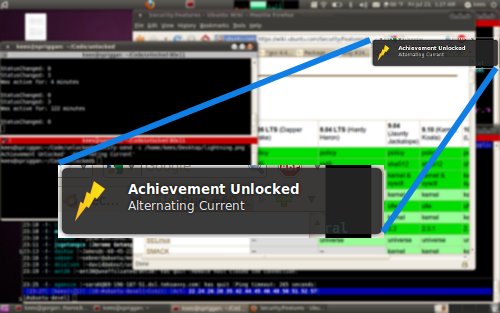
Kees Cook: Achievement Unlocked

I think it would be fun to add an achievement system to the Ubuntu Desktop, like is done on Steam and XBox. The tricky part is tracking various events and finding amusing correlations. For example, if your screen-saver kicks in 40 times in a single 24 hour period, you could earn the Alternating Current achievement, indicating that you re being repeatedly interrupted all day long: achievement unlocked: alternating current There are all kind of things to track and correlate. Miles moved with the mouse, clicks taken, keys pressed, files opened, applications installed, buddies added, IMs received, sent, etc. There are all kinds of achievements that could be designed that could be used to help people discover how to use Ubuntu, or for just plain humor. Achievement Unlocked: Application Deficit Disorder when you uninstall 100 applications you installed in the prior week. I ve been told this might all be very easy to implement with the Gnome Activity Journal (Zeitgeist), but I haven t had a chance to investigate further. UPDATE: I can easily imagine this being tracked in CouchDB, synced between systems via UbuntuOne, and could be linked to any other remote APIs that people could dream up, including Launchpad, Forums, REVU, Identi.ca, etc.

22 July 2010

Raphaël Hertzog: Quick news: dpkg, collab-maint, alioth and the future

Dpkg got rid of Perl Let s start with the interesting part and the great news: dpkg 1.15.8 (to be uploaded soon) will no longer need perl! After my changes to rewrite update-alternatives in C, Guillem recently pushed the rewrite of dpkg-divert/mksplit in C. Please test it out (binary package for i386 or .dsc). This is rather exciting news for those who would like to use dpkg in embedded contexts. And it s great to see this completed in time for Squeeze. In Squeeze+1, we might go one step further and merge cdebconf, the C replacement for debconf. I got rid of some recurring administrative tasks I have been administrating the Alioth server since its inception (see the announce I sent in 2003) but I m no longer enjoying the day-to-day administrative work that it represents. That s why I just retired from the team. We recently recruited Tollef Fog Heen so the number of admins is still the same (that said, Alioth could benefit from some more help, if you re a DD and interested, drop a mail to admin@alioth.debian.org or come to #alioth). Same goes for the collab-maint project. I have dealt with hundreds of requests to add new contributors to the project since it s the central repository where all Debian developers have write access and where they put the VCS for their packages that do not belong to a more specialized team. The new administrator that will approve the requests is Xavier Oswald and he s doing the work under the umbrella of the New Maintainer s Front Desk. The future I will continue to spend the same amount of time on Debian, the time freed will quickly be reallocated to other Debian and free software related projects. In fact, I even anticipated a bit by launching Flattr FOSS last week but that s a relatively simple project. :-) The other projects that will never all fit in the freed time: I want to spend more time working on dpkg. I do plan to blog more often too, but I m sure you ll notice that yourself soon. I would like to see my Debian book translated into English (another post coming on the topic sometimes soon). In my dreams, I could even start yet another software project, I have some ideas that I really would like to see implemented but I don t see how that could fit in this year s planning unless I can convince someone else to implement them! Maybe I should blog about them. Flattr this Share/Bookmark 5 comments Support my work

John Goerzen: Once, We Were Makers

I saw an article on Wired today: The Lost Tribes of RadioShack. It is well worth the read even if you re not into electronics. A key quote:
[H]is shop is a lone outpost; in a single generation, the American who built, repaired, and tinkered with technology has evolved into an entirely new species: the American who prefers to slip that technology out of his pocket and show off its killer apps. Once, we were makers. Now most of us are users.
I remember as a kid eagerly awaiting each year s new RadioShack catalog. I d read them pretty much cover to cover for fun. And who wouldn t? The catalogs had fun things like radios, telephone gadgets, calculators, tape recorders, electronic lab kits , books, components, LEDs I loved the catalogs and loved the store. My parents bought me a electronic kit (if memory serves 20 years later, it s the deluxe 160-project electronic kit from page 156 of the 1988 catalog, though it may have been purchased a different year). I had endless fun with that thing. It had resistors, diode, capacitors, oscillator, speaker, LED, relay, etc plenty to make a bunch of kid-friendly projects. Just looking at the catalog makes me excited even today. On the next page from the kit I had is a $5 crystal radio kit which needs no power source Solderless. With earphone, instructions, theory. On page 28 there was a revolving red light, and some microcassette recorders on p. 36 (I had one of those for awhile). I had enthusiasm for building and figuring out things for a long time. My dad let me take apart an old lawn mower for fun once I m sure he knew ahead of time it would never be back together. One of his friends from work built homemade contraptions out of things like an old vacuum cleaner (attach a cardboard tube to the exhaust and you get a great tennis ball shooter). And there was always all sorts of fun junk to discover up in the barn. I eventually shifted to a different sort of making things : programming. It has kept me busy for quite a number of years. But the Wired article has a point. RadioShack is struggling. Many people have no interest in making or fixing things anymore. The best-selling smartphone in the world comes sealed in a metal case where not even the battery can be replaced, the software is dictated by a company in California, and good luck trying to program for it without signing your life away first. A far cry from the first computer I used, a TRS-80 Color Computer II, bought, yes, at RadioShack. Turn it on, and in a few seconds you get a BASIC prompt. Can t really use it without programming. Being able to read its manual was an early motivation for me to work at learning to read. It is sad that so many devices can t be worked on anymore, and that so many people don t care. It is difficult for me to give Jacob (and later, Oliver) the sort of experience I had as a child. Companies would love to sell us $50 DVD sets, $300 educational game systems, $40 educational games, and any number of $30 plastic toys (some of which we have and the boys enjoy). I d rather give him a $10 bag of resistors, capacitors, wire, battery holders, LEDs, and a book, and see what he can come up with (when he s a bit older, of course). And, in fact, he and I built his first computer together. We installed the ultimate in operating systems for tinkering: Linux. This all brings me back to RadioShack. I ve been working on ham radio lately, with an eye to that being a project for Jacob (age 3.5), Oliver (just turned 1), and me to enjoy in the future. I needed some cable, and had been told by many people to visit the RadioShack in Derby, KS. It s like the one mentioned in the Wired article: huge, selling everything from washing machines to bulk cable, except this one specializes in amateur radio. I asked Jacob if he would like to come with me to a radio store. Dad, I would LOVE that! He brought his little semi-broken walkie-talkies with him to use during the hour drive there. At one point, he was concerned that a radio store is like a library and he might have to leave them on a shelf. I assured him he could keep them. We got to the RadioShack and he loved it. He couldn t even really contain his excitement. He ran back and forth along the bright green stripe running down the middle of the carpet. He excitedly watched them measure out 60ft of RG-8 coax for me. He pushed buttons on the demo clothes dryer, looked at all the antennas, and just had a great time. And he s been interested in my radio, too. When I was talking to somebody on it the other day, he said, I think he is at the radio store. He is having fun there. Right now, everybody I talk to on the radio is at the radio store to him. Jacob loves the fact that the backlight on my FT-857D can change colors, and often comes into the office just so I can put it into setup mode and let him spin the big wheel to change the colors. He enjoys opening boxes of components, and came out to help (and run around) while I suspended a dipole from some trees last Friday. I had told Jacob when we got to the store that This radio store is called RadioShack. He obviously took that to heart, because now if he hears me talking about a radio store , he will say, Dad, actually it is radio SHACK. So I say thank you to the Derby RadioShack for keeping the magic of making things with your dad alive for another generation.

21 July 2010

Maximilian Attems: Solid bases in Theoretical Physics

Landau, L. D.; Lifshitz, E. M. (1976). Course of Theoretical Physics is still the most interesting and solid base that is to be considered as a reference and inspiration in Theoretical Physics. The reference for "Classical Electrodynamics" is the book by J.D. Jackson. "Advanced Quantum Mechanics" by J.J. Sakurai is a popular student choice. Compendium of Relations contains various formulas and relations of the Standard Model. The Lecture Notes on General Relativity by S. Carroll are a solid introduction for an initiate relativist. "Quantum Field Theory in a Nutshell" by A. Zee is amazing. Quantum electrodynamics can be explored in the books by "The Quantum Theory of Fields" by S. Weinberg or "Quantum field theory" by L.H. Ryder or Quantum Chromodynamics in M.E. Peskin & D.V. Schroeder "An Introduction to Quantum Field Theory". The lecture notes on Quantum Chromodynamics (QCD) might be interesting for people diving into the particle physics standard model. "Finite-temperature field theory: Principles and Application" discusses systems in equilibrium but at finite temperatures and chemical potentials and thus connects to cosmology of the early universe. The field of Statistical Field Theory has the classic "Quantum Many-Particle Systems" by J.W. Negele and H. Orland or the more recent "Quantum Field Theory of Many-Body Systems" by X-G. Wen or "Ultracold Quantum Fields" by H.T.C Stoof, D.B.M. Dickerscheid, K. Gubbels. String Theory is so diverse that you'll find lots of different approaches, recommendations are Graduate Course in String Theory by A. Uranga, Applied Conformal Field Theory by P. Ginsparg, Lectures on String Theory by D. Tong or more introductory the book "A First Course in String Theory " by B. Zwiebach or the dense "Superstring Theory" by M. Green, J. Schwarz and E. Witten, "String Theory" by J. Polchinski. "Quantum Field Theory of Point Particles and Strings" by B. Hatfield assumes no previous stringy background and is known for excellent explanation of the path integral formalism. M. Nakahara wrote the wonderfull bridge to maths: "Geometry, Topology and Physics". So please when looking for "references" in theoretical physics venture on solid grounds and don't get distracted by sketchy notes. Update: Peter West pointed out that the The Feynman Lectures on Physics are missing as a timeless reference.

16 July 2010

Patrick Schoenfeld: Facebook aggressively advertising dubious features

Yesterday some confusion arised on my side when I saw a new facebook advertising campaign in my facebook account (yes, I am a member of facebook, although I'm aware of the privacy concerns). Basically it was saying that I should try the friends finder and that some of my friends (showing and naming me three of them) would have used it already.

Some background:
The friends finder feature of facebook is a feature that asks for the password of your e-mail account. It will then crawl through your emails to find contacts that might already be on facebook but not connected to you (in a facebook sense).

My first feeling was: Oh my god. How can it be that friends (and family) of mine are so naive? Especially since there were people included which I consider to be quiet clever. But honestly: Who would be so naive to give an unknown company direct unsupervised (you can't tell what they really do) access to your mail account? Would you give it to your friend? Your husband? Your father? I guess the answer will be "No" in the most cases and these people are most likely people you trust. Well, I know, you could state similar things for Googlemail who crawl your mails to show you personalized advertising. And in fact you are right. But if one decides to use gmail for your email hosting you have to trust them anyway. Like you have to trust anybody else you retain to host your mails (who could do the same but just don't tell you). But in this case its a third party, Facebook.

But if you now think that this becomes a rant against my friends: You are wrong. Over the day I found out that it basically shows up all my friends in a rotation. Every time I open the start page it randomly picks three people from my friend list and shows them to me, telling the same lie to me all over again.

So what do we have here? Facebook tries to advertise the most dubious feature they have in the most aggressive way one could imagine. By pretending wrong facts. Wouldn't that even be an element of crime in Germany ("Irref hrung" 5 UWG or maybe also 4 UWG, "unsachliche Beeinflussung")?

Facebook, you can do better.

Update: Stefano raised a good point. I didn't actually make clear that it has been verified that those people actually did not use the "feature":

1. I asked some of them. They said, they didn't use it and were in fact surprised that I asked.
2. Others told me they saw that ad stating that I used the feature. I definitely did not use this "feature".
3. Probably weak: IMHO its highly unlikely that all of my friends used that feature and at the point I've written this it had already shown my whole friend list.

13 July 2010

Fathi Boudra: What s going on in Debian Qt world?

Qt 4.7.0 beta 2 and Qt Creator 2.0.0 have been released upstream. There s some
noticeable changes in our Qt packages compared to Qt 4.6.x series:
- legacy Qt Assistant (ADP) is removed
- new Qt declarative module is introduced
- Qt Multimedia and Qt Webkit aren t being built anymore In case your package depends on the deprecated Qt Assistant, it is still being
shipped in a separated Qt Assistant compatibility package called
qt-assistant-compat. Qt Multimedia is now shipped from Qt Mobility API instead of Qt. The module has
been renamed to Qt Mobility MultimediaKit. Qt Mobility delivers a set of APIs
for mobile device functionality. Qt WebKit is shipped standalone, separated from Qt. Hopefully, it will make
Qt WebKit security support easier. There are also a new component in the family: Qt Messaging Framework (QMF).
The Qt Messaging Framework, QMF, consists of a C++ library and daemon server
process that can be used to build email clients, and more generally software
that interacts with email and mail servers. Finally, I have started to ship a snapshot of a new Phonon backend: Phonon VLC,
one backend to rule them all ! All the packages can be found in Debian Experimental repository, except
Qt Simulator, a simulator for Qt applications running on Nokia devices.
This package should land soon in Debian archives. I encourage you to try building your Qt applications against these packages and
please, report any bugs you encounter. Enjoy. http://packages.qa.debian.org/q/qt4-x11.html
http://packages.qa.debian.org/q/qtcreator.html
http://packages.qa.debian.org/q/qt-assistant-compat.html
http://packages.qa.debian.org/q/qtmobility.html
http://packages.qa.debian.org/q/qtwebkit.html
http://packages.qa.debian.org/q/qmf.html
http://packages.qa.debian.org/p/phonon-backend-vlc.html
http://bugs.debian.org/cgi-bin/bugreport.cgi?bug=587759

12 July 2010

Gerfried Fuchs: On Becoming a MOTU

Working on and for Debian for the whole millennium already it would had been hard to not notice Ubuntu through the times. Given that fixing bugs in the package is in the interest of all involved parties I started to get curious for the packages I maintain in Debian what users of Ubuntu might have filed against them. Given that a fair amount of those actually do also apply to Debian I started to fix them too. Though, some bug status isn't able to use as an outsider, and given my approach to perfection not wanting to have packages in a bad shape in a release I started to dig a bit further into the procedures and applied to be accepted as a Ubuntu Developer, more specifically as a MOTU, which gives me the possibility to directly ask for syncrequest instead of having to go through a sponsor, or set wontfix status for bugreports in my packages that simply doesn't make sense to get implemented. Last week I got accepted into that state and I'd like to thank for all the nice and encouraging feedback along the path (including some "What? I thought you were MOTU since ages already??" responses). Let's see how much I really need it, my approach is rather to reduce Ubuntu diffs instead of having to work on them. I though understand that at times close to the releases there can be a need for them, as can be seen in that the package I have to put most effort into (wesnoth-1.8) has a Ubuntu diff in the last lucid release. And because Ubuntu already is in DebianImportFreeze I did a syncrequest for gitolite. Thanks for accepting me so quickly and rather bureaucratic! And no, Laney, I won't give the talk tomorrow because of this just on my own. ;)

10 July 2010

Enrico Zini: Searching OSM nodes in Spatialite

Searching OSM nodes in Spatialite Third step of my SoTM10 pet project: finding the POIs. I put together a query to find all nodes with a given tag inside a bounding box, and also a query to find all the tag values for a given tag name inside a bounding box. The result is this simple POI search engine:
#
# poisearch - simple geographical POI search engine
#
# Copyright (C) 2010  Enrico Zini <enrico@enricozini.org>
#
# This program is free software; you can redistribute it and/or modify
# it under the terms of the GNU General Public License as published by
# the Free Software Foundation; either version 2 of the License, or
# (at your option) any later version.
#
# This program is distributed in the hope that it will be useful,
# but WITHOUT ANY WARRANTY; without even the implied warranty of
# MERCHANTABILITY or FITNESS FOR A PARTICULAR PURPOSE.  See the
# GNU General Public License for more details.
#
# You should have received a copy of the GNU General Public License
# along with this program; if not, write to the Free Software
# Foundation, Inc., 59 Temple Place, Suite 330, Boston, MA  02111-1307  USA
#
from pysqlite2 import dbapi2 as sqlite
class PoiDB(object):
    def __init__(self):
        self.db = sqlite.connect("pois.db")
        self.db.enable_load_extension(True)
        self.db.execute("SELECT load_extension('libspatialite.so')")
        self.oldsearch = []
        self.bbox = None
    def set_bbox(self, xmin, xmax, ymin, ymax):
        '''Set bbox for searches'''
        self.bbox = (xmin, xmax, ymin, ymax)
    def tagid(self, name, val):
        '''Get the database ID for a tag'''
        c = self.db.cursor()
        c.execute("SELECT id FROM tag WHERE name=? AND value=?", (name, val))
        res = None
        for row in c:
            res = row[0]
        return res
    def tagnames(self):
        '''Get all tag names'''
        c = self.db.cursor()
        c.execute("SELECT DISTINCT name FROM tag ORDER BY name")
        for row in c:
            yield row[0]
    def tagvalues(self, name, use_bbox=False):
        '''
        Get all tag values for a given tag name,
        optionally in the current bounding box
        '''
        c = self.db.cursor()
        if self.bbox is None or not use_bbox:
            c.execute("SELECT DISTINCT value FROM tag WHERE name=? ORDER BY value", (name,))
        else:
            c.execute("SELECT DISTINCT tag.value FROM poi, poitag, tag"
                      " WHERE poi.rowid IN (SELECT pkid FROM idx_poi_geom WHERE ("
                      "       xmin >= ? AND xmax <= ? AND ymin >= ? AND ymax <= ?) )"
                      "   AND poitag.tag = tag.id AND poitag.poi = poi.id"
                      "   AND tag.name=?",
                      self.bbox + (name,))
        for row in c:
            yield row[0]
    def search(self, name, val):
        '''Get all name:val tags in the current bounding box'''
        # First resolve the tagid
        tagid = self.tagid(name, val)
        if tagid is None: return
        c = self.db.cursor()
        c.execute("SELECT poi.name, poi.data, X(poi.geom), Y(poi.geom) FROM poi, poitag"
                  " WHERE poi.rowid IN (SELECT pkid FROM idx_poi_geom WHERE ("
                  "       xmin >= ? AND xmax <= ? AND ymin >= ? AND ymax <= ?) )"
                  "   AND poitag.tag = ? AND poitag.poi = poi.id",
                  self.bbox + (tagid,))
        self.oldsearch = []
        for row in c:
            self.oldsearch.append(row)
            yield row[0], simplejson.loads(row[1]), row[2], row[3]
    def count(self, name, val):
        '''Count all name:val tags in the current bounding box'''
        # First resolve the tagid
        tagid = self.tagid(name, val)
        if tagid is None: return
        c = self.db.cursor()
        c.execute("SELECT COUNT(*) FROM poi, poitag"
                  " WHERE poi.rowid IN (SELECT pkid FROM idx_poi_geom WHERE ("
                  "       xmin >= ? AND xmax <= ? AND ymin >= ? AND ymax <= ?) )"
                  "   AND poitag.tag = ? AND poitag.poi = poi.id",
                  self.bbox + (tagid,))
        for row in c:
            return row[0]
    def replay(self):
        for row in self.oldsearch:
            yield row[0], simplejson.loads(row[1]), row[2], row[3]
Problem 3 solved: now on to the next step, building a user interface for it.

Enrico Zini: Importing OSM nodes into Spatialite

Importing OSM nodes into Spatialite Second step of my SoTM10 pet project: creating a searchable database with the points. What a fantastic opportunity to learn Spatialite. Learning Spatialite is easy. For example, you can use the two tutorials with catchy titles that assume your best wish in life is to create databases out of shapefiles using a pre-built, i386-only executable GUI binary downloaded over an insecure HTTP connection. To be fair, the second of those tutorials is called "An almost Idiot's Guide", thus expliciting the requirement of being an almost idiot in order to happily acquire and run software in that way. Alternatively, you can use A quick tutorial to SpatiaLite which is so quick it has examples that lead you to write SQL queries that trigger all sorts of vague exceptions at insert time. But at least it brought me a long way forward, at which point I could just cross reference things with PostGIS documentation to find out the right way of doing things. So, here's the importer script, which will probably become my reference example for how to get started with Spatialite, and how to use Spatialite from Python:
#!/usr/bin/python
#
# poiimport - import nodes from OSM into a spatialite DB
#
# Copyright (C) 2010  Enrico Zini <enrico@enricozini.org>
#
# This program is free software; you can redistribute it and/or modify
# it under the terms of the GNU General Public License as published by
# the Free Software Foundation; either version 2 of the License, or
# (at your option) any later version.
#
# This program is distributed in the hope that it will be useful,
# but WITHOUT ANY WARRANTY; without even the implied warranty of
# MERCHANTABILITY or FITNESS FOR A PARTICULAR PURPOSE.  See the
# GNU General Public License for more details.
#
# You should have received a copy of the GNU General Public License
# along with this program; if not, write to the Free Software
# Foundation, Inc., 59 Temple Place, Suite 330, Boston, MA  02111-1307  USA
#
import xml.sax
import xml.sax.handler
from pysqlite2 import dbapi2 as sqlite
import simplejson
import sys
import os
class OSMPOIReader(xml.sax.handler.ContentHandler):
    '''
    Filter SAX events in a OSM XML file to keep only nodes with names
    '''
    def __init__(self, consumer):
        self.consumer = consumer
    def startElement(self, name, attrs):
        if name == "node":
            self.attrs = attrs
            self.tags = dict()
        elif name == "tag":
            self.tags[attrs["k"]] = attrs["v"]
    def endElement(self, name):
        if name == "node":
            lat = float(self.attrs["lat"])
            lon = float(self.attrs["lon"])
            id = int(self.attrs["id"])
            #dt = parse(self.attrs["timestamp"])
            uid = self.attrs.get("uid", None)
            uid = int(uid) if uid is not None else None
            user = self.attrs.get("user", None)
            self.consumer(lat, lon, id, self.tags, user=user, uid=uid)
class Importer(object):
    '''
    Create the spatialite database and populate it
    '''
    TAG_WHITELIST = set(["amenity", "shop", "tourism", "place"])
    def __init__(self, filename):
        self.db = sqlite.connect(filename)
        self.db.enable_load_extension(True)
        self.db.execute("SELECT load_extension('libspatialite.so')")
        self.db.execute("SELECT InitSpatialMetaData()")
        self.db.execute("INSERT INTO spatial_ref_sys (srid, auth_name, auth_srid,"
                        " ref_sys_name, proj4text) VALUES (4326, 'epsg', 4326,"
                        " 'WGS 84', '+proj=longlat +ellps=WGS84 +datum=WGS84"
                        " +no_defs')")
        self.db.execute("CREATE TABLE poi (id int not null unique primary key,"
                        " name char, data text)")
        self.db.execute("SELECT AddGeometryColumn('poi', 'geom', 4326, 'POINT', 2)")
        self.db.execute("SELECT CreateSpatialIndex('poi', 'geom')")
        self.db.execute("CREATE TABLE tag (id integer primary key autoincrement,"
                        " name char, value char)")
        self.db.execute("CREATE UNIQUE INDEX tagidx ON tag (name, value)")
        self.db.execute("CREATE TABLE poitag (poi int not null, tag int not null)")
        self.db.execute("CREATE UNIQUE INDEX poitagidx ON poitag (poi, tag)")
        self.tagid_cache = dict()
    def tagid(self, k, v):
        key = (k, v)
        res = self.tagid_cache.get(key, None)
        if res is None:
            c = self.db.cursor()
            c.execute("SELECT id FROM tag WHERE name=? AND value=?", key)
            for row in c:
                self.tagid_cache[key] = row[0]
                return row[0]
            self.db.execute("INSERT INTO tag (id, name, value) VALUES (NULL, ?, ?)", key)
            c.execute("SELECT last_insert_rowid()")
            for row in c:
                res = row[0]
            self.tagid_cache[key] = res
        return res
    def __call__(self, lat, lon, id, tags, user=None, uid=None):
        # Acquire tag IDs
        tagids = []
        for k, v in tags.iteritems():
            if k not in self.TAG_WHITELIST: continue
            for val in v.split(";"):
                tagids.append(self.tagid(k, val))
        # Skip elements that don't have the tags we want
        if not tagids: return
        geom = "POINT(%f %f)" % (lon, lat)
        self.db.execute("INSERT INTO poi (id, geom, name, data)"
                        "     VALUES (?, GeomFromText(?, 4326), ?, ?)",
                (id, geom, tags["name"], simplejson.dumps(tags)))
        for tid in tagids:
            self.db.execute("INSERT INTO poitag (poi, tag) VALUES (?, ?)", (id, tid))
    def done(self):
        self.db.commit()
# Get the output file name
filename = sys.argv[1]
# Ensure we start from scratch
if os.path.exists(filename):
    print >>sys.stderr, filename, "already exists"
    sys.exit(1)
# Import
parser = xml.sax.make_parser()
importer = Importer(filename)
handler = OSMPOIReader(importer)
parser.setContentHandler(handler)
parser.parse(sys.stdin)
importer.done()
Let's run it:
$ ./poiimport pois.db < pois.osm 
SpatiaLite version ..: 2.4.0    Supported Extensions:
        - 'VirtualShape'        [direct Shapefile access]
        - 'VirtualDbf'          [direct Dbf access]
        - 'VirtualText'         [direct CSV/TXT access]
        - 'VirtualNetwork'      [Dijkstra shortest path]
        - 'RTree'               [Spatial Index - R*Tree]
        - 'MbrCache'            [Spatial Index - MBR cache]
        - 'VirtualFDO'          [FDO-OGR interoperability]
        - 'SpatiaLite'          [Spatial SQL - OGC]
PROJ.4 Rel. 4.7.1, 23 September 2009
GEOS version 3.2.0-CAPI-1.6.0
$ ls -l --si pois*
-rw-r--r-- 1 enrico enrico 17M Jul  9 23:44 pois.db
-rw-r--r-- 1 enrico enrico 37M Jul  9 16:20 pois.osm
$ spatialite pois.db
SpatiaLite version ..: 2.4.0    Supported Extensions:
        - 'VirtualShape'        [direct Shapefile access]
        - 'VirtualDbf'          [direct DBF access]
        - 'VirtualText'         [direct CSV/TXT access]
        - 'VirtualNetwork'      [Dijkstra shortest path]
        - 'RTree'               [Spatial Index - R*Tree]
        - 'MbrCache'            [Spatial Index - MBR cache]
        - 'VirtualFDO'          [FDO-OGR interoperability]
        - 'SpatiaLite'          [Spatial SQL - OGC]
PROJ.4 version ......: Rel. 4.7.1, 23 September 2009
GEOS version ........: 3.2.0-CAPI-1.6.0
SQLite version ......: 3.6.23.1
Enter ".help" for instructions
spatialite> select id from tag where name="amenity" and value="fountain";
24
spatialite> SELECT poi.name, poi.data, X(poi.geom), Y(poi.geom) FROM poi, poitag WHERE poi.rowid IN (SELECT pkid FROM idx_poi_geom WHERE (xmin >= 2.56 AND xmax <= 2.90 AND ymin >= 41.84 AND ymax <= 42.00) ) AND poitag.tag = 24 AND poitag.poi = poi.id;
Font Picant de la Cellera "amenity": "fountain", "name": "Font Picant de la Cellera" 2.616045 41.952449
Font de Can Pla "amenity": "fountain", "name": "Font de Can Pla" 2.622354 41.974724
Font de Can Ribes "amenity": "fountain", "name": "Font de Can Ribes" 2.62311 41.979193
It's impressive: I've got all sort of useful information for the whole of Spain in just 17Mb! Let's put it to practice: I'm thirsty, is there any water fountain nearby?
spatialite> SELECT count(1) FROM poi, poitag WHERE poi.rowid IN (SELECT pkid FROM idx_poi_geom WHERE (xmin >= 2.80 AND xmax <= 2.85 AND ymin >= 41.97 AND ymax <= 42.00) ) AND poitag.tag = 24 AND poitag.poi = poi.id;
0
Ouch! No water fountains mapped in Girona... yet. Problem 2 solved: now on to the next step, trying to show the results in some usable way.

9 July 2010

Mike Hommey: Iceweasel 4.0 beta 1 preliminary packages for Debian, and a nice trick

Since this blog is now syndicated on Planet Mozilla, a little background for its readers: Iceweasel is the name under which Firefox is distributed in Debian. This is an unfortunate detail due to copyright issues with the Firefox logos that have been solved recently. Work is under progress to get Firefox back in Debian (I do have good hope this will be possible). Anyways, I ve started to work on getting Iceweasel in shape for the 4.0 release in a few months. The packaging being in a good enough shape, I am hereby making available some preliminary packages (meaning there is still some more work needed for proper packaging) for the first beta release. The packages are available in a separate repository, which you need to add to your sources.list:
deb http://mozilla.debian.net/packages/ ./
Only x86 and x86-64 (amd64) packages are available for now. As far as I tested it, it works as well as the official Firefox 4.0beta1 binaries, though some xpcshell tests failed, and I haven t got reftests working yet. If you still wish to use a current version of iceweasel (i.e. non-beta), but want to try this beta, here is the nice trick: Instead of installing iceweasel from the above mentioned repository, Now you can start the Iceweasel beta with /some/directory/usr/bin/iceweasel. This trick should work with older versions of iceweasel, too.

8 July 2010

Phil Hands: Debian Tartan: Batch 2 ready for cutting

The cloth is woven, so the tailors are busy collecting measurements. If you've ordered a kilt or whatever, and have not yet sent in your dimensions & money you need to do that within about 24 hours if you're hoping to get something in time for DebConf.We seem to have got about 20 yards more than we ordered (weaving's more of an art than a science) so if you've only just realised that you want a kilt, skirt, whatever, in glorious Debian Tartan, I suggest you get in touch promptly, as even if you don't want it in time for DebConf, I imagine the rest will get snapped up as soon as people see what they've been missing in New York.I'm getting some Ties made -- they'll cost about 25.00 GBP each. If you fancy one, tell me, and add yourself to this table on the wiki. There's more background on that page.

Michael Banck: 8 Jul 2010

Bug-Squashing-Party in Munich We are organizing another BSP in Munich on the weekend of 17th/18th July. Like the last BSP, it will take place in the LiMux office in the city center. See the coordination page for further information and directions and in order to sign up for it. Food and drinks for the event are partly sponsored by the City of Munich and this amount (100 ) has been again matched by credativ GmbH. Contributions by non-DDs are welcome as always; the BSP will be attended by several Debian Developers who will be able to upload fixes. Attending BSPs is a great way to get involved in the Debian community! We cannot guarantee crash space to people from outside Munich at this point, so if you want to attend please contact the Munich list (area-muc@teams.debian.net) beforehand or arrange your own accomodation. We probably start the BSP at some point after 6PM on Friday evening already, but the main action will be on Saturday and Sunday. As usual, people should bring their notebooks and possibly an ethernet cable. Wireless will be present as well, but a certain bandwidth cannot be guaranteed. Bug-Squashing Introduction I also plan to give an introduction to bug-squashing at this month's Garching Debian Stammtisch, which will take place next Wednesday, July 14th in the campus-cneipe (or its beergarden) as usual (the monthly Stammtisch is always on the second Wednesday of the month). If you study/work in Garching and would like to attend the BSP, come to the Stammtisch for a tutorial (and beer)! Debian Packaging Tutorial Some time ago, I gave a tutorial on Debian packaging in the TechTalk series of the Open-Source- School. The audience seemed to be pleased with the talk, and as more people requested to attend than there were seats in the room, we decided to reprise the event on September 7th. Attendence is free, but you have to register (see the event page). There are still some places left at this point.

Next.

Previous.