Search Results: "ads"

30 August 2017

Dirk Eddelbuettel: RcppArmadillo 0.7.960.1.2

armadillo image A second fix-up release is needed following on the recent bi-monthly RcppArmadillo release as well as the initial follow-up as it turns out that OS X / macOS is so darn special that it needs an entire separate treatment for OpenMP. Namely to turn it off entirely... Armadillo is a powerful and expressive C++ template library for linear algebra aiming towards a good balance between speed and ease of use with a syntax deliberately close to a Matlab. RcppArmadillo integrates this library with the R environment and language--and is widely used by (currently) 384 other packages on CRAN---an increase of 54 since the CRAN release in June!

Changes in RcppArmadillo version 0.7.960.1.2 (2017-08-29)
  • On macOS, OpenMP support is now turned off (#170).
  • The package is now compiling under the C++11 standard (#170).
  • The vignette dependency is correctly set (James and Dirk in #168 and #169)

Courtesy of CRANberries, there is a diffstat report. More detailed information is on the RcppArmadillo page. Questions, comments etc should go to the rcpp-devel mailing list off the R-Forge page.

This post by Dirk Eddelbuettel originated on his Thinking inside the box blog. Please report excessive re-aggregation in third-party for-profit settings.

29 August 2017

Colin Watson: env chdir

I was recently asked to sort things out so that snap builds on Launchpad could themselves install snaps as build-dependencies. To make this work we need to start doing builds in LXD containers rather than in chroots. As a result I ve been doing some quite extensive refactoring of launchpad-buildd: it previously had the assumption that it was going to use a chroot for everything baked into lots of untested helper shell scripts, and I ve been rewriting those in Python with unit tests and with a single Backend abstraction that isolates the high-level logic from the details of where each build is being performed. This is all interesting work in its own right, but it s not what I want to talk about here. While I was doing all this refactoring, I ran across a couple of methods I wrote a while back which looked something like this:
def chroot(self, args, echo=False):
    """Run a command in the chroot.
    :param args: the command and arguments to run.
    """
    args = set_personality(
        args, self.options.arch, series=self.options.series)
    if echo:
        print("Running in chroot: %s" %
              ' '.join("'%s'" % arg for arg in args))
        sys.stdout.flush()
    subprocess.check_call([
        "/usr/bin/sudo", "/usr/sbin/chroot", self.chroot_path] + args)
def run_build_command(self, args, env=None, echo=False):
    """Run a build command in the chroot.
    This is unpleasant because we need to run it in /build under sudo
    chroot, and there's no way to do this without either a helper
    program in the chroot or unpleasant quoting.  We go for the
    unpleasant quoting.
    :param args: the command and arguments to run.
    :param env: dictionary of additional environment variables to set.
    """
    args = [shell_escape(arg) for arg in args]
    if env:
        args = ["env"] + [
            "%s=%s" % (key, shell_escape(value))
            for key, value in env.items()] + args
    command = "cd /build && %s" % " ".join(args)
    self.chroot(["/bin/sh", "-c", command], echo=echo)
(I ve already replaced the chroot method with a call to Backend.run, but it s easier to see what I m talking about in the original form.) One thing to notice about this code is that it uses several adverbial commands: that is, commands that run another command in a different way. For example, sudo runs another command as another user, while chroot runs another command with a different root directory, and env runs another command with different environment variables set. These commands chain neatly, and they also have the useful property that they take the subsidiary command and its arguments as a list of arguments. coreutils has several other commands that behave this way, and adverbio is another useful example. By contrast, su -c is something you might call a quasi-adverbial command: it does modify the behaviour of another command, but it takes it as a single argument which it then passes to sh -c. Every time you have something that s passed to a shell like this, you need a corresponding layer of shell quoting to escape any shell metacharacters that should be interpreted literally. This is often cumbersome and is easy to get wrong. My Python implementation is as follows, and I wouldn t be totally surprised to discover that it contained a bug:
import re
non_meta_re = re.compile(r'^[a-zA-Z0-9+,./:=@_-]+$')
def shell_escape(arg):
    if non_meta_re.match(arg):
        return arg
    else:
        return "'%s'" % arg.replace("'", "'\\''")
Python >= 3.3 has shlex.quote, which is an improvement and we should probably use that instead, but it s still another thing to forget to call. This is why process-spawning libraries such as Python s subprocess, Perl s system and open, and my own libpipeline for C encourage programmers to use a list syntax and to avoid involving the shell entirely wherever possible. One thing that the standard Unix tools don t let you do in an adverbial way is to change your working directory, and I ve run into this annoying limitation several times. This means that it s difficult to chain that operation together with other adverbs, for example to run a command in a particular working directory inside a chroot. The workaround I used above was to invoke a shell that runs cd /build && ..., but that s another command that s only quasi-adverbial, since the extra shell means an extra layer of shell quoting. (Ian Jackson rightly observes that you can in fact write the necessary adverb as something like sh -ec 'cd "$1"; shift; exec "$@"' chdir. I think that s a bit uglier than I ideally want to use in production code, but you might reasonably think that it s worth it to avoid the extra layer of shell quoting.) I therefore decided that this was a feature that belonged in coreutils, and after a bit of mailing list discussion we felt it was best implemented as a new option to env(1). I sent a patch for this which has been accepted. This means that we have a new composable adverb, env --chdir=NEWDIR, which will allow the run_build_command method above to be rewritten as something like this:
def run_build_command(self, args, env=None, echo=False):
    """Run a build command in the chroot.
    :param args: the command and arguments to run.
    :param env: dictionary of additional environment variables to set.
    """
    env_args = ["env", "--chdir=/build"]
    if env:
        for key, value in env.items():
            env_args.append("%s=%s" % (key, value))
    self.chroot(env_args + args, echo=echo)
The env --chdir option will be in coreutils 8.28. We won t be able to use it in launchpad-buildd until that s available in all Ubuntu series we might want to build for, so in this particular application that s going to take a few years; but other applications may well be able to make use of it sooner.

Holger Levsen: 20170829-qubes-os

"Qubes OS from the POV of a Debian developer" and "Qubes OS user meetup at Bornhack" I wrote the following while on my way home from Bornhack which was an awesome hacking camp on the Danish island of Bornholm, where about 200 people gathered for a week, with a nice beach in walking distance (and a not too cold Baltic Sea) and vegan and not so vegan grills, to give some hints why it was awesome. (Actually it was mostly awesome due to the people there, not the things, but anyway ) And there were of course also talks and workshops, and one was a Qubes OS users meetup, which amazingly was attended by 20 Qubes OS users (and some Qubes OS users present were even missing), so in other words: Qubes OS had a >10% user base at this event! And I even found one heads user! ;-) At DebConf17 I gave a talk titled "Qubes OS from the POV of a Debian developer" and while the video was immediatly available (thanks to the DebConf videoteam!) I've also now put my slides for it online. Since then, I learned a few things: I'm looking forward to more Qubes OS user meetups in future!

Carl Chenet: Send scheduled messages to both Twitter and Mastodon with the Remindr bot

Do you need to send messages to both Twitter and Mastodon? Use the Remindr bot! Remindr is written in Python, released under the GPLv3 license. 1. How to install Remindr Install Remindr from PyPI:
# pip3 install remindr
2. How to configure Remindr First, start by writing a messages.txt file with the following content:
o en Send scheduled messages to both Twitter and Mastodon with the Remindr bot https://carlchenet.com/send-scheduled-messages-to-both-twitter-and-mastodon-with-the-remindr-bot #remindr #twitter #mastodon
x en Follow Carl Chenet for great news about Free Software! https://carlchenet.com #freesoftware
The first field only indicates if the line is the next one to be considered by Remindr, the o indicates the next line to be sent, x means it won t. The second field is the 2-letters code language your content is using, in my example en or fr. Next content on the line will compose the body of your messages to Mastodon and Twitter. You need to configure the Mastodon and the Twitter credentials in order to allow Remindr to send the messages. First you need to generate the credentials. For Twitter, you need to manually create an app on apps.twitter.com. For Mastodon, just launch the following command:
$ register_remindr_app
Some information will be asked by the command. At the end, two files are created, remindr_usercred.txt and remindr_clientcred.txt. You re going to need them for the Remindr configuration above. For the Remindr configuration, here is a complete configuration using the
[mastodon]
instance_url=https://mastodon.social
user_credentials=remindr_usercred.txt
client_credentials=remindr_clientcred.txt
[twitter]
consumer_key=a6lv2gZxkvk6UbQ30N4vFmlwP
consumer_secret=j4VxM2slv0Ud4rbgZeGbBzPG1zoauBGLiUMOX0MGF6nsjcyn4a
access_token=1234567897-Npq5fYybhacYxnTqb42Kbb3A0bKgmB3wm2hGczB
access_token_secret=HU1sjUif010DkcQ3SmUAdObAST14dZvZpuuWxGAV0xFnC
[image]
path_to_image=/home/chaica/blog-carl-chenet.png
[entrylist]
path_to_list=/etc/remindr/messages.txt
Your configuration is complete! Now we have to check if everything is fine.

Read the full documentation on Readthedocs.

3. How to use Remindr Now let s try your configuration by launching Remindr the first time by-hand:
$ remindr -c /etc/remindr/remindr.ini
The messages should appear on both Twitter and Mastodon. 4. How to schedule the Remindr execution The easiest way is to use you user crontab. Just add the following line in your crontab file, editing it with crontab -e
00 10 * * * remindr -c /etc/remindr/remindr.ini
From now on, your message will be sent every day at 10:00AM. Going further with Remindr and finally You can help me developing tools for Mastodon and other social networks by donating anything through Liberaypay (also possible with cryptocurrencies). Any contribution will be appreciated. That s a big factor motivation
Donate You also may follow my account @carlchenet on Mastodon

Jeremy Bicha: GNOME Tweaks 3.25.91

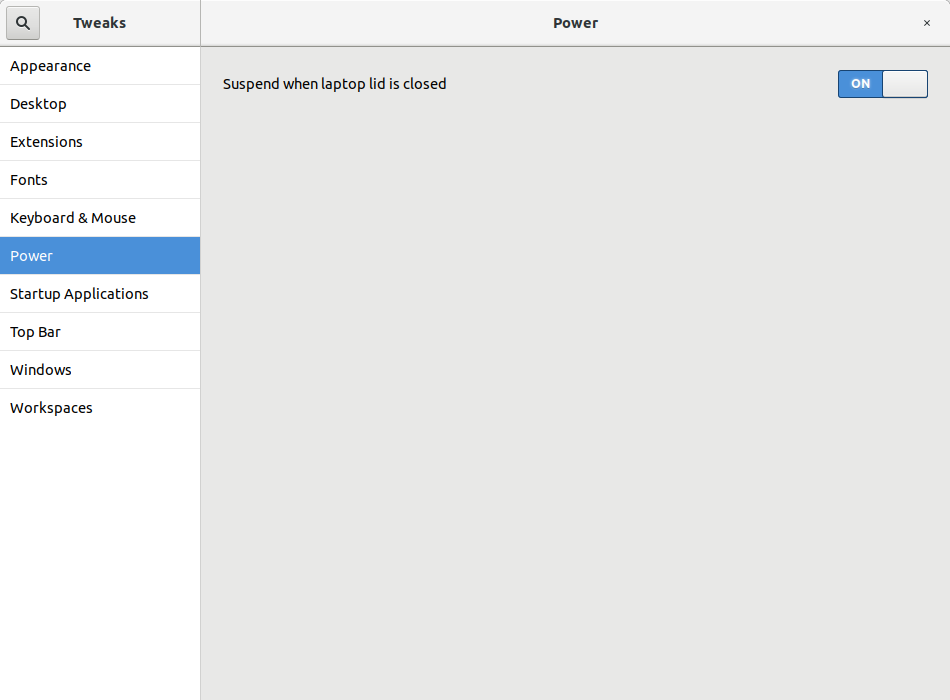
The GNOME 3.26 release cycle is in its final bugfix stage before release. Here s a look at what s new in GNOME Tweaks since my last post. I ve heard people say that GNOME likes to remove stuff. If that were true, how would there be anything left in GNOME? But maybe it s partially true. And maybe it s possible for removals to be a good thing? Removal #1: Power Button Settings The Power page in Tweaks 3.25.91 looks a bit empty. In previous releases, the Tweaks app had a When the Power button is pressed setting that nearly duplicated the similar setting in the Settings app (gnome-control-center). I worked to restore support for Power Off as one of its options. Since this is now in Settings 3.25.91, there s no need for it to be in Tweaks any more. Removal #2: Hi-DPI Settings GNOME Tweaks offered a basic control to scale windows 2x for Hi-DPI displays. More advanced support is now in the Settings app. I suspect that fractional scaling won t be supported in GNOME 3.26 but it s something to look forward to in GNOME 3.28! Removal #3 Global Dark Theme I am announcing today that one of the oldest and popular tweaks will be removed from Tweaks 3.28 (to be released next March). Global Dark Theme is being removed because: Adwaita now has a separate Adwaita Dark theme. Arc has 2 different dark variations. Therefore, if you are a theme developer, you have about 6-7 months to offer a dark version of your theme. The dark version can be distributed the same way as your regular version. Removal #4 Some letters from our name In case you haven t noticed, GNOME Tweak Tool is now GNOME Tweaks. This better matches the GNOME app naming style. Thanks Alberto Fanjul for this improvement! For other details of what s changed including a helpful scrollbar fix from Ant nio Fernandes, see the NEWS file.

Sean Whitton: Nourishment

This semester I am taking JPN 530, Haruki Murakami and the Literature of Modern Japan . My department are letting me count it for the Philosophy Ph.D., and in fact my supervisor is joining me for the class. I have no idea what the actual class sessions will be like first one this afternoon and I m anxious about writing a literature term paper. But I already know that my weekends this semester are going to be great because I ll be reading Murakami s novels. What s particularly wonderful about this, and what I wanted to write about, is how nourishing I find reading literary fiction to be. For example, this weekend I read
This was something sure to be crammed full of warm secrets, like an antique clock built when peace filled the world. Potentiality knocks at the door of my heart.
and I was fed for the day. All my perceived needs dropped away; that s all it takes. This stands in stark contrast to reading philosophy, which is almost always draining rather than nourishing even philosophy I really want to read. Especially having to read philosophy at the weekend. (quotation is from On Seeing the 100% Perfect Girl on a Beautiful April Morning)

Dirk Eddelbuettel: RcppSMC 0.2.0

A new version 0.2.0 of the RcppSMC package arrived on CRAN earlier today (as a very quick pretest-publish within minutes of submission). RcppSMC provides Rcpp-based bindings to R for the Sequential Monte Carlo Template Classes (SMCTC) by Adam Johansen described in his JSS article. This release 0.2.0 is chiefly the work of Leah South, a Ph.D. student at Queensland University of Technology, who was during the last few months a Google Summer of Code student mentored by Adam and myself. It was pleasure to work with Leah on this, and see her progress. Our congratulations to Leah for a job well done!

Changes in RcppSMC version 0.2.0 (2017-08-28)
  • Also use .registration=TRUE in useDynLib in NAMESPACE
  • Multiple Sequential Monte Carlo extensions (Leah South as part of Google Summer of Code 2017)
    • Switching to population level objects (#2 and #3).
    • Using Rcpp attributes (#2).
    • Using automatic RNGscope (#4 and #5).
    • Adding multiple normalising constant estimators (#7).
    • Static Bayesian model example: linear regression (#10 addressing #9).
    • Adding a PMMH example (#13 addressing #11).
    • Framework for additional algorithm parameters and adaptation (#19 addressing #16; also #24 addressing #23).
    • Common adaptation methods for static Bayesian models (#20 addressing #17).
    • Supporting MCMC repeated runs (#21).
    • Adding adaptation to linear regression example (#22 addressing #18).

Courtesy of CRANberries, there is a diffstat report for this release. More information is on the RcppSMC page. Issues and bugreports should go to the GitHub issue tracker.

This post by Dirk Eddelbuettel originated on his Thinking inside the box blog. Please report excessive re-aggregation in third-party for-profit settings.

28 August 2017

Norbert Preining: Gaming: The Long Dark Wintermute Episode 1

One month ago the Story Mode for The Long Dark has been released. Finally I managed to finish the first of the two chapters, and it was worth the wait. I have played many ours in the Sandbox mode, but while the first days in story mode are like hand-holding kids, on the fifth day you are kicked into a brutal void with lots, and I mean *lots* of wolves being more than eager to devour you. Targeting new players the four days one just practice basic techniques, fire making, water, food, first aid, collecting materials. Finally one is allowed to leave the crash site of the plane and climbs out into a mountainous area searching for shelter and at the end for Milton, a deserted village. But the moment one reaches a street, wolves are appearing again and again, and the only way is often to run from car to car and hide there, hoping not to freeze to death. Took me several tries to make it to the church and then into town to meet the Grey Mother. The rest of epsiode one is dedicated to various tasks set by the Grey Mother, and some additional (optional) side quests. And while the first encounter with the wolves was pretty grim, in the later parts I had the feeling that they became a bit more easy to take. This might be related to one of the many patches (8 till now) that were shipped out in this month. After having finished all the quests, including the side quests (and found the very useful distress pistol), I made my way out of Milton, probably not to be seen again?! And while all the quests were finished, I had the feeling I could spend a bit more time and explore the surroundings, maybe something is still hiding out there. But shouldering the climbing rope and climbing out of Milton leads to a very beautiful last stretch, a canyon lined with waterfalls leading to a cave and to the next episode. Now I only need more time to play Episode 2.

27 August 2017

Carl Chenet: The Importance of Choosing the Correct Mastodon Instance

Remember, Mastodon is a new decentralized social network, based on a free software which is rapidly gaining users (already there is more than 1.5 million accounts). As I ve created my account in June, I was a fast addict and I ve already created several tools for this network, Feed2toot, Remindr and Boost (mostly written in Python).

Now, with all this experience I have to stress out the importance of choosing the correct Mastodon instance.

Some technical reminders on how Mastodon works

First, let s quickly clarify something about the decentralized part. In Mastodon, decentralization is made through a federation of dedicated servers, called instances , each one with a complete independent administration. Your user account is created on one specific instance. You have two choices:

  • Create your own instance. Which requires advanced technical knowledge.
  • Create your user account on a public instance. Which is the easiest and fastest way to start using Mastodon.

You can move your user account from one instance to another, but you have to follow a special procedure which can be quite long, considering your own interest for technical manipulation and the total amount of your followers you ll have to warn about your change. As such, you ll have to create another account on a new instance and import three lists: the one with your followers, the one with the accounts you have blocked, and the one with the account you have muted.

From this working process, several technical and human factors will interest us.

A good technical administration for instance

As a social network, Mastodon is truly decentralized, with more than 1.5 million users on more than 2350 existing instances. As such, the most common usage is to create an account on an open instance. To create its own instance is way too difficult for the average user. Yet, using an open instance creates a strong dependence on the technical administrator of the chosen instance.
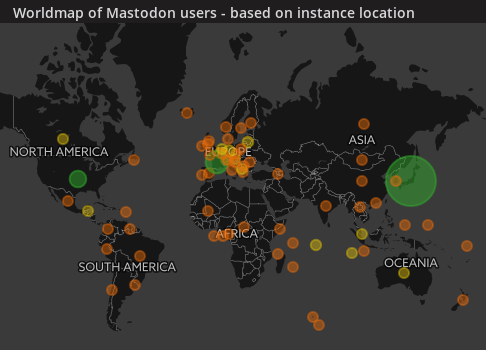
The technical administrator will have to deal with several obligations to ensure its service continuity, with high-quality hardware and regular back-ups. All of these have a price, either in money and in time. Regarding the time factor, it would be better to choose an administration team over an individual, as life events can change quite fast everyone s interests. As such, Framasoft, a French association dedicated to promoting the Free software use, offers its own Mastodon instance named: Framapiaf. The creator of the mastodon project, also offers a quite solid instance, Mastodon.social (see below).

Regarding the money factor, many instance administrators with a large number of users are currently asking for donation via Patreon, as hosting an instance server or renting one cost money.
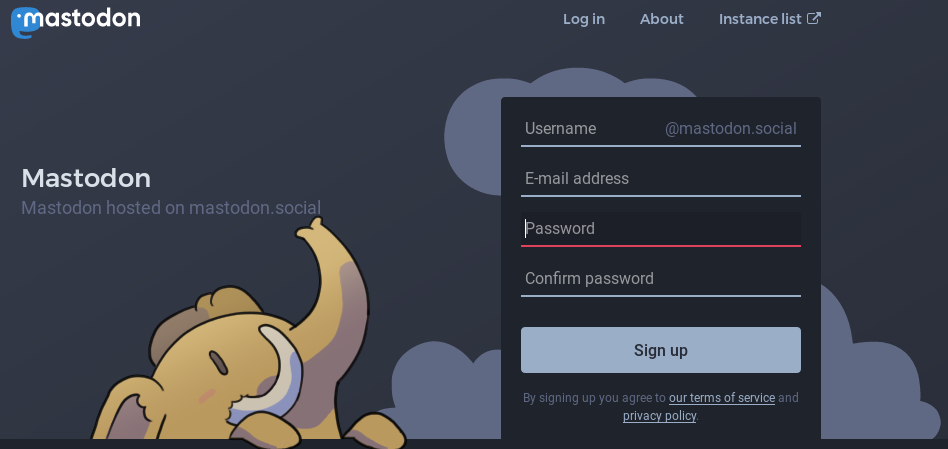
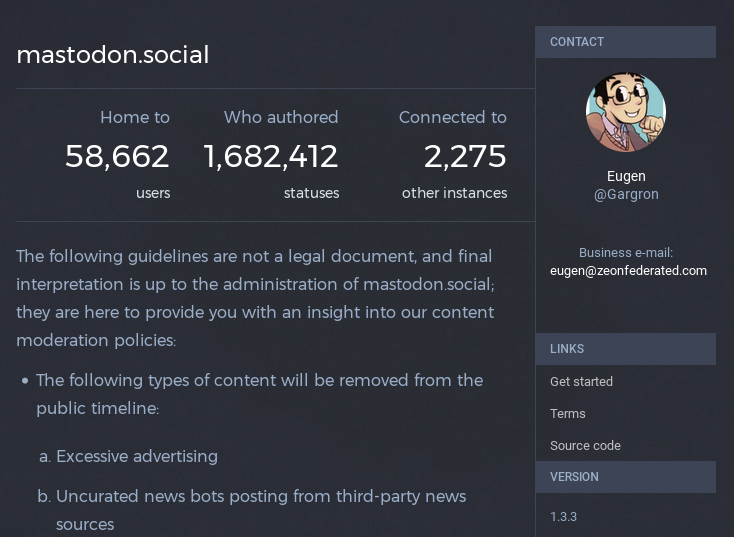
Mastodon.social, the first instance of the Mastodon network

The Ideological Trend Of Your Instance

If anybody could have guessed the previous technical points since the recent registration explosion on the Mastodon social network, the following point took almost everyone by surprise. Little by little, different instances show their culture , their protest action, and their propaganda on this social network.

As the instance administrator has all the powers over its instance, he or she can block the instance of interacting with some other instances, or ban its instance s users from any interaction with other instances users.

With everyone having in mind the main advantages to have federalized instance from, this partial independence of some instances from the federation was a huge surprise. One of the most recent example was when the Unixcorn.xyz instance administrator banned its users from reading Aeris account, which was on its own instance. It was a cataclysm with several consequences, which I ve named the #AerisGate as it shows the different views on moderation and on its reception by various Mastodon users.
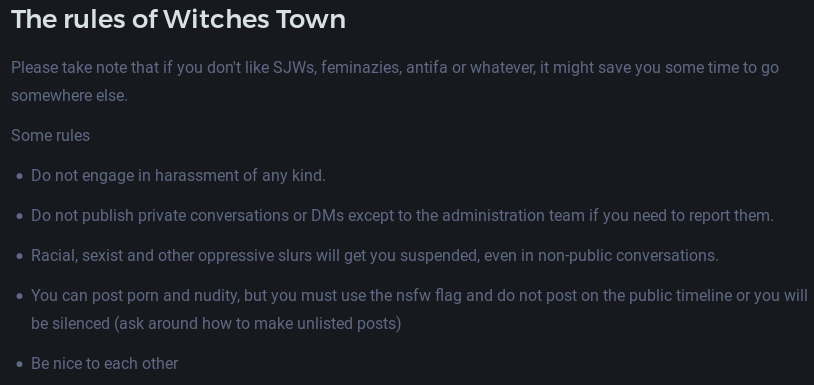
If you don t manage your own instance, when you ll have to choose the one where to create your account, make sure that the content you plan to toot is within the rules and compatible with the ideology of said instance s administrator. Yes, I know, it may seem surprising but, as stated above, by entering a public instance you become dependent on someone else s infrastructure, who may have an ideological way to conceive its Mastodon hosting service. As such, if you re a nazi, for example, don t open your Mastodon account on a far-left LGBT instance. Your account wouldn t stay open for long.

The moderation rules are described in the about/more page of the instance, and may contain ideological elements.
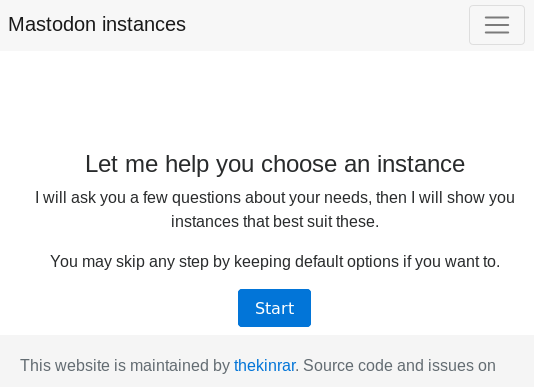
To ease the process for newcomers, it is now possible to use a great tool to select what instance should be the best to host your account.
Remember that, as stated above, Mastodon is decentralized, and as such there is no central authority which can be reached in case you have a conflict with your instance administrator. And nobody can force said administrator to follow its own rules, or not to change them on the fly. Think Twice Before Creating Your Account

If you want to create an account on an instance you don t control, you need to check two elements: the availability of the instance hosting service in the long run, often linked to the administrator or the administration group of said instance, and the ideological orientation of your instance. With these two elements checked, you ll be able to let your Mastodon account growth peacefully, without fearing an outage of your instance, or simple your account blocked one morning because it doesn t align with your instance s ideological line.

in Conclusion

To help me get involved in free software and writing articles for this blog, please consider a donation through my Liberapay page, even if it s only a few cents per week. My contact Bitcoin and Monero are also available on this page. Follow me on Mastodon Translated from French to English by St phanie Chaptal.


Jonathan McDowell: On my way home from OMGWTFBBQ

I started writing this while sitting in Stansted on my way home from the annual UK Debian BBQ. I m finally home now, after a great weekend catching up with folk. It s a good social event for a bunch of Debian folk, and I m very grateful that Steve and Jo continue to make it happen. These days there are also a number of generous companies chipping in towards the cost of food and drink, so thanks also to Codethink and QvarnLabs AB for the food, Collabora and Mythic Beasts for the beer and Chris for the coffee. And Rob for chasing us all for contributions to cover the rest. I was trying to remember when the first one of these I attended was; trawling through mail logs there was a Cambridge meetup that ended up at Steve s old place in April 2001, and we ve consistently had the summer BBQ since 2004, but I m not clear on what happened in between. Nonetheless it s become a fixture in the calendar for those of us in the UK (and a number of people from further afield who regularly turn up). We ve become a bit more sedate, but it s good to always see a few new faces, drink some good beer (yay Milton), eat a lot and have some good conversations. This year also managed to get me a SheevaPlug so I could investigate #837989 - a bug with OpenOCD not being able to talk to the device. Turned out to be a channel configuration error in the move to new style FTDI support, so I ve got that fixed locally and pushed the one line fix upstream as well.

Evgeni Golov: starting the correct Chromium profile when opening links from IRC

I am using Chromium/Chrome as my main browser and I also use its profile/people feature to separate my work profile (bookmarks, cookies, etc) from my private one. However, Chromium always opens links in the last window (and by that profile) that was in foreground last. And that is pretty much not what I want. Especially if I open a link from IRC and it might lead to some shady rick-roll page. Thankfully, getting the list of available Chromium profiles is pretty easy and so is displaying a few buttons using Python. To do so I wrote cadmium, which scans the available Chromium profiles and allows to start either of them, or Chromium's Incognito Mode. On machines with SELinux it can even launch Chromium in the SELinux sandbox. No more links opened in the wrong profile. Yay!

Holger Levsen: 20170827-coreboot-build-environment

setting up a coreboot build environment, including an Ada compiler So without much explaination, this is how lynxis told me how to setup a coreboot build environment, which contains an Ada compiler which is needed to build the free graphics initialisation for Intel cards (=so no binary VGA bios blob is needed). The Ada compiler is build automatically by default if it's build depends are installed:
sudo apt install build-essential bison flex zlib1g-dev ncurses-dev gnat
git clone --recursive https://review.coreboot.org/p/coreboot.git
cd coreboot/
git submodule update --init --checkout 3rdparty/blobs   # for the x230 this only contains microcode updates
make iasl CPUS=$(nproc)
make gnumake CPUS=$(nproc)
make crossgcc-i386 CPUS=$(nproc)
coreboot is then build as usual:
make menuconfig
make
That's it. (I've just left out the steps to choose the coreboot revision and validating it, as well as choosing a configurationwith make menuconfig as this is better documented elsewhere.)

26 August 2017

Andrew Cater: OMGWTFBBQ Cambridge 2017

Funny this - I only blog when I'm in Cambridge :) I'm sure there's a blog back in the day from a BBQ a good few years ago. This is almost deja vu - a room full of Debian types - the crazy family - Thinkpads on a lot of laps and lots of chat around the room.

Colin showing round an amateur radio project in a tobacco tin, coding happening at the back of the room. Pepper the dog sitting on my foot - everything pretty well normal.

Nathan Handler: freenode #live

For those of you who might not be aware, freenode is an IRC network that caters to free and open source projects. We have had a goal for a number of years to hold freenode #live, an in-person conference where our staff, projects, FOSS supporters, and IRC enthusiasts could all get together in one place. Thanks to some very generous sponsorship, primarily by Private Internet Access, this conference is finally happening! The first ever freenode #live conference will take place October 28 - 29, 2017 in Bristol, United Kingdom. This conference will only be a success with support from the community. Luckily, there are many ways to help out.

  1. Register to attend. We are working on putting together a great lineup of speakers that you will not want to miss. Registering allows us to finalize many logistical details surrounding the event to make sure everything runs smoothly.
  2. Do you represent a FOSS group? We would love to have your group present at the event. There will be an exhibitor hall where you can advertise your organization and attract new users and contributors.
  3. Submit a talk. Our call for proposals is still open. New and experienced speakers are welcome. Feel free to contact 2017-team@freenode.live and we would be happy to work with you to come up with a talk idea or provide feedback.
  4. If you or your company are interested in helping to sponsor this event, please reach out to exhibit@freenode.live. We have opportunities for budgets of all sizes.
I look forward to hopefully seeing you at freenode #live!

25 August 2017

Steve Kemp: Interesting times debugging puppet

I recently upgraded a bunch of systems from Jessie to Stretch, and as a result of that one of my hosts has started showing me a lot of noise in an hourly cron-email:
Command line is not complete. Try option "help"
I've been ignoring these emails for the past while, but today I sat down to track down the source. It was obviously coming from facter, the system that puppet uses to gather information about hosts. Running facter -debug made that apparent:
 root@smaug ~ # facter --debug
 Found no suitable resolves of 1 for ec2_metadata
 value for ec2_metadata is still nil
 value for netmask_git is still nil
 value for ipaddress6_lo is still nil
 value for macaddress_lo is still nil
 value for ipaddress_master is still nil
 value for ipaddress6_master is still nil
 Command line is not complete. Try option "help"
 value for netmask_master is still nil
 value for ipaddress_skx_mail is still nil
 ..
There we see the issue, and it is obviously relating to our master interface. To cut a long-story short /usr/lib/ruby/vendor_ruby/facter/util/ip.rb contains some code which eventually runs this:
 ip link show $interface
That works on all other interfaces I have:
  $ ip link show git
  6: git: <BROADCAST,MULTICAST,UP,LOWER_UP> mtu 1500 qdisc pfifo_fast state UNKNOWN mode DEFAULT group default qlen 1000
But not on master:
  $ ip link show master
  Command line is not complete. Try option "help"
I ninja-edited the code from this:
  ethbond = regex.match(%x /sbin/ip link show '# interface ' )
to:
  ethbond = regex.match(%x /sbin/ip link show dev '# interface ' )
And suddenly puppet-runs without any errors. I'm not 100% sure if this is a bug bug, but it is something of a surprise anyway.
This host runs KVM guests, one of the guests is a puppet-master, with a local name master. Hence the name of the interface. Similarly the interface git is associated with the KVM guest behind git.steve.org.uk.

Reproducible builds folks: Reproducible Builds: Weekly report #121

Here's what happened in the Reproducible Builds effort between Sunday August 13 and Saturday August 19 2017: Reproducible Builds finally mandated by Debian Policy "Packages should build reproducibly" was merged into Debian policy! The added text is as follows and has been included into debian-policy 4.1.0.0:
Reproducibility
---------------
Packages should build reproducibly, which for the purposes of this
document [#]_ means that given
- a version of a source package unpacked at a given path;
- a set of versions of installed build dependencies;
- a set of environment variable values;
- a build architecture; and
- a host architecture,
repeatedly building the source package for the build architecture on
any machine of the host architecture with those versions of the build
dependencies installed and exactly those environment variable values
set will produce bit-for-bit identical binary packages.
It is recommended that packages produce bit-for-bit identical binaries
even if most environment variables and build paths are varied.  It is
intended for this stricter standard to replace the above when it is
easier for packages to meet it.
.. [#]
   This is Debian's precisification of the  reproducible-builds.org
   definition  _.
Reproducible work in other projects Bernhard M. Wiedemann's reproducibleopensuse scripts now work on Debian buster on the openSUSE Build Service with the latest versions of osc and obs-build. Toolchain development and fixes #872514 was opened on devscripts by Chris Lamb to add a reproducible-check program to report on the reproducibility status of installed packages. Packages reviewed and fixed, and bugs filed Upstream reports: Debian reports: Debian non-maintainer uploads: Reviews of unreproducible packages 47 package reviews have been added, 58 have been updated and 39 have been removed in this week, adding to our knowledge about identified issues. 4 issue types have been updated: Weekly QA work During our reproducibility testing, FTBFS bugs have been detected and reported by: diffoscope development Development continued in git, including the following contributions: disorderfs development Development continued in git, including the following contributions: reprotest development Development continued in git, including the following contributions: tests.reproducible-builds.org Mattia fixed the script which creates the HTML representation of our database scheme to not append .html twice to the filename. Misc. This week's edition was written by Ximin Luo, Chris Lamb and Holger Levsen & reviewed by a bunch of Reproducible Builds folks on IRC & the mailing lists.

Michal &#268;iha&#345;: New projects on Hosted Weblate

Hosted Weblate provides also free hosting for free software projects. The hosting requests queue has grown too long, so it's time to process it and include new project. This time, the newly hosted projects include: If you want to support this effort, please donate to Weblate, especially recurring donations are welcome to make this service alive. You can do them on Liberapay or Bountysource.

Filed under: Debian English SUSE Weblate

Steve McIntyre: Let's BBQ again, like we did last summer!

It's that time again! Another year, another OMGWTFBBQ! We're expecting 50 or so Debian folks at our place in Cambridge this weekend, ready to natter, geek, socialise and generally have a good time. Let's hope the weather stays nice, but if not we have gazebo technology... :-) Many thanks to a number of awesome companies and people near and far who are sponsoring the important refreshments for the weekend: I've even been working on the garden this week to improve it ready for the event. If you'd like to come and haven't already told us, please add yourself to the wiki page!

Dirk Eddelbuettel: BH 1.65.0-1

The BH package on CRAN was updated today to version 1.65.0. BH provides a sizeable portion of the Boost C++ libraries as a set of template headers for use by R, possibly with Rcpp as well as other packages. This release upgrades the version of Boost to the rather new upstream version Boost 1.65.0 released earlier this week, and adds two new libraries: align and sort. I had started the upgrade process a few days ago under release 1.64.0. Rigorous checking of reverse dependencies showed that mvnfast needed a small change (which was trivial: just seeding the RNG prior to running tests), which Matteo did in no time with a fresh CRAN upload. rstan is needing a bit more work but should be ready real soon now and we are awaiting a new version. And once I switched to the just release Boost 1.65.0 it became apparent that Cyclops no longer needs its embedded copy of Boost iterator---and Marc already made that change with yet another fresh CRAN upload. It is a true pleasure to work in such a responsive and collaborative community.

Changes in version 1.65.0-1 (2017-08-24)
  • Upgraded to Boost 1.64 and then 1.65 installed directly from upstream source with several minor tweaks (as before)
  • Fourth tweak corrects a misplaced curly brace (see the Boost ublas GitHub repo and its issue #40)
  • Added Boost align (as requested in #32)
  • Added Boost sort (as requested in #35)
  • Added Boost multiprecision by fixing a script typo (as requested in #42)
  • Updated Travis CI support via newer run.sh

Via CRANberries, there is a diffstat report relative to the previous release. Comments and suggestions are welcome via the mailing list or the issue tracker at the GitHub repo.

This post by Dirk Eddelbuettel originated on his Thinking inside the box blog. Please report excessive re-aggregation in third-party for-profit settings.

24 August 2017

Michal &#268;iha&#345;: Taking over siphashc for Python

Since some time we're using siphash algorithm to speed up looking up strings in Weblate. Even though it is used by Python internally, it's not exposed in the standard library so several third party modules appeared in the PyPI. Out of all these siphashc or rather it's Python 3 fork siphashc3 seemed to perform best, so I've started to use that. However it turned out that none of them is in active maintenance anymore. The original version lacks Python 3 support, while the siphashc3 uses odd versioning which causes problems to some pip versions. After trying to get fix into siphashc3 without much of success, I've spoken to original author of siphashc and he has agreed to hand over maintainership to me. So it's new home is at https://github.com/WeblateOrg/siphashc and new release is already available on PyPI. Note: Originally we were using MD5 in Weblate, but siphash has shown to be faster and fits into 64-bits, what makes it easier to store and index in SQL databases as LONGINT.

Filed under: Debian English SUSE Weblate

Next.

Previous.