Search Results: "pm"

29 January 2010

Biella Coleman: Freedom in the Cloud

Eben Moglen, Professor of Law and Legal History at Columbia University,
and founder, Director-Counsel and Chairman of the Software Freedom Law
Center, will speak about Freedom in the Cloud: Software Freedom,
Privacy and Security for Web 2.0 and Cloud Computing on Friday,
February 5, 2010, 7-9 pm. This event will be webcast live. * What: ISOC-NY Public Meeting: Eben Moglen Freedom In The Cloud
* When: Fri. Feb 5 2010 7pm-9pm
* Where: Room 109, Warren Weaver Hall, 251 Mercer Street NYC (SW corner
of West 4th) (See note below)
* Webcast: http://www.livestream.com/isocny * Note: Use the entrance on the west side since construction blocks the
Mercer Street entrance. Must bring ID.

28 January 2010

Martin F. Krafft: Adopted passwdqc

Tollef forced me to take over libpam-passwdqc after I had reported bug #517967. passwdqc is a toolset that can be used to enforce password strength policies at exactly the right place: there s a PAM module, and with the next version, you can also use a library and command-line tools read on below. The toolset gives administrators flexibility in defining the minimum password length based on the number of character classes a user tries to use. It also includes libpam-cracklib functionality and prevents the use of trivial passwords. I appreciate this functionality, so I had little choice but to make the best out of it: Debhelper 7 is really nice. Thanks, Joey.

27 January 2010

Russell Coker: The Australian Open and Android Phones (Seer)

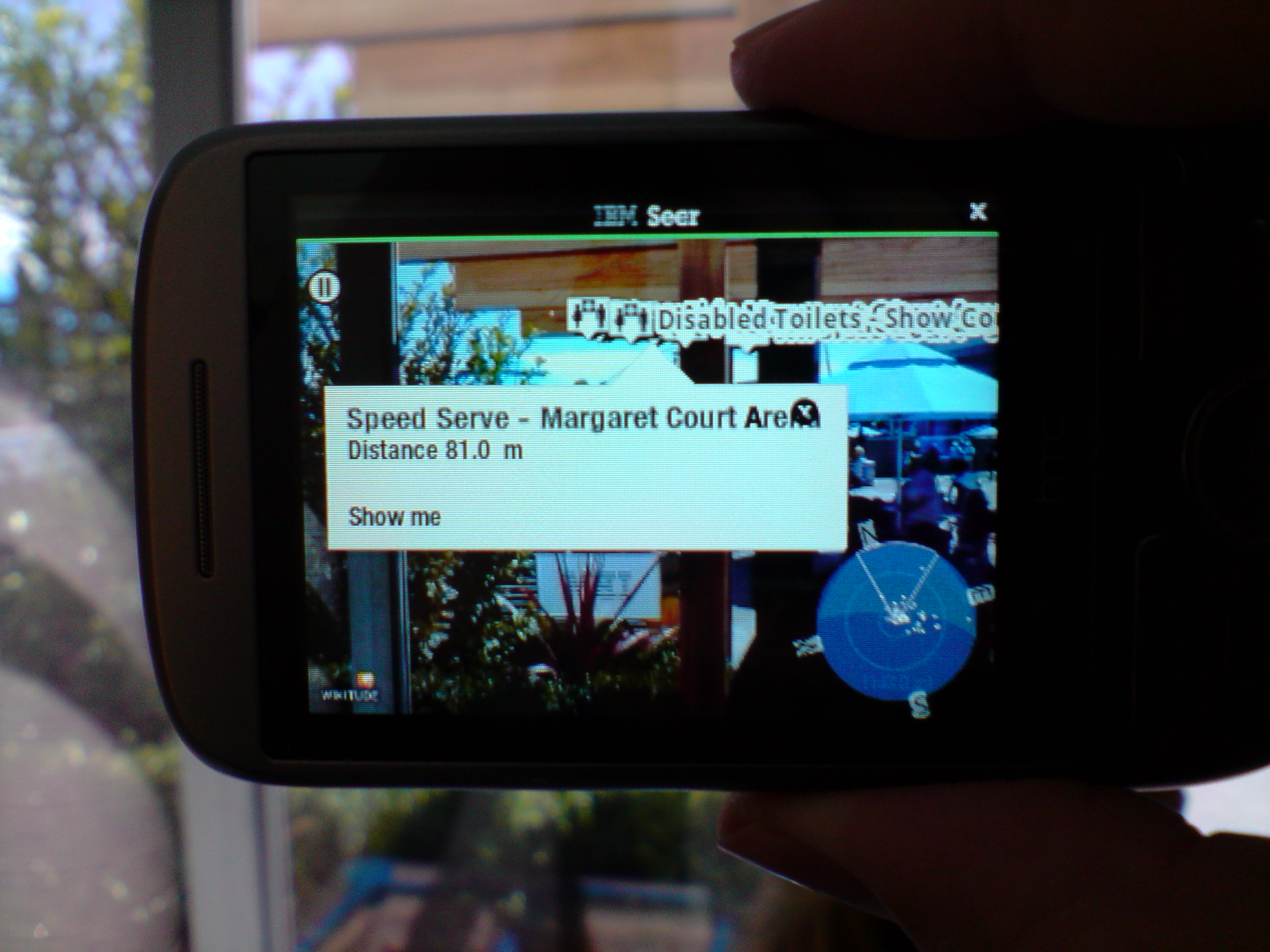
On Monday I visited the Australian Open [1] it s one of the world s greatest tennis championships and it s on in Melbourne right now. IBM sponsored my visit to show me the computer technology that they use to run the event and display the results to the world via their web site and to various media outlets. picture of IBM Seer software running on HTC Hero The first thing that they showed me was the IBM Seer software on the HTC Hero phone (which runs the Google Android OS). Seer can be freely downloaded from the Android store. The most noteworthy feature is that it uses the camera in the Android phone to display a picture of whatever you are looking at with points of interest superimposed (such as the above picture where I asked for locations of events and toilets). But it also displays a map view and has some other features I didn t get a chance to test such as viewing twitter data relevant to the event. We really need this augmented reality feature enabled with tourist data for major cities. I m sure that there s lots of interesting things I haven t seen in my own home city, if I could just pull out a phone and see a map of what s around me whenever I m bored I could see some of them. I think that this has the potential to change the way we use phones, in theory this was available as soon as Google Maps was released, but Seer seems to be the start of a whole new range of developments. One of the uses of this will be for identifying the background in tourist photos, no more of the me in front of old building descriptions. Here is a Youtube Video of the Seer software in action [BMLgHGV4zWM]. The tour guide explained that to get the software to work on an iPhone would require the 3GS for navigation as the earlier iPhones don t have a compass. The Seer software was initially developed for The Championships, Wimbledon 2009 which happened at about the same time as the iPhone 3GS release. I expect that there will be enough iPhone 3GS units sold before Wimbledon 2010 to give IBM a good incentive to port Seer to the iPhone. Three (my phone company at the moment) has just sold out of the HTC Magic which has a digital compass. They are selling the HTC Touch Pro and HTC Touch Diamond that appear to lack a digital compass. Vodaphone is offering a HTC Magic free on the $29 contract right now. The other Australian mobile phone companies don t seem to offer any Android phones. So it seems that the only option right now if I wanted to purchase a phone in Australia that can run Seer is the Vodaphone HTC Magic, and that s a phone that was released almost a year ago (a long time with recent progress in phone development it s the modem before the HTC Hero I tested) and which has only a 3.2MP camera (the LG U990 Viewty I used to take the picture for this post has a 5MP camera and is older than that). So I expect that there aren t many people using Seer in Australia. If you happen to be in Melbourne and have an Android phone with a digital compass then you may want to visit the Australian open to try the Seer software. It should work equally well from outside the security fence I ll write about the other things I saw over the next few days.

26 January 2010

Lucas Nussbaum: Re: How free is the Nokia N900?

Following my questions on the freeness of the Nokia N900, I received quite a lot of comments. I m trying to summarize the most important points here. For all the details, see the comments and Tollef s blog.

Guido G nther: Git-buildpackage and 3.0 source format

Here's a short overview of 3.0 source format support in git-buildpackage 0.4.64: One loose end is the handling of multiple upstream tarballs (#561071, #561072). I'd be great to hear from people already using this feature how this can best be added into the gbp workflow. The newer kids in town gbp-clone, gbp-pull (for keeping the repo up to date when using team maintenance) and gbp-pq (for managing the quilt patch-queue) don't care about the underlying source package format. These three are a bit underdocumented in the manual but information about the workflow is in the wiki.

25 January 2010

Joachim Breitner: Serna XML editor uploaded to Debian

The XML-Editor Serna by Syntext has been published as Free Software a few months ago. This was very good news, because there was a lack of a good free XML editors with a good graphical view on DocBook documents, which I needed to recommend to users of zpub. Therefore, I investigated packaging Serna for Debian. I had to patch a few things to make it compile on and64 and to use components shipped by Debian where possible. Today, I could finally close the RFP bug filed by W. Martin Borgert, as the serna package was accepted by the ftp-masters. The first bug (SEGFAULT on startup on lenny) is already filed. I hope this is a good sign, as it shows that there is interest in the package. For my packaging workflow, I used git-svn to import the upstream SVN branch into a git repository. I then use git-dpm by Bernhard R. Link to manage my changes as patches in the new 3.0 (quilt) debian source package. I must say that I prefer this approach to git-buildpackage, as there is only one git branch to publish. I hope that Bernhard uploads git-dpm to Debian soon. Serna is quite a big software project and uses stuff that I know little about (Qt, C++ with python interaction etc.). Also, the package currently bundles the DITA-OT package, which should rather be packaged separately. Therefore, I d be glad if co-maintainers would join the effort.

Russell Coker: Discovering OS Bugs and Using Snapshots

I m running Debian/Unstable on an EeePC 701, I ve got an SD card for /home etc but the root filesystem is on the internal 4G flash storage which doesn t have much spare space (I ve got a full software development environment, GCC, debuggers, etc as well as running KDE4). On some of my systems I ve started the practice of having two root filesystem installs, modern disks are big enough that usually it s difficult to use all the space, and even if you do use most of the space the use of a second root filesystem only takes a fraction of a percent of the available space. Today I discovered a problem with my EeePC, I had upgraded to the latest Unstable packages a few days ago and now when I run X programs the screen flickers really badly every time it s updated. Pressing a key in a terminal window makes the screen shake, watching a video with mplayer makes it shake constantly to such a degree that it s not usable. If that problem occurred on a system with a second root filesystem I could upgrade the other a few packages at a time to try and discover the root cause. But without the space for a second root filesystem this isn t an option. I hope that Btrfs [1] becomes ready for serious use soon, it seems that the btrfs snapshot facility might make it possible for me to preserve the old version in a bootable form before upgrading my EeePC (although even then disk space would be tight). So I guess I now need to test different versions of the X related packages in a chroot environment to track this bug down. Sigh.

MJ Ray: Critical Eye: Google, China, DNS and an Event

My Google Bugs page started off as a blog post back in 2006, but I ve moved it to a more permanent home and started to bring it up to date. Recent additions include the China Controversy updated, a recent search bug added andDNS service added. In just over a month, BathLitFest will be holding a debate on Is Google Good For You? Sunday 28 Feb, 1pm 2pm. The key questions are:
In the data-sharing and database age, how much information are we prepared to give away about ourselves and who, ultimately, controls that information? Is the price of convenient, high-speed communication an almost total loss of privacy? And is it right that one company knows more about us than our government, or even than we know ourselves?
Tickets are on sale, priced 7. That s pretty much what I was pointing out back in 2006. I don t hate Google or anything, but we should be realistic: it is a for-profit company, so probably won t be doing anything truly for free. There s always a payback and we should recognise it as part of making an informed choice about whether to trade with them. It s nice to see these questions getting a more mainstream airing. If you ve got any updates for the Google Bugs page, please let me have them.

22 January 2010

Michal Čihař: phpMyAdmin 3.4 will be feature killer

I know this is quite premature as we're just about to release 3.3, however development on 3.4 has already started in SVN and we've already implemented more than 20 requests from our features tracker. This is even bigger number than release 3.3 will have! Well the fact is that most of these things are cosmetic or tiny improvements, on the other side some of them were requested for very long time (the oldest one currently dates to 2003). The new features bring things such as direct blob download (thing we definitely should have earlier), links to documentation for SQL commands in highlighted SQL (what was quite easy, but nobody requested such thing and I added the feature after seeing that Adminer does this), possibility to directly bookmark most pages or exporting user privileges. See ChangeLog for more detailed list of features. You can try all new features on our demo server.

Theppitak Karoonboonyanan: Thailand Mini-DebCamp 2010

Hello, Planet Debian. I'm pleased to have announced about the first Debian event in Thailand: Thailand MiniDebCamp 2010. This is a follow-up to Taiwan MiniDebConf 2009 in last September in Taipei. At the end of that event, we discussed about having a mini-DebCamp in Thailand during the New Year holidays. However, with many factors, it has been moved to this March. And the date has been settled on 13-19 March. The place will be Khon Kaen University (KKU) in Khon Kaen, a north-eastern province of Thailand (close to Lao, if you look for it in a map). In this event, we plan to arrange a Bug Squad Party for the Squeeze release, and some meetings between DDs and local people, to encourage more Debian activities in Thailand and nearby countries. Thailand has started its GNU/Linux development and usage since no later than 1997. Currently, we have projects like Thai Linux Working Group for upstream Thai resource developments; OpenTLE.Org and thaiopensource.org for local distros (Ubuntu-based); and some communities like ubuntuclub, debianclub, and more others for other distros. The user base is slowly growing, while developer base is yet growing more slowly. We have had domestic events occasionally. But certainly, an international one like this would effectively encourage more prospecters, as well as create closer cooperations with the global projects. We also hope this event to be a meeting point for developers from nearby regions. And internationalization, among other issues, can be discussed and worked out. So, please be invited to join and discuss. Please make sure to add your name to the Wiki page so we can prepare things for you, including accommodation. And feel free to propose your agenda in BarCamp style. It will be summarized some time before the event date. We also have a mailing list for updates and discussions.

21 January 2010

Andrew Pollock: [tech] Finding the maximum message size

This was born from a need to see how big a ZIP file I could send my accountant in Australia, and scratching the itch to write some code. The fact that most SMTP servers talk Extended SMTP makes this relatively easy, and Python has some great modules for DNS and SMTP. One gripe I do have is how long it takes the Python modules to mature. It's taken until Python 2.6 for smtplib.SMTP() to gain a timeout parameter, for example. Anyway, I was able to write something nice and generic (it works for any domain) in around 100 lines, thanks in no small part to the DNS module, which makes getting a list of MX records stupidly easy.
$ ./maxmessagesize.py andrew.net.au
daedalus.andrew.net.au: -1
$ ./maxmessagesize.py pollock.id.au
ASPMX.L.GOOGLE.COM: 35,651,584
ALT1.ASPMX.L.GOOGLE.COM: 35,651,584
ALT2.ASPMX.L.GOOGLE.COM: 35,651,584
ASPMX2.GOOGLEMAIL.COM: 35,651,584
ASPMX3.GOOGLEMAIL.COM: 35,651,584
ASPMX4.GOOGLEMAIL.COM: 35,651,584
ASPMX5.GOOGLEMAIL.COM: 35,651,584
$ ./maxmessagesize.py debian.org
master.debian.org: 104,857,600
$ ./maxmessagesize.py cameronp.com
mail1.mysmarthost.com: 30,000,000
mail2.mysmarthost.com: 30,000,000
$ ./maxmessagesize.py ubuntu.com
mx.canonical.com: 62,914,560
$ ./maxmessagesize.py clug.org.au
mx.clug.org.au: 50,000,000
$ ./maxmessagesize.py linux.org.au
morton.linux.org.au: 52,428,800
It's good to see that in most cases of domains I tried, all of the MXes had the same maximum message size. Source code is here

Benjamin Mako Hill: Annual Free Software Foundation Membership Drive Appeal

I wrote this for the FSF's annual membership drive where it was originally published. I am reposting it here.
At its core, I think of free software as about the ability of computer users to take control of their technology. Insofar as our software defines our experience of the world and each other, software freedom is an important part of what allows us to determine the way we live, work, and communicate. Free software is not really about software in this fundamental sense; it's about bringing freedom to users through software. In free software's incredible success over the last two decades, many people have lost sight of this simple fact. We have created an incredible array of applications, libraries, and tools. We have created vibrant development and support communities. We have created new development methodologies, powerful copyleft licenses, and massive collaborative projects. But these are all how we give users freedom. They are not freedom itself. They are not what we were trying to achieve. They are our instruments, not our goal. This distinction becomes central in a world where technology is in flux. Indeed, we live in such a world. We can see signs of this in how, as most users' primary computers become mobile phones and new types of network services make up most of many users' interactions with computers, the free software movement's old applications, communities, development methodologies, and licenses can become ill-suited to, or ineffective at, protecting user freedoms. And indeed, in the next few years, bringing freedom to computer users will need to involve new software and new forms of advocacy. It will need to involve new licenses and new techniques for their enforcement. It will need to involve new forms of collaboration and organization. If the free software movement is to succeed, it must stay focused on computer users' freedom -- on the question of why we do what we do -- and then work creatively on how to best respect and protect the freedom we are working toward. If we are overly focused on how we've done things in the past, we may lose sight of the most fundamental goal of supporting users' control over their technology in general. There are many organizations that support the how of today's free software in various ways -- they are law firms and companies and nonprofit organizations supporting various free software projects. The Free Software Foundation is, by far, the most important organization focused on why --- on the underlying principle of software freedom. As such, it plays an essential role in keeping our broader community focused on the key issues, threats, and challenges that will affect the success of every free software project, and every computer user, in the present and in the future. In this period of rapid change in computer technology, its role is more vital than ever. The consequence of any failure is more dire. Here are some of the ways that I will be encouraging the FSF to serve the free software movement in the coming year: Mobile Phones In a short essay I wrote earlier this year, I pointed out that there are now billions of mobile phones and that, although these phones are increasingly powerful computers, they represent one of the most locked-down, proprietary, and unfree technologies in wide use. The implications of this fact for users' control over their technology are dire. Although some widely used phones make extensive use of free software, most free phones are locked down and Tivoized and their users remain fettered, divided, and helpless. We must raise awareness of free software issues among users of phones, communicate to users that phones are powerful general purpose computers, and explain that control over these devices has critical implications for individual autonomy in the future. Toward this end, the FSF staff will launch an advocacy campaign around mobile phones and software freedom in the coming year. Network Services As network services -- like those built by Facebook, Google, and others -- have continued to grow both in scope and penetration over the last year, the importance of a meaningful free software responses grows as well. The launch of products like Google's network-centric ChromeOS offers one glimpse of what a future computing platform may look like. The implications for user freedom, and for the effectiveness of traditional free software approaches, are frightening. The fact that many network services are built using free software does not make the effect of these services on users' autonomy and freedom any less catastrophic. In the next year, the FSF is planning to release the first of what I hope will be several statements on software freedom and network services. Building off the work of the FSF-supported group Autonomous, the Foundation will help provide guidelines for those implementing network services, for users deciding whether to use services, and for developers trying to build services that go further to respect their users' freedom. Reaching beyond our traditional communities Successfully fighting for user freedom is going to mean successfully reaching out to users outside the FSF's historical base . The FSF continues to do so with its Defective By Design anti-DRM campaign and its End Software Patents work. In the last year, the FSF has also reached out to younger users through its "GNU Generation" campaign run by and for high school students. Additionally, the FSF convened a summit this year on women in free software. The FSF plans to build on these successes in the coming year and to expand similar outreach projects. Of course, fighting for and promoting software freedom is more work than today's FSF has the resources to accomplish. Each of my three points above represents an ambitious undertaking, and yet just a portion of the items on the plate of the FSF's small but dedicated staff. Even just continuing its existing projects will require that the FSF adds hundreds of new members by the end of this period. Your membership and donations help make goals like this possible. A strong free software movement focused on the principled issues of software freedom -- and a strong FSF in particular -- will determine what freedoms the next generation of computer users will enjoy. At stake is no less than that next generation's autonomy. I know that this is not the first fundraising appeal you've read this season and I know that the weakened economy makes giving difficult for many. I understand that the cost of a membership or donation may be less easy to afford this year. But we also cannot afford a weakened FSF at this important point of technological transition. If you are not an FSF associate member, now is the time to become one. If you've read my appeal the last two years and decided to wait, now is the time to take the plunge. Membership is $120 per year ($60 for students) and payable monthly. If you are already a member, please join me in giving generously through a tax-deductible donation, or encourage a friend to sign up. The FSF is a small, humble organization of passionate individuals working tirelessly for our software freedom. I've seen firsthand that even small gifts make a difference.

Join now with a $10 monthly donation

20 January 2010

Theodore Ts'o: The Transitive Grace Period Public Licence: good ideas come around

I recently came across the Transitive Grace Period Public License (alternate link) by Zooko Wilcox-O Hearn. I fonud it interesting because it s very similar almost identical to something I had first starting floating about ten years ago. I called it the Temporary Proprietary License (TPL). I m sure this is a case of great minds think alike . One things that I like about my write up is that I gave some of the rationale behind why this approach is a fruitful one:
A while ago, I was talking to Jim Gettys at the IETF meeting in Orlando, and the subject of software licensing issues came up, and he had a very interesting perspective to share about the X Consortium License, and what he viewed as bugs in the GPL. His basic observation was this: Many companies made various improvements to the X code, which they would keep as proprietary and give them a temporary edge in the marketplace. However, since the X code base was continually evolving, over time it became less attractive to maintain these code forks, since it would mean that they would have to be continually merging their enhancements into the evolving code base. Also, in general, the advantage in having the proprietary new feature or speed enhancement typically degraded over time. After all, most companies are quite happy if it takes 18-24 months for their competitor to match a feature in their release. So sometime later, the companies would very often donate their previously proprietary enhancement to the X consortium, which would then fold it into the public release of X. Jim Gettys complaint about the GPL was that by removing this ability for companies to recoup the investment needed to make major developmental improvements to Open Source code bases, companies might not have the incentive do this type of infrastructural improvements to GPL ed projects. Upon reflection, I think this is a very valid model. When Open Vision distributed the Kerberos Administration daemon to MIT, they wanted an 18 month sunset clause in the license which would prevent commercial competitors from turning around and bidding their work against them. My contract with Powerquest for doing the ext2 partition resizer had a similar clause which kept the resizing code proprietary until a suitable timeout period had occurred, at which point it would be released under the GPL. (Note that by releasing under the GPL, it prevents any of Partition Magic s commercial competitors from including it in their proprietary products!)
For more, read the full proposal. No related posts.

Julian Andres Klode: python-apt 0.7.93 just hit unstable.


I just uploaded python-apt 0.7.93 to unstable with support for Python 2.6 and Python 3.1, meaning that there is now a single development branch again. This uploads brings developers the new API with real classes in apt_pkg (you can now use pydoc to view documentation), C++ bindings for making apt-pkg applications scriptable (although they should be considered experimental), a test suite (although aptsources fails in one test for now) and many new context managers for enhanced Python 3 coding fun. And objects are now freed when their reference count reaches 0. A more complete list of news can be found in the What s New In python-apt 0.7.100 part of the documentation. For the next releases until 0.7.100 release, the focus is clearly on fixing bugs and improving the documentation. We need more tests of the Python 3 builds, especially in areas dealing with str and unicode stuff. Have fun, read the documentation, and code. Posted in Debian

Robert Collins: LCA 2010 Wednesday


Pandora-build. There for support I ve contributed patches. Pandora is a set of additional glue and layers to improve autotools and make it easier to work with things like gettext and gnulib, turn on better build flags and so forth. If you re using autotools its well worth watching this talk or hop on #drizzle and chat to mtaylor :) The open source database survey talk from Selena was really interesting a useful way of categorising databases and a list of what db s turned up in what category. E.g. high availability,community development model etc. Key takeaway: there is no one-true-db. I gave my subunit talk in the early afternoon, reasonably well received I think, though I wish I had been less sick last week: I would have loved to have made the talk more polished. Ceph seems to be coming along gangbusters. Really think it would be great to use for our bzr hosting backend. 0.19 will stablise the disk format! However we might not be willing to risk btrfs yet :( Next up, the worst inventions ever.. catch it live if you can!

19 January 2010

Lior Kaplan: Hamakor, the Israeli Free Software Society, calls for the annulment of Software Patents


Following a call for submissions from the Israeli Patent Authority, the Israeli Free Software Society, Hamakor, submitted a memorandum calling for the annulment of the Software Patents. A Memorandum drafted by Adv. Jonathan J. Klinger, Hamakor s chief legal counsel, presented a tough and strict approach claiming that software patents harm innovation and incur high legal costs on software developers.
protecting software through patents shall provide protection on ideas, which are usually expressible in more than one manner, and shall be the beginning to a race to the bottom where every person shall register as many patents possible and incur high costs on each player in the software field , said Klinger, and added that the chilling effect created by the fear of using software protected by patents, be it free software or proprietary software, and incur costs on the system solely in order to purchase insurance from the theoretical patent infringement. In such case, any independent development of software without legal assistance from the first day of development shall be problematic, and deter developers from developing free software or promote innovation .
Until recently, the Israeli patent authority rejected Software Patents and provided protection only regarding hardware (in re Eli Tamir). However, the recent call for submissions had raised the fear that software patents shall be used to deter innovation. Currently, Israeli venture capital funds and technology evangelists often see patents as the core asset when protecting software companies from competition, which creates a race to the bottom that requires startups and innovative companies to register patents in order to raise funds. Hamakor presents, in its memorandum, a new approach focusing on people and not patents, as the core asset of the Israeli Innovation. See Also: Posted in Israeli Community, Software Patents Tagged: Hamakor, israel, Software Patents

Neil Williams: mobile broadband connections


  1. My Orange 3G mobile broadband USB modem won't operate properly with gnome-ppp because it doesn't use a real username or password and needs more customised chatscript support than gnome-ppp appears to be able to support.

  2. I stopped using network-manager-gnome and started using wicd instead due to problems with nm-applet at that time, which doesn't see the USB modem (and doesn't drop wlan0 for it either). I'm not sure if nm-applet would now work with the USB modem.

  3. I've got the modem working with sudo pon orange but I wanted a GUI.


Instead - and, frankly, just as an experiment to get used to auto-detecting things - I decided to write a little program that puts a status icon in place if HAL reports no modem capability, then raises a simple window to manage the connection when the modem becomes available. (I had a shell script using zenity that was almost good enough but without automated launch.)

The window is trivially simple, it just lists the available connections in /etc/ppp/peers and has a toggle button to connect or disconnect the selected connection. Almost no error checking, no configuration support for the pon scripts themselves. I might add a default connection using gconf later. Yes, I know it's HAL but PolicyKit/DeviceKit just seemed too complicated when it was simpler to use libhal's own dbus support.

I'm happy to just use this for me but if anyone else is interested in this kind of app, I might be persuaded to put the source code somewhere public and continue development with a view to uploading to Debian. Naturally, if gnome-ppp or wicd could be adapted to replace it, that would be good too. (I'll file wishlist bugs if it isn't just me who wants this - I only need this functionality for a few months and a quick and dirty version is enough just for me. By the time the bugs are fixed, I probably won't be using mobile broadband any more.)

17 January 2010

Olivier Berger: Some news of our efforts around OSLC-CM and future plans

OSLC-CM V1 is a proposed standard for REST APIs of bugtrackers, and in our seek for more interoperability in the bugtracker space, we ve been very interested in it. OSLC-CM is quite young and only so far implemented in proprietary tools (although elaborated in an open way) on the server side, and as we believe in FLOSS, we ve started trying to implement basics of server side plugins for a few bugtrackers.
In addition to a demo server that s simulating the behaviour of a bugtracker, we have started implementing a Mantis plugin and FusionForge and Codendi trackers add-ons (all PHP and based on Zend framework, see this project on picoforge). All are very basic, but we hope they will be the basis for future OSLC-CM compatible servers in these tools. At the same time we ve been experimenting with the code already published in Mylyn to support OSLC-CM on the client side. Not everything is public yet in Mylyn, as the elements that have been developped for some connectors of Tasktop to the proprietary tools are being ported to the open source code of Mylyn.
We have thus been able to use the Junit tests classes of Mylyn and tweak them in a way to connect to an instance of the demo server for Mantis (including handling some Basic auth), and be able to retrieve the first bugs descriptions :-) Now that this works, we ll try and add some Java code (maybe reusing Mylyn client libs) to doc4 (being developped as part of Helios) in order to start linking doc4 and Mantis so that this can be used in the Helios platform. This may involve mixing code of XWiki and Mylyn hmmm well, we ll see. Next steps may be also to try and implement a connector in Python that might be used in tools like bts-link. Then whichever Python or Java client libraries we have, will allow us to use them inside FetchBugs4.me to connect and harvest bugs of OSLC-CM compliant bugtrackers eventually. Lots of interesting developments ahead. Stay tuned.

Gustavo Franco: Dell Mini 10, now what?

Dear lazyweb, I bought a Dell Mini 10 and am curious on how and if you use it for some sort of Debian development.

I would like to use it in an almost stateless setup (think installed, but usb stick would do) to browse things and have a few git/svn repositories to build small packages.

It seems there are some issues with the Xorg driver for this -- sbo. Thoughts?

16 January 2010

Ingo Juergensmann: Drupal 7 alpha 1 released

As Dries Buytaert, the creator and head of development of Drupal, announced on Twitter, the new major (pre-)version of Drupal, namely Drupal 7 alpha 1 has been released! This was on the 9th birthday of Drupal.

This is great news and the release notes are mentioning some aspects why this is so:

Revamped User Interface
An incredible amount of work has gone into improving the user experience and administration interface. The new administration theme "Seven", the overlay module, the dashboard and the configurable shortcut bar, all lead to a much more user-friendly interface. In-place editing is enabled for blocks and nodes by default, so modifying the content of a site becomes much simpler.

Custom Fields
Drupal 7 bundles in the ability to add custom fields, similar in functionality to the Content Construction Kit (CCK) module. However, fields are no longer limited only to content types; they can be added to users, taxonomy terms, and other entities. Fields also have support for translations.

Image Handling
Drupal 7 brings native image handling to core. Image fields may be added to content, and have image styles applied to them, such as scaling, cropping, and other effects.
Update Manager
Building on Drupal 6's Update module, which keeps site administrators informed when new module and theme releases are available, the new Update Manger module can also install and upgrade modules and themes.

Front-end "under-the-hood" improvements
A new render API allows for highly granular theming, core template files have been revamped to provide more semantic markup, Drupal 7 now has built-in RDFa support, includes jQuery UI and a new AJAX framework, and a new core theme "Stark" which exposes Drupal's markup directly for those who want to dive in and start theming.

In addition, Drupal 7 has several major accessibility enhancements, making it the most accessible release of Drupal to date!

Back-end "under-the-hood" improvements
A revamped database layer resolving nearly all limitations in the Drupal 6 database layer, automated testing framework, new PHP stream-based file API that supports private and public files simultaneously, revamped node access system, new hooks for more flexible system interaction, an Entity API, a job queue API, and many, many, many more improvements.

Drupal 7 is also the most scalable release to date, with features such as built-in proxy server support, advanced caching techniques, and Content Delivery Network support for static files.


Alone the inclusion of CCK and Views are great news, whereas all PostgreSQL users will benefit from the new database layer under the hood. I've tested a pre-alpha development version some weeks ago and that Drupal 7 experience was already great. So, it would be nice to see Drupal 7 in Debian soon as well, but I guess a alpha 1 version might be too early to be packaged.

Next.

Previous.