Daniel Pocock: Is Uber on your side?

Crowdsourcing ventures with disruptive business models are a regular point of contention these days.
In London, taxi drivers are threatening to create gridlock as part of an anti-Uber protest. In Melbourne, Uber drivers have been issued with $1,700 fines for operating without a taxi license. San Francisco city officials, despite being the birthplace of many of these ventures, are debating whether AirBNB should be regulated.
An orderly society or an old-school protection racket?
Just what exactly is it that established players in these industries are trying to achieve through their protests and lobbying efforts?
In the case of apartment rentals, many people have sympathy for respecting the wishes of neighbourhoods over those of individual landlords. In the case of car pooling schemes, the arguments tend to come not from motorists at large but from those who are afraid of competition.
Without competition, could things be any worse?
Melbourne actually provides the perfect backdrop for this debate. Only a couple of years before Uber came on the scene, the government had made a detailed study into the taxi industry. One of Australia's most prominent economic experts, a former chairman of the Australian Competition and Consumer Commission spent 18 months studying the industry.
One of the highlights of the incumbent system (and the reason I suggest Melbourne is the perfect backdrop for this debate) is the way licenses are issued to taxi drivers. There are a fixed number of licenses issued by the government. The licenses are traded on the open market so prices can go up and down just like real-estate. Under the rules of Australia's pension scheme, people have even been able to use money from their pension fund to purchase a taxi license as an investment. It goes without saying that this has helped rampant speculation and the price of a license is now comparable to the price of a house.
 The end result is that no real taxi driver can afford a license: most of them have to rent their license from one of the speculators who bought the license. These fixed rental fees have to be paid every month whether the driver uses their car or not. Consequently, taxi drivers have cut back on other expenses, they are often criticised for failing to keep their cars clean and the industry as a whole is criticised due to the poor quality of drivers who don't even know their way around the city. The reason, of course, is simple: by the time some newly arrived immigrant has learnt his way around Melbourne he has also figured out that the economics of driving a taxi are not in his favor. Realizing there is no way to break even, they take other jobs instead.
It was originally speculated that the government review would dramatically reduce or abolish these speculative practices but ultimately lower license charges have only been used for the issue of 60 new licenses, barely 1% of the taxi fleet in the city today. Furthermore, the new licenses were only available to existing players in the industry.
Uber to the rescue?
Uber drove into the perfect storm as they launched their service in Melbourne in 2013.
Uber drivers get a significant benefit over their competitors in traditional taxis. In particular, as they don't have the fixed monthly payment to rent a taxi license, they don't have to work every day and can even take holidays or take time to clean the cars. These things may simultaneously benefit road safety and passenger comfort.
Meanwhile, those people who speculated on the old taxi licenses have tried hunger strikes and all kinds of other desperate tactics to defer the inevitable loss of their "investment".
The reality is that crowdsourcing is here to stay. Even if Uber is stopped by bullying and intimidation, the inefficiency of Melbourne's taxi system is plain for all to see and both customers and drivers will continue looking for alternatives. Other car-pooling apps based on barter or cost sharing will continue to find ways to operate even if the Uber model is prohibited.
It is interesting to note that the last great reform of Melbourne taxis, under Premier Jeff Kennett in the 1990s, simply resulted in a change of paint with the aim of making them look like those in New York City. Disruptive services like Uber (with their numerous technology-powered innovations to save time and money) appear to be doing far more to improve the lives of passengers and drivers.
The hidden cost
That said, large scale schemes like Uber do also have a down side for customer privacy. Hailing cabs in the street leaves no records of your movements. This new model, however, is leaving a very detailed trail of breadcrumbs that can be used for both marketing purposes or extracted (lawfully or otherwise) by some third party who wishes to monitor a particular customer's past or future movements. This is the trade-off that arises when we benefit from the efficiencies of any cloud-based service.
The end result is that no real taxi driver can afford a license: most of them have to rent their license from one of the speculators who bought the license. These fixed rental fees have to be paid every month whether the driver uses their car or not. Consequently, taxi drivers have cut back on other expenses, they are often criticised for failing to keep their cars clean and the industry as a whole is criticised due to the poor quality of drivers who don't even know their way around the city. The reason, of course, is simple: by the time some newly arrived immigrant has learnt his way around Melbourne he has also figured out that the economics of driving a taxi are not in his favor. Realizing there is no way to break even, they take other jobs instead.
It was originally speculated that the government review would dramatically reduce or abolish these speculative practices but ultimately lower license charges have only been used for the issue of 60 new licenses, barely 1% of the taxi fleet in the city today. Furthermore, the new licenses were only available to existing players in the industry.
Uber to the rescue?
Uber drove into the perfect storm as they launched their service in Melbourne in 2013.
Uber drivers get a significant benefit over their competitors in traditional taxis. In particular, as they don't have the fixed monthly payment to rent a taxi license, they don't have to work every day and can even take holidays or take time to clean the cars. These things may simultaneously benefit road safety and passenger comfort.
Meanwhile, those people who speculated on the old taxi licenses have tried hunger strikes and all kinds of other desperate tactics to defer the inevitable loss of their "investment".
The reality is that crowdsourcing is here to stay. Even if Uber is stopped by bullying and intimidation, the inefficiency of Melbourne's taxi system is plain for all to see and both customers and drivers will continue looking for alternatives. Other car-pooling apps based on barter or cost sharing will continue to find ways to operate even if the Uber model is prohibited.
It is interesting to note that the last great reform of Melbourne taxis, under Premier Jeff Kennett in the 1990s, simply resulted in a change of paint with the aim of making them look like those in New York City. Disruptive services like Uber (with their numerous technology-powered innovations to save time and money) appear to be doing far more to improve the lives of passengers and drivers.
The hidden cost
That said, large scale schemes like Uber do also have a down side for customer privacy. Hailing cabs in the street leaves no records of your movements. This new model, however, is leaving a very detailed trail of breadcrumbs that can be used for both marketing purposes or extracted (lawfully or otherwise) by some third party who wishes to monitor a particular customer's past or future movements. This is the trade-off that arises when we benefit from the efficiencies of any cloud-based service.
 Take a sneak peek into the sophisticated engineering processes underway here at the Hanson Robotics Lab in sunny Hong Kong.
 Debian has recently received a donation of 8 build machines from Marvell. The new machines come with


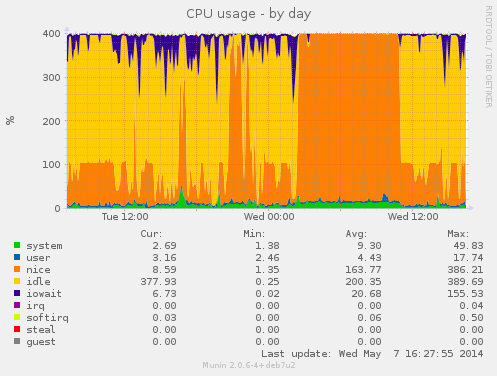 During this buildd cpu usage graph, we see most time only one CPU is consumed. So for fast package build times.. make sure your packages supports parallel building. For developers, abel.debian.org is porter machine with Armada XP. It has schroot's for both armel and armhf. set "DEB_BUILD_OPTIONS=parallel=4" and off you go. Finally I'd like to thank Thomas Petazzoni, Maen Suleiman, Hector Oron, Steve McIntyre, Adam Conrad and Jon Ward for making the upgrade happen. Meanwhile, we have unrelated trouble - a bunch of disks have broken within a few days apart. I take the warranty just run out... [1] only from Linux's point of view. - mv78200 has actually 2 cores, just not SMP or coherent. You could run an RTOS on the other core while you run Linux on the other.
 As promised, today I would like to write a bit about the making of


 I guess I ve had them around for a while Maybe I should clean these up
 I ve done some clean-up in the Debian BTS. The result can be seen in the QA graphs:
 The last remaining 6 bugs are only affecting OpenStack Essex (which is what Wheezy ships, and which unfortunately I have not enough time to support properly), and the last one is waiting for FTP masters approval after I added Python 3 support to oslo-config (OpenStack is slowly moving to Python3, and I ve tried to add support to Python3 in the packages as well each time it was possible). Also, the Icehouse packages have passed the tempest tests (a set of functional tests) which we run in our continuous integration system.
As I was doing some triaging, it is possible that some bugs have been closed a bit quickly (like for example the Ceilometer FTBFS which I couldn t reproduce, even with sbuild and cowbuilder), so it is well possible that some more QA work will be needed later on. I m also expecting a new set of patches for supporting Ceph in Nova. I m sure there s issues which we will discover later on, however, it is nice to have this result right after the first Icehouse release of OpenStack.
Next up: testing new components that I uploaded for this release: Trove (DB as a Service), Designate (DNS as a Service), Ironic (Metal as a Service, or cloud computing on bare-metal), and TripleO (OpenStack on OpenStack). I unfortunately know already that TripleO and Tuskar wont really work yet, and that it needs some patches to be sent upstream for it to support Debian correctly (let s work it out for Juno!). So please consider it as a technology preview only. Though Trove, Designate and Ironic are supposed to be in good enough shape, I didn t have the chance to test them more than just installing the packages and checking daemons are running and connected to the various components of OpenStack (eg: database, keystone and RabbitMQ). Please do test them and report bugs in the BTS.
I d like to thanks Gustavo Panizzo & Thomas Bechtold who contributed to this release, and also the folks at eNovance (Emilien, Cyril, Seb ) who provided precious help with the CI and package quality. See you in the Juno Atlanta design summit next week (as hopefully, my plane ticket issue will be soon solved).
 Yesterday I received an automated alert from my
 An issue with the integration between
 If you're looking to get started at packaging free software for
 While taking the tram to our favourite Croatian restaurant,
I spotted something dedicated to Ada. We ll never know which
one the language, the famous programmer, or someone else.

 The GNOME and many other infrastructures have been recently attacked by an huge amount of subscription-based spam against their Mailman istances. What the attackers were doing was simply launching a GET call against a specific REST API URL passing all the parameters it needed for a subscription request (and confirmation) to be sent out. Understanding it becomes very easy when you look at the following example taken from our apache.log:
 So the Kelly report of the independent review into the events leading to the Co-operative Bank s capital shortfall was published yesterday. During the day, I was putting odd bits from it out in 140 characters with the hashtags #coops #kellylessons. Here they are in one more permanent place. How many of these lessons has your organisation whether a co-op or not learned?



 I'm mostly back into my normal routine now. Next week should be spot on. Today,
after my chiropractic adjustment and another walk to the post office to collect
another package, I got stuck into cleaning the house.
I got that mostly done before my massage, and knocked out the rest of it before
I picked up Zoe from Kindergarten.
Zoe seems to have successfully dropped her day time nap at Kindergarten now,
which certainly makes a huge difference to getting out of the place on time.
I'd underestimated the number of kids coming to Zoe's birthday party, so I
needed to get some extra goody bags made up, so we headed directly out to
Westfield Carindale to raid the The Reject Shop for some more bits and pieces.
After we got home from that, Zoe watched a bit of TV and helped me assemble the
extra bags, and then we had dinner.
After some epic procrastination (on Zoe's behalf) I managed to get her to bed
approximately on time. I really need to try some different approaches to
getting through the bath time routine, because it's just taking too long. I
gave myself a couple of time outs because I could see the situation
deteriorating if I didn't. It's unhelpful that my blog seems to be the third
hit in Google at the moment for "positive parent procrastination". I don't have
the answers.
 Last week, in the spirit of always getting better, I asked Twitter how
to practice saying "um" less while speaking. Here's what I learned.
Most people suggested to practice intentionally inserting pauses instead
of saying "um". Various strategies include voice acting classes, having
a friend aid with a buzzer (presumably to help you notice), and to
record practice sessions as well as the real deal.

 The