Search Results: "ana"

14 March 2014

Richard Hartmann: Git prize: Outstanding Contribution to Open Source/Linux/Free Software

In February, Linux Magazine contacted me, asking if I would be willing to accept the Linux New Media Award 2014 in the main category "Outstanding Contribution to Open Source/Linux/Free Software" on behalf of the Git community due to my involvement with evangelizing and vcsh. Needless to say, I was thrilled. I managed to poke Junio via someone at Google and he agreed. We also reached out within the German Git community and two maintainers of git submodule, Jens Lehmann and Heiko Voigt, joined in as well. While we didn't manage to hammer out interoperability issues of vcsh and git submodule due to time constraints and too much beer, we are planning to follow up on that. Git beat OpenStack, Python, and Ubuntu by a huge margin; sadly I don't have exact numbers (yet). More details and a rather crummy photo can be found in Linux Magazine's article. A video of the whole thing will uploaded to this page soonish. If it appears that we kept our "speech" very short, that was deliberate after the somewhat prolonged speeches beforehand ;) The aftershow event was nice even though the DJ refused to turn down the music down to tolerable levels; his reaction to people moving father away, and asking him to turn down the volume a bit, was to turn it up... Anyway, given the mix of people present during the award ceremony, very interesting discussions ensued. While I failed to convert Klaus Knopper to zsh and git, at least there's a chance that Cornelius Schuhmacher will start using vcsh and maybe even push for a separation of configuration and state in KDE. The most interesting tidbits of the evening were shared by Abhisek Devkota of cyanogenmod fame. Without spilling any secrets it's safe to say that the future of cyanogenmod is looking extremely bright and that there are surprises in the works which will have quite the impact. Last but not least, here's the physical prize: Glass trophy held by your's truly

Neil Williams: LAVA server on an arndale

(ARMv7 A15 dual core) I ve covered how I set up my home LAVA lab and how I got two iMX.53 boards running, the next step was to sort out the LAVA server. My initial setup relied on using my Thinkpad as the server. This was somewhat convenient as that s how I develop the code, but didn t help me run jobs like health checks because the laptop was usually somewhere other than on the home LAN. There had been a long-standing problem with using LAVA on ARM the uwsgi support didn t compile but the code being used was old. As the same code has been in Debian for a long time, I suspected that this was fixed with a newer version. So as part of migrating LAVA to django1.6, apache2.4, postgres9.3, django-tables2 0.13 and a few other updated dependencies, I have been using the version of uwsgi from Debian unstable for quite a while without problems on x86. A simple tweak to the LAVA setup scripts and a newer version of uwsgi became available and it builds just fine on armhf. (I haven t tried armel because Linaro is ARMv7 or newer and we don t test with ARMv5/ARMv6 boards, so there s no point in trying armel it s not likely to be an issue for this fix though.) (Only the current lava-deployment-tool methods need to actually compile uwsgi directly from upstream without any patches the packaging which will replace l-d-t uses precompiled binaries, just as any admin would expect.) That initial install was on one of the iMX.53 boards, which ran as slowly as anyone who has used an iMX.53 would expect. I haven t run test jobs on that install, it had a hard enough time serving the frontend. Clearly some more cores would be a good step and when an arndale became available for the home lab, the next step was to get a SATA drive onto the arndale, put Debian unstable on that and then deploy LAVA to the arndale using the Debian packages. As a bonus, these packages are built for django1.6 (using an unreleased branch). Sounds simple enough. It works on iMX.53, it should work on an arndale. Well, it does but only after some unexpected faff. arndale, u-boot and SATA I hate u-boot every single time I ever touch it, the little I know about any other u-boot device is completely useless. Uniformity is a good thing infinite permutations are just rope to hang ourselves with cute embedded nonsense hacks and I m bored of that whole scene. So, boot the arndale, interrupt the bootloader to get to the prompt. What s the first thing most people would want? help. Denied this particular u-boot has been compiled without the ability to display any help messages. u-boot has just sunk further into the depths of please can we have something else which is uniform across devices . OK, well maybe I can get by without help. sata init unknown command sata . (Go away, do something else for a bit.) The arndale isn t one of the newest boards in the ARMv7 world, LAVA has been using them for a while, so someone has probably done some work to fix this . nope. There s a workaround a nice detailed guide by Phil Endecott which details that the kernel needs to continue to be loaded from SD and then the SATA can be used for just the rootfs. Mildly annoyed (I was hoping to be able to update the arndale kernel without the hassle of mounting the SD card at all), the rest was straight-forward. Preparing the SATA and installing Debian Due to the complexity of some of the transitions currently ongoing in Debian ahead of the Jessie release freeze, uwsgi is not in Debian testing right now so this install has to be Debian unstable. That s OK, I ve been running Debian unstable on all my machines for several years now usually updating ~5 times a week.

# parted /dev/sda -s unit mb mktable msdos
# parted /dev/sda -s unit mb mkpart primary 1 -- "-0"
# mkfs.ext4 /dev/sda1
# mount /dev/sda1 /mnt/root/
(note the in the mkpart command, that catches me out most times I try this. Without it, the special -0 gets interpreted as an option to parted but parted doesn t then tell you how to fix it, it just complains about an unknown option.) The SD image I am using is a LAVA master image, based on Ubuntu, so it was easy to put debootstrap onto it.

# apt-get install debootstrap
# debootstrap --arch=armhf sid /mnt/root/ http://ftp.uk.debian.org/debian
# chroot /mnt/root/
Inside the chroot, it s Debian as usual:

apt-get update
apt-get install emdebian-archive-keyring
passwd
emdebian-archive-keyring is a package I (ab)use to sign my LAVA packaging as it has the advantage of being in Debian and Ubuntu going back to the time of Lenny, so it is always available from a repository which has already been authenticated to apt and doesn t involve downloading some random key from a website. I use passwd manually because this rootfs won t be using auto-login, it will have regular users. root passwords can be automated, if necessary. Thinking about login, remember to give the rootfs a usable tty. (The LAVA master image has a nasty habit of mangling editors like nano and vi when used over serial, so I m using echo.) For the arndale you need:

# echo T0:23:respawn:/sbin/getty -L ttySAC2 115200 vt102 >> ./etc/inittab
# echo >> ./etc/securetty
# echo ttySAC2 >> ./etc/securetty
Then to make the hostname useful, adapt this to your needs:

echo 127.0.0.1 arndale.codehelp arndale >> ./etc/hosts
Finally, get the network running at boot and add the LAVA repository:

# echo auto lo eth0 > ./etc/network/interfaces.d/arndale
# echo iface lo inet loopback >> ./etc/network/interfaces.d/arndale
# echo iface eth0 inet dhcp >> ./etc/network/interfaces.d/arndale
# echo deb http://people.linaro.org/~neil.williams/lava sid main >> ./etc/apt/sources.list.d/lava.list
# apt-get update
# exit
Once the LAVA packaging is finalised, the packages will be uploaded to a normal Linaro PPA, I ll update the packages to use an official download location and we ll move to using sane version string handling. For now, the packages are still in development. Code for the packaging is in Alioth but there are issues with anonymous access to the pkg-linaro-lava repositories currently, so I ve also pushed to http://github.com/Linaro if you are interested in building the packages yourself. See also my packaging guide which is also linked from the Links page on my own site. With that done, time to reboot, set the SATA drive as the rootfs using the horrid u-boot and install LAVA.

# reboot
> setenv bootargs console=tty0 console=ttySAC2,115200n8 drm_kms_helper.edid_firmware=edid-1920x1080.fw root=/dev/sda1
> boot
login
# apt-get install postgresql
After this operation, 63.0 MB of additional disk space will be used.

# apt-get install lava-server
After this operation, 231 MB of additional disk space will be used.

# a2dissite 000-default
# a2ensite lava-server
# apache2ctl restart
# service lava-server restart
Take note of the IP address of your new ARM LAVA server and sign in with your regular details, e.g. using OpenID before creating a temporary superuser:

# lava-server manage createsuperuser --username default --email=user@example.com
Choose a temporary password, log out, log in as the temporary superuser, promote your regular user to superuser and default owner of unrestricted devices in the django admin interface. Finally, log out and login as regular user to delete the temporary user. (Yes, that probably could do with some improvement remind me later and I ll see if a known user can be promoted from the command line.) See also Senthil s recent post on LAVA unit tests. Getting those to run without so many steps is also on the TODO list. Results
IP Address: 127.0.0.1
Is Master? : True
Uptime: 6:02:23.700000
Architecture: armv7l
Platform: Linux-3.10.1.0-1-linaro-arndale-armv7l-with-debian-jessie-sid
Insignal Arndale evaluation board based on EXYNOS5250
System memory: 1998MiB
Next! I m working on some code upstream to make it easier to add devices from the command line. The aim is that a set of simple commands will set up an initial device, run a job on that device and submit a result bundle to the LAVA server as job #1. This gives some assurance that everything has gone well. Now I can finally add health checks for the iMX.53 boards and start regular tests on those boards. The cubie boards will wait for a later blog post, there are interesting problems with the bootloader and serial connections. That s a whole different rant.

12 March 2014

Matthew Garrett: Dealing with Apple ACPI issues

I wrote about Thunderbolt on Apple hardware a while ago. Since then Andreas Noever has somehow managed to write a working Thunderbolt stack, which awesome! But there was still the problem I mentioned of the device not appearing unless you passed acpi_osi="Darwin" on the kernel command line, and a further problem that if you suspended and then resumed it vanished again.

The ACPI _OSI interface is a mechanism for the firmware to determine the OS that the system is running. It turns out that this works fine for operating systems that export fairly static interfaces (Windows, which adds a new _OSI per release) and poorly for operating systems that don't even guarantee any kind of interface stability in security releases (Linux, which claimed to be "Linux" regardless of version until we turned that off). OS X claims to be Darwin and nothing else. As I mentioned before, claiming to be Darwin in addition to Windows was enough to get the Thunderbolt hardware to stay alive after boot, but it wasn't enough to get it powered up again after suspend.

It turns out that there's two sections of ACPI code where this Mac checks _OSI. The first is something like:

if (_OSI("Darwin")) Store 0x2710 OSYS; else if(_OSI("Windows 2009") Store 0x7D9 OSYS; else

ie, if the OS claims to be Darwin, all other strings are ignored. This is called from \_SB._INI(), which is the first ACPI method the kernel executes. The check for whether to power down the Thunderbolt controller occurs after this and then works correctly.

The second version is less helpful. It's more like:

if (_OSI("Darwin")) Store 0x2710 OSYS; if (_OSI("Windows 2009")) Store 0x7D9 OSYS; if

ie, if the OS claims to be both Darwin and Windows 2009 (which Linux will if you pass acpi_osi="Darwin"), the OSYS variable gets set to the Windows 2009 value. This version gets called during PCI initialisation, and once it's run all the other Thunderbolt ACPI calls stop doing anything and the controller gets powered down after suspend/resume. That can be fixed easily enough by special casing Darwin. If the platform requests Darwin before anything else, we'll just stop claiming to be Windows.

Phew. Working Thunderbolt! (Well, almost - _OSC fails and so we disable PCIe hotplug, but that's easy to work around). But boo, no working battery. Apple do something very strange with their ACPI battery interface. If you're running anything that doesn't claim to be Darwin, Apple expose an ACPI Control Method battery. Control Method interfaces abstract the complexity away into either ACPI bytecode or system management traps - the OS simply calls an ACPI method, magic happens and it gets an answer back. If you claim to be Darwin, Apple remove that interface and instead expose the raw ACPI Smart Battery System interface. This provides an i2c bus over which the OS must then speak the Smart Battery System protocol, allowing it to directly communicate with the battery.

Linux has support for this, but it seems that this wasn't working so well and hadn't been for years. Loading the driver resulted in modprobe hanging until a timeout occurred, and most accesses to the battery would (a) take forever and (b) probably fail. It also had the nasty habit of breaking suspend and resume, which was unfortunate since getting Thunderbolt working over suspend and resume was the whole point of this exercise.

So. I modified the sbs driver to dump every command it sent over the i2c bus and every response it got. Pretty quickly I found that the failing operation was a write - specifically, a write used to select which battery should be connected to the bus. Interestingly, Apple implemented their Control Method interface by just using ACPI bytecode to speak the SBS protocol. Looking at the code in question showed that they never issued any writes, and the battery worked fine anyway. So why were we writing? SBS provides a command to tell you the current state of the battery subsystem, including which battery (out of a maximum of 4) is currently selected. Unsurprisingly, calling this showed that the battery we wanted to talk to was already selected. We then asked the SBS manager to select it anyway, and the manager promptly fell off the bus and stopped talking to us. In keeping with the maxim of "If hardware complains when we do something, and if we don't really need to do that, don't do that", this makes it work.

Working Thunderbolt and working battery. We're even getting close to getting switchable GPU support working reasonably, which is probably just going to involve rewriting the entirety of fbcon or something similarly amusing.

comment count unavailable comments

Petter Reinholdtsen: How to add extra storage servers in Debian Edu / Skolelinux

On larger sites, it is useful to use a dedicated storage server for storing user home directories and data. The design for handling this in Debian Edu / Skolelinux, is to update the automount rules in LDAP and let the automount daemon on the clients take care of the rest. I was reminded about the need to document this better when one of the customers of Skolelinux Drift AS, where I am on the board of directors, asked about how to do this. The steps to get this working are the following:
  1. Add new storage server in DNS. I use nas-server.intern as the example host here.
  2. Add automoun LDAP information about this server in LDAP, to allow all clients to automatically mount it on reqeust.
  3. Add the relevant entries in tjener.intern:/etc/fstab, because tjener.intern do not use automount to avoid mounting loops.
DNS entries are added in GOsa , and not described here. Follow the instructions in the manual (Machine Management with GOsa in section Getting started). Ensure that the NFS export points on the server are exported to the relevant subnets or machines:
root@tjener:~# showmount -e nas-server
Export list for nas-server:
/storage         10.0.0.0/8
root@tjener:~#
Here everything on the backbone network is granted access to the /storage export. With NFSv3 it is slightly better to limit it to netgroup membership or single IP addresses to have some limits on the NFS access. The next step is to update LDAP. This can not be done using GOsa , because it lack a module for automount. Instead, use ldapvi and add the required LDAP objects using an editor.
ldapvi --ldap-conf -ZD '(cn=admin)' -b ou=automount,dc=skole,dc=skolelinux,dc=no
When the editor show up, add the following LDAP objects at the bottom of the document. The "/&" part in the last LDAP object is a wild card matching everything the nas-server exports, removing the need to list individual mount points in LDAP.
add cn=nas-server,ou=auto.skole,ou=automount,dc=skole,dc=skolelinux,dc=no
objectClass: automount
cn: nas-server
automountInformation: -fstype=autofs --timeout=60 ldap:ou=auto.nas-server,ou=automount,dc=skole,dc=skolelinux,dc=no
add ou=auto.nas-server,ou=automount,dc=skole,dc=skolelinux,dc=no
objectClass: top
objectClass: automountMap
ou: auto.nas-server
add cn=/,ou=auto.nas-server,ou=automount,dc=skole,dc=skolelinux,dc=no
objectClass: automount
cn: /
automountInformation: -fstype=nfs,tcp,rsize=32768,wsize=32768,rw,intr,hard,nodev,nosuid,noatime nas-server.intern:/&
The last step to remember is to mount the relevant mount points in tjener.intern by adding them to /etc/fstab, creating the mount directories using mkdir and running "mount -a" to mount them. When this is done, your users should be able to access the files on the storage server directly by just visiting the /tjener/nas-server/storage/ directory using any application on any workstation, LTSP client or LTSP server.

Andrew Pollock: [life] Day 43, a lovely lazy day, until we got on the bike

Zoe slept through the night again last night. Two nights of uninterrupted sleep has been totally amazing! We had a slower start to the day because we didn't have to be anywhere. I've been meaning to do a massive cull of Zoe's wardrobe for a while, and this morning seemed like as good an opportunity as any, so after TV, I managed to get Zoe to cooperate with trying on clothes for about an hour. She really enjoyed pulling everything out of her wardrobe and putting it all back again neatly. After that, she asked me if I could make her a bus out of the last remaining moving box, so I managed to make something approximating a bus. The port-a-robe boxes are really rather handy for this sort of thing. The balcony is starting to look like a cardboard box shanty town, with a cubby house, a rocket and now a bus. I think we need to host a few more play dates so they all get a good work out. It was time for lunch after that. I'd had a bucket of caramel popcorn, which I used for the journey to Coochiemudlo the other week. Zoe had asked me how popcorn was made, so I had resolved to make popcorn with her sometime soon. Yesterday at the health food shop, I opportunistically noticed some popping corn, so I grabbed a small bag of it. It turned out that buying peanut oil was good for more than just making peanut butter, as it came in handy today for popping corn. I've never popped corn before, aside from occasionally getting a bag of the microwave stuff, so it was a fun experience to do it "from scratch". It turned out pretty well, with only a few burned ones and a few unpopped ones. It'd be fun to try and dry out a corn cob and totally do it from scratch. After that I tried to get Zoe to take a nap, but it didn't work out so well, so after her quiet time we cleaned up her bedroom and generally fooled around for a bit. Throughout the day, Zoe did lots of little bouts of self-directed play. She dredged up this little wooden xylophone that we'd made in the US from a Kiwi Crate and had a great time banging away on it until she stood on it and broke it. The doctor's kit got a good workout. It was just a really nice, relaxing day at home. Zoe's Kindergarten was having a play date meet-and-greet in the park, for all the parents to meet each other. It was a fair way from home, but there was a nice, albeit circuitous, bike path to get there, and I decided to try and bike there, without really properly estimating the distance or length of time it would take. The play date was due to start at 3:30pm, and I was planning on leaving at 3pm. We were about 5 minutes late getting out of the door. I think it ended up taking us about 50 minutes to get there. It was a beautiful ride though, once we got onto the Bulimba Creek bikeway, through the Minippi Parklands. It would have been the longest ride Zoe's had on the bike, and she wasn't fazed at all. The play date itself was nice. For some reason, I'm a bit shy about going and introducing myself to the mothers (I kept wanting to write "other mothers"), but I sucked it up and made a few introductions. I'm terrible about remembering names though. At least I've got a few faces I can say hi to at drop off and pick up now. Sarah met us at the park and hung out for a bit as well, and then Zoe and her left together and I biked back home. I was feeling pretty good, and thought I'd try and bang out a run when I got home, but I didn't end up having the fuel in the tank, and blew up after about 1.5km.

11 March 2014

Andrew Pollock: [life] Day 42, a good night's sleep, Kindergarten, make up swim class and dinner with Nana

Zoe slept through the night for the first time in recent memory, and was up at around 6am. It was lovely. I'm thinking the slightly lower temperature helped. I'm definitely going to explore air conditioning for the bedrooms before next Summer. I'd picked up some egg cups on the weekend, so we did soft boiled eggs in the Thermomix for breakfast. They turned out lovely this time, and Zoe seemed to enjoy eating hers. She dressed herself while they were cooking. Her Kindergarten t-shirts arrived yesterday, so now she looks like all the other kids. It's very cute. It rained on and off in the morning, and I was in two minds about whether to chance it on the bike or not. As it happened we ended up messing around a bit before leaving, so we drove, and it was a good call, because it started raining again as we pulled out of the driveway. Drop off was super smooth. Megan had been away yesterday, but was back today, so Zoe was very happy to see her. My financial advisor came out for a chat about investments mid-morning, and then I got stuck into my US taxes. I will not miss having to do these tax returns. The 2013 one is going to be particularly complicated by the fact we sold our home and were only in the country for like 80 days. I biked over to Kindergarten to pick up Zoe, as the weather had improved. Surprisingly, she was awake, but her teacher said she'd just woken up from a nap. We managed to clear out pretty quickly. I stopped at the health food shop on the way home to get some peanut oil for the dinner I was making. Due to a miscommunication, Zoe had missed her Saturday swim class. I explained to the swim school the error, and they were kind enough to allow Zoe to have a make up class anyway, so we went to that after Kindergarten. Zoe wanted to do some more practice riding her bike. She's got a little 10 inch bike with no training wheels and a gyrobike front wheel. We haven't had a lot of success learning to ride to date, due to a combination of her height and just time, so it was interesting that she decided today she wanted to do some more practice. She wanted to "ride" her bike from home to the park on the way to swim class, but I managed to convince her to walk the bike to the park. It turns out even walking the bike is a bit of a challenge for her, so I ended up carrying it most of the way. It's heavy. We got to the park, and had a bit of a run with the bike. I'm glad I decided to take her knee pads and elbow pads, because she did stack it fairly decently, but managed to survive mostly unscathed. To her credit, she even got back on the bike again. She's a tough kid. Once we made it to the playground, she lost all interest in the bike, and we had about 15 minutes to kill before we needed to continue to the pool. We walked/carried the bike from the park to the pool, and the make up class Zoe ended up in was Megan's regular class, so the girls had a great time together. After swim class, we walked back home. Zoe's Nana was coming over for dinner, and I wanted to make a satay chicken dish. I'd bought some peanuts from the Peanut Wagon on Sunday, when I was in Nanango for my uncle's 90th birthday party, and I wanted to try making peanut butter from scratch in the Thermomix, and use that to make the satay sauce. Long story short, dinner wasn't super great. I'd made a satay chicken in the Thermomix previously, but I couldn't find the recipe I used last time. I used this recipe tonight, but didn't really follow it properly because I was trying to cut corners due to the time. I tried cooking wild rice in the microwave and it was a total flop. The satay chicken itself turned out okay, but it was a shame about the rice. It was cool making my own peanut butter. Zoe had a great time playing with her Nana, and after we dropped her off at the train station went to bed without a peep.

10 March 2014

Simon Kainz: DUCK for packagers

I finally managed to package duck 0.4 for Debian/unstable. Additionally to duck.debian.net you can now run all (in fact even more than on the website) checks on your own. Intended as as helper tool for packaging work, it inspects debian/control files as well as upstream metadata files. By trying to use the approriate tool for each URL, it tries to find out (eg. using git ls-remote for GIT repos) if a given repository is availabe. Email addresses in Maintainer and Uploaders fields as well as mailto: URLs are checked by trying to find MX, A or AAAA records for the email domain. Usage Without any additional options, duck looks for the following files: Just hop into your extracted package source tree (the one containing the debian subdir), and run:
$ duck
If everything is ok, you won't get any output. To see what's going on, run:
$ duck -v
debian/control: Maintainer: Simon Kainz simon@familiekainz.at: OK
debian/control: Vcs-Git: git://anonscm.debian.org/collab-maint/duck.git: OK
debian/control: Vcs-Browser: http://anonscm.debian.org/gitweb/?p=collab-maint/duck.git: OK
debian/control: Homepage: http://duck.debian.net: OK
Errors show up like this:
$ duck -v
debian/control: Maintainer: Simon Kainz simon@domain.invalid: ERROR
Simon Kainz simon@domain.invalid: No MX entry found.
Simon Kainz simon@domain.invalid: No A entry found.
Simon Kainz simon@domain.invalid: No AAAA entry found.
debian/control: Vcs-Git: git://anonscm.insanetypo..debian.org/collab-maint/duck.git: ERROR
fatal: unable to connect to anonscm.insanetypo..debian.org:
anonscm.insanetypo..debian.org: Name or service not known
debian/control: Vcs-Browser: http://anonscm.debian.org/gitweb/?p=collab-maint/duck.git: OK
debian/control: Homepage: http://duck.debian.net: OK
skainz@zidpc9027:~/debian/sid/home/skainz/packages/duck_2014/duck$ 
Missing features Currently the following VCS URLs are not supported: If someone knows how to get the state of one of the repos based on the VCSs above, preferably without needing to check out the complete source code, please contact me. And remember: "Always duck before dput" :-)

Andrew Pollock: [life] Day 41, Running, Kindergarten, baking

I got up not as early as I'd have liked, and did the first 10km run I've done for a while, with my new shoes and the orthotics in them. It was a bit cooler, and despite not being particularly well hydrated, I lasted the distance, and managed to complete it in under an hour. I'm a long way off my best time at the moment, but I'm hoping as it cools down my running fitness will improve. I ended up doing a bunch of startup-related stuff today, instead of Debian stuff. It felt good to make some vaguely forward progress, even if it was just business operations planning stuff. I picked up Zoe from Kindergarten by bike. We'd both confirmed with her several times since Friday as to which mode of transport she wanted to use to come home, and she'd indicated the bike. Zoe was asleep as usual, but woke up pretty easily. The Kindergarten has indicated that they want everyone out of the centre by 2:30pm, which makes it a bit of a challenge to rouse a deeply sleeping child and exit the centre in 10 minutes. I managed to sunscreen her while she was still horizontal, so that sped things up, and it helped greatly that she didn't have a post-nap meltdown. One of her class mates and her mother were hanging around waiting for her big brother to finish school, and the bike trailer tends to be a good conversation starter, so we chatted for a little bit before leaving. It was nice to properly meet another parent, and I'm glad to see Zoe's started learning some of her class mates names. I had a kale, carrot and apple juice for lunch today, and as I hate wasting the pulp out of the juicer, I'd previously found a nice muffin recipe that I could use the kale and carrot pulp in. I'd previously baked a batch of mini muffins for Zoe's lunches, and was pleased that she liked them. We were getting a bit low, so I thought we'd bake another batch this afternoon, so that's what we did after we got home. Once they were in the oven, Zoe went off to watch TV and I made a start on dinner. Bedtime went nice and smoothly tonight.

8 March 2014

Martín Ferrari: Fun with the Linux desktop

Or, "Why 2014 will NOT be the year of Linux in the desktop". So, it happens that my mum (66 yo) has been a Debian user for over a year now. With highs and lows, she manages to do what she needs; sometimes I need to intervene. Today I thought I could send her a quick email explaining how to download using BitTorrent, because of reasons. So, as I was writing, I realised that in many torrent sites, you only get a magnet link these days. No problem! Click on the magnet link, at it should work automagically. Then I remembered: it works on my computer, because I've spent a couple of hours some time ago researching how to make FireFox work with magnet links, creating a custom script, etc. I hoped that by now this must have been solved, at least in Debian unstable. Wrong again. I created a new user in my computer, launched IceWeasel/FireFox and boom: I get a dialog asking me to select a program, not from a list of desktop applications, taken from one of the gazillion sources where applications are defined, but just from any place on the file system! (At least, now you don't need to go tweaking with the hidden FireFox configuration editor). I was very angry at the brainiac at Mozilla who thought it was a great idea to ignore the host system and do their own MIMEtype handling. And then, tried Chromium to see what would happen... And I get first a scary message telling me that it is going to use the super-obscure xdg-open program to open my link, and that it could harm my computer! It was followed by another very helpful dialog telling me something like:
Unable to detect the URI-scheme of "magnet:?xt=urn:btih:diePh6iengei4quaep4shai8ahshahnae9 oolahtetheir2bohmu1eelaChui1ohdahruegh4wief6PusahDae4ho oshahjoogai7bae9shuvei9shufeX4boog8neichi3OoDee5ei9Uori c6aingairepon9gok8Mee7uRahphah4EucoopheiYin4xe4lahn0goh"
Then the real fun started... I starting looking around to understand how this is supposed to work, I wanted to provide a patch! So, it turns out that if you add some values to GConf this should work. So, try to find where would that be. Read about GConf schemas, default and mandatory values, and their 10 possible locations. Find that Azureus provides an schema, use that to create one for Transmission. Then find that in fact, Transmission was providing defaults, which are not the same but work the same, and that they had an error there: yes, problem found! (#741069) No! It turns out that the Gnome desktop does not use that any more, and now they scan the .desktop (who knows in which of the 100 directory tress where .destop files are present) files for MIME handlers, and the transmission-gtk.desktop file had that correctly. So why does it not work? Well, it turns out that if I used gvfs-open instead of xdg-open, it did work! The thing is, I am running XFCE here, which is GTK based, but it is not Gnome: instead of gvfs-open, I was getting exo-open, which is it's brain-dead cousin, and can't do anything but files, email and web. It is fecking 2014, and we still don't have a sensible, unified way to select preferred applications. We still have incompatible, duplicated, incomplete, competing implementations. We have FreeDesktop doing one thing to try and unify criteria, which is then ignored or mis-implemented up and down by some desktops and applications. Some days I get really angry at the Free Software world. PS: I guess I will tell mum to copy&paste the links from the browser to the torrent client, but not today. I have already lost 4 hours of sleep on this.

7 March 2014

Keith Packard: glamor-hacking

Brief Glamor Hacks Eric Anholt started writing Glamor a few years ago. The goal was to provide credible 2D acceleration based solely on the OpenGL API, in particular, to implement the X drawing primitives, both core and Render extension, without any GPU-specific code. When he started, the thinking was that fixed-function devices were still relevant, so that original code didn t insist upon modern OpenGL features like GLSL shaders. That made the code less efficient and hard to write. Glamor used to be a side-project within the X world; seen as something that really wasn t very useful; something that any credible 2D driver would replace with custom highly-optimized GPU-specific code. Eric and I both hoped that Glamor would turn into something credible and that we d be able to eliminate all of the horror-show GPU-specific code in every driver for drawing X text, rectangles and composited images. That hadn t happened though, until now. Fast forward to the last six months. Eric has spent a bunch of time cleaning up Glamor internals, and in fact he s had it merged into the core X server for version 1.16 which will be coming up this July. Within the Glamor code base, he s been cleaning some internal structures up and making life more tolerable for Glamor developers. Using libepoxy A big part of the cleanup was a transition all of the extension function calls to use his other new project, libepoxy, which provides a sane, consistent and performant API to OpenGL extensions for Linux, Mac OS and Windows. That library is awesome, and you should use it for everything you do with OpenGL because not using it is like pounding nails into your head. Or eating non-tasty pie. Using VBOs in Glamor One thing he recently cleaned up was how to deal with VBOs during X operations. VBOs are absolutely essential to modern OpenGL applications; they re really the only way to efficiently pass vertex data from application to the GPU. And, every other mechanism is deprecated by the ARB as not a part of the blessed core context . Glamor provides a simple way of getting some VBO space, dumping data into it, and then using it through two wrapping calls which you use along with glVertexAttribPointer as follows:
pointer = glamor_get_vbo_space(screen, size, &offset);
glVertexAttribPointer(attribute_location, count, type,
              GL_FALSE, stride, offset);
memcpy(pointer, data, size);
glamor_put_vbo_space(screen);
glamor_get_vbo_space allocates the specified amount of VBO space and returns a pointer to that along with an offset , which is suitable to pass to glVertexAttribPointer. You dump your data into the returned pointer, call glamor_put_vbo_space and you re all done. Actually Drawing Stuff At the same time, Eric has been optimizing some of the existing rendering code. But, all of it is still frankly terrible. Our dream of credible 2D graphics through OpenGL just wasn t being realized at all. On Monday, I decided that I should go play in Glamor for a few days, both to hack up some simple rendering paths and to familiarize myself with the insides of Glamor as I m getting asked to review piles of patches for it, and not understanding a code base is a great way to help introduce serious bugs during review. I started with the core text operations. Not because they re particularly relevant these days as most applications draw text with the Render extension to provide better looking results, but instead because they re often one of the hardest things to do efficiently with a heavy weight GPU interface, and OpenGL can be amazingly heavy weight if you let it. Eric spent a bunch of time optimizing the existing text code to try and make it faster, but at the bottom, it actually draws each lit pixel as a tiny GL_POINT object by sending a separate x/y vertex value to the GPU (using the above VBO interface). This code walks the array of bits in the font and checking each one to see if it is lit, then checking if the lit pixel is within the clip region and only then adding the coordinates of the lit pixel to the VBO. The amazing thing is that even with all of this CPU and GPU work, the venerable 6x13 font is drawn at an astonishing 3.2 million glyphs per second. Of course, pure software draws text at 9.3 million glyphs per second. I suspected that a more efficient implementation might be able to draw text a bit faster, so I decided to just start from scratch with a new GL-based core X text drawing function. The plan was pretty simple:
  1. Dump all glyphs in the font into a texture. Store them in 1bpp format to minimize memory consumption.
  2. Place raw (integer) glyph coordinates into the VBO. Place four coordinates for each and draw a GL_QUAD for each glyph.
  3. Transform the glyph coordinates into the usual GL range (-1..1) in the vertex shader.
  4. Fetch a suitable byte from the glyph texture, extract a single bit and then either draw a solid color or discard the fragment.
This makes the X server code surprisingly simple; it computes integer coordinates for the glyph destination and glyph image source and writes those to the VBO. When all of the glyphs are in the VBO, it just calls glDrawArrays(GL_QUADS, 0, 4 * count). The results were encouraging :
1: fb-text.perf
2: glamor-text.perf
3: keith-text.perf
       1                 2                           3                 Operation
------------   -------------------------   -------------------------   -------------------------
   9300000.0      3160000.0 (     0.340)     18000000.0 (     1.935)   Char in 80-char line (6x13) 
   8700000.0      2850000.0 (     0.328)     16500000.0 (     1.897)   Char in 70-char line (8x13) 
   6560000.0      2380000.0 (     0.363)     11900000.0 (     1.814)   Char in 60-char line (9x15) 
   2150000.0       700000.0 (     0.326)      7710000.0 (     3.586)   Char16 in 40-char line (k14) 
    894000.0       283000.0 (     0.317)      4500000.0 (     5.034)   Char16 in 23-char line (k24) 
   9170000.0      4400000.0 (     0.480)     17300000.0 (     1.887)   Char in 80-char line (TR 10) 
   3080000.0      1090000.0 (     0.354)      7810000.0 (     2.536)   Char in 30-char line (TR 24) 
   6690000.0      2640000.0 (     0.395)      5180000.0 (     0.774)   Char in 20/40/20 line (6x13, TR 10) 
   1160000.0       351000.0 (     0.303)      2080000.0 (     1.793)   Char16 in 7/14/7 line (k14, k24) 
   8310000.0      2880000.0 (     0.347)     15600000.0 (     1.877)   Char in 80-char image line (6x13) 
   7510000.0      2550000.0 (     0.340)     12900000.0 (     1.718)   Char in 70-char image line (8x13) 
   5650000.0      2090000.0 (     0.370)     11400000.0 (     2.018)   Char in 60-char image line (9x15) 
   2000000.0       670000.0 (     0.335)      7780000.0 (     3.890)   Char16 in 40-char image line (k14) 
    823000.0       270000.0 (     0.328)      4470000.0 (     5.431)   Char16 in 23-char image line (k24) 
   8500000.0      3710000.0 (     0.436)      8250000.0 (     0.971)   Char in 80-char image line (TR 10) 
   2620000.0       983000.0 (     0.375)      3650000.0 (     1.393)   Char in 30-char image line (TR 24)
This is our old friend x11perfcomp, but slightly adjusted for a modern reality where you really do end up drawing billions of objects (hence the wider columns). This table lists the performance for drawing a range of different fonts in both poly text and image text variants. The first column is for Xephyr using software (fb) rendering, the second is for the existing Glamor GL_POINT based code and the third is the latest GL_QUAD based code. As you can see, drawing points for every lit pixel in a glyph is surprisingly fast, but only about 1/3 the speed of software for essentially any size glyph. By minimizing the use of the CPU and pushing piles of work into the GPU, we manage to increase the speed of most of the operations, with larger glyphs improving significantly more than smaller glyphs. Now, you ask how much code this involved. And, I can truthfully say that it was a very small amount to write:
 Makefile.am             2 
 glamor.c                5 
 glamor_core.c           8 
 glamor_font.c         181 ++++++++++++++++++++
 glamor_font.h          50 +++++
 glamor_priv.h          26 ++
 glamor_text.c         472 +++++++++++++++++++++++++++++++++++++++++++++++++++++
 glamor_transform.c      2 
 8 files changed, 741 insertions(+), 5 deletions(-)
Let s Start At The Very Beginning The results of optimizing text encouraged me to start at the top of x11perf and see what progress I could make. In particular, looking at the current Glamor code, I noticed that it did all of the vertex transformation with the CPU. That makes no sense at all for any GPU built in the last decade; they ve got massive numbers of transistors dedicated to performing precisely this kind of operation. So, I decided to see what I could do with PolyPoint. PolyPoint is absolutely brutal on any GPU; you have to pass it two coordinates for each pixel, and so the very best you can do is send it 32 bits, or precisely the same amount of data needed to actually draw a pixel on the frame buffer. With this in mind, one expects that about the best you can do compared with software is tie. Of course, the CPU version is actually computing an address and clipping, but those are all easily buried in the cost of actually storing a pixel. In any case, the results of this little exercise are pretty close to a tie the CPU draws 190,000,000 dots per second and the GPU draws 189,000,000 dots per second. Looking at the vertex and fragment shaders generated by the compiler, it s clear that there s room for improvement. The fragment shader is simply pulling the constant pixel color from a uniform and assigning it to the fragment color in this the simplest of all possible shaders:
uniform vec4 color;
void main()
 
       gl_FragColor = color;
 ;
This generates five instructions:
Native code for point fragment shader 7 (SIMD8 dispatch):
   START B0
   FB write target 0
0x00000000: mov(8)          g113<1>F        g2<0,1,0>F                        align1 WE_normal 1Q  ;
0x00000010: mov(8)          g114<1>F        g2.1<0,1,0>F                      align1 WE_normal 1Q  ;
0x00000020: mov(8)          g115<1>F        g2.2<0,1,0>F                      align1 WE_normal 1Q  ;
0x00000030: mov(8)          g116<1>F        g2.3<0,1,0>F                      align1 WE_normal 1Q  ;
0x00000040: sendc(8)        null            g113<8,8,1>F
                render ( RT write, 0, 4, 12) mlen 4 rlen 0        align1 WE_normal 1Q EOT  ;
   END B0
As this pattern is actually pretty common, it turns out there s a single instruction that can replace all four of the moves. That should actually make a significant difference in the run time of this shader, and this shader runs once for every single pixel. The vertex shader has some similar optimization opportunities, but it only runs once for every 8 pixels with the SIMD format flipped around, the vertex shader can compute 8 vertices in parallel, so it ends up executing 8 times less often. It s got some redundant moves, which could be optimized by improving the copy propagation analysis code in the compiler. Of course, improving the compiler to make these cases run faster will probably make a lot of other applications run faster too, so it s probably worth doing at some point. Again, the amount of code necessary to add this path was tiny:
 Makefile.am             1 
 glamor.c                2 
 glamor_polyops.c      116 ++++++++++++++++++++++++++++++++++++++++++++++++++--
 glamor_priv.h           8 +++
 glamor_transform.c    118 +++++++++++++++++++++++++++++++++++++++++++++++++++++
 glamor_transform.h     51 ++++++++++++++++++++++
 6 files changed, 292 insertions(+), 4 deletions(-)
Discussion of Results These two cases, text and points, are probably the hardest operations to accelerate with a GPU and yet a small amount of OpenGL code was able to meet or beat software easily. The advantage of this work over traditional GPU 2D acceleration implementations should be pretty clear this same code should work well on any GPU which offers a reasonable OpenGL implementation. That means everyone shares the benefits of this code, and everyone can contribute to making 2D operations faster. All of these measurements were actually done using Xephyr, which offers a testing environment unlike any I ve ever had build and test hardware acceleration code within a nested X server, debugging it in a windowed environment on a single machine. Here s how I m running it:
$ ./Xephyr  -glamor :1 -schedMax 2000 -screen 1024x768 -retro
The one bit of magic here is the -schedMax 2000 flag, which causes Xephyr to update the screen less often when applications are very busy and serves to reduce the overhead of screen updates while running x11perf. Future Work Having managed to accelerate 17 of the 392 operations in x11perf, it s pretty clear that I could spend a bunch of time just stepping through each of the remaining ones and working on them. Before doing that, we want to try and work out some general principles about how to handle core X fill styles. Moving all of the stipple and tile computation to the GPU will help reduce the amount of code necessary to fill rectangles and spans, along with improving performance, assuming the above exercise generalizes to other primitives. Getting and Testing the Code Most of the changes here are from Eric s glamor-server branch:
git://people.freedesktop.org/~anholt/xserver glamor-server
The two patches shown above, along with a pair of simple clean up patches that I ve written this week are available here:
git://people.freedesktop.org/~keithp/xserver glamor-server
Of course, as this now uses libepoxy, you ll need to fetch, build and install that before trying to compile this X server. Because you can try all of this out in Xephyr, it s easy to download and build this X server and then run it right on top of your current driver stack inside of X. I d really like to hear from people with Radeon or nVidia hardware to know whether the code works, and how it compares with fb on the same machine, which you get when you elide the -glamor argument from the example Xephyr command line above.

5 March 2014

Joachim Breitner: Creative use of screen-message

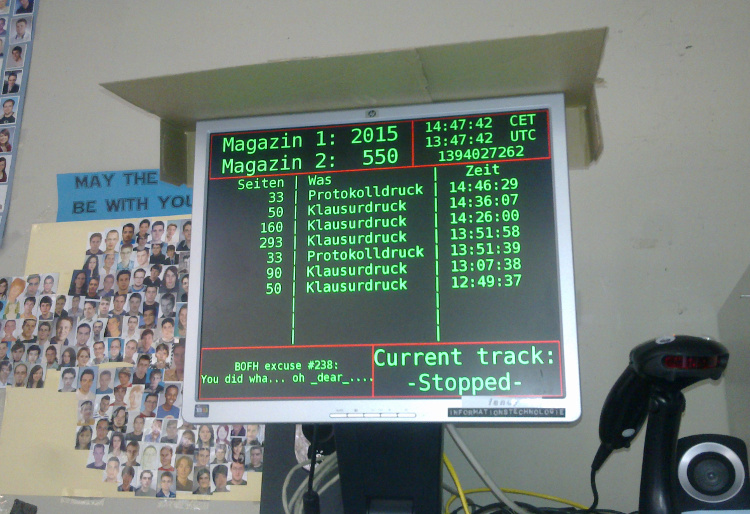
I just learnt that the math and computer science student body is using screen-message to power an information screen in their room:
There are five instances of screen-message, configured to use non-standard colors and a fixed-width fonts, and controlled by the rather new remote control feature, where screen-messages repeatedly keeps reading text from standard input until a form feed character (ASCII 0x0C) comes, and displays that. The window manager ratpoison takes care of tiling the instances. It looks quite a bit like a poor man s version of dividuum s great info-beamer. I was told that they also tried out info-beamer, but the Raspberry Pi was too slow and weak for that, while screen-message and ratpoison run happily on such small hardware. Correction: Info-beamer was not tried, but rather ruled out as overkill for this task.

H ctor Or n Mart nez: Debian build system

There are many ways to build Debian distributions from source. None of them are trivial enough for beginners and all of them require complex setups. For instance, the Debian official setup uses the following software components: Around the core components, there are other software components needed to run the Debian distribution: Thanks to Debian ftp-master and buildd team, all software is built for several architectures and several ports. Most Debian infrastructure is managed and maintained by Debian System Administration team.

Simplified Debian build infrastructure

Debian Wiki has been growing different random pages trying to ease the setup and configuration problems concerning to Debian build system infrastructure. The above infrastructure barely documents what it is involved to create and generate Debian unstable ( sid ) distribution suite. In order to produce Debian stable distribution suite, there are software transitions to happen and yet another Debian team gets involved in the process, our beloved Debian release team. Once distribution reaches its maturity level and gets released as in its stable version, it gets updates also lead by release team and security related updates, which yet another team is responsible for them, the Debian security team. and there are lots of Debian teams doing many other things you might enjoy, have a byte

Andrew Pollock: [life] Day 36, Kindergarten, cleaning and pee pee accidents in hardware stores

Today was my "clean the house" day. I made a start, then went for my chiropractic assessment and adjustment. I now only need to see him fortnightly, which is nice. I knocked out most of the cleaning, and then went for a massage and had some lunch. The next thing I knew it was about time to pick up Zoe. I biked to Kindergarten, and she was asleep again. She woke up reasonably easily, but was grumpy not long after that. She was very uncooperative, and didn't want to go home on the bike, and wouldn't let me put sunscreen on her. After a bit of work, I managed to extract from her that she didn't like my "sweaty hands" from riding the bike there, so I washed my hands and then she let me sunscreen her up. I'll try doing pick ups in the car next week I think. We got home, and I needed to get some more kitty litter, so we went out to Pet Barn. Zoe had a great time checking out all the fish, and also playing with aquarium decor. It got me thinking that maybe an aquarium might be a good birthday present for her, if not this year, maybe next year. It turns out that fish aren't particularly expensive, so they'd make for easy presents for people. After that, we popped across to Bunnings, because I needed a couple of things. While we were there, Zoe announced she wanted to go to the toilet, so we started trekking off to where I thought the toilets were. Turned out I was wrong, and they were at the opposite end of the building, so we had to trek all the way back again. Zoe got all the way into the ladies bathroom and failed to make it onto the toilet in time, so that concluded our visit to Bunnings. We got home and she got changed, and I started making dinner. While dinner was cooking, Zoe watched a bit of TV, and then I decided to try making some lunch box pies, essentially a piece of buttered bread jammed into a muffin tray with some creamed corn and bacon in the bottom and beaten egg on top, thrown in the oven. Zoe helped sample the bacon and cracked the eggs for me, while I buttered bread and cut the crusts off and jammed slices into muffin trays. Bedtime was remarkably uneventful for a change.

4 March 2014

H ctor Or n Mart nez: Debian build system

There are many ways to build Debian distributions from source. None of them are trivial enough for beginners and all of them require complex setups. For instance, the Debian official setup uses the following software components: Around the core components, there are other software components needed to run the Debian distribution: Thanks to Debian ftp-master and buildd team, all software is built for several architectures and several ports. Most Debian infrastructure is managed and maintained by Debian System Administration team.

Simplified Debian build infrastructure

Debian Wiki has been growing different random pages trying to ease the setup and configuration problems concerning to Debian build system infrastructure. The above infrastructure barely documents what it is involved to create and generate Debian unstable ( sid ) distribution suite. In order to produce Debian stable distribution suite, there are software transitions to happen and yet another Debian team gets involved in the process, our beloved Debian release team. Once distribution reaches its maturity level and gets released as in its stable version, it gets updates also lead by release team and security related updates, which yet another team is responsible for them, the Debian security team. and there are lots of Debian teams doing many other things you might enjoy, have a byte

Andrew Pollock: [life] Day 35, Kindergarten, taxes, makeup BJJ

I foolishly had a late night last night, for no particularly good reason, so I slept in quite late this morning. I didn't start getting going until about 8am. How decadent. I'd forgotten to send Zoe to Kindergarten with her water bottle yesterday, and forgotten to give it to Sarah when she picked her up yesterday, so I dropped it and a fresh set of spare clothes out to Kindergarten after I had breakfast and a shower. I managed to sneak in and out without Zoe seeing me. I did some more work on my taxes before popping out for lunch to discuss my main start up idea. I also renamed my old shelf company today. I biked over to Kindergarten for pick up, and sure enough, Zoe was fast asleep. It took quite a bit of work to rouse her. I was pretty sure she was just faking it though. She moved pretty fast when I said I had a surprise at home for her. We biked home, and I gave her the surprise (some Pop Rocks I'd been saving for a special occasion) and headed out by car to a makeup Brazilian Jiu-Jitsu class to make up for the one she missed on Friday. It turned out that trying to do an afternoon class after Kindergarten and being woken up from a nap wasn't the best idea. Zoe tired out pretty quickly, during the warm up exercises, and was moderately uncooperative for the remainder of the class (she kept going on strike). I've never driven to or from BJJ classes until today, and I wasn't actually sure how best to drive home, since we've always taken the Norman Park Greenway. Zoe was asking for a "different way" anyway, so that worked out well. We winged it through Coorparoo and the back of Norman Park and tacked onto the end of how we'd normally cycle home. Zoe had enough time to watch a little bit of TV before Sarah arrived to pick her up.

3 March 2014

DebConf team: DebConf8 registration open and CfP (Posted by Mart n Ferrari)

Registration is now open for DebConf8, which will take place in Mar del Plata from Sunday 10 to Saturday 16 August 2008. To register follow one of the processes outlined below: After you logged in After you successfully logged in, please fill in at least the General , Contact and Travel tabs reachable through the Registration details button on the bar on the left of the page. Please pay special attention to the DebConf and DebCamp boxes on the General tab. You need to select at least the I want to attend this conference checkbox or your registration won t be valid. Note to users who have an account from last year: We did our best in making sure you do not have to reenter all your personal data again, just the conference specific changes. But please check if it is all still valid. We suggest that attendees begin making travel arrangements as soon as possible. Some travel information has already been collected at the DebConf 8 site. Submitting a paper/event To submit papers, first register for DebConf as described above. Then use the New event/paper button on this page and fill in information about your submission on the various tabs. You can use the same interface to submit papers for DebConf and DebCamp, by choosing the appropriate track.

Daniel Pocock: Automatically building Java projects

Another of the GSoC project areas I have offered to mentor involves automatically and recursively building Java projects. Why is this important? Recently, I decided to start using travis-ci to automatically build some of my Java projects. One of the projects, JMXetric, depends on another, gmetric4j. When travis-ci builds JMXetric, it needs to look in Maven repositories to find gmetric4j (and also remotetea / oncrpc.jar and junit). The alternative to fetching things from repositories is to stop using Maven and ship the binary JARs of dependencies in the JMXetric repository itself, which is not desirable for various reasons. Therefore, I submitted gmetric4j into the Maven Central repository by using the Sonatype Nexus service. One discovery I made in this process disturbed me: Sonatype allows me to sign and upload my binary JAR, they don't build it from source themselves, so users of the JAR have no way to know that it really is built from the source I publish in Github. In fact, as anybody who works with Java knows, there is no shortage of Java projects out there that have a mix of binary dependencies in their source tree, sometimes without any easy way to find the dependency sources. HermesJMS is one popular example that is crippled by the inclusion of some JARs that are binary-only. No silver bullet, but there is hope Although there are now tens of thousands of JAR libraries out there in repositories and projects that depend on them (and their transitive dependencies and build tools and such), there is some hope:
  • Many JARs provide a -source JAR including source. This doesn't include all of the build artifacts of a true source package or source tarball, it just provides a subset of the source for use with a debugger.
  • Many Maven pom.xml files now include metadata about where the source is located - example
With that in mind, I'm hopeful that a system could be developed to scrape some of these data sources to find some source code and properly build some subset of the thousands of JARs available in the Maven Central Repository. But why bother if you can't completely succeed? One recent post on maven-users suggested that because nobody would ever be able to build 100% of JARs from source, the project is already doomed to failure. Personally, I feel it is quite the opposite: by failing to build 100% of JARs from source, the project will help to pinpoint those hierarchies of JARs that are not really free software and increase pressure on their publishers to adhere to the standards that people reasonably expect for source distribution or provide a red flag to help dependant projects stop using them. On top of that, the confirmation of true free-software status for many other JARs will make it safer for people to rely on them, package them and distribute them in various ways. Dumping a gazillion new Java packages into Debian Just to clear up one point: being able to automatically build JARs from source (or a chain of dependencies involving hundreds of them) doesn't mean they will be automatically uploaded to the official Debian archive by a Debian Developer (DD). Having this view of the source will make it easier for a DD to look at a set of JARs and decide if they are suitable for packaging, but there would still be some manual oversight involved. The tool would simply take out some of the tedious manual steps (where possible) and give the DD the ability to spot traps (JARs without real source hidden in the dependency hierarchy) much more quickly. How would it work? The project - whether completed under GSoC or by other means - would probably be broken down into a few discrete components. Furthermore, it would utilize some existing tools where possible. All of this makes it easier for a student to focus on and complete some subset of the work even if the whole thing is quite daunting. Here are some of the ideas for the architecture of the solution and the different components to be used or developed:
  • The data set:
    • A database schema, tracking each binary artifact, the source repository location (e.g. Git or SVN URL), source tarball location, source JAR availability and dependency relationships (including versions)
    • A local Maven repository - only containing JARs that we have built locally from some source
    • A set of Git repositories to mirror the upstream repositories of projects that need to be tweaked.
  • Tool set:
    • A web interface or command line tool would be necessary for a user to kick-start the process by specifying some artifact they want to build
    • There would need to be a script that tries to work out all the possible ways to get the source for an artifact (e.g. by looking for a Git URL in the pom.xml from the Maven Central repository). This script would be able to do other things, like identifying the existence of -source JARs which may or may not be sufficient to build the artifact.
    • A script would need to be created for testing the artifact's source tarball or repository for binary artifacts (e.g. copies of junit.jar). Whenever such things were found, the script would mirror the repository into our local git and create a branch with binaries removed. A record of the binaries would be added to the local database so we can symlink them from a trusted source when building.
    • A script would need to be created for testing whether the project includes a recognised build system (such as build.xml for ant or pom.xml for Maven). For projects without such artifacts, the script would need to generate a template build.xml and store it in a local clone of the repository
    • Jenkins would be used to build the JARs. A script would need to be created to build the Jenkins job config file for the artifact, pointing Jenkins to the upstream Git or the local Git repository depending upon the situation.
    • If the project is a Maven or Ivy project, then there are likely to be attempts to find dependencies during the build process. Running under Jenkins, these tools would be configured in such a way that they only look to the local repository and use dependencies that we have already built. If the build fails during dependency resolution, this is where the recursive process would kick off: the attempt to find each missing dependency would be logged to a queue, and the requests in this queue would each be handled by restarting the whole process again at the beginning. Each of these requests would also be logged to the database.
    • Sometimes, the system would be unable to proceed (e.g. because there are no clues about source locations in a given pom.xml). A user interface would need to be constructed to show a list of artifacts with exceptions and allow the user to manually locate the source and supply the URLs. The system would then continue iterating with this new data.
  • Reporting: we already know that for some JARs, we will simply fail to make any progress and we are not going to lose any sleep over that. The important thing is to provide accurate reports to help people make decisions that may involve working around those JARs in future:
    • For what percentage of projects could we determine the license from the pom.xml? Reports on licensing: can we spot any license mismatch in the dependency hierarchy?
    • Tools: which build tools in the chain of dependencies don't provide any source code? Are they optional tools (such as code quality analysis) that we can skip in the build process (e.g. by producing a mock version of the tool or plugin)?
    • Which non-free/sourceless JARs are most widely depended upon by other projects in the free Java eco-system? Can we make a list of the top 10 or 20?
    • Abandonware: can we detect JARs that haven't been updated for an extended period of time, with no activity in the source repository? For these projects in particular, it is a really good idea to make backups of the source repositories (or mirrors of their web sites and source download directories) in case they disappear altogether.

Rog rio Brito: More completed MOOCs

This weekend I received my 17th certification (or Statement of Accomplishment) for MOOCs. In particular, this last MOOC that I took was Creative, Serious and Playful Science of Android Apps, offered by Lawrence Angrave of University of Illinois at Urbana-Champaign. While I certainly knew that the course was an Introduction to Programming, the reasons I took it were twofold:
  1. For the "novelty" (for me, at least) of writing some Android Apps
  2. To reacquaint myself with Java, which I have not touched since 1999, when I wrote a compiler, in the ages of JDK 1.0 being transitioned to JDK 1.1.
I think that the time the course took (and which I invested in) was really well spent. In fact, I learned some nice things which I would not have touched otherwise. For instance, I made the conscious effort to use an IDE (Eclipse), despite being a person that would do most of the things inside Emacs and compile the programs with command-line tools. Despite being huge, Eclipse has some really nice features and the auto-completion is amazing. Since Java is so strongly typed and Eclipse knows Java pretty well, it almost completely writes your programs for you. :) Of course, my interest also made me want to streamline the build process and use the command line tools (with ant, another tool that was "alien" to me, having used makefiles for everything that I needed). The use of Eclipse (and the Android development environment in general) in my Debian unstable computers was not without problems, but after spending more time trying to fix Eclipse than really doing the homework (and pulling the little hair that I still have left), one really helpful post nailed it. (Yes, I had to remove other packages like gimp, but such is life). While playing with the Android side of things, I put one badly written (and not really "android-ish") app in a github repository (which I think is aptly named "Toy Android Apps"), which served me the purpose of learning some Android-specific concepts. But the course was helpful not only to get in touch with the tools (Eclipse, ant, running Android virtual machines with the help of kvm), but also on the Java side. I lost a bit of the prejudice against it (even though I still think it is a verbose language, especially when compared to, say Python), and I, also intend to contribute to one apache project or another that have low-hanging fruits. Actually, I have signed their Contributor License Agreement and I even had my first patch accepted! Aside: Well, sadly SVN doesn't support different committer and author fields like git does and it seems that doing many small commits may not be the Apache way of doing things but the important part of all this is that the code is there and there is so much more to be done. Aside #2: After a lot of time spent converting the repository to git (which is, after all, what I use), I put a mirror of Apache's the commons graph project.

1 March 2014

Russ Allbery: Review: Air Apparent

Review: Air Apparent, by Mark Monmonier
Publisher: University of Chicago
Copyright: 1999
Printing: 2000
ISBN: 0-226-53423-5
Format: Trade paperback
Pages: 232
Subtitled "how meteorologists learned to map, predict, and dramatize the weather," Air Apparent is a history of weather maps. Mapping the weather is a surprisingly new field, dating only from the early 19th century when a combination of scientific understanding and the ability to combine scattered observations made it practical. They're also a particularly tricky problem since weather is inherently three-dimensional, and even to the present day nearly all of our maps are two-dimensional. Monmonier starts with the earliest observational maps and the attempts to use them for prediction and tracks developments up to the late 1990s, with TV weathermen and (simple) interactive web data viewers. I got a copy of this book after Paul Krugman mentioned it. I don't know a lot about weather forecasting or weather maps, but I remembered finding the science of weather fronts and maps of them fascinating in high school, and I hoped I'd get the same feeling from this. Unfortunately, I probably need to stop reading Monmonier's books; they always sound interesting, but I don't enjoy reading them. One thing that's important to know is that this is not a history of meteorology. One can't hold that against the book, of course, because it never claimed to be. But it has just enough of a history of meteorology mixed into its history of map-making to make at least this reader wish he were reading that other book. I like maps, I really do, but I was hoping for either a book that melded a history of the science of weather forecasting with the maps that were used in that science, or a book that dove deep into the effective and ineffective ways to make weather maps (ideally, Edward R. Tufte for maps). This is neither; it's little more or less than a detailed history of the making of weather maps. Each time it gets close to a clear explanation of the underlying meteorology, it finds a map to examine and skips the rest of the explanation. I kept almost understanding the underlying science, but not enough to really understand the goals of the map makers, or why one presentation was better than another, or how those presentations were used to make forecasts or track weather data. I think I would have found this book more interesting in conjunction with a full history of meteorology, but I suspect that a history of meteorology would include enough about the maps to render this book largely redundant for the casual reader. The other problem I had with this book is that it's very dry. Monmonier is clearly trying, and clearly cares a lot about his topic, but the book has no flow. I kept getting lost in the barrage of names, arguments over technique, and struggles for government funding. It's hard to put a finger on why the book didn't grab me; the closest I can come is that it's a book stuffed full of facts. Monmonier did exhaustive historical research on weather map making, saved numerous quotes from original documents, and laid it all out chronologically. That's fine if you just want the information, but I was looking to be entertained in the process, and that didn't happen. I think the problems get worse in the second half of the book, when weather satellites and computers enter the picture and the laborious, manual map-making fall out, although maybe I was just exhausted with the book by then. The early history of weather maps at least has the benefit of showing the logistical struggles behind creating an effective weather service: insufficient observation points, slow communication methods, and the need for skilled map-makers to turn measurements into visual representations. Once computers and satellite photography enter the picture, the science matters even more, and I think the reader needs a better understanding of the underlying science to make sense of the results. Air Apparent has a tendency to provide a brief introduction to the type of data, a detailed chronological history, and then a discussion of the ways of presenting and representing that data, without ever getting the reader to care about the data itself or see how it ties into forecasting. Part of the problem, I suspect, is that the history of meteorology seems to be full of sensible, careful people who largely did sensible, careful things with the data they had available at the time. This is great for the advancement of science, and not so helpful at making a history engrossing. I wish I could say that I was glad I read this book for the information, if not the presentation, but unfortunately I didn't retain much. I needed some sort of structure or frame on which to hang all of the specifics, some sense of story or controversy or at least scientific understanding, and I didn't get it. It took me a couple of months to finish this book because I kept setting it down to read other things, and I only finished it out of a combination of stubbornness and knowledge that other people liked it. If the topic sounds interesting, well, this book exists, and it's gotten several good reviews. But I'm afraid I can't recommend it. Rating: 4 out of 10

Vasudev Kamath: Gzipped response for CSS/JS with Apache and mod_uwsgi

So it may sound normal to receive compressed response for CSS/JS file from Apache2 but what I faced is completely different behavior, here I saw not just body of response but also header are getting compressed and send to browser and browser was unable to interpret the response there by leading page rendered without CSS and JS. That was long story short, so let me explain in detail the case and what I found out. I have hosted SILPA on my VPS using uWSGI. I had used till date using libapache2-mod-proxy-uwsgi plugin for which uWSGI should be using network socket and in Apache2 config I need ProxyPass directive pointing to uwsgi://host:port and everything used to work out of box. There is a drawback for using network socket in uWSGI that is limited amount of ports (65535) and possible clash with other services if we use wrong port number, additionally network sockets will be slower compared to the file socket so yesterday I thought of changing it to file socket and removed socket directive in the ini file for uWSGI application container for SILPA and here is where all problems started. My updated configuration can be seen in our documentation page that is if you are interested to look my configuration file :-).
Problem Reporting We got selected to Gsoc again this year and we have lot of students jumping in our channel #silpa on irc.freenode.net and yesterday night some students reported they are facing 500 internal server error and subsequently others mentioned there is no theme being rendered. I checked and found everything was fine for me only to notice that my browser was using cached content, and when I clear cache there I go everything vanished, no theme no css no javascript just plain html!!!.
Investigation So I thought I should investigate this and fired up firebug on my iceweasel to observe the network traffic. And below is what I observed in firebug network console!. No response headers So you can see no response header in the above image but there is a response and below how is response content visible on firebug. gzipped response Still weird part was when using wget/curl directly to get the CSS I was getting correct reply and the file, which is puzzling. So I went ahead opened the CSS url directly using browser and saved the resulting file. When I used file command on it, output suggested the saved file in gzip compressed!. I went ahead uncompressed it and opened the file and inside it I found response header and the response body! So what just happened? Did apache some how manage to compress entire respone not just response body? The more puzzling question was why did it work when I was using mod_proxy_uwsgi and failed when I switched to mod_uwsgi. I had no clue at this point why this behavior is coming up.
Possible Solution I was still not sure how to resolve this, and started searching in the network but nothing was coming up in search result which can explain me this. And finally I stumbled on a link which is totally unrelated but I saw the word mod_deflate in the content and wandered on my system to see if its enabled. Yes mod_deflate was enabled I just opened the conf file and saw following.
<IfModule mod_deflate.c>
       # these are known to be safe with MSIE 6
       AddOutputFilterByType DEFLATE text/html text/plain text/xml
       # everything else may cause problems with MSIE 6
       AddOutputFilterByType DEFLATE text/css
       AddOutputFilterByType DEFLATE application/x-javascript application/javascript application/ecmascript
       AddOutputFilterByType DEFLATE application/rss+xml
</IfModule>
Interesting so it suggests to compress css, javascript files etc. So I thought possibly its compressing the result of mod_uwsgi, yeah possibly so why not try disabling mod_deflate and check if it works well and good if not I'm not gonna loose anything. So I disabled mod_deflate and voila! Everything is working fine!
What might be the reason for this behavior? Well I'm not exactly sure but here is my assumption. The whole behavior depends on internal implementation of mod_uwsgi and mod_proxy_uwsgi module. To confirm this I switched back to use mod_proxy_uwsgi module and enabled mod_deflate and observed request response in Firebug network console and below is what I observed. Response with mod_proxy_uwsgi So response is still gziped but this time only response body was gziped and Content-Encoding field was set properly which makes browser to properly uncompress the response body and use it. So it seems like there is a difference between mod_uwsgi and mod_proxy_uwsgi implementation. mod_uwsgi was sending the response along with response headers which was compressed by mod_deflate there by rendering browser helpless to interpret the response. But mod_proxy_uwsgi seems to be only sending the response content without response body and this content was later compressed by mod_deflate and proper response headers were set by apache before sending it to browser. So now whose fault is this? Is it the bug in mod_uwsgi or, mod_deflate not being able to exclude response headers from compression? I've no clue! If you have a clue and you want to share it with me, please consider writing to me over email. My details are available in Contacts

Next.

Previous.