Search Results: "ron"

24 December 2014

Benjamin Mako Hill: Images of Japan

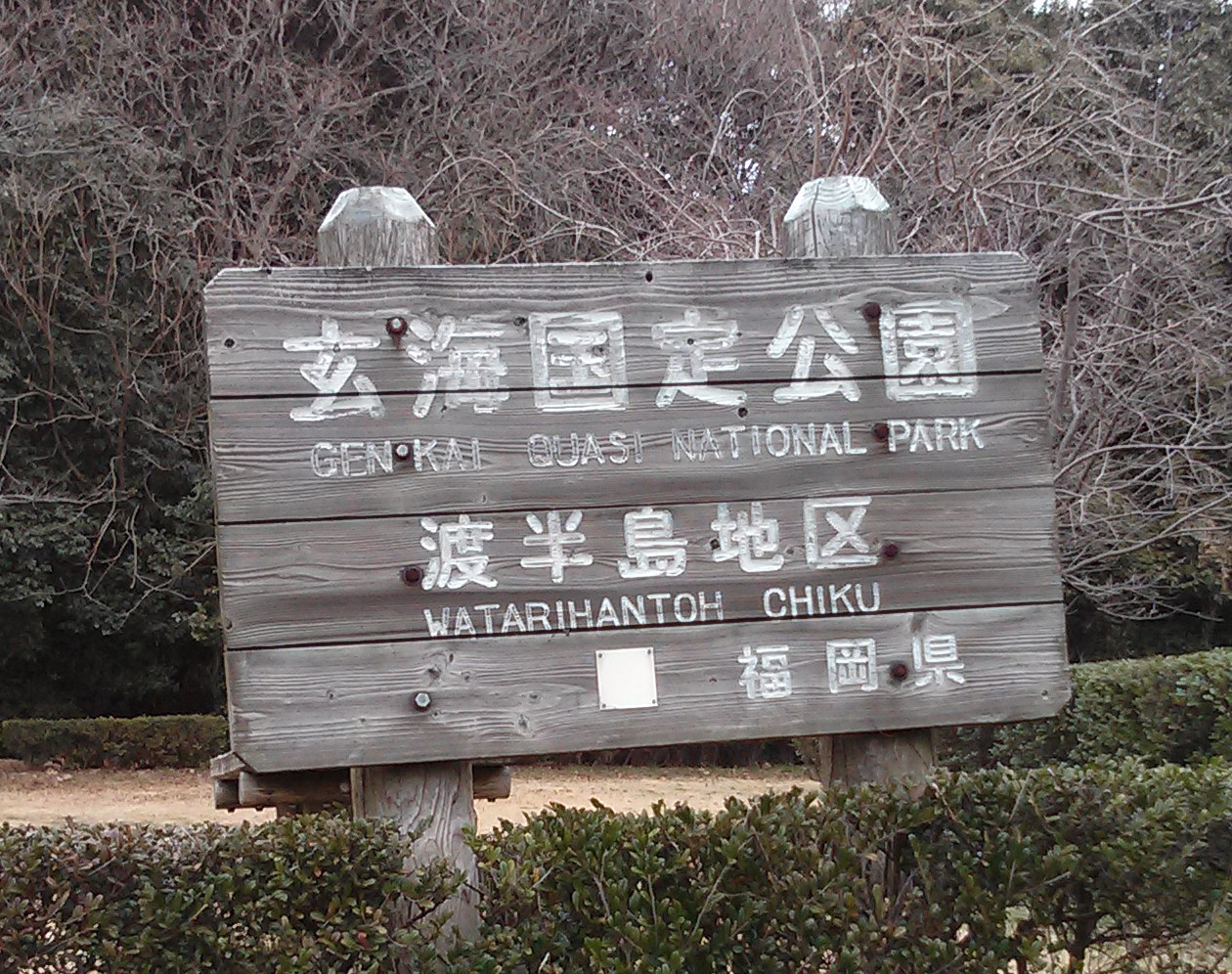
Going through some photos, I was able to revisit some of the more memorable moments of my trip to Japan earlier this year. For example, the time I visited Genkai Quasi National Park a beautiful spot in Fukuoka that had a strong resemblance to, but may not actually have been, a national park. Genkai Quasi National Park There was the time that I saw a Saw a curry fault bread. Saw a Curry Fault Bread And a shrine one could pray at in a barcalounger. Shrine Comfortable Chair There was the also the fact that we had record snowfall while in Tokyo which left the cities drainage system in a rather unhappy state. Japan Unhappy Drain

23 December 2014

Michael Stapelberg: Debian Code Search: taming the latency tail

It s been a couple of weeks since I ve launched Debian Code Search Instant, so people have had the chance to use it for a while and that gives me plenty of data points to look at :-). For every query, I log the search term itself as well as the duration the query took to execute. That way, I can easily identify queries that take a long time and see why that is. There is a class of queries for which Debian Code Search (DCS) doesn t perform so well, and that s queries that consist of trigrams which are extremely common. Whenever DCS receives such a query, it needs to search through a lot of files. Note that it doesn t really matter if there are plenty of results or not it s the number of files that potentially contain a result which matters. One such query is arse (we get a lot of curse words). It consists of only two trigrams ( ars and rse ), which are extremely common in program source code. As a couple of examples, the terms parse , sparse , charset and coarse are all matched by that. As an aside, if you really want to search for just arse , use word boundaries, i.e. \barse\b , which also makes the query significantly faster. Fixing the overloaded frontend When DCS first received the query, arse would lead to our frontend server crashing. That was due to (intentionally) unoptimized code we were aggregating all search results from all 6 source backends in memory, sorted them, and then wrote them out to disk. I addressed this in commit d2922fe92 with the following measures:
  1. Instead of keeping the entire result in memory, just write the result to a temporary file on disk ( unsorted.json ) and store pointers into that file in memory, i.e. (offset, length) tuples. In order to sort the results, we also need to store the ranking and the path (to resolve ties and thereby guarantee a stable result order over multiple search queries). For grouping the results by source package, we need to keep the package name.
  2. If you think about it, you don t need the entire path in order to break a tie the hash is enough, as it defines an ordering. That ordering may be different, but any ordering is good enough for the purpose of merely breaking a tie in a deterministic way. I m using Go s hash/fnv, the only non-cryptographic (fast!) hash function that is included in Go s standard library.
  3. Since this was still leading to Out Of Memory errors, I decided to not store a copy of the package name in each search result, but rather use a pointer into a string pool containing all package names. The number of source package names is relatively small, in the order of 20,000, whereas the number of search results can be in the millions. Using the stringpool is a clear win the overhead in the case where #results < #srcpackages is negligible, but as soon as #results > #srcpackages, you save memory.
With all of that fixed, the query became at all possible, albeit with a runtime of around 20 minutes. Double Writing When running such a long-running query, I noticed that the query ran smooth for a while, but then it took multiple seconds without any visible progress at the end of the query before the results appeared. This was due to the frontend ranking the results and then converting unsorted.json into actual result pages. Since we provide results ordered by ranking, but also results grouped by source packages, it was writing every result twice to disk. What s even worse is that due to re-ordering, every read was essentially random (as opposed to sequential reads). What s even worse is that nobody will ever click through all the hundreds of thousands of result pages, so they are prepared entirely in vain. Therefore, with commit c744b236e I made the frontend generate these result pages on demand. This cut down the time for the ranking phase at the end of each query from 20-30 seconds (for big queries) to typically less than one second. Profiling/Monitoring After adding monitoring to each of the source-backends, I realized that during these long-running queries, the disk I/O and network I/O was nowhere near my expectations: each source-backend was sending only a low single-digit number of megabytes per second back to the frontend (typically somewhere between 1 MB/s and 3 MB/s). This didn t match up at all with the bandwidth I observed in earlier performance tests, so I used wget -O /dev/null to send a query and discard the result in order to get some theoretical performance numbers. Suddenly, I was getting more than 10 MB/s worth of results, maxing out the disks with a read rate of about 200 MB/s. So where is the bottleneck? I double-checked that neither the CPU on any of our VMs, nor the network between them was saturated. Note that as of this point, the CPU of the frontend was at roughly 70% (of one core), which didn t seem a lot to me. Then, I followed this excellent tutorial on profiling Go programs to see where the frontend is spending its time. Turns out, the biggest consumer of CPU time was the encoding/json Go package, which is used for deserializing results received from the backend and serializing them again before sending them to the client. Since I was curious about it for a while already, I decided to give cap n proto a try to replace JSON as serialization mechanism for communication between the source backends and the frontend. Switching to it (commit 8efd3b41) brought down the CPU load immensely, and made the query a bit faster. In addition, I killed the next biggest consumer: the lseek(2) syscall, which we used to call with SEEK_CUR and an offset of 0 so that it would tell us the current position. This was necessary in the first place because we don t know in advance how many bytes we re going to write when serializing a result to disk. The replacement is a neat little trick:
type countingWriter int64
func (c *countingWriter) Write(p []byte) (n int, err error)  
    *c += countingWriter(len(p))
    return len(p), nil
 
// [ ]
// Then, use an io.MultiWriter like this:
var written countingWriter
w := io.MultiWriter(s.tempFiles[backendidx], &written)
result.WriteJSON(w)
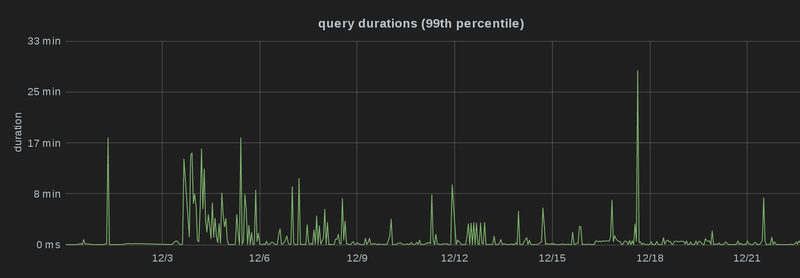
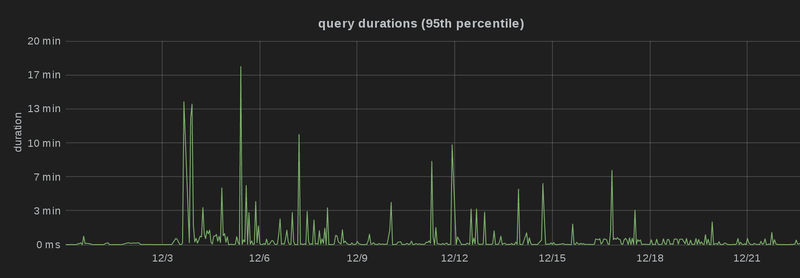
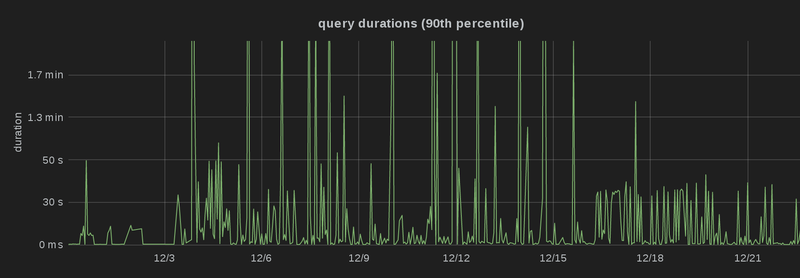
With some more profiling, the new bottleneck was suddenly the read(2) syscall, issued by the cap n proto deserialization, operating directly on the network connection buffer. strace revealed that crunching through the results of one source backend for a long query, read(2) was called about 250,000 times. By simply using a buffered reader (commit 684467ae), I could reduce that to about 2,000 times. Another bottleneck was the fact that for every processed result, the frontend needed to update the query state, which is shared amongst all goroutines (there is one goroutine for each source backend). All that parallelism isn t very effective if you need to synchronize the state updates in the end. So with commit 5d46a572, I refactored the state to be per-backend, so that locking is only necessary for the first couple of results, and the vast vast majority of results can be processed entirely without locking. This brought down the query time from 20 minutes to about 5 minutes, but I still wasn t happy with the bandwidth: the frontend was doing a bit over 10 MB/s of reads from all source backends combined, whereas with wget I could get around 40 MB/s with the same query. At this point, the CPU utilization was around 7% of one core on the frontend, and profiling didn t immediately reveal an obvious culprit. After a bit of experimenting (by commenting out code here and there ;-)), I figured out that the problem was that the frontend was still converting these results from capnproto buffers to JSON. While that doesn t take a lot of CPU time, it delays the network stream from the source-backend: once the local and remote TCP buffers are full, the source-backend will (intentionally!) not continue with its search, so that it doesn t run out of memory. I m still convinced that s a good idea, and in fact I was able to solve the problem in an elegant way: instead of writing JSON to disk and generating result pages on demand, we now write capnproto directly to disk (commit 466b7f3e) and convert it to JSON only before sending out the result pages. That decreases the overall CPU time since we only need to convert a small fraction of the results to JSON, but most importantly, the frontend is now not in the critical path anymore. It can directly pass the data through, and in fact it uses an io.TeeReader to do exactly that. Conclusion With all of these optimizations, we re now down to about 2.5 minutes for the search query arse , and the architecture of the system actually got simpler to reason about. Most importantly, though, the optimizations don t only play out for a single query, but for many different queries. I ve deployed the optimized version at the 15th of December 2014, and you can see that the 99th, 95th and 90th percentile latency dropped significantly, i.e. there are a lot fewer spikes than before, and more queries are processed faster, which is particularly obvious in the third graph (which is capped at 2 minutes):


22 December 2014

Erich Schubert: Java sum-of-array comparisons

This is a follow-up to the post by Daniel Lemire on a close topic.
Daniel Lemire hat experimented with boxing a primitive array in an interface, and has been trying to measure the cost.
I must admit I was a bit sceptical about his results, because I have seen Java successfully inlining code in various situations.
For an experimental library I occasionally work on, I had been spending quite a bit of time on benchmarking. Previously, I had used Google Caliper for it (I even wrote an evaluation tool for it to produce better statistics). However, Caliper hasn't seen much updates recently, and there is a very attractive similar tool at openJDK now, too: Java Microbenchmarking Harness (actually it can be used for benchmarking at other scale, too).
Now that I have experience in both, I must say I consider JMH superior, and I have switched over my microbenchmarks to it. One of the nice things is that it doesn't make this distinction of micro vs. macrobenchmarks, and the runtime of your benchmarks is easier to control.
I largely recreated his task using JMH. The benchmark task is easy: compute the sum of an array; the question is how much the cost is when allowing different data structures than double[].
My results, however, are quite different. And the statistics of JMH indicate the differences may be not significant, and thus indicating that Java manages to inline the code properly.
adapterFor       1000000  thrpt  50  836,898   13,223  ops/s
adapterForL      1000000  thrpt  50  842,464   11,008  ops/s
adapterForR      1000000  thrpt  50  810,343    9,961  ops/s
adapterWhile     1000000  thrpt  50  839,369   11,705  ops/s
adapterWhileL    1000000  thrpt  50  842,531    9,276  ops/s
boxedFor         1000000  thrpt  50  848,081    7,562  ops/s
boxedForL        1000000  thrpt  50  840,156   12,985  ops/s
boxedForR        1000000  thrpt  50  817,666    9,706  ops/s
boxedWhile       1000000  thrpt  50  845,379   12,761  ops/s
boxedWhileL      1000000  thrpt  50  851,212    7,645  ops/s
forSum           1000000  thrpt  50  845,140   12,500  ops/s
forSumL          1000000  thrpt  50  847,134    9,479  ops/s
forSumL2         1000000  thrpt  50  846,306   13,654  ops/s
forSumR          1000000  thrpt  50  831,139   13,519  ops/s
foreachSum       1000000  thrpt  50  843,023   13,397  ops/s
whileSum         1000000  thrpt  50  848,666   10,723  ops/s
whileSumL        1000000  thrpt  50  847,756   11,191  ops/s
The postfix is the iteration type: sum using for loops, with local variable for the length (L), or in reverse order (R); while loops (again with local variable for the length). The prefix is the data layout: the primitive array, the array using a static adapter (which is the approach I have been using in many implementations in cervidae) and using a "boxed" wrapper class around the array (roughly the approach that Daniel Lemire has been investigating. On the primitive array, I also included the foreach loop approach (for(double v:array) ).
If you look at the standard deviations, the results are pretty much identical, except for reverse loops. This is not surprising, given the strong inlining capabilities of Java - all of these codes will lead to next to the same CPU code after warmup and hotspot optimization.
I do not have a full explanation of the differences the others have been seeing. There is no "polymorphism" occurring here (at runtime) - there is only a single Array implementation in use; but this was the same with his benchmark.
Here is a visualization of the results (sorted by average):
Result boxplots
As you can see, most results are indiscernible. The measurement standard deviation is higher than the individual differences. If you run the same benchmark again, you will likely get a different ranking.
Note that performance may - drastically - drop once you use multiple adapters or boxing classes in the same hot codepath. Java Hotspot keeps statistics on the classes it sees, and as long as it only sees 1-2 different types, it performs quite aggressive optimizations instead of doing "virtual" method calls.

Craig Small: Mudlet 3 beta

A break from wordpress, I was trying to get the beta version of mudlet 3.0 compiling. On the surface the program looks a lot like the existing v2.0 that is currently within Debian. The developers have switched from qt4 to qt5 which means a lot of dependency fun for me but I got there in the end. As it is only a beta and not their final release, the package is located within the Debian experimental release. Once 3.0 hits a final release, I ll switch it to sid. If you do use the current mudlet, give 3.0 a try. I d be interested to know what you think. For people that have not heard of mudlet before, it is a mud client. mud stands for Multi User Dungeon, which is a multiplayer text-only game. While you can use something as simple as telnet to connect to a mud server, most people use some sort of specialised client. The advantages are you can display extra information (such a health stats) in a different window as well as aliases (macros or special commands, basically the same idea as a bash alias) and triggers (commands that are run depending on what the mud server sends you). The triggers take away some of the repeated things you may have to do, such as sipping a health tonic when your health level drops below some limit. One thing you might notice in the experimental 3.0 beta is that the icon is missing. lintian picked up that the license was wrong; it was by-nc which meant it can t go into main. I ve removed the icon until upstream sorts it out.

21 December 2014

Russ Allbery: Review: 2014 Hugos: Novelettes

Review: 2014 Hugos: Novelettes, edited by Loncon 3
Publisher: Loncon 3
Copyright: 2014
Format: Kindle
This is another weird "book review" covering the Hugo-nominated novelettes for the 2014 Hugos (given for works published in 2014) at Loncon 3, the 2014 Worldcon. The "editor" is the pool of attendees and supporting members who chose to nominate works, all of which had been previously edited by other editors in their original publication. I received all of these as part of the Hugo voter's packet for being a supporting member, but they all appear to be available for free on the Internet (at least at the time of this writing). "The Exchange Officers" by Brad Torgersen: An okay, if not particularly ground-breaking, military SF story, ruined for me by the ham-handed introduction of superficial jingoism. The protagonists are doing a tour as remote operators of humanoid battle suits in orbit: not a new premise, but a servicable one. Since this is military SF, they predictably have to defend a space installation against attackers. So we get a bit of drama, a bit of zero-g combat, and the fun of people learning how to remotely operate suits. You've probably read this before, but it passes the time reasonably well. Unfortunately, Torgersen decided to make the villains the Chinese military for no adequately-explained reason. (Well, I'm being kind; I suspect the reason is the standard yellow peril nonsense, but that's less generous.) So there is snide commentary about how only the military understand the Chinese threat and a fair bit of old-fashioned jingoism mixed in to the story, to its detriment. If you like this sort of thing, it's a typical example, although it escapes me why people thought it was exceptional enough to warrant nomination. (5) "The Lady Astronaut of Mars" by Mary Robinette Kowal: Once again, my clear favorite among the stories also won, which is a lovely pattern. Elma was the female astronaut in an alternate history in which manned space exploration continued to grow, leading to permanent settlement on Mars. She spent lots of time being photographed, being the smiling face of the space program, while her husband worked on the math and engineering of the launches. Now, she's an old woman, taking care of her failing and frail husband, her career behind her. Or so she thinks, before an offer that forces an impossible choice between space and staying with her husband for his final days. This is indeed the tear-jerker that it sounds like, but it's not as maudlin as it might sound. Kowal does an excellent job with Elma's characterization: she's no-nonsense, old enough to be confident in her opinions, and knows how to navigate through the world. The story is mixed with nostalgia and memories, including a reminder of just what Elma meant to others. It touches on heroism, symbolism, and the horrible choices around dying loved ones, but I thought it did so deftly and with grace. I was expecting the story to be too obvious, but I found I enjoyed the quotidian feel. It's not a story to read if you want to be surprised, but I loved the small touches. (9) "Opera Vita Aeterna" by Vox Day: Before the review, a note that I consider obligatory. The author of this story is an aggressively misogynistic white supremacist, well-known online for referring to black people as savages and arguing women should not be allowed to vote. To what extent you choose to take that into account when judging his fiction is up to you, but I don't think it should go unsaid. "Opera Vita Aeterna" is the story of a monastery in a typical fantasy world (at least as far as one can tell from this story; readers of Vox Day's fantasy series will probably know more background). At the start of the story, it gets an unexpected visit from an elf. Not just any elf, either, but one of the most powerful magicians of his society. He comes to the monastery out of curiousity about the god that the monks worship and stays for a project of illuminating their scriptures, while having theological debates with the abbot. This story is certainly not the offensive tirade that you might expect from its author. Its biggest problem is that nothing of substance happens in the story, either theologically or via more conventional action. It's a lot of description, a lot of talking, a lot of warmed-over Christian apologetics that dodges most of the hard problems, and a lot of assertions that the elf finds something of interest in this monastery. I can believe this could be the case, but Vox Day doesn't really show why. There is, at the end of the story, some actual drama, but I found it disappointing and pointless. It leads nowhere. The theology has the same problem: elves supposedly have no souls, which is should be the heart of a theological question or conflict Vox Day is constructing, but that conflict dies without any resolution. We know nothing more about the theology of this world at the end of the story than we do at the beginning. Some of the descriptions here aren't bad, and the atmosphere seems to want to develop into a story. But that development never happens, leaving the whole work feeling fundamentally pointless. (4) "The Truth of Fact, the Truth of Feelng" by Ted Chiang: This is another oddly-constructed story, although I think a bit more successful. It's a story in two interwoven parts. One is a fictional essay, told in a non-fiction style, about a man living in a future world with ubiquitous life recording and very efficient search software. Any part of one's life can be easily found and reviewed. The other is the story of a boy from a tribal culture during European colonialism. He learns to read and write, and from that a respect for written records, which come into conflict with the stories that the tribe elders tell about the past. The purpose of both of these stories is to question both the value and the implications of recording everything in a way that preserves and guarantees the facts instead of individual interpretations. The boy's story calls this into question; the narrator's story offers ambiguous support for its value and a deeper plea for giving people space to change. I found the style a bit difficult to get used to, since much of it did not feel like a story. But it grew on me as I read it, and the questions Chiang raises have stuck with me since. The problem of how and when to allow for change in others when we have perfect (or at least vastly improved) memory is both important and complicated, and this is one of the better presentations of the problem that I've seen. It's more of a think-y piece, and closer to non-fiction than a story, but I thought it was worth reading. (8) "The Waiting Stars" by Aliette de Bodard: I keep wanting to like de Bodard's space opera world of AIs and living ships, but it never quite works for me. I've read several stories set in this universe now, and it has some neat ideas, but I always struggle with the characters. This story at least doesn't have quite as much gruesome pregnancy as the previous ones (although there's still some). "The Waiting Stars" opens with a raid on a ship graveyard, an attempt to rescue and "reboot" an AI starship under the guidance of another Mind. This is intermixed with another story about a woman who was apparently rescued in childhood from birthing ship Minds and raised in a sort of foster institution. This feels like a flashback at first, but its interaction with the rest of the story is something more complicated. The conceptual trick de Bodard pulls here is thought-provoking, but once again I struggled to care about all of the characters. I also found the ending discouraging and unsatisfying, which didn't help. Someone who isn't me might really like this story, but it wasn't my thing. (6) Rating: 6 out of 10

20 December 2014

Rudy Godoy: Apache Phoenix for Cloudera CDH

Apache Phoenix is a relational database layer over HBase delivered as a client-embedded JDBC driver targeting low latency queries over HBase data. Apache Phoenix takes your SQL query, compiles it into a series of HBase scans, and orchestrates the running of those scans to produce regular JDBC result sets. What the above statement means for developers or data scientists is that you can talk SQL to your HBase cluster. Sounds good right? Setting up Phoenix on Cloudera CDH can be really frustrating and time-consuming. I wrapped-up references from across the web with my own findings to have both play nice. Building Apache Phoenix Because of dependency mismatch for the pre-built binaries, supporting Cloudera s CDH requires to build Phoenix using the versions that match the CDH deployment. The CDH version I used is CDH4.7.0. This guide applies for any version of CDH4+. Note: You can find CDH components version in the CDH Packaging and Tarball Information section for the Cloudera Release Guide . Current release information (CDH5.2.1) is available in this link. Preparing Phoenix build environment Phoenix can be built using maven or gradle. General instructions can be found in the Building Phoenix Project webpage. Before building Phoenix you need to have: Checkout correct Phoenix branch Phoenix has two major release versions: Clone the Phoenix git repository
git clone https://github.com/apache/phoenix.git
Work with the correct branch
git fetch origin
git checkout 3.2
Modify dependencies to match CDH Before building Phoenix, you will need to modify the dependencies to match the version of CDH you are trying to support. Edit phoenix/pom.xml and do the following changes: Add Cloudera s Maven repository
+  <repository>
+  <id>cloudera</id>
+  https://repository.cloudera.com/artifactory/cloudera-repos/
+  </repository>
Change component versions to match CDH s.
  
-  <hadoop-one.version>1.0.4</hadoop-one.version>
-  <hadoop-two.version>2.0.4-alpha</hadoop-two.version>
+  <hadoop-one.version>2.0.0-mr1-cdh4.7.0</hadoop-one.version>
+  <hadoop-two.version>2.0.0-cdh4.7.0</hadoop-two.version>
  <!-- Dependency versions -->
-  <hbase.version>0.94.19
+  <hbase.version>0.94.15-cdh4.7.0
  <commons-cli.version>1.2</commons-cli.version>
-  <hadoop.version>1.0.4
+  <hadoop.version>2.0.0-cdh4.7.0
  <pig.version>0.12.0</pig.version>
  <jackson.version>1.8.8</jackson.version>
  <antlr.version>3.5</antlr.version>
  <log4j.version>1.2.16</log4j.version>
  <slf4j-api.version>1.4.3.jar</slf4j-api.version>
  <slf4j-log4j.version>1.4.3</slf4j-log4j.version>
-  <protobuf-java.version>2.4.0</protobuf-java.version>
+  <protobuf-java.version>2.4.0a</protobuf-java.version>
  <commons-configuration.version>1.6</commons-configuration.version>
  <commons-io.version>2.1</commons-io.version>
  <commons-lang.version>2.5</commons-lang.version>
Change target version, only if you are building for Java 6. CDH4 is built for JRE 6.
  <artifactId>maven-compiler-plugin</artifactId>
  <version>3.0</version>
  <configuration>
-  <source>1.7</source>
-  <target>1.7</target>
+  <source>1.6</source>
+  <target>1.6</target>
  </configuration>
Phoenix building Once, you have made the changes you are set to build Phoenix. Our CDH4.7.0 cluster uses Hadoop 2, so make sure to activate the hadoop2 profile.
mvn package -DskipTests -Dhadoop.profile=2
If everything goes well, you should see the following result:
[INFO] ------------------------------------------------------------------------
[INFO] Reactor Summary:
[INFO]
[INFO] Apache Phoenix .................................... SUCCESS [2.729s]
[INFO] Phoenix Hadoop Compatibility ...................... SUCCESS [0.882s]
[INFO] Phoenix Core ...................................... SUCCESS [24.040s]
[INFO] Phoenix - Flume ................................... SUCCESS [1.679s]
[INFO] Phoenix - Pig ..................................... SUCCESS [1.741s]
[INFO] Phoenix Hadoop2 Compatibility ..................... SUCCESS [0.200s]
[INFO] Phoenix Assembly .................................. SUCCESS [30.176s]
[INFO] ------------------------------------------------------------------------
[INFO] BUILD SUCCESS
[INFO] ------------------------------------------------------------------------
[INFO] Total time: 1:02.186s
[INFO] Finished at: Mon Dec 15 13:18:48 PET 2014
[INFO] Final Memory: 45M/1330M
[INFO] ------------------------------------------------------------------------
Phoenix Server component deployment Since Phoenix is a JDBC layer on top of HBase a server component has to be deployed on every HBase node. The goal is to have Phoenix server component added to HBase classpath. You can achieve this goal either by copying the server component directly to HBase s lib directory, or copy the component to an alternative path then modify HBase classpath definition. For the first approach, do:
cp phoenix-assembly/target/phoenix-3.2.3-SNAPSHOT-server.jar /opt/cloudera/parcels/CDH/lib/hbase/lib/
Note: In this case CDH is a synlink to the current active CDH version. For the second approach, do:
cp phoenix-assembly/target/phoenix-3.2.3-SNAPSHOT-server.jar /opt/phoenix/
Then add the following line to /etc/hbase/conf/hbase-env.sh
/etc/hbase/conf/hbase-env.sh
export HBASE_CLASSPATH_PREFIX=/opt/phoenix/phoenix-3.2.3-SNAPSHOT-server.jar
Wether you ve used any of the methods, you have to restart HBase. If you are using Cloudera Manager, restart the HBase service. To validate that Phoenix is on HBase class path, do:
sudo -u hbase hbase classpath   tr ':' '\n'   grep phoenix
Phoenix server validation Phoenix provides a set of client tools that you can use to validate the server component functioning. However, since we are supporting CDH4.7.0 we ll need to make few changes to such utilities so they use the correct dependencies. phoenix/bin/sqlline.py: sqlline.py is a wrapper for the JDBC client, it provides a SQL console interface to HBase through Phoenix.
index f48e527..bf06148 100755
--- a/bin/sqlline.py
+++ b/bin/sqlline.py
@@ -53,7 +53,8 @@ colorSetting = "true"
 if os.name == 'nt':
  colorSetting = "false"
-java_cmd = 'java -cp "' + phoenix_utils.hbase_conf_path + os.pathsep + phoenix_utils.phoenix_client_jar + \
+extrajars="/opt/cloudera/parcels/CDH/lib/hadoop/lib/commons-collections-3.2.1.jar:/opt/cloudera/parcels/CDH/lib/hadoop/hadoop-auth-2.0.0-cdh4.7.0.jar:/opt/cloudera/parcels/CDH/lib/hadoop/hadoop-common-2.0.0-cdh4.7.0.jar:/opt/cloudera/parcerls/CDH/lib/oozie/libserver/hbase-0.94.15-cdh4.7.0.jar"
+java_cmd = 'java -cp ".' + os.pathsep + extrajars + os.pathsep + phoenix_utils.hbase_conf_path + os.pathsep + phoenix_utils.phoenix_client_jar + \
  '" -Dlog4j.configuration=file:' + \
  os.path.join(phoenix_utils.current_dir, "log4j.properties") + \
  " sqlline.SqlLine -d org.apache.phoenix.jdbc.PhoenixDriver \
phoenix/bin/psql.py: psql.py is a wrapper tool that can be used to create and populate HBase tables.
index 34a95df..b61fde4 100755
--- a/bin/psql.py
+++ b/bin/psql.py
@@ -34,7 +34,8 @@ else:
 # HBase configuration folder path (where hbase-site.xml reside) for
 # HBase/Phoenix client side property override
-java_cmd = 'java -cp "' + phoenix_utils.hbase_conf_path + os.pathsep + phoenix_utils.phoenix_client_jar + \
+extrajars="/opt/cloudera/parcels/CDH/lib/hadoop/lib/commons-collections-3.2.1.jar:/opt/cloudera/parcels/CDH/lib/hadoop/hadoop-auth-2.0.0-cdh4.7.0.jar:/opt/cloudera/parcels/CDH/lib/hadoop/hadoop-common-2.0.0-cdh4.7.0.jar:/opt/cloudera/parcerls/CDH/lib/oozie/libserver/hbase-0.94.15-cdh4.7.0.jar"
+java_cmd = 'java -cp ".' + os.pathsep + extrajars + os.pathsep + phoenix_utils.hbase_conf_path + os.pathsep + phoenix_utils.phoenix_client_jar + \
  '" -Dlog4j.configuration=file:' + \
  os.path.join(phoenix_utils.current_dir, "log4j.properties") + \
  " org.apache.phoenix.util.PhoenixRuntime " + args
After you have done such changes you can test connectivity by issuing the following commands:
./bin/sqlline.py zookeeper.local
Setting property: [isolation, TRANSACTION_READ_COMMITTED]
issuing: !connect jdbc:phoenix:zookeeper.local none none org.apache.phoenix.jdbc.PhoenixDriver
Connecting to jdbc:phoenix:zookeeper.local
14/12/16 19:26:10 WARN conf.Configuration: dfs.df.interval is deprecated. Instead, use fs.df.interval
14/12/16 19:26:10 WARN conf.Configuration: hadoop.native.lib is deprecated. Instead, use io.native.lib.available
14/12/16 19:26:10 WARN conf.Configuration: fs.default.name is deprecated. Instead, use fs.defaultFS
14/12/16 19:26:10 WARN conf.Configuration: topology.script.number.args is deprecated. Instead, use net.topology.script.number.args
14/12/16 19:26:10 WARN conf.Configuration: dfs.umaskmode is deprecated. Instead, use fs.permissions.umask-mode
14/12/16 19:26:10 WARN conf.Configuration: topology.node.switch.mapping.impl is deprecated. Instead, use net.topology.node.switch.mapping.impl
14/12/16 19:26:11 WARN conf.Configuration: fs.default.name is deprecated. Instead, use fs.defaultFS
14/12/16 19:26:11 WARN util.NativeCodeLoader: Unable to load native-hadoop library for your platform... using builtin-java classes where applicable
14/12/16 19:26:12 WARN conf.Configuration: fs.default.name is deprecated. Instead, use fs.defaultFS
Connected to: Phoenix (version 3.2)
Driver: PhoenixEmbeddedDriver (version 3.2)
Autocommit status: true
Transaction isolation: TRANSACTION_READ_COMMITTED
Building list of tables and columns for tab-completion (set fastconnect to true to skip)...
77/77 (100%) Done
Done
sqlline version 1.1.2
0: jdbc:phoenix:zookeeper.local>
Then, you can either issue SQL-commands or Phoenix-commands.
0: jdbc:phoenix:zookeeper.local> !tables
+------------------------------------------+------------------------------------------+------------------------------------------+---------------------------+
  TABLE_CAT    TABLE_SCHEM    TABLE_NAME    TABLE_TYPE  
+------------------------------------------+------------------------------------------+------------------------------------------+---------------------------+
  null    SYSTEM    CATALOG    SYSTEM TABLE   
  null    SYSTEM    SEQUENCE    SYSTEM TABLE   
  null    SYSTEM    STATS    SYSTEM TABLE   
  null    null    STOCK_SYMBOL    TABLE   
  null    null    WEB_STAT    TABLE   
+------------------------------------------+------------------------------------------+------------------------------------------+---------------------------+

19 December 2014

Kenshi Muto: smart "apt" command

During evaluating Jessie, I found 'apt' command and noticed it was pretty good for novice-usual users.
Usage: apt [options] command
CLI for apt.
Basic commands: 
 list - list packages based on package names
 search - search in package descriptions
 show - show package details
 update - update list of available packages
 install - install packages
 remove  - remove packages
 upgrade - upgrade the system by installing/upgrading packages
 full-upgrade - upgrade the system by removing/installing/upgrading packages
 edit-sources - edit the source information file
'apt list' is like a combination of 'dpkg -l' + 'apt-cache pkgnames'. 'apt search' is a bit slower than 'apt-cache search' but provides with useful information. 'apt show' formats bytesizes and hides some (for experts) fields. install/remove/upgrade/full-upgrade are mostly same as apt-get. 'apt edit-sources' opens a editor and checks the integrity. So, I'd like to recommend 'apt' command to Debian users. Well, why did I write this entry...? ;) I found a mistranslation I had made in ja.po of apt. Because it is critical mistranslation (Japanese users will confuse by it), I want to fix it strongly. Dear apt deity maintainers, could you consider to update apt for Jessie? (#772678. FYI there are other translation updates also: #772913, #771982, and #771967)

17 December 2014

Keith Packard: MST-monitors

Multi-Stream Transport 4k Monitors and X I'm sure you've seen a 4k monitor on a friends desk running Mac OS X or Windows and are all ready to go get one so that you can use it under Linux. Once you've managed to acquire one, I'm afraid you'll discover that when you plug it in, you're limited to 30Hz refresh rates at the full size, unless you're running a kernel that is version 3.17 or later. And then... Good Grief! What Is My Computer Doing! Ok, so now you're running version 3.17 and when X starts up, it's like you're using a gigantic version of Google Cardboard. Two copies of a very tall, but very narrow screen greets you. Welcome to MST island. In order to drive these giant new panels at full speed, there isn't enough bandwidth in the display hardware to individually paint each pixel once during each frame. So, like all good hardware engineers, they invented a clever hack. This clever hack paints the screen in parallel. I'm assuming that they've got two bits of display hardware, each one hooked up to half of the monitor. Now, each paints only half of the pixels, avoiding costly redesign of expensive silicon, at least that's my surmise. In the olden days, if you did this, you'd end up running two monitor cables to your computer, and potentially even having two video cards. Today, thanks to the magic of Display Port Multi-Stream Transport, we don't need all of that; instead, MST allows us to pack multiple cables-worth of data into a single cable. I doubt the inventors of MST intended it to be used to split a single LCD panel into multiple "monitors", but hardware engineers are clever folk and are more than capable of abusing standards like this when it serves to save a buck. Turning Two Back Into One We've got lots of APIs that expose monitor information in the system, and across which we might be able to wave our magic abstraction wand to fix this:
  1. The KMS API. This is the kernel interface which is used by all graphics stuff, including user-space applications and the frame buffer console. Solve the problem here and it works everywhere automatically.
  2. The libdrm API. This is just the KMS ioctls wrapped in a simple C library. Fixing things here wouldn't make fbcons work, but would at least get all of the window systems working.
  3. Every 2D X driver. (Yeah, we're trying to replace all of these with the one true X driver). Fixing the problem here would mean that all X desktops would work. However, that's a lot of code to hack, so we'll skip this.
  4. The X server RandR code. More plausible than fixing every driver, this also makes X desktops work.
  5. The RandR library. If not in the X server itself, how about over in user space in the RandR protocol library? Well, the problem here is that we've now got two of them (Xlib and xcb), and the xcb one is auto-generated from the protocol descriptions. Not plausible.
  6. The Xinerama code in the X server. Xinerama is how we did multi-monitor stuff before RandR existed. These days, RandR provides Xinerama emulation, but we've been telling people to switch to RandR directly.
  7. Some new API. Awesome. Ok, so if we haven't fixed this in any existing API we control (kernel/libdrm/X.org), then we effectively dump the problem into the laps of the desktop and application developers. Given how long it's taken them to adopt current RandR stuff, providing yet another complication in their lives won't make them very happy.
All Our APIs Suck Dave Airlie merged MST support into the kernel for version 3.17 in the simplest possible fashion -- pushing the problem out to user space. I was initially vaguely tempted to go poke at it and try to fix things there, but he eventually convinced me that it just wasn't feasible. It turns out that all of our fancy new modesetting APIs describe the hardware in more detail than any application actually cares about. In particular, we expose a huge array of hardware objects: Each of these objects exposes intimate details about the underlying hardware -- which of them can work together, and which cannot; what kinds of limits are there on data rates and formats; and pixel-level timing details about blanking periods and refresh rates. To make things work, some piece of code needs to actually hook things up, and explain to the user why the configuration they want just isn't possible. The sticking point we reached was that when an MST monitor gets plugged in, it needs two CRTCs to drive it. If one of those is already in use by some other output, there's just no way you can steal it for MST mode. Another problem -- we expose EDID data and actual video mode timings. Our MST monitor has two EDID blocks, one for each half. They happen to describe how they're related, and how you should configure them, but if we want to hide that from the application, we'll have to pull those EDID blocks apart and construct a new one. The same goes for video modes; we'll have to construct ones for MST mode. Every single one of our APIs exposes enough of this information to be dangerous. Every one, except Xinerama. All it talks about is a list of rectangles, each of which represents a logical view into the desktop. Did I mention we've been encouraging people to stop using this? And that some of them listened to us? Foolishly? Dave's Tiling Property Dave hacked up the X server to parse the EDID strings and communicate the layout information to clients through an output property. Then he hacked up the gnome code to parse that property and build a RandR configuration that would work. Then, he changed to RandR Xinerama code to also parse the TILE properties and to fix up the data seen by application from that. This works well enough to get a desktop running correctly, assuming that desktop uses Xinerama to fetch this data. Alas, gtk has been "fixed" to use RandR if you have RandR version 1.3 or later. No biscuit for us today. Adding RandR Monitors RandR doesn't have enough data types yet, so I decided that what we wanted to do was create another one; maybe that would solve this problem. Ok, so what clients mostly want to know is which bits of the screen are going to be stuck together and should be treated as a single unit. With current RandR, that's some of the information included in a CRTC. You pull the pixel size out of the associated mode, physical size out of the associated outputs and the position from the CRTC itself. Most of that information is available through Xinerama too; it's just missing physical sizes and any kind of labeling to help the user understand which monitor you're talking about. The other problem with Xinerama is that it cannot be configured by clients; the existing RandR implementation constructs the Xinerama data directly from the RandR CRTC settings. Dave's Tiling property changes edit that data to reflect the union of associated monitors as a single Xinerama rectangle. Allowing the Xinerama data to be configured by clients would fix our 4k MST monitor problem as well as solving the longstanding video wall, WiDi and VNC troubles. All of those want to create logical monitor areas within the screen under client control What I've done is create a new RandR datatype, the "Monitor", which is a rectangular area of the screen which defines a rectangular region of the screen. Each monitor has the following data: There are three requests to define, delete and list monitors. And that's it. Now, we want the list of monitors to completely describe the environment, and yet we don't want existing tools to break completely. So, we need some way to automatically construct monitors from the existing RandR state while still letting the user override portions of it as needed to explain virtual or tiled outputs. So, what I did was to let the client specify a list of outputs for each monitor. All of the CRTCs which aren't associated with an output in any client-defined monitor are then added to the list of monitors reported back to clients. That means that clients need only define monitors for things they understand, and they can leave the other bits alone and the server will do something sensible. The second tricky bit is that if you specify an empty rectangle at 0,0 for the pixel geometry, then the server will automatically compute the geometry using the list of outputs provided. That means that if any of those outputs get disabled or reconfigured, the Monitor associated with them will appear to change as well. Current Status Gtk+ has been switched to use RandR for RandR versions 1.3 or later. Locally, I hacked libXrandr to override the RandR version through an environment variable, set that to 1.2 and Gtk+ happily reverts back to Xinerama and things work fine. I suspect the plan here will be to have it use the new Monitors when present as those provide the same info that it was pulling out of RandR's CRTCs. KDE appears to still use Xinerama data for this, so it "just works". Where's the code As usual, all of the code for this is in a collection of git repositories in my home directory on fd.o:
git://people.freedesktop.org/~keithp/randrproto master
git://people.freedesktop.org/~keithp/libXrandr master
git://people.freedesktop.org/~keithp/xrandr master
git://people.freedesktop.org/~keithp/xserver randr-monitors
RandR protocol changes Here's the new sections added to randrproto.txt
                   
1.5. Introduction to version 1.5 of the extension
Version 1.5 adds monitors
   A 'Monitor' is a rectangular subset of the screen which represents
   a coherent collection of pixels presented to the user.
   Each Monitor is be associated with a list of outputs (which may be
   empty).
   When clients define monitors, the associated outputs are removed from
   existing Monitors. If removing the output causes the list for that
   monitor to become empty, that monitor will be deleted.
   For active CRTCs that have no output associated with any
   client-defined Monitor, one server-defined monitor will
   automatically be defined of the first Output associated with them.
   When defining a monitor, setting the geometry to all zeros will
   cause that monitor to dynamically track the bounding box of the
   active outputs associated with them
This new object separates the physical configuration of the hardware
from the logical subsets  the screen that applications should
consider as single viewable areas.
1.5.1. Relationship between Monitors and Xinerama
Xinerama's information now comes from the Monitors instead of directly
from the CRTCs. The Monitor marked as Primary will be listed first.
                   
5.6. Protocol Types added in version 1.5 of the extension
MONITORINFO   name: ATOM
          primary: BOOL
          automatic: BOOL
          x: INT16
          y: INT16
          width: CARD16
          height: CARD16
          width-in-millimeters: CARD32
          height-in-millimeters: CARD32
          outputs: LISTofOUTPUT  
                   
7.5. Extension Requests added in version 1.5 of the extension.
 
    RRGetMonitors
    window : WINDOW
      
    timestamp: TIMESTAMP
    monitors: LISTofMONITORINFO
 
    Errors: Window
    Returns the list of Monitors for the screen containing
    'window'.
    'timestamp' indicates the server time when the list of
    monitors last changed.
 
    RRSetMonitor
    window : WINDOW
    info: MONITORINFO
 
    Errors: Window, Output, Atom, Value
    Create a new monitor. Any existing Monitor of the same name is deleted.
    'name' must be a valid atom or an Atom error results.
    'name' must not match the name of any Output on the screen, or
    a Value error results.
    If 'info.outputs' is non-empty, and if x, y, width, height are all
    zero, then the Monitor geometry will be dynamically defined to
    be the bounding box of the geometry of the active CRTCs
    associated with them.
    If 'name' matches an existing Monitor on the screen, the
    existing one will be deleted as if RRDeleteMonitor were called.
    For each output in 'info.outputs, each one is removed from all
    pre-existing Monitors. If removing the output causes the list of
    outputs for that Monitor to become empty, then that Monitor will
    be deleted as if RRDeleteMonitor were called.
    Only one monitor per screen may be primary. If 'info.primary'
    is true, then the primary value will be set to false on all
    other monitors on the screen.
    RRSetMonitor generates a ConfigureNotify event on the root
    window of the screen.
 
    RRDeleteMonitor
    window : WINDOW
    name: ATOM
 
    Errors: Window, Atom, Value
    Deletes the named Monitor.
    'name' must be a valid atom or an Atom error results.
    'name' must match the name of a Monitor on the screen, or a
    Value error results.
    RRDeleteMonitor generates a ConfigureNotify event on the root
    window of the screen.
                   

15 December 2014

Gustavo Noronha Silva: Web Engines Hackfest 2014

For the 6th year in a row, Igalia has organized a hackfest focused on web engines. The 5 years before this one were actually focused on the GTK+ port of WebKit, but the number of web engines that matter to us as Free Software developers and consultancies has grown, and so has the scope of the hackfest. It was a very productive and exciting event. It has already been covered by Manuel Rego, Philippe Normand, Sebastian Dr ge and Andy Wingo! I am sure more blog posts will pop up. We had Martin Robinson telling us about the new Servo engine that Mozilla has been developing as a proof of concept for both Rust as a language for building big, complex products and for doing layout in parallel. Andy gave us a very good summary of where JS engines are in terms of performance and features. We had talks about CSS grid layouts, TyGL a GL-powered implementation of the 2D painting backend in WebKit, the new Wayland port, announced by Zan Dobersek, and a lot more. With help from my colleague ChangSeok OH, I presented a description of how a team at Collabora led by Marco Barisione made the combination of WebKitGTK+ and GNOME s web browser a pretty good experience for the Raspberry Pi. It took a not so small amount of both pragmatic limitations and hacks to get to a multi-tab browser that can play youtube videos and be quite responsive, but we were very happy with how well WebKitGTK+ worked as a base for that. One of my main goals for the hackfest was to help drive features that were lingering in the bug tracker for WebKitGTK+. I picked up a patch that had gone through a number of iterations and rewrites: the HTML5 notifications support, and with help from Carlos Garcia, managed to finish it and land it at the last day of the hackfest! It provides new signals that can be used to authorize notifications, show and close them. To make notifications work in the best case scenario, the only thing that the API user needs to do is handle the permission request, since we provide a default implementation for the show and close signals that uses libnotify if it is available when building WebKitGTK+. Originally our intention was to use GNotification for the default implementation of those signals in WebKitGTK+, but it turned out to be a pain to use for our purposes. GNotification is tied to GApplication. This allows for some interesting features, like notifications being persistent and able to reactivate the application, but those make no sense in our current use case, although that may change once service workers become a thing. It can also be a bit problematic given we are a library and thus have no GApplication of our own. That was easily overcome by using the default GApplication of the process for notifications, though. The show stopper for us using GNotification was the way GNOME Shell currently deals with notifications sent using this mechanism. It will look for a .desktop file named after the application ID used to initialize the GApplication instance and reject the notification if it cannot find that. Besides making this a pain to test our test browser would need a .desktop file to be installed, that would not work for our main API user! The application ID used for all Web instances is org.gnome.Epiphany at the moment, and that is not the same as any of the desktop files used either by the main browser or by the web apps created with it. For the future we will probably move Epiphany towards this new era, and all users of the WebKitGTK+ API as well, but the strictness of GNOME Shell would hurt the usefulness of our default implementation right now, so we decided to stick to libnotify for the time being. Other than that, I managed to review a bunch of patches during the hackfest, and took part in many interesting discussions regarding the next steps for GNOME Web and the GTK+ and Wayland ports of WebKit, such as the potential introduction of a threaded compositor, which is pretty exciting. We also tried to have Bastien Nocera as a guest participant for one of our sessions, but it turns out that requires more than a notebook on top of a bench hooked up to a TV to work well. We could think of something next time ;D. I d like to thank Igalia for organizing and sponsoring the event, Collabora for sponsoring and sending ChangSeok and myself over to Spain from far away Brazil and South Korea, and Adobe for also sponsoring the event! Hope to see you all next year!
Web Engines Hackfest 2014 sponsors: Adobe, Collabora and Igalia

Web Engines Hackfest 2014 sponsors: Adobe, Collabora and Igalia

Thomas Goirand: Supporting 3 init systems in OpenStack packages

tl;dr: Providing support for all 3 init systems (sysv-rc, Upstart and systemd) isn t hard, and generating the init scripts / Upstart job / systemd using a template system is a lot easier than I previously thought. As always, when writing this kind of blog post, I do expect that others will not like what I did. But that s the point: give me your opinion in a constructive way (please be polite even if you don t like what you see I had too many times had to read harsh comments), and I ll implement your ideas if I find it nice. History of the implementation: how we came to the idea I had no plan to do this. I don t believe what I wrote can be generalized to all of the Debian archive. It s just that I started doing things, and it made sense when I did it. Let me explain how it happened. Since it s clear that many, and especially the most advanced one, may have an opinion about which init system they prefer, and because I also support Ubuntu (at least Trusty), I though it was a good idea to support all the main init system: sysv-rc, Upstart and systemd. Though I have counted (for the sake of being exact in this blog) : OpenStack in Debian contains currently 64 init scripts to run daemons in total. That s quite a lot. A way too much to just write them, all by hand. Though that s what I was doing for the last years until this the end of this last summer! So, doing all by hand, I first started implementing Upstart. Its support was there only when building in Ubuntu (which isn t the correct thing to do, this is now fixed, read further ). Then we thought about adding support for systemd. Gustavo Panizzo, one of the contributors in the OpenStack packages, started implementing it in Keystone (the auth server for OpenStack) for the Juno release which was released this October. He did that last summer, early enough so we didn t expect anyone to use the Juno branch Keystone. After some experiments, we had kind of working. What he did was invoking /etc/init.d/keystone start-systemd , which was still using start-stop-daemon. Yes, that s not perfect, and it s better to use systemd foreground process handling, but at least, we had a unique place where to write the startup scripts, where we check the /etc/default for the logging configuration, configure the log file, and so on. Then around in october, I took a step backward to see the whole picture with sysv-rc scripts, and saw the mess, with all the tiny, small difference between them. It became clear that I had to do something to make sure they were all the same, with the support for the same things (like which log system to use, where to store the PID, create /var/lib/project, /var/run/project and so on ). Last, on this month of December, I was able to fix the remaining issues for systemd support, thanks to the awesome contribution of Mikael Cluseau on the Alioth OpenStack packaging list. Now, the systemd unit file is still invoking the init script, but it s not using start-stop-daemon anymore, no PID file involved, and daemons are used as systemd foreground processes. Finally, daemons service files are also activated on installation (they were not previously). Implementation So I took the simplistic approach to use always the same template for the sysv-rc switch/case, and the start and stop functions, happening it at the end of all debian/*.init.in scripts. I started to try to reduce the number of variables, and I was surprised of the result: only a very small part of the init scripts need to change from daemon to daemon. For example, for nova-api, here s the init script (LSB header stripped-out):
DESC="OpenStack Compute API"
PROJECT_NAME=nova
NAME=$ PROJECT_NAME -api
That is it: only 3 lines, defining only the name of the daemon, the name of the project it attaches (eg: nova, cinder, etc.), and a long description. There s of course much more complicated init scripts (see the one for neutron-server in the Debian archive for example), but the vast majority only needs the above. Here s the sysv-rc init script template that I currently use:
#!/bin/sh
# The content after this line comes from openstack-pkg-tools
# and has been automatically added to a .init.in script, which
# contains only the descriptive part for the daemon. Everything
# else is standardized as a single unique script.
# Author: Thomas Goirand <zigo@debian.org>
# PATH should only include /usr/* if it runs after the mountnfs.sh script
PATH=/sbin:/usr/sbin:/bin:/usr/bin
if [ -z "$ DAEMON " ] ; then
	DAEMON=/usr/bin/$ NAME 
fi
PIDFILE=/var/run/$ PROJECT_NAME /$ NAME .pid
if [ -z "$ SCRIPTNAME " ] ; then
	SCRIPTNAME=/etc/init.d/$ NAME 
fi
if [ -z "$ SYSTEM_USER " ] ; then
	SYSTEM_USER=$ PROJECT_NAME 
fi
if [ -z "$ SYSTEM_USER " ] ; then
	SYSTEM_GROUP=$ PROJECT_NAME 
fi
if [ "$ SYSTEM_USER " != "root" ] ; then
	STARTDAEMON_CHUID="--chuid $ SYSTEM_USER :$ SYSTEM_GROUP "
fi
if [ -z "$ CONFIG_FILE " ] ; then
	CONFIG_FILE=/etc/$ PROJECT_NAME /$ PROJECT_NAME .conf
fi
LOGFILE=/var/log/$ PROJECT_NAME /$ NAME .log
if [ -z "$ NO_OPENSTACK_CONFIG_FILE_DAEMON_ARG " ] ; then
	DAEMON_ARGS="$ DAEMON_ARGS  --config-file=$ CONFIG_FILE "
fi
# Exit if the package is not installed
[ -x $DAEMON ]   exit 0
# If ran as root, create /var/lock/X, /var/run/X, /var/lib/X and /var/log/X as needed
if [ "x$USER" = "xroot" ] ; then
	for i in lock run log lib ; do
		mkdir -p /var/$i/$ PROJECT_NAME 
		chown $ SYSTEM_USER  /var/$i/$ PROJECT_NAME 
	done
fi
# This defines init_is_upstart which we use later on (+ more...)
. /lib/lsb/init-functions
# Manage log options: logfile and/or syslog, depending on user's choosing
[ -r /etc/default/openstack ] && . /etc/default/openstack
[ -r /etc/default/$NAME ] && . /etc/default/$NAME
[ "x$USE_SYSLOG" = "xyes" ] && DAEMON_ARGS="$DAEMON_ARGS --use-syslog"
[ "x$USE_LOGFILE" != "xno" ] && DAEMON_ARGS="$DAEMON_ARGS --log-file=$LOGFILE"
do_start()  
	start-stop-daemon --start --quiet --background $ STARTDAEMON_CHUID  --make-pidfile --pidfile $ PIDFILE  --chdir /var/lib/$ PROJECT_NAME  --startas $DAEMON \
			--test > /dev/null   return 1
	start-stop-daemon --start --quiet --background $ STARTDAEMON_CHUID  --make-pidfile --pidfile $ PIDFILE  --chdir /var/lib/$ PROJECT_NAME  --startas $DAEMON \
			-- $DAEMON_ARGS   return 2
 
do_stop()  
	start-stop-daemon --stop --quiet --retry=TERM/30/KILL/5 --pidfile $PIDFILE
	RETVAL=$?
	rm -f $PIDFILE
	return "$RETVAL"
 
do_systemd_start()  
	exec $DAEMON $DAEMON_ARGS
 
case "$1" in
start)
	init_is_upstart > /dev/null 2>&1 && exit 1
	log_daemon_msg "Starting $DESC" "$NAME"
	do_start
	case $? in
		0 1) log_end_msg 0 ;;
		2) log_end_msg 1 ;;
	esac
;;
stop)
	init_is_upstart > /dev/null 2>&1 && exit 0
	log_daemon_msg "Stopping $DESC" "$NAME"
	do_stop
	case $? in
		0 1) log_end_msg 0 ;;
		2) log_end_msg 1 ;;
	esac
;;
status)
	status_of_proc "$DAEMON" "$NAME" && exit 0   exit $?
;;
systemd-start)
	do_systemd_start
;;  
restart force-reload)
	init_is_upstart > /dev/null 2>&1 && exit 1
	log_daemon_msg "Restarting $DESC" "$NAME"
	do_stop
	case $? in
	0 1)
		do_start
		case $? in
			0) log_end_msg 0 ;;
			1) log_end_msg 1 ;; # Old process is still running
			*) log_end_msg 1 ;; # Failed to start
		esac
	;;
	*) log_end_msg 1 ;; # Failed to stop
	esac
;;
*)
	echo "Usage: $SCRIPTNAME  start stop status restart force-reload systemd-start " >&2
	exit 3
;;
esac
exit 0
Nothing particularly fancy here You ll noticed that it s really OpenStack centric (see the LOGFILE and CONFIGFILE things ). You may have also noticed the call to init_is_upstart which is needed for upstart support. I m not sure if it s at the correct place in the init script. Should I put that on top of the script? Was I right with the exit values for it? Please send me your comments Then I thought about generalizing all of this. Because not only the sysv-rc scripts needed to be squared-up, but also Upstart. The approach here was to source the sysv-rc script in debian/*.init.in, and then generate the Upstart job accordingly, using the above 3 variables (or more as needed). Here, the fun is that, instead of taking the approach of calculating everything at runtime with the sysv-rc, for Upstart jobs, many things are calculated at build time. For each debian/*.init.in script that the debian/rules finds, pkgos-gen-upstart-job is called. Here s pkgos-gen-upstart-job:
#!/bin/sh
INIT_TEMPLATE=$ 1 
UPSTART_FILE= echo $ INIT_TEMPLATE    sed 's/.init.in/.upstart/' 
# Get the variables defined in the init template
. $ INIT_TEMPLATE 
## Find out what should go in After=
#SHOULD_START= cat $ INIT_TEMPLATE    grep "# Should-Start:"   sed 's/# Should-Start://' 
#
#if [ -n "$ SHOULD_START " ] ; then
#	AFTER="After="
#	for i in $ SHOULD_START  ; do
#		AFTER="$ AFTER $ i .service "
#	done
#fi
if [ -z "$ DAEMON " ] ; then
        DAEMON=/usr/bin/$ NAME 
fi
PIDFILE=/var/run/$ PROJECT_NAME /$ NAME .pid
if [ -z "$ SCRIPTNAME " ] ; then
	SCRIPTNAME=/etc/init.d/$ NAME 
fi
if [ -z "$ SYSTEM_USER " ] ; then
	SYSTEM_USER=$ PROJECT_NAME 
fi
if [ -z "$ SYSTEM_GROUP " ] ; then
	SYSTEM_GROUP=$ PROJECT_NAME 
fi
if [ "$ SYSTEM_USER " != "root" ] ; then
	STARTDAEMON_CHUID="--chuid $ SYSTEM_USER :$ SYSTEM_GROUP "
fi
if [ -z "$ CONFIG_FILE " ] ; then
	CONFIG_FILE=/etc/$ PROJECT_NAME /$ PROJECT_NAME .conf
fi
LOGFILE=/var/log/$ PROJECT_NAME /$ NAME .log
DAEMON_ARGS="$ DAEMON_ARGS  --config-file=$ CONFIG_FILE "
echo "description \"$ DESC \"
author \"Thomas Goirand <zigo@debian.org>\"
start on runlevel [2345]
stop on runlevel [!2345]
chdir /var/run
pre-start script
	for i in lock run log lib ; do
		mkdir -p /var/\$i/$ PROJECT_NAME 
		chown $ SYSTEM_USER  /var/\$i/$ PROJECT_NAME 
	done
end script
script
	[ -x \"$ DAEMON \" ]   exit 0
	DAEMON_ARGS=\"$ DAEMON_ARGS \"
	[ -r /etc/default/openstack ] && . /etc/default/openstack
	[ -r /etc/default/\$UPSTART_JOB ] && . /etc/default/\$UPSTART_JOB
	[ \"x\$USE_SYSLOG\" = \"xyes\" ] && DAEMON_ARGS=\"\$DAEMON_ARGS --use-syslog\"
	[ \"x\$USE_LOGFILE\" != \"xno\" ] && DAEMON_ARGS=\"\$DAEMON_ARGS --log-file=$ LOGFILE \"
	exec start-stop-daemon --start --chdir /var/lib/$ PROJECT_NAME  \\
		$ STARTDAEMON_CHUID  --make-pidfile --pidfile $ PIDFILE  \\
		--exec $ DAEMON  -- --config-file=$ CONFIG_FILE  \$ DAEMON_ARGS 
end script
" >$ UPSTART_FILE 
The only thing which I don t know how to do, is how to implement the Should-Start / Should-Stop in an Upstart job. Can anyone shoot me a mail and tell me the solution? Then, I wanted to add support for systemd. Here, we cheated, since we only just called the sysv-rc script from the systemd unit, however, the systemd-start target uses exec, so the process stays in the foreground. It s also much smaller than the Upstart thing. However, here, I could implement the After thing, corresponding to the Should-Start:
#!/bin/sh
INIT_TEMPLATE=$ 1 
SERVICE_FILE= echo $ INIT_TEMPLATE    sed 's/.init.in/.service/' 
# Get the variables defined in the init template
. $ INIT_TEMPLATE 
if [ -z "$ SCRIPTNAME " ] ; then
	SCRIPTNAME=/etc/init.d/$ NAME 
fi
if [ -z "$ SYSTEM_USER " ] ; then
	SYSTEM_USER=$ PROJECT_NAME 
fi
if [ -z "$ SYSTEM_GROUP " ] ; then
	SYSTEM_GROUP=$ PROJECT_NAME 
fi
# Find out what should go in After=
SHOULD_START= cat $ INIT_TEMPLATE    grep "# Should-Start:"   sed 's/# Should-Start://' 
if [ -n "$ SHOULD_START " ] ; then
	AFTER="After="
	for i in $ SHOULD_START  ; do
		AFTER="$ AFTER $ i .service "
	done
fi
echo "[Unit]
Description=$ DESC 
$AFTER
[Service]
User=$ SYSTEM_USER 
Group=$ SYSTEM_GROUP 
WorkingDirectory=/var/lib/$ PROJECT_NAME 
PermissionsStartOnly=true
ExecStartPre=/bin/mkdir -p /var/lock/$ PROJECT_NAME  /var/log/$ PROJECT_NAME  /var/lib/$ PROJECT_NAME 
ExecStartPre=/bin/chown $ SYSTEM_USER :$ SYSTEM_GROUP  /var/lock/$ PROJECT_NAME  /var/log/$ PROJECT_NAME  /var/lib/$ PROJECT_NAME 
ExecStart=$ SCRIPTNAME  systemd-start
Restart=on-failure
[Install]
WantedBy=multi-user.target
" >$ SERVICE_FILE 
As you can see, it s calling /etc/init.d/$ SCRIPTNAME sytemd-start, which isn t great. I d be happy to have comments from systemd user / maintainers on how to fix it to make it better. Integrating in debian/rules To integrate with the Debian package build system, we only need had to write this:
override_dh_installinit:
	# Create the init scripts from the template
	for i in  ls -1 debian/*.init.in  ; do \
		MYINIT= echo $$i   sed s/.init.in//  ; \
		cp $$i $$MYINIT.init ; \
		cat /usr/share/openstack-pkg-tools/init-script-template >>$$MYINIT.init ; \
		pkgos-gen-systemd-unit $$i ; \
	done
	# If there's an upstart.in file, use that one instead of the generated one
	for i in  ls -1 debian/*.upstart.in  ; do \
		MYPKG= echo $$i   sed s/.upstart.in//  ; \
		cp $$MYPKG.upstart.in $$MYPKG.upstart ; \
	done
	# Generate the upstart job if there's no already existing .upstart.in
	for i in  ls debian/*.init.in  ; do \
		MYINIT= echo $$i   sed s/.init.in/.upstart.in/  ; \
		if ! [ -e $$MYINIT ] ; then \
			pkgos-gen-upstart-job $$i ; \
		fi \
	done
	dh_installinit --error-handler=true
	# Generate the systemd unit file
	# Note: because dh_systemd_enable is called by the
	# dh sequencer *before* dh_installinit, we have
	# to process it manually.
	for i in  ls debian/*.init.in  ; do \
		pkgos-gen-systemd-unit $$i ; \
		MYSERVICE= echo $$i   sed 's/debian\///'  ; \
		MYSERVICE= echo $$MYSERVICE   sed 's/.init.in/.service/'  ; \
		dh_systemd_enable $$MYSERVICE ; \
	done
As you can see, it s possible to use a debian/*.upstart.in and not use the templating system, in the more complicated case (I needed it mostly for neutron-server and neutron-plugin-openvswitch-agent). Conclusion I do not pretend that what I wrote in the openstack-pkg-tools is the ultimate solution. But I m convince that it answers our own need as the OpenStack maintainers in Debian. There s a lot of room for improvements (like implementing the Should-Start in Upstart jobs, or stop calling the sysv-rc script in the systemd units), but that this is a very good move that we did to use templates and generated scripts, as the init scripts are a way more easy to maintain now, in a much more unified way. As I m not completely satisfied for the systemd and Upstart implementation, I m sure that there s already a huge improvements on the sysv-rc script maintainability. Last and again: please send your comments and help improving the above! :)

14 December 2014

Gregor Herrmann: GDAC 2014/14

I just got a couple of mails from the BTS. like almost every day, several times per day. now it made me realize how much I like the BTS, & how happy I am that it works so well & even gets new features. thanks to the BTS maintainers for their continuous work!
this posting is part of GDAC (gregoa's debian advent calendar), a project to show the bright side of debian & why it's fun for me to contribute.

Gregor Herrmann: RC bugs 2014/49-50

it's getting harder to find "nice" RC bugs, due to the efforts of various bug hunters & the awesome auto-removal-from-testing feature. anyway, here's the list of bugs I worked on in the last 2 weeks:

13 December 2014

Keith Packard: present-compositor

Present and Compositors The current Present extension is pretty unfriendly to compositing managers, causing an extra frame of latency between the applications operation and the scanout buffer. Here's how I'm fixing that. An extra frame of lag When an application uses PresentPixmap, that operation is generally delayed until the next vblank interval. When using X without composting, this ensures that the operation will get started in the vblank interval, and, if the rendering operation is quick enough, you'll get the frame presented without any tearing. When using a compositing manager, the operation is still delayed until the vblank interval. That means that the CopyArea and subsequent Damage event generation don't occur until the display has already started the next frame. The compositing manager receives the damage event and constructs a new frame, but it also wants to avoid tearing, so that frame won't get displayed immediately, instead it'll get delayed until the next frame, introducing the lag. Copy now, complete later While away from the keyboard this morning, I had a sudden idea -- what if we performed the CopyArea and generated Damage right when the PresentPixmap request was executed but delayed the PresentComplete event until vblank happened. With the contents updated and damage delivered, the compositing manager can immediately start constructing a new scene for the upcoming frame. When that is complete, it can also use PresentPixmap (either directly or through OpenGL) to queue the screen update. If it's fast enough, that will all happen before vblank and the application contents will actually appear at the desired time. Now, at the appointed vblank time, the PresentComplete event will get delivered to the client, telling it that the operation has finished and that its contents are now on the screen. If the compositing manager was quick, this event won't even be a lie. We'll be lying less often Right now, the CopyArea, Damage and PresentComplete operations all happen after the vblank has passed. As the compositing manager delays the screen update until the next vblank, then every single PresentComplete event will have the wrong UST/MSC values in it. With the CopyArea happening immediately, we've a pretty good chance that the compositing manager will get the application contents up on the screen at the target time. When this happens, the PresentComplete event will have the correct values in it. How can we do better? The only way to do better is to have the PresentComplete event generated when the compositing manager displays the frame. I've talked about how that should work, but it's a bit twisty, and will require changes in the compositing manager to report the association between their PresentPixmap request and the applications' PresentPixmap requests. Where's the code I've got a set of three patches, two of which restructure the existing code without changing any behavior and a final patch which adds this improvement. Comments and review are encouraged, as always!
git://people.freedesktop.org/~keithp/xserver.git present-compositor

12 December 2014

Jingjie Jiang: Week1

Down the rabbit hole Starting from this week, my OPW period officially begins.
I am thankful and very grateful to this chance. One for the reason I can get an opportunity to contribute to a beneficial, working, meaningful, real-world software. The other seemingly reason is, I can learn much experience and design philosophy from my mentors zack and matthieu. :) This week my fix is on, bug #763921. It s basically making the folder page rendering providing more information, specifically the ls -l format. This offers information such as filetype, permission, size, etc. I learned some new knowledge about man 2 stat , and also got more familiar(actually confident) with front end stuff, namely css. I also get myself familiar with the python test (coverage). Next week, I will try to increase the test coverage a bit. Tests is an essential part of software. It ensures the correctness and robustness. And more importantly, by making tests, we can easily debug the software. The so called, The trello cards of next week is interesting. (in case you dunno the site, it s here:http://trello.com Let s see it.

Dirk Eddelbuettel: RProtoBuf 0.4.2

A new release 0.4.2 of RProtoBuf is now on CRAN. RProtoBuf provides R bindings for the Google Protocol Buffers ("Protobuf") data encoding library used and released by Google, and deployed as a language and operating-system agnostic protocol by numerous projects. Murray and Jeroen did almost all of the heavy lifting. Many changes were triggered by two helpful referee reports, and we are slowly getting to the point where we will resubmit a much improved paper. Full details are below.
Changes in RProtoBuf version 0.4.2 (2014-12-10)
  • Address changes suggested by anonymous reviewers for our Journal of Statistical Software submission.
  • Make Descriptor and EnumDescriptor objects subsettable with "[[".
  • Add length() method for Descriptor objects.
  • Add names() method for Message, Descriptor, and EnumDescriptor objects.
  • Clarify order of returned list for descriptor objects in as.list documentation.
  • Correct the definition of as.list for EnumDescriptors to return a proper list instead of a named vector.
  • Update the default print methods to use cat() with fill=TRUE instead of show() to eliminate the confusing [1] since the classes in RProtoBuf are not vectorized.
  • Add support for serializing function, language, and environment objects by falling back to R's native serialization with serialize_pb and unserialize_pb to make it easy to serialize into a Protocol Buffer all of the more than 100 datasets which come with R.
  • Use normalizePath instead of creating a temporary file with file.create when getting absolute path names.
  • Add unit tests for all of the above.
CRANberries also provides a diff to the previous release. RProtoBuf page which has a draft package vignette, a a 'quick' overview vignette, and a unit test summary vignette. Questions, comments etc should go to the GitHub issue tracker off the GitHub repo.

This post by Dirk Eddelbuettel originated on his Thinking inside the box blog. Please report excessive re-aggregation in third-party for-profit settings.

11 December 2014

Rapha&#235;l Hertzog: Freexian s fourth report about Debian Long Term Support

Like each month, here comes a report about the work of paid contributors to Debian LTS. Individual reports In November 42.5 work hours have been equally split among 3 paid contributors. Their reports are available: New paid contributors Last month we mentioned the possibility to recruit more paid contributors to better share the work load and this has already happened: Ben Hutchings and Mike Gabriel join the list of paid contributors. Ben, as a kernel maintainer, will obviously take care of releasing Linux security updates. We are glad to have him on board because backporting kernel fixes really need some skills that nobody else had within the team of paid contributors. Evolution of the situation Compared to last month, the number of paid work hours has almost not increased (we are at 45.7 hours per month) but we are in the process of adding a few more sponsors: Roche Diagnostics International AG, Misal-System, Bitfolk LTD. And we are still in contact with a couple of other companies which have announced their willingness to contribute but which are waiting the new fiscal year. But even with those new sponsors, we still have some way to go to reach our minimal goal of funding the equivalent of a half-time position. So consider asking your company representative to join this project! In terms of security updates waiting to be handled, the situation looks better than last month: the dla-needed.txt file lists 27 packages awaiting an update (6 less than last month), the list of open vulnerabilities in Squeeze shows about 58 affected packages in total. Like last month, we re a bit behind in terms of CVE triaging and there are still many packages using SSLv3 where we have no clear plan (in response to the POODLE issues). The good side is that even though the kernel update spent a large chunk of time to Holger and Rapha l, we still managed to further reduce the backlog of security issues. Thanks to our sponsors

No comment Liked this article? Click here. My blog is Flattr-enabled.

10 December 2014

Clint Adams: In Uganda, a popular marbles game is called dool.

Sophie stood before me. I'm leaving with that guy, she gestured. Yes, I thought that would happen, I chuckled. She hugged me. The guy, whose name we managed to never utter, did not hug me, though he usually does. They went home together. That was the last time I saw Sophie. The rest of us sat down, finished our drinks, and split up. I went with Sophie's ex-girlfriend and the guy who sometimes serves as her ironic beard. They smoked their disgusting light cigarettes, the kind with very little tobacco but lots of horrible chemicals that make me cough and hopefully fail to give me lung cancer, because watching someone else die of that was excruciating enough. So we get to our next destination and there is a Peruvian girl sitting on a stool and shopping for shoes on her phone. I am fascinated. Phone app developers had told me that people actually did this but I thought it was just wishful thinking on their part. The Peruvian girl, who is named something that sounds like it was uttered accidentally by Tommy Gnosis, complains to Sophie's ex-girlfriend that some guy keeps harassing her. We instinctively form a human barrier to shield her from this alleged transgressor, who, it turns out, is the pompous drug dealer with whom Sophie's ex-girlfriend is just about to conduct business. I'll be right back, she says. Hit on her. What Why I shout after her. There is no response. Sophie's ex-girlfriend and the drug dealer return from the darkness, having swapped possessions. The drug dealer is a blowhard and proceeds to regale us with stories so little interest to me that I can't even remember what they were about, but as drug dealers are wont to do, he abuses the power of his possession to maintain the delusion that people would tolerate his presence even if he didn't have illegal commodities to sell them. When the beard and Sophie's ex-girlfriend go out for a smoke break, I went home.

9 December 2014

Joey Hess: podcasts that don't suck, 2014 edition

Also, out of the podcasts I listed previously, I still listen to and enjoy Free As In Freedom, Off the Hook, and the Long Now Seminars. PS: A nice podcatcher, for the technically inclined is git-annex importfeed. Featuring list of feeds in a text file, and distributed podcatching!

Wouter Verhelst: Playing with ExtreMon

Munin is a great tool. If you can script it, you can monitor it with munin. Unfortunately, however, munin is slow; that is, it will take snapshots once every five minutes, and not look at systems in between. If you have a short load spike that takes just a few seconds, chances are pretty high munin missed it. It also comes with a great webinterfacefrontendthing that allows you to dig deep in the history of what you've been monitoring. By the time munin tells you that your Kerberos KDCs are all down, you've probably had each of your users call you several times to tell you that they can't log in. You could use nagios or one of its brethren, but it takes about a minute before such tools will notice these things, too. Maybe use CollectD then? Rather than check once every several minutes, CollectD will collect information every few seconds. Unfortunately, however, due to the performance requirements to accomplish that (without causing undue server load), writing scripts for CollectD is not as easy as it is for Munin. In addition, webinterfacefrontendthings aren't really part of the CollectD code (there are several, but most that I've looked at are lacking in some respect), so usually if you're using CollectD, you're missing out some. And collectd doesn't do the nagios thing of actually telling you when things go down. So what if you could see it when things go bad? At one customer, I came in contact with Frank, who wrote ExtreMon, an amazing tool that allows you to visualize the CollectD output as things are happening, in a full-screen fully customizable visualization of the data. The problem is that ExtreMon is rather... complex to set up. When I tried to talk Frank into helping me getting things set up for myself so I could play with it, I got a reply along the lines of...
well, extremon requires a lot of work right now... I really want to fix foo and bar and quux before I start documenting things. Oh, and there's also that part which is a dead end, really. Ask me in a few months?
which is fair enough (I can't argue with some things being suboptimal), but the code exists, and (as I can see every day at $CUSTOMER) actually works. So I decided to just figure it out by myself. After all, it's free software, so if it doesn't work I can just read the censored code. As the manual explains, ExtreMon is a plugin-based system; plugins can add information to the "coven", read information from it, or both. A typical setup will run several of them; e.g., you'd have the from_collectd plugin (which parses the binary network protocol used by collectd) to get raw data into the coven; you'd run several aggregator plugins (which take that raw data and interpret it, allowing you do express things along the lines of "if the system's load gets above X, set load.status to warning"; and you'd run at least one output plugin so that you can actually see the damn data somewhere. While setting up ExtreMon as is isn't as easy as one would like, I did manage to get it to work. Here's what I had to do. You will need: First, we clone the ExtreMon git repository:
git clone https://github.com/m4rienf/ExtreMon.git extremon
cd extremon
There's a README there which explains the bare necessities on getting the coven to work. Read it. Do what it says. It's not wrong. It's not entirely complete, though; it fails to mention that you need to Make sure the dump.py script outputs something from collectd. You'll know when it shows something not containing "plugin" or "plugins" in the name. If it doesn't, fiddle with the #x3. lines at the top of the from_collectd file until it does. Note that ExtreMon uses inotify to detect whether a plugin has been added to or modified in its plugins directory; so you don't need to do anything special when updating things. Next, we build the java libraries (which we'll need for the display thing later on):
cd java/extremon
mvn install
cd ../client/
mvn install
This will download half the Internet, build some java sources, and drop the precompiled .jar files in your $HOME/.m2/repository. We'll now build the display frontend. This is maintained in a separate repository:
cd ../..
git clone https://github.com/m4rienf/ExtreMon-Display.git display
cd display
mvn install
This will download the other half of the Internet, and then fail, because Frank forgot to add a few repositories. Patch (and push request) on github With that patch, it will build, but things will still fail when trying to sign a .jar file. I know of four ways on how to fix that particular problem:
  1. Add your passphrase for your java keystore, in cleartext, to the pom.xml file. This is a terrible idea.
  2. Pass your passphrase to maven, in cleartext, by using some command line flags. This is not much better.
  3. Ensure you use the maven-jarsigner-plugin 1.3.something or above, and figure out how the maven encrypted passphrase store thing works. I failed at that.
  4. Give up on trying to have maven sign your jar file, and do it manually. It's not that hard, after all.
If you're going with 1 through 3, you're on your own. For the last option, however, here's what you do. First, you need a key:
keytool -genkeypair -alias extremontest
after you enter all the information that keytool will ask for, it will generate a self-signed code signing certificate, valid for six months, called extremontest. Producing a code signing certificate with longer validity and/or one which is signed by an actual CA is left as an exercise to the reader. Now, we will sign the .jar file:
jarsigner target/extremon-console-1.0-SNAPSHOT.jar extremontest
There. Who needs help from the internet to sign a .jar file? Well, apart from this blog post, of course. You will now want to copy your freshly-signed .jar file to a location served by HTTPS. Yes, HTTPS, not HTTP; ExtreMon-Display will fail on plain HTTP sites. Download this SVG file, and open it in an editor. Find all references to be.grep as well as those to barbershop and replace them with your own prefix and hostname. Store it along with the .jar file in a useful directory. Download this JNLP file, and store it on the same location (or you might want to actually open it with "javaws" to see the very basic animated idleness of my system). Open it in an editor, and replace any references to barbershop.grep.be by the location where you've stored your signed .jar file. Add the chalice_in_http plugin from the plugins directory. Make sure to configure it correctly (by way of its first few comment lines) so that its input and output filters are set up right. Add the configuration snippet in section 2.1.3 of the manual (or something functionally equivalent) to your webserver's configuration. Make sure to have authentication chalice_in_http is an input mechanism. Add the chalice_out_http plugin from the plugins directory. Make sure to configure it correctly (by way of its first few comment lines) so that its input and output filters are set up right. Add the configuration snippet in section 2.2.1 of the manual (or something functionally equivalent) to your webserver's configuration. Authentication isn't strictly required for the output plugin, but you might wish for it anyway if you care whether the whole internet can see your monitoring. Now run javaws https://url/x3console.jnlp to start Extremon-Display. At this point, I got stuck for several hours. Whenever I tried to run x3mon, this java webstart thing would tell me simply that things failed. When clicking on the "Details" button, I would find an error message along the lines of "Could not connect (name must not be null)". It would appear that the Java people believe this to be a proper error message for a fairly large number of constraints, all of which are slightly related to TLS connectivity. No, it's not the keystore. No, it's not an API issue, either. Or any of the loads of other rabbit holes that I dug myself in. Instead, you should simply make sure you have Server Name Indication enabled. If you don't, the defaults in Java will cause it to refuse to even try to talk to your webserver. The ExtreMon github repository comes with a bunch of extra plugins; some are special-case for the place where I first learned about it (and should therefore probably be considered "examples"), others are general-purpose plugins which implement things like "is the system load within reasonable limits". Be sure to check them out. Note also that while you'll probably be getting most of your data from CollectD, you don't actually need to do that; you can write your own plugins, completely bypassing collectd. Indeed, the from_collectd thing we talked about earlier is, simply, also a plugin. At $CUSTOMER, for instance, we have one plugin which simply downloads a file every so often and checks it against a checksum, to verify that a particular piece of nonlinear software hasn't gone astray yet again. That doesn't need collectd. The example above will get you a small white bar, the width of which is defined by the cpu "idle" statistic, as reported by CollectD. You probably want more. The manual (chapter 4, specifically) explains how to do that. Unfortunately, in order for things to work right, you need to pretty much manually create an SVG file with a fairly strict structure. This is the one thing which Frank tells me is a dead end and needs to be pretty much rewritten. If you don't feel like spending several days manually drawing a schematic representation of your network, you probably want to wait until Frank's finished. If you don't mind, or if you're like me and you're impatient, you'll be happy to know that you can use inkscape to make the SVG file. You'll just have to use dialog behind ctrl+shift+X. A lot. Once you've done that though, you can see when your server is down. Like, now. Before your customers call you.

C.J. Adams-Collier: MySQL Meet-up 20141208

I had an enjoyable time last night at Twitter with local MySQL DBAs and developers. We had an attendee who has no experience with SQL or programming at all. She is interested in organizing her collection of recipes and had heard a rumor that MySQL was a good tool to use for this task. She indicated that her desktop runs Windows 7. I think I m going to encourage her to turn her concept in to a community project, as she is not the first person I ve met who wants to organize recipes! We were hosted by Rob at Twitter, who used to work with Lisa back before she retired. He s a member of the site reliability team and keeps the fail whale from rearing its blubbery head. Pizza was provided by my dear friend and long-time open source buddy Gerry Narvaja with the assistance of the folks in the kitchen at Zeek s. We discussed new techniques in the areas of load balancing and high availability. Five nines is no longer the thing that people talk about, instead it s six nines. It s a brave new world out there! I was not the only person who was excited about one of the latest features in MariaDB / MySQL to come out of HP, the high resolution time data types. One of the attendees is an old hand at COBOL and was asking if anyone knows where one can get a COBOL runtime environment. I ve never thought about that before Let me ask the googs Looks like there s an active project called GNU COBOL which is officially part of the GNU project:

Next.

Previous.