Search Results: "edd"

27 September 2006

Benjamin Mako Hill: Who Gets to Define Freedom?

Recently, I had an opportunity to publicly discuss my projects around definitions of freedom for creative work with Lawrence Lessig at a workshop at Wizards of OS. In particular, we talked about my article Toward a Standard of Freedom in which I advance a call for a list of essential freedoms, a definition of free culture or content, and a goal around which a social movement for free creative works can be based. At WOS, Lessig and I agreed that its likely that, eventually, some standard (or standards) of freedom will take hold. Like me, Lessig seems to think that this is a good thing. We both agree that there will be, and should be, competing definitions of freedom, competing social movements, and a long conversation about what essential freedom really to creative works is before we get there. Our most fundamental differences seem to stem from a disagreement about who gets to define freedom or, perhaps more precisely, who the communities of producers should listen to in order to find out what essential freedoms in the domain of different types of creative works are. Lessig is extremely reticent to make any claims about what essential freedoms might be: he does not want to speak for creative communities that he does not intimately understand. While he seems to be suspect of any project making normative claims in this regard, he disagrees most strongly with projects like mine that offer definitions of free content and expressions that are intended to be applied broadly and outside of the explicit domain of the definition's initiators recognized experience (in our case, online encyclopedias and software). Lessig explained that he trusts musicians -- and in particular, Gilberto Gil, the progenitor of the CC Sampling license -- when it comes to defining essential freedoms for music. Similarly, he trusts programmers -- and in particular, Richard Stallman -- when it comes to defining essential freedom for software. Since Richard and I are less accomplished, less well known, and less experienced musicians, Lessig feels most comfortable erring in favor of Gil where there's a disagreement between us about the scope of essential freedom for music. While his is a convincing argument, I disagree with Lessig's position for a series of reasons I'll try to discuss here. First, it is important to remember that Gilberto Gil does not represent all musicians. There are many artists and musicians who support my definition. There are many (and probably more if the CC license usage statistics are any indication) who support Gil's lower base-line. It's worth remembering that, even though we disagree, both Gil and I are offering controversial and extreme positions. Today, most creators think that giving away their work at no cost, even non-commercially and barring derivatives, is crazy. To illustrate why this is not a problem, we can look again to free software. In the free software community, we see that Richard Stallman does not speak for the programming community at large when it comes to defining essential freedoms to code. In the mid-eighties, Stallman spoke for himself and a tiny handful of like-minded others. Today he speaks for many more but it's still a tiny fraction of all programmers. It's hard to remember when you're down in the trenches but the idea that software should be free remains a marginal and kooky idea to this day. Due to the hard work of the free software movement, many people have adopted Stallman's definition of essential freedom for software and many more will. But it is not mainstream and it didn't get here by being so. Setting an ethical standard and a goal for a social movement should not be about being popular. It should be about describing an ideal. It should be about standing up to injustice. It should be about answering the question, "what sort of world do I want to live in?" Not only is this process not a popularity contest, it will, in all likelihood, stand to make one very unpopular. Being respected or seen as an expert within a field will help with the adoption of one's ideal. Programmers trusted Richards Stallman because he'd written large parts of the very popular programming tools like GNU Emacs and GCC. However, it wasn't from his experience in programming that this insight into the importance of software freedom stemmed. It was from his desire to be a good, ethical, neighbor and member of a technical community. To this day, most great programmers continue to disagree with Richard. Second, I'm interested not only in talking about the ability of authors to choose how their works are used but in the rights of readers. You don't need to have a platinum album under your belt to have an informed and important opinion about how music should be heard, experienced and distributed. Lessig's current push for a "Read-Write Culture" is very fixated on creators and re-mixers. That's only one important piece of the community that frames and deals with this problem. Third, while I agree with Lessig that discussions around definitions of free culture must happen separately in each separate artist community, I see several compelling reasons why a single definition of freedom may be a very good idea both tactically and philosophically. For example, it provides a common rallying cry around which different creative groups can collaborate and it mirrors the common treatment of different types of works in current IP systems. More importantly, there are fundamental similarities between information goods and the way they are created, distributed, and consumed on computers and in digital networks. I've highlighted this before in quoting Eben Moglen on the ethics of creating artificial scarcity in goods with zero marginal cost. As a final note, it's worth stating that one doesn't need to feel that all works should be free to support a definition of freedom. Richard Stallman provides a great example of this. Stallman doesn't think that works of opinion or works that are designed primarily to entertain need to be free. However, he does believe that the term "free" should refer to a fixed set of freedoms so that he can take such a position. Without a definition of "free," a position on what should or should not be "free" is impossible. I believe that freedom to distribute and produce information goods like art and content and software are embedded in a set of freedoms and rights for both the producers and consumers. I think that to some degree (and quite probably a less extensive degree), Lessig agrees with this. Unlike Lessig, I don't believe that one needs extensive expertise in the creation of a particular type of creative good to make true statements about what is ethical or unethical in the production, distribution, and control of it. To use admittedly extreme analogies, you don't need to be a slave owner (or slave for that matter) to say that slavery is wrong. You don't need to be a farmer to make arguments against or in favor of vegetarianism or in favor of free range animals. I don't believe you have to be a technologist to claim that certain freedoms to technology are essential. I don't believe that you need to be an musician (successful or not) to make claims about essential rights to music. I welcomed the conversations and challenges that Lessig offered and it was encouraging to see agreement on the process of discussion and debate going forward. After the workshop, Lessig suggested that we continue the conversation. I look forward to doing just this in other venues and in other ways.

22 September 2006

Uwe Hermann: Linux running German Pfandautomat

Linux seems to run on more and more embedded systems all over the place. Nice example I learned about recently: Linux running an ALDI "Pfandautomat" (German)... Yeah, I have no idea how to translate "Pfandautomat" (container deposit?). There's a video (Flash) on the site. A screenshot is here.

21 September 2006

Simon Richter: Wacky ideas #8: package manifests

It is very difficult to install only parts of packages if you don't need all of it. For locales, there is localepurge, which removes files after installation; it is also possible to define a hook script that deletes certain things (such as documentation) after each installation run. However, all of these methods rely on a heuristic. It would be a nice thing if I could include a manifest file into a package that describes which roles a set of files or directories has, so that you can filter at installation time. This is most useful for embedded systems, but also comes in handy when doing incremental updates of a package.

20 September 2006

Edd Dumbill: Quick! Get a discount on XTech WebDev London

There are just three days left to get discount registration for XTech WebDev London: our new one-day training event on Rails, Ajax, REST and web application design and development. It will be held in London on 31 October 2006. It's a great opportunity to get yourself and your team up to date with the latest web development technologies. Our speakers are real world practitioners who will tell you about the pitfalls as well as the promises. You will hear: Additionally, everybody gets a copy of Cal Henderson's Building Scalable Web Sites, a buffet lunch and plenty of time to talk with the speakers and other attendees. We start at a developer-friendly time of 10am, which also gives plenty of time for those coming from further than London. There'll also be social events in the evening where you can continue networking and learning in more relaxed surroundings. Register now to attend at the cheaper price of 275.

Dirk Eddelbuettel: EarthWallpaper.org script, anyone?

A few days ago, the Kottke blog pointed to earthwallpapers.org. While being a most excellent site, it makes uses of a newer version of flash that doesn't run on my computer. But as it happens, the flash programming is merely a shiny (and arguably fairly pretty) 'menu' to the various picture at the Flickr tag set for earthwallpapers. Better still, the author uploads daily additions, see today's in 1280x1024 pixels. Now, I don't really know much about Flickr, but didn't they open some sort of API? Is there a way write a quick Bash, Perl or Python script to have cron download the current picture as a desktop wallpaper?

19 September 2006

Edd Dumbill: EuroFoo reflections

I got an enormous amount out of the just-finished European FooCamp, with lots of thoughts sparking off and interesting things to consider. Jon Mountjoy proposed a theory to me that Web 2.0 and the enterprise weren't in fact as far apart as a naive observe might imagine. He reckons that mashups, tagging and the like do happen within the enterprise, and in fact are often solving harder problems than found in the wilds of the web. There is a lot in common between Web 2.0 and SOA (even aside from buzzword compliance factors). This is a theme I'd like to follow through. Who are the hackers on the inside of companies, and what stories do they have to tell? Gavin Starks from Global Cool really opened our eyes again to the problem of the environment, and introduced the interesting position that Global Cool are taking. If you want to do anything real right now to avoid catastrophic consequences, it's too late to wait for government initiatives to bear fruit. Private citizens must act too. And that's the aim of Global Cool: educating and lobbying the individual, not the government. I was struck, as were others, by the unfortunate irony that conferences have a big environmental cost in the travel involved, as we sat there among people from many countries. I want to now investigate how XTech could be better in this regard, through carbon offsetting and similar schemes. I guess being in Paris is already a good start, as trains are apparently only 25% as polluting as planes, though this still seems like a lot! Claus Dahl led an interesting and wide-ranging discussion about Second Life as a prototyping space for real life invention. Too many themes there to summarise neatly, but we did have an entertaining side discussion about Second Life's potential environmental impact due to CPU consumption and data centers. One suggestion was that objects and activities could be annotated in-world with their environmental cost. Simon Willison energetically explained OpenID, a decentralized identity system proposed by SixApart and already live in systems such as LiveJournal. It attempts to solve the problem of a username and password pair for every site you visit, without the controversy of centralisation suffered by projects such as Microsoft's passport. Simon demonstrated a proof of concept that I think will be a very neat answer to site providers who ask "why should I support OpenID?" (Sneak preview: because if you don't, it's going to be astonishingly easy for a middleman to provide it, and you wouldn't want that.) I also took time to learn about something I'd been interested in but not known much about, 3D printing and "fabbing". Simon Wardley led a great overview of current systems for 3D printing and their various attributes, and indicated where the current trends were going. It doesn't seem so unrealistic that there'll soon be affordable 3D printing bureaux similar to walk-in reprographic facilities like Kinkos. Plenty more went on that I've not got time to transcribe, but I think will flavour my thinking over the months to come. I was fortunate to be among some incredibly intelligent and welcoming people. My thanks to O'Reilly for putting this on, and to everyone else who went for being inspiring companions. Oh, one more thing. Belgians are excellent at confectionery.

17 September 2006

Zak B. Elep: Software Freedom Day 2006 - Manila

Yesterday, I was at the UP Engineering Theatre at Diliman to join in the worldwide Software Freedom Day celebration. I was supposed to be there earlier, but due to new work (and some new stuff to learn too ;) I woke up rather late that day. So, I found myself there in UP at around 3 o’clock in the afternoon, rather tired and sweating (note to self: walking around the campus and looking for the venue at that time is not a good idea) but also looking forward to have some FOSS fun with fellow FOSS enthusiasts. I found Dom, Jerome, Paolo, Dong, Charlton, Ian Dexter, and Doc Mana there at the theatre listening on the technical seminars that were held by PLUG as part of the celebration. This time, the TechSem was particularly interesting, due to the new student project presentations’ by UP Engineering students, covering areas as diverse as Embedded Linux and SMS-to-Speech technology. I missed the special video from Richard Stallman though, as it was shown earlier, but I was able to grab a copy thanks to Dom :D . In between presentations, there were also mini-matchups of Frozen Bubble, which drove the (mostly geeky) crowd crazy with the rocking music and players’ itches. Representative Teddy Casi o of Bayan Muna also dropped by later that day, to observe the goings-on as well as to bring his filing of the draft FOSS bill to the public fore. This bill has been much talked about in the PLUG list, where the especially cynical posters (me more or less included ;) had been taking their time nitpicking many of the details on the draft (especially on the section where it essentially says all your base are belong to us’ ;) Turns out that RMS also saw some things that he thought needs improving (towards the end of his video, he took some time reflecting on the proposed bill,) and he wanted to see more emphasis on promoting FOSS to the education sector. Ubuntu CDs were also given away, as well as custom SFD/UP stickers. I also finally got to meet the UnPLUG hackers who, with PLUG, jointly organized this year’s SFD.
16 September 2006

Edd Dumbill: Euro(star FOO OSCON)

Today I'm travelling to Belgium to take my part in the orgy of elitist conspiracy that is O'Reilly's European Foo Camp and open source convention. I've elected to undertake the journey by train.It is difficult to overemphasize how magnificent a thing the Eurostar service is. Were it left to our drab and utilitarian government alone, such a thing would never exist.Instead, in two and a half hours of clean, comfortable carriages and more than tolerable coffee I will be in Brussels, just a short tram ride away from my hotel. With the increasing difficulty and odiousness of air travel, things could hardly be more of a contrast.The price seems to me insanely cheap. My journey to Brussels and back costs under £60, less than my journey down to London from York in the first place.It almost makes you wish for the heady days of the Major government's flirtation with Europe. Life seemed simpler then. (We even had a prime minister who understood cricket, but that's another story.)EuroFOOFoo Camp is an event where O'Reilly Media invite a bunch of people to create an ad-hoc conference. For O'Reilly, it's a great way to take the pulse of earlier-than-thou early adopters and mad inventors, which in turn feeds their business. For the invitees, it's a great way to meet others, put your ideas out there, and get your mind expanded. For those outside the fold, exclusion has taken on an importance far out of proportion to its actual significance, which appears sadly inevitable.Although I was present at the US Foo a few weeks ago, illness meant I missed the bulk of it while recovering in a darkened room. So, I'm looking forward this time to playing a bigger part.One of the themes I'm seeing developing, and for which we intend to focus on at XTech 2007, is that of the increasing connectivity and blurring of distinction between the web and the world. Things to watch include Second Life, Thinglink, mobile, geotagging, ubiquitous computing.I'm also looking forward to hearing the low-down on Railsconf Europe from those who went. Sadly pressure of time meant I couldn't go, but the write-ups I've been seeing make it sound like an excellent event, and a great progression from the Chicago one.

13 September 2006

Edd Dumbill: XTech WebDev London registration is now open

I'm delighted to announce that registration is open for XTech WebDev London. This is a one-day training event for web developers, to be held on 31 October 2006. Our first event covers web standards, Ajax, REST and Rails, with a super-duper keynote from Tom Coates of Yahoo! You can find out more about the event on its website: speakers, schedule and benefits. What I want to do here is talk a bit about the backstory of XTech WebDev. I've been chairing the XTech web technologies conference, and before that, XML Europe, for five years. If you've ever been, you'll know it's an intense four days where the latest web and standards-based technologies are discussed. We typically hold the show in a European capital: we'll be in Paris in 2007. However, the full XTech show can be out of scope either in expense, location or duration for many. So, the idea for XTech WebDev was born. Take some of the best speakers and experience from the XTech conference, figure out what's most relevant to web developers at the coalface, and create a one-day event that's easy to get to and at the right cost. For our first event, we're featuring standards-based development, best practices for Ajax development, the REST style of developing web services, and Ruby on Rails. Along with that we'll have a keynote from Tom Coates challenging the way we think about our web applications. What we're aiming for is a convenient orientation day for web developers, which will enable you get a fix on the most important trends in web development happening right now. Although we'll be in London, we're not starting until 10am, which should leave plenty of time for people coming from further afar to be able to do the show in a day trip. I reckon it should be possible from as far away as Paris or Amsterdam, and even the north of England.... Registration is 275 if you sign up before 23 September, and space is limited, so be sure to sign up you and your team quickly. I really appreciate everybody's support as we branch out into this new event, and welcome all and any feedback and requests for future events.

Edd Dumbill: Load-balancing Mongrel with Apache 2.0

You would be forgiven for thinking that using Mongrel clusters to serve Rails applications was only a good idea if you have Apache 2.2 installed, as this is what most of the instructions on the web advise. However, there are good reasons for still running Apache 2.0, one of them being that it's the most up to date version packaged in Debian and Ubuntu Linux. So, without mod_proxy_balancer, what can you do? A simple solution is to use the randomizing feature in mod_apache's rewrite map feature. Say for instance you had 3 Mongrel servers, running on ports 4000 to 4002 on localhost. First create a file map.txt containing these numbers:
ports  4000 4001 4002 
Then ensure the following directives are present in your virtual host configuration:
ProxyRequests Off
ProxyPassReverse / http://localhost:4000/
ProxyPassReverse / http://localhost:4001/
ProxyPassReverse / http://localhost:4002/
ProxyPreserveHost On
RewriteEngine On
RewriteMap servers rnd:/path/to/your/map.txt
RewriteRule ^/(images stylesheets javascripts)/?(.*) $0 [L]
RewriteRule ^/(.*)$ http://localhost:$ servers:ports /$1 [P,L]
Of course, Apache config is complex and I advise you to test this properly — it's possible if you are not careful to leave your web server as an open proxy. Thanks to Matt Biddulph for pointing out this method to me. I've written it up as nobody else seemed to have done so thus far.

11 September 2006

Jonathan McDowell: Out by a factor of 4

Kathy came back for the weekend (and we went to Vix and Richard's wedding somewhere in the middle of nowhere in Kent), bringing her contract so I could have a peer. It's not a 9 month contract. It's a permanent contract with a 3 year probation period. Which I guess means they can get rid of her easily enough at the end of each academic year, but is still somewhat different than we were both expecting. I'm ignoring it until the wedding is out of the way. There's not really a lot of point doing otherwise until we find out how she settles in.

8 September 2006

Dirk Eddelbuettel: More Comcast fun

One of the many recurring themes on this blog is the amount of trouble we're having with Comcast. So Ladies and Gentlemen, here is a new one: Having been forced to use the ISP as a smarthost for delivery (as reverse lookup is not provided for residential service), I depend on Comcast to deliver my mail. But look what we just got for attempting help a user on the quantlib-users list:
Reporting-MTA: dns; comcast.net
Arrival-Date: 8 Sep 2006 1:46:30 +0000

Final-Recipient: rfc822;
Action: failed
Status: 5.1.0 MAIL FROM: 550 REPLY:
550-"rejected_because_your_SMTP_server,_204.127.225.94,_is_in_the_Spamcop_RBL.
Diagnostic-Code: smtp; Permanent Failure: Other address status
Last-Attempt-Date: Fri, 8 Sep 2006 01:46:36 -0000
So a benefit of handing over around $500 per annum is that I do not get my mail delivered because the goods folks at sourceforge.net now think ATT Broadband aka Comcast [ to whom the address mail server 204.127.225.94 resolves ] is a spammer. Someone please remind me why I haven't switched to Speakeasy?

6 September 2006

Edd Dumbill: New home for Monopod

I'm pleased to report that Nickolay Shmyrev has taken over as the new maintainer of Monopod, my simple podcast client for the GNOME desktop.Monopod now has a new home page, and a publicly available Subversion repository. My thanks to Nickolay for taking this on.A new release is now available, which makes Monopod build with the latest ipod-sharp code. If you're in the market for a drop-dead simple podcast client, Monopod's still a great choice. 

4 September 2006

Erich Schubert: Looking for a laptop

I'm still browsing around (Google doesn't want you to google for such things, but "search", remember?) for a laptop to buy next, when my thinkpad finally dies (or I need to be mobile again, which might be in some weeks). I've found another wishlist candidate: the Panasonic Toughbook T4. It's small and tiny, extremely solid, it needs no fan, has a touchscreen (and you can carry it book-like, since it's light and comes with a hand strap) and extreme battery life. Apparently it does actually run over 9 hours in third party benchmarks. But it also has some drawbacks:
There are next to no reviews, especially no information on Linux compatibility (which shouldn't be an issue, embedded Intel graphics, and very little hardware in it, but e.g. the touchscreen might or might not work) - and it's not very widely used or known. It's also very expensive (Thinkpad X60 1500 Euro, Toughbook T4: 2500 Euro with the two big plusses for me being better battery life and the touchscreen, thats too much) and said to be quite ugly. I sent an inquiry if there will be a successor with maybe a Core CPU - I don't know if there is an ultra low voltage core - or if there will be a version without windows (it's expensive enough, I'm going to use Linux, I don't want to pay 200 Euros for Windows). I got a quick reply - that my questions will be answered when a certain colleque is back from vacation... This probably means that despite me loving the idea of being able to read papers on the laptop just like with a real book (with a pen, and as mobile), another candidate has dropped off my list... Guess I won't be buying a new laptop until my old one is completely dead and then I'll be going for something used and cheap as "temporary" solution... I guess I'll browse the web for the HP tc4400 and Toshiba M400 next. I didn't actually intend to go for a tablet PC, but apparently these are more designed for weight and power consumption than regular notebooks with their nvidia and ATI power wasters. P.S. Yes, I am aware of Thinkpads. But they are either to heavy for my liking, have too bad battery performance or have too low screen resolution (X series).

Dann Frazier: A full d-i install from a USB stick

I've been working on generating complete USB stick d-i installs - (with all necessary packages, not just base) on the stick. The way I ended up doing it is by starting with the d-i manual's instructions for booting from a usb stick w/ an embedded netinst ISO image. I did all this on the first 128MB partition of a 2G stick, then created an ext2 filesystem for a second partition containing an archive of all the packages I wanted available in the second stage (sarge-based d-i, so still has a second stage). I had problems getting the stick to boot from the first partition - the install-mbr tool didn't do the trick for me. Instead, I cat'd the mbr.bin file from the syslinux source package (not currently included in the syslinux binary package) onto the raw block device. Its also important to make sure your syslinux-configured partition has the bootable flag set (parted /dev/uba -- set 1 boot on) - syslinux doesn't appear to chain to partitions that don't. It might be better to combine the netinst ISO and the full archive into a single archive embedded in an ISO so that no manual mounting/apt configuration is necessary. But it'd also be cool if the ISO scanning in the second stage was capable of scanning local partitions for archives as well.

Benjamin Mako Hill: Big News

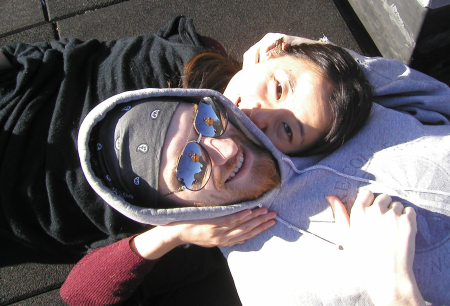
Believe it or not, there is news that is even cooler than the free content and expression definition. The news is that after knowing each other and dating for something like 7 or 8 years -- on and off but mostly on -- Mika and I are going to be getting married. Here's a picture of the two of us at a picnic last weekend:
/copyrighteous/images/mika_mako_boathouse.png
If you read my blog, you've probably seen my frequent links to hers. If you hung out with me in Seattle, Boston, or New York, in the last 3 years or have ever visited The Acetarium, you probably already know her. We've told our families and many of close friends and will going ahead with a wedding and parties in the coming months. At the very least, we'll be having parties in Cambridge (Massachusetts) and in Seattle. Neither of us are particularly traditional and I don't imagine we'll make a very traditional married couple. But we are crazy about each other and in it for the long haul. And that's what counts. The only bad news it that it means that I won't be making Debconf this year -- for the first time in four years. With a little bit of luck I'll be back (perhaps with Mika who attended Debconf 4) next year. If you want to send messages of congratulations. You could make us really happy by sending them in the form of cards or postcards. You can mail those to:
Benjamin Mako Hill and Mika Matsuzaki
The Acetarium
1010 Massachusetts Ave, Apt 54
Cambridge, MA 02138
USA
Stay tuned for information on forthcoming parties and celebrations.

Benjamin Mako Hill: A Done Deed

It's about time for a wrap-up on the recent major event in my life. On May 29th, Mika Matsuzaki and I were married. The festivities kicked off with a parade through Somerville's Davis Square. Andres Salomon kept rhythm on drums and, thanks to my new lab adviser Chris Csikszentmih lyi, we had a couple dozen other wikipedians, hackers, technologists, and biologists keeping tune on kazoos. Like all good Somerville parades, we forgot our parade permit. Which was fine.
/copyrighteous/images/marriage-parade-small.jpg
On the marginally more traditional side, we exchanged vows (written under a mathematical constraint -- Mika's idea) and rings. The marriage was made official by Oxford/Harvard professor of "Cyberlaw" -- who I once worked as teachers' assistant for many years ago -- and Massachusetts Justice of the Peace, Jonathan Zittrain.
/copyrighteous/images/marriage-vows-small.jpg
We ended the day watching the sunset with the serious party-goers from out of town, Debian, and the FSF. Then off to dinner and "happily ever after."
/copyrighteous/images/marriage-sunset-small.jpg
Lots more pictures are linked the Cambridge wedding page on our wedding wiki. If you have pictures, you should link them there or mail them to use and we'll upload them. If you want to send messages of congratulations, please visit that page for mailing instructions (best!) or a wiki page to write them up on. Just yesterday, we received (via Joey Hess) four wonderful pages of tightly packed congratulations messages from the attendees at DebConf. Although it's not a constitutional matter, I'm pretty confident we had more than 3Q developers signing that form which, in a Debian election methods sort of way, really warms my heart. Thank you everyone! It's really too bad we missed DebConf but we're both determined to make next year!

1 September 2006

Dirk Eddelbuettel: New CRAN package 'random' uploaded

A few days ago, I uploaded random to CRAN where it now has its own summary page. It has also been announced on the r-help and r-packages lists. The random packages provides convenient access to the non-deterministic random numbers provided by the random.org site created by Mads Haahr. While certain hardware and software solutions that provide access to non-deterministic random-numbers exist, few if any are portable across all the hardware platforms R supports. Retrieving non-deterministic random numbers may be beneficial to seed parallel simulations with independent draws, to obtain portable initializations for other RNGs, to validate simulation with non-deterministic RNGs, or simply for fun and experimentations. The package is fairly straightforward thanks to R's ability to read directly from remote URLs, and to random.org's nice CGI interface. Included are two pdf file ('vignettes' in R parlance). The first, random-intro, discusses the packages and provides some (currently just initial) tests using dieharder, a thorough test suite for RNGs. The second, random-essay is a 'transcriped' version of Mads essay.

31 August 2006

Jonathan McDowell: New toy! (What to do with it?)

I went wedding list creating in John Lewis yesterday. It was fun for about 5 minutes and then the novelty of a Palm with a barcode reader wore off. They'd told me to be careful where I pointed it, so I didn't get to see just how good the range was. :( During the lengthy process a Hauppauge MediaMVP caught my eye (it's a hardware MPEG2 decoder with SCART socket, ethernet and remote control - the idea being you stream content to it from your PC and watch it on the TV), reduced from £79.99 to £39.99. I'd considered buying one of these in the past, so I took a closer look. And discovered one marked down to £25.00 at the back. Took it to the checkout to confirm the price, got told it was right, and bought it. I'm not exactly sure what I'm going to do with it just yet. :) I've already got a hardware MPEG2 decoder on the DVB card hooked up to the TV, though the MVP is a fanless device and might make a better choice than the living room PC. mvpmc is a potential option, and there's a plugin for VDR as well. Or there's just the prod it and see what I can make it do approach. It's an IBM PowerPC 405 with 32MB RAM (though only 16M for the OS it seems) and an SMC 91C111 ethernet chip. The interesting bit of the MPEG2 decoder has no source which is a pain though. :( Still. Fun toy! \o/

29 August 2006

Jonathan McDowell: Bank Holiday weekend

The weekend started off with a visit from Simon - we'd begun to get more and more grumpy with each other which is usually a sign we actually need to meet up. A trip to the Fat Cat and laughing at VH1's "Top 100 Dance floor fillers" seemed to put us in a better mood. We then headed off on Saturday to Cambridge for Steve's annual Debian UK related BBQ. I took some photos though Dave took many more. There were loads of people this year - it's amazing how many people Steve's house/garden can fit! As we've come to expect it was a fine weekend with plenty of food, drink and chat. Thanks Steve! Monday was mostly spent invading Dave and Becca for the purposes of constructing wedding invitations. They look fab! Just a few little bits to finish before getting round to sending them out. And now today's been a virtual Monday and I think it's almost time to stop...

Next.

Previous.