Search Results: "az"

19 June 2008

Jonathan McDowell: BarCamp - What to say?

Dear Membersofthelazywebwhoknowme,

I am planning to attend BarCamp Belfast on Saturday. They seem to have this idea that everyone should talk about something. I can't think of anything particularly interesting I've done recently to talk about. What have I bored you about that you think might potentially be reasonable to bore a bunch of strangers about? I've been pondering the calendaring/syncing rant, but it really is just that rather than something with a nice conclusion...

18 June 2008

Benjamin Mako Hill: Ubuntu Book Third Edition

Another year has past and another edition of the Official Ubuntu Book has been finished and will be released soon. Over the last two years, the two previous editions of the book have grown along-side Ubuntu. The book has continued to sell very well, received almost universally favorable reviews, and been translated into more than half a dozen languages While Jono Bacon has mostly been pulled into other projects, Corey Burger stepped up to help play the major supporting role in this version of the book's production. The whole text was updated to reflect changes in Ubuntu over the last year including a major rewrite of the chapter on Kubuntu and important work on the Edubuntu chapter. If you use either, you'll understand that there's plenty of churn to report. In a sort of experiment, Barnes and Noble will also be selling a custom edition with an extra chapter by Matthew Helmke on the Ubuntu Forums which I hope to include in the next edition of the book. It's an excellent introduction to the best support resource Ubuntu has to offer that I hope many beginners -- the group that always been the book's audience -- will find useful. You can pre-order the custom edition from B&N or get the book from Amazon or many other sources. Like all previous editions, the book is licensed under the Creative Commons Attribution ShareAlike license and soft-copies should be up on the publisher's website once the book is released. Please support commercial free culture publishing by buying a copy if you find the book useful.

17 June 2008

Decklin Foster: Dealing with it

I had this crazy idea a few months ago which Joey's post about muscle memory reminded me of. For those not in the US, our keyboards have and ~ on the key to the left of 1. I prefer this key to be Esc. Long ago I simply swapped the two keys, but the original "Esc" key is always in some weird and inconsistent place and reaching for ~ became as annoying as reaching for Esc. (I suppose I might not care if I didn't use a unix shell or regular expressions or bit masks or...) So, noting that I mostly only wanted that key for ~, and not , I came up with the following (in xmodmap form):
keycode 49 = Escape asciitilde grave Escape
This means: if you just hit the key, it does the Right Thing (Esc, as if I were on a real unixy keyboard). If you hold Shift and press the key, it also does the Right Thing (~, as if I were on a PC). But what to do about , or Shift-Esc, which are no longer possible? We make them the alternate graphs (just old down AltGr. I think the xkb option to put this on right Alt is "grp:switch"). I honestly use those two infrequently enough that I don't care about having to remember the extra bucky. (I tend to type $(cmd) in the shell, and not cmd , because I use the former in scripts and I always found the latter harder to read. I suppose I would care more if I used Lisp or Haskell or...) What I like most about this solution is that it lets me use the same muscle memory on all my hardware. Never mind weird Esc positions; laptop vendors still can't agree on the correct order of Fn and Control. But you don't have to care if you put Control on Caps Lock. Same idea. It does feel a bit like cheating, but it has made my wrists far more comfortable. Oh, and to wean myself off the key way out in the corner:
keycode 9 = NoSymbol
Now the question, of course (getting back to Joey), is what would happen if my "new" Escape key broke. I guess I'd have to keep the laptop at home and plug in my Happy Hacking Keyboard :-)

16 June 2008

Edd Dumbill: We're all ops people now

Ten years ago, most of us wouldn't have dreamt we'd be managing terabits of storage, tens of megabits of bandwidth, arrays of network-distributed services. The height of a programmer's worry would likely be choice of UI toolkit or finding the right way to indent code, and the height of consumer concern deciding which room to put the new computer in. Now the problems associated with managing large networks are becoming real for everyone, right down to the consumer level. Stupendously large amounts of computing resource are available at an instant. Your household probably has more than a terabyte of storage already. Issues such as single sign-on are going to hit home over the next year, as networked computing and entertainment devices profilerate. Features such as Apple's Time Machine will be increasingly vital — software that makes traditionally gnarly sysadmin tasks consumer-friendly. The rebranding of .Mac into "Mobile Me" is also a step in this direction. The impact on developers As software developers, we also have to cope with the effects of this resource-richness. For small sums of money we can get access to large computing clusters, geographically redundant hosting services. Our programs have left the desktop and found their new home on the web. System administration issues loom large upon us, security concerns lurk auspiciously in the corners of our minds. Although the cost of infrastructure has dropped radically, other costs remain high and are going to stay that way. System administrators are not only grumpy, they demand high wages. Commercial software license fees spiral out of control: traditional per-CPU licensing models make little sense when you can quickly bring up tens of machines. The cost in power is already troubling large companies, and there's no reason to suspect the problems won't ripple down. Help is at hand from a variety of technologies. If they don't yet make massive resource management trivial, they at least make it possible. Some of these also inhabit the weird territory of being both the source of a problem and a solution at the same time: virtualization, for example. Distributed revision control systems Distributed revision control is a technology whose time has finally come in popular circles, thanks in part to Linus Torvald's Git system. DRCS has several important impacts on today's developer: All these trends lower the barrier to entry, increase collaboration and agility of development. You can the value of this as more software tools become free. Selling such tools is rapidly becoming a thing of the past, the advantages of sharing enable the developers at the sharp end to get their jobs done quicker. However, such increased agility and, well, messiness leave other problems to solve, which the next two technologies address. Virtualization Hardware-as-a-service, infrastructure-as-a-service, call it what you will. The ability to create what we used to call entire machines, pick them up and move them around the network is revolutionary, and it's something that will have a real impact on regular developers. The benefits are at several levels. Configuration management Computing is a zero-sum game, and despite our increased ability to create and distribute software, problems still exist. We just pushed them to the next level. In good part, this next level is the problem of configuration management. We now have networks and clusters of (virtual) machines, software so agile we need six decimal places to describe its revision levels, and network and authentication paths that are starting to tangle. How do we manage that? One thing developers crave is repeatability. That's why we love our makefiles, autoconf, Ant, rake and so on. It's the one time even the most imperative-minded programmer writes declarative code. We like to say "let the world be like this." Our new sprawling world lacks this feature, and the best of our old toolkits — .debs, RPMs — address things only at the level of packages in a single environment. So developers must look to the world of operations, a territory we probably thought we needn't enter. In this world the new "make" is called Puppet. You write recipes to describe how things ought to be, and Puppet will make it so. I've been spending some time digging into Puppet, and feel excited by the confidence it's giving me. Now my applications exceed single source trees, and single machines, it gives me the means to tie the whole together. This article was going to be solely about Puppet, but that will have to wait now for another time. It's likely you'll have played with virtual machines and distributed revision control, but have you tried Puppet yet? Give it a spin, and let your mind wander over the benefits for your organization and development approaches. Conclusions
For developers and users alike, our world is changing. Hardware, connectivity and increasingly software is becoming cheap or free. The solidity of the old things we put value on — real things you can touch like disks — is eroding. What really matters is our data, our creations, and their communication. If they don't quite yet exist in a universal "cloud" yet, they're certainly getting frisky. As vendors provide solutions for consumers to manage their new domestic infrastructure, developers must look to network-aware toolkits and operations techniques to manage and get the best from their emergent infrastructures. Also on this topic: Join the conversation about this post

Martin F. Krafft: Setting up an encrypted Debian system

Even though the Debian installer can set up encrypted partitions, it is optimised for systems with a single data partition, unless you want to enter multiple passphrases when the system boots. The installer configures a LUKS volume using cryptsetup, but it provides no mechanism for the use of key files, only interactive passphrases. I like partitioning my disks and use different filesystems for /tmp, /home, /var, and /usr/local for a number of reasons. I don t like entering more passphrases than necessary. If you can identify with that, the following is for you.
Several people have pointed out to me that one can simply create a single encrypted physical volume with the Debian installer and place logical volumes for the various filesystems in there. You still need a separate /boot partition, in any case. Kapil Hari Paranjape has described the approach. This method is much cleaner and to be preferred. It s quite likely that it also improves the speed since only a single kcryptd process takes care of all of the decryption and encryption needs. I shall try it on my next installation and report on whether the Debian installer supports it. In the mean time, the following is left as reference the approach is still fully functional.

Installing the system The first step to setting up an encrypted Debian system is to perform a normal Debian system installation. When you are asked to partition your harddrive and create filesystems, set up all partitions as encrypted volumes (I suggest to go with the installer defaults and use dm-crypt and AES with the default settings, simply because I have no reason to doubt the installer dveeloper team s choices). Make sure to erase the disks in the process the installer has an option for that. Set up the swap partition as an encrypted volume too, but don t worry too much about the settings at this point; we will recreate the swap partition later. Unless you want to boot off an external medium, such as a USB stick, you will need to create an unencrypted partition for /boot. I will return to this topic, which has security implications, further down. The installer will ask you for passphrases for each of the volumes you create. I suggest you pick a secure passphrase for the root volume (/), but simple passphrases for all the other ones (such as a ), since we will reconfigure them to use key files instead.

Using key files A key file is like a passphrase stored in a file on disk; as opposed to what you know , it s a what you have security asset. Thus, you need to store the file somewhere. When I boot up my system, I unlock the root partition with a passphrase entered interactively, which makes the root filesystem available. I store key files for all other volumes in /etc/keys. Obviously, I need to tell cryptsetup to use those. The first step is to create a key file for each partition and to add it as a decryption key to the LUKS volume. You can do all of the following without unmounting the filesystems. See the following example for hda6, which will prompt for the simple passphrase we entered above to unlock the key ring when adding the key file:
umask 077
mkdir /etc/keys
dd if=/dev/urandom of=/etc/keys/hda6.luks bs=4k count=1
cryptsetup luksAddKey /dev/hda6 /etc/keys/hda6.luks
cryptsetup luksKillSlot /dev/hda6 0 --key-file /etc/keys/hda6.luks

The last command wipes the simple passphrase from the key ring and thus makes it unusable. Now we need to tell cryptsetup to use the key file by editing /etc/crypttab and ensuring a line such as the following exists:
hda6_crypt /dev/hda6 /etc/keys/hda6.luks luks

This tells cryptsetup to create the cryptographic volume hda6_crypt from the base device /dev/hda6, using the key file we created above, and letting it know that it s dealing with a LUKS volume. Repeat this for every partition except your root and swap partitions.

Encrypting the swap partition If you are using an encrypted Debian system, you likely have some security requirements to meet. If that s the case, you must also use an encrypted swap partition. The swap partition can be encrypted in two ways:
  • it can be recreated on every boot, using a random passphrase, or
  • it can be created like the other encrypted volumes with a persistent passphrase
If you want to use suspend-to-disk, you cannot use the first approach as it would overwrite your memory footprint stored in the swap partition. Furthermore, you cannot use a key file like the other partitions, since the root filesystem is not (and must not) be mounted by the time the resume process starts and needs to read the decrypted swap partition. The way I solved this is by telling cryptsetup to compute the passphrase of the swap partition from the decryption key of the volume holding the root filesystem; the cryptsetup package implements this with /lib/cryptsetup/scripts/decrypt_derived. Thus, to set up the swap partition, I do the following, assuming hda2 is the partition holding the encrypted swap and the root filesystem is in hda5_crypt:
swapoff /dev/mapper/hda2_crypt
cryptsetup luksClose hda2_crypt
dd if=/dev/urandom of=/dev/hda2
/lib/cryptsetup/scripts/decrypt_derived hda5_crypt \
    cryptsetup luksFormat /dev/hda2 --key-file -
/lib/cryptsetup/scripts/decrypt_derived hda5_crypt \
    cryptsetup luksOpen /dev/hda2 hda2_crypt --key-file -
mkswap /dev/mapper/hda2_crypt

To tell the system about this swap partition, we need to add it to /etc/crypttab and /etc/fstab; make sure, those files contain lines like the following:
/etc/crypttab:
  hda2_crypt /dev/hda2 hda5_crypt luks,keyscript=/lib/cryptsetup/scripts/decrypt_derived
/etc/fstab:
  /dev/mapper/hda2_crypt swap swap sw 0 0

With this in place, as soon as you configure the system for suspend-to-disk, the swap partition will be automatically set up alongside the root filesystem very early during the boot sequence. To figure out which swap partition to make available at that point, cryptsetup checks the following:
  • a line like RESUME=/dev/mapper/hda2_crypt in /etc/initramfs-tools/conf.d/resume
  • a resume device setting in /etc/uswsusp.conf (see uswsusp.conf(5))
  • an entry in /etc/suspend.conf
  • a resume=/dev/mapper/hda2_crypt in the kernel command line
You can inspect /usr/share/initramfs-tools/hooks/cryptroot if you want to know more about this.

Using UUIDs Even though the above is all you have to do, you might want to consider replacing the device paths in /etc/crypttab with persistent ones. One motivation might be the ability to boot off your drive via a USB adapter, which might cause it to appear as /dev/sda instead of /dev/hda. udev is installed by default on Debian systems and it makes persistent links to partitions available under /dev/disk/by-uuid, using the UUID of the content structure (e.g. the LUKS header). It uses /lib/udev/vol_id to determine those link names. If you replace the entries in /etc/crypttab, make sure to update the initramfs (update-initramfs -u -k all) and consider to use the same approach for the /boot filesystem in /etc/fstab; you ll note that all other filesystems use persistent device paths thanks to the dm-crypt layer. If you ever end up booting off the disk through a USB adapter, you might face the problem where the usb_storage subsystem takes too long to activate, so that the cryptsetup script does not find the devices in time. You can either solve this by adding the rootdelay=x parameter or break=mount to the kernel command line. The first will cause the scripts to wait x seconds before trying to configure and mount the root filesystem; the second would give you a shell that you can exit as soon as the kernel spouted its device initialisation messages at you. If you got this far, you might even want to take it further and replace hda5_crypt with cr_root or the like to abstract those silly partition numbers away even further. This is easier than it sounds, but does require several steps. Do not do this if you re not comfortable reviving your system in case it fails to come back up!
  1. replace the old names with the new names in /etc/crypttab for all volumes except the root volume. If you are using a derived passphrase for the swap partition, make sure to put the new name for the root volume into the third column of the swap partition s configuration line.
  2. modify /etc/fstab accordingly, leave the root filesystem s device path alone.
  3. call update-initramfs -u
  4. modify your bootloader to ask the kernel to boot off the new root volume.
  5. replace the root volume s old name with the new one in /etc/fstab.
  6. reboot, and add break=mount to the kernel command line.
  7. at the busybox prompt, edit (vi) /conf/conf.d/cryptroot and change the first field of the root volume s line to the new name.
  8. exit the shell and watch the boot process complete.
  9. finally, replace the root volume s old name with the new one in /etc/crypttab.
If the system fails to boot up again, you can use the backup initial ramdisk, which update-initramfs left in /boot.

Security implications Apart from the usual security implications related to cryptosystems, passphrases, mathematics, user stupidity, and so on, the approach I outlined will leave you with a pretty well-secured system. Obviously, you should make sure to lock your screen whenever you leave the system unattended or the entire encryption is basically useless. There are two attack vectors on your system, both involving physical access to the machine: Other than that, you should be careful when travelling to totalitarian countries, like the Excited States of America, China, and probably the UK. First off, encryption arouses suspicion, and second, border agents might ask you to decrypt the partitions for them to copy or scan, and refusal to do so might get your turned away at the border. When travelling to those countries, make sure to hide your data properly.

Speed implications Obviously, having your entire system encrypted (including swap) will slow it down. I don t have any quantitative information on that, but after several years of using full-disk encryption on my laptop (an X40, which isn t very powerful), I can say that it remains usable, if you don t rely on disk-intensive operations, such as compiling kernels and the like.

Alternative approaches Several alternative approaches exist, all involving an additional device:
  • if you don t like to type in the passphrase for the root filesystem, you could store it on a USB key (or the like); cryptsetup provides /lib/cryptsetup/scripts/passdev, which can be used to deal with such a situation. You can find more information in cryptsetup s README.Debian file.
  • if you don t like the unencrypted /boot partition, you could boot the system off a USB key, which you can keep separate from the system except for when booting and upgrading the kernel. All you need to do for that is install the bootloader and kernel onto the device and configure it to use the proper encryption volume on the harddisk as root filesystem.
  • cryptsetup also comes with support for PKCS#15 smartcards (opensc and openct).
I have chosen neither of these approaches, because the extra security does not make up for the inconvenience, and the danger of an unbootable system in case of loss of forgetting of the additional device.

15 June 2008

Joey Hess: no escape

So my Esc key broke today. Maybe due to high humidity last night -- the laptop was generating a lot of spurious lid open events earlier. New keyboard ordered, etc, nothing too unusual given the crummy nature of laptop keyboards (Fujitsu's in specific). The interesting thing though, is that even though I've remapped Caps Lock to generate Escape for now, this threw my typing off to an amazing extent. I don't just have trouble typing ^]:wq in vim. I have trouble typing arbitrary sentences in programs that don't use escape at all. Why? I don't touch type the way people are taught to in school, with fingers on the home keys. I touch type the way you learn to by typing a lot, ad-hoc, until your hands learn exactly how to type the common things you throw at them. This includes being able to type ^]:wq as fast as I can type "joey". My home keys are, approximatly:
Tab Q S X Space       Down . ; ' Enter
(Space and Down are covered by my thumbs.) This might seem a bit weird, but as a programmer, I hit tab a lot, and, enter lots of semicolons, periods, and quotes. As a human on the WWW, I scroll down a lot. As a command-line user, Enter is a key I hit a lot. That's my guesses why my fingers go there. This wasn't planned, it evolved. In fact, I have other home key locations, that are used for other activities too. Now that I'm typing in a lot of text here, my WPM has increased a lot, because my hands have moved closer to the center of the keyboard. Something like this.
      W E F V    J I O  
Although every time I've checked, it's been a slightly different set of keys. My hands know where they are, and seem to make pretty good guesses about where I'll want them in the next word and pick a different "home row", depending. Also, if I'm scrolling around a lot, my left hand switches to:
                      Left Up Right
Point being that this is all very dynamic, and unconcious, and very adapted to this exact keyboard. Learning a new keyboard will take me days of fumbling, that are reminiscent of someone describing switching from QWERTY to DVORAK. And, it turns out that even moving a single key like Esc is close to switching to an entire new keyboard. Needing to reach down to Caps Lock for Esc threw everything else off subtly, even when I wasn't typing that key. Clearly this is not the best way to type. It's just my way. :-/

13 June 2008

Peter Eisentraut: Debian Release Goals

I have been tracking the Debian release goals progress for a while now, through bug-squashing parties and using various iterations of wiki pages. It's time to write down some thoughts.

First of all, I think the concept of release goals is a fantastic idea. It may be one of the most important conceptual moves in Debian of late. It allows developers to implement distribution-wide changes without having to negotiate with every package maintainer individually and without having to go through the vicious no-change-without-policy/no-policy-without-established-practice maze. It moves the focus back on operating system development instead of package hoarding.

In the future, I think we should come up with some "sexier" release goal descriptions. If you look over the current list, many of these tasks are implementation-level, without any obvious benefit to users: double-build support? no unmet recommends? Or they have incomprehensible descriptions. The pretty much only release goal that has a real user benefit, namely the piuparts cleanness, ensuring clean distribution upgrades, is both the most cryptic and actually the most neglected one in terms of development attention. Don't get me wrong, all these goals are very valid. For better or worse, the press has started to pick up these release goals to put in their various Debian release candidate timeline pre-announcement articles, and next time around we should have something cool in there. If armel support or KDE 4 integration had been release goals, the marketing effect would be better.
The next thing is tracking bugs. If you have some time on your hands, how do you find a release goal bug that you can help with? I had worked up this wiki page to help myself, but it is still too weird. The fact that bts.turmzimmer.net exists shows that the BTS is lacking features or is too hard to use or both. I'm thinking, we should regularly copy the whole BTS into an SQL database and make queries from there. Think aggregation, grouping, full-text search! I'm not familiar with the BTS internals or the LDAP gateway, but I know my SQL. So if anyone knows the other end of this deal, I'd love to chat about setting something like this up.

So then, what happens to the release goals after the release? Has this been thought through?

Obviously, some release goals become technically self-enforcing. Python 2.5 and GCC 4.3 are now the default, and anything that doesn't work with these will have permanent trouble in the future.

Release goals that implement a distribution-wide feature, such as the LSB-based init system enhancements, will really need to become part of policy after the release. Otherwise they would revert to being normal bugs without any NMU powers and the other special attention given to release goals. So over time, the support for the former release goals across packages would again decline. To keep it up, you'd either have to repeat the release goal indefinitely, which would be silly, especially when there are no problems right now, or you'd have to make it a part of policy to enforce it in the future. Essentially, you'd have to consider most release goals trial policy changes, which become permanent if successful.

Near-examples of the above are the eternal release goals of IPv6 support and LFS support. We really have these under control quite well now -- although I still wouldn't dare to call Debian or any general-purpose Linux distribution fully IPv6-ready -- but nowadays these problems are almost all upstream code problems that Debian can't really fix very well on the packaging side. So under the current approach these release goals will exist forever, or worse, will be dropped from release goal status.

And then of course, some release goals fail to be reached. These should reapply for the next release, if interest persists. The dash goal comes to mind.

By the way, we had 13 release goals. 3 are completely done, 5 are pretty much done (less than 10 bugs), 1 more looks like it could get pretty much done before the release, and 4 will most likely fail to be accomplished.

David Welton: Cache it all

I recently redid my personal web site, at welton.it. Wanting to be quick about it, and make the look and feel a bit more uniform than it has been in the past, I hacked together some pages in Rails. Despite this being sort of a "killing a fly with a bazooka" situation, I've been doing lots with Rails, so it was quick to use. Here's the thing, though: Rails is definitely overkill, as the site is basically static. I don't need to calculate anything or fetch stuff from a database - I just wanted a reasonably good template system, and I am quite comfortable with Rails these days. But the idea of leaving Rails running for a static site was of course no good: I basically need to cache the entire thing, so that Rails is simply not involved. How to do this as quick as possible (in between diaper changing and other baby duties!) ? Ideally, it would be possible to introspect Rails in order to know exactly which pages are present, then cache those, and avoid Rails on the server entirely (just generate them locally and put them in subversion), but that proved to be fairly hacky, so I settled for this code, which simply caches all pages which comes across, when caches_pages is placed in application.rb:
class CacheFileName
  include ActionController::Caching::Pages
  include ActionController::Caching::Pages::ClassMethods
  def cachedname(path)
    page_cache_file(path)
  end
end
def caches_pages()
  return unless perform_caching
  after_filter do  c 
    res = c.cache_page
    cfn = CacheFileName.new
    cf = Cachedfile.new :filename => cfn.cachedname(c.request.path)
    cf.save!
  end
end
It simply caches everything. To be able to easily clear out the cache if there are any changes to the site, we record the changes in the Cachedfile model, which is defined like this:
create_table "cachedfiles", :force => true do  t 
  t.string   "filename"
  t.datetime "created_at"
  t.datetime "updated_at"
end
with this model:
class Cachedfile < ActiveRecord::Base
  def Cachedfile.clean_cache
    Cachedfile.find(:all).each do  cf 
      begin
        fn = ActionController::Base.page_cache_directory + cf.filename
        File.delete fn
      rescue => e
        logger.error "Error deleting # fn : # e.inspect "
      ensure
        cf.destroy
      end
    end
  end
end
which has a class method to go through and clean out all the cached files. I call it manually from ./script/clean_cache:
#!/usr/bin/env ruby
ENV['RAILS_ENV'] = ARGV.first   ENV['RAILS_ENV']   'development'
require File.dirname(__FILE__) + '/../config/boot'
require "# RAILS_ROOT /config/environment"
require 'console_app'
Cachedfile.clean_cache
It's not a beautiful system, but it gets the job done.

12 June 2008

Biella Coleman: Free Speech: A Comparative Perspective

While free speech rights are valued and recognized in most liberal democracies, the degree and scope of these rights are by no means uniform. The United States, which has the most expansive free speech protections in the world, actually stands apart as this New York Times article on the subject makes clear. The article covers familiar ground (at least for those who follow free speech debates) but it does so well and discusses an interesting case now unfolding in Canada, concerning a pretty inflammatory magazine article denouncing Islam. The magazine is currently under trial for violating provincial hate laws.

Aurelien Jarno: Flight booked (aka crazy prices)

As I am one of those who have read “able” instead of “unable”, I had to find a really cheap flight. This may sound crazy, but an Iberia flight to Buenos Aires from Berlin costs far less than from Lyon (where I live) or even from Madrid: 781.12 EUR from Berlin instead over 1,200.00 EUR from Madrid and over 1,300.00 EUR from Lyon (in both cases with a change in Madrid Barajas). I wonder if Iberia pays you 420,00 EUR if you flight from Berlin to Madrid… Now I have to find a cheap way to go to Berlin from Lyon (probably an EasyJet flight). I plan to spend a few days of holiday in Berlin before flying to Argentina.

Ross Burton: UPnP in Epiphany

One of the more useful features of the UPnP specification is that devices have a standard way of specifying a "presentation URL", a human-readable web page representing the device. For example, my SoundBridge has a web page which shows the currently playing music and lets me switch radio station, whilst my router's presentation URL is the administration page. Useful, but not exposed anywhere. Until now... GUPnP in Epiphany This is a small Epiphany extension which adds all presentation URLs it finds to the Nearby Sites menu, just like the URLs discovered using Avahi. It needs a bit more work as it doesn't yet handle being unloaded or devices disappearing, but it is certainly usable now. If anyone else wants to have a go with it, the source can be fetched using Bazaar from here. Watch out for the currently hard-coded paths...

Simon Richter: I couldn't decide on eyebrows

All hail Joey's indifferent looking new sun god.

Edd Dumbill: Gandi's VM hosting beta now closed to new users

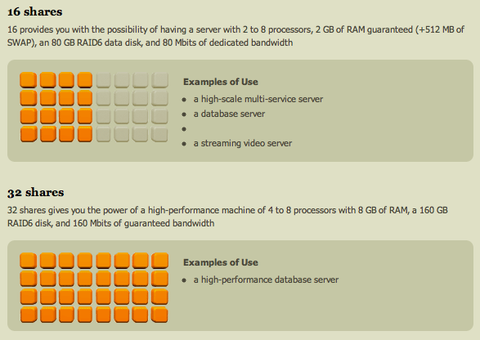
I've been experimenting with Gandi's virtual hosting service recently. In fact, this blog is now hosted on it. Gandi have created by far the easiest hosting service I've used. The web interface allows you to buy credit, create pre-installed virtual machines and log in, all in under 15 minutes. Add the ease of Ubuntu to the mix (just one of the preinstalled images you can choose from), and commissioning times for new services are low indeed. The hosting service is based on Xen, and allows you to dynamically change the resources your VMs can access (CPU/memory/disk), on a scheduled basis if required. It has an API which provides enough functionality for you to white-label hosting as part of your own web app. Gandi's hosting options
Excerpt from Gandi's explanation of the amount of resource you can allocate to a virtual machine Gandi's service isn't yet as flexible as Amazon's EC2, but it comes at the problem from the other end — its initial offering "just works" as an alternative hosting solution, with the added flexibility their Xen infrastructure brings to the mix. Even with all its tool support, Amazon EC2 feels like stepping into an alternate universe. I'm pretty excited about the directions in which Gandi's service will develop. And yes, now I've told you all this, unfortunately you can't yet play with the beta service if you've not got an account already. The initial success means Gandi are closing new signups for a little time to concentrate on improving their infrastructure. The good news is that Gandi say this is the final step before the full release of the system. I can't wait! It's so good to see innovative, high-quality internet solutions coming from Europe.Join the conversation about this post

11 June 2008

Christian Perrier: [life] Manu en su casa

Yes, Manu Chao was really home yesterday in Paris Bercy. And he was obviously feeling like being home. The concert began at 21:30 and ended up at 00:30. Yes...that makes 3 full hours concert. All that for 25 euros. The crowd support, dance, participation was *amazing*. I often go to concerts in the Bercy arena and never saw the crowd in the upper rows being stood up all concert long. Radio Bemba played their usual tracks first. As usual, the very Manu way to mix songs, themes from all his carreer and mix them up, distord them and make new songs from old ones. This is what always made Mano Negra, then Manu Chao oncerts unique experiences. Just imagine 20,000 people singing Clandestino a capella, most of us not knowing any damn word of Spanish... After about 2 hours of magic without any stop, the very special moments came in. Manu, Gambit, Majiv (what a guitarist when playing rumbas de Barcelona!), Julio (de Barcelona!)...and all others were just feeling like being home with a few friends. So the encores lasted...and lasted...and lasted. They just didn't want to stop (Manu probably said about 3 or 4 times "c'est fini"). Then, they did something I never ever saw in a big 20,000 people concert since my first one back in....long time ago. Manu asked "do you have 5 more minutes?". So, they stopped for 5 minutes to get the guitars re-accorded(sp?)....the crowd just...waited...and the gig re-started again with songs from "Si Sib rie m' tait cont e", the special book-album he made with friends, inspired by the sad winters he spent in Paris in his early years. Soooooo special and, believe me, that *was* special. Seeing all roadies, crew, friends just dancing backstage and partying clearly showed this was not to always happen (this will probably happen again on today's concert). He was just feeling like home. And so were we. Not wanting to leave and shut down the light. Finally, at 00:30, all of us were dead tired and we just hugged around with Manu and left. Just like old friends. I don't know if that will happen everywhere in the upcoming tour (some dates in France, some in Europe, a few in USA....nothing unfortunately in South America as of now)....but if you have the opportunity to go to Radio Bemba concerts, just do it. And (IRC reference), really, Erinn, this was not about "ethnic music for white people" (really wondering where you got this idea...or if you were just kidding me). I dunno what Manu ever did to kill your ears, but just try again and, even more important, go to the gig in your fair city on August 22nd. Radio Bemba concerts will be cheap, about half the price of regular bug size concerts....just use that opportunity.

MJ Ray: More driving and cycling

Jeff Bailey asked:
"Heya Brits! Any of you still driving cars at ~ 1.15 according to the Daily Mail"
Yes, I am. I drove on Monday (at 1.18/l) because it was the least bad option for the journey. I try to avoid it and I felt bad afterwards (literally - it was too damn hot and each part of the journey was too short for the cab to cool down), but the car was available and the other choices involved not attending some events. On Sunday, I used my bike instead, but I was I wondering if the world is full of Sunday drivers today or whether I was really riding that badly. You name a junction on my route and I seemed to get into a conflict with a car at it. Today's bike trip went much better, even getting thanks from a coach for pulling aside halfway up an incline, but I had to take avoiding action as I re-entered the village because of a police car. I'm pretty damn sure that wasn't my fault, but I do wonder when it's the police. I'm still riding without a helmet, without ill effects. Gunnar Wolf was getting a breeze through a different kind of helmet but I think it's telling that cyclists "feel naked" rather than actually being naked (usually, at least). Have we got too used to being cocooned in metal boxes while out on the roads? I've always ridden and walked a lot - is this why I don't miss the hat much? I must remember to drink more in summer without it, though. I share Criag Sanders's scepticism about the protests and Chrisitan Perrier's enthusiasm for bike-pools. I don't agree with many of Russel Coker's views on oil prices but they are interesting reading, even so. I'm taking part in JamBustingJune for the West of England region and BikeWeek 14-21 June 2008

Gunnar Wolf: No, it's not

Several people have approached me (or I've stumbled upon their sites) asking me about something called Debian 5.0 Beta 2.
It. Is. Not. That.
Please read clearly the announcement for Debian Installer lenny beta 2 - Yes, I understand this reached many people who are not involved in Debian but are enthusiastic users nevertheless. In short: The only thing that reached the beta is the debian-installer program (usually called just d-i), the amazing piece of code that handles a Debian installation in your system. And yes, it is meant for wide testing and work.
But please, do not take this as a preview of the new Debian release - it is not. If you install a system using this version of d-i, you will be tracking the Testing branch of Debian, and your system will be in a continuous state of flux. Yes, we do expect a freeze of Lenny in the next couple of weeks, after what it will be quite close to a Beta release (i.e. almost no new versions, no fresh software, just bug fixes). But hey - A Beta is supposed to be close to release quality. And if you look at the release-critical bugs affecting the Testing branch (green line), you will clearly see we have over 400 bugs to fix before Lenny is allowed to be called stable. And that's only one of the criteria needed to reach Lenny - Glance over at the Debian Release Management page to quickly understand the nature of changes still to come.
Oh, and of course - Even if it is not necessarily up-to-date, I have found the Wiki page created by Peter Eisentraut as an excellent place to start working whenever I have some free time: Lenny Release Goals.
so... If you are not yet working towards making Debian the best distribution ever, and Lenny the best Debian release ever, you now know where we need your help ;-)
(side note: d-i team, maybe the next announcement could use some words pointing out we are not doing a Debian beta program, just a d-i beta release?)

Russell Coker: Perpetual Motion

It seems that many blog posts related to fuel use (such as my post from yesterday about record oil prices [1]) are getting adverts about perpetual motion [2]. Note that the common usage of the term “Perpetual Motion” does not actually require something to move. A battery that gives out electricity forever would be regarded as fitting the description, as does any power source which doesn’t have an external source of energy. The most common examples of this are claims about Oxyhydrogen [3], this is a mixture of hydrogen and oxygen in a 2:1 ratio. The wikipedia page is interesting, apparently oxyhydrogen is used for welding metals, glass, and plastics, and it was also used to heat lime to provide theatrical lighting (”lime light”). So a mixture of hydrogen and oxygen does have real-world uses. The fraud comes in the issue of the claims about magnecules [4]. Magnecules are supposedly the reason for the “atomic” power of HHO gas (AKA Oxyhydrogen) which are repeated on many web sites. In brief, one mad so-called scientist (of course if he was a real scientist he would have experimental evidence to support his claims and such experiments would be repeatable) has invented entirely new areas of science, one of which involves magnetic bonds between atoms. He claims that such chemical species can be used to obtain free energy. The idea is that you start with water, end with water plus energy - then reuse the water in a closed system. Strangely the web sites promoting water fueled cars don’t seem to mention magnecules and just leave the “atomic energy” claim with no support - maybe magnecules are simply too crazy for them. The water fuelled car wikpedia page is interesting - it lists five different ways that water can actually be used in a car engine (which are based on sound scientific principles and which have been tested) and compares them to the various water fueled car frauds [5]. I’m not accepting any more comments on my blog about perpetual motion solutions to the petrol crisis (they just take up valuable space and distract people who want to discuss science). I’ll allow some comments about such things on this post though.

10 June 2008

Gunnar Wolf: Nekkid city - yet again!

After thinking it over a couple of times, I did it. I told you here about the World Naked Bike Ride. Thousands of bikers, in over 130 cities around the world, voiced their concerns about the lack of caution drivers have towards us, about the abuse of fossil fuels for urban transportation, about the easy we are not to be seen. Many among us have been run over by careless drivers (in my case, no consequences except a broken helmet - And yes, MJ: although the impact was on the flat surface of the road and not on the kerb, the strength of the impact still amazes me). We feel naked against the motorized traffic. So, the WNBR decides to show it by taking the streets of our many cities - Naked.
It was a completely different experience of the massive naked Spencer Tunick photo, as we were there not just to show our freedom and enjoy, but to get the people to look at us. There were some of the same elements of comradeship and trust we had there (and, of course, that many of us learnt in Finland when we became GNUdists at DebConf 5's unforgettable saunas).
Anyway... I did not make the full route (I rode Chapultepec-Z calo-Diana, ~15Km, but missed the Diana-Gandhi-Cibeles part, maybe some 5Km) as I had an appointment I was already late for. But it was a unique, great experience. If you are interested, we got a fair share of press coverage. Oh, and I must say: I am famous now. And in my favorite newspaper, nothing less :).

MJ Ray: Online shopping

I maintain a number of web shops for our webmaster cooperative and one of our main challenges is to encourage people who put things into their basket/cart to actually buy them. How to avoid shopping cart abandonment by Graham Jones makes some points that I've identified as possible reasons for people not buying in the past: comparisons, robots and not trusting the site enough to give payment details. There's not much we can do about robots or people comparison-shopping at a technical level, but we try to build some trust by publishing the shop owner's geographic address and telephone number (which I think is required by law in England for most web shops now), making sure the SSL certificate and domain registration details are correct, using reputable payment providers and being clear about delivery charges and terms. The point about the slickness of the checkout process is a good one and one that we've only recently started to work on. We've had pretty good results from making the checkout slicker on one site. It looks like two-thirds of people who click the checkout button now continue to buy, putting it comfortably ahead of current UK averages but I need to tweak our stats calculator to make the report directly comparable. Nevertheless, I think those improvements will be added to our other shops as soon as possible. I share Graham's low opinion of the oft-quoted Amazon. We've also been looking at other web shop software besides OSCommerce for a new project, so now would be a good time to change to something new if it improves the checkout a lot. We've made OSCommerce's checkout a lot smoother, but it's still essentially OSC. Is there a good checkout which you'd want to use as an example? The other challenge is getting visitors onto the site in the first place. How To Build Links By Patrick Altoft explains the basics as well as I've seen recently.

Adeodato Sim : Five films (#2)

It’s time for recommending five films again. I’ve also decided that I may reserve the last of the five for films I watched prior to starting these series. So here we go:

Next.

Previous.