Search Results: "ana"

25 March 2014

Sylvain Le Gall: Release of OASIS 0.4.3

I am happy to announce the release of OASIS v0.4.3. Logo OASIS small OASIS is a tool to help OCaml developers to integrate configure, build and install systems in their projects. It should help to create standard entry points in the source code build system, allowing external tools to analyse projects easily. This tool is freely inspired by Cabal which is the same kind of tool for Haskell. You can find the new release here and the changelog here. More information about OASIS in general on the OASIS website. Here is a quick summary of the important changes: Features: This new version closes 4 bugs, mostly related to parsing of _oasis. It also includes a lot of refactoring to improve the overall quality of OASIS code base. The big project for the next release will be to setup a Windows host for regular build and test on this platform. I plan to use WODI for this setup. I would like to thanks again the contributor for this release: David Allsopp, Martin Keegan and Jacques-Pascal Deplaix. Their help is greatly appreciated.

24 March 2014

Michael Prokop: Building Debian+Ubuntu packages on EC2

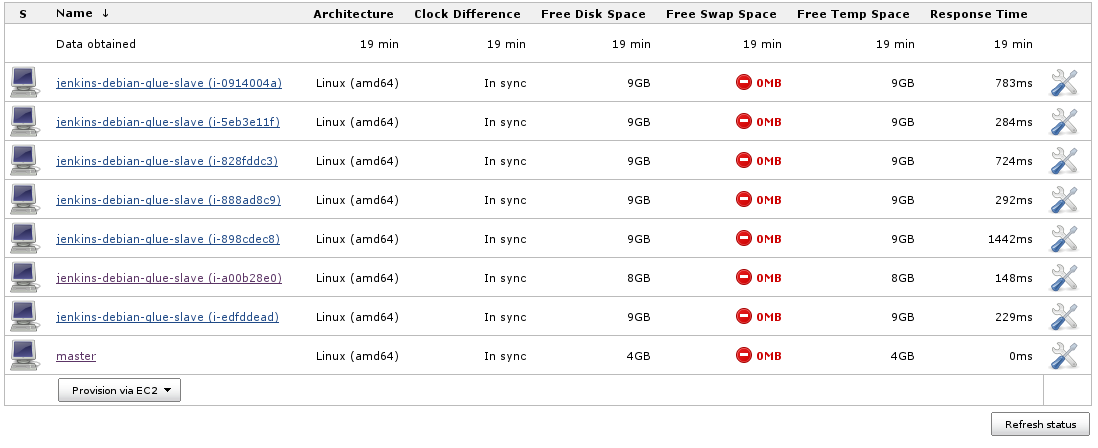
In a project I recently worked on we wanted to provide a jenkins-debian-glue based setup on Amazon s EC2 for building Debian and Ubuntu packages. The idea is to keep a not-so-strong powered Jenkins master up and running 24 7, while stronger machines serving as Jenkins slaves should be launched only as needed. The project setup in question is fully open sourced (more on that in a separate blog post), hereby I am documenting the EC2 setup in usage. Jenkins master vs. slave Debian source packages are generated on Jenkins master where a checkout of the Git repository resides. The Jenkins slaves do the actual workload by building the binary packages and executing piuparts (.deb package installation, upgrading, and removal testing tool) on the resulting binary packages. The Debian packages (source+binaries) are then provided back to Jenkins master and put into a reprepro powered Debian repository for public usage. Preparation The starting point was one of the official Debian AMIs (x86_64, paravirtual on EBS). We automatically deployed jenkins-debian-glue on the system which is used as Jenkins master (we chose a m1.small instance for our needs). We started another instance, slightly adjusted it to already include jenkins-debian-glue related stuff out-of-the-box (more details in section Reduce build time below) and created an AMI out of it. This new AMI ID can be configured for usage inside Jenkins by using the Amazon EC2 Plugin (see screenshot below). IAM policy Before configuring EC2 in Jenkins though start by adding a new user (or group) in AWS s IAM (Identity and Access Management) with a custom policy. This ensures that your EC2 user in Jenkins doesn t have more permissions than really needed. The following policy should give you a starting point (we restrict the account to allow actions only in the EC2 region eu-west-1, YMMV):
 
  "Version": "2012-10-17",
  "Statement": [
     
      "Action": [
        "ec2:CreateTags",
        "ec2:DescribeInstances",
        "ec2:DescribeImages",
        "ec2:DescribeKeyPairs",
        "ec2:GetConsoleOutput",
        "ec2:RunInstances",
        "ec2:StartInstances",
        "ec2:StopInstances",
        "ec2:TerminateInstances"
      ],
      "Effect": "Allow",
      "Resource": "*",
            "Condition":  
                "StringEquals":  
                    "ec2:Region": "eu-west-1"


  ]
 
Jenkins configuration Configure EC2 access with Access Key ID , Secret Access Key , Region and EC2 Key Pair s Private Key (for SSH login) inside Jenkins in the Cloud section on $YOUR_JENKINS_SERVER/configure. Finally add an AMI in the AMIs Amazon EC2 configuration section (adjust security-group as needed, SSH access is enough): As you can see the configuration also includes a launch script. This script ensures that slaves are set up as needed (provide all the packages and scripts that are required for building) and always get the latest configuration and scripts before starting to serve as Jenkins slave. Now your setup should be ready for launching Jenkins slaves as needed: NOTE: you can use the Instance Cap configuration inside the advanced Amazon EC2 Jenkins configuration section to place an upward limit to the number of EC2 instances that Jenkins may launch. This can be useful for avoiding surprises in your AWS invoices. :) Notice though that the cap numbers are calculated for all your running EC2 instances, so be aware if you have further machines running under your account, you might want to e.g. further restrict your IAM policy then. Reduce build time Using a plain Debian AMI and automatically installing jenkins-debian-glue and further jenkins-debian-glue-buildenv* packages on each slave startup would work but it takes time. That s why we created our own AMI which is nothing else than an official Debian AMI with the bootstrap.sh script (which is referred to in the screenshot above) already executed. All the necessary packages are pre-installed and also all the cowbuilder environments are already present then. From time to time we start the instance again to apply (security) updates and execute the bootstrap script with its &dash&dashupdate option to also have all the cowbuilder systems up2date. Creating a new AMI is a no-brainer and we can then use the up2date system for our Jenkins slaves, if something should break for whatever reason we can still fall back to an older known-to-be-good AMI. Final words How to set up your Jenkins jobs for optimal master/slave usage, multi-distribution support (Debian/Ubuntu) and further details about this setup are part of another blog post. Thanks to Andreas Granig, Victor Seva and Bernhard Miklautz for reading drafts of this.

Andrew Pollock: [life] Day 55, Kindergarten, run, Debian

I got up this morning with the intent of knocking out a 10km run. I managed to last 8km today, so it's an improvement, but I don't know what's up with my running fitness at the moment. After that, I pretty much did Debian stuff all day. I managed an upload of dstat and found a potential security bug in another of my packages when I was trying to update it, so I raised that issue with the package's upstream. I also mostly sorted out opening a bank account for my company. I just have to visit the branch in person tomorrow. Sarah had indicated to me that Zoe had slept poorly last night, on top of a big weekend, and that I should probably pick her up in the car, so I drove to Kindergarten expecting to find her fast asleep and not take too kindly to being woken. Instead, she was wide awake, not having napped at all. The highlight of her day was they had some baby chickens at Kindergarten. They had four day-old hatchlings, with more eggs in an incubator. Megan wanted Zoe to have a coffee with her, so we stopped at the local coffee shop, with her Dad and little sister, for a babyccino on the way home. I had a pretty big weekend away, and didn't feel up to doing the grocery shopping yesterday afternoon when I got home, so we went to the supermarket on the way home to do the weekly grocery shop. After we got home, I got stuck into making dinner while Zoe watched TV. My girlfriend came around after work and joined us for dinner, and the three of us had a nice dinner together. Zoe started showing signs of being particularly tired during dinner, and was a bit uncooperative around bath time, but we got through it all, and I managed to get her down to bed a little bit early, and she fell asleep without too much trouble. It's a fairly warm night. Hopefully she'll sleep well.

23 March 2014

Dominique Dumont: Easier Lcdproc package upgrade with automatic configuration merge

Hello This blog explains how next lcdproc package provide easier upgrader with automatic configuration merge. Here s the current situation: lcdproc is shipped with several configuration files, including /etc/LCDd.conf. This file is modified upstream at every lcdproc release to bring configuration for new lcdproc drivers. On the other hand, this file is always customized to suit the specific hardware of the user s system. So upgrading a package will always lead to a conflict during upgrade. User will always be required to choose whether to use current version or upstream version. Next version of libconfig-model-lcdproc-perl will propose user whether to perform automatic merge of the configuration: upstream change are taken into account while preserving user change. The configuration upgrade shown is based on Config::Model can be applied to other package. Current lcdproc situation To function properly, lcdproc configuration must always be adapted to suit the user s hardware. On the following upgrade, upstream configuration is often updated so user will often be shown this question:
Configuration file '/etc/LCDd.conf'
 ==> Modified (by you or by a script) since installation.
 ==> Package distributor has shipped an updated version.
   What would you like to do about it ?  Your options are:
    Y or I  : install the package maintainer's version
    N or O  : keep your currently-installed version
      D     : show the differences between the versions
      Z     : start a shell to examine the situation
 The default action is to keep your current version.
*** LCDd.conf (Y/I/N/O/D/Z) [default=N] ?
This question is asked in the middle of an upgrade and can be puzzling for an average user. Next package with automatic merge Starting from lcdproc 0.5.6, the configuration merge is handled automatically by the packaging script with the help of Config::Model::Lcdproc. When lcdproc is upgraded to 0.5.6, the following changes are visible:
* lcdproc depends on libconfig-model-lcdproc-perl
* user is asked once by debconf whether to use automatic configuration upgrades or not.
* no further question are asked (no ucf style questions). For instance, here s an upgrade from lcdproc_0.5.5 to lcdproc_0.5.6:
$ sudo dpkg -i lcdproc_0.5.6-1_amd64.deb 
(Reading database ... 322757 files and directories currently installed.)
Preparing to unpack lcdproc_0.5.6-1_amd64.deb ...
Stopping LCDd: LCDd.
Unpacking lcdproc (0.5.6-1) over (0.5.5-3) ...
Setting up lcdproc (0.5.6-1) ...
Changes applied to lcdproc configuration:
- server ReportToSyslog: '' -> '1' # use standard value
update-rc.d: warning: start and stop actions are no longer supported; falling back to defaults
Starting LCDd: LCDd.
Processing triggers for man-db (2.6.6-1) ...
Note: the automatic upgrade currently applies only to LCDd.conf. The other configuration files of lcdproc are handled the usual way. Other benefits User will also be able to:
* check lcdproc configuration with sudo cme check lcdproc
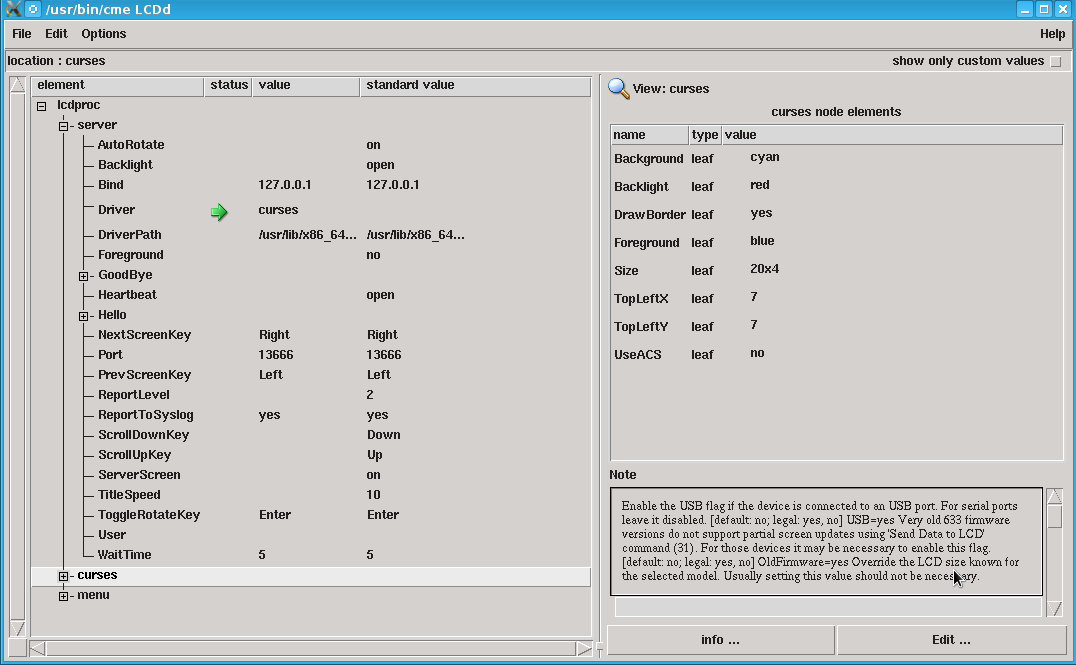
* edit the configuration with a GUI (see Managing Lcdproc configuration with cme for more details) Here s a screenshot of the GUI: GUI to edit lcdproc configuration More information * libconfig-model-lcdproc-perl package page. This package provides a configuration model for lcdproc.
* This blog explains how this model is generated from upstream LCDd.conf.
* How to adapt a package to perform configuration upgrade with Config::Model Next steps Automatic configuration merge can be applied to other packages. But my free time is already taken by the maintenance of Config::Model and the existing models, there s no room for me to take over another package. On the other hand, I will definitely help people who want to provide automatic configuration merge on their packages. Feel free to contact me on:
* config-model-user mailing list
* debian-perl mailing list (where Config::Model is often used to maintain debian package file with cme)
* #debian-perl IRC channel All the best
Tagged: config-model, configuration, debian, Perl, upgrade

Russell Coker: Aldi Deserves an Award for Misleading Email

Aldi Mobile has made a significant change to their offerings. They previously had an offer of $35 for unlimited calls and 2.5G of data in a month for which they had to publicly apologise for misleading customers as 2500 minutes of calls a month (83 minutes per day) is no-where near unlimited [1]. They also had an offer of $15 for 2G of data. In an email about this Aldi said Many of our customers are using a lot less than what is included in our current $35 plan. So we will soon be introducing new Value Packs with more flexible options; meaning you only pay for what you really need and they start from just $10. . That is grossly misleading, if they offered new plans in addition to the old ones and allowed customers to choose the plan that is the best match then it would be useful to some customers. But removing the supposedly unlimited plan and the $15 for 2G of data option is removing affordable options for people who want to use their phones for lots of calls or very few calls but moderate amounts of data use. New Plans The base rate for calls on Aldi pre-paid is $0.12 per minute and $0.12 per SMS, consider every mention of minute in this section to be minute or SMS . The Aldi Newplans page [2] starts with a $10 per month plan which offers 100 minutes of calls which would be $12 at the previous rate of $0.12 per minute. That is OK value when compared to just using the pre-paid calls if you consistently use more than 83 minutes of calls per month. However if you don t use 84 minutes of calls (EG you don t speak much on the phone and use Google Hangouts instead of SMS) then it s not good value. Also the advertised data use is $5 per 100MB, which is way below what is needed for a typical user with an Android phone. My mother in law was barely able to stick within a limit of 300MB/month when that was her limit, but while using the Aldo 2G/month bolt-on she s increased her data usage. The smallest of the new plans costs $20 per month, it provides 300 minutes of calls and includes 300MB of data. For an extra $7 you can get another 300MB of data. For my mother in law it seems that the cheapest option on the new plans would be $27 per month, that would cover the 60 minutes of calls she might make and the 450MB of data she s probably using. That s significantly more expensive than her previous cost of $15 for 2G of data and $7.20 for calls and has the additional difficulty that I would have to be more involved in helping her avoid excessive data use. The 2G data bolt-on was really good for some of my relatives, when they use that and configure their phones not to update software over 3G they never had to ask me about any problems related to excess data use. So my mother in law is facing an extra $5 per month (or maybe more depending on data use) and more time spent calling me for tech support. The data bolt on that Aldi is going to offer in future is $30 for 3G of data to replace the previous offer of $15 for 2G of data. The cost will be unchanged for anyone who uses between 2G and 3G a month, for everyone who uses less than 2G or more than 3G the data bolt-on will cost more. There is simply no possibility for any Aldi data-only customer to save on data use. The only way someone who uses a moderate amount of data could save money is if they use more than 160 minutes of calls and less than 1G of data. Disclaimer My analysis above is based on interpreting the Aldi web site. As with most telcos they aren t trying to make things easy in this regard, it seems that the consensus of opinion among telcos is to use complex pricing to make it difficult to compare and reduce competitive pressure. I blame any inaccuracies in my analysis on the Aldi web site. Why Aldi Shouldn t Mislead Customers Aldi isn t primarily a mobile phone company, their main business is running a supermarket. The trust of customers is important to them, raising prices when competition goes away is one thing, but misleading customers about it is another. If Aldi were to honestly say now that Kogan Mobile no longer exists there is nothing forcing us to have low prices then I d have a lot more respect for their company and be more inclined to shop at their supermarket. It s a sad indictment of our society that I need to include a why lying is wrong section in such a blog post.

22 March 2014

Keith Packard: glamor-core

Core Rendering with Glamor I ve hacked up the intel driver to bypass all of the UXA paths when Glamor is enabled so I m currently running an X server that uses only Glamor for all rendering. There are still too many fall backs, and performance for some operations is not what I d like, but it s entirely usable. It supports DRI3, so I even have GL applications running. Core Rendering Status I ve continued to focus on getting the core X protocol rendering operations complete and correct; those remain a critical part of many X applications and are a poor match for GL. At this point, I ve got accelerated versions of the basic spans functions, filled rectangles, text and copies. GL and Scrolling OpenGL has been on a many-year vendetta against one of the most common 2D accelerated operations copying data within the same object, even when that operation overlaps itself. This used to be the most performance-critical operation in X; it was used for scrolling your terminal windows and when moving windows around on the screen. Reviewing the OpenGL 3.x spec, Eric and I both read the glCopyPixels specification as clearly requiring correct semantics for overlapping copy operations it says that the operation must be equivalent to reading the pixels and then writing the pixels. My CopyArea acceleration thus uses this path for the self-copy case. However, the ARB decided that having a well defined blt operation was too nice to the users, so the current 4.4 specification adds explicit language to assert that this is not well defined anymore (even in the face of the existing language which is pretty darn unambiguous). I suspect we ll end up creating an extension that offers what we need here; applications are unlikely to stop scrolling stuff around, and GPUs (at least Intel) will continue to do what we want. This is the kind of thing that makes GL maddening for 2D graphics the GPU does what we want, and the GL doesn t let us get at it. For implementations not capable of supporting the required semantic, someone will presumably need to write code that creates a temporary copy of the data. PBOs for fall backs For operations which Glamor can t manage, we need to fall back to using a software solution. Direct-to-hardware acceleration architectures do this by simply mapping the underlying GPU object to the CPU. GL doesn t provide this access, and it s probably a good thing as such access needs to be carefully synchronized with GPU access, and attempting to access tiled GPU objects with the CPU require either piles of CPU code to de-tile accesses (ala wfb), or special hardware detilers (like the Intel GTT). However, GL does provide a fairly nice abstraction called pixel buffer objects (PBOs) which work to speed access to GPU data from the CPU. The fallback code allocates a PBO for each relevant X drawable, asks GL to copy pixels in, and then calls fb, with the drawable now referencing the temporary buffer. On the way back out, any potentially modified pixels are copied back through GL and the PBOs are freed. This turns out to be dramatically faster than malloc ing temporary buffers as it allows the GL to allocate memory that it likes, and for it to manage the data upload and buffer destruction asynchronously. Because X pixmaps can contain many X windows (the root pixmap being the most obvious example), they are often significantly larger than the actual rendering target area. As an optimization, the code only copies data from the relevant area of the pixmap, saving considerable time as a result. There s even an interface which further restricts that to a subset of the target drawable which the Composite function uses. Using Scissoring for Clipping The GL scissor operation provides a single clipping rectangle. X provides a list of rectangles to clip to. There are two obvious ways to perform clipping here either perform all clipping in software, or hand each X clipping rectangle in turn to GL and re-execute the entire rendering operation for each rectangle. You d think that the former plan would be the obvious choice; clearly re-executing the entire rendering operation potentially many times is going to take a lot of time in the GPU. However, the reality is that most X drawing occurs under a single clipping rectangle. Accelerating this common case by using the hardware clipper provides enough benefit that we definitely want to use it when it works. We could duplicate all of the rendering paths and perform CPU-based clipping when the number of rectangles was above some threshold, but the additional code complexity isn t obviously worth the effort, given how infrequently it will be used. So I haven t bothered. Most operations look like this:
Allocate VBO space for data
Fill VBO with X primitives
loop over clip rects  
    glScissor()
    glDrawArrays()
 
This obviously out-sources as much of the problem as possible to the GL library, reducing the CPU time spent in glamor to a minimum. A Peek at Some Code With all of these changes in place, drawing something like a list of rectangles becomes a fairly simple piece of code: First, make sure the program we want to use is available and can be used with our GC configuration:
prog = glamor_use_program_fill(pixmap, gc,
                               &glamor_priv->poly_fill_rect_program,
                               &glamor_facet_polyfillrect);
if (!prog)
    goto bail_ctx;
Next, allocate the VBO space and copy all of the X data into it. Note that the data transfer is simply memcpy here that s because we break the X objects apart in the vertex shader using instancing, avoiding the CPU overhead of computing four corner coordinates.
/* Set up the vertex buffers for the points */
v = glamor_get_vbo_space(drawable->pScreen, nrect * (4 * sizeof (GLshort)), &vbo_offset);
glEnableVertexAttribArray(GLAMOR_VERTEX_POS);
glVertexAttribDivisor(GLAMOR_VERTEX_POS, 1);
glVertexAttribPointer(GLAMOR_VERTEX_POS, 4, GL_SHORT, GL_FALSE,
                      4 * sizeof (GLshort), vbo_offset);
memcpy(v, prect, nrect * sizeof (xRectangle));
glamor_put_vbo_space(screen);
Finally, loop over the pixmap tile fragments, and then over the clip list, selecting the drawing target and painting the rectangles:
glEnable(GL_SCISSOR_TEST);
glamor_pixmap_loop(pixmap_priv, box_x, box_y)  
    int nbox = RegionNumRects(gc->pCompositeClip);
    BoxPtr box = RegionRects(gc->pCompositeClip);
    glamor_set_destination_drawable(drawable, box_x, box_y, TRUE, FALSE, prog->matrix_uniform, &off_x, &off_y);
    while (nbox--)  
        glScissor(box->x1 + off_x,
                  box->y1 + off_y,
                  box->x2 - box->x1,
                  box->y2 - box->y1);
        box++;
        glDrawArraysInstanced(GL_TRIANGLE_STRIP, 0, 4, nrect);
     
 
GL texture size limits X pixmaps use 16 bit dimensions for width and height, allowing them to be up to 65536 x 65536 pixels. Because the X coordinate space is signed, only a quarter of this space is actually useful, which makes the useful size of X pixmaps only 32767 x 32767. This is still larger than most GL implementations offer as a maximum texture size though, and while it would be nice to just say we don t allow pixmaps larger than GL textures , the reality is that many applications expect to be able to allocate such pixmaps today, largely to hold the ever increasing size of digital photographs. Glamor has always supported large X pixmaps; it does this by splitting them up into tiles, each of which is no larger than the largest texture supported by the driver. What I ve added to Glamor is some simple macros that walk over the array of tiles, making it easy for the rendering code to support large pixmaps without needing any special case code. Glamor also had some simple testing support you can compile the code to ignore the system-provided maximum texture size and supply your own value. This code had gone stale, and couldn t work as there were parts of the code for which tiling support just doesn t make sense, like the glyph cache, or the X scanout buffer. I fixed things so that you could leave those special cases as solitary large tiles while breaking up all other pixmaps into tiles no larger than 32 pixels square. I hope to remove the single-tile case and leave the code supporting only the multiple-tile case; we have to have the latter code, and so having the single-tile code around simply increases our code size for not obvious benefit. Getting accelerated copies between tiled pixmaps added a new coordinate system to the mix and took a few hours of fussing until it was working. Rebasing Many (many) Times I m sure most of us remember the days before git; changes were often monolithic, and the notion of changing how the changes were made for the sake of clarity never occurred to anyone. It used to be that the final code was the only interesting artifact; how you got there didn t matter to anyone. Things are different today; I probably spend a third of my development time communicating how the code should change with other developers by changing the sequence of patches that are to be applied. In the case of Glamor, I ve now got a set of 28 patches. The first few are fixes outside of the glamor tree that make the rest of the server work better. Then there are a few general glamor infrastructure additions. After that, each core operation is replaced, one a at a time. Finally, a bit of stale code is removed. By sequencing things in a logical fashion, I hope to make review of the code easier, which should mean that people will spend less time trying to figure out what I did and be able to spend more time figuring out if what I did is reasonable and correct. Supporting Older Versions of GL All of the new code uses vertex instancing to move coordinate computation from the CPU to the GPU. I m also pulling textures apart using integer operations. Right now, we should correctly fall back to software for older hardware, but it would probably be nicer to just fall back to simpler GL instead. Unless everyone decides to go buy hardware with new enough GL driver support, someone is going to need to write simplified code paths for glamor. If you ve got such hardware, and are interested in making it work well, please take this as an opportunity to help yourself and others. Near-term Glamor Goals I m pretty sure we ll have the code in good enough shape to merge before the window closes for X server 1.16. Eric is in charge of the glamor tree, so it s up to him when stuff is pulled in. He and Markus Wick have also been generating code and reviewing stuff, but we could always use additional testing and review to make the code as good as possible before the merge window closes. Markus has expressed an interest in working on Glamor as a part of the X.org summer of code this year; there s clearly plenty of work to do here, Eric and I haven t touched the render acceleration stuff at all, and that code could definitely use some updating to use more modern GL features. If that works as well as the core rendering code changes, then we can look forward to a Glamor which offers GPU-limited performance for classic X applications, without requiring GPU-specific drivers for every generation of every chip.

Richard Hartmann: Lenovo X1 Carbon

Christine's accidential blog spam on planet.d.o just now gave me the chance to re-read the comments in her post. The state from back then is still the current state on up-to-date Debian unstable: The last item has the most impact on me. The need to tether when you have a dedicated SIM card, built-in modem, and good antennas in your laptop is... infuriating. Especially as it's working as intended on Windows. As an added benefit, even though I saved the PIN in network manager, it asks me for the PIN every time I log in and every time after hibernating. For a device which I can't use in the first place. Argh!

21 March 2014

Andrew Pollock: [life] Day 52, Trial Ballet class, rain and paint, Science Friday

I woke up at 2am, and then spent over an hour trying to get back to sleep. That was phenomenally annoying. Then at 5am, Zoe's white noise app on her Nexus 7 decided to go a bit wonky (as it does from time to time), which caused her to wake up. I couldn't convince her tablet to behave, so I just let her get in bed with me, but neither of us went back to sleep. I think at about 6am I told her she could turn on the TV so I could try and squeeze in a bit more rest. I managed to forget to put the oats in the Thermomix when I made porridge this morning. It took me a while to figure out why the consistency and colour didn't look quite right when I dished it up. Yep, it was one of those mornings. Zoe had her trial ballet class this morning, at 9:45am in Coorparoo. I managed to get Zoe organised a bit early, so we were the first ones there. It's in a church hall, and has a nice floor, with a mirrored wall and barres on each long wall. Eventually the other girls arrived, there were 5 regulars in total. A good sized class. I had mixed feelings when I discovered that parents weren't normally able to be present in the dance studio to watch the classes. I was today, because it was a trial, but once Zoe starts regular classes, I'll have to wait outside. I'm disappointed I won't be able to watch, but it'll be nice to have 45 minutes to myself. Zoe did really well in the class today. She picked everything up very quickly, and I don't think she'll be negatively impacted by having entered in Term 2. She seemed very comfortable and looked like she enjoyed herself. Not long after we arrived, the heavens opened in a massive downpour, which continued when we had to leave. It was a fair dash back to the car. I'd had plans of a picnic lunch in New Farm Park, but scrapped them on account of the weather. We got home, and had a late morning tea, and then Zoe wanted to play with her Marble Run. After that, we gave Smudge a good brushing and then Zoe wanted to do some craft and painting. I let Zoe set herself up, and it was fun to see what bits and pieces she chose to dig out of the arts and craft bins. She wanted to make another crown for Mummy's boss, but we don't have any crown making stuff at home (yet), so she ended up starting to decorate a wand and gluing a pom pom on a shoe box, before moving on to painting her cardboard box cubby house and rocket. She wanted to start doing some hand painting right around lunch time, but I managed to convince her to do that after lunch. We had some lunch, and then she did a little bit more painting and stickering before her nap. She passed out for her nap very quickly. After her nap, I asked her if she wanted to paint or do science, and without hesitation, she chose science! I delved into the "Weather" chapter of 365 Science Experiments and we did a couple with ice cubes and salt and then she saw one where you stick a balloon over the neck of a glass bottle and put it in hot water and the balloon "inflates", so we did that one as well. We also popped a balloon to simulate thunder. It was all nice and easy, without a lot of preparation required. After that, we did a bit of a clean up and then Zoe watched some of her DVDs from the library while she waited for Sarah to arrive to pick her up. It was a good day today. No meltdowns.

20 March 2014

Bits from Debian: Debian Project Leader elections 2014

It's again that time of the year for the Debian Project: the elections of its Project Leader! Starting on March 31st, and during the following two weeks, the Debian Developers will vote to choose the person who will guide the project for one year. Among this year's candidates there is the current DPL, Lucas Nussbaum, who admits that "the workload involved in being the DPL is just huge," and motivates his nomination with the need for stability in the project in this release cycle, especially after the difficult decision about the default init system. In his platform, Lucas speaks of technical and social steps to improve the project: from reproducible builds for a more secure archive to a renewed effort to run Debian on new platforms (especially smartphone and tablets); from a more welcoming approach to prospective contributors to an easier collaboration with organizations. The only other candidate left after Gergely Nagy withdrew his nomination, is former Release Manager Neil McGovern. Neil's platform focuses mainly on the need to "ensure that we cater to our users, and there's millions of them. From those running the latest software in unstable, to people who simply want a rock solid core release." In his opinion "the size of Debian is increasing, and will reach a point where we're unable to guarantee basic compatibility with other packages, or the length of time it takes to do so becomes exponentially longer, unless something changes." To fix this problem, Neil proposes the implementation of PPAs (Personal Package Archives), the modernisation of the current build and infrastructure system as well as generally supporting the various teams. The campaigning period will last until March 30th: the candidates are already engaged in debates and discussions on the debian-vote mailing list where they'll reply to questions from users and contributors.

Laura Arjona: Hello, world! I m a Debian contributor

My blog is included now in Planet Debian, so this post is to say hello :) And what can be better to explain who I am, that saying that I am a Debian Contributor? What does Debian Contributor mean? There are lots of tasks that people accomplish to make Debian better, and Debian Contributor is a new hat to credit any participation in the Debian Project, of any kind (even if the contributor is not a full-member of Debian). The idea was started and promoted by Enrico Zini. In less than one year, a website with a list of Debian Contributors, data source schemes and much more pieces have been designed. The site is working, and evolving, according to a roadmap. There are some working data sources already, some other proof of concept , pending to adopt or refine. There are much more kind of contributions that still have no data source created. Everybody can help on that! An example: my contributions I m listed now as wiki editor (at least, I edit once a month when doing my spam fighting tasks), website committer (I upload translations to the Spanish part of the website), and publicity (I ve sent some news to Debian Project News from time to time). Having your name in a list may seem a small thing, but happiness is made of small things!! The website committers data source is one of the proof of concepts and it s not being updated recently. I hope that somebody in the www team takes care of that oh wait, I m part of the www team I m part of the Spam Fighting Force too, but the data source tracks the spam reports reviewers, and I don t do that, I only report spam. That s why I m not there (yet). I m also a translator, member of the Spanish team. Translators are already credited in the translation coordination pages (for example this one), but we want to include them in the main list of Debian Contributors too. That means modifying the bot that tracks the mailing lists. I have joined the i18n team and I hope I can understand how it works and try to propose the required changes. If in the meanwhile, other person comes with the solution, the better! I have given a talk (and two lightning talks) in the last MiniDebConf Barcelona 2014. Most of the speakers in Debian events are available via the Debconf website, for example: http://penta.debconf.org/dc13_schedule/speakers.en.html I m sure a data source can be created somehow! More examples of data sources As I said, these are only examples (it s not about crediting my contributions, but everybody s). So if you explore the already managed data sources, you can find the Debian Sysadmin and Security teams, package maintainers, package uploaders to FTP sites, committers to several source code repositories of Debian-related software, people helping mentoring other people in Debian, people helping in the New Member process, people subtitling talks But we need more!! Please have a look at DcSiteDevel where you can learn how to create a data source and the tools for extracting information in an easy way. If each Debian Team cares of their own data source (which allows to credit their members) it is a sustainable way and also improves those Team s visibility (and new contributions, probably!). Identity management The last updates to Debian Contributors project are about identity management. Right now the site only shows data of contributors having a @debian.org account or an account in Alioth (the Debian software forge, used for many subprojects). It also uses the email field to merge contributions made in areas where you login with other kind of user (e.g. the wiki). This is a great step towards crediting people that are not full Debian members (yet), if they want their names to appear in the Debian Contributors list (they can opt-out too, or show/hide each contribution separately). So, what next? There is a Roadmap and a TODO list. But nobody as individual can know all the roles and actual work in the Debian project. It s better that each team cares about how to send their contribution info to the site. There are some mining tools available to extract for example names of committers in source code repositories, or senders in mailing lists. Not much code is required. Please think about it and join the wave of making Debian diversity skills more visible!
Filed under: Interesting sites, My experiences and opinion, Uncategorized Tagged: Communities, Contributing to libre software, data mining, Debian, Developer motivations, English, libre software, Project Management, statistics, translations

Steve Kemp: Time to mix things up again

I'm currently a contractor, working for/with Dyn, until April the 11th. I need to decide what I'm doing next, if anything. In the meantime here are some diversions:
Some trivial security issues
I noticed and reported two more temporary-file issues insecure temporary file usage in apt-extracttemplates (apt), and libreadline6: Insecure use of temporary files - in _rl_trace. Neither of those are particularly serious, but looking for them took a little time. I recently started re-auditing code, and decided to do three things:
  • Download the source code to every package installed upon this system.
  • Download the source code to all packages matching the pattern ^libpam-, and ^libruby-*.
I've not yet finished slogging through the code, but my expectation will be a few more issues. I'll guess 5-10, given my cynical nature.
NFS-work
I've been tasked with the job of setting up a small cluster running from a shared and writeable NFS-root. This is a fun project which I've done before, PXE-booting a machine and telling it to mount a root filesystem over NFS is pretty straight-forward. The hard part is making that system writeable, such that you can boot and run "apt-get install XX". I've done it in the past using magic filesystems, or tmpfs. Either will work here, so I'm not going to dwell on it.
Another year
I had another birthday, so that was nice. My wife took me to a water-park where we swam like fisheseses, and that tied in nicely with a recent visit to Deep Sea World, where we got to walk through a glass tunnel, beneath a pool FULL OF SHARKS, and other beasties. Beyond that I received another Global Knife, which has now been bloodied, since I managed to slice my finger open chopping mushrooms on Friday. Oops. Currently I'm in that annoying state where I'm slowly getting used to typing with a plaster around the tip of my finger, but knowing that it'll have to come off again and I'll get confused again.
Linux Distribution
I absolutely did not start working on a "linux distribution", because that would be crazy. Do I look like a crazy-person? All I did was play around with GNU Stow, and ponder the idea of using a minimal LibC and GNU Stow to organize things. It went well, but the devil is always in the details. I like the idea of a master-distribution which installs pam, ssh, etc, but then has derivitives for "This is a webserver", "This is a Ruby server", and "This is a database server". Consider it like task-selection, but with higher ambition.
There's probably more I could say; a new kitchen sink (literally) and a new tap have made our kitchen nicer, I've made it past six months of regular gym-based workouts, and I didn't die when I went to the beach in the dark the other night, so that was nice. Umm? Stuff? Have a nice day. Thanks.

Andrew Pollock: [life] Day 51, BJJ, library, lunch at Grill'd and a play in the park

Despite having a good, unbroken night's sleep, Zoe seemed a bit out of sorts this morning. She didn't have a particularly good breakfast. I'm not sure if that was because I made the porridge with cow's milk instead of almond milk (because I had some leftover cow's milk), or she was just having a bad day. Zoe has a trial dance class booked for tomorrow, which clashes with her normal Brazilian Jiu-Jitsu class, so we skipped Playgroup and did a BJJ class this morning. It was a good class, because there were 3 other kids there, a regular boy and girl, and a girl who was taking a trial class, so it was nice to have a bit more happening, but the two other regular kids were younger and a little less focused, and I think that distracted Zoe a bit. I think the lack of a decent breakfast also kicked in, and she went on strike a couple of times. Overall, it was a pretty good class though. The one downside was when I accidentally closed her fingers in the door on the way out. I didn't realise she was holding onto the door frame when I let go of the door I was holding open for her. Luckily it wasn't a heavy door or it could have ended more badly. Zoe had chosen to go to BJJ class by car today. I wondered if it was because of the improved music selection with the new radio. Her library books were due back soon, and since I don't have her this weekend, I thought we could just go to the library after BJJ class. I gave her a muesli bar to keep her going after BJJ class, but I think the lack of a good breakfast was really starting to show after we left the library. I was feeling like lunch out, and hadn't been to Grill'd for a while, nor sampled their kids menu, so I asked Zoe if she wanted a burger for lunch, and she said she did. We got to Grill'd, and I eventually managed to extract an order out of Zoe. She went for the mini chicken burger. The kid's menu items were pretty good. They came in a little box, with the burger, some chips, a popper (a.k.a. "juice box") and a colouring sheet with a set of colouring pencils. Unfortunately Zoe had a massive meltdown because she couldn't get the angle of her straw to her liking, and wasn't doing very well expressing how she wanted it ("down and then up" didn't make a whole lot of sense without it having bendy bits in places it didn't have bendy bits). Eventually I got her to eat. I'd say that food was definitely the issue, because after lunch she perked up significantly, and we had a nice little play in Bulimba Memorial Park, where I'd parked the car, and then we went home. We read a few of the new library books, and then she passed out for a late nap without much complaint. After her nap, she was still a little bit out of sorts, but we managed a walk down to the Hawthorne Garage to grab some lamb cutlets for dinner, and then she watched some TV and ate quite a good amount of fruit while I organised dinner. After a handwashing-related meltdown and dinner, we went back to the Hawthorne Garage for a babyccino. She'd perked up somewhat by this stage, and it was a nice outing. Many dogs were patted while there and on the way home. Bath time and bedtime went pretty well. It's another warm night, so I hope she sleeps well.

19 March 2014

Russ Allbery: WebAuth 4.6.0

I was going to put out some of these changes in a 4.5.6 release late last year, but that didn't happen, and then more things kept coming up. So this release is rather large. The major new feature is a new WebAuthCookiePath directive for mod_webauth, which allows path-scoped WebAuth cookies so that different portions of a site can maintain separate authentication credentials. There are various caveats, and support will get better later, but it's a beginning. There are two bug fixes from Benjamin Coddington: WebAuthOptional should now work with Apache 2.4, and internal notes management in the module is now done better, which should prevent some cases where the user was redirected to WebLogin twice. Eventually, the things WebAuth uses notes for should become request context data, but that's for a later change. There are multiple changes to keyring handling to let mod_webauth and mod_webkdc work properly with the ITK Apache MPM, which allows each virtual host to run as a different user. Previously, all virtual hosts shared one in-memory keyring, which meant leaking authentication keys between virtual hosts. Now, each virtual host gets its own, lazily loaded from the keyring on disk when it's first needed. This allows ITK users to configure separate keyrings for each virtual host. To make this easier, keyring files are now locked for write, and writing a keyring preserves the ownership and permissions if possible. WebLogin now supports a new remctl-based password change protocol, which I developed for Stanford to work around some problems with the kpasswd when password change takes too long. All the tools for this will eventually be available outside of Stanford when I have a chance to polish them up and release them. There are a few other, more minor bug fixes. mod_webauth and WebLogin are now more aggressive about telling web browsers to really not cache pages. WebLogin also now uses the authenticated identity returned by the WebKDC for multifactor, since it may have canonicalized the user's identity. The correct template variable is now set when the user doesn't enter a code on the WebLogin multifactor page. Better error messages are returned for invalid principals and unknown realms. The workaround for invalid XML returned by the WebKDC should now actually work. And WebLogin logs a more detailed error message on password change failures. You can get the latest release from the official WebAuth distribution site or from my WebAuth distribution pages.

Andrew Pollock: [life] Day 50, Kindergarten, appointments central, cleaning, meetings and meltdowns

Today was a very busy day for me. First up, I had my chiropractic adjustment. Then I had my half-yearly dental checkup. Then I got stuck into cleaning the house. Fortunately I'd done a bit the afternoon before, otherwise I'd never have gotten it done before my massage. I'm starting to seriously consider getting a cleaner. I can make much better use of the limited time I get than cleaning the house. Zoe's Kindergarten has a Parent Advisory Group or something like that, which meets monthly. I wasn't able to attend the first one, but the second one was today, about an hour before pickup, so I grabbed a quick lunch after my massage and biked over to Kindergarten early. The meeting wasn't particularly interesting. The majority of it revolved around fund raising. At pickup time, Zoe was fast asleep again, and had another massive meltdown when I woke her up. It took forever to get her out. She wanted to give Megan a hug, but Megan had long gone. Then, rather fortuitously, Megan's Dad texted me to tell me they were in the playground on the neighbouring school grounds, so I managed to use that as an incentive to get Zoe moving. I didn't know until today, but at the foothill of the neighbouring primary school, there's some play equipment. A few of the Kindergarten kids seem to have a play over there after Kindergarten. Megan and Zoe played there for a bit before it was time to go. Once we got home, we unpacked and then walked down to the Hawthorne Garage to get some vegetables, and then, after buying some milk from the corner store and another grumpy meltdown, I figured a quiet afternoon was in order, so Zoe watched a DVD for a bit while I prepared dinner. I'd bumped into the mother of Zoe's friends Eva and Layla from her old day care while I was at the dentist in the morning, and arranged for her to drop by to pick up a copy of the photos I'd taken at their 4th birthday party. I'd hoped that she'd bring the girls with her, and had told Zoe they'd be dropping by, but unfortunately she came on the way to picking them up from day care, so Zoe was a bit disappointed. We did arrange to have them over for dinner next Friday, so I'm sure that will be very exciting. After that, we had dinner, and a fairly uneventful bedtime. It's hot again, so I hope that doesn't mess with her sleep.

18 March 2014

Enrico Zini: on-responsibilities

On responsibilities I feel like in my Debian projects I have two roles: the person with the responsibility of making the project happen, and the person who does the work to make it happen. As the person responsible for the project, I need to keep track of vision, goals, milestones, status. To make announcements, find contributors, motivate them, deal with users and bug reports, maintain documentation, digest feedback. As the person who does the work to make it happen, I need quiet time, I need to study technology, design code, write unit tests, merge patches, code, code, code, ask around about deployment information, more code. I have a hard time doing both things at the same time: the first engages my social skills and extroversion, requires low-latency interaction, and acting when outside things happen. The second engages my technical skills and introversion, requires quiet uninterrupted periods of flow, and acting when inspiration strikes. I never managed to make good use of "gift bugs" or "minions": I often found the phrase "it's easier for me to do than to explain it" sadly relevant. Now I understand that it's not because of the objective difficulty of explaining or doing things, nor about the value of doing or of involving people. It's about switching from one kind of workflow to another. If I rephrase that as "it's easier for me to stay in flux and fix it, than to switch my entire attitude to ask for help". Of course this does not scale: we've all been saying it since I can remember. Looking at the situation from the point of view of those two roles, however, I now wonder if those two roles shouldn't really require two people. In other worlds they are: the project managers, taking responsibility for making the project happen, and the software designers, artists, and all other kind of artisans doing the work to make it happen. Of course I don't want the kind of project manager that shifts responsibilities to artisans, does nothing and takes the credit for the project: not in paid work, not in Debian. Project management is something else. I would be interested instead in having the kind of project manager that takes responsibility for the project, checks how the artisans are doing and communicates what is happening to the rest of the world, deals with the community, motivates more people to help, test, try, use, give feedback on things as they happen. A project manager / community manager. So that while I'm flux there is someone who tags bugs as "gift", mentors people to find code and documentation, and remembers to write an announcement if I implemented three cool things in a row and I'm already busy working on the fourth. So that I don't write cool ideas in my todo list where nobody can read them, but I can share them to a mailing list where someone picks up a relevant one and finds someone to make it happen while I'm busy refactoring old code that only I can understand. So that if I say "sorry, paid work calls, I won't be able to work on this project for a month", I'll be able to completely forget about that project for a whole month, without leaving the community out there to die. That's an interesting job for non-uploading DDs: please take over my projects. Let's share a vision, and team up to make it happen. Give me the freedom of being the craftsman I enjoy being, and take away from me those responsibilities that I've never asked for. The worst project managers are those that never asked to be one, but were promoted to it. Let's not repeat that mistake in Debian. A good part of the credits for this post go to Francesca Ciceri, for the discussions we had on our way back from MiniDebConf Barcelona 2014. P.S. I'm seeing how a non-uploading DD could be in the Maintainer field for one or more packages, with uploading DDs being, well, uploaders. Food for thought.

Elena 'valhalla' Grandi: back from the Barcelona minidebconf

I'm back home from the MiniDebConf Barcelona 2014 (and I've had a full night of uninterrupted sleep! :) ), so it's time to thank everybody who were there (both in person and via IRC) and especially the organizers who did a great job at creating a welcoming environment and a smooth experience for all of us.

It was my first @Debian community experience (although I had already met a few of the members in various occasions) and it made me glad of my decision to start contributing to the project. (I realize that I've probably met a sanitized and newbie-friendlier version of the community, but it's also made up of people who are working to improve the not-so-friendly parts.)

It was also my first time speaking to an international audience; I believe it went overall well: I'm happy with what I said and how, not so much with what I forgot to say (e.g. mentioning testing and other non-packaging skills in my answer to Enrico's question "what skills are needed in the 3dprinter team", or actually showing the last slide with reference urls at least this one will be available as soon as I'll send the slides to be uploaded to the site).

Random mentions:

We had free software, and also free beer, from one of the sponsors (I didn't catch which one), but the venue had to remain beer free, which encourages bad puns of the kind I love :)

Contrary to what some people was fearing, the cake was real and not a lie! (also, it tasted like banana bread with chestnut flour).

Video team duty is fun and something I'll do again (and try to use in our local community what I learn in the process), but I don't think I'll let the Galadriel in my mind bully me into subtitling stuff, sorry.

To ease worries of package mistreatment, the cows in the arriero slides looked more like they were moving between pastures in transhumance rather than being led to be slaughtered.

There are curves in B ziers, France (and also bad coffee and great pastries: definitely a better place_with_geek_name to have breakfast than Perl, Germany)!

The stickers with "May I sign your PGP keys" were a nice idea, although they didn't work as well as they could (possibly because there was little time and lots of things to do). I did manage to reduce my dependency on Enrico's key to find trustpaths, however, which is nice :)

I like the idea to draw a pentacle on the floor, and forcing speakers to remain inside, as suggested by a meeting of videoteaming italian cabal members.

Lots of other things I'm forgetting to mention, but now it's time to stop writing this and start work on my todolist where a few things received a priority bump during the conf. :)

Andrew Pollock: [life] Day 49, Kindergarten, general exhaustion, a new car radio and a body corporate AGM

I was pretty exhausted after yesterday's sustained activities. By the time I'd blogged, done some photo management, gone to yoga class, made dinner and called my girlfriend, it was late, and I'd gotten to that tired point where I couldn't be bothered getting off the couch, so I ended up having a self-inflicted late night. This morning I tried to go for a run, but I died at the 2km mark, half way up Hawthorne Road, so I walked for the remainder of my 5km circuit. I'm going to say it was a combination of tiredness, insufficient hydration, the heat, and my head space. I got home from my "run", and had a shower and cleaned up the kitchen a bit and decided I'd rather get out of the house than work on my taxes, so I headed over to Moorooka to talk to the folks at Northfield about a new car radio. I've been wanting to get a better radio for the car for a while. The factory one has no line in, so I can't play anything off my phone through the car speakers. I've been wanting one that can do Bluetooth and play USB media. That way I can stick all of Zoe's CDs onto a USB stick and give her (and me) more variety than the current 3 track CD from dentist that she's favouring, and with Bluetooth I can listen to Pandora without needing a cable. I got to Northfield, and was pleased that they could do something within the budget I was looking at, and bought the DEH-X6650BT, which they were able to install for me on the spot. They said it'd take an hour and half, so I went for a walk down the road to Moorooka's main street to kill some time. I ended up having lunch at a little Ethiopian cafe where I swear the lady didn't understand English. Moorooka's quite nice and ethnic. After lunch I walked back, with the intention of reading the manual while I waited, and was pleasantly surprised to find they'd already finished the installation. When the guy was walking me through how to use it, I was really pleasantly surprised to discover that it also included Bluetooth hands free for my phone, with a little microphone glued to the top of my windscreen. That really made my day. I don't have to faff around with my little Bluetooth earpiece in the car any more. Then I discovered it had built-in Pandora support. So I'm really happy with this purchase, and really glad I didn't have to make a second trip to get it installed. I scouted around for a small USB thumb drive on the way home, and copied all Zoe's music off my laptop when I got home. By this stage, it was too late to bike to Kindergarten, and I wasn't really feeling like it anyway, because it was too hot, and I wanted to show Zoe the new radio anyway. It was a good call, because Zoe was fast asleep, and didn't take very kindly to being woken up. It took about 20 minutes to get her calm enough to get her back to the car. We got home, and we chilled out on the couch and watched a bunch of Youtube videos on the TV from when she was in the US, and then I showed her some Winter Olympics figure skating and speed skating, and then she watched a bit of DVD while I cleaned up the living room. Sarah picked up Zoe, and then I hosted our Body Corporate's annual general meeting.

17 March 2014

Andrew Pollock: [life] Day 48, Pupil free day, shoes, shoes and more shoes, ice skating, cut-throat shaving

Zoe's Kindergarten had a Pupil Free Day today. I think there's only that impacts the days Zoe attends Kindergarten for the whole year. I'd wanted to make the most of the fact that her friend Mackensie wasn't in Kindergarten on a Monday either, and have a play date with her at Southbank, but her little sister was having sleep issues, and her mother wanted her to nap at home today, so we had to scratch those plans. Given the forecast maximum temperature was going to be over 30 C today, I thought ice skating would be a great way to escape the heat, but the rink didn't have their open session until 1pm, so we had to do something in the morning to kill time. I decided we should go shoe shopping. Before we went to Westfield Carindale, we went to Officeworks to print out some more photos. Zoe really enjoys helping me with the self-serve printing kiosk, and is happy amusing herself at the kid's colouring table otherwise. I wanted some unusual size prints, so it involved one of the staff doing some additional faffing around with Photoshop for me. I'm rather amazed they'll spend the staff time doing that, when I only spend a couple of dollars on prints. After that, we headed out to Carindale. Zoe's in that limbo between size 3 and 4 at the moment. I bought her some new size 4 Autumn/Winter clothes the other weekend, and after that, went through her wardrobe and did a big cull of all her size 2 stuff and any size 3 stuff that didn't fit terribly well. That just left shoes and jumpers to sort out, so we concentrated on them today. First things first, we grabbed some morning tea at Muffin Break. They did a nice babyccino in a little china espresso cup, so Zoe enjoyed that, and we split a muffin between us. Zoe took a fancy to some ballerina pumps she saw at Cotton On Kids. We bought a few pairs of socks and a pair of size 10 pumps, and she wanted to wear them from that point on, so we wore them to the shoe shop. Almost as soon as we walked out of the store, she ran into heel problems on one foot, so after a few rounds of taking a couple of steps and needing to refit the heel of one shoe, I convinced her to go barefoot the remainder of the way. At Shoes and Sox she got properly measured for some light up closed-toe shoes. Zoe absolutely loved them, and wanted to wear them from that point on. Next we went to Target, and got a couple of jumpers. The kid's entertainment area was both a blessing and a curse. It was great for keeping her occupied when I needed to dash off and get some socks for myself for ice skating, but it was a negotiation challenge to get her away from it when it was time to leave. Toy Story 3 conveniently finished at just the right time. We dropped into Pumpkin Patch to get some boots. Despicable Me was playing there. Zoe is absolutely hooked on it at the moment. I managed to prime her to leave at the end of a scene though. She did score a couple of stickers while we were sitting there chilling out watching the movie though, so that was nice. I love Pumpkin Patch, but my God, it is expensive. I could have dropped $50 on a dress I really liked there, but I managed to resist. We decided to go back to Cotton On Kids to exchange the ballerina pumps. They didn't have any more of the style she'd chosen in her size, so we switched from gold glittery ones to red ones, which she wore out of the store. Cotton On Kids was also showing Despicable Me, so Zoe was very pleased. Shoes are horrendously expensive in Australia. The Sketchers and the boots set me back $60 each. The pumps were a bit more reasonably priced. I think they were about $20. I hope her feet don't grow too fast. After that shopping extravaganza it was lunchtime, and we split a spinach pide and had a quick fool around in the outdoor kid's play area and by then it was already after 1pm, so it was time to head to the ice skating rink. We got to the rink by about 1:45pm, and I changed Zoe into something a bit warmer. She was so excited, because we've talked about going ice skating on and off for a while, but it's just not something we've gotten around to doing yet, because neither of the two rinks are particularly convenient to home, and they have slightly odd hours. The rink had these slightly shorter than waist-height penguins that you could rent for little kids, so I rented one of them and Zoe pushed it around the rink, and got progressively better on her skates as time passed. We could also turn the penguin around and she could stand on the "feet" and I could push the penguin around by its head, which was fun for her, because we could get more speed up. By the end of the session, she was confident enough to have a few stints without the penguin, and stayed up pretty well. She was pretty buzzed afterwards. Going during the week was great, because there were maybe 20 people on the ice, tops, so it was nice and quiet. Zoe wasn't much of a hazard to anyone. She loved watching a couple of guys speed skate, and a lady do some figure skating. I'd booked myself a cut-throat razor shave at The Emporium Barber as a bit of a splurge, for 4:30pm, so we headed over there next. We got there a bit early, so I had a coffee, and Zoe had a juice while we waited. Then we discovered this dance apparel place a couple of doors down, that also had lots of fairy dresses and dress up dresses and whatnot. I asked on the off chance if they had ballet shoes, and of course they did, so we grabbed a pair of them while we were there, which was most serendipitous. Zoe has a trial dance class on Friday. She wants to do ballet or something of that ilk as her activity next term. Zoe was really good while I had my shave, and kept herself amused with my phone, and then we headed home, where Sarah was waiting to pick up Zoe. So it was really a rather non-stop, but nicely paced day. I'm looking forward to capping it off with a yoga class.

16 March 2014

Gunnar Wolf: Trying to get Blender to run in the CuBox-i (armhf): Help debugging Python!

As I posted some weeks ago, I have been playing with my CuBox-i4Pro, a gorgeous little ARM machine by SolidRun, built around an iMX6 system-on-a-chip. My first stabs at using it resulted in my previous post on how to get a base, almost-clean Debian distribution to run (Almost? Yes, the kernel requires some patches not yet accepted upstream, so I'm still running with a patched 3.0.35-8 kernel). After writing this step by step instructions, I followed them and built images ready to dd to a SD card and start running (available at my people.debian.org space. Now, what to do with this little machine? My version is by no means a limited box: 4 ARM cores, 2GB RAM make a quite decent box. In my case, this little machine will most likely be a home storage server with little innovation. However, the little guy is a power server, at only 3W consumption. I wanted to test its capabilities to do some number crunching and aid some of my friends The obvious candidate is building a Blender render farm. Right, the machines might be quite underpowered, but they are cheap (and look gorgeous!), so at least it's worth playing a bit! Just as a data point, running on an old hard disk (and not on my very slow SD card), the little machine was able to compile the Blender sources into a Debian package in 89m13.537s, that is, 5353 seconds. According to the Debian build logs (yes, for a different version, I tried with the version in Wheezy and in a clean Wheezy system), the time it took to build on some other architectures' build daemons was 1886s on i386, 1098s on PowerPC, 2003s on AMD64, 11513s on MIPS and 27721 on ARMHF. That means, my little machine is quite slower than desktop systems, but not unbearably so. But sadly, I have hit a wall, and have been unable to do any further progress. Blender segfaults at startup under the Debian armhf architecture. I have submitted bug report #739194 about this, but have got no replies to it yet. I did get the great help from my friends in the OFTC #debian-arm channel, but they could only help up to a given point. It seems the problem lies in the Python interpreter in armhf, not in Blender itself... But I cannot get much further either. I'm sending this as a blog post to try to get more eyeballs on my problem How selfish, right? :-) So, slightly going over the bug report, blender just dies at startup:
  1. $ blender -b -noaudio
  2. Segmentation fault
After being told that strace is of little help when debugging this kind of issues, I went via gdb. A full backtrace pointed to what feels like the right error point:
  1. (gdb) bt full
  2. #0 0x2acd8cce in PyErr_SetObject ()
  3. from /usr/lib/arm-linux-gnueabihf/libpython3.3m.so.1.0
  4. No symbol table info available.
  5. #1 0x2acd8c9a in PyErr_Format ()
  6. from /usr/lib/arm-linux-gnueabihf/libpython3.3m.so.1.0
  7. No symbol table info available.
  8. #2 0x2ac8262c in PyType_Ready ()
  9. from /usr/lib/arm-linux-gnueabihf/libpython3.3m.so.1.0
  10. No symbol table info available.
  11. #3 0x2ac55052 in _PyExc_Init ()
  12. from /usr/lib/arm-linux-gnueabihf/libpython3.3m.so.1.0
  13. No symbol table info available.
  14. #4 0x2ace95e2 in _Py_InitializeEx_Private ()
  15. from /usr/lib/arm-linux-gnueabihf/libpython3.3m.so.1.0
  16. No symbol table info available.
  17. #5 0x00697898 in BPY_python_start (argc=3, argv=0x7efff8d4)
  18. at /build/blender-dPxPUD/blender-2.69/source/blender/python/intern/bpy_interface.c:274
  19. py_tstate = 0x0
  20. py_path_bundle = 0x0
  21. program_path_wchar = L"/usr/bin/blender", '\000' <repeats 1007 times>
  22. #6 0x0044a1ca in WM_init (C=C@entry=0x1d83220, argc=argc@entry=3,
  23. argv=argv@entry=0x7efff8d4)
  24. at /build/blender-dPxPUD/blender-2.69/source/blender/windowmanager/intern/wm_init_exit.c:176
  25. No locals.
  26. #7 0x0042e4de in main (argc=3, argv=0x7efff8d4)
  27. at /build/blender-dPxPUD/blender-2.69/source/creator/creator.c:1597
  28. C = 0x1d83220
  29. syshandle = 0x1d8a338
  30. ba = 0x1d8a840
  31. (gdb)
I'm not pasting here the full bug history (go to the bug report for the full information!), but it does point me to this being a problem in Python-land: It points to something not found at line 59 of Python/errors.c. And what I understand from that line is that some kind of unknown exception is thrown, and the Python interpreter does not now what to do with it. The check done at line 59 is the if (exception != NULL ** ....:
  1. void
  2. PyErr_SetObject(PyObject *exception, PyObject *value)
  3. PyThreadState *tstate = PyThreadState_GET();
  4. PyObject *exc_value;
  5. PyObject *tb = NULL;
  6. if (exception != NULL &&
  7. !PyExceptionClass_Check(exception))
  8. PyErr_Format(PyExc_SystemError,
  9. "exception %R not a BaseException subclass",
  10. exception);
  11. return;
So... Dear lazyweb: Any pointers on where to go on from here? kthxbye.

14 March 2014

Andrew Pollock: [life] Day 45, BJJ, Science Friday and baking cookies

We had a pretty busy day today. Sarah dropped Zoe off at around 8:30am. I reminded Zoe that she'd forgotten to give Sarah her crown that she'd made at Playgroup the previous day, so she gave that to her. After Sarah left, I let Zoe watch a little bit of TV while I finished getting myself organised. We drove to Brazilian Jiu Jitsu class today, because I wanted to go directly to the Planetarium afterwards. Zoe's BFF Megan came to BJJ class today for a trial class. Zoe was very excited. Megan picked everything up really quickly, and the girls had a good time. She didn't want to wear her uniform today though. I managed to get out of her later that she felt it made her sweaty. I told her it was probably all the running around that made her sweaty, not the uniform. We went out for a coffee with Megan, her Dad and her little sister afterwards. We found a little take away shop around the corner. Not quite the place that did babyccinos unfortunately, so Megan's Dad very cleverly got a chocolate milk and split it three ways with the girls and called it a "milkshake". I've realised that for Science Friday, I've pretty much been doing solely chemistry so far, so I wanted to throw in a bit of astronomy this week. The Sir Thomas Brisbane Planetarium had just recently reopened after getting a spanky new projector because 1978 called and wanted theirs back. Unfortunately, they weren't showing Perfect Little Planet today, but the slightly more specific Black Holes: Journey into the Unknown. I wanted Zoe to see something in the auditorium, so I thought we'd give it a shot anyway. I think we got to the Planetarium at around 11am, and the next show was at 1:30pm, so we had a bit of a look around the foyer for a bit, which Zoe quite enjoyed. They had a life-size model of Neil Armstrong's spacesuit, and a scale model of a Saturn V rocket. Zoe quite enjoyed both of them. I'll have to dig up some Youtube footage of a Saturn V launch. We then headed over to the cafe in the adjacent Botantic Gardens, and had a reasonable lunch. After lunch we wandered around the Botanic Gardens to kill some time, so you could say that today's Science Friday also included a goodly amount of botany as well. We went into the Tropical Dome and looked at the fish in the lily pond, and toured the fern garden, before heading back. We timed it pretty well, and got back to the Planetarium with about 10 minutes to kill. I'd prepped Zoe for the presentation, and told her that she needed to keep quiet, and if we had to leave we wouldn't be able to go back in again, and she could whisper to me if she needed to. I have to say, she was so well behaved. She sat through the whole 45 minute presentation and the projected tour of the night sky. I guess the presentation was sufficiently visually interesting to hold her attention for the duration. There was certainly a lot of "wow" out of her. I was so proud of how she went that I had to go and buy her an ice cream as a reward. After that, we went for a drive around Mount Coot-tha. I pointed out the TV towers that we can see from our balcony, and then she fell asleep on the way home. She didn't wake up particularly happy from her late, short nap, when we got home, but once she got herself sorted out, we baked the cookies that we'd made yesterday. They came out very nicely indeed. Once they were all baked, we dropped off a dozen to Megan's place, and then came home to have dinner. Bedtime went pretty well. I hope she has a good night's sleep, as we have a big day tomorrow.

Next.

Previous.