Search Results: "ag"

16 August 2021

Russ Allbery: Review: The Galaxy, and the Ground Within

Review: The Galaxy, and the Ground Within, by Becky Chambers
Series: Wayfarers #4
Publisher: Harper Voyager
Copyright: April 2021
ISBN: 0-06-293605-0
Format: Kindle
Pages: 325
The name of the planet Gora is the Hanto word for useless. It's a bone-dry, resource-poor planet with nothing to recommend it except that it happened to be conveniently located between five other busy systems and had well-established interspacial tunnels. Gora is therefore a transit hub: a place lots of people visit for about half a day while waiting for a departure time, but where very few people stay. It is the interstellar equivalent of an airport. Ouloo is a Laru, a species physically somewhat similar to a giant dog. She is the owner of the Five-Hop One-Stop in a habitat dome on Gora, where she lives with her child (who is not yet old enough to choose a gender). On the day when this novel begins, she's expecting three ships to dock: one Aeluon, one Quelin, and, to Ouloo's significant surprise and moderate discomfort, an Akarak. But apart from that, it's a normal day. A normal day, that is, until maintenance work on the solar satellite array leads to a Kessler syndrome collision cascade that destroys most of the communication satellites and makes it unsafe to leave the surface of the planet. Ouloo and her guests are stuck with each other for longer than they expected. In a typical SF novel, you would expect the characters to have to fix the satellite cascade, or for it to be a sign of something more nefarious. That is not the case here; the problem is handled by the Goran authorities, the characters have no special expertise, and there is no larger significance to the accident. Instead, the accident functions as storm in a very old story-telling frame: three travelers and their host and her child, trapped together by circumstance and forced to entertain each other until they can go on their way. Breaking from the formula, they do not do that primarily by telling stories to each other, although the close third-person narration that moves between the characters reveals their backgrounds over the course of the book. Instead, a lot of this book is conversation, sometimes prompted by Ouloo's kid Tupo (who I thought was a wonderfully-written tween, complete with swings between curiosity and shyness, random interests, occasionally poor impulse control, and intense but unpredictable learning interest). That leads to some conflict (and some emergencies), but, similar to Record of a Spaceborn Few, this is more of a character study book than a things-happen book. An interesting question, then, is why is this story science fiction? A similar story could be written (and has been, many times) with human travelers in a mundane inn or boarding house in a storm. None of the aliens are all that alien; despite having different body shapes and senses, you could get more variation from a group of university students. And even more than with Chambers's other books, the advanced technology is not the point and is described only enough to provide some background color and a bit of characterization. The answer, for me, is that the cognitive estrangement of non-human characters relieves my brain of the baggage that I bring to human characters and makes it easier for me to empathize with the characters as individuals rather than representatives of human archetypes. With human characters, I would be fitting them into my knowledge of history and politics, and my reaction to each decision the characters make would be influenced by the assumptions prompted by that background. I enjoy the distraction of invented worlds and invented histories in part because they're simplified compared to human histories and therefore feel more knowable and less subtle. I'm not trying to understand the political angle from which the author is writing or wondering if I'm missing a reference that's important to the story. In other words, the science fiction setting gives the narrator more power. The story tells me the important details of the background; there isn't some true history lurking beneath that I'm trying to ferret out. When that's combined with interesting physical differences, I find myself imagining what it would be like to be the various aliens, trying to insert myself into their worlds, rather than placing them in a historical or political context. That puts me in a curious and empathetic mindset, and that, in turn, is the best perspective from which to enjoy Chambers's stories. The characters in this story don't solve any large-scale problems. They do make life decisions, some quite significant, but only on a personal scale. They also don't resolve all of their suspicions and disagreements. This won't be to everyone's taste, but it's one of the things I most enjoyed about the book: it shows a small part of the lives of a collection of average individuals, none of whom are close to the levers of power and none of whom are responsible for fixing their species or galactic politics. They are responsible for their own choices, and for how their lives touch the lives of others. They can make the people they encounter happier or sadder, they can chose how to be true to their own principles, and they can make hard choices without right answers. When I describe a mainstream fiction book that way, I often find it depressing, but I came away from The Galaxy, and the Ground Within feeling better about the world and more open-hearted towards other people. I'm not sure what Chambers does to produce that reaction, so I'm not sure if it will have the same effect on other people. Perhaps part of it is that while there is some drama, her characters do not seek drama for its own sake, none of the characters are villains, and she has a way of writing sincerity that clicks with my brain. There is a scene, about two-thirds of the way through the book, where the characters get into a heated argument about politics, and for me this is the moment where you will either love this book or it will not work for you. The argument doesn't resolve anything, and yet it's one of the most perceptive, accurate, and satisfying portrayals of a political argument among normal people that I've seen in fiction. It's the sort of air-clearing conversation in which every character is blunt with both their opinion and their emotions rather than shading them for politeness. Those positions are not necessarily sophisticated or deeply philosophical, but they are deeply honest.
"And you know what? I truly don't care which of them is right so long as it fixes everything. I don't have an... an ideology. I don't know the right terms to discuss these things. I don't know the science behind any of it. I'm sure I sound silly right now. But I just want everyone to get along, and to be well taken care of. That's it. I want everybody to be happy and I do not care how we get there." She exhaled, her broad nostrils flaring. "That's how I feel about it."
I am not Ouloo, but I think she represents far more people than fiction normally realizes, and I found something deeply satisfying and revealing in seeing that position presented so clearly in the midst of a heated argument. If you like what Chambers does, I think you will like this book. If it's not for you, this is probably not the book that will change your mind, although there is a bit less hand-wavy technology to distract the people whom that distracts. The Galaxy, and the Ground Within didn't have the emotional resonance that Record of a Spaceborn Few had for me, or the emotional gut punch of A Closed and Common Orbit. But I loved every moment of reading it. This will apparently be the last novel in the Wayfarers universe, at least for the time being. Chambers will be moving on to other settings (starting with A Psalm for the Wild-Built). Rating: 8 out of 10

15 August 2021

Dirk Eddelbuettel: RcppBDT 0.2.4 on CRAN: Updates

After a seven-year break (!!), the RcppBDT packages has been updated on CRAN. The RcppBDT package is an early adopter of Rcpp and was one of the first packages utilizing Boost and its Date_Time library. The now more widely-used package anytime is a direct descentant of RcppBDT. In fact, the last time RcppBDT was released, anytime did not yet exist. And some of the changes now finally released here in this version are some of the first steps made towards what became anytime. RcppBDT is broader in scope and provides a wider range of functionality but in a somewhat rougher form as we never sat down writing higher-end wrappers in R for all the potential use cases. When we wrote the first RcppBDT versions, many other popular date/time packages were all in R code and not compiled, and this package showed how things could be done at the compiled level. Now other packages, including anytime have filled the void so fully polishing RcppBDT may never happen. In any event, this release refreshes the package and brings it to full R CMD check --as-cran compliance. The NEWS entry follows:

Changes in version 0.2.4 (2021-08-15)
  • New utility function toPOSIXct which can take multitple input format (integer, floating point or character) vectors and can convert by relying on a wide variety of standard formats. This predates what has long been split off into a new package anytime which is more functional and feaureful.
  • New demo 'toPOSIXct' illustrating the feature.
  • New demo 'toPOSIXctTiming' benchmarking it.
  • Documentation for new functions was added as well.
  • CI now uses run.sh from r-ci.
  • Functions getLastDayOfWeekInMonth and getFirstDayOfWeekInMonth now use dow argument.
  • The shared library is now registered when loaded from NAMESPACE.
  • C level entry points are now registered as R now recommends.
  • Several badges were added to the README.md file.
  • Several fields were added to the DESCRIPTION file, and/or updated.
  • Documentation URLs where both updated as needed and converted to https.

Courtesy of my CRANberries, there is also a diffstat report for this release. If you like this or other open-source work I do, you can now sponsor me at GitHub.

This post by Dirk Eddelbuettel originated on his Thinking inside the box blog. Please report excessive re-aggregation in third-party for-profit settings.

Mike Gabriel: Chromium Policies Managed under Linux

For a customer project, I recently needed to take a closer look at best strategies of deploying Chromium settings to thrillions of client machines in a corporate network. Unfortunately, the information on how to deploy site-wide Chromium browser policies are a little scattered over the internet and the intertwining of Chromium preferences and Chromium policies required deeper introspection. Here, I'd like to provide the result of that research, namely a list of references that has been studied before setting up Chromium policies for the customer's proof-of-concept. Difference between Preferences and Policies Chromium can be controlled via preferences (mainly user preferences) and administratively rolled-out policy files. The difference between preferences and policies are explained here:
https://www.chromium.org/administrators/configuring-other-preferences The site-admin (or distro package maintainer) can pre-configure the user's Chromium experience via a master preferences file (/etc/chromium/master_preferences). This master preferences file is the template for the user's preferences file and gets copied over into the Chromium user profile folder on first browser start. Note: By studying the recent Chromium code it was found out that /etc/chromium/master_preferences is the legacy filename of the initial preferences file. The new filename is /etc/chromium/initial_preferences. We will continue with master_preferences here as most Linux distributions still provide the initial preferences via this file. Whereas the new filename is already supported by Chromium in openSUSE/SLES, it is not yet support by Chromium in Debian/Ubuntu. (See Debian bug #992178). Difference of 'managed' and 'recommended' Policies The difference between 'managed' and 'recommended' Chromium policies is explained here:
https://www.chromium.org/administrators/configuring-other-preferences Quoting from above URL (last visited 2021/08): Policies that should be editable by the user are called "recommended policies" and offer a better alternative than the master_preferences file. Their contents can be changed and are respected as long as the user has not modified the value of that preference themselves. So, policies of type 'managed' override user preferences (and also lock them in the Chromium settings UI). Those 'managed' policies are good for enforcing browser settings. They can be blended in also for existing browser user profiles. Policies ('managed' and 'recommended') even get blended it at browser run-time when modified. Use case: e.g. for rolling out browser security settings that are required for enforcing a site-policy-compliant browser user configuration. Policies of type 'recommended' have an impact on setting defaults of the Chromium browser. They apply to already existing browser profiles, if the user hasn't tweaked with the to-be-recommended settings, yet. Also, they get applied at browser run-time. However, if the user has already fiddled with such a to-be-recommended setting via the Chromium settings UI, the user choice takes precedence over the recommended policy. Use case: Policies of type 'recommended' are good for long-term adjustments to browser configuration options. Esp. if users don't touch their browser settings much, 'recommended' policies are a good approach for fine-tuning site-wide browser settings on user machines. CAVEAT: While researching on this topic, two problematic observations were made:
  1. All setting parameters put into the master preferences file (/etc/chromium/master_preferences) can't be superceded by 'recommended' Chromium policies. Pre-configured preferences are handled as if the user has already tinkered with those preferences in Chromium's settings UI. It also was discovered, that distributors tend to overload /etc/chromium/master_preferences with their best practice browser settings. Everything that is not required on first browser start should be provided as 'recommended' policies, already in the distribution packages for Chromium .
  2. There does not seem to be an elegant way to override the package maintainer's choice of options in /etc/chromium/master_preferences file via some file drop-in replacement. (See Debian bug #992179). So, deploying Chromium involves post-install config file tinkering by hand, by script or by config management tools. There is space for improvement here.
Managing Chromium Policy with Files Chromium supports 'managed' policies and 'recommended' policies. Policies get deployed as JSON files. For Linux, this is explained here:
https://www.chromium.org/administrators/linux-quick-start Note, that for Chromium, the policy files have to be placed into /etc/chromium. The example on the above web page shows where to place them for Google Chrome. Good 'How to Get Started' Documentation for Chromium Policy Setups This overview page provides a good get-started-documentation on how to provision Chromium via policies:
https://www.chromium.org/administrators/configuring-policy-for-extensions First-Run Preferences It seems, not every setting can be tweaked via a Chromium policy. Esp. the first-run preferences are affected by this:
https://www.chromium.org/developers/design-documents/first-run-customiza... So, for tweaking the first-run settings, one needs to adjust /etc/chromium/master_prefences (which is suboptimal, again see Debian bug #992179 for a detailed explanation on why this is suboptimal). The required adjustments to master_preferences can be achieved with the jq command line tool, here is one example:
# Tweak chromium's /etc/chromium/master_preferences file.
# First change: drop everything that can be provisioned via Chromium Policies.
# Rest of the changes: Adjust preferences for new users to our needs for all
# parameters that cannot be provisioned via Chromium Policies.
cat /etc/chromium/master_preferences   \
    jq 'del(.browser.show_home_button, .browser.check_default_browser, .homepage)'  
    jq '.first_run_tabs=[ "https://first-run.example.com/", "https://your-admin-faq.example.com" ]'  
    jq '.default_apps="noinstall"'  
    jq '.credentials_enable_service=false   .credentials_enable_autosignin=false'  
    jq '.search.suggest_enabled=false'  
    jq '.distribution.import_bookmarks=false   .distribution.verbose_logging=false   .distribution.skip_first_run_ui=true'  
    jq '.distribution.create_all_shortcuts=true   .distribution.suppress_first_run_default_browser_prompt=true'  
    cat > /etc/chromium/master_preferences.adapted
if [ -n "/etc/chromium/master_preferences.adapted" ]; then
        mv /etc/chromium/master_preferences.adapted /etc/chromium/master_preferences
else
        echo "WARNING (chromium tweaks): The file /etc/chromium/master_preferences.adapted was empty after tweaking."
        echo "                           Leaving /etc/chromium/master_preferences untouched."
fi
The list of available (first-run and other) initial preferences can be found in Chromium's pref_names.cc code file:
https://github.com/chromium/chromium/blob/main/chrome/common/pref_names.cc List of Available Chromium Policies The list of available Chromium policies used to be maintained in the Chromium wiki: https://www.chromium.org/administrators/policy-list-3 However, that page these days redirects to the Google Chrome Enterprise documentation:
https://chromeenterprise.google/policies/ Each policy variable has its own documentation page there. Please note the "Supported Features" section for each policy item. There, you can see, if the policy supports being placed into "recommended" and/or "managed". This is an example /etc/chromium/policies/managed/50_browser-security.json file (note that all kinds of filenames are allowed, even files without .json suffix):
 
  "HideWebStoreIcon": true,
  "DefaultBrowserSettingEnabled": false,
  "AlternateErrorPagesEnabled": false,
  "AutofillAddressEnabled": false,
  "AutofillCreditCardEnabled": false,
  "NetworkPredictionOptions": 2,
  "SafeBrowsingProtectionLevel": 0,
  "PaymentMethodQueryEnabled": false,
  "BrowserSignin": false,
 
And this is an example /etc/chromium/policies/recommended/50_homepage.json file:
 
  "ShowHomeButton": true,
  "WelcomePageOnOSUpgradeEnabled": false,
  "HomepageLocation": "https://www.example.com"
 
And for defining a custom search provider, I use /etc/chromium/policies/recommended/60_searchprovider.json (here, I recommend not using DuckDuckGo as DefaultSearchProviderName, but some custom name; unfortunately, I did not find a policy parameter that simply selects an already existing search provider name as the default :-( ):
 
  "DefaultSearchProviderEnabled": true,
  "DefaultSearchProviderName": "DuckDuckGo used by Example.com",
  "DefaultSearchProviderIconURL": "https://duckduckgo.com/favicon.ico",
  "DefaultSearchProviderEncodings": ["UTF-8"],
  "DefaultSearchProviderSearchURL": "https://duckduckgo.com/?q= searchTerms ",
  "DefaultSearchProviderSuggestURL": "https://duckduckgo.com/ac/?q= searchTerms &type=list",
  "DefaultSearchProviderNewTabURL": "https://duckduckgo.com/chrome_newtab"
 
The Essence and Recommendations On first startup, Chromium copies /etc/chromium/master_preferences to $HOME/.config/chromium/Default/Preferences. It does this only if the Chromium user profile has'nt been created, yet. So, settings put into master_preferences by the distro and the site or device admin are one-time-shot preferences (new user logs into a device, preferences get applied on first start of Chromium). Chromium policy files, however, get continuously applied at browser runtime. Chromium watches its policy files and you can observe Chromium settings change when policy files get modified. So, for continuously provisioning site-wide settings that mostly always trickle into the user's browser configuration, Chromium policies should definitely be preferred over master_preferences and this should be the approach to take. When using Chromium policies, one needs to take into account that settings in /etc/chromium/master_preferences seem to have precedence over 'recommended' policies. So, settings that you want to deploy as recommended policies must be removed from /etc/chromium/master_preferences. Essentially, these are the recommendations extracted from all the above research and information for deploying Chromium on enterprise scale:
  1. Everything that's required at first-run should go into /etc/chromium/master_preferences.
  2. Everything that's not required at first-run should be removed from /etc/chromium/master_preferences.
  3. Everything that's deployable as a Chromium policy should be deployed as a policy (as you can influence existing browser sessions with that, also long-term)
  4. Chromium policy files should be split up into several files. Chromium parses those files in alpha-numerical order. If policies occur more than once, the last policy being parsed takes precedence.
Feedback If you have any feedback or input on this post, I'd be happy to hear it. Please get in touch via the various channels where I am known as sunweaver (OFTC and libera.chat IRC, [matrix], Mastodon, E-Mail at debian.org, etc.). Looking forward to hearing from you. Thanks! light+love
Mike Gabriel (aka sunweaver)

14 August 2021

Andy Simpkins: Debian Bullseye Released

Wow. It is 21:49 in the evening here (I am with isy and sledge in Cambridge) and image testing has completed! The images are being signed, and sledge is running through the final steps to push them out to our servers, and from there out onto the mirror and torrent networks to be available for public download.

We have had help testing installation images from the regular team; amacater and schweer. With schweer, as ever, covering the edu images. Thank you. This release we were joined by bitin who kindly ran through a couple of tests of the default netinst image with both UEFI and BIOS based VMs, before joining a release party. Moving onto the live images, linux-fan once again spent time testing i386 images on vintage hardware. Getting a desktop environment to work on a Pentium (4?) machine with 1GiB RAM from a live-image sees the number of desktops that will run in this environment get fewer all the time. Again highvoltage was around to run tests on some of the images.

liz, contributed for the first time indeed raised her first bug report as well. I hope that you had fun thanks for joining us today. smcv, also joined in the testing fun a long time DD is this the first time you have run through image smoke tests on release day? thanks! Many thanks to everyone taking time to test installation and live images. Of cause building and testing images doesn t happen in isolation. There is a huge team that puts together and releases the project that is Debin .
On a release day there are many teams working flat out: dsa, ftp, publicity, release, web, and ourselves as the cd/images team.
But that is just activity on a release day
There are all the other teams that are needed to produce the distribution, who work tirelessly day in, day out. Curating the 1,152,960,944 lines of code in Debian bullseye are over more than 6,208 people!!
Some of the contributors are shown in https://contributors.debian.org/contributors/flat
THANK YOU In the 15 minutes it has taken me to compile this post (many thanks to cnote and jmw for facts and figures they published on debian micronews), the last of the image release process has completed by sledge and that s it. Installation images for Debian 11 Bullseye are out in the big wide world, joining the official archives that became available at 10:35 this morning.

Bits from Debian: Debian 11 "bullseye" has been released!

Alt Bullseye has been released We're happy to announce the release of Debian 11, codenamed bullseye! Want to install it? Choose your favourite installation media and read the installation manual. You can also use an official cloud image directly on your cloud provider, or try Debian prior to installing it using our "live" images. Already a happy Debian user and you only want to upgrade? You can easily upgrade from your current Debian 10 "buster" installation; please read the release notes. Do you want to celebrate the release? We provide some bullseye artwork that you can share or use as base for your own creations. Follow the conversation about bullseye in social media via the #ReleasingDebianBullseye and #Debian11Bullseye hashtags or join an in-person or online Release Party!

Andrew Cater: Bullseye - Centre of release is going on.

And so we're building CDs / DVDs and larger images. Lots of people joining us, either to say Hi or to actually add to the tests.All of the most common CDs / DVDs have been tested. Not too many obvious bugs found in our processes this time and tests are going well.Some of the usual suspects but also some new testers: Hi to bittin who dropped in before the Stockholm release party, to smcv and to highvoltage and to liz and Linux-Fan
Hope all's going well with everyone.

Dirk Eddelbuettel: RApiDatetime 0.0.5 (and 0.0.6): Updated (Twice)

After nearly two years, the RApiDatetime package on CRAN has received an update, followed-up a quick bug fix. RApiDatetime provides a number of entry points for C-level functions of the R API for Date and Datetime calculations. The functions asPOSIXlt and asPOSIXct convert between long and compact datetime representation, formatPOSIXlt and Rstrptime convert to and from character strings, and POSIXlt2D and D2POSIXlt convert between Date and POSIXlt datetime. Lastly, asDatePOSIXct converts to a date type. All these functions are rather useful, but were not previously exported by R for C-level use by other packages. Which this package aims to change. This pair of releases updates the code to the current R-devel standard, and refreshes a few standard packaging aspects starting from making builds on the Windows UCRT platform possible. And while making an accomodation for one beloved architecture (in release 0.0.5), we introduced another issue on another almost equally beloved platform which 0.0.6 clears up. It should be ready and stable now.

Changes in RApiDatetime version 0.0.6 (2021-08-13)
  • Correctly account for SunOS to have it avoid GMTOFF use
  • A new test file was added to ensure NEWS.Rd is always at the current release version.

Changes in RApiDatetime version 0.0.5 (2021-08-05)
  • Add a few #nocov tags
  • Update continuous integration to use r-ci, reenable coverage
  • Update DESCRIPTION with URL and BugReports fields
  • Add new CI and LastCommitted badges to README.md
  • Add compiler flag for Windows UCRT build
  • Synchronized datetime function with upstream r-devel code

Courtesy of my CRANberries, there is are comparisons to the previous release 0.0.5, and 0.0.4, respectively. More information is on the rapidatetime page. For questions or comments please use the issue tracker off the GitHub repo.

This post by Dirk Eddelbuettel originated on his Thinking inside the box blog. Please report excessive re-aggregation in third-party for-profit settings.

Andy Simpkins: Bullseye release part 1

And so it begins
Release of Debian 11 Bullseye is in progress. Building install media is underway, and we ll be downloading and smoke testing these images just as soon as they become available. Want to help test some images? see https://wiki.debian.org/Teams/DebianCD/ReleaseTesting/Bullseye_r0 We expect to be at this until the small hours of Sunday morning
watching the build progress, awaiting images to test

Clint Adams: upgrayedd

Mom, When you upgrade to bullseye, you need to change your security source from
deb http://security.debian.org/ buster/updates main
to
deb http://security.debian.org/debian-security bullseye-security main
However, that will silently fail to work if you forget to update the file in /etc/apt/preferences.d to add something like this stanza:
Explanation: Debian security
Package: *
Pin: release o=Debian,n=bullseye-security
Pin-Priority: 990
Posted on 2021-08-14
Tags: quanks

Jonathan Wiltshire: #ReleasingDebianBullseye

Gunnar Wolf: Bullseye arrives. Private ARM64 install fest!

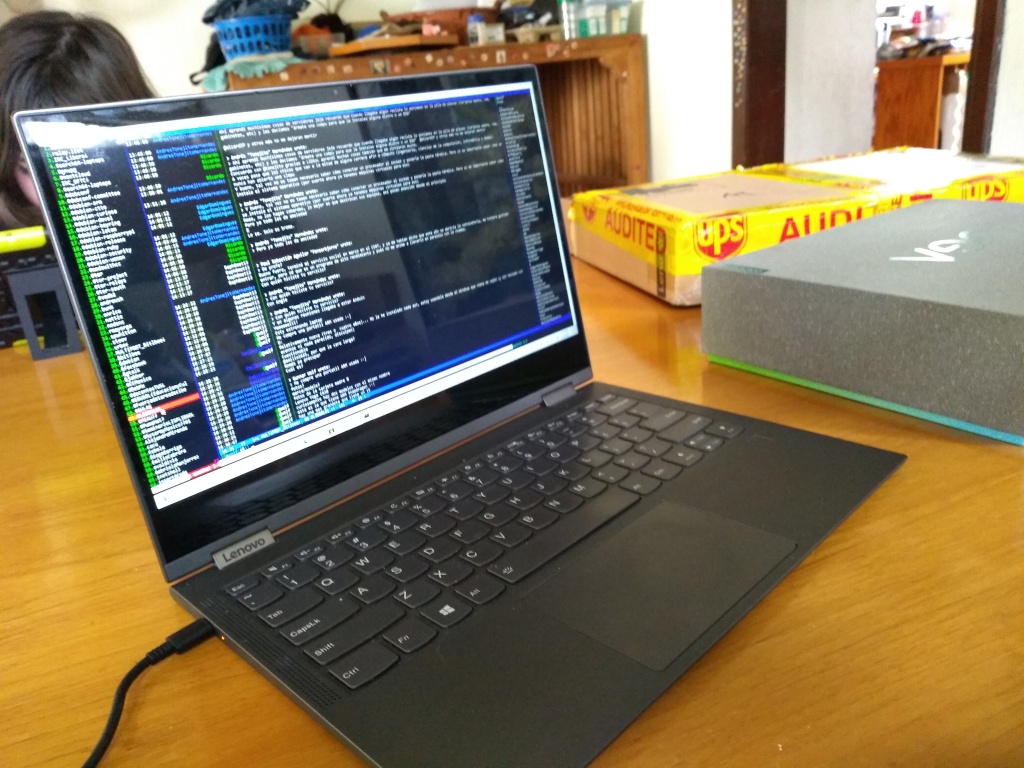
So today is the day when a new Debian release comes out! Congratulations to everybody, and thanks a lot mainly to the Release Team. Lots of very hard work was put into making Debian 11 Bullseye a reality! My very personal way to celebrate this was to do a somewhat different Debian install at home. Why different? Well, I have quite a bit of old, older and frankly elderly laptops at home. And as many of you know, I have done more than my fair share of Raspberry Pi installs I have played and worked with assorted ARM machines at least since 2013, and I cannot consider myself a newbie with them by any means. But this is the first time I installed Debian on a mass-market, decently-specced ARM64-based laptop. Yes, I know the Pinebook has been there like for ages, but it really does feel like a computer to show off and not to use seriously (and I ve seen probably too many people fiddling with it, unable to get $foo to work). So I got myself a used Lenovo Yoga C630. Yes, a discontinued product it seems Lenovo was not able to properly market this machine, and it had a pretty short shelf life the machine was available for samples in late 2018 and for general sale in 2019! The specs are quite decent: Installing it via an almost-standard debian-installer is almost straightforward does require the installer to know what he is doing but is not too different from a regular Debian install. The AArch64 laptops project has done quite a feat in getting a d-i image ready to be inserted as a USB drive, and comprehensive instructions to help through the process. The shipped scripts even reap the Windows partition for the firmware images! I have reduced Windows to 25GB, but having only a 128GB drive, it still is a little bit too much.. I guess I ll blow it away sooner rather than later. The installer image has a regular GNOME install, which works beautifully, but I promptly replaced it with i3, as it s fundamental for me to work happily. Of course, the computer has quirks, more than I d expect from a regular x86 system, but well within what I expected to achieve during my first day with it. The issues I have most noted are: Of course, more quirks will surely appear with use. And I ll start trying to address some of them. So Happy Bullseye! Happy Debian 11! Enjoy a great release! \o/
13 August 2021

Leandro Doctors: Clojure CLI Tools in Debian - GSoC 2021 Partial Evaluation Report

NOTE: this blog post is based on my "Clojure CLI Tools in Debian" GSoC 2021 project Partial Evaluation Report.Hi, everybody!For those who don't know me, my name is Leandro Doctors (allentiak on IRC), and I'm the Debian Clojure Team's GSoC 2021 intern. My mentor is Louis-Philippe V ronneau[*] (pollo on IRC). My co-mentor is Utkarsh Gupta (utkarsh2102 on IRC). My 'no-mentor' :) is Elana Hashman (ehashman on IRC).In this message, I will summarize what I've been up to during the Coding I period (June 7th - July 16th).
TL;DR: my updated data-xml-clojure package was accepted[1] in experimental on Wednesday night :-)
[1] https://tracker.debian.org/news/1244465/accepted-data-xml-clojure-020alpha6-1-source-into-experimental/Now, let's tell the full story.During the first days of the "Coding I" phase, I did some research on the clj dependencies. And after the precious feedback from Louis-Philippe, Elana, Utkarsh, and Alex Miller (the upstream developer of clj, among many other libraries), I came up with the following packaging strategy.
  1. update org.clojure:data.xml (data-xml-clojure) to 0.2.0-beta6.
  2. package org.clojure:tools.gitlibs (tools-gitlibs-clojure).
  3. consider updating libjsch-agent-proxy-java, jgit, libtools-cli-clojure (all of them already in Debian).
  4. consider packaging com.cognitec.aws:* packages.
According to my original proposal, I should have completed all four tasks during Coding I. Looking back, the main lesson from these past weeks is a known classic: my timeline was too optimistic: I definitely underestimated the difficulty of the packaging process. Out of the four tasks, I only finished the first one.There were many challenges I had to overcome in order to update the library from version 0.0.8 to 0.2.0-alpha6:This what I did:First, I patched the source code so:Then, I completely overhauled the packaging code (this is, what goes inside debian/).All this improved the quality of the package.I also improved the Clojure Packaging Tutorial[2] to make the process easier to follow.[2] https://wiki.debian.org/Clojure/PackagingTutorialLooking back, it is almost as if I had started packaging the library from scratch...But, more that what I produced, I think the most important part of all this is what I learned during these weeks.As it was the first time I ever packaged anything in Debian, I had to learn the basics, bump by bump. (And, oh my, I surely did bump quite a few times!)[2] https://wiki.debian.org/Clojure/PackagingTutorial[3] https://wiki.debian.org/sbuild[4] https://manpages.debian.org/unstable/git-buildpackage/gbp.1.en.html[5] https://wiki.debian.org/UsingQuiltDefinitely, all this was worth it. After all, my updated data-xml-clojure package was accepted[1] in experimental on Wednesday :-)[1] https://tracker.debian.org/news/1244465/accepted-data-xml-clojure-020alpha6-1-source-into-experimental/Now that I've learned the basics of packaging bumped enough to get my package accepted, I'm hopeful I can ramp up and catch up with (at least most of) my original schedule during Coding II.tools-gitlibs-clojure, you're next :-)Thank you very much Louis-Philippe, Elana, and Utkarsh (plus a special mention to Alex) for your precious support during the last few weeks!

12 August 2021

Dirk Eddelbuettel: x13binary 1.1.57-2 on CRAN: Packaging Updates

Release 1.1.57-2 of the x13binary package providing the X-13ARIMA-SEATS program by the US Census Bureau is now on CRAN. This release comes a mere week after the previous release 1.1.57-1 and cleans up two packaging aspects. It corrects a (non-bash) shell script snippet for SunOS, and turns off the prohibition of staged install (which was needed a while back for macOS). No other changes were made; please see last week s release post for more about x13binary and the 1.1.57 release. Courtesy of my CRANberries, there is also a diffstat report for this release showing changes to the previous release. If you like this or other open-source work I do, you can sponsor me at GitHub.

This post by Dirk Eddelbuettel originated on his Thinking inside the box blog. Please report excessive re-aggregation in third-party for-profit settings.

11 August 2021

Bits from Debian: Debian User Forums changes and updates.

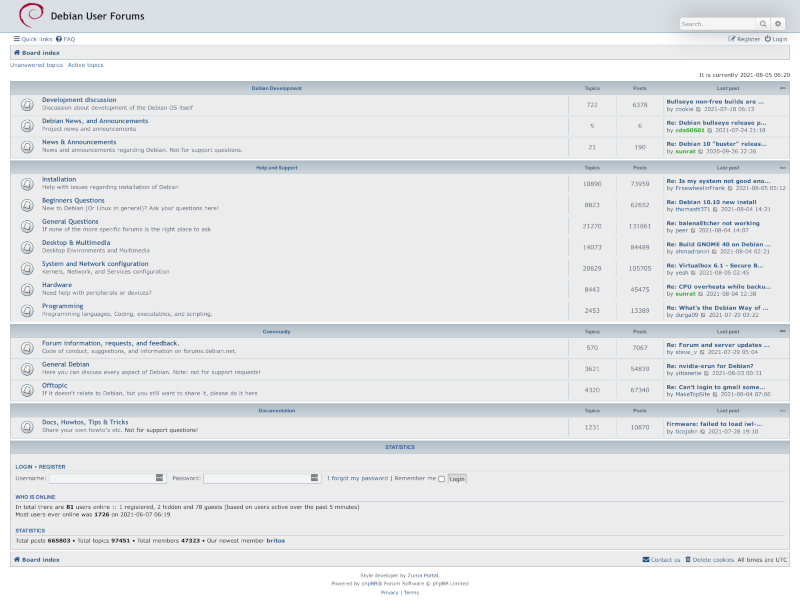
DebianUserForums Several issues were brought before the Debian Community team regarding responsiveness, tone, and needed software updates to forums.debian.net. The question was asked, who s in charge? Over the course of the discussion several Debian Developers volunteered to help by providing a presence on the forums from Debian and to assist with the necessary changes to keep the service up and running. We are happy to announce the following changes to the (NEW!) forums.debian.net, which have and should address most of the prior concerns with accountability, tone, use, and reliability: Debian Developers: Paulo Henrique de Lima Santana (phls), Felix Lechner (lechner), and Donald Norwood (donald) have been added to the forum's Server and Administration teams. The server instance is now running directly within Debian's infrastructure. The forum software and back-end have been updated to the most recent versions where applicable. DNS resolves for both IPv4 and IPv6. SSL/HTTPS are enabled. (It s 2021!) New Captcha and Anti-spam systems are in place to thwart spammers, bots, and to make it easier for humans to register. New Administrators and Moderation staff were added to provide additional coverage across the hours and to combine years of experience with forum operation and Debian usage. New viewing styles are available for users to choose from, some of which are ideal for mobile/tablet viewing. We inadvertently fixed the time issue that the prior forum had of running 11 minutes fast. :) We have clarified staff roles and staff visibility. Responsiveness to users on the forums has increased. Email addresses for mods/admins have been updated and checked for validity, it has seen direct use and response. The guidelines for forum use by users and staff have been updated. The Debian COC has been made into a Global Announcement as an accompanyist to the newly updated guidelines to give the moderators/administrators an additional rule-set for unruly or unbecoming behavior. Some of the discussion areas have been renamed and refocused, along with the movement of multiple threads to make indexing and searching of the forums easier. Many (New!) features and extensions have been added to the forum for ease of use and modernization, such as a user thanks system and thread hover previews. There are some server administrative tasks that were upgraded as well which don't belong on a public list, but we are backing up regularly and secure. :) We have a few minor details here and there to attend to and the work is ongoing. Many Thanks and Appreciation to the Debian System Administrators (DSA) and Ganneff who took the time to coordinate and assist with the instance, DNS, and network and server administration minutiae, our helpful DPL Jonathan Carter, many thanks to the current and prior forum moderators and administrators: Mez, sunrat, 4D696B65, arochester, and cds60601 for helping with the modifications and transition, and to the forum users who participated in lots of the tweaking. All in all this was a large community task and everyone did a significant part. Thank you!

10 August 2021

Shirish Agarwal: BBI, IP report, State Borders and Civil Aviation I

If I have seen further, it is by standing on the shoulders of Giants Issac Newton, 1675. Although it should be credited to 12th century Bernard of Chartres. You will know why I have shared this, probably at the beginning of Civil Aviation history itself.

Comments on the BBI court case which happened in Kenya, then and the subsequent appeal. I am not going to share much about the coverage of the BBI appeal as Gautam Bhatia has shared quite eloquently his observations, both on the initial case and the subsequent appeal which lasted 5 days in Kenya and was shown all around the world thanks to YouTube. One of the interesting points which stuck with me was that in Kenya, sign language is one of the official languages. And in fact, I was able to read quite a bit about the various sign languages which are there in Kenya. It just boggles the mind that there are countries that also give importance to such even though they are not as rich or as developed as we call developed economies. I probably might give more space and give more depth as it does carry some important judicial jurisprudence which is and which will be felt around the world. How does India react or doesn t is probably another matter altogether  But yes, it needs it own space, maybe after some more time. Report on Standing Committee on IP Regulation in India and the false promises. Again, I do not want to take much time in sharing details about what the report contains, as the report can be found here. I have uploaded it on WordPress, in case of an issue. An observation on the same subject can be found here. At least, to me and probably those who have been following the IP space as either using/working on free software or even IP would be aware that the issues shared have been known since 1994. And it does benefit the industry rather than the country. This way, the rent-seekers, and monopolists win. There is ample literature that shared how rich countries had weak regulation for decades and even centuries till it was advantageous for them to have strong IP. One can look at the history of Europe and the United States for it. We can also look at the history of our neighbor China, which for the last 5 decades has used some provision of IP and disregarded many others. But these words are of no use, as the policies done and shared are by the rich for the rich.

Fighting between two State Borders Ironically or because of it, two BJP ruled states Assam and Mizoram fought between themselves. In which 6 policemen died. While the history of the two states is complicated it becomes a bit more complicated when one goes back into Assam and ULFA history and comes to know that ULFA could not have become that powerful until and unless, the Marwaris, people of my clan had not given generous donations to them. They thought it was a good investment, which later would turn out to be untrue. Those who think ULFA has declined, or whatever, still don t have answers to this or this. Interestingly, both the Chief Ministers approached the Home Minister (Mr. Amit Shah) of BJP. Mr. Shah was supposed to be the Chanakya but in many instances, including this one, he decided to stay away. His statement was on the lines of you guys figure it out yourself. There is a poem that was shared by the late poet Rahat Indori. I am sharing the same below as an image and will attempt to put a rough translation.
kisi ke baap ka hindustan todi hain Rahat Indori
Poets, whether in India or elsewhere, are known to speak truth to power and are a bit of a rebel. This poem by Rahat Indori is provocatively titled Kisi ke baap ka Hindustan todi hai , It challenges the majoritarian idea that Hindustan/India only belongs to the majoritarian religion. He also challenges as well as asserts at the same time that every Indian citizen, regardless of whatever his or her religion might be, is an Indian and can assert India as his home. While the whole poem is compelling in itself, for me what hits home is in the second stanza

:Lagegi Aag to aayege ghat kayi zad me, Yaha pe sirf hamara makan todi hai The meaning is simple yet subtle, he uses Aag or Fire as a symbol of hate sharing that if hate spreads, it won t be his home alone that will be torched. If one wants to literally understand what he meant, I present to you the cult Russian movie No Escapes or Ogon as it is known in Russian. If one were to decipher why the Russian film doesn t talk about climate change, one has to view it from the prism of what their leader Vladimir Putin has said and done over the years. As can be seen even in there, the situation is far more complex than one imagines. Although, it is interesting to note that he decried Climate change as man-made till as late as last year and was on the side of Trump throughout his presidency. This was in 2017 as well as perhaps this. Interestingly, there was a change in tenor and note just a couple of weeks back, but that could be only politicking or much more. Statements that are not backed by legislation and application are usually just a whitewash. We would have to wait to see what concrete steps are taken by Putin, Kremlin, and their Duma before saying either way.

Civil Aviation and the broad structure Civil Aviation is a large topic and I would not be able to do justice to it all in one article/blog post. So, for e.g. I will not be getting into Aircraft (Boeing, Airbus, Comac etc., etc.) or the new electric aircraft as that will just make the blog post long. I will not be also talking about cargo or Visa or many such topics, as all of them actually would and do need their own space. So this would be much more limited to Airports and to some extent airlines, as one cannot survive without the other. The primary reason for doing this is there is and has been a lot of myth-making in India about Civil Aviation in general, whether it has to do with Civil Aviation history or whatever passes as of policy in India.

A little early history Man has always looked at the stars and envisaged himself or herself as a bird, flying with gay abandon. In fact, there have been many paintings, sculptors who imagined how we would fly. The Steam Engine itself was invented in 82 BCE. But the attempt to fly was done by a certain Monk called Brother Elmer of Malmesbury who attempted the same in 1010., shortly after the birth of the rudimentary steam engine The most famous of all would be Leonardo da Vinci for his amazing sketches of flying machines in 1493. There were a couple of books by Cyrano de Bergerac, apparently wrote two books, both sadly published after his death. Interestingly, you can find both the book and the gentleman in the Project Gutenberg archives. How much of M/s Cyrano s exploits were his own and how much embellished by M/S Curtis, maybe a friend, a lover who knows, but it does give the air of the swashbuckling adventurer of the time which many men aspired to in that time. So, why not an author???

L Autre Monde: ou les tats et Empires de la Lune (Comical History of the States and Empires of the Moon) and Les tats et Empires du Soleil (The States and Empires of the Sun). These two French books apparently had a lot of references to flying machines. Both of them were authored by Cyrano de Bergerac. Both of these were sadly published after his death, one apparently in 1656 and the other one a couple of years later. By the 17th century, while it had become easy to know and measure the latitude, measuring longitude was a problem. In fact, it can be argued and probably successfully that India wouldn t have been under British rule or UK wouldn t have been a naval superpower if it hadn t solved the longitudinal problem. Over the years, the British Royal Navy suffered many blows, one of the most famous or infamous among them might be the Scilly naval disaster of 1707 which led to the death of 2000 odd British Royal naval personnel and led to Queen Anne, who was ruling over England at that time via Parliament and called it the Longitude Act which basically was an open competition for anybody to fix the problem and carried the prize money of 20,000. While nobody could claim the whole prize, many did get smaller amounts depending upon the achievements. The best and the nearest who came was John Harrison who made the first sea-watch and with modifications, over the years it became miniaturized to a pocket-sized Marine chronometer although, I doubt the ones used today look anything in those days. But if that had not been invented, we surely would have been freed long ago. The assumption being that the East India Company would have dashed onto rocks so many times, that the whole exercise would have been futile. The downside of it is that maritime trade routes that are being used today and the commerce would not have been. Neither would have aircraft or space for that matter, or at the very least delayed by how many years or decades, nobody knows. If one wants to read about the Longitudinal problem, one can get the famous book Longitude .

In many mythologies, including Indian and Arabian tales, in which we had the flying carpet which would let its passengers go from one place to the next. Then there is also mention of Pushpak Vimana in ancient texts, but those secrets remain secrets. Think how much foreign exchange India could make by both using it and exporting the same worldwide. And I m being serious. There are many who believe in it, but sadly, the ones who know the secret don t seem to want India s progress. Just think of the carbon credits that India could have, which itself would make India a superpower. And I m being serious.

Western Ideas and Implementation. Even in the late and early 18th century, there were many machines that were designed to have controlled flight, but it was only the Wright Flyer that was able to demonstrate a controlled flight in 1903. The ones who came pretty close to what the Wrights achieved were the people by the name of Cayley and Langley. They actually studied what the pioneers had done. They looked at what Otto Lilienthal had done, as he had done a lot of hang-gliding and put a lot of literature in the public domain then.

Furthermore, they also consulted Octave Chanute. The whole system and history of the same are a bit complicated, but it does give a window to what happened then. So, it won t be wrong to say that whatever the Wright Brothers accomplished would probably not have been possible or would have taken years or maybe even decades if that literature and experiments, drawings, etc. in the commons were not available. So, while they did experimentation, they also looked at what other people were doing and had done which was in public domain/commons.

They also did a lot of testing, which gave them new insights. Even the propulsion system they used in the 1903 flight was a design by Nicolaus Otto. In fact, the Aircraft would not have been born if the Chinese had not invented kites in the early sixth century A.D. One also has to credit Issac Newton because of the three laws of motion, again without which none of the above could have happened. What is credited to the Wilbur brothers is not just they made the Kitty Hawk, they also made it commercial as they sold it and variations of the design to the American Air Force and also made a pilot school where pilots were trained for warfighting. 119 odd pilots came out of that school. The Wrights thought that air supremacy would end the war early, but this turned out to be a false hope.

Competition and Those Magnificent Men and their flying machines One of the first competitions to unlock creativity was the English Channel crossing offer made by Daily Mail. This was successfully done by the Frenchman Louis Bl riot. You can read his account here. There were quite a few competitions before World War 1 broke out. There is a beautiful, humorous movie that does dedicate itself to imagining how things would have gone in that time. In fact, there have been two movies, this one and an earlier movie called Sky Riders made many a youth dream. The other movie sadly is not yet in the public domain, and when it will be nobody knows, but if you see it or even read it, it gives you goosebumps.

World War 1 and Improvements to Aircraft World War 1 is remembered as the Great War or the War to end all wars in an attempt at irony. It did a lot of destruction of both people and property, and in fact, laid the foundation of World War 2. At the same time, if World War 1 hadn t happened then Airpower, Plane technology would have taken decades. Even medicine and medical techniques became revolutionary due to World War 1. In order to be brief, I am not sharing much about World War 1 otherwise that itself would become its own blog post. And while it had its heroes and villains who, when, why could be tackled perhaps another time.

The Guggenheim Family and the birth of Civil Aviation If one has to credit one family for the birth of the Civil Aviation, it has to be the Guggenheim family. Again, I would not like to dwell much as much of their contribution has already been noted here. There are quite a few things still that need to be said and pointed out. First and foremost is the fact that they made lessons about flying from grade school to college and afterward till college and beyond which were in the syllabus, whereas in the Indian schooling system, there is nothing like that to date. Here, in India, even in Engineering courses, you don t have much info. Unless until you go for professional Aviation or Aeronautical courses and most of these courses cost a bomb so either the very rich or the very determined (with loans) only go for that, at least that s what my friends have shared. And there is no guarantee you will get a job after that, especially in today s climate. Even their fund, grants, and prizes which were given to people for various people so that improvements could be made to the United States Civil Aviation. This, as shared in the report/blog post shared, was in response to what the younger child/brother saw as Europe having a large advantage both in Military and Civil Aviation. They also made several grants in several Universities which would not only do notable work during their lifetime but carry on the legacy researching on different aspects of Aircraft. One point that should be noted is that Europe was far ahead even then of the U.S. which prompted the younger son. There had already been talks of civil/civilian flights on European routes, although much different from what either of us can imagine today. Even with everything that the U.S. had going for her and still has, Europe is the one which has better airports, better facilities, better everything than the U.S. has even today. If you look at the lists of the Airports for better value of money or facilities, you would find many Airports from Europe, some from Asia, and only a few from the U.S. even though they are some of the most frequent users of the service. But that debate and arguments I would have to leave for perhaps the next blog post as there is still a lot to be covered between the 1930s, 1950s, and today. The Guggenheims archives does a fantastic job of sharing part of the story till the 1950s, but there is also quite a bit which it doesn t. I will probably start from that in the next blog post and then carry on ahead. Lastly, before I wind up, I have to share why I felt the need to write, capture and share this part of Aviation history. The plain and simple reason being, many of the people I meet either on the web, on Twitter or even in real life, many of them are just unaware of how this whole thing came about. The unawareness in my fellow brothers and sisters is just shocking, overwhelming. At least, by sharing these articles, I at least would be able to guide them or at least let them know how it all came to be and where things are going and not just be so clueless. Till later.

Thorsten Alteholz: My Debian Activities in July 2021

FTP master This month I accepted 13 and rejected 2 packages. The overall number of packages that got accepted was 13. As the Release Team prefers not to have any new package upload to unstable, the numbers are this low. I am afraid there is some discussion needed after the release of Bullseye Debian LTS This was my eighty-fifth month that I did some work for the Debian LTS initiative, started by Raphael Hertzog at Freexian. This month my all in all workload has been 30h. During that time I did LTS and normal security uploads of: I also made further progress on gpac and started to test the package now. Last but not least I did some days of frontdesk duties. I am not sure whether it is just me, but I got the impression that nowadays lots of CVEs can be marked as not-affected in the corresponding Stretch-version. Most of the remaining CVEs only have a small security impact (if at all) and can be marked as no-dsa. So the number of packages that really need an update decreases steadily. Does that mean that all issues in older versions are fixed now? Or are people more focused on new features in software as it is easier to find issues in more or less unexplored code? Debian ELTS This month was the thirty-seventh ELTS month. During my allocated time I uploaded: Last but not least I did some days of frontdesk duties. In ELTS the decreasing number of uploads, as mentioned above, seems to be even more clearly. Other stuff I played a bit with RISC-V and looked after some packages that did not build on that architecture. Generally this looks like fun but building packages with qemu dampens the mood a bit. So if anybody knows some hardware that runs Debian, that is available now and that does not cost more than my car, I would be happy to get some pointer. This month I uploaded new upstream versions of: to experimental. I improved packaging and fixed bugs in: On my neverending golang challenge I again uploaded some packages either for NEW or as source upload.

9 August 2021

Dirk Eddelbuettel: nanotime 0.3.3 on CRAN: Some Updates

Leonardo and I are pleased to share that a new nanotime version 0.3.3 was released today, and arrived on CRAN. This release brings a new (plotting) demo, an updated documentation site, additional nanoduration and nanoperiod functionality, and enhanced testing. nanotime relies on the RcppCCTZ package for (efficient) high(er) resolution time parsing and formatting up to nanosecond resolution, and the bit64 package for the actual integer64 arithmetic. Initially implemented using the S3 system, it has benefitted greatly from work by co-author Leonardo who not only rejigged nanotime internals in S4 but also added new S4 types for periods, intervals and durations. The NEWS snippet adds full details.

Changes in version 0.3.3 (2021-08-09)
  • New demo ggplot2Example.R (Leonardo and Dirk).
  • New documentation website using mkdocs-material (Dirk).
  • Updated unit test to account for r-devel POSIXct changes, and re-enable full testing under r-devel (Dirk).
  • Additional nanoduration and character ops plus tests (Colin Umansky in #88 addressing #87).
  • New plus and minus functions for periods (Leonardo in #91).

Thanks to CRANberries there is also a diff to the previous version. More details and examples are at the nanotime page; code, issue tickets etc at the GitHub repository. If you like this or other open-source work I do, you can now sponsor me at GitHub.

This post by Dirk Eddelbuettel originated on his Thinking inside the box blog. Please report excessive re-aggregation in third-party for-profit settings.

Ben Hutchings: Debian LTS work, July 2021

In July I was assigned 16 hours of work by Freexian's Debian LTS initiative and carried over 2.75 hours from earlier months. I worked 12.75 hours and will carry over the remainder. I applied some urgent (and some not-so-urgent) security fixes to the linux (Linux 4.9), uploaded it, and issued DLA-2713-2. I also updated the linux-4.19 package based on the stable security update, and issued DLA-2714-1.

Ian Wienand: nutdrv_qx setup for Synology DSM7

I have a cheap no-name UPS acquired from Jaycar and was wondering if I could get it to connect to my Synology DS918+. It rather unhelpfully identifies itself as MEC0003 and comes with some blob of non-working software on a CD; however some investigation found it could maybe work on my Synology NAS using the Network UPS Tools nutdrv_qx driver with the hunnox subdriver type. Unfortunately this is a fairly recent addition to the NUTs source, requiring rebuilding the driver for DSM7. I don't fully understand the Synology environment but I did get this working. Firstly I downloaded the toolchain from https://archive.synology.com/download/ToolChain/toolchain/ and extracted it. I then used the script from https://github.com/SynologyOpenSource/pkgscripts-ng to download some sort of build environment. This appears to want root access and possibly sets up some sort of chroot. Anyway, for DSM7 on the DS918+ I ran EnvDeploy -v 7.0 -p apollolake and it downloaded some tarballs into toolkit_tarballs that I simply extracted into the same directory as the toolchain. I then grabbed the NUTs source from https://github.com/networkupstools/nut. I then built NUTS similar to the following
./autogen.sh
PATH_TO_TC=/home/your/path
export CC=$ PATH_TO_CC /x86_64-pc-linux-gnu/bin/x86_64-pc-linux-gnu-gcc
export LD=$ PATH_TO_LD /x86_64-pc-linux-gnu/bin/x86_64-pc-linux-gnu-ld
./configure \
  --prefix= \
  --with-statepath=/var/run/ups_state \
  --sysconfdir=/etc/ups \
  --with-sysroot=$ PATH_TO_TC /usr/local/sysroot \
  --with-usb=yes
  --with-usb-libs="-L$ PATH_TO_TC /usr/local/x86_64-pc-linux-gnu/x86_64-pc-linux-gnu/sys-root/usr/lib/ -lusb" \
  --with-usb-includes="-I$ PATH_TO_TC /usr/local/sysroot/usr/include/"
make
The tricks to be aware of are setting the locations DSM wants status/config files and overriding the USB detection done by configure which doesn't seem to obey sysroot. If you would prefer to avoid this you can try this prebuilt nutdrv_qx (ebb184505abd1ca1750e13bb9c5f991eaa999cbea95da94b20f66ae4bd02db41). SSH to the DSM7 machine; as root move /usr/bin/nutdrv_qx out of the way to save it; scp the new version and move it into place. If you cat /dev/bus/usb/devices I found this device has a Vendor 0001 and ProdID 0000.
T:  Bus=01 Lev=01 Prnt=01 Port=00 Cnt=01 Dev#=  3 Spd=1.5  MxCh= 0
D:  Ver= 2.00 Cls=00(>ifc ) Sub=00 Prot=00 MxPS= 8 #Cfgs=  1
P:  Vendor=0001 ProdID=0000 Rev= 1.00
S:  Product=MEC0003
S:  SerialNumber=ffffff87ffffffb7ffffff87ffffffb7
C:* #Ifs= 1 Cfg#= 1 Atr=80 MxPwr=100mA
I:* If#= 0 Alt= 0 #EPs= 2 Cls=03(HID  ) Sub=00 Prot=00 Driver=usbfs
E:  Ad=81(I) Atr=03(Int.) MxPS=   8 Ivl=10ms
E:  Ad=02(O) Atr=03(Int.) MxPS=   8 Ivl=10ms
DSM does a bunch of magic to autodetect and configure NUTs when a UPS is plugged in. The first thing you'll need to do is edit /etc/nutscan-usb.sh and override where it tries to use the blazer_usb driver for this obviously incorrect vendor/product id. The line should now look like
static usb_device_id_t usb_device_table[] =  
    0x0001, 0x0000, "nutdrv_qx"  ,
    0x03f0, 0x0001, "usbhid-ups"  ,
  ... and so on ...
Then you want to edit the file /usr/syno/lib/systemd/scripts/ups-usb.sh to start the nutdrv_qx; find the DRV_LIST in that file and update it like so:
local DRV_LIST="nutdrv_qx usbhid-ups blazer_usb bcmxcp_usb richcomm_usb tripplite_usb"
This is triggered by /usr/lib/systemd/system/ups-usb.service and is ultimately what tries to setup the UPS configuration. Lastly, you will need to edit the /etc/ups/ups.conf file. This will probably vary depending on your UPS. One important thing is to add user=root above the driver; it seems recent NUT has become more secure and drops permissions, but the result it will not find USB devices in this environment (if you're getting something like no appropriate HID device found this is likely the cause). So the configuration should look something like:
user=root
[ups]
driver = nutdrv_qx
port = auto
subdriver = hunnox
vendorid = "0001"
productid = "0000"
langid_fix = 0x0409
novendor
noscanlangid
#pollonly
#community =
#snmp_version = v2c
#mibs =
#secName =
#secLevel =
#authProtocol =
#authPassword =
#privProtocol =
#privPassword =
I then restarted the UPS daemon by enabling/disabling UPS support in the UI. This should tell you that your UPS is connected. You can also check /var/log/ups.log which shows for me
2021-08-09T18:14:51+10:00 synology synoups[11994]: =====log UPS status start=====
2021-08-09T18:14:51+10:00 synology synoups[11996]: device.mfr=
2021-08-09T18:14:51+10:00 synology synoups[11998]: device.model=
2021-08-09T18:14:51+10:00 synology synoups[12000]: battery.charge=
2021-08-09T18:14:51+10:00 synology synoups[12002]: battery.runtime=
2021-08-09T18:14:51+10:00 synology synoups[12004]: battery.voltage=13.80
2021-08-09T18:14:51+10:00 synology synoups[12006]: input.voltage=232.0
2021-08-09T18:14:51+10:00 synology synoups[12008]: output.voltage=232.0
2021-08-09T18:14:51+10:00 synology synoups[12010]: ups.load=31
2021-08-09T18:14:51+10:00 synology synoups[12012]: ups.status=OL
2021-08-09T18:14:51+10:00 synology synoups[12013]: =====log UPS status end=====
Which corresponds to the correct input/output voltage and state. Of course this is all unsupported and probably likely to break -- although I don't imagine much of these bits are updated very frequently. It will likely be OK until the UPS battery dies; at which point I would reccommend buying a better UPS on the Synology support list.

Next.

Previous.