Search Results: "tb"

3 February 2010

Russell Coker: Michael Atkinson Lies

The South Australian government wanted to force bloggers to disclose their name and post-code when commenting on an election [1]. According to Adelaide Now this included posts on Twitter and Facebook [2]. As expected there was a strong public reaction to this and Michael Atkinson (state Attorney General) stated that the law was not going to be enforced and that it would be retrospectively repealed after the election [3]. Which might have been the end of the issue, but he also said All MPs and all parties voted for Electoral law. Hope Libs, Greens, Family First, Independents etc will join us to support repeal which seems to be a clear claim that the Greens supported that legislation. The Greens are pretty good about freedom of speech issues so I immediately enquired as to what was going on. The following is from a Greens media brief issued yesterday by the office of Mark Parnell MLC (the Greens MLC in SA) which was issued before the new law was retracted: Attorney General Michael Atkinson must urgently clarify the scope of new electoral laws covering public comment on the internet, in the wake of concerns that the impact will be much wider than expected.

With only weeks to go before the election kicks off, there is an urgent need for the Attorney General to explain exactly what his laws are
intended to capture, said Greens MLC Mark Parnell.

When this was debated in Parliament last year, we were told that the law change would only affect electronic versions of a journal . Now there is
concern that the laws could extend further, restricting public commentary on media sites like AdelaideNow and ABC Online, he said.

When the Bill was debated in the Lower House, Michael Atkinson originally wanted to include ALL material on the web. However, the Government
backed down on this by the time it got to the Upper House, with Minister Holloway saying:
The intention is to limit the coverage of section 116 as it applies to the internet to electronic versions of a journal rather than any electronic publication on the internet.

A journal was narrowly defined as a newspaper, magazine or other periodical . Now I don t have a great objection to a law that demands that journalists identify themselves when commenting on an election, and I think that most people would not care about that. It seems that Michael Atkinson is repeatedly changing his claims to try and match popular sentiment. He has got form for this sort of thing, his past achievements include censoring the censorship debate about an R18+ rating for computer games [4].

2 February 2010

Russell Coker: 3G Broadband for Home Use

I have just installed an old Three mobile phone with 3G broadband for my parents home network access for the reasons described in my cheap net access in Australia post [1]. The first problem I had was that the pre-paid Three SIM just wouldn t work at all. I ended up phoning the Three support line and had a guy guess at which version of Windows I was running, after guessing every version of Windows from the last 10 years and Mac OS/X he finally asked what OS I use and then told me that Linux isn t supported. I said I HAVE TWO SIMS FROM THREE, ONE WORKS AND THE OTHER DOESN T, IT S ON THE SAME PC WITH THE SAME 3G ACCESS DEVICE, THE PROBLEM IS WITH THE SIM OR THE SERVER NOT MY OS . When the support guy discovered that one sim was pre-paid he said that there is a configuration difference, instead of an APN of 3netaccess for post-paid (contract) you have to use 3services for pre-paid. There are a bunch of web pages describing how to get Three 3G broadband working on Linux in Australia, some say to use 3netaccess and some say 3services. None of the pages I read stated correctly that 3netaccess is for when you are on a contract and 3services is for pre-paid. I ve submitted a suggestion for the Ross Barkman s GPRS Info Page (which seems to be the best reference for such things) [2]. After getting the pre-paid 3G SIM working for net access from the Huawei E1553 USB 3G modem I was unable to get it working from my LG U890 mobile phone. I never figured out how to solve this problem, I left my parents with the SIM that is connected to my $15 per month contract plan for 3G net access and am now using the pre-paid SIM for my own use. Of course this means that as I m using a SIM registered to my mother and she s using one registered to me I ll surely have some problems getting the support center to help me with problems in future. I found that the 3G net access got better reception when the phone was higher than the computer, so I used a USB extension cable to allow it to be placed on a shelf above the computer. The extension cable also allows it to be easily unplugged and plugged in again I ve already seen one situation where Linux got confused about the state of the USB device and replugging it was necessary to solve the problem. I was using Debian/Lenny. Here is my chatscript for connecting to Three with my 3G modem on a pre-paid SIM which also allows roaming to Telstra (I haven t tested whether pre-paid allows roaming, I ve only tested Telstra roaming with a contract SIM): ABORT 'BUSY'
ABORT 'NO CARRIER'
ABORT 'ERROR'
'' AT
OK ATQ0V1E1S0=0&C1&D2+FCLASS=0
OK 'AT+COPS=0,0,"3TELSTRA",2'
OK AT+CGATT=1
#OK AT+CGDCONT=1,"IP","3netaccess"
OK AT+CGDCONT=1,"IP","3services"
OK ATDT*99**3# Here is the ppp configuration for connecting via the USB 3G modem. For use as a permanent connection you want to also include persist and maxfail 0 :
/dev/ttyUSB0
230400
noauth
defaultroute
logfile /var/log/ppp.log
connect "/usr/sbin/chat -v -f /etc/chatscripts/three" For connecting with an LG U890 mobile phone you need to use ATDT*99***1# as the dial command and the device is /dev/ttyACM0 .

Russell Coker: Precision vs Accuracy in Identifying People

Andrew Dowdell and Michael McGuire have an interesting article in the Adelaide Now about censorship in the South Australian election [1]. The South Australian government wants to force everyone who comments on the upcoming SA election to provide their name and postcode. Attorney-General Michael Atkinson said the law was all about honesty . However a law that forces someone to not comment as Anonymous and instead forces them to use a name that sounds like something that might appear on a birth certificate and a postcode is not going to increase honesty at all. I think it s much better to honestly say I m not telling you my name than to lie and claim to be revealing your name. When the government forces people to give precise but totally inaccurate information it seems that it s going to be bad for everyone. It s even bad for the people who want to be identified, if most people who comment on a blog post are anonymous then I d like to be distinguished as the person who uses their real name! In the vast majority of cases the effort of determining who is using their real name will not be worth the effort. If someone comments on my blog under the name John Howard from Bennelong I will be very suspicious that they are using a fake name. But probably the vast majority of the English speaking population of the world wouldn t immediately identify such a name as fake. If someone wants to comment on my blog and they don t have a published phone number then I won t have any good way of identifying their address. If their name and postcode match an entry in a phone book then they still might be faking it they could take a random name from a phone book. If I was to demand that people who enter blog comments provide their phone numbers then I would have to pay the expense of phoning them as well as dealing with cases of people who are away from home, should I delay a blog comment for a month until the author returns from their European vacation? I have had a moderate amount of experience in writing letters to the editors of newspapers, and I have only once had an editor phone me to verify my details. In all other cases I guess I could have fooled them if I wished. I believe that there are already precedents regarding libel, if I approve a blog comment (or fail to unapprove it in a reasonable amount of time if it meats the automatic approval criteria) then I could be sued for libel if the contents of the comment are deemed to be suitably damaging. So if I was to try to get the real names of people who make comments on my blog then it wouldn t make it any easier for an idiot who wants to sue also anyone who wants to sue regarding an Australian political issue will probably find me a better target than most people who comment on my blog (a significant portion of whom are from the US and have much greater legal protections of their freedom of speech). Extending such a law to US based services such as Twitter is just silly. The stockholders and employees of a US based corporation can freely laugh at Australian censorship laws. Also it s pretty stupid to have a global scope on such laws, as a Victorian why should I care about the South Australian state laws? Implementing laws that can be easily broken inadvertently and can never be enforced against anyone who cares is just pitiful and will result in the MPs who vote for such laws being the object of derision. Vote for the small parties and independent candidates. Both Labour and Liberal want to censor us, put them in the second last two spots on your vote card! Now this law doesn t take affect until the writs for the March 20 election are issued. I encourage Australian bloggers to write bad things about the Liberal and Labour parties after the writs are released which are not libelous and which don t include your postcode. If they try to apply the new law then your blog post gets wide attention. If you plan to be a professional blogger then you could consider the $5,000 fine to be an advertising fee. If you don t want to be known then you can use a US based blogging service. I m going to continue to write political blog posts whenever I feel like it and I won t be telling anyone where I live. I will rely on the Streisand effect to save me. Update:
The politicians in SA have surrendered, the law in question won t be enforced and will supposedly be repealed after the election [2]. It will be interesting to see whether they really do repeal that law.

Craig Small: procps: Third time lucky

OK, ok, i got a chroot and pbuilder now. So that should, I hope stop any more FTBFS bugs about missing depdendencies.

procps got uploaded that fixes some important bugs, but mainly they were small fiddly things. About the most significant enhancement was pmap now has a real working -x flag. It looks a lot like some of the other pmap programs out there and shows the RSS and Dirty bytes per map. Let me know if its useful or not.

However there still is 48 bugs in the package, so if you're feeling game wander over to procps bug page and have a look around, but here are some more interesting ones, such as why would a process start time be earlier than the boot time? Bug 408879 has this problem

Now, a nice can of worms is in a Linux system, what is free memory? What should the "free" program report? Currently free just reports what it sees in /proc, but in Bug 565518 should the slab count be taken out? I certainly won't be making any Debian-specific changes here as you could get different numbers depending on your distribution, or even worse the age of you Debian system.

procps is also my first attempt at using git-buildpackage which I found very helpful. There was one problem with it and that is how it works with the quilt patch program. If the quilt patches are applied, git doesn't know this and says all the files have changed. I know its how these two programs are supposed to work but its a little annoying.
<script defer="defer" src="http://static.zemanta.com/readside/loader.js" type="text/javascript"></script>

1 February 2010

Cyril Brulebois: G-I, part 1

Producing udebs How to patch That s actually quite trivial. Most packages from Josselin s 1st and 2nd lists are libraries, and generating udebs for libraries is easy. Basically it boils down to declaring a new binary package: Now, populating it might depend on the considered source package, but thankfully, pkg-x11 packages are quite sane, using debhelper s dh_install. So duplicating debian/libfooN.install into debian/libfooN-udeb.install is usually sufficient. It s a bit trickier when dh_movefiles is used, but calling install and cp -r after the dh_movefiles call should be sufficient. Next step, tweak shlibs for libfooN. Without that step, a libbarM package built against libfooN would get libfooN in Depends, which is not appropriate. The idea is to get libfooN-udeb instead. Trivial: add --add-udeb=libfooN-udeb to the dh_makeshlibs call. Possible issues at that step: Various checks to perform: Results (These files might be moved around during the following steps, but this post shall be kept up-to-date and point to them at all time.) Legend: Graphs are scaled down to 75%, click for full size. Step 1: Step 2: Adding udebs to a d-i image Basic d-i image General guidelines (see d-i documentation for detailed installation, needed packages, etc.):
svn co svn://svn.debian.org/svn/d-i/trunk/ debian-installer-trunk
cd debian-installer-trunk/installer/build
make build_netboot
If that breaks (e.g. due to missing packages), make sure there s a similar entry in sources.list.udeb:
deb http://yourmirror/debian squeeze main/debian-installer
If everything goes well, the generated image should be available as dest/netboot/mini.iso, and tmp/netboot/udeb.list should contain the list of embedded udebs. To give it a try:
qemu-system-x86_64 -cdrom dest/netboot/mini.iso
Actually adding udebs Drop all additional udebs under localudebs/. Needed Packages and Packages.gz should be generated on the fly (but beware, secure apt is then disabled, even for non-local udebs). Now, tell d-i we want some more packages. If all of them are wanted, one can do that:
for i in localudebs/*.udeb; do \
  dpkg-deb --showformat='$ Package \n' -W $i; \
done > pkg-lists/local
(Update: Thanks to Guillem for pointing out a better and cleaner way than dpkg --info $i grep Package: awk ' print $2 ') Generate a new image (note the rebuild part of the target):
make rebuild_netboot
Make sure they got added by looking in tmp/netboot/udeb.list and profit! What s next Future steps include: Stay tuned.

31 January 2010

Gregor Herrmann: RC bugs 2010/04

again, I focussed on the RC bugs in the perl group. & again, carnil++ was very active both in finding & in fixing them :)

Axel Beckert: abe@debian.org

On Wednesday I got DAM approval and since Saturday late evening I m officially a Debian Developer. Yay! :-) My thanks go to As Bernd cited in his AM report, my earliest activity within the Debian community I can remember was organising the Debian booth at LinuxDay.lu 2003, where I installed Debian 3.0 Woody on my Hamilton Hamstation hy (a Sun SparcStation 4 clone). I wrote my first bugreport in November 2004 (#283365), probably during the Sarge BSP in Frankfurt. And my first Debian package was wikipedia2text, starting to package it August 2005 (ITP #325417). My only earlier documented interest in the Debian community is subscribing to the lists debian-apache@l.d.o and debian-emacsen@l.d.o in June 2002. I though remember that I started playing around with Debian 2.0 Hamm, skipping 2.1 (for whatever reasons, I can t remember), using 2.2 quite regularily and started to dive into with Woody which also ran on my first ThinkPad bijou . I installed it over WLAN with just a boot floppy at the Chemnitzer Linux-Tage. :-) Anyway, this has led to what it had to lead to a new Debian Developer. :-) The first package I uploaded with my newly granted rights was a new conkeror snapshot. This version should work out of the box on Ubuntu again, so that conkeror in Ubuntu should not lag that much behind Debian Sid anymore. In other News Since Wednesday I own a Nokia N900 and use it as my primary mobile phone now. Although it s not as free as the OpenMoko (see two other recent posts by Lucas Nussbaum and by Tollef Fog Heen on Planet Debian) it s definitely what I hoped the OpenMoko will once become. And even if I can t run Debian natively on the N900 (yet), it at least has a Debian chroot on it. :-) I'm going to FOSDEM, the Free and Open Source Software Developers' European Meeting A few weeks ago, I took over the organisation of this year s Debian booth at FOSDEM from Wouter Verhelst who s busy enough with FOSDEM organisation itself. Last Monday the organiser of the BSD DevRoom at FOSDEM asked on #mirbsd for talk suggestions and they somehow talked me into giving a talk about Debian GNU/kFreeBSD. The slides should show up during the next days on my Debian GNU/kFreeBSD talks page. I hope, I ll survive that talk despite giving more or less a talk saying Jehova! . ;-) What a week.

Russell Coker: Choosing an Australian Mobile Telco for use with Android

Since playing with the IBM Seer augmented reality software [1] I ve been lusting after a new mobile phone which can do such things. While the implementation of Seer that I tried was not of great practical use to me (not being a tennis fan I was only there to learn about computers) it was a demonstration of an exciting concept. It will surely be implemented by IBM in other venues that are of more immediate interest, and we can probably expect other vendors to write similar systems to compete with IBM. So the question is how to get a phone that will run such things well. The answer is probably not to rely on a contract plan for this, currently Vodaphone [2] is currently the only Australian telco that sells a phone that can run Seer, it is offering a HTC Magic (which was released in April 2009) on a $29 per month plan. A phone that is 9 months old isn t necessarily a bad thing, but the has been out for more than 6 months and has some significant benefits (such as a 5MP camera). So it seems that Three (my current provider) is probably the best option at this time. Virgin would save my $4 per month, but would only give me 300M of Internet data per month, and the Virgin limit of $60 per month of calls might not be enough for me. Vodaphone offers a deal for $25 that only includes 200MB of data, that might be enough for just phone use, but wouldn t be enough for tethering for laptop net access. I wonder how well tethering works on an Android phone, can you make a phone call while transmitting data from a tethered laptop? I find that with my Viewty when I receive an SMS or phone call it stops the net access. That makes a tethered Viewty impractical for some support tasks as it s fairly common that I need to talk to someone while logging in to their server I m sure that most people who use mobile Internet services regularly need to phone someone while using them. My current Three bill is $29 per month for the phone plan and $15 per month for Internet access. If I m going to buy phones outright instead of getting them with the plan then I want to reduce the overall amount of money I spend on phone plans and using tethering instead of a 3G USB dongle would allow this. I think that I can get something that comes close to my ideal mobile phone [8] (apart from being able to connect a keyboard, mouse, and monitor) if I import it from overseas. We really need more competition in the Australian mobile phone market. We have only two phone companies offering Android phones, Three is sold out of the obsolete model that they offer while Vodaphone has stock of an obsolete model.

Russell Coker: My Ideal Mobile Phone

Based on my experience testing the IBM Seer software on an Android phone [1] I have been considering what type of mobile phone to get when my current contract expires. Here are the features above what is common in current smart phones that I think most people will sorely miss if they don t have them for the 2011-2012 period:
  1. Camera that takes reasonable quality pictures at a 5MP resolution.
  2. High resolution screen (VGA or better).
  3. GPS (for navigation and augmented reality.
  4. Digital compass for augmented reality.
  5. An open market for applications which allows free software to be installed such as OpenSSH.
The first two items shouldn t be a problem, there has been a constant trend towards better cameras and higher resolution screens in phones. The difficult ones are GPS and a Digital compass which require phone software to use them. I get the impression that Android and iPhone are going to share the market for fully functional smart phones (because they have the market of applications). So I predict that by 2012 the phone market will have iPhone and Android fully functional smart phones as well as budget phones that don t support running applications (and will probably lack a compass and GPS). Here are the features that while not essential, will greatly increase the experience of using a phone for serious users:
  1. At least 2G of storage built in installing a 2G micro-SD card is not adequate.
  2. A screen that can be easily read during the day maybe Pixel Qi.
  3. The ability to give a good quality of sound for playing video and audio recordings with a regular headphone jack (so I can use my Bose headset).
For my use a hardware keyboard (such as is used in the Motorolla A855 Droid ) is essential. I want to have a pocket sized ssh client for emergencies, and I want to be able to type notes reasonably quickly. I wonder what portion of the smart-phone user base actually needs a keyboard. I ve seen many people who use a smart-phone as just a regular phone that can exchange photos. Even among people who are moderately serious about smart-phone use there are probably many who only want to take high resolution photos and tag them with GPS data. Currently there are no Android phones on sale in Australia that have a hardware keyboard, I m worried that this may be an ongoing trend which will result in people with my requirements being forced to either pay significantly more or compromise on features due to the market meeting the needs of average people. Finally I would like to have a smart-phone that has a regular USB port for plugging in devices (which would of course require an adapter as the size of a phone doesn t permit a regular USB port). That would permit copying files from USB flash devices, driving a digital SLR camera, and printing photos directly to a USB printer. It would also allow connecting a USB video device, keyboard, and mouse to make a mobile phone work as a desktop workstation. Current smart phones have a lot more compute power than the desktop machines I was using in 1998, so there s no reason that one couldn t be used as a workstation with the appropriate peripherals.

29 January 2010

John Goerzen: Hands On with Thinkpad X200s and Debian Squeeze

I have recently been evaluating small laptops, and wound up purchasing the Thinkpad X200s. It arrived a few days ago, so here are some first impressions. The Hardware The X200s is, in a word, awesome. It is light and portable, built solidly, and very fast. With the 6-cell battery, it feels light. The 9-cell makes it physically bigger and heavier, but even so, it is still a light unit even then. The fans run only rarely, and battery life looks to be towards the upper range of what I was expecting, so I am pleased with that. The screen is a very high-DPI one, and quite bright. However, it is also one of the only drawbacks: its vertical viewing angle is quite poor compared to most other screens I ve used recently, meaning I m frequently adjusting it to get the best angle relative to my head. The keyboard is a pleasant change after having using the Eee 901 for so long. I hadn t realized just how much of a pleasant change it would be. I was concerned about the lack of a touchpad, but it appears that the touchpoint device is a lot better than it was on the Thinkpads I used a few years back. I miss a touchpad, but not very much, and far less than I thought I would. Debian Squeeze Of course, one of the first things I did with it was to wipe off Windows 7 and install Debian. Now a word about Debian. I rarely do fresh installs. I normally tar up my machine and move it over to new hardware when needed, and upgrade the software over time. However, I wanted to make this a 64-bit install and had no suitable image to move over. I decided to try the default Gnome install in squeeze since I hadn t tried Gnome in awhile and was about due to give it a shot. I was very impressed. Squeeze will make an awesome desktop OS. Everything worked perfectly out of the box. It suspended and resumed. X came up in full resolution without me having to do anything. Ethernet worked, and I was helpfully invited to supply the non-free firmware for the wifi on a USB stick during install time. Hardware brightness and volume keys work. The docking station is fully compatible with Linux. Sound works. The hardware lock screen key even works. Bluetooth works out of the box. It is a well-integrated, extremely fast, and smooth setup. Cups is installed out of the box by default, and accepts network printer broadcasts by default too. So I snapped in an Ethernet cable, and when I went to print a few minutes later, I just could. It didn t even strike me as special until later. Yes, that s right I plugged it into the network and, with absolutely zero action on my part, could print to all the printers at work or at home. The update-manager that Gnome uses by default (I wonder if Debian s KDE installs yet use one? I have never seen one in KDE) is a wonderful work of simplicity compared to Windows 7 s madness. You click the update icon, click the button to start updating, and 30 seconds later get a message that 45 updates have been installed. With no ominous reboot now message. This is no surprise to me as a long-time Debian developer, but I just wanted to highlight it here. I think I should file a wishlist bug on update-manager asking them to improve the wording in the box to say There is no need to reboot your computer :-) I still have my gripes about Gnome. It only lets me choose some pre-defined settings for screensaver timeouts, for instance. I still feel that KDE gives me more control. But Gnome seems to be better integrated with the entire system, faster, and less buggy. This difference is especially acute at login time. This laptop logs me in far faster than my Core 2 Quad machine at home running KDE (from sid) does. So, of course, my next task is to integrate xmonad with Gnome. Should be fun. Now, a final word on why I wrote this. None of these components have been a surprise really to me (aside from the completeness of the hardware support for this laptop). But what I want to bust is the myth that somehow Debian is difficult to use on the desktop. It isn t. This setup was easier by far than the Windows 7 install I did on a different machine recently. Although it has less eye candy than Windows 7, it exudes solidity, performance, power, and yes, ease of use in every way.

Joey Hess: xmonad layouts for netbooks

How a window manager with tiling layouts makes a 1024x600 resolution livable. I spend a lot of time in front of a screen, and for the past year I have used only my netbook. No desktops, no laptops. Just a cheap $200 computer that is nearly a kid's toy. The most challenging thing about this is dealing with the 1024x600 screen resolution. When I moved to this screen from something with many more pixels, it at first seemed very cramped. After a year, I think that the most important part of coping with the small screen is the flexability and customizability of layouts provided by the Xmonad window manager. In this post I will explain a few layouts I have developed for fitting specific tasks onto the netbook screen. (I assume that you know maybe 0.1% of Haskell (about what I do), and can read Haskell code without having a brain aneurysm.) web browsing
It's important that the web browser have as few toolbars and other cruft as possible, as horizontal space is especially at a premium. I've configured both Epiphany and Firefox to put everything in one tool bar. But now I use Chromium, which comes pre-configured that way.
What the netbook is designed for. You just want a web browser, taking up the full screen, and with its own tabs. So far, so easy: that's Xmonad's Full layout. But, you sometimes want to see two websites side-by-side. This layout accomplishes that, allowing the sizes to be adjusted as needed. It also uses Xmonad's Magnifier to zoom the smaller window when it's focused, which is useful if you briefly need to see more of a web site.
mySplit = magnifiercz' 1.4 $ Tall nmaster delta ratio
    where
        -- The default number of windows in the master pane
        nmaster = 1
        -- Percent of screen to increment by when resizing panes
        delta   = 3/100
        -- Default proportion of screen occupied by master pane
        ratio   = 60/100
screenshot screenshot web development If you're doing web development, you'll want probably one big web browser window, but also with a nice wide terminal on the same screen, in order to see web server logs. A simple way to do this is to mirror Xmonad's Tall layout by 90 degrees.
myWide = Mirror $ Tall nmaster delta ratio
    where
        -- The default number of windows in the master pane
        nmaster = 1
        -- Percent of screen to increment by when resizing panes
        delta   = 3/100
        -- Default proportion of screen occupied by master pane
        ratio   = 80/100
The myWide layout uses the full screen width for a single terminal, and splits the width when there are more. This is sufficient for viewing logs and doing minor things at the shell prompt, in between testing the result in the web browser. Of course a terminal can be temporarily moved to the master area by pressing mod-return, if you need it to be larger. screenshot screenshot chat
Tips on configuring Pidgin for a netbook: Set it up to use vertical tabs to save horizontal space. Configure the input area to only 1 line tall, and turn off as much other cruft as you can. The menu bars, sadly, cannot be disabled, nor can the excessively large borders. In my screenshots, you can see that stuff wasting space that could be used to show four more lines of text.
For chat, you want to put the buddy list on the side of the screen, and use the rest for conversation windows. Xmonad's IM module takes care of allocating a sidebar on the screen for the buddy window. The rest of the screen can be occupied by any layout you choose. I like to have the conversation windows be as wide as possible, and typically only want to see two conversations at a time. But sometimes I might have a dozen visible. A good layout to cope with those needs is Grid.
myChat' l = withIM size roster l
    where
        -- Ratio of screen roster will occupy
        size = 1%5
        -- Match roster window
        roster = Title "Buddy List"
myChat = myChat' Grid
The withIM layout puts the buddy list on the left; I prefer it on the right for some reason, so I tweaked my layout to do that. All it took was using the reflectHoriz layout modifier to get a mirror image of the layout. Then I reflect the inner layout back to its normal orientation. Being able to throw in a few function calls and mutate a layout like that is where Xmonad shines.
myChat' l = reflectHoriz $ withIM size roster $
            reflectHoriz $ l
screenshot screenshot logs
Ever notice that tail -f wastes the last line of the terminal? On a netbook this matters. shorttail lets the last line be used.
I have a dedidated workspace that I use to tail logs, and as a place to send long-running tasks (such as compiles). The layout for this needs to keep windows wide, to see whole logged lines, but they need only be five or so lines tall. And it's convenient to have one bigger window with the small ones below. Xmonad has a perfect layout for this, called Dishes, because it's sorta like a stack of plates.
myDish = limitWindows 5 $ Dishes nmaster ratio
    where
        -- The default number of windows in the master pane
        nmaster = 1
        -- Default proportion of screen occupied by other panes
        ratio = 1/5
screenshot screenshot
In the second screenshot above, I have 6 windows open, but only 5 are visible. The limitWindows 5 accomplishes this. It's handy mostly because gnome-terminal has a bad habit of crashing when resized to 0x0. (That's gotta be a bug in something!)
Notice that the screenshots above also have Procmeter in a sidebar on the right. I (ab)used the withIM layout to do that:
myLogs' l = reflectHoriz $ withIM procmeterSize procmeter $
              reflectHoriz $ l
    where
        -- Ratio of screen procmeter will occupy
        procmeterSize = 1%7
        -- Match procmeter
        procmeter = ClassName "ProcMeter3"
myLogs = myLogs' myDish
coding Everything above was easy. Doing coding (or writing) on a small screen is where it gets hard. When I'm coding I want to have one window that is exactly 80 columns wide, and as tall as possible, where I do the main development. Then I need a minimum of two other windows also visible: one action window for running tests and the like, and one to view references (emails, man pages, other files, etc). I may need to view any of these windows fullscreen at any time, of course.
As an example of the three window rule: While I'm writing this post, I have a reference window open with my .xmonad/xmonad.hs, and an action window open where I am managing screenshots.
Often, deep into something, I will accumulate many other reference and action windows. But three seems to be the magic, minimum number for me; use of screen or anything else doesn't reduce it; if I can't see all three at once, I will waste time and concentration flipping back and forth. The Xmonad layout I've developed to handle this is based on the handy FixedColumn layout, which automatically keeps the master window 80 columns wide. I modify this by adding the Magnifier, so that my action and reference windows "pop out" over the master window when focused.
myCode = limitWindows 3 $ magnifiercz' 1.4 $ FixedColumn 1 20 80 10
The 1.4 was carefully tuned, to magnify a window to be big enough to be usable for editing, reading, or command-line, while not obscuring too much of the other two windows. And again I use limitWindows, to only show three windows, in order to keep them all as big as possible. Other windows are hidden offscreen, but I can rotate to them with alt-tab as needed. screenshot screenshot reading ebooks When I'm reading an ebook, I want to have the reader in the middle of the screen. But a widescreen netbook like mine is too wide to comfortably read text all the way across, so it's nice to have margins. (In the margins, I put terminals, or notes.) The ThreeColumns module has a layout that does just that.
myBook = ThreeColMid nmaster delta ratio
    where
        nmaster = 1
        -- Percent of screen to increment by when resizing panes
        delta   = 3/100
        -- Default proportion of screen occupied by master pane
        ratio   = 2/3
screenshot putting it all together I join all my layouts together, so Xmonad will allow switching between them. These three combinations all have the same layouts, only ordered differently, so that different workspaces can have different default layouts.
codeFirst  = myCode    myWide    myGrid    myDish
dishFirst  = myDish    myCode    myWide    myGrid
gridFirst  = myGrid    myDish    myCode    myWide
Xmonad layouts can be decorated with things like title bars. To save horizontal space, I leave off the title bars on layouts where they are not needed to disambiguate windows. Two helper functions can be applied to add or remove titles (and also cause the layout to avoid the Gnome panel.)
withTitles l = noFrillsDeco shrinkText myTheme (desktopLayoutModifiers l)
noTitles l = desktopLayoutModifiers l
I have semi-dedicated workspaces; one for each of the above activities. To assign a layout to a workspace, I use the PerWorkspace module.
Notice that the "web" workspace has only two available layouts. Meanwhile, the "book" workspace always uses the specialized myBook layout; I don't use that layout elsewhere.
perWS = onWorkspace "logs" (withTitles $ myLogs' dishFirst) $
        onWorkspace "web"  (noTitles   $ (mySplit   myWide)) $
        onWorkspace "chat" (noTitles   $ myChat' gridFirst) $
        onWorkspace "book" (noTitles   $ myBook) $
                           (withTitles $ codeFirst)
Finally, I allow toggling between the currently selected layout and fullscreen mode, and use smartBorders to avoid displaying borders when there is only one window onscreen.
myLayout = smartBorders $ toggleLayouts Full perWS
Xmonad layout optimised for the small screen of a netbook: Done! (For now...)
screenshots screenshots screenshots screenshots screenshots
PS: Thanks to #xmonad regulars for always having the answer I need up their sleeves.

Craig Small: The Great Australian Internet Firewall

Some what belatedly (hey I'm travelling!) I've changed the layout of my main website http://www.enc.com.au/ so it now has black panels and a little pop-up. It's all in the name of T he Great Australian Internet Blackout which is a protest about the upcoming Australian Governments Internet Filtering.

As per usual with this sort of thing, the proposed solution will not even meet its rather vague goals, unless you count filtering a 1000 or so websites a "goal". While the numbers vary, the best estimates is its way over 100 to 200 million websites. So that 1000 is 0.0005, or 1 in 200,000.

The filter is alternatively going to filter reported refused classification material or perhaps "other stuff"; they'll get back to you on the second one. For the first it works that somone finds a website of sufficient level of classification, reports it to the government and it gets filtered. And how many times have you come across RC websites, just by wandering around? That's not R rated websites, its not porn, its not even reasonably exotic porn, but stuff that's downright nasty.

The government, as per usual, has come out with the tired old protect the children rant. The filter doesn't stop spam, it doesn't stop weirdos on facebook or MSN chatting up your teenage daughter or son, it filters websites that, unless you or your child is REAL unlucky you will never see; ever.

So why am I against it? Surely filtering RC level websites is great right? And to be honest if that is all this ever was going to be, it's still a complete waste of my (and if you are an Australian Internet user) your money, but once the filtering is in, there is going to be a line outside the relevant ministers door to filter anything else anyone wants to filter, for example:
This sort of filtering while initially seeming ok, will get worse, much much worse. There is not a real strong push from the general public about filtering RC websites, most people see and hate spam much more. If you are an Australian citizen I ask you to visit the The Great Australian Internet Firewall website and write to your local member of parliament.

<script defer="defer" src="http://static.zemanta.com/readside/loader.js" type="text/javascript"></script>

27 January 2010

Joerg Jaspert: HP Mini 5101, gobi_loader problem

A short while ago I bought a new device, a HP Mini 5101. Basically a slightly oversized pocket calculator, but exactly what I wanted: It is painful to do anything real on it, but it can be used if there is really no better way. And this is exactly what I want to take with me on the vacation starting soon. A device that ensures I will not use it for more than the emergency case and as backup storage for pictures I take. This little thing has a tiny 10.1 (non-glare, I want it painful but even there is a limit. Idiot mirrors, brrr) TFT (1366x768), an Atom N280 with 1.66GHz, 2G RAM, a 160Gb disc, 3 usb ports, wifi, gigabit lan, bluetooth and a 3G module. It ships with one of those pain adventures with which the seller shows you how much they hate you (Windows XP), but that did only boot twice yet. Once to check everything works, for the second read on. It weights 1.3kg and HP imagines some 8 and a half hour runtime with the 6-cell battery. ACPI and powertop predict between 7 and 14hours, depending on my workload and probably the phase of the moon. But 7 will do nicely. Of course I put a Debian on this device. It runs all well. As it has no optical drive its either usbboot or netboot and off it goes. Easy install, only need to remember installing the broadcom-sta packages and building the module for the kernel to get wifi. Otherwise its a simple install and the stuff works out of the box. Except for one thing. I can not get this goddamn 3G module to work. It works fine in Windows, confirming this was the second time I did boot this abomination of a bad joke. When using that HP manager thingie for 3G, its all fine and works. When you then reboot into Linux - it also works. Annoying. It is one of those Qualcomm Gobi USB chipsets and to function it needs it firmware transferred over. Fine. Using google one can easily find gobiloader, which is meant to do that. Just get the firmware from Windows and let gobiloader do the rest. Except - it does not work. Everything I can find tells me it should, ie. various posts on various places on the net, the usbids the device has when without firmware and after this windows crap put firmware into it, everything looks exactly like it should. Yet, gobi_loader simply hangs itself right in the first while (1) loop, where it wants to send the first real data after the set of 3 magics it send before. The write never times out, the firmware never gets into the device, its not usable. Argh. Dear lazyweb, anyone out there with an idea? I tested various firmwares (the one I found in Windows, the one you can find at vendors download page, various of the 10 different you find in each), even let it run for some while before interrupting. Unfortunately I do not have enough clue in this area to debug what is happening here, nor to fix this up myself.

Russell Coker: The Australian Open and Android Phones (Seer)

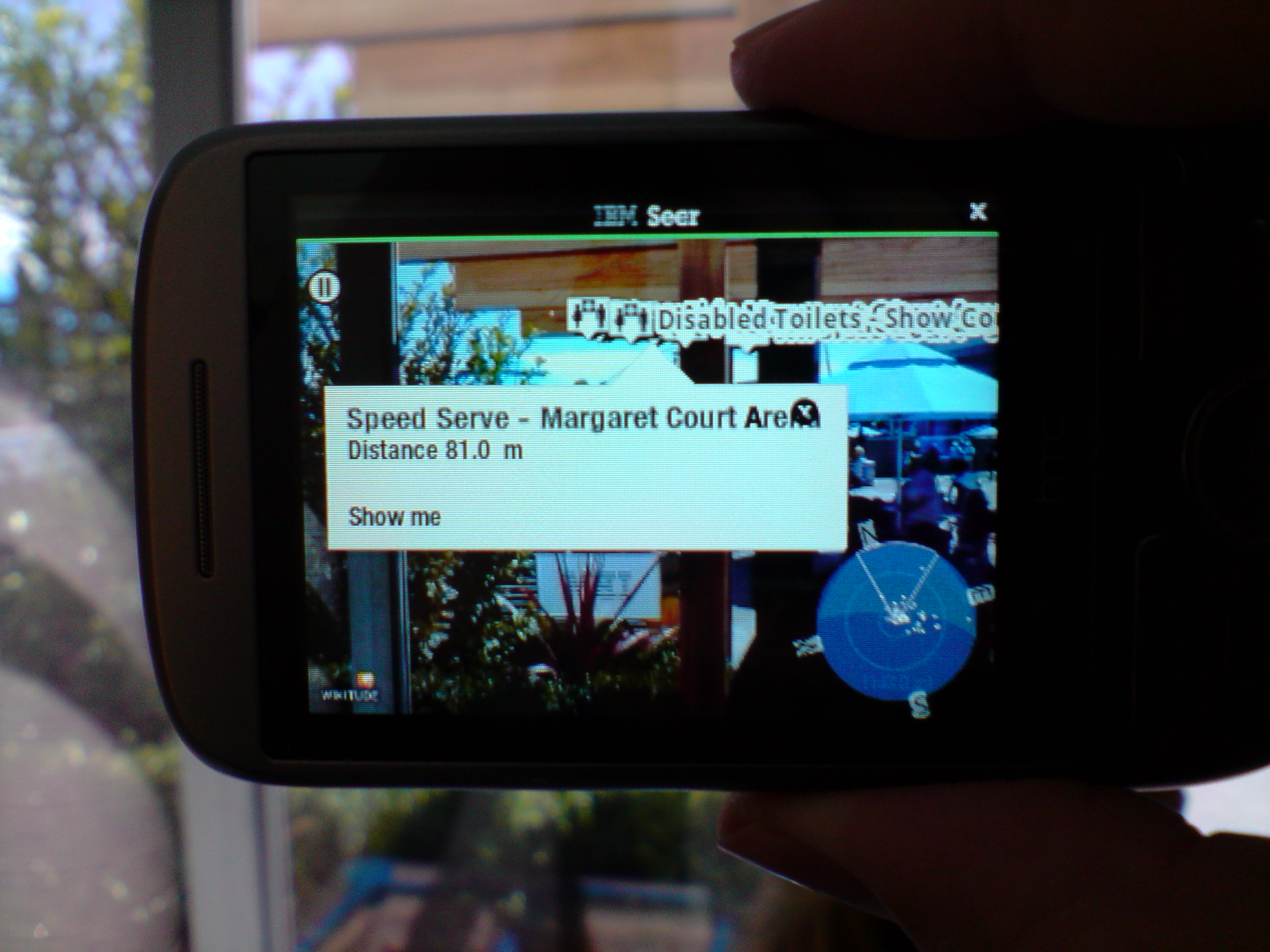
On Monday I visited the Australian Open [1] it s one of the world s greatest tennis championships and it s on in Melbourne right now. IBM sponsored my visit to show me the computer technology that they use to run the event and display the results to the world via their web site and to various media outlets. picture of IBM Seer software running on HTC Hero The first thing that they showed me was the IBM Seer software on the HTC Hero phone (which runs the Google Android OS). Seer can be freely downloaded from the Android store. The most noteworthy feature is that it uses the camera in the Android phone to display a picture of whatever you are looking at with points of interest superimposed (such as the above picture where I asked for locations of events and toilets). But it also displays a map view and has some other features I didn t get a chance to test such as viewing twitter data relevant to the event. We really need this augmented reality feature enabled with tourist data for major cities. I m sure that there s lots of interesting things I haven t seen in my own home city, if I could just pull out a phone and see a map of what s around me whenever I m bored I could see some of them. I think that this has the potential to change the way we use phones, in theory this was available as soon as Google Maps was released, but Seer seems to be the start of a whole new range of developments. One of the uses of this will be for identifying the background in tourist photos, no more of the me in front of old building descriptions. Here is a Youtube Video of the Seer software in action [BMLgHGV4zWM]. The tour guide explained that to get the software to work on an iPhone would require the 3GS for navigation as the earlier iPhones don t have a compass. The Seer software was initially developed for The Championships, Wimbledon 2009 which happened at about the same time as the iPhone 3GS release. I expect that there will be enough iPhone 3GS units sold before Wimbledon 2010 to give IBM a good incentive to port Seer to the iPhone. Three (my phone company at the moment) has just sold out of the HTC Magic which has a digital compass. They are selling the HTC Touch Pro and HTC Touch Diamond that appear to lack a digital compass. Vodaphone is offering a HTC Magic free on the $29 contract right now. The other Australian mobile phone companies don t seem to offer any Android phones. So it seems that the only option right now if I wanted to purchase a phone in Australia that can run Seer is the Vodaphone HTC Magic, and that s a phone that was released almost a year ago (a long time with recent progress in phone development it s the modem before the HTC Hero I tested) and which has only a 3.2MP camera (the LG U990 Viewty I used to take the picture for this post has a 5MP camera and is older than that). So I expect that there aren t many people using Seer in Australia. If you happen to be in Melbourne and have an Android phone with a digital compass then you may want to visit the Australian open to try the Seer software. It should work equally well from outside the security fence I ll write about the other things I saw over the next few days.

Russell Coker: Costs and Benefits of Search Engines

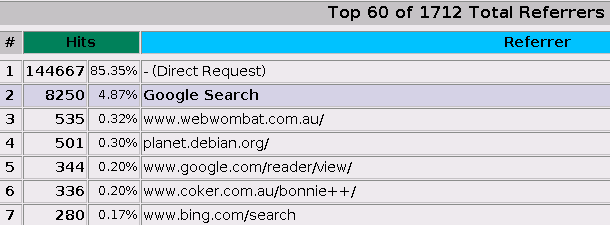
Chris Smart writes about the latest money making schemes for OS distributors, Canonical is getting paid by Yahoo to make them stop using Google as the default Firefox search engine [1]. I think this is OK, the user can easily change it back if desired and it allows them to pay the salaries of more employees who contribute code back to upstream projects. MSN uses 455M, Google uses 189M, and Yahoo uses 109MGoogle referrs 8250 hits, but Bing only refers 280 Above are sections of my Webalizer output related to my blog which show the data transfer use of search.msn.com (Bing presumably) which is 50% greater than that of Google and Yahoo combined. Why does MSN need to do 455MB of transfer so far this month to scan my blog when Google gets the job done with 189M and Yahoo only takes 109M? Also judging by the referrals Bing is only 3% as much use to me as Google. MSN uses 525M, Yahoo uses 132M, and Google only uses 35M Above is a sample of the Webalizer output from www.coker.com.au, MSN is using 525MB of data to scan the site which contains about 1.2G of static files that change very rarely. A Russian malware site seems to be downloading it three times a month, and Google only takes 35MB of data transfer to scan the site (which is probably still excessive). If Bing was a quality search engine that returned appropriate results then this could be forgiven. But however it is a very poor search engine that returns bad results. For example if you query Google or Yahoo for bonnie++ you will get an entire page of search results concerning my Bonnie++ benchmark, and those results are ordered in a sensible way. If you ask Bing then the first four results concern Bonnie (three women and a plant) and most of the first page don t concern my benchmark. Some time ago I had blocked MSN from scanning a server that I ran. The server in question had all the web servers for my domain plus quite a few other small domains. The total MSN data transfer was 3G per month which was almost half the data allowance for the server in question (data plans in Australia suck that s why my web servers are hosted in Germany now), so it was a question of whether to allow normal operation of the business or MSN searches. With Microsoft not running a popular search engine (then or now) it was an easy decision. I think that anyone who accepts money from Microsoft/Bing is doing their users a mis-service. Bing is simply an inferior search engine, it gets bad results and imposes excessive costs on service providers. Yahoo however seems to be a reasonable service, not as good as Google for the web hosters but not too bad. I wonder what would happen if Yahoo offered some sponsorship money to the Debian project in exchange for being the default search engine. I m sure it would be dramatic.


25 January 2010

Torsten Landschoff: Eclipse 3.5.1 mouse event problems with gtk >= 2.18

Recently, Eclipse started ignoring clicks on dialog buttons for me. This seems to be due to some changes in gtk 2.18. It does not use native windows for all widgets anymore, and SWT seems to rely on it. Thanks to this blog post, I have this fix in my bashrc:
1
alias eclipse="GDK_NATIVE_WINDOWS=true eclipse"
The Debian bug tracker also knows about this problem, which is partly fixed for the eclipse packages. Bad luck that I am using a download from eclipse.org.

Russell Coker: Discovering OS Bugs and Using Snapshots

I m running Debian/Unstable on an EeePC 701, I ve got an SD card for /home etc but the root filesystem is on the internal 4G flash storage which doesn t have much spare space (I ve got a full software development environment, GCC, debuggers, etc as well as running KDE4). On some of my systems I ve started the practice of having two root filesystem installs, modern disks are big enough that usually it s difficult to use all the space, and even if you do use most of the space the use of a second root filesystem only takes a fraction of a percent of the available space. Today I discovered a problem with my EeePC, I had upgraded to the latest Unstable packages a few days ago and now when I run X programs the screen flickers really badly every time it s updated. Pressing a key in a terminal window makes the screen shake, watching a video with mplayer makes it shake constantly to such a degree that it s not usable. If that problem occurred on a system with a second root filesystem I could upgrade the other a few packages at a time to try and discover the root cause. But without the space for a second root filesystem this isn t an option. I hope that Btrfs [1] becomes ready for serious use soon, it seems that the btrfs snapshot facility might make it possible for me to preserve the old version in a bootable form before upgrading my EeePC (although even then disk space would be tight). So I guess I now need to test different versions of the X related packages in a chroot environment to track this bug down. Sigh.

24 January 2010

Russell Coker: Old Mobile Phones as Toys

In the past I have had parents ask for advice on buying a digital camera for a young child. For some years there have been digital cameras on sale for much less than $100 cheap enough that no-one will be THAT bothered if the child breaks it, so digital photography is a good hobby for a young child. Such cameras are however quite bulky and require AA batteries which often don t last that long between charges. Some of the cheap phones are large enough that a 3yo child can have trouble carrying them. I recently gave an old LG U8110 phone to a young child for use as a camera. The phone has a 640*480 resolution camera and a display that is a few centimeters wide. It s no good for any remotely serious photography, and among other problems I never managed to get it s USB connection to work so the only way I ever managed to get a photograph off it was to MMS it to a newer camera. But it s quite adequate for a child to play with, it s small, light, and the battery stays charged for ages. Also the phone has a clock built in which is a handy feature it seems that nowadays the trend in society is away from wearing a watch and towards using a mobile phone to discover the time. Also a phone is a fairly capable computer, I think that the first two computers that I owned had significantly less CPU power and RAM than an LG U8110 and lots of newer phones compare well to PCs that were manufactured in the mid 90 s. The trend has been towards having an increasing number of applications and games on phones which of course gives more things for a child to play with. I believe that playing with computers that have a variety of different user interfaces and sets of applications is good for the education of young children. Now to make a phone work you need to have a SIM. If a phone was designed by someone who was intelligent and who was acting on behalf of the owner of the phone then it would support the camera etc without a SIM. But it seems that mobile phones are either designed by idiots or they are designed to act on behalf of the phone companies to the exclusion of the customer s interests, so I haven t seen a camera-phone that is usable for any purpose other than calling the emergency services when there is no SIM installed. Fortunately it is possible to get old SIMs, I had one that was replaced due to an intermittent fault that caused calls to drop out. I also have some SIMs from other telcos that would probably work (I m not sure whether a phone that is locked to one carrier will take photos if a SIM from another carrier is installed). Update: It seems that there is a range of phones that operate without a SIM, a Nokia N900 (if you consider it to be a phone rather than an Internet tablet), an Android, or a phone running the Symbian OS. I suspect that the majority of phones that are currently in use and due to be replaced soon will require a SIM though. One final notable aspect of giving a phone to a child is the possibility of it being used to call emergency services (which will work even when there is no SIM or a SIM that is not associated with an account). If you are planning to give a phone to someone else s child then you should ask the parents first, some parents believe (either correctly or incorrectly) that the chance of their child making prank calls to the emergency services is too great. A present that a child receives which is undesired by their parents will probably get lost or broken quickly When such a phone gets broken by a child (they are tough, but almost everything that is used without restriction by a child gets broken) the next thing to do is to disassemble it. With modern design and manufacturing probably all that a child could really learn from a phone is how the keyboard works and not even that for a touch-screen phone. But it s still a good experience for a child to take apart old machines. When I was young my father gave me many old machines to take apart, I had a lot of fun and learned some interesting things. I find it really sad to see those boxes for recycling old phones at the mobile phone stores which are full of 2yo phones that are mostly in good condition. Almost everyone has some young relatives or friends who have children who could find a good use for that stuff. Send the bits to be recycled AFTER the children nearest to you have finished doing things to the old phone!

Gregor Herrmann: RC bugs 2010/02, 2010/03

during the last two weeks I focused on the FTBFS bugs in the Debian Perl Group, only one NMU:

Russell Coker: Preventing Children from Accessing Porn

The following was written by Stefano Cosentino in regard to the ongoing efforts of the Australian government to censor the Internet with protecting the children as an excuse. All these Internet filtering ideas that have been in the news lately has made me voice my own opinion on the matter as a non-expert. I m an IT advisor. I take someone s problem and help them fix it. I have a few clients who provide laptops to their students, everything is done with these laptops. The students have no books. The school provides laptops to their primary school students as well as their high school students. They have done this long before the public system started to hand out laptops to a select number of high school students. When you provide a child with anything, there are always areas where a child will find that you may have overlooked. In fact, a young kid will probably find a host of things that you might have totally missed or didn t ever know about. One of these things is the inappropriate nature of information you may find that are associated with computers. This can be anything. But specifically, what the filtering argument has been about has been leaning towards Internet pornography and I would imagine, more specifically content of a pedophiliac nature. I m not against child pornography being banned or filtered. I personally think this is one of the most cruel, inconsiderate, disrespectful and self centered behaviors a person could display. Their psychological makeup isn t the scope of this article. However these ideas must be conveyed when discussing the Internet as a modern technological device that can be used for both good and bad. The primary school students that I attend to aren t very interested in this stuff and as it has been mentioned long ago by others who have joined this argument, are more interested in online flash games that include characters such as Ben 10, Pokemon and Yu-Gi-Oh. When I m called in to scan these computers during the school holidays and hand the laptops back to the kids or when they get handed back after 3 years for new ones, I find that the older primary school kids computers are usually more prone to the adult orientated content. To me this is the first sign of a filter s failure. This customer of mine spends more money on the filtering devices they use on campus than I charge them for a few days of work. Does it work? Sadly, I hate to report that no, it does not. It s completely useless. The kids still have files and traces of files on their computers that isn t suitable for young children. Not only pornography but also content of a violent or morbid nature. As young and impressionable people, everything they read, see and hear is absorbed. This shapes the way society will become in years to come. Since no one can realistically tell the future, wouldn t it be nice if we could make sure that the people looking after us and our lives forty or fifty years from now have a sane mind free of blemish? It s a different story for the high school children. While scanning their laptops I have to contact the police on a daily basis because of the nature of the content I find during my day. Some things you can let slip, today s version of a pinup girl, or a provocative pic of whatever skimpy clad girl the record companies are flogging off these days as musicians. But sadly that s rare. I won t go into detail of what I find on these laptops of 14 year old boys, but it ranges from some innocent growing up curiosity right to perverted, sick and most if not all of the time, illegal content. The filters fail again. The kids find a way around it. And they find it easily. I ve seen filters work and not work at all with young kids right through to young adults. All the filters do is either hinder the poor kids actually trying to do research of scholastic nature or prolong the inevitable and temporarily block a determined child s interest in the search for some adult related material. The filter might prevent accidental viewing but it doesn t stop the deliberate finding of pornography and other illegal content. How does a filter stop this from happening? How does a filter stop a child taking their parents adult videos and copying them to their laptop or finding dad s stash of Penthouse? How does it stop a school mate bringing this stuff to school to show everyone at lunch time or to trade for other content they found by other means. Remember back to when you were their age and caught a glimpse of your big brother s room wall. How many times did you try and catch a peak at that Samantha Fox poster hanging off the wall? Where s the filter now? Here s some thing to think about. The filter shouldn t be a thing, it should be a person. They re called responsible . They re called parents. What priorities do parents have if their child feels that what they look at online that is of an adult nature is acceptable? Or maybe the kid knows better, knows it isn t acceptable but still goes out of their way to get the stuff on their computer? Sneaker Net still exists, USB memory sticks are cheap and can now have two or three straight DVD rips on them, or perhaps five or six encoded films on there. Hundreds and thousands of images and so on. Filter failure again. When the kids go online, they know of the technology used to block them from gaining access to what they want to see. Chances are, they ll know what a proxy server is and does. Then they ll figure out what they need to do to get around the filter. I, myself did this back in high school and TAFE when I couldn t find photographs of a particular device I was researching. Turns out the name is also a form of sexual activity, in another language, but still. The filter stopped me from not only looking the offending content but also to look at the legitimate data that I needed to complete an assignment. I got around the problem by researching some more information and the following day I was breaking through firewalls and proxy servers with easy. Filter failure. How do I get around this issue when speaking to younger kids that need guidance and knowledge on how to deal with this situation? I hold talks at the school I provide my services to. I talk to the parents, no kids. The talk costs less than a broken filter they keep throwing money at keep up-to-date. The school puts these filters in place to appear responsible, because while the kids are attending their school, the school is in fact responsible. In fact, there is nothing more the school can do. They could educate the children, but you can tell someone what to do, and the chances of them doing it are pretty dismal. Music is not allowed on their computers either. Yet we constantly find iTunes on there and a host of music that traces to certain peer to peer applications where they acquired the stolen music. If a kid can learn how to do that, imagine what sort of influence can be placed on them from a more positive angle. Like maybe parents providing an explanation for starters of what it is they re looking at. What it is they ll find online. What material is inappropriate. What material should you tell an adult about. Why do I get stupid emails with Russian girls wanting to marry me. Kids absorb everything. Parents have relegated responsibility but not delegated it. This filter idea might help slow down a child s enthusiasm to learn about everything, both good and bad. But educating the kids from an early stage in life about morals and the modern world where lets think about it, we have absolutely everything we need and want at our finger tips will be more valuable than any filter. But the fact that we have so much available makes it difficult to say what is and isn t appropriate for a child to see. It is up to us to inform the children of what s out there is the world. It may or may not stop them from seeing the adult related content, but it will help them respond to it in a mature and adult manner. We all know, kids aren t stupid. So, if the filters worked, why am I called in once a year, every year to give my talk to parents?

Next.

Previous.