Search Results: "sto"

5 February 2016

Daniel Pocock: Giving up democracy to get it back

Do services like Facebook and Twitter really help worthwhile participation in democracy, or are they the most sinister and efficient mechanism ever invented to control people while giving the illusion that they empower us? Over the last few years, groups on the left and right of the political spectrum have spoken more and more loudly about the problems in the European Union. Some advocate breaking up the EU, while behind the scenes milking it for every handout they can get. Others seek to reform it from within. Yanis Varoufakis on motorbike Most recently, former Greek finance minister Yanis Varoufakis has announced plans to found a movement (not a political party) that claims to "democratise" the EU by 2025. Ironically, one of his first steps has been to create a web site directing supporters to Facebook and Twitter. A groundbreaking effort to put citizens back in charge? Or further entangling activism in the false hope of platforms that are run for profit by their Silicon Valley overlords? A Greek tragedy indeed, in the classical sense. Varoufakis rails against authoritarian establishment figures who don't put the citizens' interests first. Ironically, big data and the cloud are a far bigger threat than Brussels. The privacy and independence of each citizen is fundamental to a healthy democracy. Companies like Facebook are obliged - by law and by contract - to service the needs of their shareholders and advertisers paying to study and influence the poor user. If "Facebook privacy" settings were actually credible, who would want to buy their shares any more? Facebook is more akin to an activism placebo: people sitting in their armchair clicking to "Like" whales or trees are having hardly any impact at all. Maintaining democracy requires a sufficient number of people to be actively involved, whether it is raising funds for worthwhile causes, scrutinizing the work of our public institutions or even writing blogs like this. Keeping them busy on Facebook and Twitter renders them impotent in the real world (but please feel free to alert your friends with a tweet) Big data is one of the areas that requires the greatest scrutiny. Many of the professionals working in the field are actually selling out their own friends and neighbours, their own families and even themselves. The general public and the policy makers who claim to represent us are oblivious or reckless about the consequences of this all-you-can-eat feeding frenzy on humanity. Pretending to be democratic is all part of the illusion. Facebook's recent announcement to deviate from their real-name policy is about as effective as using sunscreen to treat HIV. By subjecting themselves to the laws of Facebook, activists have simply given Facebook more status and power. Data means power. Those who are accumulating it from us, collecting billions of tiny details about our behavior, every hour of every day, are fortifying a position of great strength with which they can personalize messages to condition anybody, anywhere, to think the way they want us to. Does that sound like the route to democracy? I would encourage Mr Varoufakis to get up to speed with Free Software and come down to Zurich next week to hear Richard Stallman explain it the day before launching his DiEM25 project in Berlin. Will the DiEM25 movement invite participation from experts on big data and digital freedom and make these issues a core element of their promised manifesto? Is there any credible way they can achieve their goal of democracy by 2025 without addressing such issues head-on? Or put that the other way around: what will be left of democracy in 2025 if big data continues to run rampant? Will it be as distant as the gods of Greek mythology? Still not convinced? Read about Amazon secretly removing George Orwell's 1984 and Animal Farm from Kindles while people were reading them, Apple filtering the availability of apps with a pro-Life bias and Facebook using algorithms to identify homosexual users.


Jose M. Calhariz: Preview of amanda 3.3.8-1

While I sort out a sponsor, my sponsor is very busy, here is a preview of the new packages. So anyone can install and test them on jessie. The source of the packages is in collab-maint.The debs files for jessie are here: amanda-common_3.3.8-1_cal0_i386.deb amanda-server_3.3.8-1_cal0_i386.deb amanda-client_3.3.8-1_cal0_i386.deb Here comes the changelog:
amanda (1:3.3.8-1~cal0) unstable; urgency=low
  * New Upstream version
    * Changes for 3.3.8
      * s3 devices
          New NEARLINE S3-STORAGE-CLASS for Google storage.
          New AWS4 STORAGE-API
      * amcryptsimple
          Works with newer gpg2.
      * amgtar
          Default SPARSE value is NO if tar < 1.28.
          Because a bug in tar with some filesystem.
      * amstar
          support include in backup mode.
      * ampgsql
          Add FULL-WAL property.
      * Many bugs fix.
    * Changes for 3.3.7p1
      * Fix build in 3.3.7
    * Changes for 3.3.7
      * amvault
          new --no-interactivity argument.
          new --src-labelstr argument.
      * amdump
          compute crc32 of the streams and write them to the debug files.
      * chg-robot
          Add a BROKEN-DRIVE-LOADED-SLOT property.
      * Many bugs fix.
  * Refreshed patches.
  * Dropped patches that were applied by the upstream: fix-misc-typos,
    automake-add-missing, fix-amcheck-M.patch,
    fix-device-src_rait-device.c, fix-amreport-perl_Amanda_Report_human.pm
  * Change the email of the maintainer.
  * "wrap-and-sort -at" all control files.
  * swig is a new build depend.
  * Bump standard version to 3.9.6, no changes needed.
  * Replace deprecated dependency perl5 by perl, (Closes: #808209), thank
    you Gregor Herrmann for the NMU.
 -- Jose M Calhariz <jose@calhariz.com>  Tue, 02 Feb 2016 19:56:12 +0000

Ben Hutchings: Debian LTS work, January 2016

In January I carried over 10 hours from December and was assigned another 15 hours of work by Freexian's Debian LTS initiative. I worked a total of 15 hours. I had a few days on 'front desk' at the start of the month, as my week in that role spanned the new year. I fixed a regression in the kernel that was introduced to all stable suites in December. I uploaded this along with some minor security fixes, and issued DLA 378-1. I finished backporting and testing fixes to sudo for CVE-2015-5602. I uploaded an update and issued DLA 382-1, which was followed by DSA 3440-1 for wheezy and jessie. I finished backporting and testing fixes to Claws Mail for CVE-2015-8614 and CVE-2015-8708. I uploaded an update and issued DLA 383-1. This was followed by DSA 3452-1 for wheezy and jessie, although the issues are less serious there. I also apent a little time on InspIRCd, though this isn't a package that Freexian's customers care about and it seems to have been broken in squeeze for several years due to a latent bug in the build system. I had already backported the security fix by the time I discovered this, so I went ahead with an update fixing that regression as well, and issued DLA 384-1. Finally, I diagnosed the regression in the update to isc-dhcp in DLA 385-1.

Enrico Zini: debtags-cleanup

debtags.debian.org cleaned up Since the Debtags consolidation announcement there are some more news: No more anonymous submissions Official recognition as Debian Contributors Mailing lists closed We can just use debian-devel instead of debtags-devel. Autotagging of trivial packages Miscellaneous other changes

4 February 2016

Vincent Fourmond: Making oprofile work again with recent kernels

I've been using oprofile for profiling programs for a while now (and especially QSoas, because it doesn't require specific compilation options, and doesn't make your program run much more slowly (like valgrind does, which can also be used to some extent for profiling). It's a pity the Debian package was dropped long ago, but the ubuntu packages work out of the box on Debian. But, today, while trying to see what takes so long in some fits I'm running, here's what I get:
~ operf QSoas
Unexpected error running operf: Permission denied

Looking further using strace, I could see that what was not working was the first call to perf_event_open.
It took me quite a long time to understand why it stopped working and how to get it working again, so here's for those of you who googled the error and couldn't find any answer (including me, who will probably have forgotten the anwser in a couple of months). The reason behing the change is that, for security reason, non-privileged users do not have the necessary privileges since Debian kernel 4.1.3-1; here's the relevant bit from the changelog:

  * security: Apply and enable GRKERNSEC_PERF_HARDEN feature from Grsecurity,
    disabling use of perf_event_open() by unprivileged users by default
    (sysctl: kernel.perf_event_paranoid)

The solution is simple, just run as root:
~ sysctl kernel.perf_event_paranoid=1

(the default value seems to be 3, for now). Hope it helps !

Daniel Pocock: Australians stuck abroad and alleged sex crimes

Two Australians have achieved prominence (or notoriety, depending on your perspective) for the difficulty in questioning them about their knowledge of alleged sex crimes. One is Julian Assange, holed up in the embassy of Ecuador in London. He is back in the news again today thanks to a UN panel finding that the UK is effectively detaining him, unlawfully, in the Ecuadorian embassy. The effort made to discredit and pursue Assange and other disruptive technologists, such as Aaron Swartz, has an eerie resemblance to the way the Inquisition hunted witches in the middle ages and beyond. The other Australian stuck abroad is Cardinal George Pell, the most senior figure in the Catholic Church in Australia. The Royal Commission into child sex abuse by priests has heard serious allegations claiming the Cardinal knew about and covered up abuse. This would appear far more sinister than anything Mr Assange is accused of. Like Mr Assange, the Cardinal has been unable to travel to attend questioning in person. News reports suggest he is ill and can't leave Rome, although he is being accommodated in significantly more comfort than Mr Assange. If you had to choose, which would you prefer to leave your child alone with?

Russell Coker: Unikernels

At LCA I attended a talk about Unikernels. Here are the reasons why I think that they are a bad idea: Single Address Space According to the Unikernel Wikipedia page [1] a significant criteria for a Unikernel system is that it has a single address space. This gives performance benefits as there is no need to change CPU memory mappings when making system calls. But the disadvantage is that any code in the application/kernel can access any other code directly. In a typical modern OS (Linux, BSD, Windows, etc) every application has a separate address space and there are separate memory regions for code and data. While an application can request the ability to modify it s own executable code in some situations (if the OS is configured to allow that) it won t happen by default. In MS-DOS and in a Unikernel system all code has read/write/execute access to all memory. MS-DOS was the least reliable OS that I ever used. It was unreliable because it performed tasks that were more complex than CP/M but had no memory protection so any bug in any code was likely to cause a system crash. The crash could be delayed by some time (EG corrupting data structures that are only rarely accessed) which would make it very difficult to fix. It would be possible to have a Unikernel system with non-modifyable executable areas and non-executable data areas and it is conceivable that a virtual machine system like Xen could enforce that. But that still wouldn t solve the problem of all code being able to write to all data. On a Linux system when an application writes to the wrong address there is a reasonable probability that it will not have write access and you will immediately get a SEGV which is logged and informs the sysadmin of the address of the crash. When Linux applications have bugs that are difficult to diagnose (EG buffer overruns that happen in production and can t be reproduced in a test environment) there are a variety of ways of debugging them. Tools such as Valgrind can analyse memory access and tell the developers which code had a bug and what the bug does. It s theoretically possible to link something like Valgrind into a Unikernel, but the lack of multiple processes would make it difficult to manage. Debugging A full Unix environment has a rich array of debugging tools, strace, ltrace, gdb, valgrind and more. If there are performance problems then tools like sysstat, sar, iostat, top, iotop, and more. I don t know which of those tools I might need to debug problems at some future time. I don t think that any Internet facing service can be expected to be reliable enough that it will never need any sort of debugging. Service Complexity It s very rare for a server to have only a single process performing the essential tasks. It s not uncommon to have a web server running CGI-BIN scripts or calling shell scripts from PHP code as part of the essential service. Also many Unix daemons are not written to run as a single process, at least threading is required and many daemons require multiple processes. It s also very common for the design of a daemon to rely on a cron job to clean up temporary files etc. It is possible to build the functionality of cron into a Unikernel, but that means more potential bugs and more time spent not actually developing the core application. One could argue that there are design benefits to writing simple servers that don t require multiple programs. But most programmers aren t used to doing that and in many cases it would result in a less efficient result. One can also argue that a Finite State Machine design is the best way to deal with many problems that are usually solved by multi-threading or multiple processes. But most programmers are better at writing threaded code so forcing programmers to use a FSM design doesn t seem like a good idea for security. Management The typical server programs rely on cron jobs to rotate log files and monitoring software to inspect the state of the system for the purposes of graphing performance and flagging potential problems. It would be possible to compile the functionality of something like the Nagios NRPE into a Unikernel if you want to have your monitoring code running in the kernel. I ve seen something very similar implemented in the past, the CA Unicenter monitoring system on Solaris used to have a kernel module for monitoring (I don t know why). My experience was that Unicenter caused many kernel panics and more downtime than all other problems combined. It would not be difficult to write better code than the typical CA employee, but writing code that is good enough to have a monitoring system running in the kernel on a single-threaded system is asking a lot. One of the claimed benefits of a Unikernel was that it s supposedly risky to allow ssh access. The recent ssh security issue was an attack against the ssh client if it connected to a hostile server. If you had a ssh server only accepting connections from management workstations (a reasonably common configuration for running servers) and only allowed the ssh clients to connect to servers related to work (an uncommon configuration that s not difficult to implement) then there wouldn t be any problems in this regard. I think that I m a good programmer, but I don t think that I can write server code that s likely to be more secure than sshd. On Designing It Yourself One thing that everyone who has any experience in security has witnessed is that people who design their own encryption inevitably do it badly. The people who are experts in cryptology don t design their own custom algorithm because they know that encryption algorithms need significant review before they can be trusted. The people who know how to do it well know that they can t do it well on their own. The people who know little just go ahead and do it. I think that the same thing applies to operating systems. I ve contributed a few patches to the Linux kernel and spent a lot of time working on SE Linux (including maintaining out of tree kernel patches) and know how hard it is to do it properly. Even though I m a good programmer I know better than to think I could just build my own kernel and expect it to be secure. I think that the Unikernel people haven t learned this.

3 February 2016

Sven Hoexter: Moby

Maybe my favourite song of Moby - "That's when I reach for my revolver" - is one of the more unsual ones, slightly more rooted in his Punk years and a cover version. Great artist anyway.

Jonathan Dowland: Comparing Docker images

I haven't written much yet about what I've been up to at work. Right now, I'm making changes to the sources of a set of Docker images. The changes I'm making should not result in any changes to the actual images: it's just a re-organisation of the way in which they are built. I've been using the btrfs storage driver for Docker which makes comparing image filesystems very easy from the host machine, as all the image filesystems are subvolumes. I use a bash script like the following to make sure I haven't broken anything:
oldid="$1"; newid="$2";
id_in_canonical_form()  
    echo "$1"   grep -qE '^[a-f0-9] 64 $'
 
canonicalize_id()  
    docker inspect --format '  .Id  ' "$1"
 
id_in_canonical_form "$oldid"   oldid="$(canonicalize_id "$oldid")"
id_in_canonical_form "$newid"   newid="$(canonicalize_id "$newid")"
cd "/var/lib/docker/btrfs/subvolumes"
sumpath()  
    cd "$1" && find . -printf "%M %4U %4G %16s %h/%f\n"   sort
 
diff -ruN "$oldid" "newid"
diff -u <(sumpath "$oldid") <(sumpath "$newid")
Using -printf means I can ignore changes in the timestamps on files which is something I am not interested in. If it is available in your environment, Lars Wirzenius' tool Summain generates manifests that include a file checksum and could be very useful for this use-case.

Michal &#268;iha&#345;: New projects on Hosted Weblate

I had some pile of hosting requests in queue since half of January and my recent talk on FOSDEM had some impact on requests for hosting translations as well, so it's about time to process them. New kids on the block are: Second round includes: Unfortunately I had to reject some projects as well mostly due to lack of file format support. This is still the same topic - when translating project, please stick with some standard format. Preferably what is usual on your platform. If you like this service, you can support it on Bountysource salt or Gratipay. There is also option for hosting translations of commercial products.

Filed under: English Weblate 0 comments

2 February 2016

Dirk Eddelbuettel: Like peanut butter and jelly: x13binary and seasonal

This post was written by Dirk Eddelbuettel and Christoph Sax and will be posted on both author's respective blogs. The seasonal package by Christoph Sax brings a very featureful and expressive interface for working with seasonal data to the R environment. It uses the standard tool of the trade: X-13ARIMA-SEATS. This powerful program is provided by the statisticians of the US Census Bureau based on their earlier work (named X-11 and X-12-ARIMA) as well as the TRAMO/SEATS program by the Bank of Spain. X-13ARIMA-SEATS is probably the best known tool for de-seasonalization of timeseries, and used by statistical offices around the world. Sadly, it also has a steep learning curve. One interacts with a basic command-line tool which users have to download, install and properly reference (by environment variables or related means). Each model specification has to be prepared in a special 'spec' file that uses its own, cumbersome syntax. As seasonal provides all the required functionality to use X-13ARIMA-SEATS from R --- see the very nice seasonal demo site --- it still required the user to manually deal with the X-13ARIMA-SEATS installation. So we decided to do something about this. A pair of GitHub repositories provide both the underlying binary in a per-operating system form (see x13prebuilt) as well as a ready-to- use R package (see x13binary) which uses the former to provide binaries for R. And the latter is now on CRAN as package x13binary ready to be used on Windows, OS-X or Linux. And the seasonal package (in version 1.2.0 -- now on CRAN -- or later) automatically makes use of it. Installing seasaonal and x13binary in R is now as easy as:

install.packages("seasonal")
which opens the door for effortless deployment of powerful deasonalization. By default, the principal function of the package employs a number of automated techniques that work well in most circumstances. For example, the following code produces a seasonal adjustment of the latest data of US retail sales (by the Census Bureau) downloaded from Quandl:
library(seasonal) 
library(Quandl)   ## not needed for seasonal but has some niceties for Quandl data
rs <- Quandl(code="USCENSUS/BI_MARTS_44000_SM", type="ts")/1e3
m1 <- seas(rs)
plot(m1, main = "Retail Trade: U.S. Total Sales", ylab = "USD (in Billions)")
This tests for log-transformation, performs an automated ARIMA model search, applies outlier detection, tests and adjusts for trading day and easter effects, and invokes the SEATS method to perform seasonal adjustment. And this is how the adjusted series looks like:
Of course, you can access all available options of X-13ARIMA-SEATS as well. Here is an example where we adjust the latest data for Chinese exports (as tallied by the US FED), taking into account the different effects of Chinese New Year before, during and after the holiday:
xp <- Quandl(code="FRED/VALEXPCNM052N", type="ts")/1e9
m2 <- seas(window(xp, start = 2000),
          xreg = cbind(genhol(cny, start = -7, end = -1, center = "calendar"), 
                       genhol(cny, start = 0, end = 7, center = "calendar"), 
                       genhol(cny, start = 8, end = 21, center = "calendar")
          ),
          regression.aictest = c("td", "user"),
          regression.usertype = "holiday")
plot(m2, main = "Goods, Value of Exports for China", ylab = "USD (in Billions)")
which generates the following chart demonstrating a recent flattening in export activity measured in USD.
We hope this simple examples illustrates both how powerful a tool X-13ARIMA-SEATS is, but also just how easy it is to use X-13ARIMA-SEATS from R now that we provide the x13binary package automating its installation.

This post by Dirk Eddelbuettel originated on his Thinking inside the box blog. Please report excessive re-aggregation in third-party for-profit settings.

Norbert Preining: Gaming: The Talos Principle Road to Gehenna

After finishing the Talos Principle I immediately started to play the extension Road to Gehenna, but was derailed near completion by the incredible Portal Stories: Mel. Now that I finally managed to escape from the test chambers my attention returned to the Road to Gehenna. As with the pair Portal 2 and Portal Stories: Mel, the challenges are going up considerably from the original Talos Principle to the Road to Gehenna. Checking the hours of game play it took me about 24h through all the riddles in Road to Gehenna, but I have to admit, I had some riddles where I needed to cheat. road-to-gehenna.jpg The Road to Gehenna does not bring much new game play elements, but loads of new riddles. And the best of all, playable on Linux! And as with the original game, the graphics are really well done, while still be playable on my Vaio Pro laptop with Intel integrated graphic card a plus that is rare in the world of computer games where everyone is expected to have a high-end nVidia or Radeon card. Ok, there is not much action going on where quick graphic computations are necessary, still the impression of the game is great.
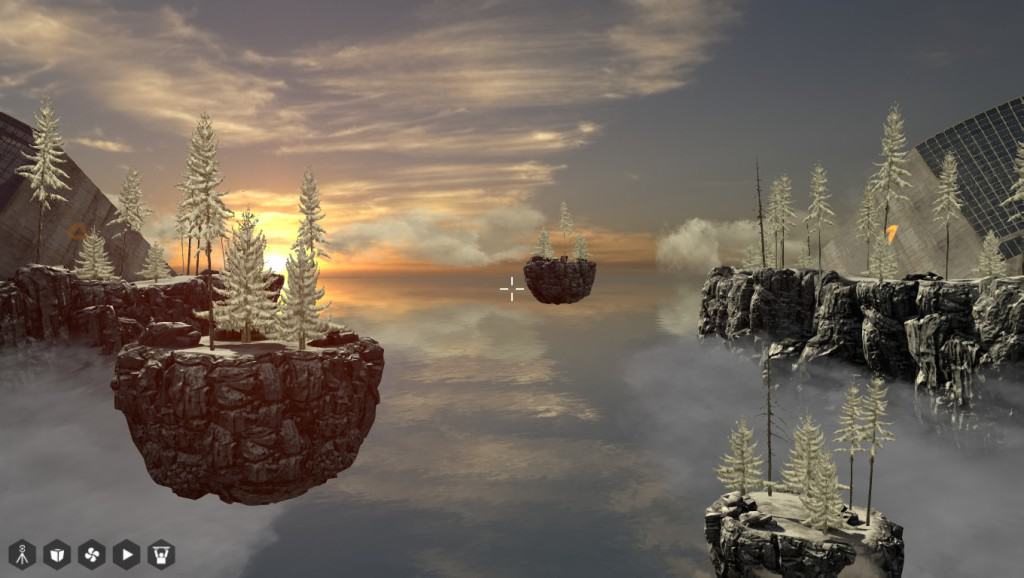
gehenna1 The riddles contain the well known elements (connectors, boxes, jammer, etc), but the settings are often spectacular, sometimes very small and narrow, just a few moves if done in the right order, sometimes like wide open fields with lots of space to explore. Transportation between various islands suspended in the air is with vents, giving you a lot of nice flight time!
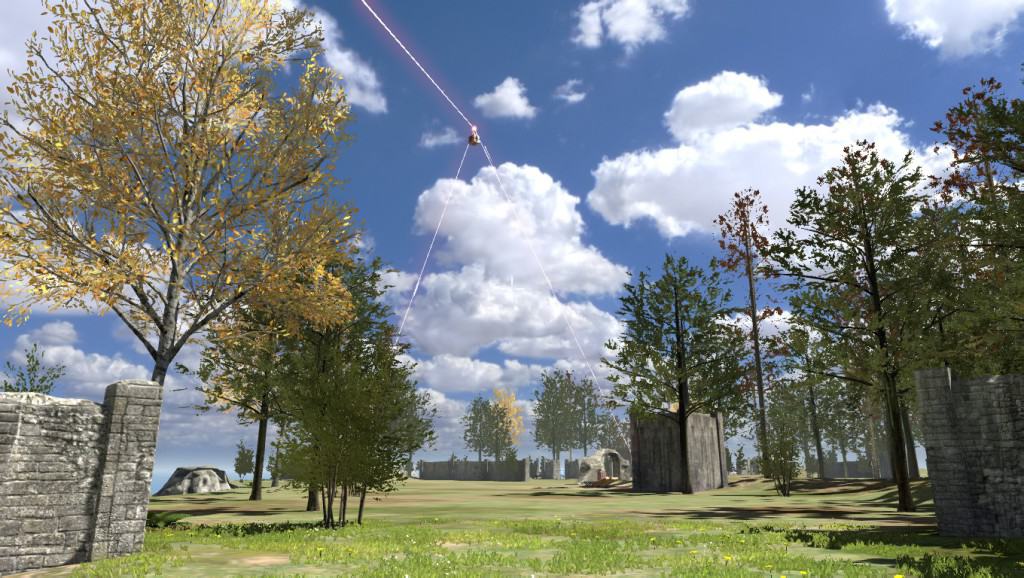
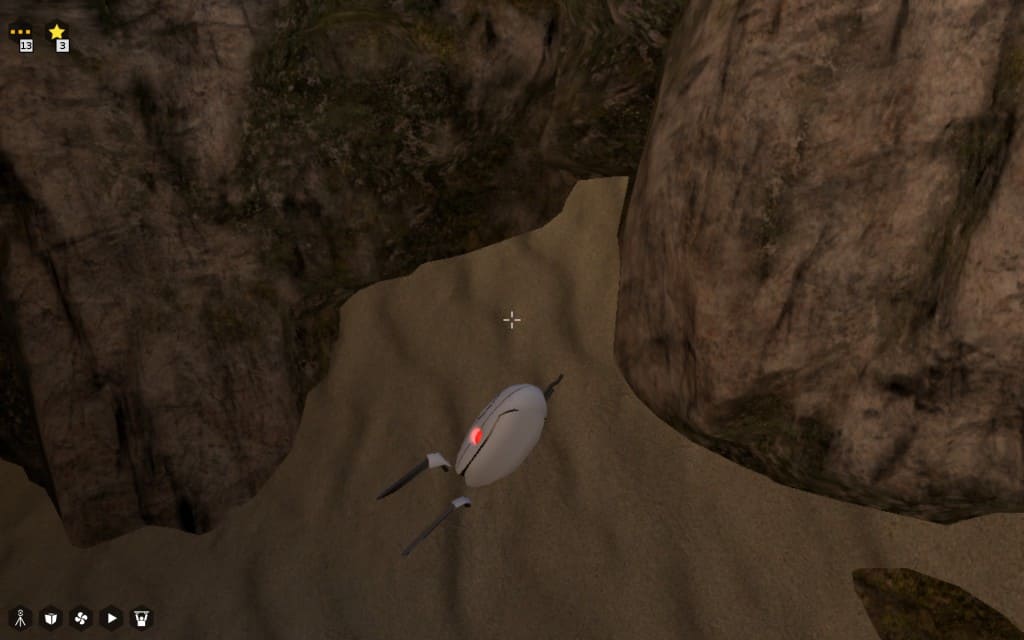
gehenna2 If one searches a lot, or uses a bit of cheating, one can find good old friends from the Portal series, burried in the sand in one of the world. This is not the only easter egg hidden in the game, there are actually a lot, some of which I have not seen but only read about afterwards. Guess I need to replay the whole game.
gehenna3 Coming back to the riddles, I really believe that the makers have been ingenious in using the few items at hand to create challenging and surprising riddles. As it is so often, many of the riddles look completely impossible at first glance, and often even after staring at them for tens and tens of minutes. Until (and if) one has the the a-ha effect and understands the trick. This often still needs a lot of handwork and trial-error rounds, but all in all the game is well balanced. What is a bit a pain similar to the original game are collecting the stars to reach the hidden world and free the admin. There the developers overdid it in my opinion, with some rather absurd and complicated stars.

gehenna4 The end of the game, ascension of the messengers, is rather unspectacular. A short discussion on who remains and then a big closing scene with the messenger being beamed up a la Starship Enterprise, and a closing black screen. But well, the fun was with the riddles.
gehenna5 All in all an extension that is well worth the investment if one enjoyed the original Talos, and is looking for rather challenging riddles. Now that I have finished all the Portal and Talos titles, I am hard thinking of what is next looking into Braid Enjoy!

Russell Coker: Compatibility and a Linux Community Server

Compatibility/interoperability is a good thing. It s generally good for systems on the Internet to be capable of communicating with as many systems as possible. Unfortunately it s not always possible as new features sometimes break compatibility with older systems. Sometimes you have systems that are simply broken, for example all the systems with firewalls that block ICMP so that connections hang when the packet size gets too big. Sometimes to take advantage of new features you have to potentially trigger issues with broken systems. I recently added support for IPv6 to the Linux Users of Victoria server. I think that adding IPv6 support is a good thing due to the lack of IPv4 addresses even though there are hardly any systems that are unable to access IPv4. One of the benefits of this for club members is that it s a platform they can use for testing IPv6 connectivity with a friendly sysadmin to help them diagnose problems. I recently notified a member by email that the callback that their mail server used as an anti-spam measure didn t work with IPv6 and was causing mail to be incorrectly rejected. It s obviously a benefit for that user to have the problem with a small local server than with something like Gmail. In spite of the fact that at least one user had problems and others potentially had problems I think it s clear that adding IPv6 support was the correct thing to do. SSL Issues Ben wrote a good post about SSL security [1] which links to a test suite for SSL servers [2]. I tested the LUV web site and got A-. This blog post describes how to setup PFS (Perfect Forward Secrecy) [3], after following it s advice I got a score of B! From the comments on this blog post about RC4 etc [4] it seems that the only way to have PFS and not be vulnerable to other issues is to require TLS 1.2. So the issue is what systems can t use TLS 1.2. TLS 1.2 Support in Browsers This Wikipedia page has information on SSL support in various web browsers [5]. If we require TLS 1.2 we break support of the following browsers: The default Android browser before Android 5.0. Admittedly that browser always sucked badly and probably has lots of other security issues and there are alternate browsers. One problem is that many people who install better browsers on Android devices (such as Chrome) will still have their OS configured to use the default browser for URLs opened by other programs (EG email and IM). Chrome versions before 30 didn t support it. But version 30 was released in 2013 and Google does a good job of forcing upgrades. A Debian/Wheezy system I run is now displaying warnings from the google-chrome package saying that Wheezy is too old and won t be supported for long! Firefox before version 27 didn t support it (the Wikipedia page is unclear about versions 27-31). 27 was released in 2014. Debian/Wheezy has version 38, Debian/Squeeze has Iceweasel 3.5.16 which doesn t support it. I think it is reasonable to assume that anyone who s still using Squeeze is using it for a server given it s age and the fact that LTS is based on packages related to being a server. IE version 11 supports it and runs on Windows 7+ (all supported versions of Windows). IE 10 doesn t support it and runs on Windows 7 and Windows 8. Are the free upgrades from Windows 7 to Windows 10 going to solve this problem? Do we want to support Windows 7 systems that haven t been upgraded to the latest IE? Do we want to support versions of Windows that MS doesn t support? Windows mobile doesn t have enough users to care about. Opera supports it from version 17. This is noteworthy because Opera used to be good for devices running older versions of Android that aren t supported by Chrome. Safari supported it from iOS version 5, I think that s a solved problem given the way Apple makes it easy for users to upgrade and strongly encourages them to do so. Log Analysis For many servers the correct thing to do before even discussing the issue is to look at the logs and see how many people use the various browsers. One problem with that approach on a Linux community site is that the people who visit the site most often will be more likely to use recent Linux browsers but older Windows systems will be more common among people visiting the site for the first time. Another issue is that there isn t an easy way of determining who is a serious user, unlike for example a shopping site where one could search for log entries about sales. I did a quick search of the Apache logs and found many entries about browsers that purport to be IE6 and other versions of IE before 11. But most of those log entries were from other countries, while some people from other countries visit the club web site it s not very common. Most access from outside Australia would be from bots, and the bots probably fake their user agent. Should We Do It? Is breaking support for Debian/Squeeze, the built in Android browser on Android <5.0, and Windows 7 and 8 systems that haven t upgraded IE as a web browsing platform a reasonable trade-off for implementing the best SSL security features? For the LUV server as a stand-alone issue the answer would be no as the only really secret data there is accessed via ssh. For a general web infrastructure issue it seems that the answer might be yes. I think that it benefits the community to allow members to test against server configurations that will become more popular in the future. After implementing changes in the server I can advise club members (and general community members) about how to configure their servers for similar results. Does this outweigh the problems caused by some potential users of ancient systems? I m blogging about this because I think that the issues of configuration of community servers have a greater scope than my local LUG. I welcome comments about these issues, as well as about the SSL compatibility issues.

1 February 2016

Lunar: Reproducible builds: week 40 in Stretch cycle

What happened in the reproducible builds effort between January 24th and January 30th:

Media coverage Holger Levsen was interviewed by the FOSDEM team to introduce his talk on Sunday 31st.

Toolchain fixes Jonas Smedegaard uploaded d-shlibs/0.63 which makes the order of dependencies generated by d-devlibdeps stable accross locales. Original patch by Reiner Herrmann.

Packages fixed The following 53 packages have become reproducible due to changes in their build dependencies: appstream-glib, aptitude, arbtt, btrfs-tools, cinnamon-settings-daemon, cppcheck, debian-security-support, easytag, gitit, gnash, gnome-control-center, gnome-keyring, gnome-shell, gnome-software, graphite2, gtk+2.0, gupnp, gvfs, gyp, hgview, htmlcxx, i3status, imms, irker, jmapviewer, katarakt, kmod, lastpass-cli, libaccounts-glib, libam7xxx, libldm, libopenobex, libsecret, linthesia, mate-session-manager, mpris-remote, network-manager, paprefs, php-opencloud, pisa, pyacidobasic, python-pymzml, python-pyscss, qtquick1-opensource-src, rdkit, ruby-rails-html-sanitizer, shellex, slony1-2, spacezero, spamprobe, sugar-toolkit-gtk3, tachyon, tgt. The following packages became reproducible after getting fixed: Some uploads fixed some reproducibility issues, but not all of them:
  • gnubg/1.05.000-4 by Russ Allbery.
  • grcompiler/4.2-6 by Hideki Yamane.
  • sdlgfx/2.0.25-5 fix by Felix Geyer, uploaded by Gianfranco Costamagna.
Patches submitted which have not made their way to the archive yet:
  • #812876 on glib2.0 by Lunar: ensure that functions are sorted using the C locale when giotypefuncs.c is generated.

diffoscope development diffoscope 48 was released on January 26th. It fixes several issues introduced by the retrieval of extra symbols from Debian debug packages. It also restores compatibility with older versions of binutils which does not support readelf --decompress.

strip-nondeterminism development strip-nondeterminism 0.015-1 was uploaded on January 27th. It fixes handling of signed JAR files which are now going to be ignored to keep the signatures intact.

Package reviews 54 reviews have been removed, 36 added and 17 updated in the previous week. 30 new FTBFS bugs have been submitted by Chris Lamb, Michael Tautschnig, Mattia Rizzolo, Tobias Frost.

Misc. Alexander Couzens and Bryan Newbold have been busy fixing more issues in OpenWrt. Version 1.6.3 of FreeBSD's package manager pkg(8) now supports SOURCE_DATE_EPOCH. Ross Karchner did a lightning talk about reproducible builds at his work place and shared the slides.

Rapha&#235;l Hertzog: My Free Software Activities in January 2016

My monthly report covers a large part of what I have been doing in the free software world. I write it for my donators (thanks to them!) but also for the wider Debian community because it can give ideas to newcomers and it s one of the best ways to find volunteers to work with me on projects that matter to me. Debian LTS I did not ask for any paid hours this month and won t be requesting paid hours for the next 5 months as I have a big project to handle with a deadline in June. That said I still did a few LTS related tasks: Distro Tracker Due to many nights spent on playing Splatoon (I m at level 33, rank B+, anyone else playing it?), I did not do much work on Distro Tracker. After having received the bug report #809211, I investigated the reasons why SQLite was no longer working satisfactorily in Django 1.9 and I opened the upstream ticket 26063 and I had a long discussion with two upstream developers to find out the best fix. The next point release (1.9.2) will fix that annoying regression. I also merged a couple of contributions (two patches from Christophe Siraut, one adding descriptions to keywords, cf #754413, one making it more obvious that chevrons in action items are actionable to show more data, a patch from Balasankar C in #810226 fixing a bad URL in an action item). I fixed a small bug in the unsubscribe command of the mail bot, it was not properly recognizing source packages. I updated the task notifying of new upstream versions to use the data generated by UDD (instead of the data generated by Christoph Berg s mole-based implementation which was suffering from a few bugs). Debian Packaging Testing experimental sbuild. While following the work of Johannes Schauer on sbuild, I installed the version from experimental to support his work and give him some feedback. In the process I uncovered #810248. Python sponsorship. I reviewed and uploaded many packages for Daniel Stender who keeps doing great work maintaining prospector and all its recursive dependencies: pylint-common, python-requirements-detector, sphinx-argparse, pylint-django, prospector. He also prepared an upload of python-bcrypt which I requested last month for Django. Django packaging. I uploaded Django 1.8.8 to jessie-backports.
My stable updates for Django 1.7.11 was not handled before the release of Debian 8.3 even though it was filed more than 1.5 months before. Misc stuff. My stable update for debian-handbook has been accepted fairly shortly after my last monthly report (thank you Adam!) so I uploaded the package once acked by a release manager. I also sponsor a backports upload of zim prepared by Joerg Desch. Kali related work Kernel work. The switch to Linux 4.3 in Kali resulted in a few bug reports that I investigated with the help of #debian-kernel and where I reported my findings back so that the Debian kernel could also benefit from the fixes I uploaded to Kali: first we included a patch for a regression in the vmwgfx video driver used by VMWare virtual machines (which broke the gdm login screen), then we fixed the input-modules udeb to fix support of some Logitech keyboards in debian-installer (see #796096). Misc work. I made a non-maintainer upload of python-maxminddb to fix #805689 which had been removed from stretch and that we needed in Kali. I also had to NMU libmaxminddb since it was no longer available on armel and we actually support armel in Kali. During that NMU, it occurred to me that dh-exec could offer a feature of optional install , that is installing a file that exists but not failing if it doesn t exist. I filed this as #811064 and it stirred up quite some debate. Thanks See you next month for a new summary of my activities.

No comment Liked this article? Click here. My blog is Flattr-enabled.

Mike Gabriel: My FLOSS activities in January 2016

In January 2016 I was finally able to work on various FLOSS topics again (after two months of heavily focussed local customer work): Upload of MATE 1.12 to Debian testing/unstable At the beginning of the new year, I finalized the bundle upload of MATE 1.12 to Debian unstable [1]. All uploaded packages are available in Debian testing (stretch) and Ubuntu xenial by now. MATE 1.12 will also be the version shipped in Ubuntu MATE 16.04 LTS. Additionally, I finally uploaded caja-dropbox to Debian unstable (non-free), thanks to Vangelis Mouhtsis and Martin Wimpress for doing first steps preparations. The package has already left Debian's NEW queue, but unfortunately has been removed from Debian testing (stretch) again due to build failures in one of its dependencies. Debian LTS work In January 2016 I did my first round of Debian LTS front desk work [2]. Before actually starting with my front desk duty, I worked myself through the documentation and found it difficult to understand the output of the lts-cve-triage.py script. So, I proposed various improvments to the output of that script (all committed by now). During the second week of January then, I triaged the following packages regarding known/open CVE issues: read more

Russ Allbery: Review: Oathblood

Review: Oathblood, by Mercedes Lackey
Series: Vows and Honor #3
Publisher: DAW
Copyright: April 1998
ISBN: 0-88677-773-9
Format: Mass market
Pages: 394
I have this story collection listed as the third book in the Vows and Honor series, but as mentioned in the review of The Oathbound, it's more complicated than that. This book has the first Tarma and Kethry story, which is not found in The Oathbound, and two of the better stories from that volume. This is probably the place to start for the series; you're not missing that much from the rest of that book. However, the last three stories ("Wings of Fire," "Spring Plowing at Forst Reach," and "Oathblood") have significant spoilers for Oathbreakers. Therefore, if you care about both avoiding spoilers and reading this series, my recommended reading order is to ignore The Oathbound entirely, read Oathblood up to but not including "Wings of Fire," read Oathbreakers, and then come back here for the last two stories. "Sword-sworn": This is the very first Tarma and Kethry story and hence where this series actually begins. As Lackey notes in her introduction, it's a pretty stock "rape and revenge" story, which is not something I particularly enjoy. Marion Zimmer Bradley liked it well enough to accept it anyway, and I can sort of see why: the dynamic between the two characters sparkles in a few places, and the Shin'a'in world-building isn't bad. The plot, though, is very predictable and not very notable. There isn't much here that you'd be surprised by if you'd read references to these events in later stories. And there's no explanation of a few things one might be curious about, such as where Need came from. (6) "Turnabout": This is one of the two stories also found in The Oathbound. Merchants are plagued by bandits who manage to see through ruses and always catch their guards by surprise (with a particularly nasty bit of rape and murder in one case Tarma and Kethry stories have quite a lot of that). That's enough to get the duo to take the job of luring out the bandits and dealing with them, using a nice bit of magical disguise. This story is also a song on one of the Vows and Honor albums from Firebird (which I also have). It was one of my favorites of Lackey's songs, so I want to like the story (and used to like it a great deal). Unfortunately, the very nasty bit of revenge that the supposed heroes take at the end of the story completely destroyed my enjoyment of it on re-reading. It's essentially a glorification of prison rape, which is a trope that I no longer have any patience for. (4) "The Making of a Legend": In order to explain the differences between the song based on "Turnabout" and the actual story, Lackey invented a bard, Leslac, who loves writing songs about Tarma and Kethry and regularly gets the details wrong, mostly by advertising them as moral crusaders for women instead of mercenaries who want to get paid, much to their deep annoyance. This is his debut in an actual story, featuring an incident that's delightfully contrary to Leslac's expectations. It's a slight story, but I thought it was fun. (6) "Keys": Another story from The Oathbound, this is a locked-room mystery with a bit of magical sleuthing. Kethry attempts to prove that a woman did not murder her husband while Tarma serves as her champion in a (rather broken) version of trial by combat. I think the version here is better than the edited version in The Oathbound, and it's a fairly enjoyable bit of sleuthing. (7) "A Woman's Weapon": I would call this the typical Tarma and Kethry story (except that, for a change, it's missing the rape): they stumble across some sort of serious injustice and put things to right with some hard thinking and a bit of poetic justice. In this case, it's a tannery that's poisoning the land, and a master tanner who can't put a stop to his rival. Competent although not particularly memorable. (6) "The Talisman": A rather depressing little story about a mage who wants shortcuts and a magic talisman that isn't what it appears to be. Not one of my favorites, in part because it has some common Tarma and Kethry problems: unnecessary death, a feeling that the world is very dangerous and that mistakes are fatal, and narrative presentation of the people who die from their stupidity as deserving it. I couldn't shake the feeling that there was probably some better way of resolving this if people had just communicated a bit better. (5) "A Tale of Heroes": Back to the rape, unfortunately, plus a bit of very convenient match-making that I found extremely dubious. For all that Lackey's introduction paints this as a story of empowering people to follow their own paths, the chambermaid of this story didn't seem to have many more choices in her life after meeting Tarma and Kethry than before, even if her physical situation was better. I did like the touch of Tarma and Kethry not being the heroes and victors in the significant magical problem they stumble across, though, and it's a warm-hearted story if you ignore the effects of trauma as much as the story ignores them. (6) "Friendly Fire": An amusing short story about the power of bad luck and Murphy's Law. It hit one of my pet peeves at one point, where Lackey tries to distort the words of someone with a cold and just makes the dialogue irritating to read, but otherwise a lot of fun. (7) "Wings of Fire": I love the Hawkbrothers, so it's always fun when they show up. The villain of this piece is way over the top and leaves much to be desired, but the guest-starring Hawkbrother mostly makes up for it. Once again, Tarma and Kethry get out of a tight spot by thinking harder instead of by having more power, although the villain makes that rather easy via overconfidence. Once again, though, the poetic justice that Lackey's protagonists enjoy leaves a bad taste in my mouth, although it's not quite as bad here as some other stories. (6) "Spring Planting at Forst Reach": On one level, this is a rather prosaic story about training horses (based on Lackey's experience and reading, so a bit better than typical fantasy horse stories). But it's set at Forst Reach, Vanyel's home, some years after Vanyel. I like those people and their gruff approach to life, and it meshes well with Tarma and Kethry's approach. If you enjoy the two showing off their skills and wowing people with new ideas, you'll have fun with this. (7) "Oathblood": As you might guess from the matching title, this novella is the heart of the book and about a quarter of its length. We get to see Kethry's kids, see more of their life in their second (post-Oathbreakers) career, and then get a rather good adventure story of resourceful and thoughtful youngsters, with a nice touch of immature but deeply-meant loyalty. I didn't enjoy it as much as I would have without one of the tactics the kids use to get out of trouble, but my dislike for reading about other people's bowel troubles is partly a personal quirk. This is a pretty typical Lackey story of resourcefulness and courage; if you like this series in general, you'll probably enjoy this one. (7) Rating: 7 out of 10

31 January 2016

Thorsten Alteholz: My Debian Activities in January 2016

FTP assistant This month I marked 281 package for accept and rejected 58, so almost back to normal processing. I also sent 19 emails to maintainers asking questions. As mentioned in October the accept-number has reached another milestone. I accepted package 6666 on 20151221, it was python-skbio_0.4.1-1. The winner of a fast processed package with the best guess of this date is: *tata* Javi. Ok, he was the only participant :-) . So, who can guess the date of 7777? Squeeze LTS This was my nineteenth month that I did some work for the Squeeze LTS initiative, started by Raphael Hertzog at Freexian. This month several people had to reduce their contribution, so all in all I got a workload of 30h. Altogether I uploaded those DLAs: For the first time this month, I was also involved in three embargoed uploads. Ben and I were informed about some security issues before they got published and I prepared the DLAs. Although the real upload for all suites were still done by the security team, it was really exciting. I also spent some time on #796095 and prepared another patch for review. Further I am almost done with the next upload of PHP 5.3. Just before starting dupload, another issue appeared. As I think that this will be the last upload of PHP for Squeeze LTS, I also want to take care of this latecomer. The upload of krb5 is waiting in the pipeline, I am just waiting for a confirmation that everything is fine. This month I also had another term of doing frontdesk work and looked for CVEs that are important for Squeeze LTS or could be ignored. As Wheezy LTS is just before the start, I already prepared the new build environment. So either now or later in April, I am ready Other stuff Due to the high LTS workload, there was no time for other stuff :-( .

Daniel Silverstone: The Beer'o'Meter project

As some of you may know, I have been working on a small hardware project called the Beer'o'Meter whose purpose is to allow us to extend Ye Olde Vic's beer board to indicate the approximate fullness of each cask. For some time now, we've been operating an electronic beer board at the Vic which you may see tweeted out from time to time. The pumpotron has become very popular with the visitors to the pub, especially that it can be viewed online in a basic textual form. Of course, as many of you who visit pubs know only too well. That a beer is "on" is no indication of whether or not you need to get there sharpish to have a pint, or if you can take your time and have a curry first. As a result, some of us have noticed a particular beer on, come to the pub after dinner, and then been very sad that if only we'd come 30 minutes previously, we'd have had a chance at the very beer we were excited about. Combine this kind of sadness with a two week break at Christmas, and I started to develop a Beer'o'Meter to extend the pumpotron with an indication of how much of a given beer had already been served. Recently my boards came back from Elecrow along with various bits and bobs, and I have spent some time today building one up for test purposes. As always, it's important to start with some prep work to collect all the necessary components. I like to use cake cases as you may have noticed on the posting yesterday about the oscilloscope I built. Component prep for the Beer'o'Meter Naturally, after prep comes the various stages of assembly. You start with the lowest-height components, so here's the board after I fitted the ceramic capacitors: Step 1, ceramic capacitors And here's after I fitted the lying-down electrolytic decoupling capacitor for the 3.3 volt line: Step 2, capacitors which lie down Next I should have fitted the six transitors from the middle cake case, but I discovered that I'd used the wrong pinout for them. Even after weeks of verification by myself and others, I'd made a mistake. My good friend Vincent Sanders recently posted about how creativity is allowing yourself to make mistakes and here I had made a doozy I hadn't spotted until I tried to assemble the board. Fortunately TO-92 transistors have nice long legs and I have a pair of tweezers and some electrical tape. As such I soon had six transistors doing the river dance: Transistors doing the river-dance With that done, I noticed that the transistors now stood taller than the pins (previously I had been intending to fit the transistors before the pins) so I had to shuffle things around and fit all my 0.1" pins and sockets next: Step 3, pins and sockets Then I could fit my dancing transistors: Step 4, transistors We're almost finished now, just one more capacitor to provide some input decoupling on the 9v power supply: Finished -- decoupling fitted Of course, it wouldn't be complete without the ESP8266Huzzah I acquired from AdaFruit though I have to say that I'm unlikely to use these again, but rather I might design in the surface-mount version of the module instead. Fitted with the module And since this is the very first Beer'o'Meter to be made, I had to go and put a 1 on the serial-number space on the back of the board. I then tried to sign my name in the box, made a hash of it, so scribbled in the gap :-) The back of the finished module Finally I got to fit all six of my flow meters ready for some testing. I may post again about testing the unit, but for now, here's a big spider of a flow meter for beer: The Beer'o'Meter spider This has been quite a learning experience for me, and I hope in the future to be able to share more of my hardware projects, perhaps from an earlier stage. I have plans for a DAC board, and perhaps some other things.

Daniel Silverstone: Building an Oscilloscope

I recently ordered some PCBs from Elecrow for the Vic's beer-measurement system I've been designing with Rob. While on the site, I noticed that they have a single-channel digital oscilloscope kit based on an STM32. This is a JYE Tech DSO138 which arrives as a PCB whose surface-mount stuff has been fitted, along with a whole bunch of pin-through components for you to solder up the scope yourself. There's a non-trivial number of kinds of components, so first you should prep by splitting them all up and double-checking them all. Preparing the components Once you've done that, the instructions start you off fitting a whole bunch of resistors... Step 1, fitting resistors Then some diodes, RF chokes, and the 8MHz crystal for the STM32. Step 2, fitting diodes, a crystal, and chokes The single most-difficult bit for me to solder was the USB socket. Fine pitch leads, coupled with high-thermal-density socket. Step 3, the USB socket There is a veritable mountain of ceramic capacitors to fit... Step 4, all the ceramic capacitors And then buttons, inductors, trimming capacitors and much more... Step 5, buttons, inductors, trimming capacitors, etc THe switches were the next hardest things to solder, after the USB socket... Step 6, Switches, connectors, etc Finally you have to solder a test loop and close some jumpers before you power-test the board. Step 7, Test loop and jumper soldering The last bit of soldering is to solder pins to the LCD panel board... Step 8, LCD panel Before you finally have a working oscilloscope Working oscilloscope! I followed the included instructions to trim the scope using the test point and the trimming capacitors, before having a break to write this up for you all. I'd say that it was a fun day because I enjoyed getting a lot of soldering practice (before I have to solder up the beer'o'meter for the pub) and at the end of it I got a working oscilloscope. For 40 USD, I'd recommend this to anyone who fancies a go.

Next.

Previous.