Search Results: "pm"

6 March 2010

Sandro Tosi: Tune google-code-prettify for Blogger dark theme

Following up my post about using google-code-prettify to syntax highlight code on Blogger, I want to share what I did to tune it for a dark theme.

Big warning: I'm completely ignorant of any web development, html/css/js are kinda arab (no offense intended) for me, so I'm quite sure there are more elegant solutions to this, but at least it works, and seems to have broken nothing :)

So, the default CSS has some bad values for tokens colors, in particular for the keywords and tags (that are in dark blue) and for the plain text (that is in black, so completely hidden).

What I did was to simply override those values, using this table as reference; so now the code to add to Blogger "Minima Black" template (the one I'm using) is:
<link href='http://google-code-prettify.googlecode.com/svn/trunk/src/prettify.css'
rel='stylesheet' type='text/css'/>
<style type='text/css'>
.pln color: #C0C0C0;
.kwd color: #4169E1;
.tag color: #4169E1;
</style>
<script src='http://google-code-prettify.googlecode.com/svn/trunk/src/prettify.js'
type='text/javascript'> </script>

5 March 2010

David Welton: Books vs "e-books" ?

I've been thinking about something for a while, and to be honest, still haven't reached any firm conclusions: what to think about self-published "e-books"? I'm curious to hear your opinions. For instance: These are all: electronic, in that they aren't distributed as real, paper books, have no ISBN number, and are generally only available via the author's web site (you won't find them on Amazon.com). They aren't simply on-line, PDF versions of real books. They're certainly a departure from the traditional model of having a publisher, editor, and real, physical books that could be purchased from book stores. They don't appear to have been through any kind of formal editing or quality control process. The prices seem to differ quite a bit; the first one is $19, the second one is $12, and the last one is $30.77. For the authors, the appeal is obvious: they get to keep all of the money, and don't have to fool around with a lot of "process". Consumers, on the other hand, have to consider different aspects: with a "real book", the bureacracy and process exist to guarantee some minimum standards of quality. If you buy an O'Reilly book, you know that it's probably like many of the other books they sell: perhaps it won't stand the test of time like something written by Knuth, but it'll be a pretty good guide to the technology it describes, most likely be someone who is indeed an expert in that area. If I buy some random PDF on the internet, it may come from someone who really knows their stuff, or it may be junk. On the other hand, were this market to grow, theoretically prices could come down. Since the people who are authoring the book don't have to fool around with editing, printing, and so on, and get to keep all the money themselves, they could in theory keep their prices significantly lower than someone creating a more 'traditional' book with a lot of overhead. That is, of course, if the book is one where there is competition in its niche. Right now a lot of these books that pop up on my radar are written by domain experts. However, what's to prevent a lot of people from jumping in and attempting to make a quick buck with a flashy looking web site? Buying books based only on reputation? That might lead to people who are really good authors, but perhaps not well known as "doers" (they didn't invent the technology in question) being left out in the cold. Also, there is something of an unknown quantity about "pdf books". For instance, after raking in a bunch of cash with theirs, 37signals put it on their web site, completely for free. That had to leave the guy who bought it the day before it went free feeling like a bit of a chump. At least with a 'real book', even if the contents are posted on the internet, you have a physical object that belongs to you. I wonder how bad piracy is, and how bad it might be were these to become more popular? Another thing worth noting is that, via services like Lulu.com, it *is* possible to print these out. In any case, I think things are likely to change with time, as we aren't dealing with a static situation, but rather one where a changing landscape maylead to different outcomes, as the key variables... vary. I am honestly unsure of what to make of this development. How do you see the market for "home brewed" pdf ebooks evolving?

3 March 2010

Wouter Verhelst: dpkg vs RPM

Thomas blogs about some issues he had with his N900's facebook plugin. This post isn't about that, as I don't use facebook. But as part of his blog post, he mentions the following:
This reminded me of a pet peeve I have with those people who claim Debian s packaging system to be far superior to rpm apparently dpkg doesn t have any equivalent of rpm -qv which allows you to verify that the files that should be installed by a package are indeed on disk
True, probably because the script would be so trivial:
for i in $(cat /var/lib/dpkg/info/nbd-client.list)
do
	[ -f "$i" -o -d "$i" ]   echo "$i missing"
done
There, that wasn't hard, was it? Now I'm not sure whether rpm's -qv option actually checks the checksum of the files, too. If it does that, then the semantically similar way would be:
(cd / && md5sum -c var/lib/dpkg/info/nbd-client.md5sums)
... except that MD5 is totally and utterly useless these days, and that we should be changing to something else. And that md5sums is an optional feature, provided by some, but not all, packages. And it may also be that maemo packages don't have md5sums (which would make sense). But, anyway.

2 March 2010

Colin Watson: debhelper statistics

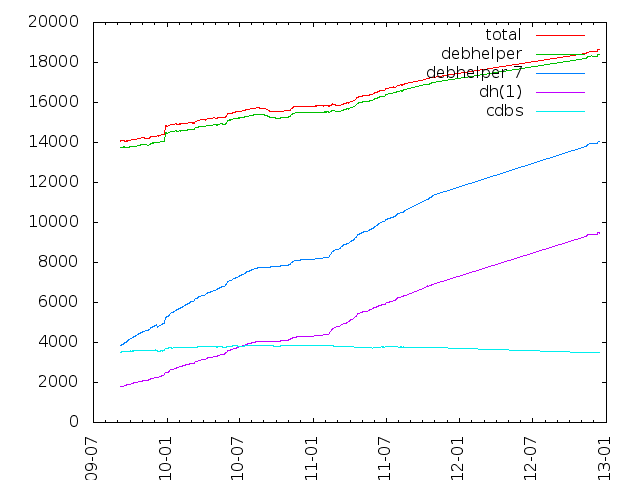
I don't know if anyone else has been tracking this recently, but a while back I got curious about the relative proportions of dh(1) and CDBS in the archive, and started running some daily analysis on the Lintian lab. Apologies for my poor graphing abilities, but the graph is here (occasionally updated): Although dh is still a bit behind CDBS, the steady upward trend is quite striking - it looks set to break 20% soon, up from under 13% in September - compared with CDBS which has been sitting within half a percentage point of 25% the whole time. Incidentally, was that an ftpmaster trying to sign his name in the graph over Christmas or something? :-)

MJ Ray: The Co-operative Development Review: a call for evidence

Cooperatives-UK Chief Executive Ed Mayo has asked Robin Murray to undertake a brief review of the potential for expansion of co-operation in the UK, and the infrastructure necessary to support it. The review is intentionally wide ranging. It covers areas for innovation in methods of co-operation and its promotion, and ways in which the movement connects, reflects and supports itself in the era of the web. The aim is to prepare a report with recommendations and a plan for discussion during Co-operative Fortnight in June. Anyone with ideas about the challenges and opportunities you feel the movement is facing, and what can be done about them please email evidence to robinmurray AT blueyonder.co.uk by Friday March 5th for a first summary of the issues on Tuesday March 9th.

1 March 2010

MJ Ray: Fairtrade Fortnight 2010: Fairtrade and IT

ftfnbutton
We re in the middle of Fairtrade Fortnight and it seems like the most advertised one yet, with Cadbury s adverts joining the push of this year s big swap theme: replace some of the stuff you d usually buy with Fairtrade alternatives. For IT workers, this is easier said than done. It s difficult enough to find more sustainably-produced products, let alone fairtrade ones. Our co-op has failed to achieve full marks on Prioritise and promote Fairtrade and other ethical and sustainable initiatives so far and I don t expect us to reach 100% any time soon. Just last Friday, Greenpeace International reported on more toxic electrical equipment, which shows that IT s environmental sustainability is far from a solved problem. Meanwhile, it doesn t seem like the fairness side is being addressed much yet. There are no fairtrade electrical product standards yet. Isn t there demand for fairer as well as greener production? Anyway, if you re looking for faitrade products this fortnight, you could try some fairtrade chocolate from the New Internationalist worker co-op. Food is further along, which is a good thing because it s pretty fundamental to life

Gregor Herrmann: RC bugs 2010/07, 2010/08

not many closed RC bugs in the last two weeks. it seems we're running out of easy-enough-for-me bugs does this mean the freeze is near? :)

28 February 2010

Ingo Juergensmann: Buildd.Net - to be shutdown soon

For over 6 years now I've been running Buildd.Net as a service for additional information about Debian autobuilder network. The reason for running Buildd.Net was simple: until then there was a web interface running on kullervo.debian.org, but generating the webpage took more and more time on that m68k box as Debian was growing in number of packages. That webpage was always a nice plus for m68k over other architectures and it was often asked for having such a page for those other archs as well. With taking over the webpage from kullervo the other archs were added as well and Buildd.Net was born.

Buildd.Net was open for other archs and flavours, as I called the different dists like unstable, non-free or even volatile or skolelinux. Buildd.Net was always buildd centric, contrary to buildd.debian.org, which is more package centric. Yes: was - as I'm shutting down Buildd.Net soon.

The reason for this is a change of interest after m68k has been removed from Debian because of the Vancouver proposal. Vancouver caused the death of m68k. Well, anyway. Without being an official Debian arch, the development on m68k came to an end. There was no progress anymore and on the other hand there were changes in the backend of the Debian autobuilder network, which made changes on Buildd.Net necessary. Requests for help in maintaining to adopt the changes were fruitless. The changes that Buildd.Net is needing are beyond my capability of programming.

And as a consequence I'm going to shutdown Buildd.Net in the near future. Not entirely, but significantly. It will return to its origins: being a m68k (and m32r) autobuilder informational page instead of trying to follow up the whole Debian autobuilder network. Just for the chance that m68k will be revived again somewhen.
Andreas Barth told me that most of the functions of Buildd.Net is available on buildd.debian.org as well, although not yet visible. I offered cooperation and help when he wants to implement Buildd.Net functionality into buildd.debian.org. I still believe that Buildd.Net is offering a worthwhile alternative view of the autobuilder network. But, as I already said, I can't maintain Buildd.Net code source any longer on my own. So I better shut the service down instead of delivering a broken service any longer, if there's noone interested in helping.

Anyway, I hope that you all enjoyed the service in the past!

Russ Allbery: Review: Coders at Work

Review: Coders at Work, by Peter Seibel
Publisher: Apress
Copyright: 2009
ISBN: 1-4302-1948-3
Format: Trade paperback
Pages: 601
Coders at Work is a collection of edited interviews by Peter Seibel (probably best known previously for his book Practical Common Lisp) of an eclectic and excellent collection of fifteen programmers. It opens with an interview with Jamie Zawinski (one of the original Netscape developers) and closes with Donald Knuth. In between, the interview subjects range in programmer generations from Fran Allen (who started at IBM in 1957) and Bernie Cosell (one of the original ARPANET developers) to Brad Fitzpatrick (LiveJournal founder and original developer). Techniques and preferences also range widely, including two people involved in JavaScript development and standardization (Brendan Eich and Douglas Crockford), a functional programming language designer and developer (Simon Peyton Jones), language designers and standardizers such as Guy Steele, and people like Dan Ingalls who have a different experimental approach to programming than the normal application development focus. All of the interviewees are asked roughly the same basic questions, but each discussion goes in different directions. Seibel does an excellent job letting the interview subjects shape the discussion. Two things immediately stood out for me about this book. First, it's huge, and that's not padding. There are just over 600 pages of content here, much of it fascinating. The discussions Seibel has are broad-ranging, covering topics from the best way to learn programming to history and anecdotes of the field. There's some discussion of technique, but primarily at the level of basic approaches and mindset. One typical question is how each programmer organizes their approach to reading code that isn't familiar with them. Each interviewee is also asked for book recommendations, for their debugging techniques, for their opinions on proving code correct, and how they design code. The participants are so different in their backgrounds and approaches that these conversations go in fifteen different directions. This is one of the most compelling and engrossing non-fiction books I've read. Second, the selection of interview subjects, while full of well-known names in the field, is not the usual suspects. While I'm interested in the opinions of people like Larry Wall and Guido van Rossum, I've already heard quite a lot about how they think about programming. That's material that Coders at Work doesn't need to cover, and it doesn't. Many of the interview subjects here are people I'd heard of only vaguely or not at all prior to this book, often because they work in an area of programming that I'm not yet personally familiar with. Those who I had heard of, such as L. Peter Deutsch, I often knew in only one context (Ghostscript in that case) and was unfamiliar with the rest of their work. This gives the book a great exploratory feel and a lot of originality. There is so much good material here that it's hard to give a capsule review. This is a book I'm highly likely to re-read, taking more detailed notes. There's entertaining snarking from Jamie Zawinski and Brendan Eich, fascinating history of the field (including in gender balance) from Fran Allen, and an intriguing interview with Joe Armstrong (creator of Erlang), who seems to have a far different attitude towards languages and libraries than the other interviewees. Every interview is full of gems, bits of insight that I now want to research or play with. A couple of examples come to mind, just to provide a feel of the sort of insights I took out of the book. In the interview with Joshua Bloch, who does a lot of work on library APIs, he mentions that empathy is one of the most important skills for designing an API. You have to be able to put yourself in the shoes of the programmer who's going to use the API and understand how it will feel to them. This came up in the context of a discussion about different types of programmers, and how programmers can be good at different things; the one who can do low-level deep optimization may not have that sense of empathy. Another example: Bernie Cosell talked about how he did debugging, and how he got a reputation for being a fantastic debugger who was able to fix just about anything. He confessed that he often reached a portion of the code that he didn't understand, that seemed too complex and tricky for what it was attempting to accomplish, and rather than trace through it and try to understand it, he just rewrote it. And after rewriting, the bug was often gone. It wasn't really debugging, but at the same time it's close to the more recent concept of refactoring. Several of the interview subjects commented on a subjective feeling of complexity and how when it gets too high that's a warning sign that code may need to be rethought and rewritten. A third example: I was fascinated by the number of interviewees who said that they used printf, assert, and eyeballs to debug rather than using any more advanced debugging tools. The former Lisp developers would often bemoan the primitiveness of tools like gdb, but many of them found that print statements and thinking hard about the code were usually all that's needed. (There was also a lot of discussion about test suites and test-driven development.) The general consensus was that concurrency problems were the hardest to debug; they made up a disproportional number of the responses to Seibel's question about the hardest bug the programmer ever had to track down. I could go on giving similar examples at great length, but apart from the specific bits of wisdom, the strongest impact this book made on me was emotional. Coders at Work is full of people who love programming and love software, and that enthusiasm, both in general and for specific tools and ideas, comes through very clearly. I found it inspiring. I realized while reading this book, and I suspect I'm not alone among programmers in this, that I largely stopped learning how to program a few years back and have been reusing skills that I already have. Reading Coders at Work gave me a strong push towards finding ways to start learning, experimenting, and trying new techniques again. It also filled me with enthusiasm for the process of programming, which immediately helped my productivity on my own coding projects. This is obviously a book whose primary target audience is practicing programmers, and while it doesn't go too far into language theory, I was relying on remembered terms and structure from my master's degree for a few of the interviews. I think it's approachable for anyone who has a working background in programming and a few languages or a CS degree, but it might be a stretch for someone new to the field. But even someone without any programming knowledge at all would get a lot out of the anecdotes and snapshots of the history of software development. Coders at Work is also full of jumping-off points for some additional research on Google or additional reading in other recommended books. I only have one complaint, which I have to mention in passing: for such a large book full of interesting ideas and book recommendations, the index is wholly inadequate. I tried looking up five or six things in it, including the source of some of the book recommendations that are collected in an appendix, and I struck out every time. It's very hard to find something again in 600 pages, and more attention paid to the index would have been greatly appreciated. But, despite that, for people within the target audience, I cannot recommend this book too highly. Not only was it full of useful information, at the level of programming above the code details that's often the hardest to talk about, but it's consistently entertaining and emotionally invigorating and inspiring. It made the rounds of tech blogs when it was first released, to nearly universal approval, and I can only echo that. If you're a practicing programmer, I don't think you'll regret spending a few weeks reading and thinking about this book. Rating: 10 out of 10

27 February 2010

Mark Brown: ASoC updates in 2.6.33

This has been another fairly quiet release for ASoC. Aside from the addition of virtual mux support to DAPM and some further preparatory work for multi-CODEC cards the majority of changes have been driver updates, including:

26 February 2010

Frans Pop: Fun with VMware

Until two years or so ago I used VMware Workstation intensively for development and testing of Debian Installer, using one of the licenses generously made available to the D-I team by VMware. It was much faster than Qemu and thus very welcome. But due to increasing problems keeping it working with new kernels on a desktop system running unstable, I switched to VirtualBox (the OSE version), which has the huge advantage of being packaged for Debian and thus automatically follows the Debian kernel packages. That advantage has disappeared somewhat as I'm currently compiling my own kernels I'm currently running 2.6.33 on a Lenny desktop. So far I've been able without too much trouble to find patches for the VirtualBox modules to keep them compatible with new upstream kernels. This week I had reason to try VMware again. The Server edition this time as that has free licenses. The Server concept, where you connect to the management system and virtual machines via a web browser, is quite nice. It means I could install it on a server and keep my laptop nice and responsive. To keep VMware separate from the rest of the system and not mix it with software installed cleanly from Debian packages, I decided to install it in /opt. And that works beautifully. There are only a few bits installed in /etc, but that's OK. I have /etc managed by etckeeper anyway [1]. More challenging was building WMware modules to match my kernel. VMware wants you to run their vmware-config.pl script every time you switch kernels and build the kernel modules on the system where it runs (which requires the kernel headers). I wanted to build the modules as part of my kernel build process, on a totally different machine. The same as I already do for VirtualBox. I save the custom modules in a tarball that has the same uname and package version as the kernel package I build and have a simple script that installs them correctly. I succeeded by hacking the Makefiles (deleting most of their content) and then integrating them in my kernel build wrapper script. The module source provided by VMware built fine with a Debian 2.6.26 kernel, but not with the 2.6.32.9 kernel on my server (of course). But luckily others had already run into the same problems and solved them, so with some searching I found the required patches (first a full updated source for 2.6.29, then patches needed for .31 and for .32). Isn't open source just wonderful? So with that the VMware server started beautifully (well, the init script needed to be told that module names have changed from *.o to *.ko), but I could not connect to it from my laptop using SSL. Connecting without SSL (using an instance of iceweasel running on the server but started remotely from my laptop using X forwarding SSH) worked fine. That turned out to be a known issue too. After applying all the suggested workarounds in my iceweasel configuration (disable TLS 1.0; set cache size to zero; explicitly disable use of proxy for the server) I can now connect reliably to the VMware Server management system. Phew. [1] I had to exclude a fair number of VMware files for etckeeper as they are updated by VMware itself and thus really belong in /var. Example are DCHP status files...

Andrew McMillan: DAViCal 0.9.8.3 - A return to stability

After a whole bunch of drastic changes, lots of bugfixes, rewriting and refactoring, I released DAViCal 0.9.8 on Christmas day last year. I didn't release it very publicly, because I knew it sucked significantly. In an increasingly fast turnaround I've subsequently released 0.9.8.1 to a somewhat wider audience while I was at the recent Calendaring and Scheduling Consortium meeting in Costa Mesa at the beginning of the month. Earlier this week I released 0.9.8.2 to the more interested of the DAViCal userbase. So finally, yesterday, I released DAViCal 0.9.8.3 to fix the few significant problems that were left with that, and this is the release that I'm telling everyone about, because I believe it should be a good stable platform to people who want to upgrade their production DAViCal servers, or who have been hanging back from using DAViCal until the platform was a little more stable.
<!--break-->
This release marks some significant departures from previous DAViCal. I've decided to walk away from some of the more ancient legacy software I tried to work with in the past (PHP4 & PostgreSQL 7.x), to move to support the most ancient-but-not-superseded legacy Linux release I know of, which is CentOS / RHEL, so DAViCal now has a minimum requirement of PHP 5.1 & PostgreSQL 8.1. The biggest changes to DAViCal are under the covers. It is server software, after all, so the largest changes often are not visible on the surface. What has changed is that the architecture for constructing responses as been refactored into a core object which is used to access any DAV resource in the system. This greatly simplifies the general coding and reduces a fair bit of code duplication which had been happening. Another long overdue change is to get rid of the old arcane & obtuse permissions model, replacing it with something which will be radically faster in installations with more than a few hundred users, as well as being more consistent, easier for people to control, and directly in alignment with the DAV ACL specification. Some of the work here was assisted by NZ Registry Services who gave me a Macbook to help with my compatibility testing. Not all of the changes are under the covers though. The new DAViCal also has a thoroughly revised administrative interface, and over the last couple of releases I've gone through the system trying to uncover all the places which were not properly localisable, too, so if you see DAViCal displaying strings in a language you didn't configure it for, it should be a fixable thing. I'd like to particularly thank Masahiro Mikami for turning around some Japanese translations very quickly which enabled me to quickly and visually see what was not properly translatable. There's still more work to do (there's always more work to do) but a fully translated DAViCal should, I hope, be quite usable by non-English speakers now. The new DAViCal also supports some rather significant extra functionality beyond the CalDAV standard, in particular we can thank Rob 'Cave' Ostensen for providing an implementation of pub/sub event change notifications. This version also supports draft 2 of the proposed WebDAV synchronisation standard - that's still under development, but we expect to track pretty close to released versions of that. Of course with all of this work there are some areas that didn't get changed. I didn't manage to finish an implementation of the scheduling extensions draft, much as I would have liked, but that is going to become very much a focus in the coming couple of months, and I'll be calling it "1.0" when things settle down after we get that done. Other things I will be working on include a ticketing system for providing targeted, controlled access to a specific collection or event, and making a start on CardDAV support for addressbook storage. DAViCal seems to be fitting a need for people, and I know there are several thousand installations around the world, even if I'm not sure where they all are. I know some people are running DAViCal on their 8-way server, where I've no doubt it gurgles along pretty happily, and that there are some people running it on their OpenWRT installation, with some tiny amount of resources - just enough for a family calendar. Traffic on the wiki has increased to several hundred thousand hits per month, perhaps three times what it was a year ago, and I hope that I can continue to provide a valuable and useful piece of infrastructure for that little calendaring corner of your organisation. What heartens me the most in this ongoing experience is the nascent community that appears to be forming around my software, with people writing 'tip sheets' and helping to answer questions on the IRC channel and mailing list. These small contributions made by many people - people whom I have never met, for the most part - are enabling me to put more time into feature development and expansion, and that's what I really love.

25 February 2010

Adnan Hodzic: DebConf11; n Banja Luka wiki

Almost all of wiki contents got updated, so please take your time to review it all, once again Heh n was more of a symbolic meaning, since in meantime we solved our bids weakest links and pretty much got it mature and at the stage we were aiming it to be. We ll still make some minor changes to it until the final decision date (in 47 hours) but this is it really Party So without further ado, let me introduce you to our n wiki Announce Since besides changing pretty much the whole wiki we have also added (important) new pages for: Banja Luka and Republika Srpska We have added a new pages to bring Banja Luka and Republika Srpska closer to every potential visitor. Full Government Support Today we have received the most important information when it comes to our bid. Today government council sitting was done, where one of the topics was full financial support in case Banja Luka is host to DebConf11. Proposition was accepted! Dance To remind you, we will get free venue building wheter it s Government Building or Banski Dvori , besides that we re getting them to cover basically all of the costs needed for the conference, and besides that we re getting 5 additional members to our local team (highly capable and educated govt. officials) which even includes city Mayor. Early tomorrow we ll get scan/fax of this memorandum from Chief of Cabinet along with the local team names which will all together be added to this very wiki page. Local Team We have almost assembled our local team/supporters team whose members were wisely and thoroughly selected. Since before anything this is Balkans Debconf, and a new breakthrough to a region that has ~55 million inhabitants, we have made connections all over Balkans, especially from Serbia and Belgrade. This page might might suffer the biggest changes in next few hours, especially since we still need to add people on behalf of ETF (Faculty of Electrical Engineering) and Goverment itself. Accommodation
We have made a separate page for accommodation as well, since we have gathered a whole bunch of new information that just required us to make a new page. Internet We have made a major breakthrough in Network connectivity and technicalities as well! SARNET Academic and Research Network of Republic of Srpska has offered us with 1GB link free as in beer! Please see their Letter of Support/Memorandum, besides that we have Mtel and BHTelecom as our backup options. Besides all that, as I previously noted we made changes throughout wiki page, we have added new contents to fun and free time, as well as to the arrival. Tomorrow with last pages to our local team + govt. support memorandum being added to our wiki we are ready for the DebConf11 final decision! Remainder, decision is being made in 47 hours on #debconf-team on irc.debian.org; please come and support us for being host to DebConf11! Fingers Crossed Bosnia and Herzegovina FTW! Victory http://wiki.debconf.org/wiki/DebConf11/BanjaLuka

Jon Dowland: iPhone Doom

Id Software have released a port of Doom for the iPhone. What makes this exciting for me is the lineage of this code. the iPhone port is derived from prboom. Peeking around in the source code, there's some of my code in there (p_checksum.[ch]) as well as some code I borrowed from dpkg (md5.[ch], thanks to Colin Plumb and Ian Jackson). This stuff is unlikely to actually be run on the iPhone, mind (although I think I have some patches against p_enemy.c which will). John Carmack has some interesting words about developing the app.

24 February 2010

Michal &#268;iha&#345;: phpMyAdmin documentation translations

Activity of our current Chinese translator pushed me to do some work on localized documentation for phpMyAdmin. The biggest change is that I lowered ratio for generating translated documents from 70% to 15%. I know 15% is quite low threshold, but I think showing partially translated documents is better than nothing. Especially for those like Chinese where the translation does cover installation instructions but not rest of document. Also now header of each translated document points users where to improve the translation, so hopefully we will get even more contributors. Anyway if you're interested in it, just go to our translation server.

23 February 2010

Russell Coker: Divisive Behavior

Past Sins Sam Varghese wrote an article about Matthew Garrett s LCA talk The Linux community: what is it and how to be a part of it [1]. In page 2 Sam quotes Martin Krafft as asking about how Matthew s behavior had changed between 2004 and the present, Sam cites some references for Matthew s actions in 2005 to demonstrate. I think that this raises the issue of how far back it is reasonable to go in search of evidence of past behavior, something that I think is far more important than the specific details of what Matthew said on mailing lists many years ago and whether he now regrets such email. If someone did something that you consider to be wrong yesterday and did the same thing five years ago you might consider it to be evidence of a pattern of behavior. If someone s statements today don t match their actions yesterday then you should consider it to be evidence of hypocrisy. But if someone did something five years ago which doesn t match their current statements then in many situations it seems more reasonable to consider it as evidence that they have changed their mind. Then of course there is the significance of what was done. Flaming some people excessively on some mailing lists is something that can be easily forgiven and forgotten if Google doesn t keep bringing it up. But as a counter-example I don t think that Hans Reiser will be welcome in any part of the Linux community when he gets out of jail. For the development of the Linux community (and society in general) I think it s best to not tie people to their past minor mistakes. While it is nice when someone apologises for their past actions, the practical benefits of someone just quietly improving their behavior are almost identical. A particular corner case in this regard is the actions of young people, anyone who was born after about 1980 will have had great access to electronic media for their entire life and will have left a trail. Most people do a variety of silly things when they were young, the older members of the Linux community were fortunate enough not to have electronic records remaining where Google could find them. Back to Matthew, I think that if he is to be criticised about such things then evidence that is much more recent than 2005 needs to be used. Cultural Differences Sam quotes Matthew as claiming that the Linux community was largely a Western, English-speaking one, those who participated in it necessarily had to adapt to the norms of this group . I don t believe that there is a single Linux community. There are a number of different communities that are formed around free software, which have significant amounts of overlap. I don t believe that there s any reason why a Chinese or Indian Linux mailing list should conform to the same standards as those of an American list. But there will be a trend towards meme propagation through people who are associated with the Linux communities in multiple countries every time you meet Linux people in another country you are helping to reduce the cultural differences in the Linux community. Someone from China or India who joins a LUG in Australia will have to adapt to some of the norms of Australian behavior in the same way as an Australian who migrates to China or India would have to adapt to some local norms. On page 4 of the discussion Matthew disagrees with Sam s interpretation [2], maybe Matthew s opinions on this matter are closer to mine than the way Sam describes them. Is Division Inherently Bad? I believe that the word divisive is overused. The only way to avoid division is to have everyone agree with the majority, but sometimes the minority will be right. Note that I am using the word minority to refer to any group of people who happen to disagree with the majority, among other things that includes people who vote for a political party that isn t one of the two biggest ones. An entirely separate issue is that of the treatment of minority groups , one of the most divisive events in history was the US civil war it s good that slavery is outlawed but unfortunate that a war was required to gain that result. On page 4 of the discussion Matthew says to Sam Your writing is influenced by members of the Linux community, and in turn it influences the Linux community. The tone of it is entirely relevant to the behavioural standards of the community [2]. If a community can be easily divided then the real problem probably isn t the person who triggered a particular division. Also there is the issue that even if you could get a general agreement that certain issues shouldn t be discussed in certain ways then with the wide range of cultural attitudes and ages of participants you have to expect someone to raise the issue you don t want raised. Of course it s impossible to objectively determine whether a division is productive or not, so it doesn t seem at all viable to have any expectations regarding outsiders not being divisive. Sometimes you just have to deal with the fact that the Internet contains people who disagree with you. It seems to me that the most divisive issues we face involve people who mostly agree on contentious issues. If someone entirely disagrees with you then it s easy to ignore them (if you even have a conversation with them), but if they are someone that you communicate with and they are almost right in your opinion then there s the potential for a big argument. Probably the best way to minimise division in the community is to have the first people who get involved in a dispute take a Rogerian approach [3]. Failing that a good approach is to respond by writing an essay. When an issue is made popular by services such as Twitter that give little explanation then everyone rushes to the barricades. It seems to me that the unreliability of some blogging platforms is part of the cause of the problem in this regard. I ve just given up on writing comments on Blogger, I m not going to write a good comment only to have it eaten by blogger. There are lots of blogs that have problems which discourage the population from writing anything other than a one-sentence response. The Good that can come from Disputes On page 5 of the discussion there is a comment from Anirudh the Indian student who was criticised by Sam (which ended up inspiring part of Matthew s talk and leading to more disputes) [4]. Here is the start: I am the person who wrote the ill thought-out post that drew criticism eight months ago. There has been some discussion about that, so I wish to say something.

I am very grateful to Sam Varghese. I say this with utmost sincerity. Read the rest, it s educational. I m sure that there are others who have had similar learning experiences but who don t want to write about them. I m sure that there have been many disputes which would appear to the casual observer to have resulted in no good at all, but which would actually have resulted in people learning things and amending their behavior. The issue of Age Car rental companies generally don t do business with men who are less than 25 years old. Life insurance policies don t offer reasonable rates to males between the ages of about 16 and 25. This is because the insurance companies have good statistical data on the results of the typical actions of people at various ages and know that young men tend to be at a high risk of earning a Darwin Award. The same combination of hormones and life experience that makes a young man a danger on the road will also tend to make him get involved in flame-wars on the net. If we could figure out how to influence teenagers into being less anti-social then it would be a great achievement. The current young people will become older and more sensible soon enough but will be replaced by a larger number of young people who will do the same things. As things stand I don t expect the next cohort of young people to learn from Anirudh.

17 February 2010

Stefano Zacchiroli: RC bugs of the week - issue 21

RCBW - #21 I've accumulated one more day of delay, but here is a full RCBW issue. Still, I've a nice good excuse for the extra delay: I've changed house in Paris, the new one is very small (a chambre de bonne), but also very comfortable. Without any further ado, here are this week's squashes: And here are the usual highlights:

Michal &#268;iha&#345;: phpMyAdmin demo server provides MariaDB

In addition to MySQL, the phpMyAdmin demo server now provides also MariaDB. It is based on OurDelta packages. So you can now choose either MariaDB or MySQL on login screen and play with either of database engines.

Masayuki Hatta: Freenet for Debian

The recent development of the situation in China or Iran reminds me of the importance AND fragility of the freedom of speech on the Net. As the influence by the Net on the general public grows, attempts by governments to control and tame the Net will be aggravated, in a more sophisticated, crowd-pleasing way (for example, by claiming a need for Internet Driver's Licenses). How can we deal with this? Freenet can be a key to solve this problem. After almost 10 years of continuous development, it seems that it finally became an usable product(I don't say it's perfect -- there are still a lot of things to be done, especially around its UI). Freenet has its own dark side and I don't expect that it will become the standard way of the communication over the Net, but we always need the last resort to enjoy our everyday life. Unfortunately, most of Freenet-related information on the Net, especially about the installation method on GNU/Linux, are severely outdated. Freenet is a Free Software(GPL'd), and Debian did have a .deb package for Freenet long long ago, but it's basically gone and defunct. Since the pace of current development is quite fast and sometimes the backward compatibility is broken, it's not really a good idea to ITP and upload Freenet to the main Debian archive for now. Thus, I cooked up up-to-date .deb packages of the modern Freenet and publish them by myself on people.debian.org. I tried to follow the Debian packaging convention as much as possible, so at least they can be installed & uninstalled cleanly ;-) Also, Build-Deps are carefully set, so you may rebuild it without much hassle if you need. Add the following to your /etc/apt/sources.list:
deb http://people.debian.org/~mhatta/debian/freenet ./
deb-src http://people.debian.org/~mhatta/debian/freenet ./
Then run "apt-get update" and install "fred" package. This is basically all you need(you might also want jSite or FMS). Then take a look at /usr/share/doc/fred/README.Debian. You might need to copy seednodes.fref into /var/lib/fred if you want to use Freenet's Opennet mode for the first time. After that, access http://localhost:8888 and follow the instructions. Recommended readings on the modern Freenet: Enjoy.

Tag this post with del.icio.us!

Michal &#268;iha&#345;: phpMyAdmin slowly goes to Git

As can be already visible from our SourceForge.net devel page or from repository listing, there are already some Git repositories for phpMyAdmin. They are not yet being used for development, they are there just for developers to get used to new workflow. The only exception are scripts and localized_docs repositories, which were made master as of today and will not receive updates from SVN anymore. Anyway the repository should have same content as SVN (as of yesterday) so if you find any problems with that please let me know so that I can fix migration magic.

Next.

Previous.