Search Results: "he"

3 February 2022

Sven Hoexter: Suntime Calculation with Lua and the Great Gift of Open Source

tl;dr I ported a part of the python-suntime library to Lua to use it on OpenWRT and RutOS powered devices. suntime.lua There are those unremarkable things which let you pause for a moment, and realize what a great gift of our time open source software and open knowledge is. At some point in time someone figured out how to calculate the sunrise and sunset time on the current date for your location. Someone else wrote that up and probably again a different person published it on the internet. The Internet Archive preserved a copy of it so I can still link to it. Someone took this algorithm and published a code sample on StackOverflow, which was later on used by the SatAgro guys to create the python-suntime library. Now I could come along, copy the core function of this library, convert it within a few hours - mostly spent learning a bit of Lua, to a working script fulfilling my needs.

2 February 2022

Norbert Preining: Mechanical keyboards: Pulsar PCMK

Mechanical keyboards the big fat rabbit hole you can disappear I started using mechanical keyboards about a year ago, with a Drevo Blademaster Pro (review coming up), but recently got a Pulsar PCML TKL keyboard in a build-it-yourself order.
The Drevo Blademaster Pro I am using is great, but doesn t allow changing switches at all. So I was contemplating getting a mechanical keyboard that allows for arbitrary switches. My biggest problem here is that I am used to the Japanese JIS layout which gives you a lot more keys which come in extremely handy in Emacs or when typing various languages. Fortunately, APlusX a Korean company manufactures a lot of gear under the Pulsar name, and supports also JIS layout. In addition, they have a great web site to customize your keyboard (layout, color, switch, keycaps) and send you a build-yourself kit for a very reasonable prize at least in Japan. So I got my first keyboard to put together myself . how was I nervous getting all the stuff out! Despite being a DIY keyboard, it is very easy (and they offer also pre-assembly options, too!). You don t need to solder the PCB or similar, the steps are more or less: (i) put in the switches, and (ii) add the key caps. I started with the first, putting the switches (I went with Kailh Box Brown tactile ones) into the PCB board
Well, that was easy at least I thought until I started testing the keys and realized that about 20 of them didn t work!! Pulling out the switches again I saw that I twisted a pin on each of them. One by one I straightened the pins and reinserted them very carefully. Lesson learned! At the end all the switches were on the board and reacted to key presses. Next step was adding the key caps. Again, those are not really special key caps, but simply style and sufficient for me. Of course I messed up 0 and O (which have different heights) and at first were confused about different arrow options etc, but since plugging in and pulling out key caps is very easy, at the end all the caps were in place.
With the final keyboard assembled (see top photo), I connected it to my Linux system and started typing around. And first of all, the typing experience was nice. The Kailh Box Brown switches have a bit stronger actuation point then the switches I have in the Blademaster Pro (which are Cherry MX Brown ones), but above all the sound is a bit deeper and thumbier , which really gives a nice feeling. The keyboard also allows changing the RGB lightening via the keyboard (color, pattern, speed, brightness etc). There is a configuration software for macros etc, unfortunately it only works on Windows (and I couldn t get it to work with Wine, either), a sour point One more negative point is that the LED backlight doesn t have a timeout, that is, it stays on all the time. The Drevo I have turns off after a configured number of seconds, and turns completely black something I really like and miss on the Pulsar. Another difference to the Blademaster is connectivity: While the Blademaster offers cable, bluetooth, and wireless (with dongle), the Pulsar only offers cable (USB-C). Not a real deal-breaker for me, since I use it at my desktop and really don t need wireless/bluetooth capabilities, but still. I have been using the Pulsar now for a few days without even touching the Drevo (besides comparing typing sounds and actuation points), and really like the Pulsar. I think it is hard to get a fully configurable and changeable mechanical keyboard for a similar prize. There is one last thing that I really really miss an ergonomic mechanical keyboard. Of course there are some, like the ErgoDox EZ or the Kinesis Advantage 2, but they don t offer JIS layout (and are very expensive). Then there is the Truly Ergonomic CLEAVE keyboard, which is really great, but quite expensive. I guess I have to dive down the rabbit hole even more and make my own PCB and ergonomic keyboard!

Ben Hutchings: CI for the Debian kernel team

Starting just after Christmas, I have been working on CI for all the kernel team's packages on Salsa. The salsa-ci-team has done great work on producing a common pipeline that is usable for most packages with minimal configuration. However, for some packages a lot more work was required. Linux I started with the most important package, linux itself. This now has about 1.1 GiB of source spread over 76,000 source files. That turns out to be a problem for the pipeline which currently puts unpacked source in artifacts - it is far beyond the limits of what Salsa allows. I worked around this by using a modified version of the extract-source and build jobs that use packed source package as the artifacts. The output of the build job is compatible with the common test jobs. The linux package also takes a lot of resources to build; around 80 minutes on the fastest PC I have at home (if ccache is not primed). Salsa's shared CI runners seem to be about 10 times slower than that, so it is completely unfeasible to even one full build in CI. Instead I defined a new build profile that includes only the smallest kernel configuration, without debug info, and the user-space packages. This still takes over an hour with the Salsa CI runners, but I don't think we can improve this much without losing a lot of code coverage. Our Git repository for linux also does not contain the upstream source, so the extract-source job has to fetch that. The common extract-source job uses origtargz to do that, and in case the orig tarball is not already in the archive this will run uscan. That led me to a new problem: our debian/watch file could only find tarballs linked from the front of www.kernel.org, and we're sometimes working with different upstream versions. There is actually no single page listing all tarball releases of Linux, and tarballs for release candidates are dynamically generated by CGit and unsigned. So I changed debian/watch to fetch from Git, which is what we were already doing with our own genorig.py script. Unfortunately, running uscan against a Git upstream, with some files excluded (as there are still a few upstream files we consider non-free), is about twice as slow as it could be. Since I had to modify the extract-source job anyway, I've continued using genorig.py there. A full build log for linux is over 200 MiB, and even with the reduced build profile it would be much longer than Salsa's limit of 2 4 MiB. I therefore opted to use the 'terse' build option (which translates to V=0), but made the builds of user-space tools ignore this option so that blhc could still do its work. (The kernel itself cannot use the same hardening options, so blhc is not useful there.) Finally, with the CI pipeline running, blhc and lintian showed a lot of problems that we hadn't been attending to. I've fixed all the blhc errors (with some careful suppressions), all the lintian errors, and the most straightforward lintian warnings. firmware-nonfree The firmware-nonfree package also has huge "source" (about 560 MB) and needed some of the same modifications, but is quick to build so did not require a special build profile. Running lintian over firmware-nonfree reminded me that I needed to sort out the unsuual and inconistent handling of machine-readable copyright information in this source package. I had already done most of that work on a private branch in 2020, so this is mostly ready but I still need to resolve a licensing issue with AppStream metadata. Other packages For kernel-handbook, there was already a trivial "CI" pipeline used to push static pages to the web site. I've replaced this with the common pipeline plus a job that will push the pages from each build on the master branch. For everything else, it was straightforward to enable the common pipeline with a little bit of configuration.

1 February 2022

Ben Hutchings: Debian LTS work, January 2022

In January I was assigned 24 hours of work by Freexian's Debian LTS initiative. I worked 16 hours, and will carry over the remaining time to February. I sent various backported security fixes for Linux to the stable mailing list, and they have been included in subsequent stable releases. I rebased the linux package on the latest 4.9-stable release, but did not yet upload it.

Jonathan Dowland: Amateur archiving activities, January 2022

I have a backlog of digital stuff to upload to archive.org that I'm finally starting to flush. I'd had some difficulties in getting uploads to work until I tried using the excellent ia CLI tool, which is packaged in Debian. In January 2022 I uploaded: two sets of multitracks from the 1981 album My Life in the Bush of Ghosts by Brian Eno and David Byrne, "A Secret Life" and "Help Me Somebody"; 28 cover disks from late 80s/early 90s issues of PC Plus, Pc Today, PC Zone and Personal Computing; and a LEGO Land Billund brochure from 1993. I try to keep a record of my amateur archiving work (and related TODO items) at archiving. In January I also discovered that, late last year, the nine inch nails live archive project have had their download links forcibly removed by their ISP. I've been watching this project for a while because I thought it was "at risk". Years ago the project's creator, Ryan, created a series of torrents covering all the material at the time, although there had been a number of changes since the last one. However, this issue with his ISP spurred him on to create up-to-date torrents. It seems to me that archive.org would be a good place for this material, but there are two problems: the most natural collection would be the Live Music Archive, but it has a rule that musicians must have given explicit permission for live recordings to be deposited there (inherited from the earlier etree.org days) and in this case no such permission exists. The second problem is that ninlive's owner/creator, Ryan, has always resisted the idea. For now the best I can think to do is simply to continue to seed the torrent.

Russell Coker: First Flounder Meeting

Based on a comment from my previous post [1] I have named the new FOSS group for Australia and NZ Flounder. Here is the link to the agenda for the first meeting [2]. I am currently using a DNS name in my own domain for the group, but in the near future I ll move it to somewhere else under a zone I don t control. My aim is not to have personal control but to create an organisation for the community. But at the moment I m just doing things in the fastest way possible, I will setup HTTP redirects when I get a better DNS name.

Junichi Uekawa: Already February.

Already February. Surprising. I've been practicing Rust every day and I am getting more comfortable with Rust the language now.

Dirk Eddelbuettel: #35: apt install rstudio quarto

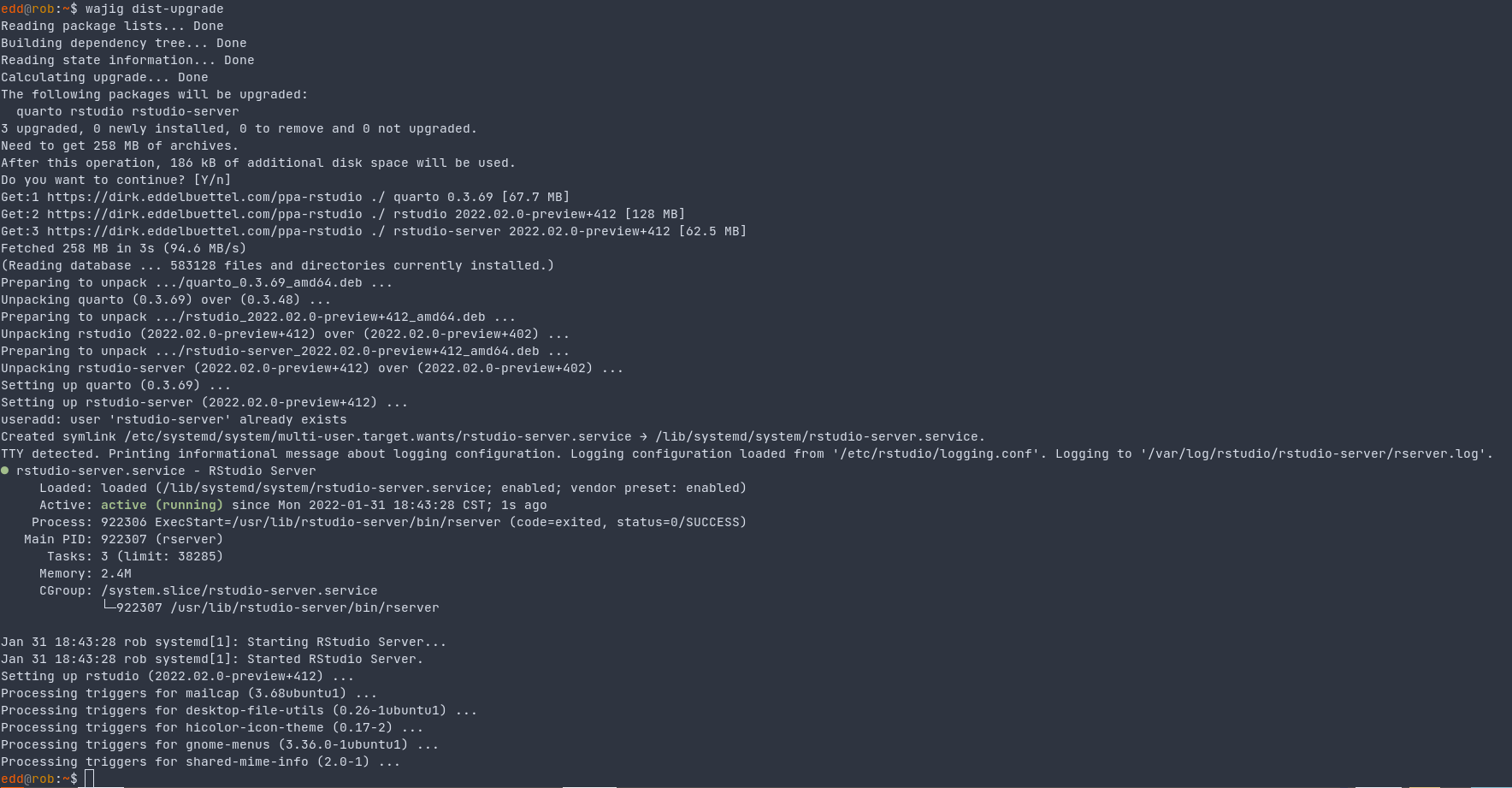
Welcome to the 35th post in the ravishingly rabiant R recommendations, or R4. Today s post is about apt and R tools. Many of us have been running RStudio off our local machines for as long as binaries have been provided. Which is by now probably a bit over a decade. Time flies. And as nice it is to have matching binaries, in my case in the .deb format used on Debian or Ubuntu, it is wee bit a painful to manually download a file and then install it. Twice the pain if you are lucky enough to be on a system where you can also run RStudio Server. And now three times as painful as you may need a matching quarto-cli binary for the nice quarto service. So wouldn t it be nice to have an apt-getable repo? And to autoMAGICall get updated versions when they are available? Oh yes. And I had been bugging JJ from day one. And JJ would almost listen intendly, nod briefly and firmly, and issue an assured we will look into it. Well, they are still looking Luckily, years ago, Carl wrote a helper script for our use in Rocker. I promptly adopted these and kept them in the littler examples directory as a pair of script getRStudioDesktop.r and getRStudioServer.r, later complemented by getQuartoCli.r. And I used these for years, somewhere between weekly and monthly. But it is still very manual: three script calls, one sudo dpkg -i call. And as our good friends at RStudio don t seem to be coming forward with a repo, I created one at GitHub thinking I could serve the files via GitHub Pages. Which of course I cannot as the .deb file for rstudio is well above the 100mb limit. So that seemed to be a bit of a setback. But after a bit of pondering, and recognizing that I am now in the fortunate position to have symmetric broadband access at home, I reckoned that until the bandwidth use gets excessive I will serve this as truly personal package archive (or tPPA) from here. Note that this is calibrated for my use so Ubuntu amd64 it is. Nothing else. And that it installs dailies . Which may cause issues for some people. You have warned. Reading tis paragraphs signifies agreement with the terms and limitations. Just kidding. A quick screenshot from an update earlier is here. Note that I use the fabulous wajig wrapper by Graham Williams here as my frontend to apt, dpkg and more as I have for even longer than I have use RStudio. Its use is tangential here; sudo apt upgrade would have done the same (and is essentially being called). And it demonstrates the main benefit: we are now automated as the cron scheduler launches an update of the PPA at which ever frequency you chose (currently twice a week for me) and after that it becomes part of the normal apt updates we do anyway (and which I do about daily). So that s main gist: automated apt upgrades of rstudio, rstudio-server, and quarto-cli. And you can find the underlying code in the GitHub repo ppa-rstudio which I put together a good week ago. I am currently updating the tPPA twice a week from crontab and have had two full upgrades already. And who knows, maybe with a bid of prodding RStudio may come around. One can always hope. If you like this or other open-source work I do, you can sponsor me at GitHub.

This post by Dirk Eddelbuettel originated on his Thinking inside the box blog. Please report excessive re-aggregation in third-party for-profit settings.

Paul Wise: FLOSS Activities January 2022

Focus This month I didn't have any particular focus. I just worked on issues in my info bubble.

Changes

Issues

Review

Administration
  • Debian BTS: unarchive/reopen/triage bugs for reintroduced packages
  • Debian servers: ping folks about mail forwarding issues
  • Debian wiki: unblock IP addresses, approve accounts

Communication
  • Respond to queries from Debian users and contributors on the mailing lists and IRC

Sponsors The oci-cli, oci-python-sdk, circuitbreaker, autoconf-archive, libpst, purple-discord, sptag work was sponsored. All other work was done on a volunteer basis.

31 January 2022

Ingo Juergensmann: XMPP and Mail Clients

I really like XMPP, but I m a little unhappy about the current general situation of XMPP. I think XMPP could do better if there were some benefits of having an XMPP address. For me one of those benefits is to have the option to have just one address I need to communicate to others. If everything is in place and well-configured, a user can be reached by mail, XMPP and SIP (voice/video calls) by just one address. To address this I would like to see XMPP support in mail clients (MUAs). So when you reply to a mail or write a new one, the client will do a lookup in your addressbook if the address has an XMPP field associated with it and (if not) do a DNS lookup for _xmpp-server._tcp.example.com (or the matching domain part of recipients address). If there is an XMPP address listed in mail header, that JID will be used. When the lookup is successful and an xmpp: protocol handler is configured in the system, the MUA offers an option to begin a chat with the recipient and/or displays the presence status of the recipients (depending on available web-presence or presence subscription). Basically a good candidate could be Thunderbird, because it already has XMPP support built in, albeit not a good implementation and lacking many modern features like OMEMO. But for basic functions (like presence status and such) it should be sufficient for a start. Other candidates could be Evolution, Kmail (as KDE MUA and Kaidan as a native KDE XMPP client) or even Apple Mail.app, because Apples addressbook supports XMPP fields for each contact. Basically the same could be done for SIP contacts: if a SIP SRV record for that domain does exist, the MUA could offer an option to call the recipient. I would be willing to give some money via Bountysource or similar platforms. Is anyone aware of such a project or willing to write some addons? Maybe within the GSoC? PS: there is RFC7259 about Jabber/XMPP JID in mail headers and there is also a page in the XMPP.org wiki.

Russ Allbery: Review: The Story of the Treasure Seekers

Review: The Story of the Treasure Seekers, by E. Nesbit
Publisher: Amazon
Copyright: 1899
Printing: May 2012
ASIN: B0082ZBXSI
Format: Kindle
Pages: 136
The Story of the Treasure Seekers was originally published in 1899 and is no longer covered by copyright. I read the free Amazon Kindle version because it was convenient. My guess is that Amazon is republishing the Project Gutenberg version, but they only credit "a community of volunteers." There are six Bastable children: Dora, Oswald, Dicky, the twins Alice and Noel, and Horace Octavius (H.O.), the youngest. Their mother is dead and the family's finances have suffered in the wake of her death (or, as the first-person narrator puts it, "the fortunes of the ancient House of Bastable were really fallen"), which means that their father works long hours and is very absorbed with his business. That leaves the six kids largely to fend for themselves, since they can't afford school. Clearly the solution is to find treasure. This is a fix-up novel constructed from short stories that were originally published in various periodicals, reordered and occasionally rewritten for the collected publication. To be honest, calling it a fix-up novel is generous; there are some references to previous events, but the first fourteen chapters can mostly stand alone. The last two chapters are closely related and provide an ending. More on that in a moment. What grabs the reader's attention from the first paragraph is the writing style:
This is the story of the different ways we looked for treasure, and I think when you have read it you will see that we were not lazy about the looking. There are some things I must tell before I begin to tell about the treasure-seeking, because I have read books myself, and I know how beastly it is when a story begins, "Alas!" said Hildegarde with a deep sigh, "we must look our last on this ancestral home" and then some one else says something and you don't know for pages and pages where the home is, or who Hildegarde is, or anything about it.
The first-person narrator of The Story of the Treasure Seekers is one of the six kids.
It is one of us that tells this story but I shall not tell you which: only at the very end perhaps I will.
The narrator then goes on to elaborately praise one of the kids, occasionally accidentally uses "I" instead of their name, and then remembers and tries to hide who is telling the story again. It's beautifully done and had me snickering throughout the book. It's not much of a mystery (you will figure out who is telling the story very quickly), but Nesbit captures the writing style of a kid astonishingly well without making the story poorly written. Descriptions of events have a headlong style that captures a child's sense of adventure and heedless immortality mixed with quiet observations that remind the reader that kids don't miss as much as people think they do. I think the most skillful part of this book is the way Nesbit captures a kid's disregard of literary convention. The narrator in a book written by an adult tends to fit into a standard choice of story-telling style and follow it consistently. Even first-person narrators who break some of those rules feel like intentionally constructed characters. The Story of the Treasure Seekers is instead half "kid telling a story" and half "kid trying to emulate the way stories are told in books" and tends to veer wildly between the two when the narrator gets excited, as if they're vaguely aware of the conventions they're supposed to be following but are murky on the specifics. It feels exactly like the sort of book a smart and well-read kid would write (with extensive help from an editor). The other thing that Nesbit handles exceptionally well is the dynamic between the six kids. This is a collection of fairly short stories, so there isn't a lot of room for characterization. The kids are mostly sketched out with one or two memorable quirks. But Nesbit puts a lot of effort into the dynamics that arise between the children in a tight-knit family, properly making the group of kids as a whole and in various combinations a sort of character in their own right. Never for a moment does either the reader or the kids forget that they have siblings. Most adventures involve some process of sorting out who is going to come along and who is going to do other things, and there's a constant but unobtrusive background rhythm of bickering, making up, supporting each other, being frustrated by each other, and getting exasperated at each other's quirks. It's one of the better-written sibling dynamics that I've read. I somehow managed to miss Nesbit entirely as a kid, probably because she didn't write long series and child me was strongly biased towards books that were part of long series. (One book was at most a pleasant few hours; there needed to be a whole series attached to get any reasonable amount of reading out of the world.) This was nonetheless a fun bit of nostalgia because it was so much like the books I did read: kids finding adventures and making things up, getting into various trouble but getting out of it by being honest and kind, and only occasional and spotty adult supervision. Reading as an adult, I can see the touches of melancholy of loss that Nesbit embeds into this quest for riches, but part of the appeal of the stories is that the kids determinedly refuse to talk about it except as a problem to be solved. Nesbit was a rather famous progressive, but this is still a book of its time, which means there's one instance of the n-word and the kids have grown up playing the very racist version of cowboys and indians. The narrator also does a lot of stereotyping of boys and girls, although Nesbit undermines that a bit by making Alice a tomboy. I found all of this easier to ignore because the story is narrated by one of the kids who doesn't know any better, but your mileage may vary. I am always entertained by how anyone worth writing about in a British children's novel of this era has servants. You know the Bastables have fallen upon hard times because they only have one servant. The kids don't have much respect for Eliza, which I found a bit off-putting, and I wondered what this world looks like from her perspective. She clearly did a lot of the work of raising these motherless kids, but the kids view her as the hired help or an obstacle to be avoided, and there's not a lot of gratitude present. As the stories unfold, it becomes more and more clear that there's a quiet conspiracy of surrounding adults to watch out for these kids, which the kids never notice. This says good things about society, but it does undermine the adventures a little, and by the end of the book the sameness of the stories was wearing a bit thin. The high point of the book is probably chapter eight, in which the kids make their own newspaper, the entirety of which is reproduced in the book and is a note-perfect recreation of what an enterprising group of kids would come up with. In the last two stories, Nesbit tacks on an ending that was probably obligatory, but which I thought undermined some of the emotional subtext of the rest of the book. I'm not sure how else one could have put an ending on this book, but the ending she chose emphasized the degree to which the adventures really were just play, and the kids are rewarded in these stories for their ethics and their circumstances rather than for anything they concretely do. It's a bit unsatisfying. This is mostly a nostalgia read, but I'm glad I read it. If this book was not part of your childhood, it's worth reading if only for how well Nesbit captures a child's narrative voice. Rating: 7 out of 10

30 January 2022

Russell Coker: Links Jan 2022

Washington Post has an interesting article on how gender neutral language is developing in different countries [1]. pimaker has an interesting blog post about how they wrote a RISCV CPU emulator to boot a Linux kernel in a pixel shader in the VR Chat platform [2]. ZD has an interesting article about the new Solo Bumblebee platform for writing EBPF programs to run inside the Linux kernel [3]. EBPF is an interesting platform and it s good to have new tools to help people develop for it. Big Think has an interesting article about augmented reality suggesting that it could be worse than social media for driving disputes [4]. Some people would want tags of racial status on all people they see. Vice has an insightful article making the case for 8 hours of work per week [5]. The Guardian has an insightful article about how our attention is being stolen by modern technology [6]. Interesting article about the Ilobleed rootkit that targets the HP ILO server management system [7], it s apparently designed for persistent attacks as it bypasses the firmware upgrade process and updates only the version number so anyone who thinks that a firmware update will fix it is horribly mislead. Nick Bostrom wrote an insightful and disturbing article for Aeon titles None of Our Technologies has Managed to Destroy Humanity Yet [8] about the existential risk of new technologies and how they might be mitigated, much of which involves authoritarian governments unlike any we have seen before. As a counterpoint the novel A Deepness in the Sky claims that universal surveillance would be as damaging to the future of a society as planet-buster bombs. Euronews has an informative article about eco-fascism [9]. The idea that the solution to ecological problems is to have less people in the world and particularly less non-white people is a gateway from green politics to fascism. The developer of the colors and faker npm libraries (for NodeJS) recently uploaded corrupted versions of those libraries as a protest against companies that use them without paying him [10]. This is the wrong way to approach the issue, but it does demonstrate a serious problem with systems like NPM that allow automatic updates. It gives a better result to just use software packaged by a distribution which has QA checks applied including on security updates. VentureBeat has an interesting article on the way that AI is taking over jobs [11]. Lots of white collar jobs can be replaced by machine learning systems, we need to plan for the ways this will change the economy. The Atlantic has an interesting article about tapeworms that infect some ants [12]. The tapeworms make the ants live longer and produce pheromones to make the other ants serve them. This increases the chance that the ants will be eaten by birds which is the next stage in the tapeworm lifecycle.

29 January 2022

Abiola Ajadi: Debci- An introduction for beginners!

Hello again! Been a minute! for this blog i will continue from my previous article where i explained Debci you can read more about it here. In my previous article I mentioned Debci stands for Debian Continous Integration and it exist to make sure packages work currently after an update by testing all of the packages that have tests written in them to make sure it works and nothing is broken. For my internship, I am working on improving the user experience through the UI of the debci site making it easier to use.

Debci consist of the following major terms:
  • Suite
  • Architecture
  • Packages
  • Trigger

How it works together There are three releases in the active maintenance which are Unstable, Testing, and stable(these are known as the suite). What do they mean? Unstable: This is where active development occurs and packages are initially uploaded. This distribution is always called sid. Testing: After packages undergone some degree of testing in unstable, they are installed into the testing directory. This directory contains packages that have not yet been accepted into the stable release but are on their way there. Stable: The stable distribution includes Debian s most recent officially released distribution. The current stable release which is Debian 11 is codenamed Bullseye. Also we have the oldstable which is the previous stable release. The Debian 10 is now old stable which was codenamed Buster. Architectures: These are known as the CPUs achitecture and there are various ports like amd64, arm64, i386 et.c. An scenerio for example is if a user wants to test a package such as acorn in Testing on arm64 along with a package X from Unstable this would be a pin-package (Pin packages are packages that need to be obtained from a different suite than the main suite that selected.), which means the package the user wants to test with the initial Package selected.Finally, trigger can be described as the name of the test job which is optional. This test is done to check if those packages in unstable can be migrated to Testing. This is a break down of Debci and I hope you enjoyed learning about what my internship entails. Till next time! references: Debian releases. Ports

Sylvestre Ledru: An update on rust/coreutils

TLDR: we are making progress on the Rust implementation of the GNU coreutils. Well, it is an understatement to say my previous blog post interested many people. Many articles, blog posts and some podcasts talked about it! As we pushed coreutils 0.0.12 a few days ago and getting closer to the 10 000 stars on github, it is now time to give an update! This has brought a lot of new contributors to this project. Instead of 30 to 60 patches per month, we jumped to 400 to 472 patches every month. Similarly, we saw an increase in the number of contributors (20 to 50 per month from 3 to 8). Two new maintainers (Michael Debertol & Terts Diepraam) stepped in and have been doing a much better job than myself as reviewers now! As a silly metric, according to github, we had 5 561 clones of the repository over the last 2 weeks! The new contributors focused on: Closing the gap with GNU As far as I know, we are only missing stty (change and print terminal line settings) as a program. Thanks to some heroes, basenc, pr, chcon and runcon have been implemented. For example, for the two last programs, Koutheir Attouchi wrote new crates to manage SELinux properly. This crate has been used for some other utilities like cp, ls or id. Leveraging the GNU testsuite to test this implementation Because the GNU testsuite is excellent, we now have a proper CI using it to run the tests. It is pretty long on the Github action CI (almost two hours to run it) but it is an amazing improvement to the way we work. It was a joint work from a bunch of folks (James Robson, Roy Ivy III, etc). To achieve this, we also made it easier to run the GNU testsuite locally with the Rust implementation but also to ignore some tests or adjust some error messages (see build-gnu.sh and run-gnu-test.sh). Following a suggestion of Brian G, a colleague at Mozilla (he did the same for some Firefox major change), we are now collecting the history of fail/pass/error into a separate repository and generating a daily graph showing the evolution of regression. Evolution over time At this date, we have, with GNU/Coreutils 9.0:
Total 611 tests
Pass 214
Skip 84
Fail 298
Error 15
We are now automatically identifying new passing tests and regressions in the CI. For example:
Warning: Congrats! The gnu test tests/chmod/c-option is now passing!
<br />Warning: Congrats! The gnu test tests/chmod/silent is now passing!
<br />Warning: Congrats! The gnu test tests/chmod/umask-x is now passing!
<br />Error: GNU test failed: tests/du/long-from-unreadable. tests/du/long-from-unreadable is passing on 'master'. Maybe you have to rebase?
[...]
<br />Warning: Changes from master: PASS +4 / FAIL +0 / ERROR -4 / SKIP +0
This is also beneficial to GNU as, by implementing some options, Michael Debertol noticed some incorrect behaviors (with sort and cat) or an uninitialized variable (with chmod). Documentations Every day, we are generating the user documentation and of the internal coreutils. User documentation: https://uutils.github.io/coreutils-docs/user/ Example: ls or cp The internal documentation can be seen on: https://uutils.github.io/coreutils-docs/dev/uucore/
For example, the backup style is documented here: https://uutils.github.io/coreutils-docs/dev/uucore/backup_control/index.html More? Besides my work on Debian/Ubuntu, I have also noticed that more and more operating systems are starting to look at this: In parallel, https://github.com/uutils/findutils/, a rust dropped-in replacement for find, is getting more attention lately! Here, the graph showing the evolution of the program using the BFS testsuite (much better than GNU's). Evolution over time - BFS testsuite What is next?
  1. stty needs to be implemented
  2. Improve the GNU compatibility on key programs and reduce the gap
  3. Investigate how to reduce the size of the binaries
  4. Allow Debian and Ubuntu to switch by default without tricky manipulation
How to help? I have been maintaining a list of good first bugs for new comers in the repo! Don't hesitate to contribute, it is much easier than it seems and a terrific way to learn Rust!

28 January 2022

Reproducible Builds (diffoscope): diffoscope 202 released

The diffoscope maintainers are pleased to announce the release of diffoscope version 202. This version includes the following changes:
[ Chris Lamb ]
* Don't fail if comparing a nonexistent file with a .pyc file (and add test).
  (Closes: #1004312)
* Drop a reference in the manual page which claims the ability to compare
  non-existent files on the command-line. This has not been possible since
  version 32 which was released in September 2015. (Closes: #1004182)
* Add experimental support for incremental output support with a timeout.
  Passing, for example, --timeout=60 will mean that diffoscope will not
  recurse into any sub-archives after 60 seconds total execution time has
  elapsed and mark the diff as being incomplete. (Note that this is not a
  fixed/strict timeout due to implementation issues.)
  (Closes: reproducible-builds/diffoscope#301)
* Don't return with an exit code of 0 if we encounter device file such as
  /dev/stdin with human-readable metadata that matches literal, non-device,
  file contents. (Closes: #1004198)
* Correct a "recompile" typo.
[ Sergei Trofimovich ]
* Fix/update whitespace for Black 21.12.
You find out more by visiting the project homepage.

27 January 2022

Jonathan Dowland: Using an iPad for note-taking in talks

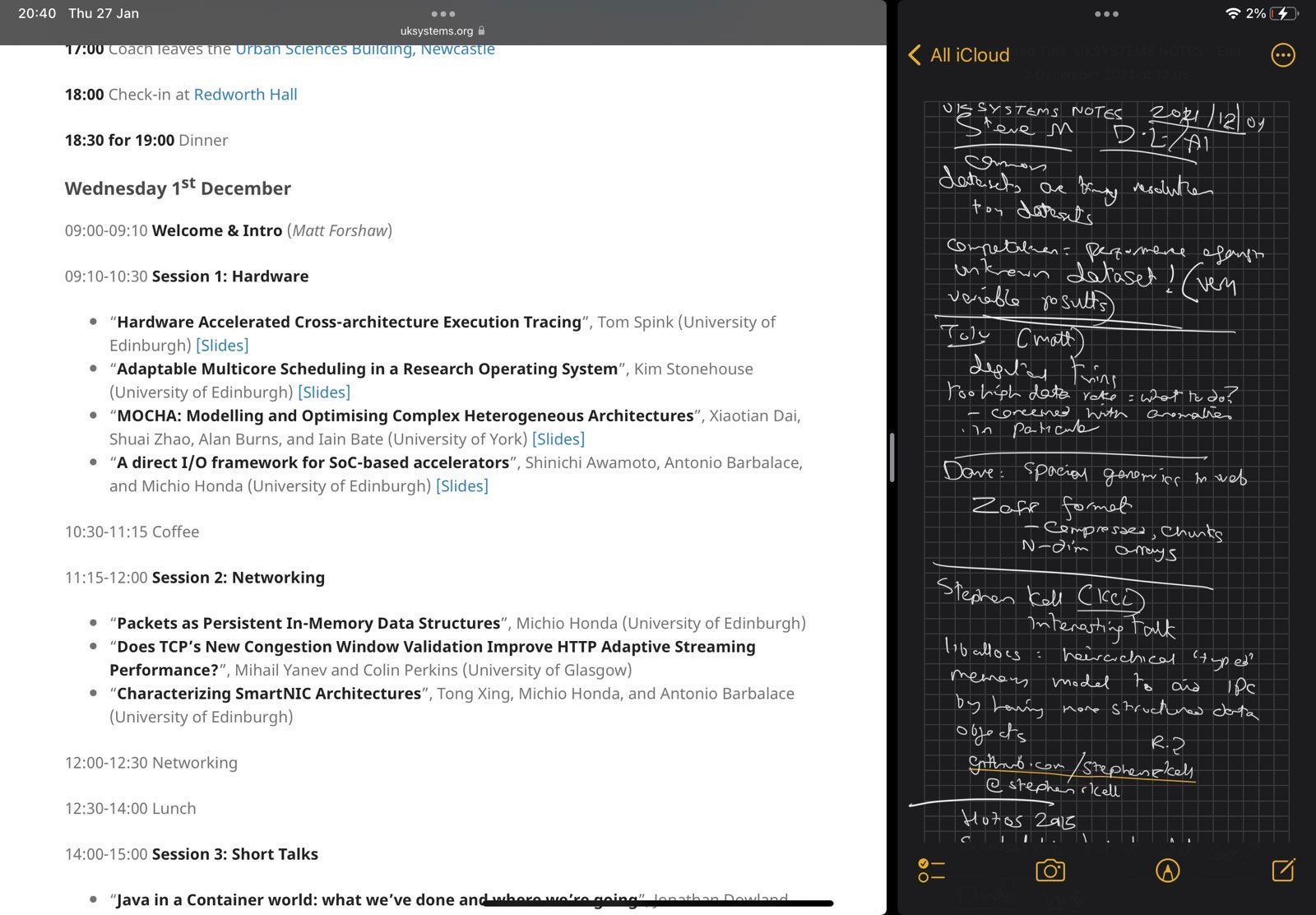
I've found that using a laptop during conference talks means you either end up doing something else and missing important bits of the talk, or at least look like you're doing something else. But it's extremely helpful to be able to look up the person who is talking, or their project, or expand an acronym that's mentioned or read around the subject. At December's uksystems21 conference, I experimented with using an iPad as a kind of compromise. Modern iOS versions let you split the display between two apps1, so I put the built-in Notes app on one side and a web browser on the other. I took notes using the Apple Pencil. I've got a "paper-like" rough surface display protector on the front which vastly improves the experience of using the Apple Pencil for writing2.
An example of note-taking and researching talks on an iPad. An example of note-taking and researching talks on an iPad.
I mostly took notes on the active talk, but I also tweaked my own slides3, looked up supplementary information about the topic and the talker, and things like that. It worked really well: much better than I expected. Apple's split-screen implementation is clunky but essential to make this work. The textured surface protector is a serious improvement over the normal surface for writing. But most importantly I didn't lose focus over the talks, and I don't think I looked like I did either.

  1. Yes, this is something that some Android vendors have supported for years. I remember playing around with Samsung Galaxy Notes when I was still in IT and being pretty impressed. On the other hand, I'd bet not 1% of those tablets are still running Today. My iPad Mini from that time still is, albeit vastly diminished.
  2. It's still not as good as the Remarkable, but that's a topic for another blog post.
  3. A tiny bit. Not serious reworking. Just nervous last minute tweaks that I could probably have not bothered with at all. I'm one of those people who does that right up to the wire.

Russ Allbery: Review: I Didn't Do the Thing Today

Review: I Didn't Do the Thing Today, by Madeleine Dore
Publisher: Avery
Copyright: 2022
ISBN: 0-593-41914-6
Format: Kindle
Pages: 291
At least from my narrow view of it, the world of productivity self-help literature is a fascinating place right now. The pandemic overturned normal work patterns and exacerbated schedule inequality, creating vastly different experiences for the people whose work continued to be in-person and the people whose work could become mostly or entirely remote. Self-help literature, which is primarily aimed at the more affluent white-collar class, primarily tracked the latter disruption: newly-remote work, endless Zoom meetings, the impossibility of child care, the breakdown of boundaries between work and home, and the dawning realization that much of the mechanics of day-to-day office work are neither productive nor defensible. My primary exposure these days to the more traditional self-help productivity literature is via Cal Newport. The stereotype of the productivity self-help book is a collection of life hacks and list-making techniques that will help you become a more efficient capitalist cog, but Newport has been moving away from that dead end for as long as I've been reading him, and his recent work focuses more on structural issues with the organization of knowledge work. He also shares with the newer productivity writers a willingness to tell people to use the free time they recover via improved efficiency on some life goal other than improved job productivity. But he's still prickly and defensive about the importance of personal productivity and accomplishing things. He gives lip service on his podcast to the value of the critique of productivity, but then usually reverts to characterizing anti-productivity arguments as saying that productivity is a capitalist invention to control workers. (Someone has doubtless said this on Twitter, but I've never seen a serious critique of productivity make this simplistic of an argument.) On the anti-productivity side, as it's commonly called, I've seen a lot of new writing in the past couple of years that tries to break the connection between productivity and human worth so endemic to US society. This is not a new analysis; disabled writers have been making this point for decades, it's present in both Keynes and in Galbraith's The Affluent Society, and Kathi Weeks's The Problem with Work traces some of its history in Marxist thought. But what does feel new to me is its widespread mainstream appearance in newspaper articles, viral blog posts, and books such as Jenny Odell's How to Do Nothing and Devon Price's Laziness Does Not Exist. The pushback against defining life around productivity is having a moment. Entering this discussion is Madeleine Dore's I Didn't Do the Thing Today. Dore is the author of the Extraordinary Routines blog and host of the Routines and Ruts podcast. Extraordinary Routines began as a survey of how various people organize their daily lives. I Didn't Do the Thing Today is, according to the preface, a summary of the thoughts Dore has had about her own life and routines as a result of those interviews. As you might guess from the subtitle (Letting Go of Productivity Guilt), Dore's book is superficially on the anti-productivity side. Its chapters are organized around gentle critiques of productivity concepts, with titles like "The Hopeless Search for the Ideal Routine," "The Myth of Balance," or "The Harsh Rules of Discipline." But I think anti-productivity is a poor name for this critique; its writers are not opposed to being productive, only to its position as an all-consuming focus and guilt-generating measure of personal worth. Dore structures most chapters by naming an aspect, goal, or concern of a life defined by productivity, such as wasted time, ambition, busyness, distraction, comparison, or indecision. Each chapter sketches the impact of that idea and then attempts to gently dismantle the grip that it may have on the reader's life. All of these discussions are nuanced; it's rare for Dore to say that one of these aspects has no value, and she anticipates numerous objections. But her overarching goal is to help the reader be more comfortable with imperfection, more willing to live in the moment, and less frustrated with the limitations of life and the human brain. If striving for productivity is like lifting weights, Dore's diagnosis is that we've tried too hard for too long, and have overworked that muscle until it is cramping. This book is a gentle massage to induce the muscle to relax and let go. Whether this will work is, as with all self-help books, individual. I found it was best read in small quantities, perhaps a chapter per day, since it otherwise began feeling too much the same. I'm also not the ideal audience; Dore is a creative freelancer and primarily interviewed other creative people, which I think has a different sort of productivity rhythm than the work that I do. She's also not a planner to the degree that I am; more on that below. And yet, I found this book worked on me anyway. I can't say that I was captivated all the way through, but I found myself mentally relaxing while I was reading it, and I may re-read some chapters from time to time. How does this relate to the genre of productivity self-help? With less conflict than I think productivity writers believe, although there seems to be one foundational difference of perspective. Dore is not opposed to accomplishing things, or even to systems that help people accomplish things. She is more attuned than the typical productivity writer to the guilt and frustration that can accumulate when one has a day in which one does not do the thing, but her goal is not to talk you out of attempting things. It is, instead, to convince you to hold those attempts and goals more lightly, to allow them to move and shift and change, and to not treat a failure to do the thing today as a reason for guilt. This is wholly compatible with standard productivity advice. It's adding nuance at one level of abstraction higher: how tightly to cling to productivity goals, and what to do when they don't work out. Cramping muscles are not strong muscles capable of lifting heavy things. If one can massage out the cramp, one's productivity by even the strict economic definition may improve. Where I do see a conflict is that most productivity writers are planners, and Dore is not. This is, I think, a significant blind spot in productivity self-help writing. Cal Newport, for example, advocates time-block planning, where every hour of the working day has a job. David Allen advocates a complex set of comprehensive lists and well-defined next actions. Mark Forster builds a flurry of small systems for working through lists. The standard in productivity writing is to to add structure to your day and cultivate the self-discipline required to stick to that structure. For many people, including me, this largely works. I'm mostly a planner, and when my life gets chaotic, adding more structure and focusing on that structure helps me. But the productivity writers I've read are quite insistent that their style of structure will work for everyone, and on that point I am dubious. Newport, for example, advocates time-block planning for everyone without exception, insisting that it is the best way to structure a day. Dore, in contrast, describes spending years trying to perfect a routine before realizing that elastic possibilities work better for her than routines. For those who are more like Dore than Newport, I Didn't Do the Thing Today is more likely to be helpful than Newport's instructions. This doesn't make Newport's ideas wrong; it simply makes them not universal, something that the productivity self-help genre seems to have trouble acknowledging. Even for readers like myself who prefer structure, I Didn't Do the Thing Today is a valuable corrective to the emphasis on every-better systems. For those who never got along with too much structure, I think it may strike a chord. The standard self-help caveat still applies: Dore has the most to say to people who are in a similar social class and line of work as her. I'm not sure this book will be of much help to someone who has to juggle two jobs with shift work and child care, where the problem is more sharp external constraints than internalized productivity guilt. But for its target audience, I think it's a valuable, calming message. Dore doesn't have a recipe to sort out your life, but may help you feel better about the merits of life unsorted. Rating: 7 out of 10

Dirk Eddelbuettel: td 0.0.6 on CRAN: Minor Bugfix

The td package for accessing the twelvedata API for financial data has been updated once more on CRAN and is now at version 0.0.6. The release comes in response to an email from CRAN who noticed (via r-devel) that I was sloppy (in one spot, it turns out) with a logical expression resulting in an expression of length greather than one. Fixed by wrapping an all() around it and the package was back at CRAN minutes later thanks to automated processing over their end. The NEWS entry follows.

Changes in version 0.0.6 (2022-01-26)
  • Correct one equality comparison by wrapping in all() to ensure a length-one logical expression is created

Courtesy of my CRANberries, there is a comparison to the previous release. For questions or comments use the issue tracker off the GitHub repo. If you like this or other open-source work I do, you can now sponsor me at GitHub.

This post by Dirk Eddelbuettel originated on his Thinking inside the box blog. Please report excessive re-aggregation in third-party for-profit settings.

Michael Ablassmeier: Qemu backup on Debian Bullseye

In my last article i showed how to use the new features included in Debian Bullseye to easily create backups of your libvirt managed domains. A few years ago as this topic came to my interest, i also implemented a rather small utility (POC) to create full and incremental backups from standalone qemu processes: qmpbackup The workflow for this is a little bit different from the approach i have taken with virtnbdbackup. While with libvirt managed virtual machines, the libvirt API provides all necessary API calls to create backups, a running qemu process only provides the QMP protocol socket to get things going. Using the QMP protocol its possible to create bitmaps for the attached disks and make Qemu push the contents of the bitmaps to a specified target directory. As the bitmaps keep track of the changes on the attached block devices, you can create incremental backups too. The nice thing here is that the Qemu process actually does this all by itself and you dont have to care about which blocks are dirty, like you would have to do with the Pull based approach. So how does it work? The utility requires to start your qemu process with an active QMP socket attached, like so:
 qemu-system-<arch> <options> -qmp unix:/tmp/socket,server,nowait
Now you can easily make qemu push the latest data for a created bitmap to a given target directory:
# qmpbackup --socket /tmp/socket backup --level full --target /tmp/backup/
[2022-01-27 19:41:33,819]    INFO  Version: 0.10
[2022-01-27 19:41:33,819]    INFO  Qemu version: [5.0.2] [Debian 1:5.2+dfsg-11+deb11u1]
[2022-01-27 19:41:33,825]    INFO  Guest Agent socket connected
[2022-01-27 19:41:33,825]    INFO  Trying to ping guest agent
[2022-01-27 19:41:38,827] WARNING  Unable to reach Guest Agent: cant freeze file systems.
[2022-01-27 19:41:38,828]    INFO  Backup target directory: /tmp/backup/
[2022-01-27 19:41:38,828]    INFO  FULL Backup operation: "/tmp/backup//ide0-hd0/FULL-1643308898"
[2022-01-27 19:41:38,836]    INFO  Wrote Offset: 0% (0 of 2147483648)
[2022-01-27 19:41:39,838]    INFO  Wrote Offset: 25% (541065216 of 2147483648)
[2022-01-27 19:41:40,840]    INFO  Wrote Offset: 33% (701890560 of 2147483648)
[2022-01-27 19:41:41,841]    INFO  Wrote Offset: 40% (867041280 of 2147483648)
[2022-01-27 19:41:42,844]    INFO  Wrote Offset: 50% (1073741824 of 2147483648)
[2022-01-27 19:41:43,846]    INFO  Wrote Offset: 59% (1269760000 of 2147483648)
[2022-01-27 19:41:44,847]    INFO  Wrote Offset: 75% (1610612736 of 2147483648)
[2022-01-27 19:41:45,848]    INFO  Saved disk: [ide0-hd0]
The resulting directory now contains a full backup image of the disk attached. From this point on, its possible to create further incremental backups:
# qmpbackup  --socket /tmp/socket backup --level inc --target /tmp/backup/
[2022-01-27 19:42:03,930]    INFO  Version: 0.10
[2022-01-27 19:42:03,931]    INFO  Qemu version: [5.0.2] [Debian 1:5.2+dfsg-11+deb11u1]
[2022-01-27 19:42:03,933]    INFO  Guest Agent socket connected
[2022-01-27 19:42:03,933]    INFO  Trying to ping guest agent
[2022-01-27 19:42:08,938] WARNING  Unable to reach Guest Agent: cant freeze file systems.
[2022-01-27 19:42:08,939]    INFO  Backup target directory: /tmp/backup/
[2022-01-27 19:42:08,939]    INFO  INC Backup operation: "/tmp/backup//ide0-hd0/INC-1643308928"
[2022-01-27 19:42:08,953]    INFO  Wrote Offset: 0% (0 of 1835008)
[2022-01-27 19:42:09,957]    INFO  Saved disk: [ide0-hd0]
The target directory will now have multiple data backups:
/tmp/backup/ide0-hd0/
  FULL-1643308898
  INC-1643308928
Restoring the image Using the qmprebase utility you can now rebase the images to the latest state. The --dry-run option gives an good impression which command sequences are required, if one wants only rebase to a specific incremental backup, thats possible using the --until option.
# qmprebase rebase --dir /tmp/backup/ide0-hd0/ --dry-run
[2022-01-27 17:18:08,790]    INFO  Version: 0.10
[2022-01-27 17:18:08,790]    INFO  Dry run activated, not applying any changes
[2022-01-27 17:18:08,790]    INFO  qemu-img check /tmp/backup/ide0-hd0/INC-1643308928
[2022-01-27 17:18:08,791]    INFO  qemu-img rebase -b "/tmp/backup/ide0-hd0/FULL-1643308898" "/tmp/backup/ide0-hd0/INC-1643308928" -u
[2022-01-27 17:18:08,791]    INFO  qemu-img commit "/tmp/backup/ide0-hd0/INC-1643308928"
[2022-01-27 17:18:08,791]    INFO  Rollback of latest [FULL]<-[INC] chain complete, ignoring older chains
[2022-01-27 17:18:08,791]    INFO  Image files rollback successful.
Filesystem consistency The backup utility also supports to freeze and thaw the virtual machines file system in case qemu is started with a guest agent socket and the guest agent is reachable during backup operation. Check out the README for the full feature set.

26 January 2022

Gunnar Wolf: Progvis Now in Debian proper! (unstable)

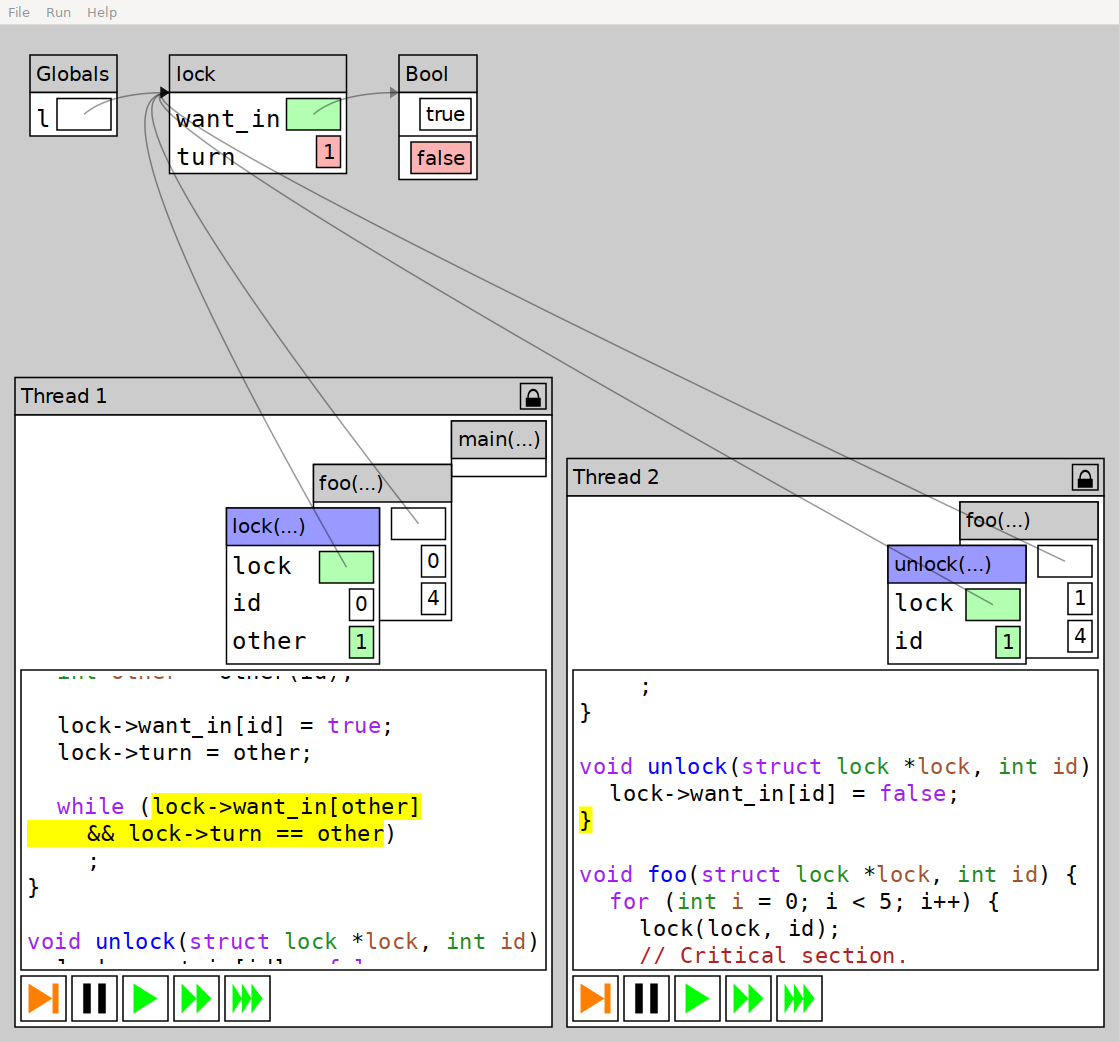
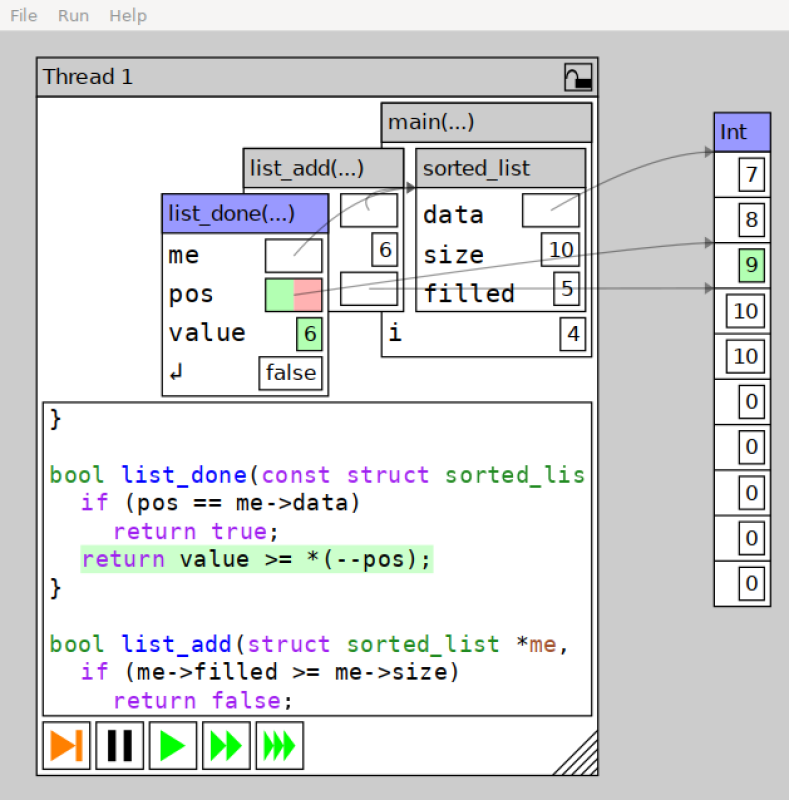
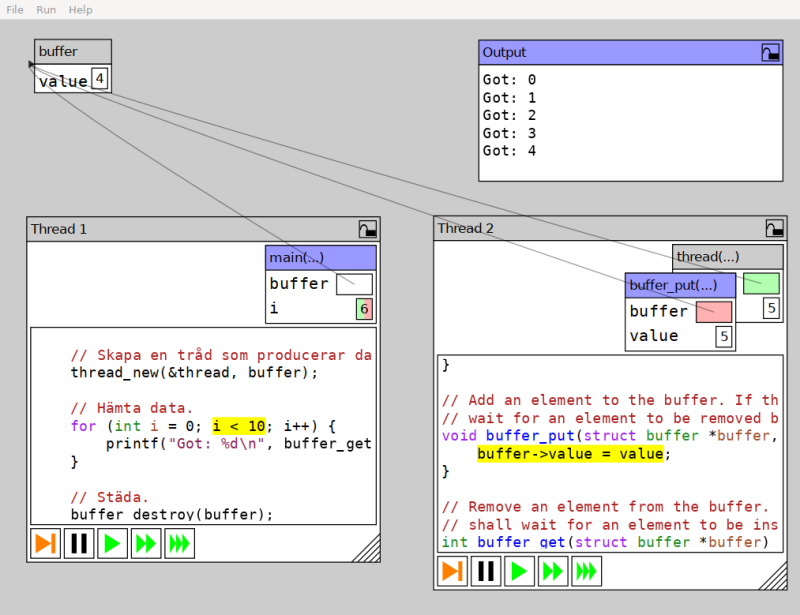
Progvis finally made it into Debian! What is it, you ask? It is a great tool to teach about memory management and concurrency. I first saw progvis in the poster presentation his author, Filip Str mb ck, did last year at the 52nd ACM Technical Sympossium on Computer Science Education (SIGCSE), immediately recognizing it as a tool I wanted to use at my classes, and being it free software, make it available for all interested Debian users. Quoting from Progvis Web page:
This is a program visualization tool aimed at concurrent programs and related issues. The tool itself is mostly language agnostic, and relies on Storm to compile the provided code and provide basic debug information. The generated code is then inspected and instrumented to provide an experience similar to a basic debugger. The tool emphasizes a visual representation of the object hierarchy that is manipulated by the executed program to make it easy to understand how it looks. In particular, a visual representation is beneficial over a text representation since it makes it easier to find shared data that might need to be synchronized in a concurrent program. As mentioned, the tool is aimed at concurrent programs. Therefore, it allows spawning multiple threads running the same program to see if that affects the program s execution (this is mostly interesting if global variables are used). Furthermore, any spawned threads also appear in the tool, and the user may control them independently to explore possible race conditions or other synchronization errors. If enabled from the menu bar, the tool keeps track of reads and writes to the data structure in order to highlight basic race conditions in addition to deadlocks.
So, what is this Storm thing? Filip promptly informed me that Progvis is not just a pedagogical tool Or rather, that it is part of something bigger. Progvis is a program built using the Storm programming language platform is more than a compiler; it presents as a framework for creating languages, designed to make easy to implement languages that can be extended with new syntax and semantics. Storm is much more than what I have explored, and can be used as an interactive compiler, a language server used as a service for highlighting and completing in IDEs. But I won t dig much more into Storm (which is, of course, now also available in Debian as well as the libraries built from the same source). Back to progvis: It implements a very-close-to-C++ language, with some details to better suit its purpose (i.e. instead of using the usual pthread implementation, an own thread model is used; i.e. thread creation is handled via int thread_id = thread_name(funcname, &params) instead of the more complex pthread_create() function (including details such as the thread object being passed as by reference as a parameter) All in all, while I have not yet taken full advantage of this tool in my teaching, it has helped me show somewhat hard to grasp concepts such as: All in all, a great tool. I hope you find it useful and enjoyable as well! PS- I suggest you to install the progvis-examples package to get started. You will find some dozens of sample programs in /usr/share/doc/progvis-examples/examples; playing with them will help you better understand the tool and be able to better write your own programs.

Next.

Previous.