How to disable internal keyboard/touchpad when a cat arrives I m using an external keyboard (1) and mouse (2), but the laptop lid is usually still open for better cooling. That means the internal keyboard (3) and touchpad (4) made of comfortable materials are open to be used by a cat searching for warmth (7), in the obvious every time case that a normal non-heated nest (6) is not enough.
The problem is, everything goes chaotic at that point in the default configuration. The solution is to have quick shortcuts in my Dash to Dock (8) to both disable (10) and enable (9) keyboard and touchpad at a very rapid pace.It is to be noted that I m not disabling the touch screen (5) by default, because most of the time the cat is not leaning on it there is also the added benefit that if one forgets about the internal keyboard and touchpad disabling and detaches the laptop from the USB-C monitor (11), there s the possibility of using the touch screen and on-screen keyboard to type in the password and tap on the keyboard/touchpad enabling shortcut button again. If also touch screen was disabled, the only way would be to go back to an external keyboard or reboot.So here are the scripts. First, the disabling script (pardon my copy-paste use of certain string manipulation tools):
dconf write /org/gnome/desktop/peripherals/touchpad/send-events "'disabled'" sudo killall evtest sudo evtest --grab $(sudo libinput list-devices grep -A 1"AT Translated Set 2 keyboard" tail -n 1 sed 's/.*\/dev/\/dev/')& sudo evtest --grab $(sudo libinput list-devices grep -A 1"Dell WMI" tail -n 1 sed 's/.*\/dev/\/dev/')& sudo evtest --grab $(sudo libinput list-devices grep -A 1"Power" grep Kernel tail -n 1 sed 's/.*\/dev/\/dev/')& sudo evtest --grab $(sudo libinput list-devices grep -A 1"Power" grep Kernel head -n 1 sed 's/.*\/dev/\/dev/')& sudo evtest --grab $(sudo libinput list-devices grep -A 1"Sleep" grep Kernel tail -n 1 sed 's/.*\/dev/\/dev/')& sudo evtest --grab $(sudo libinput list-devices grep -A 1"HID" grep Kernel head -n 1 sed 's/.*\/dev/\/dev/')& sudo evtest --grab $(sudo libinput list-devices grep -A 1"HID" tail -n 1 sed 's/.*\/dev/\/dev/')& #sudo evtest --grab $(sudo libinput list-devices grep -A 1 "ELAN" tail -n 1 sed 's/.*\/dev/\/dev/') # Touch screen
And the associated ~/.local/share/applications/disable-internal-input.desktop:
With these, if I sense a cat or am just proactive enough, I press Super+9. If I m about to detach my laptop from the monitor, I press Super+8. If I forget the latter (usually this is the case) and haven t yet locked the screen, I just tap the enabling icon on the touch screen.
Two weeks ago I decided to make myself a combined birthday and Christmas present and upgrade my coffee gear.
I ve got my first espresso machine back in 2013, it was a cheap Saeco Philips Poemia, which made reasonably
drinkable coffee, but not being able to make good coffee made me increasingly unhappy about it. However,
since it worked, I wasn t motivated enough to change anything until it stopped working. One day the nut holding
the shower screen broke, and I couldn t replace it.
Having no coffee machine is arguably worse than having a mediocre one, so I started looking for a new one in the budget
range. Having spent about two months reading reviews for all sorts of manual espresso machines, I realised the best
thing I can probably do for the money I was willing to spend at the time was to buy a second-hand Gaggia Classic.
Which is what I did: I paid 260 to a person who apparently decided they prefer to press a button to get their espresso
rather than have to prepare it themselves.
My first attempts at making espresso weren t very much successful, as my hand grinder couldn t produce the right grind for
espresso (without using pressurised baskets), so I quickly upgraded it to the 50 De Longhi electric grinder, which was much
better for espresso.
Gaggia Classic 2015 and De Longhi grinder
This setup has worked for me for nearly 4 years, but over the time the Gaggia started malfunctioning.
See, this particular Gaggia Classic is the 2015 model, which resulted in the overhaul of the design after Gaggia was acquired by
Philips. They replaced the boiler, changed the exterior design a bit, and importantly for me replaced the fully metal group
head with the metal and plastic version typically found in cheap espresso machines like my old Poemia.
The Gaggia Classic 2015 group head
The trouble with this one is that the plastic bit (barely seen on the picture, but it s inserted into the notches on the sides
of the group head) is that it gets damaged over the time, especially when the portafilter is inserted very tightly. The more
damaged it gets, the tigher it is necessary to insert the portafilter to avoid leakage, the more damaged it gets and so on.
At one point, the Gaggia was leaking water every time I was making coffee, affecting the quality of the brew and making a mess
in the kitchen. I made a mistake and removed the plastic bit only to realise it cannot be purchased separately and nobody knows
how to put it back once it s been removed; I ended up paying more than a hundred euro to replace the group head as a whole.
Once I ve got the Gaggia back, I became too conscious of the potential damage I can make by overengaging the portafilter, I decided
it s probably the time to get a new coffee machine.
Gaggia Classic 2015 vs 2019
The makers of Gaggia listened to the critics and undid the 2015 changes to the Gaggia Classic design, reverting to the previous one
and fixing it they basically merged the fixes many of the owners of the old Gaggia did themselves. The group head is now without
any plastic, so I don t have to worry that much about damaging it accidentally.
A friend pointed out that my grinder is probably not good enough and recommended a couple of models to me; I checked
Kev s Coffee Blog and found a grinder, Sage Dose Control Pro,
which was available on sale in my local shop for a reasonable price.
I ve also got a portafilter holder to make tamping more comfortable I used to tamp against an edge of the sink:
The final setup:
Gaggia Classic 2019 and Sage BCG600 Dose Control Pro
What I learnt from this is that the grinder does indeed make a huge difference. I am now able to consistently produce brews I would only occasionally
get with the old De Longhi grinder. There is one downside to the new grinder.
Happy with my new purchase, I went to read this review and thought to myself: lucky me, my grinder is absolutely quiet! And then I realised that
the noise in my kitchen is not, in fact, produced by the fridge, but the grinder. Well, a cheap switched plug solved the issue completely (I wish
sockets here each had a switch like they usually to in the UK!)
Debian security is pretty good, but there s always scope for improvement. Here are some ideas that I think could be used to improve things.
A security wizard , basically a set of scripts with support for plugins that will investigate your system and look for things that can be improved. It could give suggestions on LSMs that could be used, sysctl settings, lists of daemons running as root that possibly don t need root privs, etc. Plugins could be for different daemons, so there could be a plugin for Apache that looks for potential issues with Apache configuration. It wouldn t be possible to cover everything, but it would be possible to cover many common cases. It appears that we used to have a harden package to do some of these things which disappeared. It appears that the only remnant of that is the hardening-runtime package.
Kali Linux [1] is a distribution designed for penetration testing, I recently tried out many of it s features and I was very impressed. While I don t think that the aim should be to copy all Kali features into Debian there are probably some that are worthy of inclusion. Most Kali features run well in a VM, but the Wifi penetration testing tools need access to the hardware, so they could be a good candidate for inclusion in Debian (license permitting).
We have a Securing Debian Manual [2] that is really good. It s a little out of date and needs some contributions, it also needs to be better known.
The Security Management page of the Debian wiki [3] has links to a number of pages about improving system security. It needs some updates, it doesn t have a link to a page about SE Linux so there s some work for me to do there.
Can training help people? I would be happy to run some Debian SE Linux training sessions over Matrix or Jitsi. We can probably find people to offer training on other aspects of Linux security that are implemented in Debian if there is an audience. I don t think that I and other DDs (Debian Developers) can train everyone, but we could train people who then go on to run other training sessions and make the session notes etc available under the GPL.
There would also be some benefits to training other DDs as probably no-one has a good overview of all the security features that are supported.
Any other ideas? Feel free to comment here or start a thread on a public mailing list. If you start a mailing list discussion please email me or comment here with the URL if it s a list that I m not on so I can track it via the archives. This post was inspired by a discussion on a private list of a related topic. I think it s better to have a public discussion instead.
The first time I applied for grad school it was a bit of a lark. I was serious about it, I wanted to go, I had goals, and I am happy to be here now. However, it was a little fun. I took a white paper and crisped it up with the help of some friends who read it and provided comments. I wrote a personal statement, got some letters of recommendation, and generally felt pretty good about the process. It wasn t stressful.
The second time I applied to grad school it was a slog. For several weeks I gave up most of my free time to application writing and when I wasn t working on applications I thought about how I ought to be doing something about it. Applications are due while you re coming up on the end of your semester or end of the year push at work or both! There just isn t enough time for everything. I think even applying for grad school qualifies you to attend.
Here are some things I learned in the application process. Note, I haven t gotten in anywhere (yet), so we ll see how it pans out.
You have to do a lot of research.
This changes by field, school, and even individual faculty preference. Some possible mentors / advisors like to talk with prospective students ahead of time. On two of my applications I was explicitly asked who I spoke with in the department. On others I was asked to list faculty (in order of preference even!) that I would be interested in working with. Some schools requested in essays to list faculty. In general, it s considered important to explain why a particular school: what about that school attracts you? What resources do they have that you want to take advantage of? What research that they are doing interests you?
Faculty profiles and department websites are useful for this, but far from complete. A co-worker suggested I contact someone who, based on their profile, I shared no research interests with. However, we talked and it turns out we had things in common! In general, colleagues, peers, other academics, and friends were the best resource I had for investigating schools and potential faculty.
I also went to some Q&A sessions / office hours run by schools / departments / labs. Some really cool people wrote blog posts and / or Tweets soliciting grad students. These are great.
Sometimes the people you want to work with aren t taking grad students.
Most schools I looked at did not maintain lists of who is taking on grad students starting in the fall, but I think two did. Sometimes I contacted people and got back Sorry, not taking on anyone this year. Try $OtherProfessor. This was actually really helpful! But, it s a downer to learn you re not going to get to work with one of your academic heroes because the timing is wrong.
It s expensive and waivers might not help.
Most applications in the US cost about $100 (USD). In some fields it s recommended you apply to 8-10 schools. That s a lot of money. I think everywhere I applied had a waiver you could apply for, but I generally didn t qualify. Some waivers require you to submit days to weeks ahead of the deadline. Others require that you participate in certain professional organizations, student organizations, or live locally to the school. These might be less useful than you were hoping.
Everyone says your writing sample matters, but only five people will read it.
This is what I was told anyway. I was told that my writing sample (which was 20 pages!) will probably only be read by faculty who are thinking of taking me on as an advisee. Someone else might pick it up and read it out of curiosity. I was told stories about how the right writing sample turned eh, maybe candidates into enthusiastic yeses.
Everyone says letters of recommendation matter and it s extremely frustrating.
My recommenders are all amazing people I have so much respect and admiration for it s wild. They re people I want to be like in my academic career. They also all got their letters in the day they were due. I had a moment where I genuinely thought I was just not going to go to grad school because of how close the deadline was.
I ve been told that a great letter matters a lot, but meh letters don t hold you back as much as it sounds like they will. I ve been told that where a recommender is affiliated matters a lot.
My personal statement radically changed based on school / program.
Two of the schools I applied to had very specific requirements for their personal statements. Other schools wanted me to mostly talk about my research interests. One school had a 350 word personal statement, but a 1,000 word research statement. I wrote a research statement and a personal statement and then used them as the basis for what I submitted to different schools. Each application ended up with something pretty different, and not just because I talked about why each program was exciting to me in different ways.
I also applied to different kinds of programs, and presented myself a differently depending on the program s focus and the faculty. For the more social science heavy programs I emphasized the empirical research I did, while for others I leaned more heavily on my philosophical background and theoretical interests.
Oh, also, I was told to not use contractions. Getting rid of them in all my materials was super tedious.
Diversity Statements are becoming more common.
A few of my schools had diversity statements either required or optional. The purpose of these, I was told, is not to play some sort of marginalization Olympics, but to show that you can talk about diversity (and equity and inclusion, etc) without being offensive. It s just as valid to write about your own disability as the disability of a parent (though, ask their permission first).
Triple check what s required.
I made spreadsheets about what each school required. For example, some people wanted official transcripts, some unofficial. Some places required essays rather than generic personal statements, and I needed to build in enough time to manage that.
Ask your friends to help.
I hate asking for help, but applying for grad school made me shameless. I asked anyone I could to read over materials, proofread, or just talk with me about what I was writing. People picked up on things like you used the word technology five times in this one sentence and it looks real weird.
Some schools have projects where current grad students will even look over materials!
As a follow on to a previous blog entry of mine, Free and Open, I feel it
worthwhile to do my bit to dismantle the pseudo-science and over
simplification in the idea that gender is binary at a biological level.
TL;DR: Science simply does not support binary sexes or binary genders.
Truth is a bit more complicated.
There is certainty and there are binary answers in mathematics. Things
get less definitive in physics, certainly as soon as quantum is
broached. Processes become more of an equilibrium between states in
chemistry, never wholly one or the other. Yes, there is the oddity of
absolute zero but no experiment has yet achieved that fully. It is
accurate to describe physics as a development of applied mathematics
and to view chemistry as applied physics. Biology, at the biochemical
level, is applied chemistry. The sciences build on each other, "on the
shoulders of giants", but at each level, some certainty is lost, some
amount of uncertainty is expanded and measurements become
probabilities, proportions and percentages.
Biology is dependent on biochemistry - chemistry is how a biological
change results in a different organism. Physics is how that chemical
change occurs - temperature, pressure and physical states are inherent
to all chemical changes.
Outside laboratory constraints, few chemical reactions, especially in
organic chemistry, produce one and only one result from two or more
known reagents.
In biology, everyone is familiar with genetic mutations but a genetic
mutation only happens because a biochemical reaction (hydrogen bonding
of nucleobases) does not always produce the expected result. Every cell
division, every viral infection, there is a finite probability that a
change will occur. It might be a small number but it is never zero and
can never be dismissed. This is obvious in the current Covid pandemic -
genetic mutations result in new variants. Some variants are inviable,
some variants produce no net change in the way that the viral particles
infect adjacent cells. Sometimes, a mutation happens that changes
everything. These mutations are not mistakes - these are simply changes
with undetermined outcomes. Genetic changes are the foundation of
biodiversity and variety is what allows lifeforms of all kinds to
survive changes in environmental factors and/or changes in prevalent
diseases.
It is precisely the same in humans, particularly in one of the
principle spheres of human life that involves replicating genetic
material - the creation of gametes for sexual reproduction. Every
single time any DNA is copied, there is a finite chance that a
different base will be put in place compared to the original. Copying
genetic material is therefore non-binary. Given precisely the same
initial conditions, the result is not always predictable and the range
of how the results vary from one to another increases with every
iteration.
Let me stress that - at the molecular level, no genetic operation in
any biological lifeform has a truly binary result. Repeat that
operation sufficiently often and an unexpected result WILL inevitably
occur. It is a mathematical certainty that genetic changes will arise
by attempting precisely the same genetic operation enough times.
Genetic changes are fundamental to how lifeforms survive changing
conditions. Life would likely have died out a long time ago on this
planet if every genetic operation was perfect. Diversity is life.
Similarity leads to extinction.
Viral load is interesting at this point. Someone can be infected with a
virus, including coronavirus, by encountering a small number of viral
particles. Some viruses, it may be a few hundred, some viruses may need
a few thousand particles to infect a vulnerable host. But here's the
thing, for that host to be at risk of infecting another host, the virus
needs the host to produce billions upon billions of copies of the virus
by taking over the genetic machinery within a huge number of cells in
the host. This, as is accepted with Covid, is before the virus has been
copied enough times to produce symptoms in the host. Before those
symptoms become serious, billions more copies will be made. The numbers
become unimaginable - and that is within a single host, let alone the
265 million (and counting) hosts in the current Covid19 pandemic. It's
also no wonder that viral infections cause tiredness, the infection is
diverting huge resources to propagating itself - before even
considering the activity of the immune system.
It is idiocy of the highest order to expect all those copies to be
identical. The rise of variants is inevitable - indeed essential - in
all spheres of biology. A single viral particle is absolutely no threat
of any kind - it must first get inside and then copy the genetic
information in a host cell. This is where the complexity lies in the
definition of life itself. A virus can be considered a lifeform but it
is only able to reproduce using another, more complex, lifeform. In
truth, a viral particle does not and cannot mutate. The infected host
mutates the virus. The longer it takes that host to clear the
infection, the more mutations that host will create and then
potentially spread to others.
Now apply this to the creation of gametes in humans. With seven billion
humans, the amount of copying of genetic material is not as large as
the pandemic but it is still easy for everyone to understand that
children do not merely combine the DNA of both parents. Changes happen.
Human sexual reproduction is not as simple as 1 + 1 = 2. Sometimes, the
copying of the genetic material produces an unexpected result. Sexual
reproduction itself is non-binary. Sexual reproduction is not easy or
simple for lifeforms to adopt - the diversity which results from the
non-binary operations are exactly why so many lifeforms invest so much
energy in reproducing in this way.
Whilst many genetic changes in humans will be benign or beneficial, I d
like to take an example of a genetic disorder that results from the
non-binary nature of sex. Humans can be born with the XY phenotype -
i.e. at a genetic level, the individual has the same combination of
chromosomes as another XY individual but there are changes within the
genes in those chromosomes. We accept this, some children of blonde
parents do not have blonde hair, etc. There are also genetic changes
where an XY phenotype is not binary. Some people, who at a genetic
level would be almost identical to another person who is genetically
male, have a genetic mutation which makes it impossible for the cells
of that individual to respond to androgens (testosterone). (See
Androgen insensitivity syndrome). Genetically, that individual has an X
and a Y chromosome, just like many other individuals. However, due to a
change in how the genes on those chromosomes were copied, that
individual is biologically incapable of constructing the secondary
sexual characteristics of a male. At a genetic level, the individual
has the XY phenotype of a male. At the physical level, the individual
has all the sexual characteristics of a female and none of the sexual
characteristics of a male. The gender of that individual is not binary.
Treatment is centred on supporting the individual and minimising some
risks from the inactive genes on the Y chromosome.
Human sexual reproduction is non-binary. The results of any sexual
reproduction in humans will not always produce the binary option of
male or female. It is a lie to claim that human gender is binary. The
science is in plain view and cannot be ignored.
Identifying as non-binary is not a "cop out" - it can be a biological,
genetic, scientific fact.
Human sexuality and gender are malleable. Where genetic changes result
in symptoms, these can be ameliorated by treatment with human sex
hormones, like oestrogen and testosterone. There are valid medical uses
for anabolic steroids and hormone replacement therapies to help
individuals who, at a genetic level, have non-binary gender. These
treatments can help align the physical outer signs with the personality
and identity of the individual, whether with or without surgery. It is
unacceptable to abandon such people to suffer life long discrimination
and harassment by imposing a binary definition that has no basis in
science.
When a human being has an XY phenotype, that human being is not
necessarily male. That individual will be on a spectrum from female
(left unaffected by sex hormones in the womb, the foetus will be
female, even with an X and a Y chromosome), to various degrees of male.
So, at a genetic, biological level, it is a scientific fact that human
beings do not have binary gender. There is no evidence that this is new
to the modern era, there is no scientific basis for thinking that
copying of genetic material was somehow perfectly reliable in earlier
history, or that such mutations are specific to homo sapiens. Changes
in genetic material provide the diversity to fight infections and adapt
to changing environmental factors. Species have and will continue to go
extinct if this diversity is absent.
With that out of the way, it is no longer a stretch to encompass other
aspects of human non-binary genders beyond the known genetic syndromes
based on changes in the XY phenotype. Science has not uncovered all of
the ways that genes affect personality, behaviour, or identity.
How other, less studied, genetic changes affect the much more subtle
human facets, especially anything to do with consciousness, identity,
personality, sexuality and behaviour, is guesswork. All of these facets
can and likely are being affected by genetic factors as well as
environmental factors in an endless range of permutations. Personality
traits are a beautiful and largely unknowable blend of genes and
environment. Genetic information has a finite probability of changes at
each and every iteration. Environmental factors are more akin to chaos
theory. The idea that the results will fit into binary constructs is
laughable.
Human society puts huge emphasis on societal norms. Individuals who do
not fit into those norms suffer discrimination. The norms themselves
have evolved over time as a response to various influences on human
civilisation but most are not based on science. It is up to all humans
in that society to call out discrimination, to call for changes in the
accepted norms and support those who are marginalised. It is a
precarious balance, one that humans rarely get right, but it must be
based on an acceptance that variation is the natural state. Artificial
constraints, like binary genders, must be dismantled because human
beings and human sexual reproduction are not binary.
To those who think, "well it is for 99%", think again about Covid. 99%
(or closer to 98%) of infected humans recover without notable after
effects. That has still crippled the nations of the globe and humbled
all those who tried to deny it. Five million human beings are dead
because "most infected people recover".
Just because something only affects a proportion of human beings does
not invalidate the suffering of those humans and the discrimination
that those humans will face.
Societal norms are not necessarily correct. Religious and other
influences typically obscure and ignore scientific fact and undermine
human kindness.
The scientific truth of life on this planet is that gender is not
binary.
The more complex the lifeform, the more factors will affect where on
the spectrum any one individual will appear.
Just because we do not yet fully understand how genes affect human
personality and sexuality, does not invalidate the science that
variation is the natural order.
My previous blog about diversity is not just about male vs female, one
nationality vs another, one ethnicity compared to another. Diversity is
diverse. Diversity requires accepting that every facet of humanity is
subject to variation. That leads to tension at times, it is inevitable.
Tension against societal norms, tension against discrimination, tension
around those individuals who would abuse the tolerance of others for
their own gratification or from their own ignorance.
None of us are perfect, none of us have any of this fully sorted and
all of us will make mistakes. Personally, I try to respect those around
me. I will use whatever pronouns and other conventions that the person
requests, from their perspective and not mine. To do otherwise is to
deny the natural order and to deny the science.
Celebrate all diversity, it is the very stuff of life.
Final comments:
The discussions around (typically female) bathroom facilities often
miss the point. The concern is not about individuals who describe
themselves as non-binary. The concern is about individuals who are
fully certain of their own sexuality and who act as sexual predators
for their own gratification. These people are acting out a lie for
their own ends. The problem people are the predators, so stop blaming
the victims who are just as at risk as anyone else who identifies as
female. Maybe the best people to spot such predators are those who are
non-binary, who have had to pretend to fit into societal norms. Just as
travel can be a good antidote to racism, openness and discussion can be
a tool to undermine the lies of sexual predators and reassure those who
are justifiably fearful. There can never be a biological binary test of
gender, there can never be any scientific justification for binary
division of facilities.
Humanity itself is not binary, even life itself has blurry borders
around comas, suspended animation and locked-in syndrome. Legal
definitions of human death vary around the world.
The only common thread I have ever found is: Be kind to each other.
If you find anything above objectionable, then I can only suggest that
you reconsider the science and learn to be kind to your fellow humans.
None of us are getting out of this alive.
My degree is in pharmaceutical sciences and I practised community and
hospital pharmacy for 20 years before moving into programming. I have
direct experience of supporting people who were prescribed hormones to
transition their physical characteristics to match their personal
identity. I had a Christian upbringing but my work showed me that those
religious norms were incompatible with being kind to others, so I
rejected religion and I now consider myself a secular humanist.
The diffoscope maintainers are pleased to announce the release of diffoscope
version 196. This version includes the following changes:
[ Roland Clobus ]
* Add a comment/annotation when the GNU_BUILD_ID field has been modified.
[ Brent Spillner ]
* Fix the "Black" version detection.
[ Chris Lamb ]
* Replace "token" with anonymous variable "x" in order to remove extra lines.
A new package of mine arrived on CRAN yesterday in its inaugural 0.0.1 upload: qlcal.
qlcal is based on the calendaring subset of QuantLib. It is provided (for the R package) as a set of included files, so the package is self-contained and does not depend on an external QuantLib library (which can be challenging to build). The only build requirements are Rcpp for the seamless R/C++ integration, and BH for Boost headers.
qlcal covers over sixty country / market calendars and can compute holiday lists, its complement (i.e. business day lists) and much more. As a teaser see this two-liner for 2022 holiday for the Federal Reserve calendar in the United States, now including Juneteenth (on June 20 next year) as the most recently added holiday:
See the project page and package documentation for more details, and more examples.
Going forward, and time permitting, it would be nice to slowly reduce the Boost dependency to make the underlying qlcal C++ library more self-sufficient.
If you like this or other open-source work I do, you can now sponsor me at GitHub.
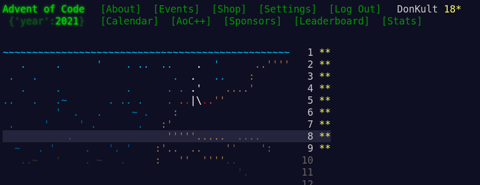
Advent of Code 2021Advent of Code, for those not in the know,
is a yearly Advent calendar (since 2015) of coding puzzles many people
participate in for a plenary of reasons ranging from speed coding to code
golf with stops at learning a new language or practicing already known
ones.
I usually write boring C++, but any language and then some can be used.
There are reports of people implementing it in hardware, solving them by
hand on paper or using Microsoft Excel
so, after solving a puzzle the easy way yesterday, this time
I thought: CHALLENGE ACCEPTED! as I somehow remembered an old 2008
article about solving Sudoku with aptitude
(Daniel Burrows via archive.org as the blog is long gone)
and the good same old a package management system that can solve [puzzles] based on package dependency rules is not something that I think would be useful or worth having (Russell Coker).
Day 8 has a rather lengthy
problem description and can reasonably be approached in a bunch of
different way. One unreasonable approach might be to massage the
problem description into Debian packages and let apt help me solve the
problem (specifically Part 2, which you unlock by solving Part 1. You
can do that now, I will wait here.)
Be warned: I am spoiling Part 2 in the following, so solve it yourself
first if you are interested.
I will try to be reasonable consistent in naming things in the following
and so have chosen: The input we get are lines like acedgfb cdfbe gcdfa fbcad dab cefabd cdfgeb eafb cagedb ab cdfeb fcadb cdfeb cdbaf.
The letters are wires mixed up and connected to the segments of the
displays: A group of these letters is hence a digit (the first 10)
which represent one of the digits 0 to 9 and (after the pipe) the four
displays which match (after sorting) one of the digits which means
this display shows this digit. We are interested in which digits are
displayed to solve the puzzle. To help us we also know which segments
form which digit, we just don't know the wiring in the back.
So we should identify which wire maps to which segment!
We are introducing the packages wire-X-connects-to-Y for this which
each provide & conflict1 with the virtual packages segment-Y and
wire-X-connects.
The later ensures that for a given wire we can only pick one segment and
the former ensures that not multiple wires map onto the same segment.
As an example: wire a's possible association with segment b is
described as:
Note that we do not know if this is true! We generate packages for
all possible (and then some) combinations and hope dependency resolution
will solve the problem for us. So don't worry, the hard part will be
done by apt, we just have to provide all (im)possibilities!
What we need now is to translate the 10 digits (and 4 outputs) from
something like acedgfb into digit-0-is-eight and not, say
digit-0-is-one. A clever solution might realize that a one consists
only of two segments so a digit wiring up seven segments can not be
a 1 (and must be 8 instead), but again we aren't here to be clever:
We want apt to figure that out for us! So what we do is simply making
every digit-0-is-N (im)possible choice available as a package and
apply constraints: A given digit-N can only display one number and
each N is unique as digit so for both we deploy Provides
& Conflicts again.
We also need to reason about the segments in the digits: Each of the
digit packages gets Depends on wire-X-connects-to-Y where X is each
possible wire (e.g. acedgfb) and Y each segment forming the digit
(e.g. cf for one). The different choices for X are or'ed together,
so that either of them satisfies the Y.
We know something else too through: The segments which are not used by
the digit can not be wired to any of the Xs. We model this with
Conflicts on wire-X-connects-to-Y.
As an example: If digit-0s acedgfb would be displaying a one
(remember, it can't) the following package would be installable:
Repeat such stanzas for all 10 possible digits for digit-0 and then
repeat this for all the other nine digit-N. We produce pretty much the
same stanzas for display-0(-is-one), just that we omit the second
Provides & Conflicts from above (digit-is-one) as in the display
digits can be repeated. The rest is the same (modulo using display
instead of digit as name of course).
Lastly we create a package dubbed solution which depends on all 10
digit-N and 4 display-N all of them virtual packages apt will have
to choose an installable provider from and we are nearly done!
The resulting Packages file2 we can give to apt while requesting to
install the package solution and it will spit out not only the display
values we are interested in but also which number each digit represents
and which wire is connected to which segment. Nifty!
$ ./skip-aoc 'acedgfb cdfbe gcdfa fbcad dab cefabd cdfgeb eafb cagedb ab   cdfeb fcadb cdfeb cdbaf'
[ ]
The following additional packages will be installed:
  digit-0-is-eight digit-1-is-five digit-2-is-two digit-3-is-three
  digit-4-is-seven digit-5-is-nine digit-6-is-six digit-7-is-four
  digit-8-is-zero digit-9-is-one display-1-is-five display-2-is-three
  display-3-is-five display-4-is-three wire-a-connects-to-c
  wire-b-connects-to-f wire-c-connects-to-g wire-d-connects-to-a
  wire-e-connects-to-b wire-f-connects-to-d wire-g-connects-to-e
[ ]
0 upgraded, 22 newly installed, 0 to remove and 0 not upgraded.
We are only interested in the numbers on the display through, so grepping
the apt output (-V is our friend here) a bit should let us end up with
what we need as calculating3 is (unsurprisingly) not a strong suit of
our package relationship language so we need a few shell commands to
help us with the rest.
$ ./skip-aoc 'acedgfb cdfbe gcdfa fbcad dab cefabd cdfgeb eafb cagedb ab   cdfeb fcadb cdfeb cdbaf' -qq
5353
I have written the skip-aoc script as a testcase for apt,
so to run it you need to place it in
/path/to/source/of/apt/test/integration and built apt first, but that
is only due to my laziness. We could write a standalone script
interfacing with the system installed apt directly and in any apt
version since
~2011.
To hand in the solution for the puzzle we just need to run this on each
line of the input (~200 lines) and add all numbers together. In other
words: Behold this beautiful shell one-liner:
parallel -I ' ' ./skip-aoc ' ' -qq < input.txt paste -s -d'+' - bc
(You may want to run parallel with -P to properly grill your CPU as
that process can take a while otherwise and it still does anyhow as
I haven't optimized it at all the testing framework does a lot of
pointless things wasting time here, but we aren't aiming for the
leaderboard so )
That might or even likely will fail through as I have so far omitted a
not unimportant detail: The default APT resolver is not able to solve
this puzzle with the given problem description we need another solver!
Thankfully that is as easy as installing apt-cudf (and with it aspcud)
which the script is using via --solver aspcud to make apt hand over the
puzzle to a "proper" solver (or better: A solver who is supposed to be
good at "answering set" questions). The buildds are using this for
experimental and/or backports builds and also for installability checks
via dose3 btw, so you might have encountered it before.
Be careful however: Just because aspcud can solve this puzzle doesn't
mean it is a good default resolver for your day to day apt. One of the
reasons the default resolver has such a hard time solving this here is
that or-groups have usually an order in which the first is preferred over
every later option and so fort. This is of no concern here as all these
alternatives will collapse to a single solution anyhow, but if there are
multiple viable solutions (which is often the case) picking the "wrong"
alternative can have bad consequences. A classic example would be
exim4 postfix nullmailer. They are all MTAs
but behave very different. The non-default solvers also tend to lack
certain features like keeping track of auto-installed packages or
installing Recommends/Suggests. That said, Julian is working on
another solver
as I write this which might deal with more of these issues.
And lastly: I am also relatively sure that with a bit of massaging the
default resolver could be made to understand the problem, but I can't
play all day with this maybe some other day.
Disclaimer: Originally posted in the daily megathread
on reddit, the version here is just slightly better understandable as
I have hopefully renamed all the packages to have more conventional
names and tried to explain what I am actually doing.
No cows were harmed in this improved version, either.
If you would upload those packages somewhere, it would be good
style to add Replaces as well, but it is of minor concern for apt
so I am leaving them out here for readability.
We have generated 49 wires, 100 digits, 40 display and 1 solution
package for a grant total of 190 packages. We are also making use of
a few purely virtual ones, but that doesn't add up to many packages
in total. So few packages are practically childs play for apt given it
usually deals with thousand times more. The instability for those
packages tends to be a lot better through as only 22 of 190 packages
we generated can (and will) be installed. Britney will hate you if
your uploads to Debian unstable are even remotely as bad as this.
What we could do is introduce 10.000 packages which denote every
possible display value from 0000 to 9999. We would then need to
duplicate our 10.190 packages for each line (namespace them) and then
add a bit more than a million packages with the correct dependencies
for summing up the individual packages for apt to be able to display
the final result all by itself. That would take a while through as at
that point we are looking at working with ~22 million packages with
a gazillion amount of dependencies probably overworking every solver
we would throw at it a bit of shell glue seems the better option for
now.
This article was written by David Kalnischkies on apt-get a life and republished here by pulling it from a syndication feed. You should check there for updates and more articles about apt and EDSP.
Welcome to the 34th post in the rambunctiously refreshing R recitations, or R4. Today s post is about architecture.
Mies defined modernism. When still in Europe, I had been to the Neue Nationalgalerie in Berlin which provides a gorgeous space for the arts. Twenty-five years ago, I worked next to his Toronto-Dominion Center in Toronto. Here in Chicago we have numerous buildings: the Federal Center (the Dirksen, the Kluczynski and the US Post Office rounding out the square in the Loop), multiple buildings on the Illinois Tech (aka IIT) Campus where he taught in the architecture department he created and lead, the (formerly called) IBM Plaza building at the river and more.
Structure and minimalism, often based on the same core elements of black steel beams and glass, are a landmark of these buildings. One immediately senses that there is nothing left to take away.
Code and programming can be similar. We too compose based on parts we assemble and combine to create something hopefully larger than the parts. The difficulty arising from too many dependencies is something we discussed before both here in this 2018 post but also via the tinyverse site.
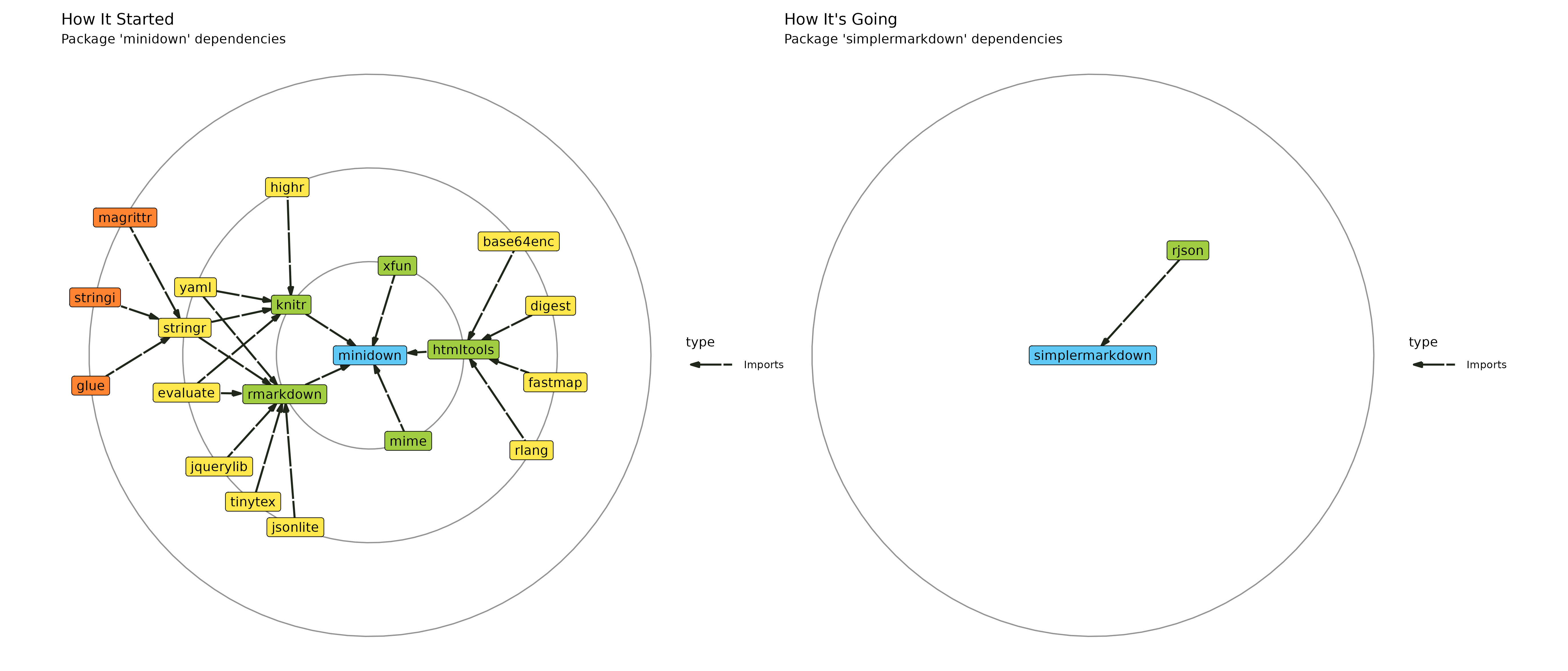
Over the last seven days, and via uploads to new versions to CRAN, I have switched the vignettes of seven packages from using minidown (which in turn requires rmarkdown and knitr, plus their aggregate dependencies) to using simplermarkdown with its sole dependency. That is, of course, a personal choice. I tend to not even knit much in my vignettes (and simplermarkdown supports what I do) but to rely mostly on pandoc for code rendering. So I only need a small subset of the functionality provided, but I can not access just that as the default comes with numerous bells, whistles as well as enough other instruments to form a small marching band.
A picture may express this better:
(courtesy of the deepdep package for the figures).
Which of these two setups is less likely to surprise you with random breaks, say in continuous integration? Which takes less time to install, and burns fewer cpu cycles just to be set up, each time we run a new test? Which is taxing your students, colleagues, collaborators, users, less on setup for use or replication? The first, comprises a total of 29 dependencies, or the second with just one?
My money is on the second choice. Less is more.
The redhat talk I gave at UK Systems '21 was entitled "Java in a
Container World: What we've done and where we're going". The slides (with
notes) for it are available:
Hello Everyone!
I am Abiola Ajadi from Lagos, Nigeria. I have my B.sc in computer science from the University of Ilorin where I was involved in various community building and also a student leader.
In my free time, I love watching anime, reading comics also surfing the net. I enjoy learning about different cultures and will love to travel the world soon!
Concerning pets, I love dogs(they are so cute!!)
My core values
I will use the 3Cs to describe my core values, which stands for Curiosity, Compassion and Community.
Curiosity: Being curious builds the thirst and interest for knowlegde and how things work. I believe being curious helps us as individuals be vigilant and gain knowledge.
Compassion: This is one of my core values because i love to support people the way i can, especially in technology which is why community will be the third C. the role of community is very important i enjoy being with people who share the same goals and mindset with me.
Why I applied to Outreachy.
I have been curious about open source and how to get started. I wasn t sure of the right way to start so i made some research and spoke to a friend who introduced me to outreachy as a good place to start. I submitted my initial application and made it to the contribution stage. It was exciting to see my first merged contribution to open source. I look forward to an exciting internship with the Debian community and Outreachy!
As I wrote, last week I attended the UK Systems Research
2021 and gave two (or 2 , or 3) talks. my
PhD talk is entitled "Picking a winner: cost models for evaluating
stream-processing programs". The slides (with notes) are here:
One might think, this blog is exclusively about weirdlanguage behavior and yelling at computers Well, welcome to another episode of Jackass!
Today's opponent is Ruby, or maybe minitest , or maybe Mocha. I'm not exactly sure, but it was a rather amusing exercise and I like to share my nightmares ;)
It all started with the classical "you're using old and unmaintained software, please switch to something new".
The first attempt was to switch from the ci_reporter_minitest plugin to the minitest-ci plugin. While the change worked great for Foreman itself, it broke the reporting in Katello - the tests would run but no junit.xml was generated and Jenkins rightfully complained that it got no test results.
While investigating what the hell was wrong, we realized that Katello was already using a minitest reporting plugin: minitest-reporters. Loading two different reporting plugins seemed like a good source for problems, so I tried using the same plugin for Foreman too.
Guess what? After a bit of massaging (mostly to disable the second minitest-reporters initialization in Katello) reporting of test results from Katello started to work like a charm. But now the Foreman tests started to fail. Not fail to report, fail to actually run. WTH
The failure was quite interesting too:
test/unit/parameter_filter_test.rb:5:in  block in <class:ParameterFilterTest>':
  Mocha methods cannot be used outside the context of a test (Mocha::NotInitializedError)
Yes, this is a single test file failing, all others were fine.
The failing code doesn't look problematic on first glance:
The failing line (5) is mock('Example').tap and for some reason Mocha thinks it's not initialized here.
This certainly has something to do with how the various reporting plugins inject themselves, but I really didn't want to debug how to run two reporting plugins in parallel (which, as you remember, didn't expose this behavior). So the only real path forward was to debug what's happening here.
Calling the test on its own, with one of the working reporter was the first step:
Wait, what? #<Mocha::Mock: >? Shouldn't this read more like ParameterFilterTest:: as it happens for every single other test in our test suite? It definitely should! That's actually great, as it tells us that there is really something wrong with the test and the change of the reporting plugin just makes it worse.
What comes next is sheer luck. Well, that, and years of experience in yelling at computers.
We use let(:klass) to define an object called klass and this object is a Mocha::Mock that we'll use in our tests later. Now klass is a very common term in Ruby when talking about classes and needing to store them mostly because one can't use class which is a keyword. Is something else in the stack using klass and our let is overriding that, making this whole thing explode?
It was! The moment we replaced klass with klass1 (silly, I know, but there also was a klass2 in that code, so it did fit), things started to work nicely.
I really liked Tomer's comment in the PR: "no idea why, but I am not going to dig into mocha to figure that out."
Turns out, I couldn't let (HAH!) the code rest and really wanted to understand what happened there.
What I didn't want to do is to debug the whole Foreman test stack, because it is massive.
So I started to write a minimal reproducer for the issue.
All starts with a Gemfile, as we need a few dependencies:
And a test! I took the liberty to replace ActiveSupport::TestCase with Minitest::Test, as the test won't be using any Rails features and I wanted to keep my environment minimal.
Wait, I didn't change anything and it's already failing?! Fuck! I mean, cool!
But the test isn't minimal yet. What can we reduce? let is just a fancy, lazy def, right? So instead of let(:klass) we should be able to write def class and achieve a similar outcome and drop that Minitest::Spec.
$ bundle exec rake testTESTOPTS=-v
/home/evgeni/Devel/minitest-wtf/test/parameter_filter_test.rb:5:in klass': Mocha methods cannot be used outside the context of a test (Mocha::NotInitializedError) from /home/evgeni/Devel/minitest-wtf/vendor/bundle/ruby/3.0.0/gems/railties-6.1.4.1/lib/rails/test_unit/reporter.rb:68:in format_line' from /home/evgeni/Devel/minitest-wtf/vendor/bundle/ruby/3.0.0/gems/railties-6.1.4.1/lib/rails/test_unit/reporter.rb:15:in record' from /home/evgeni/Devel/minitest-wtf/vendor/bundle/ruby/3.0.0/gems/minitest-5.10.3/lib/minitest.rb:682:in block in record' from /home/evgeni/Devel/minitest-wtf/vendor/bundle/ruby/3.0.0/gems/minitest-5.10.3/lib/minitest.rb:681:in each' from /home/evgeni/Devel/minitest-wtf/vendor/bundle/ruby/3.0.0/gems/minitest-5.10.3/lib/minitest.rb:681:in record' from /home/evgeni/Devel/minitest-wtf/vendor/bundle/ruby/3.0.0/gems/minitest-5.10.3/lib/minitest.rb:324:in run_one_method' from /home/evgeni/Devel/minitest-wtf/vendor/bundle/ruby/3.0.0/gems/minitest-5.10.3/lib/minitest.rb:311:in block (2 levels) in run' from /home/evgeni/Devel/minitest-wtf/vendor/bundle/ruby/3.0.0/gems/minitest-5.10.3/lib/minitest.rb:310:in each' from /home/evgeni/Devel/minitest-wtf/vendor/bundle/ruby/3.0.0/gems/minitest-5.10.3/lib/minitest.rb:310:in block in run' from /home/evgeni/Devel/minitest-wtf/vendor/bundle/ruby/3.0.0/gems/minitest-5.10.3/lib/minitest.rb:350:in on_signal' from /home/evgeni/Devel/minitest-wtf/vendor/bundle/ruby/3.0.0/gems/minitest-5.10.3/lib/minitest.rb:337:in with_info_handler' from /home/evgeni/Devel/minitest-wtf/vendor/bundle/ruby/3.0.0/gems/minitest-5.10.3/lib/minitest.rb:309:in run' from /home/evgeni/Devel/minitest-wtf/vendor/bundle/ruby/3.0.0/gems/minitest-5.10.3/lib/minitest.rb:159:in block in __run' from /home/evgeni/Devel/minitest-wtf/vendor/bundle/ruby/3.0.0/gems/minitest-5.10.3/lib/minitest.rb:159:in map' from /home/evgeni/Devel/minitest-wtf/vendor/bundle/ruby/3.0.0/gems/minitest-5.10.3/lib/minitest.rb:159:in __run' from /home/evgeni/Devel/minitest-wtf/vendor/bundle/ruby/3.0.0/gems/minitest-5.10.3/lib/minitest.rb:136:in run' from /home/evgeni/Devel/minitest-wtf/vendor/bundle/ruby/3.0.0/gems/minitest-5.10.3/lib/minitest.rb:63:in block in autorun'rake aborted!
Oh nice, this is even better! Instead of the mangled class name, we now get the very same error the Foreman tests aborted with, plus a nice stack trace! But wait, why is it pointing at railties? We're not loading that! Anyways, lets look at railties-6.1.4.1/lib/rails/test_unit/reporter.rb, line 68
defformat_line(result)klass=result.respond_to?(:klass)?result.klass:result.class"%s#%s = %.2f s = %s"%[klass,result.name,result.time,result.result_code]end
Heh, this is touching result.klass, which we just messed up. Nice!
But quickly back to railties What if we only add that to the Gemfile, not full blown Rails?
Yepp, same failure. Also happens with require => false added to the line, so it seems railties somehow injects itself into rake even if nothing is using it?! "Cool"!
By the way, why are we still pinning minitest to < 5.11? Oh right, this was the original reason to look into that whole topic. And, uh, it's pointing at klass there already! 4 years ago!
So lets remove that boundary and funny enough, now tests are passing again, even if we use klass!
Minitest 5.11 changed how Minitest::Test is structured, and seems not to rely on klass at that point anymore. And I guess Rails also changed a bit since the original pin was put in place four years ago.
I didn't want to go another rabbit hole, finding out what changed in Rails, but I did try with 5.0 (well, 5.0.7.2) to be precise, and the output with newer (>= 5.11) Minitest was interesting:
It's leaking Minitest::Result as klass now, instead of Mocha::Mock. So probably something along these lines was broken 4 years ago and triggered this pin.
What do we learn from that?
klass is cursed and shouldn't be used in places where inheritance and tooling might decide to use it for some reason
inheritance is cursed - why the heck are implementation details of Minitest leaking inside my tests?!
tooling is cursed - why is railties injecting stuff when I didn't ask it to?!
dependency pinning is cursed - at least if you pin to avoid an issue and then forget about said issue for four years
The Rblp team is happy to announce a new version 0.3.12 of Rblpapi which just arrived at CRAN. Rblpapi provides a direct interface between R and the Bloomberg Terminal via the C++ API provided by Bloomberg (but note that a valid Bloomberg license and installation is required).
This is the twelveth release since the package first appeared on CRAN in 2016. Changes are detailed below and include both extensions to functionality, actual bug fixes and changes to the package setup. Special thanks goes to Michael Kerber, Yihui Xie and Kai Lin for contributing pull requests!
Changes in Rblpapi version 0.3.12 (2021-12-07)
bdh() supports new option returnAs (Michael Kerber and Dirk in #335 fixing #206)
Remove extra backtick in vignette (Yihui Xie in #343)
Fix a segfault from bulk access with bds (Kai Lin in #347 fixing #253)
Support REQUEST_STATUS in bdh (Kai Lin and John in #349 fixing #348)
Courtesy of my CRANberries, there is also a diffstat report for the this release. As always, more detailed information is on the Rblpapi page. Questions, comments etc should go to the issue tickets system at the GitHub repo.
If you like this or other open-source work I do, you can now sponsor me at GitHub.
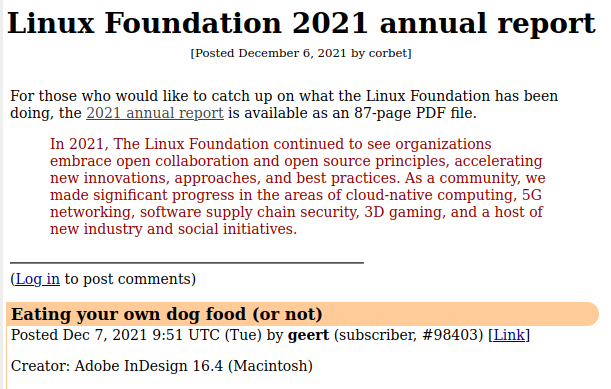
After last year's blunder with trying to hide the Adobe toolchain and using hilarious stock photos, the Linux Foundation did much better in their 2021 annual report1 published Dec. 6, 2021.
Still they are using the Adobe toolchain (InDesign, Acrobat PDF) and my fellow DebianKernel2 Developer Geert was quick to point that out as the first comment to the LWN note on the publication:
I think it is important to call the Linux Foundation (LF) out again and again. Adobe is a Silver member of the LF and they can motivate them to publish their applications for Linux. And if that is not an option, there are Free alternatives like Scribus that could well use the exposure and funds of LF to help catch up to the market leading product, Adobe InDesign.
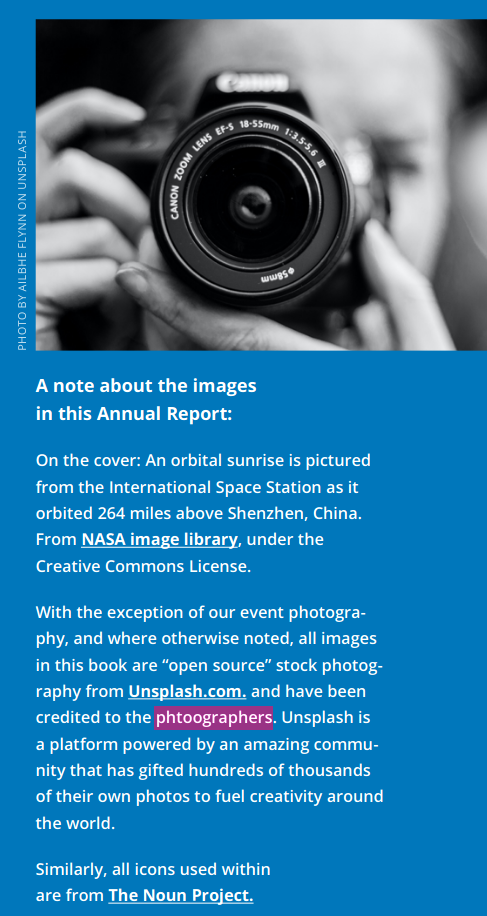
Personally, as a photographer, I am very happy they used stock images from Unsplash to illustrate the 2021 edition over the cringeworthy Shutterstock footage from last year's report.
And they gave proper credit:
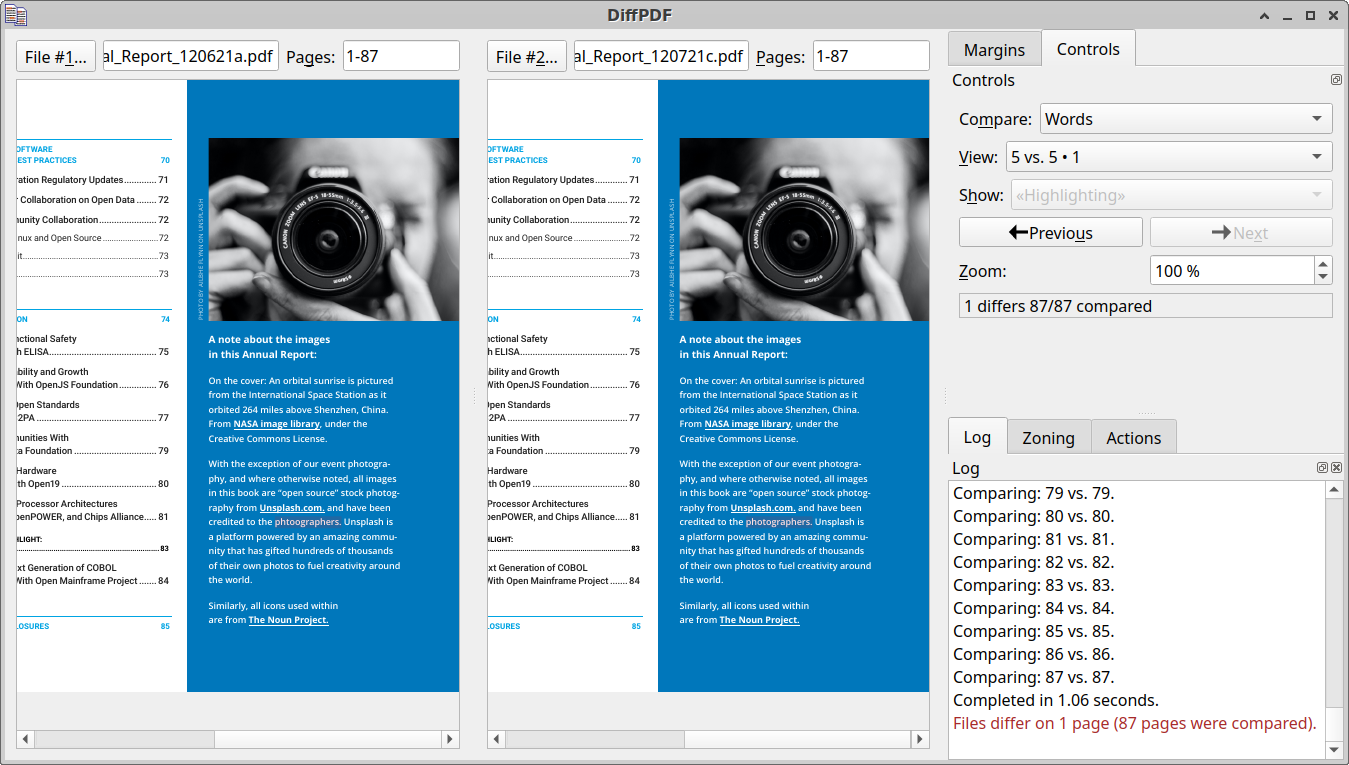
Now for next year ... find an editor that knows how to spell photographers, please. And consider Scribus. And make Adobe publish their apps for Linux. Thank you.
Update 07.12.2021 22:00 CET: I had to replace the link to the Linux Foundation 2021 annual report with an archive.org one as they updated the report to fix the typo as per the comment from Melissa Schmidt below. Stable URLs are not a thing, apparently. You can find their new report at https://www.linuxfoundation.org/wp-content/uploads/2021_LF_Annual_Report_120721c.pdf. Unless somebody points out more typos. There is a Last-Modified Header in HTTP 1.1. Wordpress, Varnish and Nginx, serving the LF website, all support that.
08.12.2021: Geert Uytterhoeven wrote in that he is "geert" on LWN, both are very nice Geert's but different Geert's :-)
The IBM i operating system on the AS/400 is a system that runs on PPC for midrange systems. I did a bit of reading about it after seeing an AS/400 on ebay for $300, if I had a lot more spare time and energy I might have put in a bid for that if it didn t look like it had been left out in the rain. It seems that AS/400 is not dead, there are cloud services available, here s one that provides a VM with 2GM of RAM for only EUR 251 monthly [1], wow. I m not qualified to comment on whether that s good value, but I think it s worth noting that a Linux VM running an AMD64 CPU with similar storage and the same RAM can be expected to cost about $10 per month.
There is also a free AS/400 cloud named pub400 [2], this is the type of thing I d do if I had my own AS/400.
Last week I attended the UK Systems Research
2021 conference in County Durham, my first
conference in nearly two years (since FOSDEM 2020,
right on the cusp of the Pandemic). The Systems conference community
is very pleasant and welcoming and so when I heard it was going to
take place "physically" again this year I was so keen to attend I
decided to hedge my bets and submit two talk proposals. I wasn't
expecting them both to be accepted
As well as the regular talks (more on those in another post) there is
a tradition for people to give short, impromptu lightning talks after
dinner on the second night. I've given two of these before, and I'd
been considering whether to offer to one this time or not, but with
two talks to deliver (and finish writing) I wasn't sure. Usually
people talk about something interesting that they have been doing
besides their research or day-jobs, but the last two years have been
somewhat difficult and I didn't really think I had a topic to talk
about. Then I wondered if that was a topic in itself
During the first day of the conference (and especially one I'd got
past one of my talks) I started to outline a lightning talk idea and
it seemed to come out well enough that I thought I'd give it a go.
Unusually I therefore had something written down and I was surprised
how well it was received, so I thought I'd share it. Here it is:
I was anticipating the lightning talks and being cajoled into talking
about something. I've done it twice before. So I've been racking my
brains to figure out if I've done anything interesting enough to talk
about.
in 2018 I talked about some hack I'd made to the classic computer game
Doom from 1993. I've done several hacks to Doom that I could probably
talk about except I've become a bit uncomfortable about increasingly
being thought of as "that doom guy". I'd been reflecting on why it was
that I continued to mess about with that game in the first place and I
realised it was a form of expression: I was treating Doom like a canvas.
I've spent most of my career thinking about what I do in the frame of
either science or engineering. I suffer from the creative urge and I've
often expressed (and sated) that through my work. And that's possible
because there's a craft in what we do.
In 2019 I talked about a project I'd embarked on to resurrect my
childhood computer, a Commodore Amiga 500, in order to rescue my
childhood drawings and digital paintings. (There's the artistic thing
again). I'd achieved that and I have ambitions to do some more Amiga
stuff but again that's a work in progress and there's nothing much to
talk about.
In recent years I've been thinking more and more about art and became
interested in the works and writings of people like Grayson Perry,
Laurie Anderson and Brian Eno. I first learned about Eno through his
music but he's also a visual artist. and a music producer. As a producer
in the 70s he co-invented a system to try and break out of writer's
block called "oblique strategies": A deck of cards with oblique
suggestions written on them. When you're stuck, you pull a card and it
might help you to reframe what you are working on and think about it in
a completely different way.
I love this idea and I think we should use more things like that in
software engineering at least.
So back to casting about for something to talk about. What have I been
doing in the last couple of years? Frankly, surviving - I've just about
managed to keep doing my day job, and keep working on the PhD, at home
with two young kids and home schooling and the rest of it. Which is an
achievement but makes for a boring lightning talk. But I'd like to say
that for anyone here who might have been worrying similarly: I think
surviving is more than enough.
I'll close on the subject of thinking like an artist and not an
engineer. I brought some of the Oblique Strategies deck with me and I
thought I'd draw a card to perhaps help you out of a creative dilemma if
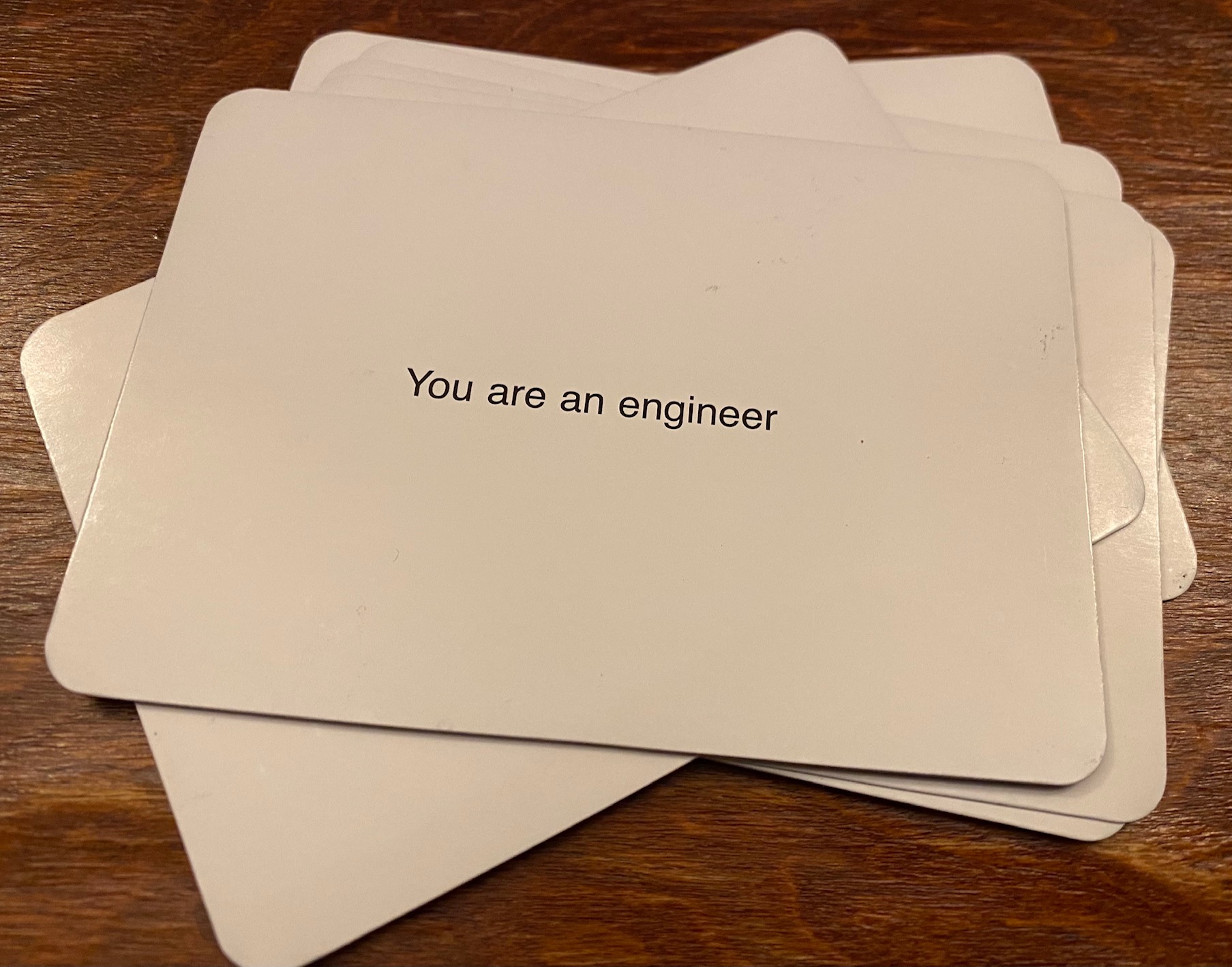
you're in one. And I kid you not, the first card I drew was this one:

 The problem is, everything goes chaotic at that point in the default configuration. The solution is to have quick shortcuts in my Dash to Dock (8) to both disable (10) and enable (9) keyboard and touchpad at a very rapid pace.It is to be noted that I m not disabling the touch screen (5) by default, because most of the time the cat is not leaning on it there is also the added benefit that if one forgets about the internal keyboard and touchpad disabling and detaches the laptop from the USB-C monitor (11), there s the possibility of using the touch screen and on-screen keyboard to type in the password and tap on the keyboard/touchpad enabling shortcut button again. If also touch screen was disabled, the only way would be to go back to an external keyboard or reboot.So here are the scripts. First, the disabling script (pardon my copy-paste use of certain string manipulation tools):
 Gaggia Classic 2015 and De Longhi grinder
 The Gaggia Classic 2015 group head
 Gaggia Classic 2015 vs 2019

 Gaggia Classic 2019 and Sage BCG600 Dose Control Pro
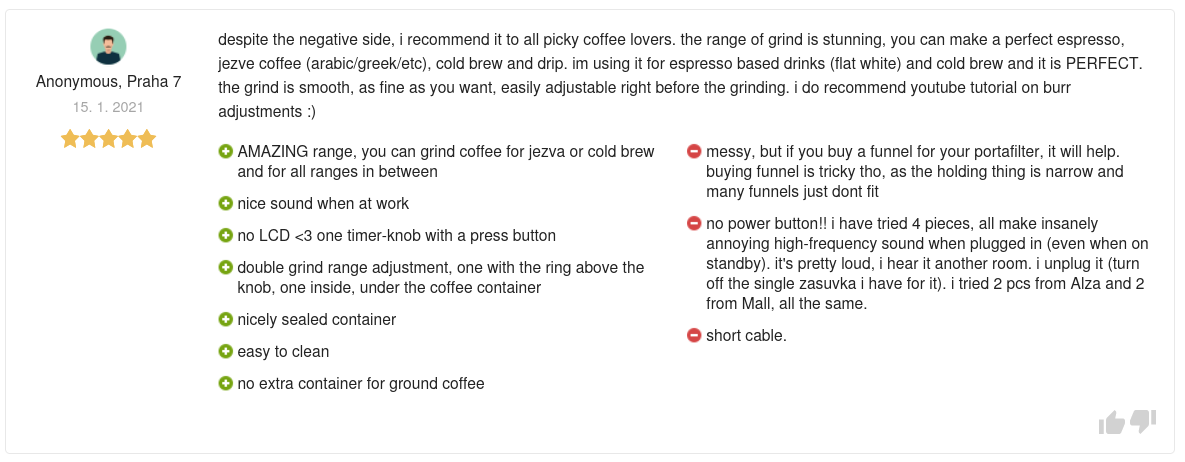 Happy with my new purchase, I went to read this review and thought to myself: lucky me, my grinder is absolutely quiet! And then I realised that
the noise in my kitchen is not, in fact, produced by the fridge, but the grinder. Well, a cheap switched plug solved the issue completely (I wish
sockets here each had a switch like they usually to in the UK!)

 As a follow on to a previous blog entry of mine,
 Updated my raspberry pi to bullseye and no longer connects to network. Seems like eth0 got renamed.
 A new package of mine arrived on
 (courtesy of the



 After
 Personally, as a photographer, I am very happy they used stock images from
 Now for next year ... find an editor that knows how to spell photographers, please. And consider Scribus. And make Adobe publish their apps for Linux. Thank you.
](https://jmtd.net/log/lightning/tweet.jpg)