Search Results: "ean"

9 June 2014

Dirk Eddelbuettel: Rcpp 0.11.2

A new minor release 0.11.2 of Rcpp is now on the CRAN network for GNU R, and binaries for Debian have also been uploaded. The release smoothes a few edges on both the Rcpp side itself, as well as on the interaction between Rcpp and R which since release 3.1.0 offers a few new features related to C++11. Kevin added a couple of neat extensions related to vectors, a new ListOf templated list class, as well as a new option to warn on implicit casts. We decided not to make this option the default as it may be too common in some packages. JJ took care of a few buglets related to the wonderful Rcpp Attributes. See the NEWS file section below for details, or the ChangeLog file in the package and on the Rcpp Changelog page. Note that the diffstat reported by CRANberries is very large as Kevin also committed a whitespace cleanup which touched almost all files. As before, we tested this release by building against all CRAN packages which depend upon Rcpp. In fact we did three such runs leading up to the release. Only one package was blacklisted (as I currently don't have CUDA set-up), two had what may be internal errors or tests which were too restrictive, sixteen suffered from missing packages or RGL devices --- but the remaining 202 packages all built and tested cleanly. Detailed results of those tests (and the scripts for it) are in the rcpp-logs repo GitHub. There are a number of other fixes, upgrades and other extensions detailed in NEWS file extract below, in the ChangeLog file in the package and on the Rcpp Changelog page.
Changes in Rcpp version 0.11.2 (2014-06-06
  • Changes in Rcpp API:
    • Implicit conversions, e.g. between NumericVector and IntegerVector, will now give warnings if you use #define RCPP_WARN_ON_COERCE before including the Rcpp headers.
    • Templated List containers, ListOf<T>, have been introduced. When subsetting such containers, the return is assumed to be of type T, allowing code such as ListOf<NumericVector> x; NumericVector y = x[0] + x[1] + x[2].
    • In a number of instances, returned results are protected and/or cast more carefully.
  • Changes in Rcpp Attributes
    • Trailing line comments are now stripped by the attributes parser. This allows the parser to handle C++ source files containing comments inline with function arguments.
    • The USE_CXX1X environment variable is now defined by the cpp11 plugin when R >= 3.1. Two additional plugins have been added for use with C++0x (eg when using g++ 4.6.* as on Windows) as well as C++1y for compilers beginning to support the next revision of the standard; additional fallback is provided for Windows.
    • compileAttributes() now also considers Imports: which may suppress a warning when running Rcpp.package.skeleton().
Thanks to CRANberries, you can also look at a diff to the previous release. As always, even fuller details are on the Rcpp Changelog page and the Rcpp page which also leads to the downloads, the browseable doxygen docs and zip files of doxygen output for the standard formats. A local directory has source and documentation too. Questions, comments etc should go to the rcpp-devel mailing list off the R-Forge page

This post by Dirk Eddelbuettel originated on his Thinking inside the box blog. Please report excessive re-aggregation in third-party for-profit settings.

8 June 2014

Paul Tagliamonte: adventures in android

I ve been learning about android development over the last few weeks, and I think I m slowly getting the hang of best practices. It s a bit tough, there s a lot of stuff that s not super Java-idomatic that s become Android-idiomatic, so getting over that stuff has been interesting. I ve been finding that Android tends to re-implement most things in a similar enough way, but always with some small tweak that feels kinda funny. It s working well enough, and I m hoping that I can clean up a few android libraries to deal with some of the OpenGov datasets I m interested in. If anyone has any tips on proper handling of what to make a fragment, and what activities should look like, I d really love posts about that. It seems like sometimes I have a 1-to-1 mapping of Fragments to Activity, but I want to keep it a fragment for large devices. Anyway, best practices welcome.

Wouter Verhelst: Is Debian non-free?

According to the Free Software Foundation, the Debian distribution is not a Free System Distribution. While I, as a Debian Developer, disagree with that point of view, it should be obvious that the opinion of an organization that engages in politics (or, at the very least, in political lobbying) and of which I am not a member should not be my concern. However, it has long irked me the wrong way that these claims exist. A few weeks ago, I found the System distribution commitments page on Wikipedia. This does change the situation somewhat; I cannot say that a page explaining an opinion of the FSF is wrong; but if that opinion is copied nearly verbatim to a website which claims neutrality as one of its "Core content policies", then the situation is significantly different. When I originally found that page, it was immediately obvious where the content came from, but there was no reference listed, so I added a "citation needed" tag, the first time I ever did so on Wikipedia. Now, a few weeks later, a reference has been added, and the "citation needed" tag removed. However, as expected, the only reference which has been added is the highly opinionated document on the FSF's website, which is hardly neutral. I've added another tag (this time a "which" tag, asking for more clarification) and added a Talk page listing my concerns with the article. But I can't really explain in Wikipedia why I think the whole premise is wrong; that's what a blog is for. So, here goes. The FSF lists two reasons why they do not endorse Debian:
  1. The non-free and contrib repositories
  2. An unsubstantiated claim that "the installer in some cases recommends [...] non-free firmware files for the peripherals on the machine."
Let's have a look at them, each in turn.

Non-free and contrib It is true that Debian provides non-free software in separate repositories, and that software in these repositories does not comply with either the Debian Free Software Guidelines (DFSG) or the FSF's Free Software Definition. However, the non-free and contrib repositories are fairly small:
wouter@carillon:/var/lib/apt/lists$ awk -F':' 'BEGIN total=0 /^Size/ total+=$2 END print total ' ftp.be.debian.org_debian_dists_sid_non-free_binary-amd64_Packages
4398812934
That is, the non-free repository contains just over 4G of software (after installation). Contrib is even smaller:
wouter@carillon:/var/lib/apt/lists$ awk -F':' 'BEGIN total=0 /^Size/ total+=$2 END print total ' ftp.be.debian.org_debian_dists_sid_contrib_binary-amd64_Packages 
306578636
While, combined, this is approximately the same size as some other distributions, free and non-free together, it pales in comparison with the "main" repository:
wouter@carillon:/var/lib/apt/lists$ awk -F':' 'BEGIN total=0 /^Size/ total+=$2 END print total ' ftp.be.debian.org_debian_dists_sid_main_binary-amd64_Packages
60025033622
i.e., the "main" repository contains just shy of 60G of software. Of course, whether non-free is large or not should not matter at all; the fact that it exists in the first place is a problem for free software advocates. But of those 4 gigabytes, what exactly is the non-free repository used for? For that, the Debian popularity contest has a page specifically for the non-free section. Looking at this page, and ignoring the packages that are listed as "Not in sid" (which either means they were installed from third-party suppliers and therefore cannot be attributed to Debian, or were only available in older distributions so should not be held against the Debian of today anymore), we see three main uses of non-free:
  1. Various implementations of non-free algorithms (unrar, libfaac0, etc)
  2. A lot of packages containing non-free firmware
  3. A number of packages containing non-free documentation
The first package which does not fit any of those descriptions is iozone3, currently on the 64th position of the popularity contest (including packages "Not in sid"). The first item in this list is something which most free software advocates will try to avoid. After all, for all of those algorithms, alternatives exist, and so there is no real reason why one would want to use such software, other than "someone sent me a file encoded according to that algorithm, and I want to decode it". Debian gives you the option to do so, but a valid case could be made for not doing so. The second item in that list is really an alternate version of "the installer recommends non-free software", so I'll come back on that in the next section. The 3rd item in the above list deserves some special attention. Just over 10 years ago, Debian clarified its position where it clearly specified that documentation and programs (as both are interpreted as "software") should follow the same set of guidelines regarding freedom. The FSF disagrees with this position, and chose to release some of its documentation under the GFDL with invariant sections, which Debian decided is a non-free license in 2006. Since then, such GNU documentation would no longer be available were Debian to ditch the non-free repository.

Recommending non-free firmware As I said above, the FSF's page claims that the Debian installer recommends non-free firmware "in some cases", without going into much detail. Special care should be taken in understanding the word "recommend" here; wiktionary defines it as follows:
recommend (third-person singular simple present recommends, present participle recommending, simple past and past participle recommended)
  1. (transitive) To bestow commendation on; to represent favourably; to suggest, endorse or encourage as an appropriate choice.
The board recommends Philips, given his ample experience in similar positions.
  1. (transitive) To make acceptable; to attract favor to.
  2. (transitive) To advise, propose, counsel favorably
The therapist recommends resting the mind and exercising the body.
  1. (transitive, archaic) To commit, confide to another's care, confidence or acceptance, with favoring representations
A medieval oblate's parents recommended the boy for life to God and the monastery
However, according to the FSF, merely showing a firmware filename in unencrypted form counts as a recommendation. I've always found that use of the word "recommendation" to be dubious, at best. Ignoring that part, we can make the following observations: The debian-installer module ("udeb") which is responsible for configuring apt is called apt-mirror-setup (code in the apt-setup git repository). The actual debconf templates which allow the user to enable the non-free or contrib repositories are the apt-setup/non-free and apt-setup/contrib templates, and they look like this:
Template: apt-setup/non-free
Type: boolean
Default: false
# :sl1:
_Description: Use non-free software?
 Some non-free software has been made to work with Debian. Though this
 software is not at all a part of Debian, standard Debian tools can be used
 to install it. This software has varying licenses which may prevent you
 from using, modifying, or sharing it.
 .
 Please choose whether you want to have it available anyway.
Template: apt-setup/contrib
Type: boolean
Default: false
# :sl1:
_Description: Use contrib software?
 Some additional software has been made to work with Debian. Though this
 software is free, it depends on non-free software for its operation. This
 software is not a part of Debian, but standard Debian tools can be
 used to install it.
 .
 Please choose whether you want this software to be made available to you.
Note the lines Default: false, which imply that the default answer to these questions is to disable the non-free and contrib repositories. A question which defaults to false isn't a recommendation, nor do I read the text as any form of recommendation to install these repositories (quite the contrary, in fact). More important than whether the default is to enable or disable these repositories is whether this question is even shown to the user in normal installations. Whether this is the case isn't decided by any template; instead, it is decided by the code that calls the templates. That code currently looks like this:
STATE=1
while true; do
        case "$STATE" in
            1)
                db_input low apt-setup/non-free   true
                ;;
            2)
                # If they chose not to use non-free, ask about
                # contrib, with a default of no. If they chose to
                # use non-free, they get contrib too..
                db_get apt-setup/non-free
                if [ "$RET" = false ]; then
                        db_fget apt-setup/contrib seen
                        if [ "$RET" = false ]; then
                                db_set apt-setup/contrib false
                        fi
                        db_input low apt-setup/contrib   true
                else
                        db_fget apt-setup/contrib seen
                        if [ "$RET" = false ]; then
                                db_set apt-setup/contrib true
                        fi
                fi
                ;;
            *)
                break
                ;;
        esac
        if db_go; then
                STATE=$(($STATE + 1))
        else
                STATE=$(($STATE - 1))
        fi
done
Note the "low" in the db_input lines; it means the question is only shown at low priority, i.e., in "expert" mode. The result is that, unless you enable expert mode, you won't even see the question about the non-free repository, and it will be disabled by default. There won't even be any mention of it in your sources.list file. Of course, the above isn't about firmware files, which is what the FSF website claims. So, there is a second part to this story. If you run a system with hardware for which there is a non-free firmware package in the non-free repository, and you provided firmware for this hardware to the installer through various means, then the hw-detect module comes into play. This has code which currently looks like this:
# install cached firmware debs
if [ -d /var/cache/firmware ]; then
    for deb in /var/cache/firmware/*.deb; do
            if [ -f "$deb" ]; then
                    cp -a "$deb" /target/tmp
                    # TODO debconf passthrough
                    if ! in-target dpkg -i "/tmp/$(basename "$deb")"; then
                            # dpkg failed, force removal of package
                            in-target dpkg --force-depends --remove "$(deb_package "$deb")"   true
                    fi
                    rm -f "/target/tmp/$deb"
                    need_nonfree=1
            fi
    done
fi
if [ "$need_nonfree" ]; then
    db_set apt-setup/non-free true
fi
As can bee seen, if any firmware .deb files exist under /var/cache/firmware in the installer environment, then these will be installed on the target system and default answer to the apt-setup/non-free question will be changed to enable the non-free repository. How do such packages end up there? Well, that's done by the same hw-detect udeb, in a different script. The code there is a bit too long to quote in this already far too long blog post, but it boils down to:
  • If the installer detects missing firmware, the user is asked whether (s)he wants to install firmware, with the following template:
    Template: hw-detect/load_firmware
    Type: boolean
    Default: true
    # :sl2:
    _Description: Load missing firmware from removable media?
     Some of your hardware needs non-free firmware files to operate. The
     firmware can be loaded from removable media, such as a USB stick or
     floppy.
     .
     The missing firmware files are: $ FILES 
     .
     If you have such media available now, insert it, and continue.
    
  • If the user agreed to doing so (and to me, the above template does not read as a recommendation), any firmware .deb files that are provided to the installer are tested for the missing firmware files.
  • If any of those files are found, these .deb files are copied to the /var/cache/firmware directory, and the firmware files are made available to the running kernel.

Conclusion In my opinion, while some of the claims on the FSF website are correct, others are at the very least misleading. Debian does not recommend the use of non-free software; and while providing non-free firmware to the installer isn't too difficult, it isn't documented very well; and as such installing a system with non-free enabled isn't something you can easily do by accident. Debian and the FSF clearly disagree on certain things, and this disagreement, not any policies by the Debian project, is the main reason why the FSF won't encourage Debian as a free distribution. I don't think the Debian project will easily agree to get rid of the non-free repository while the FSF still produces non-free documentation or while non-free firmware is still a fact of life in this world. However, I do think the following should happen:
  1. The FSF should relicense its non-free documentation so it becomes truly free.
  2. Once that has happened, Debian should rename its non-free repository to a "hardware-support" repository (or something along those lines), and remove everything that does not exist solely for the support of proprietary hardware (i.e., non-free drivers, non-free firmware, etc).
  3. The installer could be clearer on the fact that if non-free firmware is found to be in use for the system, the user is using software that cannot be properly supported by the Debian project.
While the above wouldn't necessarily bring the opinions of the FSF and Debian 100% in line, it would at least bring their positions closer to eachother. Unfortunately, however, I doubt that this will happen; and that's a shame, because in the end, both Debian and the FSF want the same thing: a world where Free Software is the norm, not the exception.

Update
  • The first version of this text said that providing firmware is not very easy. As was pointed out to me, it isn't too hard, but it's not very well documented and not part of the 'regular' installer images.
  • Add contrib too, when we compare non-free and main
  • Clarify when GFDL is non-free

7 June 2014

Vasudev Kamath: Exposing function in python module using entry_points, WSME in a Flask webapp

The heading might be ambiguous, but I couldn't figure out better heading so let me start by explaining what I'm trying to solve here.
Problem I have a python module which contains a function which I want to expose as a REST web service in a Flask application. I use WSME for Flask application, which actually needs signature of function in question and problem comes to picture because function to be exposed is foreign to Flask application, it resides in separate python module.
Solution While reading Julien Danjou's Hackers Guide To Python book I came across the setuptools entry_points concept which can be used to extend existing feature of a tool like plug-ins. So here I'm going to use this entry_points feature from setuptools to provide function in the module which can expose the signature of function[s] to be exposed through REST. Of course this means I need to modify module in question to write entry_points and function for giving out signature of function to be exposed. I will explain this with small example. I have a dummy module which provides a add function and a function which exposes the add functions signature.
def add(a, b):
    return a + b
def expose_rest_func():
    return [add, int, int, int]
This is stored in dummy/__init__.py file. I use pbr tool to package my python module. Below is content of setup.cfg file.
[metadata]
name = dummy
author = Vasudev Kamath
author-email = kamathvasudev@gmail.com
summary = Dummy module for testing purpose
version = 0.1
license = MIT
description-file =
  README.rst
requires-python = >= 2.7
[files]
packages =
  dummy
[entry_points] =
myapp.api.rest =
  rest = dummy:expose_rest_func
The special thing in above file is entry_points section, which defines function to be hooked into entry_point. In our case entry_point myapp.api.rest is used by our Flask application to interact with modules which expose them. The function which will be got accessing the entry_point is expose_rest_func which gives the function to be exposed its arg types and return types as a list. If we are looking at only supporting python3 it was sufficient to know function name only and use function annotations in function definition. Since I want to support both python2 and python3 this is out of question. Now, just run the following command in virtualenv to get the module installed.
PBR_VERSION=0.1 python setup.py sdist
pip install dist/dummy_module-0.1.tar.gz
Now if you want to see if the module is exposing entry_point or not just use entry_point_inspector tool after installing you will get a command called epi if you run it as follows you should note the dummy_module in its output
epi group list
+-----------------------------+
  Name                         
+-----------------------------+
  cliff.formatter.completion   
  cliff.formatter.list         
  cliff.formatter.show         
  console_scripts              
  distutils.commands           
  distutils.setup_keywords     
  egg_info.writers             
  epi.commands                 
  flake8.extension             
  setuptools.file_finders      
  setuptools.installation      
  myapp.api.rest               
  stevedore.example.formatter  
  stevedore.test.extension     
  wsme.protocols               
+-----------------------------+
So our entry_point is exposed now, we need to access it in our Flask application and expose the function using WSME. It is done by below code.
from wsmeext.flask import signature
import flask
import pkg_resources
def main():
   app = flask.Flask(__name__)
   app.config['DEBUG'] = True
   for entrypoint in pkg_resources.iter_entry_points('myapp.api.rest'):
       # Ugly but fix is only supporting python3
       func_signature = entrypoint.load()()
       app.route('/' + func_signature[0].__name__, methods=['POST'])(
           signature(func_signature[-1],
               *func_signature[1:-1])(func_signature[0]))
   app.run()
if __name__ == '__main__':
    main()
entry_point myapp.api.rest are iterated using the pkg_resources package provided by setuptools, when I load the entry_point I get back the function to be used which is called in same place to get function signature. Then I'm calling Flask and WSME decorator functions (yeah instead of decorating I'm using them directly over function to be exposed). The code looks bit ugly at the place where I'm accessing list using slices but I can't help it due to limitation of python2 with python3 there is new packing and unpacking stuff which makes code look bit more cooler see below.
from wsmeext.flask import signature
import flask
import pkg_resources
def main():
    app = flask.Flask(__name__)
    app.config['DEBUG'] = True
    for entrypoint in pkg_resources.iter_entry_points('silpa.api.rest'):
        func, *args, rettype = entrypoint.load()()
        app.route('/' + func.__name__, methods=['POST'])(
        signature(rettype, *args)(func_signature[0]))
    app.run()
if __name__ == '__main__':
    main()
You can access the service at http://localhost:5000/add depending on Accept header of HTTP you will get either XML or JSON response. If you access it from browser you will get XML response.
Usecase Now if you are wondering what is the reason behind this experience, this is for SILPA Project. I'm trying to implement REST service for all Indic language computing module. Since all these module are independent of SILPA which is a Flask web app I had to find a way to achieve this, and this is what I came up with.
Conclusion I'm not sure if there is any other approaches to achieve this, if there I would love to hear about them. You can write your comments and suggestion over email

Craig Small: A python utf gotcha

This one had me stumped for a while:
# -*- coding: utf-7 -*-
import datetime
from sqlalchemy import ForeignKey, Column
from sqlalchemy.types import Integer, Unicode, Boolean, DateTime
 
default_due_date = datetime.datetime.now() + datetime.timedelta(days=30)
Syntax error found on last line. Hmm, bring up a python interpreter and type the last line in with the imports. Works fine. It s the first line that is the problem, I typoed it and made it utf-7 not utf-8. I suppose it means that it is case-insenstive. Still, it wasn t too clear to me at least, what was going on.

6 June 2014

Rhonda D'Vine: No Portland

This year's debconf in portland will happen without me being there. As much as I would love to be at home again, I won't be able to afford it. As much as I'd liked to help to keep portland weird, a discussion led to the feeling that I'm not welcome there and along that lines made me miss the deadline for sponsorship request due to not being very motivated to push for it because of that. And without sponsorship I won't be able to afford it, given that I need to save up for my upcoming move. This also means I won't be able to host the Poetry Night. I hope that someone will be picking up that ball and continue it. Personally I am more motivated than ever to start writing again, given that there is currently a Bus Bim Slam (Bus Tram Slam) happening over here in Vienna and I try to attend as much stations as possible, and there will be a Diary Slam during this year's FemCamp Vienna.
I'm indifferent on whether the Debconf Poetry Night should be recorded or not. On the one hand it would be great to see people performing, on the other hand it might shy away certain personal poems that one wouldn't want to have out in the wild. Whoever picks it up, think about that part. I wish everyone luck in Portland, and I'm looking forward to yet another great job by the video team so I can follow a few talks from at home. It sort of breaks my heart to not be able to hug you lot this year, and I wish you a great conference. We'll meet again next year in Heidelberg!

/debian permanent link Comments: 3 Flattr this

Gunnar Wolf: What defines an identity?

I must echo John Sullivan's post: GPG keysigning and government identification. John states some very important reasons for people everywhere to verify the identities of those parties they sign GPG keys with in a meaningful way, and that means, not just trusting government-issued IDs. As he says, It's not the Web of Amateur ID Checking. And I'll take the opportunity to expand, based on what some of us saw in Debian, on what this means. I know most people (even most people involved in Free Software development not everybody needs to join a globally-distributed, thousand-people-strong project such as Debian) are not that much into GPG, trust keyrings, or understand the value of a strong set of cross-signatures. I know many people have never been part of a key-signing party. I have been to several. And it was a very interesting experience. Fun, at the beginning at least, but quite tiring at the end. I was part of what could very well constitute the largest KSP ever in DebConf5 (Finland, 2005). Quite awe-inspiring We were over 200 people, all lined up with a printed list on one hand, our passport (or ID card for EU citizens) in the other. Actwally, we stood face to face, in a ribbon-like ring. And, after the basic explanation was given, it was time to check ID documents. And so it began. The rationale of this ring is that every person who signed up for the KSP would verify each of the others' identities. Were anything fishy to happen, somebody would surely raise a voice of alert. Of course, the interaction between every two people had to be quick More like a game than like a real check. "Hi, I'm #142 on the list. I checked, my ID is OK and my fingerprint is OK." "OK, I'm #35, I also printed the document and checked both my ID and my fingerprint are OK." The passport changes hands, the person in front of me takes the unique opportunity to look at a Mexican passport while I look at a Somewhere-y one. And all is fine and dandy. The first interactions do include some chatter while we grab up speed, so maybe a minute is spent Later on, we all get a bit tired, and things speed up a bit. But anyway, we were close to 200 people That means we surely spent over 120 minutes (2 full hours) checking ID documents. Of course, not all of the time under ideal lighting conditions. After two hours, nobody was checking anything anymore. But yes, as a group where we trust each other more than most social groups I have ever met, we did trust on others raising the alarm were anything fishy to happen. And we all finished happy and got home with a bucketload of signatures on. Yay! One year later, DebConf happened in Mexico. My friend Martin Krafft tested the system, perhaps cheerful and playful in his intent but the flaw in key signing parties such as the one I described he unveiled was huge: People join the KSP just because it's a social ritual, without putting any thought or judgement in it. And, by doing so, we ended up dilluting instead of strengthening our web of trust. Martin identified himself using an official-looking ID. According to his recount of the facts, he did start presenting a German ID and later switched to this other document. We could say it was a real ID from a fake country, or that it was a fake ID. It is up to each person to judge. But anyway, Martin brought his Transnational Republic ID document, and many tens of people agreed to sign his key based on it Or rather, based on it plus his outgoing, friendly personality. I did, at least, know perfectly well who he was, after knowing him for three years already. Many among us also did. Until he reached a very dilligent person, Manoj, that got disgusted by this experiment and loudly denounced it. Right, Manoj is known to have strong views, and using fake IDs is (or, at least, was) outside his definition of fair play. Some time after DebConf, a huge thread erupted questioning Martin's actions, as well as questioning what do we trust when we sign an identity document (a GPG key). So... We continued having traditional key signing parties for a couple of years, although more carefully and with more buzz regarding these issues. Until we finally decided to switch the protocol to a better one: One that ensures we do get some more talk and inter-personal recognition. We don't need everybody to cross-sign with everyone else A better trust comes from people chatting with each other and being able to actually pin-point who a person is, what do they do. And yes, at KSPs most people still require ID documents in order to cross-sign. Now... What do I think about this? First of all, if we have not ever talked for at least enough time for me to recognize you, don't be surprised: I won't sign your key or request you to sign mine (and note, I have quite a bad memory when it comes to faces and names). If it's the first conference (or social ocassion) we come together, I will most likely not look for key exchanges either. My personal way of verifying identities is by knowing the other person. So, no, I won't trust a government-issued ID. I know I will be signing some people based on something other than their name, but hey I know many people already who live pseudonymously, and if they choose for whatever reason to forgo their original name, their original name should not mean anything to me either. I know them by their pseudonym, and based on that pseudonym I will sign their identities. But... *sigh*, this post turned out quite long, and I'm not yet getting anywhere ;-) But what this means in the end is: We must stop and think what do we mean when we exchange signatures. We are not validating a person's worth. We are not validating that a government believes who they claim to be. We are validating we trust them to be identified with the (name,mail,affiliation) they are presenting us. And yes, our signature is much more than just a social rite It is a binding document. I don't know if a GPG signature is legally binding anywhere (I'm tempted to believe it is, as most jurisdictions do accept digital signatures, and the procedure is mathematically sound and criptographically strong), but it does have a high value for our project, and for many other projects in the Free Software world. So, wrapping up, I will also invite (just like John did) you to read the E-mail self-defense guide, published by the FSF in honor of today's Reset The Net effort.

5 June 2014

Johannes Schauer: botch updates

My last update about ongoing development of botch, the bootstrap/build ordering tool chain, was four months ago and about several incremental updates. This post will be of similar nature. The most interesting news is probably the additional data that bootstrap.debian.net now provides. This is listed in the next section. All subsequent sections then list the changes under the hood that made the additions to bootstrap.debian.net possible.

bootstrap.debian.net The bootstrap.debian.net service used to have botch as a git submodule but now runs botch from its Debian package. This at least proves that the botch Debian package is mature enough to do useful stuff with it. In addition to the bootstrapping results by architecture, bootstrap.debian.net now also hosts the following additional services: Further improvements concern how dependency cycles are now presented in the html overviews. While before, vertices in a cycle where separated by commas as if they were simple package lists, vertices are now connected by unicode arrows. Dashed arrows indicate build dependencies while solid arrows indicate builds-from relationships. For what it's worth, installation set vertices now contain their installation set in their title attribute.

Debian package Botch has long depended on features of an unreleased version of dose3 which in turn depended on an unrelease version of libcudf. Both projects have recently made new releases so that I was now able to drop the dose3 git submodule and rely on the host system's dose3 version instead. This also made it possible to create a Debian package of botch which currently sits at Debian mentors. Writing the package also finally made me create a usable install target in the Makefile as well as adding stubs for the manpages of the 44 applications that botch currently ships. The actual content of these manpages still has to be written. The only documentation botch currently ships in the botch-doc package is an offline version of the wiki on gitorious. The new page ExamplesGraphs even includes pictures.

Cross By default, botch analyzes the native bootstrapping phase. That is, assume that the initial set of Essential:yes and build-essential packages magically exists and find out how to bootstrap the rest from there through native compilation. But part of the bootstrapping problem is also to create the set of Essential:yes and build-essential packages from nothing via cross compilation. Botch is unable to analyze the cross phase because too many packages cannot satisfy their crossbuild dependencies due to multiarch conflicts. This problem is only about the dependency metadata and not about whether a given source package actually crosscompiles fine in practice. Helmut Grohne has done great work with rebootstrap which is regularly run by jenkins.debian.net. He convinced me that we need an overview of what packages are blocking the analysis of the cross case and that it was useful to have a crossbuild order even if that was a fake order just to have a rough overview of the current situation in Debian Sid. I wrote a couple of scripts which would run dose-builddebcheck on a repository, analyze which packages fail to satisfy their crossbuild dependencies and why, fix those cases by adjusting package metadata accordingly and repeat until all relevant source packages satisfy their crossbuild dependencies. The result of this can then be used to identify the packages that need to be modified as well as to generate a crossbuild order. The fixes to the metadata are done in an automatic fashion and do not necessarily reflect the real fix that would solve the problem. Nevertheless, I ended up agreeing that it is better to have a slightly wrong overview than no overview at all.

Minimizing the dependency graph size Installation sets in the dependency graph are calculated independent from each other. If two binary packages provide A, then dependencies on A in different installation sets might choose different binary packages as providers of A. The same holds for disjunctive dependencies. If a package depends on A C and another package depends on C A then there is no coordination to choose C so to minimize the overall amount of vertices in the graph. I implemented two methods to minimize the impact of cases where the dependency solver has multiple options to satisfy a dependency through Provides and dependency disjunctions. The first method is inspired by Helmut Grohne. An algorithm goes through all disjunctive binary dependencies and removes all virtual packages, leaving only real packages. Of the remaining real packages, the first one is selected. For build dependencies, the algorithm drops all but the first package in every disjunction. This is also what sbuild does. Unfortunately this solution produces an unsatisfiable dependency situation in most cases. This is because oftentimes it is necessary to select the virtual disjunctive dependency because of a conflict relationship introduced by another package. The second method involves aspcud, a cudf solver which can optimize a solution by a criteria. This solution is based on an idea by Pietro Abate who implemented the basis for this idea back in 2012. In contrast to a usual cudf problem, binary packages now also depend on the source packages they build from. If we now ask aspcud to find an installation set for one of the base source packages (I chose src:build-essential) then it will return an installation set that includes source packages. As an optimization criteria the number of source packages in the installation set is minimized. This solution would be flawless if there were no conflicts between binary packages. Due to conflicts not all binary packages that must be coinstallable for this strategy to work can be coinstalled. The quick and dirty solution is to remove all conflicts before passing the cudf universe to aspcud. But this also means that the solution does sometimes not work in practice.

Test cases Botch now finally has a test target in its Makefile. The test target tests two code paths of the native.sh script and the cross.sh script. Running these two scripts covers testing most parts of botch. Given that I did lots of refactoring in the past weeks, the test cases greatly helped to assure that I didnt break anything in the process. I also added autopkgtests to the Debian packaging which test the same things as the test target but naturally run the installed version of botch instead. The autopkgtests were a great help in weeding out some lasts bugs which made botch depend on being executed from its source directory.

Python 3 Reading the suggestions in the Debian python policy I evaluated the possibility to use Python 3 for the Python scripts in botch. While I was at it I added transparent decompression for gzip, bz2 and xz based on the file magic, replaced python-apt with python-debian because of bug#748922 and added argparse argument parsing to all scripts. Unfortunately I had to find out that Python 3 support does not yet seem to be possible for botch for the following reasons:
  • no soap module for Python 3 in Debian (needed for bts access)
  • hash randomization is turned on by default in Python 3 and therefore the graph output of networkx is not deterministic anymore (bug#749710)
Thus I settled for changing the code such that it would be compatible with Python 2 as well as with Python 3. Because of the changed string handling and sys.stdout properties in Python 3 this proved to be tricky. On the other hand this showed me bugs in my code where I was wrongly relying on deterministic dictionary key traversal.

4 June 2014

Russell Coker: Android Device Service Life

In recent years Android devices have been the most expensive things I ve purchased apart from airline tickets and other travel/holiday expenses. As they are expensive I d like to use them for as long as possible to get the most value for money. Also as I give my devices to relatives when they no longer work for me I d like to avoid having relatives hassling me about their phone not working as desired. So I ve been thinking about the features that I need to make it possible to use a phone or tablet for a long time. RAM The way Android works is that when an application in the foreground requests more memory background applications may be closed to free some memory. Android doesn t use swap by default, there is some documentation on how to enable it (and it s not difficult to figure out for anyone who has used Linux before) but generally it s not done. If you run a larger application the chances of apps closing in the background (causing delays when you switch back to them and possibly a loss of context if the app is buggy and doesn t preserve all state) are increased. As a general trend apps tend to get bigger to provide more features and also because users who own newer bigger devices don t complain as much about memory use. Also to make things worse new versions of Android tend to use more RAM. So a phone that runs well can suddenly start performing badly when you upgrade to a new version of Android (which incidentally usually can t be reversed) and upgrade to new versions of apps (which can t be reversed through the Google Play Store). The Sony Ericsson Xperia X10 was a very nice phone when it was released, it ran Android 2.1 very quickly. When I upgraded the Xperia X10s that my wife and I used to Android 2.3 (which was necessary to have the phone run as a Wifi access point) performance dropped considerably. The Android upgrade combined with newer larger apps means that those phones are barely usable now. 384M of RAM was plenty in early 2011 when I first used the Xperia X10 but it s not nearly enough now. Recently 2G of RAM has been the minimum for a mid-range or high-end phone. It seems difficult to imagine a new Android feature as compelling as the addition of Wifi access point support in Android 2.3 that would drive an upgrade to a future memory hogging version of the OS. It also seems difficult to imagine Android apps needing enough memory to destroy the performance of a phone with 2G of RAM. But then I couldn t imagine the 384M in an Xperia X10 becoming inadequate or the 512M in a Samsung Galaxy S becoming barely usable either. Storage Until fairly recently storage in an Android device was divided into USB attached storage (a VFAT filesystem that could be directly mounted on a PC) and a Linux filesystem that was used for all internal operations of the phone. On such devices it typically wasn t possible to change partition sizes without a lot more skill than most users possess and most of the storage space was reserved for USB attachment. If you only had a few Android apps and lots of photos, movies, etc then this worked well. But if you wanted to install larger Android apps then you would have big problems. Even with Android 4.x devices (which all seem to have a single filesystem) you can easily run out of space. Modern games often take several hundred megs of storage. Games that take 500M+ for the Android package install (which also requires the same amount of temporary space for installation and upgrade) are common. Sometimes games download data files after they have been installed for a total size approaching 2G (such as The Sims Freeplay). When I bought a Nexus 4 for my wife I got the version with 8G of storage because paying an extra $50 for the 16G version seemed unreasonable. 8G was fine for my wife, but when she got a new phone I gave the Nexus 4 to a relative who wanted to play The Sims and other big games. That relative isn t so happy about having a limited number of games on their phone and I have to fix it when storage space runs out and things start aborting (when storage runs out the Google App Store program aborts and uses lots of space for temporary files). I recently bought a tablet with 32G of storage and filled 16G on the first day (tablets are good for watching
TV and TV shows are big). Fortunately the tablet in question has a SD socket so that when space becomes a problem in a year or two I can buy an SD card and keep using it. An unfortunate recent decision by Google was to prevent apps from being run from a SD card. So even if you have a device with a SD socket you still need to have enough internal storage for all apps and their private data. At 500M+ for a modern game that means a device with 8G of storage (which includes space for the OS) will be lucky to get 8 games installed. If you want to use a phone to it s full capacity (playing various media files, games, etc) then it seems that the minimum storage capacity would be 8G of internal storage and a SD socket. For a device without an SD socket (such as the Nexus 5 with 16G or 32G of storage) your future use will be limited. 32G is probably enough for a phone given that you can recode movies to use less space (the FullHD screen on the Nexus 5 is nice but 720p movies will probably look good enough). But the larger screens of tablets demand better video quality so the Nexus tablets are probably a bad choice due to lack of storage space. Screen Size and Resolution I have previously written about the sizes of devices and how they may be used by people of various ages [1]. That should be of use for anyone who plans to use their old phone as an educational device for their children (which appears to be very common). But apart from that I can t think of any reason why size would suddenly make an old phone obsolete. Only young children will have their hands change size in any significant way. Resolution also shouldn t be a huge problem, the 480*854 screen on the Xperia X10 is fairly good for a 4 screen. While a higher resolution makes text more readable at a small size for most users the availability of a higher resolution screen isn t going to make their old phone obsolete. CPU The only Android devices I owned that appeared to develop CPU speed issues late in life were the Xperia X10 phones, and that might be more due to RAM limits and the OS upgrade. All the other devices were either obviously slow at purchase time or are still performing well now. CPU speed may make it difficult or impossible to play new games, but shouldn t affect other uses of a phone or tablet. Conclusion It seems to me that if you want to use an Android device for more than 2 years then storage capacity should be a major factor in choosing which device to purchase. It seems that lack of storage space is in many cases the main factor that makes older devices annoying or impossible to use.

2 June 2014

Rapha&#235;l Hertzog: My Free Software Activities since January 2014

If you follow my blog closely, you noticed that I skipped all my usual monthly summaries in 2014. It s not that I stopped doing free software work, instead I was just too busy to be able to report about what I did. As an excuse, let me tell you that we just moved into a new house which was in construction since may last year. The lack of visible activity on my blog resulted in a steady decrease of the amount of donations received (January: 70.72 , February: 71.75 , March: 51.25 , April: 39.9 , May: 40.33 ). Special thanks to all the people who kept supporting my work even though I stopped reporting about it. So let s fix this. This report will be a bit less detailed since it covers the whole period since the start of the year. Debian France Preparations related to general assemblies. The year started with lots of work related to Debian France. First I took care of setting up limesurvey with Alexandre Delano to handle the vote to pick our new logo:

The new logo of Debian France I also helped Sylvestre Ledru to finalize and close the accounting books for 2013 in preparation for the general assembly that was due later in the month. I wrote the moral report of the president to be presented to the assembly. And last step, I collected vote mandates to ensure that we were going to meet the quorum for the extraordinary assembly that was planned just after the usual yearly assembly. The assemblies took place during a two days mini-debconf in Paris (January 17-18) where I was obviously present even though I gave no talk besides announcing the logo contest winner and thanking people for their participation.
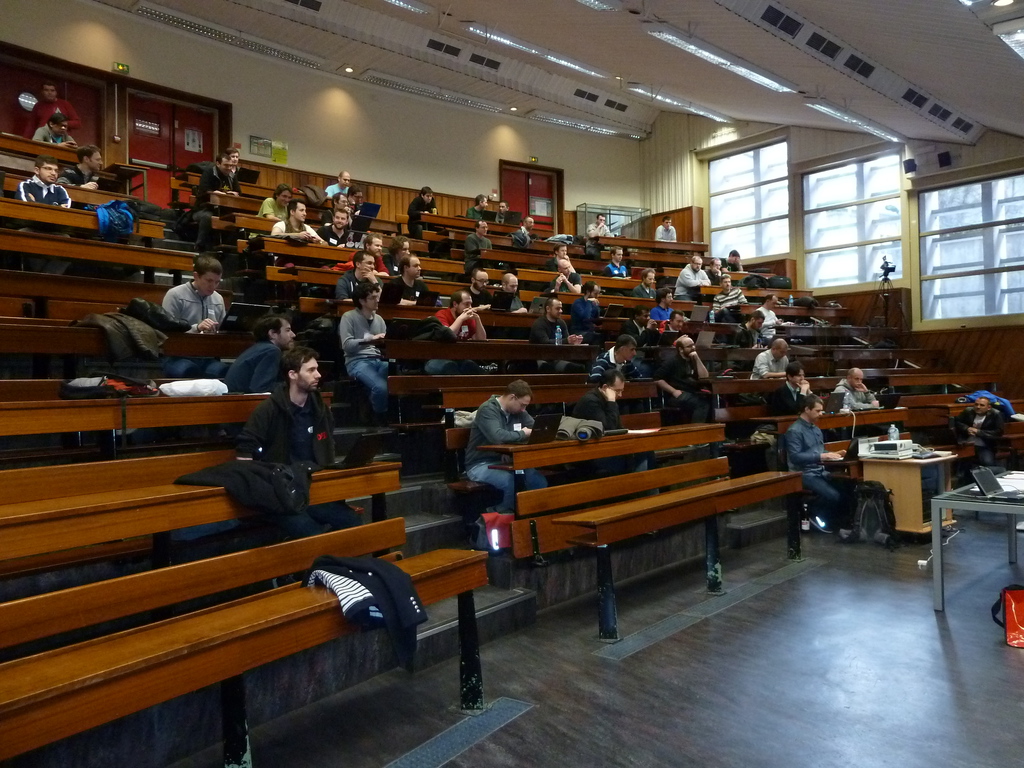
Assembl e g n rale 2014 de Debian France

The Debian France members during the general assembly

It s worth noting that the extraordinary assembly was meant primarily to enshrine in our bylaws the possibility to act as a trusted organization for Debian. This status should be officialized by the Debian project leader (Lucas Nussbaum) in the upcoming weeks since we answered satisfactorily to all questions. Our paypal donation form and the accounting tools behind it are ready. Galette packaging and members map. I managed to hand over the package maintenance of galette to Fran ois-R gis Vuillemin. I sponsored all his uploads and we packaged a new plugin that allows to create a map with all the members who accept to share their location. The idea was to let people meet each other when they don t live far away with the long term goal to have Debian France organized activities not only in Paris but everywhere in France. New contributor game. Last but not least, I organized a game to encourage people to do their first contribution to Debian by offering them a copy of my book if they managed to complete a small Debian project. We got many interesting projects but the result so far seem to be very mixed. Many people did not complete their project (yet) that said for the few that did substantial work, it was rather good and they seem to be interested to continue to contribute. Debian France booth at Solutions Linux in Paris. Like each year, I spent two days in Paris to help man the Debian France booth at Solutions Linux. We had lots of goodies on sale and we made more than 2000 EUR in earnings during the two days. I also used this opportunity to try to convince companies to support the new Debian LTS effort.
Debian France booth at Solutions Linux

Tanguy Ortolo and Fernando Lagrange behind the Debian France booth

The Debian Administrator s Handbook In the last days of 2013, we released the wheezy update of the book. Then I quickly organized everything needed so that the various translation teams can now focus their efforts on the latest release of the book. Later (in February) I announced the availability of the French and Spanish translations. Debian Squeeze LTS When the security team called for help to try to put in place long term support for Squeeze, I replied positively because I m convinced that it s very important if Debian wants to stay an acceptable choice in big deployments and because I knew that some of my customers would be interested Thus I followed all the discussions (on a semi-private list first and then on debian-lts@lists.debian.org) and contributed my own experience. I have also taken up the responsibility to coordinate with the Debian contributors who can be hired to work on Squeeze LTS so that we have a clear common offer for all the companies who have offered financial support towards Squeeze LTS. Expect further news on this front in the upcoming days/weeks. Tryton I have been a long time user of SQL-Ledger to manage the accounting of my company Freexian. But while the license is free software, the project is not. It s the work of a single developer who doesn t really accept help. I have thus been considering to move to something else for a long time but never did anything. This year, after some rough evaluation, I decided to switch to Tryton for my company. It s probably not a wise choice from a business perspective because that migration took me many hours of unpaid labor but from a free software perspective it s definitely better than everything else I saw. I contributed a lot of bug reports and a few patches already (#3596, #3631, #3633, #3665, #3667, #3694, #3695, #3696, #3697) mainly about problems found in the French chart of accounts but also about missing features for my use case. I also accepted to sponsor Matthias Berhle, who is maintaining the official Debian packages of Tryton. He s already a Debian maintainer so it s mainly a matter of reviewing new source packages and granting him the required rights. Misc Debian work Thanks See you next month for a new summary of my activities.

2 comments Liked this article? Click here. My blog is Flattr-enabled.

Francesca Ciceri: 100 bugs triaged: achievement unlocked

After two weeks working as OPW intern for Mozilla, it's time for a recap!
What exactly I've been doing in these two weeks? 100 bugs triaged: achievement unlocked! Yes, this is the thing I'm most proud of. I'm a bit cheating here, as strictly speaking, since the beginning of the internship I've triaged only 44 bugs.
But I've decided to count from the beginning of my activity on bugzilla, at the end of March, since I've started work on that as part of the small contribution required for applying to OPW.
Therefore, it's all OPW related :) Here's the grand total. Right now, I've decided to work on an average of 5 bugs a day: it's mostly triage and/or verification, which is quite fun.
It consists in trying to have a more complete and detailed bug report for the developers: asking the right questions to the reporter, ensuring that the bug is filed against the right product or component and all the information about platforms and version are correct. Or verifying that the bug isn't a duplicate, which involves doing some voodoo with Bugzilla quicksearch (I'm not so good with that yet, mostly because I'm not imaginative enough in the queries... but I'm getting better!) Sometimes triaging means reading lots of documentation (to be sure that something is a bug and not a feature) and checking meta-bugs and release notes to be able to pinpoint the time when something was introduced and the reasoning behind it.
That takes a lot of time, but it makes you discover some funny things, like the Mighty Bouncing Unicorn. And while I know it sounds a bit cruel, it's really good when you're verifying a fix and you find it's not totally ok, or that it triggered another bug.
I've been assured that feeling satisfied after that it's an essential part of the sadistic QA work. Writing FAQs for new triager This started as a personal project even before knowing I've been selected for OPW, and it's now part of my internship: I've been writing a first draft of FAQ for those who approach for the first time the Bug Triaging and Verifying work in Mozilla. It meant taking a whole lot of IRC logs and scan them for the most asked questions during bugdays, and you can find here my first draft. I'll send a RFC today about it on dev-quality mailing list and link it to the main Bugdays page. Lessons learned So, what I've learned in these two weeks? That I'm pretty good at figuring things alone, but I like to have feedback on what I'm working on.
That testing things is an art, and perfectionism is a big plus.
That there are such things as stupid questions, but you have to ask them nonetheless.
That people in the Mozilla community are quite friendly and not scary at all. Not even in video! :) Wishlist I've been thinking about this a lot, and I think I'd like to have They will probably become my next pet project.

Ean Schuessler: Singing tiny robotic Einstein head

Tiny Robot Einstein Head

Work on the ROS/Blender robotics control pipeline has culminated in the integration of the system with the tiny robotic Einstein head that had been living at Polytechnic University under the watchful eye of the OpenCog group. Back at Hanson Robotics, tiny Einstein was mercilessly ripped apart and his head attached to an absurdly long robot snake neck apparatus that mimics the configuration of the upcoming Dmitroid robot system. Once suitably mutated, tiny Einstein was able to make a few statements and even sing a couple of tunes.

Enrico Zini: when-i-said-iloveyou

When I said "I love you"
All people ever say is: thank you (a celebration of life) and please (an opportunity to make life more wonderful). Marshall Rosenberg
I have said "I love you" many times in my life, and many times I have failed to say it, because, for me, it is not an easy thing to say. It is not easy when I have no idea what the other person will make of it: will they be frightened? Will they feel awkward around me afterwards? Will they disappear from my life? But do I know what I myself mean when I say it? I have said "I love you" because I thought you somehow expected it of me. "please, consider me worth of you". I have said "I love you" to beg for affection. "please, love me back". I have said "I love you" because I was grateful to you for existing in my life. "thank you". I now understand why it has not been easy for me to say "I love you" when I was feeling, or imagining, that I had to say it. I now understand why I have sometimes made myself awkward, as I was begging. I now understand why, when I said "I love you" out of gratitude, when I said it to celebrate that you exist in my life, that's when I felt no trouble, no fear, and when I felt that my words really were fitting with what I was feeling and what I was wanting to say.

1 June 2014

Antonio Terceiro: An introduction to the Debian Continuous Integration project

Debian is a big system. At the time of writing, looking at my local package list caches tells me that the unstable suite contains 21306 source packages, and 42867 binary packages on amd64. Between these 42867 binary packages, there is an unthinkable number of inter-package dependencies. For example the dependency graph of the ruby packages contains other 20-something packages. A new version of any of these packages can potentially break some functionality in the ruby package. And that dependency graph is very small. Looking at the dependency graph for, say, the rails package will make your eyes bleed. I tried it here, and GraphViz needed a PNG image with 7653 10003 pixels to draw it. It ain t pretty. Installing rails on a clean Debian system will pull in another 109 packages as part of the dependency chain. Again, as new versions of those packages are uploaded the archive, there is a probability that a backwards-incompatible change, or even a bug fix which was being worked around, might make some funcionality in rails stop working. Even if that probability is low for each package in the dependency chain, with enough packages the probability of any of them causing problems for rails is quite high. And still the rails dependency chain is not that big. libreoffice will pull in another 264 packages. gnome will pull in 1311 dependencies, and kde-full 1320 (!). With a system this big, problems will arrive, and that s a fact of life. As developers, what we can do is try to spot these problems as early as possible, and fixing them in time to make a solid release with the high quality Debian is known for. While automated testing is not the proverbial Silver Bullet of Software Engineering, it is an effective way of finding regressions. Back in 2006, Ian Jackson started the development of autopkgtest as a tool to test Debian packages in their installed form (as opposed to testing packages using their source tree). In 2011, the autopkgtest test suite format was proposed as a standard for the Debian project, in what we now know as the DEP-8 specification. Since then, some maintainers such as myself started experimenting with DEP-8 tests in their packages. There was an expectation in the air that someday, someone would run those tests for the entire archive, and that would be a precious source of QA information. Durign the holiday break last year, I decided to give it a shot. I initially called the codebase dep8. Later I renamed it to debci, since it could potentially also run other other types of test suites in the future. Since early January, ci.debian.net run an instance of debci for the Debian Project. The Debian continuous Integration will trigger tests at most 4 times a day, 3 hours after each dinstall run. It will update a local APT cache and look for packages that declare a DEP-8 test suite. Each package with a test suite will then have its test suite executed if there was any change in its dependency chain since the last test run. Existing test results are published at ci.debian.net every hour, and at the end of each batch a global status is updated. Maintainers can subscribe to a per package Atom feed to keep up with their package test results. People interested in the overall status can subscribe to a global Atom feed of events. Since the introduction of Debian CI in mid-January 2014, we have seen an amazing increase in the number of packages with test suites. We had little less than 200 packages with test suites back then, against around 350 now (early June 2014). The ratio of packages passing passing their test suite has also improved a lot, going from less than 50% to more than 75%. There is documentation available, including a FAQ for package maintainers with further information about how the system works, how to declare test suites in their packages and how to reproduce test runs locally. Also available is development information about debci itself, to those inclined to help improve the system. This is just the beginning. debci is under a good rate of development, and you can expect to see a constant flux of improvements. In special, I would like to mention a few people who are giving amazing contributions to the project:

Russ Allbery: Spring haul post

Sorry about the lack of posting recently. Work has been rather problematic, and also very distracting, and on my time away from work I've been relaxing rather than writing. Didn't even get reviews written while on vacation. I am still hoping to catch up on reviews, however. In the meantime, I have been reading some, and buying more books. Here's a new haul list. Elizabeth Bear Steles of the Sky (sff)
Katherine Boo Behind the Beautiful Forevers (non-fiction)
John Chu The Water That Falls on You from Nowhere (sff)
Lewis Dartnell The Knowledge (non-fiction)
David Lochbaum, et al. Fukushima (non-fiction)
Ben Goldacre Bad Pharma (non-fiction)
Mira Grant Parasite (sff)
Thomas Olde Heuvelt The Ink Readers of Doi Saket (sff)
Mary Robinette Kowal The Lady Astronaut of Mars (sff)
Madeline Miller The Song of Achilles (historical)
Edmund S. Morgan American Slavery, American Freedom (non-fiction)
Richard Rhodes The Making of the Atomic Bomb (non-fiction)
Lee Smolin The Trouble with Physics (non-fiction)
Charles Stross Equoid (sff)
Charles Stross Neptune's Brood (sff) This is a bit of a grab-bag, including a variety of non-fiction that I had recommended to me by various people. I also picked up the remaining Hugo nominees for best novel that won't be in the voter packet, and the short fiction from Tor.com that was nominated and was available for free from Amazon for the Kindle. I read The Knowledge while I was on vacation, and it's in my large backlog of pending reviews.

31 May 2014

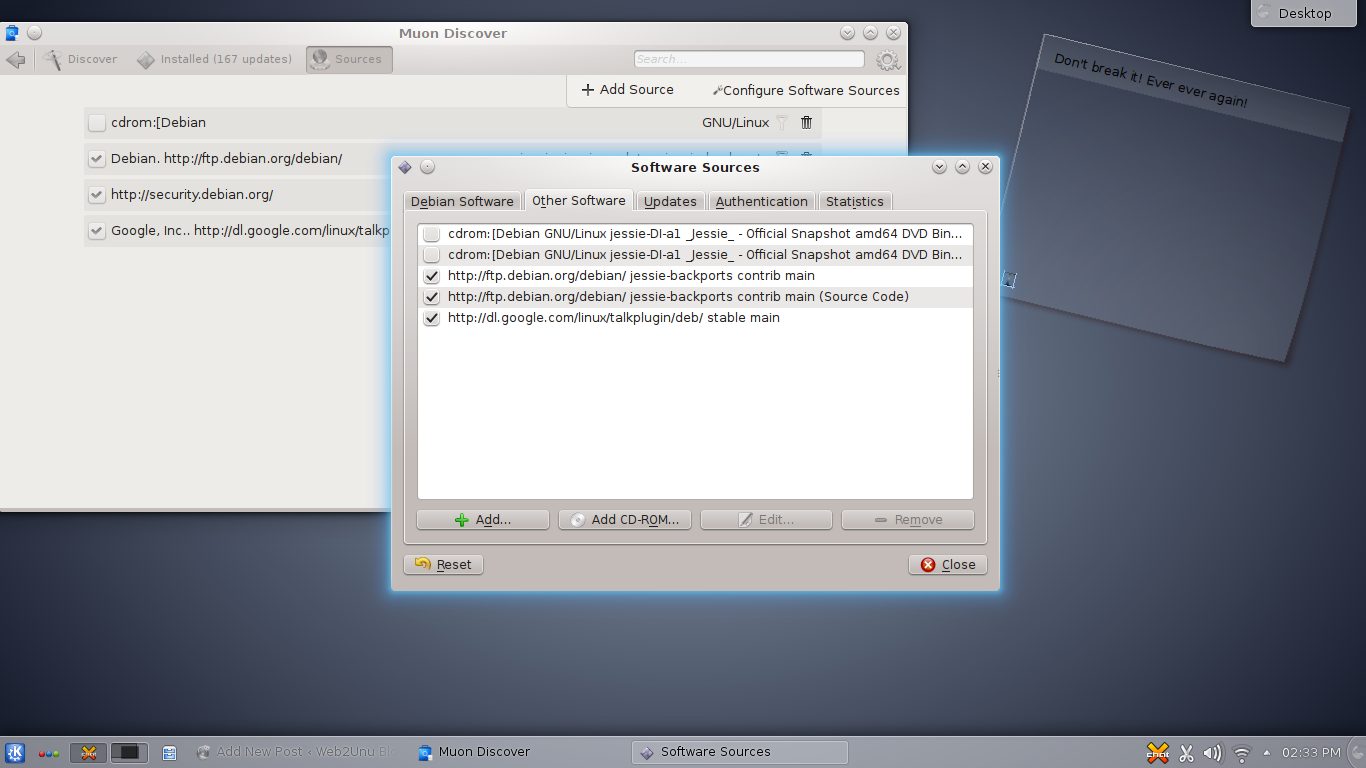
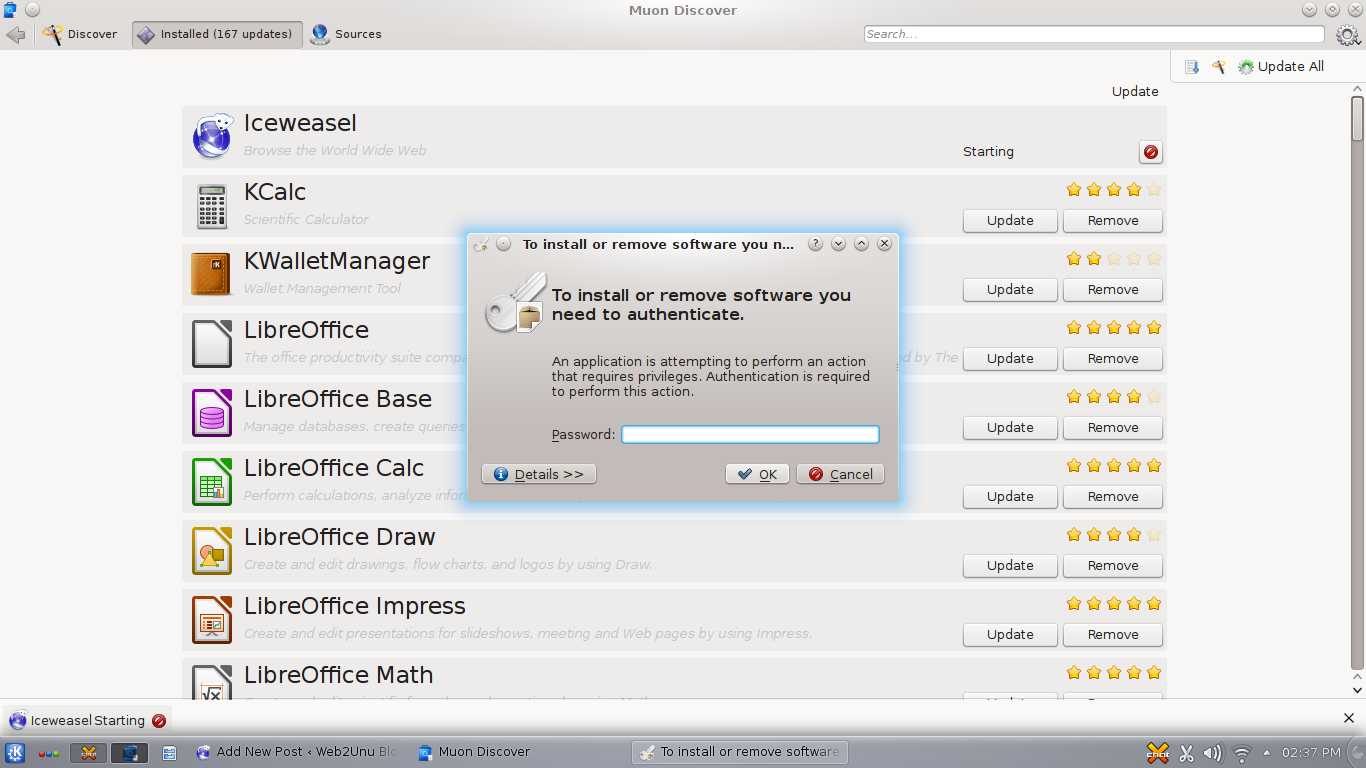
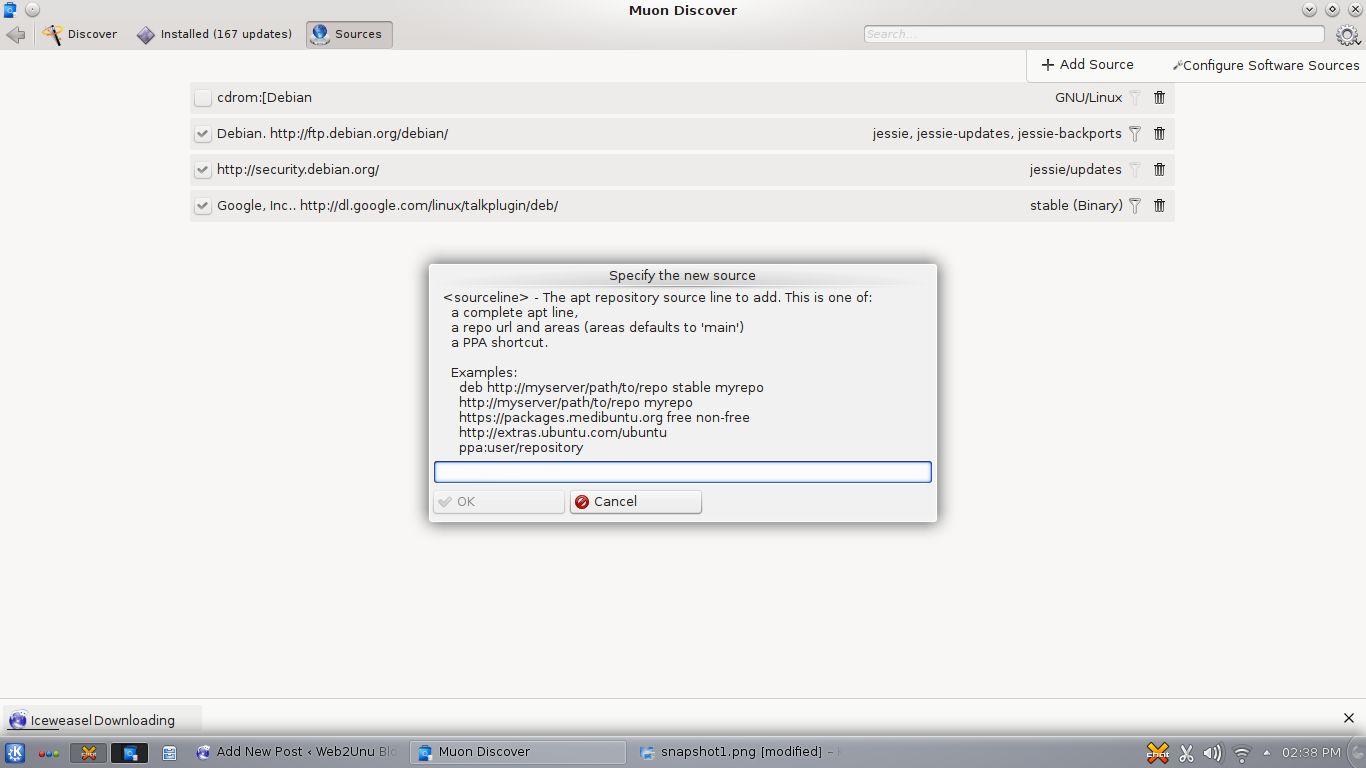
Floris Stoica-Marcu: GSoC2014 Muon and sudo [Week2]

Hello, This has been a terrific week and a real learning experience for me. I finished packaging both Muon and QApt for Debian; my first two real debian packages, with very different packaging styles! Sune (svuorela), Maximiliano (maxy) and others helped me allot to understand the tools and I thank them very much for their support. While the first part of this second week was all about trying to make a solid package, the second part was me figuring out Policykit and KAuth in order for us to let go (as much as possible) of Kdesudo. I have managed to do a complete turnaround from kdesudo through policykit and now I am working on making an add-repo helper in C++/Qt using KAuth to keep it in line with QApt, in order to have a more uniform codebase. Big thanks to Aleix (apol) that guided me through the different uses of policykit and Kauth. To keep it short, policykit will not be used directly except QApt, in every other case we ll use KAuth. I m very close to finishing the KAuth add-repo helper and that will add improved functionality, as it extends well in what I will be doing next: renouncing specific backend support; The helper will manage how backends add/remove repos, meaning that if you use PackageKit you will no longer be tied to Apt if you want to use Muon! Here is a screenshot of the configure-software button in muon-discovery (finally) working on Debian and launching software-properties-kde:
Muon Software properties And below are some screens of Muon in the wild, running on Debian:
Auth required through policykit

Auth required through policykit

Adding Sources

Adding Sources

I hope you enjoyed this update and stay tuned for the debian package which is currently under review. Floris.

30 May 2014

Steve Kemp: Sometimes reading code makes you scream.

So I've recently been looking at proxy-server source code, for obvious reasons. The starting point was a simple search of the available options:
~$ apt-cache search proxy filter
...
trafficserver - fast, scalable and extensible HTTP/1.1 compliant caching proxy server
ssh-agent-filter - filtering proxy for ssh-agent
Hrm? trafficserver? That sounds like fun. Lets look at the source.
cd /tmp
apt-get source trafficserver
Lots of code, but scanning it quickly with my favourite tool, grep, we find this "gem":
$ rgrep /tmp .
./mgmt/tools/SysAPI.cc:  tmp = fopen("/tmp/shadow", "w");
./mgmt/tools/SysAPI.cc:    system("/bin/mv -f /tmp/shadow /etc/shadow");
Is that really what it looks like? Really? Sadly yes. There's lots of abuse of /tmpfiles in the code in mgmt/tools/, and although the modular structure took a while to understand the code that is compiled here ultimately ends up being included in /usr/bin/traffic_shell. That means it is a "real" security issue, allowing race-tastic local-attackers to do bad things. Bug reported as #749846. In happier news, the desk I was building is now complete. Pretty.
I feel like I should write about auditing software, but equally I feel unqualified - better people than me have already done so, e.g. David Wheeler. Also I've done it before, and nobody paid attention. (Or rather the poeple that should consider security frequently fail to do so, which is .. frustrating.)

Julien Danjou: OpenStack Design Summit Juno, from a Ceilometer point of view

Last week was the OpenStack Design Summit in Atlanta, GA where we, developers, discussed and designed the new OpenStack release (Juno) coming up. I've been there mainly to discuss Ceilometer upcoming developments. The summit has been great. It was my third OpenStack design summit, and the first one not being a PTL, meaning it was a largely more relaxed summit for me! On Monday, we started by a 2.5 hours meeting with Ceilometer core developers and contributors about the Gnocchi experimental project that I've started a few weeks ago. It was a great and productive afternoon, and allowed me to introduce and cover this topic extensively, something that would not have been possible in the allocated session we had later in the week. Ceilometer had his design sessions running mainly during Wednesday. We noted a lot of things and commented during the sessions in our Etherpads instances. Here is a short summary of the sessions I've attended. Scaling the central agent I was in charge of the first session, and introduced the work that was done so far in the scaling of the central agent. Six months ago, during the Havana summit, I proposed to scale the central agent by distributing the tasks among several node, using a library to handle the group membership aspect of it. That led to the creation of the tooz library that we worked on at eNovance during the last 6 months. Now that we have this foundation available, Cyril Roelandt started to replace the Ceilometer alarming job repartition code by Taskflow and Tooz. Starting with the central agent is simpler and will be a first proof of concept to be used by the central agent then. We plan to get this merged for Juno. For the central agent, the same work needs to be done, but since it's a bit more complicated, it will be done after the alarming evaluators are converted. Test strategy The next session discussed the test strategy and how we could improve Ceilometer unit and functional testing. There is a lot in this area to be done, and this is going to be one of the main focus of the team in the upcoming weeks. Having Tempest tests run was a goal for Havana, and even if we made a lot of progress, we're still no there yet. Complex queries and per-user/project data collection This session, led by Ildik V ncsa, was about adding finer-grained configuration into the pipeline configuration to allow per-user and per-project data retrieval. This was not really controversial, though how to implement this exactly is still to be discussed, but the idea was well received. The other part of the session was about adding more in the complex queries feature provided by the v2 API. Rethinking Ceilometer as a Time-Series-as-a-Service This was my main session, the reason we met on Monday for a few hours, and one of the most promising session I hope of the week. It appears that the way Ceilometer designed its API and storage backends a long time ago is now a problem to scale the data storage. Also, the events API we introduced in the last release partially overlaps some of the functionality provided by the samples API that causes us scaling troubles. Therefore, I've started to rethink the Ceilometer API by building it as a time series read/write service, letting the audit part of our previous sample API to the event subsystem. After a few researches and experiments, I've designed a new project called Gnocchi, which provides exactly that functionality in a hopefully scalable way. Gnocchi is split in two parts: a time series API and its driver, and a resource indexing API with its own driver. Having two distinct driver sets allows it to use different technologies to store each data type in the best storage engine possible. The canonical driver for time series handling is based on Pandas and Swift. The canonical resource indexer driver is based on SQLAlchemy. The idea and project was well received and looked pretty exciting to most people. Our hope is to design a version 3 of the Ceilometer API around Gnocchi at some point during the Juno cycle, and have it ready as some sort of preview for the final release. Revisiting the Ceilometer data model This session led by Alexei Kornienko, kind of echoed the previous session, as it clearly also tried to address the Ceilometer scalability issue, but in a different way. Anyway, the SQL driver limitations have been discussed and Mehdi Abaakouk implemented some of the suggestions during the week, so we should very soon see more performances in Ceilometer with the current default storage driver. Ceilometer devops session We organized this session to get feedbacks from the devops community about deploying Ceilometer. It was very interesting, and the list of things we could improve is long, and I think will help us to drive our future efforts. SNMP inspectors This session, led by Lianhao Lu, discussed various details of the future of SNMP support in Ceilometer. Alarm and logs improvements This mixed session, led by Nejc Saje and Gordon Chung, was about possible improvements on the alarm evaluation system provided by Ceilometer, and making logging in Ceilometer more effective. Both half-sessions were interesting and led to several ideas on how to improve both systems. Conclusion Considering the current QA problems with Ceilometer, Eoghan Glynn, the new Project Technical Leader for Ceilometer, clearly indicated that this will be the main focus of the release cycle. Personally, I will be focused on working on Gnocchi, and will likely be joined by others in the next weeks. Our idea is to develop a complete solution with a high velocity in the next weeks, and then works on its integration with Ceilometer itself.

28 May 2014

John Goerzen: Review: The Wheel of Time

Five years ago, I opened The Eye of the World, the first book in the Wheel of Time series, and read:
Lord of the Morning, he said, I have come for you.

On the island, the air shimmered and coalesced. The black-clad man stood staring at the fiery mountain rising out of the plain. His face twisted in rage and contempt. You cannot escape so easily, Dragon. It is not done between us. It will not be done until the end of time. Then he was gone, and the mountain and the island stood alone. Waiting.
And then, as often, Robert Jordan began books citing some of the prophecy he invented:
And it came to pass in those days, as it had come before and would come again, that the Dark lay heavy on the land and weighed down the hearts of men, and the green things failed, and hope died. And men cried out to the Creator, saying, O Light of the Heavens, Light of the World, let the Promised One be born of the mountain, according to the prophecies, as he was in ages past and will be in ages to come. Let the Prince of the Morning sing to the land that green things will grow and the valleys give forth lambs. Let the arm of the Lord of the Dawn shelter us from the Dark, and the great sword of justice defend us. Let the Dragon ride again on the winds of time. from Charal Drianaan to Calamon,
The Cycle of the Dragon.
Author unknown, the Fourth Age
And then, the grand opening to each of the books in the 11,000-page series, something like this:
The Wheel of Time turns, and Ages come and pass, leaving memories that become legend. Legend fades to myth, and even myth is long forgotten when the Age that gave it birth comes again. In one Age, called the Third Age by some, an Age yet to come, an Age long past, a wind rose in the Mountains of Mist. The wind was not the beginning. There are neither beginnings nor endings to the turning of the Wheel of Time. But it was a beginning. Born below the ever cloud-capped peaks that gave the mountains their name, the wind blew east, out across the Sand Hills, once the shore of a great ocean, before the Breaking of the World. Down it flailed into the Two Rivers, into the tangled forest called the Westwood, and beat at two men walking with a cart and horse down the rock-strewn track called the Quarry Road.
And yesterday, 11,000 pages later, I have completed the series. Really, how could I have put down a book with such a majestic beginning as that? It hinted at the epic that was to come, the amazing literature I was going to read. I didn t read it straight through; I enjoyed books like War and Peace along the way. But what a trip the Wheel of Time series was. The characters were so detailed, so deep, the setting so elaborate, the plots so grand and also so small everyone from servants to queens were well-represented in the books. Not every section was a page-turner; in fact, around the 4th or 5th book, the series started to plod for a thousand pages or two, reading more like a history book than a novel. Sometimes the prejudices and stereotypes of the characters, particularly the sexism that both the men and women displayed, were frustrating to read. I never quite figured out of this was brilliant writing (making the reader feel frustrated at the plodding pace of the book when it was describing characters being frustrated at the plodding pace of events), or if it could have been trimmed down by 2/3 in some places. But really, the number of brilliant endings, laugh-out-loud situations, and page-turning suspense that somehow managed to build over hundreds, and then even thousands of pages, outweighed the flaws.
Politics is a foggy mire full of snakes. - The Eye of the World
Ah. Furlan washed his hands in one direction, then rubbed them in the other. Ah. Forgive me, Master Andra, but Lady Alys is a fierce sounding woman. Only with those who displease her, Lan said blandly. Her bite is far worse than her bark. Ah. Ah. Ah. Your rooms are this way. . . - The Dragon Reborn
One of the marks of truly good writing is that I leave a book or series with a sense of sadness or nostalgia, leaving characters that seem almost like friends. I felt that after finishing the last book in the series, A Memory of Light. The ending was deep, and satisfying, but ultimately left me wanting even more even more than 11,000 pages, somehow.
Elienda and Briain woke from the dream. She might have been speaking of the weather rather than two deaths among women she knew. We all must wake eventually. - Knife of Dreams
I was often touched by the way the Aiel referred to each other. A desert people, their fond farewall was may you always find water and shade. A fitting metaphor for anyone s life, I think. And they referred to their spouse as shade of my heart. Jordan touched on quite a few themes of religion and philosophy. In that quote above, he has the Aiel referring to death as waking from a dream. An intriguing metaphor, isn t it? He even writes conflicts of philosophy, religion, and culture into the series. I was particularly impressed with his treatment of theodicy and the problem of evil (the argument and religious response relating to the presence of evil in the world in the face of a loving God.) It is the most impressive treatment I have seen in fiction, and does a better job of advancing the theodistic argument than many philosophers have, I suspect. It is hard to really go into that one here because of the length and potential for spoilers. I can, however, comment on his treatment of existential nihilism the theory that life and the universe is without meaning, and the sometimes-related comment that what does anything matter then anyway? Here are a couple of quotes:
In Maradon, I saw what had been done to men who followed me. I saw Light in them, Min. Defying the Dark One no matter the length of his shadow. We will live, that defiance said. We will love and we will hope. And I saw him trying so hard to destroy that. He knows that if he could break them, it would mean something. Something much more than Maradon. Breaking the spirit of men he thirsts for that. He struck far harder than he otherwise would have because he wanted to break my spirit. His voice grew softer and he opened his eyes, looking down at her. And so I stood against him. - Towers of Midnight
What if I think it s all meaningless? he demanded with the loud voice of a king. What if I don t want it to keep turning? We live our lives by the blood of others! And those others become forgotten. What good is it if everything we know will fade? Great deeds or great tragedies, neither means anything! They will become legends, then those legends will be forgotten, then it will all start over again!

Why? Rand thought with wonder. Because each time we live, we get to love again.

It felt relaxing to stare out at that distant light, so welcoming and noble. Storms will soon come, it seemed to say. But for now, I am here. I am here. - The Gathering Storm
I unfortunately can t put in in its proper context due to spoilers, but it is a pivotal turning point in the series, relating to the preservation of the world. By giving what we might normally call a characteristic or behavior evil an almost-human voice and character, it can be discussed in interesting ways.
We are always more afraid than we wish to be, but we can always be braver than we expect. Hold on to your heart, and the Aes Sedai cannot harm what is really you, your heart. They are not nearly so far above us as we believed. May you always find water and shade, Egwene. And always remember your heart. - Lord of Chaos
Eben is dead. Would you want to forget your pain if you lost that hulking giant of yours? Have your feelings for him cut away like some spoiled chunk of flesh in an otherwise good roast? - The Gathering Storm
These quotes are examples of characters in the series dealing with difficult situations. In one, a character is yelled at for offering to use her special powers to numb the pain of another person over a death. It brings up a question that those of us that have known pain might find interesting: would we really have wanted our pain erased? And suggests perhaps not. That there is a benefit to it. That we get through it by embracing it by embracing it while still being true to our heart.
He had four rules concerning action and information. Never make a plan without knowing as much as you can of the enemy. Never be afraid to change your plans when you receive new information. Never believe you know everything. And never wait to know everything. - Lord of Chaos
Sometimes the series treats us to logical thinkers, whether they are generals or innkeepers, and gives us little tidbits like this one.
Androl brushed off his hands, smiling. Children were so adaptable. Before them, centuries of tradition, terror and superstition could melt away like butter left too long in the sun. - Towers of Midnight
And sometimes, things to chew over. Isn t that an interesting comment on prejudice? Children aren t born prejudiced; we can see how easily they make friends with anyone. It is sad that we teach them to be, isn t it? Wheel of Time is a fine story, expertly woven. But it is not just a story. It is true, in the sense that it illuminates truths, just like Romeo and Juliet can. In it, I see lessons and echoes of the civil rights era, comments on what makes good leaders, characters wrestling with decisions without adequate data, people putting on a mask of emotions, sacrifice, and the overall theme of the entire series: the power of love and compassion. The inspiration of the series for me well, it is there, but it may take a few more days to figure it out. I think it has something to do with this: The wind rose high and free, to soar in an open sky with no clouds.

27 May 2014

Jon Dowland: Nine Inch Nails, Manchester, 2014

I spent the bank holiday weekend mostly in Manchester with my brother and a couple of friends, mostly to see Nine Inch Nails perform, but also to enjoy the pleasures of the city.

the Marble Arch's ceiling the Marble Arch's ceiling
We arrived on the Sunday and after checking in headed out to get some food. I'd booked us a table at the historic Marble Arch - the pub which gives its name to the parent company Marble Beers - and produce my most favourite ales. Whenever a Marble beer ends up as a guest at one of the Newcastle real ale pubs a friend of mine (who is much more on top of this stuff than I am) lets me know and we stop off for a few. Invariably there's a crowd of a dozen or so Manchester expats in bar when we do. I reserved our table over twitter, which is a bit of a novelty for me. My two friends are ale skeptics but - due to lack of choice - we all ended up sampling the Chocolate Marble and the Ginger 5.1, which went down a storm. They are possibly converts now. There was an Earl Grey IPA too, which was nice but a bit on the strong side for sessioning.
copyright   Jonathan Dowland 2014, http://creativecommons.org/licenses/by/4.0/ click for the animated version
The gig was great - I prefer club gigs to arena gigs but the sound techs for NIN know what they are doing and the mix was great. The visuals were stunning too. Highlights for me were "The Great Destroyer" - in particular the extended, improvised 5 minute glitch-meltdown coda; the slow build of "Eraser" and "The Day The World Went Away" - played faithfully to the CD mix rather than the traditional extended live arrangement. I miss the former live arrangement, which includes a drawn out drum-backed finish, but this arrangement had a lot of force, with all four of the band bashing guitars into a pummelling wall of sound. I've heard that at least one person has taped the show and it turns out recordings have just recently surfaced for the two club gigs my brother and I attended back in 2005 and 2007 - meaning there are now widely available, high quality ROIO copies for every NIN gig I've ever been to. Afterwards we tried to find a decent club. Manchester is a lot larger than my native city and there's plenty of places to go, if you know where they are. We had originally planned to visit The Factory on Charles Street, but we didn't believe it was open on the Sunday. The Factory is Peter Hook's (formerly of Joy Division/New Order) club - occupying the former office spaces of Factory records. I've chanced in there once before as it's right across the road from the Lass O' Gowrie pub, which is the haunt of choice for HE/tech people whenever we're in Manchester for conferences.
cheesy cocktail names cheesy cocktail names
Instead we gravitated towards Dry Bar on Oldham street. By coincidence this place also has historic ties to Factory Records. However the doormen wouldn't let us in! Finally we landed at a place which had one name on the door and a different name on the inside (Jack's). Like the aformentioned Lass O' Gowrie and perhaps half of all pubs and clubs in Manchester, the place is decked out as a shrine to the former musical giants of the City, with framed pictures of Mark E Smith, the Ha ienda again, the Stone Roses in their boy-band-looks hay day, John Peel (champion of many of them) and of course Tony Wilson. I can't help but wonder whether people who live here get royally sick of that. This place served some delicious albeit clich -titled Cocktails and played a pretty good set - the obligatory Madchester throwback interlude was followed by a chunk of Northern Soul and a couple of early Rap classics. Setlist wise it was pretty much identical to that of Foundation in Newcastle, 12 years ago, no doubt because Foundation was cribbing heavily from the Ha ienda in the first place.
Record haul Record haul
Monday was dedicated to exploring and shopping. Top of my list of places to go was my pilgrimage venue Vinyl Exchange. Whilst waiting for it to open we rolled around in Affleck's Palace, which turned out to have a small record stall within. After Vinyl Exchange we chanced across another record store right across the road - Picadilly Records - which happens to be larger and focuses more on new releases. It didn't take long before we found another small, DIY record shop, then another. We tried out the Fopp branch here - more Vinyl; then Urban Outfitters - more; then an Oxfam branch - even more. I actually got Vinyl snow blind at this point. I've been controlling myself admirably and only picked up a couple of bits and pieces. My best find was Fad Gadget's sophmore album "Incontinent".

Next.

Previous.